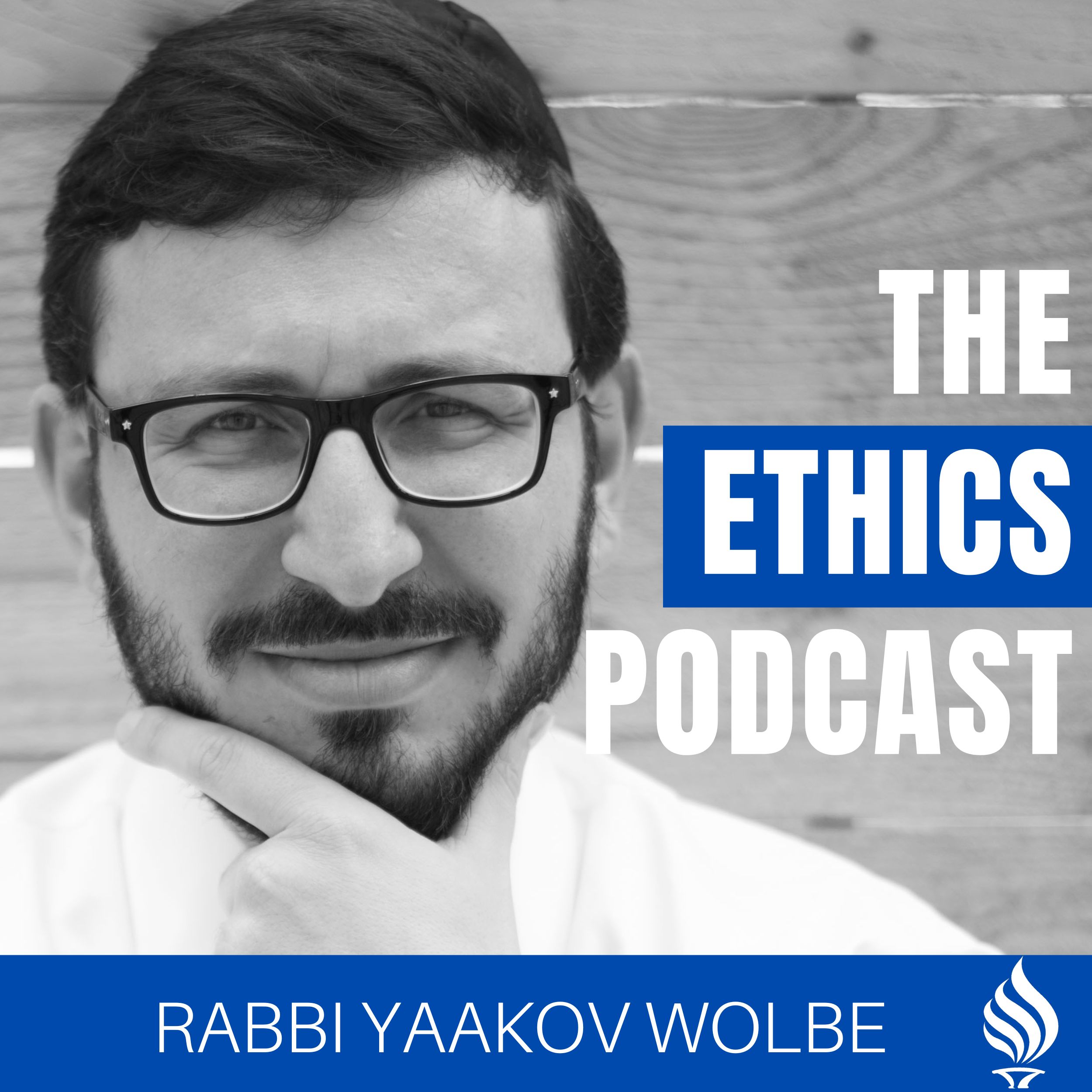
The Ethics Podcast - With Rabbi Yaakov Wolbe
321 episodes — Page 4 of 7
How to be a Peacemaker (1:11-12)
One of the great legendary figures in Jewish history, Hillel, instructs us to follow the ways of Aaron: To love peace and to pursue it, and to love people and bring them near to Torah. This Ethics Podcast was originally released on the Ethics Podcast on Jan 15, 2018 – – – – – – […]
The Two Elements of Leadership (1:10)
In the tenth Mishna, the leader of the Jews Shemayah, a descendent of the Assyrian king Sanchereb, teaches us about the work, leadership and politicians. This Ethics Podcast was originally released on the Ethics Podcast on Jan 8, 2018 – – – – – – – – – – – – – – – – […]
Ethical Judicial Conduct (1:8-1:9)
In the Second Century before the Common Era, the Jewish world was in an upheaval due largely to various splinter sects, such as the Sadducees and Boethusians, causing internal conflict and confusion among the nation. The two great leaders of the Jews at the time had many challenges on their hands. In this podcast we tell […]
Avoiding Bad Neighbors (1:7)
In the previous mishna we are instructed how to choose positive influences, in this one we are warned of the perils of bad friends and bad neighbors. This Ethics Podcast was originally released on the Ethics Podcast on Dec 4, 2017 – – – – – – – – – – – – – – – […]
Selecting Mentors (1:6)
In the 6th mishna of Pirkei Avos, we learn about the importance of having good mentors and friends, and the prerequisites to make such relationships work. This Ethics Podcast was originally released on the Ethics Podcast on Nov 27, 2017 – – – – – – – – – – – – – – – […]
Excessive Schmoozing with Women (1:5)
In the fifth mishna we learn about the proper ways to interact with others, especially those less fortunate, in a pious and peril-free manner. This Ethics Podcast was originally released on the Ethics Podcast on Nov 20, 2017 – – – – – – – – – – – – – – – – – […]
Godly Intellect (1:4)
In the fourth mishna of Pirkei Avos, our sages offer three steps to accessing Torah. In our deconstruction of this teaching we learn about the nature of Torah and the unusual ways that we access it. This Ethics Podcast was originally released on the Ethics Podcast on Nov 13, 2017 – – – – – – […]
Fostering Lasting Relationships (1:3)
In following the previous mishna which distilled the life objectives to three tenets, Pirkei Avos proceeds to delve into each one individually. In perhaps the most difficult mishna of the book, Antigonus lays out how to fulfill “Avodah” properly. In this teaching we read a take on altruism and how to create deep, meaningful and […]
Three-Pronged Purpose (1.2)
The second Mishna in Pirkei Avos features a powerful teaching from one of the pivotal and legendary characters in Jewish History. Shimon HaTzadik (Simeon the Righteous), the Kohen Gadol who succeeded Ezra, enlightens us by teaching us that the world stands on three things, Torah, worship of God, and loving-kindness. What are these three things […]
New 2025 Initiative: The Book of Ethics (1.1)
The first mishna of Pirkei Avos begins with attributing the first 900 years of the line of transmission of the Torah from Moshe at Sinai until the Men of the Great Assembly. The second sections is three teachings of those great men. What is the connection between these two parts and why was this chosen […]
Ethics Podcast Conclusion Message
Speech at celebratory lunch at Genesis Steakhouse in Houston, TX to mark the completion of the Book Ethics and the Ethics Podcast. – – – – – – – – – – – – – – – – – – – – – – DONATE to TORCH: Please consider supporting the podcasts by making a donation […]
Purpose of Creation (6:11)
With endless praise to the Almighty for all goodness that he has done for us, we hereby present the final episode of the Ethics podcast. We began this project 7 years ago and now, thanks to the boundless help from the Almighty, we have finally finished this grand initiative May the Almighty continue to give […]
God’s Cherished Possessions (6:10)
God owns everything. He created everything and owns it all. But there are some things that God cherishes above others. Our Mishnah describes five cherished possessions of God. These five are uniquely beloved by Him. They are what He “acquired.” – – – – – – – – – – – – – – – […]
Place of Torah (6.9)
There are only three rules of real estate: location, location, location. When it comes to choosing a place to live, the same principle applies. But what determines a good location? In this very interesting Mishnah we learn about the absolute imperative of living in a place of Torah. – – – – – – – […]
Double-Edged Swords (6.8)
Not everything that we covet in life necessarily redounds to our benefit. There are great many things that are double-edge swords: they can be used for good; they can accelerate our ascent to righteousness, and they can be absolutely destructive and lead us towards a death spiral of decadence. Proceed with caution. – – – […]
The Life-Giving Property of Torah (6:7)
The thing that we crave more than anything else is life. We all want life. We all flee from curtailing of – or danger to – our life. How do we indeed get life? In this wonderful Mishnah we learn how Torah bestows life – both here and in the afterlife – upon those who […]
Proper Attribution (6.6.48)
When we hear something beautiful, something genius, something powerful, we may be tempted to pass it off as our own. In the final installment of the 48 ways to wisdom we learn about the imperative of proper attribution: saying something in the name of its originator. – – – – – – – – – […]
Systematic Studying (6.6.47)
The penultimate way to wisdom offered by our sages instructs us to be systematic in our studies. What exactly does this mean? In this very special Ethics Podcast, we offer three different interpretations. Listen carefully if you want to give a boost to your studies and your connection with your Creator. – – – – […]
Sharpening Teachers (6.6.46)
Teachers are usually pretty talented. They’re usually gifted, knowledgeable, intelligent, and well-studied. In way to wisdom # 46 we learn how a student should strive to make their teacher even sharper and wiser. By upgrading our teachers, we ourselves become wiser along the way. – – – – – – – – – – – […]
Studying with Intentionality (6.6.44-45)
What are our intentions when we study? What are we trying to achieve? If we are studying the Almighty’s Torah simply as an exercise in theoretical, abstract learning, we are missing the essence of Torah. In these two ways to wisdom, we learned about the imperative to study with intentionality and the different types of […]
Active Listening (6.6.43)
Listening is a lost art. To truly listen and consider the other person’s position is becoming increasingly rarer. We get consumed with our own ideas and perspectives; someone else’s opposing position will not be granted true consideration. But listening – and listening actively and attentively – is critical if we are desirous of learning and […]
Asking and Answering (6.6.42)
Questions are arguably the most potent tool by which to open up a complex subject. Asking questions on a given matter; asking many, diverse questions, analyzing and probing the issue from all angles, helps open portals of understanding that can deepen your appreciation and your perception of the matter. Our Sages were masters of the […]
Well-Grounded (6.6.41)
What is our relationship with our studies? For some (many?) studying Torah is very important. It is a great priority. But is it the permanent fixture of a person’s life? That designation is applied to the few. In this way to wisdom, we learn about the transformative nature of rendering Torah study the primary focus […]
Truth and Peace (6.6.40)
Truth and peace are often incompatible. A peaceful solution to a problem is often not truthful; unvarnished truth is rarely diplomatic. In way number 40 to acquire wisdom we learn how we must deploy truth and peace in the right manner, in the right fashion, to the right person, at the right time – and […]
Judging Favorably (6.6.39)
Not everyone is a saint. In fact, the verse testifies that there is no righteous person in the land who does only good and never sins. So everyone is a sinner, to one degree or another. How ought we relate to sinners? What do we do when we see people behaving in an inappropriate fashion? […]
Bearing the Burden (6.6.38)
Everyone is going through something. Everyone has difficulties in life. That is the human condition. It is also all by design. But we are instructed to empathize with others in whatever challenge they may be undergoing. We are supposed to help them bear their burden. We are supposed to identify with their pain, validate it, […]
Unenthusiastic Judgment (6.6.37)
There was a need to render halachic rulings. Sometimes there was uncertainty and there’s a need to have a halachic decisor render a ruling. But what is the attitude necessary for a halachic arbiter? In way to wisdom #37 we learned that he is not supposed to be enthusiastic and eager to render rulings. – […]
Swelled Heart (6.6.36)
It is a mark of Torah ignorance to be content with the degree of Torah study that you have. It is broader than the land and deeper than the sea. Torah is effectively infinite. To have a swelled heart – to feel supremely confident in your knowledge – is both foolish and counterproductive. – – […]
Aversion to Honor (6.6.35)
Honor is a funny thing. It yields no tangible, discernible, sensory benefit to the recipient, yet it is so highly coveted and desired. We all want respect. We all want others to look up to us and to admire us. Our standing in the eyes of others matters greatly to us. In way to wisdom […]
Loving Rebuke (6.6.34)
No one likes criticism. To receive criticism is painful. To be told what we did wrong stings. We bristle at the notion that we are flawed and imperfect. The mere knowledge of the existence of our shortcomings causes us discomfort. But receiving criticism is actually highly productive. It’s a good thing. It is very beneficial […]
Loving Straightness (6.6.33)
Straightness is a virtue. Straightness means to be proper and upstanding in all of your conduct. It means doing what’s proper and just and good. It also references thinking. Straight, sensible, logical, clear, cogent thinking is better than crooked thinking. Way number 33 to wisdom is about this virtue. – – – – – – […]
Loving Charities (6.6.32)
Charity is a big element of religious life. Our Sages tell us that the mitzvah of charity equals all the mitzvos of the Torah combined. But monetary charity is only one type of charity. There are many different types of charity, in the love of charities is a means to acquire higher levels of wisdom. […]
Loving Humanity (6.6.31) + TORCH Fundraiser
TORCH Fundraiser — support the Ethics Podcast Our organization, TORCH, does only one fundraiser a year, and that is happening right now at giveTORCH.org. This is a matching campaign and every donation will be DOUBLED. Please support the Ethics Podcast right now at giveTORCH.org The website for the Fundraiser is giveTORCH.org Click and donate to support the Ethics Podcast […]
Loving God (6.6.30) + TORCH Fundraiser
TORCH Fundraiser — support the Ethics Podcast Our organization, TORCH, does only one fundraiser a year, and that is happening right now at giveTORCH.org. This is a matching campaign and every donation will be DOUBLED. Please support the Ethics Podcast right now at giveTORCH.org The website for the Fundraiser is giveTORCH.org Click and donate to support the Ethics Podcast […]
Beloved (6.6.30 Intro)
Torah was not given to angels. Torah was given to humans. One way to expand our ability to acquire Torah is by enhancing our humanity. The more human we are, the more we are a worthy receptacle of Torah. But what does it mean to be a human? – – – – – – – […]
Sense of Mission (6.6.29)
We love Torah. Torah study is our national pastime and obsession. It is enjoyable; it is fun; it is interesting — but to acquire it – we have to now that it is imperative: It is as indispensable as water, oxygen and bread. – – – – – – – – – – – – […]
Making Fences (6.6.28)
Humans are fallible. We are imperfect, yet we are tasked with being the stewards and the guardians of the perfect. We hold the Almighty’s Torah in our hands. We are tasked with perpetuating it from generation to generation and with rendering rulings in line with the will of God. The only way that we can […]
Joyous With Your Lot (6.6.27)
There is an unequal distribution of talents, gifts, abilities, strengths, and weaknesses. Everyone is different. Everyone is their own world. This applies both in the spiritual domain and in the material/physical domain. A believer who understands that the Almighty gives everyone exactly what they need must be joyous with their lot. Your lot is exactly […]
Know Your Place (6.6.26)
The greatest pedagogues of history – the Sages of the Mishnah – codified “knowing your place” as a means to acquire Torah, to acquire wisdom. What exactly is intended with knowing your place? In this Ethics Podcast we share three life-changing approaches. – – – – – – – – – – – – – […]
Accepting Affliction (6.6.25)
Life is full of nuisances. For many – maybe all – life inevitably contains some pain, suffering, and affliction. How we approach these situations is a central element of our religion and theology. Our Sages revealed to us that accepting affliction is a means to achieve wisdom. It is one of the 48 ways to […]
Trust Sages (6.6.24)
Our primary responsibility as humans and as Jews is to develop and deepen our faith in the Creator. Can we have faith in man? Can we have faith in a mortal? In the 24th way to achieve and acquire wisdom, we learn about the concept of having faith in our Sages. What does it mean […]
Good Heart (6.6.23)
Although the study of Torah is ostensibly a cognitive pursuit, there are many qualities that are not cognitive nature that facilitate and enable the study of Torah. In this way to acquire wisdom, way #23, we learn about what it means to have a good heart , and how that serves as a means to […]
Anger Suppression (6.6.22)
Anger is part of the human experience. When things agitate us, we get frustrated and have a tendency to lash out, to berate, to say things that we may regret. In this ethics podcast, we learn about the virtue of being slow to anger and how it can help supercharge our pursuit of wisdom. – […]
Levity (6.6.21)
Life is serious. Pursuit of wisdom is the pursuit of truth. Pursuit of wisdom is the pursuit of understanding the Divine (to the best of our abilities). To access wisdom, we have to be very serious. But a little bit of levity – when done properly and in the right context – can be helpful. […]
Conversation (6:6:20)
We are speaking beings. In fact, the central differentiation between humanity and animals is the capacity of verbal communication. The judgment that we face in Heaven is largely about how we deployed our superpower, our speech. The greatest mitzvos are performed with speech and some of the most grievous transgressions are also a product of […]
Sleep (6.6.19)
We all need to sleep. All humans, irrespective of their intelligence, their physical prowess, their wealth, must lay down in a comatose state for several hours a day and sleep. Sleep is also enjoyable. There’s something seductively delicious about sleep. What is the Torah’s attitude on sleep? Why did the Almighty design us that we […]
Pleasure (6.6.18)
Pursuit of pleasure and avoidance of pain are hardwired impulses . We all want to feel good and to avoid feeling bad. Perhaps surprisingly, the Torah fully embraces this principle. The reason why we were created, we are told, is so that we can become receptacles of pleasure. Our only disagreement with other philosophies is […]
Moderation (6:6:17)
Our resources are finite. We must engage in trade-offs, deciding what pursuits to prioritize over others. This, of course, is all well known. But it’s more complicated: by design, we feel drawn to seek out and pursue goals that are potentially harmful and that can overtake your life. Balance is key. – – – – […]
Worldliness (6.6.16)
The central conflict of our lives orients around our relationship with the physical world in which we currently inhabit: the Torah teaches us that the objective of life is to optimize for the benefit and betterment of the soul, and to prepare for Olam Haba. The Yetzer Hara is engineered to make us believe that […]
48 Ways to Wisdom: Mishnah (6:6:15)
The oral Torah is vast, comprehensive, and multi-layered. One of its layers is known as Mishnah. What is Mishnah, how was it organized and codified, and why does it prepare us for wisdom? In this Ethics Podcast we learn all about Mishnah and it’s indispensability and power. – – – – – – – – […]