The Economics Show
141 episodes — Page 1 of 3
The EU vs China: it’s complicated. With Bernd Lange
Why Big Tech wants more economists
How to be a middle power in a superpower world. With Jenny Bates
Can you spreadsheet your way to equal parenting? With Corinne Low
Will US debt burst the AI bubble? With Ruchir Sharma
Memory chip mania isn’t going away, with Dan Kim
Kevin Warsh spoke — what did we learn? With Torsten Slok
From "The Story of Money": How a stock market crash gave birth to modern antisemitism
From "Trumponomics": Can the US Actually Tax Billionaires?
How to break China’s chokehold on rare earths
Will AI solve the productivity puzzle? With Nick Bloom
Is China catching up with the US in AI? With Kyle Chan
The US-Iran war has not triggered a food crisis — yet. With Adam Hanieh and Susannah Savage
The economics of weight loss, with Rebecca Diamond and Claer Barrett
Why didn’t the Iran war cause a recession? With Tyler Goodspeed
How to win at AI (if you’re not the US or China), with AI minister Kanishka Narayan
China wanted western tech. Now, the tables have turned. With John Minnich
Brexit at 10: What comes next? With Anand Menon
The US-China decoupling fantasy, with Jessica Chen Weiss
How to win a trade war, with Paul Krugman and Chad Bown
Can African countries mimic Asia’s economic success? With Joe Studwell
Should economics have fewer taboos? With Alvin Roth
Will AI help the Fed conquer inflation? With Austan Goolsbee
How will falling fertility rates hurt the economy? With Melissa Kearney
Will energy security fears change the global energy market? With Daniel Yergin
Introducing: The Story of Money
Will the energy shock change global trade imbalances? With Brad Setser
How long will the Iran energy shock last? With Chris Giles
President Donald Trump backed off his threats to wipe out “a whole civilization". Instead, we have a ceasefire – at least for now. But how much damage has the conflict between Iran, the US and Israel already done to the global economy? Where will that damage show up next? And how long will the effects of the Iran shock be felt? Soumaya Keynes speaks to the FT’s economics commentator Chris Giles to discuss the economic consequences of the war and what policymakers should be doing to mitigate them.Subscribe to Soumaya's show on Apple, Spotify, Pocket Casts or wherever you listen.Subscribe to Chris Giles on Central Banks here.Further readingThe Iran war shock is about half the size of Covid-19The ECB’s three-pronged monetary strategyPresented by Soumaya Keynes. Produced by Mischa Frankl-Duval. Manuela Saragosa is the executive producer. Original music by Breen Turner. Sound design by Simon Panayi. The FT head of audio is Cheryl Brumley.Read a transcript of this episode on FT.com Hosted on Acast. See acast.com/privacy for more information.
Economic warfare: lessons from history, with Mark Harrison
Warring countries have attacked each other’s economies for hundreds of years. But do the tools of economic warfare – sanctions, tariffs, blockades and embargoes – actually work? Soumaya speaks to Mark Harrison, emeritus professor of economics at Warwick university, and co-editor (with Stephen Broadberry) of Economic Warfare and Sanctions since 1688, about what centuries of economic conflict can teach us about Iran (and Russia) today.Subscribe to Soumaya's show on Apple, Spotify, Pocket Casts or wherever you listen.Further reading: Which chokepoint wins in a game of geoeconomic Top Trumps?Presented by Soumaya Keynes. Produced by Mischa Frankl-Duval. Manuela Saragosa is the executive producer. Original music by Breen Turner and sound design by Sean McGarrity. The FT head of audio is Cheryl Brumley.Read a transcript of this episode on FT.com Hosted on Acast. See acast.com/privacy for more information.
The global economy is Iran’s hostage. Can it be released? With Edward Fishman
Iran’s de facto closure of the Strait of Hormuz has already rocked global oil markets and stock market indices, spooking everyone from politicians to central bankers. But if Iran wants to make matters worse, it can. Soumaya speaks to Edward Fishman, senior fellow at the Council on Foreign Relations and author of ‘Chokepoints: American Power in the Age of Economic Warfare,’ to find out what this conflict means for the future of economic coercion. Soumaya and Edward also discuss how geographical chokepoints differ from economic ones (like rare earths, or the dollar system), and the unintended consequences of the war.Subscribe to Soumaya's show on Apple, Spotify, Pocket Casts or wherever you listen.Further reading:Which chokepoint wins in a game of geoeconomic Top Trumps?How to survive an energy crunchPresented by Soumaya Keynes. Produced by Mischa Frankl-Duval. Manuela Saragosa is the executive producer. Original music by Breen Turner. Sound design by Sean McGarrity The FT’s head of audio is Cheryl Brumley.Read a transcript of this episode on FT.com Hosted on Acast. See acast.com/privacy for more information.
Lessons from China’s industrial dominance, with Kyle Chan
There’s a trope going around these days: western commentators travel to China, tour its factories and when they return home they say that when it comes to innovation, China has won the global race. But how true is that? Host Soumaya Keynes discusses the successes and shortcomings of China's evolving industrial policy with Kyle Chan, author of the High Capacity newsletter and a fellow in the John L Thornton China Center at the Brookings Institution.Subscribe to Soumaya's show on Apple, Spotify, Pocket Casts or wherever you listen.Further reading: How China pulled off a great tech reversalWhich chokepoint wins in a game of geoeconomic Top Trumps?China’s growth target is a global problem Presented by Soumaya Keynes. Produced by Mischa Frankl-Duval and Michela Tindera. Manuela Saragosa is the executive producer. Original music by Breen Turner and sound design by Sam Giovinco. The FT head of audio is Cheryl Brumley.Read a transcript of this episode on FT.com Hosted on Acast. See acast.com/privacy for more information.
Introducing Untold: Opus Dei
Introducing Opus Dei, a new season of Untold from the Financial Times. Host Antonia Cundy uncovers the cultural and political influence of a controversial Catholic organisation in America. Opus Dei exists to help people get closer to God, but some members say they found other agendas – and unexpected harm – entangled in that spiritual mission. The first episode of Untold: Opus Dei launches March 25. Listen on Apple Podcasts, Spotify, Pocket Casts or wherever you get your podcasts. Hosted on Acast. See acast.com/privacy for more information.
Is AI (finally) making us more productive? With John Burn-Murdoch and Sarah O’Connor
Banks, consultancies and LinkedIn posts alike are trumpeting the transformative effects of AI, promising an imminent uptick in productivity. Some of these claims are no doubt exaggerated. But there are unmistakable signs that AI is boosting productivity. How is that showing up in economic data? And what does that information tell us about the future of the economy? Soumaya is joined by John Burn-Murdoch and Sarah O’Connor, authors of the FT’s ‘AI Shift’ newsletter, to discuss.You can sign up to the AI shift newsletter here.Related LinksWhere is AI showing up in the productivity data?The AI productivity take-off is finally visiblePresented by Soumaya Keynes. Produced by Mischa Frankl-Duval. Manuela Saragosa is the executive producer. Sound design by Sean McGarrity. Original music by Breen Turner. The FT head of audio is Cheryl Brumley.Read a transcript of this episode on FT.com Hosted on Acast. See acast.com/privacy for more information.
Are investors getting the Iran conflict wrong? With Robin Brooks
Markets haven’t exactly been calm since the conflict in Iran started. But are they mispricing the risks of a bigger economic blow-up? And how does this conflict compare with what happened after Russia invaded Ukraine? Host Soumaya Keynes discusses these questions with Robin Brooks, author of the Shadow Price Macro substack and senior fellow in the Global Economy and Development program at the Brookings Institution. Subscribe to Soumaya's show on Apple, Spotify, Pocket Casts or wherever you listen.Read a transcript of this episode on FT.com Hosted on Acast. See acast.com/privacy for more information.
Could common debt make the EU stronger? With Carlos Cuerpo
Some believe a deeper pool of common debt would allow the European Union to tackle some of its biggest problems, attracting more investment, reducing the cost of financing, and helping the EU achieve greater strategic autonomy. One such believer: Carlos Cuerpo, Spain’s economy, trade and business minister. In this episode, Soumaya asks him how a common EU safe asset would work, whether money (not politics) is the EU’s issue, and what the bloc could learn from Spain’s economic bounceback.Related linksEurope’s best bet for financial sovereignty is a true safe assetEurope is not thinking straight on competitivenessSubscribe to Soumaya's show on Apple, Spotify, Pocket Casts or wherever you listen.Read a transcript of this episode on FT.com Hosted on Acast. See acast.com/privacy for more information.
Trump’s tariffs are not dead yet, with Michael Froman
Shortly after the US Supreme Court ruled Donald Trump’s tariffs were illegal, he hit back. The president vowed to impose a 10% levy on US imports through different means. He raised those duties to 15% the following day. These tariffs – imposed under the Trade Act of 1974, rather than the International Emergency Economic Powers Act (IEEPA) – are only temporary. But Trump has a range of tariff tools at his disposal. How will he use them? Which of his trading partners will be worse off from these new policy changes? And will US companies that have already paid tariffs get their money back? To discuss all this and more, Soumaya is joined by former US trade representative, and president of the Council on Foreign Relations, Michael Froman.Subscribe to The Economics Show on Apple, Spotify, Pocket Casts or wherever you listen. Presented by Soumaya Keynes. Produced by Mischa Frankl-Duval. Original music from Breen Turner, and sound design by Sean McGarrityRead a transcript of this episode on FT.com Hosted on Acast. See acast.com/privacy for more information.
What did ‘Nudge’ get wrong? With Nick Chater
When Richard Thaler and Cass Sunstein released their book ‘Nudge’ in 2008, it caught the public imagination. ‘Nudge theory’ – the idea that people could be encouraged to make better choices through small, subtle interventions – was innovative, and exciting. A decade and a half later, a whole lot of nudging seems to have come to a whole lot of nothing. Why wasn’t ‘nudge theory’ more help in tackling climate change, or helping people enroll in pensions? And, even if it hasn’t saved the world, does behavioural science still have a role in policymaking? Former member of the UK’s Behavioural Insights Team and professor of behavioural science, Nick Chater, reflects on the legacy of nudges.Related LinksCan we ‘nudge’ our way to higher growth?The uses — and the limits — of ‘nudge’ economicsWhat nudge theory got wrongSubscribe to Soumaya's show on Apple, Spotify, Pocket Casts or wherever you listen.Read a transcript of this episode on FT.com Hosted on Acast. See acast.com/privacy for more information.
How China is fighting ‘involution’, with Yanmei Xie
China’s export powerhouse is feeding global demand for cheaper electronics, cars, clothing, and plenty more besides. But the supercharged competition driving that trend is causing problems within China itself, including deflation and thin or negative profit margins. China’s government has recognised the problem, but what is it actually doing in response – and how should the country’s trading partners react? Soumaya speaks to Yanmei Xie, senior associate fellow at the Mercator Institute for China Studies, to discuss.Subscribe to Soumaya's show on Apple, Spotify, Pocket Casts or wherever you listen.Presented by Soumaya Keynes. Produced by Josh Gabert-Doyon and Mischa Frankl-Duval. Manuela Saragosa is the executive producer. Original music and sound design by Breen Turner. The FT head of audio is Cheryl Brumley.For China, ‘involution’ is a blessing as well as a curseWhy China is reluctant to make a much-needed shiftFall in Chinese investment suggests Xi Jinping’s ‘anti-involution’ drive is bitingChina battles price wars in fight against deflationRead a transcript of this episode on FT.com Hosted on Acast. See acast.com/privacy for more information.
What an economist eats for lunch (in 2026), with Tyler Cowen
If you want to understand food – and eat better – economics is a good place to start. How do immigration patterns shape a country’s cuisine? How do labour laws make our working lunches worse? And why do strip malls serve such good grub? To find out, Soumaya Keynes talks to Tyler Cowen, economics professor at George Mason University and chair of the Mercatus Center think-tank. Cowen has written about food for more than two decades, including in his 2012 book An Economist Gets Lunch.Read Soumaya’s columns here: https://www.ft.com/soumaya-keynesSubscribe to The Economics Show on Apple, Spotify, Pocket Casts or wherever you listen. Presented by Soumaya Keynes. Produced by Mischa Frankl-Duval. Manuela Saragosa is the executive producer. Cheryl Brumley is the FT’s global head of audio. Original music and sound design by Breen Turner.Read a transcript of this episode on FT.com Hosted on Acast. See acast.com/privacy for more information.
How big a deal is the EU-India trade agreement? With Nicolas Köhler-Suzuki and Ajay Srivastava
The EU-India trade deal was partly a geopolitical statement, directed towards Trump. But what’s actually in it? What were the toughest bits to agree, who gave up concessions, and what will the deal mean for the economies of India and the EU? Soumaya Keynes is back to chat to Nicolas Köhler-Suzuki, adviser for trade and economic security, Jacques Delors Institute, and Ajay Srivastava, founder of the Global Trade Research Initiative in Delhi, and a former trade negotiator. Subscribe to Soumaya's show on Apple, Spotify, Pocket Casts or wherever you listen.Further reading: EU and India seal trade pact to slash €4bn of tariffs on bloc’s exportsIndian exporters seek new markets after Donald Trump’s trade blitzEU leaders push to implement Mercosur trade pactPresented by Soumaya Keynes. Produced by Josh Gabert-Doyon, Manuela Saragosa is the executive producer. Original music and sound design by Breen Turner. The FT’s global head of audio is Cheryl Brumley.Read a transcript of this episode on FT.com Hosted on Acast. See acast.com/privacy for more information.
The economy in 2026: What risks lie ahead? With Gita Gopinath
Are the headline growth figures really telling us the full story about the global economy? Gita Gopinath, a former deputy managing director at the IMF and a professor of economics at Harvard University, discusses this question with Martin Wolf, the FT’s chief economics commentator. They talk about how AI investments are offsetting the economic drag from tariffs, the risk of another financial crisis and whether the dollar can remain the world’s dominant currency. Subscribe to Soumaya's show on Apple, Spotify, Pocket Casts or wherever you listen.Further reading: Trump is erasing the global economic orderSo you tried to buy a country . . . IMF warns global economic resilience at risk if AI faltersPresented by Soumaya Keynes. Produced by Josh Gabert-Doyon, Alex Bell and Kirsty Loughlin. Manuela Saragosa is the executive producer. Original music and sound design by Breen Turner. Read a transcript of this episode on FT.com Hosted on Acast. See acast.com/privacy for more information.
How the Fed fights back, with Don Kohn
It wasn’t the Trump administration’s first attack on the Federal Reserve – but it was perhaps the most shocking. The Department of Justice’s criminal investigation into Jay Powell – nominally over his testimony about the refurbishment of Fed buildings – has ramped up pressure on the Fed chair, whom Donald Trump has frequently criticised over the central bank’s interest rate stance. Will Trump succeed in imposing his will on the Fed, and how might the world’s most important financial institution fight back? Is there any hope that the next Fed chair will stand up to Trump? FT US economics editor Claire Jones speaks to the Fed's former vice-chair Don Kohn.Further ReadingHigh-stakes Powell probe carries risks for US justice departmentCentral bank chiefs ‘stand in full solidarity’ with Jay PowellJustice department’s probe into Jay Powell galvanises Fed leaders to repel Donald Trump’s attacksClaire Jones is the FT’s US economics editor. You can find her articles here.Subscribe to The Economics Show on Apple, Spotify, Pocket Casts or wherever you listen. Presented by Claire Jones. Produced by Mischa Frankl-Duval. The executive producer was Manuela Saragosa. Original music from Breen Turner, and sound design by Breen Turner and Sam Giovinco.Read a transcript of this episode on FT.com Hosted on Acast. See acast.com/privacy for more information.
How bad is America’s affordability crisis? With Mechele Dickerson
Affordability is set to be a key issue in US politics ahead of the country’s midterm elections. And though American politicians often express their support for the country’s middle class, life has become progressively more difficult for that group, Mechele Dickerson argues. The University of Texas law professor explains how sluggish wage growth, housing policy and the growth of personal debt have made it harder to secure the markers of middle class life.Claire Jones is the FT’s US economics editor. You can find her articles here Subscribe to The Economics Show on Apple, Spotify, Pocket Casts or wherever you listen. Presented by Claire Jones. Produced by Mischa Frankl-Duval. Manuela Saragosa is the FT’s acting co-head of audio. Original music from Breen Turner, and sound design by Sam Giovinco.Read a transcript of this episode on FT.com Hosted on Acast. See acast.com/privacy for more information.
Behind The Money: How First Brands Group collapsed
Some of the world’s biggest financial institutions are reeling after the collapse of a little-known car parts supplier: First Brands Group. The company filed for bankruptcy last month, and since then, FT reporters have shone a spotlight on billions of dollars of hidden debt and a secretive founder whose borrowing habits left creditors exposed. The FT’s corporate finance editor Robert Smith and banking editor Ortenca Aliaj walk through their investigation and explain how this event has raised questions about potential cracks in private credit. This is a repeat of an episode published on Behind The Money, a sister podcast of The Economics Show, on October 29, 2025For further reading:The secretive First Brands founder, his $12bn debt and the future of private creditFirst Brands Group: dude, where’s my cash?First Brands bankruptcy: the losers — and winnersFollow Robert Smith on X (@BondHack), or on Bluesky (@bondhack.ft.com). Michela Tindera is on X (@mtindera07) and Bluesky (@mtindera.ft.com), or follow her on LinkedIn for updates about the show and more. Hosted on Acast. See acast.com/privacy for more information.
Martin Wolf speaks to Christine Lagarde: Europe’s ‘existential crisis’
The European Commission must urgently dismantle internal trade barriers that are stifling innovation, productivity and investment across the EU. So says Christine Lagarde, president of the European Central Bank, in a conversation with the FT’s chief economics commentator, Martin Wolf, as she calls for immediate structural reforms and explains why this is the moment to do it.This interview was recorded on December 10 as part of the FT’s The Global Boardroom conference.Subscribe and listen to this series of The Economics Show on Apple Podcasts, Spotify, Pocket Casts or wherever you listen to podcasts. Read Martin’s column here Sound design and original music by Breen Turner.Read a transcript of this episode on FT.com Hosted on Acast. See acast.com/privacy for more information.
The Wolf-Krugman Exchange: Power, plutocracy and political economy
In this final episode of their series for The Economics Show, FT chief economics commentator Martin Wolf and Nobel laureate Paul Krugman consider listeners’ questions and comments ranging from a critique of globalisation, increasing inequality and plutocracy, the global appetite for US federal debt, China’s economic future and much more.Subscribe and listen to this series of The Economics Show on Apple Podcasts, Spotify, Pocket Casts or wherever you listen to podcasts. Read Martin’s column here Subscribe to Paul’s substack hereFind Paul’s cultural coda here.Find Martin’s cultural coda here.Produced by Mischa Frankl-Duval and Josh Gabert-Doyon. Manuela Saragosa is the executive producer. Tom Hannen is the video editor. Sound design and original music by Breen Turner.Read a transcript of this episode on FT.com Hosted on Acast. See acast.com/privacy for more information.
The Wolf-Krugman Exchange: America vs the world
The US last week released its new national security strategy – and it wasn’t good news for Europe. The document, which sets out US foreign policy priorities, blasted Europe for undermining “political liberty and sovereignty”, de-emphasised the threat from Russia, reframed America’s competition with China and put influence over the western hemisphere at the top of the US agenda. In this episode, FT chief economics commentator Martin Wolf and Nobel laureate Paul Krugman discuss what the impact of this new US strategy may be. How should Europe react to this sharp turn from its strongest historical ally? And is Trump handing China the world on a silver platter?Email any questions for Martin and Paul to [email protected] and listen to this series of The Economics Show on Apple Podcasts, Spotify, Pocket Casts or wherever you listen to podcasts. Read Martin’s column here Subscribe to Paul’s Substack hereFind Paul’s cultural coda here.Find Martin’s cultural coda here.Produced by Mischa Frankl-Duval. Manuela Saragosa is the executive producer. Tom Hannen is the video editor. Sound design by Breen Turner. Original music by Breen Turner.The Wolf-Krugman Exchange: America vs the world videoRead a transcript of this episode on FT.com Hosted on Acast. See acast.com/privacy for more information.
The Wolf-Krugman Exchange: Maga man and Mamdani
Donald Trump promised to bring industrial jobs back to America when he swept to victory in last year’s presidential election, powered by a 12-point lead among male voters, but can he really deliver? In the second of this four-part series, the FT’s chief economics commentator Martin Wolf and Nobel prize-winning economist Paul Krugman discuss the economic plight of American men - why their problems are real, but Maga’s proposed solutions are not. Plus, they consider the policy platform of another populist, the newly elected mayor of New York City, Zohran Mamdani, and whether his affordability agenda can translate into a nationwide policy for the Democrats.Subscribe and listen to this series of The Economics Show on Apple Podcasts, Spotify, Pocket Casts or wherever you listen to podcasts. Read Martin’s column here Subscribe to Paul’s substack hereFind Paul’s cultural coda hereFind Martin’s cultural coda hereProduced by Mischa Frankl-Duval. Manuela Saragosa is the executive producer. Sound design by Sam Giovinco and Breen Turner. Original music by Breen Turner.Read a transcript of this episode on FT.com Hosted on Acast. See acast.com/privacy for more information.
The Wolf-Krugman Exchange: Trump’s ‘vibecession’
As President Donald Trump approaches the one-year anniversary of his second term in office, the FT’s chief economics commentator Martin Wolf, and Nobel prize-winning economist Paul Krugman sit down to discuss the US economy and the state of American democracy. Are American consumers finally feeling the effect of Trump’s tariffs? Is AI to blame for the frozen labour market? Or is the spectre of a weakening democracy and plutocracy to blame for slumping consumer sentiment? In the first of four weekly episodes, Wolf and Krugman unpick the US and world economy, with Krugman explaining why he’s less pessimistic now than he was earlier this year.Subscribe and listen to this series of The Economics Show on Apple Podcasts, Spotify, Pocket Casts or wherever you listen to podcasts. Read Martin’s column here.Subscribe to Paul’s Substack here.Find Paul’s cultural coda here.Find Martin’s cultural coda here.Produced by Mischa Frankl-Duval. Manuela Saragosa is the executive producer. Original music and sound design by Breen Turner.Read a transcript of this episode on FT.com Hosted on Acast. See acast.com/privacy for more information.
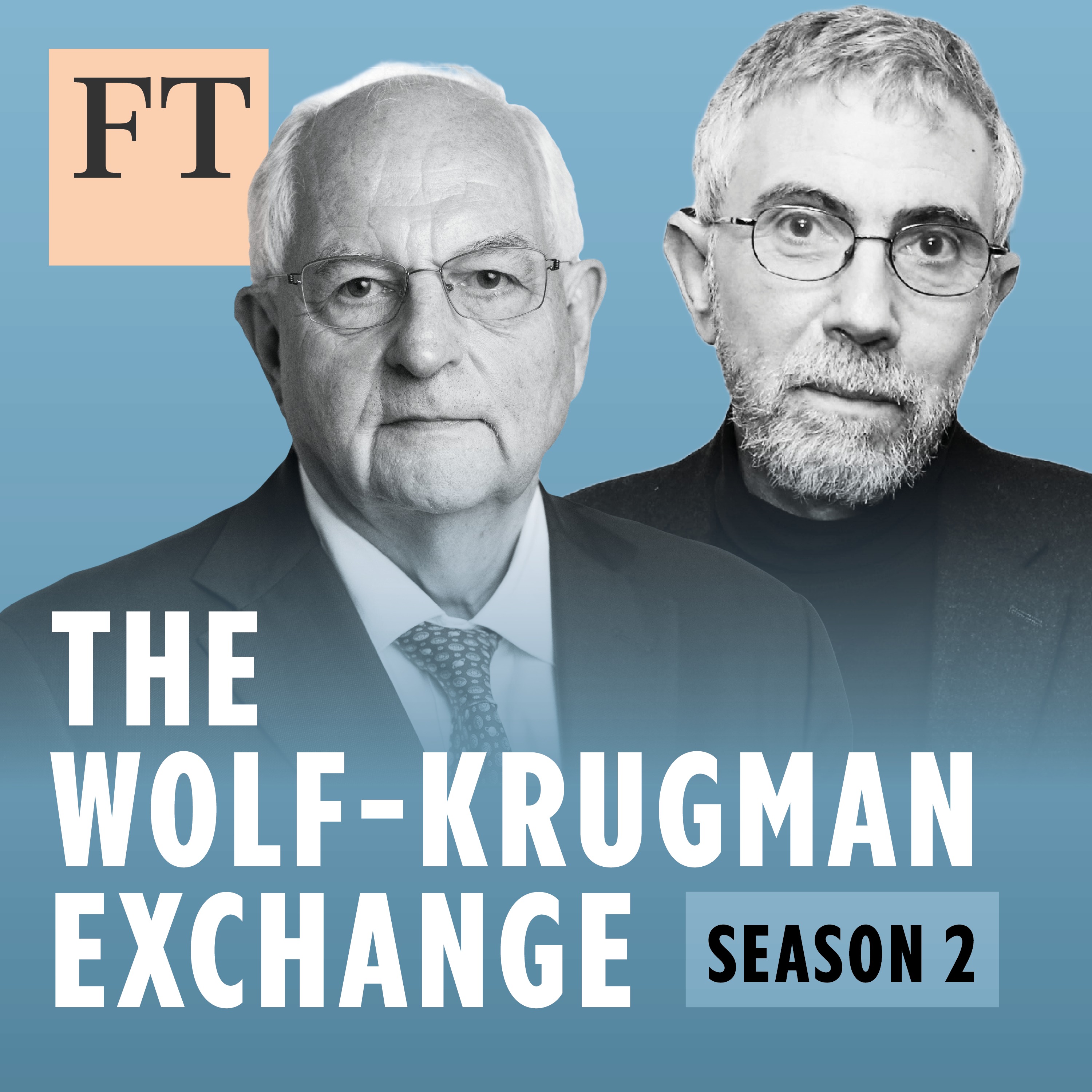
Coming soon: The Wolf-Krugman Exchange: One year of Trump
In this four-part series starting on Wednesday November 26, FT chief economics commentator Martin Wolf and Nobel-prize winning economist Paul Krugman take stock after (almost) a year of Donald Trump’s second term and assess the impact of his presidency on the US and world economy and democracy everywhere.Martin Wolf is the FT’s chief economics commentator. You can find his articles here: https://www.ft.com/martin-wolfYou can find Paul Krugman’s Substack newsletter here Subscribe to The Economics Show on Apple, Spotify, Pocket Casts or wherever you listen.Presented by Martin Wolf. Produced by Mischa Frankl-Duval. The executive producer is Manuela Saragosa. Original music and sound design by Breen Turner. Hosted on Acast. See acast.com/privacy for more information.