The David Burnell Podcast
99 episodes — Page 1 of 2
SURVIVAL FIRST AID: The Complete Audiobook
SWITCH ON: The Stories That Stay
THE QUIET WAR: The Complete Audiobook
Self-Defense: The Complete Audiobook
TEANCUM - A True Friend to Liberty
We Will Come for You
Improvised Weapons: The Complete Audiobook
The Beggar: The Complete Audiobook
The Man Who Went In
Crisis Response: Managing Acute Stress After the Unthinkable
September 11: When Ordinary People Stood Tall
David Burnell: Leave No One Behind: Bring Them Home
David Burnell: Thy Will Be Done - Grief, Healing, and Learning to Let Go
D-Day: The Longest Day
Defense for Women: Introduction
Defense for Women: Where It Happens
Defense for Women: The Dangerous Need to Be Nice
What Freedom Means to Me
Defense for Women: Boundaries Are a Weapon
Audiobook: Fight Though
THE EXAMINER: What The Examiner Is — And Is Not
(Audiobook) The Climb
Sun Tzu Made Simple
Defense for Women: Trust the Signal
The Weight You Carry Still Matters
David Burnell: Sorab and Rustum - The Son He Never Knew
Defense for Women: The Color Code of Awareness
Defense for Women: The Interview Phase
Audiobook: The Weight We Carry
Audiobook: Tiger Stripe

Quiet Readiness: Martial Arts and the Reality of Self-Defense
Martial arts builds discipline, confidence, and physical capability—but does it actually prepare you for real-world self-defense?In this episode of Quiet Readiness, David Burnell explores the gap between martial arts training and real-world violence. Drawing from a lifetime of experience in martial arts and self-defense instruction, David breaks down why most traditional training assumes a fight will happen—and why that assumption can be dangerous.This episode covers:• the strengths of martial arts for discipline, fitness, and mental resilience• why most training environments do not reflect real-world violence• how rules, structure, and technique can create a false sense of security• the role of aggression and unpredictability in real encounters• why awareness and prevention are the foundation of true self-defense• how to shift from a “fight mindset” to a “readiness mindset”Quiet Readiness is not about learning how to win fights.It is about learning how to avoid them—and how to think clearly when avoidance is no longer possible.Make sure to follow or subscribe for more Quiet Readiness insights on awareness, preparedness, and practical self-defense thinking.Stay aware.Stay prepared.Stay quietly ready. Get full access to David Burnell at davidburnell.substack.com/subscribe

Defense for Women: This Is Where Real Self-Defense Begins
DEFENSE FOR WOMENIf you’re here, it’s because you’ve thought about your safety.This isn’t about fear.It’s about being prepared.Most self-defense training teaches you how to fight—but by the time you’re fighting, you’re already behind.Real safety starts earlier.In this program, you’ll learn how to recognize danger before it escalates, set boundaries with confidence, and take action before it becomes physical.Because violence isn’t random—and once you understand how it develops, you can stay ahead of it.You don’t need to be a fighter.You need to be aware.Prepared.And willing to act.More information available at: https://defenseforwomen.com/ Get full access to David Burnell at davidburnell.substack.com/subscribe

Defense for Women: What Predators Look For
Violence is not random.The people who commit it are not guessing—they are choosing.In this episode of Defense for Women, David Burnell breaks down how attackers think, how they select targets, and what they are looking for before anything ever happens.This isn’t about fear—it’s about understanding the process.You’ll learn why distraction, hesitation, and isolation matter, and how small changes in awareness and behavior can make you a hard target instead of an easy one.Because the truth is simple:You don’t get chosen by accident.And once you understand what they’re looking for…you can take it away. Get full access to David Burnell at davidburnell.substack.com/subscribe

Defense for Women: The Moment Something Felt Wrong
There is a moment most people ignore.A pause.A hesitation.A quiet signal that something isn’t right.In this episode of Defense for Women, David Burnell breaks down the earliest and most important indicator of danger—the moment your instincts recognize a threat before your mind can explain it.This is where safety begins… or where it is lost.You’ll learn why that feeling matters, why people override it, and how to trust it before a situation escalates.Because the truth is simple:Most dangerous situations don’t begin with violence—They begin with something that just feels off.And what you do in that moment can change everything. Get full access to David Burnell at davidburnell.substack.com/subscribe

Defense for Women: This Is Not a Fight
There’s a moment most people ignore.A pause.A hesitation.A quiet voice that says: something isn’t right.In this first episode of Defense For Women: Before It Happens, we talk about that moment—the one that comes before danger fully reveals itself.This isn’t about fear.It’s about awareness.Drawing from real-world experience in law enforcement, military operations, and civilian encounters, this episode breaks down what many call a “bad gut feeling”—and why it may be one of the most powerful survival tools you have.You’ll learn:* Why intuition is often your first line of defense* How danger presents itself before it becomes obvious* The cost of ignoring early warning signs* How to begin trusting what you feel—even when you can’t explain itThis is not about teaching you to fight.It’s about teaching you to see.Because the truth is—most dangerous situations don’t start with violence…They start with something that just feels off.And what you do in that momentcan change everything.If this message resonates with you, follow the series and share it with someone you care about.Because awareness isn’t just personal—It’s something we pass on. Get full access to David Burnell at davidburnell.substack.com/subscribe
Echo Valor: Lifting the Weary and Downcast

David Burnell: Natural Rights the Foundation of Liberty
In this episode, David Burnell explores the timeless doctrine of natural rights—the idea that certain freedoms belong to every human being simply by virtue of being human.Tracing the origins of these ideas back to 17th-century philosophers such as John Locke, David explains how these principles shaped the thinking of the American Founders and became embedded in the documents that define the United States, including the Declaration of Independence, the United States Constitution, and the United States Bill of Rights.With a clear and apolitical perspective, he reflects on the tension between individual liberty and collectivism, the responsibility that comes with freedom, and the principle championed by leaders such as Thomas Jefferson and Abraham Lincoln—that our rights must never infringe upon others’ rights.This episode is a reminder that the foundations of liberty are not simply political ideas, but enduring principles that continue to shape free societies. Get full access to David Burnell at davidburnell.substack.com/subscribe
Echo Valor: What Makes a Hero
Quiet Readiness: Everyday Essentials
Preparedness does not begin with bunkers and panic. It begins with the ordinary decisions you make before something goes wrong.In this episode of Quiet Readiness, David Burnell takes a practical look at three layers of readiness:* What to carry on your body* What to keep in your vehicle* How to build a realistic 72-hour kitDrawing from operational experience, rescue work, and real-world emergency thinking, this episode covers the gear, habits, and priorities that matter most when you are stranded, cut off, delayed, displaced, or forced to move.This is not about fear. It is about reducing friction when life gets chaotic. Get full access to David Burnell at davidburnell.substack.com/subscribe

Quiet Readiness: Calm in the Storm by Managing Trauma and Crisis Stress
In a world where traumatic events unfold in real time across our screens, the human mind is being exposed to more crises than ever before.But how do we process it?In this episode of Quiet Readiness, David Burnell sits down with longtime friend and crisis-response specialist Jeffrey Denning — a retired law enforcement officer, federal agent, and mental-health professional who has spent years helping first responders recover after critical incidents.Together they discuss:• The hidden cost of repeated trauma exposure• Why first responders experience cumulative stress• The psychological impact of witnessing violence• The dangers of isolation and social media trauma loops• The practical disciplines that restore mental balanceDrawing from decades of operational experience and clinical work, Denning shares simple but powerful tools for maintaining mental readiness: sleep, exercise, connection, gratitude, and purposeful service.Because resilience is not accidental.It is practiced. Get full access to David Burnell at davidburnell.substack.com/subscribe
Echo Valor: The Glass Case - A Warrior’s Perspective on Trauma and Misunderstanding
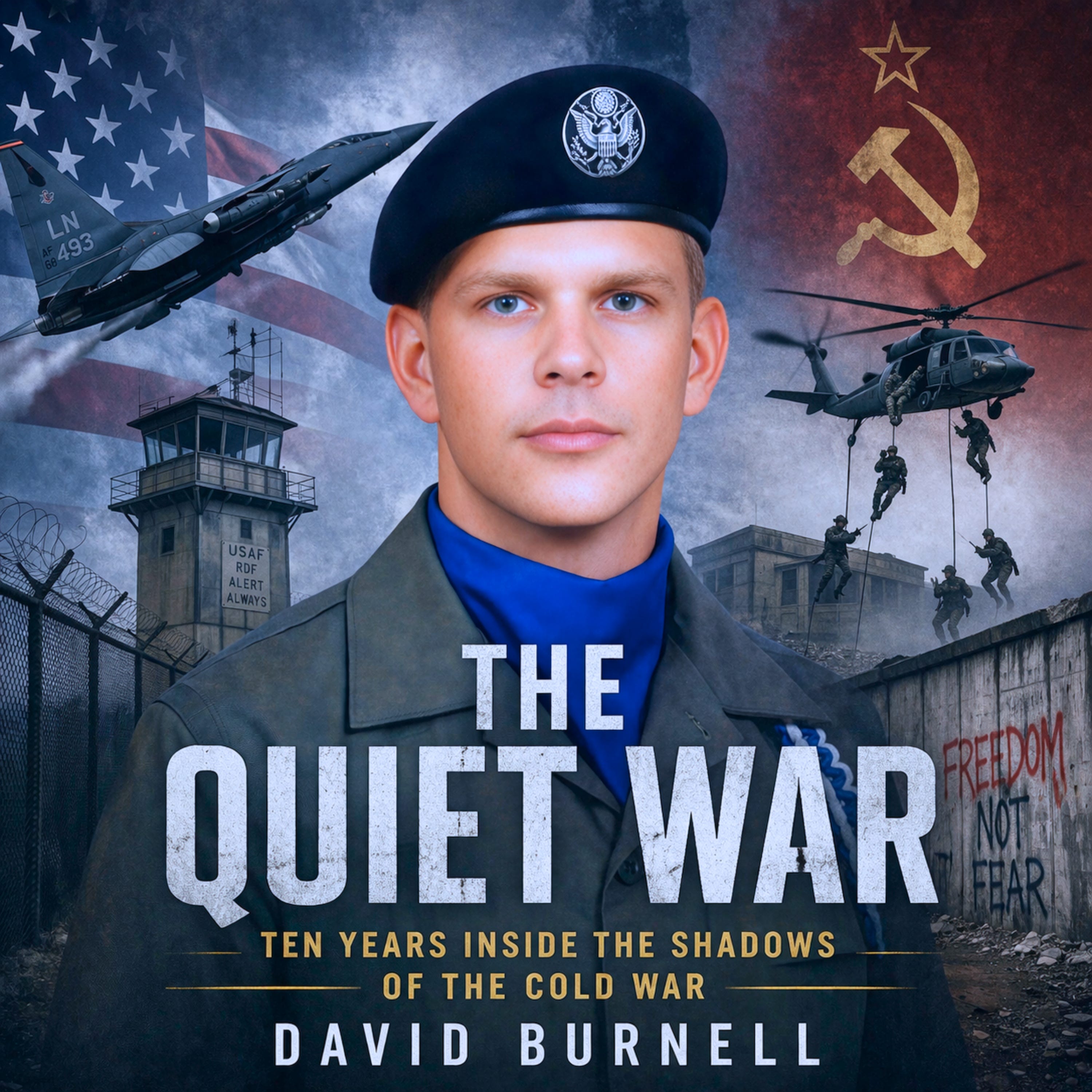
Audiobook: The Quiet War
For ten years, David Burnell lived in the invisible war—serving as a U.S. Air Force Communications Operations Specialist during the most volatile decade of the late Cold War.His battlefield wasn’t marked by trenches or gunfire, but by encrypted transmissions, coded messages, and the heavy silence of classified operations.From the blackout classrooms of Sheppard Air Force Base to the fog-covered runways of RAF Sculthorpe, and from the jungles of Central America to the frozen plains of South Dakota, Burnell’s decade in uniform unfolded behind security fences, within cleared rooms, and beneath the constant hum of secrecy.In The Quiet War, Burnell opens a window into the unseen world of intelligence operations—where loyalty is tested by polygraphs, trust is earned in whispers, and the smallest mistake can echo across nations.He recounts the call that changed everything: volunteering for Task Force Bravo in Cabañas ’87, where a last-minute reassignment spared his life when a friendly-fire incident took down the helicopter he was meant to board.He describes the OSI polygraph interrogations after the capture of Navy spy John Walker, and the eerie feeling of serving “in the glass bowl” where every heartbeat was measured for loyalty.He walks through the fall of the Berlin Wall, the rising threat of global terrorism, and the quiet moments on the flight line when coffins draped in flags arrived home without ceremony.Amid the secrecy and tension, Burnell’s story is deeply human. It is about faith, family, endurance, and the cost of commitment.It’s about the dream that first drew him in—the desire to become a Pararescue operator (“That Others May Live”)—and how that same drive would later carry him into real-world search and rescue, humanitarian missions, and crisis response long after the uniform came off.The Quiet War is more than a military memoir—it is a testament to those who serve in silence, whose battles are unseen but whose sacrifices are just as real.For readers of The Right Stuff, American Sniper, and The Operator, this is the untold story of a warrior who lived at the intersection of technology, intelligence, and faith during one of the most complex eras in modern history.Themes & Tone* True Cold War service through the eyes of an intelligence operator* Faith, discipline, and moral courage under pressure* Psychological and emotional costs of secrecy* Human connection amidst technology and global tension* The unseen link between military service and humanitarian rescueKey Operations & Chapters* The Road Not Taken – Pararescue Dreams and Duty* Boot Camp – Breaking and Building* The 12th Tactical Intelligence Squadron* Into the Fire: Cabañas ’87* The Polygraph – Loyalty Under Interrogation* Signals in the Silence – RAF Sculthorpe and the Shadow War* Bodies on the Tarmac* And the Wall Came Down – Berlin 1989* Ellsworth AFB and the End of the Uniform* From Airman to Rescuer – A Life Built by FireFind this and other episodes from the Echo Valor Podcast by searching “Echo Valor Podcast” on your favorite podcast platform. You can also discover original music by searching “Echo Valor Music” on your favorite streaming platform, and explore books and written works by searching “David Burnell” on Amazon to visit his author page. Get full access to David Burnell at davidburnell.substack.com/subscribe

David Burnell: Biography
David Burnell is a U.S. Air Force veteran, rescue professional, entrepreneur, humanitarian, and storyteller whose life has been shaped by a deep commitment to service. Over the course of several decades, Burnell has worked across military operations, search and rescue, disaster response, counter-terror, and protective security environments, as well as the development of advanced training programs for those who protect and serve. His career reflects a consistent focus on preparing people to face danger, uncertainty, and adversity with discipline, courage, and clarity of purpose.Military ServiceDavid Burnell served in the United States Air Force, where he worked in communications and operational support roles connected to intelligence, air operations, and special operations environments during the final decade of the Cold War. His military service provided the foundation for his lifelong focus on operational readiness, teamwork under pressure, and leadership in high-stakes environments. The principles learned during this period—discipline, accountability, and mission focus—would guide the rest of his career.Rescue and Search & Rescue OperationsFollowing his military service, Burnell became deeply involved in search-and-rescue operations, including work as a public-safety diver and rescue professional. He participated in demanding recovery and rescue missions in challenging environments, including underwater and ice-dive operations where lives and evidence depended on calm execution under pressure. These experiences exposed him to the realities first responders face and reinforced his belief that preparation, training, and emotional resilience are essential for those operating in life-and-death environments.Counter-Terror and Protective Security WorkBurnell later worked in the protective security and counter-terror environment, including roles as a protective security detail (PSD) operator, where teams safeguard individuals operating in volatile, high-risk regions. These missions required the ability to operate with precision, discipline, and situational awareness in complex security environments. The experience further strengthened his understanding of operational planning, risk mitigation, and the leadership required to protect others in the face of a threat.Entrepreneur and Business LeaderIn addition to his operational work, Burnell is a serial entrepreneur and business builder who has founded and led several successful companies. Among his ventures was the Urban Warfare Center. Burnell helped pioneer realistic force-on-force training environments designed to simulate the stress and complexity of real-world operations. These programs trained thousands of military personnel, law enforcement officers, and first responders in decision-making under pressure and operational readiness.Over the years, Burnell has built, grown, and exited multiple businesses, demonstrating a rare ability to combine operational experience with entrepreneurial leadership.Humanitarian MissionsThroughout his life, David Burnell has participated in numerous humanitarian and disaster-response missions around the world, working alongside rescue teams, medical volunteers, and non-governmental organizations in environments where lives had been disrupted by natural disasters, poverty, and conflict.In 2010, Burnell deployed to Haiti following the devastating earthquake that destroyed much of Port-au-Prince. Serving as Chief of Security for the Utah Hospital Task Force, he helped establish and protect a field hospital that provided desperately needed medical care to thousands of survivors. Operating in an environment marked by collapsed infrastructure, widespread suffering, and intense humanitarian need, the mission left a lasting impression on Burnell’s understanding of service and resilience.In 2011, after the massive earthquake and tsunami in Japan, Burnell traveled independently to assist in the recovery effort along the devastated northeastern coastline. Working alongside the internationally respected Mexican rescue team Los Topos, he participated in recovery operations in some of the hardest-hit areas near Sendai, Ishinomaki, and Onagawa, searching through debris fields left by the catastrophic wave. The mission exposed him to the quiet dignity and resilience of the Japanese people as communities struggled to rebuild after unimaginable loss.Burnell has also served in Burma (Myanmar) in support of humanitarian efforts among the Karen people, who have endured decades of conflict and displacement. Working with humanitarian organizations, he supported medical training programs that equipped local medics with lifesaving skills in remote jungle regions where access to modern medical care was limited.His humanitarian travels have also taken him to Costa Rica and Thailand, where he assisted with training, outreach, and service efforts focused on community resilience, emergency preparedness, and humanitarian support. These experiences broadened h

David Burnell: Why I Write
bonusA reader recently asked me a simple but powerful question:Why do you write?It made me stop and think about the journey that led me here.For most of my life, I didn’t think of myself as a writer. I was serving in the military, working in rescue operations, protective assignments, and humanitarian missions around the world. Those environments are full of moments that shape a person—moments of courage, loss, faith, resilience, and quiet reflection.Over time, I realized those experiences carried lessons worth sharing.In this episode, I talk about how storytelling became a way to process life’s hardest moments, what kinds of stories I choose to tell, and why authenticity matters more than perfect writing.Sometimes a story can do more than entertain.Sometimes it helps someone see their own life more clearly.Sometimes it even helps someone through a difficult season.This episode is about the purpose behind the stories. Get full access to David Burnell at davidburnell.substack.com/subscribe

Built by Fire: The Rescue I Didn’t Expect - Japan Tsunami
In March of 2011, after the devastating earthquake and tsunami struck Japan’s eastern coast, David Burnell felt a quiet but powerful pull to go.He didn’t go on an official mission.He went alone.With a backpack, rescue gear, and the experience of a lifetime spent in military service, rescue operations, and crisis response, David traveled into one of the largest disaster zones of the modern era.Eventually, embedding with the legendary Mexican rescue team Los Topos, he moved north into the devastated coastal regions of Sendai, Ishinomaki, and Onagawa—places where entire towns had been erased by the sea.He believed his mission was simple:help recover the missing.But along the way, two unexpected encounters revealed a deeper truth.Sometimes rescue isn’t about pulling bodies from rubble.Sometimes it’s about helping someone find their way home.This episode is a reflection on service, faith, purpose, and the quiet moments when a single conversation can redirect a life’s course. Get full access to David Burnell at davidburnell.substack.com/subscribe
Built By Fire: The Wounds You Cannot See
Some wounds bleed. Others stay hidden for years.In this episode of Built By Fire, David Burnell sits down with longtime friend Jeffrey Denning — veteran, former law enforcement officer, federal operator, and trauma-informed mental health professional — for a deeply honest conversation about critical incidents, cumulative trauma, and the invisible wounds carried by first responders, warriors, and ordinary people.Together they explore the weight of secondary and tertiary trauma, the emotional aftermath of violence, the danger of isolation, and the practical habits that help people heal: sleep, nutrition, movement, gratitude, faith, connection, and service.This episode is not about weakness.It is about reality.It is about the unseen cost of service, the burden carried by those who run toward crisis, and the reminder that healing is possible — but it takes intention, honesty, and people who care enough to knock on the door.If you’ve ever carried pain you couldn’t explain, or loved someone who has, this conversation is for you. Get full access to David Burnell at davidburnell.substack.com/subscribe

Quiet Readiness: The Benevolent Wolf - Why It Takes a Wolf to Stop a Wolf
In this episode of Quiet Readiness, David Burnell speaks with former African Special Forces instructor and executive coach David Fabricius about the famous “sheep, sheepdog, and wolf” concept popularized by Lt. Col. Dave Grossman.But Fabricius offers a deeper perspective:Sometimes it takes a wolf to stop a wolf.Drawing from his upbringing in Africa, his military service, and decades of international experience, Fabricius explains the role of the benevolent wolf — individuals capable of violence, but guided by discipline, character, and moral responsibility.The conversation explores:• why violence sometimes must confront violence• the psychology of predators and protectors• lessons from South Africa’s political transformation• the importance of capability and preparedness• why freedom must be actively protectedIn an increasingly unstable world, the ability to protect oneself and others may be more important than ever. Get full access to David Burnell at davidburnell.substack.com/subscribe

Quiet Readiness: Cortisol, Chaos, and Calm Under Pressure
What happens to the human mind and body under sudden stress, violence, and uncertainty?In this episode of Quiet Readiness, David Burnell is joined by Jeffrey Denning for a deep conversation about cortisol, adrenaline, fear, fight-flight-freeze, stress inoculation, and what helps some people remain calm when chaos erupts.Drawing on real-world experience in military, protective, tactical, and training environments, David and Jeff explore lessons from active violence incidents, high-level operators, civilian self-defense, and the importance of training the mind as well as the body.This episode covers:* cortisol and the body’s stress response* fight, flight, freeze, and tonic immobility* what training under pressure actually does* why some people become calmer when chaos increases* how civilians can build readiness without living in fear* the role of faith, discipline, training, and mindset in uncertain timesThis is not fear-based content.It is a practical conversation about how to think clearly, prepare wisely, and remain steady when the world becomes unstable.Make sure to follow or subscribe for more Quiet Readiness insights on awareness, preparedness, and practical self-defense thinking.Stay aware.Stay prepared.Stay quietly ready. Get full access to David Burnell at davidburnell.substack.com/subscribe