The Curbsiders Internal Medicine Podcast
522 episodes — Page 10 of 11

#154 DVT and PE Master Class with Michael Streiff MD
What do Judas Priest, surfing, and clots have in common? They are the passionate interests of expert Dr. Michael Streiff who guides us through the diagnosis and management of DVT and PE aka venous thromboembolism (VTE). By the end of the episode you will know how to catch a clot very Wells! We dive deep into the treatment options, literature, and some unique cases. ACP members can claim CME-MOC credit at https://acponline.org/curbsiders (CME goes live at 0900 ET on the episode’s release date).Full show notes available at https://thecurbsiders.com/episode-list. Join our mailing list and receive a PDF copy of our show notes every Monday. Rate us on iTunes, recommend a guest or topic and give feedback at [email protected]. Credits Written and produced by (including CME questions): Justin Berk MD, MPH, MBA Cover art by: Kate Grant MBChB DipGUMed Hosts: Matthew Watto MD, FACP; Paul Williams MD, FACP; Stuart Brigham MD Edited by: Matthew Watto, MD, FACP Guest: Michael Streiff MD
#153 Heart Disease in Women with Dr Bairey Merz
Expand your idea of ischemic heart disease to include non-obstructive patterns, which as our guest, Dr Noel Bairey Merz, a clinical investigative cardiologist whose multiple roles include Director of the Barbra Streisand Women’s Heart Center and the Preventive Cardiac Center at the Smidt Cedars-Sinai Heart Institute, shares with us, is incredibly common, especially in women. Learn to recognize these women and treat according to guidelines, preventing unnecessary IHD mortality in our female (and some male) patients. We review a variety of non-obstructive pathologies and the best techniques to evaluate them. Full show notes available at http://thecurbsiders.com/podcast. Join our mailing list and receive a PDF copy of our show notes every Monday. Rate us on iTunes, recommend a guest or topic and give feedback at [email protected]. Credits Written and produced by: Shreya Trivedi MD, Molly Heublein MD Hosts: Paul Williams MD, FACP; Shreya Trivedi MD; Molly Heublein MD Edited by: Matthew Watto MD, FACP; Emi Okamoto MD Graphics by: Hannah Abrams Guest: Dr. C Noel Bairey Merz MD, FACC, FAHA Curbsiders' Schwag! We’ve got the perfect father’s day gift for every internal medicine nerd. The Curbsiders have opened our own online shop. Get your Curbsiders t-shirts, hoodies, stickers, and coffee mugs. Help support the show and gain instant bragging rights. Note: All purchases come with admitting privileges at Kashlak Memorial Hospital!

#152 Dare to Lead: Becoming a PGY2
Dare to lead. Master the transition to PGY2 with tips from expert educator Abby Spencer MD, MS, FACP, IM Residency Program Director and Vice Chair for Education for the Medicine Institute at Cleveland Clinic and Shreya Trivedi MD, GIM Fellow at NYU School of Medicine. Topics include: how to run work rounds, preparing your team for attendings rounds, how to teach on the fly, finding your leadership style, and what to read during residency. This is the first of three episodes that we’re co-developing with the American College of Physicians for their Resident Transitions Series.Full show notes available at http://thecurbsiders.com/podcast. Rate us on iTunes, recommend a guest or topic and give feedback at [email protected]. Credits Written and produced by: Shreya Trivedi MD Graphics and Show Notes by: Hannah R Abrams Hosts: Paul Williams MD, FACP; Stuart Brigham MD; Matthew Watto MD, FACP; Shreya Trivedi MD Guest: Abby Spencer MD, MS, FACP SponsorThe Resident Transitions Series is brought to you by The American College of Physicians with support from its Council of Resident/Fellow Members. Visit acponline.org/resident to learn more about the benefits of Resident/Fellow Membership and join our proud internal medicine community today!

#151 Anaphylaxis with Dr Olajumoke Fadugba MD
Recognize common presentations of anaphylaxis and stop under-treating this deadly allergic reaction with tips from Dr. Olajumoke Fadugba, Assistant Professor of Medicine, University of Pennsylvania! We review the basic pathophysiology and the standard criteria for diagnosing anaphylaxis, treatment basics, the primary importance of epinephrine, and the utility of adjunctive therapies. Also included are great tips on counseling patients about auto-injectable epinephrine, and a reminder not to panic...even when you inject your own thumb?! ACP members can claim CME-MOC credit at https://acponline.org/curbsiders (CME goes live at 0900 ET on the episode’s release date).Full show notes available at https://thecurbsiders.com/podcast. Join our mailing list and receive a PDF copy of our show notes every Monday. Rate us on iTunes, recommend a guest or topic and give feedback at [email protected]. Credits Writer (interview, show notes & CME questions) and cover art: Emi Okamoto MD Infographic by: Emi Okamoto MD Hosts: Matthew Watto MD, FACP; Stuart Brigham MD Editors: Matthew Watto MD, FACP Guest: Olajumoke Fadugba MD Special thanks to Sarah Phoebe Roberts MPH for booking!
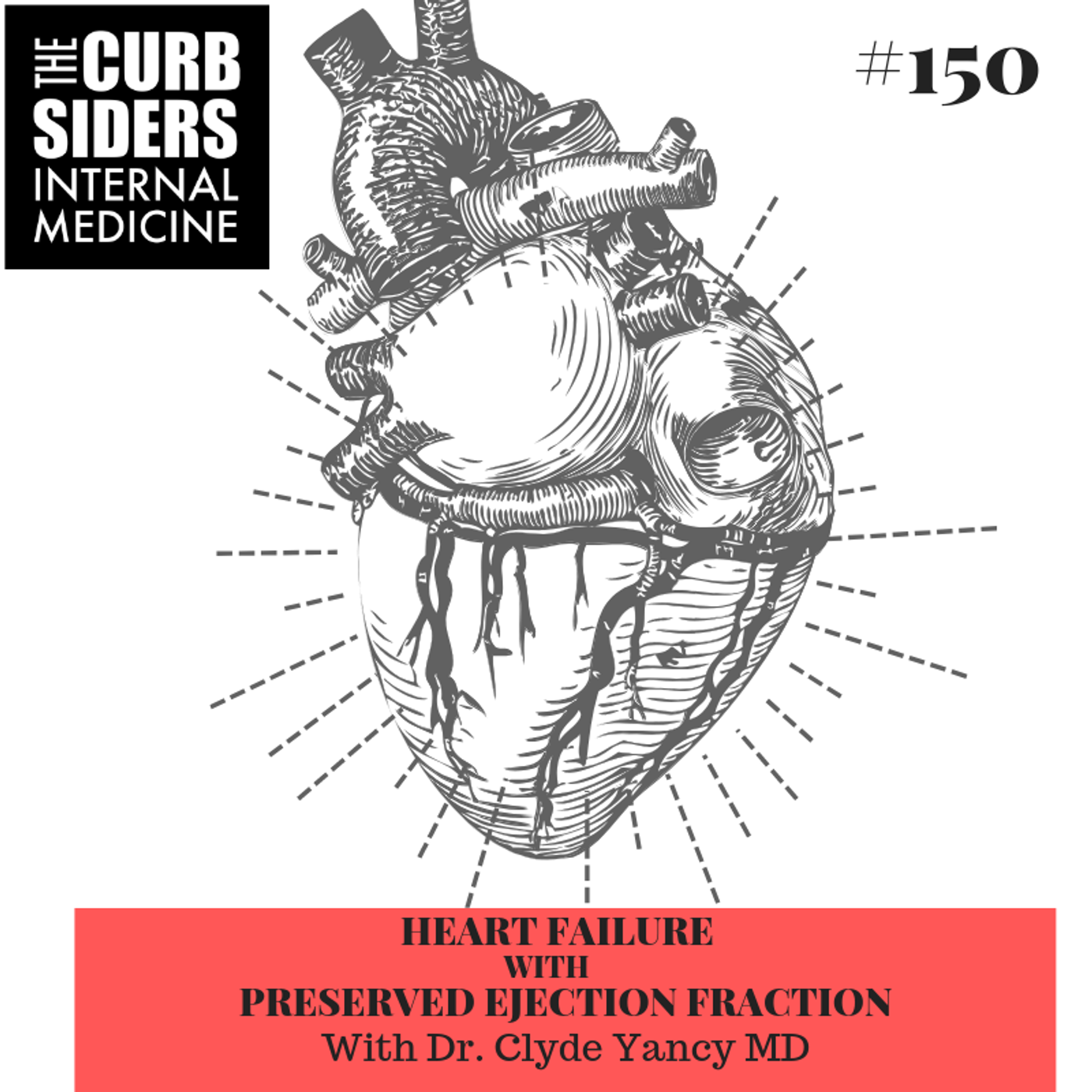
#150 HFpEF with Dr Clyde Yancy MD
HFpEF (heart failure with preserved ejection fraction) with master cardiologist, Dr Clyde Yancy MD, Chief of Cardiology and Professor of Medicine (Cardiology) and Medical Social Sciences, Northwestern, Feinberg School of Medicine. Topics include: pathophysiology, HFpEF phenotypes, how to interpret a borderline ejection fraction, evidence based therapies, diuretics, and future directions (pulmonary artery monitors, intra-atrial shunts, ARNI compounds), and more!Full show notes available at http://thecurbsiders.com/podcast. Join our mailing list and receive a PDF copy of our show notes every Monday. Rate us on iTunes, recommend a guest or topic and give feedback at [email protected]. Credits Written and produced by: Paul Williams MD, FACP; Sarah Phoebe Roberts MPH Hosts: Matthew Watto MD, FACP; Paul Williams MD, FACP; Stuart Brigham MD Show Notes: Justin Berk MD, MPH, MBA; and Beth Garbitelli MS1 Infographics: Beth Garbitelli MS1 Editor: Matthew Watto MD, FACP Guest: Clyde Yancy MD, MSc, MACC, FAHA, MACP, FHFSA

Recap SGIM19 Day 2
Recap of random pearls and highlights from SGIM19 Day 2 including: methadone and buprenorphine, perioperative buprenorphine, medical cannabis, HPV vaccination, young adult medicine, academic promotions, long term sequelae of childhood kidney disease, stage 1 hypertension, some great free resources in addiction medicine, and more! Special thanks to the Society for General Internal Medicine for their hospitality.Full show notes available at https://thecurbsiders.com/episode-list. Join our mailing list and receive a PDF copy of our show notes every Monday. Rate us on iTunes, recommend a guest or topic and give feedback at [email protected]. Credits Written, produced, and cohosted by: Paul Williams MD, Matthew Watto MD, Justin Berk MD, Carolyn Chan MD, Shreya Trivedi MD, Nora Taranto MS4 (soon to be MD!) Edited by: Matthew Watto MD

Recap SGIM19 Day 1
Recap of random pearls and highlights from SGIM19 Day 1 including: Kidney stone treatment (roller coasters, sex and tamsulosin), aspirin, SGLT2 inhibitors to reduce kidney events, oral antibiotics for endocarditis, preferred physician attire, sexual harassment, writing letters of recommendation, triple therapy for COPD, DAPT for stroke, and more! Special thanks to the Society for General Internal Medicine for their hospitality. Full show notes available at https://thecurbsiders.com/episode-list. Join our mailing list and receive a PDF copy of our show notes every Monday. Rate us on iTunes, recommend a guest or topic and give feedback at [email protected]. Credits Written, produced, and cohosted by: Paul Williams MD, Matthew Watto MD, Justin Berk MD, Carolyn Chan MD, Shreya Trivedi MD, Abby Spencer MD, MS, Nora Taranto MS4 (soon to be MD!) Edited by: Matthew Watto MD Special Guest: Abby Spencer MD, MS

#149 Hip Pain for Primary Care
Identify and treat the most common causes of hip pain in the outpatient setting with returning guest, Dr Ted Parks. A large majority of hip pain in the office setting will be due to one of three conditions (hip osteoarthritis, greater trochanteric pain syndrome, and lumbo-sacral back pain). Learn to easily identify these conditions, how to initiate conservative treatment, and more about hip replacements. ACP members can visit https://acponline.org/curbsiders to claim free CME-MOC credit for this episode and show notes (goes live 0900 EST).Full show notes available at http://thecurbsiders.com/podcast. Join our mailing list and receive a PDF copy of our show notes every Monday. Rate us on iTunes, recommend a guest or topic and give feedback at [email protected] and produced by: Molly Heublein MD, Nora Taranto MS4CME questions by: Molly Heublein MD, Nora Taranto MS4Hosts: Matthew Watto MD, Paul Williams MD, Stuart Brigham MD, Molly Heublein MDEdited by: Matthew Watto MD, Emi Okamoto MDGuest Presenter: Ted Parks MD

Telehealth with Ana María López MD
Electric cars, virtual reality, nanotechnology, and now… telemedicine? We chat with Dr. Ana María López MD, FACP about the future of telehealth, how to implement it in your practice, and the challenges you might face in doing so. Dr. López is immediate past president of the American College of Physicians (ACP) as well as Vice Chair of Medical Oncology and Chief of New Jersey Division Sidney Kimmel Cancer Center of Thomas Jefferson University. Her main areas of professional interest and expertise include cancer prevention and equity, integrative oncology, implementation of innovations in health care including telemedicine, and women’s health. We learned immensely from our talk with her and we hope you will, too! ACP members can claim free CME & MOC credit at https://acponline.org/curbsiders. Download Dr Brigham’s telehealth cheat sheet as a PDF at http://thecurbsiders.com/podcast. Rate us on iTunes, recommend a guest or topic and give feedback at [email protected]. Credits Written and produced by: Hannah Abrams, Stuart Brigham MD Cohosts: Matt Watto MD, Stuart Brigham MD, Paul Williams MD, Hannah Abrams Guest: Ana María López MD

#148 Benign Prostatic Hyperplasia for the Internist
This week we narrow in on the enlarging prostate and decipher the common issue of benign prostatic hyperplasia with Adam C. Reese MD, Associate Professor of Urology at the Lewis Katz School of Medicine at Temple University and Chief of Urologic Oncology at Temple University Hospital. Learn how to interpret the symptom profile for patients presenting with common urinary issues, what to feel for in the digital rectal exam, how to treat BPH, and when to refer.ACP members can visit https://acponline.org/curbsiders to claim free CME-MOC credit for this episode and show notes (goes live 0900 EST). See you at SGIM 2019!Find us in our red Curbsider’s t-shirts handing out Curbsiders and Kashlak stickers/patches at SGIM 2019 in Washington DC! We’ll be recording full length shows and daily recaps! CreditsWritten and produced by: Paul Williams MDHosts: Paul Williams MD, Matthew Watto MDImages and infographics: Elena Gibson, Beth GarbitelliShow Notes: Elena Gibson, Beth GarbitelliEdited by: Matthew Watto MD, Chris Chiu MDGuest: Adam Reese MD Time Stamps00:00 SGIM announcement00:30 Disclaimer, intro and guest bio03:20 Guest one liner, book recommendation, favorite failure and surgical M&M10:56 Case of benign prostatic hyperplasia, defining terms and obstructive/voiding versus storage/irritative symptoms16:11 IPSS score and evaluating symptoms22:10 Digital rectal exam. Will this give any useful information?26:55 Taking a history about BPH and some lifestyle modifications29:20 Lab studies for urinary tract symptoms and interpreting PSA and free PSA36:20 Initial therapy for BPH and managing patient expectations, alpha blocker side effects39:25 Choice of agent and monitoring symptoms on therapy42:25 Nonpharmacologic management of bladder complaints45:10 Who and when to refer to urology47:33 Counseling about use of 5 alpha reductase inhibitors, their side effects and is there a risk for high grade cancer?52:35 Phosphodiesterase inhibitors for BPH symptoms53:50 Urethral milking. NOT prostate milking54:55 Desmopressin for nocturia56:20 Take home points59:03 Prostate volume and PSA61:10 OutroFull show notes available at http://thecurbsiders.com/episode-list.
Random Pearls #IM2019 Day 3
Random pearls from ACP #IM2019 Day 3. The Curbsiders crew is joined by Dr Alan Dow of VCU to discuss highlights from ACP’s Internal Medicine Meeting in Philadelphia including: sleep deprivation, the glymphatics system, inflammatory back pain, heart failure, dermatology pearls, a new definition for pulmonary hypertension and more! "Sorry, no time stamps or full show notes for this one. We're too tired." -The Curbsiders Join our mailing list and receive a PDF copy of our show notes every Monday. Rate us on iTunes, recommend a guest or topic and give feedback at [email protected]. #IM2019 Curbsiders Crew Guest: Renee Dversdal MD, Alan Dow MD, Alia Chisty MD Cohosts: Paul Williams MD, Stuart Brigham MD, Shreya Trivedi MD, Molly Heublein MD, Emi Okamoto MD, Justin Berk MD, Cyrus Askin MD, Matthew Watto MD, Chris Chiu MD Director of operations: Chris Chiu MD Twitter: Cyrus Askin MD, Hannah Abrams MS3 Instagram: Beth Garbitelli MS1 Facebook: Chris Chiu MD Off-air producer: Sarah Phoebe Roberts MPH, Nora Taranto MS4 Marketing: Jen Watto

Random Pearls #IM2019 Day 2
Random pearls from ACP #IM2019 Day 2. The Curbsiders crew is joined by Dr Alia Chisty (future PD at Penn State Hershey) at ACP’s Internal Medicine Meeting in Philadelphia to discuss highlights including: baloxavir a new drug for flu, stress testing and coronary CT angiography pearls, celiac disease, H. pylori pearls, and a bunch of random pearls from infectious diseases, palliative care and more! "Sorry, no time stamps or full show notes for this one. We're too tired." -The Curbsiders Join our mailing list and receive a PDF copy of our show notes every Monday. Rate us on iTunes, recommend a guest or topic and give feedback at [email protected]. #IM2019 Curbsiders Crew Guest: Renee Dversdal MD, Alan Dow MD, Alia Chisty MD Cohosts: Paul Williams MD, Stuart Brigham MD, Shreya Trivedi MD, Molly Heublein MD, Emi Okamoto MD, Justin Berk MD, Cyrus Askin MD, Matthew Watto MD, Chris Chiu MD Director of operations: Chris Chiu MD Twitter: Cyrus Askin MD, Hannah Abrams MS3 Instagram: Beth Garbitelli MS1 Facebook: Chris Chiu MD Off-air producer: Sarah Phoebe Roberts MPH, Nora Taranto MS4 Marketing: Jen Watto
Random Pearls #IM2019 Day 1
Random pearls from #IM2019 Day 1. The Curbsiders crew is joined by Kashlak’s POCUS Chief, Renee Dversdal MD at ACP’s Internal Medicine Meeting in Philadelphia to discuss day 1 highlights inlcuding: POCUS, lyme rash, back pain, syphilis, women’s health, patient handoffs, the flip-flop fungal sign a ton of cardiology pearls (ie diuretics, paracentesis for CHF, beta blockers, LBBB, when is it safe to have intercourse after an MI?) and more! "Sorry, no time stamps or full show notes for this one. We're too tired." -The Curbsiders Join our mailing list and receive a PDF copy of our show notes every Monday. Rate us on iTunes, recommend a guest or topic and give feedback at [email protected]. #IM2019 Curbsiders Crew Guest: Renee Dversdal MD, Alan Dow MD, Alia Chisty MD Cohosts: Paul Williams MD, Stuart Brigham MD, Shreya Trivedi MD, Molly Heublein MD, Emi Okamoto MD, Justin Berk MD, Cyrus Askin MD, Matthew Watto MD, Chris Chiu MD Director of operations: Chris Chiu MD Twitter: Cyrus Askin MD, Hannah Abrams MS3 Instagram: Beth Garbitelli MS1 Facebook: Chris Chiu MD Off-air producer: Sarah Phoebe Roberts MPH Marketing: Jen Watto
#147 Rheumatoid Arthritis for the Internist
Join(t) us in learning about rheumatoid arthritis care for the internist with Robert McLean MD, rheumatologist, Associate Clinical Professor at Yale, and President Elect of the ACP! We discuss the complexity of rheumatoid arthritis, how to differentiate from other arthritic conditions, and how to have a patient-centered framework for the evaluation and treatment of affected patients. ACP members can claim CME-MOC credit at on ACP's site.. Full show notes available at http://thecurbsiders.com/podcast. Join our mailing list and receive a PDF copy of our show notes every Monday. Rate us on iTunes, recommend a guest or topic and give feedback at [email protected]. Credits Writer (Interview & CME questions): Cyrus Askin MD Show Notes and Infographic by: Elena Gibson MS4 Hosts: Matthew Watto MD, Stuart Brigham MD Editors: Matthew Watto MD, Emi Okamoto MD Guest: Robert McLean MD

#146 NephMadness: Pain Meds in Chronic Kidney Disease
Pain management in patients with chronic kidney disease (CKD) often goes something like this: NSAIDs are evil, acetaminophen hardly works, opioids are dangerous, and all the rest (tramadol, gabapentinoids, antidepressants) are messy. But, we tackle the complexities of pain management in patients with chronic kidney disease in this special @NephMadness 2019 episode that, on a scale of 1-10, will leave you feeling very relieved in addressing pain.Full show notes available at https://thecurbsiders.com/episode-list. Join our mailing list and receive a PDF copy of our show notes every Monday. Rate us on iTunes, recommend a guest or topic and give feedback at [email protected]. Earn CME and read about each region in NephMadness 2019 at AJKD blog.Credits Written and produced by: Justin Berk MD, Samantha Gelfand MD NephMadness Pun Contest produced by: Hannah R Abrams MS3 Cover art by: Kate Grant MBChB, Dip GUMed Hosts: Matthew Watto MD, Paul Williams MD, Stuart Brigham MD Edited by: Matthew Watto MD, Emi Okamoto MD Guests: Samantha Gelfand MD, Matthew Sparks MD, David Juurlink MD

#145 NephMadness: Hepatorenal Syndrome vs AKI
Does your sympathetic nervous system get activated when you notice acute kidney injury in patients with cirrhosis? Ever wonder how to really diagnose hepatorenal syndrome (HRS)? Think you have the bile-acid-stones to start diuretics on a patient requiring pressor support for kidney failure? You have come to the right place! Listen to @kidney_boy Joel Topf, HRS expert Juan Carlos Velez (@veleznephhepato), and self-proclaimed most-handsome-nephrologist Bill Whittier (@TWhittier_RUSH) tackle the complex pathophysiology and treatment of hepatorenal syndrome in this NephMadness 2019 special episode! Fill out your bracket for NephMadness 2019 today and sign up as part of The Curbsiders! Earn CME and read about each region at AJKD blog.Full show notes available at https://thecurbsiders.com/episode-list. Join our mailing list and receive a PDF copy of our show notes every Monday. Rate us on iTunes, recommend a guest or topic and give feedback at [email protected]. CreditsWritten and produced by: Justin Berk MD, Nora Taranto MS4Infographic by: Alex M @nephroguyHosts: Matthew Watto MDEdited by: Matthew Watto MD, Emi Okamoto MDGuests: Joel Topf MD, Juan Carlos Velez MD, Bill Whittier MD SponsorGet your ACP membership today and use the code CURB100 to save $100 when you join by March 31, 2019.

HCP: Primary Care Workforce with Fatima and Deep
Some precocious policy wonks take a deep dive into the evolving trends and future directions for our primary care workforce. Experts, Dr. Fatima Syed and Dr. Deep Shah return to school us on Physician Supply and Demand, the Access Gap, role of NPs and PAs, Retail Clinics, and Managed Care Clinics. ACP members can visit https://acponline.org/curbsiders to claim free CME-MOC credit for this episode and show notes (goes live 0900 EST).Catch up on our previous discussions with Dr. Syed and Dr. Shah: Episode #62: Pod Save Health Care: The Curbsiders Foray into health policy and Episode #120 Health Policy, Patients, Payments, Paperwork for more context. We also did an overview of health care policy essentials with Dr. Sue Bornstein in Episode #64: Stuff You Should Know About Health PolicyFull show notes available at http://thecurbsiders.com/episode-list. Join our mailing list and receive a PDF copy of our show notes every Monday. Rate us on iTunes, recommend a guest or topic and give feedback at [email protected]. CreditsWritten and produced by: Fatima Syed MD, MSc; Deep Shah MD, MScCME questions by: Chris Chiu MD, Beth Garbitelli MS1,Hosts: Stuart Brigham MD, Paul Williams MD, Matthew Watto MD,Images and infographics: Beth Garbitelli MS1Edited by: Matthew Watto MD, Chris Chiu MDGuest: Fatima Syed MD, MSc, Deep Shah MD, MSc

#144 NephMadness: Inpatient Hypertension
Inpatient hypertension is tricky. What’s the best way to answer those overnight nursing phone calls for elevated blood pressures? What’s the role of treating hypertensive urgency in the hospital? Plus, Our nephrology experts put a new issue on the generalist’s radar: are ACE-inhibitors dangerous to give (or hold) during an operation? This NephMadness 2019 episode, features special guests Dr. Pascale Khairallah (@Khairallah_P), Dr. Charlie Wray (@WrayCharles) and Dr. Joel Topf (@kidneyboy) to better understand the role of anti-hypertensives in the inpatient setting and keep your blood pressure down on those overnight calls. Fill out your bracket for NephMadness 2019 today and sign up as part of The Curbsiders!Full show notes available at https://thecurbsiders.com/episode-list. Join our mailing list and receive a PDF copy of our show notes every Monday. Rate us on iTunes, recommend a guest or topic and give feedback at [email protected] and produced by: Justin Berk MD, MPH, MBA; Pascale Khairallah MDHosts: Matthew Watto MD, Paul Williams MD, Stuart Brigham MDEdited by: Matthew Watto, MDGuest: Pascale Khairallah MD, Charlie Wray DO, Joel Topf MDSponsor Get your ACP membership today and use the code CURB100 to save $100 when you join by March 31, 2019.

#143 NephMadness: Fluid Wars
The battle over the superiority of resuscitation fluids is coming to a boil. Enter the Fluid Wars. Are Lactated Ringers superior to normal saline? Will LR increase a patient’s lactate? What about albumin? The Curbsiders quench the thirst for knowledge by turning to masters Dr. Pascale Khairallah (@Khairallah_P), Dr. Charlie Wray (@WrayCharles) and Dr. Joel Topf (@kidneyboy) for guidance in this special @NephMadness episode that will get your feet wet with the complicated world of fluid resuscitation. Fill out your bracket for NephMadness 2019 today and sign up as part of The Curbsiders! Full show notes available at https://thecurbsiders.com/episode-list. Join our mailing list and receive a PDF copy of our show notes every Monday. Credits Written and produced by: Justin Berk MD, Pascale Khairallah MD NephMadness Pun Contest produced by: Hannah R Abrams MS3 Hosts: Matthew Watto MD, Paul Williams MD, Stuart Brigham MD Edited by: Matthew Watto MD Guest: Pascale Khairallah MD, Charlie Wray DO, Joel Topf MD
#142 Cirrhosis TIPS for Acute Complications
Cirrhosis TIPS for the decompensated cirrhotic & acute on chronic liver failure from expert hepatologist and keto-practitioner Scott Matherly MD, @liverprof and chief hepatologist at @KashlakHospital. We walk through acute management of variceal bleeds, when to suspect SBP in decompensated cirrhosis (all the time, it turns out), how much fluid to remove in paracentesis, and some definitions about what decompensated cirrhosis and acute on chronic liver failure really mean. Take our pretest on cirrhosis!Full show notes available at http://thecurbsiders.com/episode-list. Join our mailing list and receive a PDF copy of our show notes every Monday. Rate us on iTunes, recommend a guest or topic and give feedback at [email protected]. CreditsWritten and produced by: Nora Taranto MS4, Matthew Watto MDPretest by: Cyrus Askin MDHosts: Matthew Watto MD, Paul Williams MD,Images and infographics: Hannah Abrams MS3Edited by: Matthew Watto MDGuest: Scott Matherly MDSponsor Get your ACP membership today and use the code CURB100 to save $100 when you join by March 31, 2019.

Reboot - Diuretics, leg cramps, and resistant hypertension
Listen to our first ever discussion with @kidney_boy, Joel Topf MD. It’s a classic episode with a fresh intro as we prepare for @NephMadness 2019 with our friends from Twitter and @AJKDonline Dominate leg cramps, diuretic therapy, and resistant hypertension with tips from @kidney_boy, Joel Topf MD @kidney_boy, Chief of Nephrology Kashlak Memorial Hospital, co-creator @NephMadness. We start with basic renal physiology and build up to the treatment of resistant hypertension. Corrections: Dr Topf posted the following corrections on his blog PBfluids.com 3/22/2017 “I enjoyed the experience immensely, but in an hour of talking off the cuff I made some embarrassing mistakes: In describing water reabsorption I said it occured in the cortical collecting duct rather than the medullary collecting duct. In describing my cure for cramps I tell the story of Gitelman’s and say it is like congenital loop diuretics rather than congenital thiazide diuretics I mucked up the story about the MRFIT story and how it allowed a head to head comparison of HCTZ and chlorthalidone. I really oversold what happened.” Full show notes at https://thecurbsiders.com/podcast. Join our newsletter mailing list. Rate us on iTunes, recommend a guest or topic and give feedback at [email protected]. Credits Written by: Matthew Watto MD Produced by: Stuart Brigham MD and Matthew Watto MD Cohosts: Stuart Brigham MD and Matthew Watto MD Guest: Joel Topf MD Sponsor Get your ACP membership today and use the code CURB100 to save $100 when you join by March 31, 201
#141 Wound Care Pearls
Demystify chronic wound care management with high yield pearls from wound care expert Dr. Elizabeth (Foy) White-Chu. She takes us through a simple yet thorough approach to manage complex chronic wounds. We discuss everything from selecting a dressing, to pain management, and what kind of water should you really use when cleansing a wound. Answers to all of these burning questions and more await you, so don’t waste anymore time! Press play and let Dr. White-Chu take you on a journey through evidence based practices for the management of chronic wounds. ACP members can visit https://acponline.org/curbsiders to claim free CME-MOC credit for this episode and show notes (goes live 0900 EST). Full show notes available at http://thecurbsiders.com/podcast. Join our mailing list and receive a PDF copy of our show notes every Monday. Rate us on iTunes, recommend a guest or topic and give feedback at [email protected]. Credits Written by: Carolyn Chan MD CME questions by: Justin Berk MD Produced by: Matthew Watto MD Hosts: Matthew Watto MD, Paul Williams MD, Carolyn Chan MD Guest: Dr. Elizabeth (Foy) White-Chu Sponsor Check out the ACP's Medical Knowledge Self Assessment Program, MKSAP 18.

#140 Psychopharmacology 2.0 - Antidepressant Master Class
Dive deep into the psychopharmacology of depression with Dr Patrick Finley, PharmD at UCSF. Learn practical tips including how to switch from one antidepressant to another, what to expect with SSRI and SNRI withdrawal, and how to choose a second (or third) antidepressant for refractory depression. We also summarize the safety around antidepressants in the peripartum period. ACP members can visit https://acponline.org/curbsiders to claim free CME-MOC credit for this episode and show notes (goes live 0900 EST).Full show notes available at http://thecurbsiders.com/podcast. Join our mailing list and receive a PDF copy of our show notes every Monday. Rate us on iTunes, recommend a guest or topic and give feedback at [email protected] and produced by: Molly Heublein, MDCME questions by: Molly Heublein, MDHosts: Matthew Watto MD, Paul Williams MD, Stuart Brigham MD, Molly Heublein, MDEdited by: Matthew Watto MDGuest Presenter: Patrick Finley, PharmD BCPPSponsor Check out the ACP's Medical Knowledge Self Assessment Program, MKSAP 18.

#139 Genetic Testing in Primary Care
Join us at the forefront as we talk genetic testing in primary care with Dr Dallas Read, esteemed gynecologist and **the only** medical geneticist at Tufts Medical Center. Topics include: what internists should be comfortable testing for in the office, how and when to refer for screening, what tests to order, how to interpret test results, how to handle direct-to-consumer results or requests, and so much more! For years, the medical community has been talking about the immense potential for genetic testing to guide diagnosis and treatment. But has it realized its full potential? The answer to that seems to be a resounding no at the moment--but the days of ubiquitous genetic testing to identify disease and disease risk may not be so far off after all. ACP members can visit https://acponline.org/curbsiders to claim free CME-MOC credit for this episode and show notes (goes live 0900 EST). Coming to you from the Curbsiders, we hope you’ll enjoy this latest episode about the genes you wear, whether you want to put them on or not. Genes, Genes, they’re (maybe) good for your heart. But do patients want to know if they are, or if they aren’t? Full show notes available at http://thecurbsiders.com/episode-list. Join our mailing list and receive a PDF copy of our show notes every Monday. Rate us on iTunes, recommend a guest or topic and give feedback at [email protected]. Credits Written and produced by: Nora Taranto MS4 CME questions by: Nora Taranto MS4 Hosts: Stuart Brigham MD, Matthew Watto MD, Nora Taranto MS4 Images and infographics: Beth Garbitelli MS1 Edited by: Matthew Watto MD, Chris Chiu MD Guest: Dr. Dallas Reed MD Sponsor Check out the ACP's Medical Knowledge Self Assessment Program, MKSAP 18.

#138 Inflammatory Bowel Disease: Crohn’s and Ulcerative Colitis
Learn expert tips for the diagnosis and management of inflammatory bowel disease (IBD) from Dr. Adam Ehrlich, Assistant Professor of Medicine and co-director of the Inflammatory Bowel Disease Program at Temple University Hospital. In this episode, we learn about the initial work-up, general principles of management, and important primary care considerations for Crohn’s disease and ulcerative colitis (ie endoscopic surveillance, immunizations, bone health/osteoporosis, and more!).Full show notes available at https://thecurbsiders.com/episode-list. Join our mailing list and receive a PDF copy of our show notes every Monday. Rate us on iTunes, recommend a guest or topic and give feedback at [email protected] Written and produced by: Paul Williams MD Edited by: Matthew Watto MD Hosts: Matthew Watto MD, Stuart Brigham MD, Paul Williams MD Guest: Adam Ehrlich MD Sponsor Check out the ACP's Medical Knowledge Self Assessment Program, MKSAP 18.
#137 Hyperkalemia Master Class with Joel Topf MD
Master the management of hyperkalemia with tools, tips and tactics from @kidney_boy, Joel Topf MD, Chief of Nephrology @KashlakHospital. We cover: common causes of hyperkalemia; the U-shaped curve of potassium levels and mortality; albuterol nebs; how to safely use insulin; potassium binding resins and colonic necrosis; Does it make sense to give loop diuretics and fluids?; Should we be using fludrocortisone?; Plus, answers to all your questions about a high potassium diet and oral potassium supplements! Join us for Dr Topf’s masterful insights on hyperkalemia and potassium homeostasis.Full show notes available at http://thecurbsiders.com/podcast. Join our mailing list and receive a PDF copy of our show notes every Monday. Rate us on iTunes, recommend a guest or topic and give feedback at [email protected]. SponsorJoin us at ACP's Internal Medicine Meeting 2019 April 11-13th in Philadelphia, PA . We'll see you there! CreditsWritten and produced by: Matthew Watto, MDHosts: Matthew Watto MD, Paul Williams MD, Stuart Brigham MDInfographic: Matthew Watto MDEdited by: Matthew Watto MDGuest: Dr Joel Topf MD

#136 Sickle Cell Disease, Management & Complications
Stuck on sickle cell disease? We hammer out the basics of diagnosis, common sickle cell variants and their manifestations, preventive medicine, acute and chronic pain management, opioid use, and how to recognize and treat common complications like anemia, fever and acute chest syndrome. Sickle cell expert, Sophie Lanzkron MD, Associate Professor of Medicine and Oncology and Director of the Sickle Cell Center for Adults at Johns Hopkins joins! Full show notes available at http://thecurbsiders.com/podcast. Join our mailing list and receive a PDF copy of our show notes every Monday. Rate us on iTunes, recommend a guest or topic and give feedback at [email protected]. Sponsor ACP's Internal Medicine Meeting 2019 April 11-13th in Philadelphia, PA. We'll see you there! Credits Written (including CME questions) and produced by: Justin Berk MD, Martha Brucato MD PhD, Beth Garbitelli MS1 Hosts: Paul Williams MD, Justin Berk MD, Matthew Watto MD Edited by: Matthew Watto MD Guest: Sophie Lanzkron MD MHS Time Stamps 00:00 Announcements, intro 02:30 A quick refresher on hemoglobinopathy 03:45 Guest bio 05:03 Guest one-liner, movie recommendation, career advice, picks of the week 10:53 ACP Internal Medicine Meeting 2019 (ad read) 12:33 Clinical case; defining sickle cell; pathophysiology 16:23 Different types of hemoglobinopathy genotypes and phenotypes 20:20 Preventive care for sickle cell disease 22:56 Taking a history at the initial visit in patient with sickle disease 26:40 Life expectancy in SCD 28:30 Hydroxyurea 30:40 Chronic red blood cell transfusion therapy; complications; monitoring 37:07 Silent cerebral infarcts and mild cognitive impairment in SCD 40:10 Chronic pain management; opioid use disorder in sickle cell disease 46:00 Acute pain crisis management; PCAs vs bolus therapy 54:08 Reticulocyte count in sickle cell disease 55:40 Itching, opioids and naloxone? 58:10 Red blood cell transfusion threshold in sickle cell disease (anemia) 60:03 Acute fever in SCD 61:48 Acute chest syndrome 66:45 Transition from pediatrics to adult medicine in sickle cell 68:00 Incentive spirometry to prevent acute chest syndrome 68:45 Take home points 70:00 Outro

#135 Perioperative Medicine with Dr Avital O'Glasser
Optimize perioperative risk and dominate perioperative medicine. Topics include surgical risk calculators, preoperative labs, stress testing, use of BNP and troponins, postoperative MI, cardiac and pulmonary risk stratification, and more! We’re joined by perioperative medicine expert, Avital O’Glasser MD, Associate Professor of Medicine at Oregon Health & Science University and Assistant Program Director for Scholarship and Social Media. ACP members can visit https://acponline.org/curbsiders to claim free CME-MOC credit for this episode and show notes (goes live 0900 EST). Full show notes available at http://thecurbsiders.com/podcast. Join our mailing list and receive a PDF copy of our show notes every Monday. Rate us on iTunes, recommend a guest or topic and give feedback at [email protected]. Credits Written and produced by: Matthew Watto MD CME questions by: Matthew Watto MD Hosts: Matthew Watto MD, Stuart Brigham MD Edited by: Matthew Watto MD Guest: Avital O’Glasser MD Time Stamps 00:00 Disclaimer, intro and guest bio 04:20 Guest one-liner, book and movie recommendations, career advice 11:20 ACP Internal Medicine Meeting 2019 details 14:02 Patient with coronary artery calcifications going for elective hip surgery and wants "clearance" 20:50 Functional capacity 25:00 Preoperative stress testing and coronary revascularization 31:55 Canadian guidelines, BNP and troponin testing 36:30 The METS trial and predicting perioperative cardiac events and mortality 40:44 Preoperative testing (labs, imaging, urine studies) 50:24 Choosing your perioperative cardiac and surgical risk calculator (RCRI, MICA, ACS-NSQIP) 59:50 Communicating risk to patient and their surgeon 61:30 Pulmonary risk assessment and complications 70:35 Perioperative use of opioids 75:30 Who needs an echocardiogram prior to surgery? 79:00 Canceling a patient's surgery 82:55 Take home points 83:45 Outro

#134 Urinary Tract Infections Delirium and Voltaire
“Urinary tract infections” (UTIs) are overdiagnosed. Antibiotics are overprescribed. UTIs are inappropriately blamed for geriatric syndromes (eg delirium) despite little supporting evidence. Our guest, Tom Finucane MD, Emeritus Professor of Medicine at Johns Hopkins makes us question everything. Topics: How can we diagnose “UTI”? Who needs treatment? Do urinary tract symptoms matter? Does malodorous urine correlate with infection? Who’s at risk for pyelonephritis and sepsis? Don’t miss this paradigm changing episode. And stop using the term “urinary tract infection” unless it’s prefaced by air quotes! Sponsor: Join ACP's Internal Medicine Meeting 2019 April 11-13th in Philadelphia, PA . We'll see you there! Full show notes available at http://thecurbsiders.com/podcast. Join our mailing list and receive a PDF copy of our show notes every Monday. Rate us on iTunes, recommend a guest or topic and give feedback at [email protected]. Credits Written and produced by: Matthew Watto MD Hosts: Matthew Watto MD, Paul Williams MD Edited by: Matthew Watto MD Guest: Tom Finucane MD, MACP Time Stamps 00:00 Disclaimer, intro and guest bio 04:00 Guest one liner, book recommendation, career advice 08:22 The “medical ignorome” 13:40 ACP Internal Medicine Meeting 2019 details 16:20 Case of malodorous urine; Urine is NOT sterile; Defining terms 25:14 Stop saying UTI unless using air quotes 28:34 What symptoms or history matters in evaluation for “UTI”? And can we predict who will become systemically ill? 34:47 Voltaire and when treatment is warranted for “urinary tract infections” 37:15 Delirium in an older adult with possible UTI, how to work it up, and who warrants antibiotics 51:55 Take home points 53:38 Outro

2018 Recap Extravaganza
Take a trip down memory lane with top clinical pearls and favorite moments from The Curbsiders in 2018. Welcome to our 2018 Recap Extravaganza! Since last year, the Curbsiders team has grown substantially and the podcast has undergone several exciting developments. These include our collaboration with ACP that allows us to provide CME and MOC credit for select episodes, our new partnership with Human Dx as featured in our Kashlak Morning Reports, and the launch of our Women in Medicine series. For our 2017 year-end show, we had listeners vote for their favorite episodes from the past year. This year, we're changing it up a bit and have invited our Curbsider colleagues to share their picks for pearliest pearls and most illuminating episodes of 2018. We hope you’ll enjoy hearing the team’s highlights, and we’ll be back in 2019 with fresh content. Note: No CME-MOC credit for this episode, but stay tuned in 2019 for eligible episodes. Full show notes available at http://thecurbsiders.com/podcast. Join our mailing list and receive a PDF copy of our show notes every Monday. Rate us on iTunes, recommend a guest or topic and give feedback at [email protected]. Credits Written and produced by: Chris Chiu MD and Sarah Phoebe Roberts, MPH Hosts: Matthew Watto MD, Paul Williams MD, Stuart Brigham MD, Chris Chiu MD Edited by: Chris Chiu MD Time Stamps 00:00 Disclaimer, Intro 06:39 Clinical Reasoning Pearls 12:35 Pulmonary Hypertension Pearls 15:52 Women In Medicine Pearls 20:40 Iron Deficiency Pearls 24:52 Tick-Borne Illness Pearls 28:00 STI Pearls 31:00 Physical Exam Pearls 32:51 “Things we do for no reason” Pearls 36:16 Host Picks 42:38 Paul Wraps-up the Year 43:38 Outro and Curbsider Team sign-offs

#133 Herpes for Everyone
Master the diagnosis and management of Genital Herpes with tips from expert, Robert Bettiker MD . Topics include: the natural history, diagnosis & screening guidelines for genital herpes; cold sores; options for primary and recurrent episodes including prophylaxis; and consideration of specific populations including symptomatic and asymptomatic patients, pregnancy and MSM (men who have sex with men). We also discuss partner notification and treatment. Full show notes available at http://thecurbsiders.com/podcast. Rate us on iTunes, recommend a guest or topic and give feedback at [email protected]. Credits Written and produced by: Kate Grant MBChB DipGUMed, Matthew Watto MD Images by: Kate Grant MBChB DipGUMed Hosts: Stuart Brigham MD, Paul Williams MD, Matthew Watto MD Guest: Robert Bettiker MD Time Stamps 00:00 Disclaimer, guest bio, intro 01:50 Guest one liner, memorable teaching moment and a few failures 10:50 Intro to herpes 12:25 Case 1: Genital herpes in a married man 15:42 Overview of testing options 18:50 Marital counseling in Herpes 22:18 Prophylaxis in serodiscordant partners and asymptomatic shedding 25:08 Case 2: Severe outbreak of genital herpes in a young woman 31:50 Case 3: Young male with recent exposure to herpes 38:45 Herpes 1 (HSV1) versus Herpes 2 (HSV2) 44:12 Case 4: Herpes in pregnancy 50:45 Do topical agents work for herpes 55:05 Take home points 56:10 Outro 57:52 Stuart shares a PUN!

#132 A Case of Abdominal Pain
Sharpen your diagnostic schema for abdominal pain and eosinophilia with this mystery case http://hdx.org/Rxg (click link to follow along). Reza Manesh MD, editor of Global Morning Report at The Human Diagnosis Project aka Human Dx attempts to solve this challenging case with the help of The Curbsiders. Use this link http://hdx.org/Rxg to follow along with the case on the Human Dx app and check out more Global Morning Report cases. Full show notes available at http://thecurbsiders.com/podcast. Join our mailing list and receive a PDF copy of our show notes every Monday. Rate us on iTunes, recommend a guest or topic and give feedback at [email protected]. Credits Written and produced by: Hannah R Abrams Hosts: Matthew Watto MD, Paul Williams MD, Stuart Brigham MD Edited by: Matthew Watto MD Guest: Reza Manesh MD Special thanks to: Steph Sherman, Zaven Sargsyan, Anand Jagannath, John Inou Hwang, and Rabih Geha for contributing and editing the cases; and to Tyler Brandon for helping to coordinate these wonderful episodes. Time Stamps 00:00 Announcement, disclaimer, intro, guest bio 01:20 Picks of the week 05:42 How Reza fell in love with clinical reasoning 08:58 Case of 50 yo male with abdominal pain 21:14 Some unexpected findings 43:00 Case conclusion/answer, cognitive autopsy and Reza’s take home points 48:35 Outro

#131 A Case of Cough and Dyspnea
Hone your diagnostic skills with this mystery case of cough and dyspnea http://hdx.org/pdp (click link to follow along). The Curbsiders deconstruct the case and discuss their diagnostic schemas for these common problems with the help of returning guest, Reza Manesh MD, editor of Global Morning Report at The Human Diagnosis Project aka Human Dx. Use this link http://hdx.org/pdp to follow along with the case on the Human Dx app or website and check out more Global Morning Report cases. Full show notes available at http://thecurbsiders.com/podcast. Join our mailing list and receive a PDF copy of our show notes every Monday. Rate us on iTunes, recommend a guest or topic and give feedback at [email protected]. Credits Written and produced by: Hannah R Abrams Hosts: Matthew Watto MD, Paul Williams MD, Stuart Brigham MD Edited by: Matthew Watto MD Guest: Reza Manesh MD Special thanks to: Steph Sherman, Zaven Sargsyan, Anand Jagannath, John Inou Hwang, and Rabih Geha for contributing and editing the cases; and to Tyler Brandon for helping to coordinate these wonderful episodes. Time Stamps 00:00 Announcement, disclaimer, intro, guest bio 03:13 When and how to practice clinical reasoning 05:53 Creating diagnostic schemas and Clinical Problem Solvers Podcast 09:40 A bit on Human Dx and the show format 12:00 Case of a 40 yo male with a cough 23:22 Some insights from Reza on “signal versus noise” 37:10 Case conclusion/answer, cognitive autopsy and Reza’s take home points 45:36 Outro
#130 Work-Life Fit: Women In Medicine
Create a successful partnership and career withs tips from Wonder Woman, Sue Hingle MD of ACP. Work-Life Balance: is it a myth, or attainable if we could just find the right fit? In this episode, we chat with Dr. Susan Hingle about identifying our work-life priorities and re-evaluating these priorities throughout our lives. We strategize about achieving personal and professional goals (pro tip: stop worrying about what others think!). Dr. Hingle is Professor in the Department of Internal Medicine and Vice Chair of Education and Faculty Development and Associate Internal Medicine Residency Program Director at Southern Illinois University. She is also the Immediate Past Chair of the Board of Regents of the American College of Physicians (ACP). She has served at the ACP in a variety of ways, including as a member of the ACP Women’s Task Force. Her clinical expertise is in women’s health, health promotion, and disease prevention. Enjoy the episode!ACP members can visit https://acponline.org/curbsiders to claim free CME-MOC credit for this episode and show notes (goes live 0900 EST). Full show notes available at http://thecurbsiders.com/podcast. Rate us on iTunes, recommend a guest or topic and give feedback at [email protected]. Credits Written and produced by: Nora Taranto MS4, Shreya Trivedi MD, Leah Witt MD, Sarah P. Roberts MPH. CME Questions by: Shreya Trivedi MD Editors: Matthew Watto MD and Chris Chiu MD Hosts: Shreya Trivedi MD, Paul Williams MD, Leah Witt MD Guest: Susan Hingle MD Time Stamps 00:00 Disclaimer, intro and guest bio 02:52 Guest one liner, WIM Moment of awakening, advice for her younger self 07:45 Picks of the week 10:30 Physician with family and caregiver responsibility; How to plan for personal and professional goals 18:20 What to look for in a partner, how to work with them to achieve work life fit, and non-traditional roles 28:35 Advice on family planning 31:40 Residency programs and life events 32:55 Should you go part-time? 39:43 Work life balance? Or work life fit? And some examples/tips for success 49:54 Take home points 50:45 Outro

#129 Depression and Suicide: Occupational Hazards of Practicing Medicine
Dr Elisabeth Poorman MD joins us to discuss the natural history of physician depression in residency and beyond. We share some of our own personal stories, and discuss how we can support one another and reach out for help, how to take care of our mental health in an emotionally demanding career, how to deal with licensing questions and worry about stigma, and what systemic changes may be coming (read: we think need to be coming) down the line. The problem of depression and suicide is a particularly real one in medicine, a profession that is, by its very nature traumatic and emotionally draining (both in terms of work demands and also the sick and dying patients we treat).N.b. This is a sensitive topic. If this is triggering for anyone listening, the national suicide hotline number 1-800-273-8255. Moreover, if anyone needs or wants guidance on available resources, Dr. Elisabeth Poorman has made herself available either via email, private msg on FB or twitter (@DrPoorman), or any of us on twitter. We are happy to talk and see that you get support you need.Full show notes available at http://thecurbsiders.com/podcast. Join our mailing list and receive a PDF copy of our show notes every Monday. Rate us on iTunes, recommend a guest or topic and give feedback at [email protected]. CreditsWritten and produced by: Nora Taranto MS4, Shreya Trivedi MDHosts: Stuart Brigham MD, Shreya Trivedi MD, Matthew Watto MDEdited by: Matthew Watto MDGuest: Elisabeth Poorman, MD
#128 Aspirin Overhyped and Overused
Aspirin’ to figure out if ASA can help prevent a heart attack? Interpreting all the new trials doesn’t have to cause chest pain! Join Dr. Ambarish Pandey from UT Southwestern as he helps The Curbsiders ASCEND the mountains of the latest studies to ARRIVE at some well-informed conclusions on the role of aspirin in primary prevention for cardiac events. The team also discusses secondary prevention, aspirin and dual (or triple) antiplatelet therapy, and whether it’s okay to stop giving aspirin to older adults without known CAD (Spoiler alert: it’s okay). ACP members can visit https://acponline.org/curbsiders to claim free CME-MOC credit for this episode and show notes (goes live 0900 EST). Full show notes available at http://thecurbsiders.com/podcast. Join our mailing list and receive a PDF copy of our show notes every Monday. Rate us on iTunes, recommend a guest or topic and give feedback at [email protected]. Credits Written and produced by: Justin Berk MD, Matthew Watto MD CME questions by: Justin Berk MD Hosts: Matthew Watto MD, Paul Williams MD, Stuart Brigham MD Edited by: Matthew Watto MD and Chris Chiu MD Guest: Dr. Ambarish Pandey MD Time Stamps 00:00 Disclaimer, intro and guest bio 04:15 Guest one liner, book recommendation, career and research advice 11:07 Case of aspirin for primary prevention, aspirin’s public persona, and nocebo effects of statins 21:40 ARRIVE and ASCEND trials 28:14 Aspree trial 32:38 Coronary artery calcium; aspirin use for secondary prevention 37:42 Dual antiplatelet therapy and the DAPT score 41:25 Should we continue aspirin when a patient also needs a DOAC? 46:14 Should we continue DAPT in a patient who needs a DOAC (or warfarin)? 49:40 Deprescribing aspirin for primary prevention in older adults? 50:51 Closing remarks 52:33 Outro

Hotcakes: Exercise, Aspirin, Fish Oil and Hypertension
Tony Breu MD joins us for some hotcakes, and “cold cakes” including: how aspirin and zodiac sign affect the treatment of acute MI, a recent study on how exercise is probably still good for you, the recently announced REDUCE-IT trial, and the evidence (or lack thereof) for the treatment of hypertensive urgency. Welcome to another edition of Hotcakes and Hot Takes, where we discuss the most interesting articles and news that we have been reading. Special guest is the prolific Dr. Tony Breu (@tony_breu) who is an Assistant Professor of Medicine at Harvard Medical School and a Hospitalist and Director of Internal Medicine Resident Education at the VA Boston Healthcare System. He is known for his series on "Things We Do For No Reason” as well as his thought-provoking “Tweetorials” online. ACP members can visit https://acponline.org/curbsiders to claim free CME-MOC credit for this episode and show notes (goes live 0900 EST on day of release). Full show notes available at http://thecurbsiders.com/podcast. Rate us on iTunes, recommend a guest or topic and give feedback at [email protected]. Credits Written and Produced by: Sarah Phoebe Roberts MPH, Christopher Chiu MD CME Questions: Christopher Chiu MD Hosts: Matthew Watto MD, Stuart Brigham MD, Paul Williams MD, and Christopher Chiu MD Guest Presenter and Content Planning: Anthony Breu MD Editor: Christopher Chiu MD Cover-Art: Christopher Chiu MD Time stamps 00:00 Disclaimer, intro, guest bio 05:53 Discussion on Tweetorials 08:00 Cold Cake: ISIS-2 and the treatment of acute MI with aspirin 14:04 ISIS-2 and zodiac subgroup analysis 16:19 What is the relationship between cardiorespiratory fitness on mortality? 24:40 Discussion of the REDUCE-IT study 33:00 Cold Cake: VA Cooperative study and the evidence for treating essential hypertension 36:42 TWDFNR and the treatment of hypertensive urgency 46:36 Wrap-up and outro

#127 STIs: Syphilis, Gonorrhea and Chlamydia
Master the diagnosis and management of common STIs (sexually transmitted infections) with tips from expert, Dana Dunne MD, Associate Professor of Medicine in Infectious Diseases at Yale. Topics include: the stages and many presentations of syphilis, syphilis treatment and counseling, the natural history, diagnosis, and screening guidelines for gonorrhea and chlamydia, treatment options in the age of growing resistance, and a discussion of partner notification and treatment. Full show notes available at http://thecurbsiders.com/podcast. Rate us on iTunes, recommend a guest or topic and give feedback at [email protected]. Credits Written and produced by: Bryan Brown MD Hosts: Bryan Brown MD, Paul Williams MD, Matthew Watto MD Guest: Dana Dunne MD Special thanks to Kate Grant MBChB, Dip GUMed for her contribution of knowledge and artwork. Time Stamps 00:00 Announcement, disclaimer, intro and guest bio 04:29 Guest onliner, book recommendation, advice for learners/teacher, and picks of the week 11:00 A case of syphilis, clinical manifestations and discussion of the stages 26:05 Testing for syphilis 39:05 Mandatory reporting and partner tracing 42:40 Counseling patients with syphilis 44:44 A case of gonorrhea and chlamydia, clinical manifestations, screening guidelines 52:30 How to counsel patients to obtain samples from urethra, rectum, vagina, oropharynx; Mycoplasma genitalium 59:40 CDC treatment guidelines, Super gonorrhea, test of cure, and treatment of partners 72:35 Take home points 74:30 Outro

#126 Kashlak Morning Report with Human Dx
Practice solving diagnostic puzzles with The Curbsiders and Internist / Diagnostician, Reza Manesh MD, Assistant Program Director for Clinical Reasoning of the Osler Medical Training Program at Johns Hopkins! Solve along with us at these links: Case 1 http://hdx.org/I2B and Case 2 http://hdx.org/uM2. Topics include: clinical reasoning terminology, how to use cases to practice diagnostic reasoning, how to build a diagnostic schema, and how to conduct your own cognitive autopsy. Full show notes available at http://thecurbsiders.com/podcast. Rate us on iTunes, recommend a guest or topic and give feedback at [email protected]. Credits Written and Produced by: Hannah Abrams Hosts: Hannah Abrams, Paul Williams MD, Stuart Brigham MD, Matthew Watto MD Guest: Reza Manesh MD Special thanks to: Doctors Steph Sherman, Zaven Sargsyan, Anand Jagannath, John Inou Hwang, and Rabih Geha for contributing cases Time Stamps 00:00 Disclaimer, intro and guest bio 04:02 Guest one liner, book recommendation, favorite failure, advice for learners 11:27 Human Dx Project and Global Morning Report 15:35 Diagnostic terminology 21:25 Case #1, Reza solves 33:40 Diagnostic autopsy and teaching points for case #1 38:00 Case #2, The Curbsiders solve 57:30 Diagnostic autopsy and teaching points for case #2 61:33 Take home points and a plug 64:30 Outro

#125 Hidden Curriculum
Check out this audio treasure map to find the hidden curriculum and learn how it can change your practice. Learn how positive teaching spans not just the classroom or bedside but, how we simply talk about patients. Sanjay Desai MD, coauthor of ACP’s Position Paper on Hidden Curriculum and Internal Medicine program director at Johns Hopkins guides us through several cases that illustrate how our institutional norms can shape the practice of medicine...for better or worse. ACP members can visit https://acponline.org/curbsiders to claim free CME-MOC credit for this episode and show notes (goes live 0900 EST). Full show notes available at http://thecurbsiders.com/podcast. Join our mailing list and receive a PDF copy of our show notes every Monday. Rate us on iTunes, recommend a guest or topic and give feedback at [email protected]. Credits Written and produced by: Sanjay Desai MD; Justin Berk MD, MPH, MBA; Matthew Watto MD CME questions by: Justin Berk MD Editors: Chris Chiu MD & Matthew Watto MD Hosts: Justin Berk MD, MPH, MBA; Matthew Watto MD; Paul Williams MD Guest: Sanjay Desai MD Time Stamps 00:00 Disclaimer, Intro and guest bio 04:00 Guest one liner, book recommendations, career advice 10:50 Intro to the hidden curriculum and ACP’s three recommendations 22:00 Case #1: A patient with schizophrenia 32:10 Case #2: The iPatient 38:07 Case #3: Attending forgets to wash their hands 41:10 Case #4: A dying patient’s primary care doctor saves the day 46:26 Case #5: A case of violating duty hours 60:10 Take home points 62:00 Outro
#124 The Shoulder - Simplify Your Approach
Shoulder pain made simple. Develop your confidence and skills with tips from sports medicine specialist Dr. Carlin Senter MD. We discuss her simplified approach to the basic shoulder exam, including when and how to do special tests, high yield exam maneuvers, when to refer shoulder pain patients to orthopedic surgery, and who can be managed conservatively. Full show notes available at http://thecurbsiders.com/podcast. Rate us on iTunes, recommend a guest or topic and give feedback at [email protected]. Credits Written and produced by: Molly Heublein MD and Nora Taranto MS4 Editor: Matthew Watto MD Hosts: Molly Heublein, MD, Paul Williams MD, Matthew Watto MD Guest: Carlin Senter, MD Time Stamps 00:00 Disclaimer, intro, and guest bio 03:15 Guest one liner, book recommendation, career advice, and some picks of the week 13:20 Clinical case of shoulder pain; helpful historical features 18:54 Differentiating referred pain from c-spine pathology from shoulder pathology 21:00 A framework for shoulder pain, HIP-ROT, and using ROM to generate a differential 27:40 Frozen shoulder aka adhesive capsulitis 31:57 Glenohumeral joint arthritis 33:52 Rotator cuff disease 40:53 Specific testing for rotator cuff tears 51:45 Impingement syndrome versus bursitis 56:25 Counseling patient with shoulder pain or injury 59:03 Steroid injections, topical therapy, and AC joint arthritis 65:18 When to refer to surgery and some take home points

#123 Sleep Apnea Pearls and Pitfalls
The sleep apnea episode that won’t put you to sleep. Become a sleep apnea guru with incredible insights from Barbara Phillips MD, MSPH, FCCP an expert in pulmonary medicine, critical care and sleep medicine who is also a past president of CHEST! We discuss high-yield topics in the world of obstructive sleep apnea including: home sleep studies vs in-lab polysomnography, the importance of oxygen saturation (the T90 and ODI) when interpreting sleep study results, tricks to improve CPAP adherence, and alternatives therapies for obstructive sleep apnea. ACP members can visit https://acponline.org/curbsiders to claim free CME-MOC credit for this episode and show notes. Full show notes available at http://thecurbsiders.com/podcast. Rate us on iTunes, recommend a guest or topic and give feedback at [email protected]. Credits Written and produced by: Cyrus Askin MD CME questions by: Cyrus Askin MD Editor: Chris Chiu MD & Matthew Watto MD Hosts: Cyrus Askin MD & Matthew Watto MD Guest: Barbara Phillips, MD Cover-Art & Infographic - Beth Garbitelli, MS1 Time Stamps 00:00 Disclaimer, intro, guest bio 03:00 Guest one liner, book recommendation, advice for trainees 08:10 Clinical case of sleep apnea, some basic stats, and key predictors of sleep apnea 12:38 Barriers to diagnosis and treatment of OSA 15:23 Discussion of T90, hypoxemia and sleep fragmentation 17:05 How to read a sleep study report 21:55 Home sleep apnea testing 24:15 What are the consequences of sleep apnea 28:30 What is the efficacy of cpap for lowering blood pressure and mortality 31:45 Counseling a patient who is new to cpap 33:45 Choice of mask 40:10 Do alternatives to cpap work? e.g. surgery, mandibular advancement devices 44:17 Modafinil and z-drugs 47:15 Driver’s license issues in sleep apnea 48:35 Future of sleep medicine and take home points
#122 Headaches Advanced Class
We delve into advanced management of headaches, including novel therapies, migraines with aura, migraines in complicated patients, and headaches of short duration with Dr. Rebecca Burch, a headache medicine specialist at the John R. Graham Headache Center at Brigham and Women’s Hospital. Full show notes available at http://thecurbsiders.com/podcast. Rate us on iTunes, recommend a guest or topic and give feedback at [email protected]. Credits Written and produced by: Paul Williams MD Edited by: Matthew Watto MD Hosts: Paul Williams MD, Stuart Brigham MD, Matthew Watto MD Guest: Rebecca Burch MD Time Stamps 00:00 Disclaimer, intro and guest bio 03:28 Guest one-liner, movie and podcast recommendations, favorite failure and picks of the week from The Curbsiders 10:38 Clinical case of migraines; diagnosis and classification 14:12 Does medication overuse headache exist? 16:16 Chronic daily headache; Conversion from episodic to chronic and vice versa 21:43 Approaches to medication overuse headache 25:54 Case 2: migraine with aura and other types of migraine (retinal, hemiplegic, etc.) 32:09 Pathophysiology of migraine; how triptans work; How should aura effect management? 38:44 Migraine cocktails 41:15 Comorbid mood disorders; Use of psych meds and triptans 45:08 Migraines and oral contraceptives 48:42 Botulinum toxin and new CGRP therapies 53:36 What does success look like in migraine therapy? 55:32 Nonpharmacologic management 60:45 Case 3: headaches of short duration 66:36 Headache red flags; Imaging for headaches; pathophysiology of high and low pressure headaches 72:00 Idiopathic intracranial hypertension 75:25 Take home points 77:00 Outro

#121 HIV Care for the Internist
HIV care for the internist with author and HIV expert, Michael Saag MD, Professor of Infectious Diseases at University of Alabama and founder of the 1917 Clinic. We discuss the specifics of screening & diagnostic testing in HIV, monitoring CD4 counts and viral loads, first line antiretroviral therapy, harm reduction, and how to provide excellent HIV care in your primary care clinic. Full show notes available at http://thecurbsiders.com/podcast. Join our mailing list and receive a PDF copy of our show notes every Monday. Rate us on iTunes, recommend a guest or topic and give feedback at [email protected]. Credits Written & Produced by: Elena Gibson MS4, Justin Berk MD MBA MPH Artwork by: Elena Gibson MS4 Hosts: Matthew Watto MD, Paul Williams MD, Justin Berk MD MBA MPH Editor: Matthew Watto MD Guest: Michael Saag MD Time Stamps 00:00 Disclaimer, intro, and guest bio 04:35 Getting to know our guest, a movie recommendation, and words of wisdom 08:48 Clinical case, HIV screening, in-depth discussion of HIV testing & diagnosis 15:56 New diagnosis of HIV, counseling after diagnosis, confirmation, follow-up testing, the second visit 24:20 Treatment - what to start and when; some basic comments on therapy 30:05 Primary care after diagnosis, vaccines, cancer screening, cardiovascular disease prevention 34:35 Monitoring CD4 counts and viral load; interpreting CD4 count; time course of response for CD4 and viral load 42:02 Harm reduction counseling; addressing medication non-adherence 47:40 PCP prophylaxis 49:43 The 1917 Clinic, Ryan White Clinics, and linking patients to care 53:10 Take home points 55:40 Plugs 57:45 Will a cure or vaccine for HIV emerge? 59:16 Outro

#120 Policy, Patients, Payments, Paperwork
Join us in this roundtable discussion of patients before paperwork, administrative burden, the new CMS payment model proposal, and a bit on health insurance with cohost, Fatima Syed MD MSc and guest, Deep Shah MD MSc. Doctors Syed and Shah are both early career physicians with masters degrees in comparative social policy from Oxford University and are active members of the American College of Physicians. ACP members can visit https://acponline.org/curbsiders to claim free CME-MOC credit for this episode. Full show notes available at http://thecurbsiders.com/podcast. Rate us on iTunes, recommend a guest or topic and give feedback at [email protected]. Credits Written and produced by: Fatima Syed MD MSc and Matthew Watto MD CME questions by: Matthew Watto MD Hosts: Fatima Syed MD MSc, Matthew Watto MD Guest: Deep Shah MD MSc Time Stamps 00:00 Disclaimer, intro, and guest bios 02:18 Guest one liners, book recommendations, picks of the week 11:00 Administrative burden 16:00 Will the documentation problem get better? Suggestions for improvement 25:11 Why do CMS rules spread to the private insurance sector? 29:30 What innovations might reduce administrative burden? 32:40 The Affordable Care Act, health insurance, price transparency 40:20 Take home points 43:20 Outro

#119 Nutrition Pearls, Heart Health and Bacon
Nutrition pearls from integrative cardiologist, Steven Devries MD, Associate Professor of Medicine, Northwestern Feinberg School of Medicine, Executive Director of The Gaples Institute. Clinicians receive little formal nutritional training in medical school and residency. It’s time to fill that gap! We discuss the strength of the literature supporting dietary interventions for cardiovascular health and review practical tips to help patients achieve healthy eating patterns. Patients need to hear from us that nutrition matters! Full show notes available at http://thecurbsiders.com/podcast. Join our mailing list and receive a PDF copy of our show notes every Monday. Rate us on iTunes, recommend a guest or topic and give feedback at [email protected]. Credits Written & Produced by: Molly Heublein MD Hosts: Matthew Watto MD, Paul Williams MD, Molly Heublein MD Guest: Stephen Devries MD Editor: Matthew Watto MD Special thanks to Elena Gibson MS4 for writing our show notes

#118 Female Sexual Problems with Stacy Lindau MD
Houston, we have a female sexual dysfunction problem. Female sexual problems, which can affect women of all ages, are underdiagnosed and undertreated--in part because clinicians are not the best at asking about sex in primary care visits. In the course of this episode, learn about how to have that sex talk you’ve (maybe) been avoiding, what to ask when working up sexual problems in women, and find the words to talk to patients about sex. Today, we’re lucky to have the female sexual health expert of experts, Dr. Stacy Lindau, MD, MA, Professor of Obstetrics and Gynecology and Medicine-Geriatrics at the University of Chicago Medicine, on the show to teach us the best “sex talk” language, the differential for female sexual problems, and explore therapies. Sadly, there’s no sildenafil-like magic bullet, but a multidisciplinary team can make real impact on female sexual problems. Don’t forget to check out http://womanlab.orgFull show notes available at http://thecurbsiders.com/podcast. Rate us on iTunes, recommend a guest or topic and give feedback at [email protected]. Credits Written and produced by: Nora Taranto MS4 Hosts: Leah Witt MD and Matthew Watto MD Infographic: Leah Witt MD Editor: Matthew Watto MD Guest: Stacy Lindau MD Time Stamps 00:00 Disclaimer 00:35 Intro and guest bio 03:30 Guest one liner, book recommendations, favorite failure, career advice and picks of the week 12:57 Clinical Case of female sexual dysfunction and some definitions 15:08 Are sexual problems a normal part of aging?; How to take a sexual history; Etiology of sexual dysfunction; “Diagnostic sex”; Red flags 27:54 Medications that contribute to sexual dysfunction 31:00 Labs 34:45 Treatment: pelvic PT, medications, counseling, flibanserin, herbal supplements 49:05 Screening for female sexual problems 51:58 Take home points; WomanLab.org 55:19 Outro

#117 Clostridium Difficile: IDSA Guidelines, Bad Puns, and Random Pearls
Summary Conquer Clostridium difficile (Clostridioides difficile) with this “spore-tacular” episode featuring infectious diseases expert, Dr. Curtis Donskey, Professor at Case Western Reserve University and clinician at the Louis Stokes VA Hospital. We discuss the updates in the 2017 IDSA C. difficile guidelines plus a bunch of random pearls. If you have ever laid awake at night wondering how many pills are needed for a fecal transplant, then this is the episode for you! We discuss why metronidazole was dropped as the first line therapy for Clostridium difficile infection (CDI) along with other hot topics such as two-step testing, loperamide use, which antibiotics are the least likely to cause CDI, and more. Do not miss this episode! Full show notes available at http://thecurbsiders.com/podcast. Join our mailing list and receive a PDF copy of our show notes every Monday. Rate us on iTunes, recommend a guest or topic and give feedback at [email protected]. Credits Written by: Carolyn Chan MD Produced by: Matthew Watto MD Hosts: Carolyn Chan MD, Matthew Watto MD, Paul Williams MD Editor: Matthew Watto MD Guest: Curtis Donskey, MD
#116 Geriatric Psychiatry: Sleep, Dementia, and Behavioral Disturbances
Geriatric psychiatry returns. We tackle sleep problems and behavioral disturbances in patients with dementia with returning guest, and Geriatric Psychiatrist Dennis Popeo MD, Clinical Associate Professor of Psychiatry at NYU Langone Medical Center. Topics include: pharmacologic and nonpharmacologic management of insomnia; treating agitation and irritability; medical management of psychotic symptoms and paranoia; ethical concerns about the treatment of challenging behaviors in dementia; and the shortage of geriatricians and geriatric psychiatrists. Full show notes available at http://thecurbsiders.com/podcast. Join our mailing list and receive a PDF copy of our show notes every Monday. Rate us on iTunes, recommend a guest or topic and give feedback at [email protected]. Credits Written & Produced by: Jordana Kozupsky NP, Matthew Watto MD Artwork by: Kate Grant MD Hosts: Jordana Kozupsky NP, Matthew Watto MD Editor: Matthew Watto MD Guest: Dennis Popeo, MD Time Stamps 00:00 Intro and guest bio 01:55 Case of sleep disturbance in a patient with dementia; medications for sleep disturbances; nonpharmacologic strategies for sleep 11:32 Irritability and agitation versus paranoia, or psychotic symptoms; benzodiazepines in older adults 15:40 Antipsychotic medications, the black box warning and ethical concerns 23:50 Geriatricians, geriatric psychiatrists in short supply; Behavioral interventions 28:16 Outro Tags psychiatry, psych, geri, geriatrics, dementia, paranoia, psychosis, sleep, insomnia, agitation, antipsychotics, atypical, black, box, warning, adverse, zolpidem, benzodiazepine, side, effects, therapy, mirtazapine, gabapentin, assistant, care, doctor, education, family, FOAM, FOAMim, FOAMed, health, hospitalist, hospital, internal, internist, meded, medical, medicine, nurse, practitioner, professional, primary, physician, resident, student

#115 Geriatric Depression
Summary Geriatric depression got you down? Boost your spirits with tips and tactics from Geriatric Psychiatrist, Dennis Popeo MD, Clinical Associate Professor of Psychiatry at NYU Langone Medical Center. Topics include: suicide in the older adults; how to diagnosis depression in older adults; how to counsel patients about antidepressants, how to choose an antidepressant, how to monitor and titrate medications, and how long to continue therapy. Stay tuned for part two of our discussion with Dr Popeo on managing sleep and behavioral problems in older adult patients with dementia. Full show notes available at http://thecurbsiders.com/podcast. Join our mailing list and receive a PDF copy of our show notes every Monday. Rate us on iTunes, recommend a guest or topic and give feedback at [email protected]. Credits Written & Produced by: Jordana Kozupsky NP, Matthew Watto MD Artwork by: Kate Grant MD Hosts: Jordana Kozupsky NP, Matthew Watto MD Editor: Matthew Watto MD Guest: Dennis Popeo, MD Time Stamps 00:00 A question for you, the listeners 01:12 Disclaimer, intro and guest bio 05:00 Getting to know our guest, recommendations for reading, and career advice 14:13 Case of geriatric depression; effective history taking; recognizing associated symptoms; depression scales 19:03 Suicide in older adults; firearm safety 24:26 Choice of therapy; Pharmacologic agents; Counseling patients and managing expectations; Dose titration and tracking symptoms 34:41 Augmenting therapy versus cross-titration to another agent; When is it okay to stop an antidepressant 40:50 Take home points 44:40 Outro Tags: psychiatry, psych, geri, geriatrics, depression, mdd, sleep, insomnia, appetite, agitation, suicide, SSRIs, side, effects, therapy, diagnosis, serotonin, mirtazapine, bupropion, assistant, care, doctor, education, family, FOAM, FOAMim, FOAMed, health, hospitalist, hospital, internal, internist, meded, medical, medicine, nurse, practitioner, professional, primary, physician, resident, student