The Creative Potential Of NFTs For Authors With J. Thorn And Joanna Penn
The Creative Penn Podcast For Writers
Audio is streamed directly from the publisher (media.blubrry.com) as published in their RSS feed. Play Podcasts does not host this file. Rights-holders can request removal through the copyright & takedown page.
Show Notes
J. Thorn and I are both authors and passionate about helping writers find new ways to create, collaborate, reach fans, and make more money in the Creator Economy. We're also both excited about the creative and financial possibilities of emerging blockchain technology, including NFTs.
In this discussion, we cover:
- Explaining NFTs for non-technical people. Some metaphors that might help.
- Why are we so excited about NFTs? What are the benefits to authors and other Creators?
- Why resale of unique digital assets using smart contracts on a blockchain is such a radically new prospect for authors and the publishing industry — and why it could be so exciting for long-term creators who own and control their intellectual property
- What are some of the different kinds of NFTs that authors could use — both for fiction and non-fiction? How might AI-generative art and music play a part in that?
- Fractionalization of royalty rights and how this is emerging in the music industry through new platform, Royal, where the co-founder is an independent musician, 3LAU and knows what creators want
- How we envisage unique digital originals (NFTs) sitting alongside unique physical products like hand-bound books, or vinyl music, and other ideas for how this could introduce so many opportunities for authors to create more in their worlds
- Some of the companies emerging in the NFT for book space and our thoughts on what we want to see before we commit to a platform — since smart contracts can represent a long-term commitment.
- Open questions about the financial and tax implications of NFTs that we're still investigating
- Our recommendations if you're interested in NFTs for books and blockchain
[Please note: We are not financial or legal professionals, and this is not financial or legal advice. Just a discussion among enthusiastic authors learning along the way!]
This podcast episode is supported by my wonderful Patrons at Patreon.com/thecreativepenn and by tips at BuyMeACoffee.com/thecreativepenn.
You can find more futurist episodes, including more on NFTs and blockchain at www.TheCreativePenn.com/future.
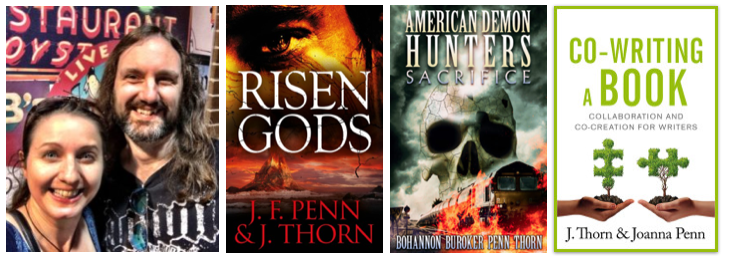
J. Thorn is a best-selling horror and dark fantasy writer, and he also writes non-fiction for authors. He's a podcaster at Writers, Ink, and The Author Success Mastermind, as well as an editor. J and I have co-written several books together, including Risen Gods, Co-Writing A Book, and American Demon Hunters: Sacrifice, the inaugural Authors On A Train event with Zach Bohannon and Lindsay Buroker.
Joanna Penn writes non-fiction for authors and is an award-nominated, New York Times and USA Today bestselling thriller author as J.F.Penn. She’s also an award-winning podcaster, creative entrepreneur, and international professional speaker.
Transcription of discussion
Now, today, we're talking about NFTs, and in particular, what we want to see in a platform for NFT books that will help authors sell more books, make more money, provide value to readers, and build community. So welcome back to the show, J.
J: Thanks, Joanna. I'm excited to be back.
Joanna: I'm excited to talk to you. So you and I talk about this topic offline away from the mic.
J: Yes, quite a bit.
Joanna: I mean, amazingly, we actually have conversations away from a microphone. People might not believe it but we do. So let's start with the basics.
How do you explain NFTs to a non-technical audience?
J: Not well! But I just read something today that I think really crystallized it for me.
An NFT is proof of ownership. That's all it is. It's a receipt. And I think when you frame it that way, things start to make a lot more sense. So it's not necessarily a physical object. It's not necessarily even a digital object. It's proof of ownership.
Joanna: I think that's one good way of explaining it. I talk about it as like a box. A box that you can put stuff in, and we'll be talking about some of the examples of the stuff you can put in the box.
But the NFT is essentially like the receipt showing you have access to the box, and then there are all the different kinds of things we can put in a box. I guess we should also say it is programmable in some way. So when you say a receipt, I might think in my mind, just a one-liner, which says, ‘I paid J some money and he edited my book,' or whatever. And that's like a one-liner. Whereas NFTs can contain, let's just use the word, smart contract which makes it more programmable, right?
J: Yes. It's an immutable digital ledger that is spread across many different computers. We'll leave out the highly technical stuff.
But the idea is with an NFT, from the time it's created or minted for its entire lifespan, you can track who's owned it and when by the address of the wallet of the owner. So yes, it's much more detailed than a single-line receipt, and it does contain the history of that particular NFT.
Joanna: And then I guess we have to use the term blockchain. But, again, as we always say, you don't need to know how the internet works to use the internet. So you don't need to know all this technical stuff. It's the same with blockchain.
I think what's most interesting at this point is NFTs can be on different blockchains. And the different blockchains have different properties associated with them. And I feel like some objections to blockchain technologies are because people have only heard of certain blockchains like Bitcoin.
So what are some of the other blockchains that you've seen that you think are more interesting?
J: Well, I think from an author's perspective, I'm not entirely interested in Bitcoin simply because Bitcoin is more like stored value. It's the digital equivalent to gold. So you can hold gold and it has value, and you can sell it. But people don't really use gold to pay for things. And in much the same way, they don't really use Bitcoin transactionally.
So I think for me, the next big one is Ethereum or Eth. And that one is the biggest blockchain right now as far as transactions go, especially with NFTs. But there are certain other side chains and level twos. And again, don't worry about the terminology. But there are blockchains like Solana, Avalanche, Polkadot, and Tezos. These are all different blockchains with different currencies that are popping up and filling different niches in the blockchain world.
Joanna: And that's where some of them are dealing with the carbon thing, and we'll come back on the environmental topic which I know some people just have it in their heads. So we'll come back on that one. And they also have different fees for different transactions. So all of this stuff is just evidence of growth in a new industry.
But let's also be clear on what NFTs are NOT as it relates to intellectual property.
J: Yes. I don't know if people are familiar with what happened with the ‘Dune' book, but it was auctioned, I believe, at Christie's. And the intention was SpiceDAO was going to turn it into an NFT project.
And their assumption, incorrectly, was that they owned copyright, or that they owned the IP to create derivatives or to change it. And there was a great article on The Next Web that said that would be the equivalent of saying you bought a Jar Jar Binks toy and now you have the right to make a new ‘Star Wars' movie starring Jar Jar Binks. It doesn't work that way.
And so really, you do not own the intellectual property, you cannot create in it or on it. Think of it more as a work of art. So if you go to a gallery and you purchase a painting, you own that painting but you don't own the intellectual property.
Joanna: Just to put it on the book perspective, just on a really basic level, someone goes into a secondhand bookstore and they buy a secondhand copy of your book. So they own that book and they can resell that book, but they don't own the intellectual property of that book.
They can't scan it, turn it into a Kindle book, and upload it onto Amazon and make money from it, or make a movie of it. So it's essentially exactly the same as the physical world as such, if they had bought a physical book, and then they just assumed they had this right to do stuff with it.
So you also mentioned the DAO which we should just explain briefly. DAO stands for a decentralized autonomous organization. And I'm thinking about it as a collective of people who come together and you can, again, programmable ways of running an organization. Let's not go into that because I'm going to have a separate episode on DAOs. I think they're incredibly interesting from a legal and business perspective.
But for now, we're gonna stick with NFTs. So just to be very clear, copyright is not assumed in an NFT unless that is specified. And of course, I had someone on the show last year who talked about the communities of authors who are trying to grant copyright within a community, a bit like the Kindle world, where the author who wrote in that got the copyright over their book within the world, but not over the whole world. [The Ownership Model with Jessica Artemisia in episode 561.] Does that make sense?
J: It certainly does. That's a good way of explaining it.
Joanna: So hopefully, that's given a bit of an overview and people who are new to this topic. Let's get into some more details.
Why are you so excited about NFTs and blockchain for authors? And what are some of the benefits you can see in the years ahead?
J: Yes. This is crazy stuff. I want to say, first of all, we are not tax professionals. We are not financial advisors. I'm barely scratching the surface of what Web 3 is. I'm an author who's really interested in this. So everything I'm going to say is not necessarily grounded in a ton of experience or research. It's my experience so far.
And what I'm really excited about at the highest level, because of where I was in my life stage in the early to mid-'90s, I feel like I missed out on the internet. Like the internet boom, right?
Like, if you think about what happened between, say, 1994 to 1999, there was an explosion of Web 1, starting to go into Web 2 with blogging and eventually, podcasting. And I was completely tied up in my day job and my family. And I knew what was happening but I wasn't really paying close attention to it. I wasn't participating in it. And this feels like that, and now I feel like I have the opportunity to participate. So I think on a very grand scale, I'm excited about a once-in-a-lifetime opportunity.
I have strong suspicions and feelings that Web 3, crypto, blockchain, all the stuff we're talking about is going to radically transform our lives, whether or not we understand the technology, in much the same way the internet has.
Joanna: Yes. Those of us in our mid-40s, 50s, started to hear really about the internet in the late 90s. I mean, I didn't get an email until I think '95, you know, an email address.
When we're talking about Web 1, we're really talking about static websites where it's like, you can't do anything. It was just like the Yellow Pages online (if you remember the Yellow Pages!).
Web 2 is the more interactive internet, blogging, podcasting, social media. I mean, what we're in now is still kind of the end-stage of Web 2, e-commerce, that type of thing on more interactive websites, creator, content, posted social media, that kind of thing.
Web 3 is what we're seeing with the metaverse, blockchain, converging technologies with AI, different ways of doing things that will empower the creative economy.
So what specifically for authors are you excited about in terms of, I guess, the creative or business potential of NFTs?
J: I think you're correct in saying potential, that is the right word. So what I'm going to discuss is not necessarily something that we can start right now, although the technology's there.
But what really has me excited about, specifically, NFTs for authors, is it's a paradigm shift. We are going to have the ability to sell directly to fans and readers to create communities directly without any sort of middle entity, without a marketplace. And I know we can do this now in selling direct, but I think here's the takeaway like, if this is all Greek to you or you don't understand what we're talking about, this is at its core where I think it's going to fundamentally change the way authors sell and do business is the digital resale.
So with NFTs and with the way you can structure a smart contract, an author can get paid on the resale of anything, whether that's a physical book or a digital book.
And if you think about that, you think about like, if you sell a paperback and someone who bought your paperback goes and sells it to a used bookstore, and someone else comes in and buys that book from the used bookstore, you as the author receive zero from that. But imagine, in perpetuity, you as the author receive 10% of that resell forever. I think that's just a radical idea that's going to completely change the way we do business.
Joanna: Yes. And that's why I think so many people haven't got this yet because it hasn't happened before. The penny hasn't dropped.
And the publishing industry and some of the things I've seen online from agents and publishers who… Well, I guess, this is another difference, right?
You and I (and the listeners) are creators. We create Intellectual Property. We are the Creator Economy.
And so everything we put out into the world with our name on it that we own the IP for, we get money for some kind of licensing on that. And it's all funded by what we actually make.
Whereas people who work in the publishing industry, generally get a salary that is not related to the licensing of their own IP. So I feel like sometimes people aren't understanding this because they aren't actually creators.
And I'm very excited about the same reason as you because resale opens up for the life of copyright. Okay, this is what's so exciting with a programmable smart contract.
So I create an NFT now and someone buys it for, let's say, $250. And, you know, that's nice. But what then happens is they can resell that over time and I get a percentage of that resale. So they could sell it next year, and maybe because I'm such a prolific creator, the value has gone up.
So maybe it's now worth $400 and I get 10% of that. So I get like 40 bucks, just turns up in my wallet. And then I do something and I manage to hit some list or I win an award, and suddenly the value of my IP is worth more. So my trading value on of my NFTs goes up too. And maybe I've created more limited editions of things. And so the value of my intellectual property suddenly just expands into this incredible realm. That's why I'm excited.
J: Yes. It's funny you used that example of winning awards or having a breakout hit, where I was thinking like, I'll probably say something stupid or get arrested, and that'll make the value of mine go up.
Joanna: Yeah, but there is that, you just don't know. I mean, the funny thing is I really feel like right now, this is fiction particularly.
The fiction business model right now, I feel, is almost broken because the rise of subscription models for ebooks and digital audio are tending the income for fiction digital products down. It's sloping down.
And so yes, sure there's print on demand. But many indies make far more with digital products for fiction, in particular. This doesn't count with nonfiction because nonfiction is, I think, far more resilient. And then you've got ads, the fact that we have to pay for ads. So I've been feeling for a while, like, frustrated that our business model just can't last another decade.
But this to me feels like the pivot, it feels like with special editions — let's call them special digital editions NFTs — we are suddenly going to explode and expand the fiction possibilities and the fiction business model.
Even with collaboration. Like you and I, right, we still have to fanny around with paying each other for various projects. You know, whereas if we had smart contracts, the money just arrives in your account, in your wallet automatically. So it opens up the potential for collaboration and so much more.
J: Totally agree. And I think this is probably going to bridge into the conversation around NFTs in the nonfiction space. But I think there are some opportunities in fiction that can build upon habits and behaviors we already have, and leverage the power of the technology.
So here's a very rudimentary example. Let's say that you as a fiction author offer a book club to your core readers. And let's say, you and 20 readers are going to get together and you're going to hold a book club meeting. And those people are coming to that because they're drawn to you, they want to support you. So imagine now that you sell an NFT that is your seat in this book club. And now you own that seat.
And as time goes on, if you want to sell it to someone else, you can. And as you mentioned, if your stock as an author goes up, or if you become more in demand, or your time was more limited, the perceived value on that book club seat grows as well. So it's just one small example of the way I think NFTs have the potential to really change the way fiction authors sell and market too.
Joanna: Well, let's get into that question then. So if the NFT unlocks a digital box of things, let's talk about those different things.
So you just mentioned access to a book club through an NFT. Talk about that in your idea for nonfiction-based community and masterminds?
J: Yes. So I'm currently in what I'm calling an NFT beta phase where I have a small subset of people within my author community who…they raised their hand and said they want to be part of this. And we don't have it all figured out yet, but we are in the middle of figuring out, okay, how can we create this subgroup, this smaller group that has access?
One of the problems with NFTs right now is that the lingo and the tech bros who are talking about this stuff are using language that excludes the average person because they feel stupid, like, they don't know what they're talking about. That's always bothered me with technology and it's still here, but, you know, it's not that complicated.
And having the ability to create access is different than buying a JPEG. So if you look at the news stories, all the news stories around, you know, ‘Someone paid $69 million for this JPEG, why would they do that?' And a JPEG is one type of NFT. It's probably the most popular one. But as you mentioned, if you think about it more as a digital box, you can put anything in there. Like Gary Vaynerchuk is doing really innovative stuff with his NFTs [Veefriends] that includes access to him, attendance at physical live events, and more.
So the sky's the limit here as far as what you can put into that digital box.
Joanna: Yes. So I guess what you're talking about there is the idea of a community coin which you and I are in some other kind of futurist communities around this, and if you buy one of these tokens or an NFT that can represent a ticket to something, then it gives you access.
And I was talking to a friend of mine who is a coach. And he was kind of struggling to understand this potential for his business model. And I was telling him about the NFT smart contract doesn't have to be for the life of copyright. It doesn't have to be a product. We'll circle back to products in a minute. It can be a service, like you're saying, it could be access to a community. And I said to him, ‘Well, it could be access to six months coaching.' So someone buys the token upfront.
But then I said, ‘What is awesome is this functionality called airdropping,' right? So you airdrop extra special things to anyone holding a token of yours. So maybe you've done a special audio that goes out to everyone holding your token, or maybe you've commissioned some art to go with your project, or maybe you just do something special which you can then airdrop to anyone holding one of your tokens.
And we were talking about the benefits for your long-term kind of client maintenance and brand-building of being able to send something, it's like, ‘Surprise, here's an awesome extra for you,' or you know, a lesson on something if it's nonfiction, or if it's fiction, a bonus chapter or something. And then it arrives in people's wallet. And it almost, I don't want to say it replaces email, but it becomes this way to deliver surprising delightful things to an audience who have already invested in you.
J: Absolutely. And as you mentioned, it doesn't have to be something that lasts forever. You can almost think of an NFT as an enhanced concert ticket.
So let's say a musician wants to put on a show and much like on a Patreon or Kickstarter, they create several tiers of access, and you purchase the NFT for whatever level of access you want. And once you've purchased that NFT, everything else is controlled by the program. So you could scan the NFT, you could sell it to someone else, you could trade it, the NFT knows where you're supposed to be, and where you're not. And especially in a digital world, I can fully imagine NFTs or tokens of some kind replacing membership software. If your membership site can read the address in your wallet, knows you belong there, you're just in. You don't need a password. You don't need to register. It's all automated, and I think there's a lot of potential there too.
Joanna: Yeah, absolutely. Well, let's talk about some of the other things you might do. So you're, obviously, incredibly great at communities. That's one of your superpowers, and it's not one of mine. And so I am far more interested in… I think even my dad's a visual artist. He was a sculptor and now he's a printmaker, and my brother's a photographer, and we come from a more of a visual arts family.
And I am also starting to create art around my worlds with AI generation tools, which is a whole ‘nother podcast! But I feel like for me, the business model I'm interested in is what I mentioned before, which is creating NFTs of limited digital editions.
So for example, with the short story, I just put out, Blood, Sweat, and Flame, which is set in the glassblowing world. That's just a short story, right? But the ideas I have for the NFTs I could do around that short story just opened the world up to other things.
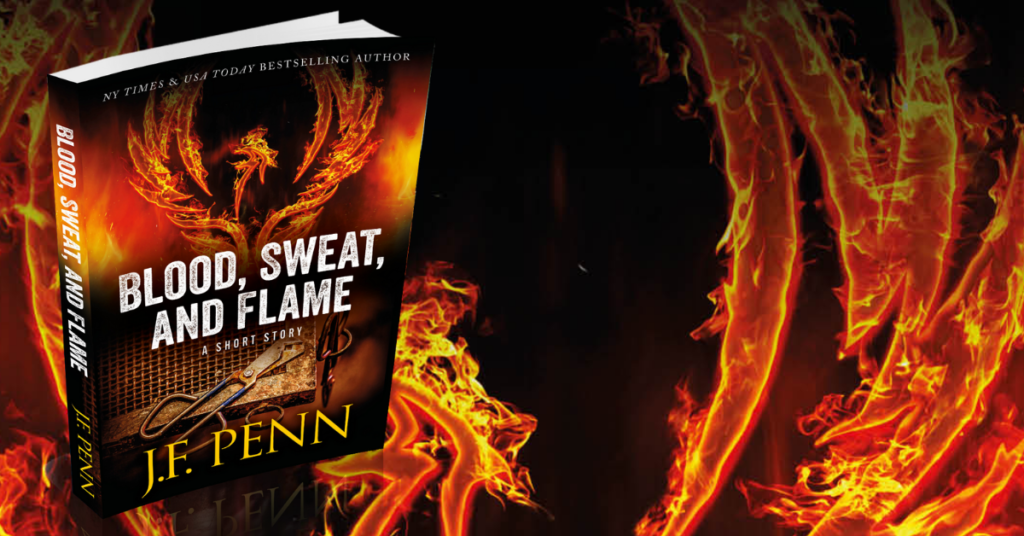
So a collaboration with an artist, or making my own art, for example, or creating a postscript on the story of what happened next, or collaborating with a glass artist to do a video. There's lots of things I can do to make a limited edition version of these books.
Now, in my mind, these are all individually different. So I only see myself doing like three or five, or maybe even 10 individual NFTs for each book. And that would be like a collection.
So the collection would be per book, and each one would be different. So even like, superfans might buy more than one because they love whatever it is that I've included. And then over time, my collections will grow and grow around the IP that I have in my universes.
And to me, this is making me feel so much more creative because I've got so many ideas that suddenly become viable within this space. And I know lots of fiction authors who've already commissioned art and things like this that they could include in NFT.
J: I wish I had more hours in the day, Joanna, because I'm like you. I can honestly say that the whole NFT craze of 2021 was the sole reason I started picking up my guitar again.
I hadn't taken my guitar out of its case for years, and I started to see what was happening and I thought, ‘Wow, music is another great place.' So you mentioned the graphic arts, which is clearly a wonderful opportunity. And the same with the visual and the auditory arts.
I think if you're a musician and you have the ability to create original music, you could tie that to your fiction to different stories. And I'm actively working on writing some music now that I think will tie into several things that I'm working on. And I don't need a major record label, I don't need to go through Spotify. These are things that my audience might be interested in, and I can sell directly to them. So I agree with you.
I'm so excited. It's really restoked a lot of my creative fire outside of just the writing and publishing.
Joanna: Awesome. I'm so happy to hear that. I hope people listening can hear our excitement. And I do feel like we're pretty, let's say, ‘mature' in the indie space. We've been around the block a few times in the indie world.
And I think it can become a little bit sort of, ‘Yes, I know how to write a book now, I know how to sell a book, I know how to market a book, and I'll just do it again.' And yes, every book is interesting in its way. But there's so much more that we want to do with the ideas. And this finally gives us a chance to do it.
So I do want to ask about another example, which you forwarded to me earlier, about royalty rights to songs. Now, this could also apply to books. So talk about this.
J: This is fascinating. And I'm not surprised it's happening in the music industry because artists in that industry have been exploited for a long time. And I think they see Web 3.0 as an opportunity to gain back some of their rights and their IP and their revenue, quite frankly.
NAS, big-time rapper, is selling royalty rights to two of his songs through NFTs.
And this is on a platform called royal.io and it's brand new. So there's not much there yet. But just to give you a sense of what's possible. [Full article on NME here.]He's creating tokens around one song. He created three levels, the gold, the platinum, and the diamond. At the gold level, which is $50, so you pay $50 And you get access to his Discord and you get some sort of…he calls it a sweet chick secret menu. I don't know what that is but it must be valuable.
Joanna: Sounds cool!
J: Yeah. And you also get 0.143% ownership of his streaming royalties on that song. So when that song is played, you're going to share in that revenue. On the platinum level, it's $250 to buy in. You get everything with gold, plus you get exclusive merch, and in that you get the 0.857% of streaming royalties. And then the top tier of the diamond, you get everything for gold and platinum.
You also get two VIP concert tickets, exclusive signed vinyl, a video conversation with him, and 2.14% of streaming royalties, and that package costs $5,000. So you can already see how artists are empowering…not only empowering their audience, they're bringing them along. And I think this is again, one of those fundamental differences.
You're not only supporting the artists but you are benefiting from their success. Everybody wins in this situation.
Joanna: There's a few things out of this. First of all, you've got baked in marketing for everyone who buys a token because everyone is incentivized to go stream NAS on whatever platform.
And of course, as we know, if you send traffic and get more people streaming, the algorithms like it, and they bump you up. So if you get all those token holders streaming and telling their friends, ‘Hey, stream NAS this weekend at your party or whatever,' you get baked in marketing which is brilliant.
Secondly, this is, I believe, is called fractionalization where you're essentially splitting this into micropayments, and this is exactly what we need in the publishing space. And just for something that people ask me all the time, I get so many emails, and I wanted to do this too with my first book, which is I want to give 10% of my profits to charity. How do I do that?
This is one of those ways. You could put in your smart contract a 10% fraction that goes directly to a charity's digital wallet if they set one up, that's another way of looking at it. But I think that's amazing.
I also love Royal, the CEO is 3LAU; I think you pronounce his name, Blau, 3-L-A-U. He is the one who got me into this. About a year ago, I heard him speak at a conference, online, obviously, because of the pandemic.
And when he spoke about blockchain and music, I saw our future because he's a creator, he is an artist.
And he's not well known as far as I know in the normal world. But he just ran with blockchain early, and the guy is just doing so well. And obviously now what he started, Royal, and this is probably going to be billions of dollars for him now because he's done the architecture for other musicians. So yeah, that's amazing, right?
J: It is. And it's very easy to just say, ‘Okay, substitute a novel for song,' right? Like, we can take the same structure and this is what I'm working on right now, is I want to be able to fractionalize the royalties from my books, and I want to be able to give 0.5% or 1% to hundreds, you know…well, not hundreds, I can't do the math there. But I want to be able to fractionalize and give percentages or parts of percentages of royalties to readers because now they're incentivized to, as you said, market the book, and everybody wins.
When the book sells, I make money and they make money. And it works all the way around. So the fact that this structure is already in place, that there are artists, creatives who are doing this, it's just a matter of time before it comes to us. And I can't wait for it.
Joanna: I agree. And this is another kind of principle of Web 3, right? So you're rewarded for participation in a community. So whereas like at the moment, you're on Twitter, and I like, ‘Oh, you know, J's my friend, I really want to support him. I'll tweet here about his book or whatever.' And then that's helping in a way. In the future, we'll be able to help each other or support the creators we love by buying tokens, we support them, we also get a cut. So that's really amazing.
There are now social networks on blockchain where you get rewarded for participation, and you get coins for what your participation is. There is obviously gaming, play to earn, I think it's called where you can play games on blockchain and earn coin, and there are people making full-time livings from this.
[Check out this introductory article on Web 3 by Yaro Starak. It has examples of all these different kinds of participatory platforms.]
So this is not the future anymore, is it? It's kind of right now.
J: No, it's not. And I'm not a gamer so I don't know the world. But I do know that NFTs and tokenization of gaming is probably what's gonna be the gasoline on the fire here.
Once the big companies get behind this, or once there are some indies who start understanding how blockchain works, because this is the kind of thing that's been happening with traditional currency for years. I mean, kids were, you know, in ‘Roblox' or ‘Minecraft,' or whatever you want to call it, they're going in there buying digital weapons and digital outfits, and this is already happening. So there's no stopping it.
Joanna: Yes. And we should say, you mentioned there, big companies. I mean, Microsoft just bought a massive gaming company which you guys covered on the ‘Writers, Ink,' which was great. But also I've seen news articles that YouTube's looking at NFTs, Twitter is looking at incorporating NFTs. Facebook/Meta is looking at NFTs [Financial Times]. And when these big companies are looking at it, that's when it will go more mainstream. I mean, let's just be clear, I have not bought an NFT. I am excited as a creator. There is a creator I really love but his work has already like blown up massively. But you have bought one. Tell us about that.
J: I've purchased a few NFTs but the one I'm really excited about is called ZIGGURAT.
And the ZIGGURAT was created by Mike Shinoda of Linkin Park. And he calls it a generative mixtape. So what he did is he created, I think it was 8,000 or 9,000 NFTs. And what he did was, they're a combination of a profile picture style graphic and music. And he created different characteristics, different variables. So everything from hair color to eye color to facial expressions.
On the music track, there were 10 or 15 different drum beats, different melodies, different instrumentation. So he created all of these core building blocks, so to speak, of both the graphic image and the audio. And then he fed that into an AI. And the AI then kicked out 8,000 unique NFTs. So no two are the same. Now they might share certain attributes, but every single one of those is unique.
And when I heard about this, I just thought that sounds like the coolest thing ever. And I went, and on the day it dropped it sold out instantly. It's on the Tezos blockchain. So I ended up buying one of the secondary market. I think the original minting, it was the equivalent of about $75. And when I bought it, it was maybe $110, so it cost me a little bit more. But I have one now.
And it's so creative and it's so unique. And I thought if I'm going to get into the space, I need to know what it feels like to be a fan, to be a consumer.
So I kind of got that experience and it was really fun. And people are tired of hearing me talk about it because I share it everywhere, but it was a great example of being super creative and using the technology in a way that hadn't been done before.
Joanna: And it's funny because you talked about it, I was like, ‘Oh yeah, I used to listen to Linkin Park back in the day, put them on the Spotify playlist, revisiting like, '90s when I used to listen to these things.' So I think it's really interesting. And what you've done there is you're a fan of the music, you know that creator. I mean, he has name recognition amongst certain people, obviously, but you're a fan. So that's a great example.
That generative mixtape idea, I actually did a one-hour tutorial on how to do that at the weekend. And it was for the visual ones. And I mean, I'm not a programmer, but this guy really kind of took it from even if you don't know programming you can do this.
And this is kind of a sub-question though because I've been into AI generative work for a while now and words, as well as images, and you're talking about music there, but you were not that much of a fan of AI art generation a year ago. So has that changed?
J: No, it hasn't. I knew you were gonna put me on the spot on this, I was prepared. This might be semantics and maybe I just need to get over myself, but I think the difference here is that Mike didn't use AI to create the components, he used it to assemble them.
Joanna: But that's what I do, I assemble. I put the input in and I assemble what comes out. So yes, I think it is semantics.
For example, it's been going around in the art space, the WOMBO Dream app. Rachael Herron put some of her pictures. Get the app or get it on your desktop. And what I'm doing with that is I'm creating like word clouds separately from my novels. And then you create images with AI from a string of words. So you enter the words and then it outputs a unique image based on your words. So your words will always be different to my words. And, essentially they're going to have a minting button soon.
J: Of course.
Joanna: I love this idea that I can take my words and turn them into visual art. And in the same way, there's obviously now AI generative music which is another art form. So I mean, this is a sub-topic. We're going to come back on this sub-topic, I think. But that's just on a practical level. For someone to create 9,000, 10,000 individual NFTs, you have to have some help.
J: Yes.
Joanna: Because I said before if I do 3 or 5 or 10 because I'm going to individually make them, which is different. I can assemble those separately. I don't need an AI to help me create them. So I think people have to consider what kind of collections they want to do, what kind of audience they're looking for. I mean, you wouldn't do 10,000 community tokens, would you, I guess?
J: No. And I mean, even going back to Royal, like, there were only…I think there were only a total of 750 tokens, 760 tokens total. So yeah, it doesn't have to be a crypto punks or a massive collection, you can make one of ones. And I think that's more of what you're talking about.
Joanna: Yes. And I think, again, that's because I guess what I've seen my dad do as a visual artist. And it's so funny. And one of my phrases for this year is “more digital, more physical.”
So as in, I want to get more into all this digital stuff but I also want to do more physical stuff. So I did a bookbinding course years ago, but I'm going on another one.
I want to make physical products too. I want to make limited edition physical products.
And then on my JFPenn.com redesigned website, which I'm going to do later this year, it will have limited editions as a page. And on that page, it will have limited physical editions and limited NFT editions. That's how I want to educate people.
J: I love that. And I'm thinking along the same lines with music and thinking of doing the digital files, obviously, but maybe a limited press vinyl, or a limited number of CDs. And so in the physical world, as well as in the digital world.
Joanna: There you go. And I hope…that kind of crosses the gap, doesn't it? These are limited editions. But equally with those physical products, once they're sold, they're gone.
J: Right.
Joanna: They are gone. So you're never gonna get any more money for that. But I just like the idea. I think that's cool. Okay, anything else on any ideas? So look, and this is just off the top of our heads and we haven't even started yet. I mean, you can put video in, you can do audio, obviously, I'm going to do scans of my hand edits.
I love the partnership idea with other artists. In the past, we've obviously done written products together like Risen Gods, but you can do an NFT for an audio-only product, like a private conversation between Joanna Penn and J. Thorne. There are lots of things you can do that people will be interested in if they're in your community, I guess.
J: Absolutely. And as we said with the whole smart contract thing, it doesn't require us finagling around and doing all the accounting.
In the smart contract, we put ourselves as co-creators and our percentages, and then anytime that sells, it just ends up in our wallet.
Joanna: Yeah. So I guess both of us are…I mean, you're more heavily into the music space, I'm probably more heavily into the art space. But we're watching these communities who are ahead of us like, they're ahead of publishing. And music's always like two to five years ahead, would you say?
J: It feels that way.
Joanna: So I would say we've probably got at least another year before we get a platform that works for authors. Well, let's talk about platforms. Okay. So everyone's now really excited now — if they haven't turned off already!
J: The people who are here are loving it, though!
Joanna: They are like, ‘Yeah, tell us more. Tell us more. How can I do one?' Okay, so hold up, hold your horses. We're recording this on the 26th of January, 2022. We're going to probably do another one of these in a couple of months, right?
J: It will all change.
Joanna: It'll all change. But the principles should remain. So there are different companies emerging with different business models for NFTs in publishing.
And I do see some early adopters jumping in. I've had some people on my podcast like Creatokia and Bookchain. I've got some meetings with some other people. You've had some meetings with some other people. There's already like 10 on my list already.
What are your thoughts on any companies you want to mention and anything that you've seen is particularly interesting?
J: Well, the one I want to mention, and I'll be fully transparent and say that I'm a moderator on their Discord server, so I'm not getting compensated monetarily, but I'm definitely interested in what they're doing, is bookcoin.com.
Out of all of the NFT book sites that are popping up, I'm most intrigued by Book Coin, and for a number of reasons. If you go to bookcoin.com, I think their messaging is crystal clear, and they're trying to carve out a market. And right now, what their value proposition is, “own a quote, a character, or a chapter from your favorite book.” And their first drop is going to be next month in February of 2022. And it's gonna be Mark Manson's book and a New York Times' bestseller.
Joanna: We should say that is ‘The Subtle Art of Not Giving a F***,' which I'm sure everyone's heard of. It was one of the first to use that language in a book title, and then everyone did it.
J: Yes. And it was massive and is massively successful. Mark Manson just finished working with Will Smith on a memoir. But anyway, the Book Coin guys, they have Alan Watts and Alan Watts collection coming up after the Mark Manson drop.
Joanna: I don't know who that is.
J: Yeah. He's a sort of 20th-century philosopher type, I guess would be the best way to describe him. But I think what Book Coin is doing is they're starting with name recognition. They're starting with authors that everyone knows as a way to bridge that gap.
And I think that's an approach I really like because until they have a platform that's mature and developed, and that readers feel comfortable going to, indies or self-publishers have no hope of getting any discoverability. So I'm really interested in Book Coin. And as I said, I'm working for them as a moderator because I really believe in what they're doing. And that first drop comes next month. So I think things are gonna start rolling pretty fast there.
Joanna: Okay, that's interesting. Now, Creatokia who I had on the podcast in episode 583, I've been talking to them about things and they're working with a lot of the publishing industry. They're a German company and they're very well known for their work in digital audio and ebooks within Europe.
So what's interesting about Creatokia, I guess is because their company is Bookwire, they have a reputation in the publishing industry. They're also German and the EU has rules around crypto, around finances