![Creativity, Collaboration, Community, and Cash. NFTs For Authors [Audio] With Joanna Penn](https://www.thecreativepenn.com/wp-content/uploads/2024/04/TheCreativePennPodcast2024-1.jpg)
Creativity, Collaboration, Community, and Cash. NFTs For Authors [Audio] With Joanna Penn
The Creative Penn Podcast For Writers
Audio is streamed directly from the publisher (media.blubrry.com) as published in their RSS feed. Play Podcasts does not host this file. Rights-holders can request removal through the copyright & takedown page.
Show Notes
I've spent the last 15 years building an author business on Web 2 — digital publishing, blogging and podcasting, social media, and more.
But as Web 3 begins to emerge through blockchain, NFTs, AI, and the metaverse, I want to make sure I still have a thriving business over the next 15 years.
NFTs are an important part of the future business model in the Creator Economy and in this presentation, I explain why they're important and how authors can consider using them.
In the intro, I give an update on my first couple of NFTs, minted on OpenSea, the potential impact of President Biden's blockchain and crypto Executive Order [The Verge];
In the main section, I go through:
- Who am I, and why am I talking about NFTs? My technical background and how I've embraced technology early in my author career so far
- What is an NFT?
- Different blockchains — and energy requirements
- Why do we need NFTs? Ownership and resale; flexing in the metaverse, and erosion of royalties + paid ads + inflation = we need more income streams from our IP
- Six different types of NFTs that authors can consider, and how they are being used in other industries
- Why digital scarcity enables more creativity and collaboration
- How smart contracts enable easier collaboration and a simplified payment system
- How blockchain and smart contracts (and DAOs) could change royalty payments, estate management, and more
- What we need in an NFT solution for publishing
- How do NFTs fit into the current business model? What is a potential future state once the technology goes mainstream?
- What action should you take right now?
You can find more resources at thecreativepenn.com/future
For a broader look at web 3 and emerging technologies, check out my book, Artificial Intelligence, Blockchain, and Virtual Worlds: The Impact of Converging Technologies on Authors and the Publishing Industry.
If you have any comments, tweet me @thecreativepenn or leave a comment under the video or on the post.
Thanks again to my patrons who sponsor these futurist episodes, and if you find them useful, you can support the show at patreon.com/thecreativepenn and get the monthly Q&A coming soon for March.
Or if you don’t want to commit for a monthly payment. you can also buy me a coffee or two at BuyMeACoffee.com/thecreativepenn
Transcript of the introduction
I put the main section out as a video on YouTube and on the blog, but I know many of you prefer audio only — I do too! So I wanted to put it out on the audio feed as well, but I also have an extra section upfront, an update — as I mentioned on Monday’s show, I minted my first NFT on Opensea, and it sold immediately, so I minted another one, which also sold immediately! I wanted to talk briefly about this before playing the presentation as things move on apace.
First of all, the book-specific NFT platforms aren’t ready quite yet, although many are almost there, so I decided to mint some of my AI generative art, which I’ve been playing with for a while.
This is not out of the blue for me. My family are primarily visual artists. My dad’s a printmaker, one brother is a photographer, my other brother is a 3D fashion designer, and one of my sisters designs textiles and interiors for superyachts. We are indeed The Creative Penns!
I already dabble in visual art. I take thousands of photos during my research trips (some of which I share on Instagram @jfpennauthor ). My fiction is very visual and sense of place is important to me, as you can also discover through my Books and Travel Podcast. For my AI generative art, I’m using my own photos of places combined with words from the books about that place, and then remixing those images and curating until I find one that resonates with me.
Of course, art is subjective, but since I’m the writer and the photographer, I can curate the output based on many iterations of AI images. I love love love playing with generative art. It is so much fun!
On 11 March 2022, I made my first NFT, Rain soaked the ashes of the dead, by combining one of my pictures from the burning ghats of Varanasi, India, which inspired the first scene of my first novel, Pentecost (later republished as Stone of Fire) with a prompt of the first line. “Rain soaked the ashes of the dead into the winding Varanasi streets as rivers of mud ran down to the holy river Ganges.”
The image is the NFT, and the special edition of the ebook of Stone of Fire is ‘unlockable content.' There is a smart contract attached to it that says I get 5% on any resale.
I used OpenSea as it's known as ‘the Amazon of NFTs,’ and it has an Art category. I chose the Polygon blockchain, which is less energy-intensive than Ethereum, but OpenSea still prices in ETH. I couldn’t use an auction for this setup so I just priced at 0.1ETH (around US$250 at the time of minting).
The first NFT was bought quickly, so I made another one, Inscribed in an ancient hand, from a picture of the Radcliffe Camera, part of the Bodleian Library in Oxford, and another line from Stone of Fire. “The names of each School were written above the wooden portals, inscribed in an ancient hand, gold-leafed and stamped into thick oak, banded with copper.”
It was also bought almost immediately, which is encouraging!
These NFTs are art, rather than books. A special edition of the ebook of Stone of Fire is included in the Unlockable Content, but that is not the NFT itself.
I have plans for lots of different types of NFTs, some of which I’ll talk about in the presentation ahead. They include a video of me writing my novella, Tomb of Relics, with GPT-3 tool, Sudowrite, and also PDF scans of my drafts, and of course, special NFT editions of my books, which will be limited edition but not unique.
These first generative art NFTs are unique. They are 1 of 1s, and I’m experiencing surprising feelings that I didn’t expect and that go some way to explaining the interest in this space.
I have never created something that is a 1 of 1 before.
When we write books and publish them, we expect to sell many copies of the same thing. Each book is interchangeable, or fungible. When I minted these first NFTs — non-fungible tokens — they were in my wallet on OpenSea. I owned them. But when I listed them for sale, and they sold, they disappeared from my wallet and exist now in other people’s wallets. I don’t own those images anymore.
Even though I have been thinking a lot about this, the experience of the NFT disappearing out of my wallet clicked something in my mind around what ownership truly means in the digital realm.
It is special to own something unique, and I feel almost sad to know that I don’t own that anymore. In fact, I have a few images that I love so much that I might mint them, but not list them for sale. I want to keep them, but I can also see that as an NFT artist, I want to have them displayed on my profile. You can find my NFTs on opensea.io/jfpenn and more detail at jfpenn.com/nfts
Of course, there is so much that I want to do — and that is part of the creativity section of the presentation coming up.
If you want to play with AI generative art, I mentioned WomboDream on the podcast a while back, and because I use Sudowrite, I got access to their Sudomake.art beta. I love that I can use my own words and my own images, combined with AI, to make something new. I also think it's easier to understand how AI prompting works with a medium you don't excel in already.
I also cover a lesson AI generative art in The AI-Assisted Author (50% off, so it's under $100, if you use coupon MARCH22 until 31 March!)
If you are still doubtful about NFTs and blockchain as an emerging economy, remember that President Biden signed an Executive Order on blockchain and crypto last week.
The Verge reports “the order legitimizes digital assets by treating them as worthy of measured regulation,” “instructs agencies to develop policies that will protect consumers, investors, and businesses, as well as to guard against systemic risks,” and “it also directs the Department of Commerce to figure out how to keep the US competitive in the development of digital assets.”
The days of wild west crypto will recede and with regulation, we’ll see the development of a lot more platforms that are more easily used by more people. It’s essentially the beginning of web 3 going mainstream. You may not even know that the platforms you use in the future use blockchain architecture, you’ll just use it.
If you want to get into this space now, you are still early, but there is no need to do anything. You can just wait and watch and see what emerges. I shall be a crash test dummy as ever, and no doubt make mistakes along the way, but hey, I just can’t help myself!
Thanks again to my patrons who sponsor these futurist episodes, and if you find them useful, you can support the show at patreon.com/thecreativepenn and get the monthly Q&A coming soon for March.
Or if you don’t want to commit for a monthly payment. you can also buy me a coffee or two at BuyMeACoffee.com/thecreativepenn
Transcript of the presentation
Hello, Creatives. I'm Joanna Penn, and this is a presentation on NFTs for Authors: Creativity, Collaboration, Community, and Cash.'
So, first of all, who am I and why am I talking about NFTs?
I spent 13 years as a business consultant, implementing financial systems for consultancies like Accenture, Capgemini, and other firms in Europe and Asia-Pacific. And so, I have a background in technology, although I was never a programmer.
I started writing for publication in 2006 and started self-publishing in 2008 (see my timeline here). As a businesswoman, I embraced digital publishing, ebooks, and all of that, before it really became mainstream.
I was able to leave my consulting job in 2011. So, I've been a full-time creative entrepreneur running my own business for over a decade.
In terms of other technology, in 2009, I started The Creative Penn Podcast, well before podcasting went mainstream. It's now had over 6.5 million downloads in over 200 countries. And it is one of the longest-running podcasts for writers and creatives with over 600 episodes. I tend to embrace technology reasonably early, certainly not the earliest to adopt but, you know, reasonably early.
So, over the last decade, I've built a multi-six-figure business basically as an individual author. I work with freelancers but I'm, you know, what one could call, ‘a solopreneur.'
I've built this business on what is known as Web 2.0 — the internet as we know it right now. What I can see ahead are changes to my business model. So, this is an entirely selfish endeavor to try and protect my business as we move into Web 3.0!
And as I learn things, I like to share them with my community. So, really I'm looking at NFTs and blockchain as the architecture of what may become my business model in the next decade. And certainly, I'm in my late 40s and I really want to be doing this business for the rest of my life. And, inevitably, businesses change.
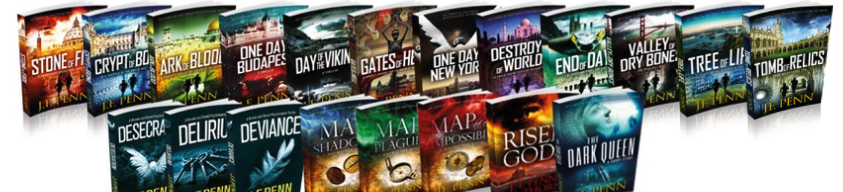
In terms of my writing, I'm an award-nominated New York Times and USA Today best-selling thriller author, as J.F. Penn, and I write non-fiction for authors under Joanna Penn.
I've got around 35 books and I've sold nearly a million books across 162 countries and 5 languages. I'm also an award-winning podcaster and creative entrepreneur and I'm an international professional speaker. I'm a futurist and I'm very interested in how these technologies will change things in the next decade.
What is an NFT?
Well, just in terms of a definition, NFT stands for non-fungible token, which, let's face it, is a terrible acronym!
It's defined in this book, The NFT Handbook by Matt Fortnow and QuHarrison Terry, which is a really good introduction, as “unique digital collectibles secured by the blockchain.” And also an NFT provides “authenticity of origin, ownership uniqueness, scarcity, and permanence for any particular item.” There are a lot of interesting things within this, and we'll explore various parts of these terms as we go through.
But just for now, think about it as a collectible. And since we're authors and rights holders, it's really thinking about, well, the equivalent of a physical collectible, so, a special limited edition hardback with a lovely leather cover with gold embossing hand created by the author, that would be a physical collectible. And we're talking here about digital collectibles, and we'll go into more detail.
But what is dramatically different from a physical, collectible book is that NFTs can be programmed with a smart contract.
So, this is where things become very interesting, because smart contracts allow for automated transactions without manual processing.
When I mint a NFT, and ‘mint' on the blockchain is, essentially, publishing it, publishing this edition on a blockchain, I can put a smart contract with it which says things like terms of the license, the use of that intellectual property, the resale percentage, the ownership, and much more. And I'll come back to all of these things, but that's what is truly different. It is, essentially, a digital product but it can be programmed.
So, it gives it so many more possibilities for functionality but also for payments. And, as authors and rights holders, we are very interested in making more money from our intellectual property!
So, just to come back to the phrase ‘minted on a blockchain.' And, of course, this area is full of different language, but so is every area of publishing, there's always different language, so, try not to get too bogged down in the language, just accept that there's always another language.
So, minting is, essentially, publishing on a blockchain. You don't have to understand blockchain in order to use it. I'm sure you don't understand the https protocol for using the internet. You can send money on PayPal without understanding how that works. And this is the same. You don't need to understand the technology of blockchain to think about using it.
But the point is there are different blockchains and they have different functionality and energy usage.
And, of course, this is one of the issues that people have with NFTs at the moment, as I record this in the late days of February, 2022. And it's very important to time and date stamp this actually because things will change.
But I will direct you to a site called cleannfts.org where they list out what are the different eco-friendly blockchains. So, when people say, ‘Oh, the blockchains will destroy the planet,' there are different uses on different blockchains.
Here's an example from the Flow blockchain, which is fascinating, it says, ‘1 minute in a hot shower is 382,000 Flow NFTs,' so, and, ‘1 mile in a car is a million Flow NFTs.' So, when people say, ‘Oh, you're destroying the planet with creating NFTs,' well, compare that to some of the other things that you probably do every day. Or here, ‘1 Google search equals 12.5 Flow NFTs.' So, have a think about that.
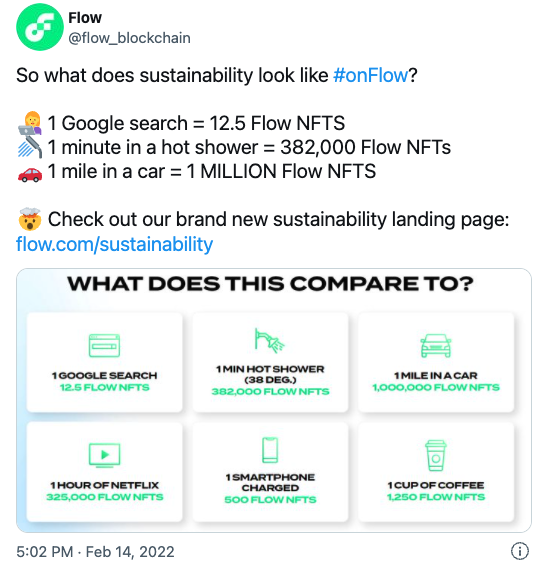
And if you're going to look at doing NFTs yourself, then consider an eco-friendly blockchain. Now, personally, I think that they will all become eco-friendly, it's just a matter of time because this is a problem that people in the NFT and blockchain community absolutely want to solve.
Why do we need NFTs? Don't we have a perfectly good publishing system already?
So, you might be thinking, ‘Well, why do we even need NFTs? We have a perfectly good publishing system already. Why do we need to go into this?' Well, there are a few reasons.
First of all, ownership and resale of digital products.
This is something that many readers don't even understand, but readers do not own digital files in the current ecosystem. If they read on Amazon Kindle, if they read on Apple devices, or they listen on Audible or some of the other platforms, these services, these companies can remove access at any time. And indeed, we've seen this. If a customer has their account removed, the person loses access to all those things.
Essentially, a reader has paid for something they do not own, they have a license to read it but they don't own it, they can't resell it like they could a physical book. And NFTs make it truly possible to own this copy of the book and resell those digital products.
This resale market for NFTs is something I'll come back to because I think it's really amazing. With smart contracts and resale, it means money coming down the pipe for many many years into the future. And let's face it, we all like automated income streams! And this will allow it.
The second thing is flexing your bookshelf in the metaverse.
So, yes, sorry, more jargon, but people increasingly live inside digital realms. And I'm sure you've been aware of the news around metaverse and the different places that people will gather virtually.
I don't believe there will be any single system. There won't be ‘the' metaverse in the same way there won't be ‘the' internet — it is lots of different places. NFTs are being used to flex identity, or show what kind of person you are, in the metaverse.
And this terminology is kind of the reason why I have my books behind me is I'm showing you what type of person I am. And that's the same reason why people put a particular NFT as their avatar on Twitter or they, you know, might carry a particular brand or wear a particular brand. It says something about you as a person in the way you dress, in the things that you carry, in the way you portray yourself. And we know that branding is super important.
Now, art, music, gaming fans are already flexing their NFTs online and in the metaverse. And so, publishing has to catch up because book lovers, bibliophiles, people like us, we love our books.
If I walk into someone's house, the first thing I do is look at their bookshelf, and I'm sure you do too. That's the type of people we are. So, when I think about the future…and again, not right now but in the next couple of years, 5 years, 10 years, if I do this presentation in a metaverse space, then I'll want to do it in a space where I'm surrounded by my books. And that may be using NFTs, which will be, essentially, original digital products that I've bought to display what I think is important in the metaverse.
So, both of those are really from the reader perspective, from the end-user perspective.
In terms of authors and rights holders, digital income and author royalties are being eroded.
Now, in the same way as we've seen in the music industry, what's happened with streaming over the last few years, streaming and subscription models, is that, while the cost of creating the original product is still the same, we then have to, essentially, get lower payments for our books when they're borrowed, when they're checked out.
These are micropayments, payments essentially per stream, per subscription, per page read, per listen, whatever they will end up being. And this isn't going to stop because, from a reader and a listener perspective, from my perspective as a reader and a listener, subscription models are incredibly good value. So, they're not going away. In fact, they'll probably increase.
So, while subscription and streaming have increased the audience for our work, they've also eroded the royalties. And this is why the music industry has jumped headfirst into NFTs because they're a couple of years ahead of us and they've seen the erosion of income through micropayments and, so, they're looking at different ways to make more money from intellectual property.
Now, at the same time, we've had erosion of royalties, we've also had the rise in paid advertising, which eats into profits at the same time and has become basically non-negotiable for authors, publishers, rights holders in order to get our work in front of readers and listeners.
So, while we've got, you know, income coming down and ad costs going up, both of these things are squeezing the income streams. Also, we've got inflation and most of the prices have not risen in line with inflation. So, the money we are getting is worth less over time. And with caps on the price of digital products, we need something new.
So, basically, authors and rights holders need to make more income and readers want to own digital products, resell digital products, and support the creators they love.
What are the different types of NFTs?
Right, let's get into the different types of NFTs for authors. And these are just some that I've come up with based on the other things going on in the blockchain space. But I'm recording this at the end of February, 2022, and it's very likely that other things will emerge over time. But this is a good start.
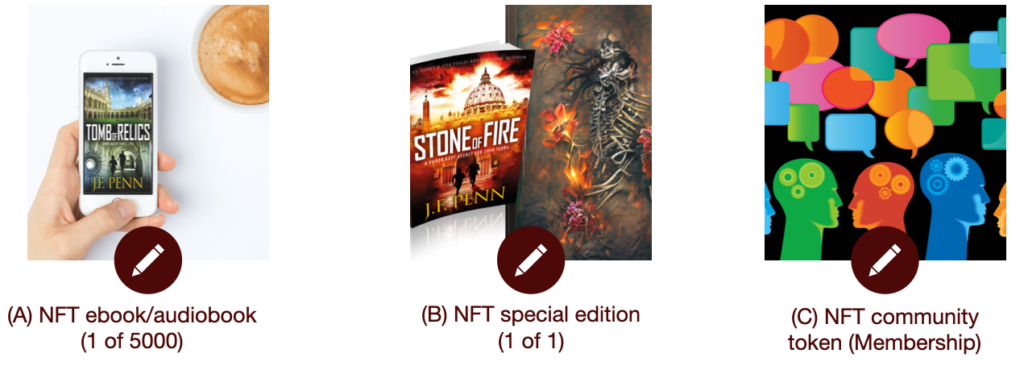
(A) The NFT ebook or audiobook
Now, this is, essentially, the same product as we already publish on the other stores but the difference is that, by publishing on blockchain as NFTs, these can be bought and owned and resold and the smart contract will distribute money to the authors and rights holders and whoever else you put in the smart contract as part of the ecosystem.
There might be digital extras within these. It might be a limited edition here, for example, one of 5,000 might be the particular run. But the important thing here is the ownership and the resale and the smart contract.
(B) The NFT special edition
I'm calling this my one-of-one. And here's an example, this is my first novel, ‘Stone of Fire,' with an AI-generated piece of art, which I love and actually I'm keeping as my own NFT, but it's really important to think about how we can create things that will surprise and delight readers that they might be really interested in.
So, also, for example, I'm thinking of putting my entire hand-edited draft into an NFT, and that might be interesting to both readers, but also for authors to see behind the scenes on a manuscript. I'd certainly be interested in owning that from Stephen King or someone like that. You can see the value.
I'm also considering doing videos that might go with these but, essentially, they are special editions in the same way that you might do a perfectly hand-tooled print edition. This is a special digital edition. And I like the idea of one-of-one. Some people are doing 1 of 10. And obviously, there'll be different price differentials on that but a true one-of-one, essentially, is an equivalent to the pieces of art that we're seeing in the world.
So, when you consider what you might do for NFTs, it's interesting to start thinking of what you might do for these one-of-one products that will be truly special, that will be interesting to both the readers and the fans and also the whole community that's built up.
(C) NFT community token, also potentially known as membership
This can give access into special channels. So, Discord is being used because it's, essentially, linked to NFT tokens so you can give special access. Maybe it's a readers group, maybe it is a group of genre authors joining together, maybe it's a coaching add-on to your non-fiction book, maybe…well, there's just so many things that you could possibly do with this.
This may, potentially, replace membership websites because tokens are much more easily used as access. So, this will enable authors, publishers, rightsholders, genre communities, author organizations to create spaces where people can buy access but then the buyer can also, potentially, sell their token on. Of course, you don't have to allow resale, that's just one of the possibilities. The idea with a smart contract is that you can put whatever you like in it, which is the power of it.
So the NFT community token is interesting because a lot of people want to pay for access. Again, I mentioned Stephen King, one of my favorite authors, I would definitely be buying a community token for Stephen King to get on video once a month and talk about his writing process.
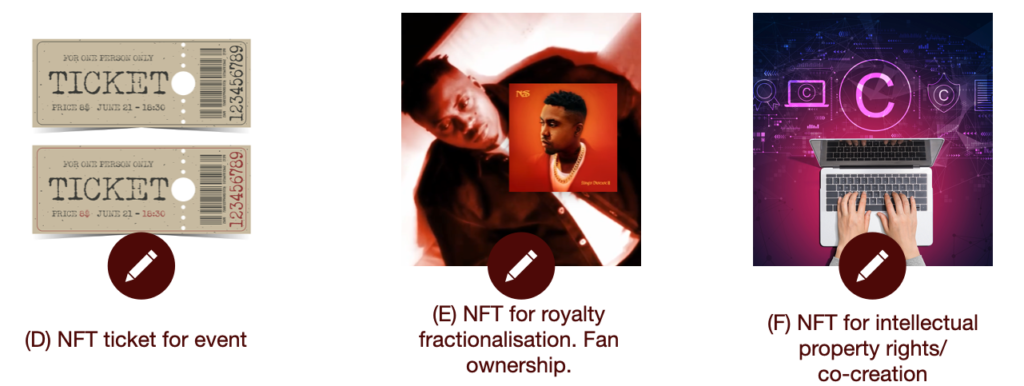
Now, these are some of the more developed aspects that we're seeing in the music industry.
(D) NFT ticket for a physical event or it can, obviously, be an online event
These are actually limited-time tokens that allow access into that event rather than that sort of membership ongoing thing. The ticketing industry is totally enamored with this because in sports, people resell tickets outside stadiums and the original rights holders, the people who own the rights to that basketball team or whatever, they're not getting any extra money from resale. What NFT tickets allow is a percentage of resale of a ticket to go to the original rights holders.
So, in terms of authors, this could be book launch events. This could be, again, a group of authors getting together and doing an event and selling NFT tickets. And then the NFT can be used to, they call it, ‘airdrop,' which is, essentially, a new piece of content will arrive into the token holder's wallet. And that may be the book for the evening, for example, or that may be a recording of a presentation.
So, the ticket idea, it's unique and it expires. So, it might be able to be resold up to the point of the event and then it might be cut off or, if it's some truly awesome event, it might also have resale value after the fact if it includes all of that extra content. There are so many possibilities with these, and I just want to scratch the surface with this.
(E) NFTs for royalty fractionalization
This is already happening in the music space, royal.io has enabled the rapper Nas to fractionalize the royalties on his streaming. So, they must have worked out a way to publish through a blockchain with a smart contract involved and then you can buy an NFT — well, you can't now because they all sold out — but other artists are starting to do this, you buy an NFT and you get a percentage of those streaming royalties.
So, it's essentially a form of crowdfunding, but also has a form of ownership. So, as a fan, I can own 0.001% or whatever percent of this song or these songs or this album or this book and then I receive money into my wallet as other people stream it.
I love this idea because it bakes in marketing. If you are a fan of Nas, or a fan of Stephen King, if you buy a fractionalization of that book, then you are totally incentivized to go and market that song, book, whatever. You're going to encourage your friends to read it and download it and you're going to just have built-in marketing for the people who've, essentially, bought into the future of this product.
So, this is a very interesting model. It is entirely dependent on being able to automate the publication and streaming and royalties, which is what blockchain offers. And I will come back to that for my future state of publishing later.
But I think this model could be fascinating for those authors who have created a fan base and who want to do something very interesting with their book without the overheads of manually distributing tiny, tiny, micropayments to all of those fans.
(6) NFTs for intellectual property rights and co-creation
So, what we're starting to see is NFTs in collections around a digital world. That might be actually built in a metaverse place, but it might also just be for publishing other books or songs or whatever.
So, essentially, you buy an NFT, and then that gives you the IP rights to use the content of that NFT in creating more products. So, we've seen this with some of the famous art NFTs where people have got the rights to turn that into merchandise, so, say, T-shirts with that image on.
Now, in the past, this has not really been possible, you've had to do licensing agreements. But what this NFT enables is, essentially, to set it up in advance. So, you've created a smart contract that, essentially, gives the rights to the rights holder to do certain things. And it's a contract, so, it actually has it all up front.
Now, most NFTs don't include the right to do that. They're just another copy, but this NFT type is, essentially, almost a co-creation. Now, I would equate it to what Kindle Worlds did a few years back, which was an author created a world, fiction world, and then other authors were allowed to write in that world and use characters within that world because the Kindle World's contract allowed them to do that.
And this is how I see the NFTs for IP rights could look like in the future. And there are jobs in the metaverse called ‘lore master,' people who are creating these narratives around digital worlds in gaming etc, and different NFT products so that people can then go and use them to do other things.
[More on this model in The Ownership Economy: Business Models Around NFTs with Jessica Artemisia]
And again, it's a way of expanding your brand, it's a way of creating other products, it's a way of buying in with the community so that we can all profit together. It's a very interesting model.
Creativity, Collaboration, Community, and Cash
So, these are the four areas that I think are interesting, creativity, collaboration, community, and cash. So, first of all, creativity.
Since getting into this NFT space, I've come up with literally hundreds of ideas for NFT s around my IP.
So, I have around 35 books at the moment, fiction and non-fiction, and I have ideas for all of them. This example, ‘A Thousand Fiendish Angels,' which was is based around Dante's Inferno and features a book of human skin (I just can't help myself!) but I've come up with lots of ideas just for this. And this is a trilogy of short stories, essentially a short-story collection, which I can think of absolutely tons of ideas for NFTs. That's just one book.
So, when you get into this, the creativity sparks start going and you start realizing what the possibilities are. So, it's turning our digital intellectual property into so much more.
And of course, it's cheaper to create digital products but that doesn't mean they're worth less.
If we have true digital scarcity, we can create awesome, surprising, delightful, wonderful products that people are interested in.
We can also use video and audio to add to our ebooks and enhance these products and we can do stand-alone NFTs.
So, for example, I do a lot of podcasting and I have a lot of private conversations with creatives that, potentially, we could collaborate in turning those into NFTs. I'm certainly interested in, you know, listening into a conversation by two writers I love and, you know, buying a token for access to that. So, there are lots of ways we can create these one-off products, as well as the products based off our IP.
I also love the potential of commissioning art for different aspects of the books. Or also using AI art generation. There are some really interesting tools for using words to create art now. You can take a passage from a book and generate an original art piece from it, and that can become the token with the text.
There are also lots of ways to collaborate with authors and other creators through NFTs.
And this has been traditionally very difficult. So, this is an example of a book. I co-wrote with my friend J. Thorn, Risen Gods, it's set in New Zealand, it's, again, got a lot of visual stuff we could do with it.
But J. and I, we have a co-writing contract, we published this about 5 years ago, and I published it under my company. And I have to pay J. every month or every quarter. Essentially, I have to go through all the reports, I have to figure out how much I owe him, I have to send the money. It's all manual. And this is what's done across the publishing industry. Obviously, there are a lot of systems, but they're all diverse systems. There's a lot of paperwork and manual work around collaboration.
Now, there are beginning to be things you can do with ebooks. So, Draft2Digital, for example, includes payment splitting. But if you want to do 100 authors in a anthology, for example, it's a lot of work to set that up and then to do all the different products. And you still have to do something manually, you can't necessarily do it all through one system.
So, what blockchain allows and NFTs will allow is you can set up the smart contract to automatically split the payments, the micropayments over time. And also you could include a percentage for an editor, you can include a percentage for a cover designer, there will be freelancers who really want to collaborate with prolific artists, authors. And this will enable much more interesting collaborations between people because it's so easy to do.
Community is incredibly important. It's incredibly important right now, and it always has been.
Having a community is a way to reach readers with your work, it's a way to support the artist community, it helps your mental health. I mean there's a lot of things that community is important for.
And community is even more important as we move into Web 3. So, community tokens, as I talked about, will enable access to different levels within an online community. This might replace membership software, this might also help author collectives, genre collectives, but also organizations like ‘The Society of Authors' or ‘The Alliance of Independent Authors' or I'm a member of International Thriller Writers. These types of tokens could actually change the access model and get rid of a lot of the manual work in the back end, which is, ‘Oh, this person hasn't paid their dues,' or, ‘this person has changed their level,' or whatever.
What we can also see, and again, sorry to bring in more language, but the rise of DAOs or ‘decentralized autonomous organizations.' These are very exciting, this is essentially a way to automate a type of company. It's difficult to go into it without too much technical detail but, essentially, it will be a more automated way of running things on a higher level.
[For more check out this Coin Telegraph article on DAOs.]
DAOs will allow authors to have controlling stakes in these types of societies and organizations or it will enable publishing and estate management with much more automation.
In my head, I see that as the future of my own company is that it becomes a decentralized company with everything automated in the back end. I am a one-person company right now, this would help me a lot. But it would also reduce back-end costs for groups of authors, rights holders, publishing companies. And let's face it, everyone wants to reduce their costs.
And then, finally, cash.
We are artists but we also want to earn some money from our work.
And this is the basis of having a business and a thriving publishing community. We do need there to be money involved. Yes, we love this, but we also run businesses.
Now, what true digital scarcity allows, and that's why I like the one-of-one ideas, but there's so many ways to bring in new streams of income with NFTs, I hope you can see that with some of the examples that I've given, but also resale.
Again, in my mind, resale is very, very exciting. So, let's say I do an NFT and I make $500 on the initial sale. Well, then, let's say, something happens. I win a prize or I hit the top of a list and the value of my IP goes up. So, maybe that holder then sells it for…let's say, you sell it for $1,000. And then, out of that $1,000, I might get the 20% or 10%. So, let's say I get another 10%, let's say I get $100 from that.
And then, over the years, as the NFT is resold and resold, I keep getting a percentage stream from that resale automatically.
Now, this has never happened before. There are some attempts to make the resale of second-hand books work this way but, of course, it's not automated, and it's tiny. Whereas this has potential for massive scale at an automated level. So, it truly is very exciting. When I think about resale of digital books and products and audio, I can't get more excited about it because it really is revolutionary.
As an individual one-person business, everything I do is designed to be scalable. I don't want to have to touch things a second time. I want to put things out there and then just have money coming in. And that's what I love about the digital business. But this makes it even better.
So, when you think about resale and digital scarcity, consider what resale might mean to you as a rights holder, as an author, as a publisher.
Smart contracts and automatic payments mean easier reconciliation, immediate and faster payment.
So, instead of waiting months for money, you get it immediately on the transaction.
It means the removal of third-party processing costs. I mean, of course, there will always be some kind of like gas fee, which is the platform fee, and there might also be other companies involved. I don't believe this will be truly decentralized, I see that there will always be companies that we use who will take a percentage. So, it's important to look at those companies and how much the percentage is.
But it means, as we talked about, easier collaboration, which can, potentially, expand the number of products without expanding the back-end pain of figuring out how to pay people for that.
The author is also incentivized to create more for the long term. So, I am always thinking about my long-term business, my long-term sustainable income.
What happened when I had Covid last year, I couldn't work but the money still came in because I've set it all up that way. Now, I like the idea that, as I create more and the value of my intellectual property rises, which, inevitably, it does, generally, unless something really awful happens, but even then we found bad publicity can cause authors work to sell more.
So, what we can think about is how the value of an author's IP will rise over time and how that might affect the value of their NFTs. Some musicians are doing their own creator coins that might be something that big-name authors will be interested in, in the future.
And then, of course, licensing for other rights might also spin off into the value of other NFTs, which, again, brings in more money. So, to me, this is expanding the possible streams of income. And that is very exciting.
What do we want in a NFT solution for publishing?
I've been looking into the various companies and these are, essentially, the things that I want and I think we need in a blockchain solution.
So, first of all, low-fee minting or low-gas-fees minting on an environmentally-friendly blockchain. This is really important.
Readers care about this, authors care about this, everyone cares about this. We don't want to destroy the planet so we need the blockchain that a solution uses to be an environmentally-friendly blockchain or at least a very low-energy blockchain. Plus, this will encourage resale because, obviously, every time you resell, there's another transaction, which costs more energy. So, we definitely do want this environmentally-friendly blockchain idea.
The next thing is ease of use for readers, collectors, fans, and community, as well as creators.
So, I need it to be easy when I mint my own NFTs, but the reader and the collectors need to find it easy too. Now, at the moment, it is difficult for people who are not blockchain/NFT/crypto people to deal with NFTs, and that's because the technological solutions are designed for people who already know what they're doing. And we can't have that for a mainstream solution.
It needs to be easy. So, it must be as easy as, at the moment, using something like Amazon to get an ebook or Audible to get an audiobook or PayPal to pay. And so, we're definitely looking for these easier-to-use solutions, which, at the moment, I haven't seen emerge.
We also need the ability to change the terms of the smart contract.
So, some solutions will have a standard contract but, as an author and rights holder, and I'm sure most of the publishing companies want to be able to, basically, configure each NFT. So, when I put out a one-of-one NFT, I want to be able to say how long it lasts, what the resale percentage is, if I have other collaborators, and what percentage goes to different people. And, if I want to send the money to different wallets, that might be that I want to send 5% to a charity, for example. It needs to be configurable per NFT mint, essentially.
And then also adhering to financial regulations and providing tax documentation.
So, this is something that is still up in the air as I record this, again, late February, 2022. The jurisdictional laws and changes around blockchain and NFTs are difficult because, of course, blockchain is a truly international technology. It's even difficult to tell where the buyer is from or where the NFT minter is from.
So, these things will have