
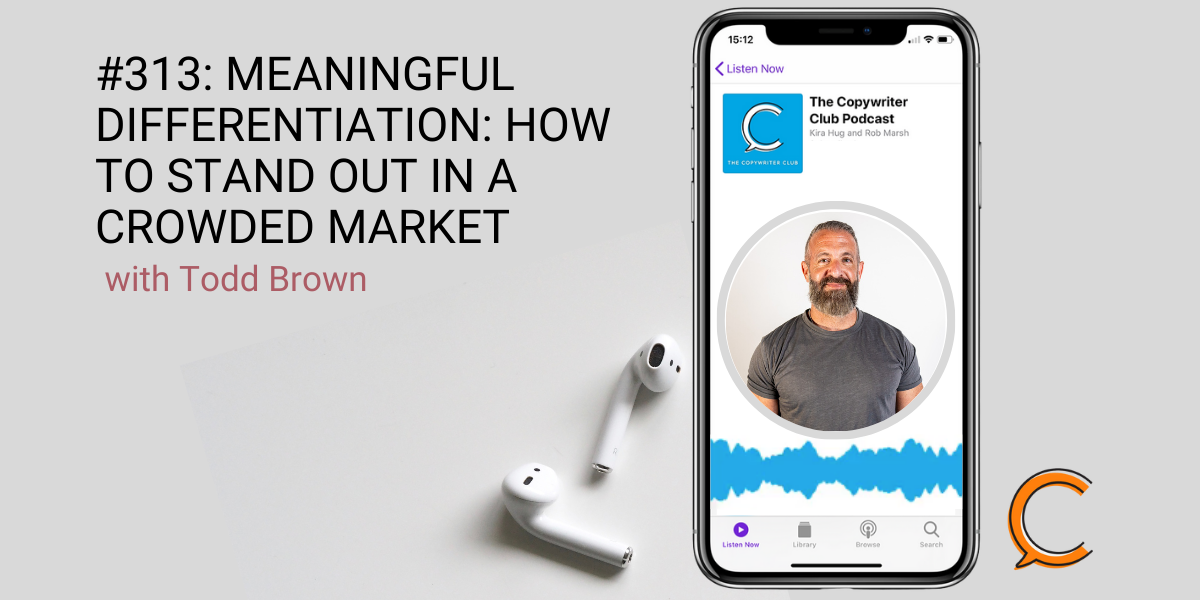
TCC Podcast #313: Meaningful Differentiation: How to Stand Out in a Crowded Market with Todd Brown
Audio is streamed directly from the publisher (media.blubrry.com) as published in their RSS feed. Play Podcasts does not host this file. Rights-holders can request removal through the copyright & takedown page.
Show Notes
On the 313th episode of The Copywriter Club Podcast, Todd Brown makes an entrance on the show. Todd is an expert marketer with over 15 years of experience and in this episode, you’ll find out how he went from making $8.50 an hour as an overworked employee to creating a sought-after marketing approach other experts utilize in their own direct response marketing campaigns.
The conversation goes a little like this:
- Where Todd got his start in the direct response marketing industry.
- What he learned about discipline as a bodybuilder and how he carries it into his everyday life and business.
- The importance of consistency and why it wins every time.
- His perspective on discipline and how anyone can add it to their toolkit.
- The double-edged sword of hiring a team.
- His shift from marketer to entrepreneur and how it changed the game for his business growth.
- What is marketing really?
- How to use Todd’s E-5 method for marketing campaigns and to grow a thriving copywriting business.
- Two ways to bulletproof your copywriting business and NOT become a commodity.
- The easy way to compete against AI software.
- Can you create a valuable USP in a saturated market?
- Why you should interrogate your own processes and how to justify it to your audience.
- How to be seen as the genius in the room by solving problems.
- An inside look at (THE) Todd Brown’s life + a handy book recommendation.
- Business and life lessons he’s taken from fatherhood with two daughters.
- The only swipe file you’ll need for the rest of your career.
Do not hesitate to press play on this episode.
The people and stuff we mentioned on the show:
The Copywriter Think Tank
Kira’s website
Rob’s website
Get Todd’s Swipe file
Todd’s website
The Copywriter Club Facebook Group
The Copywriter Underground
Free month of Brain.FM
Episode 24 with Roy Furr
Our episode on Roy Furr’s podcast
Full Transcript:
Rob: What does it take to become a truly great marketer? How do you learn the skills you need to serve your clients in a way that helps them grow? And when do you step beyond the role of copywriter and take on the title and role of entrepreneur? Our guest for today’s episode of The Copywriter Club Podcast is expert marketer Todd Brown. Over the past decade and a half, Todd has become the go-to expert for creating flourishing direct-response businesses. Todd is one of our mentors and we’ve learned a ton from him and his team. And every time we talk, we walk away with ideas and insights to implement in our business. What he shared in this interview will do the same for you. It’s a little longer than our usual, but Todd shared so many good insights. Do not skip this episode.
Kira Hug: So let’s kick it off. How did you end up as The Todd Brown? How did you get here?
Todd Brown: I mean, first of all, I don’t know if I would say I’m “The” anything. Let me be crystal clear about that. But it’s so interesting. First of all, I knew nothing about marketing or selling. I never liked selling, I was never really good at selling. But I was working for a health club company in central New Jersey, and through good luck, I guess I was promoted in this company. This company, they owned health clubs in New Jersey, that were all about 40,000 square feet, these big facilities, really beautiful architecture. They did something really special back then.
The company was growing very quickly. Actually, an interesting little gem was the owner of the company, I like to say that he was like my Steve Jobs, he was brutal to work for but I learned so much. I don’t believe that I would be where I am today, if it wasn’t for the experience, seeing how this guy looked at the numbers and was relentless with production and all that. Anyway, what was interesting was that prior to the gym business, he was one of the first people to lease computers.
This was when computers were expensive and big companies would lease them. And so he was leasing companies to like Avis rental and like all the airports and whatnot. And so he sold the company for 30-some-odd million dollars. The company that purchased it from him, a company based out of Italy, ran it into the ground in 12 months. Crazy right? He then was able to reacquire the team without having to buy it back, built it up again, and sold it for another 20-some-odd million dollars.
So he took that kind of very business savvy you know, aggressive kind of mindset and brought it to the health club industry. So I’m now working for this health club. I started out making $8.50 an hour. I graduated from college. I graduated from college with a degree in nutrition, and then I ended up making $8.50 an hour working for this company, and through good luck, was promoted and eventually was made VP of the personal training department. So now, at this time, I had several facilities, a team eventually of 75 trainers, 7 managers, and 2 directors. We’re selling personal training. And I ended up getting this postcard in the mail, this oversized postcard all yellow-black text, front to back, with what I know today is copy. Never seen anything like this in my life, right? I was like, what is this?
But they were offering a home study course on how to market and sell personal training services. It was really designed for the independent trainer, but I was like, man, this sounds awesome. I don’t know what the heck I’m doing here, like I’m winging it. And so I went to my boss, it was like a few $100 I’m like, hey, is it cool if I expense this? And he was like, yeah. So I got this thing in the mail, to show you how long ago this was, this is going to date me a bit. But to show you how long ago this was that this thing showed up. It’s a two-three-ring binder. It’s got cassette tapes, it’s got like a diskette. Like it’s this whole thing, I became enamored This is my first introduction to direct response marketing to long-form copy.
I never knew anything about it. I thought that like advertising and marketing is the, same thing. I thought it was like Home Depot, Pepsi, you know, like that sort of stuff. I became enamored and blown away. I dove into this thing, couldn’t get enough of it. Ended up ironically picking up the phone and calling the creator of the thing. Somehow I tracked him down, and called the creator of the thing, and said, Who did you learn from? Right? He mentioned these two names Gary Halbert, and Dan Kennedy. That became the never-ending pursuit of everything that I could get my hands on from those guys. Of course, in the spirit of transparency, I probably should write down a very large additional check at some point since I bought everything off of eBay.
VHS tapes and the whole lot. I couldn’t get enough of this. And so I started to implement what it is that I was learning both in that course and through the stuff that I was learning from Dan and Gary. And I had to kind of maneuver it a little bit to fit in the health club. But my department took off. And then eventually, I don’t remember, call it a year later or 15 months later, my department is the poster child in this club, in this company. I’m now a rock in the house. I’m struggling around like I’m the man in this facility.
We’re doing 3 million bucks a year in personal training sales. And then I said, you know what, let me see if I could use what it is that I applied in the health club. Let me see if I could teach it to somebody else, to other to other folks. I didn’t want to do anything in the health club business in the personal training field, because I felt like it would be a conflict of interest with my boss. I just didn’t want to do that. And so I decided to help massage therapists. It’s a group that we kind of work within the health clubs. And so I created my own kind of home study version, very similar to what I received back then first thing and then that was the beginning of my journey.
I didn’t know how to put up a webpage. There was no WordPress, there was no ClickFunnels, there was none of that. Everything had to be done on Microsoft FrontPage, or Dreamweaver. My aim at the time was to make 1000 bucks a month, like if I can make 1000 bucks a month that I could just blow on whatever nonsense, I’m loving life, right? Like, I’ll be loving life. And it was a little bit of a test for me, like could I apply? Could I take what it is that I was learning in this one setting and apply it somewhere else. And so I would say that maybe, I don’t remember exactly, this is going way back now, but maybe a year and a half later, that little business is matching what it is that I’m making from the health club company.
And at that time, I was doing pretty well in my role. And so that kind of led to when I decided, let me work with chiropractors since I felt like chiropractors had more money and could spend more money. And to kind of wrap this up without giving you the gory details in between, right around that time, a buddy of mine who you might recognize his name, his name is Chris Brisson. He is the founder of Call Loop today. He’s the founder of Salesmsg. He’s a great SaaS entrepreneur today.
He had given me access to all the tech things like the automated teleseminar, auto teleseminar, I think it was called, he had given me all these things, because I had given him some advice on his business. And so one day, I was like, what can I do for you man, you have given me so much, I just feel terrible. I feel like I’m just taking in this relationship and not giving anything back. And he was like, you know, look, would you jump on and share with my audience, like the marketing stuff that you’re doing. And at the time, we had a campaign that was generating like $24 a lead. So for every lead that we generated, we generated $24 in revenue. So I was like, Sure, man, let me get on. I’d love to do that. Got on, and for like 90 minutes just dumped everything that I possibly could. And at the end, I was like, alright, later. See you guys. That was my whole pitch in the end. I was like, alright, see you. I’m out. I hung up.
And 20 minutes later, I get a text message from Chris’s partner. And the text was something like, dude, people are pissed. Now I’m thinking like, did I say anything inappropriately? Did I? What the heck? You know? I probably could have said something inappropriate. I’m like, did I? I’m like, what’s up, man? What did I do? What can I do to fix it? And he texted me back. He’s like, no, you don’t understand.
He’s like, people are pissed that you didn’t have something to offer which I always say has never happened to me before and never happened to me since. Ever. Of course, it would happen then, right that time.
Rob Marsh: Yeah, for sure.
Todd Brown: And so I’m like alright, and so then I started to think. I’m like wow, maybe there is a market for this. Maybe people would be interested. I think I’d be jacked to share this stuff with people. This was you know, the idea of a funnel which is just starting to be talked about. And so three months later, we did an encore. In the end I made this offer for, I don’t even remember, like a coaching thing. It sold out before the teleseminar was over. And that was the genesis and that’s where it began. And that’s where the The Todd Brown, whatever that means, was born.
Rob Marsh: Yeah, The Todd brown. So you didn’t mention this Todd but I’ve seen some photos of you flexing muscles and standing in a bikini like you were part of the body, I mean, you’re not as old as Arnold Schwarzenegger, but you were in that competitive field. Before we get into all of the marketing stuff. I’m just curious. What did you learn from that kind of competition that you bring to what you’re doing in marketing today?
Todd Brown: Yeah, man, I love the question. So yeah, let me give you a little background. So, right, I’m 5’5”, I’m still 5’5”. So I’m sure I was always a really skinny kid. I was terrible at athletics. I don’t want to say shy, but, you know, I was always introverted, still I am introverted. And so I remember I wanted to wrestle in high school, like my sophomore year. And why I wanted to wrestle, I have no idea. Like I said, I had no athletic ability, I think because it was a little bit of a macho thing. I couldn’t make any other team. And so let me give this a shot. I was so light that when everybody else was weighing in, you know, you weighed in before you competed, everybody else is stripped down in their drawers getting on the thing. I’m in my wrestling jacket, I don’t have to take an ounce of clothing off because I was like 15 pounds under the lightest weight.
Rob Marsh: They must have looked at you and thought I hope I get him on the draw.
Todd Brown: They did. They always did. And of course, I stunk, you know. I think I might have won once. So our buddy Russell Brunson, right, who’s got an amazing story, who’s an incredible wrestler and I was the antithesis of that, like the complete opposite of Russell. So it was after my freshman year that my parents got me this dumbbell of this sand weight set, like it was filled with sand at home. And I always love like, the bigger guys, I think, because I was a smaller guy. I watched the Incredible Hulk when I was a kid. And I was like, man, it must be great to walk around looking like that like the women love you. The men respect you. And it was more to me about the men, like the men respect you.
So I started weightlifting. And my body just took to it. And so the first year, I put on like 16-17 pounds of muscle. And so I decided, come my sophomore year that I was not going to wrestle, I was going to just take the full year, I was going to continue to just weight train, and my body just continued to respond. And I continued to put on muscle and then that became the end of my struggling wrestling career. And then over the next handful of years, I just continued to train. I was so into it so that it was easy to be disciplined. My parents then eventually took me to a gym, to a health club. I got bigger, better, and then I got into competitive bodybuilding.
I love competitive bodybuilding for a number of reasons. Number one I liked that it was an individual sport. So my success wasn’t dependent on anybody else it was dependent on me and what I chose to do and so there was no blame on anybody else. There was no reliance on anybody else, it was all about reliance on myself. It required a tremendous amount of discipline because you know bodybuilding is really one of the most difficult sports because it’s 24/7. It’s your nutrition, your food intake, right? I was eating six meals a day every two and a half hours.
I weighed everything out, I prepackaged everything, did not matter where I was, what I was doing, if it was time to eat, like I’d never forget having ground beef as one of the staples, ground beef and rice. If I was driving the car on my way somewhere and it was time for me to eat, I had to pull over, could not heat it up, couldn’t heat it up. I did what I had to do. And so sleep, fluid, training the whole nine.
And so the biggest thing that I really learned, I learned a lot of lessons ironically, with this question I’m gonna be sharing some of these lessons with you guys in a top one. But number one, I learned the value of discipline, most specifically, I learned the value of putting your head down and doing the work that you need to do and not entertaining the voice in your head. That will bring doubt and challenge and resistance, but put your head down, put your nose to the grindstone, do what you got to do. Be consistent. Consistency is key.
And not look up until it’s done and not entertain, like I said that inner dialogue. I think that one thing alone carries over in so many ways to business. I just want to spell it out real quick. Number one, I see so many people, so many entrepreneurs that are constantly rethinking their strategy, constantly rethinking their model, constantly trying to reinvent a new way, a new thing to execute their business, constantly on the hunt for this next magic bullet, when the reality is that many of the things that they’re entertaining, most of the things that they’re entertaining, would work if they would just put their nose to the grindstone, implement and continue to implement and do it consistently.
It’s very much like, you know, again, like weight loss. There are a lot of different ways, a lot of different programs, a lot of different cardio programs, a lot of different weight training programs, and a lot of different diets. The problem isn’t that there’s one magic way to do it. The problem is that people don’t stick with the way that they’ve chosen to do it long enough, consistently enough, with discipline to reap the rewards.
And so it showed me right, like, I followed the same program for years. For years. Now, there are nuances to pushing yourself to do an additional rep or add weight or all that, but I follow the same program. I ate the same thing every day, all those six meals were the same, at the same time, all the time. And it was that just relentless discipline, in terms of consistency, not entertaining any doubt, not rethinking the whole thing that just allowed me to thrive. And so I ended up on the national stage, I was on TV. And yeah, I took some tremendous lessons from that. And so hope that answered the question without going too long.
Rob Marsh: Yeah, totally.
Kira Hug: Yeah, it sounds like that discipline was in you from a young age with wrestling. Do you think it’s possible for people who struggle with discipline or maybe don’t even have an athletic background at such a young age, to now as an adult building our business, figure out how to have that focus and silence those voices? It sounds like a lot of mindset work too. What has worked for some of the businesses you’ve worked with? And the entrepreneurs you’ve worked with who have struggled with that?
Todd Brown: Yeah, so I’ll give you the answer that is likely not the answer that you’re looking for. Because I think that I have a little bit of a different perspective when it comes to discipline. So for me, number one, I believe that discipline is a choice, I don’t believe that it’s a character attribute. I don’t believe that it’s something you either have, or you don’t, I don’t even believe that it’s something that you develop, I believe that it is a choice. And so for me, it’s a little bit of a hard question to answer. Because I really believe that when people say, I’m struggling with discipline, or I’m struggling with motivation, my response is typically the same. You either want it bad enough, or you don’t. You either want it bad enough, or you don’t. When you’re faced with two choices, like either I’m going to work on my business, or I’m going to binge Netflix, well, which is more important to you, which do you want more?
If you truly want this thing more, then act. Take action. Then do what it is that you say you want most. So for me, when people say, I lack the motivation, what should I do, then find a different goal to pursue if that’s the case if you’re not jazzed about it or motivated if it’s not something that you really truly want in your core? Well, then yeah, when you’re faced with other options or obstacles, you’re going to succumb to that. Right.
And so for me, I would say that you know, in most areas of my life, I would say that if you judged, if we put this under the umbrella of discipline, in most areas of my life, I lacked discipline, if you put it under that umbrella. Because there are lots of areas that just aren’t really important to me like they’re not that important to me. So I brush it off, you know. Like when my wife gives me a chore around the house, I procrastinate until the very last minute on that, right, which is a separate issue in and of itself. It’s a different podcast for a different day. Right?
But it’s like, I’m getting better at that. But it really comes down to you either want it or you don’t. Now look, maybe for some people, for some entrepreneurs, they haven’t taken the time to really process what it will mean for them to have a successful business, and how their life will be different. What it will do for them, what it will give them. The autonomy, the financial freedom, all those things. But to me you either want it or you don’t. And when you want something bad enough, you’re going to make it the priority.
I didn’t want to eat cold beef and rice on the side of the road, but I wanted to win more than I didn’t want to eat that beef and rice, right? I wanted to eat pizza. I love pizza. I love donuts. I love the worst of the worst. Like I have a palette for garbage. But there are things that are more important to me than eating that garbage. And so for me, it’s an easy choice. When I say I can either have this. And I know like in the moment, I love the ring Dang, or the Twinkie or whatever, like I’ll savor that bad boy in that moment. And then afterward I’ll feel terrible about myself and be like, Why did I do that? I blew it, like that was a poor decision. And right, and so I’m just able to look like what do I want? How badly do I want it because if you want it badly enough, then you’re going to do what you got to do.
When I launched that first business to massage therapist. So at the time, I had two toddlers, my youngest daughter was just born. And so I had two toddlers 17 months apart. And I’m working a full-time job. I’m thriving in the full-time job. I owe it to my employer to continue to do great. So I had to get up early in the morning, right before anybody else was getting up. Early in the morning, late at night. Sometimes I’ll never forget on the week, I remember looking out the window of the room that I was working in, and I would see my wife on the little deck in the backyard with my two toddlers. And I desperately wanted to be with them. But I knew that I believed that and wanted the success that the business would give me and I knew that it would impact my relationship with them long-term forever.
And so I was willing to sacrifice that little bit of time, or what I believed would be a little bit of time to get this bad boy off the ground. I just believe that you’ve got to get real with yourself. And you’ve got to ask yourself what is most important to me. And when you want it bad enough, you’ll do what you’ve got to do, period.
Rob Marsh: So Todd, I want to come back to some of the marketing stuff. Like I’m feeling the discipline stuff, and you’ve got me excited already, like ready to jump into it. But so when you launched this marketing business, and you’re reaching out to massage therapists, you’re reaching out to some of these other groups. Today, you’ve got all kinds of programs, you know, E5, you’re talking about the big idea, you talk about leads, like all of these things you do. What were the things that you were teaching them as they were just getting started, as you were getting started? What were the basics of that program? If you want to succeed in marketing, you got to do X, Y and Z.
Todd Brown: Yeah. So the foundation of the program was really an introduction to direct response marketing, the difference between direct response and brand institutional advertising, the difference between direct response and what the typical professional massage therapist was doing. You know, they were trying to build name recognition, that repeated exposure, all the typical stuff that we see from the typical Mom and Pop. And so it was very focused on the difference between direct response and brand institutional advertising.
And then it incorporated all the principles and tenants of direct response, the idea of what is long-form copy. What are the elements of long-form copy? What is the purpose and role of a headline? How do you write an effective headline, the format and the flow of a direct response message? And presenting and constructing an offer, presenting an offer, using two-step campaigns for lead generation and all this was mostly what I was teaching, mostly offline stuff, like how to use toll-free recorded messages and having multi-step follow-up and all that.
So it was really just very foundational stuff. It was the stuff that I became enamored with in the fitness world. And now I was like, let me show them how this would work for them in the massage space and kind of translated everything over to their world. And so show them examples of massage ads done the right way, direct response that I created, and all that stuff. So it’s very, very basic.
Kira Hug: You mentioned Todd, that when you were starting out, you were independent and self-reliant. And so over time, you’ve built this incredible team, and we’ve been able to work with so many of your team members. What was that path like for you? Was it an easy path or was like I need the team, we’re going to do it or was it a challenge to go from being more self-reliant to eventually relying on this team?
Todd Brown: It was brutal, it’s still a little brutal. If I’m being honest with you, it’s still a little brutal, because as I mentioned, right, I’ve always been introverted. I love the idea, like when I look at my calendar, and I’m like, man, today, I get to just work in my office, like alone, I’m like, Oh, my gosh, I almost sit and savor it for a moment before I dive into the day. And so I resisted building a team for a very long time. And so, for me, that was learning as many parts of the business as I possibly could doing everything really. Which, you know, this is such a deep topic, too, I almost kind of felt like, that’s what this thing that I was doing was supposed to be, it was supposed to be, I almost didn’t treat it like a business. I treated it like it was just marketing that I was doing and making money and helping people.
And so I’m gonna juggle all the other little things. So it was very difficult for me to make the decision to start to bring in a team because I fear the idea of having to manage people, because I did that, like in the health club business. And I was always like, you know, this person didn’t show up, this person didn’t do the job that they were supposed to do, this person didn’t execute the right way like that whole, right? Like, I just liked the idea of like, man, if I didn’t have to rely on anybody, right, then I’m golden. And I was golden for a little while.
Until it just got stretched, until I got to this point where I was doing everything and doing most things poorly. Right? Like because you only have so much bandwidth, only have so much time until you reach this point where I can’t do everything that I want to do and do it at the level that I want to do it. And so I have no choice but to now bring somebody in to support me. And I still have moments where I’m like, Man, if I just did this myself, it would be perfect from the start. I still have that conversation. I’d be lying if I said that I don’t. And I have a great team. I’m very blessed and very fortunate. I love these people to death. But yeah, not easy. I know that explanation probably didn’t give much value. And so if there’s a specific question, I’d love to, I’d love to share.
Kira Hug: I think it’s just good to hear that it’s hard. I guess a specific question would be like, when it is hard, what helped you get through it? Because it sounds like it’s worthwhile. It’s worth building that team. Otherwise, you wouldn’t do it. So what helps you get through it when you’re like, I don’t know, maybe I should just do all this myself?
Todd Brown: Yeah. What really helped me was comparing the negatives of the two scenarios, really, in my mind. It was like, well, here’s my options, right? My option is, I can bring aboard a person, start to build a team. And then yeah, there are some management leadership things that I have to put in place and some processes and whatnot, which I was dreading, right, because like, I love marketing, I love marketing, I love marketing. The idea of the right processes and systems and managing leadership, I had enough of that, I did that for many, many years in the health club business. I was like, I don’t want to do that. So there are negatives associated with that. But there are negatives associated with me continuing to do it the way that I’ve been doing it.
And it was the negatives, the negatives of me doing it and having to try to juggle everything and knowing what that would look like in terms of my life and my schedule, and my brain space that was worse to me than this. And so I chose, in my mind, the lesser of two evils. There wasn’t this big vision of, you know when we have a team, a well-oiled machine with divisions, and division leaders, and it was never that. Never that at all. Now, some of that, in all fairness, could be what I enjoy, and my area of strength, right? I’ll tell you this for what it’s worth, and it pains me to actually say this, but this is the truth.
I believe this, that I’d rather be a better entrepreneur than be a better marketer. I’d rather be a better entrepreneur than a better marketer, right? The better entrepreneur, the individual with business skills, the skills of really being able to understand financials, understanding strategy, understanding team development, understanding vision setting, that individual will beat a better marketer, who lacks on the entrepreneurial skill set all the time, because great entrepreneur will find a great marketer and will know how to train them, you know, bring them aboard, incentivize them.
But I also realized that we are who we are, we’re created with certain gifts and talents and certain skills, and it’s just not what I enjoy. And so I just choose not to, you know, I choose not to do it. Fortunately, I’ve got Damien, whose arm I twisted to come aboard and run the company for me. It wasn’t like I just said, the heck with it. We’re not going to have any of that. But it was this decision that I don’t want to do it, I ain’t doing it, because I’m not good at it, and I don’t enjoy it. And so let me find somebody else that can do it.
Rob Marsh: So this is a really interesting idea to me. Like the shift from marketer to entrepreneur, this is something we talk a lot about with copywriters, you know. You’re not just there to write words, you’re there to solve problems. And this feels like that idea on steroids, where you’re basically saying, Okay, you’re not the thing you’re doing. You’re all of this other stuff that makes the thing you’re doing possible. Will you talk a little bit about how you made that shift, because you were a stellar marketer before you were a great entrepreneur?
Todd Brown: Well, look, I appreciate that. There are far better entrepreneurs than me, right? There are clients that are far better entrepreneurs than I am. I certainly have gotten better. And I’ve embraced certain aspects out of sheer demand, you know. But I believe that some of it came about, Rob, from just the evolution of the marketplace, you know. There was a time when we are all in some capacity, byproducts of Dan Kennedy, of these true legends the true does in the business. And, you know, Dan, who is amazing, and I can’t say enough about what he’s done, he’s created this industry pioneered this industry for the most part
He really indoctrinated everybody with this idea that you’re not in the business of X, you’re in the business of marketing X, and marketing fixes all problems, and, you know, marketing, marketing, marketing. And there was a time when that was very true. And very early on, there were no monster information product businesses, like there are today. The idea of doing a million bucks a year back then was like, wow, okay, you’re at the pinnacle, right? Today, you’re not so much. And so I saw the marketplace evolve. And I saw that there were individuals coming in that were just great entrepreneurs. They were able to thrive, even though they weren’t nearly as good marketers, as some of the others. They were able to go well beyond what just good marketing could get you by being a good entrepreneur.
And so as I saw just more and more folks that were breaking the ceiling, shattering the ceiling, I started to realize, like, wow, what’s the thing that these folks have in common, and what I realized was that they are entrepreneurs that happen to be using direct response marketing and long-form copy and all the cool marketing stuff that we talk about as a means to grow their business. But they didn’t see themselves as marketers doing marketing, they saw themselves as entrepreneurs that happened to use direct response marketing because it’s the most effective form of marketing to grow their business. And so I just started to really realize like wow, okay, the days of the pure marketer remaining on top of the mountain, those days are quickly coming to an end. And so that was really what led to that change.
Kira Hug: What advice would you give to copywriters to help them stay in their zone of genius, especially if they don’t have a team yet, but they really are struggling and could benefit from leaning into it.
Todd Brown: So it’s a great question, Kira. Tell me when you say their zone of genius should I assume that that is writing copy?
Kira Hug: It could be part of it. It could be brainstorming ideas or it could be more strategy and thinking through strategies for funnels, or it could be brilliant at writing personality-driven copy and email sequences or it could be anything you’re bringing to the table that they’ve identified already. But they feel like they haven’t really fully jumped into it.
Todd Brown: Yeah, I mean, I think I don’t have any kind of brilliant answer for that. But I would say that you’ve really got to be intentional and proactive about your schedule, that you are allocating the time on your schedule, blocked out to focus on your zone of genius. And when you find your other responsibilities beginning to encroach on that time, that’s when you’ve got to make a decision. And that decision could either be I need to change the business that I’m in, or I need to hire people to support me so that they can take those things that are now encroaching on my time, but it’s really just a matter of managing your schedule, monitoring it and making sure that you’re not allowing all these other things to encroach on that time.
And so again, when you find that it is, because of the nature of your business, because it’s evolving, it’s growing, it’s expanding, there are more things that you want to do in the business, well, then you have to take a step back, and you have to say, okay, these things are now encroaching on my ability to stay in my zone of genius, therefore, right, number one, are these things necessary? Or am I just allowing these oddball things to come into play that I can just cut? And not even do? Or is it that these are now mandatory things for where my business is at right now? If so, do I want to continue on the same business trajectory? Well, if so, then I have to find somebody to support me to do those, or you have to change the business.
Rob Marsh: So Todd, I would love to talk a little bit about E5, and just marketing campaigns in general. Obviously, we’ve got maybe 15 or 20 minutes left of our time here. You’ve taught this for three days. But as far as an effective marketing campaign, and I’m thinking mostly, like, if I’m a copywriter, and I want to get myself out in front of more clients, more of my ideal clients, what are just a couple of steps that you can help us through so that we can start doing some of that stuff that you and your company do so well?
Todd Brown: Yeah. So, Rob, is it more about how can a copywriter really use some of the elements of E5 to grow their own business?
Rob Marsh: Yep, exactly.
Todd Brown: Yeah. Okay. So that’s an awesome question. This is something that, at some point, we could ponder, even do a special workshop for your people on this, It’d be my pleasure to do that.
Rob Marsh: We’re going to say yes to that. No additional discussion.
Todd Brown: Yeah. Cool. So, let me start here. Marketing at the core, right, there are a lot of definitions and terms and all this kind of inaccuracy associated with marketing, but at the core, marketing is really the art of meaningful differentiation, right? Like at its core marketing is the art of meaningful differentiation. Now, there are two words that I need to point out. Number one is differentiation. So we know that as markets evolve, and they become more crowded, like the copywriter space, you know, there’s so many copywriters today right? Which is cool, because there’s a wild demand. More demand than I can ever remember for good copywriters today. But you know, there was a time when I knew, like, two copywriters, and I was like, where are the other copywriters, there were like two of them, you know what I mean? Like, that’s how it felt.
Markets evolve, as they always do. And the solution, the thing that you’re ultimately offering becomes more and more commonplace, it becomes that much more critical to demonstrate what makes you, your approach, and your ability to deliver results, different from everybody else. In other words, what you don’t want to do, what you never want to do, is you never want to allow your service to be viewed as a commodity, to be viewed as something that they can get somewhere else, right? When you become viewed as a commodity. That’s when people shop around. Right? That’s when you’re gonna do it for, you know, for 10 grand, let me see if somebody’s willing to do it for 9 grand, if somebody’s willing to do it for 8 grand or whatever it is, right?
Because you’re offering the same thing, right? A gallon of gas. No, there’s no gas station that’s gonna sell a gallon of gas for double the price that the other gas stations are. Because no one’s paying for that, because it’s viewed as a commodity, because it is a commodity. So when you reach this point, like copywriting as a profession has reached, you have to differentiate.
Now the second word that I said in there, the art of meaningful differentiation. So what is meant by meaningful differentiation? Well, meaningful to who? Meaningful to the prospect, right? Meaningful to the prospect in that differentiation, the point of difference, is a value and benefit to the prospect. So different for different sake doesn’t make it more valuable and beneficial for the prospect. You might be the only copywriter that’s got, you know, gorgeous, gorgeous mane of red hair. That’s not a point of meaningful differentiation, right? That means nothing to me. You might stand out in your ads, you might look cool, it might write from a branding perspective. But in terms of meaningful differentiation in this context, that doesn’t fall into that category.
So meaningful, it needs to be a value and benefit to the prospect. Well, today, there are only two ways to do that, two effective ways to do that in marketing. The first way is the USP, the Unique Selling Proposition. Unique Selling Proposition, there are tons of definitions, but the easiest definition to remember for folks is that a Unique Selling Proposition, USP is when you offer a benefit, a unique benefit to prospects that they can’t get or experience with any other competing product.
So when your product or service has a unique benefit that nobody else that you are competing with has. And we could talk about, like there’s a whole discussion that we could have on who you are competing with. Because for what it’s worth, right, it’s important to understand that like, for copywriters, this is an important point. So I gotta take this. So it’s important to realize that when we are marketing and selling anything, we’re marketing and selling a solution to a problem, right? We’re selling an outcome, we’re selling a result, right? People aren’t paying for the copywriter to write X amount of words, they’re paying for the result of what those words are going to do for them, the additional sales, the additional leads, the bonding, whatever, all that’s the result, right?
And so it’s important to understand that we’re solving a problem, we’re solving a problem for the prospect. Problems are either pain points that they want alleviated, or they are unfulfilled desires, right. We’re solving a problem, we’re offering a solution to a problem. So even for copywriters, you’ve got to realize that you’re competing with not only other copywriters, but you’re competing potentially with these supposed AI software that will bang out, right with three clicks of the mouse, that’ll bang out a high conversion sales letter. Why? Because that thing is promising the same result that a copywriter is promising, right? And I say supposed because it’s, it’s ..