
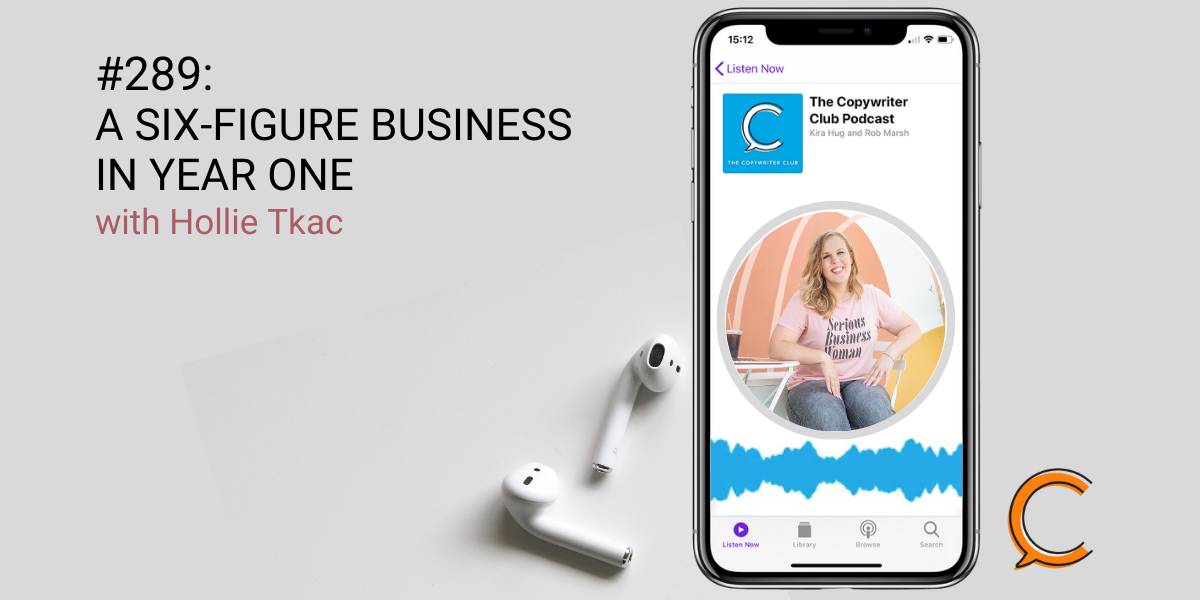
TCC Podcast #289: A Six-Figure Business in Year One with Hollie Tkac
Audio is streamed directly from the publisher (media.blubrry.com) as published in their RSS feed. Play Podcasts does not host this file. Rights-holders can request removal through the copyright & takedown page.
Show Notes
Hollie Tkac joined The Copywriter Club Podcast for episode 289. Hollie is a copywriter for coaches in the online space who has built her multiple six-figure business on DFY copy. She shares her experience in creating sustainable income without the 50+ hour work weeks and how other copywriters can build a business that works for them.
Here’s how the conversation breaks down:
- The importance of building your network and how it can translate into 50% of your income.
- How Hollie transitioned from coaching into copywriting for coaches.
- The benefits of hiring a coach and how to find the right one for you and your business.
- Transferring skill sets from coaching to copywriting.
- Steps to developing self trust and stepping into your sense of worthiness.
- Having 6 coaches at once and determining which coaches could help you get to where you want to go.
- How to get the most out of your coaching programs, so you see a return on your investment.
- Hitting six-figures in the first year of business – How did it happen?
- Should you add retainer clients to your business model?
- How to hire junior copywriters and how to effectively work with them.
- The wrong way to charge for your copywriting services.
- Creating a strong client relationship and building trust can lead to this.
- Where do most coaches struggle and how copywriters can help them.
- When are business owners ready for a copywriter?
- Systems and processes to use when working with a team and keeping things organized.
- Client work vs working on your own business – Where’s the balance?
- Creating financial projections and how to plan for the future of your business.
If you’ve been thinking about adding retainers to your business or hiring a team to help scale your business, be sure to tune into this episode.
The people and stuff we mentioned on the show:
The Copywriter Think Tank
Copywriting Income Survey
Kira’s website
Rob’s website
Hollie’s website
The Copywriter Club Facebook Group
The Copywriter Underground
Sign up for Typeform
Episode 253
Full Transcript:
Kira Hug: If you’ve ever questioned whether or not you could make six figures as a copywriter without creating and selling products, courses, or group programs on the side, this episode is for you. In this conversation, we’ll speak with copywriter, Hollie Tkac, about how she niched down and grew her Done For You copywriting business with just that; copywriting. We talked about Hollie’s approach to retainers, hiring, and working with junior copywriters, and a few best practices for running a successful copywriting business.
Rob Marsh: Before we jump into our interview with Hollie, this podcast is sponsored by the Copywriter Think Tank. That’s our mastermind for copywriters and other marketers who want to think outside the box, build new offers, and add revenue streams to their business. We’ve recently added a mindset coach and assistant coach to help members of the Think Tank make more progress than ever before, and it’s not cheap, but given the results that Think Tank members experience after they join the program, it is absolutely worth it. If you are earning three, four, five thousand dollars or more consistently in your business, go to copywriterthinktank.com to learn more.
Kira Hug: Okay. Let’s hear from Hollie about how she got her start as a copywriter. Hi, Hollie. Well, let’s kick off with your story. How did you end up as a copywriter for Coaches?
Hollie Tkac: Yeah. Really, it all came down to networking actually, and I still think to this day that’s one of the main ways I’ve built my business. What happened was originally I wanted to be a coach myself, and this is in like 2015, so I joined a bunch of programs and things like that and just took that leap to invest in my business. From that, I ended up making connections and people were liking what I was putting out for my own coaching business I wanted to start at the time and they asked me to write copy for them. I ended up saying yes to that because I was having such a hard time with the selling piece of having a coaching business. I’d write the copy, but getting people on the phone was a little bit scary for me at first, so I wasn’t really having a lot of success with that, but for some reason, the copy was easier for me to sell and say yes to. Then it just kind of started snowballing from there.
I ended up getting some key clients, even two clients I still work with today, from being in some masterminds and programs initially back in the beginning, and they’ve been like almost 30 to 50% of my revenue over six years, just those few clients alone. Those connections I made have really grown into something cool. It sort of started that way through community.
Rob Marsh: Yeah. I love that. I actually want to talk a little bit more about the whole pulled into coaching, because I think copywriters, in at least a pretty major way, we are all coaching our clients in some things and how to sell themselves, that kind of thing. What was the draw to coaching? What was it that you wanted to do there that initially got you started?
Hollie Tkac: It was definitely my own journey. Actually in 2015, during this personal development program that I did in LA, I just realized I had worked in corporate at that point. I ended up working a total of seven years at an accounting firm as an operations manager, and I was in the very tail end of that time at that point. I just knew I always wanted to do something else. It started back when I first changed into a role where I was working from home and I wanted to stay home all the time and never have to report anywhere, so I started to think of how could I do this? Then by the time 2015 rolled around, I had decided that I really wanted to be a coach because I was experiencing such a transformation in my own life through getting coached, so that’s kind of why I went forward with that. I figured it was something that I could do from anywhere and work from home more and just have that freedom, so it just seemed like a natural next step.
Rob Marsh: As you were thinking about being a coach, how have you applied that in your copywriting business?
Hollie Tkac: Tons of ways. One of the things that I like to think back to is my own story and I try to think about who, because all of my clients are coaches, and they have always been. I think I’ve only worked with one person in six or seven years that wasn’t a coach, so I always try to think about what is the person going through that would attract them to get the transformation. Of course, knowing that they don’t use those languages themselves to describe what they’re going through. They’re not seeking out a transformation in their mind, but they’re going through some kind of pain or something like that that would make them… or they want a certain outcome that would make them candidates for my clients’ services. I just really focus in on what is that and why would somebody want this person’s offer? Being a client helps you to realize those things and helps make you better. I’ve had lots of coaches in different areas and it’s always helped me be better at writing copy for coaches.
Kira Hug: Can you talk more about that, the coaches that you’ve worked with directly who have helped you personally, professionally? How do you look for a specific coach? There’s so many different types of coaches you could work with. How do you know when to find a specific coach that could help you with the current problem and when it’s time to leave? How do you approach that?
Hollie Tkac: Awesome. I love that question because I feel like I’ve done everything wrong in that area in the initial few years that I was starting to take on coaches and do different things. Mostly as a client, so what I have found lately is that I’ve also invested in some things recently that have really been fruitful. I’m thinking, what’s the difference between now and then? I would say back then the most important thing to think about when you’re looking for support is to assess your motivations behind getting the support. How that looked for me before, like five, six years ago, is I just didn’t have a good sense of my own worthiness and identity. I was actually trying to solve my problems by putting out money and hoping that would fix whatever issues.
I worked with a health coach for a year and I worked with a love coach for a year and other types of coaches too. What I realized was that I was just trying to fix something with them that they couldn’t fix. Long story short, I realized I needed to just get clear on the fact that I’m basically a worthy human being with or without a coach. Then now that I’ve reached that place through some spiritual stuff I went through in the last couple years, I’ve been able to feel like when I hear about opportunities, I have a gut instinct about them and I know that I should dive in or not and I can trust it more. I’ve developed this sense of trust for my own instincts that I didn’t have before. It’s led me to make decisions that were better for me and have been able to definitely produce fruit without having a lot of stress in terms of… at one point I had like six coaches at once.
Kira Hug: Oh, wow.
Hollie Tkac: It was a little crazy financially, and also just like so much input from different people. There were all kinds of different areas of my life, but it was a little crazy. Now it’s like, I know I can pick something I know that will be fruitful and go with it.
Kira Hug: Can we talk more about this, because I think this is a common challenge for many of us as writers and humans; feeling worthy. You mentioned you went through some spiritual stuff that helped you feel worthy and I feel like we skipped over it, but I’d love to know what you did during that time to really shift from not feeling worthy to feeling worthy and trusting yourself.
Hollie Tkac: Yeah. In my case, I ended up finding Jesus, to be honest. I had tried a lot of other new age spiritual things and it didn’t really solve my issue. I was in a place of just depression and things like that. This was in 2019, going into that year, and one thing that somebody just invited me to go to church and I went, so that’s something that’s really changed my life. I kind of went all in with it and that’s one of the things that I did some programs at my church and stuff like that over the last couple years that took a few days out of the week for me and I needed to manage my business around it and stuff like that, but it’s really given me a firm foundation to just know that I have that solid baseline. I think people can find that in different ways, but that’s what really got me there was just finding Jesus.
Rob Marsh: Yeah. I love that story and you’re right. People come to different things in different ways, but just getting to that understanding of self worth is independent of anything else that we do; body size, thoughts, politics, all that stuff that we all have inherent worth. Yeah. However anybody gets to it, that’s a good thing, I think. Hollie, I’m curious, you mentioned you had six coaches at once and that feels, to me, like not necessarily crazy. Obviously you were searching for a lot of help or whatever, but as you got advice from six different coaches, were they telling you things that contradicted? How did you figure out what was the thing you should be doing or listening, and as you’ve come out of that, would you recommend that people stick to one coach, two? Where’s the number that’s maybe right for most of us?
Hollie Tkac: I think it can kind of depend. There wasn’t a lot of conflicting advice being given at the time, just because they were in different areas of my life. I had the health coach and the love coach simultaneously, plus like a business program, but I think that if I had to say a blanket advice, you wouldn’t want more than one person in the same area of your life, in my opinion, just because there could be those conflicts of what they’re saying. I think in terms of the business side, it’s really great to have potentially two things that you could say are business oriented at the most, but you want to think about having one.
This is something that one of my mentors that I’m working with that I think you guys know, Sara, Sara Anna Powers. She says having one community that’s copywriters, like industry focused, so as copywriters, being in a community of other copywriters that you can talk shop with. Obviously your guys’ mastermind, things like that, and then also having a community that has different types of business owners in it too is really helpful because then you can also get that cross advice from other types of people that have different backgrounds too. Business wise, probably maybe two at the most and then other areas of your life you’d only want one, but I’d be definitely cautious to take on more than a few different communities or coaches at a time just because you need time to implement and digest things that they tell you. Are you really giving yourself that if you’re spending even time on coaching calls with four different people, five different people every week? It’s kind of crazy.
Kira Hug: I’m glad you mentioned that because I feel like we haven’t. We talk a lot about investing in your business, investing in yourself, working with mentors and coaches and we haven’t talked as much about possibly overdoing it and having too many voices in your head. I can tell the difference when we’re working with someone with a copywriter who’s working with two or more coaches at the same time. I can usually call it out because there’s actually less getting done and there’s more conflict, so I’m glad you mentioned that and maybe you can share an example of what you would’ve done previously to throw money at a problem. Throwing money at a problem, beyond hiring a coach, because we’ve already talked about that, but what else you were doing previously and then how you would approach it differently today or maybe how you are approaching it differently? Same problem, similar problem, but you’re approaching it in a totally different way. Are you able to share any examples just to paint that picture?
Hollie Tkac: Yeah. For example, even right now, well, my love life, I’m still single. If I think about that, I kind of jumped into having a coach for a year. This is four years ago at this point, and I’m sure I got things out of that and it had value, but I kind of jumped into that quickly without much thought. I would pretty much buy anything people offered me, I feel like, for a while. Now I don’t have a coach, but I still feel like I’m working on that area and I’m conscious of that area, so things I’m doing are looking at books, podcasts, stuff like that. Then in the case that I found people that I really align with and that resonate with me and my values, I tend to buy more from them.
I haven’t necessarily found a coach that has a coaching program in the same format that I was in before, but I’ve purchased more books from these couple of people that have really resonated with me or a course or a couple of little things like that. I have those people in my mind and I follow them a little more just in case they do offer something more. I would say it’s really been more about thinking who actually matches my values, which I never used to really think about when I made those decisions, but now I do, and who do I resonate with? What do they have out there for free or for low cost? Do I resonate with that? Do I get results from that by itself? Do I get some kind of transformation from just that? Then there’s somebody worth following me even more long term.
It’s just exactly what we work with as copywriters day to day and making funnels and stuff like that. People try things that are a little bit easier to get into and then they will continue with the person if they continue to like it and get results. I’m just actually doing that in my own life too when I assess people and decide if I want to work with them.
Rob Marsh: Yeah. There are definitely a lot of parallels with how we work with people. I want to change our conversation just a little bit and ask about your business and how it is today. When we met in San Diego a couple of years ago, I remember you were telling me about your business, and if I’m remembering right, I was thinking, wow, you’ve built a pretty amazing business pretty quickly into six figures. Tell us about your business today and the kind of work that you’re doing.
Hollie Tkac: Yeah. It’s been really steady. The first full year of business, I was over six figures and I’ve just kind of stayed there. Last year I hit over like half a million total gross sales in just a couple years really, so it’s been really cool to see that, and it’s been almost 100% done for you copy, if I’m honest, even though at times I was like, I don’t want to be… that classic thing to say. I don’t want to be writing for people all the time, so I’m still actually exploring ways that I can scale and do things differently this next year, but so far it’s been done for you writing and it’s been really steady. I would attribute that to my network really at this point, since mostly I have gotten clients through referrals and I’m looking for ways to expand out of that to grow, but that’s really been… even just joining one mastermind group for one year has contributed to a very significant portion of my overall revenue because of those two long term clients I’ve had for three years each. One of them I’ve been with for four.
That’s been a really key part of my growth, and just being really intentional and clear on who I work with has also helped a lot because then it’s allowed me to develop a specialty as being the copywriter for coaches. Like I told you guys, I’ve only worked with one product and otherwise it’s been 100% coaches for six years, so it allows me to talk about that niche very authoritatively and things like that when I’m in sales calls and that’s allowed me to be able to raise my rates and attract higher caliber referrals and higher caliber people that make… I have like one eight figure client and a couple of seven figure clients are on retainer, and so that’s been really helpful to just be specific about my niche too.
Kira Hug: Let’s talk about how this breaks down if you’re open to talking about money more, because you mentioned half a million in gross sales from done for you copy. Right? Am I getting that right?
Hollie Tkac: Yeah.
Kira Hug: Okay. That’s a big deal. Congratulations. That’s amazing. I think also listening, I was expecting you to say, I have multiple offers outside of done for you copy and that’s how I was able to hit that number, but can you break down how did you hit that with done for you copy? How much are you charging per retainer? How does it break down, just to give us an idea of how you achieve that?
Hollie Tkac: Yeah. I’ve definitely tried to do some low ticket stuff, some course type stuff, things like that. If I had to be just roughly estimating, I would say maybe $50,000 of that could be from those, maybe a little more, but from the non-done for you offers. Not most of it, but a little portion of it. That would be that side, and then with the done for you side, since I am just supporting myself, it was really important to me to build some consistency and I didn’t have that for a long time. I had that one client I’ve been with for four years, who I love, so she was a consistent person in my life in terms of financially. Then I knew I wanted to have a few more retainer clients too.
I already know this year I’m going to break six figures right now if nothing changed and everyone under contract continued and everything like that. I’d be over six figures already, which is kind of a cool, nice place to be, so I would say I built a lot more stability into my life when I started to be open to bringing on retainers and then I brought on a few. This is something I feel weird sharing because there’s definitely ways I could up it probably, but they’re between $2,000 and $3,500 a month each.
Kira Hug: How many do you have? How many retainers?
Hollie Tkac: I have three right now.
Kira Hug: Okay.
Hollie Tkac: Yeah. One of the other things that helped me was bringing on junior copywriters to support additional projects. I have, every month, my retainers and then I add on projects and all of my retainers totally cover my business and personal expenses, which feels really good to me, like I said, because I wanted the stability, and then everything else is extra. I’m using air quotes because I find a way to use the money, but it’s like extra.
Rob Marsh: I definitely want to come back to the junior copywriters and how you use them in your business, but first, while we’re still talking about earning six figures, I think some people are like, well, yeah. I’d like to do six figures, but I don’t want to work seven days a week or I don’t want to be chained to my desk from 8:00 until 9:00 or 10:00 at night, which is sometimes what people think is involved, but if I’m not mistaken, you’ve done it in considerably less time than that. Tell us about that.
Hollie Tkac: Yeah. It comes down to really thinking about your value and how you price things. Just a couple of things I do that I’ve heard are not always the standard for a lot of copywriters, but a few things is I definitely always charge flat fees and not hourly, which some people listening might still charge hourly, but I highly recommend not doing that just because you become a commodity, I think, and it kind of strips away the value. I’ve had a lot of conversations internally with myself about charging even for a number of emails because that also kind of commoditizes it because people automatically think, oh $2000 for 20 emails. That’s $100 an email and stuff like that, and I try to avoid feeling like a commodity.
Long story short, I just charge a flat fee every month. What that helps with is it ends up on the back end giving you some flexibility. I do actually also track my hours, even though I never charge hourly, because I like to know how long things take me. That gives me an idea when I want to price other projects later and I know it takes me X hours to do a sales page and I know I want to make at least X dollars per hour of my time. Even though I’m not going to charge it that way, it helps me make the pricing. I personally would want to be making over… my project price will equate to $100, $200, maybe even more an hour for my actual time output. You just could never come to somebody for copy and be like, I’m going to charge you $200 an hour. They probably wouldn’t say it, but it might end up working out that way in the back end for project pricing, so I highly recommend that.
Another I do is I always get paid up front. I want to get paid at the start and in the middle if they’re going to do a payment plan or just upfront in full, which more and more people do once they are making more money. I often find that they don’t even think about it. They just pay in full, but if they need a payment plan, I right at the beginning and then I do something in the middle, but I’m never going to do something where the last payment’s contingent upon the end of the project, because I just don’t think it’s fair.
I know sometimes people come to me thinking that’ll be the case because it’s more common to do it that way, but I never even realized that was common so I never even let that be in my mind. I was like, I’m going to get paid in the beginning and if they want to break it up, I’m going to get paid in the beginning and in the middle, because that’s what makes sense. That’s what has always happened for me. I’ve never had an issue with it. Because of that, maybe only one person max two people in six years that didn’t pay me for something I felt like I already did.
Kira Hug: Yeah. That’s one of the best changes I’ve made in my own processes was just changing the payment system so that I charged before the project ended rather than here’s the final deliverable and the invoice. I agree that it made a huge change.
Rob Marsh: Okay. Let’s stop here for a couple of minutes and add color commentary to what we’ve covered so far. Kira, I know you’ve got a list of stuff. There are a ton of things that jumped out to me too. Let me just start by pointing out that as Hollie was talking about her business, I started making notes of some of the smart business practices that she does. She has this balance of retainers and projects, which gives her stability, but also variety. She talked about her pricing, project pricing, so that she can more easily raise her rates and she’s not talking about say $200 or $300 hour projects, which she doesn’t think would get accepted. She even talked about how she structured her payments so that she’s never waiting for the end of the project, which is something you and I talk a lot about in the accelerator and some of the other places where we’ve talked about pricing, and I just think she’s done some really smart things in her business that are worth calling out and mentioning.
Kira Hug: Yeah. I was interested in the fact that she works with coaches and she has niched down so well. She knows that space better than any copywriter or just as well as any other copywriter. I also found it interesting that she mentioned she’s worked with six different coaches at once. I know we focused on that part of the conversation that stood out to me as someone who has worked on both sides, has worked with many coaches, and then we also offer coaching in our programs.
I think it’s important to think about what specifically you need from different coaches. That’s a lot of what Hollie talked about; how initially she was just kind of throwing money at problems and oftentimes that was a coach that could solve that problem. Now that she’s really worked on herself and worked through some personal development, some spiritual growth, she has been able to really feel worthy as a human being with or without a coach and has been a lot more realistic about what she needs, what she doesn’t need. I think it’s just another reminder that the personal growth we all go through is so directly connected to what we do in our business and how we invest and how we spend money well or not so well. It all is connected in there. One big personal growth journey.
Rob Marsh: I agree. The six coaches thing was one that’s like, wow, wait a second. I’ve been thinking about that because sometimes your coach doesn’t cover everything you need. If you have a business coach and you have spiritual needs, then you might need to find a spiritual advisor to go along with that, but also, I think a lot of people might benefit from if you’re in a coaching relationship already and you’re starting to see needs that you’re not being met, maybe first start by talking to the coach. Say, hey, can you help me with this stuff too? For instance, we’ve talked with people and helped with business coaching and then had them say stuff like, I could really use some help with copy critiques. Well, that’s something that also we could help that person with.
Sometimes the coach that you have can help with a variety of things, but then there are also times when it doesn’t make sense and the coach that you have for one thing doesn’t have the qualifications or the skills to help you make progress. As I think about it, my initial reaction was wow, six, that’s way too many, but I think the real answer is find out what you’re getting and what you need. Before spending money, see if you can match it up with your existing resources and if not, then go for it. Find the person that can help you with that problem, that challenge, that need that you have.
Kira Hug: Yeah. I was thinking six is a lot too, but then when I counted up the number of coaches I’m working with currently, actually the number is pretty close to six. Granted, three of them are packaged under one umbrella coaching program and we’ve talked a lot about Todd Brown and being a part of his mastermind, and the cool thing about masterminds like that is that you get access to multiple experts under one umbrella. It’s Todd, it’s his COO, Damian, it’s also their marketing lead. It’s just the entire team. Then I also have a leadership and mindset coach I’ve started working with over the last month. Then I count my therapist as a coach as well, even though we meet once a month. That relationship has been really important to me as I’ve grown.
Once I add up the numbers, I’m quickly at six as well, so it’s not a crazy number. It just depends on how it all fits together. Like you mentioned, Rob, we have started to add coaches to our Think Tank program because we realized that you and I specialize in certain areas and we’re really good at certain things, but that does not mean that we are good at everything and can offer everything to the members of the Think Tank, so that’s why we brought in a mindset coach and a systems coach and we’ll continue to bring and other coaches when it makes sense. I guess my question for you, Rob, is as you’ve thought about coaching and working with coaches and then offering that, what do you feel like you specialize in? If someone was to say, well, I want to work with you, Rob, what type of coach, how would you categorize yourself as a coach?
Rob Marsh: I think for me, my strong suit is business strategy ideas, thinking through funnels, ways to reach an audience. Obviously there are things that we can do as far as copy critiques, sales pages, and the work that we do there, but that’s really where my focus is in business strategy and the ideas that are around that and how do you change business, grow a business, scale a business, all of those kinds of things so that it meets your needs as a copywriter and as a business owner. I know you have some of that as well, Kira, but then you also have other coaching skills. What would you add to that list for you?
Kira Hug: I think for me, and this is a struggle. We’re so close to it. I struggle to figure this out and articulate it, but I think it’s seeing how to position people and what their X-factor could be and how to build out different offers around that X-factor and what someone does differently or better than everyone else. How does that actually shape into different offers that you can sell and turn into new revenue streams? I think that’s probably a piece of it.
Rob Marsh: I think you bring a lot of creativity to the table, so you have a design sense. When you’re talking about brands, and in your own business you always talk about people’s weird, get to know your own weird, and as you bring that into The Copywriter Club, you’re right. You help people identify what is the thing that makes them different, but also you’re really good at helping people turn up the dial on that so that they’re showing up and getting noticed. You’re also really good at encouraging people to make themselves more visible, to build their authority, and all of the things that are involved in that. When we’re working together, the way that we help other copywriters grow, get visible, talk about the things that make them different and get seen and noticed, I think, works really well together.
Kira Hug: Yeah. I’m a pusher. I like to push people. I like to push them to do things. I think this conversation that we’re having around what are we doing differently, that is something that Hollie is really good at in her coaching space and that’s why she’s so great at helping the coaches she works with differentiate and figure out their unique message and how to sell their offers. It’s something that we all need to think about as copywriters, especially being able, if someone asks you, what are you doing differently than every other copywriter out there, being able to answer that question relatively quickly. It’s not easy. I stumbled over it, so it just takes practice and even asking the people who know you best what comes to mind.
Rob Marsh: Yeah, I agree. I mentioned this during our conversation, but I really truly believe that copywriters are teachers and are coaches with our clients, and we’re helping them talk about the transformation that they create, but we are also creating a transformation for our clients. That’s what coaches do. Coaches help you work through mindset blocks or money blocks or business blocks, help you think through strategy. We’re really helping copywriters, or if we’re copywriters, our clients to create a transformation in their own business. I waited way too long in my business to work with mentors and coaches. It’s something that really could make a fundamental difference in the kind of business that you build.
Kira Hug: Yes. As far as other things that Hollie’s doing really well, I was blown away when she mentioned that she is on track to hit a half a million dollars gross revenue from her done for you business. I think that’s the number that we’ve talked about with other business owners on the podcast, but usually it’s not solely from done-for-you services. It’s a combination of different offers, so clearly she’s figured out how to make this work well, and then everything else she’ll add from here on out, additional revenue stream, that could just sit on top of what she’s already doing. That was really impressive.
Rob Marsh: Yeah. If I heard her right. I don’t think she was saying she’s making a half a million dollars in a single year. I think that was cumulative, but still, over four years to hit a half a million dollars means that she’s got a very healthy business. She’s six figures every single year. She’s working in a way… she mentions how many hours that she worked and she’s not killing herself to do it. She’s working with a team. She’s doing so much well. It’s just proof that you can make good money as a copywriter without courses, without products to sell just by servicing clients that you love and clients that fit in the skillset that you’ve developed. Her niche, working specifically with coaches, does a lot to help her find the right clients. Then of course, she brings all of that experience from the last four or five years to serving those clients in a way that helps them succeed. It just snowballs. The impact is really good for her business and it’s really smart the way that she’s built her business.
Kira Hug: Okay. Let’s jump back in and talk to Hollie about her retainer packages. Can we dig into your retainers a little bit more, let’s say the $3,500 retainer? What’s typically included each month? What are you promising them, and then what does the communication look like? Is it a meeting a week or a check-in call, and how do your team members get involved in that retainer client, if they do?
Hollie Tkac: Yeah. Well, at this point I could say that I don’t really have a lot of team involved with my retainers, just small pieces that are really routine and easy to outsource. I mostly use teams with single projects, and that might not change. I would like it to change. Then for the actual retainers, this is the part where I’m like, do I share? I kind of have it wild west wide open. All the three teams do have a weekly call, so I do show up on the call. I’ve had other people tell me, you’re still a contractor.
You don’t have to do anything like that, like any kind of calls, but for me, I like to be a part of the team and really have them get that feeling like I’m a part of the team, so I do it. I show up on the calls. There’s one hour call for each of those teams every week and I’m cool with it. Then I show up to that and otherwise they all have project managers now. I used to do that part myself, but now they all have people doing that, so I end up just having Asana list and I go and write everything.
All the people I help are using email marketing and they’re not doing one or two launches a year. Constantly, every month they’re doing maybe a webinar or something like that, and then with high ticket coaching usually, you’re just driving call bookings instead of selling the offer and stuff like that. You don’t even need to have sales pages usually because it’s happening on the sales call and stuff. Usually I’m producing copy for different webinars and things like that every month. A lot of things… sometimes it’ll already be created and it just needs a refresh. It just depends on each month it is a little different, but I actually don’t have a lot of rigid… none of them have any kind of, oh, it’s only for this amount of emails or this amount of hours tied to it. I have found that on average it stays pretty consistent in terms of the time I’m spending on each one, so I’m okay with it. I just think about a few of them.
I haven’t really raised the rates in a long time. I have since, over the last year, personally invested in two different copywriting certifications and stuff like that, so I have up leveled my skills and I have clearly been getting more results for them because they’re getting a lot more calls booked and things like that in every campaign that we do or we’re coming up with really great campaigns that actually make a huge difference. Now I feel like I have a case to ask for more, but I’ve also been on the other side in the last year where I’ve had people on my team want to raise their rates, but I didn’t really have a firm understanding of what extra value they’re going to bring and that didn’t really feel great, so I want to make sure that if I’m going to go to them and request more I will have a case for it. That’s how I think. I know that there’ll be other people that’ll just say, oh, raise your rates anyway, just because of the market, but that’s how I go about it.
Rob Marsh: Yeah. That’s a hard discussion and something that’s always bothered me a little bit is the raise the rates, but don’t show any additional value.
Hollie Tkac: Right. It’s like, well there is inflation. I