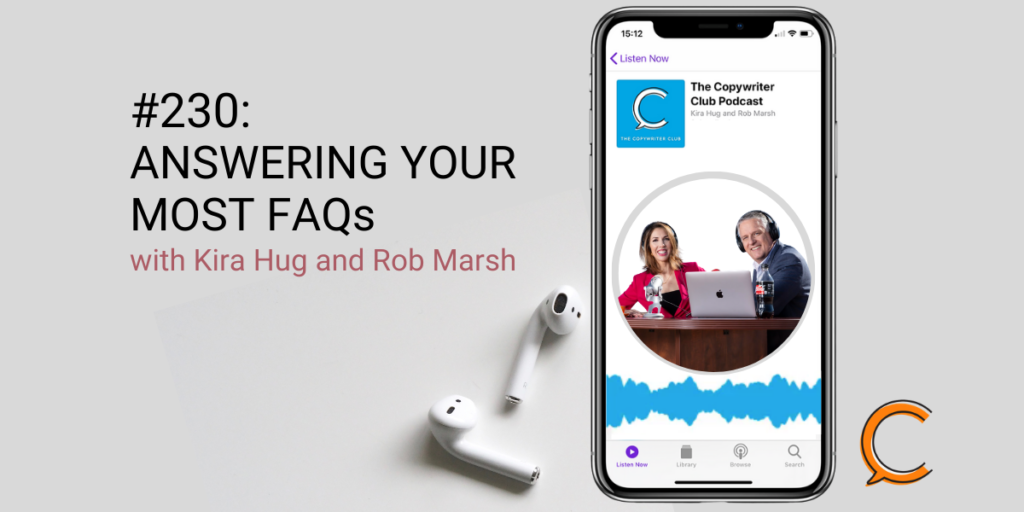
TCC Podcast #230: Answering Your Most FAQs with Kira Hug and Rob Marsh
Audio is streamed directly from the publisher (media.blubrry.com) as published in their RSS feed. Play Podcasts does not host this file. Rights-holders can request removal through the copyright & takedown page.
Show Notes
On the 230th episode of The Copywriter Club podcast, Rob and Kira are going guestless. They’re sitting back and answering some questions they get frequently among our community. They’re giving their best advice and tips for new and established copywriters who are looking to level up and sustain what they’re building. In this episode, we dive into:
• when you’ll get the chance to build the foundations of your business with us in just 3 months
• the truth about working for free – should you do it?
• how to hire a VA that will pay for themselves.
• 9 books we’re reading right now – one genre? Never.
• the #1 question we get asked every. single. day.
• the 3 biggest levers when it comes to pricing your offers.
• how to choose the most profitable niches in copywriting.
• the good and the bad of Clubhouse. (Note: We will be on Clubhouse on Tuesdays at 5PM EST.)
• if you don’t have copywriting samples for a particular project, here’s what you should do.
• the secret to building trust with potential clients.
• what Rob & Kira would do differently if they were beginners.
• success as a copywriter – how we define success
• how to maintain your business as you’re helping scale others.
Tune in and listen as we give candid advice on your most asked questions. Hit the play button below or check out the transcript.
The people and stuff we mentioned on the show:
The Copywriter Club Annual Event – Early Bird Sale Ends March 22nd
Done by Noon by Dave Ruel
Ready, Fire, Aim by Michael Masterson & Mark Ford
Yes to Life by Viktor Frankl
Man Search for Meaning by Viktor Frankl
The Righteous Mind by Jonathan Haidt
Facing the Climate Emergency by Margaret Salamon
Fair Play by Eve Rodsky
The Uninhabitable Earth by David Wallace-Wells
Lives of the Stoics by Ryan Holiday
The Copywriter’s Ultimate Guide to Using Clubhouse
Kira’s website
Rob’s website
The Copywriter Club Facebook Group
The Copywriter Underground
Full Transcript:
Rob Marsh: If you’ve been listening to the show for the last three plus years, you no doubt have heard us ask hundreds, maybe even thousands of questions to the amazing copywriters and experts who have been on the show. We’ve even asked a few people to join us and turn the tables to ask us questions. Today we’re going guestless for the 230th episode of The Copywriter Club Podcast, and we’re answering the questions that get asked the most often in our free Facebook group, as well as some questions that are asked in our paid programs, like The Copywriter Accelerator and The Copywriter Underground.
Kira Hug: When you say guestless, it makes it sound like we’re naked.
Rob Marsh: Does it?
Kira Hug: Like we’re missing something. Yeah, it sounds like we’re shedding all the layers today and it’s just us.
Rob Marsh: Nice. I would hate to think that people would think that we’re not clothed here, but yeah, that’s … How embarrassing.
Kira Hug: It’s just us today, naked and we’re going to answer your questions. Before we do that, this podcast episode is brought to you by TCC(N)IRL, of course it’s The Copywriter Club (Not) In Real Life, our event for copywriters and other smart marketers who want to learn from experts like Joanna Wiebe, Carline Anglade-Cole, Todd Brown, Jereshia Hawk, Joel Klettke, Eman Ismail and more than a dozen others. But this event is not just about great presentations, it’s not just about sitting at your computer and staring at Zoom all day. It’s really about connecting with other copywriters in intimate virtual spaces so you can build real relationships, even possibly friendships, partnerships, and also get a lot of work done while you’re with us over the three days. So we’re really focused on doing, not just learning, and we’re focused on implementation through workshops. So you’re not just sitting through a presentation and then going back to your work with nothing to show for it.
So if you’re interested in this virtual experience that we’re really excited about, you can learn more at thecopywriterclub.com\tccnirl-2021, and if you don’t remember that link, then you can just find it in the show notes on our website.
Rob Marsh: Yeah, I’m excited. That’s going to be April 7th through 9th, 2021. If you’re listening to this after that, you missed the opportunity to join us, but if you’re listening before those dates, make sure you join us. It’s going to be great.
Okay, so let’s open up, I want to say the mailbag. We don’t actually get any real mail, email bag or the Facebook groups, and answer some of the questions-
Kira Hug: Well, we get mail.
Rob Marsh: Well, email.
Kira Hug: Oh, you mean like mail questions.
Rob Marsh: Yes, yes. Questions in the mailbag. So we’re going to answer a bunch of questions that we get asked a lot, starting with, when are you going to open the accelerator again? So Kira, when are we going to open the accelerator again?
Kira Hug: I feel like that’s a really easy question to start, which is great, because I like easy. So we are going to open the accelerator again in the fall. We are currently running the program with an incredible group of copywriters and we’re going to run it again starting September. So you’ll hear about it probably starting in July but definitely in August. We’re going to make some updates to the program. It’s a program that we love and believe in, and we’re always excited to improve it and make it better as the copywriting space changes so that it’s valuable to all the copywriters who participate in it.
Rob Marsh: Yeah, I actually sat down this morning and started outlining some of the changes that I think we need to make, and I’m actually kind of excited about what this new iteration is going to look like, so it’s all good.
Kira Hug: You’re on the ball. We just talked-
Rob Marsh: I’m trying.
Kira Hug: … about changes yesterday and you’re already making notes. That’s impressive.
Rob Marsh: I had some time.
Kira Hug: Okay, so let’s start with … I’m glad that you gave me the easy question. I’m going to give you a harder question. Rob, should you ever work for free? Should any of us ever work for free? This question comes up quite frequently in all of our groups.
Rob Marsh: Yeah, and I think it’s actually a really good question because there are times when it’s definitely not right to work for free and times when I think it is acceptable. So, there’s a lot of pushback in the copywriting world about doing free projects or test projects, and sometimes I would agree with that. Sometimes it is not okay to work for free, especially if people are going to be using the work that you create for their clients, if they’re charging for it, those kinds of things, you should definitely be paid for that. But occasionally there’s an opportunity that will come along where you’re asked to do a test project as part of an application process or if a client may say, “Hey, I don’t have the budget. Can you do this for free?” In which case you might decide to do it, and I think that there are a couple of criteria that I would assign to that. First of all, does this free project, if it doesn’t earn you money, does it lead to something else that is beneficial?
So you and I, Kira, we talk sometimes about how there’s more than one way to get paid, it’s not always cash. It’s not always money in the bank. So if a free project could lead to a testimonial, or to a case study, or to another paying project, if it introduces you to potential clients, if it is the starting point of a project with an agency, that kind of thing, then you might consider doing it. Maybe not always, but those things you can use to leverage in your business and sometimes, especially when you’re starting out, testimonials, case studies, connections are worth more than a few $100 in the bank. So, in those cases you might consider working for free.
If you’ve been doing this thing for a long time though, I think free work, you’ve got connections, you’ve got your processes down, you’ve got a few testimonials, whatever, at that point I think you really do need to stop doing free work and ask for money for the value that we create. What do you think? Disagree, agree?
Kira Hug: I disagree completely.
Rob Marsh: Yeah, I thought so.
Kira Hug: I’m just kidding. I’ve never done … I mean, I’m sure I’ve done free work in my lifetime, but I have not done free copywriting projects for a client. I agree with you that sometimes we get paid in multiple ways that could be more valuable than a payment, than a cash payment, but I think as far as if you’re doing free work, then at least you should be able to control it. Maybe you’re building your portfolio and you’re choosing a couple of clients and you’re choosing dream clients and dream projects of companies that probably wouldn’t hire you, but you’re adding it to your portfolio and doing some really cool work that you could send over to them and possibly win them over as a client.
I think the part I disagree with is that I would never feel comfortable hiring someone and not paying them anything, like a copywriter in that sense. So, I guess I question any client you would work with that’s not paying you in some way. Is that a healthy relationship? I think even when I work with junior copywriters and do test projects I like to pay them something. It might be significantly less than a typical fee for a project because it’s a test project and there are multiple people, and it’s a different matter at that point. But if there was a client you really want to work for and they’re like, “I’m not going to pay you for this.” I just think, unless it is this tremendous portfolio piece and they’ve guaranteed they’ll write you a testimonial, then I just would steer clear of that client.
Rob Marsh: Yeah. Again, I think it’s never a hard yes or a hard no. That’s actually not true. Sometimes it is a hard yes or a hard no, but if you’re just starting out there may be opportunities to consider, but it’s definitely not something that you want to make a habit. It’s definitely not something that once you’ve got some experience that you’re making as part of your business plan or whatever because we should all get paid for the value we create.
Kira Hug: I do think there are times where you can charge a little bit less and work within budgets of a client, a particular client, if it’s a dream client or if you just want to get that experience, or you want to grow your portfolio that maybe you’re more flexible with your budget and you even take a cut. I’ve been willing to do that at times for the right client. So I’m not against that either when it makes sense.
Rob Marsh: Yeah, agree. Okay, next question. This is one that we get asked a ton as well. In fact, we’ve even asked it of other guests who have been on the podcast, and that is when should I hire a VA or start hiring other people onto my team to help me get the work that I need to get done done?
Kira Hug: When you hate your life, and you’re stressed out, and you hate your business probably is a good time to hire someone to help, maybe before that. So, for me, it was when I was definitely overstretched. I probably waited way too long, but I think if you’re managing multiple clients, I would say maybe more than like two, more than two clients, definitely more than three, at that point you could bring on a VA to help you with the project management. So, I mean, that was my main use for a VA, was please help me manage these project so they’re smooth because I can’t project manage them and copy chief them, and be the main copywriter, and be the sales person. So definitely if you have a business set up where you’re working with more than three clients at a time I would bring in a VA to help you with the project management side of the business. I think that’s a great way to bring somebody in for a necessary part of the business that will help alleviate stress and help you actually be able to take on more client work, which will ultimately cover the expense of a VA.
Rob Marsh: Yeah, I think that last point that you’re making about covering the expense I think is really important, because any time you bring somebody else into your business, they really do need to pay for themselves in some way. So either they’re taking lower paid tasks off of your hands so that you can focus on higher paid work. So maybe they’re doing things like invoicing, which can be done for 25 or $30 an hour, and that allows you to do more copywriting that you’re doing at say 150 or $200 an hour, or whatever those prices are right for in your business.
I think also we often think that the VA is the first hire, and while that is true in a lot of cases, sometimes it makes more sense to hire somebody that’s a little bit more skilled in processes, an OBM, a business manager type person first to help get those processes aligned, to help get all those structures set up. When you have that, then when you start bringing in people like a junior writer or a VA, the processes are in place, everything is much more efficient. So, that’s another way that you can go. That may not be the right thing for everybody because there is an additional expense there, but processes make having employees or contractors in your business so much easier.
Kira Hug: Yes. I would have, looking back, I didn’t really know what an OBM was at the time when I hired my VA. I feel like it’s something that we talk about frequently now, but we didn’t a couple years ago. So I would’ve hired that person probably to come in and build out all the systems to make everything run smoothly and that would be the first hire, even though it is a little bit pricier, I think it’s worth it, especially if you’re not a systems minded person.
Okay, next question. Ooh, this is a good one. What books are you currently reading?
Rob Marsh: It is a good question, and I’m just looking around my desk right now. I have like six or seven books that I read at the same time, and I don’t know how to overcome this. I feel like it’s a weakness, but I can’t stop. So I just finished a couple days ago reading Done By Noon by Dave Ruel. That’s a time management book. Not necessarily anything new, but offered a really good process that was intriguing to me and I like and highly recommend. I’m hearing something coming through the speakers, is that …
Kira Hug: I don’t think that’s me.
Rob Marsh: Oh no. Oh, you know what it is? I hear it. Yeah, it’s because something just turned on in my Audible as I was looking for the books. Nevermind. Okay, so other books that I’ve been reading. Ready, Fire, Aim by Michael Masterson or Mark Ford. All about how to grow your business, different stages of your business and what you should be doing in each. I’m going to grab a book. I have not yet started reading this one but it just came out, Viktor Frankl, Yes to Life. So apparently this is a bunch of lectures that he published early on. He’s the author of Man’s Search for Meaning, which is like easily in my top 10 books that I’ve ever read. There were some untranslated lectures that he gave and they’ve just been republished into a book. So my wife gave those to me on Valentine’s Day.
Kira Hug: I would like that one, and my birthday is coming up, so just …
Rob Marsh: Yeah, there you go.
Kira Hug: Making a note.
Rob Marsh: Three or four podcast fans are going to be sending you that book now. I was just listening to another book that is incredibly fascinating called The Righteous Mind by Jonathan Haidt. It’s all about how our morals are founded on intuition and then how we use reason to justify the things that we react to emotionally. I think that there are a ton of copywriting lessons in this, but it’s really about morals in a society and individually and why the different political sides don’t get along, and the basis for that and how we often think that the other side, whoever we disagree with, is wrong or evil. It’s a really good look at how other people’s belief systems are often based on just different kinds of morality that we don’t often see when we don’t grow up thinking that way, or even some of it is intuitive and inborn, and comes with our genes before the culture starts acting on it. So it’s a fascinating book. Then one last book-
Kira Hug: Wait, what’s that one called again? I would like that one too. What’s that one called?
Rob Marsh: It’s called The Righteous Mind by Jonathan Haidt. He also wrote a book I think called something on happiness, I can’t remember what his other book is called, but yeah. Then last but not least, if I can find it, I just downloaded to listen to it, it’s like a three part trilogy on the Civil Rights Movement and Martin Luther King in particular, and I can’t see it on my list, but I’m really excited about that. I’ll post a link to it in the show notes. I can’t remember what the title is, but it’s on audible, it’s super long, it’s like a 40 hour book or whatever, so it’s going to take me a little while to get through, and that’s just the first of the trilogy, but it sounded really interesting as I heard about it. I thought, “Let’s listen to that one when I’m out walking.” So that’s a range of maybe the six or seven books that I’ve got. There’s another book of poetry over on my nightstand and some other stuff I’m looking at, but that’s good enough. What are you reading, Kira?
Kira Hug: I like it. Well, I’m going to take the books out that you and I are both reading because you already mentioned Ready, Aim, Fire. Let’s see, so I am reading, this is the unedited, Facing the Climate Emergency by Margaret Klein Salamon. So this one is all about what to do over the next 30 years to alleviate some of the pain of the climate emergency. It’s a quick read, it’s all about … It’s actually interesting because she’s a psychologist, so she’s talking about climate change from the perspective of how people are dealing with it and how people cope and deny, and all the emotions around it. So it’s interesting if you’re interested in the psychology behind it.
Fair Play is one I need to start, Fair Play by Eve Rodsky. My therapist recommended it because it’s all about in your relationship, I guess in any partnership, how to make sure that it’s fair the responsibilities of the household or a family are fair. In my relationship with Ezra he tends to do a lot more than me. So, this is an exercise we can go through to kind of reassign all the tasks in our household and our family so that it’s fair.
Rob Marsh: Are you guys reading it together?
Kira Hug: The reason I’m delaying it is because I don’t actually want to make it fair, I think I should. It even comes with this set of cards and each card has a different responsibility, and I flipped through the cards and I realized a lot of them belong to him and not many belong to me. So, it’s one of those exercises, I know is important but I’m also delaying that as long as possible so I don’t have to take on more responsibility in my household.
Then The Uninhabitable Earth: Life After Warming by David Wallace-Wells. I think you can see a trend with what I’m thinking about these days. Also the one that Rob recommended, which I will mention because I’m excited about it, Done By Noon. So Rob is forcing me to read this, and I’m grateful for that because I do want to figure out how to be done by … I want to be done by noon, so I think that’s a great goal.
Then the other one that I started and stopped because Rob, I actually like reading six to eight books at a time, Lives of the Stoics by Ryan Holiday, just to get some wise words in there. So, that’s one that I can kind of take a break in. I’ll read it a little bit and then I need a break, and I need to read about some type of crisis or something else to keep me interested. So, that’s the current collection. It’s quite fun. Can be a little emotional, a little depressing at times, but I feel like it’s a good mix to pull me in many directions.
Rob Marsh: I think if you are able to be done by noon you’ll have more time for fair play in making that happen, so it’s a good combination, a one-two punch.
Kira Hug: Right, and then I can do more to fight and work towards the climate emergency. I think I need to start with that book, Done By Noon, so I can actually do all the things I want to do with all the other books. So yeah, that’s our collection. I want some of your books, Rob, so I’m actually looking forward to getting your list.
Rob Marsh: Cool, yeah, and that’s maybe something we can revisit. Every time we do a podcast like this, I mean, we will have read another bunch, a handful of books, so it’s …
Kira Hug: Or for me the same maybe eight books.
Rob Marsh: Or maybe we’re still making through. Yeah, so we can revisit that in the future. Okay, next question. Another one that we just see all the time, and this one’s a little bit nebulous, and so maybe we can just talk about a couple of approaches to this, but what should I charge for X? We’ll see people who have projects in the Facebook group, it’s like, “Hey, I’ve never done this kind of a thing before. I haven’t done a sales page before. I haven’t done a small launch before or a video script.” Whatever, so how do you think about pricing, Kira, and what should people be charging for the work that they do?
Kira Hug: Yeah, so actually we just talked about this in our clubhouse room this past week. We talked all about pricing and I think the first place to start is to just understand where you are as a copywriting business. What stage you’re in in your business growth, and as far as experience, as far as building your authority, creating a demand for your services, because what we would say to somebody who has done the work and marketed their business, and built their reputation over a couple of years, or more than that, would be very different. I think our advice to them would be very different in maybe our think tank or our round table mastermind compared to if we’re talking to somebody who is new to a copywriting business and just got started the advice would be slightly different because they’re in a different stage of their business. Maybe no one knows them, they just are taking their first few copywriting jobs. So I think the first place to start is where are you in that stage. Are you a beginner, a newbie? Are you more intermediate, where you’ve got some projects under your belt and you have some experience, you’ve started to put yourself out there, you’re starting to get some referrals, people are sharing your name.
That’s kind of the second bucket where it’s you’re really competitive. You’re in a competitive market, people are often commodity shopping. They’re talking to you but they’re also probably talking to two other copywriters, and then of course when you have invested the time in building your authority and building your expertise and visibility, then you have people … That stage is what we all want, right? It’s like you have prospects who are coming to you and only want to work with you. They heard you speak on a podcast or on a stage and they’re like, “I just want to work with you, Rob Marsh, I don’t even want to talk to other people. Please, find time in your schedule, I’ll pay whatever you want me to pay to work with you.” So we want to be there, but we don’t start there. At least, Rob, that would be my advice. Is figure out where you are starting because that’s going to be a very different conversation. We could dive deeper into that too, but what would you start to think about or advice when you’re thinking about pricing?
Rob Marsh: Yeah. So I always talk about these three main levers. There’s actually more than that, and you’re hitting on number one, which is that expertise level. Where are you in your business and what are you capable of actually doing right now?
Number two, and this lines up with where you are in your business, and that is which clients are you working with. So, as a beginner you tend to start out working with cheaper clients, smaller projects, those kinds of things, and as you grow in your business bigger projects come along, more research heavy or writing heavy, or longer projects, whatever, and higher paying projects. Then so it’s the kinds of clients that you work with and their ability to pay, their willingness to pay for what you’re asking, their experience level in working with other copywriters helps determine that price. If you decide that you’re going to charge $5,000 for a sales page and your clients all are under the impression the sales pages are worth about $1,500 or they’re budgeting about $1,500 for a sales page, there’s a huge disconnect there that you’re not going to be able to get what you think you’re worth or what you’re charging, right? So as far as pricing goes, your client’s ability, willingness to pay matters.
Then I guess the third lever is just the value you create. This is a little hard to figure out as you’re just starting out, but if you create a launch plan, sales pages, video scripts, emails, whatever that create a high six figures, seven figure launch for a client, you can then use that to talk about the value that you created. You just created assets that can be used for two or three years to create a million dollar result, or a $500,000 result, or maybe it’s a $20,000 result, right? The fact that you have proven that value, that the work that you do has X number as the end result, you can use that value to start raising your prices and to charge for the value you create as opposed to the hours that you work, or what a project should be worth inside your head. So I guess that’s what I would add to what you said.
Kira Hug: Yeah. I think the value piece is most important because the majority of us overlook the value completely and we’re just thinking about the time it takes to create the deliverable, which is important, but you’re right. It’s easier to know the value if you have those testimonials and those case studies, and if you’re asking those offboarding questions like a month after a project and you’re getting into the data and asking those somewhat uncomfortable questions, which is like did this work, was this effective, did you get sales, it’s scary to ask that sometimes because we’re worried that they’re going to say no or they’re going to be disappointed.
Rob Marsh: Sometimes they do say no.
Kira Hug: And sometimes it doesn’t work out as well, so oftentimes we don’t even ask. But if you can start collecting that data, it’s easier to start to see trends and to understand that out of the last five projects, the five email sequences I wrote, each one averaged and made about 10K for that client over six months. So you can start to make predictions about what else you could do for future clients based on the past results, and if you don’t have the past results, that’s okay too. You can make an estimate and a hypothesis about what you predict you could make for that client based on the numbers, how much traffic they have to their website, how many sales you predict you could make if you make improvements and optimize their website. So you can ask for numbers in the sales call to start to formulate an idea of what they could make on a project, without guaranteeing it.
Rob Marsh: Yeah, exactly. If you have those numbers it just becomes so much easier to figure out what that value is that you can build for somebody.
Kira Hug: And I think the hourly part though, I always, even though I want to think about value, I do think about my hours on a client project, how much I’m getting paid for the hour, especially as you get busier and you try to evaluate is this worth it, there’s an opportunity cost. Is this client project worth it? I want to know what the hourly rate is and what I’m bringing in per hour to see if the project is worth it or not. So, that’s where tracking your time becomes really important.
Rob Marsh: Yeah, you wouldn’t necessarily bill hourly, but understanding sort of this hourly rate in your head so that you’re making sure your time is used most effectively is definitely something everybody should be doing.
Kira Hug: And an example of that is I have one retainer client that I write emails for that retainer client. I have junior copywriters I work with, so I usually spend an average of an hour a week on that client, and so I have to look at the time that I’m spending on it to see how much I’m getting paid and then also what I’m paying out to other copywriters to see is it worth it in the end. Is what I’m making hourly worth it when I’m paying out other people to help with those projects? So it’s always a key to track.
Okay, there’s always more to say when it comes to pricing, that is a whole masterclass, but let’s move on to the next question. Rob, what are the most profitable niches?
Rob Marsh: Yeah, this is a question that comes up quite a bit in our accelerator program because when we talk about whether or not we should niche and which niches people should choose, obviously people want to be able to make money and sometimes that’s the driving factor for some people, which is totally okay if that’s what you’re in copywriting for, and typically you’ll hear the answers finance, maybe health and wellness, nutraceuticals, vitamins, supplements, those kinds of things, but I would say that honestly any niche can be profitable if you can connect with the right clients and you can solve a problem that those clients have. So, you do not necessarily need to write things that you don’t like, that don’t interest you, as long as you can find clients who have a problem that has some value to it.
So if you want to write say in the nonprofit sector, which there are lots of clients there who don’t have big budgets, they have huge opportunities to help people out, but again, maybe don’t want to pay as much as say somebody who has a financial newsletter. If you can help them solve their biggest problem, which may be bringing in donations or growing their donor lists, those kinds of things, you can almost write your own check, because if you can bring in four or $5 million, if you can help them raise that kind of money, then you can start to negotiate, say, “Well, what if I take 5% of that, or 10% of that.” And maybe you learn how to dial it up so it’s not five or 10 million but now you’re bringing 50 million.
As long as you can solve a big problem for somebody, you can make money. That’s not just true, again, in what I’ve talked about. If you can help doctors bring in more patients, or dentists bring in more patients into their practice, that is a really valuable skillset and it’s achieved by copywriting. If you can help people find clients for their online stores or get their launches off the ground. All of these things can be profitable, as long as you can solve a problem. If you can’t solve that problem that they have, then you’ll struggle in any niche, including the profitable ones like finance and health and wellness.
Kira Hug: Well said.
Rob Marsh: Right.
Kira Hug: I don’t have much to add to that, other than if you’re just getting started and you’re trying to figure this out, just look at where other copywriters are working, what niches are they talking about, what type of projects are they taking. There’s nothing wrong with getting started by almost mimicking what other working copywriters are doing. Not copying them, but just following the trends of oh, it seems like this industry is paying a lot of copywriters to do work, so maybe I should explore it, and figure out if you like it or not, or these deliverables seem to be mentioned frequently, so maybe I should see if I like writing that type of deliverable because I know there’s a lot of work there. So I think oftentimes we make it more complicated when we’re just getting started out and we feel like we have to find something that’s so unique in the copywriting space, but there’s nothing wrong with starting with something that is just needed and popular and there’s already a demand for it in the copywriting industry, because there’s always going to be more work with those deliverables or those industries.
Rob Marsh: For sure, yeah. No niche is forever. You can try things.
Kira Hug: No.
Rob Marsh: You can back up. You can try new things.
Kira Hug: Yes.
Rob Marsh: You can switch at any time. In fact, I think both you and I have switched our niches in the past, and who knows, we may switch again in the future.
Okay, next question. Why are you guys on clubhouse and when are you guys on clubhouse?
Kira Hug: Yeah. So well, I think Rob, you really kind of hooked on to Clubhouse initially. I mean, I kind of had the same reaction that a lot of copywriters in our communities have had, which is oh my gosh, I don’t need another social media channel. I need less, not more, but I think it was really helpful because you were so curious about it, and a couple other people too. Christina Torres in our think tank was telling us about how powerful it is. So hearing about how new and exciting and how different it is was alluring enough to pull I think both of us in. I do think that even if we feel like we have too many social media channels, it’s always worth paying attention to what is happening in a marketplace, even if you have zero interest in using it as a marketing tool for your own business. We are marketers and whether or not we like it we need to pay attention to what is happening in the space we work in for our clients, so we can provide a better education and be more of a consultant to our clients.
So for me, when you got interested in it I was like, “Sure, I’ll check it out.” Rob is excited about this, this could be great for The Copywriter Club because it’s community based and we are a community based business, but mostly it was like I want to check this out because I want to understand what’s happening in the marketplace because that’s my job as a marketer, so that’s where it started for me. What about for you?
Rob Marsh: Yeah. I was also curious about it. There are a couple things that I really like about Clubhouse and then there are some drawbacks to it as well that I’m not convinced that it’s the best thing out there, but there are conversations that happen on Clubhouse that because of the nature of Clubhouse they really aren’t happening anywhere else. So for example, I’ve jumped into some calls with direct response copywriters and heard them talk about their philosophy behind a particular promotion, the response rates they’ve got, why they did a particular upsell, what they were doing to change persuasion. I think, I mean, in your head or in my head I’m thinking, “Well, those conversations happen elsewhere.” But they don’t happen in the same way because everything is off the cuff, it’s not scripted, you’re actually getting the real expert, not a PR person or their assistant who is posting something on social media for them.
So you’re getting information in a different way, and it feels to me like it’s just a little bit more raw, a little bit more real. So those kinds of conversations are really interesting to me and I’ve learned some things that I don’t think I would’ve learned even in a podcast interview if I’d asked the same questions. I think people are a little bit more protective of what they share, certainly when they write it down or they create courses. So there are conversations happening on Clubhouse that are different from conversations happening anywhere else. I do think that there are some drawbacks though.
The fact that it’s not recorded, the fact that it lives in the moment. That’s been pitched as one of the good things about it, but it also means that those conversations are lost. If you’re not there at 11 o’clock or at four o’clock, whenever that conversation happens, then you miss out, and that’s unfortunate. Because of that, we might look at that and say okay, it’s kind of fun to be here but we’re not going to make it a huge part of our business because we can’t repurpose that content somewhere else, or it disappears, unlike the time we spend on a podcast, which we’ve got podcasts that we recorded three years ago that still get listens to almost every single week. Being able to share information in that modality, in that way may be more productive for us as a business.
So yeah, so there’s kind of two sides to it that I like and don’t like about it. I’m just going to keep showing up and experimenting and playing around in there just because I think it’s, like you said, new, interesting, and we should understand how it works as a marketing vehicle or as an authority building vehicle for our clients and for ourselves.
Kira Hug: And it is working for copywriters we know who are in the underground and the think tank who are showing up in rooms regularly, maybe once or twice a week. They are getting clients. They’re actually booking clients from this platform. I mean, you and I aren’t necessarily looking for a ton of new clients for our copywriting business right now, but if I were looking to get booked for the next six months I would use Clubhouse as the tool right now because it’s still new and you can get into these rooms with the right people who are launching. There are rooms just about course creators, and you can be the only copywriter in that room. So I think it’s really strategic if you are looking for clients, if you feel like you could even level up and find new clients to use it.
For us, it’s been really powerful just to connect with more copywriters because that’s what we’re focused on, in the community. To hear from copywriters that we may not have met otherwise that aren’t in any of our current communities, I’m constantly surprised by how many jump into our room and I have no idea who they are, and so we start following each other.
So I think there is just this access to a new group of people, a new pool of people that you may not have access to otherwise. So if you’re interested in finding new clients or community building, it’s definitely a great tool. As Christina Torres has shared with us, she uses it for research for her client projects. This is what we do, voice of customer is so important. So if you could go into a room focused on a particular subject related to a client’s project and you can listen like a fly on the wall to the conversations that are unedited and oftentimes vulnerable too, I mean, that’s the best voice of customer data out there. So I think if anything, we should probably all be using Clubhouse as a tool in our marketing or our research toolkit because it could be more powerful than the other tools we’re currently using.
Rob Marsh: Yeah, I agree. We actually wrote a guide to Clubhouse for copywriters, it’s on The Copywriter Club blog. If you want to check that out, we’ll link to it in the show notes. We talk about how Christina is using Clubhouse for research, and she shares three or four different ways for copywriters to do that specifically. We also talked about Kathy Young, who has been in there and she’s landed two or three clients just from connecting with people, asking questions, talking about what she does. So anyway, check out that on the blog. It will give you some ideas of what you might be able to do with Clubhouse if you’re curious about it.
Maybe finally, Kira, we should just share when we’re on Clubhouse, at least right now, pretty regularly.
Kira Hug: Yeah. So we are on every Tuesday at 1:00 PM Eastern. Sometimes we’re leading the discussions or we’re inviting other copywriters to lead the discussions on a variety of topics of interest to the community. So you can always jump in there just to watch, or not to watch, to listen, or if you want to share and participate, we’re always allowing and pulling more people onto the stage to share their insights and advice. So it is still a bummer that Androids can’t access Clubhouse. I feel like that will change soon, so that is also the downside, is just that we’re losing part of our community that can’t plug in right now.
Rob Marsh: Yeah. I know they’ve hired an Android developer, and so that is coming, but yeah, it may still be a few months away from when we’re recording this.
Kira Hug: But in the end I think my final words on it is just don’t be a Debbie Downer when it comes to new social media platforms. Even though I’m the first person to be that Debbie Downer, because I’m like, “I don’t need this. This is just really bad.” But again, you never know when there is an opportunity with a new social media platform, and again, this is what we all signed up for as marketers, is at least to learn and explore and then make a decision. So at least explore before you decide that it’s not a tool you want to use for research, it’s not a tool you want to use for acquisition, it’s not a tool you want to use with consulting for your clients, but at least explore it first before you make that decision.
Rob Marsh: I mean, it’s a great place to make connections. If you show up and you want to talk to Rob and Kira one-on-one or as part of the group, you come into our room, you can ask us a question directly, and I can do the same thing in a room with Laura Belgray. I know when she’s showing up in some rooms, I can do the same thing with someone like Parris Lampropoulos or David Deutsch because they show up in rooms where they are. Right now it’s a great way to connect with people, and so definitely worth just playing around with.
Kira Hug: Okay. So, Rob, how do you respond to a client who asks to see samples of your work when you don’t yet have