
The Bill Walton Show
297 episodes — Page 2 of 6

S6 Ep 237Episode 237: Financial Regulation: Boring, or Terrifying? with Chris Iacovella and Norbert Michel
A slew of financial crises that stretch all the way back to the banking Panic of 1907 have been exploited to justify erecting a financial regulatory system that has vastly centralized and expanded federal power over our money. The irony is that these crises were largely caused, or at least exacerbated, by poorly designed government regulations. What we have now is an unholy alliance of regulators, mega banks and entrenched special interests who are the chief beneficiaries our system of opaque and complex financial regulation. Adding to this mix is the progressive Left who are now using our financial system to push its DEI and climate change agendas. Joining me on this episode to explore some of what should be our main concerns and to point the way to solutions are Chris Iacovella, the president of the American Securities Association and Norbert Michel, the director of Cato Institute's Center for Monetary and Financial Alternatives. Both are deep subject matter experts who know their way around most every nook and cranny of the deep regulatory state. Read More: https://billwalton.substack.com/p/financial-regulation-boring-or-terrifying?sd=pf

S6 Ep 236Episode 236: It's High Time to Retire Senator Tim Kaine: Talking with Senate Candidate Scott Parkinson
This show only occasionally gets into election politics but we now have a candidate for U.S. Senate from Virginia who is superbly equipped to run a substantive campaign articulating the real issues facing Americans. In this episode I'm introducing Scott Parkinson, who's running for the Senate in the Commonwealth of Virginia, to replace Virginia Senator Tim Kaine. In a crowded primary field, Scott stands out as a candidate with the expertise to understand the mechanics of how to get things done in the Senate. He has worked in the United States Senate for three Senators — John Ensign, Ron Johnson and Marco Rubio. Scott was the Executive Director of the Republican Study Committee (RSC), the largest caucus in the House of Representatives – under Chairmen Bill Flores and Mark Walker. He also was Chief of Staff to Representative Ron DeSantis and served as the Deputy Executive Director to Governor-Elect Ron DeSantis' transition team in Tallahassee, Florida. Read More Here: https://billwalton.substack.com/p/its-high-time-to-retire-senator-tim?sd=pf

S6 Ep 235Episode 235: "Defining a Man and a Woman: What's At Stake" with Dr Jay Richards
Until recently, no precise legal definition of sex—and especially the terms "male" and "female"—was needed because no one contested it. Up to now. Gender activists are rapidly moving to redefine sex in federal laws and regulations, such as Title IX, to include "gender identity." If this succeeds, it will subvert all preexisting legal references to sex, contrary to their plain intent. The movement to redefine sex to include "gender identity" is part of a larger agenda to dissolve sex as a stable legal category and create chaos. This is a massive and infuriating issue and we need to understand the deeper agenda that lies underneath it. For some answers I'm joined in this episode with Dr Jay Richards, Director of the DeVos Center for Life, Religion, and Family at the Heritage Foundation about his recent essay on "Why States Must Define Sex Precisely". Read more: https://billwalton.substack.com/p/defining-a-man-and-a-woman-whats

S6 Ep 234Episode 234: "The Chess Pieces are Moving: Russia, Putin, the Wagner Group, Ukraine, China, Xi, and Blinken" with Stephen Bryen
Two months ago I wrote "the war in Ukraine drags on at a terrible cost for all involved with no seeming end in sight. Ukraine is on the ropes and running out of manpower with its most of its elite forces destroyed. Missiles for its air defenses are depleted. Both sides are dragooning teenagers and old men for their armies. Russia's military command is in disarray." Since then, the situation's grown worse - for both sides. So I've asked my frequent guest Stephen Bryen back for another conversation for his take on what's likely to happen next. Stephen is a senior fellow at the Center for Security Policy and the Yorktown Institute, and has over 50 years' experience in the arms trade and national security including several stints in the Pentagon. As usual, there's a lot packed into our brief conversation, ranging from Zelensky's and Putin's future, and the Wagner Group uprising, to China's involvement and Xi's designs on Taiwan. And of course Tony Blinken's recent humiliation at the hands of the Chinese. Read More: https://billwalton.substack.com/
S6 Ep 233Episode 233: Biohacked: China's Race to Control Life with Brandon Weichert
"Would you want your DNA and other healthcare data going to an authoritarian regime with a record of exploiting that data for repression and surveillance? Let's be specific, would you want it going to China?" That's just one of the questions my returning guest national security expert Brandon Weichert and I cover in this far-reaching conversation about China's BioTech ambitions and their alarming implications. Brandon Weichert, author of Biohacked: China's Race to Control Life is a leading expert in geopolitics and emerging technologies and who been described as a "panic-and-anxiety inducing scholar." He lives by Dr. Herman Kahn's mantra that "I'm against fashionable thinking" and you won't hear much of that in this disturbing, yet at the same time entertaining conversation. In the realm of cutting-edge biotechnology, the relentless drive of the Chinese Communist Party (CCP) to exploit emerging BioTech technologies casts a dark shadow over the global stage. "China's President Xi Jinping has identified biotechnology as one of the key fourth industrial revolution industries that China must dominate in order to achieve his China Vision 2049," warns Brandon. Amidst this pursuit, China has been utilizing CRISPR-Cas9, the gene editing tool originally developed in America. "China's using CRISPR-Cas9, the gene editing tool that we in America developed and we shared with China, which allows scientists to go in, and at the genetic level, splice human genes and either take out unwanted or undesirable aspects of that individual's genome or input," reveals Weichert. Read more at https://billwalton.substack.com

S6 Ep 232Episode 232: "Our Dystopian Green Energy Future" with Mark Mills
This episode is about the catastrophic dead ends we face if we plow blindly ahead with the promised "green energy"future. Powerful forces obsessed with CO2 and climate change are determined to replace hydrocarbon fuels with solar and wind energy and other yet to be invented technologies. It's a obsession fueled by a toxic mix of religious fervor, old fashioned greed and a "degrowth" agenda aimed at dismantling the modern global economy. But setting these agendas aside, has anyone anywhere adequately explained the physics and the economics of the so-called green utopia? My guest on this episode, Mark Mills, has thought it through and has a stark message for us, an inconvenient truth. "There won't be a world powered entirely by wind and solar or batteries. The reason I say that is because it is not possible. We don't have the materials and we can't afford it in either environmental or economic terms." Mark Mills probably knows more about this than anyone. He's a senior fellow at the Manhattan Institute, focusing on science, technology, and energy issues. He's also faculty fellow at the McCormick School of Engineering at Northwestern, where his focus is on future manufacturing technologies and a strategic partner in an energy software venture fund. This episode defies a brief description. Mark provides tour de force explanations that are well worth an hour of your time to understand. With them you will be equipped to properly understand and debate energy realities. If we are to push back against the dystopian future that a fully-realized climate change agenda guarantees, we need to be armed with informed arguments. Just a few of the highlights: "All energy systems used to deliver useful power to society require building machines, every energy system. So, what you really want to know is how much material does it take to build the machines to make windmills and solar panels. For wind turbines, the amount of concrete glass, polymers, plastics, and steel you need per unit of energy goes up tenfold per unit of energy produced compared to a gas turbine" "You'll have to increase the total supply of metals and minerals, copper, nickel, lithium, aluminum, molybdenum, neodymium, etc. Not by a little but by a lot, tenfold. We will need hundreds of new mines, not a few, hundreds of new mines." "By one estimate, nearly 400 new giant mines … but at what price …environmentalists are broadly sweeping under the rug the consequences, the environmental, economic and human consequences" "Climate Change advocates have fundamentally thrown under the bus all of the environmental issues they used to care about. Everything. Land use, use of toxic chemicals, visual pollution, habitat destruction, species protection …because the quantity of materials you need to produce the same unit of energy by moving to wind and solar increases by at least 1,000%." "If you multiply the number of mines we need for solar, for wind and also for batteries … it's hundreds and hundreds of mines … hundreds of thousands of square miles. We're going to be killing habitat and species all over the planet." "The quantity of plastic in one small wind farm is greater than all the plastic used to make all the world's plastic straws." "We import roughly 80 to 90% of the manufactured solar modules we use to make solar panels in America … from China." "Wind turbines being built today are about the size of a Washington Monument, two to three megawatts each. So a field of 50 covering 100 square miles could power a small town of say 20,000 to 50,000 people … A single gas turbine whose gas pipe is bare and you can't see, the size of a tractor trailer, can provide the same amount of electricity." Congress has appropriated trillions of dollars to what should now be properly called the Climate Change Industrial Complex which is growing richer by the day. "When you say, "Oh, we need to replace all hydrocarbons with wind, solar, and batteries," you're not making a small subsidy distortion. You're now saying, "I have to subsidize by definition, all American energy production."" "The Inflation Reduction Act (aka the Green New Deal) included provisions intended to override local communities and state's objections to transmission lines. The climate agenda would not only change our energy systems, but also seek to make it yet another federal power." "A Dutch government sponsored study concluded that Netherlands green ambitions alonewould consume a major share of all the world's minerals." "The CO2 emitted to build the electric cars batteries and mine the materials will offset most, if not all, of the CO2 then not emitted by not burning gasoline in the first place. So you get nothing in CO2 terms or very, very little, for the price of exporting of jobs, geopolitical dependencies, and environmental impacts somewhere on the planet for no benefit." "What they're essentially saying is that there is no possibility, and I agree with them, on cutting the planet's carbon dioxide emissions,

S6 Ep 231Episode 231: "Reclaiming the Culture through Film" with Michael Pack
Global streaming services are projected to reach over 1.5 billion subscribers in 2025 with worldwide spending on TV, film and documentary production reaching over $220 billion a year. Netflix, Disney, Amazon Prime, and HBO Max alone account for more than $75 billion of that spend with almost all of it on woke progressive themed entertainment. Looking only at documentaries and small independent features, the Left spends tens of billions of dollars each year. The Left's successful decades "long march through the institutions" has captured Hollywood and it now owns the cultural narrative. Conservatives have paid a big price for downplaying the importance of culture, seeing its airy fictions as less serious than economics or politics. The numbers show it. The right spends, maybe, only tens of millions of dollars on films and television, a spending gap of over hundreds of billions of dollars. Artists are "the unacknowledged legislators of the world" and if conservatives hope to regain the cultural ground, we need to get into the game. Joining me to explain how is Michael Pack, documentary filmmaker and the former CEO of the US Agency for Global Media. Michael's produced over 15 award-winning films for public television, and most recently Created Equal: Clarence Thomas in His Own Words. Conservatives who have basically surrendered the culture wars often claim, "We can't fight back because the left is naturally more artistic and given to storytelling." Michael and I do not believe that's true and that the culture wars are winnable, but only if we take them seriously. This episode provides a start, exploring the craft of making - and the business of financing - filmed storytelling and documentaries. We cover film schools, production facilities, cinematography, sound, editing, the foundations financing progressive filmmakers and much more. We also talk about the pure fun of filmmaking and storytelling. It's a lot more fun than politics. Based on my experience, the actors are all pretty good-looking, the creatives are fun to work with and it's a joy to be on a movie set. Getting into movies is not like taking your castor oil. We start with story and the truth that the most effective way to win hearts and minds is through the telling of stories. From the first cave paintings, to the Bible, to Shakespeare, to today, stories are how people learn to understand the world, and each story is a model for how the world works. "People crave epic stories, meaningful life pursuits, and courageous figures who appear to stand for something," relates Michael. "Good stories are stories of heroic individuals, usually not without flaws, dealing with complex things and making choices." "Contrary to conventional wisdom, I am much more optimistic about the culture, especially the story-telling media, than about politics and government." Politics is actually a harder game to win. The administrative state has really dug in and civil servants have iron-clad protections. On the other hand, the culture is still relatively a free market. We can make films. We can set up streaming companies. We can set up distribution companies. "We have simply seeded that turf to the Left," says Michael. "We have simply let them have it. It's not a culture war when only one side has an army in the field and the other side just writes essays about how they don't like that army. " We have to be making culture, not just complaining about it, and it is not that hard to do and we can do it.

S6 Ep 230Episode 230: "An Action Plan to Thwart the Chinese Communist Party's Aim to Achieve Global Dominion" with Frank Gaffney
Over three decades ago the leadership of the Chinese Communist Party began in earnest to develop and execute a strategy to bring about what its now President Xi Jinping calls "global governance, directed and enforced from Beijing." Determined to avoid the fate of the Soviet Union's defeat in the Cold War by the United States, then President Deng is said to have declared to the Party that "a new Cold War has now begun between the United States and China, and China will win." Thus began a comprehensive plan of "unrestricted warfare" that came to be known colloquially as the Hide and Bide strategy … "Hide your capacities, bide your time." It was designed to assure that China become so integrated with the United States' open economy and society (e.g. through "elite capture") that the US would be strategically vulnerable. In this, the CCP has wildly succeeded, and now the United States finds itself back on its heels against an openly aggressive China and its intention to replace the United States as the preeminent power not only in Asia but around the globe. The US needs its own plan of action. My guest on this episode, Frank J. Gaffney has done just that in his recent book, an across the board plan that addresses the many fronts to be fought on against China's "unrestricted warfare". "The Indictment: Prosecuting the Chinese Communist Party & Friends for Crimes against America, China, and the World." The book represents the fruits of a comprehensive effort to develop and champion a vigorous response to the China challenge. It draws upon a comprehensive program of some seventy webinars conducted by the Committee on the Present Danger: China addressing: 1) the CCP's decades-long self-described "Unrestricted Warfare" against America; and 2) the role America's elites have played in helping the Chinese Communists win. "It identifies nine "criminal charges" that can be brought and prosecuted, at least in the court of public opinion, against the Chinese Communist Party and its American enablers." "The Indictment also enumerates twenty specific actions that are intended to inspire and equip congressional investigators, patriotic executive branch officials, journalists, and the public at large to review these charges and recommended actions bring to justice and take down the Chinese Communist Party for its horrific criminal conduct—past, present, and that which is in the works—against its own people and countless others, including ours." Frank J. Gaffney is the founder and executive chairman of the Center for Security Policy, a non-partisan organization that champions "peace through strength." He is the vice chairman of the Committee on the Present Danger: China and the host of Securing America with Frank Gaffney, a daily television program on the Real America's Voice Network. Listen in for some of highlights from Frank's book and to learn what's at stake in what must now be our own "unrestricted war" with China.

S6 Ep 229Episode 229: "You May Not Be Interested in CISA, But CISA is Certainly Interested in You" with Ben Weingarten and Frank Gaffney
"Overwhelming evidence suggests that federal agencies – led by among others, the Cybersecurity and Infrastructure Security Agency (CISA), buoyed by senior executive branch officials and lawmakers, colluding with Big Tech, and a coterie of often government-coordinated and government-funded "counter-disinformation" organizations, have imposed nothing less than a mass public-private censorship regime on the American people." Explains Ben Weingarten, one of America's leading investigative journalists, at a recent Homeland Security Oversight hearing. As you'll learn in this episode, the evidence is overwhelming. Ben Weingarten is editor-at-large for RealClearInvestigations, contributor to the Federalist, Newsweek, New York Post, Epoch Times and author of the alarming book American Ingrate: Ilhan Omar and the Progressive-Islamist Takeover of the Democratic Party. Joining me as co-host is Frank Gaffney, host of "Securing America with Frank Gaffney" on Real America's Voice and the founder of the Center for Security Policy. "CISA is a microcosm of a federal government censorship regime, and by proxy through social media platforms, that runs from merely shadow banning or flagging tweets and Facebook messages, all the way up to de-platforming and debunking people and even more alarming, actually throwing dissenters in jail for their views," explains Ben. "It's rooted in an ideology which says that speech that the authorities don't like constitutes a "threat" to our democracy that is then used as a justification to engage in a slew of acts that I think most Americans would say violate their most essential civil liberties." Some of what we talk about in this episode: The mission creep within our national security agencies which are increasingly turning from targeting foreign jihadists and instead to "domestic wrong thinkers" as America's preeminent threat. How Obama's DHS Secretary Jeh Johnson expanded its mandate to protect America's infrastructure to include "election infrastructure" as critical infrastructure which then became part of CISA's charge when it was established in 2018. Current CISA director Jen Easterly has now declared that the American mind is a "cognitive infrastructure"which means they're now targeting not only what we say but what we think. "CISA's tasks are to defend our most critical infrastructures and our most critical infrastructure is cognitive infrastructure … the American mind," she asserts. CISA's convening and coordinating meetings between national security and law enforcement agencies, and technology companies including Facebook, Meta, Google, Twitter, Reddit, Microsoft, Verizon, Pinterest, LinkedIn, Wikimedia Foundation, etc CISA's "Switchboarding" reports of purported misinformation and disinformation from state and local authorities and then forwarding reports of offending content to social media platforms for censorship. How the rosters of the censorship "trust and safety integrity" teams at Meta, Twitter and others are filled with former CIA officials, FBI officials, DOD officials, etc DHS targeted list of "inaccurate information" includes "the origins of the COVID-19 pandemic, the efficacy of COVID-19 vaccines, racial justice, U.S. withdrawal from Afghanistan, and the nature of U.S. support to Ukraine." CISA's previous Director Christopher Krebs claimed the 2020 election was the most above board cleanest election, most secure election in American history. But at the same time worked to censor "wrong think" about mail-in balloting and changes to election rules and policies, sometimes while they were still being debated. The CISA agenda is aimed at not only what people say, but what they will refrain from saying in public, or in private. "How much speech will never be out there for people to grapple with and consider because no one wants to go through the ordeal of potentially being broken by expressing wrong things," worries Ben. "The entire basis of our system rests on free inquiry, free speech, free thought, freedom to listen. Otherwise, you have tyranny." This is a heart-of-the-matter issue for America and there's a lot packed into this episode about our alarming "security state." Definitely worth your time to listen and learn.

S6 Ep 228Episode 228: "Google's Utopian Vision and the 2024 Election" with Dr Robert Epstein and Jenny Beth Martin
Voter and ballot fraud may just be a small part of the problem that conservatives face in the upcoming 2024 elections compared to the power of Alphabet, the parent company of Google and YouTube. Using its "total data collection" systems it can sway the opinions of millions of people and influence how they vote. We've known about this issue since at least 2016 and it has not gone away. If anything, with the emergence of AI, the threat has grown even more ominous. Executives at Google have stated that "investments in machine learning and AI" are a big opportunity to address the "misinformation" shared by "low-information voters." Shining a bright light on Alphabet's power is the comprehensive research done by my returning guest, research psychologist Dr. Robert Epstein, a California Democrat with a Harvard Ph.D, who has spent the last decade monitoring Google's manipulation of newsfeeds, search results and YouTube suggestions. Joining me to co-host is Jenny Beth Martin, founder of the Tea Party Patriots, who also has an extensive information technology background. "96% of Alphabet's employee's political donations go to Democrats and its homogeneous culture leans extremely left and the two founders are utopians," explains Dr. Epstein. "In their mind, they know what's best for the world. These are extremely arrogant people who think they have the power of gods." An eight‑minute video leaked from Google called "The Selfish Ledger," starkly reveals Google's aspirations to re‑engineer humanity according to its utopian "company values." Another leaked video after the 2016 election shows Google's co-founders Larry Page and Sergey Brin and its CEO Sundar Pichai dismayed by Trump's win and essentially saying "never again." In it, they talk about Trump supporters as "extremists" and say the election outcome "conflicts with many of Google's core values." Epstein estimates that Google shifted about 6 million votes to Joe Biden in the 2020 election by manipulating voters with things like biased algorithms, "get out the vote" messages and videos. (Over 70% of the videos that people watch every day on YouTube come from liberal sources suggested by its "up next" algorithm.) Does anyone doubt that Google will be all-in on making sure the "correct" candidates win 2024 elections? One source of its power is that Google knows with precision practically every voter's political preferences. They know who's going to vote, who's not going to vote, and how they're going to vote. "If you've been using the internet for 20 years, Google has the equivalent of more than three million pages of information about you," according to Dr. Epstein. "They're doing surveillance at a massive level that J. Edgar Hoover couldn't even possibly have imagined. It's 24 hours a day, and it's over many, many, many different kinds of platforms that most people haven't even heard of." Google has also partnered in the "Global Disinformation Index" and the release of the Twitter Files have shown how extensively the Executive Branch communicated and coordinated with technology companies for taking in moderation "requests" from the White House, the FBI, DHS, HHS, DOD, the Global Engagement Center at State, and even the CIA. If Google is manipulating search results or YouTube suggestions it's impossible to trace because they are "ephemeral." They disappear once you click off the links provided, and can never be recovered. However, there is hope, a potential counter-measure that Dr Epstein has developed to capture that ephemeral data by effectively "looking over the shoulders" of real users. He now has almost 8,000 registered voters in 50 states, who have given him permission to monitor and record their every Google interaction. Of course, challenging a $1 trillion tech colossus requires resources and it will take up to $50 million to fully build out his system. It's a big lift and we talk about what it will take to get it done. It's a critical project. "With companies like Google, we're talking about control that's completely invisible to people," Epstein says. "We're talking about control by mainly one and to a lesser extent a couple of other private companies … the more I've learned about it over the years, the more concerned I've become." We unpack a lot in this episode, including which email and browser you should be using to protect your privacy.
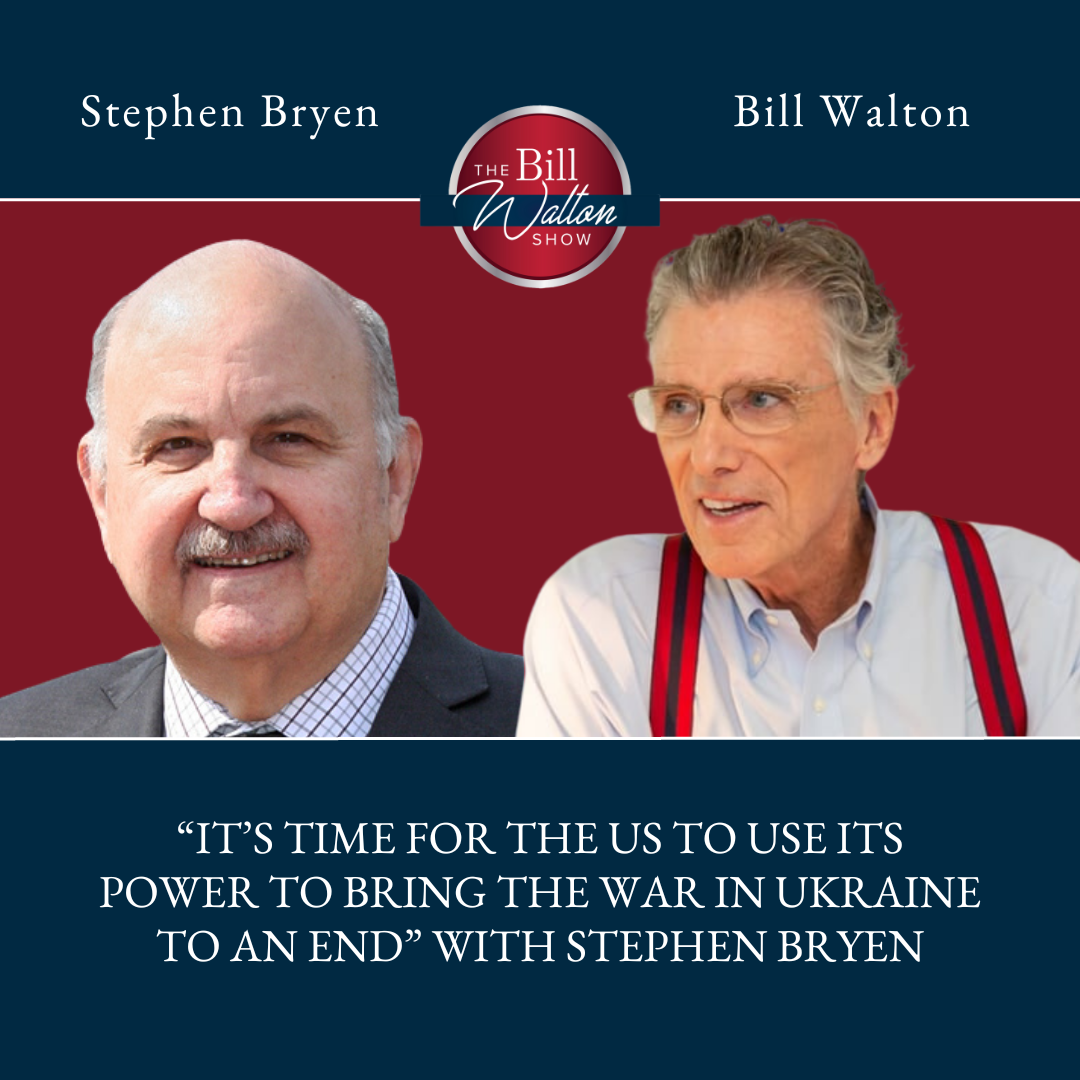
S6 Ep 227Episode 227: "It's Time for the US to Use Its Power to Bring the War in Ukraine to an End" with Stephen Bryen
The war in Ukraine drags on at a terrible cost for all involved with no seeming end in sight. Some estimate that there have been almost 400,000 total Russian and Ukraine casualties so far, although both sides claim their losses are much lower. Ukraine is on the ropes and running out of manpower with its most of its elite forces destroyed. Missiles for its air defenses are depleted. Both sides are dragooning teenagers and old men for their armies. Russia's military command is in disarray. But no one knows what is really going on. A key problem understanding the war in Ukraine is the reliability of sources of information and the fact that both sides specialize in disinformation and fake news. To sort through what might be true, and where events are leading us, I'm joined again by an astute observer of the world scene, Dr. Steven Bryen, Senior Fellow at the Center for Security Policy and the Yorktown Institute. With over 50 years national security experience, including many stints at the Pentagon where he was known as the Yoda of the arms trade, he's been following closely the details and the ins and outs of the war in Ukraine. What was initially sold by the Biden Administration as humanitarian aid to Ukraine has had from the very start a deeper agenda: The White House wanted this war to bring about regime change in Russia. "For God's sake, this man cannot remain in power," declares Joe Biden. And this: "Our objective is to exhaust and degrade Russian forces so they cannot fight anywhere else in the world," warned Secretary of Defense Lloyd Austin last year. So has their proxy war been a smart move? So far, hardly. It ranks right up there with their catastrophic exit from Afghanistan and the mess they've made in the Middle East. It's also driven Russia into the arms of our real geopolitical enemy China. "If you want to break up Russia, it's a fool's errand, it won't work," says Stephen. "Russia's not going to break up. It's a big powerful country and a nuclear power. So why tempt the furies with that kind of nonsense? It doesn't make any sense. It's not in the United States' national interest. It's not in the Europeans interest, although you'd never know it from listening to them. Having a war in Europe in this day and age would be a horrible tragedy. It would destroy the West. So why would anyone risk that?" Henry Kissinger says that conditions are right for negotiations on Ukraine by the end of the year. "But negotiations won't start unless Washington wants them to start," says Stephen. "Or unless Zelensky and his crowd are gone and someone else takes over in Ukraine. But if things stay the way they are, there's not going to be any negotiations. Biden doesn't want them. He wants a victory, a total victory over Russia in Ukraine." But if things stay the way they are there will be no victory. This will grind on and on, there'll be many more dead, more destruction, and let's not forget the risk of bringing nuclear weapons into play. It's time for the US to use its power to bring the war in Ukraine to an end now. It's in our interest. It's in the world's interest. This episode is a treasure trove of Stephen Bryen's nuanced and penetrating insights. I keep bringing Stephen back on for his wisdom and he never disappoints. Well worth your time to listen.

S6 Ep 226Episode 226: "The Weaponization of Loneliness" with Stella Morabito
"Terror can rule absolutely only over men who are isolated against each other.… Therefore, one of the primary concerns of all tyrannical government is to bring this isolation about." — Hannah Arendt, The Origins of Totalitarianism "Americans have long sensed a new kind tyranny creeping into our lives. This disquiet has hovered in the background for a long time, though most of us couldn't put our finger on it. Trends to control speech and behavior are isolating us from one another, and they have begun to intensify rapidly and spread throughout society's institutions." — Stella Morabito In this episode Stella Morabito returns to talk about her recently published book The Weaponization of Loneliness: How Tyrants Stoke Our Fear of Isolation to Silence, Divide, and Conquer. Stella, a prolific author at The Federalist, writes incisively about the social fallout of propaganda, mob psychology, and the cult mindset, drawing in part from her years as an analyst at the Central Intelligence Agency where she focused on methods of Soviet propaganda and disinformation, and its state-controlled media. Some excerpts from our conversation: The underlying dynamic of totalitarianism is the same: a machinery of loneliness that threatens to turn people into social pariahs in order to extort compliance. History is filled with vivid examples - Cromwell's England, Robespierre's France, Lenin and Stalin's Russia, Hitler's Germany, Mao's China - of the damage done by totalitarian regimes that impose the machinery fueled by the conformity impulse and terror of isolation. "Isolation and how tyrants use it to control people, is really the greatest threat to freedom, no matter what level of tyranny it is. It can be a gaslighting partner, it could be a cult leader, it could be a world-class dictator. I finally concluded that there is a machinery at work—a machinery of loneliness. Tyrants operate that machinery—wittingly or not—in order to disarm those they wish to control." When signals surfaced in America —such as anti-speech codes written into federal law in the 1990s allegedly to curb hate—we tended to shrug them off. It was too frightening to believe those speech codes could really lead to direct attacks on freedom of speech protected by the First Amendment. Yet a new kind of authoritarianism has multiplied over the course of decades, usually with the claim that they were needed to ensure justice against racism or sexism. Multiculturalism took root, then morphed into identity politics and intersectionality. When the canon of Western civilization came under direct attack in the 1980s, few expected it to be followed by direct attacks on free speech on college campuses. But it was, and with a vengeance. "The weaponization of isolation and loneliness drives just about everything in human affairs. The threat of social isolation tends to determine what we say or don't say. Then it begins to regulate what we think and how we behave." "Oppression is inevitable in one-party states that sustain themselves through constant propaganda and censorship and the subversion of any independent institution. They're driven to control the speech, thoughts, and, therefore, the associations of their presumed subjects, usually through some form of demonization." So we need a line of action against this tyranny and can start by asking what is its essential weakness? The short answer is … free speech. "People say, "Oh, it's so daunting. What can I do?" Well, the thing to remember is that even one voice makes a huge difference, because they're always trying to shut down every single solitary voice." "Our strength as human beings really comes from our connections in the private sphere of life. Just a single honest voice can make a big difference."

S6 Ep 225Episode 225: "Protecting Investors from an Overreaching Regulatory State" with Chris Iacovella
When Walmart went public in 1970 and soon thereafter listed on the New York Stock Exchange, its SEC disclosure prospectus was 20 pages long. Today, a prospectus requires massive numbers of mostly obscure disclosures imposing very real liabilities for the issuing company - but which no one reads, except for lawyers who charge $2,000 an hour to read it and to write it - and which can run upwards to 300 pages or more. Under President Joe Biden's whole of government effort to weaponize federal agencies, this regulatory creep has become an outright onslaught of new regulations. Except now it brings an overt political agenda to promote ESG and "equity" outcomes. Case in point is the SEC under Chairman Gary Gensler (who was Hillary Clinton Campaign's CFO), which has proposed 55 new rules and massive climate change disclosure requirements without any mandate from Congress. "Over the last two years, we've seen more rules than we've ever seen before," explains my guest on this episode Chris Iacovella, "the amount of paper, the amount of costs that are being heaped on companies, not just in the financial services space, but in every sector of our economy, are far outweighing whatever good they are supposed to be doing." Chris Iacovella is in a position to know. He is the President and Chief Executive Officer of the American Securities Association, and has deep expertise in the equity, fixed income, and derivatives markets, as well as growth capital and wealth management. Prior to becoming CEO of the ASA, he was the CEO of the Equity Dealers of America and Director of Global Government Affairs at Bloomberg LP. "Gensler claims that he has to do this because investors are clamoring for this disclosure, but it's not investors that are clamoring for it. It's Wall Street asset managers, investment banks, and institutional investors who are pushing an ESG political agenda into the boardroom that they can't get through Congress." This is just one of the many concerning issues we get into in this episode. Some others: The higher fees Wall Street charges for its ESG funds. Klaus Schwab (of the World Economic Forum) and his "stakeholder" capitalism and how Wall Street has adopted many of his views. Public company security regulations seeping into private businesses. A long segment about how the Chinese have used the US capital markets to access to American capital and allowing them to fund their military and economic rise with our money. Something obscurely called the Consolidated Audit Trail where the SEC has decided to add to its surveillance capabilities, the ability to collect all of the personal and financial information of every investor who has a share of stock in our capital markets. "Can you imagine if the SEC entered into a memorandum of understanding with the IRS? Then the government would have a true and complete picture of not only your securities holdings, but also any businesses that you might own that are private, any real estate that you may own. It's would be complete picture of what your wealth is." There's a lot to unpack in this episode, but I think you'll find it worth your time.

S6 Ep 224Episode 224: "The FBI's Ambitious New Plans" with J. Michael Waller
The Federal Bureau of Investigation is proceeding with plans to build a new headquarters which would be twice the size of the The Pentagon, the world's largest office building. The new FBI headquarters is to be built on one of three sites in suburban Virginia and Maryland. Those sites are large parcels of 58, 61, and 80 acres. The Kremlin in Moscow —a walled fortress containing the administrative offices of the Russian central government, the official presidential residence, massive auditoriums, an arsenal, a museum, four palaces, three cathedrals and several churches—is just over 66 acres in area. Vatican City in Rome, the seat of the Roman Catholic Church, is tucked into 110 acres. The FBI is proceeding with its plans at a time when Americans have grown increasingly alarmed about the mission creep of an institution we once regarded as the world's greatest law-enforcement agency. After the 9/11 attacks, the Bureau's mission changed to become an intelligence operation rather than a law enforcement agency. Case management has been centralized in its headquarters in Washington DC rather than as before in the field offices around the country. It did this to place so-called operational decisions in the hand of what they've called "politically sensitive" individuals at headquarters. What this means in practice it that the political biases of FBI leadership, and some of its investigators, have come to influence the conduct and public perception of the agency's most consequential investigations. Joining me to talk about the planned building, the FBI's history and what it's become today, is my frequent guest and astute observer of US intelligence agencies, Mike Waller. J. Michael Waller, is a Senior Analyst for Strategy at the Center for Security Policy where he concentrates on propaganda, political warfare, psychological warfare, and subversion. Mike's author of a soon to be published book about the CIA and the FBI. The FBI hasn't revealed a reason or strategy for its colossal new HQ but we do know this according to the GSA specs: "Riveted into its new project are woke regulations to ensure that the FBI center will comply with diversity, equity, LGBTQ+, and climate change political goals," explains Mike. The site, design, and structure of the new FBI headquarters must "advance racial equity and support for underserved communities through the Federal Government," as part of Joe Biden's Executive Order 13985 calling for "an ambitious whole-of-government equity agenda." But the problem with today's FBI runs deeper. "After 9/11 the FBI has been stuck in this netherworld of being a law enforcement agency and an intelligence agency, and you can't combine those with the same people in the same organization or you get political police." Is this what we want from our FBI? There is a lot packed into this episode about a woke and politicized FBI. Mike explains how we got here - from the 1920s to today - and it's a fascinating, and disturbing, story.

S6 Ep 223Episode 223: The Differences Between Men and Women: Warriors and Worriers with Joyce Benenson
What are the evolutionary differences between men and women, and how do they survive and thrive through differing competitive strategies? In this episode, Dr. Joyce Benenson talks with Bill about her book, Warriors and Worriers, which draws her extensive lifelong research on children's interactions. The result is fascinating array of studies and stories that explore the ways boys and men deter their enemies, while girls and women find assistants to aid them in coping with vulnerable children and elders. Dr. Benenson, a retired professor of psychology at Emmanuel College and an associate member of the Human Evolutionary Biology Department at Harvard University, turns upside down the conventional wisdom that women are more sociable than men and that men are more competitive than women. E.O. Wilson of Harvard praises her work as: "brave, thoroughly documented, and written with unusual clarity … her book explains more about the fundamentals of gender differences – and the meaning of human nature – than a library of conventional social science." An engaging conversationalist, Joyce quickly deconstructs the notion that being male, or female is simply a matter of "sex assigned at birth." Human history is a story of men and women genetically built to specialize in different behaviors necessary to ensure the survival of their children to adulthood.

S6 Ep 222Episode 222: "What You Need to Know About Your Money and the Federal Reserve" with Cato's Norbert Michel
Is the Federal Reserve a godlike Zeus able to control our money and the economy, preserve financial stability and keep a lid on inflation? Or is it like the Wizard of Oz? A little man behind the curtain pulling levers to create smoke and noise to terrify and control people, but in the end only one market participant among many worldwide. If you're a bond trader in New York, trying to predict minute day to day changes in interest rates, it's more like Zeus. For the rest of us, I believe, it's like Oz. Trying to figure out the Fed is a complicated business and I'm delighted to be joined again on this episode by one of my favorite guests and good friend Norbert Michel, who's vice president and director of Cato Institute's Center for Monetary and Financial Alternatives. "The Fed does set an interest rate target," says Norbert, "and they do administratively set a policy rate that they pay on reserves. But the idea that the Fed is sitting down in a basement and turning some dials and cranking up unemployment or cranking down inflation or cranking up GDP, it's just not true." In this episode we delve into this, and a lot of other news in the headlines about our money. Like whether the United States dollar is likely to lose its status as the world's reserve currency. The United States enjoys an enormous gift which is also a curse: with the world's reserve currency, it can run massive federal budget and trade deficits as long as other countries want to hold dollars. That's not likely to change in the near future. "The US economy is still about a quarter of the global economy. And then almost another quarter of the global economy is China. Well, who on Earth wants to hold Chinese currency when it's controlled by the Chinese Communist Party? And so you're really left with no place else to go." Norbert is also one of true experts in the very real threat to our liberty that the Biden Administration (along with many other governments worldwide) is cooking up: a central bank digital currency. "Our paper dollars today are technically liabilities of the Federal Reserve; but with a CBDC, your checking account is with the Fed, giving it potential control of every transaction." "On Cato's website we have direct quotes from international government officials talking about how great it is going to be to control what everybody does with their money. So this is real. This is coming." Given how complicated all this stuff is, Norbert and I try to keep the conversation from getting too dense. Listen in. These are important matters that do concern you and your money.

S6 Ep 221Episode 221: "Are We Really Surprised We're Having Another Banking Crisis?" with Alex Pollock and Steve Dewey
It looks like the bill is finally coming due after decades of reckless monetary policy and out of control federal spending. After 40 years of relatively stable prices, we now have raging inflation. Interest rates have risen dramatically. Mortgage rates have more than doubled. And commercial banks are now sitting on more than $600 billion of unrealized bond losses. Of course, and as expected, with the Silicon Valley Bank bailout, the Regulators have pulled out their default playbook declaring yet another institution systematically risky, taking another step toward the federalization of our banking system. But there's also something new to worry about: regulatory mission drift. The Fed's historical mandates are to 1) promote price stability and 2) full employment and a safe and sound banking system. But instead, the Fed - and the Treasury - have changed their priorities to promote the progressive policies of climate change and equity. Joining me to talk all this through are Alex Pollock and Steve Dewey. Both are grizzled veterans of the banking and regulatory world, which, as Alex points out, has been hit by a major crisis every decade since the 1970s. Together we have many decades of experience in financial markets. Alex and I have been conversing with each other, and interrupting each other, for almost fifty years. Alex is a Senior Fellow at the Mises Institute and was Principal Deputy Director of the Office of Financial Research of the U.S. Treasury Department in 2019 and through 2021. He was also my second boss in the commercial banking world almost 45 years ago and was on my board at Allied Capital Corporation as we worked through the 2008 crisis and its aftermath. Steve Dewey worked for several years in Asia during the Asian financial crisis and for the FDIC during and after the 2008 financial crisis where he was involved in the resolution of failed banks. According to Alex, "We are still living in the aftermath of the long manipulation of interest rates and financial markets by the Federal Reserve and the club of central banks worldwide: the vast expansion of money and suppression of interest rates to an abnormally low level. Now we're seeing the results." Meantime, rather than being the above-the-fray dispassionate wise actor, the Federal Reserve has become part of the problem: Just in the last six months, the Fed itself lost $44 billion which exceeds its capital of $42 billion. A big portion of its $8.7 trillion in assets are highly vulnerable to rising interest rates. Ironically, the Fed's interest rate risk is similar to SVB's. So, what's going to happen next? The Fed and the Treasury seem likely to take more control in the name of risk management. The banking system holds $17 trillion of deposits and Treasury Secretary Janet Yellen recently declared that these would be de facto insured by the Treasury, the Fed and the FDIC. But consider this: the FDIC's deposit insurance fund is $128 billion, which is - putting it mildly - a little short of $17 trillion. Also, if the Fed continues losing money on its mortgage-backed securities, it will be losing over $100 billion a year. Republican Senator Everett Dirksen, the Minority leader during the 1960s Kennedy-Johnson years, once said "a billion here, a billion there, and pretty soon we're talking real money." Now we're talking trillions. Has the banking system become to big to save? Will the "solution" be a nationalized bank and a digital currency to prevent a collapse of the system? Or something else? How do the woke climate and equity agendas figure into this? There's a lot to speculate about here. Join in our conversation for our take on the crisis. As always, we try to make complicated things easier to understand and nothing right now seems more complicated than our money.

S6 Ep 220Episode 220: "Silicon Valley Bank: The Bill Finally Comes Due for Decades of Reckless Monetary, Fiscal and Regulatory Policy" with Rick Manning and Robert Romano
This week, Americans for Limited Government published a provocative and insightful piece about the banking system asking, "Has the United States banking system become too big to save?" In the past three years, to finance massive federal spending, the Treasury has issued almost $8 trillion new treasury bonds with almost $4 trillion bought by US banks during the tail-end of the Fed's era of zero interest rates. US Treasury Bonds? Sounds like a safe investment for a bank, but here's the problem. After 40 years of relatively stable prices, we now have raging inflation caused by reckless Federal spending. To try to fight this price inflation the Federal Reserve is raising interest rates which reduces the value of the commercial banks treasury bond investments. (We explain why this happens in this episode.) The result: banks are now sitting on more than $600 billion of unrealized bond losses. Silicon Valley (SVB), Signature, and First Republic banks look to be canaries in the coal mine, potentially the first of many regional bank balance sheets to blow up. The root cause for this – and the Fed is almost entirely responsible - is the 14 years of free money policies and asset price inflation driven by the Fed. Since 2008, banks have been borrowing from depositors at near 0% interest. With "free money", bankers forgot how to be bankers matching assets and liabilities, interest rate risk and duration. As they have during the banking crises of the past quarter century, the regulators have pulled out their default playbook: making more institutions "systemically risky," foisting the tab on taxpayers and giving regulators more control. But there's also something new: the troubling problem of regulatory mission drift. The Fed's historical mandates are to promote price stability and full employment and a safe and sound banking system. Instead, the Fed (and the Treasury) have changed their priorities to promote the progressive priorities of climate change and equity. Case in point: SVB received its first "outstanding" rating from examiners for fulfilling the SF Fed's social and climate agenda. These didn't cause SVB to fail, but it sure looks like examiners became more permissive of - or overlooked entirely - its balance-sheet risks. The scenario playing out here is potentially accelerating toward something much worse: What better way to push us towards a correct climate change and equity agenda than a wholly government-operated banking system where everyone's bank is effectively the Federal Reserve. In this system, our money will become a so-called "central bank digital currency" giving the federal government power over most of our personal financial matters. Far-fetched? I don't think so. Read about the "Overton Window." Joining me to talk through how we got here and where this may be going is Rick Manning, president of Americans for Limited Government, and its Vice President, Robert Romano. Rick describes the banks recent "doomed-to-fail strategy, owning and trading government debt, dependent on falling interest rates to create a guaranteed profit." When those trends reverse, crashes ensue and bailouts occur. These bailouts, from the Savings-and-Loan Associations of the 1980s to Silicon Valley Bank's today, have helped drive financial centralization as big banks get saved and little ones go under. After 2008, the Dodd-Frank Act made takeovers easier, setting up an arbitrary mechanism based on whether a bank is deemed to be a "systemic risk." Rick explains how this can be politicized: "They determined that Silicon Valley Bank had "systemic risk" because politically connected people were investing in woke capitalism and the green agenda. But if you're invested in drilling, you're not going to get bailed out." Says Robert: "it's a lethal threat to the private sector if Treasury and the Federal Reserve can just label a bank 'systemically risky' and take it over." Rick and I served on President Trump's transition team, and we know that sound ideas can get lost in the politics. Still, change has to start somewhere. What about solutions? We have many but there's so much in this episode, it almost resists description. Listen in for yourself. I worry that we're seeing the weaponization of our money. We lay these issues out and you decide.

S6 Ep 219Episode 219: "The Labor Department's Radical Agenda" with Pat Pizzella
Under President Joe Biden and his Administration the whole of government has been weaponized to promote a so-called Diversity Equity and Inclusion agenda that, in fact, will bring about just the opposite of what these words mean. Case in point is an assertive, left-wing, anti-family Department of Labor with its power to regulate and attempt to social engineer virtually every aspect of the American workplace. Congress has granted it a stunning amount of power to administer more than 180 federal laws and thousands of regulations affecting more than 10 million employers and 150 million workers. And almost no knows what it does. There's probably no one better equipped to explain this threat to liberty than my old friend, the very honorable Patrick Pizzella who served as Deputy Secretary of Labor for three years under President Trump, and as Acting Secretary for a few months in 2019. I've known Pat since former Attorney General Edwin Meese brought me into the Conservative Action Project and introduced us. No one I know has a better grasp of the big picture and the minutiae of labor laws and regulations. The New York Times calls Pat "a movement conservative" who when he was appointed was "far more consequential than those of the many acting secretaries that have served..." The legislation creating the Labor Department was signed into law by a reluctant President Taft on his last day in office. Since then its power has grown "like a rolling stone relentlessly gathering more moss" as Pat puts it. In this wide ranging conversation we talk about how Labor is radically ratcheting up regulatory costs on productive industry and is pushing "environmental, social and governance" aka ESG initiatives that promise to dramatically reduce investment returns for pensioners. The threat to Americans' pension returns from ESG investing is that its principle focus is on the climate change agenda, even though it's utterly clear that high, or even positive, ESG returns don't exist except through government subsidies. (Trillions of dollars in federal spending in the past two years went to climate subsidies, in the form of tax credits, favorable financing for climate-related projects, and the like.) The Biden Administration is obsessed with pushing its ESG climate agenda: this week Joe Biden's first and only veto was to reject a bill passed by Congress that would have reversed a Labor Department rule effectively promoting ESG investing. We also talk about Labor's threat to the so-called gig economy - independent contractors - who comprise 15 to 20 percent of America's workforce. Gig labor benefits from the free-market principle of voluntary exchange: you can make a contract with me because you can discern what's in your own interest; so can I. We're adults. Not surprisingly, many adults in America like this arrangement: proposals to eliminate it have been voted down even in California. Nevertheless, the command-and-control Labor Department is preparing a rule "that makes it more difficult for people to be classified as independent contractors" and easier for unions to organize. Listen in to learn some surprising and unsettling things about Labor, a boring-sounding agency which we need to watch like a hawk, because its actions are major threats our liberties. The brute force of top-down government is no friend to freedom—and a friend to freedom this Department is not.

S6 Ep 218Episode 218: "The Ugly Truth About the White House, the FBI and the Social Media Companies" with Jenin Younes and Todd Zywicki
Newly released documents show that the White House has played a major role in censoring Americans on social media. Email exchanges between Rob Flaherty, the White House's director of digital media, and social-media executives prove the companies put Covid censorship policies in place in response to relentless, coercive pressure from the White House—not voluntarily as the government has claimed. The emails emerged last month in the discovery phase of Missouri v. Biden, a free-speech case brought by the attorneys general of Missouri and Louisiana and four private plaintiffs, including leading epidemiologists Stanford's Jay Bhattacharya and Harvard's Martin Kulldorff. Government's role in social media censorship has been just as bad as we feared and worse. So what are the details, and what's at stake? To explain, Jenin Younes, litigation counsel at the New Civil Liberties Alliance which is representing the private plaintiffs in Missouri v. Biden, joins me on this episode with Todd Zywicki, Professor at George Mason's Scalia Law School and who was last on the show exploring with me whether "Chinese-Style Social Credit Will Be Coming to America" The ugly truth. We also now know that not only the White House, but also the Centers for Disease Control and Prevention, the Department of Homeland Security, the Federal Bureau of Investigation and other agencies have all played a major role in censoring Americans on social media, directing tech companies to remove certain types of material and even to censor specific posts and accounts. Apparently they even censored this show. "If you recall Bill," reminds Todd, "the last time Jenin and I were here with you, was about when I sued my employer over trying to force me to get vaccinated even though I had natural immunity. And why that's so relevant to the conversation we're having today was that quite quickly that episode was removed from YouTube. It was taken down as violating the terms of service of YouTube. And to this day, we have no idea why." People were censored for saying things that we now know to be true. "Martin Kulldorff is among the most cited scientists in the world when it comes to infectious disease issues and vaccine safety," says Jenin. "And he was censored on Twitter for saying that people with natural immunity and children don't need the vaccine." The censorship regime has been widespread and relentless. Our argument here is that the companies, as private actors, have a right to do that, but that the government does not have a right to coerce private actors to do what the government wants them to do. The White House emails demonstrate that the federal government unlawfully coerced social media companies in an effort to ensure that Americans would be exposed only to state-approved information about Covid-19. The government's unlawful, deceptive and dangerous conduct is the biggest issue of our day. We cover a lot in this episode: the First Amendment issues, public choice (government officials don't have a monopoly on truth), shadow banning, Section 230 (protects the social media companies but is now abused by them) and how Twitter has changed with Elon Musk in charge. This is a fascinating and entertaining overview of the sometimes hard-to-understand issues. We taped this in-studio to amplify its importance, but if you don't have time to watch, be sure to listen in.

S6 Ep 217Episode 217: "Ukraine: It's Time for Realism" with David Goldman and Stephen Bryen
The Biden Administration - and a majority of Republicans in Congress - persist in their bellicose rhetoric about an "existential war to defend Ukraine" telling the Russians that "we're going to destroy your regime and dissolve the Russian Federation." Really? After sending more than $100 billion to Ukraine to fight a proxy war against Russia, have they thought through whether the US is capable of doing this? They are calling for actions that only a global hegemon might possess. But a hegemon that no longer controls its own borders, has crumbling critical infrastructure, hollowed out military capabilities and is $33 trillion in debt is no longer a hegemon. This is an Administration that left $87 billion of U.S. military equipment behind when it bolted from Afghanistan, let a Chinese surveillance ballon pass unmolested over the entire Continental United States and is led by a Commander in Chief who daily elicits ever stronger labels for cognitive impairment. It is not to be trusted to lead ever more aggressive actions against Russia and tempt the possibility of nuclear war. Instead, Americans should demand that we seek to bring about a negotiated peace - if that is even still possible. To sort out where the war stands now, and how we might bring it to an end, two experienced and insightful observers, Dr. Stephen Bryen and David P Goldman have returned as guests to follow up on our conversation of a few weeks ago. Stephen Bryen is a senior fellow at the Center for Security Policy and the Yorktown Institute and David Goldman is the Spengler columnist and Deputy Editor for Asia Times and PJ Media. David is also the Washington Fellow at the Claremont Institute. Stephen has over 50 years national security experience including several stints in the Pentagon where he was known as the Yoda of the arms trade. "The global utopians, led by the likes of Tony Blinken and Jake Sullivan and Victoria Nuland, have plunged us into a war which could take us into a real catastrophe," says David. Already, they've let take root a Russian coalition with China, Iran, North Korea, and perhaps Turkey and India. Whether or not Vladimir Putin made a costly mistake in invading Ukraine, the big battles right now are going badly for the Ukrainians and the Russians have solidified their gains. "The Ukrainians are out of ammunition," says Stephen. "They're out of air power. They're out of air defenses. Their artillery is running low and it's a grim situation for them." By escalating and destroying major Russian infrastructure, you risk widening the war in Europe. And this is not a war, at least a conventional war, that the United States could win. "I don't think the United States can fight in Ukraine at present without building up all the logistics, all the capabilities," explains Stephen. "It would take years. It's not going to happen." "American forces haven't fought a peer in a long time," reminds David. "The Ukrainians probably fight a lot better than any American unit could at this point, who have only fought goat herders for the past 40 years. So I'm not sure how well American troops would perform, and that would be a real risk to take." Pursuing this dangerous anti-Russian agenda is not in the best strategic interests of the United States. "We need a realist foreign policy. Donald Trump, of whom I have a long list of criticisms, managed to get out of office with no real important conflicts with the Russians, with a peace agreement between Israel and some of the Gulf states, and a generally stable world." "I wish this could be settled. It is crying out for a political settlement. It's absolutely crying. It's in our international interests, in our strategic interests, in our leadership interests in the world, which is all important, that we settle this thing," warns Stephen. "And the lack of desire by Biden and his people, all of them, to want to settle it, is really disgraceful." This view - one I share - won't be found in most of the mainstream media. You may or may not agree with our conclusions, but you should hear the arguments.

S6 Ep 216Episode 216: "What The Grateful Dead and Successful Dealmakers Have in Common" with Marc Morgenstern
Backstage with Bill Walton In this episode I compare notes and share stories with veteran dealmaker and entrepreneur Marc Morgenstern. In today's polarized world, where people seem intent on not agreeing, Marc has had a long and successful career helping opposing sides come to agreement. He's completed billions of dollars of M&A transactions, buying, selling, and financing businesses as a managing partner of law firm Kahn Kleiman and as a venture capitalist. Marc's new book The Soul of the Deal: Creative Frameworks for Buying, Selling, and Investing in Any Business creatively reframes and radically changes how we can approach dealmaking of any type. Marc is a brilliant synthesist who weaves in, for example, what he's learned as a successful door-to-door encyclopedia salesman, as a leader of several rock bands in college (Yale) and as a lifelong fan of The Grateful Dead. He's come to believe - and I think this is right - that much of the conflict in dealmaking comes from seeing the other side as an opponent. They'd do better to listen like musicians rather than as lawyers. "When you saw the Dead over time in many different venues, in many different cities, a thousand seats to a hundred thousand seats, you realize that they took into account, whether it's conscious or unconscious, that this is a different audience, these are different acoustics. I'm in a better mood, I'm in a worse mood. It doesn't matter," explains Marc. "So the fact that you played something five nights ago one way, doesn't mean you're going to play it that way tonight." "In the deal world, I think of each counterparty as my audience and in every deal I've got a different counterparty with different needs." A wise and creative man, Marc's also has taught at UC Berkeley and is on the boards of both the Rock and Roll Hall of Fame and the Rex Foundation, which was started by members of the Dead. This is a fun and enlightening conversation and Marc has a lot to teach us. Backstage and off the beaten path.

S6 Ep 215Episode 215: "To Shrink Government, Cut Taxes: How the States are Doing It" with Grover Norquist
For an excellent primer about how the politics of our over-complicated state and local tax systems operate, this conversation with Grover Norquist is absolutely the place to start. It's comprehensive, easy to understand and often humorous, as only Grover knows how to make it. (When Grover is not doing taxes, he's doing stand-up comedy. For real, and he's good at it.) As founder of Americans for Tax Reform, which opposes all tax increases as a matter of principle, no one in modern times has fought harder than Grover Norquist to shrink the state by keeping the issue of high taxes and IRS abuses in the public eye. To my delight, I learn that there are some good things taking place at the state level, where many states are either getting rid of their income tax altogether or moving to a flat tax. Grover explains where and how this is happening, with ATR playing a leading role. "Americans for Tax Reform," explains Grover, "hosts frequent conference calls among the various governors and legislative leaders. We're creating a community where each of the governors understands fully well that most other Republican governors are phasing down to zero or significantly cutting tax." But how can states afford to have no income tax? Grover tells us how. "How does Florida pay for it? Florida 22 million people. New York, 20 million. Florida spends a $100 billion on state government. It's a lot, a $100 billion. New York, twice as much, 200 billion." "But the roads aren't any better up in New York. Public safety and cops aren't any better. Schools aren't any better. They hire more government employees, pay them more and have ridiculous pensions. That's what you get for twice the cost of state government. New York wouldn't need an income tax if they spend half as much. So the key is spending restraint." Of course politicians have figured out a lot of other ways to tax us besides the income tax. Sales taxes. Property taxes. Excise taxes. Capital gains taxes. Cigarette taxes. Estate taxes. Alcohol taxes. Disguised taxes (aka licensing fees). And on and on. We get into these and learn how for example "red states have gotten suckered into subsidizing their blue cities." One big takeaway: A simple tax system is the friend of the taxpayer. Complicated tax systems? The more confusing and opaque, the more governments love them. Grover explains why having a single tax rate makes it tougher for them to raise taxes. "All taxes are raised to the breaking point, to the point where politicians careers are broken." Also discussed in this episode: the FAIR tax which aims to eliminate the IRS, school vouchers, Janet Yellin's quest for an international minimum corporate tax, what to negotiate for in the debt ceiling fight and the significance of ATR's no tax increase pledge. Listen in. There's much to learn here. Audio playback is not supported on your browser. Please upgrade.

S6 Ep 214Episode 214: "Ukraine, The Balloon and the Loss of US Hegemony" with Brandon Weichert.
Events are picking up pace rapidly on the world stage and I've asked my frequent guest Brandon Weichert to join me to help explain what's happening. Brandon, geopolitical analyst and publisher of The Weichert Report, is among the best at connecting the dots globally with his bold and unnerving forecasts. Among the many issues brewing that we get into: Russia is amassing up to 400 thousand troops on Ukraine's borders for a winter offensive, objectives unknown. Nuclear escalation looms. The Chinese sent a satellite balloon hovering ominously across the entire United States as it presumably took surveillance photos. Strangely, the Biden Administration, which is all in to defend the borders of Ukraine, refused to protect America's own airspace. Why wasn't it shot down sooner? Our southern border with Mexico has been left wide open for over two years. The United States' enemies - and its friends - have watched us admit almost five million undocumented aliens, whose purposes and destinations are unknown. South Korea's president is having a public meltdown about no longer having reliable American nuclear protection. He has reason to be concerned. Joe Biden, just two weeks ago, declared that "global warming is the single most existential threat to humanity we have ever faced, including nuclear weapons." Did the way Biden fail to confront the Chinese balloon sooner than he did reflect this priority? Brandon conjectures: "A political decision in the White House was made to let it just pass by quietly because the Biden administration didn't want to rock the boat going into their global warming negotiations with China. They worried that if they shot it down, that the Chinese would freak out and leave the meeting before anything could get done". "If it wasn't for a local Montana newspaper, we wouldn't have known about any of this. This would have been just another conspiracy theory on the internet." With Ukraine, United States strategic objectives could have been the preservation of the Ukrainian core in the western portion of the country and a speedy end to the fighting. Instead, the Biden administration continues to insist that Ukraine drive the Russians completely out. If this means sending in U.S. combat jets and long range missiles, the massive risk is that this widens the war, triggering our NATO agreements, leading to a general - and possibly nuclear - war in Europe. The German general von Clausewitz told us that "war is an extension of politics through other means." Well, politics and our politicians seem to have gone mad. Worryingly, the United States is playing a weaker and weaker hand. Brandon warns that "America's political and cultural system is collapsing here at home. The rest of the world sees that. Especially in China, they talk about this all the time. China believes the Americans are declining." There's a lot to unpack in this episode. Please listen in.

S6 Ep 213Episode 213: "It's High Time for a Ceasefire in Ukraine" with Stephen Bryen and David P. Goldman
As the Russian invasion of Ukraine grinds on, it's nearly impossible for the ordinary observer to figure out what's really happening. One of the problems is that war news is generated primarily by Ukrainian propaganda, which is endlessly parroted in the Western media. Anytime there is contradictory information – for example, mention of Ukraine's high casualties – Kiev pushes back so hard that Western leaders go silent. But what is clear is that looming on the horizon is the very real possibility of a nuclear war, as more and more European countries are drawn in to the conflict. The stakes could not be higher. To understand what's happening as the Ukraine situation grows more dire, I'm joined on this episode by my frequent guest Dr. Stephen Bryen, a senior fellow at the Center for Security Policy and by David P. Goldman - Spengler columnist and Deputy Editor for Asia Times and PJ Media. Stephen has over 50 years national security experience that includes serving as Senior Staff Director of the US Senate Foreign Relations Committee and several stints in the Pentagon where he was known as the Yoda of the arms trade. David is also the Washington Fellow at the Claremont Institute and has vast subject matter expertise and has written extensively on international affairs and security matters. This was a disturbing conversation framed in part by US Joint Chiefs of Staff Chairman Mark Milley's recent statement that "it would be very, very difficult to militarily eject the Russian forces from Ukraine in 2023" and that the casualties on both sides are very high. "This is something that Ukrainians keep trying to hide, but it's not a symmetrical conflict. It's an asymmetrical conflict," explains Stephen. "The Russian side is much heavier, much bigger, more troops, more capabilities. In a war of attrition, Ukraine loses." "A few dozen tanks are not going to really make any difference in the strategic balance," concurs David. "Ukrainians have fought very well and very hard, and they've been, from a command and control point of view, superior to the Russians overall, but remember that the troops they started with are not the troops they have now." Among Ukraine's urgent call for more weapons is a 100-mile ground-launched long-range bomb known as ATACMS which would shift the war from Ukrainian to Russian territory. Putting this sort of weapon in Ukrainian hands will likely result in a wider war in Europe. And the US decision to ship upgraded nuclear bombs to Europe leads the Russians to conclude that a tactical nuclear war may be NATO's response if Ukraine collapses. Washington is facing dangerous choices. "Should it commit US forces or US air power to Ukraine?" asks Stephen. "If it did so, how quickly would the war spread in Europe? Would NATO, always far more boisterous than can be justified by reality, support sending NATO forces to Ukraine? Or would NATO's knees finally buckle?" "Reality is starting to set in a little bit in Europe that the next Russian target is not going to be in Ukraine. It's going to be in Europe." David says it's time for a gut check: "The United States should step back and ask what our strategic interests are. Do we have an existential or even an important strategic interest in Ukraine?" "The Biden Administration, personified by Victoria Nuland, believes with religious fervor that Russia is destined to be a liberal democracy and that our goal in one way or another should be regime change, to get rid of Putin." But from the Russian's perspective, explains Stephen, "They lost their entire buffer, which was their award for winning a big part of World War II, when the Soviet Union collapsed. The Russians extracted promises from us that we wouldn't expand NATO further, and certainly not to Ukraine, and we broke those promises. Absolutely broke those promises." So here we are. Ukraine is being reduced to rubble. Russia is not going to be a liberal democracy. "By making this a war effectively for regime change and threatening the Russians with not just asset seizures, but also war crimes and tribunals, this has caused everyone to rally around Putin," David warns. "If we wanted to ensure his absolute leadership there, we couldn't have done it better." The Russians firmly believe that the only negotiation is with Washington. It's time for some grown up diplomacy and for Washington to push for what up until now it has strictly opposed: a peace settlement. Will Russia be willing to sit down and discuss a deal? Stephen and David have a surprising candidate from within the Administration who might be able pull it off.

S7 Ep 212Episode 212: "The Truth about Energy, Global Warming, and Climate Change" with Dr Jerome Corsi, PhD
"This whole climate hysteria seems to focus on a molecule - carbon dioxide (CO2) - which we humans exhale and which we release into the atmosphere by burning so-called fossil fuels," explains my guest on this episode Jerome Corsi, PhD. But what are realities of CO2, who is behind the agenda to demonize it and - most importantly - who benefits? Dr. Corsi, author of the tour de force book The Truth about Energy, Global Warming, and Climate Change: Exposing Climate Lies in an Age of Disinformation, has the answers. Drawing extensively on scholarly published peer-reviewed literature in the fields of climate science, geology, astronomy, energy physics, and statistical methodologies, Dr. Corsi reframes the CO2 global warming argument from the realm of politics to the sphere of science where the discussion properly belongs. He also exposes the political, scientific, and economic reasons for concluding that the Intergovernmental Panel on Climate Change (IPCC) is an advocacy creation of the United Nations that masquerades as a scientific research community to push climate hysteria for globalist political purposes. Created by the United Nations in 1988, the IPCC has led the "consensus science" effort to advance the argument that man-made CO2 emissions resulting from burning hydrocarbon fuels are "causing a climate change disaster of unprecedented proportions." Yet aiming for "net zero carbon emissions" by eliminating hydrocarbons and mandating wind and solar power, will essentially shut down a modern economy that has lifted billions of people out of poverty. The IPCC itself concedes this. Its 2018 IPCC Special Report on Global Warming warns that "limiting global warming to 1.5°C would require "rapid and far-reaching" transitions in land, energy, industry, buildings, transport, and cities. Global net human-caused emissions of carbon dioxide (CO2) would need to fall by about 45 percent from 2010 levels by 2030, reaching 'net zero' around 2050. Limiting warming to 1.5°C is possible within the laws of chemistry and physics but doing so would require unprecedented changes. The effectiveness of such techniques are unproven at large scale and may carry significant risks for sustainable development" What's happening now is not about the climate, energy, or the environment. Instead, an unscientific and purposeful climate scare is being perpetrated by a new class of power elites to impose their will and right to rule over the rest of us. It is a backdoor way for progressives to impose central planning, socialism, and progressivism on once-free democracies. "They had to find something that created an existential threat," observes Jerry, "where they could warn 'we're all going to die unless you do what we say.'" It is also about money. About three quarters of the money that President Obama spent on green energy went to people who were on his finance committee. Under President Biden, trillions have flowed to the green energy lobby, benefiting almost entirely Democrat donors. These are strong statements but the more you dig into the faux science and the unstated agenda of the climate change regime, the more they ring true. Dr. Jerome Corsi received a Ph.D. from Harvard University and has published over twenty-five books on economics, history, and politics, including six New York Times bestsellers, two at #1 "Unfit For Command" and "The Obama Nation" Jerry is an erudite and charming guide to climate realities. Well worth a listen. I believe his book will become a must-read classic. (By the way, you'll be relieved to learn that, contrary to what AOC and Greta Thunberg believe, we're not burning the mystical remains of long dead dinosaurs as "fossil fuels." Jerry explains why.)

S6 Ep 211Episode 211: "It's Happening According to Plan" with Kevin Freeman
If someone wanted to weaken, then destroy a sovereign and free United States, what would they do? Well they might start with surrendering its energy independence. Make war on reliable fossil fuels oil and gas, coal and nuclear power. Induce it to rely on wind and solar energy sources that are certain to lead to rolling blackouts and the ultimate failure of America's electrical grid. And while they're at it, persuade America to rely on China for most all of its wind and solar energy production technologies. Inflate its currency. Have the Federal Reserve print trillions of dollars of money out of thin air to finance insane levels of federal spending, much of it going to a so-called "green energy" lobby. Destroy public trust in its elections. Make Election Day a thing of the past. Normalize a voting system that coughs up over 100 million unaccountable mail-in ballots. Demonize the idea of America as a melting pot and encourage tribalism, based on race, ethnic, gender, or sexual orientation. Have these tribes band together to oppose a supposed "white privilege" majority. Racially discriminate to end discrimination. Open its borders. End any difference between citizens and residents. Muzzle speech. Cancel or shadow-ban anyone who questions the "consensus" about January 6, the efficacy of Covid vaccines or election integrity. Weaponize the FBI, CIA, and Department of Justice. All these things are happening. This list could go on and on. The patterns are there. The questions become: is there a plan and who is behind it? For some answers, I've turned to Kevin D. Freeman, my guest on this episode, who has written an all-encompassing new book - According to Plan, the Elite Secret Plan to Sabotage America. Kevin's considered one of the world's leading experts on economic warfare and financial terrorism. He is a co-founder and host of the Economic War Room on BlazeTV and of the National Security Consultant Institute. Kevin also serves as a Senior Fellow at the Center for Security Policy. In According to Plan, Kevin Freeman lays out a clear case that the current attack is an intentional one aimed at all the pillars of freedom that have made America great. "I wrote According to Plan to show that there is a pattern," explains Kevin. "A equals B, B equals C. Isolated facts don't persuade, but showing people the pattern can." Join us on the episode to learn about the disturbing patterns - the plan - and the people behind them.

S6 Ep 210Episode 210: "Office Buildings: Will We Ever Go Back?" with John Scheurer
"Commuting to office work is obsolete. It is now infinitely easier, cheaper, and faster to do what the 19th century could not do, move information, and with it office work to where the people are, the tools to do so are already here. The telephone two-way video, electronic mail, the fax machine, the personal computer, and so on." Peter Drucker (1989) In 2020, over 30 years later, futurist and management guru Peter Drucker's prediction came true with a bang. With the mandated COVID lockdowns, suddenly everybody had to learn to work from home. Office occupancy plummeted from 90% to 10% and we all learned about how to Zoom. Since then people are going back to the office, but occupancy still averages only 40 to 50% depending on the market, and in New York lower. So what's going to happen next? In this episode, I talk with commercial real estate expert extraordinaire John Scheurer about the prospects for office work and office buildings. John heads the real estate investing arm of Siguler Guff and was formerly CEO of Allied Capital after leading its very successful commercial real estate business. "What COVID forced us to do is cram 50 years' worth of commuting to the office to working wherever you wanted to work into two years" explains John. One big beneficiary of the office exodus has been residential housing prices, which rose in some markets up to 50% fueled by people wanting to get bigger houses so they can have a home office. With people not wanting to return to the office, demand for office leases has collapsed from 250 million square feet of office space signed for in 2019 to about 50 million in 2022. Microsoft is reportedly giving up office in Seattle - a million square feet of space - and Reebok and hundreds of big companies have concluded to dramatically cut back as well. Allstate is getting rid of their suburban Chicago campus, because 75% of their people are now working remotely. So this is an interesting story about how businesses and markets adapt to changing fortunes. Will empty office buildings be converted to condos? Will tech workers be lured back to work with promises of private offices? Did businesses need all those employees to begin with? After all, Elon Musk fired 80% of Twitter's so-called workers and its seems to be operating just fine. One of the fascinating aspects of this story is how entrepreneurs take advantage of distressed markets and can turn despair into opportunity. With the prices of office buildings falling, is this actually a good time to invest? John and I also talk about what's happening to hotel and retail properties, and where the future is not as bleak as it looked just a couple of years ago. I asked John where he would invest today and his answers were intriguing.

S6 Ep 209Episode 209: "The Money Confusion: Why Inflation Now?" with John Tamny
In 1974, with annual inflation raging over 12%, President Gerald Ford introduced WIN ("whip inflation now") buttons telling Americans: "To help increase food and lower prices, grow more and waste less. To help save scarce fuel in the energy crisis, drive less, heat less." In other words, the responsibility to fix inflation fell to ordinary Americans. It didn't work - because they didn't cause it in the first place - and it would be another eight years before Fed Chairman Paul Volcker tamed the inflation beast. With draconian measures, like draining bank reserves, the Fed funds rate rose to 19.1% and mortgage rates reached over 18%. Volcker's "remedy" engineered not one severe recession but two of them, back to back. Today, a "WIN" button might stand for "Why Inflation Now?" The many explanations include: the explosion of Federal spending and the money supply, Vladimir Putin and the Ukraine war, the economic disruptions caused by Covid policy lockdown, the war on fossil fuels and (my favorite) claims from MSNBC commentators that Republicans have invented the term inflation for political purposes. In this episode my frequent guest John Tamny and I debate whether today's out-of-control inflation has been caused by a massive increase in federal spending and paid for by the Federal Reserve's printing money. Or By the destruction of critical elements of our real productive economy caused by governments' coercive lockdowns and other measures taken in 2020 and 2021 to stop a covid virus, which in the end, came anyway. Notice that both explanations lay the blame at the doorstep of government policymakers. Both explanations probably play a part, although John, reliable contrarian that he is, believes only the second is the real reason. John Tamny, Vice President of FreedomWorks, editor of RealClearMarkets and a senior fellow at the Market Institute is the author of the recently published The Money Confusion: How Illiteracy About Currencies and Inflation Sets the Stage for a Crypto Revolution Vastly oversimplified, there are essentially two types of inflation. "Non-monetary" inflation where price increases are driven by rising demand for products and services that occurs naturally in markets. The other type is "monetary" inflation, resulting from central bank money printing or other events that cause currencies to lose value. The Money Explanation: At $30 trillion, our Federal debt now exceeds the size of the entire US economy with much of this massive obligation being financed by the Federal Reserve buying Treasury bonds that it pays for with money it creates out of thin air. This has unleashed an ocean of dollars into the economy. From 2020 to mid 2021, the money supply exploded by more than 35 percent, exceeding an astonishing $ 20 trillion. The result: inflation with the average American losing $8,500 in purchasing power in the last year. The Shutdown of the Economy Explanation: Higher prices in the aftermath of crushing lockdowns weren't caused by government spending or "money supply" but instead were the logical consequence of impairing the interconnectedness of the market that makes ever-falling prices a possibility in the first place. "To be clear" John explains, "higher prices did reveal themselves in 2021 and 2022 but there's a big difference between rising prices born of currency devaluation versus the imposition of command-and-control. The latter is not inflation." Listen to our brief back and forth and you decide.

S6 Ep 208Episode 208: "How Policy Responses to the Pandemic Continue to Shatter Our World" with Jeffrey Tucker
The world has suffered and continues to suffer catastrophic economic and social damage from the Covid-19 pandemic of 2020 - but not from the virus itself. Rather we're in the midst of a continuing global crisis created by governments' policy responses to the pandemic. Trillions of dollars of Federal "relief" spending Financed by the Federal Reserve massively increasing the money supply And the countless coercive rules and restrictions implemented to stop a Covid virus that came anyway. The result is the highest inflation in 40 years, which is not slowing down but accelerating. Of course there are other forces at work, like the Biden Administration's war on fossil fuels, but the root causes of inflation were in place before that. To understand this better and what we need to be concerned about next, in this episode I talk with the great Jeffrey A. Tucker, the founder of the Brownstone Institute and author of the recently published "Liberty or Lockdown." Our topic: his speech at Hillsdale College and related article about"The Economic Disaster of the Pandemic Response." From the beginning - and starting with Donald Trump's response - the idea of "the economy" – viewed as mechanistic, money-centered, mostly about the stock market, and detached from anything truly important – was pitted against public health and lives," reminds Jeffrey. When governments started declaring some businesses essential and others non-essential what they did not understand is that everything in a economy is interconnected. It's woven. It's never obvious, but if you cut even one thread, all of a sudden the whole fabric can start to unravel. You cannot just turn off an economy and expect that you can restart it with a snap of your fingers. The same thing was done with medical procedures and treatments and hospital beds. Some were declared "essential", others not. Perversely, spending on healthcare plummeted during the pandemic. Non-virus health conditions worsened and life expectancy in America fell. "We lost two years of education, substance abuse and addiction rose and hundreds of thousands of businesses were destroyed," says Jeffrey. "Vaccine mandates led to more than a million people being displaced from their jobs." In the almost three years after the virus emerged from Wuhan China, "we face an economic crisis without precedent in our lifetimes, the longest period of declining real income in the post-war period, a health and educational crisis, an exploding national debt plus inflation at a 40-year high, continued and seemingly random shortages, dysfunction in labor markets that defies all models, the breakdown of international trade, a collapse in consumer confidence not seen since we started tracking it, and a combustible level of political division." So here we are. We all need to be deeply concerned about not just this one crisis, but authorities response to the inevitable next "crises" as well. "To this day, the educated elites in the public health establishment defend every last thing they did. Not a single power that they used to lock us down before has been diminished," worries Jeffrey. "Yes, the courts have cut this policy or that policy a little bit here and there, too little, too late. But in general, all the policy, all the powers that they had before, they have now still, and they will use them again." We can't afford to sit on the sidelines and let this happen. Listen in as Jeffrey and I explore what happened and what we need to do to prevent it next time.

S6 Ep 207Episode 207: "The Red Trickle: Where Do Our Elections Go From Here?" with Paul Teller PhD
To put it mildly, the expected massive Republican Red Wave in the recent 2022 midterm elections didn't materialize. Even though 75% of Americans believe the country is on the wrong track, the election gave us status quo. Virtually every Governor, Senator and House incumbent won reelection. Trump states elected Republican Senators and Biden states elected Democrats. And despite House Republicans getting six million more votes than Democrats (52.3% compared to 46.2%), these votes did not translate into a surge of seats for Republicans. With more and more districts tightly gerrymandered, Democrat incumbents hung on if only by narrow margins. So what happened? Was it the issues, the money, the candidates, local factors, or something else? Joining me to explore this question, and where we go from here, is Paul Teller PhD, the Executive Director of Advancing American Freedom who served in the Trump White House as Special Assistant to the President for Legislative Affairs, and then as Director of Strategic Affairs for Vice President Mike Pence. Paul was also Chief of Staff for Senator Ted Cruz. Issues and candidates matter, but how we vote now may matter much more. The COVID lockdowns in 2020 provided the pretext of crisis to radically change American elections to mail-in and early voting, and in ways that now vary wildly state-by-state. Election Day is a thing of the past. Mail in ballots start coming in months earlier. Returns are not counted for days and ballots are both cast and counted under radically different and often suspicious conditions. "The reason in-person voting was always so important was someone else checks you in," explains Paul. "A different person gives you a ballot, maybe a different person shows you how to in insert your ballot. Just different eyeballs. And so there's less chance for fraud because there's so many different kind of checks in the system." The Democrats—with overwhelming media and money advantages—have mastered the arts of massive and unprecedented early, mail-in, and absentee voting. Democrats have far more control of the election machinery and almost total control of the American media and Republicans don't. Still, Republicans seem bent on winning "hearts and minds" and on energizing their voters to show up on Election Day. But it is far easier to finesse and control the mail-in ballots than to "get out the vote." Since the advent of massive ballot mail-in and collection drop-off processes, "votes" have become increasingly less valuable and "ballot collection" has become a key to Democrat party success. Case in point: In Pennsylvania, Oz drew 500,000 more voters to the polls on Election Day than Fetterman did. But Fetterman's mail-in total exceeded 868,000, four times Oz's mail-in total, netting a 655,000-vote difference in Fetterman's favor. With boxes of ballots always seeming to show up at the last minute in close elections to push Democrat candidates into the win column, more and more American will likely never again trust our election results. There is an alternative. Same day voting. In person. With paper ballots. On a Sunday, or make it a national holiday. If Brazil can hold an election and on the same day get the results tabulated by 10 pm, we can too. Paul and I also talk about the great work Advancing American Freedom is doing and their Biden Accountably Tracker which monitors all the bills that Biden proposes, bills he signs, executive orders he issues, letters and directives the White House issues to the agencies, regulations they put out for comment and on and on … all the horribles of Biden's bad policy choices. Elections matter.
S6 Ep 206Episode 206: "The Pro-Human Answer to Intolerance & Racism" with Bion Bartning
In this episode I'm joined by Bion Bartning, the founder of FAIR, the Foundation Against Intolerance and Racism. An entrepreneur and investor, Bion also co-founded eos Products, a personal care brand best known today for its iconic egg-shaped lip balm. Bion launched FAIR to address head-on the tribalism, identity culture and politics of division that are pitting Americans one against the other. With innocuous terms like diversity, equity and inclusion, or arcane ones like critical race theory, a cynical and intolerant orthodoxy of division is being advocated and enforced throughout America. It's infected virtually every American institution: colleges, businesses, government, the media, museums and the arts, the military and most alarmingly, our children's K-12 schools. In schools, "what's called an "anti-racist" curriculum," explains Bion, "is in every sense of the word, racist and is teaching children to see themselves fundamentally as defined by the color of their skin, by their immutable characteristics instead of seeing each other as unique individuals who are united by our shared humanity." What we must be doing instead is to share and teach what it means to be pro-human. These so-called "anti-racist" ideologies have manipulated language in a way that makes it very difficult for normal people to oppose them. Suppose somebody comes in and says, "I'm bringing anti-racism to your institution," and they tell you anti-racism means ending racism, who could be opposed? "Our approach is to reclaim the words, reclaim the language," explains Bion. "We're just insisting on what those words really mean to the vast majority of people. For example, the word equity means the quality of being fair and impartial." "And we're not going to give up on the word diversity. Diversity is a good thing and just because somebody's pushing conformity and calling it diversity doesn't mean that we give up on the word diversity." In just a year and half, FAIR a mostly volunteer organization, has grown into a national grassroots network of 1,000s of people with chapters in over 40 states. With its compelling aim to promote a common culture based on fairness, understanding, and our common humanity, FAIR's big tent has attracted people from across the political spectrum with diverse backgrounds, ancestries, ideologies to advance civil rights and liberties for all Americans. "I think what most people need is to feel that they're part of a community," explains Bion, pushing back against these toxic ideologies. "They need to feel that there are people backing them up, supporting them, who can help them with messaging and how to talk about how we are unique individuals with a shared common humanity. We call it being pro-human." pro-human adjective \ 'prō-'hyü-men \ Advocating for one human race, individual civil rights and liberties, and compassionate opposition to racism and intolerance rooted in dignity and our common humanity. The Foundation Against Intolerance and Racismis an idea whose time has come. Listen to Bion Bartning explain its work and then sign up to support the FAIR cause. I know I will.
S6 Ep 205Episode 205: "Confronting the K-12 Racialist Star Chamber" with Sahar Tartak
Recently The Wall Street Journal published an op-ed by my guest on this episode, Yale freshman Sahar Tartak. Titled "My High School's 'Antiracist' Agitprop", she described how illiberal her supposedly liberal high school had become, and the ways she and other students were "berated, bullied and insulted" for voicing dissent towards the school's race essentialist policies and programs. The story goes like this. In 2021 Great Neck North High School directed the student government to give $375 of student funds to a "racial equity" group to speak to the student body about "systemic racism." Sahar, then a Senior at Great Neck, was the student government's treasurer, and felt they didn't know enough about the organization and its mission to disburse the funds. So she refused to sign the check. What happened next was that the full weight of the education cartel's racialist star chamber fell upon a smart and courageous 17 year old. The teachers who advise the student government berated, bullied and insulted her at their next meeting. They began by announcing that her social studies teacher would be present. Together, the three adults told her that the principal himself found my stance "appalling." She had made them and the school "look bad," they told her. One teacher said the situation gave her "hives." Another said "If you're not on board with systemic racism, I have trouble with that, girlfriend." The adults in the room were teachers who had the power to grade and affect her prospects of getting into college. After that, there were a series of tense meetings between Sahar and the administration and her parents, resulting in stalemate. Sahar, whose mother escaped revolutionary Iran, and grandfather escaped the Nazis, wouldn't back down. "The experience prompted me and a few like-minded others to look into our school's curriculums. What we found was an arsenal of lopsidedly race-obsessed lesson plans." One was the American Psychological Association's "Apology to People of Color" for its role in "Promoting, Perpetuating, and Failing to Challenge Racism." Another asserted that America is a place where racism is "no better today than it was 200 years ago." So what does she do? She presents her findings in an audacious speech to the school board and receives a standing ovation - from other students parents, not the school board. "This was about speech," she explains. "These are the values that we protect and the reason why my family came to this country." Sahar's story is inspirational. I'm sure we'll be hearing much more from her in the future. By the way, she taped this show from her Yale dorm room, where she also shared what a terrific time she's having in her Freshman year. She's a fun and engaging interview. Listen in.
S6 Ep 204Episode 204: "The Climate Change Industrial Complex: Trillion $$$ Promises That It Can't Keep" with Myron Ebell
In this episode I'm talking again with Myron Ebell, Director of the Competitive Enterprise Institute's Center for Energy and Environment, one of our most effective advocates for Free Market Environmentalism. Myron led the successful decade-long fight to defeat cap-and-trade legislation and led the effort to convince President Trump to withdraw from the Paris climate treaty. The list of those in the "climate industry" who fear Myron's effectiveness is long. The radical head of the Sierra Club has said he is "one of the biggest threats our planet has ever faced." But when you actually listen to Myron, you conclude that nothing could be further from the truth. Some Takeaway From Our Conversation: Inflation and an economy heading south are far and away the biggest issues that concern American voters. Climate change barely makes the list. But instead of easing inflation, the falsely named Inflation Reduction Act (IRA) pours climate change subsidies onto the inflation bonfire. Inflation is not a natural disaster. It is a politician-made disaster brought about by massive Federal spending and tax subsidies. The Inflation Reduction Act lavished massive spending on green energy and climate change. Almost $400 billion in subsidies for wind power, solar power, carbon capture and storage, credits for buying electric vehicles and a myriad of yet to be proven technologies. But as we all know, in Washington you need to follow the money. Who are the lobbyists? Who benefits? Who is getting this money? One of the biggest recipients is what Myron Ebell calls the "Climate Change Industrial Complex." The climate change industrial complex is thrilled with the Inflation Reduction Act. "The climate economy is about to explode," crows Robinson Meyer writing in The Atlantic. "Many of the IRA's most important provisions are "uncapped" tax credits. That means that as long as you meet their terms, the government will award them and theIRA's total spending is likely to be more than $800 billion, double what the Congressional Budget Office projects." These wind and solar subsidies benefit already wealthy investors who want to have a guaranteed return on their investment and the federal tax credit is necessary to assure that. The Manchin-Schumer Permitting Bill, which failed by only one vote in the Senate, contained even more massive tax subsidies for transmission lines and vastly expand the Federal Energy Regulatory Commission's (FERC) authority over the electric grid. It's scheme was to allow the FERC to put climate goals ahead of electric reliability and affordability. According to Myron, "The total costs of transmitting intermittent and unreliable electricity from locations where the wind blows or the sun shines to the distant places where most Americans live in order to achieve "net zero emissions" have been estimated at trillions of dollars." Green energy mandates and subsidies reduce real wages and real GDP by shifting resources from high-productivity uses such as fossil-fuel extraction toward low-productivity and unreliable green energy projects with unproven technologies. But isn't it all worth it if we "save the planet?" Perhaps, if wind and solar green energy could actually deliver the goods. But it can't. "People have no idea how stuff is made," explains another The Bill Walton Show guest Mark Mills. "Wind turbines, electric cars, solar panels use far more copper than the products they replace, and no one in the world has any kind of plan to meet this explosion in demand." "Want 100 megawatts of electricity?" asks Mark. "You could build a natural gas turbine which fits inside the footprint of a residential house. From wind? You'll need 40 Washington Monument sized, wind turbines spread out over a hundred square miles." If we were to try to provide all the energy America needs using just wind and solar, the physical land area would have to occupy close to half the continental United States. Myron again: "Wind and solar are a dead end. They cannot provide the power we need unless we want to go back to living lives where most of the work is done by human beings manual labor and draft animals like horses and mules." Europe is now waking up to these energy realities. Led by Angela Merkel, who says she has no regrets, Europe's energy system became so fragile as a result of their green energy policies that now with Russia's invasion of Ukraine and the sabotage of the gas pipelines, they are faced with a crisis of enormous proportions. It's not just high energy prices. It's people freezing to death and entire industries closing down because they don't have enough energy to stay warm or to keep the plants operating. German inflation, largely driven by skyrocketing energy prices, is running at 10.9%. It gets worse. Europe now has to worry about food. "Modern agriculture, which is really machines plus energy plus fertilizer, and the fertilizer comes from natural gas and petroleum," reminds Myron. Faced with this, Germany is bringing coal-
S6 Ep 203Episode 203: "This is not a Nintendo Game" with Dr Stephen Bryen
"There is more respect to be won in the opinion of this world by a resolute and courageous liquidation of unsound positions than by the most stubborn pursuit of extravagant or unpromising objectives." George F. Kennan, 1966 Americans may admire the valiant resistance of the Ukrainians to the Russian invasion and be proud that we have been able to support their defense. Yet now we have to ask: how does this war end? Neither the leaders of Russia or Ukraine have espoused a goal that can restore peace in the area. Nor have any other suppliers of cash, military assistance and equipment - including the United States - articulated what an acceptable outcome might be. At what point are the players in the conflict in Ukraine willing to stop fighting and enter into genuine negotiations to bring peace in Ukraine? The primary concern of any American government must be the security interests of the American people. How is continuing to escalate the conflict in Ukraine serving American interests? To learn more about what's increasingly looking like madness, I'm talking again with the very wise Dr. Stephen Bryen, a senior fellow at the Center for Security Policy and the Yorktown Institute. Dr Bryen has over 50 years national security experience with a long resume that includes serving as Senior Staff Director of the US Senate Foreign Relations Committee and several stints in the Pentagon where he was known as the Yoda of the arms trade. "How many Ukrainians have to die before we sort this thing out?" asks Stephen. "What's the end game here?" Ukraine has never been of strategic importance to the United States. We have no treaties or agreements with Ukraine. The Ukrainians are now saying they need air defenses. Where are we going to get them? We would have to take them out of our inventory of active systems and move them to Ukraine. The Biden Administration has been bent on regime change in Russia from day one. There were any number of things that could have been done to deter Putin's invasion of Ukraine, but we did not do them. "It's clear, this is an American war, using the Ukrainians as proxies," says Stephen. And now the war is escalating beyond what most "official Washington" could have imagined. Putin has installed a new commander, whose nickname is "General Armageddon" for his ruthless annihilation of Syria. Ukraine's President Zelensky has called for nuclear weapons. "They're calling tactical nuclear weapons at 15 kilotons tactical. The bomb that destroyed Hiroshima was 11 kilotons," reminds Stephen "Nuclear war is nuclear war. If we get into a nuclear war, the chance of global nuclear war is very high indeed." "This is not a Nintendo game. This is a deadly, serious, dangerous, globally dangerous situation, and we're not handling it responsibly." Strong and upsetting words. But true words. You won't find Dr Stephen Bryen's wisdom covered by the mainstream media. His is a voice that must be listened to.
S6 Ep 202Episode 202: "Biden's Playing Nuclear War Brinksmanship with Russia; Meanwhile China Looms" with KT McFarland
In the 20 months that Joe Biden has been President, his decisions and rhetoric have made the world ever more combustible. Events in Ukraine has reached a flash point. Still, the Biden Administration refuses to negotiate with Russia's Vladimir Putin. The chance of a wider war between NATO and Russia grows ever more likely, a war that would immediately draw in the United States under NATO's Article 5 requiring collective defense . Worse, supposedly serious people - both in the Biden Administration and many top Republicans - are talking about a "limited nuclear war.' Do they really want to risk this outcome over a country that most Americans cannot even find on a map? Meanwhile, China is about to elect President Xi Jinping to a third term, effectively anointing him as Emperor for Life. And Xi has his sights set on Taiwan, which like Putin with Ukraine, he believes must be absorbed into China. "The complete reunification of our country must be realized, and it can without a doubt be realized," he declared this weekend. China will "never promise to renounce the use of force" on Taiwan. Neither Putin, nor Xi, are making idle threats. As my guest on this episode, KT McFarland explains: "Both the Chinese president, Xi Jinping, and the Russian president, Vladimir Putin, have the same sort of mindset problem. They think that they have been designated by fate to restore the greatness of their nations and that they personally want to achieve this during their time in office. And they're both in their seventies, so the clock is ticking." KT McFarland shares her penetrating and savvy insights into these threats from Russian and China and has a plan of action for what to do about them. She has served as Deputy National Security Advisor under President Trump, in the Pentagon under President Reagan and is author of several books including "Revolution: Trump, Washington and "We the People."" The main thing we need to do now is to keep the Ukraine conflict from escalating. Putin has put a general in charge who led the bombing campaign in Syria whose nickname is "General Armageddon." Ukraine's President Zelensky recklessly wants to join NATO now, has asked for the United States to deploy nuclear weapons and keeps upping his endless demands for billions of American dollars. Instead of refusing to negotiate with Russia, the United States needs to step in and bring Russian and Ukraine to the table to wrap this thing up. "For the first time in my adult lifetime … and I've studied nuclear weapons and taught nuclear weapons at MIT in the '80s. I was in the Reagan administration. I even go back to the Nixon and Ford administrations, so I have a long 45, 50 year old career, and I have never been as nervous about the threat of escalation to the point where it runs out of everybody's control as I am right now," worries KT. Americans should be terrified that one of their politicians could push the wrong button and destroy the world. For a short, chock full with information and insight, briefing on both Russian and China today, listen in to this conversation with KT McFarland.
S6 Ep 201Episode 201: "Surviving Hurricane Ian while Contemplating Nuclear Armageddon" with Brandon Weichert
This episode took a couple of twisting turns to complete. A few weeks back, I emailed my friend Brandon Weichert, a very smart geopolitical strategist and publisher of the Weichert Report, to ask if he could come on my show to talk about Ukraine, Putin and the possibilities of a nuclear war. He emailed back that "well, perhaps we could do the recording later this week or next weekend because I've got a category three hurricane bearing down in my home, presently. It might end up in Tampa, but we might be right in the epicenter". In the event, the hurricane did land, and it landed right on top of Brandon. "Before the hurricane hits," shares Brandon, "the night before, I'm watching local news and they're saying it's going to strengthen into a category four, but it looks like it's still going to miss Southwest Florida, it's going to hit Tampa. So we'll be ok. Not great, but ok." "Then I wake up at 7:00 or 8:00 am the next morning and my house is shaking and it's like something from a disaster film. And this hurricane not only strengthened into a category four, but almost a category five! We lost power immediately. We had no internet, no nothing. So I could receive texts and phone calls, but I couldn't make any and I couldn't send anything out." What happened next is quite a story, and a sobering look at what happens after a real disaster. Listen in as Brandon shares this first-hand experience surviving Hurricane Ian, but also as we segue into what's developing in Ukraine, Russia and Putin's nuclear saber rattling. There are troubling parallels explains Brandon: "So this was really a snapshot, I think, of what may happen if, God forbid, this issue with Russia and Ukraine goes nuclear or EMP Electromagnetic Pulse Weapons or involves cyber-attack or space attack or some combination thereof." "Because the first thing that I learned, is that our infrastructure is going to collapse. No one will save us." President Biden seems weirdly glib about the prospect of catastrophe, and some of his remarks sound almost as it he's inviting it. It's not just Biden. He's joined in this by too many in official Washington, including Republicans like Lindsay Graham. People who say Vladimir Putin would never use nuclear weapons have not studied Putin, or at best, are making a judgement call about an unknowable mind. Talk of regime change and further arming Ukraine to win a decisive victory are beyond reckless. Instead, we need to use American power to wrap this war up and return Europe to peace. "We've gone on to push this to the red line of a nuclear war," warns Brandon Weichert. "It now it behooves a great power like the United States to say, 'It's time for everyone to go to that big beautiful table, sit down and figure out how we're going to get out of this situation.'" We unpack a lot in this episode. Given the existential stakes we face, Brandon's assessment is definitely worth a listen.
S6 Ep 200Episode 200: If You Want Lawful Elections, You Will Need To Get Engaged (Here's How) with Cleta Mitchell
Election process isn't a sexy topic, but if we want to preserve our democratic election system, and keep our Republic, election integrity is essential. Election Integrity means ensuring the legal right of all Americans to vote in a free and fair election: without concerns that their political voice would be diminished by individual or institutional fraud, physical or verbal intimidation, vote trafficking ("harvesting") buying of votes, ballot manipulation at election offices, voting by non-citizens, or any political activism that alters, coerces, or negates a citizen's right to vote. In 2020, using the pretext of COVID, Democrat lawmakers and partisan judges, systematically changed state election laws. No matter what words you use to characterize it, the election process was massively tilted to favor the Democrat candidates, including Joe Biden. However we feel about 2020, that was then, and this is now. We have an election coming up November 6 and we need to be sure it is a lawful one. Joining me on this episode of The Bill Walton Show to talk about what's at stake and what to do about it, is a great American, Cleta Mitchell, who has spent a lifetime fighting for free and fair elections, calling out the left's tactics and encouraging Americans to take an active role in their local elections. Cleta runs the Election Integrity Network and hosts the podcast "Who's Counting." Her goal is to make 'easy to vote and hard to cheat' a reality in every voting jurisdiction in America. "Voting has already started in multiple states, including Virginia which has 45 days of early voting,"explains Cleta. "Absentee ballots have been sent out all over the country. So we no longer have Election Day. We have election two months. We have election season with massive extensions of early voting and voting by mail, no excuse absentee voting, so that our election process has essentially been wrenched away from its moorings." In our brief conversation, Cleta provides a sobering - yet also energizing - overview of what Republicans are up against in this election. The 2020 playbook has been revealed and there's a lot we as individuals can do to neutralize it. Start by listening to Cleta's insights here, and then go to her website whoscounting.us to download her "Citizens Guide" for some powerful lines of action. There's a lot we can do to matter, and Cleta Mitchell shows the way.
S6 Ep 199Episode 199: It is Time to Negotiate Peace Between Ukraine and Russia with Shea Bradley-Farrell
"These are the cold, hard facts: Russia, the country cornering the European energy market, is profiting from its war against Ukraine, while the West's adversaries gain economic and global dominance. U.S. Warhawks and like-minded ideologues of the European Union (EU) have enabled a war that grinds on, destroying Ukraine, while its leadership poses artistically for Vogue magazine." "And now, in the ninth month, the citizens of the EU are preparing for a cold, dark winter and a fight for which they did not ask." "Peace will not come to Ukraine until the U.S. and Russia sit down face-to-face and negotiate specific terms and conditions of a peace treaty. Nothing short of that level of negotiation will be effective, respected, or guaranteed." So declares my guest on this episode of The Bill Walton Show, Dr Shea Bradley-Farrell - and I agree. Shea is president of the Counterpoint Institute for Policy, Research and Education and is a recognized expert in international development, national security, foreign policy and aid, women's empowerment, and human rights. The State Department's job is to keep us out of war through effective diplomacy. Instead, Anthony Blinken et al has put us at risk of a wider war in Europe, out of control inflation, a steep recession, massive food insecurity, and a nuclear confrontation. The Biden Administration's brinksmanship tactics have driven Russian and China into an even deeper partnership that has ominous implications for future of the U.S. and its European allies. With the sabotage of the Nord Stream pipeline, Germany's economy is on the brink of collapse. German industries and households are starved for energy that grows more expensive with each passing week. Why has the United States encouraged this war to proceed, sending over $60 billion of American taxpayers money? It now seems apparent that President Biden and the State Department's aim has been regime change - an ouster of Vladimir Putin - through a proxy war in Ukraine. This is reckless and dangerous. The United States has a miserable track record in "regime change" - think Afghanistan, Iraq, Syria, and Libya. The Biden Administration has blundered us into the most dangerous situation in American foreign policy since the Cuban Missile Crisis. It is time to negotiate peace. This is not the conventional view in America at the moment. Listen in as Dr Shea Bradley-Farrell makes the case.
S6 Ep 198Episode 198: Will Chinese-Style Social Credit Be Coming to America? with Todd Zywicki
In the decade since Barrack Obama remarked that "it would be so much easier to be the President of China," the Chinese Communist Party has been working hard to make that job even easier. How? One way is to impose a social credit system that monitors, rewards, and punishes people according to how closely their behavior conforms to the Party's diktats. "The social credit system is an important component of the social market, the socialist market economy, and the social government system. Keeping trust is glorious, and breaking trust is disgraceful," the Party declares. So what happens in China when its people do things that the Communist Party thinks "breaks its trust"? We saw that last month when some Chinese banking customers tried to organize a rally to protest having access to their bank deposits cut off. The CCP flipped their social credit health codes to red, which means they couldn't use public transport, they couldn't go into restaurants, they couldn't go into malls, they lost their right to travel. They were made into non-persons. Could this happen in America? My guest on this episode Todd Zywicki, Professor at George Mason's Scalia Law School and who served as Chair of the Consumer Financial Protection Bureau's Task Force on Consumer Financial Law, is quite concerned. "In contrast to China, at least for the time being, American government is constrained from imposing social credit criteria on Americans. But it wouldn't necessarily have to do it directly. The technologies and systems are in place so that social credit scoring could be implemented through our financial services system: banks, brokerage firms, credit rating agencies, insurance companies, etc." At the World Economic Forum - home to the Global Reset agenda - their meetings have hosted presentations about rolling out credit cards that would monitor our individual carbon footprints. Also openly discussed were systems to implant chips to monitor vaccine booster shots. The system would remind you to get one, and if you didn't do it, then you'd be shut off from access to public spaces. These would be implemented by private sector actors but with the nodding approval of government agencies, much like Twitter has censored speech at the behest of federal health authorities. Who is pushing social control in America and why? Are these paranoid imaginings, or are social credit scores coming to a American house near you? Maybe your house. There's a lot we need to know about these developments and Todd and I cover a lot of ground to examine the many issues. Worth a listen. "What's the difference between reality and conspiracy theory? About three months."
S6 Ep 197Episode 197: "How We Can Rein in the Power of the Federal Government" with Mark Meckler.
The genius of the founders who gave us the United States Constitution was that they sought to provide a system of government to guard against the concentration of power by an elite few. Their clear-eyed understanding of human nature was that unchecked power almost always and everywhere has been the source of tyranny throughout history. But for more than a century in America, the Constitution, as drafted and ratified, has been either ignored or, creatively lawyered by Supreme Court rulings, to expand federal power. Washington DC today enjoys almost unchecked power. This is a systemic problem that requires a systemic solution. So says Mark Meckler, my guest on this episode. Mark is founder of the Convention of the States, which calls for using Article V of the Constitution to call a Convention of States to propose amendments. "This is about more than elections. Elections cannot and will not solve the problems of a broken system. The only solution big enough to fix our nation's problems is a Convention of States for proposing constitutional amendments to rein in federal tyranny." The Convention of States would only allow the states to discuss amendments that, "limit the power and jurisdiction of the federal government, impose fiscal restraints, and place term limits on federal officials." Here are some of the types of amendments that could be proposed: • Limiting Supreme Court Justices to nine members of the court • Preventing the federal government from adding states without the affirmative consent of three quarters of the existing states • A limitation on using Executive Orders and federal regulations to enact laws • A balanced budget amendment, including limitations on taxes and spending • Imposition of Generally Accepted Accounting Principles (GAAP) • Single Subject Amendment – One subject per bill in Congress • A redefinition of the General Welfare Clause back to original intent (the original view was the federal government could not spend money on any topic within the jurisdiction of the states) • A redefinition of the Commerce Clause back to original intent (the original view was that Congress was granted a narrow and exclusive power to regulate shipments across state lines–not all the economic activity of the nation) • A prohibition of using international treaties and law to govern the domestic law of the United States • Placing an upper limit on federal taxation • Requiring the sunset of all existing federal taxes and a super-majority vote to replace them with new, fairer taxes • Religious freedom amendment, prohibiting the government from further interference with our religious freedoms • Regulatory curtailment by forcing Congress to vote on regulations instead of deferring law making to regulators. Is any of this possible? Nineteen states have already voted to call for a Convention. Thirty four are need needed to make it happen. Listen in to learn how Mark believes we can bring this about.
S6 Ep 196Episode 196: Freedom, CPAC, America and Winning the Next Election with Matt Schlapp
This episode is set in our mountainside house in Rappahannock County, Virginia for a wide ranging conversation with my friend, the always engaging and provocative Matt Schlapp, leader and Chairman of CPAC. We cover a lot of ground, with some of the highlights being: Why we believe we're in the human flourishing business. Why the "diversity, equity and inclusion" mantra is a false God. How CPAC is finding that America's founding principles and freedoms are resonating all over the world with its international events in Japan, Brazil, Hong Kong, and this week, Israel. What we think is the most important word in CPAC's name. Where people who share our values should be investing their time and money. Why a "little bit of voter fraud and corruption" is unacceptable when it comes to our elections. What Ron DeSantis can expect if he becomes the Republican standard bearer. This is a fun conversation, especially as we joust and jest with my director Kenny, as the sun moves around the set.
S6 Ep 195Episode 195: "The Supreme Court Reins in the EPA: Why? What Happens Next" with John Vecchione and Casey Norman
The Supreme Court's most momentous decision was not the 5-to-4 vote to overturn Roe v. Wade. That simply sent the issue back to the states to decide. Rather it was the blockbuster decision to rein in the Environmental Protection Agency from claiming powers that Congress did not grant. When Congress passed the Clean Air Act it authorized the EPA to impose the "best system of emission reduction" for carbon-emitting activities. It did not authorize the EPA to shut down electricity generated from coal. It did not authorize a "generation shift" to so-called renewables like wind and solar. The EPA had claimed these powers to order changes of vast economic and political significance and the Supreme Court essentially said "no you can't do that, not unless there's legislation that clearly and explicitly authorizes it." As John Vecchione, my guest on this episode, puts it succinctly: "Why do you write down laws? If you write down the laws, don't those words mean something or can they mean anything?" What the EPA has been saying is 'We are going to set the CO2 levels such that the coal plants can no longer operate. We want to put the coal plants out of business completely.' This was not its intended mandate. Join me as I talk with John Vecchione and his colleague Casey Norman, both with the New Civil Liberties Alliance, about the EPA decision and what it means. If you're looking a lively, engaging and plain English conversation about the issues, this is the place to start.
S6 Ep 194Episode 194: "Making America First Again" with Brooke Rollins
As we can all recall, when Donald Trump took office in January 2017, he didn't exactly come equipped with the detailed plans and the 1,000s of people necessary to bring about his agenda. Essentially, he had to start from scratch. That was part of his appeal. That he did accomplish so much was a testament to the strength of his mission - Make America Great Again - and the power of his personal leadership. Still, there were a lot of missed opportunities. With Republicans likely to get another chance when America elects a Republican President in 2024, we need to get it right. We need to be prepared. Working on just such a project is the America First Policy Institute led by its CEO Brooke Rollins, my guest on this episode. Brooke was Director of the Domestic Policy Council in President Trump's White House, where she also served as Director of the Office of American Innovation. Simply put, AFPI is developing a detailed blueprint for governing. To put in place the right people, policies, processes, etc.. to bring about transformational change. And doing this while knowing full well that the Deep State will fight tooth and nail to block this agenda - just as it did with Donald Trump. In just over a year, AFPI has assembled a team with 17 former White House senior staffers, 45 former administration officials, and is building an organization that, in Brooke's words, will "continue to execute, continue the America First agenda to be ready for the next White House, whether that is Donald Trump or Ron DeSantis or Ted Cruz or someone we may not even be talking about today. Our side has never been ready. And we're going to change that." Pay attention to AFPI and Brooke Rollins. What they're doing can be a game changer.
S6 Ep 193Episode 193: "Gun Control Myths" with Dr. John Lott
We've all been appalled by yet another school shooting, this time in Uvalde, Texas. We want these tragedies to stop. We want to do something. Of course the cries to "do something" almost always means doing something about guns. Yet, the gun bill just signed into law by President Biden is unlikely to prevent future school shootings. There's a lot of evidence to show why it won't work, especially when existing gun laws appear to cost more lives than they save. So says Dr. John Lott, my guest on this episode, and the nation's leading expert on guns and gun laws. Dr. Lott, with a PhD in economics, is president of the Crime Prevention Research Center. With almost three decades of research, his many books including More Guns, Less Crime, The Bias Agains Guns and Gun Control Myths which show that by allowing adults to carry concealed weapons significantly reduces crime in America. Some things you may find surprising: Between 1950 and May 2022, 96% of mass public shootings in the United States occurred in places where citizens were banned from carrying guns. Yet the mainstream media refuses to mention that the attacks occur in "gun-free" zones. "If someone were threatening you or your family, would you feel safe putting a sign in front of your home that said this home is a gun-free zone?" asks John. America's "average" gun crime statistics are badly distorted by black on black murders in our inner cities. Even average deaths of children killed by guns include teenagers, and most of those gun crimes are gang murders. "When people cite the rise in "mass shootings" in America, we need to know that almost 90% are gangs fighting each other over drug turf." Survey data and news reports show that the fear that targeted victims might be armed deters criminals, and that guns are used in self-defense or to ward off criminal threats about 2.3 million times a year. "Burglars in the United States spend about twice as long casing a home before they break in compared to their British counterparts. What's the reason that they give? They're worried about getting shot." In the more that 30 years since John Lott wrote More Guns, Less Crime, his facts, arguments and recommendations remain true as ever.
S6 Ep 192Episode 192: "National Security Realities: Threats and Solutions" with Brandon Weichert
From the moment President Joe Biden's administration took office, the world has grown a more dangerous place, and the pace is accelerating. There's a long list of national security worries that didn't used to be of concern to everyday Americans, but now are, or should be. Russia, Ukraine and the prospects of a nuclear war. China's mounting threat to envelop Taiwan, a world leader and supplier of semiconductors and information technology. Collapsing political stability in the Middle East thanks to the administration's blunders that have helped Iran's quest to obtain nuclear weapons. The mostly unreported Chinese and Russian quest to dominate outer space. The country that controls space controls the world. And, maybe worst of all, the made-in-America war on fossil fuels, which has driven inflation sky high and made us dependent on our enemies for our energy. Triggered by our disastrous cut and run from Afghanistan last year, the world's bad actors have been emboldened by America's weakness. Like Thema and Louise, Joe Biden seems determined to drive us off a cliff. Download The Bill Walton Show and Subscribe on Apple or wherever you get your podcasts. Joining me on this episode to see what we should and can be doing to keep America safe, is my returning guest, the brilliant Brandon Weichert, publisher of The Weichert Report. And author of "Winning Space" and the soon to be published "The Shadow War: Iran's Quest for Supremacy". Brandon, who has been called a "brilliant and anxiety inducing scholar," has emerged as one of our most well-informed, original defense intellectuals since the great Herman Kahn. He tells us what we do not want to hear, but need to know, about the gathering threats to our freedom and prosperity. He also offers solutions.
S6 Ep 191Episode 191: "Lessons from the Street: Stephen Schwarzman's Book Prompts Bill to Compare Insights into the World of Money" with John Tamny
In this episode, my friend John Tamny interviews me about legendary Wall Street leader and Blackstone founder Stephen Schwarzman's book What It Takes: Lessons in the Pursuit of Excellence. There are many fascinating insights and lessons in Steve's book which we can all benefit from. A few highlights: Steve Schwarzman started Blackstone with a unique strategic plan. There's a tremendous lesson in how he approached building his firm. For any young man or woman who wants to build a business, or any type of organization, Steve Schwarzman's book would be a great place to start learning about "what it takes." When Steve Schwarzman tells his team "don't lose money" it's about a mindset. Think through the downsides, what Jay Pritzker called "the horribles." Both, in part, became billionaires from thinking this way. One of my favorite Steve Schwarzman Rules: "Worrying is an active, liberating activity. If channeled appropriately, it allows you to articulate the downside in any situation and drives you to take action to avoid it." Great advice. Private equity's been demonized by a lot of people with agendas and who know nothing about it. True, it's a competitive and tough business, but it's created a lot of value over the past 4-5 decades. Look at the record. Do companies become woke because their young woke new hires demand it? Disney employees clearly seem to be running the asylum, not its CEO. Is this also true for Wall Street? One of ways our culture has changed, and not for the better, it that we seem to have lost the ideal of pursing excellence. In my private equity experience, making an investment successful was exhilarating. Under President Xi, China's becoming "uninvestable" for Western businesses. Even Chinese private equity investors say China's turned hostile to capitalism. No longer simply a competitor, China's turned enemy. In "What It Takes" Steve Schwarzman writes that had we not had FAS 157 mark-to-market accounting, the meltdown we had in 2008 would not have happened. I agree. One history's great ironies is that Dodd-Frank, the bill to supposedly cure the ills of the 2008 meltdown, is named after Barney Frank and Chris Dodd, who pushed banks to drop their underwriting standards to promote housing. When you're running an investment company there's a real tension between the roles of CEO and CIO (chief investment officer). It's a balancing act you must get right to succeed. John Tamny is Vice President of Freedom Works and editor of Real Clear Markets, and author of the terrific book, When Politicians Panicked, which is about the government mishandling of the coronavirus pandemic. John's other books includeWho Needs the Fed, Popular Economics and The End of Work. He asks some tough, penetrating questions and we hope you'll find the answers illuminating. Steve's book holds many many stories and lessons about "what it takes" to be both a leader and investor. Hope you'll listen in.
S6 Ep 190Episode 190: "Cancel Culture Comes to Banking" with Todd Zywicki and Paul Watkins
Have you ever thought about what your life would be like if you were denied access to a bank account or a credit card or access to any kind of digital payment system? Well, it's happening and it's happening to an increasing number of people and organizations. Cancel culture has come to banking. PayPal, major credit card networks and banks have already stopped processing payments for organizations they deem "hate groups." Remember "Operation Chokepoint"? Well, it's evolved and gotten even more draconian. And cryptocurrencies, which some thought might be a safe haven, well, maybe not so much. Bitcoin was supposed to be a financial lifeline for the truckers in Canada, but instead, Canadian authorities ordered banks and crypto exchanges to block transactions from crypto wallets tied to the truckers. Seems like everything has now become political, including our digital money. Joining me for a chilling conversation about these threats are Todd Zywicki, who served as Chair of the Consumer Financial Protection Bureau's Task Force on Consumer Financial Law and is a professor at George Mason's Scalia Law School, and Paul Watkins with Potomac Partners and Fusion Law Firm. He founded the Office of Innovation at the Consumer Financial Protection Bureau and served on the Digital Financial Stability Oversight Committee's Subcommittee on Digital Assets. Our money has become yet another battlefront in the struggle to preserve a free society. Todd and Paul are serious men talking about a serious issue. Please invest the time to listen and learn.
S6 Ep 189Episode 189: "Ukraine Explained, Taiwan Explained" with Dr Stephen Bryen
Russian's war on Ukraine, and China's aim to take over Taiwan. Joining me is one the wisest national security experts around, Dr Stephen Bryen. With 50 years of experience in foreign relations and national security, he's seen it all. Called the Yoda of the arms trade, he was the Pentagon's top cop, the man whose job it was to ensure that sensitive technology would be kept from enemies, potential enemies and questionable allies. Stephen is the driving force behind the Center for Security Policy's just published Stopping a Taiwan Invasion. It's proposals, if adopted, will discourage any attack from China and strengthen peace and security in the Pacific. I've a lot of questions, and Stephen provides answers. And some deep insights. Was Russia's invasion of Ukraine inevitable, or did the we provoke it? Why is Russia's invasion failing? If Putin's ousted, what are the odds that someone much worse takes over? How concerned is the veteran intelligence community that we could lurch into a nuclear war over Ukraine? Shouldn't the Biden administration tell the Europeans and tell Zelensky, that it's time to sit down and figure this out? China is running a dedicated campaign to "uproot the rules based order that has existed in the Indo Pacific region since the end of World War II". China is mounting its largest military buildup in history. China is ramping up its ambitions to take over Taiwan. And Joe Biden says we'll go to war to prevent it. How would we win this war? Who would our allies be? Why would we now have more than ever? Why is Taiwan a much bigger issue for the U.S. than Ukraine? What lessons have the Chinese learned from Ukraine? What's behind President Xi's lockdown of Shanghai? Has Joe Biden finally gotten something right in drawing the line on Taiwan? There's a lot more packed into this episode with Dr Stephen Bryen. If you're looking for an easy-to-understand primer about what's at stake for America in Ukraine and Taiwan, this is a great place to start.
S6 Ep 188Episode 188: "Why Are We Investing American Retirement Dollars in China?" with Frank Gaffney and Roger Robinson
The Federal Retirement Thrift Investment Board is once again planning to allow federal employees' to invest their retirement savings into companies controlled by the Chinese Communist Party. The FRTIB has decided to ignore directives by both President Trump - and President Biden - as well as strong opposition on Capitol Hill, to open a 'Mutual Fund Window' in June which would make available to Thrift Savings Plan (TSP) participants the opportunity to invest up to 25% of their savings in some 5,000 mutual funds. The problem? These funds would include businesses involved in the Chinese government's military, espionage, human rights abuses, and its aggressive industrial policy designed to undermine U.S. industry. Why, after all we've learned about China's extensive aims at global domination, does the FRTIB plan to proceed with this? China is no longer simply an economic competitor, but rather an aggressive adversary. The FRTIB public statements say it's "too much work" to winnow out CCP controlled or influenced companies. But are there deeper purposes at work? Joining me to talk about this alarming development is Frank Gaffney, Host of Securing America with Frank Gaffney, Founder and Executive Chairman of the Center for Security Policy, and Vice Chairman of the Committee for Present Danger: China. And Roger Robinson former Senior Director of International Economic Affairs at the Reagan National Security Council and Chairman of the Congressional US-China Economic and Security Review Commission.