
The Berean Call Podcast
2,045 episodes — Page 38 of 41

Does God Really Care?
<p>It’s interesting that for many the thought of God is only brought to mind when their situation is bad news. He’s at fault. He could have done something about it, but He didn’t. He obviously didn’t care enough to get involved.</p>
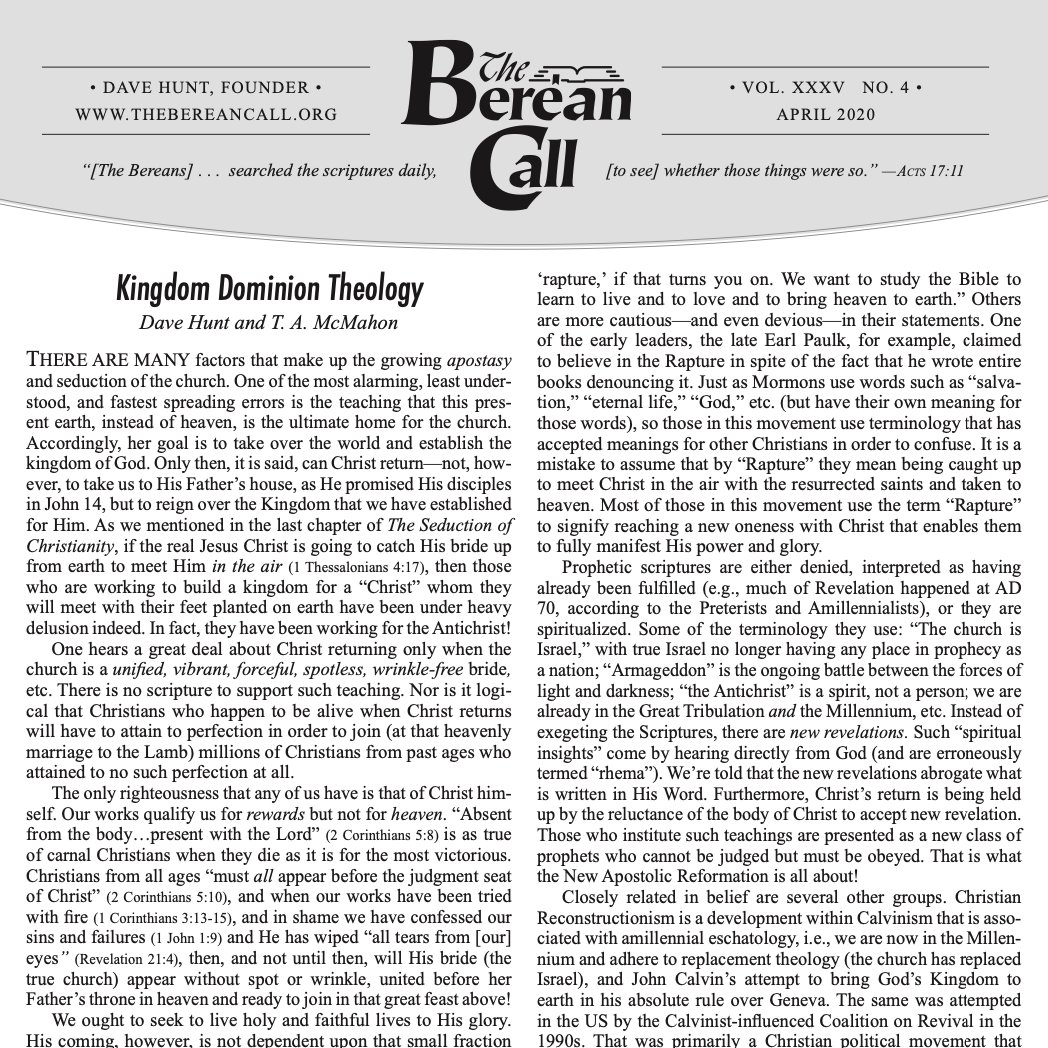
Kingdom Dominion Theology
<p>There are many factors that make up the growing apostasy and seduction of the church. One of the most alarming, least understood, and fastest spreading errors is the teaching that this present earth, instead of heaven, is the ultimate home for the church. Accordingly, her goal is to take over the world and establish the kingdom of God. Only then, it is said, can Christ return—not, however, to take us to His Father’s house, as He promised His disciples in John 14, but to reign over the Kingdom that we have established for Him. As we mentioned in the last chapter of The Seduction of Christianity, if the real Jesus Christ is going to catch His bride up from earth to meet Him in the air (1 Thessalonians 4:17), then those who are working to build a kingdom for a “Christ” whom they will meet with their feet planted on earth have been under heavy delusion indeed. In fact, they have been working for the Antichrist!</p>
Kingdom Dominion Theology
Until the Day
Until the Day
<p>In 1983, I wrote a book titled Peace, Prosperity, and the Coming Holocaust. The first chapter was called, “A Contrary Scenario,” which I based on my understanding of Scripture. Here was the situation as I recall it: interest rates in the US were over 20 percent; the stock market was around 700 on the DOW, and the experts were predicting a crash that would make 1929 seem like prosperity; the housing market was dead, with tens of thousands of houses unsold and apartments vacant; the most popular books in Christian bookstores were about “the death of the dollar, the imminent international financial collapse, the pending Soviet attack on Israel, etc.” Gloom and doom prevailed.</p>

Anti-Christianity Ascending - Part One
<p>When I first began speaking at prophecy conferences years ago, I was intrigued by the fact that during the panel question-and-answer sessions there were always a few questions related to the Antichrist. It was a bit unsettling—probably because I knew little about that end-time biblical figure and cared even less. I therefore avoided adding my uninformed remarks and usually passed the microphone to the speaker to my right or left. Then there came a time when that wasn’t an option, and I had to say something. As I remember it, my comment was something that I now regard as astute sounding but in reality was ignorance verging on stupidity, i.e., some sort of babble about “Why should we concern ourselves with the Antichrist when we believers will be raptured before he comes on the worldwide scene?” I know people who feel that way today, but I gave up that misconception early on, and here’s why.</p>
Anti-Christianity Ascending - Part One
Vanishing Lovingkindnesses and Tender Mercies
<p>The idea that kindness seems to be vanishing in our day and in our country is not a matter of a pessimistic outlook but one of everyday observation. Political differences, as an all-too-obvious example, appear to have reached a new level of ugliness. Kindness hasn’t disappeared altogether, yet neither has it taken society by storm. For many people, an act of kindness is little more than a “nice” occurrence, even though some are aggressively promoting the action. Hence the bumper sticker: “Practice Random Acts of Kindness!” Things like holding the door open for a person or letting an individual with very few items go ahead of us in a checkout line are just a few of the countless number of acts that we can all appreciate.</p>
Vanishing Lovingkindnesses and Tender Mercies
What God Wants of You
<p>Belief in God as Creator and in His authority as well as in our responsibility to Him is almost universal among men. The fact that our daily lives do not measure up to God’s standards is also quite generally conceded, but the solution to this evident shortcoming is the subject of many theories and religious practices: “How can a man please God and be accepted of Him?” “What does God want of me?” These are questions that have arisen in the hearts of men since the beginning of time.</p>
What God Wants of You
Tragedy Compounded
<p>"This know also, that in the last days perilous times shall come. For men shall be lovers of their own selves...." - 2 Timothy 3:1-2</p>
Tragedy Compounded
They Have Forsaken the Lord
<p>Most of us fail to grasp the depths of depravity into which the United States—and the world––are rapidly sinking, provoking a merciful and patient God to judgment. The evidence is overwhelming. Yet we’re blinded to the truth like the proverbial frog in the pot that is slowly, by small degrees, being brought to a boil. Deceit is everywhere, and lies pass for truth. The major promoter of abortion calls itself Planned Parenthood. By what perverted logic can a husband and wife who deliberately murdered in the womb what would have been their baby be called its “parents”? Shouldn’t the organization that inspired and assisted in this foul deed rather be called “Planned No Parenthood”?</p>
They Have Forsaken the Lord
The Send Deception
The Send Deception
<p>For the last couple of months I have been writing and speaking about a “Christian” gathering of nearly 50,000 young adults at a stadium on February 23, 2019, in Orlando, Florida. This is a summation of my observations made after viewing hours of video of the assembly as well as my knowledge of the producers and speakers of the 12-hour, one-day event.<br><br>It began with an enthusiastic exhortation given by mostly young dynamic speakers to the equally enthusiastic crowd to fulfill the great commission: “And he said unto them, Go ye into all the world, and preach the gospel to every creature” (Mark 16:15). That urging underscored the theme of the event, which was titled “The Send.” The goal was to motivate and send the young adults back to their neighborhoods, their high schools and universities, their workplaces, their cities and nations, and then to countries far and wide in order to share the gospel.</p>
The Shameful Social Gospel
<p>For various reasons, Christians of different sorts have tinkered with “the gospel of Christ” as though it needed adjustments. Not major alterations, most will tell you, but just some minor tweaking here and there. The changes often begin by one’s declaring that there is no real change involved, simply a shift in emphasis. Yet no matter what the rationale may be, the end result is being “ashamed of the gospel of Christ.”</p>
The Shameful Social Gospel
Noah Found Grace
<p>Atheists argue that according to the “myth” of the Garden of Eden, evil had too innocent a beginning to be the root from which all the wickedness on this earth could possibly have grown. Adam and Eve merely ate some forbidden fruit—an act hardly worth getting upset about.</p>
Noah Found Grace
A Berean Exercise: “Christian” Magazines – Part 2
A Berean Exercise: “Christian” Magazines – Part 2
<p>There’s a Latin saying that is similar to what it means to be a Berean. The Bereans were Jews to whom the Apostle Paul spoke in the synagogue in the Greek city of Berea. Luke commended them (Acts 17:10-11) for listening to what Paul and Silas had to say and then for searching the Scriptures to discern whether or not their words were true to what was written therein. In a secular sense, that’s what the Latin phrase caveat emptor means: “Let the buyer beware.”</p>
A Berean Exercise: "Christian" Magazines
A Berean Exercise: "Christian" Magazines
<p>A staff member handed me a couple of the latest magazine issues we received in order to review them. They were Christianity Today (CT) and Charisma Magazine (CM). We subscribe to them in order to keep up to date regarding teachings that are being disseminated throughout Christendom...</p>
Ecumenism and Catholicism
Ecumenism and Catholicism
<p>We have noted that the ecumenical movement plays a key role in forming the Antichrist’s world religion, which will be a paganized Christianity such as was developed under Constantine and became Roman Catholicism. It is therefore not surprising that behind the scenes, the Catholic Church has been pushing ecumenism for years. It is not only drawing the “separated brethren” of Protestantism back into the fold but uniting all religions under Rome, as Revelation 17 indicates.</p>
Justice, Forgiveness and Transformation
<p>This is a newsletter article taken from our archives. More newsletters area available here: <a href="https://www.thebereancall.org/newsletters" rel="nofollow noopener" target="_blank">https://www.thebereancall.org/newsletters</a><br><br>Introduction:<br><br>The Bible declares, "In the beginning God created the heaven and the earth." After the creation of all else, God said, "Let us make man in our <a href="http://image....So" rel="nofollow noopener" target="_blank">image....So</a> God made man in his image." He then created Eve, a wife for Adam, and gave them the easiest command possible: of the innumerable trees of delicious fruit He had planted in the Garden paradise, there was only one of which they were not to eat: "the tree of knowledge of good and evil" (Gen 2:9). It could have borne any variety of fruit. There was no spiritual power in the fruit of this tree any more than in any other fruit just like it.</p>
Justice, Forgiveness and Transformation
Missing the Mark—Missing the Solution
Missing the Mark—Missing the Solution
<p>Most of us understand that “missing the mark” is one of the biblical definitions of sin. The Apostle Paul uses the Greek verb hamartano for sin in Romans 3:23: “For all have sinned, and come short of the glory of God.” That may seem to some as a bit unfair, since rarely would we think that not measuring up to a goal or standard is sin. “Missing the mark” doesn’t seem like much of an offense, considering most sins of which we’re aware, especially the horrendous ones. An arrow that falls short of the target is sin? Seriously? To react in such a way reveals much about ourselves and the condition of our hearts in relationship to our Creator.</p>
A Call to Repentance
<p>It is now nearly 500 years since October 31, 1517. We need a new Reformation—this time more biblical and thorough. We are drowning in “political correctness.” Having changed from a president who couldn’t define “is,” we have one who persists in calling Islam “peace” in the face of mountains of evidence to the contrary. What the Bible clearly calls sin is whitewashed as “alternate” styles of living. Nothing is wrong, so nothing is right. The church has joined the world, the gospel has been compromised, and we think God doesn’t care. Elijah’s words come across 3,000 years of history to rebuke us as he did Israel:<br><br>How long halt ye between two opinions? If the LORD be God, follow him: but if Baal, then follow him. (1 Kings 18:21)<br><br>More than 90 percent of Americans claim to believe in God. About 80 percent call themselves Christians. But when asked to define God, the answers range from “Mother Earth” to a “higher power.” Even many who claim to be born again deny that Jesus Christ is the “only way to God.” About 70 percent of Americans, 64 percent who call themselves born again, and 40 percent of self-proclaimed evangelicals reject the idea of absolute truth. And most of those who claim to believe in absolutes have fallen victims to a universal reluctance to speak the truth.</p>
A Call to Repentance
Christ Died for our Sins
<p>In desperation, the Philippian jailor cried, “What must I do to be saved?” Paul’s reply was simple: “Believe on the Lord Jesus Christ, and thou shalt be saved” (Acts 16:31). The great apostle said nothing about baptism or sacraments, candles, incense, church attendance, reforming one’s life, or anything else being necessary or even helpful for salvation. From Genesis to Revelation, the Bible makes it clear that there is nothing a sinner can do, much less must do, to pay the infinite penalty required by God’s justice. One can and need only believe in Christ, who paid the penalty in full: “It is finished” (Jn 19:30)!<br><br>continue reading: <a href="https://www.thebereancall.org/content/christ-died-our-sins" rel="nofollow noopener" target="_blank">https://www.thebereancall.org/content/christ-died-our-sins</a></p>
Christ Died for our Sins
Reflections on a Reasonable Faith
Reflections on a Reasonable Faith
<p>A false idea exists in both the world and in the church that faith and reason do not go together when, in fact, one cannot exist without the other. When God called out, “Adam, where art thou?” it was not Adam’s physical location He was asking about but his moral and spiritual relationship with his Creator. As a bumper sticker says, “When you feel far from God, guess who moved?”</p>
O, Jerusalem!
O, Jerusalem!
<p>Israel is the major topic of the Bible, occupying most of its pages. The many prophecies concerning its past, present, and future are vital in understanding God’s Word. Sadly, they are ignored, explained away, or simply rejected by the vast majority of professing Christians, a growing number of whom insist that Israel has been replaced by the church.<br><br>Yet Jeremiah declares that Israel will never “cease from being a nation” (Jer 31:35-37); in just one sermon Paul refers to Israel as an ongoing entity three times (Acts 13:17, 23, 24); and on the twelve gates of heavenly Jerusalem are written the names of “the twelve tribes of the children of Israel” (Rev 21:12)—so ten tribes were not lost after all!—along with the names of “the twelve apostles of the Lamb” in the foundations (21:14). Unaware that “replacement theology” is one of several Roman Catholic doctrines that clung to Luther, Calvin, and other leading reformers, it is accepted by many as Reformation theology.</p>
Bless the Lord!
<p>We look to God to bless us, and hope and pray that He will, especially when we have some urgent need. But who ever thinks of blessing God? Yet the repeated usage of this expression in Scripture makes it clear that we are to do so; and that something more than words of praise must be involved—God is to be genuinely blessed with a gift from man that is of great value. Yet David’s description of blessing God seems to put it beyond human capacity: “O magnify the LORD with me, and let us exalt his name together” (Ps 34:1-3). Mere men can magnify and exalt the infinite God who brought them into existence? That seems impossible.</p>
Bless the Lord!
What a Sovereign God Cannot Do
<p>One of the most common expressions one hears in Christian circles, especially for reassurance when things aren't going well, is that "God is in control, He's still on the throne." Christians comfort themselves with these words—but what do they mean? Was God not "in control" when Satan rebelled and when Adam and Eve disobeyed, but now He is? Does God's being in control mean that all the rape, murder, war and multiplied evil is exactly what He planned and desires?<br><br>Christ asks us to pray, "Thy kingdom come. Thy will be done in earth, as it is in heaven" (Mt. 6:10). Why that prayer if we are already in God's kingdom with Satan bound, as John Calvin taught and Reconstructionists claim today? Could a world of rampant evil really be what God wills? Surely not!</p>
Pre- or Post-Trib Rapture?
<p>The Rapture of the church involves all believers being caught up to heaven—those just resurrected, together with those alive at the time (1 Thes 4:13-18). If it occurs at the beginning of the tribulation period, then clearly Christ’s Second Coming at the end of the Tribulation to rescue Israel in the midst of Armageddon is a separate event. According to Zechariah 14:3-5, “all the saints” must accompany Christ back to earth. But if the Rapture occurs at the end of the Tribulation, it must be simultaneous with the Second Coming, making them one event. Which is it: two events separated by seven years, or one event with two diverse purposes?</p>
What a Sovereign God Cannot Do
Pre- or Post-Trib Rapture?
Heard from God Lately?
Heard from God Lately?
<p>Let’s say I were to voice the question, “Heard from God lately?” to a very large crowd that had a mix of Christians and non-Christians. Among the crowd would be professing Christians, biblical Christians, cessationist Christians, charismatic Christians, pentecostal Christians, contemplative Christians, progressive Christians, conservative Christians, as well as a few agnostics, skeptics, and atheists. <br><br>Their first thoughts related to a response to my question, no doubt, would be as diverse as their religious perspectives. For example, atheists and skeptics would think I was delusionary. Agnostics wouldn’t think much about it nor probably even care. Contemplative Christians would react to my question as supportive of their intuitive feelings-oriented approach to hearing from God. Some of the charismatic and pentecostal Christians might respond in the same way. Conservative Christians and those with a cessationist bent might worry that I had bailed on the written Word of God in favor of personal subjective communication with Jesus. All biblical Christians, I would hope, would restrain themselves from thinking ill of me doctrinally for at least a few minutes. They would give me the opportunity to explain what I meant by my question and then would search the Scriptures to see whether or not it was true.</p>
Creation Witnessing
<p>I’m extremely blessed to have friends who are very knowledgeable about science and whose calling it is to use their knowledge to reach the lost and to help believers stay the biblical course in the spiritual battle between beliefs in creation and evolution. I’m blessed because science is hardly in my comfort zone, and my friends are always there for me with explanations that I can understand (no small feat), so I’m thankful for their longsuffering in helping me to that end. I want to use what the Bible says about creation in contrast to evolution just as they do, but I need an approach that is just as solid as theirs but obviously not as deep. I prefer to swim without the fear of drowning. For those who are reading this and have the creation vs. evolution debate well in hand, you still may want to share it with folks or family members who are like me.</p>