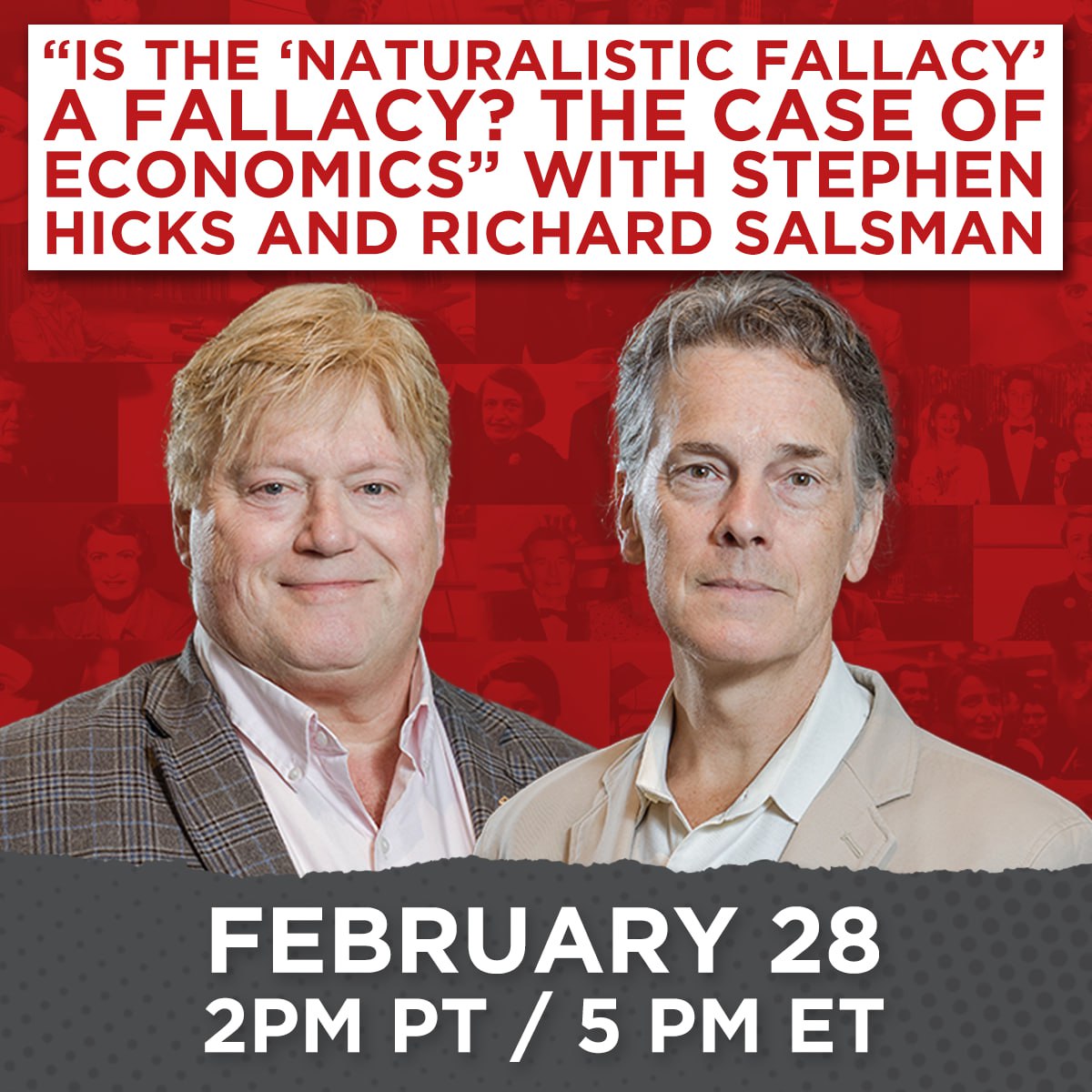
Is the ‘Naturalistic Fallacy’ a Fallacy? The Case of Economics with Hicks & Salsman
Join Senior Scholars Stephen Hicks, Ph.D., and Richard Salsman, Ph.D. for a philosophical discussion on the intersection of ethics and economics: “For centuries, the ‘is-ought’ (or ‘fact-value’) dichotomy has been a perennial issue in philosophy (see Hume) and remains so today. Those who reject it and contend that morality can (and should!) be objective and fact-based are accused of committing ‘the naturalistic fallacy.’ In economics, the is-ought dichotomy takes the form of a supposed conflict between ‘positive’ and ‘normative’ economics. Even pro-capitalist Austrian economists say economics isn’t science unless it is ‘value-free.’ Is this valid? Is the argument about the ‘naturalistic fallacy’ itself fallacious? If the good isn’t to be grounded in nature (including human nature), then what or whence? Only the supernatural?”
The Atlas Society Presents - Objectively Speaking
Audio is streamed directly from the publisher (episodes.castos.com) as published in their RSS feed. Play Podcasts does not host this file. Rights-holders can request removal through the copyright & takedown page.
Show Notes
Join Senior Scholars Stephen Hicks, Ph.D., and Richard Salsman, Ph.D. for a philosophical discussion on the intersection of ethics and economics:
“For centuries, the ‘is-ought’ (or ‘fact-value’) dichotomy has been a perennial issue in philosophy (see Hume) and remains so today. Those who reject it and contend that morality can (and should!) be objective and fact-based are accused of committing ‘the naturalistic fallacy.’ In economics, the is-ought dichotomy takes the form of a supposed conflict between ‘positive’ and ‘normative’ economics. Even pro-capitalist Austrian economists say economics isn’t science unless it is ‘value-free.’ Is this valid? Is the argument about the ‘naturalistic fallacy’ itself fallacious? If the good isn’t to be grounded in nature (including human nature), then what or whence? Only the supernatural?”