
The AI in Business Podcast
1,218 episodes — Page 16 of 25

Contract Analysis Workflows, Before and After AI - with Gilad Turbahn of Apttus / Conga
Today's guest is the great and brilliant Gilad Turbahn, Sr. Director of Product Management at Apttus, which acquired his former employer, Conga, for $700+ million in 2020, joining Apttus's quote-to-cash capabilities with Conga's contract lifecycle management platform. In this episode, Gilad helps us learn how AI can enhance back-office workflows, clearly mapping the space before and after implementation to show how AI creates value. Want to discover more opportunities to use natural language processing for automation? Get Emerj's free PDF brief: Unlocking the Business Value of NLP emerj.com/nlp1

How AI Consultants Find Projects and Opportunities - with Charles Martin of Calculation Consulting
Today I'm excited and honored to welcome back a long-time mentor who I really respect, the great a brilliant Dr. Charles Martin. Doc Martin received his Ph.D. in Theoretical Chemical Physics from the University of Chicago, where he authored scientific programs in C and Fortran using the Cray supercomputer. His company, Aardvark (later acquired by Google), developed statistical machine learning techniques (SVM, NLP, etc.) for the Aardvark social search engine. Want to expand your AI services? Until tomorrow (10/29), get Emerj's new "Finding AI Opportunities" report free with Emerj Plus membership: emerj.com/op1

Emerging AI Use-Cases for Elder Care - with Wijay Wijayakumaran of IBM Systems
Today's guest is the great and brilliant Wijay Wijayakumaran, Chief Architect, ML/DL & AI at IBM Systems. In this episode, Wijay helps us explore AI in surprising spaces, like Elder Care. As populations age worldwide, healthcare organizations across the globe are meeting demand with intelligent technologies. Learn insights gleaned from the heads of AI at Square, Slack, and HSBC with Emerj's AI Opportunities report (free for new Emerj Plus members until 10/30): emerj.com/op1

Building AI Products That Clients Actually Use - with Dr. Nick Pilkington of Drone Deploy
Today's guest is the great and brilliant Dr. Nick Pilkington, CTO and Founder of Drone Deploy. To date, DroneDeploy has raised 90+ million dollars for its cloud-based drone mapping and analytics platform, which enables capabilities such as automated flight safety checks, workflows, and real-time mapping and data processing. DroneDeploy is compatible with any drone, and industries adopting this technology include agriculture, real estate, mining, and construction. In this episode: Dr. Pilkington breaks down opportunities to enhance user experience and lower entry barriers for AI-driven technologies. Discover more opportunities, frameworks, and infographics for leveling up your AI capabilities with Emerj Plus: emerj.com/p1

The Evolution of AI for Credit Card Fraud - with Dmitry Efimov of American Express
Today's guest is the great and brilliant Dr. Dmitry Efimov, VP of Machine Learning Research at American Express. Dr. Efimov has lead the charge to detect fraudulent transactions and activity at Amex. Episode topics include: breaking down the evolution of fraud detection, the future of AI-driven fraud detection, and what's next for AI at Amex. Want to learn more about AI in financial services? Read Emerj's pdf guide: emerj.com/fin1
Creating AI Products That Are Easy for Non-Technical Users - with Bryton Shang of Aquabyte
Today we welcome the return of the great and brilliant Bryton Shang, CEO of Aquabyte, which has raised $10 million to bring AI to fish farming. This episode focuses on the product and processes of Aquabyte as a case study in how to best service industrial managers and workers. Episode topics include: how to build AI products for non-technical audiences, keeping the data science (data labeling, feature selection, etc.) in the hands of the vendor, AI software as a service. Want to learn more about AI at the edge? Join industry leaders at the Edge AI Summit, hosted by Kisaco Research. Attend virtually, Nov 18-20th. Learn more: bit.ly/2RAv62n

How to Get Value from Equipment and Heavy Machinery Data - with Manuel Terranova of PEAXY
Today's guest is the great and brilliant Manuel Terranova, CEO of Peaxy. Since 2012, Peaxy has raised $30+ million to expand its AI-driven platform, helping companies unlock the value of their industrial data. Manuel shares some really valuable insights: diving into the landscape of sensor data e.g. temperature, energy usage, flow rate, GPS, vibration, acceleration, etc., transformational opportunities for predictive analytics, and how to start exploring these opportunities. Learn more: peaxy.net

Unique Considerations of Selling AI Solutions to the Enterprise - with Spence Green of Lilt
Today's guest is the great and brilliant Spence Green, CEO of Lilt. Lilt has received $35+ million in venture funding since 2015 to build its AI-powered language translation platform, which combines adaptive neural machine translation technology with an enterprise translation management system. Episode topics include: how to simplify system integrations, when enterprise transformation is required before AI can be implemented, how Lilt can maintain brand voice in nuanced translations across many languages. Want the best of Emerj's insights? Try Emerj Plus: emerj.com/p1
Computer Vision Applications for Fish Farming - with Bryton Shang of Aquabyte
Today's guest is the great and brilliant Bryton Shang, Founder & CEO of Aquabytes, which has raised $10 million to bring AI to fish farming. Bryton shows how AI is opening doors for transformation far from traditional high technology centers. Episode topics also include: how to create a successful AI product that fits into a conventional industrial workflow, how AI can be used to detect and support the health and behavior of fish at farms. Want to learn more about AI at the edge? Join industry leaders at the Edge AI Summit, hosted by Kisaco Research. Attend virtually, Nov 18-20th. Learn more: bit.ly/2RAv62n

Building an Enterprise AI Adoption Roadmap - with Ron Bodkin, Technical Director of Applied AI at Google
Today's guest is the great and brilliant, Ron Bodkin. Ron has served as Director of Applied AI at Google, VP/GM of AI at Teradata, founded multiple technology ventures, and now leads AI & Engineering at Vector Institute and Schwartz Reisman Institute. In this episode, Ron shares how to avoid scattered projects by following a reliable roadmap for leveled investment in AI capabilities. Want to learn about Emerj's best practices and frameworks? Get Emerj's report: "Generating AI ROI": emerj.com/roi1

AI and the Optimization Airline Meals - with Kurt Muehmel of Dataiku
Today's guest is the great and brilliant Kurt Muehmel, Chief Customer Officer of Dataiku. Dataiku is a unicorn AI platform that has raised $250+ million since 2013 and outranked Google in Gartner's 2020 reports. In this episode, Kurt discusses some of the platform's powerful capabilities and brings it down to earth with some relatable examples. Want to discover more ways to apply AI in your organization? Join Emerj Plus: emerj.com/p1

What it Means to be "AI Ready" - with Matthew Mattina of ARM
Today's guest is the great and brilliant Matthew Mattina, Director of Machine Learning Research at ARM. ARM is a leading technology provider of silicon IP and custom SoCs at the heart of billions of devices. Mr. Mattina's research agenda covers deep learning, neural network design & optimization, and HW accelerator architecture, resulting in ISA extensions, SW libraries, novel microarchitectures for ML inference and training, and efficient neural network models. Episode topics include: Mr. Mattina's criteria for AI readiness and how to customize your AI Readiness Checklist. Are you a business or innovation leader exploring opportunities for leveraging AI? Check out Emerj's 9-page Pdf Guide, Beginning with AI: emerj.com/beg1

Using Existing Edge Hardware for New AI Capabilities - with Roeland Nusselder of Plumerai
Today's guest is the great and brilliant Roeland Nusselder, CEO and Co-founder of Plumerai. Plumerai is making deep learning tiny and computationally radically more efficient, to enable inference on edge devices. Episode topics include: nuances of leveraging machine learning at the edge, the limitations and capabilities of ML processing on legacy and standard chipsets. Roeland is presenting at this year's AI Hardware Summit, hosted by our sponsor, Kisaco Research. Attend virtually, Sept 29 - Oct 7. Want to connect with AI industry leaders? Learn more about the Summit here: bit.ly/2Ywz1kU

Trends That are Changing AI Hardware and Software - with Marshall Choy of SambaNova
Today's guest is the great and brilliant Marshall Choy, VP of Product at SambaNova. SambaNova is a unicorn startup that has raised $450+ million since its founding in 2017 to enable optimum performance for any ML training, inference, or analytics model. In this episode, Marshall dives into key trends driving AI hardware innovation. SambaNova is also presenting at this year's AI Hardware Summit, hosted by our sponsor, Kisaco Research. Attend virtually, Sept 29 - Oct 7. Want to learn more? Visit: https://aihardwaresummit.com/events/ai-hardware-summit

AI for Chat Support, What's Possible and What's Working - with Abinash Tripathy of HelpShift
Today's guest is the great and brilliant Abinash Tripathy, CEO and Founder of HelpShift, an AI-powered support platform installed on more than two billion devices worldwide. HelpShift has raised $50+ million in venture funding since its founding in 2011, and its customers include giants like Microsoft, Xfinity, and Zynga. Dan's last interview with Abinash covered the challenges of AI deployment in the enterprise. This episode's topics include: chatbot capabilities, best/worst AI deployment approaches, lessons learned, and which problems are solvable with AI. Want to learn more about chatbots and other NLP use cases? Download Emerj's guide: emerj.com/nlp1

[AI Futures] AGI and International Conflict and Coordination - with Dr. Hugo de Garis (S1E12)
Concluding Emerj's first AI Futures series, Dan speaks with Dr. Hugo de Garis, an enigmatic figure in AI research, who has been publishing and positing on AI methods and implications for 30+ years. Dr. De Garis ran the Artificial Brain Lab at Xiamen University. His controversial book, "The Artilect War," plays out potential conflict between AI proponents, dissidents, and the machines themselves, as AI's power rises. Episode topics include: technology-centered conflict scenarios, the AI control problem, the nature of human relationships with potential superintelligent AI, and possible forms of effective AI governance. Conversations in this series have spanned from near-term governance to far-out notions. What do you think? And what would you like to hear next? Let us know: emerj.com/pod3

Questions to Ask When Buying or Selling AI Services - with Sankar Narayanan of Fractal Analytics
Today we're excited to welcome the return of the great and brilliant Sankar Narayanan. Sankar is Chief Practice Officer of Fractal Analytics, a unicorn AI & analytics services firm, which has raised $300+ million since its founding in 2000. Fractal Analytics offers a range of products and services, empowering optimal decisions across the world's largest enterprises. Episode topics include: dynamics on the buyer and vendor side for potential new AI/analytics partnerships, setting realistic expectations for a first project together, and the right questions to ask when vetting potential vendors or clients. Are you a non-technical professional, exploring opportunities to apply AI in your business? Download Emerj's guide: "Beginning with AI" emerj.com/beg1

The Future of AI and Defense Analyst Workflows - with Michael Segala of SFL Scientific
Today's guest is the great and brilliant Dr. Michael Segala, CEO and co-founder of SFL Scientific, a Boston-based Data Science and AI consultancy. Dr. Segala earned his Ph.D. in Physics from Brown University and co-founded SFL Scientific in 2015. Since then, his firm has grown to 30+ employees, was chosen as Nvidia's Service Delivery Partner of the Year (for the last two years), and has earned growing partnerships with distinguished clients like the US Military. Episode topics include: how data science can empower and automate Defense analysis, pattern recognition for anomaly and threat detection, and opportunities for embedding AI to support current and future workflows. Want to level up your organization's AI capabilities? Try Emerj Plus: emerj.com/p1

[AI Futures] Creating Decentralized Artificial General Intelligence - with Ben Goertzel of SingularityNET (S1E11)
Today's guest is the great and brilliant Dr. Ben Goertzel, the man who coined the term AGI with his eponymous book, "Artificial General Intelligence." Dr. Goertzel is known by many from his role as Chief Scientist of Hanson Robotics, where he lead the creation of Sophia, the first robot to be granted national citizenship. Dr. Goertzel founded OpenCog, an open-source software framework for AGI. He also founded SingularityNET, a decentralized marketplace for AI algorithms. Episode topics include: Dr. Goertzel's optimistic vision for AGI's future, how it might be born, and why decentralized frameworks may offer the most fertile ground for AI evolution. Dan and Ben first met in 2012, and we're grateful to Ben for keeping up the conversation. No series on the Future of AI would be complete without him.

Saving Cost and the Environment by Reducing AI Energy Use - with Rick Calle of Microsoft (M12)
Today's guest is the great and brilliant Rick Calle of M12, Microsoft's corporate venture fund. M12 has leveraged Microsoft's leadership and know-how to allocate billions across its portfolio of 100+ startups. In this episode, Rick shares insights from M12 and hones in on critical levers that AI-driven enterprises can pull to reduce their energy costs. Rick is also one of the presenters at this year's AI Hardware Summit, hosted by this episode's sponsor: Kisaco Research. Attend virtually, Sept 29 - Oct 7. Register today!

Drug Discovery, Before and After AI - with Kristof Szalay of Turbine.ai
The great and brilliant Dr. Kristof Szalay returns to the podcast. Dr. Szalay is CTO and Founder of Turbine.ai, a simulation-driven drug discovery company, delivering targeted cancer therapies to targeted patient populations. Today's episode topics include: how AI integrates with the phases of drug discovery, development, and generally applicable enterprise deployment challenges. Want to discover opportunities to integrate AI in your organization? Try Emerj Plus: emerj.com/p1

[AI Futures] The Transition to AGI Governance - with Dr. Steve Omohundro (S1E10)
Today's guest is the great and brilliant Dr. Steve Omohundro, Chief Scientist at AIBrain. AIBrain is creating Turingworld, a powerful AI learning social media platform based on AI-optimized learning, AI-powered gamification, and AI-enhanced social interaction. Dr. Steve Omohundro received his Ph.D. in Physics from U.C. Berkeley. He also founded an organization to support AI safety and another organization to advance new intelligence architectures based on the programming language Omda, the specification language Omex, and the semantics language Omai. Episode topics include: how humans can build safe AI, what facets of AI development might/might-not require global governance, how the international community might best collaborate to prioritize AGI development efforts, and how AI may influence our lives as consumers.

What AI Readiness Really Means - with Tim Estes of Digital Reasoning
The great and brilliant Tim Estes returns for another conversation, this time focused on AI readiness. Tim is Founder & CEO of Digital Reasoning, an American AI company that raised over $130 million to bring cognitive computing services to intelligence agencies, financial institutions, and healthcare organizations. This episode's topics include: what AI readiness means, ground rules and AI readiness components including: data, expertise, and in-house talent. Want to learn more about how to implement AI in your organization? Download Emerj's guide: emerj.com/beg1

The Evolution of AI Chips and Their Business Impact - with Dr. Gregory Diamos of Landing AI
Today's guest is the great and brilliant Dr. Gregory Diamos, Transformation Engineer at Landing AI, an innovative AI engineering firm founded by Andrew Ng (who also founded Coursera and deeplearning.ai). Dr. Diamos holds a Ph.D. in Electrical Engineering from Georgia Tech. Previous to his current role, he served as Silicon Valley AI Research Lead for Baidu, after stints at Nvidia and Intel. Episode topics include: what sets apart AI hardware from other CPU's, what businesses and industries will especially benefit from advances in AI chips. Dr. Diamos is one of the presenters at this year's AI Hardware Summit, hosted by this episode's sponsor: Kisaco Research. Attend virtually, Sept 29 - Oct 7. Register today!
[AI Futures] Forging International Consensus About the Future of Intelligence - with Jerome Glenn of The Millennium Project (S1E9)
Today we step farther into AI futures with the great and brilliant Jerome Glenn, Executive Director of The Millenium Project. This participatory think tank publishes the annual "State of the Future." For over a quarter of a century, Jerome has collaborated with organizations from the Red Cross to the Korean government to map out potential futures. Episode topics include: critical global stakeholders for technology governance, win-win scenarios for international collaboration, how artificial general intelligence might transform the future.

Using Pilot Projects to Set Enterprise Expectations - with Dr. Babak Hodjat of Cognizant
Today I'm excited to welcome the return of one of our veteran guests, the great and brilliant Dr. Babak Hodjat, VP of Evolutionary AI at Cognizant, one of the world's most intelligent enterprise IT integration & service firms. Babak has 20+ years of AI experience, founding his first AI startup in 1998 in the SF Bay area and later founding Sentient Technologies, which raised $174 million to innovate with AI in trading. In this episode, Babak shares best practices for pilot projects, to set expectations for enterprise implementations. Want to learn more about how to get started with AI in your organization? Check out Emerj's guide: emerj.com/beg1

AI Adoption and Facial Recognition in Europe - with Dr. Francisco Zamora-Martínez of Veridas
Today's guest is the great and brilliant Dr. Francisco Zamora-Martinez, Facial Biometrics Lead at Veridas. Francisco received his Ph.D. from the Universitat Politècnica de València (UPV), specializing in Artificial Intelligence, Pattern Recognition, and Digital Imaging. Episode topics include: opportunities and challenges presented by facial recognition and biometrics, unique opportunities for AI innovation in Europe, and how Europe is leading technology transformation. Want to learn more? Check out Emerj's professional reports: emerj.com/reports

[AI Futures] Steps Towards International AI Governance - with Futurist David Wood (S1E8)
Today I'm happy to bring you another futurist discussion, with the great and brilliant David Wood. David holds degrees in Mathematics and Philosophy from Oxford University. He is a thought leader and activist in multiple organizations, notably serving as Board Director of SingularityNET (with Ben Goertzel), Chair of the London Futurists, and Executive Director of Transpolitica. Episode topics include: David's perspective on the practical steps and interim goals that could lead toward broader international collaboration for AI governance, bridges from near-term to long-term governance, potential transformations of international politics, and other issues of AI ethics.

Financial Services Analytics, Before and After AI - with Dr. Derek Wang of Stratifyd
Listen to Dan's interview with the great and brilliant Dr. Derek Wang, CEO and Founder of Stratifyd. Dr. Wang's AI-powered analytics company has raised $50 million+, enabling enterprise companies to transform structured and unstructured human textual data from a unified platform. Episode topics include: a view of analytics for financial services before and after transformation for machine learning, the maturity landscape from retrospective dashboards to predictive analytics, and Derek's hard-won lessons from new implementations. Want to discover the core AI use cases driving transformation in Financial Services? Get Emerj's FS Cheat Sheet: emerj.com/fin1

[AI Futures] Is AI Governance Premature, or Redundant? - with Peter Voss of Aigo.ai (S1E7)
Today I'm excited to welcome back the great and brilliant Peter Voss, founder/ CEO/ Chief Scientist of Aigo.ai and AGI Innovations. Peter is one of the world's most prominent minds in the Artificial General Intelligence (AGI) space. Peter collaborated and contributed to AGI work with Ben Goertzel, which resulted in the eponymous book, Artificial General Intelligence, and Shane Legg, now Chief Scientist at Google's DeepMind. Episode topics include: potential futures for AI capabilities and legislation, and what it means to prepare for an AI boom. Peter's first podcast appearance was back in 2013, and I've had the pleasure of swapping ideas with him about his work and publications over the years since. He's an essential mind in this space, and I'm grateful to have him back as a contributor to this series.

Identifying AI Opportunities, a Key to AI Readiness - with Mark Ewing of Eastman Chemicals
Mark Ewing, Sr. Technologist and Architect at Eastman Chemicals, emphasizes identifying key leverage points for AI as foundational for successful and profitable AI adoption in the enterprise. He asserts that the challenges of high engineering and adequate staffing are made easier with clear and compelling opportunities in scope for executives. Eastman has delivered specialty chemicals for over 100 years, earning over $9 billion in revenue for 2019. We're grateful to learn from his highly valuable perspective atop Eastman's formidable presence in the industry. Aiming to transform your organization's capabilities for AI readiness? Download Emerj's guide: emerj.com/beg1

AI Transformation in Banking Compliance - with Mark Gazit of Thetaray
Today I'm excited to share a conversation with Mark Gazit, CEO of ThetaRay. This New York-based fintech firm raised over $80 million to expand threat detection solutions to critical infrastructure, financial institutions, and other verticals. Mark speaks about where AI is enabling new capabilities in compliance and fraud detection, shares valuable insights for successful AI deployments, and risk management lessons that translate to other industries. Want to apply AI in finance? Download Emerj's AI in Financial Services Cheat Sheet: emerj.com/fin1

[AI Futures] Artificing a Superintelligent Future - with Roman Yampolskiy of the University of Louisville (S1E6)
Today I'm excited to welcome back long-time friend and alumnus of the podcast, Dr. Roman Yampolskiy. Roman is Director of the University of Louisville's Cybersecurity Lab. He has authored four books and many more academic publications about AI, cybersecurity, AI safety, and other areas of computer science. This discussion jumps off from ideas in his most recent book, "Artificial Superintelligence: a Futuristic Approach," and unpacks further-out AI futures, exploring possibilities and challenges pertaining to AI governance, artificial general intelligence, and more...

AI for Competitive Advantage - with Priya Rajagopalan of FourKites
Priya Rajagopalan, Chief Product Officer of FourKites, shares how to leverage AI for a real competitive advantage. FourKites has raised over $100 million in venture capital to build an end-to-end supply chain visibility platform that major global companies use to track and manage freight. This conversation sheds light on how emergent intelligence is disrupting even the world's most stable and traditional industries. Enterprise strategy and innovation leaders may glean valuable insights from this example. Want to discover more case studies and insights? Explore Emerj's AI Best Practices Library: emerj.com/p1

Recommendations for Banking User Experience - with Tanushree Luke of US Bank
Dr. Tanushree Luke, Head of AI at US Bank (USA's 5th largest bank), shares pragmatic opportunities for improving customer experience in banking, by learning from customer interactions. For example: how to prompt users with the right features and services to predict needs and solve problems more effortlessly. Dr. Luke earned her Ph.D. in Theoretical/Mathematical Physics and MS in Physics and Applied Engineering from George Mason University. Previously she served as the Head of Predictive AI and Machine Learning for Capital One's Conversational AI Platform. Dr. Luke also served as Technical Lead for the Department of Defense/DARPA Network Defense Program and held leadership roles at companies supporting the Department of Homeland Security and the Department of Energy. Want to learn more about AI opportunities in banking? Download Emerj's AI in Banking Cheat Sheet: emerj.com/cs1

[AI Futures] How Might AI Transform Global Politics? - Zoltan Istvan of the US Transhumanist Party (S1E5)
Our AI Futures series aims to share perspectives from those pushing the boundaries of technology, and this episode's discussion steps toward farther-out potential futures. Before founding the US Transhumanist Party, Zoltan earned a degree in Philosophy & Religion from Columbia University, worked as a reporter for National Geographic, and served as a Director for WildAid (a nonprofit protecting endangered species). In recent years, he's shifted his focus to authorship, speaking, and activism, with a focus toward the long-term future for humanity. His book, "The Transhumanist Wager," is an Amazon best-seller. This episode dives into perspectives pertinent to the future of AI governance e.g. dynamics of the USA-China AI race, the "winner-take-all" potential for powers controlling artificial general intelligence (AGI), and China's potential rise in an environment with fewer regulations and hurdles for transformational technologies like AGI, gene editing, and neurotech.

The Truth About Enhancing Software Products with AI - with Manny Medina of Outreach.io
Manny Medina, CEO and co-founder of unicorn startup Outreach.io, shares wisdom from the trenches of AI adoption. We're excited to have him on for many reasons - to celebrate his success (Outreach's valuation recently surpassed $1 billion), exemplify how AI early adopters are disrupting Industry, and learn from his real-life journey of AI adoption. He shares how he thought about potential leverage points for AI, the kinds of experiments necessary to test these opportunities, what Outreach learned the hard way, and what they feel like they're getting right. Before Outreach, Manny was employee number three on Amazon's AWS team and led the Microsoft mobile division from launch to $50M in annual revenue. He holds an MBA from Harvard and a Masters in Computer Science from the University of Pennsylvania. Outreach is a sales engagement platform that accelerates revenue growth by optimizing every interaction throughout the customer lifecycle. The platform manages all customer interactions across email, voice and social, and leverages machine learning to guide reps to take the right actions. Customers include Cloudera, Glassdoor, Pandora, Zillow. This episode was inspired by Emerj's community, requesting more tales and lessons learned from successful AI implementations. What else do you want to hear? We'd love your feedback and ideas. Get engaged with Emerj Plus: emerj.com/p1.
Drones and AI for Industrial Equipment Inspection - with Nick Pilkington of Drone Deploy
Nicholas Pilkington, CTO and Co-Founder of DroneDeploy, breaks down drone technology trends and dives into some powerful use cases in heavy industry. Notably, drones are transforming best practices for equipment maintenance monitoring by using computer vision. Nick goes into great detail about the process improvement opportunities in this space and shares valuable insights about the trajectory of drone technology capabilities. To date, DroneDeploy has raised 90+ million dollars for its cloud-based drone mapping and analytics platform, which enables capabilities such as automated flight safety checks, workflows, and real-time mapping and data processing. Industries adopting this technology include: agriculture, real estate, mining, construction, and many other commercial and consumer arenas. DroneDeploy is compatible with any drone. Want to learn 3 ways to find AI trends in any sector? Download Emerj's free pdf: emerj.com/t3

[AI Futures] Centralized vs Decentralized AI Governance - with Ben Garfinkel of Oxford's FHI (S1E4)
Ben Garfinkel is a Research Fellow at Oxford's Future of Humanity Insitute (FHI). In this episode, he breaks down key issues central to the near-term formation of good AI governance, such as: the comparative advantages of centralized vs decentralized governance structures, the influence of big tech on governance, etc. He does a great job of presenting the possibilities in clear and objective terms for consideration. We're grateful for Ben and FHI's seminal and leading contributions to AI governance, and - writ large - we suggest that our listeners and clients take heed and engage with the important work manifesting from FHI's brilliant minds. Ben is a DPhil student at Oxford's Department of Politics and International Relations. He previously earned a degree in Physics and in Mathematics and Philosophy from Yale University. FHI is a multidisciplinary research institute at the University of Oxford. Academics at FHI bring the tools of mathematics, philosophy and social sciences to bear on big-picture questions about humanity and its prospects. The Institute is led by Founding Director Professor Nick Bostrom, author of "Superintelligence".
Tech Investments Post Covid - with Brett Beranek of Nuance
Today's discussion is with Brett Beranek of Nuance Communications, arguably the best-known NLP company in the world. Nuance has been selling AI to enterprises for decades, earning billions of revenue in this mature space. In this episode, Brett shares valuable insights and predictions about how technology priorities might and should transform in the post-Covid world. Learn more with Emerj's Pandemic Response - Business Continuity Playbook: emerj.com/p1
The Future of Pharma Data, AI, and Drug Development - with Glen de Vries of Medidata
Glen de Vries cofounded Medidata in 1999, offering SaaS-based clinical development solutions addressing the functioning of customers' clinical trials, and 20 years later the company - which he still leads - sold to Dassault Systemes for almost $6 billion. What a triumph, Glen! Thank you for joining the podcast. Listen in as Glen shares his unique and valuable perspective on the current state and potential futures for the data ecosystem in Life Sciences. Want to stay on the cutting edge of emerging data-driven technologies? Try out Emerj Plus: emerj.com/p1

[AI Futures] Formation of Ethically Aligned AI Standards - with Dr. Karachalios PhD, Managing Director of IEEE Standards (S1E3)
Today's interview is with, Konstantinos Karachalios, Managing Director of the Institute of Electrical and Electronics Engineers Standards Association (ieee.org). Konstantinos earned a Ph.D. in Energy Engineering (nuclear reactor safety) from the University of Stuttgart. Before IEEE, Konstantinos played a crucial role in international scenario simulation for large-scale nuclear reactor accidents. And with the European Patent Office, his experience included establishing EPO's patent academy. For 100+ years, the IEEE has developed global standards for bleeding-edge technologies like nuclear power, blockchain, nanotech, systems engineering, and many more. Emerj is a big supporter of the IEEE's AI standards for "Ethically Aligned Design", and in this talk, we speak about what's happening in the early stages of AI standards and policy formation around the world.
Defining AI Readiness - with Joel Minnick of Amazon, Databricks
In this podcast Joel Minnick, AI & ML Strategy Leader at Amazon Web Services (now VP at Databricks), shares his valuable perspective on what defines "AI Readiness" for large enterprises. Want to discover how to pick high-ROI projects? Explore Emerj's flagship Research and Strategy Services: emerj.com/aiol
Can AI Reduce Physician Burnout? - with Peter Durlach of Nuance Communications
Today, Peter Durlach, Senior Vice President of Nuance Communications, joins the podcast to discuss important and timely opportunities for AI in Healthcare. Peter shares how enhancing and automating key elements of physician workflows with intelligent solutions can ease the workload and reduce burnout among physicians. Want to discover more AI trends? Explore Emerj's 4-page Guide: emerj.com/t3
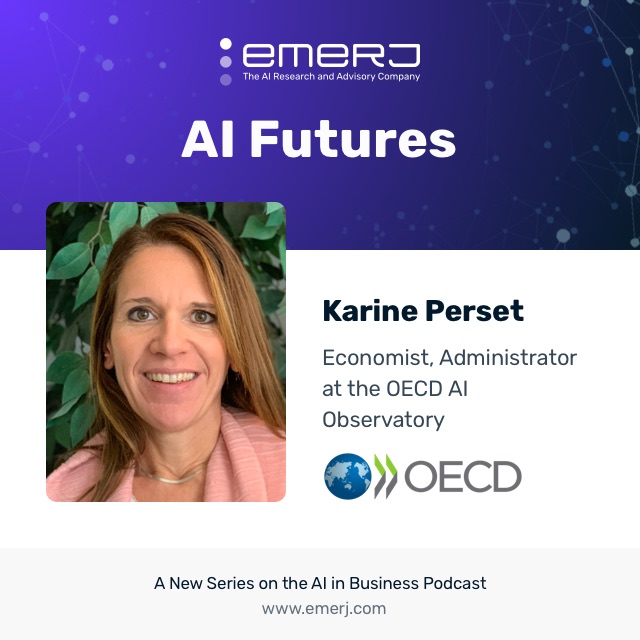
[AI Futures] Karine Perset, Economist at the OECD's AI Observatory, on AI Governance (S1E2)
In June 2019, the G20 adopted human-centered AI Principles that draw from the OECD Principles on AI. Emerj was invited to Paris to collaborate with the OECD's AI Governance efforts, and today we're excited to share this interview with Karine Perset, Economist and Policy Analyst at the OECD's AI Policy Observatory. She speaks about the role of principles in the formation of national legislation, international governance, and shares how leaders can nudge the evolution of powerful technologies like artificial intelligence, to steward a safe and abundant world.
How to Make Sure AI Pilots Actually Get Deployed - with Sankar Narayanan of Fractal Analytics
Today's guest is Sankar Narayanan, Chief Practice Officer at Fractal Analytics, a unicorn company in Bangalore. Sankar's last interview with Emerj was last year's most popular episode: "How to measure the ROI of AI". We're excited to share more of Sankar's insights in this episode, with a special focus on how to deploy and position AI pilot projects for momentum that leads to bigger and better projects. For more insights gathered's from global AI leaders like Nick Bostrom, Stuart Russell, and Ben Goertzel, check out Emerj Plus - emerj.com/p1
Applying AI in Europe, What's So Different? - with Martin Musiol of IBM
Today we kick off the first in a series of discussions about AI in Europe with Martin Musiol, Sr. Data Scientist at IBM. Martin is a member of IBM's Technical Expert Counsel, and in this episode he speaks about what makes the European ecosystem different, providing what may be a peak ahead for other nations following Europe's leadership regarding regulation and data-sharing. Learn more with Emerj's Beginning with AI Guide: emerj.com/beg1

[AI Futures] Stuart Russell of UC Berkeley on AI Governance (S1E1)
In this first episode in our 12-part Saturday "AI Futures" series, UC Berkeley Professor and renown AI expert Stuart Russell shares his perspectives on the near and long-term considerations of AI governance. https://emerj.com/ai-podcast-interviews/stuart-russell-ai-governance/ Visit the blog post for this article, and subscribe to the podcast on your favorite podcast platform. From June 27th to September 12th, we'll be covering a new "AI Futures" episode about AI governance every Saturday. This is an experimental series designed to extend current AI trends to long-term AI consequences. We hope you'll enjoy.
Go After Big Problems First in Your AI Approach - with Babak Hodjat of Cognizant
Today we interview Babak Hodjat, VP of Evolutionary AI at Cognizant, one of world's largest IT integration & service firms. Babak has 20+ years of AI experience, starting his first AI startup in 1998 in the SF Bay area, and later founding Sentient Technologies which raised $174 million to innovate with AI in trading. In this episode, Babak says "AI should be disruptive.", and leaders should "go big". Want to learn more about how to make the business case for AI? Check out Emerj Plus: emerj.com/p1
Two Areas of AI Impact in Logistics - with Jim Barnebee of GetSwift
Today's guest is Jim Barnebee, VP of AI and Infrastructure at GetSwift, a public company that has raised $143 million to bring AI to the world of Delivery - with a smart platform enabling driver management, dispatch tasks, and tracking in real-time. Jim highlights the 2 areas where he thinks logistics will be impacted the most, breaks down hurdles to successful AI deployment, and discusses multiple promising use cases. Emerj has assessed over 80 AI vendors in the logistics and supply chain space. Learn more about Emerj's AI Opportunity Landscape here: emerj.com/aiol