
The AI in Business Podcast
1,218 episodes — Page 22 of 25

How Machine Learning Shapes Your eBay Experience
At Facebook headquarters, I learned there are 1 billion active users every month. In a more recent interview at eBay headquarters in San Jose, l learned that the well-known digital store has over 1 billion products for sale. eBay is, without a doubt, the world's largest marketplace, and there's enough incoming data to keep a large team of data scientists busy for years. I speak with Zoher Karu, eBay's Chief Data Officer, about how eBay leverages data and machine learning to create a better experience for its customers and also their sellers, shedding light on important lessons for anyone looking to sell a product online.

Machine Learning Cyber Security May Help Speed Response to Hack Attacks
In this week's episode, I speak with Igor Baikalov, Chief Scientist at cybersecurity company Securonix, about the trends in data security and where security itself has had to take a step up in the last five years. Igor touches on major meta-trends that have forced data security to advance, as well as what has made AI and machine learning a 'requirement' of modern data security strategy, something that has changed significantly in the last decade. Igor sheds light on these issues and likely future trends in cybersecurity over the next five to 10 years.

Facebook Artificial Intelligence and the Challenge of Personalization
In this week's episode, we feature an in-person interview from Facebook's headquarters with Hussein Mehanna, director of engineering of the Core Machine Learning group. Mehanna and I talk in-depth about the topic of personalization, touching on the pros and cons, how it works at Facebook, and how his team is working to overcome technological barriers to implement personalization in a way that improves the customer experience.

What Can Machines Do That Lawyers Can't? A.I. Applications for Law
When one thinks through important industry apps of AI, law or legal apps are not usually the first to jump to mind, but there's certainly a need. Richard Downe, Ph.D. is Vice President of Data Science at Casetext, a startup working on improving search and natural language processing and democratizing legal information. In this episode, he speaks about the current bottlenecks for people trying to get more out of legal case documents, as well as some of the apps on which the Casetext team is working, to make these processes easier and to gain a strategic advantage in this industry.

Start with a Problem: How Fast-Growing Startups Can Leverage Machine Learning
Learning about the research behind machine learning is always fun, but so is learning about the real-world applications. In today's episode, we're joined by the CEO and founder of Wrike, Andrew Filev. Filev speak about where Wrike is currently applying machine learning and AI in their fast-growing, data-driven company. He shares his insights as to why he thinks marketing might be the most ripe for disruption by AI, and also discusses how most companies can prepare to take advantage of machine learning in any industry.

Technology Meta-trends and a Bird's Eye View of the Singularity
Today we have a guest who has interviewed more futurists than anyone else I know. While at TechEmergence a lot of our interviews focus on executives in AI, Nikola Danaylov has had the pleasure of interviewing some of the finest futurists and forward-thinking minds in the world, including Ray Kurzweil, Verner Vinge, Marvin Minsky, and many others. We speak today about the trends he's seen aggregated (if any) amongst futurists, and about how technology may be dragging us farther into a transhuman future, whether that be closer to a utopia or a dystopia.

How Business Event Data and Predictive Analytics Help Deliver Better ROI
A lot of companies in the San Francisco Bay make the claim that they can do something great with data; many fewer are at a degree of scale to make this vision possible. Today we speak with Nicholas Clark, CEO of DoubleDutch, a company now powering thousands of events nationally and implementing machine learning into their operations, including predicting business results from actual attendees. DoubleDutch is at the beginning of its journey with predictive analytics, having to make hard choices around what sort of information and thought processes they need in order to use machine learning and remain profitable. Nicholas gives his perspective on these decisions, as well as how he thinks DoubleDutch's efforts will impact the conference/event industry at scale.

How Natural Language Processing Helps Mattermark Find Business Opps
Natural language processing (NLP) sounds cool in theory. We're familiar with Siri and Echo of course, but where does it play a role in other companies? In today's episode, we speak with Samiur Rahman from Mattermark, whose entire business model is predicated on organizing and making findable information about companies, and generating a platform to search by unique criterion. Doing so involves some conceptual work with NLP to make things findable. Samiur talks about what Mattermark is doing with this technology now and where he thinks the future may take the field, and interesting topic for investors and founders alike.

A Close Up of Computer Vision with Shutterstock
We've spoken in the past about computer vision on the TechEmergence show, but we haven't covered much about it in industry apps. Few businesses have better mastered this technology in the form of an app better than Shutterstock. In today's episode, we speak with Nathan Hurst, currently a distinguished engineer with Shutterstock and previously with Google, Amazon, and Adobe. Nathan delves into the topic of business apps that can "see", and touches on what that means for the industry, some of the exciting developments that he's seen over last the 10 years, and what he sees coming up in the next few years.

Searching for Higher Ground in Rough Seas of Emerging Tech Governance
In addition to focusing on industry applications of artificial intelligence and emerging technology, we also focus on ethical and societal impacts of emerging technology. In this episode, we get back to ethics with Wendell Wallach, a scholar at Yale's Interdisciplinary Center for Bioethics and author of "A Dangerous Master", which addresses tech governance and other emerging technology issues. In this week's episode, Wendell talks about the problems of governing technologies that are developing faster than we can possibly assess all the risks, a topic that Wendell has thought about in-depth through both his extensive consulting, speaking and writing.

Predictive Analytics Offers Customized Solutions to Complex Problems
The artificial intelligence field is normally seen as burgeoning and new, populated with lots of small, scrappy companies aiming to become the next de-facto solution, with maybe one exception - "Big Blue". IBM has been involved since the 'beginning' and is perhaps best known for Watson, which has from Jeopardy to a range of applications in small and big businesses, as well as the public sector. Swami Chandrasekaran is Chief Technologist of Industry Apps and Solutions for IBM, and he speaks in this episode about what he sees as some of the low-hanging fruit for applying predictive models to business data. Swami has seen this technology applied in a variety of contexts, from automotive and shipping to telcos and more, providing an informed perspective for industry executives, data scientists, and anyone else interested in the intersection of predictive analytics and business.

Follow the Data: Deep Learning Leads the Transformation of Enterprise
"Artificial intelligence (AI) can be seen as a progression in our scalability of labor." This quote comes from this week's guest, Naveen Rao, who received his PhD in Neuroscience from Brown before becoming CEO at Nervanasys, which works on full stack solutions to help companies solve machine learning (ML) problems at scale. In this week's episode, Rao speaks about certain domains in industry where he feels optimistic about machine learning (ML) making a difference in the next five to 10 years, providing interesting perspectives that include advances in the areas of agriculture and oil & gas.

Building to Scale: How Yahoo! Turns Machine Learning into Company-Wide Systems
Many employers (and employees) are familiar with the 'painful' learning curves of using multiple software products or platforms at once, but these may not be gripes you want to share with Amotz Maimon. This week, we feature an interview recorded at Yahoo headquarters with its Chief Architect, Amotz Maimon. He speaks about technology governance and how companies small and large can make faster and better decisions around what technologies to use, how to integrate and streamline the processes, and how to integrate machine learning into the mix (which Yahoo has been using for the past decade). This episode provides important insights for those looking to scale such technologies within their own businesses.

Pulling Back the Curtain on Machine Learning Apps in Business
If you're in the San Francisco Bay area, it's not all that novel to be trained in or working on some form of AI; however, to be doing so in the 1980s and 1990s was a more rare occurrence. Dr. Lorien Pratt has been working with neural nets and AI applications for many decades, and she does lots of consulting work in implementing these technologies with companies in the Bay area. In this episode, Lorien provides her unique perspective on decades of development and adoption in AI as we ask, where is the traction today in places where it wasn't 5 or 10 years ago? We also discuss where Lorien thinks machine learning applications in business and government seem to be headed in the near term.

Machine Learning Opening New Doors in Human Resource Industry
When we think about applying AI and data science to different areas of business, we often think about those domains that offer a wide swath of quantitative metrics that we can feed a machine, like marketing or finance. Human resources (HR) normally doesn't fit the bill. How we hired someone, how we felt about them when we hired them, how they perform qualitatively, these are things that are often difficult to discern in team dynamics. That being said, big teams like Google are applying machine learning (ML) to some of their HR choices, and our guest today believes more companies will be doing the same in future. CEO of Humanyze Ben Waber applies ML to HR decision-making, helping people get better employees and better performance by measuring and improving using data science in new ways.

From Past to Future, Tracing the Evolutionary Path of FinTech
There are hedge funds and financial institutions that already use real-time data and sentiment analysis from social media, articles and videos in real-time to potentially make better trading decisions - but what does it mean when those same companies can use real-time satellite information to detect company activities and make trades based on that data? In this episode, Research Director of Capital Markets at Celent Securities discusses the focus on emerging technologies in trading and finance. He talks about the way that analytics and machine learning have affected the ways banks operate, the kinds of data that hedge funds and individual investors now have at their fingertips, and what that means for the future implications of AI-related technology in the finance world.

NLP Systems Have a Lot to Learn from Humans
Ten years ago, it would have been difficult to talk into your phone and have anything meaningful happen. AI and natural language processing (NLP) have made large leaps in the last decade, and in this episode Dr. Catherine Havasi articulates why and how. Havasi talks about how NLP used to work, and how a focus on deep learning has helped transform the prevalence and capabilities of NLP in the industry. For the last 17 years, Havasi has been working on a project through the MIT Media Lab called ConceptNet, a common sense lexicon for machines. She is also Founder of Luminoso, which helps businesses make sense of text data and improve their business processes.

Insights on the Symbiotic Relationship Between Data Science and Industry
When it comes to data science and machine learning, what are the related skills that are getting people jobs and what are the industries that are supplying those in-demand jobs? These are two important questions that we discuss in this week's episode with CrowdFlower's CEO Lukas Biewald, whose company is providing a pragmatic perspective of the industry by focusing on assessing job listings and related information in the field of data science. If you're a company that is interested in finding someone with in-demand data science and related skills, or if you're in the market to find a position in this field, this episode will likely be very useful!

How Cognitive Computing Can Change the Nature of Business Operations
When you go to Harvard Business School and then to McKinsey company to work in private equity, there's really only one thing left to do - go to Silicon Valley and start an AI startup. At least, this is exactly what CEO Praful Krishna did when he moved to San Francisco to start Coseer, an AI company focused on understanding natural language and unstructured data. In this week's episode, we speak about where unstructured data lives in a business, and how a business can be changed if the right data is unlocked. Krishna also discusses his experience in how executives are making decisions around how or how not to leverage AI in their companies.

Machine Learning Still Getting Sea Legs in the World of Midsize Business
While we've featured quite a few companies that use and implement AI systems, we've more rarely gone behind the scenes with companies or consultants providing AI-related services to companies. In this week's episode, we talk with Machine Learning Consultant Charles Martin, a data scientist and machine learning expert who has done freelance consulting on machine learning systems at companies including eBay, GoDaddy, and Aardvark. In this interview, Charles talks about the areas in AI that he believes are ripe for implementation in a business context, and where he sees businesses getting AI 'wrong' before getting to the hard work of implementing systems that work for them.

Machine Learning Not a Crystal Ball, But It Brings Clarity to Investment Decisions
Tad Slaff is the founder of Inovance, the creator of TRAIDE - a strategy creation platform that use machine learning algorithms to help traders uncover patterns in assets and indicators and build more reliable trading strategies. In this episode, Tad speaks about the state of machine learning in finance today, and touches on how future applications of machine learning and trends may alter what gives an edge to one hedge fund or institutional investor over another.

How Gaming Could Win Us More Adaptable Artificial Intelligence
It's more common to ask what AI can to do to win at games, but it's less common to ask what games can do to help develop AI. This is a particularly fitting topic after Google's DeepMind's defeat of Go, and in this episode we talk with New York University's Julian Togelius about his research in how games can help us develop AI. We discuss how simple AI has been used in more common video games; the 'smoke and mirrors' effect that is more often used to mimic AI; and the more innovative ways that AI are being used in gaming at present, setting precedents for the future role of AI in gaming.

Is Embodied Intelligence a Necessity for Flexible, Adaptive Thinking?
What is intelligence? For some researchers, it may be quite possible to create an intelligent machine 'in a box', something without physical embodiment but with a powerful mind. Others believe general intelligence requires interaction with the outside world, inferring information from gestures and other features of functioning in an environment. Dr. Vincent Müller is of the belief that intelligence may involve more than just mental algorithms and may need to include the capacity to sense rather than just run a program. Vincent focuses on cognitive systems as an approach to AI, and in this episode he talks about what this means and implies, how this approach is different from classical AI, and what this might permit in the future if the field is developed.

Why Big Data is Not Necessarily the Best Data for Business
You're a business, and you've collected data - now how do you now make sense of it? Bring in a technology called 'sentiment analysis', a form of machine learning that determines whether text is positive or negative. Slater Victoroff's company Indico provides a sentiment analysis API product that specializes in this task. In this episode, we talk about about the common misconceptions that businesses have about where 'big data' may be applicable, and the lessons he's learned by gaining more tangible insights from smaller sets of data for companies. He explains why big data is not necessarily better, and discusses the steps that companies should take early on to make sure they're prepared when it's time to apply machine learning to their processes.

Advocating a More Sustainable Business Culture in an Automated World
How does automation influence society today? This is an open-ended question with likely endless answers that can be observed in many different areas of society. As a Writer, Speaker, and Professor in Media Theory and Economics, Douglas Rushkoff has made it his livelihood to examine the impacts of automation in our evolving digital society. In this episode, we speak about his 'disappointment' in how automation has been used by many industries without regard for employees' long-term well being, and how a cultural shift in industry priorities may be what's needed to make automation beneficial for the majority.

How Will the World Be Different When Machines Can Finally Listen?
This week's in-person interview is with Dr. Adam Coates, who spent 12 years at Stanford studying artificial intelligence before accepting his current position of Director of Baidu's Silicon-Valley based artificial intelligence lab. We speak about his ideas around consumer artificial intelligence applications and impact and what he's excited about, as well as what he thinks may be more 'hype' than reality. He gives a an idea about applications that Baidu is working, to potentially influence billions of mobile and computer users worldwide. If you're interested in the developments of speech recognition and natural language processing, this is an episode you won't want to miss.

Closing Gaps in Natural Language Processing May Help Solve World's Tough Problems
People often mark progress by what they see, but there's often much more going on behind the scenes, the up and coming, that marks actual current progress in any particular field. The same can said to be true for natural language processing, and Dr. Dan Roth's research in this field makes him privy to the advancements that most of us are bound to miss. In this episode, Dr. Dan Roth explains what the last 10 years of progress in natural language processing (NLP) have brought us, what's happening with approaches in developing this technology today, and what the next steps might be in a computer capable of real conversational speech and understanding language in context.

The Rise of Neural Networks and Deep Learning in Our Everyday Lives
How do neural networks affect your life? There's the one that you walk around with in your head of course, but the one in your pocket is an almost constant presence as well. In this episode, we speak with Dr. Yoshua Bengii about how the neural nets in computer software have become more ubiquitous and powerful, with deep learning algorithms and neural nets permeating research and commercial applications over the past decade. He also discusses likely future opportunities for deep learning in areas like natural language processing and individualized medicine. Bengio was a researcher at Bell Labs with Yann LeCun and Geoffrey Hinton, now at Facebook and Google respectively, and was working on neural nets before they were the "cool" new AI technology that they're seen as today.

Fear Not, AI May Be Our New Best Creative Collaborators
Statements about AI and risk, like those given by Elon Musk and Bill Gates, aren't new, but they still resound with serious potential threats to the entirety of the human race. Some AI researchers have since come forward to challenge the substantive reality of these claims. In this episode, I interview a self-proclaimed "old timer" in the field of AI who tells us we might be too preemptive about our concerns of AI that will threaten our existence; instead, he suggests that our attention might be better honed in thinking about how humans and AI can work together in the present and near future.

Neural Nets Just One Strand in a Braided Approach to Building Strong AI
TechEmergence has had a number of past guests who have talked about neural networks and machine learning, but Dr. Pieter Mosterman speaks in-depth about the pendulum swing in this approach to AI from the 1960s to today. What we call neural networks as a general approach to developing AI has come in and out of favor two or three times in the last 50+ years. In this episode, Dr. Pieter Mosterman speaks about the shift in this approach and why neural networks have gone in and out of favor, as well as where the pendulum may take us in the not-too-distant future.
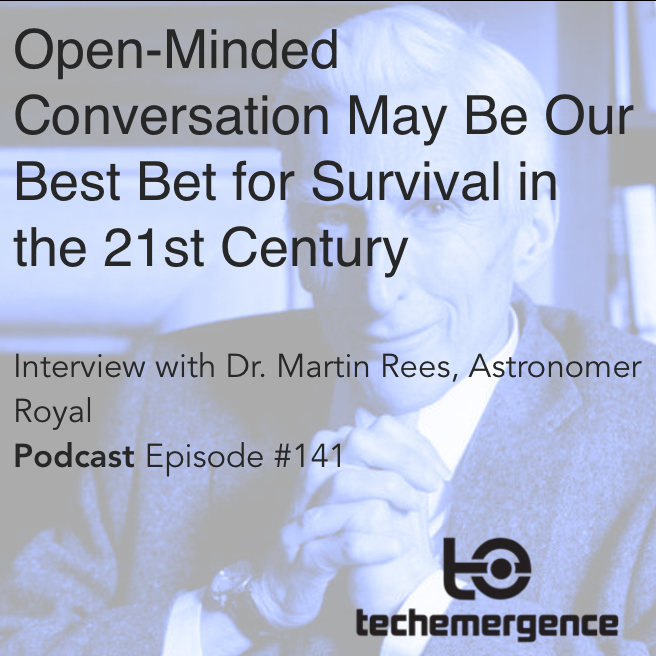
Open-Minded Conversation May Be Our Best Bet for Survival in the 21st Century
Few astrophysicists are as decorated as Martin Rees, Baron Rees of Ludlow, who was a primary contributor to the big-bang theory and named to the honorary position of UK's astronomer royal in 1995. His work has explored the intersections of science and philosophy, as well as human beings' contextual place in the universe. In his book "Our Final Century", published in 2003, Rees warned about the dangers of uncontrolled scientific advance, and argued that human beings have a 50 percent chance of surviving past the year 2100 as a direct result. In this episode, I asked him why he considers AI to be among one of the foremost existential risks that society should consider, as well as his thoughts around how we might best regulate AI and other emerging technologies in the nearer term.

Putting the Art in Artificial Intelligence with Creative Computation
When we think about AI, we often think about optimizing some particular task. In most circumstances through computation there is an optimal chess move, or an optimal way to determine pattern in data, or solve a math problem, or route info through servers. Most of us are aware of these uses, but what about creative tasks? Can these also be optimized? If we want to give a computer information and tell it to create powerpoint slides, is there an optimal way to create such slides? Dr. Philippe Pasquier's computational research is focused on artificial creativity. In this episode, we talk about how to define a very new field, train machines in this area, and also discuss trends and developments that might permit such technology to thrive in the next 10 years.

How Machine Learning Builds Meaning from Our Chats, Tweets, and Likes
There's a small lab in Pennsylvania that may know your gender, age, and understands facets about your personality, whether you're introverted or extroverted, for example…and it's using machine learning to help make conclusions from social media information. For those who are raising an eyebrow, know that they're not tapping into people's accounts without permission. The described study is happening at University of Pennsylvania and is led in part by Dr. Lyle Ungar. In this episode, we talk about the focus of his work - on finding patterns between users and their language on social media content, and building an understanding for how this information might help individuals and communities in the future.

AT&T Predicts Future, Save Service with Machine Learning
We've featured a number of artificial intelligence researchers on the show, but today we switch gears and dive into the business side of the industry. In this episode, Dr. Mazin Gilbert (who earned his PhD in Engineering) breaks down AT&T's efforts to make more intelligent systems large-scale. How do they train their network to route traffic through the right nodes on holidays, when certain areas of traffic are overloaded? How can a system know, based on signals from hardware, which pieces might be going bad and need replacing and send out a message to alert the company? Making a network 'aware' is a large challenge, but Mazin gives an insider's perspective as to how economic and business pressures are driving AT&T to implement machine learning technologies in order to remain profitable.

Snuggle up with Technology, But Don't Leave Empathy in the Cold
Are we losing something with technology? There are two sides to every argument, including this one. Dr. Sherry Turkle is of the belief that there's enough mounting scientific evidence that points toward loss of empathy and self knowledge due to increasing interaction with machines. In this episode, we discuss Dr. Turkle's research and her subtle fears for the future, particularly of those about machines that replicate emotions or conversation but that don't actually feel anything - is the ability to form real connections between two beings at risk of being lost?

Putting the Horse Before the Cart May Lead the Way to Artificial General Intelligence
A lot of AI applications are not really "smart", at least not in the sense of the word as most humans might envision a true artificial intelligence. If you know how Deep Blue beat Gary Kasparov, for example, then you may not believe that Watson is a legitimate thinking machine. Our guest this week, Dr. Pei Wang, is of the belief that building a Artificial "General" Intelligence (AGI), what researchers define as an entity with human-like cognition, is a separate question from figuring out AI applications in the more narrow sense. In this episode, Dr. Wang lays out three differentiating factors that separate AGI from AI in general, and also talks about three varied and active approaches being taken to try and accomplish AGI.

Brain Gains on the Road to Mapping a Personal Connectome
It goes without saying that the brain is difficult to understand, with the billions of neurons, fine individual synapses between each neuron, and the different regions responsible for the innumerable behaviors exhibited by human beings. A new burgeoning and promising intermediary field called Connectomics is making waves in mapping the brain and figuring out how these various connections work together to make us sentient. In this episode with Dr. Olaf Sporns, who is in part credited with coming up with the term Connectomics, we explore the progress that's been made in this new field in the past decade, and take a tentative but hopeful look ahead at what the next decade might bring as the field progresses into its adolescence.

Deciphering the Discovery Engines that Decipher Our Digital Wants and Needs
Ever had the perfect book recommended to you by Amazon or gave a pleasantly-surprised thumbs up for a song selected for you by Pandora? Both services are powered by recommendation engines, which are gaining steam int he commercial space. In this episode, we speak with Entrepreneur Raefer Gabriel, who works for Delvv on the commercial applications of recommendation engines. We talk about how this technology works, and how it comes to learn from reviews, ratings, and consumer interactions. Gabriel also gives perspective on how these engines might be enhanced and applied in the future, a good topic for those of you in the startup world.

When Many Intelligent Agents are Better than One
The beauty of a platform like eBay is that you can set a price that you're willing to spend and let eBay do the bidding long after you've left the site. What if, in similar fashion, your washing machine could turn on and serve up clean clothes once it had found the cheapest rate and time of day by autonomously communicating with local electricity providers? In this episode, we discuss multi-agent intelligent systems with Computer Scientists Dr. Mehdi Dastani, who provides a perspective on how this emerging dynamic technology is changing the landscape of how and how companies and governments operate, allowing for greater systemic change that might not be possible otherwise.

A Global Call to Ban Autonomous Killer Robots for Good
Over the last decade, many first-world militaries have developed, and in some cases deployed, autonomous "killer" robots. Some proponents believe that such robots will save human lives, but another side believes that an accidental arms race of this type would yield long-term detriments that outweigh any good. University of Sheffield's Dr. Noel Sharkey stands by the latter argument. As Co-Founder for the International Committee for Robot Arms Control, he has spent a good part of the last decade trying to create an international ban on such robots. In this episode, he speaks about the developments in the domain of autonomous killer robots, as well as how groups of global leaders might come together to convince nations and other global policy platforms to adhere to such an agreement for the benefit of all humankind.

Seeing the World through Machine Eyes - with Dr. Irfan Essa
Most of us forget that just about a decade ago, Facebook's software was incapable of tagging people in a photo, but today can so without difficulty, sometimes without us even knowing. Machine vision has progressed to the point where it's also common for computers to be able to pick out dogs from cats in images, another task that was not possible 10 years ago. In this episode, we talk with Dr. Irfan Essa, an expert in Computer Vision at the Georgia Institute of Technology (GA Tech), about progress made in machine vision over the last 10 years, related projects in the works today, and where machine vision may be headed in the next decade.

Navigating the Uncanny Valley with Character Robots
Have you ever seen a humanoid robot and felt creeped out? In this episode, we talk with Robotics Engineer Derek Scherer about the psychology of the uncanny valley and our relationships with robots. Scherer talks about the factors in robotics that tend to spook people and provoke a feeling of disgust, and how we might be able to move beyond this resistance as they become a more active part of the social fabric of our society.

Conscious Evolution of an Economic Social Contract
Most of society functions based on a general social contract i.e. we work to contribute to society and earn income to acquire goods. Those who can't earn an income are required in some fashion to validate why. In this episode with Federico Pistono, an entrepreneur, author, and futurist, asks if this contract is the only way to exist as a society. In a more automated world, is this contract the best long-term structure for the common welfare? Pistono and I discuss what a future society might be like with an altered social contract i.e. a general minimum wage for all, how this might affect our approach to "work", and the avenues for testing out such a contract in society today. .

Turning Up the Synaptic Noise to Create Machines that Dream
Neural network - it's almost a buzz word, but it was looked down on during certain periods of AI development. Nonetheless, most of the public is not aware of what a neural network is, how it works, and how we can create an artificial one. CEO and Founder of Imagination Engines, Inc., Dr. Stephen Thaler gives us some insight today on how neural networks create what we call creativity, and provides his perspective on how a neural net eventually merges to give way to consciousness.

Artificial Intelligence's Double-Edged Role in Cyber Security
Cyber security is closely linked to advances in artificial intelligence. In this episode, we speak with Dr. Roman V. Yampolskiy about the cyber security factors and risks associated with AI. How is AI both causing risks, and how can AI be used to combat those risks? We dive briefly into the future to speak about some of the potential 'super' AI risks to cyber security and touch on what can be done now to help hedge the unknown.

Get into the Machine's Head to Better Understand Your Own
It's common knowledge that scientists study the brain to understand how to replicate intelligence in machines; it's less commonly known that scientists also use machine models to understand how the mind works. In this episode, we talk with Dr. Ashok Goel, a researcher in the field of cognitive systems who sheds light on this idea. Dr. Goel also speaks about his perspective on where machines are becoming more creative, and what the future might look like if machines begin to reflect on their "identities" as humans do.

The Spirit in the Machine May Not Be So Far Out
Over 100,00 years ago, it may have been advantageous for human beings to be hyper aware of other living things for the purposes of survival. In the future, between the IoT and advances in AI, we once again find ourselves ever more aware. Erik Davis, the author of TechGnosis and a praised journalist and speaker, explores the intersection of the technical, spiritual, and often mystical. In this episode, we discuss how our gut reactions to AI often spring from evolutionary or cultural reasons, and how this shapes our reactions to technology and guides our development of it in the 21st century.

Wanted: Emotionally Intelligent AI that Understands the Human Mind
Most of us can admire AI such as Siri, Watson, and other agents shaping the fabric of future AI-powered entities, but it's also possible to admire them as a "dead end". Dr. Alexei V. Samsonovich is one researcher who believes that we won't be close to perceiving AI as 'conscious' machines until we can grant them the necessary emotional intelligence. Though a lot of progress has been made in field of intelligent agents in the last 10 years, many researchers who are in the same camp as Samsonovich are now on a mission to develop human-like intelligence, cognitive abilities, emotional and social intelligence, and common sense reasoning.

A Wealthier, Healthier Society through Increased Automation?
Dr. James D. Miller, an Economics and AI researcher who received his doctorate from the University of Chicago, sheds light on how economics factors into our increasingly automated world, where development is growing exponentially. We discuss how this acceleration may (or may not) help materialize the "Singularity", the theorized point at which society is so drastically revolutionized by technologies that we never return to our past ways of life.

Welcome to AI Kindergarten
Dr. Danko Nikolic, a scientist at the Max-Planck Institute for Brain Research, asks and works to answer questions about how our physical neuronal connections create the mind's perceptions. In the realm of AI, Danko zones in on learning in a newborn human and compares that to a robot. He asks how we can take human lessons, what's built into our genome, and apply that to construct a more generally intelligent AI, in a way that is not being done today.