
Talking Taiwan
335 episodes — Page 4 of 7
Ep 213Ep 213 | Formosa Files: John Ross and Eryk Michael Smith are on a Mission to Share the History of Taiwan
Related Links: To view all related links for this article, click link below: https://talkingtaiwan.com/formosa-files-john-ross-and-eryk-michael-smith-are-on-a-mission-to-share-the-history-of-taiwan-ep-213/ A note from Talking Taiwan host Felicia Lin: John Ross and Eryk Michael Smith are the co-hosts of the Formosa Files podcast. Together John and Eryk tell stories from the history of Taiwan (formerly known as Formosa) in a nonchronological order. They spoke with me about where the idea for the podcast came from, their love of history and where they find inspiration for their podcast episodes. They are on a mission to share the history of Taiwan far and wide. Now in their second season, John and Eryk also shared what we can expect from season three. John Ross is an author and co-founder of publisher Camphor Press, which specializes in books on Taiwan and China in English, while Eryk Michael Smith has worked as a writer and journalist for multiple media outlets in Taiwan, including the island's only English-language radio station ICRT (FM 100.7). Both Ross and Smith have lived in Taiwan for well over 20 years and call the island home. This episode of Talking Taiwan has been sponsored by NATWA, the North America Taiwanese Women's Association. NATWA was founded in 1988, and its mission is: to evoke a sense of self-esteem and enhance women's dignity, to oppose gender discrimination and promote gender equality, to fully develop women's potential and encourage their participation in public affairs, to contribute to the advancement of human rights and democratic development in Taiwan, to reach out and work with women's organizations worldwide to promote peace for all. To learn more about NATWA visit their website: www.natwa.com Here's a little preview of what we talked about in this podcast episode: What brought John and Eryk to Taiwan Eryk's work at Next Media How John and Eryk met Where the idea and inspiration for the Formosa Files podcast came from The first episode of Formosa Files, The White Formosan Their approach to creating content for Formosa Files Why John and Eryk decided to focus on the time period from 1600-2000 How John and Eryk came up with the name of the podcast Where John and Eryk's love of history comes from Why John and Eryk think it's important to know history The sources of research that John and Eryk use for Formosa Files How Eryk discovered the story of the Duck King Han Cheung's Taiwan in Time column in the Taipei Times newspaper Steven Crook's Highways and Byways column in the Taipei Times newspaper Why Formosa Files episodes don't follow chronological order and how John and Eryk decide what topics to cover and when Episode ideas that John and Eryk have had to scrap Topics that their listeners are interested in How Formosa Files has evolved and changed over time Eryk and John's favorite episodes of Formosa Files What we can expect from Formosa Files in the future What's being planned for season three of Formosa Files Related Links: To view all related links for this article, click link below: https://talkingtaiwan.com/formosa-files-john-ross-and-eryk-michael-smith-are-on-a-mission-to-share-the-history-of-taiwan-ep-213/

Ep 212Ep 212 | Dr. Mark Chen: Advocate for Taiwan in Both the U.S. and Taiwan Part 1
Related Links: To view all related links for this article, click link below: https://talkingtaiwan.com/dr-mark-chen-advocate-for-taiwan-in-both-the-u-s-and-taiwan-ep-212/ A note from Talking Taiwan host Felicia Lin: 1979 was a crucial year for Taiwan. In January of that year the United States changed its diplomatic recognition from Taipei to Beijing and in December of that same year the Kaohsiung Incident happened. Speaking with my guest, Dr. Mark Chen, for this episode made me realize that there are many people to thank for the important work that they did back then to safeguard Taiwan and the people of Taiwan. Dr. Mark Chen (陳唐山 ) has spent much of his life dedicated to doing advocacy work for Taiwan both in the U.S. and in Taiwan. Listeners of this podcast may recall his name being mentioned in episode 199 when I spoke with Gerrit van der Wees about the Taiwan Relations Act. When the United States formally recognized the communist People's Republic of China and severed its diplomatic relations with Taiwan in 1979, Mark Chen and others reached out to U.S. congressmen and senators to express the concerns of the people of Taiwan. As a result, he and several others were invited to testify in front of the U.S Congress as the Taiwan Relations Act was being drafted. The act passed in April of 1979. Later that same year when the Kaohsiung Incident happened on December 10th Dr. Chen and overseas Taiwanese were galvanized to call for further investigation into the matter and to put international pressure on the Kuomintang government to release those charged and arrested in connection with the Kaohsiung Incident. Dr. Chen also shared how the advocacy work being done for Taiwan at the time led to the formation of FAPA (the Formosan Association for Public Affairs) in 1982. This year marks the 40th anniversary of FAPA. In part one of my interview with him we focus on the work he's done for Taiwan in the U.S.- which started when he was a student at the University of Oklahoma. Dr. Chen has been the president of the Taiwanese Association of America, World Federation of Taiwanese Associations, and the Formosan Association of Public Affairs. In part two of my interview with Mark Chen, we'll talk about his work in Taiwan as an elected official and public servant, and his current work as the chairman of the Prospect Foundation. Here's a little preview of what we talked about in this podcast episode: How the education Dr. Chen received when Taiwan was ruled by the Japanese influenced him How the arrival of the Kuomintang in Taiwan in 1945 at the end of World War II was without the consent of the Taiwanese people and changed things overnight for the people of Taiwan How the Chiang Kai-shek Kuomintang government was focused on retaking China at the time and a lot of this rhetoric ended up being taught in schools The impact of the 228 massacre on the people of Taiwan How subject matter taught in schools changed under the Kuomintang How Mark and many of his peers were able to study in the U.S. with the financial assistance of scholarships How an exit visa was needed to be able to leave Taiwan which was still under martial law at the time His involvement with Taiwanese student groups as a university student was forbidden by the Kuomintang government in Taiwan at the time Why his Taiwan passport was confiscated after sending it to the Taiwan embassy in Houston to be renewed; making him stateless When an ad about the 228 massacre that was to run to the University Oklahoma newspaper was denied publication, Dr. Chen who was a young student at the university, appealed directly to the university's president who agreed to publish the ad When the U.S. cut its official relationship with Taiwan in 1979, Taiwan was known as "Free China" under the rule of the Chiang Kai-shek government, as opposed to "Red China" which refers to the People's Republic of China How Dr. Chen and others in the Taiwanese American community worked to inform members of the U.S. Congress about the importance of the U.S. maintaining a relationship with Taiwan, and understanding the perspectives of the Taiwanese people How Dr. Chen was blacklisted for being involved with organizing Taiwanese student organizations not allowed to return to Taiwan for father's funeral How Dr. Chen, Peng Ming-min and others were invited to testify to the U.S. Congress about on behalf of the people of Taiwan that there should be freedom and democracy in Taiwan, this formed the basis for the Taiwan Relations Act On January 1, 1979 U.S. President Jimmy Carter switched the U.S.'s diplomatic recognition from Taiwan to the People's Republic of China How Dr. Chen asked the American Institute in Taiwan office in Washington D.C. to investigate the Kaohsiung Incident which happened on December 10, 1979 Dr. Chen was the chairperson of the World Federation of Taiwanese Associations when he personally went to visit the chairman of Amnesty International in London to appeal of their help in calling for th

Ep 211Ep 211 | Guy Gilchrist: On Dealing with Setbacks and How Dr. Seuss Influenced His Life
Related Links: To view all related links for this article, click link below: https://talkingtaiwan.com/guy-gilchrist-on-dealing-with-setbacks-and-how-dr-seuss-influenced-his-life-ep-211/ A note from Talking Taiwan host Felicia Lin: In this episode of Talking Taiwan, we share the second half of my interview with illustrator and cartoonist Guy Gilchrist, picking up after part one in episode 207. In the second half of my interview with Guy, he talked about how Dr. Seuss has been an influence in his life. Guy also talked about how he had to deal with chronic pain and back surgery. These days Guy can be seen on social media and at Comicons around the country doing what he loves most drawing cartoon character live for his fans. Guy is best known as the cartoonist of Jim Henson and The Muppets. He's also had his hand in notable cartoons such as The Teenage Mutant Ninja Turtles, Looney Tunes, Tom & Jerry, Tiny Toons, Pink Panther, and Disney, among others. He was declared a national treasure by former First Lady, Nancy Reagan and his artwork has been enshrined in the Smithsonian. Since one thing we can't do on this podcast is to show the magic of Guy's cartooning, we decided to host a LIVE online event where you can meet Guy this Saturday, November 5th at 6:30pm EST. At the event you'll have a chance to see him drawing live. Guy will also show you how to draw cartoon characters yourself. The best part of all this is that Guy has generously offered to donate all of the drawings he does that night and you can enter to win them by simply making a donation of $25 or more to Talking Taiwan's GoFundMe page: http://gofundme.com/building-talking-taiwans-legacy If you'd like to attend the event just Register at: https://us06web.zoom.us/meeting/register/tZ0qcuippj0oGNFuyKrRnUTpoPMCFSBcWEqP#/registration This episode of Talking Taiwan has been sponsored by NATWA, the North America Taiwanese Women's Association. NATWA was founded in 1988, and its mission is: to evoke a sense of self-esteem and enhance women's dignity, to oppose gender discrimination and promote gender equality, to fully develop women's potential and encourage their participation in public affairs, to contribute to the advancement of human rights and democratic development in Taiwan, to reach out and work with women's organizations worldwide to promote peace for all. To learn more about NATWA visit their website: www.natwa.com Here's a little preview of what we talked about in this podcast episode: How hearing Dr. Seuss speak when Guy was in grade school left a lasting impression on him How Guy went from being a bad student to realizing that he could actually do something with his talents How Guy wrote to Dr. Seuss when he was struggling to get a children's book published Guy's encouragement not to give up on your dreams especially if you are in the arts How Guy's children's book about the character Mudpie had been rejected by a dozen publishers The story of how Dr. Seuss' first book I Saw It On Mulberry Street got published Guy's Mudpie character and the book series he's created about Mudpie How Guy has dealt with arm and back issues, and chronic pain How Guy first had back surgery at the age of 29 and has gotten cortisone shots to deal with pain for years How Guy started having trouble walking about six years ago Guy's recovery from the back surgery he had about six years ago after his muscles atrophied from not being active for a year How Guy now deals with pain Guy's advice to love ourselves and take care of ourselves first Guy's music and songwriting Related Links: To view all related links for this article, click link below: https://talkingtaiwan.com/guy-gilchrist-on-dealing-with-setbacks-and-how-dr-seuss-influenced-his-life-ep-211/

Ep 210Ep 210 | Emma Choi: Youngest NPR Host Talks About Her Comedy Podcast "Everyone and Their Mom"
Related Links: To view all related links for this article, click link below: https://talkingtaiwan.com/emma-choi-youngest-npr-host-talks-about-her-comedy-podcast-everyone-and-their-mom-ep-210/ A note from Talking Taiwan host Felicia Lin: Emma Choi is the host of the NPR weekly short-form comedy podcast Everyone & Their Mom. She is the youngest host at NPR and currently in her final year at Harvard University. In January of 2021, she was an intern for the NPR show Wait, Wait... Don't Tell Me! Initially she was told that she couldn't be hired since she was a college student but apparently her PowerPoint prowess led to her working with the Wait Wait team to create Everyone & Their Mom, which began airing in February 2022. She's a second generation Korean American. Emma is definitely a trailblazer with a quirky sense of humor. I especially enjoyed the episodes of Everyone & Their Mom that she did about the job of a grizzly bear conflict manager, and the one about how her grandmother's kimchi could be improved. She spoke to me about what it's been like working at NPR and why she did a satanic Tickle Me Elmo impression during her internship interview. On Mon, Oct 24, 2022 at 11:32 PM Felicia Lin A note from Talking Taiwan host Felicia Lin: Emma Choi is the host of the NPR weekly short-form comedy podcast Everyone & Their Mom. In 2021, she was an intern for the NPR show Wait, Wait... Don't Tell Me! Apparently, it was her PowerPoint prowess led to her working with the Wait Wait team to create Everyone & Their Mom, which began airing in February 2022. She's a second generation Korean American. We talked about that it's been like working at NPR and being NPR's youngest host, what why she did a satanic Tickle Me Elmo impression during her internship interview. This episode of Talking Taiwan has been sponsored by NATWA, the North America Taiwanese Women's Association. NATWA was founded in 1988, and its mission is: to evoke a sense of self-esteem and enhance women's dignity, to oppose gender discrimination and promote gender equality, to fully develop women's potential and encourage their participation in public affairs, to contribute to the advancement of human rights and democratic development in Taiwan, to reach out and work with women's organizations worldwide to promote peace for all. To learn more about NATWA visit their website: www.natwa.com Here's a little preview of what we talked about in this podcast episode: What it's like being NPR's youngest host Her keynote speech at the Asian American Journalists Association Who would be her dream guest Where Emma's sense of humor comes from How her family has been on her podcast Everyone & Their Mom How Emma did an episode about how her grandma's kimchi is missing something What goes into producing an episode What Emma has learned from Wait Wait… Don't Tell Me!host Peter Sagal How Emma wrote a 400-page bookspanning three generations of Korean women Emma's experience with the Harvard Lampoon Emma's interest in writing in the future What Emma's experience working at NPR has been like How Emma's experience with the Harvard Lampoon has made her appreciate the diverse writing team she works with at NPR If Emma has thought about what she wants to do next Related Links: To view all related links for this article, click link below: https://talkingtaiwan.com/emma-choi-youngest-npr-host-talks-about-her-comedy-podcast-everyone-and-their-mom-ep-210/
Ep 209Ep 209 | Michelle Kuo and Albert Wu: On a Broad and Ample Road and the Taiwanese Presbyterian Church Shooting
Related Links: To view all related links for this article, click link below: https://talkingtaiwan.com/michelle-kuo-and-albert-wu-on-a-broad-and-ample-road-and-the-taiwanese-presbyterian-church-shooting-ep-209/ A note from Talking Taiwan host Felicia Lin: In mid-June I spoke with Michelle Kuo and Albert Wu about their weekly newsletter, A Broad and Ample Road. They began writing it in 2020 as a way to keep in touch with people during the pandemic. We also spoke about the shooting at the Irvine Taiwanese Presbyterian church in Laguna Woods which had happened a month before on May 15th. We discussed how the shooting sparked debate on the shooter's identity as Taiwanese or Chinese, and the terms benshengren (本省人) and waishengren (外省人) which are commonly used in Taiwan to differentiate people. Michelle reflected on how the close-knit nature of the Taiwanese community in Laguna. Her parents live five minutes from the church and knew members of the Taiwanese community in Laguna Woods. Albert shared why he felt that in a different life the shooter could have been one of his uncles. Michelle Kuo is a social activist, lawyer, teacher, and writer. She is an associate professor at the American University of Paris in History, Law, and Society and a visiting associate professor at National Taiwan University. Albert Wu is a historian and an associate research fellow at the Institute of History and Philology, Academia Sinica. This episode of Talking Taiwan has been sponsored by NATWA, the North America Taiwanese Women's Association. NATWA was founded in 1988, and its mission is: to evoke a sense of self-esteem and enhance women's dignity, to oppose gender discrimination and promote gender equality, to fully develop women's potential and encourage their participation in public affairs, to contribute to the advancement of human rights and democratic development in Taiwan, to reach out and work with women's organizations worldwide to promote peace for all. To learn more about NATWA visit their website: www.natwa.com Here's a little preview of what we talked about in this podcast episode: Why Michelle and Albert named their newsletter A Broad and Ample Road Why Michelle and Albert started their newsletter The piece that Michelle and Albert wrote about how Taiwan's pro-China media depicts Ukraine and Russia How Michelle thinks that writing doesn't have to be a solidary activity How Michelle and Albert decide what to write together How Michelle and Albert write together What Michelle and Albert's writing process is How Michelle and Albert deal with disagreements in the writing process How often the newsletter is published One of the most enjoyable things about writing the newsletter How the newsletter had connected them with a variety of people who can relate to the things Michelle and Albert write about Michelle's piece about moving to Taiwan Michelle and Albert have envisioned the newsletter being bilingual and through a grant from Substack have been able to work with translators Michelle's book Reading With Patrickhas been translated into Chinese The shooting at Irvine Taiwanese Presbyterian Church in May Divisions between the different groups of people who identify as Taiwanese and Chinese in Taiwan The terms benshengren (本省人) and waishengren (外省人) The Chinese character for sheng (省) means province which is how Taiwan was referred to under the Republic of China initially until constitutional amendments were made The term the "49ers" which refers to the Chinese that fled China with the with the Kuomintang to Taiwan in 1949 How the gunman of the shooting at Irvine Taiwanese Presbyterian Church was a son of waishengren Albert and Michelle's experiences growing up a family that was a mix of bengshengren and waishengren The discrimination that Albert's waishengren uncles experienced in Taiwan How Michelle was raised by her parents to identify as Chinese American The debate over whether to call the gunman Taiwanese or Chinese The idea that the term Taiwanese can be inclusive, multicultural The waishengren identity as victim vs. privileged The variety of reactions to the Taiwanese Presbyterian Church shooting Michelle's parents' connection to the members of the Taiwanese Presbyterian Church How members of the Taiwanese community in Laguna Woods coexist and interact despite their differences in political opinions How the circumstances of the shooter David Chou's life were unraveling What makes someone become a killer or a hero The types of communities that could contribute to making people in to heroes or killers The brutal impact of authoritarian regimes on all members of its society Activists in the opposition (dangwai) movement have included waishengren, aboriginal, Hakka and other groups Related Links: To view all related links for this article, click link below: https://talkingtaiwan.com/michelle-kuo-and-albert-wu-on-a-broad-and-ample-road-and-the-taiwanese-presbyterian-church-shooting-ep-209/
Ep 208Ep 208 | Dr. Wilma Welsh: How the Presbyterian Church in Taiwan Became the Voice of the People in the 1970s
Related Links: To view all related links for this article, click link below: https://talkingtaiwan.com/dr-wilma-welsh-how-the-presbyterian-church-of-taiwan-became-the-voice-of-the-people-in-the-1970s-ep-208/ A note from Talking Taiwan host Felicia Lin: When Wilma Welsh left Canada to work with the Presbyterian Church in Taiwan (PCT) in 1969, she told me that it changed her life. Little did she know how she'd be a part of the pivotal role that the PCT would play as a voice for the people of Taiwan. During her time in Taiwan, Wilma experienced the Kuomintang's surveillance and censorship, and felt the lingering impact of the 228 massacre which happened on February 28, 1947. She was the English secretary to Reverend Kao Chun-ming, the General Secretary of the General Assembly of the Presbyterian Church in Taiwan. When Taiwan's international status and the fate Taiwan's people came in to question Reverend Kao and others wrote the Public Statement on Our National Fate, Wilma typed it up and took it out of Taiwan to Hong Kong where it could be safely mailed out. She also recounted how she was working at the Bible Society in Taipei in 1975 when the Kuomintang arrived to confiscate Taiwanese Hoklo language versions of the Bible and ended up smuggling out 2 copies of the Bible. In 2006 she became the Moderator of the 132nd General Assembly of the Presbyterian Church in Canada. She was the first lay person to ever hold this position. In 2010 she was by the bestowing of a Doctor of Divinity Degree (DD) from Knox College, the University of Toronto. During her year as Moderator she received three additional honors, a life membership in the Women's Missionary Society, the Mahatma Gandhi Peace Medal, and an honorary membership in the World Taiwanese Christian Association. This episode of Talking Taiwan has been sponsored by NATWA, the North America Taiwanese Women's Association. NATWA was founded in 1988, and its mission is: to evoke a sense of self-esteem and enhance women's dignity, to oppose gender discrimination and promote gender equality, to fully develop women's potential and encourage their participation in public affairs, to contribute to the advancement of human rights and democratic development in Taiwan, to reach out and work with women's organizations worldwide to promote peace for all. To learn more about NATWA visit their website: www.natwa.com Here's a little preview of what we talked about in this podcast episode: Wilma's early involvement with the Presbyterian Church What brought Wilma to Formosa (as Taiwan was known then) to work with the Presbyterian Church in Taiwan Wilma's parents' reaction to her going to Taiwan What Wilma was doing before she went to Taiwan What Wilma knew about Taiwan before she went there The language training that Wilma did before going to Taiwan Wilma's first impressions of Taiwan How Wilma first worked with M.C. Chong How Wilma work for Dr. Kao (Reverend Kao Chun-ming) How Taiwan was under martial law and Wilma had to beware of informers The censorship of postal mail coming from Taiwan Wilma's work with Dr. Kao How she worked half a day on Wednesdays at the Bible Society How it was not safe for Dr. Kao to speak with Wilma about certain things in the office because there were planted informants in the office How the Taiwanese were afraid of the Kuomintang since the 228 Massacre had happened How she burned documents that Dr. Kao didn't want people to read How the Presbyterian Church in Taiwan was pressured to cancel its membership in the World Council of Churches The letter that was written by Presbyterian Church in Taiwan stating that it was not their wish to withdraw from the World Council of Churches How Wilma hid this letter when she left Taiwan for Hong Kong where she mailed the letter out to partner churches The letter was also taken to the American embassy (AIT) to be sent out to the U.S. How the Republic of China's United Nations seat was transferred to the People's Republic of China in 1971 when UN Resolution 2758 recognized the PRC as the legitimate representative of China and what that meant for the fate of Taiwan and the people of Taiwan What prompted the Presbyterian Church in Taiwan (PCT) to issue the Statement on Our National Fate How Wilma secretly took copies of the PCT's Statement on Our National Fate with her to Hong Hong to be mailed out How the PCT's Statement on Our National Fate stated: How the PCT's Statement was perceived as a challenge to the Kuomintang's authority What happened when the Kuomintang sent police to confiscate Hoklo (Taiwanese) language bible from the Bible Society in 1975 How Wilma was asked to intervene and smuggle copies of the Bible out of Taiwan How Wilma smuggled the Bibles out of Taiwan to Canada How Wilma knew that despite the things she did, she was protected by the Canadian government How there were informants in the office of the PCT Wilma reflects on how the time she spent in Taiwan changed her Wilma's thoughts on current event

Ep 207Ep 207 | Guy Gilchrist Cartoonist for the Muppets Talks About How to Achieve Your Dreams
Related Links: To view all related links for this article, click link below: https://talkingtaiwan.com/guy-gilchrist-cartoonist-for-the-muppets-talks-about-how-to-achieve-your-dreams-ep-207/ A note from Talking Taiwan host Felicia Lin: I first learned about illustrator and cartoonist Guy Gilchrist, when I interviewed Dr. Karen Tsai (in episode 120) about how she spearheaded the creation of Monster Dance, a children's book created to help children deal with and understand the challenges of the COVID-19 pandemic. Guy is best known as the cartoonist of Jim Henson's Muppets comic strip that was printed worldwide in 660-plus newspapers daily in 80 different languages. Guy spoke with me about his humble beginnings, and how he made his childhood dreams of becoming a cartoonist a reality. Guy has had a lead role on the creative team for the Muppet Babies, Jim Henson's Fraggle Rock, and other Henson creations. Throughout the years, Guy has also had his hand in notable cartoons such as The Teenage Mutant Ninja Turtles, Looney Tunes, Tom & Jerry, Tiny Toons, The Pink Panther, and Disney, among others. Since we can't showcase or share all of Guy's talents on the podcast, we are excited to announce that on November 5th, we'll be hosting a live online event where you can meet Guy and see him draw your favorite cartoon characters live. Guy has agreed do a special live online event to help raise some money for Talking Taiwan on November 5th. To get invited to this special event to meet Guy online just make a donation to Talking Taiwan's GoFundMe campaign: http://gofundme.com/building-talking-taiwans-legacy. We'll be sharing more information about the fun things planned for this event in the upcoming weeks. This episode of Talking Taiwan has been sponsored by NATWA, the North America Taiwanese Women's Association. NATWA was founded in 1988, and its mission is: to evoke a sense of self-esteem and enhance women's dignity, to oppose gender discrimination and promote gender equality, to fully develop women's potential and encourage their participation in public affairs, to contribute to the advancement of human rights and democratic development in Taiwan, to reach out and work with women's organizations worldwide to promote peace for all. To learn more about NATWA visit their website: www.natwa.com Here's a little preview of what we talked about in this podcast episode: How Guy got involved with the children's book Monster Dance How Guy met Dr. Karen Tsai who spearheaded the creation of Monster Dance Dr. Karen Tsai's nonprofit organization Donate PPE How Guy helped Donate PPE's efforts by drawing comic book characters with masks for kids and to thank frontline health care workers How they went from the idea to create a coloring book to a children's book Madeleine Editions, the publisher they worked with to create the children's book Monster Dance The Walt Disney quote that inspired Guy to put out the book in record time How the team working on the book worked via Zoom and from locations all around the world and Eva Lou the founder of Madeleine Editions How the book got done in record time during the pandemic Guy's childhood and how his mother nurtured his artistic talent Since childhood Guy always imagined that he'd be a famous cartoonist How Guy did not have a television when he grew up, so he often watched television in an appliance store near the diner where his mother worked How he was inspired by watching cartoonist Walter Lantz draw Woody Woodpecker on television Why at the age of 10 Guy sent in his artwork to Walter Lantz How as a kid Guy imagined that he'd get to Los Angeles or New York to find work The first time Guy went to a Comic Convention, now known as ComiCon The letter that Walter Lantz sent in response to Guy How at age 16 Guy landed his first job drawing for a Disney coloring book How Guy became the cartoonist who drew the Muppets comic strip, which debuted in September 1981 The first time that Guy met Jim Henson, creator of The Muppets How the Muppets comic strip was the only one to appear daily in 80 different languages around the world because Jim Henson wanted the Muppets How Guy ended up being a guest of honor at the Whitehouse, declared a national treasure and having his work enshrined in the Smithsonian Which Muppet Guy identifies with the most Guy's advice for illustrators who are struggling with their career or creativity Related Links: To view all related links for this article, click link below: https://talkingtaiwan.com/guy-gilchrist-cartoonist-for-the-muppets-talks-about-how-to-achieve-your-dreams-ep-207/
Ep 206Ep 206 | Eric Chan Discusses What Led the Taiwan Military to Shoot Down a Chinese Civilian Drone
Related Links: To view all related links for this article, click link below: https://talkingtaiwan.com/eric-chan-discusses-what-led-the-taiwan-military-to-shoot-down-a-chinese-civilian-drone-ep-206/ A note from Talking Taiwan host Felicia Lin: On September first, the Taiwan military shot down a Chinese civilian drone that flew near Kimen. In this episode of Talking Taiwan. I speak with Eric Chan about what led up the incident, China's increased gray zone tactics toward Taiwan since U.S. House Speaker Nancy Pelosi visited Taiwan in early August, and other news related to Taiwan's military, such as the Taiwan Policy Act and UMC founder, Robert Tsao's donation for civil defense in Taiwan. Eric Chan is a non-resident research fellow at the Global Taiwan Institute, a Washington DC-based think tank dedicated to policy research on Taiwan and its people. He is also a senior airpower strategist with the U.S. Air Force, where he provides USAF with expertise on People's Republic of China military capabilities, political leadership, and strategic culture. Mr. Chan was previously the China, Korea, Philippines, and Vietnam Country Director with the Air Force. In this role, Mr. Chan was responsible for USAF engagement with the Chinese Air Force, and for managing security cooperation with key allies and partners. Mr. Chan has published widely on Chinese influence operations and gray zone warfare, Taiwan military reform, and military diplomacy with the People's Liberation Army. He has written for publications including the Global Taiwan Brief, the USAF Journal of Indo-Pacific Affairs, The Diplomat, and War on the Rocks. Mr. Chan holds a Master's degree in International Affairs from the George Washington University and a Bachelor's degree in Political Science/History from the University of California, San Diego. This episode of Talking Taiwan has been sponsored by NATWA, the North America Taiwanese Women's Association. NATWA was founded in 1988, and its mission is: to evoke a sense of self-esteem and enhance women's dignity, to oppose gender discrimination and promote gender equality, to fully develop women's potential and encourage their participation in public affairs, to contribute to the advancement of human rights and democratic development in Taiwan, to reach out and work with women's organizations worldwide to promote peace for all. To learn more about NATWA visit their website: www.natwa.com Here's a little preview of what we talked about in this podcast episode: How China's gray zone tactics towards Taiwan have changed over the years and since U.S. House Speaker Nancy Pelosi's visit to Taiwan in August Should there be concerns about these changes and China's use of drones in their gray zone tactics towards Taiwan What kind of intelligence can drones collect and damage they can do When China started sending drones over to Taiwan To date about 30 drones have flown over Kimen What led up to Taiwan's military shooting down a drone from China on September 1 How Taiwan's military is considering installing anti-drone systems The difference between civilian and miliary drones How Ukraine has rigged civilian drones with grenades in the war with Russia The impact of China's military actions in response to Nancy Pelosi's visit to Taiwan and was it a blockade How some have called China's recent military actions against Taiwan the fourth straits crisis What would constitute a military blockade of Taiwan Based on China's recent military actions, what do we know about China's military capability How Beijing's recent white paper "One China, Two Systems" does not include promises made in a previous 1993 paper that Taiwan could have its own administrative, legislative, and judicial institutions, run its own democratic system, have its own military and economic affairs How Beijing will use Taiwan's rejection of the white paper to justify harsher tactics against Taiwan How has China's' recent military actions and white paper affected public perception of people in China UMC (United Microelectronics Corporation) founder, Robert Tsao's sizeable donation for civil defense of Taiwan The Taiwan Policy Act which has been passed through the Senate Foreign Relations Committee What the Taiwan Policy Act would mean for Taiwan and the Taiwan Relations Act The message that the Taiwan Policy Act would send to China Related Links: To view all related links for this article, click link below: https://talkingtaiwan.com/eric-chan-discusses-what-led-the-taiwan-military-to-shoot-down-a-chinese-civilian-drone-ep-206/

Ep 205Ep 205 | Rev. Michael Stainton Working with Indigenous People in Taiwan Before and After Martial Law
Related Links: To view all related links for this article, click link below: https://talkingtaiwan.com/rev-michael-stainton-working-with-indigenous-people-in-taiwan-before-and-after-martial-law-ep-205/ A note from Talking Taiwan host Felicia Lin: In this episode of Talking Taiwan, I welcome back Reverend Michael Stainton to talk about his time in Taiwan and work with the indigenous people of Taiwan. Much of the time he spent in Taiwan was during the martial law era (before 1987) and he gives an interesting account of what Taiwan was like at the time. Reverend Stainton is the President of the Taiwanese Human Rights Association of Canada and the Founder and Director of the Canadian Mackay Committee. We had Reverend Stainton on as a guest previously (in episode 173) to talk about Canadian missionary George Leslie Mackay's contributions to Taiwan. This episode of Talking Taiwan has been sponsored by NATWA, the North America Taiwanese Women's Association. NATWA was founded in 1988, and its mission is: to evoke a sense of self-esteem and enhance women's dignity, to oppose gender discrimination and promote gender equality, to fully develop women's potential and encourage their participation in public affairs, to contribute to the advancement of human rights and democratic development in Taiwan, to reach out and work with women's organizations worldwide to promote peace for all. To learn more about NATWA visit their website: www.natwa.com Here's a little preview of what we talked about in this podcast episode: In the 1970s, while Chiang Kai-shek was President of Taiwan Chinese Communist materials and materials from China were labeled "banditry materials" at the Stanford Center's library Students could access the "banditry materials" but were required to sign out and promptly return them because the materials had to remain on premises The Garrison Command would periodically stop by the library to check to make sure none of the "banditry materials" was missing How the death of Chiang Kai-shek was covered by the three television stations in Taiwan How Taiwan was a totalitarian police state in the 1970s What happened when Reverend Stainton was sent to Taiwan as a missionary in 1980 to work with the Presbyterian Church of Taiwan Reverend Stainton's work as the Director of the Taipei Aboriginal University Student Center How students of the Taipei Aboriginal University Student Center were required to report to the political commissary what Reverend Stainton was teaching them How Reverend Stainton tried to encourage the aborigine students to think about their identity and history by inviting various speakers such as local politicians and an academic who had critiqued the myth of Wu Feng (who was beheaded by the Tsou aborigine tribe) How the police were always watching and Reverend Stainton's mail was opened and censored (during Taiwan's martial law era) What happened when the police and garrison command arrived to break up a birthday party that students were having at the Taipei Aboriginal University Student Center How Reverend Stainton knew that his phone was being tapped Some students from the Taipei Aborigine University Student Center went on to become leaders and politicians including Icyang Parod who is the Minister of the Council of Indigenous Peoples (CIP) In 1982 Reverend Stainton switched to doing work in a rural aboriginal development in Wulai How Reverend Stainton helped to uncover embezzlement by the director of the Taipei Presbytery's community development center in Wulai How Reverend Stainton discovered that he was disinvited from continuing to stay in Taiwan and sent back to Canada The Atayal people began to request that they run the aboriginal development in Wulai be under the Atayal Presbytery church instead of the Taipei Presbytery How Reverend Stainton studied at the Coady Institute after returning to Canada in 1983 and learned methods of community of development How Reverend Stainton was invited to return to Taiwan How Reverend Stainton was invited to work at community development centers in Taidong and Hualien How the president of a cooperative ran for and was elected township mayor, but the KMT found a way to oust him People who planned to participate in the Aboriginal return our land movement demonstration march in Taipei on August 25,1988 were harassed by the police and warned not to participate, busloads of people en route to the demonstration were also stopped In this era Cheng Wen Chen's murder at Taida happened in 1981 and in 1989, Deng Nylon (Cheng Nan-jung) committed suicide by self-immolation rather than be arrested Reverend Stainton and his wife returned to Canada in 1991 How Reverend Stainton's observation of the variations in behavior of different aborigine groups at the Taipei Aborigine University Student Center made him interested in anthropology How Columbus Leo challenged the blacklist after martial law had been lifted Reverend Stainton was sent by the United Church of Canada to be an

Ep 204Ep 204 | Eduoard Roquette Talks About his Life-Changing Scooter Accident and Playing Tiger Man
Related Links: To view all related links for this article, click link below: https://talkingtaiwan.com/eduordo-roquette-talks-about-his-life-changing-scooter-accident-and-playing-tiger-man-ep-204/ A note from Talking Taiwan host Felicia Lin: Edouard Roquette is the founder of Rooms.Taipei a co-living business. In episode 192 he spoke to me about his experiences as an entrepreneur and the challenges facing foreign entrepreneurs in Taiwan. I've invited him back on to talk about the life-changing scooter accident that happened to him in 2012. It landed him in a wheelchair for six months, and on crutches for eight years. With physical therapy and treatment Edouard has been able to walk and hike again. To this day he continues to consult with physical therapists about his condition. We also spoke about how he took on the role of playing Tiger Man at the annual festivities in Beigang celebrating the birthday of Mazu, the goddess of the sea, and his fascination with Taiwan's religious festivals and ceremonies. This episode of Talking Taiwan has been sponsored by NATWA, the North America Taiwanese Women's Association. NATWA was founded in 1988, and its mission is: to evoke a sense of self-esteem and enhance women's dignity, to oppose gender discrimination and promote gender equality, to fully develop women's potential and encourage their participation in public affairs, to contribute to the advancement of human rights and democratic development in Taiwan, to reach out and work with women's organizations worldwide to promote peace for all. To learn more about NATWA visit their website: www.natwa.com Here's a little preview of what we talked about in this podcast episode: How Edouard recovered enough from his scooter accident to be able to walk How Edouard's accident happened three days before his visa for Taiwan expired The approach that hospitals in Taiwan take with pain management As a result of overstaying his visa Edouard had to leave Taiwan for a year How Edouard has been able to go from not being able to stand for more than a few minutes to being able to walk and hike Edouard's physical therapist in Taipei JJ. Physio How Edouard had to advocate for himself to get physical therapy As a result of Edouard's accident he lost his company, money, health, and relationship How it took eight years for Edouard to walk again and how he got through it How it was important for Edouard to feel a sense of normalcy as he was dealing with his injury and recovering How he dealt with the way that people treated him at various stages of his recovery How Edouard has been open trying all different types of treatments The lessons that Edouard has learned throughout this journey to recover from his accident The importance of connecting with support groups or people who have had similar experiences Edouard's advice to others who have visa issues in Taiwan How Edouard ended up playing the role of Tiger man for Mazu's birthday Taiwan's dense religious practices The Mazu festival in Beigang (北港) attracts 200,000 people The Mazu festival in Dajia (大甲) attracts 2 million people The Wanjin (aka Wanchin) Catholic Basilica in Pingtung, Taiwan Obscure religious festivals in Taiwan Edouard has posted videos of Mazu birthday festivities on Facebook How Edouard has been involved with the Mazu birthday festivities in Beigang for 14 years Edouard's recommendations for people interested in attending religious festivals in Taiwan Being a tourist in your own country and constantly discovering things about the place you live The Taiwan Gods website Related Links: To view all related links for this article, click link below: https://talkingtaiwan.com/eduordo-roquette-talks-about-his-life-changing-scooter-accident-and-playing-tiger-man-ep-204/
Ep 203Ep 203 | John Eastwood: Discusses Areas in Need of Legal Reform in Taiwan
Related Links: To view all related links for this article, click link below: https://talkingtaiwan.com/john-eastwood-discusses-areas-in-need-of-legal-reform-in-taiwan-ep-203/ A note from Talking Taiwan host Felicia Lin: John Eastwood is a partner at the Taipei office of the law firm Eiger. I spoke with John previously in episode 195 about some of the changes he's seen in Taiwan from a legal perspective, in the 20 years that he's resided in Taiwan. In this second half of our interview, John and I spoke about other issues and areas in need of legal reform in Taiwan. This episode of Talking Taiwan has been sponsored by NATWA, the North America Taiwanese Women's Association. NATWA was founded in 1988, and its mission is: to evoke a sense of self-esteem and enhance women's dignity, to oppose gender discrimination and promote gender equality, to fully develop women's potential and encourage their participation in public affairs, to contribute to the advancement of human rights and democratic development in Taiwan, to reach out and work with women's organizations worldwide to promote peace for all. To learn more about NATWA visit their website: www.natwa.com Here's a little preview of what we talked about in this podcast episode: Legal reforms that John has seen happen in Taiwan Issues that are in need of legal reform The Anti-banditry Act (aka The Act for the Control and Punishment of Banditry) The case of a man who decapitated a child in Taiwan What does it mean to be not guilty by reason of insanity The need for increased awareness and understanding of mental health and mental illness when it comes to making judgments on criminal cases Cases of elder abuse fraud in Taiwan and conservatorship How John's firm has helped to safeguard their elderly clients' assets How elder fraud is not just an "old person's" issue but also a "young person's" issue How difficult it is to undo things once fraud had been committed Related Links: To view all related links for this article, click link below: https://talkingtaiwan.com/john-eastwood-discusses-areas-in-need-of-legal-reform-in-taiwan-ep-203/

Ep 202Ep 202 | The History of Mets Taiwan Day with Diana Lee from Hello Taiwan
Related Links: To view all related links for this article, click link below: https://talkingtaiwan.com/the-history-of-mets-taiwan-day-with-diana-lee-of-hello-taiwan-ep-202/ A note from Talking Taiwan host Felicia Lin: On this episode of Talking Taiwan I'm speaking with Diana Lee, one of the founders and organizers of Hello Taiwan about Mets Taiwan Day which is in its 17th year. It's coming up soon on August 28th. We talked about how the event got started, some of the celebrities and notable people who have appeared at Mets Taiwan Day in the past and what sorts of activities and things people will experience at the event. Among the most exciting news for Taiwanese baseball fans is who will be throwing the first pitch of the game, and how to get a limited edition MetsTaiwan No. 1 jersey. Hello Taiwan also sponsors other sporting and cultural events throughout the year. This episode of Talking Taiwan has been sponsored by NATWA, the North America Taiwanese Women's Association. NATWA was founded in 1988, and its mission is: to evoke a sense of self-esteem and enhance women's dignity, to oppose gender discrimination and promote gender equality, to fully develop women's potential and encourage their participation in public affairs, to contribute to the advancement of human rights and democratic development in Taiwan, to reach out and work with women's organizations worldwide to promote peace for all. To learn more about NATWA visit their website: www.natwa.com Here's a little preview of what we talked about in this podcast episode: How and when Mets Taiwan Day started How the NY Mets have several celebration of different culture events in the month of August Activities at Mets Taiwan Day include the Formosan Black Bear mascot, Third Prince, diabolo performance Peng Cheng-min (aka Chia Chia) former Taiwanese baseball player and coach will be throwing the first pitch at this year's Mets Taiwan Day The Mets Taiwan No. 1 jersey and how to get one How the Mets Taiwan No. 1 jersey will be available in kids sizes for the first time this year Celebrities and famous, notable Taiwanese who have made appearances or thrown the first pitch at past Mets Taiwan Day events Other sports events sponsored by Hello Taiwan include: Rhode Island Dragon Boat Festival, Hello Taiwan Night at Dodgers' Stadium, Hello Taiwan Night Lunar New Year event with the Long Island Nets Other events that Hello Taiwan has planned throughout the year for Halloween, a Taiwanese night market, Easter, Christmas Related Links: To view all related links for this article, click link below: https://talkingtaiwan.com/the-history-of-mets-taiwan-day-with-diana-lee-of-hello-taiwan-ep-202/

Ep 201Ep 201 | Shu-Ying Chung Talks About Filmmaking and her Award-Winning Short
Related Links: To view all related links for this article, click link below: https://talkingtaiwan.com/shui-ying-chung-talks-about-filmmaking-and-her-award-winning-short-ep-201/ A note from Talking Taiwan host Felicia Lin: Shu-Ying Chung is a filmmaker based in New York. Her short film Removable has been making the rounds at film festivals. It's won several awards for best story, best short, best actress, and best director, to name a few. I spoke with Shu-Ying about what motivated her to write, direct and produce the film and how she can identify with the subject matter of the film due to her own past immigration status issues. She also talked about some of the highlights of her career in film and offered some advice for those interested in filmmaking. This episode of Talking Taiwan has been sponsored by NATWA, the North America Taiwanese Women's Association. NATWA was founded in 1988, and its mission is: to evoke a sense of self-esteem and enhance women's dignity, to oppose gender discrimination and promote gender equality, to fully develop women's potential and encourage their participation in public affairs, to contribute to the advancement of human rights and democratic development in Taiwan, to reach out and work with women's organizations worldwide to promote peace for all. To learn more about NATWA visit their website: www.natwa.com Here's a little preview of what we talked about in this podcast episode: What it was like growing up in Taiwan for Shu-Ying Her interest in music, television and film and her parents' reaction Her short film Removable that is currently making the rounds at several film festivals, which has earned many awards for best short, best actress, and best director, to name a few What inspired her to write, produce and direct her short film Removable Shu-Ying's own experience with being forced to leave the U.S. due to work visa issues What happened when Shu-Ying had to leave the U.S. to return to Taiwan due to a visa issue and ended up staying there for 1.5 years How she wrote the script for Removable with her husband The research involved in writing the script for Removable How Shu-Ying and her husband did everything required for pre-production of the film in four weeks and a five-day shoot to make the short film, Removable How Removable was self-funded by Shu-Ying and her husband If Shu-Ying has plans to expand Removable into a full-length film Shu-Ying's career path in film so far and her work at Hearst Magazines How Shu-Ying's immigrant/work status has been a barrier in her career path How English language proficiency can be a barrier for foreigners to overcome in the U.S. Shu-Ying's dream of being able to direct full length films full-time What it takes to be a good film director Shu-Ying's approach to filmmaking The most memorable film/video projects (shown on Shu-Ying's website) that she has worked on Shu-Ying's first experience shooting with 35 mm film The difference between shooting on film vs. digitally Shu-Ying's work on the Artists' Den documentary series What Shu-Ying misses about Taiwan Some of Shu-Ying's favorite films One of the films that influenced her short film Removable What Shu-Ying thinks she would be doing if she wasn't a filmmaker The dream film project that Shu-Ying would like to make about her grandmother How Shu-Ying would like to be remembered What advice Shu-Ying has for others interested in being a filmmaker Related Links: To view all related links for this article, click link below: https://talkingtaiwan.com/shui-ying-chung-talks-about-filmmaking-and-her-award-winning-short-ep-201/
Ep 200Ep 200 | Charlie Wu Talks About the Annual Event TaiwanFest
Related Links: To view all related links for this article, click link below: https://talkingtaiwan.com/charlie-wu-talks-about-the-annual-event-taiwanfest-ep-200/ A note from Talking Taiwan host Felicia Lin: Today Talking Taiwan hits a major milestone with episode 200! We think it's especially meaningful that the topic of this interview is TAIWANfest, an annual Taiwanese Canadian event that dates back to 1990. Nowadays, TAIWANfest is held annually in Toronto and Vancouver. And my guest on this episode is Charlie Wu, the Managing Director of Asian-Canadian Special Events Association , which organizes TAIWANfest and LunarFest. You may recall that we had Charlie on earlier this year (in episode 167) to talk about LunarFest. TAIWANfest will be held in Toronto later this month from August 26-28 and in Vancouver from September 3-5. This year's theme is: The Stories of Independence Indulge in Indonesia, Discover Malaysia. The programming will feature the indigenous band, Kanatal, which is a sort of experiment, that breaks the mold. They are a newly formed band of 4 experienced musicians, that have performing on tour without even having an album released. Other programs at TAIWANfest include a standup comedian, film screenings discussions, and events both in-person and virtual with topics covering: literature, social activism, food and culture. This episode of Talking Taiwan has been sponsored by NATWA, the North America Taiwanese Women's Association. NATWA was founded in 1988, and its mission is: to evoke a sense of self-esteem and enhance women's dignity, to oppose gender discrimination and promote gender equality, to fully develop women's potential and encourage their participation in public affairs, to contribute to the advancement of human rights and democratic development in Taiwan, to reach out and work with women's organizations worldwide to promote peace for all. To learn more about NATWA visit their website: www.natwa.com Here's a little preview of what we talked about in this podcast episode: TAIWANfest will be taking place in Toronto from August 26-28 and in Vancouver from September 3-5 The theme of TAIWANfest 2022: The Stories of Independence Indulge in Indonesia, Discover Malaysia The independence of nations vs. people The newly formed band, Kanatal [ga-na-dal], which means "island" in the Amis language, referring to the small island of Taiwan How Kanatal is touring and will perform at TAIWANfest The opening concert for TAIWANfest Toronto will be performed by an orchestra led by Maestro Ken Hsieh TAIWANfest Vancouver's closing concert will be performed by a string orchestra Comedian Ed Hill who will be performing at TAIWANfest Toronto and Vancouver TAIWANfest's virtual programming The Let Taiwan Be Taiwan program Connections between Indonesia and Taiwan There are 300,000 Indonesians living in Taiwan Indonesian migrant workers and their cultural impact on Taiwan Films, performances and food presented at TAIWANfest The "Taiwan Bookstore" concept at TAIWANfest Vancouver The food known in Taiwan, Indonesia and the Philippines, as "lumpia"; "run-bing" in Mandarin Chinese; and "popiah" in Malaysia The discussion on "Making Taiwan Relevant in Cansda" about the book Charlie wrote with two others about his experiences running TAIWANfest How Indonesian culture will be represented at TAIWANfest How TAIWANfest Vancouveris working with the Brilliant Time Bookstore in Taiwan to collect donated books in Southeast Asian languages for migrant workers in Taiwan The graphic image that represents TAIWANfest 2022 was inspired by batik culture from Malaysia and Indonesia How Charlie and his team decides and curates the content of TAIWANfest Some of the films that will be part of Cinematic Taiwan, such as The Road Forward, a musical documentary by Marie Clements, which will be subtitled in Chinese Kanatal's song Peace The documentary being made about Kanatal The story of how Kanatal was formed Suana·Emuy·Cilangasay, who assembled the musicians to form Kanatal Eden Liu's social activism in Indonesia Due to capacity limitations at the Harbourfront Center in Toronto and the pandemic, TAIWANfest in Toronto will be scaled down while TAIWANfest in Vancouver will be at full scale Future plans for the Jade Music Festival Related Links: To view all related links for this article, click link below: https://talkingtaiwan.com/charlie-wu-talks-about-the-annual-event-taiwanfest-ep-200/
Ep 199Ep 199 | Gerrit van der Wees: The Past and Present State of US Taiwan Relations
Related Links: To view all related links for this article, click link below: https://talkingtaiwan.com/gerrit-van-der-wees-the-past-and-present-state-of-u-s-taiwan-relations-ep-199/ A note from Talking Taiwan host Felicia Lin: In June I spoke with Gerrit van der Wees about an article that he wrote about U.S. President Biden's remarks about Taiwan when he was in Tokyo in May. Just last week, Gerrit wrote a very timely article about the controversy over the U.S. House of Representatives Speaker Nancy Pelosi's plans to visit Taiwan. In April Pelosi had planned to visit Taiwan as part of a tour to the Indo Pacific region but had to cancel because she contracted COVID-19. Last week Pelosi left with a delegation for Asia, but made no mention of visiting Taiwan. There had been speculation that the Chinese would attack if U.S. fighter jets escorted Pelosi's plane into Taiwan, and in a phone conversation with U.S. president Joe Biden, Chinese president Xi Jinping warned Biden against "playing with fire" over Taiwan. In his piece for the Taipei Times, Gerrit stated that it is essential that Pelosi stands her ground and pushes through with her plan to visit Taiwan. We'll share Gerrit's Taipei Times article and a few others about this situation on our website for this episode. In my interview with Gerrit I asked him to explain in detail what the Taiwan Relations Act is, and what it tells us about the relationship between the U.S. and Taiwan. We also talked about the so-called U.S. policy of strategic ambiguity, how his work on the Taiwan Communique evolved from 1980 to 2016, and his thoughts on the war in Ukraine, and how it relates to China and Taiwan. About Gerrit van der Wees Gerrit van der Wees is a former Dutch diplomat. From 1980 through 2016, he served as chief-editor of "Taiwan Communiqué." Also, from 2005 through 2016 he was liaison for the Senate and the State Department at FAPA-HQ. He currently teaches the History of Taiwan at George Mason University and Current issues in East Asia at George Washington University's Elliott School for International Affairs. This episode of Talking Taiwan has been sponsored by NATWA, the North America Taiwanese Women's Association. NATWA was founded in 1988, and its mission is: to evoke a sense of self-esteem and enhance women's dignity, to oppose gender discrimination and promote gender equality, to fully develop women's potential and encourage their participation in public affairs, to contribute to the advancement of human rights and democratic development in Taiwan, to reach out and work with women's organizations worldwide to promote peace for all. To learn more about NATWA visit their website: www.natwa.com Here's a little preview of what we talked about in this podcast episode: U.S. President Joe Biden's remarks on the U.S.'s willingness to help defend Taiwan The Taiwan Relations Act, the document that contains US commitments to (help) defend Taiwan, and its first two clauses How U.S. Secretary of State Anthony Blinken referred to the second clause of the Taiwan Relations Act in a speech he made at the end of May What the second clause of the Taiwan Relations Act says and means The background of the Taiwan Relations Act How Harvey Feldman of the East Asia Pacific desk of the U.S. State Department was involved in initially drafting the Taiwan Policy Act How in 1979 the U.S. Congress started drafting the Taiwan Relations Act which had security clauses and a human rights clause embedded within it How Senator Ted Kennedy, Senator Claiborne Pell, and Congressman Jim Leach were instrumental in drafting the Taiwan Relations Act and getting it passed in April 1979 The establishment of the American Institute in Taiwan (AIT) in January 1979 Mark Chen's (陳唐山) work with Senators and Congressmen to ensure that the Taiwan Relations Act took into consideration the native Taiwanese perspective The Taiwan Communique and why it was established How news from and about Taiwan while under martial law was obtained, communicated and printed in the Taiwan Communique How dangwai (outside party) magazines: Měilì dǎo aka Formosa Magazine (美麗島) and Bāshí niándài aka 1980s (8十年代) were sources of information for the Taiwan Communique How the George Washington University library has a complete collection of dangwai magazines from Taiwan The censorship of postal mail that was received in and sent out from Taiwan during the martial law era After the Taiwan democratized in the early 1990s the focus of the Taiwan Communique shifted to working to gain more international recognition for Taiwan What the "One China Policy" means from the perspective of the U.S. and China How the "One China Policy" which was based on the 1970s, a time in which Beijing and Taipei that claimed to be the government of China How things have changed since the 1970s, which requires an adjustment in policy to reflect current times What makes the Taiwan Relations Act so unique How Taiwan meets all the requirements of a nation state ac

Ep 198Ep 198 | Emily Wu Truong: Award-Winning Mental Health Speaker Inspires Others to Find Meaning in Their Struggles
A note from Talking Taiwan host Felicia Lin: Emily Wu Truong is a motivational speaker for mental health awareness. She is affiliated with NAMI, the National Alliance on Mental Illness and has been involved with this organization for the last 8.5 years. I've invited her on to Talking Taiwan as a guest since July is BIPOC (Black Indigenous People of Color) Mental Health Month. Emily spoke with me about her own struggles with mental health, and suicide. She has a passion for working with youths on mental health related issues. She also shared her thoughts about the oppression and trauma experienced firsthand or as generational trauma by the people of Taiwan, and how it could impact one's mental health. About Emily Wu Truong: Emily Wu Truong is an award-winning mental health advocate, nationally-recognized motivational speaker, catalytic thought leader, community educator, playwright and published author. For over a decade, Emily has worked tirelessly to create more compassionate & accepting communities by bringing mental health education wherever she goes. As a speaker, Emily utilizes her story from depression to self-actualization, inspiring others to find meaning in life struggles. She has spoken to a variety of audiences, including students from elementary school to graduate school students, school administrators, teachers, families, law enforcement, faith-based communities, medical and mental health professionals and many more. Over the years, in recognition of Emily's efforts to raise awareness on mental health and emotional resilience, she has been featured in the California Mental Health Movement "Each Mind Matters," Good Morning America, NBC Asian America, LA 18 and World Journal (世界日報). Emily has also been honored with the "2015 Woman of Achievement Award" by former Senator Ed Hernandez. Also in 2015, Emily was honored with the Youth and Young Adult Leadership Award at the 29th Annual National Alternatives Conference in Memphis, Tennessee. In 2017, the Los Angeles County Supervisors honored Emily's request to establish May 10th as "Asian Pacific American Mental Health Day." In 2018, former Assemblyman Ed Chau honored Emily with the 2018 Make A Difference Award. Emily has become a role model for many, sharing her life lessons and delivering her message that helplessness is not hopelessness and that with help, there is hope. This episode of Talking Taiwan has been sponsored by NATWA, the North America Taiwanese Women's Association. NATWA was founded in 1988, and its mission is: to evoke a sense of self-esteem and enhance women's dignity, to oppose gender discrimination and promote gender equality, to fully develop women's potential and encourage their participation in public affairs, to contribute to the advancement of human rights and democratic development in Taiwan, to reach out and work with women's organizations worldwide to promote peace for all. To learn more about NATWA visit their website: www.natwa.com Here's a little preview of what we talked about in this podcast episode: Why she's been called the lady in green How Emily tries to talk about mental health in a positive light The struggles that Emily felt growing up How the painting "The Potato Eaters" by Van Gogh reminds her of how she felt disconnected from her family in the past How she started asking existential questions about life when she was in junior high Competitiveness in the Asian culture Comparisons made by Asian parents, families and relatives Emily's passion for the mental health of youth How important it is for kids to have supportive friends How Emily struggled in elementary school and was bullied in junior high Emily's best friend in high school Enoch who helped her to get through high school How Emily used dating as a coping skill in the past How Emily is a suicide survivor what her to consider suicide and what stopped her from committing suicide Emily's thoughts on school shootings Her first experience with a therapist and counseling in college How Emily wants to help young people to develop coping skills to deal with their parents and peers so that they don't need to internalize things How Emily took an interest Taiwan in order to bond with her mother How Emily competed in the Miss Taiwan pageant How Emily discovered that her mother's cousin is Taiwanese activist Koh Se Kai and that encouraged her to be more outspoken How Emily got involved in the Write in Taiwanese Census Bureau, TACL and FAPA Emily's thoughts on how the people of Taiwan have been oppressed and how and trauma experienced firsthand or as generational trauma could impact one's mental health Author Iris Chang who committed suicide Emily's work with NAMI (National Alliance on Mental Illness) Related Links: To view all related links for this article, click link below: https://talkingtaiwan.com/emily-wu-truong-award-winning-mental-health-speaker-inspires-others-to-find-meaning-in-their-struggles-ep-198/

Ep 197Ep 197 | Ed Lin: Winner of Three Asian American Literary Awards Talks About his New Book "Death Doesn't Forget"
A note from Talking Taiwan host Felicia Lin: Ed Lin is a native New Yorker of Taiwanese and Chinese descent. He is the first writer to win three Asian American Literary Awards. The last time we had Ed on Talking Taiwan (in 2014) we spoke about "Ghost Month" his first book in the Taipei Night Market Series of mysteries. Since then, he's written a YA novel and now four books in the Taipei Night Market Series. "Death Doesn't Forget," Is the latest book in the series and it will be published in July. This episode of Talking Taiwan has been sponsored by NATWA, the North America Taiwanese Women's Association. NATWA was founded in 1988, and its mission is: to evoke a sense of self-esteem and enhance women's dignity, to oppose gender discrimination and promote gender equality, to fully develop women's potential and encourage their participation in public affairs, to contribute to the advancement of human rights and democratic development in Taiwan, to reach out and work with women's organizations worldwide to promote peace for all. To learn more about NATWA visit their website: www.natwa.com Here's a little preview of what we talked about in this podcast episode: Ed Lin's Taipei Mysteries books series and how he went about planning and writing them The main character of Ed Lin's Taipei Mysteries book series, Jing-Nan and how he's evolved The premise and what inspired Ed to write Death Doesn't Forget How the indigenous tribe that Ketagalan Boulevard in Taipei is named after is not officially recognized as a tribe in Taiwan The lack of representation of indigenous people in Taiwan's government The way Ed has described Taipei in his novel The neighborhood of Guangzhou Street west of Longshan Temple and why he described it as seedy The training center located near Longshan Temple in Taipei for aborigine people and why the program was unsuccessful The inconsistent romanization of streets in Taipei How the stops on Taiwan's MRT system are announced in four languages: Mandarin, Taiwanese (Holo), Hakka and English How safe Taipei and Taiwan is The role of organized crime, good and bad in Taiwan's society How the population of Taiwan is not monoethnic as some would assume Taiwan's new immigrants from Southeast Asia The plight of Taiwan's migrant workers The "island mentality" of Taiwan that Ed describes as people's kindness and helpfulness Ed's interactions with complete strangers and gangsters in Taiwan How the characters in Death Doesn't Forget represent different ethnic and socioeconomic backgrounds How Taiwan's White Terror era has affected the people of Taiwan and its lasting trauma Some of the intriguing characters of Death Doesn't Forget The abuse of migrant fishermen and migrant workers in Taiwan and Ed's interest in writing about it The "orphan brigade" of Death Doesn't Forget and Taiwanese baseball teams from the Japanese occupation period (similar to what was portrayed in the film Kano) How Japan used baseball as a form of soft power in its colonies How Taiwan's Little League baseball team is a form of its soft power Green Island and how one of the characters of Death Doesn't Forget in spent time at the prison there Why murder is the crime featured in many of Ed's novels Ed's observations and thoughts on the intermingling of religions in Taiwan How Ed would immerse himself in the time period of 1976 when writing his Chinatown Mysteries series Ed's thoughts on how the war in Ukraine may or may not be giving China ideas about attacking Taiwan Ed's approach to his book readings How/why the narration of Death Doesn't Forget was switched to third person, instead of first person for all of the other novels in the Taipei Mysteries series How the writing James T. Farrell, Irish-American author of the Studs Lonigan trilogy and Danny O'Neill pentology, inspired Ed to write Death Doesn't Forget in third person Ed's foray into YA (young adult) novel writing with David Tung Can't Have A Girlfriend Until He Gets Into An Ivy League College How Ed came up with the title Death Doesn't Forget Related Links: To view all related links for this article, click link below: https://talkingtaiwan.com/ed-lin-winner-of-three-asian-literary-awards-talks-about-his-new-book-death-doesnt-forget-ep-197/

Ep 196Ep 196 | Susan Chung: Talks About her Career in Mental Health and BIPOC Mental Health Month
A note from Talking Taiwan host Felicia Lin: July is BIPOC (Black Indigenous People of Color) Mental Health Month, which is also known as Bebe Moore Campbell National Minority Mental Health Awareness Month, named for the mental health advocate who brought awareness to the unique struggles that underrepresented groups face in regard to mental illness in the US. I've invited Susan Chung on to Talking Taiwan to talk about her career in mental health, and BIPOC Mental Health Month. Susan is a Licensed Clinical Social Worker at the University of North Carolina - Chapel Hill, who provides psychotherapy specifically to BIPOC students. We also spoke about key statistics and research findings that inform us about the mental health of Asians, some of the unique challenges facing BIPOC communities and individuals, the racism that Susan has experienced as a mental health professional, and the importance of managing our own mental health. This episode of Talking Taiwan has been sponsored by NATWA, the North America Taiwanese Women's Association. NATWA was founded in 1988, and its mission is: to evoke a sense of self-esteem and enhance women's dignity, to oppose gender discrimination and promote gender equality, to fully develop women's potential and encourage their participation in public affairs, to contribute to the advancement of human rights and democratic development in Taiwan, to reach out and work with women's organizations worldwide to promote peace for all. To learn more about NATWA visit their website: www.natwa.com Here's a little preview of what we talked about in this podcast episode: How Susan got interested in studying mental health and social work How Susan realized that there's a need to have more Asians represented in mental health Susan's work with forensic social work and how it is different from social work Susan's work with survivors of human trafficking Susan's career path Susan has worked with middle school-aged kids in addition to college kids How Susan manages the impact that dealing with victims of human trafficking could have on her own mental health How Susan continues to do forensic social work since moving from New York to North Carolina by accompanying police on raids How Susan felt about being the only Asian-identifying therapist among Black-identifying therapists at the University of North Carolina counseling center Work-related trauma that Susan has experienced Susan's work experience at the University of North Carolina Susan's experiences living in Irvine, California, New York City and North Carolina In 2017, according to the Office of Minority Health, the leading cause of death in young Asian Americans in the US was suicide. Citation: Matsuoka, J. K., Breaux, C., & Ryujin, D. H. (1997). National utilization of mental health services by Asian Americans/Pacific Islanders. Journal of Community Psychology, 25(2), 141-145. doi:10.1002/(sici)1520-6629(199703)25:23.0.co;2-0 Susan's research at University of California, Irvine about the higher rate of depression and suicidal thoughts amongst Asian-identifying students The rates of reported and diagnosed mental illness are low for Asian Americans compared to Euro-Americans, averaging between 5-12% Citation: https://minorityhealth.hhs.gov/omh/browse.aspx?lvl=4&lvlid=54 According to the nonprofit organization Mental Health America, Asian Americans are the least likely racial group in the United States to seek mental health services Susan's work in the children's psychiatric department of a hospital and how many of the students referred to her were Asian, and none had voluntarily sought help for themselves Challenges that BIPOC experience that could affect their mental health Resources provided by Mental Health of America's web page for BIPOC Mental Health Month How the 2021 BIPOC Mental Health Month tool kit acknowledged that the Western medical model is based on evidence-based approaches (which can be problematic especially for BIPOC) Susan talked about how her Asian-identifying clients often have psychosomatic symptoms that are indicative of a mental health-related issue Mental illness doesn't have to be about an illness or having a condition like depression, being bipolar, having PTSD, etc. The stigmatization of mental health De-stigmatizing mental health by changing the language we use or referring to it as mental wellness How the pandemic has impacted people's mental health and the research that Susan did related to this Susan's thoughts on the Atlanta spa shooting in March of 2021 Tips to manage and assess our own mental health What can we do to support friends and family who may be struggling with their mental health The racism that Susan has experienced as a mental health professional The vicarious trauma Susan felt in dealing with a student who was the target of an Asian hate crime at UNC How racial injustice and systemic injustice can affect BIPOC communities Challenges faced by indigenous communities and how they may have some nonevi
Ep 195Ep 195 | John Eastwood: Talks About the Legal Changes in Taiwan Over the Past 20 Years
A note from Talking Taiwan host Felicia Lin: John Eastwood is a partner at the law firm Eiger. He was previously interviewed for Talking Taiwan in 2012 and we've invited John back on to Talking Taiwan to talk about some of the changes he's seen in Taiwan from a legal perspective, in the 20 years that he has resided in Taiwan. We touched upon how Taiwan's WTO accession improved the protection of intellectual property rights, LGBTQIA+ rights, migrant worker rights, and laws that should be reformed like the Parade an Assembly law. This episode of Talking Taiwan has been sponsored by NATWA, the North America Taiwanese Women's Association. NATWA was founded in 1988, and its mission is: to evoke a sense of self-esteem and enhance women's dignity, to oppose gender discrimination and promote gender equality, to fully develop women's potential and encourage their participation in public affairs, to contribute to the advancement of human rights and democratic development in Taiwan, to reach out and work with women's organizations worldwide to promote peace for all. To learn more about NATWA visit their website: www.natwa.com Here's a little preview of what we talked about in this podcast episode: What brought John to Taiwan John was a journalist before becoming a lawyer John spent time in China as a visiting scholar Eiger has branches in both Taipei and Shanghai John's experience with COVID-19 in Taiwan What John has been up to since his last interview for Talking Taiwan in 2012 John's involvement with the Democratic National Convention and Democrats Abroad How John feels its important for people to understand the situation and what's going on in Taiwan Taiwan's health restrictions in things like pork imports The early days of COVID in Taiwan How mask wearing is perceived in Taiwan How Taiwan has changed from a legal standpoint with respect to intellectual property in the last 20 years, since John has lived in Taiwan How Taiwan's WTO accession improved the protection of intellectual property rights Human rights issues in Taiwan that could be improved include: LGBTQIA+ adoption and reproductive rights, How manufacturing of counterfeit goods has moved to China How people in Taiwan often call on the police to resolve domestic disputes How public insult laws in Taiwan need to be reformed Misuse of the public insult law and how it can be used against foreigners How the police in Taiwan are often used to harass people How the police in Taiwan don't necessarily stop people from pursuing frivolous cases The Assembly and Parade Law How migrant workers in Taiwan have been mistreated Other issues in need of legal reform like abortion Related Links: To view all related links for this article, click link below: https://talkingtaiwan.com/john-eastwood-talks-about-the-legal-changes-in-taiwan-over-the-past-20-years-ep-195/
Ep 194Ep 194 | John Eastwood | Lost Episodes
A note from Talking Taiwan host Felicia Lin: This lost episode of Talking Taiwan features John Eastwood, co-managing partner at Eiger Law. In the original interview with John which was recorded October 2012, John talks about attending the Democratic National Convention of 2012, his involvement with the Democratic National Committee and Democrats Abroad, and the significance of the Japanese Taihoku prison wall in Taipei. Stay tuned for my follow up interview with John next week as we check in with him 10 years later to get an update from him. For the month of June we'll be slowing things down by sharing lost episodes every other week, and in July we'll be taking a break from the lost episodes. We've got a lot of great new content planned and we just can't fit it all into our weekly publication schedule. Here's a little preview of what we talked about in this podcast episode: At the time of the interview Eiger Law had won Taiwan's law firm of the year for two years in a row At the time of the interview Eiger Law had won awards for employment and compliance practices, for investment and employment practices (from Acquisition International), for corporate and MNA practices Eiger Law was named Employer of Choice for 2012 (which was based on responses given by Taiwanese lawyers) The Democratic National Convention in September of 2012 in Charlotte, North Carolina How John is the first resident from within Taiwan to be elected to be a member of the Democratic National Convention How John spent the summer of 2012 trying to get American citizens living abroad registered to vote on a nonpartisan basis The politicians who spoke at the Democratic National Convention of 2012 The different events that Democrats Abroad Taiwan organizes including Memorial Day and Veteran's Day activities to remember Americans who served and sacrificed for the freedom of the U.S.A. The Japanese Taihoku prison wall in Taipei where 14 American airmen who held there as prisoners of war were executed in the final weeks of World War II Who can join Democrats Abroad Taiwan Related Links: To view all related links for this article, click link below: https://talkingtaiwan.com/ep-194-lost-episodes-john-eastwood/
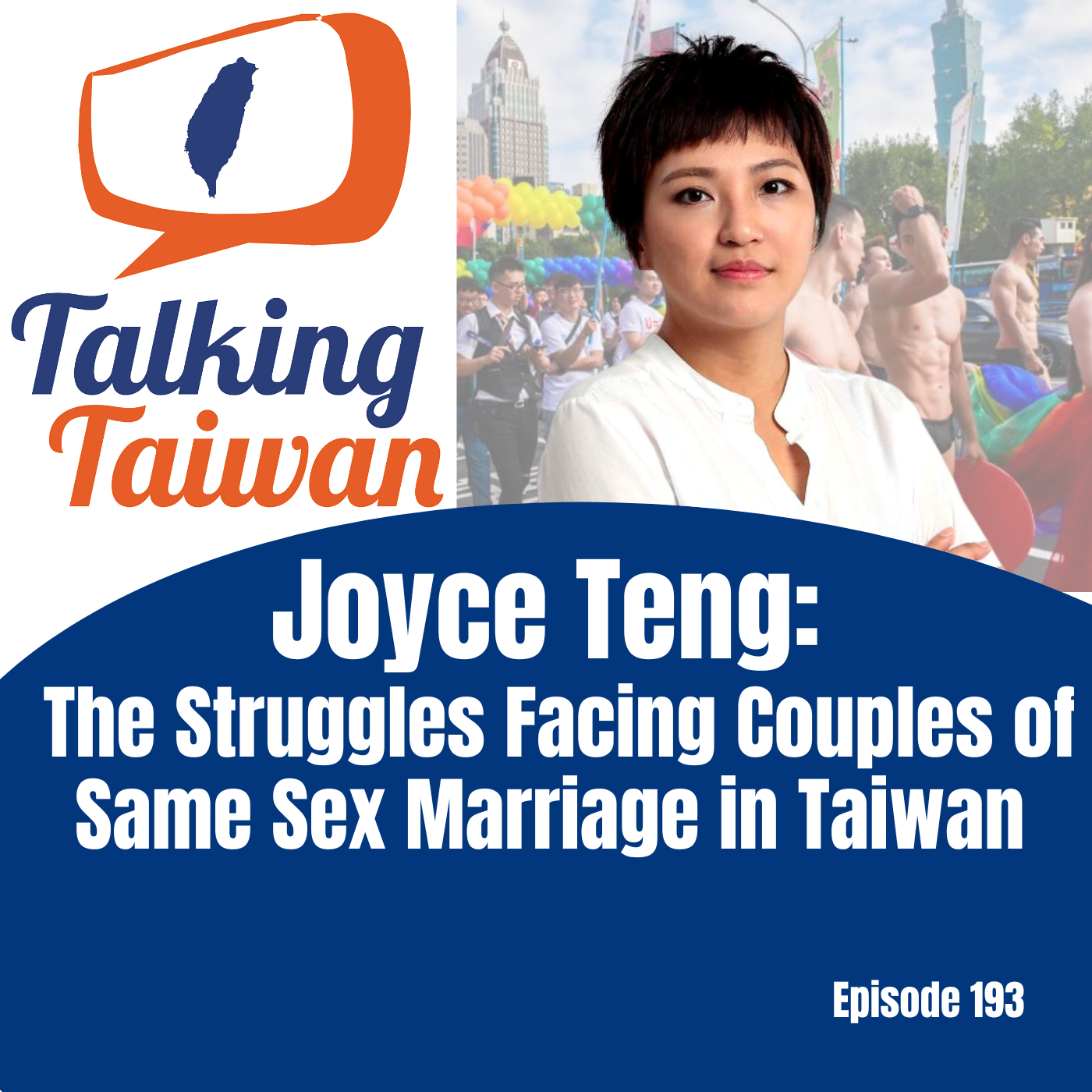
Ep 193Ep 193 | Joyce Teng: The Struggles Facing Couples of Same Sex Marriage in Taiwan
A note from Talking Taiwan host Felicia Lin: It's been three years since Taiwan became the first country in Asia to legalize same sex marriage in 2019. My guest on this episode of Talking Taiwan is Joyce Teng, the Deputy Executive Director of Taiwan Equality Campaign, previously known as the "Marriage Equality Coalition Taiwan." We talked what's happened since 2019. Surveys and polls conducted over the past three years indicate growing support for LGBTQIA+ issues within Taiwan's society. However, there are still some additional struggles that same sex married couples experience as opposed to heterosexual married couples in Taiwan. Joyce also touched upon a few issues concerning transgender and nonbinary individuals. She mentioned three areas in which same sex married couples face some challenges, the first being transnational couples; problems arise for couples of different nationalities when their marriage cannot be legally recognized in Taiwan; the second issue is co-adoption and dealing with Taiwan's adoption procedures, and finally reproductive rights. It's been eye-opening for me to learn about all of this. These are all complex issues and many of them they could also pose challenges for heterosexual married couples in Taiwan. I only recently learned about a woman's reproductive rights in Taiwan when it comes to freezing her eggs. We'll include some articles on this topic in the Related Links section of this episode. This episode of Talking Taiwan has been sponsored by NATWA, the North America Taiwanese Women's Association. NATWA was founded in 1988, and its mission is: to evoke a sense of self-esteem and enhance women's dignity, to oppose gender discrimination and promote gender equality, to fully develop women's potential and encourage their participation in public affairs, to contribute to the advancement of human rights and democratic development in Taiwan, to reach out and work with women's organizations worldwide to promote peace for all. To learn more about NATWA visit their website: www.natwa.com Here's a little preview of what we talked about in this podcast episode: Taiwan Equality Campaign was previously the "Marriage Equality Coalition Taiwan" How the rights of heterosexual married couples differ from the rights of same sex married couples in Taiwan How heterosexual married couples and single individuals can adopt in Taiwan, but same sex married couple cannot adopt in Taiwan Earlier this year there was a court case that ruled that one of the spouses of a same sex couple, could adopt his spouse's child who had been adopted when the was still single, however this is only one case, and according to the law in Taiwan a same sex spouse is unable to adopt the adopted child of their spouse What is involved with the adoption process in Taiwan and how it could take up to 3-5 years The gap when it comes to reproductive rights for heterosexual women and lesbian women who want to freeze their eggs in Taiwan Reproductive rights of same sex couples in Taiwan How Taiwan has one of the lowest birth rates in the world The government in Taiwan offers subsidies for heterosexual couples to do IVF but not for same sex couples How birth rates in Taiwan tend to be low during the year of the tiger (February 1, 2022 – January 21, 2023 is a tiger year) How Taiwan has changed in the time that Joyce has been working for the Taiwan Equality Campaign and since same sex marriage was legalized in Taiwan Surveys done by the Taiwan Equality Campaign over the past three years indicate increasing support by the general public for same sex couples to adopt, do IVF Surveys done by the Taiwan Equality Campaign show that over time more of the general public have indicated that they have friends identifying as LGBTQIA+; this indicates that LGBTQIA+ individuals are more willing to come out to their family, friends and peers Surveys have also indicated that since the legalization of same sex marriage in Taiwan, LGBTQIA+ individuals are more comfortable to talk about their personal lives and spouses The different types of survey questions asked to gage people's acceptance of same sex couples in Taiwan Whether the general public in Taiwan supports teaching school-aged children about gender equality, sexual orientation and expression How attitudes and acceptance of LGBTQIA+ individuals and issues may be indicative of generational differences The film Small Talk, a documentary film about the filmmaker's difficult relationship with her mother who was a lesbian If having a nonbinary "Digital Minister" in Taiwan, Audrey Tang has had any impact on the general public's views or acceptance of LGBTQIA+ individuals How there is work to be done when it comes to awareness and understanding of transgender and nonbinary individuals in Taiwan The challenges faced by transgender and nonbinary individuals in Taiwan The question of how transgender and nonbinary individuals would like to be identified on their identification cards/documents How the Taiw
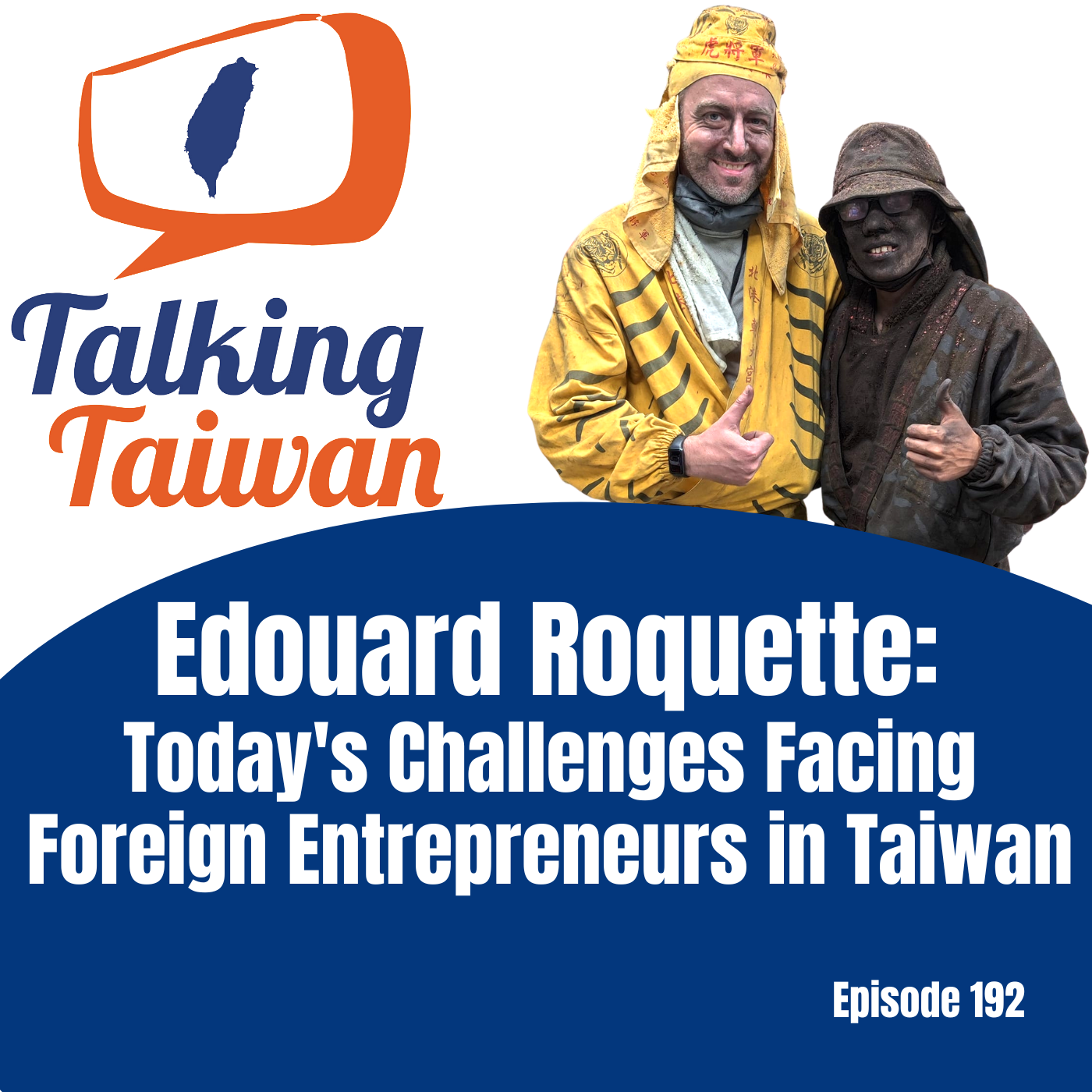
Ep 192Ep 192 | Edouard Roquette: Today's Challenges Facing Foreign Entrepreurs in Taiwan
A note from Talking Taiwan host Felicia Lin: Edouard Roquette was at the beginning of his experience as an entrepreneur when he was previously interviewed for Talking Taiwan, as you may have heard in the previous lost episode of Talking Taiwan (episode 191) featuring Edouard. We've invited Edouard back on as a guest to talk about what he's been up since then. Edouard talked to us about his clean tech startup and why it failed, and the challenges that many foreign entrepreneurs experience in Taiwan. He also had a life changing accident which we will talk about in a follow up interview, in a future episode. Edouard is currently the founder of Rooms.Taipei a co-living business. If you'd like to check out their COVID newsletter that Edouard mentioned in his interview, the one that provides updates to help people keep up on the visa and immigration situation in Taiwan during COVID, check out the related links section below. Here's a little preview of what we talked about in this podcast episode: Edouard's clean-tech start-up CityVolt and why it failed The differences between a gas vehicle and electric vehicle Battery sources for electric vehicles Exchangeable, rechargeable batteries for scooters How Edouard won a competition and was invited to speak at The Economist's Carbon Economy Summit in Washington D.C. in 2009 Eduoard's thoughts on what makes Gogoru successful The accident that changed Eduoard's life and led him to consider a co-living business that he started in 2014 Edouard's co-living business, Rooms.Taipei The problems that Edouard's co-living business aims to solve How Rooms.Taipei is an accelerator for the experiences that a foreigner can have in Taiwan Why it's difficult to scale a business like this or to differentiate it How businesses in Taiwan are not protected from extreme rent increases that negatively impact their businesses, causing them to close How rent increases can lead to many other "costs" aside from causing businesses to close, these costs include: environmental costs, human costs (jobs lost), economic cost (when companies are constantly closed and new ones started) Edouard's thoughts about Taiwan's plans to attract 100,000 foreign workers by 2030 Edouard's business strategy of reaching out to and collaborating with his competitors How difficult it is for foreign entrepreneurs to do business in Taiwan How most of Edouard's customers are people who have just arrived in Taiwan or are new to Taiwan How housing and banking are two of the most difficult things for foreigners in Taiwan to deal with The E. Sun Bank branch that offers English service and where Edouard is encouraging foreigners to open bank accounts Problems that people have encountered with negligent landlords How Edouard has reached out to the office of the mayor of Taipei through the French Chamber of Commerce about creating a standard of accommodations and contracts How most housing projects in Taipei are luxury apartments targeted to investors but not to the average resident of Taipei Last year Taipei city lost inhabitants Edouard's thoughts on what to do when the odds are against you Edouard's private entrepreneur group of business owners who meet regularly and support each other's businesses Katie Moves Taipei, a business that offers Zumba online classes Taiwan Impact Entrepreneurs Facebook group and what they are doing for foreign entrepreneurs in F&B (food and beverage) The kombucha beverage company, Daoori Elias Ek's efforts to improve things for foreign entrepreneurs in Taiwan How there needs to be better representation for foreign employees, migrant workers, foreign students How things have changed for entrepreneurs in Taiwan in the past 10 years since Eduoard's "lost" episode of Talking Taiwan interview Edouard's advice for foreigner entrepreneurs considering doing business in Taiwan What Edouard loves about Taiwan which includes cycling and being a Tiger Man for the goddess Matsu's birthday How Edouard founded one of the biggest sports groups for foreigners in Taiwan Outdoor sports groups in Taiwan to check out Related Links: https://talkingtaiwan.com/edouard-roquette-todays-challenges-facing-foreign-entrepreneurs-in-taiwan-ep-192/
Ep 191Ep 191 | Edouard Roquette | Lost Episodes
A note from Talking Taiwan host Felicia Lin: This lost episode of Talking Taiwan features Edouard Roquette, a member of the French Chamber of Commerce talking about entrepreneurship and Taiwan's foreign entrepreneur community. Next week we'll be bringing Edouard back on to find out what he's been up to since then. For the month of June we'll be slowing things down by sharing lost episodes every other week, and in July we'll be taking a break from the lost episodes. We've got a lot of great new content planned and we just can't fit it all into our weekly publication schedule. Here's a little preview of what we talked about in this podcast episode: Edouard was a finalist for the French Chamber of Commerce's Innovation award in 2010 and 2011 Edouard is a member of the French Chamber of Commerce's SME (Small and Medium Enterprises) committee Edouard's involvement with the Founder's Club that meets monthly How to raise money for a business that doesn't involve equity The different approaches that foreign entrepreneurs in Taiwan take to raising funds Why Edouard has chosen to start his business in Taiwan and not China The variety of ideas that come out of the Taiwan's foreign entrepreneur community Advice Edouard would give to people on the beginning of their entrepreneurial paths What people should not do when starting a business Why it's important to consider who you decide to work with and accept money from Local Taiwanese entrepreneurs vs. to foreign entrepreneurs How Edouard learned about entrepreneurship before coming to Taiwan through a program developed jointly by the MIT Sloan Business School and the University of Cambridge called the SEEDA (South East England Development Agency) Enterprisers The lack of support, programs or resources available for entrepreneurs in Taiwan Related Links: To view all related links for this article, click link below: https://talkingtaiwan.com/ep-191-lost-episodes-edouard-roquette/
Ep 190Ep 190 | Peter Zhao: Tourette Syndrome Awareness and his Own Personal Struggles with Mental Health
A note from Talking Taiwan host Felicia Lin: May 15 to June 15th is Tourette Syndrome Awareness Month. To learn more about what Tourette syndrome is, I encourage you to listen to the episode that we did last year with Peter Zhao, episode 129. Peter is a Tourette Activist and has been a guest on Talking Taiwan several times. He's also spoken up about Asian hate crimes. I really appreciate the openness and candor with which he speaks about his personal struggles with mental health. It's not an easy thing to do. Peter spoke about the challenges he's faced in dealing with Tourette and bipolar I, and his concerns with the side effects of medication, which he noted has made him lose his "edge." Dealing with mental health is a process that requires assessment, evaluation, and self-reflection. To learn more about Peter, you can find him on social media as @fabulouslytourette or check out his podcast Fabulously Tourette Radio. Here's a little preview of what we talked about in this podcast episode: Peter's podcast Fabulously Tourette Radio Peter's diagnosis of manic depression, bipolar I with major depressive episodes How Peter is considered neurodivergent How podcasting is a form of talk therapy for Peter The term neurodivergent What happened to lead Peter to get officially diagnosed with bipolar I Peter's previous struggles in taking an anti-psychotic drug Orap (generic name Pimozide), which he shared in detail in Talking Taiwan episode 129 Peter's Op Ed on AsAm News about dealing with bipolar disorder Peter's struggles with his mood swings and comorbidities How Peter's depression affected his job performance and family life The difficulties and challenges of Peter's day job How Peter has experienced greater anxiety after working remotely since the beginning of the pandemic Peter's candid posts about mental health on social media What happened after Peter was diagnosed with bipolar I and started taking a new medication The approach Peter took to starting this new medication How the medication stopped many of Peter's tics and how he feels about that How Peter feels after being on this new medication for four months The side effects of the medication that Peter is taking and how he's dealing with them The support of Peter's partner How Peter came to the decision to take a leave of absence from work How Peter handled his leave of absence and used it as a mental health reset Peter's considerations when it comes to job satisfaction and his career path Peter's advocacy for Tourette syndrome and bipolar disorder Peter's tip, the 50-50 mindfulness technique for people dealing with anxiety Related Links: To view all related links for this article, click link below: https://talkingtaiwan.com/peter-zhao-tourette-syndrome-awareness-and-his-own-personal-struggles-with-mental-health-ep-190/
Ep 189Ep 189 | Why Should you Care About the Taiwan Fellowship Act: A Discussion with Richard Pearson and Shelley Rigger
A note from Talking Taiwan host Felicia Lin: In this episode of Talking Taiwan, my guests are Richard Pearson, the Executive Director of the Western Pacific Fellowship Project and Professor Shelley Rigger. We will be talking about the Taiwan Fellowship Act, a bill which has been decades in the making, and was inspired by the Mansfield Fellowship. This bill which has gotten bipartisan support in both the U.S. and Taiwan. It has been added to the COMPETES Act, and has also passed through both the U.S. House of Representatives and Senate in slightly different versions. Now the House and Senate are in conference committee to resolve differences in order to come up with a final version of the bill. Learn more about what the Taiwan Fellowship Act is, how it serves to strengthen U.S.-Taiwan ties, why you should care about it, and how you can support passage of this bill in to law. About Richard Pearson: Richard Pearson is Executive Director of the Western Pacific Fellowship Project and Managing Director, Taiwan Fellowship. He has roughly two decades of experience in U.S.-Asia economic relations and the political-economy of the Asia-Pacific largely in the public service sector. Mr. Pearson's professional experience includes time as a business reporter based in Taipei and in public service focusing on the Indo-Pacific. From 2010-2014 Mr. Pearson was an Associate Director at the Maureen and Mike Mansfield Foundation during which time he originally conceived and explored the Taiwan Fellowship concept. Along with Ryan Shaffer and former AIT Director and Chairman Ambassador Raymond Burghardt, Mr. Pearson founded the Western Pacific Fellowship Project in late-2019 to operationalize the Taiwan Fellowship. Mr. Pearson received his undergraduate degree from St. Olaf College and his graduate degree from the Fletcher School of Law and Diplomacy. Immediately after college, he held a Fulbright scholarship to Taiwan. His essays on U.S.-Asia relations have been published in various outlets in the U.S. and East Asia including the Taipei Times and The Diplomat. About Shelley Rigger: Shelley Rigger is the Brown Professor of East Asian Politics at Davidson College. She has a PhD in Government from Harvard University and a BA in Public and International Affairs from Princeton University. She has been a Fulbright scholar at National Taiwan University (2019), a visiting researcher at National Chengchi University in Taiwan (2005) and a visiting professor at Fudan University (2006) and Shanghai Jiaotong University (2013 & 2015). She is a non-resident fellow of the China Policy Institute at Nottingham University and a senior fellow of the Foreign Policy Research Institute (FPRI). She is also a director of The Taiwan Fund, a closed-end investment fund specializing in Taiwan-listed companies. Rigger is the author of two books on Taiwan's domestic politics, Politics in Taiwan: Voting for Democracy (Routledge 1999) and From Opposition to Power: Taiwan's Democratic Progressive Party (Lynne Rienner Publishers 2001). She has published two books for general readers, Why Taiwan Matters: Small Island, Global Powerhouse (2011) and The Tiger Leading the Dragon: How Taiwan Propelled China's Economic Rise (2021). She has published articles on Taiwan's domestic politics, the national identity issue in Taiwan-China relations and related topics. In 2019-20 she was a Fulbright Senior Scholar based in Taipei, where she worked on a study of Taiwan's contributions to the PRC's economic take-off and a study of Taiwanese youth. Here's a little preview of what we talked about in this podcast episode: The COMPETES Act and the Taiwan Fellowship Act, what they are and the background The Western Pacific Fellowship Project How the China Bill in the COMPETES Act aims to strengthen the U.S. response and monitoring of China's economic activity, and political and security moves globally How the COMPETES Act aims to strengthen the U.S. semiconductor industry How the COMPETES Act contains a bill to change the name TECRO (Taipei Economic and Cultural Representative Office) change to Taiwan Representative Office is a part of the Competes How the Taiwan Fellowship Act fits into the larger question of the U.S.'s response to China What the Taiwan Fellowship Act is The Mike Mansfield Fellowship Why Americans should care about getting the Taiwan Fellowship Act passed Why Taiwan matters on its own, apart from China What is the procedure for an Act to get passed and what stage the Taiwan Fellowship Act is currently at The many Taiwanese American civic groups that support the Taiwan Fellowship Act For those who'd like to support the Taiwan Fellowship Act and see it get passed in to law, now is a crucial period; they should contact their members of congress to express their support for getting it passed You can write an email to your member of congress through an automated form on FAPA's (Formosan Association of Public Affairs) website How the Mansfield Fellowship came from congress v

Ep 188Ep 188 | Michael Turton Lost Episodes | 5000 Blog Posts
A note from Talking Taiwan host Felicia Lin: This lost episode of Talking Taiwan features blogger Michael Turton. At the time Michael had written over 5000 blog posts for his blog The View From Taiwan. Michael began writing his blog in 2005 and I remember how popular Michael's blog was. That's how I learned about him when I was living in Taiwan, back in the days before social media. Michael has been a guest twice on Talking Taiwan. in episode 119 he spoke with me about China's ban on Taiwan's pineapples. And in episode 138 he spoke about his love of biking in Taiwan. That episode earned Talking Taiwan a Golden Crane Podcast Award. Be sure to give those episodes a listen to learn more about Michael. For the month of June we'll be slowing things down by sharing lost episodes every other week, and in July we'll be taking a break from the lost episodes. We've got a lot of great new content planned and we just can't fit it all into our weekly publication schedule. Here's a little preview of what we talked about in this podcast episode: Michael's blog the View From Taiwan How Michael has written over 5000 blog posts How long it takes him to write a blog post on average What keeps him going with his blog writing How his blog posts are fact based and he's been quoted by journalists How being based in Taichung, gives him a different perspective than those living in Taipei Michael's love of biking in Taiwan The most active English language bloggers in Taiwan Related Links: To view all related links for this article, click link below: https://talkingtaiwan.com/ep-188-lost-episodes-michael-turton-5000-blog-posts/

Ep 187Ep 187 | Karen Lin: Democratic Candidate for Civil Court Judge Talks About Her Career in the Legal Profession
A note from Talking Taiwan host Felicia Lin: Karen Lin is running as the Democratic candidate for Judge of the Civil Court in Queens, New York. Presently, Karen serves as Court Attorney-Referee in Kings County Surrogate's Court. She has also served as a Judge in the New York City Housing Court, adjudicating disputes between landlord and tenants in the Bronx and Manhattan. We spoke about her current position as Surrogate Court Referee which involves estate settlement between family members and other matters such as guardianship, which was the central issue of the #FreeBritney movement involving Britney Spears. Karen talked about what she loves about the legal profession and the challenges of working as a Judge in New York City's Housing Court, which is one of the busiest courts in the nation. Karen also volunteers as Co-Chair of the Pro Bono and Community Service Committee of the Asian American Bar Association of New York (AABANY), she also spearheaded the Queens Pro Bono Clinic and helped to set up and manage AABANY's Remote Legal Clinic during the pandemic, to assist seniors and low-income families by phone. Here's a little preview of what we talked about in this podcast episode: Karen's connection to Taiwan What Karen wanted to be when she grew up and how she got interested in law as a career What Karen does in her current position as Surrogate Court Referee The #FreeBritney movement and guardianship What's been a challenging moment in Karen's career What's have a highlight or high point in Karen's career What it was like being a judge in housing court The confirmation hearing for Supreme Court Justice Ketanji Brown Jackson How the civil rights movement led to the Immigration and Naturalization Act (1965) How landlord tenant law in New York is very tenant friendly and could be reformed to protect individual homeowner landlords who are renting out a space in their homes The reform of landlord tenant law is an issue for lawmakers to address How New York City's Housing Court is one of the busiest courts in the nation How Karen's experience as a judge in New York City's Housing Court and Surrogate's Court has prepared her for being a civil court judge How in the Anglo American system (or common law system) that we have in the United States, a judge's ruling or interpretation of the law can affect or create laws Karen's pro bono work as Co-Chair of the Pro Bono and Community Service Committee of the Asian American Bar Association of New York (AABANY) Karen's involvement in setting up AABANY's Remote Legal Clinic during pandemic Her decision to step down as judge of the New York City Housing Court What a civil court judge does and can accomplish during their 10-year term How Karen would like to see greater access to legal advice and support for those who most need it Karen's mentors and advice on finding them If Karen would like to be a Supreme Court Judge The difference levels of the U.S. court system The importance of voting In Queens, NY Asian Americans are 25% of the population Karen is running in the Democratic primary, on June 28; only people registered as Democrats and who live in Queens can vote for Karen Related Links: To view all related links for this article, click link below: https://talkingtaiwan.com/karen-lin-democratic-candidate-for-civil-court-judge-in-nyc-talks-about-her-career-in-the-legal-profession-ep-187/

Ep 186Ep 186 | Lost Episodes | Dr. Jerome Keating PhD, The Mapping of Taiwan
A note from Talking Taiwan host Felicia Lin: It's Thursday and we're releasing another "lost" episode of Talking Taiwan! We've discovered some never before published, "lost" episodes of Talking Taiwan that were recorded 10 years ago, when Talking Taiwan was being created, and we've decided to re-release them on Thursdays. This week's lost episode of Talking Taiwan features Jerome Keating, the author of The Mapping of Taiwan, Desired Economies, Coveted Geographies, New Perspectives on Cartography, Competing Monopolies and the Destiny of Taiwan. We've had Jerome on Talking Taiwan twice in the past. In fact, in episode 97 he gives a great synopsis of the history of Taiwan. That episode was also the number one episode of 2020. And in episode 98 he talks about the books he's written. Be sure to check out those episodes to learn more about Dr. Keating. Here's a little preview of what we talked about in this podcast episode: Jerome Keating' book, The Mapping of Taiwan, Desired Economies, Coveted Geographies, New Perspectives on Cartography, Competing Monopolies and the Destiny of Taiwan The meaning behind the title of Jerome's book The purpose behind the Dutch and Spanish colonization of Taiwan How Japan was the first to control the entire island of Taiwan Taiwan's trade history Taiwan's fong tian jade How the indigenous people of Taiwan were Taiwan's first traders The Austronesian empire Related Links: To view all related links for this article, click link below: https://talkingtaiwan.com/lost-episodes-dr-jerome-keating-phd-ep-186/

Ep 185Ep 185 | Brian Foden Newscaster for ICRT Talks About How Life has Changed in Taiwan
A note from Talking Taiwan host Felicia Lin: In this episode of Talking Taiwan, I'm speaking with Brian Foden. We're welcoming Brian back on as a guest after discovering his lost episode that was recorded 10 years ago. Originally from Canada, he's been living in Taiwan for over 20 years now. We spoke about what Taiwan was like when he first arrived, how it's changed and what life is like for him these days. Brian is a writer/editor and part-time newscaster at ICRT. Here's a little preview of what we talked about in this podcast episode: When Brian arrived in Taiwan How life is like in Taiwan now that the government has switched away from a zero-COVID strategy What life was like in the early period of the pandemic when Taiwan had no local COVID cases How Brian manages working remotely and in-person at the office Brian started working at ICRT in May of 2000 and worked there full-time until 2004 Brian's position as morning show news producer at ICRT How Brian left ICRT in 2004 and returned in 2012 Brian's work as a news reader at ICRT Brian's background in journalism Comparing winters in Regina, Saskatchewan and in Ottawa, Ontario How Brian ended up in Taiwan How Taiwan has changed in the time that Brian has lived there Chen Shui-bian was elected President around the time that Brian moved to Taiwan; it was the first time that a Democratic Progressive Party candidate had been elected President in Taiwan The development of Taiwan's MRT system The popularity of English learning magazines in Taiwan How ICRT has changed over the years The podcast series Rick Monday made about ICRT (Radioactive Taiwan) The glory days of ICRT and the impact it made on Taiwan's culture and society in the 1980s How Brian first got his job at ICRT in 2000 Brian's advice for anyone considering living and working in Taiwan The type of writing Brian does for work What Brian found difficult about journalism Related Links: To view all related links for this article, click link below: https://talkingtaiwan.com/brian-foden-newscaster-for-icrt-talks-about-how-life-has-changed-in-taiwan-ep-185/

Ep 184Ep 184 | Lost Episodes | Brian Foden
A note from Talking Taiwan host Felicia Lin: As some of you may know, I started hosting Talking Taiwan in 2013, but Talking Taiwan was actually created back in 2012. And we've discovered some never before published, "lost" episodes of Talking Taiwan that were recorded 10 years ago! Some of these guests featured in these "lost episodes" may already be familiar to our listeners and some of them will be reintroduced with a follow up interview for us find out what they're up to these days. Stay tuned every Thursday a new "lost" episode of Talking Taiwan. This "lost" episode of Talking Taiwan features Brian Foden, a proud Canadian. Next week we'll be bringing Brian back on to find out how he's doing and what he's up to these days. Here's a little preview of what we talked about in this podcast episode: Where in Canada Brian is from What brought Brian to Taiwan Brian's work on the ICRT News team How he left ICRT Brian's travels through South America The Brass Monkey in Taipei's pub quiz nights and Brian's pub quiz team The Three Stooges Brian shared what kinds of job opportunities there were in writing, editing, recording or for those with a journalism background Related Links: To view all related links for this article, click link below: https://talkingtaiwan.com/ep-184-lost-episodes-brian-foden/
Ep 183Ep 183 | Erin Hale: On Taiwan's Antiquated Banking System and Being an American Journalist Living in Asia
A note from Talking Taiwan host Felicia Lin: Erin Hale is an American Journalist who has lived and worked across Asia. She is currently a freelance journalist based in Taiwan. Her work has appeared in The Guardian, The Independent, Al Jazeera, Voice of America, The BBC News, The New Statesman, The South China Morning Post, Marie Claire, The Southeast Asia Globe, Forbes.com and other outlets. I came across her work through a recent article she wrote about how Taiwan's banking system is stuck in the 80's. I happened to discover it the same week we released episode 180 with Paolo Lising. In that episode Paolo and I talked about how people in Taiwan still update their account passbooks by running them through dot matrix printers at the bank. Erin has lived in Asia for seven years. We talked about how she's lived in Hong Kong, China and Cambodia and the reporting she's done on Hong Kong and Cambodia, in addition to Taiwan. Here's a little preview of what we talked about in this podcast episode: What brought Erin to Taiwan What Erin witnessed of the Hong Kong protests in 2019 Hong Kong's Umbrella Movement of 2014 John Lee who was elected to succeed Carrie Lam as Hong Kong's next leader How the recent article that Erin wrote for BBC News about how Taiwan's banking system is still stuck in the 80s was inspired by a tweet by Catherine Chou (@catielila) The reaction on Twitter to Erin's article and how she used Twitter to crowdsource research for it How often Erin uses Twitter to do research for her stories How Erin appealed to Twitter for people's experiences voting in the Philippines presidential election How Erin deals with bots on Twitter, fake news and disinformation as a journalist Taiwan-related visa and immigration issues that Erin has dealt with The bureaucracy that Erin has experienced in Taiwan How Erin gets ideas or sources for her stories Working as a freelance journalist What it takes to succeed as a freelance journalist What Erin enjoyed about writing the story about banking in Taiwan The article that Erin wrote about Taiwan's indigenous people What it's been like for Erin to learn Mandarin Chinese in Taiwan and what her goals in studying Chinese are How Erin ended up moving to Asia Beijing's 'Airpocalypse' in 2013 How journalists' experiences in China have changed over the last five years How Cambodia has changed and become influenced by China Related Links: To view all related links for this article, click link below: https://talkingtaiwan.com/erin-hale-on-taiwans-antiquated-banking-system-and-being-an-american-journalist-in-asia-ep-183/

Ep 182Ep 182 | Michael Fahey of Forward Taiwan Talks About the Gold Card Program
A note from Talking Taiwan host Felicia Lin: Taiwan's Employment Gold Card program has come up in several past episodes of Talking Taiwan. I've been wanting to bring someone on to talk about what it is, who might be eligible for it and how to apply for it. In this episode I spoke with Michael Fahey, an American lawyer who's lived in Taiwan for 30 years. He worked with the Taiwan National Development Council on Taiwan's Gold Card program. Michael is co-founder of Forward Taiwan, an organization founded to improve Taiwan's immigration laws as they pertain to foreign professionals. Here's a little preview of what we talked about in this podcast episode: How people may consider Taiwan small but with its population of 23 million people it could be compared to one of the U.S.'s largest states or a mid-sized European country What is the Taiwan Gold Card How the Taiwan Employment Gold Card is a four-in-one card: visa, work permit, resident permit, and re-entry permit, that is valid for three years After three years Gold Card holders who have been in Taiwan for an average of 183 days can apply for permanent residency in Taiwan How there was an increase in Gold Cards issued during the pandemic The government of Taiwan's goal of getting to 10,000 Gold Cards issued by the end of the year and a long-term goal of having 100,000 foreign professionals in Taiwan by 2030 How to apply for a Gold Card The eight fields that people can apply to in order to obtain a Gold Card The special category of consultation for those who don't fit in to any of the eight fields What documentation needs to be provided in order to apply for a Gold Card The importance of providing objective evidence of your professional accomplishments (e.g. an award, a measurable accomplishment) 60% of Gold Card holders have qualified by meeting the salary qualification in the economy field The type of work that Gold Card holders can seek while in Taiwan Singapore's Employment Pass program and the backlash it's gotten from Singaporean citizens Recent changes to the Gold Card program including the requirement for applying for permanent residence was lowered from five years to three years and different tax incentives Changes to ordinary work permit requirements which previously required both a college degree and two years of related experience The American Chamber of Commerce Taiwan Business Topics publication Useful resources for people applying for a Gold Card including: the Taiwan National Development Council's website Foreign Talent, the Taiwan Employment Gold Card Office Help Desk, Taiwan EZ Permit The challenges faced by some Gold Card holders in finding employment in Taiwan It's not necessary to speak Chinese to live and work in Taiwan If there is something missing or incomplete with a Gold Card application, you will have 30 days to rectify it Currently Gold Card applications are taking 4-6 weeks to get approved What happens if someone's application for the Gold Card is not accepted The most competitive sub field under arts and culture is popular music/TV/movies Special considerations for people wanting to live and work in Taiwan Considering places to live in Taiwan other than Taipei Michael's work with Forward Taiwan How Forward Taiwan is working on access to dual nationality for people naturalizing as Taiwanese citizens How Michael is transitioning to working on migrant workers issues The most meaningful accomplishments of Forward Taiwan: an increased number of countries that Taiwan has working holiday agreements with, making it easier for graduates of Taiwanese universities to stay and live and work in Taiwan How the National Development Council came up with Taiwan's Gold Card program and modeled it after Singapore's Employment Pass program Taiwan's independent artist work permit Related Links: To view all related links for this article, click link below: https://talkingtaiwan.com/michael-fahey-of-forward-taiwan-talks-about-the-gold-card-program-ep-182/

Ep 181Ep 181 | Yao Huang: Solving Financial Inequalities by Funding Minority Owned Businesses
A note from Talking Taiwan host Felicia Lin: Yao Huang is funding minority owned businessess to solve the financial inequality problem. I first met and interviewed Yao Huang, in 2013. She is founder and managing partner of The Hatchery. If you want to learn more about her and the Hatchery you can go back and listen to episode 147 of Talking Taiwan. Last year I looked her up, wondering what she's been up to and reached out to invite her back on to Talking Taiwan as a guest. A lot can happen in 9 years! I learned that she had done two TED Talks and a stint of standup comedy. Yao has been focusing on some very big things like solving the problem of financial inequality through a $100 million dollar fund for minority-owned small to medium-sized businesses. And from her social media posts it looks like she's living the life and having a ball at these gatherings called the Wonder Women Dinner Series all across the country. When I asked her what she's excited about these days she mentioned crypto, blockchain and Web3. To some, these may sound like things of the future but the future is already here. Last year Facebook's name change to Meta was a nod to the metaverse, and earlier in the year, the buzz over a thing called NFTs hit mainstream media. When it comes to understanding NFTs you've got to also understand crypto currency, and blockchain technology. We covered that topic in episode 157: DJ Kaku Trailblazes NFTs in Asia. All of these things together- crypto, blockchain and the metaverse make up Web3. Here's a little preview of what we talked about in this podcast episode: What the Wonder Women Dinner Series is How the Wonder Women Dinner Series has been going on for 16 years How the Wonder Women Dinner Series is a way for women to network, connect, make friendships, and have fun How Yao did standup comedy at Caroline's, B.B. King's and around New York City around 2014 Division One Capital a $100 million fund for women and minority small businesses How venture capital only helps 2% of all companies How Division One Capital's lending is based on a company's sales or revenues How it is difficult it is for women and minorities to secure a loan from a bank How loans from traditional banks can be at higher rates than funding obtained from Division One Capital How funding from a fund like Division One Capital can stabilize and allow a business to grow How Division One Capital was previously called Diana Capital How Division One Capital is working with cities' initiatives to help SMBs (small and medium-sized businesses) How Yao believes there is a lot of wealth that can be more equally distributed and easily accessed The businesses that Yao has helped grow e.g. a Black woman owned HVAC company and a woman-led company in the data security space that has raised $3.5 million How crypto, bitcoin and block chain has revolutionized the fintech sector, banking, credit, currency, stocks, and led the wave of Web3 How important it is to learn about bitcoin and cryptocurrency and how it works The bitcoin 2022 conference in Miami, FL Related Links: To view all related links for this article, click link below: https://talkingtaiwan.com/yao-huang-solving-financial-inequalities-by-funding-minority-owned-businesses-ep-181/

Ep 180Ep 180 | Paolo Lising Startup Taiwan Author: Shares His Knowledge on Starting a Business in Taiwan
A note from Talking Taiwan host Felicia Lin: Paolo Lising shares his knowledge on starting a business in Taiwan. In February, I did a follow up interview with Paolo Lising, who I've had on as a guest previously along with Ramon Ray in episode 168, which was about solopreneurship. Paolo is the author of Startup Taiwan: Foreigners Business Guide, and the founder of MillionDC.com. Startup Taiwan is the second book written to help foreigners wanting to start a business in Taiwan after How to Start a Business in Taiwan, which was written by Elias Ek in 2013. Elias has also been a guest on Talking Taiwan. I spoke in depth with Paolo about his early interest in entrepreneurship, what brought him to Taiwan, and how he transitioned from journalism to corporate life and the startup scene. We had an in-depth conversation about what went into his book Startup Taiwan. For those wanting the most up-to-date information they should subscribe to a digital version of Startup Taiwan, which Paolo regularly updates on his website StartupInTaiwan.com. He also has a podcast by the same name Startup Taiwan, that I'd recommend you check out. Here's a little preview of what we talked about in this podcast episode: Paolo's background and upbringing Paolo's career as a journalist covering the Philippines energy sector and banking When and how Paolo became an entrepreneur Paolo's first business, which was an antique shop in the Philippines How Paolo decided to go from being a journalist to pursing an MBA How Paolo decided to go Taiwan to purse an MBA degree How the MBA program at NTU (National Taiwan University) is taught in English Paolo worked at ASUS and Rayliant Global Advisors in Taiwan before getting into the startup scene Paolo's current startup in Taiwan, MillionDC.com, which is a learning platform for entrepreneurs from developing countries The special needs of entrepreneurs from developing countries Where the name MillionDC comes from How his bosses at ASUS and Rayliant Global Advisors were supportive of Paolo's interest in starting his own company on his own time outside of his work hours How one of the problems for people in the Philippines is having stable internet connection and access to information What led Paolo to write Startup Taiwan How to Start a Business in Taiwanby Elias Ek How so much has changed since 2013 when How to Start a Business in Taiwanby Elias Ek was published and Paolo felt a need to write a book with up dated information How Taiwan has changed it policies towards accepting foreigners and allowing them to open up businesses The two ways that foreigners can enter Taiwan and start a business: entrepreneur visa and Gold Card visa The requirements for an entrepreneur visa include submitting a plan of what you will to do in Taiwan, and the growth potential of your business Incubators in Taiwan and the support they provide to entrepreneurs The Gold Card visa is for those with expertise in their fields, similar to an APRC (lien Permanent Resident Certificate) The requirements for a Gold Card The process of writing and doing research for Paolo's book, Startup Taiwan There are six steps to starting a business in Taiwan How Paolo's book includes interviews with entrepreneurs and case studies The KPIs (key performance indicator) for grants given by the government of Taiwan The difference and added value of Paolo's book, Startup Taiwan compared to Elias' book, How to Start a Business in Taiwan How the interviews in Paolo's book, Startup Taiwan offer some real life examples of what people go through in the process of trying to start a business in Taiwan How Taiwan is in general very technologically advanced, but its banking system is not Why there aren't many venture capitalists setting up in Taiwan How a chop aka seal aka stamp is still commonly used by Taiwan's banks as form of identification The inspiration behind the book cover art for Startup Taiwan The challenges that Paolo has experienced in doing business in Taiwan Common misperceptions that people have about Taiwan or doing business in Taiwan If any of the case studies from the book Startup Taiwanhave been translated into Chinese How Audrey Tang, Taiwan's digital minister has received a copy of the book and thought the recommendations were helpful informing policies to make Taiwan a startup hub in Asia How Paolo wanted the first version of the print version of Startup Taiwanto look like a coffee table art book with grey paper vs. white or off-white How there are three versions of the book, Startup Taiwan 1)the print book released in 2020, 2) the online version available at StartupInTaiwan.com which is regularly updated 3) the 2022 version which is available on Amazon Kindle and print (updated up to January 31, 2022) If you go to StartupInTaiwan.com you can get a digital version of the book with real time updates based on current events and news How it is more challenging for foreign entrepreneurs in Taiwan to get access to funding than local Taiwanese ent
Ep 179Ep 179 | John Fan Pic Collage CoFounder: Creating Jobs for Taiwan's Most Talented Diaspora Since 2011
A note from Talking Taiwan host Felicia Lin: So much has happened since I interviewed John Fan, one of the co-founders of PicCollage back in December. PicCollage is an app that allows you to create fun things with your photos and videos. It is one of the most popular apps in the photo and video app category in the app store. We actually spoke the day after Talking Taiwan won a Golden Crane Podcast Award. It was a fascinating conversation not only about PicCollage, but about what it was like for John being in Taiwan when it was one of the few places in the world relatively unaffected by COVID at the beginning of the pandemic, and how it attracted COVID refugees that included some of Taiwan's most talented influential diaspora. John also talked about how the startup scene in Taiwan has changed in the ten years that he's lived there. Here's a little preview of what we talked about in this podcast episode: How PicCollage is an app that allows you to create fun things with your photos and videos How PicCollage as a company that creates a variety of apps related to greetings, video editing, and wellness The WOWSHI app inspired by Japanese washi tapes designed to mimic the tactile experience of applying washi tape, which can be a form of relaxation The idea for the WOWSHI app came out of the realization that during the pandemic people were looking for ways to de-stress How PicCollage was started 10 years ago and was initially designed primarily for the iPad 10 years ago apps like Uber, Instagram and Snapchat were still relatively new How PicCollage was started in Silicon Valley but has much of its operations in Taiwan John's experience as a Taiwanese American having moved to Taiwan and lived there for 10 years The challenges of running a business in multiple time zones The advantages of running a business in Taiwan The freedom and creativity in Taiwan The popularity of bubble tea and cat cafes of Taiwan How Taiwan is connected to and influenced by China, Japan and the U.S. Taiwan's kawaii i.e. cute aesthetic which has been influenced by Japan Kawaii culture in the in the campaign for Democratic Progressive Party (DPP) presidential candidate Chen Shui-bian How Bitmoji was created in 2007 PicCollage's Silicon Valley values and Taiwanese employees How PicCollage has offered its team members U.S. $3,500 to spend on learning about or getting training on something of their own choice How PicCollage's values are a mix from Silicon Valley and Taiwan: Always Be Learning. Be Proactive and Overcommunicate. Win As A Team. How PicCollage has changed and evolved over time John's work experience prior to PicCollage What it has been like starting and running PicCollage How PicCollage values user feedback and has invited users to come in for user interviews on Fridays What they have learned from user feedback e.g. the ability to save/back up the collages on their phone in the cloud Artist collaborations with PicCollage have included collaborations with individual artists, Sanrio, and tokidoki What it's been like being in Taiwan when it was relatively unaffected by COVID at the beginning of the pandemic, and attracted COVID refugees How Taiwan was one of the first countries to be aware of the threat of COVID early on in the pandemic and was prepared due to its prior experience with SARS How Taiwan was able to maintain zero COVID cases up until April/May 2021 and attracted COVID refugees, like the founders of Rotten Tomatoes, Twitch and YouTube The use of Gather and Kumospace as Taiwan has gone into partial lockdown and adopted working remotely How has the startup culture in Taiwan changed in the 10 years that John has been in Taiwan How software startups exist in the shadows of Taiwan's two major industries: the semiconductor industry and ODM (Original Design Manufacturer) industry or contract manufacturing industries How Taiwan can play a role in the software industry How people in Taiwan vs Japan and Korea, are more willing to take a risk and work for smaller companies instead of large companies and conglomerates How the startup Gogoro has been able to get a lot of funding How Appier went public in Japan There's been greater investor interest in Taiwan startups than in the past 500 Startups has set up a branch in Taiwan How there are more VCs (venture capital) in Taiwan now How there are more VCs investing in software How Taiwan can excel in creativity and design Pinkoi. "the Etsy of Asia" that was started in Taiwan GagaOOLala, an LGBTQ+, "Netflix for Asia" that was started in Taiwan How Taiwan needs people with senior level experience with product marketing, and engineering management, and this void could be filled by Taiwan's diaspora or those interested in working with Taiwanese companies How PicCollage is hiring Related Links: To view all related links for this article, click link below: https://talkingtaiwan.com/john-fan-pic-collage-cofounder-creating-jobs-for-taiwans-most-talented-since-2011-ep-179/
Ep 178Ep 178 | Taiwan's Civil Defense Preparedness: T.H. Schee on How to Prepare for the Threat of an Attack
A note from Talking Taiwan host Felicia Lin: Russia's invasion of Ukraine has put the reality of war on display for the world, especially for Taiwan, which like Ukraine, has been under the constant threat of military aggression of an unfriendly neighbor. Because of the war that's been happening in Ukraine there's been talk of how Taiwan must improve its military defense capabilities and preparedness, but beyond this, there are people in Taiwan wondering what they themselves can do to be prepared, should Taiwan come under attack. My guest on this episode of Talking Taiwan, T.H. Schee, a representative of Open Knowledge Taiwan, is one of those people asking these important questions. We'd like to dedicate this episode to the memories of David Kilgour, who passed away on April fifth at the age of 81 and Peng Ming-min who passed away on April eighth at the age of 98. Mr. Kilgour, who I interviewed recently, was a human rights activist, and a former Member of Canada's Parliament, having served in the House of Commons for nearly 27 years, as Secretary of State for Latin America & Africa from 1997-2002, and Secretary of State for Asia-Pacific from 2002-2003. Dr. Peng Ming-Min was a pro-Taiwan independence/pro-democracy activist. In 1964 he was arrested for sedition for drafting and printing a manifesto advocating for democracy in Taiwan, he served as president of the Formosan Association of Public Affairs from 1986 to 1988, and in 1996 he ran as a Democratic Progressive Party (DPP) candidate in Taiwan's first direct presidential election. This episode of Talking Taiwan has been sponsored by the Taiwanese United Fund. The Taiwanese United Fund is an arts and culture foundation that celebrates the cultural heritages of Taiwanese Americans. Established in 1986, the foundation's mission is to facilitate cultural exchange between the Taiwanese American community and other American cultural communities, hoping to enrich and expand our cultural experiences. To learn more about TUF visit their website http://www.tufusa.org/ Here's a little preview of what we talked about in this podcast episode: How T.H. became interested and involved with civil defense The 9/21 earthquake in Nantou His work with Open Knowledge Taiwan What is civil defense Great Britain's Air Raid Wardens Service How T.H. has been dealing with disaster response for over ten years How Taiwan has to deal with disaster response year round due to typhoons and earthquakes What is digital first aid Taiwan's history of civil defense programs in Kimen and Matsu What is covered in Open Knowledge workshops The last time that preparedness for war was treated as a priority in Taiwan The 1995-1996 missile crisis in Taiwan aka the Third Taiwan Strait Crisis What Taiwan can learn from what's happening with the war in Ukraine The challenge of evacuating from Taiwan since it is an island How prepared Ukrainian civilians were for war How people can prepare for different levels of crisis: 1) emergency preparation (e.g. power outage/ blackout) 2) natural disaster 3) an attack/invasion/war The importance of establishing several reliable sources of information in case of a natural disaster The emerging discussion about how to handle an attack on Taiwan The importance of being able to identify friend from foe in case of a war in Taiwan The importance of first aid knowledge How civil defense in Taiwan is mandated by the national police agency/law enforcement in Taiwan An explanation of infographics from Open Knowledge that were recently shared on Twitter How general citizens could seek to improve their preparedness by enrolling in courses offered by hospitals Preparedness for military reservists The importance of having secure lines of communication in times of crisis Taiwan's Ministry of Defense has published a handbook that outlines the roles and responsibilities of the local and central government in times of crisis; the handbook is irrelevant for civilians T.H.'s thoughts on how the government of Taiwan can better prepare its citizens for war How the past civil defense programs in Kimen and Matsu prepared and trained civilians for war and what we can learn from them How the defense sector is a closed circle and Open Knowledge Taiwan is trying to address civilians' lack of access to defense related information Ukraine's Territorial Defense Forces How it's important for Taiwan to improve bi-lateral and tri-lateral exchanges of information Michael Turton's piece in the Taipei Times about Taiwan's preparedness for war How it's important to be able to resist the first 72 hours of an attack How critical points identified at Open Knowledge Taiwan workshops could be turned into policy recommendations for Taiwan's government Related Links: To view all related links for this article, click link below: https://talkingtaiwan.com/taiwans-civil-defense-preparedness-t-h-schee-on-how-to-prepare-for-the-threat-of-an-attack-ep-178/

Ep 177Ep 177 | Celebrating Children's Day in Taiwan: Margaret Chiu Greanias Talks About What Inspired her Latest Book "Amah Faraway"
A note from Talking Taiwan host Felicia Lin: April fourth is Children's Day in Taiwan, which is great timing for this interview with children's book author Margaret Chiu Greanias. She spoke with me about her latest book Amah Faraway, which has many of its scenes set in Taipei, Taiwan. Margaret shared how she became a children's book author, what she loves about picture books, how they get created and what she's working on next. This episode of Talking Taiwan has been sponsored by the Taiwan Elite Alliance 優社 and the Taiwanese United Fund. The Taiwan Elite Alliance 優社 was established in 2000 to promote Taiwanese and Taiwanese American arts and literature, and to protect and enhance the human rights, freedom and democracy of the people in Taiwan. The Taiwanese United Fund is an arts and culture foundation that celebrates the cultural heritages of Taiwanese Americans. Established in 1986, the foundation's mission is to facilitate cultural exchange between the Taiwanese American community and other American cultural communities, hoping to enrich and expand our cultural experiences. To learn more about TUF visit their website http://www.tufusa.org/ Here's a little preview of what we talked about in this podcast episode: How Amah Faraway is written as a reverse poem What is a reverse poem The reverse poem, "The Lost Generation" by Jonathan Reed that inspired Margaret to write Amah Faraway as a reverse poem What inspired Margaret to write Amah Faraway How much of the book was based on Margaret's relationship with her amah and on her children's relationship with their amah (Margaret's mother) How Margaret's children react to reading her books Margaret's memories of visiting Taiwan as a child How Margaret got connected with the illustrator of Amah Faraway Tracy Subisak the illustrator of Amah Faraway who is half Taiwanese and her special contributions to the book, which included the use of Mandarin Chinese The Two Tigers nursery rhyme that amah sings to Kylie in Amah Faraway How children's picture books can be written first without an illustrator or written with a specific illustrator, in which case the manuscript and sketches would be sent together to an editor How Margaret's first book Maximillian Villainous was created with illustrator Lesley Breen Withrow, and the manuscript and sketches were sent together to an editor How the movie Despicable Me inspired the idea for Margaret's first children's book Maximillian Villainous When the editor chooses the illustrator for a picture book usually the author and illustrator aren't introduced to each other, and the illustrator works independently to interpret the words of the story in their own way How picture books are half about the words and half about the art How Margaret decided to become a children's book author What Margaret was doing before she became a children's book author Margaret's favorite books as a child How Margaret decides to write about Margaret's writing process Margaret writes picture books for ages 3-8 but would like to also write chapter books for middle grade (8-12 years old) What Margaret loves about picture books and writing for the 3-8 year old age group World Read Aloud Day The Five Chinese Brothers, an American children's book written by Claire Huchet Bishop What's involved in the process of getting a children's book published The challenge of writing a story in 500 words or less Children's books that Margaret recommends Margaret's next book, Hooked on Books that will be coming out next summer Related Links: To view all related links for this article, click link below: https://talkingtaiwan.com/celebrating-childrens-day-in-taiwan-margaret-chiu-greanias-talks-about-her-latest-book-amah-faraway-ep-177/

Ep 176Ep 176 | Taiwan Cares Humanitarian Efforts for Ukraine Raise $9000 in 24 Hours
A note from Talking Taiwan host Felicia Lin: As she watched the humanitarian crisis unfold due to the war in Ukraine, S. Chien wanted to do something to help. She came up with the idea for the Taiwan Cares project and together with Dr. Monty Wang and Dr. Bo-Chheng Lin, mobilized the efforts of over 30 Taiwanese Americans from New Jersey to raise over $9000 in 24 hours. The funds were used to purchase and ship urgently needed medical supplies and baby formula to people in Ukraine. Chien is the President of New Jersey Chapter of North America Taiwanese Women's Association. Dr. Monty Wang is a retired physician. [INSERT photo of Dr. Bo-Chheng Lin] Dr. Bo-Chheng Lin, is cofounder of New Jersey Living Well Club and an elder of the New Jersey Taiwanese American Fellowship Presbyterian Church (TAFPC). I learned about their project Taiwan Cares from an email that was forwarded to me with a touching video created by Shi Chien about how over $9,000 was raised in 24 hours in order to send humanitarian relief to people in Ukraine. With everything that's been happening in the world today, I think that we need to tell more stories of the good that people are doing in the world. The Taiwanese Care project team will continue to provide humanitarian assistance to Ukrainian refugees in cooperation with the Taiwanese American Council of Greater New York (TAC-GNY) which has set up the Ukraine-Taiwan Humanitarian Fund Drive. Donors may contact them for details and/or send checks to: Taiwanese American Council (TAC) of Greater New York TAC / Taiwan Center 137-44 Northern Blvd, Flushing, NY 11354 Make checks payable to TAC/GNY. Please write the following as the check's memo: Ukraine – Taiwan Cares TAC-GNY is a 501(c)(3) tax exempt organization. After receiving a donation check, TAC-GNY will send the donor a tax-deductible receipt. The fundraising drive ends mid-April. This episode of Talking Taiwan has been sponsored by the Taiwan Elite Alliance 優社 and the Taiwanese United Fund. The Taiwan Elite Alliance 優社 was established in 2000 to promote Taiwanese and Taiwanese American arts and literature, and to protect and enhance the human rights, freedom and democracy of the people in Taiwan. The Taiwanese United Fund is an arts and culture foundation that celebrates the cultural heritages of Taiwanese Americans. Established in 1986, the foundation's mission is to facilitate cultural exchange between the Taiwanese American community and other American cultural communities, hoping to enrich and expand our cultural experiences. To learn more about TUF visit their website http://www.tufusa.org/ Here's a little preview of what we talked about in this podcast episode: How the Taiwan Cares Project was initiated Dr. Monty Wang talks about how he's visited both Ukraine and Russia and his impressions Why they only had 24 hours to raise funds How the Taiwan Cares Project team partnered with a Ukrainian Orthodox Church in New Jersey to deliver the supplies to people in need in Ukraine Why they decided to purchase urgently needed baby formula and medical supplies to send to Ukraine rather than sending a cash donation How Dr. Wang planned what items to order and the quick turnaround time in order to get them delivered to the Ukrainian church The Taiwan Care project will be a continued and continuous effort How Taiwan has made disaster relief contributions to Japan (Fukushima earthquake) and Indonesia How Ukraine's situation is similar and different from Taiwan's China's incursions into Taiwan's ADIZ How people from Taiwan have donated around $240 million U.S, dollars to Ukraine The Holodomor, Ukraine's Great Famine Possible future initiatives of the Taiwan Cares project The YouTube video S. Chien created about the Taiwan Cares project and the music she used for it The Ukrainian folk instrument, the bandura that was banned by Russia How they purchased 900 pounds of supplies to send as humanitarian relief to Ukraine The design of the Taiwan Cares label and how it includes the Ukrainian words for "Help from Taiwan" Related Links: To view all related links for this article, click link below: https://talkingtaiwan.com/taiwan-cares-humanitarian-efforts-for-ukraine-raise-9000-in-24-hours-ep-176/
Ep 175Ep 175 | Will China Attack Taiwan? Kuan-Ting Chen Discusses Ramifications of the War in Ukraine on Taiwan
A note from Talking Taiwan host Felicia Lin: Will China attack Taiwan given the current circumstances surrounding the war in Ukraine? My guest on this episode of Talking Taiwan is Kuan-Ting Chen, the CEO of Taiwan NextGen Foundation, which is an NGO (a non-governmental organization) founded in Taipei that focuses on various issues such as Taiwan's soft power, promoting democracy, educational policy research, public advocacy and issues related to domestic and foreign policy. He shared his thoughts on Russian's invasion of Ukraine and the comparisons being made between Ukraine and Taiwan. I asked him how people in Taiwan have been reacting to the situation. Prior to serving as CEO of Taiwan NextGen Foundation Kuan-Ting served at the Taipei City government as the chief research officer and deputy spokesperson. He was in charge of various issues related to public affairs, international affairs, and student affairs. Before that Kuan-Ting served on Taiwan's National Security Council. In that capacity he was responsible for Taiwan-Japan relations. This episode of Talking Taiwan has been sponsored by the Taiwan Elite Alliance 優社 and the Taiwanese United Fund. The Taiwan Elite Alliance 優社 was established in 2000 to promote Taiwanese and Taiwanese American arts and literature, and to protect and enhance the human rights, freedom and democracy of the people in Taiwan. The Taiwanese United Fund is an arts and culture foundation that celebrates the cultural heritages of Taiwanese Americans. Established in 1986, the foundation's mission is to facilitate cultural exchange between the Taiwanese American community and other American cultural communities, hoping to enrich and expand our cultural experiences. To learn more about TUF visit their website http://www.tufusa.org/ Here's a little preview of what we talked about in this podcast episode: Some of the history of the conflict between Ukraine and Russia The famine that Ukraine endured during the early 20thcentury due to the policies of the Soviet Union The Budapest Memorandum Why people are drawing comparisons between Ukraine and Taiwan How the situation in Ukraine and Taiwan are similar and different How the invasion and conflict in eastern Ukraine's Donbas has been going on for 7-8 years already Comparing China with Russia Kuan-Ting's thoughts on the relationship between China and Russia How the international reaction to Russia can send a message to China The weaknesses of Russia and China militarily and economically China's reactions to Russia's invasion of Ukraine The role that China could play to possibly deter Russia's invasion of Ukraine Why Kuan-Ting doesn't think that China will try to attack Taiwan at this time What Taiwan can do as deterrence What has been the reaction in Taiwan to what's been happening to Ukraine Taiwan's military preparedness A recent survey of how many Taiwanese would be willing to fight to defend Taiwan The rallies in support of Ukraine in Taiwan How the sunflower is the national flower of Ukraine How thousands have showed up to rallies in support of Ukraine How the government of Taiwan has shown support for Ukraine The Taiwan Can Help campaign How the U.S. has responded to the Russian invasion of Ukraine and what we could infer, if anything about how the U.S. might respond if Taiwan was to be attacked by China What Taiwan can realistically expect in terms of military assistance from the U.S. How Taiwan needs to be better prepared in case China attacks What Taiwan can learn from what's happening in Ukraine What Kuan-Ting learned about how Ukrainians are reacting to Russia's invasion of Ukraine when he interviewed a Ukrainian minority Related Links: To view all related links for this article, click link below: https://talkingtaiwan.com/will-china-attack-taiwan-kuan-ting-chen-discusses-ramifications-of-the-war-in-ukraine-on-taiwan-ep-175/

Ep 174Ep 174 | Reliving the Sunflower Movement from Ground Zero: Jiho Chang Tells the Inside Story
A note from Talking Taiwan host Felicia Lin: Jiho Chang tells us the inside story first hand by reliving the Sunflower Movement from Ground Zero. March 18th will mark the eighth anniversary of the beginning of the Sunflower Movement during which time activists occupied Taiwan's Legislative Yuan in order to protest the passing of the Cross-Strait Service Trade Agreement, which was a treaty between Taiwan and China. The roots of the Sunflower Movement go back much further, years before 2014. My guest on this episode of Talking Taiwan, Jiho Chang, shares his perspectives on the Sunflower Movement as he looks back upon it, and talks about his involvement with the movement. Jiho has been a guest on Talking Taiwan previously, talking about his work as Keelung City Councilman (episode 149), and remembering the late revolutionary Su Beng (史明) (episode 156). This episode of Talking Taiwan has been sponsored by the Taiwan Elite Alliance 優社 and the Taiwanese United Fund. The Taiwan Elite Alliance 優社 was established in 2000 to promote Taiwanese and Taiwanese American arts and literature, and to protect and enhance the human rights, freedom and democracy of the people in Taiwan. The Taiwanese United Fund is an arts and culture foundation that celebrates the cultural heritages of Taiwanese Americans. Established in 1986, the foundation's mission is to facilitate cultural exchange between the Taiwanese American community and other American cultural communities, hoping to enrich and expand our cultural experiences. To learn more about TUF visit their website http://www.tufusa.org/ Here's a little preview of what we talked about in this podcast episode: Why the Sunflower Movement happened in Taiwan How the Sunflower Movement had roots in protests that started in 2008 How former President Ma Ying-jeou tried to "re-sinicize" many things in Taiwan Jiho's involvement with the Sunflower Movement How there had been an attempt to occupy the Ministry of the Interior a year before the Sunflower Movement in 2014 The power struggle between former President Ma Ying-jeou and Speaker of the Legislative Yuan, Wang Jing-ping at the time of the Sunflower Movement Factions between the Kuomintang Jiho's account of what happened the night activists broke into the Legislative Yuan How the length of the occupation was unexpected The public support for the movement, with crowds of people surrounding the Legislative Yuan for the duration of the occupation How Jiho has to testify in court about the attempted occupation of the Executive Yuan How there was a livestream of what was happening inside of the Legislative Yuan during the occupation How nothing was planned but people (such as doctors and other professionals) stepped up The documentary about the Sunflower Movement that featured Jiho and his colleagues How the Sunflower Movement has affected Taiwan's political landscape and directions The conditions inside of the Legislative Yuan during the occupation There were 500-600 people occupying the Legislative Yuan How another headquarters of operations was set up at a NTU (National Taiwan University) social sciences building nearby The attempt at occupying the Executive Yuan on March 28, 2014 The end of the occupation of the Legislative Yuan March 30thrally in Taipei in which hundreds of thousands of people took to the streets in support of the Sunflower Movement Rallies organized globally on March 30thin support of the Sunflower Movement Hong Kong's protests (in 2014 aka the Umbrella Movement and 2019-2020) In the end as a result of the Sunflower Movement the Cross-Strait Service Trade Agreement was not approved and many young activists went on to serve in politics Related Links: To view all related links for this article, click link below: https://talkingtaiwan.com/reliving-the-sunflower-movement-from-ground-zero-jiho-chang-tells-the-inside-story-ep-174/

Ep 173Ep 173 | George Leslie MacKay: Canadian Missionary Iconoclast and his Contributions to Taiwan with Rev. Michael Stainton
A note from Talking Taiwan host Felicia Lin: On March 9th Taiwan Post will be issuing a stamp commemorating the 150th anniversary of the arrival of Canadian missionary George Leslie Mackay in Northern Taiwan. Mackay was unlike most 19th century missionaries. He has been referred to as the "son-in-law of Taiwan," and was a forward thinker. He was one of the first to oppose the Head Tax imposed on Chinese in Canada. To help understand who George Leslie Mackay was and the significance of his contributions, I'll be speaking with Reverend Michael Stainton, the founder of the Canadian Mackay Committee. Reverend Stainton has worked for the last 25 years to promote the recognition of Mackay in Canada and on several campaigns for Canada Post to issue a stamp to commemorate George Leslie Mackay. Those interested in contacting the Canadian Mackay Committee can email [email protected] This episode of Talking Taiwan has been sponsored by the Taiwan Elite Alliance 優社 and the Taiwanese United Fund. The Taiwan Elite Alliance 優社 was established in 2000 to promote Taiwanese and Taiwanese American arts and literature, and to protect and enhance the human rights, freedom and democracy of the people in Taiwan. The Taiwanese United Fund is an arts and culture foundation that celebrates the cultural heritages of Taiwanese Americans. Established in 1986, the foundation's mission is to facilitate cultural exchange between the Taiwanese American community and other American cultural communities, hoping to enrich and expand our cultural experiences. To learn more about TUF visit their website http://www.tufusa.org/ Here's a little preview of what we talked about in this podcast episode: How and when Reverent Stainton first learned about Dr. George Leslie Mackay How Reverend Stainton was a student radical at York University and was involved in the anti-Vietnam War movement and interested in China How Reverend Stainton became disillusioned with the friendship work with China that he was doing How Reverend Stainton was initially reluctant to go to Taiwan to work with the Presbyterian Church in 1979 How the Kuomintang had cancelled elections in response to U.S. President Jimmy Carter's switch in recognition from the Republic of China to the People's Republic of China as the sole legal government of China (in 1978) The Tangwai movement in 1979 How Reverend Kao Chun-ming, who was the guarantor on Reverend Stainton's visa to Taiwan (in 1979) had gotten arrested for helping to hide Shih Ming-teh How things in Taiwan were in chaos when Reverend Stainton arrived there in 1980 Upon arriving in Taiwan Reverend Stainton was assigned to the Aboriginal Student Center At the time the Kuomintang believed the Presbyterian Church in Taiwan was a cat's paw of the Chinese Communist Party Reverend Stainton was warned that he would be watched and under surveillance with his phone calls tapped and letters opened How Reverend Stainton was asked to play the part of Dr. George Leslie Mackay in a play was put on for the 100th anniversary of the Mackay Memorial Hospital in 1981 In 1992 after Reverent Stainton had returned to Canada, he saw the importance of promoting the recognition of Dr. George Leslie Mackay in Canada How Dr. George Leslie Mackay breaks the stereotypes of 19th century missionaries How Joseph Steere a professor of Zoology at the University of Michigan who met Mackay in Taiwan in 1873 wrote that he observed that Mackay treated the Chinese as equals rather than an inferior race How Mackay learned Taiwanese culture and language from his students How Mackay accepted his students' suggestion and arrangement for him to marry a Taiwanese woman, Tiuⁿ Chhang-miâ (aka Minnie) How Mackay was criticized about his marriage and why he got married at the British Consulate How Mackay told the Foreign Mission Board of his marriage only after he had already gotten married Why Mackay is so beloved in Taiwan and is called the "son-in-law of Taiwan" How Mackay's upbringing influenced his values Mackay was the youngest son of a Scottish Evangelical Presbyterian family Mackay and his family had gone to Canada as refugees from the Sutherland Highland Clearances in northern Scotland because aristocratic landlords had pushed peasants off their land due to the English Industrial Revolution Mackay along with other refugees had been sent to Oxford county which is present-day South Central Ontario in Canada How highlanders (people from northern Scotland) were also looked down upon in Canada because they weren't civilized Scots from the south How the early injustice Mackay and his family experienced shaped him How he learned frontier medicine and developed strong resilience from growing up in the frontier The Zorra pioneers and how Zorra refers to part of the province of Ontario How Mackay became known for pulling teeth and was able to gain the trust of local people in Taiwan but he was not a dentist or doctor Mackay was given an honorary doctorate degree in 1881 Misc
Ep 172Ep 172 | Helping 228 Survivors Deal with Trauma: Dr. Michi Fu and Dr. Tsuann Kuo Work with the Transitional Justice Commission
A note from Talking Taiwan host Felicia Lin: Dr. Michi Fu and Dr. Tsuann Kuo are helping 228 Survivors deal with trauma. This year marks 75 years since the 228 Massacre and this week we continue our discussion on the topic. 228 refers to February 28, 1947, which could be argued is a misnomer because tensions leading up to the massacre of tens of thousands of people had been building for quite some time before February 28th, ever since the Chinese Nationalists (the Kuomintang) had fled from China to Taiwan in 1945. Some Taiwanese dissidents have used the term March Massacre instead of 228 since the massacres that happened were mostly in March of 1947. Last week we talked about the lasting impact of 228. Under the subsequent authoritarian rule of the Chiang regime, there was 38 years of martial law and the White Terror era. Anyone could be disappeared, executed or worse for just saying or doing the wrong thing, or for what was seemingly wrong in the eyes of the authorities. The people of Taiwan were horrified and terrified. Generations dared not speak of 228. If you haven't already listened to last week's episode, I encourage you to listen to it first to understand the trauma that 228 has inflicted on generations of Taiwanese. My guests on this week's episode will talk about some of the ways they have helped 228 survivors and their relatives to start to heal their trauma. I am welcoming back Dr. Michi Fu and Dr. Tsuann Kuo to talk about the work they did with the Transitional Justice Commission's "caring projects" that were set up specifically to help 228 survivors and their relatives. Three sites were set up for the "caring projects" and Tsuann and Michi were at the Taichung site at the end of 2020 up until February 28, 2021. Please note that the comments and experiences they share are limited to the work that they did through the "caring project" in Taichung and their personal opinions. They are not representing the Transitional Justice Commission, which as you'll hear in the interview, has a much broader scope with five main objectives. The Transitional Justice Commission was set up in 2018 to investigate the actions taken by the Kuomintang between 15 August 1945 and 6 November 1992 (This includes 228, the martial law era and White Terror era). Special thanks to Michi for her help in assembling all the guests for this episode and the previous one, both dedicated to discussing the topic of 228. This episode of Talking Taiwan has been sponsored by the Taiwan Elite Alliance 優社 and the Taiwanese United Fund. The Taiwan Elite Alliance 優社was established in 2000 to promote Taiwanese and Taiwanese American arts and literature, and to protect and enhance the human rights, freedom and democracy of the people in Taiwan. The Taiwanese United Fund is an arts and culture foundation that celebrates the cultural heritages of Taiwanese Americans. Established in 1986, the foundation's mission is to facilitate cultural exchange between the Taiwanese American community and other American cultural communities, hoping to enrich and expand our cultural experiences. To learn more about TUF visit their website http://www.tufusa.org/ About this episode's guests Dr. Michi Fu is a second-generation Taiwanese American and a NATWA II member. She became a Taiwanese citizen after spending a sabbatical year as a mid-life adult. As a Taiwanese returnee, identity politics was an inevitable part of the ethnic identity development process. As such, she has been educating herself on Taiwanese history, including the 228 Massacre, that her family has traditionally remained silent about. Tsuann Kuo, Ph.D. was trained as a gerontologist and has had both clinical and managerial work experiences in the United States before returning to Taiwan. Currently, Dr. Kuo works as an Associate Professor at the School of Medicine, Chung Shan Medical University in Taichung City, Taiwan. She is actively involved in a number of organizations as the President of Taiwan Association of Family Caregivers, the Executive Director of Taichung Dementia Integrated Care Center and the President of Red Cross in Taichung City. Here's a little preview of what we talked about in this podcast episode: The five objectives of the Transitional Justice Commission How Tsuann and Michi got involved with the Transitional Justice Commission The caring projects that extended help to the survivors of 228 and their descendants at three sites (Taipei, Taichung and Kaohsiung) Michi's related work with the Museum of Tolerance and survivors of the Armenian genocide The challenges and difficulties in gaining the trust and cooperation of 228 survivors How survivors and their relatives were impacted by 228 How the program's activities helped survivors to reflect on their past and to make sense of it, and to build their social networks How 228 survivors tried to make sense of why their fathers were killed or jailed The workshops that Michi and Tsuann conducted to help 228 survivors deal with thei

Ep 171Ep 171 | The 228 Massacre: Taboos, Scars, Stigmas, and an Essential Lesson in Taiwan History
A note from Talking Taiwan host Felicia Lin: The 228 Massacre has been a subject of taboo for those who have had family who lived through it and the White Terror Era that followed. The Lunar New Year holiday and celebrations in Taiwan have just ended, but another national holiday will soon be here, the 228 Peace Memorial Day. But what is 228? It's been, 75 years and as you'll hear from my guests on today's show, it's still a touchy topic. And frankly it's not something that can be easily boiled down to a single date, February 28, 1947. The first thing to know is that 228 is actually a misnomer because the events thought to have ignited the conflicts and that led to the massacring of tens of thousands actually happened the night before on February 27th, 1947. Also, tensions had already been mounting for quite some time before then. Two years earlier in 1945, at the end of World War II, the Chinese Nationalists (the Kuomintang) had fled from China to Taiwan bringing with them the Republic of China framework. On the night of February 27th, Tobacco Monopoly Bureau agents tried to confiscate contraband cigarettes from a 40-year-old woman and brutally knocked her out. When an angry crowd gathered in protest, one of the agents fired a shot into the crowd killing a bystander. Within 24 hours, the incident had escalated into bloody violence and massacres. Under the authoritarian Chiang regime, what followed was 38 years of martial law and the White Terror era. Anyone could be disappeared, executed or worse for just saying or doing the wrong thing or for what was seemingly wrong in the eyes of the authorities. The people of Taiwan were horrified and terrified. Generations dared not speak of 228. 228 was absent from high school textbooks until relatively recently. Denial, distrust, suppression, and the passage of time have made it hard for many to come to terms with 228. What I've presented is of course not the entire story but is meant to provide you with some basic background for the discussion in this episode of Talking Taiwan. If you were previously unfamiliar with 228, I hope that this has piqued your interest, and that you do some further research for yourself on the topic History is not about an isolated date like 228 but understanding its deeper context, significance and repercussions. Since it's the 75th anniversary of the 228 massacre we will be dedicating two episodes to this topic. In this first episode today, my guests Wei-Wei Chang, Michi Fu, TsuAnn Kuo and Josephine Pan represent different backgrounds and generations of Taiwanese women. Each will share their personal perspectives and experiences related to 228, thoughts on the societal impact of 228. Next week Michi and TsuAnn will return to discuss their work with 228 survivors and their families through the Transitional Justice Commission. Special thanks to Michi for her help in assembling all the guests for these two episodes. This episode of Talking Taiwan has been sponsored by the Taiwan Elite Alliance 優社 and the Taiwanese United Fund. The Taiwan Elite Alliance 優社was established in 2000 to promote Taiwanese and Taiwanese American arts and literature, and to protect and enhance the human rights, freedom and democracy of the people in Taiwan. The Taiwanese United Fund is an arts and culture foundation that celebrates the cultural heritages of Taiwanese Americans. Established in 1986, the foundation's mission is to facilitate cultural exchange between the Taiwanese American community and other American cultural communities, hoping to enrich and expand our cultural experiences. To learn more about TUF visit their website http://www.tufusa.org/ About this episode's guests Weiwei Chang was born and raised in Taiwan during the martial law era. Her parents retreated from China to Taiwan as refugees after World War II. She has been living in the U.S. for over 40 years. Six years ago she retired from her job as registered nurse. Michi Fu is a second-generation Taiwanese American and a NATWA II member. She became a Taiwanese citizen after spending a sabbatical year as a mid-life adult. As a Taiwanese returnee, identity politics was an inevitable part of the ethnic identity development process. As such, she has been educating herself on Taiwanese history, including the 228 Massacre, that her family has traditionally remained silent about. Tsuann Kuo, Ph. D. was trained as a gerontologist and had both clinical and managerial work experiences in the United States before returning to Taiwan. Currently, Dr. Kuo works as an Associate Professor at the School of Medicine, Chung Shan Medical University in Taichung City, Taiwan. She is actively involved in a number of organizations as the President of Taiwan Association of Family Caregivers, the Executive Director of Taichung Dementia Integrated Care Center and the President of Red Cross in Taichung City. Josephine Pan is a proud Taiwanese Hakka from Hsinchu. She immigrated to the US in 1980 after graduating from colle

Ep 170Ep 170 | David Kilgour Author and Human Rights Advocate: Why 2022 is the China Genocide Olympics
A note from Talking Taiwan host Felicia Lin: David Kilgour recently wrote an article that appeared in the Ottawa Citizen, Winter Olympics — here's why we're calling them the China Genocide Olympics. For nearly 20 years, he has been outspoken about the human rights abuses and organ trafficking in China. When he and David Matas were asked in 2006 to investigate allegations that the organs of Falun Gong practitioners were being harvested, the disturbing truth was revealed. Following the investigation, Kilgour and Matas co-wrote, Bloody Harvest-The Killing of Falun Gong for their Organs. Mr. Kilgour is a former Member of Canada's Parliament, having served in the House of Commons for nearly 27 years, Secretary of State for Latin America & Africa from 1997-2002, and Secretary of State for Asia-Pacific from 2002-2003. Prior to his political career he was a prosecutor. In this interview Mr. Kilgour reflected on his career in politics and as a prosecutor, and shared his thoughts on Taiwan. This episode of Talking Taiwan has been sponsored by the Taiwan Elite Alliance 優社 which was established in 2000 to promote Taiwanese and Taiwanese American arts and literature, and to protect and enhance the human rights, freedom and democracy of the people in Taiwan. Here's a little preview of what we talked about in this podcast episode: Why he's calling the 2022 Winter Olympic Games the Genocide Games The protest held in Ottawa of the 2022 Winter Olympics in Beijing How he became aware of persecution of the Falun Gong and the harvesting of their organs for involuntary transplants The International Coalition to Investigate the Persecution of the Falun Gong approached David Kilgour and David Matas about looking into the allegations of organ harvesting of Falun Gong practitioners The book that he wrote with David Matas, Bloody Harvest Ethan Gutmann who also wrote a book about organ harvesting in China The update on organ harvesting done by David Kilgour, David Matas and Ethan Gutmann The China Tribunal in London chaired by Sir Geoffrey Nice The Uyghur Tribunal How there are 9-10 countries that have banned organ tourism Mr. Kilgour's efforts to lobby the Canadian Parliament to enact legislation against organ trafficking Accounts from doctors who performed surgeries for involuntary organ transplants How Uyghurs have been persecuted in China The persecution of Falun Gong practitioners in China How Mr. Kilgour is a voluntary advisor to two Uyghur organizations Mr. Kilgour's recollection of his first visit to China His work to get goods produced by slave labor banned internationally How the U.S. has strengthened laws on importing goods produced by slave labor Volkswagen's plants in Xinjiang with parts being made by forced labor in China The diplomatic boycotts of the 2022 Winter Olympics in Beijing Why the International Olympic Committee would award the Olympics to Beijing a second time Taiwan's early response to COVID-19 The last time Mr. Kilgour visited China on a trade mission under Canadian Prime Minister Jean Chrétien The Chinese surgeon who removed the cornea of thousands of Falun Gong Who is profiting from the organ harvesting and transplant business in China Comparing the 2022 Olympics in Beijing to the 1936 Olympics in Berlin What the average person can do about the human rights abuses in China What Mr. Kilgour enjoyed about his political career Where his sense of social justice and activism came from Mr. Kilgour's position as State Secretary of Asia Pacific Taiwan has laws banning organ trafficking Ryszard Paszkowski, a Soviet-trained spy that Mr. Kilgour wrote a book about Mr. Kilgour's past visits to Taiwan The trucker protests and Freedom Convoy in Ottawa The Taiwanese politicians that he's met His work with the Ottawa Mission How the National People's Congress of China has 91 billionaires Billionaire investor Chamath Palihapitiya's comments about the Uyghurs The hate email that Mr. Kilgour has received Related Links: To view all related links for this article, click link below: https://talkingtaiwan.com/david-kilgour-author-and-human-rightd-advocate-why-2022-is-the-china-genocide-olympics-ep-170/

Ep 169Ep 169 | Michael Cannings of Camphor Press Rescues Notable Books About Taiwan and East Asia
A note from Talking Taiwan host Felicia Lin: Michael Cannings is the Publisher at Camphor Press, a British-Taiwanese publishing house focused on East Asia, that he co-founded with John Grant Ross and Mark Swofford, in 2014. Profit was not the motive for setting up Camphor Press, but promoting books, especially those about Taiwan was. Michael spoke with me about how they weathered the challenging, early years of Camphor Press, and shared some insights about the publishing industry. Camphor Press has been responsible for rescuing notable books such as Formosa Betrayed and A Pail of Oysters- among the must-read books for those wishing to understand Taiwan. Here's a little preview of what we talked about in this podcast episode: What brought Michael to Taiwan Michael's time in Taiwan How Michael met is Camphor Press co-founders What motivated him personally to start Camphor Press and why he saw the need for a publishing company that focused on books about Taiwan How he witnessed the re-election of Chen Shui-bian as President of Taiwan and the Sunflower Movement during the time he lived in Taiwan The Red Shirts Movement after the re-election of Chen Shui-bian in 2006 The book that led to the idea to start a publishing company How they choose the name of the publishing company Michael's co-founders John Grant Ross, Mark Swofford and how they work together Advice on how to work with your friends on a business The initial challenges after setting up Camphor Press in 2014 How Michael has been working on Camphor Press full-time since the beginning of the pandemic How the pandemic has affected Camphor Press How Camphor went from publishing e-books to also publishing print books How Camphor Press acquiredEastBridge Books and the rights to several previously out-of-print books about Taiwan including Formosa Betrayed The oldest book in Camphor Press' catalog How Michael and his co-founders were able to persist with Camphor Press during the most challenging first years Michael's book recommendations for people interested in learning more about Taiwan Joe Henley's book Migrante The new Taiwan-related books that Camphor Press will be publishing Discount code: talktw for Talking Taiwan listeners to get 15% off any online purchase from Camphor Press: https://camphorpress.com/ Tin Gate, the hybrid publishing company that Michael is starting and how it is different from Camphor Press Michael's advice for authors wanting to get their books published The changing stigma of self-published books The podcast Formosa Files that John Ross co-hosts with Eryk Michael Smith Mark Swofford's website: http://pinyin.info/and his work with the Sino-Platonic Papers Related Links: To view all related links for this article, click link below: https://talkingtaiwan.com/michael-cannings-of-camphor-press-publisher-rescues-notable-books-about-taiwan-and-east-asia-ep-169/

Ep 168Ep 168 | Ramon Ray and Paolo Lising: How to Become a Solopreneur in Taiwan and the U.S.
A note from Talking Taiwan host Felicia Lin: My guests on this episode of Talking Taiwan are serial solo entrepreneurs Ramon Ray and Paolo Lising. Ramon has started 5 companies and sold 2 of them. He is the author of Grow Your Solo, a book about how to grow a solo business. Paolo Lising is founder of MillionDC.com, a learning platform for entrepreneurs from developing countries. He is the author of Startup Taiwan, a comprehensive guide for foreigners and global Taiwanese who wish to start a business in Taiwan. Ramon and Paolo talked about their experiences running a solo business, why they have chosen to be solopreneurs and what it takes to be successful as a solopreneur. About Ramon Ray Ramon is a US based serial entrepreneur focused on making the world a better place. He's started 5 companies and sold 2 of them. Ramon has authored several books, including Grow Your Solo about how to grow a solo business, and Celebrity CEO, all about personal branding. Ramon has testified to the United States Congress, interviewed President Obama, been fired from the United Nations and graduated from the FBI Citizens Academy. He's never been to Taiwan but hopes to travel there, one day! About Paolo Lising Paolo Lising is founder of MillionDC.com, a learning platform for entrepreneurs from developing countries. Lising is a digital marketing expert with a decade of experience working for listed tech companies and finance firms in Taiwan. He has won awards as a business journalist and book author in the Philippines. He recently published his book Startup Taiwan: Foreigners Business Guide as the first comprehensive and unbiased guide for foreigners and global Taiwanese who wish to start their business in Taiwan. Paolo took his Masters in Business Administration from National Taiwan University with extensive training in strategy consulting under a joint program at the Wharton School at the University of Pennsylvania. Here's a little preview of what we talked about in this podcast episode: Ramon's background and current solo business Paolo's background and current solo business Ramon's definition of what a solo business is The pros and cons of running a solo business What Ramon and Paolo like about running a solo business How studies show that businesses started by a solo founder are more likely to be successful than a business started by several co-founders What it takes to be a successful and long-lasting solopreneur Advice for people wanting to start a solo business Paolo's first small business A hundred-thousand-dollar business vs. a million-dollar business What types of business ideas might be better suited for a hundred-thousand-dollar business Taiwan as a place to start a business and do business The challenges of doing business in Taiwan Resources offered by Paolo's website: www.startupintaiwan.com How Taiwan is focused on building itself as a tech hub Taiwanese culture and customs as they relate to gift giving The importance of "guanxi" when it comes to doing business in Taiwan How Taiwan compares as a place to do business in the world Tips that Paolo has for foreigners wanting to have a business in Taiwan Banking in Taiwan Ramon's invitation for people to visit www.SmartHustle.com Ramon's invitation for people to visit www.GrowYourSolo.com The 5 businesses that Ramon has started including the latest one, Zone of Genius And how Ramon sold 2 of his small businesses Flippa, a company that specializes in selling online companies How to create a business that is more saleable Related Links: To view all related links for this article, click link below: https://talkingtaiwan.com/ramon-ray-and-paolo-lising-how-to-become-a-solopreneur-in-taiwan-and-the-u-s-ep-168/

Ep 167Ep 167 | Charlie Wu of Lunarfest Celebrates the Year of the Tiger
A note from Talking Taiwan host Felicia Lin: This year, the Lunar New Year falls on February 1st and it's the year of the tiger. For those of you familiar with Lunar New year celebrations, you may recall some of the traditions, which might include: wearing the color red, receiving or giving red envelopes, eating special foods, lion dances and firecrackers My guest on this episode of Talking Taiwan is not going to talk about any of that. Charlie Wu is the Managing Director of the Asian-Canadian Special Events Association, which organizes Taiwanfest and Lunarfest. The Lunarfest is a twist on celebrating the Lunar New Year, inspired by the Lantern Festival which marks the end of the Lunar New Year celebrations. Charlie talked about how Lunarfest has evolved over the course of a decade and engages with local indigenous communities in Canada. Here's a little preview of what we talked about in this podcast episode: Charlie's background and upbringing in Taiwan Charlie's experience assimilating to life in the U.S. The differences between Canadians and Americans Why he wrote an article about being Taiwanese Canadian, not Chinese Canadian Why Charlie was named one of the top 100 influential Chinese Canadians in B.C. What happened when a group of Chinese Canadians asked Charlie to support their fight against anti-Asian and anti-Chinese racism at the beginning of the pandemic When Lunarfest started and its connection to the 2010 Winter Olympics hosted by Vancouver How Lunarfest is the only legacy event from the 2010 Winter Olympics that has continued until present day How Lunarfest has evolved over time and been able to sustain for a decade The challenges in changing the perception from Chinese New Year to Lunar New Year This year's Lunarfest events in B.C. How the Lunarfest is different from most traditional Lunar New Year celebrations How Lunarfest has engaged the local community by inviting participation of indigenous people The artists who have created the lanterns for Lunarfest There will be a celebration planned on February 5thand 6th at the ---art gallery The Lunarfest installation in association with the Taiwanese Canadian Association of Toronto in Markham The endangered Formosa leopard The Lunarfest's annual arts and crafts programs for 2000 school-aged kids in the Greater Vancouver Area Past Lunarfest programs and how Lunarfest has changed due to COVID How the Panjabi community is participating in Lunarfest Vancouver Cirque de Soleil's participation on Lunarfest Vancouver Lunarfest lanterns will be on Granville Island for the first time Indigenous artist Susan Point's participation in Lunarfest Vancouver How you can participate and see photos of Lunarfest online using the hashtags #lunarfest #lanterncity The Lunarfest lanterns have audio descriptions about the artists accompanied by pipa music in the composition, "Woven Melodies" Related Links: To view all related links for this article, click link below: https://talkingtaiwan.com/charlie-wu-of-lunarfest-celebrates-the-year-of-the-tiger-ep-167/
Ep 166Ep 166 | Bilingual Podcast and Discrimination That Overseas Taiwanese Experience in Taiwan: Talking with Cindy Wu
A note from Talking Taiwan host Felicia Lin: "If you are listening to this episode as part of a class or institutional program, we'd love to hear from you — please tell us the country, city, and name of the university you are studying and listening from, and give us details about how this episode is being used as part of a class or an ongoing project, and email us at [email protected]." __________________________________________ I'm always interested in listening to other podcasts and to learn about Taiwan-related ones. Late last year I heard about the Bilingual aka Bailingguo (百靈果) News Podcast because there was an episode that generated some heated discussion on Forumosa.com, among English-speaking foreigners in Taiwan. Forumosa is an online discussion forum for English-speakers about Taiwan and in full disclosure, they have been a sponsor of Talking Taiwan. I was wondering what all the controversy was about so I spoke to my friend Cindy about it and this led to a discussion about how foreigners are viewed in Taiwan and oddly enough the discrimination that overseas Taiwanese sometimes experience in Taiwan. Here's a little preview of what we talked about in this podcast episode: One of the most popular podcasts in Taiwan the 百靈果(Bilingual) News Podcast How an episode of the 百靈果(Bailingguo) News Podcast generated a lot of discussion amongst the English-speaking expat community in an online discussion forum on Forumosa.com What the discussion on Forumosa.com was about If the slang term lao wai (老外) that refers to foreigners in Taiwan is insulting What makes the 百靈果(Bailingguo) News Podcast so controversial How people have compared the style of the hosts of the 百靈果(Bilingual) News Podcast to Joe Rogan and Howard Stern Why the English-speaking expat community on Forumosa.com were upset by the episode People's opinions of the 百靈果(Bailingguo) News Podcast The discrimination that foreigners experience in Taiwan The discrimination that some overseas Taiwanese experience in Taiwan Related Links: To view all related links for this article, click link below: https://talkingtaiwan.com/bilingual-podcast-discrimination-that-overseas-taiwanese-experience-in-taiwan-talking-with-cindy-wu-ep-166/

Ep 165Ep 165 | Cindy Wu Music Educator in Taiwan Speaks About Her Music Career and Positivity
A note from Talking Taiwan host Felicia Lin: Cindy Wu is an English and Mandarin Chinese bilingual performer, speaker, and music educator based in Kaohsiung, Taiwan. She loves and enjoys all aspects of life, travel, and culture. I met Cindy years ago when I lived in Kaohsiung. I've invited her on to Talking Taiwan to speak about her music career and how she's dealt with the setbacks and challenges that she's faced along the way. When asked about how she's been able to impact the lives of her students, she responded that it's her students who have impacted and inspired her with their love support. Here's a little preview of what we talked about in this podcast episode: • How Cindy and I met in Taiwan • Cindy's background and connection to Taiwan • When she immigrated to the United States • What brought Cindy back to Kaohsiung, Taiwan in 2005 from the U.S. • ORIENTED.com and how Felicia organized ORIENTED.com Happy Hours in Kaohsiung • Where Cindy's love of music came from • How Cindy first learned piano by attending Yahama classes • How the time she spent at Eastman School of Music in Rochester, NY affected her • How Cindy uses music to educate kids • How Cindy began teaching piano, violin and singing in Taiwan • How the perception of the Taiwanese language has changed over time • What Cindy's done in her music career • The challenges that Cindy deals with as a vocalist • The voiceover work that she does • How Cindy started her first livestream show • Why she stopped doing her livestream show for a year • Cindy's approach to her livestream shows and how she deals with criticism, haters and trolls • Cindy's children's book, Sunny Girl's Dream World • Cindy's approach to teaching junior high and high school students • The opportunities that Cindy's livestream show has brought her • How Cindy works with the Oxford Institute and is on the board the Global Leadership and Learning Association • How Cindy helps students get a dual high school diploma Related Links: To view all related links for this article, click link below: https://talkingtaiwan.com/cindy-wu-music-educator-in-taiwan-speaks-about-her-music-career-and-positivity-ep-165/

Ep 164Ep 164 | Amazin LeThi: Her Journey from Homelessness to World LGBTQ Ambassador
A note from Talking Taiwan host Felicia Lin: My guest on this episode of Talking Taiwan is Amazin LeThi, a global LGBTQIA+ advocate and one of the first Asian ambassadors for WorldPride at Copenhagen 2021. She reached out to me not long after hearing that Taiwan would be hosing WorldPride 2025. She spoke with me about the challenges she's faced as an Asian and LGBTQ youth, and how her sports training and deep sense of purpose helped to pull her out of homelessness. About Amazin LeThi: Amazin LêThi was born in Saigon where she was left in an orphanage by her mother. Amazin was bullied constantly as a young child because of her ethnicity and sexuality and it was because of this she went into bodybuilding at the tender age of 6 going onto become a competitive natural bodybuilder in her teens then qualifying as a strength and conditioning coach. As a young adult, she was homeless for a number of years and it was at this lowest point, contemplating suicide, Amazin realized her passion and love for sport could help her survive. Gaining physical and mental strength and confidence, from her personal journey of homelessness and against all the odds she has overcome enormous barriers to become one of the most visible and influential leading global rainbow (LGBTQIA+) advocate in the world. She is also a TV/Film star, entertainment executive and the first Vietnamese internationally published health and fitness author. Here's a little preview of what we talked about in this podcast episode: Why Amazin travels so much What it means to Amazin personally that WorldPride will be hosted in East Asia for the first time in 2025 Her struggles growing up in a predominantly white culture after being adopted from Vietnam What is has been like for her to re-connect with her Asian identity and visit Vietnam How WorldPride 2021 was held in 2 cities, Copanhagen and Malmö It was the first time that WorldPride and Eurogames coincided How many of the WorldPride 2021 events were held virtually How COVID has impacted Amazin personally Amazin's thought on the prevalence of Asian Hate What advice she has for the WorldPride 2025 Taiwan team How she ended up homeless and what that was like being homeless How she had a mental breakdown as she tried to get out of homelessness Amazin's struggle with mental health What people can do about homelessness The importance of having a sense of purpose in life How sports have helped her to be more resilient The high percentage of Asian LGBTQ youth that become homeless How Amazin was not able to be "out" in the world of bodybuilding The Amazin LeThi Foundation How 10 states in the United States have banned transgender and nonbinary kids from playing sports The work that Amazin does and how she's worked with President Obama and President Biden What Amazin is currently working on Amazin's Olympic ambitions Related Links: To view all related links for this article, click link below: https://talkingtaiwan.com/amazin-lethi-her-journey-from-homelessness-to-world-lgbtq-ambassador-ep-164/