Show overview
Study for the Bar in Your Car has published 87 episodes, alongside 3 trailers or bonus episodes during 2025. That works out to roughly 50 hours of audio in total. Releases follow a near-daily cadence, with the show now in its 6th season.
Episodes typically run twenty to thirty-five minutes — most land between 24 min and 40 min — though episode length varies meaningfully from one episode to the next. None of the episodes are flagged explicit by the publisher. It is catalogued as a EN-language Education show.
The catalogue appears to be on hiatus or wound down — the most recent episode landed 1 year ago, with no new episodes in over a year. Published by Angela Rutledge, LLM, LLB.
From the publisher
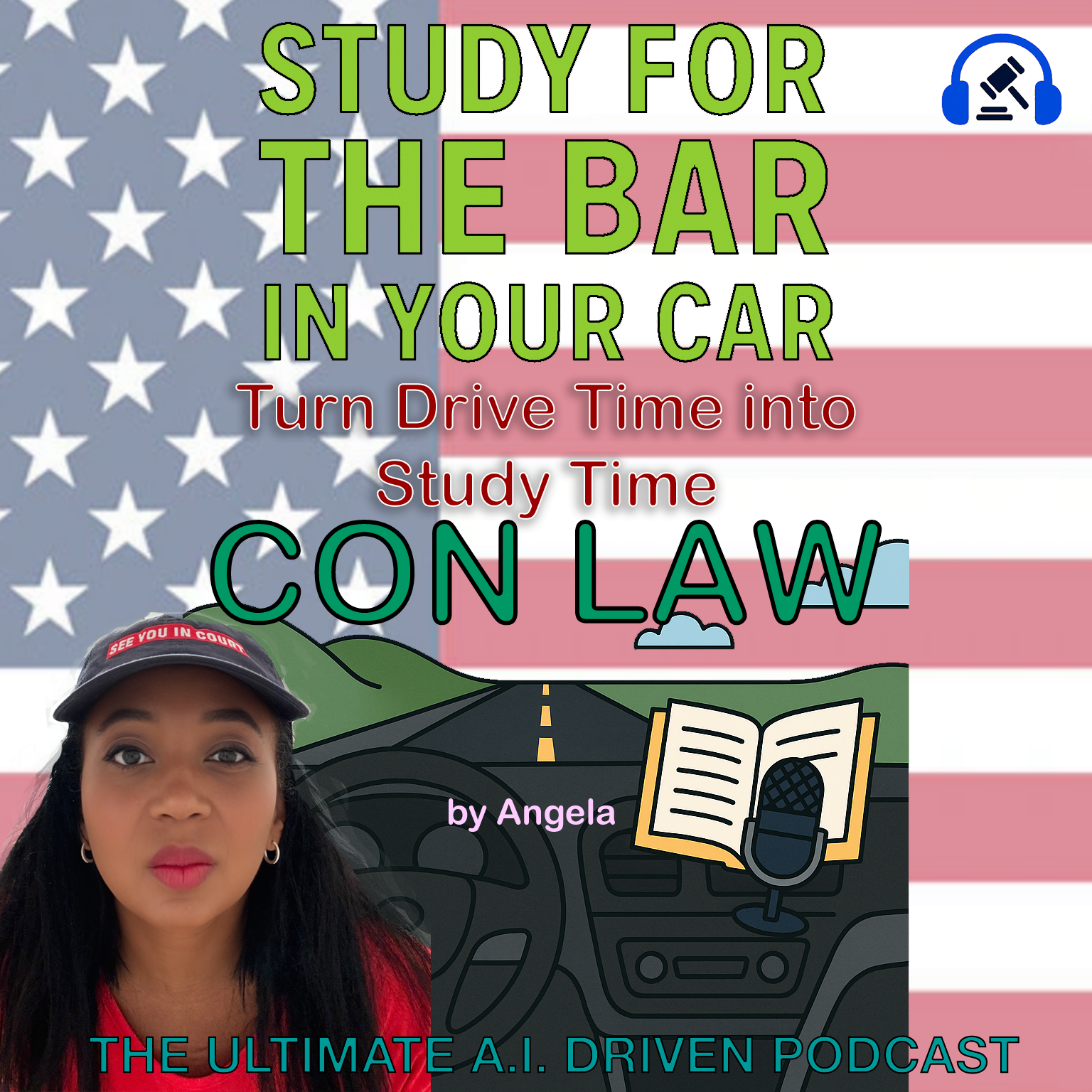
Turn Drive Time into Study Time: The Ultimate Bar Exam Prep PodcastAre you juggling a busy schedule while preparing for the bar exam? Maximize every moment with "Study for the Bar in Your Car," the podcast designed specifically for ambitious law students and graduates who refuse to let a single minute go to waste on their journey to becoming attorneys.Whether you're commuting through traffic, riding public transit, working out, or completing household chores, this podcast transforms your otherwise "lost" time into productive bar exam preparation. Each episode delivers focused, audio-friendly content covering essential MBE and MEE subjects, distilled into clear, memorable lessons you can absorb on the go.I'm Angela, a law student from George Mason University's Antonin Scalia Law School, and I created this podcast with one primary goal: to help myself pass the bar exam. By transforming my comprehensive study notes into engaging audio content, I've developed a resource that fits seamlessly into busy lifestyles—and now I'm sharing it with you.Join me and my team of knowledgeable assistants as we break down complex legal concepts, review critical cases, and provide strategic approaches to exam questions. We'll cover everything from Constitutional Law and Civil Procedure to Evidence, Criminal Law, and beyond."Study for the Bar in Your Car" isn't just another passive study aid—it's your mobile companion for the final stretch toward bar exam success. Subscribe now and turn your commute into your competitive advantage for the July bar exam.Because sometimes, the road to becoming an attorney means literally studying on the road.
Latest Episodes
View all 87 episodes
S6 Ep 6Criminal Law - Arson and Possession Crimes
Join your AI hosts, Maude and Claude, for Episode 6 of the Study for the Bar in Your Car podcast, where they ignite your understanding of Arson and critical Possession Crimes. Guided by Angela's meticulously detailed notes, this episode unpacks essential concepts that frequently appear on the bar exam, promising those "aha moments" that solidify your learning.Maude and Claude expertly break down Arson, clarifying that common law requires malicious burning of a dwelling (or modern-day structure). You'll discover that malice for arson means acting with a reckless disregard of an obvious risk of burning, not a specific intent to set fire. A crucial distinction is made between mere scorching (not enough for arson) and charring (sufficient, as the material itself is altered by fire). The hosts highlight a vital bar exam takeaway: while completed arson is a malice crime, attempted arson always requires specific intent to complete the burning, a higher mental state. Furthermore, learn how transferred intent applies to completed arson but generally not to attempt.The discussion then pivots to Possession Offenses. You'll grasp that for general possession, knowing you possess an item and its nature (e.g., it's white powder) is usually enough, but you typically do not need to know its illegality. A significant clarification is made for Receiving Stolen Property: not only must the defendant know or believe the property is stolen at the time of receipt, but the property must actually be stolen. This means that in a police sting operation where goods have been recovered, the property legally loses its "stolen" status, preventing a conviction for the completed crime (though attempted receipt remains a possibility under the MPC).Finally, the hosts shed light on the modern legislative shifts that have consolidated common law property crimes like larceny, embezzlement, and false pretenses into a single, broader statutory crime often simply called theft. This simplifies complex charging issues, focusing on the wrongful nature of the taking rather than technical common law distinctions.Don't let these intricate details trip you up on exam day! Tune in to master the nuances of arson, possession crimes, and the evolution of theft law. Subscribe now to Study for the Bar in Your Car and drive your bar prep forward!.
S6 Ep 5Criminal Law - Larceny, Robbery and Burglary
Join your AI hosts, Maude and Claude, as they return in Episode 5 of the Study for the Bar in Your Car podcast to tackle the "big six" property crimes: Larceny, Embezzlement, False Pretenses, Robbery, Receipt of Stolen Property, and Burglary. Drawing directly from Angela's meticulously organized notes, this episode is a vital resource for navigating these heavily tested legal concepts on the bar exam.Maude and Claude dissect each crime, emphasizing the crucial elements and the subtle distinctions that can make all the difference in a legal analysis. You'll learn:Larceny as the "trespassory taking and carrying away of tangible personal property of another with the intent to permanently deprive" – paying close attention to the critical timing of intent and the continuing trespass doctrine.Embezzlement hinges on the defendant's initial lawful possession of the property, followed by its fraudulent conversion.False Pretenses uniquely requires obtaining title (ownership) to property through an intentional false statement of fact with intent to defraud, a key differentiator from larceny by trick where only possession is transferred.Robbery escalates larceny by adding "force or threats of immediate death or physical injury" when taking property "from the person or presence" of another.Receipt of Stolen Property demands actual knowledge that the property was, in fact, stolen at the time of receipt – a crucial common law distinction often tested via police sting scenarios.Burglary at common law is meticulously defined by "breaking and entering of the dwelling of another at nighttime with the intent to commit a felony therein," highlighting the specific nature of each element.The hosts illuminate these complex areas with practical examples, challenge your understanding with MBE-style questions, and guide you through an MEE essay analysis in the IRA format. Tune in to demystify these core property crimes and drive your bar prep forward. Subscribe now to master the nuances and ace your exam!

S6 Ep 4Criminal Law - Offenses Against the Person
Welcome to "Study for the Bar in Your Car," Episode 4: Criminal Law – Offenses Against the Person! Your AI hosts, Maude and Claude, are here to expertly guide you through Angela's invaluable law notes, breaking down the intricacies of crimes that directly impact individuals.This episode delves into the core definitions and critical distinctions essential for bar exam success. We start with Assault and Battery, clarifying the "unlawful application of force" for battery—a general intent crime where even an offensive touch suffices. Then, we differentiate between assault as an "attempted battery" and "reasonable apprehension of immediate harmful contact."Next, we unravel False Imprisonment and its aggravated cousin, Kidnapping, emphasizing the addition of "substantial movement" (asportation) or concealment that elevates the offense. Learn how seemingly simple acts can trigger serious charges and why intent and the degree of movement are so crucial.The episode thoroughly unpacks Rape, highlighting the evolution from common law definitions to modern statutes, and the nuances of "effective consent". But perhaps most critically for your exam, we dive deep into Statutory Rape, a strict liability crime where a defendant's mistake regarding the victim's age is generally NO defense! This is a frequent bar exam trap, and we make sure it sticks.To solidify your understanding, we walk through MBE-style questions, dissecting real-world scenarios to illustrate how these rules apply in practice. Tune in to "Study for the Bar in Your Car" and master these high-stakes concepts with us. Subscribe now for more expertly distilled legal knowledge that will drive your bar prep forward!

S6 Ep 3Criminal Law - Homicide
Welcome to "Study for the Bar in Your Car," Episode 3: Criminal Law - Homicide! Join Maude and Claude, your AI hosts, as we unravel the intricate world of causing another's death, guided by Angela's meticulously organized notes.This episode dives deep into the foundational definition of homicide and the critical concept of malice aforethought, distinguishing between various types of murder: intent to kill, intent to inflict great bodily injury, and the dramatic depraved heart murder (extreme indifference to human life). We also dissect first-degree murder's requirements of premeditation and deliberation.Crucially, we clarify the nuances of felony murder, detailing the BARK felonies (Burglary, Arson, Rape, Robbery, Kidnapping) and exploring the differing agency vs. proximate cause theories of liability.Understanding manslaughter is key, so we break down voluntary manslaughter (triggered by adequate provocation or imperfect self-defense) and involuntary manslaughter (from criminal negligence or misdemeanor manslaughter).The episode illuminates the vital role of causation, distinguishing between actual ("but-for") and proximate (foreseeable) causes, and addressing how intervening acts like medical negligence impact liability.Finally, equip yourself with essential defenses like self-defense (including the duty to retreat nuances and proportionality) and the limited application of voluntary intoxication.This episode is packed with "aha moments" to help you confidently tackle homicide questions on the bar exam. Tune in and subscribe to "Study for the Bar in Your Car" to master these high-stakes concepts!

S6 Ep 2Criminal Law - General Principles
Welcome to "Study for the Bar in Your Car," Episode 2: Criminal Law - General Principles! Join your AI hosts, Maude and Claude, as we delve into the essential building blocks of criminal liability. Based on Angela's meticulously organized law notes, this episode simplifies complex legal ideas into digestible insights.We break down the absolute fundamentals: Actus Reus (the guilty act) and Mens Rea (the guilty mind), exploring common law distinctions like General Intent and Specific Intent, plus the Model Penal Code's culpability categories (Purposely, Knowingly, Recklessly, Negligently). Understand the critical difference of Strict Liability crimes where intent isn't required.Unpack the vital link of Causation (Actual and Proximate Cause) and learn about Parties to a Crime (e.g., Accomplice Liability vs. Accessory After the Fact). Navigate Inchoate Crimes such as Conspiracy (remember, it doesn't merge!) and Attempt (it does merge!), grasping their distinct elements and liability rules.We then tackle key property crimes like Larceny, Robbery, Burglary, and Embezzlement, highlighting their unique requirements. Delve into the serious area of Criminal Homicide, distinguishing between types of Murder (including Felony Murder and Depraved Heart Murder) and Manslaughter.Finally, equip yourself with crucial Defenses (e.g., Intoxication, Self-Defense, Insanity, Mistake of Fact) and essential Procedural/Constitutional Principles from the Fourth, Fifth, Sixth, and Eighth Amendments, covering everything from Search & Seizure to Double Jeopardy and Burdens of Proof.This episode is your roadmap through foundational criminal law concepts, designed to make them stick for your bar prep. Tune in, enhance your understanding, and get those "aha!" moments! Subscribe now to "Study for the Bar in Your Car" for more expert-guided legal insights.

S6 Ep 1Criminal Law - Introduction
Welcome to Criminal Law EP 01: Introduction! Join your AI hosts, Maude and Claude, on Study for the Bar in Your Car, as we begin an essential journey through criminal law. Built upon Angela's exceptionally detailed law school notes, our mission is to transform complex legal concepts into digestible, insightful audio.This episode lays the groundwork, diving deep into the foundational elements of any crime: actus reus (the prohibited act) and mens rea (the guilty mind), including specific intent, malice, general intent, and strict liability, plus the Model Penal Code categories. We also unravel the intricacies of causation, from "but for" cause to foreseeable harm, and its unique application in felony murder.Beyond foundational concepts, we introduce inchoate crimes like solicitation, attempt, and conspiracy, highlighting the critical merger doctrine and conspiracy's non-merger rule. We also explore accomplice liability, distinguishing common law roles from the modern approach. This comprehensive overview is designed not just for bar exam success, but for anyone seeking a deep understanding of our legal system.Discover actionable knowledge and achieve those "aha!" moments, truly grasping the rationale and practical implications of criminal law. Tune in to distill immense information into clear concepts that truly click! Subscribe now to master criminal law with Maude and Claude!
S5 Ep 26Constitutional Law - The 13th, 14th and 15th Reconstruction Era Amendments
Unlock critical insights into the 13th, 14th, and 15th Reconstruction Amendments with Maude and Claude on 'Study for the Bar in Your Car'! This essential episode, directly from Angela's expertly organized constitutional law notes, navigates how these revolutionary amendments reshaped American law.Discover the 13th Amendment’s unique power to ban private racial discrimination without requiring state action. Grasp the 14th Amendment’s expansive reach, covering citizenship, incorporation of fundamental rights (Due Process), and Equal Protection’s three levels of scrutiny—from strict (race, fundamental rights) to intermediate (gender) and rational basis. Finally, understand the 15th Amendment’s direct protection of voting rights against racial discrimination.This deep dive clarifies complex concepts, providing the key tests, buzzwords, and distinctions vital for your bar exam success. Elevate your understanding and confidently tackle MBEs and essays by exploring the foundational impact of these amendments on modern civil rights. Listen now and make your study time count!
S5 Ep 25Constitutional Law - The Tenth Amendment
Join Maude and Claude, your AI hosts on the Study for the Bar in Your Car podcast, for a deep dive into the Tenth Amendment! You'll even hear from Angela herself, fresh off her bar exam, sharing her candid experience with essay success and MBE challenges. This episode illuminates the bedrock of American federalism, exploring how this vital amendment reserves powers to the states and the people, firmly limiting federal overreach.Discover why the federal government lacks a general police power and the nuanced interpretations of the Necessary and Proper Clause, ensuring Congress's implied powers remain strictly tied to enumerated ones. Maude and Claude break down how landmark cases like Lopez redefined the Commerce Clause, drawing a crucial line between economic and non-economic activity, and explain the delicate balance of Congress's Spending Power, distinguishing between permissible inducement and unconstitutional coercion.The discussion extends to key state protections, including the anti-commandeering doctrine, which shields states from federal mandates, and the complexities of state sovereign immunity under the Eleventh Amendment, detailing its crucial exceptions, such as congressional abrogation under the Fourteenth Amendment's Section 5. The hosts connect the Tenth Amendment's powerful phrase "powers...to the people" to the protection of unenumerated fundamental rights through substantive due process, covering the critical levels of judicial scrutiny applied.Gain essential insights into how this foundational amendment, often seen as quiet, profoundly shapes modern constitutional law – from its subtle links to privacy through the Third Amendment to its application in contemporary issues like prison conditions and homelessness under the Eighth Amendment. Tune in and subscribe to Study for the Bar in Your Car for an illuminating and comprehensive review that's crucial for your bar prep!
S5 Ep 24Constitutional Law - The Ninth Amendment
Join Maude and Claude, your AI hosts on the Study for the Bar in Your Car podcast, as they delve into the Ninth Amendment – a short yet profoundly impactful clause often seen as the Constitution's "constitutional sleeper agent". Drawing from Angela's comprehensive law school notes, this episode illuminates how this amendment protects fundamental liberties that are not explicitly listed in the Constitution.Discover why the framers, particularly James Madison, included this vital safeguard: to explicitly state that the enumeration of certain rights "shall not be construed to deny or disparage others retained by the people". This prevents the dangerous implication that any rights not mentioned were implicitly surrendered to the government.For nearly two centuries, the Ninth Amendment largely "sat there", underutilized due to judicial hesitation and fears of "judicial activism". However, its pivotal moment arrived in the landmark 1965 Supreme Court case, Griswold v. Connecticut, which recognized a constitutional right to privacy. Justice Goldberg's concurring opinion in Griswold powerfully argued the Ninth Amendment provided a solid textual basis for discovering these "unenumerated rights".Maude and Claude explain how the Ninth Amendment, though often un-cited directly in modern cases, acts as a "vital rule of interpretation" for understanding concepts like substantive due process. It deeply informs the protection of rights considered "deeply rooted in this nation's history and tradition" such as marriage, procreation, and travel, which are subject to strict scrutiny against government interference.This episode provides essential context, helping you grasp the philosophy behind our broad realm of individual freedoms. Tune in and subscribe to Study for the Bar in Your Car to elevate your understanding of constitutional law for bar exam success!.
S5 Ep 23Constitutional Law - The Eighth Amendment
Join Maude and Claude, your AI hosts on the Study for the Bar in Your Car podcast, as they delve into the Eighth Amendment – a concise yet profound constitutional safeguard against government overreach. Drawing from Angela's comprehensive notes, this episode illuminates the amendment's historical roots in English law and its enduring impact on American justice.Discover the protections against excessive bail and fines, learning that while the government doesn't always have to grant bail, any bail set cannot be disproportionate. The hosts clarify how preventive detention is permissible for community safety, and how fines must align with legitimate governmental purposes. Crucially, the Excessive Bail Clause is incorporated against the states through the 14th Amendment.The episode then tackles the highly debated Cruel and Unusual Punishments Clause. Maude and Claude explain the concept of "evolving standards of decency" that shapes its interpretation. They explore its application to prison conditions, where officials have a duty to ensure humane treatment, and deliberate indifference can constitute a violation. A timely discussion addresses the contentious issue of homelessness, examining how criminalizing the status of being homeless or unavoidable acts like sleeping outdoors, when no alternatives exist, can be deemed cruel and unusual punishment – a vital area of modern litigation.This insightful discussion provides a solid understanding of the Eighth Amendment's text, its three core clauses, and its vital role in protecting fundamental liberty interests from arbitrary and excessive governmental action. Tune in and subscribe to elevate your constitutional law understanding!
S5 Ep 22Constitutional Law - The Seventh Amendment
Join Maude and Claude, your AI hosts on the Study for the Bar in Your Car podcast, as they navigate the Seventh Amendment, a crucial yet often overlooked pillar of civil litigation. Drawing from Angela's meticulously organized law school notes, this episode illuminates the amendment's core protections and nuances vital for bar exam success.Discover the dual essence of the Seventh Amendment: first, its preservation of the right to a jury trial in "suits at common law" (cases historically tried by juries in 1791), and second, its strict limits on federal courts re-examining jury factual findings. Maude and Claude clarify key distinctions, such as why cases seeking equitable relief (like injunctions) typically don't trigger this right.A critical takeaway for your bar prep: learn why the Seventh Amendment's civil jury right is NOT incorporated against the states via the 14th Amendment – a classic "bar exam trap" often overlooked! The hosts also explain how, despite historical tradition, federal civil juries can constitutionally consist of fewer than 12 members, balancing historical intent with modern practicality. They discuss the "re-examination clause," detailing the narrow circumstances under which a judge can review a jury's verdict without undermining its fact-finding role.This episode provides a solid and engaging review of the Seventh Amendment's text, its historical context, and the subtle but vital distinctions that can make all the difference on exam day. Don't miss out on this essential deep dive into American civil procedure! Listen now and subscribe to Study for the Bar in Your Car to boost your bar prep!
S5 Ep 21Constitutional Law - The Sixth Amendment
Come back to thisJoin Maude and Claude, your AI hosts on the Study for the Bar in Your Car podcast, as they tackle the Sixth Amendment – a crucial pillar of American criminal procedure. Drawing directly from Angela's comprehensive law school notes, this episode dives deep into the fundamental rights guaranteed to those accused of a crime.Discover the intricacies of the right to counsel, a cornerstone for ensuring a fair trial. Learn when this right automatically attaches (after formal charging like an indictment or arraignment) and the strong protections it provides against the government's deliberate attempts to elicit incriminating statements without a lawyer present (the Messiah rule principle). The hosts explain how the exclusionary rule serves as the primary remedy for violations of these vital rights.The episode also clarifies the critical concept of incorporation, explaining how the 14th Amendment's Due Process Clause extends most of the Sixth Amendment's protections to state and local governments. You'll gain key insights into specific aspects of the jury trial right that are not incorporated against the states, such as the exact federal judicial district requirement and the mandatory 12-person unanimous jury standard – a classic "bar exam trap".This podcast offers a solid foundational understanding of the Sixth Amendment's text, core principles, and the nuances vital for bar exam success, presented in an informative and enthusiastic tone. Don't miss out on this essential review for your constitutional law studies!
S5 Ep 20Constitutional Law - The Fifth Amendment
Join Maude and Claude on Study for the Bar in Your Car podcast for a deep dive into the Fifth Amendment! It's far more than just "pleading the fifth"—this powerful pillar safeguards individual rights across due process, property, and criminal justice.Learn the vital components for your bar prep:Privilege Against Self-Incrimination: Understand Miranda warnings—when they're required (custody + interrogation), the four key rights, and how invoking silence or counsel affects questioning.Exclusionary Rule: Discover how illegally obtained evidence is generally inadmissible to deter police misconduct. Crucially, Maude and Claude explain why the "fruit of the poisonous tree" doctrine does NOT apply to evidence found solely due to a Miranda violation (unlike Fourth Amendment violations). Explore exceptions like inevitable discovery and independent source.Due Process Clause: Primarily applies to the federal government.Procedural Due Process: Focuses on how government deprives life, liberty, or property, demanding fair procedures like notice and a hearing, balanced by the Matthews v. Eldridge test.Substantive Due Process: Examines why the government interferes with fundamental rights. Laws infringing on fundamental rights face strict scrutiny. Importantly, post-Dobbs, abortion regulations now receive rational basis review.Takings Clause: Government can take private property for public use (broadly interpreted, even for economic development) but must pay just compensation (fair market value). Understand the difference between physical and regulatory takings, and when a regulation becomes a compensable taking.Plus, grasp the Grand Jury Clause (federal, not incorporated against states) and the Double Jeopardy Clause.This episode is packed with essential constitutional law insights. Tune in and boost your bar prep with Maude and Claude!
S5 Ep 19Constitutional Law - The Fourth Amendment
Join Maude and Claude on Study for the Bar in Your Car podcast for a crucial episode on Constitutional Law - The Fourth Amendment! Navigate the essential protections against unreasonable government intrusion into your life.We start with the core principle: the Fourth Amendment shields you from unreasonable searches and seizures by the government. Learn why the default rule requires a warrant, supported by probable cause and particularity, before police can search or seize.Discover what constitutes a "search" under the Katz test – focusing on your reasonable expectation of privacy, especially the highest protection afforded to the home. We'll also cover areas where privacy expectations are diminished, like open fields or items in plain view.Master the critical exceptions to the warrant requirement, which are vital for your bar exam:The Automobile Exception allows warrantless searches of vehicles with probable cause.Search Incident to a Lawful Arrest (SILA) permits contemporaneous searches of an arrested person and their immediate area for safety and evidence.Terry Stop and Frisk allows brief detentions based on reasonable suspicion of criminal activity, and pat-downs for weapons if the person is deemed armed and dangerous.Understand the controversial Exclusionary Rule, which mandates that illegally obtained evidence is generally inadmissible in court, serving to deter police misconduct. We'll also highlight key exceptions to this rule, such as the Independent Source Doctrine and the Good Faith Exception for warrants.Finally, grasp how the Fourth Amendment's protections are incorporated and applied to state and local governments through the 14th Amendment's Due Process Clause.This episode is packed with essential insights to help you conquer Constitutional Law! Listen and subscribe to elevate your bar prep!
S5 Ep 18Constitutional Law - The Third Amendment
Join Maude and Claude on the Study for the Bar in Your Car podcast for a fascinating look at Constitutional Law – The Third Amendment! This often-overlooked amendment holds a unique place in U.S. history.Here's the essential takeaway for your bar prep: The Third Amendment is NOT typically tested on the bar exam. Maude and Claude explain why, delving into its historical origins rooted in colonial grievances against British soldiers quartering in private homes during the mid-18th century. The Amendment explicitly states: "No soldier shall in time of peace be quartered in any house, without the consent of the owner, nor in time of war, but in a manner to be prescribed by law."Discover why this "silent guardian" has virtually no judicial interpretation, having never been the primary basis for a Supreme Court decision in over 200 years. Its very effectiveness at preventing such abuses means there's little need for lawsuits today, as military personnel are housed in purpose-built bases.While speculative modern applications (like militarized police) are interesting thought experiments, they lack judicial precedent and reinforce why this amendment remains outside core bar exam topics.This episode offers a unique insight into a foundational, yet quiescent, part of our Constitution. Tune in for intellectual curiosity and solidify your foundational knowledge, even for the parts of Con Law you won't see on the test! Listen and subscribe to Maude and Claude for more essential bar prep insights!
S5 Ep 17Constitutional Law - The Second Amendment
Join Maude and Claude on the Study for the Bar in Your Car podcast for a vital episode on Constitutional Law – The Second Amendment! This fundamental right often sparks intense debate, and mastering its nuances is crucial for your bar exam.We explore how the Supreme Court has definitively established the Second Amendment protects an individual's right to keep and bear arms for self-defense, including possessing a handgun at home and carrying one in public. Discover how this right applies to state and local governments through incorporation via the 14th Amendment's Due Process Clause.A major focus is the dramatic shift in the standard of review post-Bruen (2022). Courts now reject balancing tests, requiring gun regulations to be consistent with the nation's historical tradition of firearm regulation from 1791 or 1868. Modern public safety arguments alone are insufficient; historical analogs are required.We also cover:Heller (2008): The landmark case establishing the individual right to possess a handgun at home for self-defense, independent of militia service.Lopez (1995): A critical Commerce Clause case highlighting limits on federal power to regulate non-economic activity (like gun possession near schools) where aggregation for substantial effect is not permitted. This distinction between economic and non-economic activity is vital!The essential state action requirement for most constitutional challenges.Tune in to grasp these complex, evolving concepts and empower your understanding of constitutional protections! This episode is an essential listen for effective bar prep.
S5 Ep 16Constitutional Law - The First Amendment
Join Maude and Claude on Study for the Bar in Your Car podcast for an essential episode on Constitutional Law - First Amendment! Dive into the fundamental protections of free speech and religion that shape American liberties.We'll cover free speech, from spoken words to symbolic acts and the freedom not to speak. Learn the crucial distinction between content-based (subject to strict scrutiny) and content-neutral (subject to intermediate scrutiny) speech regulations, impacting how government can limit expression.Explore categories of unprotected or less protected speech, including:Incitement to illegal activity: Punishable only if directed at and likely to produce imminent lawless action.Obscenity: Defined by the specific Miller test (appeals to prurient interest, patently offensive, and lacks serious value).Defamation: Protection varies based on public/private figure status and actual malice.Commercial speech: Receives less protection than political speech.Understand why vague laws, laws granting unfettered discretion to officials, and prior restraints (pre-publication censorship, heavily disfavored even for national security) are unconstitutional.Discover how speech rights depend on the forum – with traditional public forums (streets, parks) offering the strongest protection, and non-public forums (military bases, courthouses) allowing more government restriction. Learn the essential state action requirement – the First Amendment limits government, not private actors.Finally, delve into the religion clauses:Free Exercise Clause: Protects sincere religious belief and practice. Neutral, generally applicable laws don't require exemptions, but targeted laws or those with individualized exemptions trigger strict scrutiny.Establishment Clause: Prohibits government establishment or endorsement of religion. The rigid Lemon test is gone, replaced by a focus on historical practices and absence of coercion, especially in schools. Government aid is permissible if neutral and based on private choice.This episode illuminates the dynamic legal landscape of fundamental rights, crucial for mastering Constitutional Law! Listen and subscribe to elevate your bar prep!
S5 Ep 15Constitutional Law - Levels of Scrutiny
Join Maude and Claude on the Study for the Bar in Your Car podcast for a vital episode on Constitutional Law – Levels of Scrutiny! This episode is your essential roadmap to understanding how courts evaluate government actions that impact your rights.Learn the three main tiers of judicial review and how they dictate the scrutiny applied to challenged laws:Rational Basis Review (or Minimal Scrutiny): The easiest test for the government to pass. A law is presumed constitutional and upheld if it's rationally related to any conceivable legitimate government interest. The burden is on the challenger to prove otherwise. This applies to most economic and social welfare regulations, as well as classifications based on age, wealth, or disability. Crucially, abortion regulations now fall under this standard post-Dobbs.Intermediate Scrutiny: A tougher standard requiring the government to show the law is substantially related to an important government interest. The burden shifts more to the government. This level applies primarily to classifications based on gender (as seen in Craig v. Borne) and illegitimacy, and also to content-neutral speech regulations.Strict Scrutiny (or Maximum Scrutiny): The most demanding test. The law is presumed unconstitutional, and the government must prove it is necessary to achieve a compelling government interest and is the least restrictive means. This applies to laws affecting fundamental rights (like the right to marry, free speech, or freedom of association) and suspect classifications (such as race, national origin, and most alienage classifications). Laws under strict scrutiny rarely survive.Understanding these levels of scrutiny is fundamental for effective bar prep. Tune in and boost your constitutional law expertise!
S5 Ep 14Constitutional Law - Substantive Due Process
Join Maude and Claude on the Study for the Bar in Your Car podcast for an insightful episode on Constitutional Law – Substantive Due Process!This episode explores how the U.S. Constitution protects fundamental, unenumerated liberties from government interference, even if they aren't explicitly written down. Learn the crucial difference between Substantive Due Process (impacting everyone's core freedoms) and Equal Protection (addressing group discrimination).Discover how courts identify these rights using "reasoned judgment" guided by history and tradition. When a right is deemed fundamental, government action infringing upon it faces strict scrutiny, requiring a compelling government interest and narrow tailoring – an incredibly tough test for the government to meet. For non-fundamental liberties, the lower rational basis review applies.A key focus is the dramatic shift in abortion rights. Following the Dobbs decision, the fundamental constitutional right to abortion no longer exists, and regulations are now subject to the much more lenient rational basis review.We also cover other vital privacy-related rights including:The fundamental right to marry, famously extended to same-sex couples in Obergefell v. Hodges.The right to procreate.The right to use contraceptives.The right of adults to engage in private, consensual, non-commercial sexual activity.The right to refuse unwanted medical treatment.The fundamental right to interstate travel.Crucially, you'll learn that the Supreme Court has not recognized a fundamental right to personal data collection and distribution under Substantive Due Process.This episode is packed with essential insights, helping you navigate these complex, evolving areas of constitutional law for your bar exam and beyond. Tune in and boost your legal understanding!
S5 Ep 13Constitutional Law - Procedural Due Process
Join Maude and Claude on the Study for the Bar in Your Car podcast for a vital episode on Constitutional Law – Procedural Due Process! This isn't just theory; it’s about ensuring fundamental fairness in how government impacts your life.We explore the core principle: when the government deprives you of life, liberty, or property, it must provide due process. Discover what counts as "liberty" (like parental rights, but not mere reputational harm alone) and "property" (focusing on "entitlements" or reasonable expectations, not just land).The episode breaks down the crucial Matthews v. Eldridge balancing test, which determines how much process is due. You'll learn to weigh:The importance of the private interest at stake.The risk of error with current procedures and the value of additional safeguards.The government’s interest, including administrative burdens and costs.This flexible test ensures fairness across diverse scenarios. We also touch on essential gatekeeping doctrines like standing, ripeness, and mootness, showing how they filter cases before a court can even consider a due process claim. Learn how the state action requirement is the initial hurdle for most constitutional challenges.Tune in to grasp these critical concepts and empower your understanding of constitutional protections! This episode is an essential listen for effective bar prep.