
Startup Istanbul Podcast
64 episodes — Page 2 of 2

Investing is more "psychology than finance" early on
Last week, we chatted with Scott about entrepreneurship, early stage investments, the Fuzzy and Techie book, and many different topics. When I started writing this post, I couldn't remember when we first met and looked back at our emails. We corresponded for the first time in 2012 when he was at Mohr Davidow Ventures. Even though we did not meet physically over the years, we kept in touch regularly about entrepreneurship. In 2017, Scott was one of our keynote speakers at Startup Istanbul but could not come at the last minute due to the visa crisis. During the pandemic, we had the chance to communicate and make investments with Scott more frequently. He and Jenny are doing great work at The Fund and Everywhere Fund. I also carry their vision of investing globally in early stage startups. I think we have very parallel ideas on this subject.The Fuzzy Meets the Techie: My Chat with Scott HartleyScott believes liberal arts are key for technology innovation. But technical skills are still needed to bring creative ideas to life.How do we blend these mindsets in the future? I had an insightful discussion with Scott Hartley, author of The Fuzzy and the Techie, on combining technical and creative abilities.7 Learnings from My Scott Hartley Conversation1. Why We Need Both Fuzzies and Techies Fuzzies - skills like critical thinking and empathyTechies - coding, data analysis As tech advances, jobs need more fuzzies but require techies to build it.2. The Future of Work Amid AI Rise:As AI and technology advance, the need for more human skills is driven up. Jobs won't disappear, but the tasks within those jobs might change or be automated, requiring a new set of skills and adaptability.3. The Enduring Value of the Liberal Arts Teaches critical thinking and empathy needed as AI advances.Need people to spot bias, ask hard questions, apply ethics.4. Real-World Fuzzy-Techie CollaborationAnthropologist helped Nissan with self-driving cars by understanding human behavior. Dancer/roboticist created "choreobotics" to make robots move more gracefully.5. Evaluating Startups HolisticallyAs an investor, Scott looks at founder grit, ethics, desire to solve problems - not just technical specs.He says venture capital is more "psychology than finance" early on. 6. The Importance of Investing in World-Positive Companies:Investing isn't just about making money. It's about backing world-positive companies that can have a significantly positive impact, not just on the market, but on society as a whole.7. Developing Authentic Global RelationshipsScott spots global opportunities by listening to his diverse founder network built over decades.Focuses on genuine long-term conversations rather than quick hits.SummaryAs we navigate through an ever-evolving global landscape, it's clear that the intersection of technology, liberal arts, and entrepreneurship is leading us to uncharted territories. The future holds exciting possibilities and challenges. The key takeaway? Stay open, stay curious, and embrace a well-rounded perspective. Scott Hartley, a notable venture capitalist and startup advisor, is the co-founder of Everywhere Ventures and has invested in over 500 companies worldwide. With a background spanning Google, Facebook, the White House, and top venture capital firms, Scott's evolution from techie to fuzzy showcases his belief in combining technical skills with humanities education. He is the author of "The Fuzzy and the Techie," a finalist for the McKinsey Bracken Bower Prize, and has delivered over 50 keynote speeches on innovation for major global organizations.If you want to follow Scott Hartley, you can access his Substack articles here. You can take a look at his regular articles on Linkedin here. If you haven't read Fuzzy and Techie, you can find it here. Get full access to Startup Istanbul at newsletter.startupistanbul.com/subscribe

Insights from an Emerging Market VC: A Chat with Vir Kashyap
I recently had the pleasure of interviewing Vir Kashyap, veteran investor and entrepreneur, on the Startup Istanbul podcast. Vir has a unique background, having been born in India, educated in the US, worked at startups in Silicon Valley, and eventually returned to India in 2007 to tap into the early stage startup ecosystem there.In our conversation, Vir traces his journey from writing his college thesis on e-commerce in the late 1990s to co-founding recruiting platform Babajob in India in 2007. He reflects on the dramatic evolution of India's startup ecosystem over the last 15 years, highlighting three key inflection points - the launch of Jio increasing internet access, demonetization driving digital payments, and COVID necessitating remote work and transactions.According to Vir, these developments have allowed Indian startups to "build a global quality product and compete on a global stage from day one." He advises startups looking to expand globally to get a team member or investor with experience in their target overseas market.Speaking from his experience of straddling both the US and India as an investor, Vir stresses the importance of founder-market fit above all else when evaluating startups to invest in. He looks for mission-driven founders who will stick through the ups and downs required to solve a real problem they are passionate about.Maintaining work-life balance is also critical for founders to be successful long-term, Vir emphasizes. He advises founders to prioritize sleep and exercise as well as block off dedicated personal time.For fuller insights from Vir on emerging market opportunities, cross-border investing, trends in the India startup ecosystem, and advice for founders, be sure to check out the podcast episode. Get full access to Startup Istanbul at newsletter.startupistanbul.com/subscribe
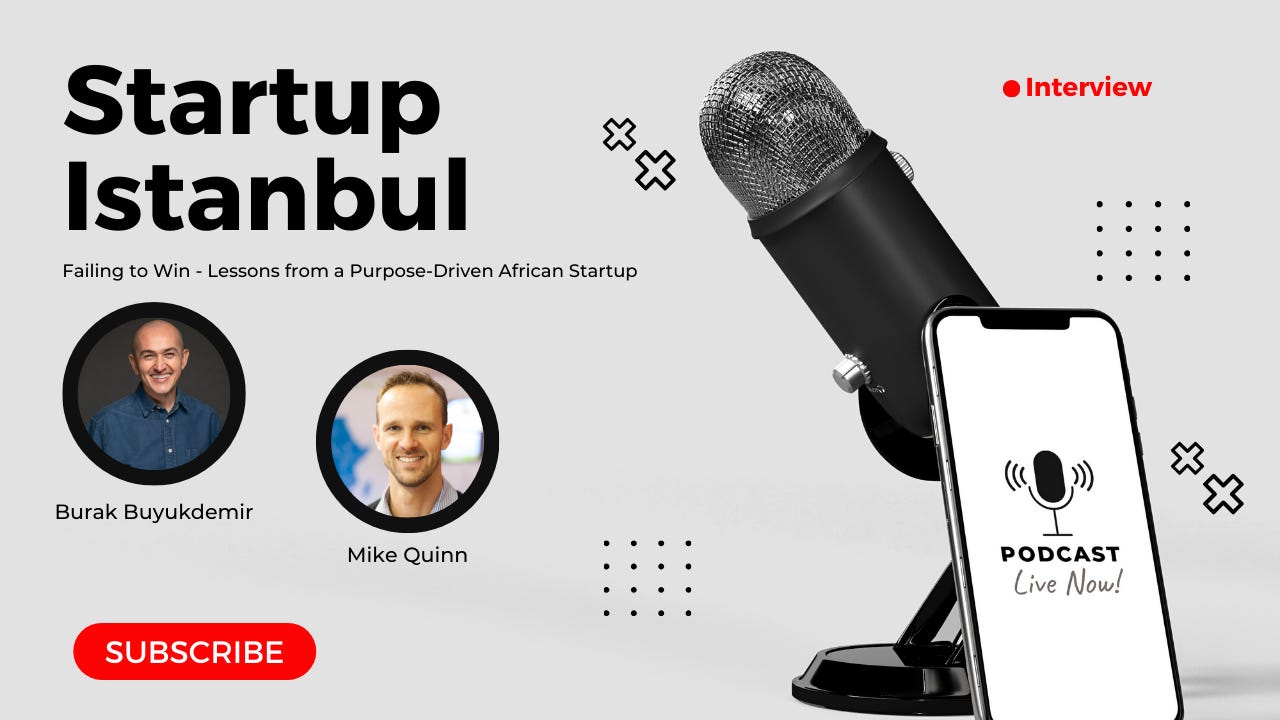
Failing to Win - Lessons from a Purpose-Driven African Startup
I had the pleasure of talking with Mike Quinn, founder of Boost, a B2B commerce platform for retailers and distributors in Africa. We discussed his entrepreneurial journey, lessons learned from building and scaling his past startup Zoona, and advice for startup founders based on his experience leading a purpose-driven fintech in Africa for over 10 years.Persevering Through the Emotional RollercoasterMike Quinn's journey from Canada to leading a startup in Africa has been defined by constantly learning from failures. In this interview, he shares the hard lessons he learned while building and scaling his first startup Zoona in Zambia. Despite rapid growth serving millions of customers, Zoona struggled to raise later stage capital and ultimately had to reset the business. Mike reflects on the challenges of fundraising, managing growth, and the importance of designing your startup for scale from the beginning.After 10 intense years building Zoona, Mike stepped down as CEO ready for his next challenge. He wrote a book titled "Failing to Win" to process his experience and inspire other entrepreneurs to embrace failure as part of the iterative process of building a business. Mike then launched his second startup Boost, applying the lessons learned from Zoona. Boost provides digital infrastructure for informal retailers and distributors in Africa - essentially Shopify for the supply chain. He designed Boost from the outset for multi-country scale, with a capital efficient model and small remote team. In this interview, Mike provides an inside look at the emotional rollercoaster of startup life and finding the motivation to keep persevering through difficulties. His story offers inspiration and wisdom for entrepreneurs everywhere.Seeing the Potential: My Motivations for Investing in BoostAs an early stage investor with a global focus, I look for outlier talented entrepreneurs building disruptive companies. Each year, I evaluate thousands of ventures across verticals and geographies. After extensive due diligence, I selectively invest in those demonstrating the most promising team, product, market potential and ability to execute. (Here is my framework) My goal is to back visionaries solving big problems where my capital, network and experience can empower them to achieve accelerated growth. I get excited about bold ideas that can drive innovation and have a positive impact.The founder and CEO of Boost Technology, Mike Quinn, is an experienced and resilient entrepreneur who has spent significant time living and working in Africa. Through this experience, he has gained a deep understanding of the challenges in the African supply chain and has assembled a strong founding team with complementary skills in technology and operations. Since launching in mid-2020, the company has achieved promising early traction, with gross merchandise volume growing steadily month-over-month. Boost’s products address a major gap in supply chain financing and management that presents a vast market opportunity across Africa and beyond. Execution challenges remain, including intense competition, but I am confident that this experienced team can navigate obstacles and establish a leadership position. Within five years, if successful, I believe Boost could reach $250 million in annual GMV across untapped African markets and beyond.If you believe your startup may be a fit for my investment criteria, I invite you to submit a short application. Completing the form will allow me to review your venture's key details and determine if it aligns with my current investment thesis and portfolio goals. Qualifying startups will be contacted to schedule a pitch meeting. I appreciate your interest and look forward to learning more about how your company is driving impact. Get full access to Startup Istanbul at newsletter.startupistanbul.com/subscribe

Step-by-Step Guide: How to Start a Startup in 15 Minutes
This video is the most popular one on our Startup Istanbul YouTube channel. We have also converted it into a podcast format. Michael Seibel's (Managing Director and Group Partner at Y Combinator) 15 minute guide provides extremely valuable advice for entrepreneurs on how to start a successful startup. He covers the key elements like building a strong team, identifying a good idea, launching quickly, achieving growth and fundraising. This concise and practical guide is a great starting point for any founder, so be sure to watch or listen to the full video.1. Build a Strong Technical Founding Team- Have 2-4 founders, with at least 50% of them being technical/engineers.- Make sure all founders can dedicate themselves full-time and have a year's worth of living expenses saved up. - Founders should quit any existing jobs to focus 100% on the startup.2. Brainstorm Ideas as a Team - Tap into problems founders experience daily/weekly. Avoid ideas that are only monthly/yearly problems.- B2B founders should focus on gaining reference customers in target industry.- Ensure all co-founders buy into the idea and have ownership.3. Launch an MVP Quickly - Build and launch an MVP in 2 months or less. - Get product in users' hands ASAP and iterate based on feedback.- Speed is key - don't wait until product is perfect.4. Grow Users Rapidly- Growth is the top metric for investors. - Build sharing directly into consumer product experience. - Use ads or leverage reference customers for B2B.5. Get Press with News Worthy Announcements- Earn press like you build business relationships. Offer value.- Time announcements of funding, product launches, key hires. - Follow up continually with reporters.6. Fundraise from Relevant Investors - Line up investor meetings back-to-back to create FOMO. - Target investors who understand your customers and problem.- Customers and early users can provide initial funding.7. Watch Spending Closely- Review detailed monthly expenses line-by-line.- Cut unnecessary spending whenever possible.- Pay founders and employees just enough to get by. 8. Hire Carefully and Slowly- Increase team intelligence with each new hire. - Bring on risk-averse people to balance founding team.- Hire slowly - founders can do a lot themselves at first. Get full access to Startup Istanbul at newsletter.startupistanbul.com/subscribe

Khyaal - An Engagement Platform for Senior Citizens in India
I had the pleasure of talking last week with Hemanshu Jain, founder of Khyaal, an engagement platform for senior citizens in India. We discussed his entrepreneurial journey, lessons learned from past failures, and advice for startup founders based on his experience building both Diabeto and now Khyaal.Lessons from Serial Entrepreneur Hemanshu JainHemanshu Jain is an experienced entrepreneur in India, having successfully built and exited his previous startup Diabeto before founding his current venture Khyaal. Early Beginnings Hemanshu started Diabeto in 2012 to build a hardware glucometer along with his co-founder who had a pharmacy background. It began as a passion project fueled by their interest in hardware and grew into a full-fledged startup. Diabeto struggled initially to raise funds in India since hardware startups were still rare. Through perseverance and continuously learning, they were able to build out the product and company.Pivoting for SuccessAfter realizing diabetes management solutions weren't taking off in India, they pivoted Diabeto's model for the US market in 2017. Being adaptable and not rigid on the original idea was key to finding the right product-market fit.Diabeto was eventually acquired successfully, but he says the 5 year journey also had many failures before getting there. Failing fast and changing course was crucial.Tips for FoundersHemanshu stresses the importance of building a strong team aligned to the founding mission. He suggests founders spend significant time on hiring, as the right team makes up the foundation.On difficult days, he recommends focusing on your customers and their positive feedback rather than third-party criticism. Finding motivation through creating real impact is key.He says being adaptable to change and persisting through failures has helped him develop resilience as an entrepreneur.New Venture - KhyaalKhyaal aims to provide digital literacy, community support, and upskilling for seniors.He took a different approach this time by first building an audience and community of elderly people before designing the product. He advises entrepreneurs to continuously gather customer feedback and be flexible.What is Khyaal?Hemanshu Jain is the founder of Khyaal, an engagement platform for senior citizens in India. He started Khyaal after realizing that many elderly people feel lonely, especially after losing a spouse or friends. The inspiration for Khyaal came during the COVID-19 pandemic when Hemanshu spent more time with his father and understood the difficulties faced by seniors living alone. Initial ideas were around building hardware products with sensors to track health vitals, but through talking to seniors, Jain realized the bigger need was around solving digital literacy and providing community.Khyaal began informally on WhatsApp groups where they offered free digital literacy workshops to seniors on topics like online shopping, transportation, and entertainment. This organic growth led to over 10,000 seniors joining their WhatsApp groups. They then built a mobile app as their MVP to offer a more private community platform.Some key benefits Khyaal provides are:* Digital literacy training to help seniors use smartphones and apps confidently* Support groups to discuss grief, loss and other mental health issues* Entertainment content and games to reduce loneliness* Financial services tailored for seniors like fraud protectionIndia has over 140 million seniors currently, but this will double in the next 5 years presenting a huge market opportunity. Khyaal aims to be the one-stop solution for the elderly to live life happily and independently.SummaryHemanshu Jain's journey shows how perseverance through failures and a willingness to pivot are key traits for startup success. His focus on listening to customers provides valuable insights for founders as they build and refine products to solve real problems. He emphasizes that aligning your team to the social mission creates an energized culture. His experiences at both Diabeto and now Khyaal demonstrate that experienced entrepreneurs continue learning and evolving with each new venture. His advice stresses being flexible, responsive to user feedback, and resilient when faced with the ups and downs of entrepreneurship. His insights provide motivation and practical guidance for the next generation of startup founders in India. Get full access to Startup Istanbul at newsletter.startupistanbul.com/subscribe

Inside Superface AI: How This Startup Uses AI to Automate Integrations
I recently had the pleasure of interviewing Radek Novotny, founder of Superface AI, for the Startup Istanbul podcast. Superface is an exciting startup using AI to automate integrations between software applications.Radek shared the origin story of Superface - how painful manual integrations created a "red carpet" problem to solve. He discussed pivoting to an AI-powered "agent" to connect apps and systems, requiring no code.It was fascinating to learn about his entrepreneurial journey, lessons in culture building, go-to-market strategies, and insights into the future AI landscape. Radek is a passionate, serial entrepreneur driven by solving real customer problems.This interview provides an inside look at the ups and downs of building a B2B SaaS startup leveraging emerging technology like AI. It's an inspiring case study for any founder or tech entrepreneur.Be sure to listen to our full conversation on the latest episode of Startup Istanbul!I invite you to contribute to our curated investment list on Airtable. Next month, I'll be enriching this list with my own deal flow, as well as with vetted recommendations from my circle of trusted investors. This compiled resource will be exclusively shared with those who have actively contributed. To be a part of this unique opportunity, please submit a startup here. Thank you. Get full access to Startup Istanbul at newsletter.startupistanbul.com/subscribe

From Campus to Success: Empowering Middle Eastern Students in the Startup World
In a recent podcast, I had the pleasure of engaging in a conversation with Yousef Hamidaddin, a well-respected figure in the Middle Eastern startup ecosystem. Our discussion delved into various aspects of the startup scene, including recent developments, challenges, and opportunities. In this post, I will explore key highlights from our conversation, shedding light on the current state of the Middle Eastern startup ecosystem.The Middle Eastern Startup LandscapeYousef emphasized the importance of ideation and the need for more university students to launch startups while still on campus. He highlighted the immense potential of the region's universities, with thousands of students who have the ability to drive innovation and entrepreneurship. This untapped resource could contribute to a vibrant startup culture across the Middle East.Overcoming Challenges and Embracing FailureWe discussed the perception of failure within the startup ecosystem. Yousef emphasized that failure should not be stigmatized but rather viewed as a learning opportunity. He stressed the significance of building confidence in the system and encouraging entrepreneurs to take risks. By providing support and creating an environment where failure is accepted and understood, we can foster a more resilient and innovative startup ecosystem.Government Support and FundingYousef acknowledged the role of government support and funding in the Middle Eastern startup ecosystem. He highlighted the initiatives taken by governments in the region to pour capital into startups and develop funds of funds. However, he also stressed the need for continued results and the importance of leveraging these opportunities to attract further investment. Building confidence and demonstrating success will encourage governments to stay committed to supporting the startup ecosystem.Fostering Collaboration and Scaling UpYousef discussed the importance of collaboration and inclusivity within the startup ecosystem. He emphasized the need for more people to get involved, including investors, mentors, and entrepreneurs. By expanding the network and inviting more diverse perspectives, the ecosystem can thrive and attract greater interest from investors worldwide. Yousef encouraged startups to think globally and scale up, highlighting the potential for disruptive solutions to address regional challenges.His Motivation Yousef Hamidaddin is motivated by the opportunity to make a positive impact and drive change. His mission is to create a vibrant ecosystem for startups and entrepreneurs in the Middle East and North Africa (MENA) region. He is passionate about supporting and empowering young individuals with innovative ideas, helping them turn their visions into successful businesses. He believes in the potential of the region and aims to leverage it by fostering collaboration, scaling up startups, and attracting investment. By working with founders and investors, Yousef strives to build a thriving startup ecosystem that can contribute to the economic growth and development of the MENA region.SummaryIn our conversation, Yousef Hamidaddin provided valuable insights into the Middle Eastern startup ecosystem. He emphasized the importance of ideation, overcoming challenges, and fostering collaboration. With continued support, an inclusive environment, and a focus on scaling up, the Middle Eastern startup ecosystem has the potential to make a significant impact on the global stage. By embracing failure as a stepping stone to success, we can encourage more entrepreneurs to pursue their dreams and contribute to a thriving startup ecosystem in the region. Get full access to Startup Istanbul at newsletter.startupistanbul.com/subscribe

Interview with Artemis Cofounder Josh Gray
Hello everyone! I'm excited to share my latest podcast interview on Startup Istanbul with Josh Gray, founder of ArtemisArtemis is an early-stage startup operating in the data infrastructure space. They have developed a platform that helps teams, especially data analysts, clean and prepare messy datasets for downstream analytics and AI applications.In this interview, Josh provides an overview of Artemis's target customers, product, market validation, competitive landscape, and more. We discuss some interesting insights he has gained through starting this company as well as challenges around moving to a usage-based pricing model.Overall, I found Josh to be passionate and thoughtful about solving a real pain point around data quality and transformation. Let me know what you think of this episode! As always, please share any feedback on the podcast or suggestions for future guests.ARTEMISSummary: Artemis is a startup operating within the data infrastructure space, targeting the prevalent issue of data cleanliness. The company's primary objective is to assist data analysts in cleaning and preparing data sets for further analytics and Language Models (LLMs). The platform is designed to be low-code, enabling non-engineering professionals to construct data models and pipelines efficiently.Problem: The process of data cleaning is time-consuming and complex. On average, data analysts spend approximately 9.8 hours per week cleaning messy data. Additionally, data is often dispersed across thousands of tables making it difficult for non-technical users to navigate. Artemis addresses these problems by offering a low-code platform for visually exploring, building, and automating data cleanup.Solution: Artemis offers a low-code platform for analysts to prep data through intuitive building blocks and workflows. The platform connects to data warehouses and leverages a proprietary knowledge graph to understand data relationships and context. This results in faster, higher quality data pipelines.Market: The data infrastructure market is currently valued at around $100 billion, with a growth rate of about 25% YoY. Within the data transformation segment, the market size is estimated to be about $25 billion, growing at about 40% per year. Traction: Artemis is currently in beta and is being used by 50+ organizations. Business Model: Currently usage-based. Future plans for intelligent usage controls to align value with pricing. High gross margins anticipated. Team: Founders met in middle school and previously worked together. Josh Gray led finance for previous startup acquired in 2022. William Shi, CTO worked at AutoDesk.* Josh Gray (CEO and Co-Founder): Josh's superpower lies in his comfort with failure. He believes that failure is a part of the process and is necessary for growth and improvement. His comfort with failure allows him to take risks and push boundaries.* William Shi (CTO and Co-Founder): William's superpower is his relentless problem-solving ability. He is unfazed by challenges and does not let obstacles defeat him. He is determined to find solutions to problems and is committed to overcoming any hurdles that come his way.Josh Gray, the CEO of Artemis, is kept awake at night due to concerns revolving around product development. On one hand, he is excited about all the things they are building and how fast they are doing it. On the other hand, he is concerned about the rapid pace of advancements in AI tools and data as a whole. He worries about staying up-to-date and riding the wave of innovation rather than getting left behind. Get full access to Startup Istanbul at newsletter.startupistanbul.com/subscribe

The Existential Founder: Finding Purpose Over Profits
I spoke with serial social entrepreneur Alex Souza about the importance of existential founder fit. Alex has founded 5 companies across different industries and countries, focusing on empowerment and impact. He explained how after his 4th venture, he realized he lacked existential founder fit, meaning the business did not align with his values and purpose. Don't miss our event on Nov 29, 10:00-13:00, at Maria 01, Helsinki. Co-hosted with the Embassy of Finland in Ankara, it's a unique chance to connect Turkish and Finnish startup worlds. Ideal for networking and partnership opportunities. Register now and let us know if you're also attending Slush.Alex coined the term “Existential Founder Fit” to evaluate if a startup truly fits one's life mission. He believes most founders neglect the "Inner Game" of entrepreneurship in favor of just pursuing the outer metrics like funding and scale. However, true well-being comes from living a purpose-driven life. Alex shared 6 questions founders can ask themselves to determine existential founder fit: * Will it maximize my meaning? * Will I love the day-to-day? * Will it push me outside my comfort zone? * Does it connect to my big why? * Is it aligned with my values? * Do I want this as my legacy?As a mentor, Alex looks for that spark of passion in founders that shows they couldn't live without seeing their venture succeed. He warned against opportunistic founders who lack this existential drive. Moving forward, Alex plans to help more founders through content, communities and his upcoming book "The Existential Founder." For Startup Istanbul listeners, I hope this conversation sparks reflection on living life with intention and ensuring your ventures truly fulfill your why.Alex Souza provides a unique mentoring program called Existential 1:1. He can assist you with various areas like social entrepreneurship, impact model, inclusion and empowerment, leadership, culture, fundraising, team building, content creation, community building, and public speaking.For more details about Alex's courses and services, visit the following link. I encourage all entrepreneurs seeking guidance to win the inner game of entrepreneurship to explore these resources. Get full access to Startup Istanbul at newsletter.startupistanbul.com/subscribe

Puppetry ( former Elbo AI )
In a recent episode of the Startup Istanbul podcast, we got to talk with Saravana Rathinam and Ben McMahan. They're the folks behind Puppetry (Former Elbo AI), a cool startup that's working on making it easier to talk to computers.Puppetry has made a platform that lets us chat with AI almost like it's another person. They're getting a lot of people interested because this is something many of us could use in our daily lives.During our chat, Saravana talked about his past work, like helping to build parts of Apple Siri. He's really into finding better ways for people and computers to understand each other. Ben shared his views about where Puppetry is going next and what they're working on now.Both Saravana and Ben have been around the startup scene and talked about how it's been working in a fast-moving field like tech. What drives them? They want to make it as easy to talk to a computer as it is to chat with your friend.If you're curious about what the future holds for talking to computers and gadgets, you'll want to listen to this episode of the Startup Istanbul podcast.Here is a summary of the conversation with Saravana and Ben:1. Saravana Rathinam and Ben McMahan introduce themselves as the co-founders of Elbo AI, a venture focused on creating 'faces' for AI to make interactions more natural.2. Both have experience at major tech companies like Google, Microsoft, Apple, and Amazon, where they worked on various interactive technologies, including voice search.3. Saravana shares his journey from working on mobile touchscreens to contributing to Google Assistant, emphasizing his long-standing interest in human-computer interaction.4. They highlight how the advent of generative AI and large language models have made it possible to create more conversational and less command-based AI interfaces.5. Puppetry aims to make conversing with AI as easy and intuitive as talking to a human, reducing the cognitive load involved in interactions.6. A demonstration of their tool "Puppetry" is given, which allows users to animate a face with their own facial expressions as the first step toward their bigger vision.7. Their target market includes startups interested in enhanced AI interfaces and consumers who want to create talking avatars.8. The team has been bootstrapping using used GPUs and is currently preparing to join an accelerator program to further their goals.9. Puppetry emphasizes a company culture of "tinkering and innovation," encouraging a dynamic, creative work environment.10. They invite interested parties to join their community via Discord or email, and offer a downloadable version of Puppetry for users to explore.These are my questions I asked during the interview* Who is the target market for your product?* How did you understand that this is a problem? Or how did you validate the customer problem and demand for your solution right now?* Which kind of technologies do you use? Are you dependable on AI structures and models?* How do you differentiate your product from others in the field?* When did you start the company, and when did you leave your earlier jobs?* Are you planning investment rounds in the upcoming months?* What keeps you awake at night nowadays?* How many hours do you spend with your customers weekly?* What are the funny facts about yourselves?* What is your expectation about creating the company culture when you find the product-market fit? Get full access to Startup Istanbul at newsletter.startupistanbul.com/subscribe

Flipside XR - Lesley Klassen
In the latest episode of the Startup Istanbul podcast, we had the privilege of discussing virtual reality (VR) and spatial content creation with Lesley Klassen, the co-founder and CEO of Flipside XR, an innovative startup making waves in the XR (extended reality) industry.Flipside XR has developed a unique platform designed specifically for the emerging generation of creators, drawing significant attention in the industry.During our conversation, Lesley shared insights about Flipside's technology, his entrepreneurial journey, thoughts on Canada's vibrant startup ecosystem, and the motivation driving him and his team in this dynamic field.Here is a summary of the conversation with Lesley:* Flipside XR is a social network designed for the next generation of creators who are growing up with VR.* Next-generation creators intuitively understand spatial mediums like VR.* Flipside allows creators to make motion capture recordings, referred to as "Spatial posts," that others can remix and share.* The company was founded by a team of creators who recognized the potential of VR to disrupt traditional stage performances.* Flipside distinguishes itself by prioritizing creator tools and asynchronous sharing over live interactions.* The company believes in solving the problem of asynchronous spatial sharing for creators.* Lesley Klassen, the founder, emphasizes that they are not early to the market but rather pioneers in a new content format and medium.* The Canadian startup ecosystem is thriving, with major hubs in Toronto, Montreal, and Vancouver.* Canada offers strong incentives and support for startups, including tax credits and grants.* Flipside's future plans include rolling out remixing and sharing features, testing business models, and exploring opportunities in the evolving XR market, including potential collaboration with Apple's Vision Pro.These are my questions I asked during the interview* Lesley, thank you very much for the great beginning and starting of this conversation. So, could you give us a little bit about the technology behind that? When did it start? I mean, also, what was the problem that initiated you to start this venture?* I mean, I know that there is quite a bit of interest in the AI and VR marketplace, let's call it XR market. What sets Flipside apart from competitors, or are there also similar models or similar applications like yours?* Do you think that you are earlier than the market or trends or the products?* So, I mean, you mentioned about the right team. So what is your personal journey about entrepreneurship? Is it the first time that you are building a startup? And how about the other co-founders?* Another question I've been following up this storm. Every startup faces challenges, I mean, when it comes to funding and also revenue. How is Flipside approaching this? I mean, have you raised any funding rounds or are you going to plan to raise any funding?* How long in a week's time do you spend time with your potential users or customers? How many times a week?* Also, you mentioned about the ecosystem of Canada. Could you give us an overview of what the startup ecosystem looks like in Canada?* And how do you describe the availability and quality of the talent in Canada? Is there still also a skill gap particularly in tech roles?* How do you see, what are your plans for the next 6 to 12 months, by the way, for Flipside?* Also, did you have an opportunity to work on Apple products, Vision Pro, or are you still also waiting for the product to come on the market?* I mean entrepreneurship is very hard and difficult so what is your superpower to come out being in this hard environment?* What keeps you awake at night? I mean, in these days, what are the challenges that you are facing?* Lastly, last question. I mean, what is the fun fact about yourself? Anything that we don't know? Anything nobody knows? Get full access to Startup Istanbul at newsletter.startupistanbul.com/subscribe

Lukhu - Sustainable fashion
I'm Burak Buyukdemir, and I'm thrilled to bring you an exclusive glimpse into my recent podcast interview with Reynolds Mungai, who serves as the co-founder and CEO of Lukhu. During our engaging conversation, Reynolds generously shared insights about Lukhu's incredible journey, their mission, and the hurdles they've faced while embarking on their mission to reshape Africa's fashion commerce landscape.Meet Reynolds Mungai and Lukhu: Reynolds Mungai kicks things off by introducing himself as the co-founder and CEO of Lukhu, an ambitious startup on a mission to revolutionize sustainable fashion commerce in Africa. Lukhu's vision is to create digital infrastructure and offline enablement solutions, serving both fashion-conscious consumers and fashion entrepreneurs.Lukhu's Dual Platforms: Lukhu offers two powerful platforms:* Dukastax by Lukhu (Merchant Platform): This equips fashion entrepreneurs with comprehensive tools for growth, including storefronts, secure payments, efficient fulfillment, and assistance with production, sourcing, and financing.* Lukhu App (Consumer Platform): Connects fashion-conscious consumers to a curated selection of clothing, footwear, and accessories, promoting circular and responsible consumption.The Problem Lukhu Aims to Solve: Reynolds explains that the inspiration for Lukhu came from personal experiences. He and his co-founder, Benedict, had been running separate fashion businesses for over six years before discovering common challenges within Kenya's fashion market. These issues included a lack of convenient delivery options, payment infrastructure, and a dedicated platform for discovering and selling fashion. Lukhu aimed to bridge these gaps.The Journey So Far: Lukhu was launched in 2022, and within the first year, they witnessed remarkable growth, averaging 4x. Currently, they are gearing up to launch Dukastax by Lukhu, their merchant platform, and revamp the Lukhu app to better cater to consumer preferences.Challenges and Balance: Reynolds discusses the challenges of building trust in e-commerce within Africa's context, where trust is a significant barrier. He also emphasizes the importance of balancing technical and business expertise, with his own background being more technical and Benedict's more focused on business.Evolution of Lukhu: Reynolds delves into Lukhu's evolution from a singular platform to a multi-platform approach. Lukhu's primary goal is to empower fashion merchants and provide them with tools that enhance their businesses, thus indirectly benefiting consumers as well.Funding and Future Plans: Lukhu secured its first round of funding of $50,000 in its initial year. Now, they're working on a pre-seed round to achieve product-market fit, with a goal of raising $100,000. Over the next six to 12 months, Lukhu aims to focus on market testing, revenue growth, and expanding into adjacent African markets.Long-Term Vision: Reynolds envisions Lukhu becoming the go-to platform that empowers all aspects of fashion commerce in Africa. They aim to provide merchants with tools for success while building a thriving ecosystem that benefits both consumers and the environment.Kenya's Thriving Startup Ecosystem: Reynolds acknowledges the growth of Kenya's startup ecosystem and mentions notable startups like Marketforce, Wasoko, and Workpay, which have expanded beyond Kenya's borders, showcasing the potential of African startups.Investment Climate and Collaboration: Kenya's investment climate is growing steadily, with increased interest from both venture capitalists and angel investors. The startup community in Kenya is highly collaborative, with regular meetups, events, and communication channels for founders, inventors, and investors.Lukhu's Accelerator Experience: While Lukhu hasn't directly participated in local incubators or accelerators, they have engaged with programs like Founders Institute and are exploring partnerships with accelerators focused on economic impact in Africa.Reynolds's Superpower and Stoic Influence: Reynolds's superpower lies in his ability to identify trends effectively. He's also a fan of stoicism, which he incorporates into his daily life to remain balanced and focused.What Keeps Reynolds Awake at Night: Reynolds is primarily concerned with whether Lukhu is providing enough value to its customers and whether they're creating a workplace where their team can thrive.Reynolds's Musical Background: A fun fact about Reynolds is his passion for music. He used to study audio production and has recently released some of his music. He also loves writing music in his free time.Stoicism and Blogging: Reynolds has been actively practicing stoicism and even started a blog to share his insights on navigating life and purpose through stoicism within the African context.Future Outlook: Lukhu's long-term perspective is to become the organization that powers fashion commerce in Africa, providing tools and support for both merchants and consumers, ultimately benefitin

Lease Simple - Jeremie Romand
Introducing LeaseSimple, the first banking app tailored for renters! Renting in big cities has become increasingly expensive and complex, and we aim to simplify and make it fairer for tenants.Traditional banking overlooks rent payments in your credit history, leading to a 100-point credit score gap between renters and homeowners. LeaseSimple not only allows you to pay your rent online but also connects rent payments to the financial ecosystem, positively affecting your credit score.It’s more than just paying rent; it's about saving for your future and improving your financial well-being. Get full access to Startup Istanbul at newsletter.startupistanbul.com/subscribe

Action Fuels Reality
Source of motivation"Without actions, the world would still be an idea" — General Georges Doriot Founder, INSEAD. Startup Discovery Digest* Kiwi Launch provides an all-in-one scheduling and online booking software for service-based businesses to easily manage their online presence and generate bookings with real-time availability. (Seed, UAE)* Legal Karma is an embedded legal products company that provides easy, affordable and accessible legal services to customers through a white-label service offered by banks and credit unions. Their solution offers a unique value proposition with trained customer support, automation, and white-labeling that is not currently offered in the market. (Seed, Austin/US)* Lease Simple is a platform that simplifies the finance experience of renting a home for Gen Z renters. It offers flexible rent payment plans, security deposit insurance, and credit building tools. The company is focused on consolidating the finance experience for renters and is well-positioned in a growing market. (Pre-seed, Canada)Handling Investor Relations and Steering Through Due Diligence for Early-Stage StartupsUpon showing initial curiosity following the first discussion, I can share insights into our everyday approach for planning and executing due diligence.Family Relationships Among Co-founders: Co-founders who are related by romantic or family relationships can be tricky to judge. I do not necessarily consider this a red flag but a yellow sign. The team can entirely be made up of family members, or the co-founders can be a couples/significant others. However, this information should be shared during calls or meetings, as it can be difficult to extract at times and it leaves a bad taste when discovered laterTeam Composition and Presentation: Early-stage startups often include all team members on a team slide, including advisors, VCs, relatives, entertainers, and interns. However, having a crowded team slide is unnecessary. As an investor, I focus on whether the product, market, and founder capabilities are well-matched rather than the team size, whether it's two or twenty. It's not expected to have a large and excellent team in the pre-seed or seed stage. Quality is more important than quantity.Conflicting Visions among co-founders: Detecting disagreements or potential conflicts among co-founders, especially concerning the startup's future direction, may signal future issues or even a potential breakup.Complicated cap table: A complex capitalization table with various share classes, differing liquidation preferences, and unclear ownership structures can make future fundraising and exits more challenging. Any non-active x-founding team member is especially a huge concern.Overemphasis on "serial" entrepreneurs and complex structures: Startups that prioritize "serial" entrepreneurs or "advisor" figures, or involve intricate structures like tech leads and phantom shares, might focus more on superficial aspects rather than the actual business.Thank you for reading Startup Istanbul. This post is public so feel free to share it. Get full access to Startup Istanbul at newsletter.startupistanbul.com/subscribe