
St Timothy Presbyterian Church in Toronto: Sermons
310 episodes — Page 2 of 7
Happiness Within You
Happiness does not come from our circumstances, it comes from within us - it is a gift from God.By Rev. In Kee Kim
God Knows My Name
God knew us before we were even born. God has watched over us all our life. God is and will always be good to us. We are known by God. Nothing will separate us from his love. May our praise to God continually flow out of our hearts.By Rev. In Kee Kim
Stay Focused
Our life is a race. In the face of hardship, we are often tempted to give up. Stay focused on God and keep fighting. Through this, we can persevere until the end.By Rev. Dave Lee
Be Ready
Life is very unpredictable and that can make us feel vulnerable. However, we can get ready for life's chaos through faith in God. Let us be spiritually ready for God. God will come to us in unexpected times.By Rev. In Kee Kim

A Time For Peace
Peace is being in the right mind and free from the powers that often control us negatively. Jesus came to give us peace by freeing us from our bondage and pain. From our recent visit to Sioux Valley, we believe that with God's love, healing and hope are possible.By Rev. Simon Park
When Life Is Hard, Pray!
Call on God and he will answer you. Seek God, and you will find him. Ask God, and you will receive his Spirit. Knock on the door of God’s heart, and he will open it. Cry out to God in faith. Our souls will be strengthened and uplifted.By Rev. In Kee Kim
You Are Not Alone
Serving others is an important part of a good life, but you are not alone.By Rev. Simon Park
The Key to Eternal Life
Only attending to your own needs shrinks your life. Eternal life comes from something much deeper, more fulfilling. It comes from joy and full hearts.By Rev. Simon Park

No Purses, No Bags, No Sandals
Fulfillment does not come from external achievements or possessions, but from offering your true, flawed self to the world. Jesus sends us, empowered by grace.By Rev. Simon Park
It Is Alright To Be Rejected
Jesus' life was one of rejection. Do not fear being rejected, because God sees you, and he knows you.By Rev. In Kee Kim
Restore Hope Within You
The only way out of our despair is to restore hope within us. Hope is a gift from God, it will bring us peace and make us whole.By Rev. Dave Lee
A Glorious Life
Your life is glorious - that's how God created it. Don't stay too focused on your problems and circumstances, look up to the God who created the universe and let your soul expand.By Rev. Simon Park
Time to Take Your Place
Sometimes, life puts you in places or situations you didn't expect. Whether or not you're ready, sometimes it's time to take your place.By Rev. Simon Park
Words to Live By
The words you live by shape your life, so it’s important to discern whose words you’re listening to.By Rev. Simon Park
Love One Another
Jesus gave a new commandment, to love one another. It is a very simple and yet very difficult to do. What did Jesus mean by loving one another?By Rev. In Kee Kim
Pursue The Best Things
We should pursue the best things in life, but we know that they don't come easy. Don't take the easy way out. Persevere and pursue the best things in life. Faith is the best thing.By Rev. Simon Park

Resurrection: New Heavens and A New Earth
Resurrection is the creation of new heavens and a new earth. It is hope. Hope is not hope when things are good and positive. Hope is hope when there is no hope. May you live with true hope made possible by the resurrection of our Lord!
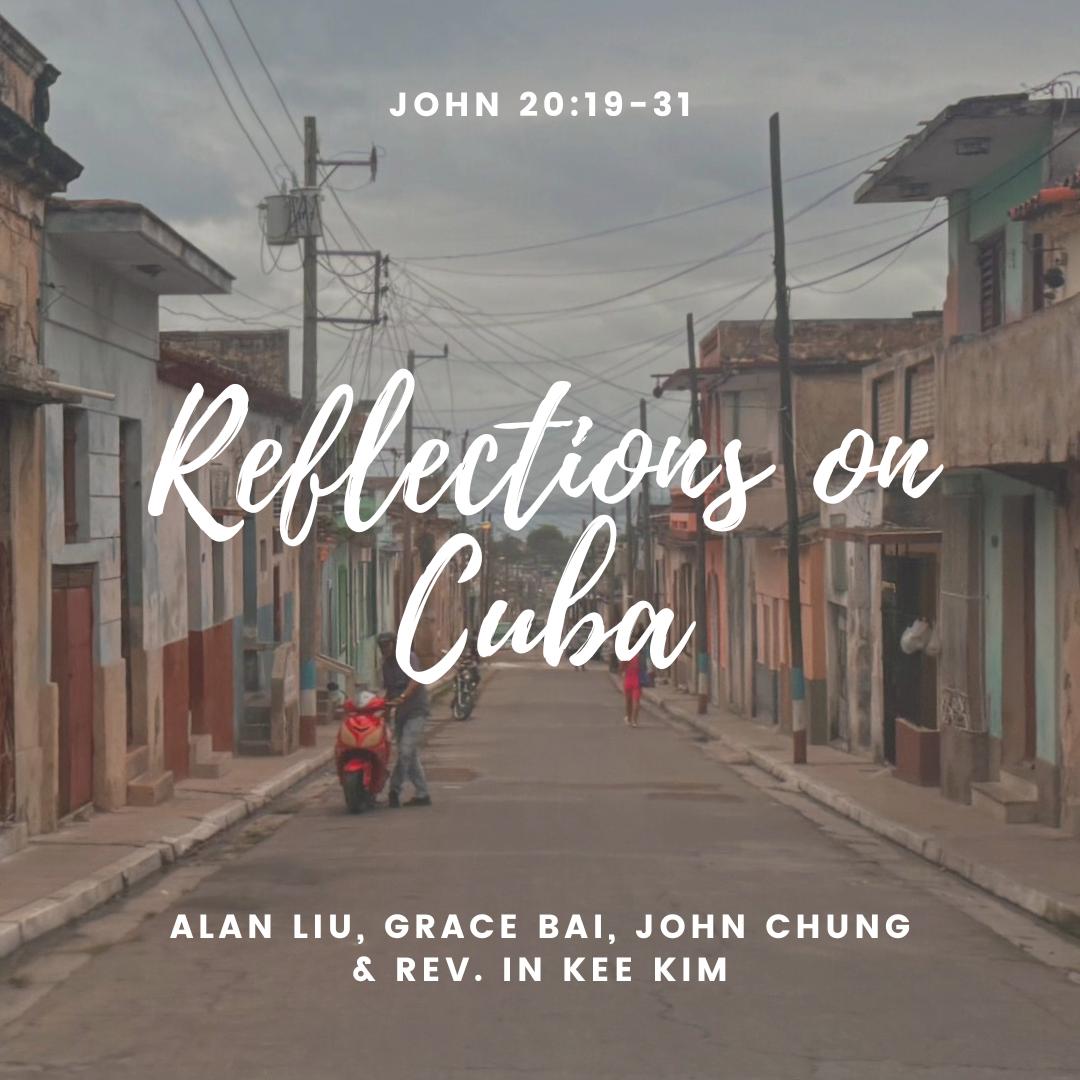
Reflections on Cuba
Reflections by Alan Liu, Grace B., John Chung, & Rev. In Kee Kim from St. Tim's recent mission trip to Cuba.

Look To the Future
Scripture Passage Philippians 3:4b-14 Worship Video Worship Audio Sermon Script What do people value the most? A recent Reuters poll says that American people value time the most. Then career , success , and money come in as close seconds. I think that is so true. What good is money when you have no time to spend it? What good is all the power and success when no time is left for you. It is like a parable of a rich fool that our Lord Jesus taught us. Then he told them a parable: The land of a rich man produced abundantly. And he thought to himself, What should I do, for I have no place to store my crops? Then he said, I will do this: I will pull down my barns and build larger ones, and there I will store all my grain and my goods. And I will say to my soul, Soul, you have ample goods laid up for many years; relax, eat, drink, be merry. But God said to him, You fool! This very night your life is being demanded of you. And the things you have prepared, whose will they be? (Luke 12:16-21) He had all the riches but he didn't have time. What's the use? Time is the most valuable, the most important, and the most practical. So, appreciate your time. Cherish it. Don't waste it away. It is free but priceless. Once you have lost it you can never get it back. There are different ways of thinking of time. Different aspects of time. The Past, the Present, and the Future. Yesterday, Today, and Tomorrow. Of these three, I think the future is the most important. If there is no future, our past and present become meaningless. You reflect on your past to make a better future. You work hard today so that you can have a good tomorrow. So your past and your present should ultimately work for your future. Because your future is the most important. The interesting thing is: The future is not here yet but it is the most important. In our hands, we don't have the future yet, but it is what determines the quality of your life. When you have no future, you will be devastated. So life is very interesting and strange in that way. What we don't have, what we don't see, what has not happened yet, – that controls and determines the quality of our life. So don't tell me that I can accept only thing that I can see, I can touch, and I can feel. You are controlled by what is not here yet. Your future. The future – It is interesting. People have different attitudes about their future. I don't think many people are comfortable with their future. Is your future your friend or your enemy? Do you love to think about your future or you try to avoid your future as much as possible? The future can be scary because it is unknown. It is uncertain. These days, the uncertainty of our future has become very real. Because of US policy, the whole world is wondering what their future may be. Uncertain, unknown, unpredictable. The future is not just uncertain and unknown – It is uncontrollable. The future is not in your control. You don't know what tomorrow holds for you. In Myanmar, close to 3,000 people died because of earthquake. Nobody knew that it was coming. Recently in LA, and also in Korea, so many people lost their homes because of fire. Nobody expected that. The future just comes without warning. What are human responses to the very nature of the future? Worries and anxieties. That is what a lot of people have about the future. University students – What if I can't get into the program I want. People who are working, especially in the auto industry – What if I get laid off because of this new tariff. Old people – What if I get sick, who will take care of me? Worries and Anxieties – A very common attitude towards their future. Another human response is – You become helpless and hopeless. You can do nothing about your future. So, just passively receive your future. Que sera sera – whatever will be, will be. The future is not ours to see. But Paul showed a different attitude towards the future today. but this one thing I do: forgetting what lies behind and straining forward to what lies ahead (Philippians 3:13) He didn't worry about his future. He didn't just passively take whatever future that came to him. He strained forward to what lied ahead. He put away his past. He didn't dwell on it. Our past can be a good teacher for us. But at the same time, our past can haunt us. Our past can drag us down. Not just your painful past but even your glorious past can drag you down. What good is your glorious moment in the past? It's gone. No use. You have to cut it off. St. Paul considered his past as rubbish. Rubbish is a very toned down translation. The Greek word Paul used, skubalon – means “dung,” “excrement,” or “refuse . He cut it off. Forgetting what lies behind me, I will strain forward to what lies ahead. A very future oriented mentality. How could he have this very strong future-oriented mentality? Because he saw what most of us don't see. He clearly saw what was ahead of him. He clearly saw the end. He was able to see the goal. Verse 14. I press on to
Pain of Letting Go
Scripture Passage Luke 15:1-3, 11b-32 Worship Video Worship Audio Sermon Script This is a very famous story. I am sure most of you have heard about this story and are very familiar with it. This is one of the most famous parables Jesus left behind for us to remember. What we read today is the last one of three stories. All three stories have the same theme. The first one is about a shepherd searching for one lost sheep, leaving 99 in the wilderness. The second one is about a woman searching for one lost coin. And today's story is the last one about a father who lost a son. All three parables are about losing something and finding it back. But the third story has its unique message that is not in the first two. The shepherd and the woman were actively searching for their lost one. The shepherd went out and went through all the troubles to find the lost sheep. The woman lit a lamp and swept through the whole house to find the lost coin. But the father didn't do anything to find the lost son. He didn't go out to search for him. He didn't send people to find his son. Was it because the father did not love the son? Was it because he was upset at the son? Or was it because he didn't care? I don't think so. I see two images of God in these three stories. The first one is the image of God who actively goes out to search for the lost. The second one is the image of God who waits. The lost sheep and the lost coin could not come back on their own. That's why the shepherd and the woman actively searched for it. But the son – he was different. He chose to go out. He didn't want to stay home. The Scripture doesn't tell us why he wanted to leave the house. Maybe because of his self-righteous brother? Maybe because he felt stuffy at home? Maybe because he wanted to see the bigger world? Maybe because he simply wanted freedom? We don't know why. But he wanted to leave home. He wanted his inheritance. The father didn't die yet. But he wanted his portion anyway. That doesn't sound nice. But strangely, the father was silent. He just gave it to him. The father let him go. He didn't tell him to stay. He didn't tell him to reconsider. He didn't threaten him not to give him his portion. He simply divided his property between two sons and gave his portion. The father might have been disappointed. The father might have been angry. The father might have been concerned. But the Scripture doesn't express any of his emotions. The silence of the father speaks volumes. The father knew exactly that his son needed to do that. He needed to leave the house. He needed to go out and experience the world. He needed to find his own life. He needed freedom even though the father knew that freedom was costly. That is the kind of God we have. God allows us to go. God allows us to have freedom. God allows us to have our own choice. You have many young children. Now they are cute and adorable. But there will be a time when they want to leave you and leave home. They want to make their own choices. They want to have their own freedom. Letting them go is hard. There is pain in letting go. Sometimes going out and actively searching for them is easier. But human beings are not like a sheep or a coin. The image of God this parable portrays to us is the pain of God who lets his son go. The pain of God who lets his son reject him. Asking for his inheritance while the father was alive was the greatest insult and disrespect. And yet the father doesn't say anything. His silence delivers his pain. That is the kind of love Jesus showed. Jesus allowed people to reject him. I could see that very clearly in his last supper. He knew that Judas would soon reject him. And yet he gave the bread to him. Then he said, Do quickly what you are going to do. (John 13:27) John described the scene in this way. So, after receiving the piece of bread, he (Judas) immediately went out. And it was night. (John 13:30) And it was night. This was a symbolic expression. He left Jesus who is the light and entered into darkness. Jesus allowed Judas to betray him. Jesus allowed Peter to deny him. Listen to this conversation. Peter said to him, Lord, why can I not follow you now? I will lay down my life for you.' Jesus answered, Will you lay down your life for me? Very truly, I tell you, before the cock crows, you will have denied me three times. (John 13:37, 38) Jesus allowed Judas to betray him and Peter to deny him. Jesus allowed people to reject him. That is the message of the cross. Today's story shows the agony of the father who allows the son to reject him, disrespect him, and leave him. But that is not the end. The story also shows the image of God who is waiting. The father let him go even though it was painful but deep inside, he was hoping that he would come back. This is well captured in verse 20. So he set off and went to his father. But while he was still far off, his father saw him and was filled with compassion; he ran and put his arms around him and kissed him. (Luke 15:20)
Hold Fast, Do Not Give Up
Scripture Passage 1 Corinthians 10:1-13 Worship Video Worship Audio Sermon Script Have you had a personal experience of meeting God? Meeting God is a wonderful experience. When you meet God, everything is good. You feel embraced by God's love. Your burdens are lifted. You feel that everything is going to be alright. Many of you have experienced this kind of wonderful encounter with God. This is what it was like when the Corinthians received the gospel. Meeting God instills a core belief: that everything will be alright. In God's hands, all will be good. In Christian faith, we call that hope. Everything might not be alright now, but they will be. Hope is at the core of Christian faith. Hope is what the resurrection is all about. No matter how bad things are now, in the end, God will be victorious. The writer of Revelation articulates a beautiful vision of this good ending: See, the home of God is among mortals.He will dwell with them;they will be his peoples,and God himself will be with them and be their God;he will wipe every tear from their eyes.Death will be no more;mourning and crying and pain will be no more,for the first things have passed away. (Revelation 21:4) That is the promise of our hope. Our whole Christian faith is built on the promise that no matter how bad things are right now, in the end they will be alright. Because of that hope, how you live now changes. You live based on the promise that is to come. That's what happened to the Corinthians when they met God. Christ was coming soon, and that all would be well. Based on that belief, they made radical changes to their lives. They created a new community that crossed social and economic lines. Relationships that would never have been formed were created. It was a beautiful new kind of humanity and community. When you meet God, that hope seems so real and alive. It is a beautiful thing. But what happens when that hope doesn't manifest? What if there is a never ending delay to that promise? What if things don't really get better? Things don't change or even get worse? When the promise of a better future doesn't become real, two questions arise in the heart: What's the point?What difference does it make? What's the point of holding onto faith when nothing changes? What difference does it make to keep trying? Your belief in the promise of a better future erodes. You lose hope. That is the situation that Paul is addressing. Christ did not come as they expected. Their problems remained. They were losing hope. In today's passage, Paul is warning them using examples from the past. The examples he uses are from the Israelites when they were in the wilderness. The Israelites had been slaves in Egypt. God heard their cries and sent Moses to lead them out of Egypt. They experienced the mighty hand of God in leading them out and providing for them. This is how Paul describes this: I do not want you to be ignorant, brothers and sisters, that our ancestors were all under the cloud, and all passed through the sea, and all were baptized into Moses in the cloud and in the sea, and all ate the same spiritual food, and all drank the same spiritual drink. (1 Corinthians 10:1-4) God had led them out with a mighty hand. God promised that he would lead his people into the Promised Land, a land flowing with milk and honey. But then they got stuck in the wilderness. People grew restless. They began to lose hope in the promise. Paul describes what happened: Nevertheless, God was not pleased with most of them, and they were struck down in the wilderness. (1 Corinthians 10:5) They lost hope and fell away from God. Paul has a few warnings based on what happened to them in the wilderness: Do not become idolaters as some of them did, as it is written, The people sat down to eat and drink, and they rose up to play. (1 Corinthians 10:7) This is based on the golden calf. Moses went up to Mt Sinai to receive the commandments from God. But he took so long. The people got tired of waiting. They demanded a god they could see. So Moses' brother Aaron created a golden calf. They held a festival where they ate, drank and played. God makes a promise that all will be good. But when things don't seem to get better, people easily turn to other things. Where do you really turn to to feel safe and secure? What do you trust to make your life better? We must not engage in sexual immorality, as some of them did, and twenty-three thousand fell in a single day. (1 Corinthians 10:8) At another point during their time in the wilderness, they settled at a place in Moab. The men began to sleep with Moabite women. Not only that, they began to offer sacrifices to Moabite gods. They forgot about God's promise. They lost hope they would ever get to the Promised Land. So they focused on pleasure for that moment. Many people say: just focus on the present. We should enjoy each moment, yes. (Olivia tanned from vacation – jealous!) But when you only focus on the present and ignore the future, if all you lo
Know You Are Loved
Scripture Passage Psalm 27 Worship Video Worship Audio Sermon Script We've been studying David at our Winter Fridays. The psalm we read today was written by him. Around 73 of the 150 psalms are attributed to David. That is almost half of the entire book. He was a talented poet. He had the sensitivity of an artist and the insight of a theologian. When I look at David's life, I see a common theme. It is that God was always with him. He lived his life with this understanding, in all circumstances. God was never separate from or outside the reality of his life. God was intimately involved in his life. We can see this at the beginning of today's psalm The LORD is my light and my salvation;whom shall I fear?The LORD is the stronghold of my life;of whom shall I be afraid? (Psalm 27:1) Even in danger, David never lost his confidence. Knowing that God was with him gave him strength. It gave him the courage to face Goliath when no one else wanted to. It gave him the wisdom to spare Saul's life even when it was to his advantage. It made him the spiritual rock that he was. What does it mean to know that God is always with us? What did it mean for David? I asked myself that question. This is something that we hear often. But what is implied in that expression? To know that God is with us is to know that we are LOVED. There is no difference. They are very much connected. That we are loved reveals itself in the way God cares for us. Knowing this is the foundation of our faith. It is the source of our confidence in the midst of trouble. David knew that he was loved. It was not head knowledge. He experienced God's love surrounding him all throughout his life. Not only in his successes and victories, but especially in situations that seemed impossible and life-threatening. He was saved numerous times from Saul's attempts to kill him. He was pulled back from the frontlines just as he thought he had to go to war against his own people. When he was lost and unsure of what to do, David saw God's hand rescuing him like a ray of light piercing through the darkness. God's steadfast love became real to him in those moments. We don't know the exact context or background of today's psalm. It is obvious that he is in some kind of danger. People are against him and they want his life. Yet, he does not easily waver in his confidence. He knows that he is loved and God will take care of him. For he will hide me in his shelterin the day of trouble;he will conceal me under the cover of his tent;he will set me high on a rock. (Psalm 27:5) If my father and mother forsake me,the LORD will take me up. (Psalm 27:10) Whenever difficulties come, the first thing we do is panic. We become fearful. We lose perspective and get overwhelmed. We look for solutions to get rid of our problems quickly. We make rash and impulsive decisions. We end up complicating our situations even more. We feel more powerless and helpless than before. All this comes from believing that we are alone. That is why we ask ourselves, Why is this happening to me? We feel totally isolated. Is God really with me? In other words, we are asking Am I loved by God? That was Saul. He lived in constant fear. It stemmed from his belief that he was totally alone. Unlike David, God was not a part of his reality. Only himself. His life became all about him trying to deal with his problems. But it didn't better his situation. It only led him further and further into darkness. It ultimately destroyed him. In that sense, dealing with the challenges of life is not so much a question of what to do, but WHO WE ARE. It is not a matter of finding effective solutions, but our IDENTITY. When the storms come, what gets rattled is our sense of self. Everything else in our life feels shaky as a result. If our identity is firmly rooted, we can withstand the storm. If our identity is fragile, we will be knocked down by the storm. That is what our Hi-C students reflected on at their retreat last weekend. The theme was, Be Who You Are . To be a rock, we need to cultivate a healthy and strong identity. Adolescence is perhaps the most formative time for that. Cultivating a healthy sense of self begins with hearing who God says that we are. The first thing God tells us is that we are loved as Jesus heard at his baptism And a voice came from the heavens, You are my Son, the Beloved; with you I am well pleased. (Mark 1:11) We are not loved because of anything we have done. It is because that is who God is. God is love. We were loved even before we were born. Our very existence is the evidence of God's love. To know that we are loved is where everything starts. It is the bedrock of our life and identity. Do you know that you are loved? Do you believe that? Remind yourself daily of this truth. I AM LOVED. Every morning. During the day. At the end of the night. I think it can be a good spiritual practice for Lent. When we rest in God's love, the power of fear will lose its grip over us. It will no longer control or

Know Who You Are
Scripture Passage Deuteronomy 26:1-11 Worship Video Worship Audio Sermon Script When I think about people today, there's a word that comes to my mind: overwhelmed. I sense that people are just overwhelmed. Overwhelmed by the demands placed on them. Their time. Energy. Attention. It is true, our senses are overwhelmed, our brains are overwhelmed. We can't even sit still: our phones demand our attention. But I think there's a deeper force that leads people to feel overwhelmed. It's that the anchors people rely on are crumbling. In Canada, we're going through a huge change. For our entire lifetimes, the United States was our anchor. Our identity as Canadians was closely tied to the United States, whether we like it or not. We liked to say that we're not Americans, but even saying that reveals just how closely tied we were to them. They were our economic anchor. They were our security anchor. We could live safely, peacefully and prosperously because we had a strong, rich, friendly neighbour to the south. But all that has changed in just two months. Canada is very alone and vulnerable right now. We cannot rely exclusively on the United States for our economy. But it will take time to diversify our trading relationships. Even geographically we are isolated – the only neighbour we have is the United States. I have concerns about the future; I don't know what will happen. Today's passage is the final speech of Moses to the Israelites. It begins this way: When you have come into the land that the Lord your God is giving you (Deuteronomy 26:1) They are still in the wilderness. In the wilderness, the Israelites had no anchor. Their only thing they knew before freedom was their life in slavery. That's why even though they were free in the wilderness, many times the people complained to Moses. They would say that at least in Egypt we had food to eat! In the wilderness, they had absolutely no anchors but God. They had to learn how to trust completely in God. They trusted God for everything: food, water, shelter and where to go. It took a whole generation. Over 40 years. The first generation all died in the wilderness. A new generation was born. But finally, by the end, they knew their anchor was God. They became God's people. Our identity is always in connection with something or someone else. I am not just Simon. Even my name is not from me – it was given to me by my parents. I am their son. I am Joonie and Abby's dad. I am a pastor of St. Timothy. I am always someone in relation to someone or something else. For me, the most important part of my identity is that I am a child of God. God is the unchanging anchor that I pin my identity to. That was the main outcome of the Israelites in the wilderness: they became God's people by pinning their identity to God. They and God became one. My friends, in these times, we feel no true anchor in this world. Anything can change. And that can be overwhelming. But we HAVE an unchanging anchor. Jesus Christ is the same yesterday, today and forever. God is steadfast, unchanging and forever faithful. That is who we pin our identity on. If your identity as God's child is clear, steadfast and unchanging, then you can get through ANYTHING in life! That's how important your identity is. You are a child of God. You are God's. If you know who you are, if you know whose you are, then you will withstand anything that comes your way. Moses' main concern was whether the people would maintain their identity. Their time in the wilderness was coming to an end. A whole generation had passed away, and a new one emerged. They would enter a new environment filled with new challenges. Would they remain attached to God, or would they attach themselves to other things? That was the great question and concern in Moses' mind. Who would they be? That's the question for us. In today's passage, Moses institutes spiritual practices so that people would maintain their identity as God's people. That is what today's passage is all about: how the people maintain their identity as the people of God in new and changing environments. Those practices are just as relevant for us today. When you have come into the land that the Lord your God is giving you as an inheritance to possess and you possess it and settle in it, you shall take some of the first of all the fruit of the ground, which you harvest from the land that the Lord your God is giving you, and you shall put it in a basket and go to the place that the Lord your God will choose as a dwelling for his name. You shall go to the priest who is in office at that time and say to him, Today I declare to the Lord your God that I have come into the land that the Lord swore to our ancestors to give us.' (Deuteronomy 26:1-2) Moses instituted the first fruit offering. This is where we get our practice of tithing from. Give to God before you take anything for yourself What does this achieve? It affirms your connection to God. It acknowledges who gave you this fruit in the f
A Glorious Moment in Difficult Times
Scripture Passage Luke 9:28-36 Worship Video Worship Audio Sermon Script Today's passage gives us a wonderful scene. A glorious scene! While Jesus was praying, his face changed. His clothes became dazzling. Two dead people appeared. They were not just dead people. They were like pillars of the Old Testament. Moses represented the Law. Elijah represented the Prophet. So the Law and the Prophet, the core tradition of the Old Testament. What a glorious scene! It's a miracle. It was out-of-this-world experience. I need that these days. The reality is so harsh that I need something out of this world. The world we live in is a very difficult world. Especially for those who are weak and powerless, this world becomes more and more difficult to survive. Yesterday was 3.1. It is a special day for Koreans. They protested against Japanese occupation. The powerless fought against the powerful. Many Christians participated in this movement. But now the powerless has no place to stand. Our reality is harsh; I need fantasy. The Scripture tells us about a few wonderful out-of-this-world experiences people had. It is the intervention of God. It is God's way of entering into this world. It is God's special touch. On the road to Damascus, Paul had this intervention of God. He was going to arrest Christians, imprison them and kill them. He was exercising his power and authority on the weak and the vulnerable. But on the way, he experienced the bright light shining around him. And he heard Jesus talking to him. By then, Jesus was already dead. And Paul knew that. He heard the voice of Jesus telling him, Saul, Saul, (His Hebrew name) why do you persecute me? Why are you doing this to my powerless people? Persecuting those who are weak and vulnerable is persecuting me. Out-of-this-world experience! It happened to Isaiah too. He was in the temple. He described his experience in this way. In the year that King Uzziah died, I saw the Lord sitting on a throne, high and lofty; and the hem of his robe filled the temple. Seraphs were in attendance above him; each had six wings: with two they covered their faces, and with two they covered their feet, and with two they flew. And one called to another and said: Holy, holy, holy is the Lord of hosts;the whole earth is full of his glory.' (Isaiah 6:1-3) Out-of-this-world Experience! Elijah also had this kind of experience. He (God) said, Go out and stand on the mountain before the Lord, for the Lord is about to pass by.' Now there was a great wind, so strong that it was splitting mountains and breaking rocks in pieces before the Lord, but the Lord was not in the wind; and after the wind an earthquake, but the Lord was not in the earthquake; and after the earthquake a fire, but the Lord was not in the fire; and after the fire a sound of sheer silence. When Elijah heard it, he wrapped his face in his mantle and went out and stood at the entrance of the cave. Then there came a voice to him that said, What are you doing here, Elijah?' (1 Kings 19:11-13) Out of this world Experience! I discover one common thing of all those who had this wonderful glorious moment. They were all facing their harsh reality. They were all going through hard times before this happened. Isaiah was struggling with his own inadequacy and sinfulness, living in a sinful surroundings. This was what he said. Woe is me! I am lost, for I am a man of unclean lips, and I live among a people of unclean lips; yet my eyes have seen the King, the Lord of hosts! (Isaiah 6:5) Elijah was so deeply depressed that he wanted to die. This was what he said. He asked that he might die: It is enough; now, O Lord, take away my life, for I am no better than my ancestors. (1 Kings 19:4) Even in Jesus' case, this was what he said just before he experienced the transfiguration on the mountain. The Son of Man must undergo great suffering, and be rejected by the elders, chief priests, and scribes, and be killed, and on the third day be raised. (Luke 9:22) Jesus was facing his own death. Sometimes God intervenes in our life. God shows his grace in a special way. Not necessarily only through the forms of miracles and supernatural experiences. But there are times when God specially touches you, awakens you, and inspires you. These are glorious moments. This happens when you are going through difficult times. When life is difficult, God appears to you and makes his presence evident. God's presence empowers you, transforms you, and lets you experience glorious moment. But my friends, God gives you this wonderful experience not just to console you and comfort you but to PREPARE you. To prepare you to take the challenges ahead of you. God prepared Paul to be an apostle to the Gentiles. How about Isaiah? After this experience, God said this. Whom shall I send, and who will go for us? (Isaiah 6:8) Isaiah said, Here am I; send me! (Isaiah 6:8) Elijah too. Elijah said this. I have been very zealous for the Lord, the God of hosts; for the Israelites have forsake
Don’t Be A Victim, Be Empowered
Scripture Passage Luke 6:27-38 Worship Video Worship Audio Sermon Script Jesus is our Lord. But Jesus was also a flesh and blood human being. His ministry took place among flesh and blood human beings. Jesus' message to them was that the kingdom of God was at hand. Something new was being born. What was the main point about the kingdom of God? Put simply, it was this: you are not merely a victim of your circumstances, but you are empowered to live a better way. Today's passage is the first lesson Jesus gives to his listeners. Love your enemies. Why did he begin with this? He was addressing a critical issue for his audience. His listeners were not people living comfortably, there for a good and entertaining lecture. They were desperate, poor, struggling peasants and commoners in the countryside and small villages. Life had become very difficult for commoners in Galilee. They were forced into debt. They lost their land. They were left behind economically, politically, socially. When things get difficult, the first thing to get affected is unity. The hardships they faced eroded the bonds that held them together. Their difficult circumstances made former friends enemies. Former neighbours adversaries. Hatred and mistreatment grew among people. They were victims of forces and decisions beyond their control. But Jesus is saying: don't be victims of your circumstances. If you react to hate; If you curse those who curse you; If you mistreat those who mistreat you; Aren't you merely a victim of your circumstances? You don't have control over their actions or behaviours. But you allow those behaviours to shape yours. The behaviours and actions of others take control over you. Offering your other cheek; Giving your shirt after they've already taken your coat; Are these signs of weakness? No. They are signs of an empowered person. One who is making their own choice. Jesus' message is that you have agency. You have the power to live a different way. You may not be able to change your circumstances, but you can change how you live. The kingdom of God is this: people who live a new way despite present circumstances. A new way defined by God's will that goes against present circumstances. Jesus came to show that a new way is possible. The kingdom of God is not something that takes place in the afterlife. It is something that is present now. Once Jesus was asked by the Pharisees when the kingdom of God was coming, and he answered, The kingdom of God is not coming with things that can be observed, nor will they say, Look, here it is!' or There it is!' For, in fact, the kingdom of God is among you. (Luke 17:20-21) This is a radical message for life. You can live a different way from your circumstances or environment. I don't want to underestimate our circumstances. They have a huge effect on your life. Sometimes they are so difficult to deal with. I know some people are dealing with health issues. Others are dealing with financial challenges or finding a job. Others are very anxious by the political uncertainties in the world. Difficult circumstances instill fear, uncertainty, anxiety. Our circumstances are so powerful. They are powerful because they become so much larger than us. Last Sunday, our sanctuary was quite empty because of all the snow. We had no control over nature. We were at its mercy. Circumstances are like that. Because they are so large, they influence us deeply. They affect how you feel. How you think. But what Jesus is saying is that yes, they are powerful and real, but still, you do not need to become a slave to your circumstances. Human beings are very adaptable. We've learned to adapt and survive in all sorts of environments. It is an important skill. But if all you do is adapt and survive, then you will not be free. You will continue to be a slave to your circumstances. You will be absorbed by your circumstances. Sometimes, we need to fight against the circumstances and work to change them. When things are unfair or unjust, we should speak truth and resist. If your health is not great, then you should seek the best medical help and do everything you can to improve your health. But more important is your attitude and thinking. Do not let your circumstances dictate how you think, feel and behave. Circumstances will come and be beyond your control. But do not let them control your thinking. Don't just react to them with your emotions. If you do, then you are just a victim of your circumstances. The people listening to Jesus had adapted to the hostility around them. They began to think like those in a hostile environment. They began to feel like them. Talk like them. They all became part of that environment and perpetuated it. Jesus came to break that cycle. He came to break the grip that circumstances in this world have on you. Jesus came to bring freedom and the possibility of a new start. Now the Lord is the Spirit, and where the Spirit of the Lord is, there is freedom. (2 Corinthians 3:17) Freedom to li
Think About Being Alive Every Day
Scripture Passage 1 Corinthians 15:12-20 Worship Video Worship Audio Sermon Script When does a person deteriorate? What I means is When does a person become weak, frail, dark, and negative? When does a person become overly critical, not happy, gloomy, and feel hopeless? I think that happens when your thinking is deteriorated. The other day, I was talking with a person who just retired. I asked, How is your retired life? He said, Good. I do a lot of things. When I do a lot of things, I don't think about death too much. That was interesting, I thought when I heard it. But I think he is right. There is wisdom in what he said. If you think about death all the time, definitely, you will soon become deteriorated. I visit many people at the hospital. I realized that after they were diagnosed, they became much more quickly deteriorated. It is all to do with your thinking. That was what happened at the church in Corinth. When they first heard the message from St. Paul, they were ecstatic. They received the message of the good news. First time, they heard about the message of resurrection. When Paul preached that in Athens which is very close to Corinth, this was people's reaction. May we know what this new teaching is that you are presenting? It sounds rather strange to us, so we would like to know what it means. (Acts 17:19-20) Corinthian people also found it strange but soon they were able to receive the message of resurrection. When they believed the message, they experienced the power of the resurrection. They were filled with joy and eternal hope. But soon, their thinking became deteriorated. They focused more on day to day living. They worried about what to eat, what to wear. They worried about their businesses. They worried about their children. They worried about their own death. Their thinking became weak. When their thinking became weak, everything fell apart. There were sexual corruptions. They created factions and fought with each other. They became very divisive. They neglected the poor around them. Their spirituality became very self-focused. Their spiritual gifts made them proud and arrogant. When their thinking became weak, their life became dark. Morality, principles, spirituality – everything went down the drain. Ultimately, they doubted about their own resurrection. Their belief deteriorated. That was why Paul raised this question. Now if Christ is proclaimed as raised from the dead, how can some of you say there is no resurrection of the dead? (1 Corinthians 15:12) They didn't raise this doubt when they first received the message from St. Paul. That's why it was possible that the church was established in Corinth. But now some people at the church could not accept the resurrection. When their thinking became weak, their belief became frail. The resurrection of Jesus Christ is the core belief that we Christians hold unto. If there is no belief in the resurrection, there is no Christianity. On resurrection, Christianity is established. If the cross were the end, then there is no point in believing. If the cross were the end, then the evil won. God is defeated by the evil, the darkness, and the death. There is no hope for us. The whole theology and all Christian thinking depend on the truth that there is resurrection. Death is not the end. There is resurrection after the death. Death did not win. Life defeated death. That's what we believe. Jesus exemplified what our destiny would be. He created the path to the eternal life for us. As God raised Jesus from the dead, he will raise us from the dead. People who were martyred died with the hope of resurrection. If there is no resurrection, their death is in vain. That was what St. Paul firmly reiterated in today's passage. If there is no resurrection of the dead, then Christ has not been raised; and if Christ has not been raised, then our proclamation has been in vain and your faith has been in vain. (1 Corinthians 15:13-14) All my life, I have been in ministry. All my life, I have preached about the resurrection. If there is no resurrection, I have lived all my life for nothing. I can feel what Paul was saying today. If Christ has not been raised, your faith is futile and you are still in your sins. Then those also who have died in Christ have perished. If for this life only we have hoped in Christ, we are of all people most to be pitied. (1 Corinthians 15:17-19) Belief in the resurrection is tough. The resurrection is not something that you can prove theoretically or empirically. That is the nature of belief. Belief is different from knowing. Knowing is intellectually convinced or convicted. Belief is spiritually accepting the truth. Knowing is in your limited capacity. You can only know what you can intellectually understand. But belief is accepting what is much bigger than yourself. The good will win over the evil. The truth shall set you free. It's hard to believe these days but ultimately justice will prevail. That is all in the realm of belief. T
More Than Fish
Scripture Passage Luke 5:1-11 Worship Video Worship Audio Sermon Script Life is about more than fish. Focus on God, not the fish. God will provide all that you need and unlock what you really want. Do you know what it is that you WANT? What if what you THINK you want is not REALLY what you want? We often confuse what we WANT with what we NEED. What we THINK we want is often really what we NEED. Because it's hard to get what we need, we think that's what we want. It's very hard to make money. Especially if you don't have much to begin with. Young people are having a hard time getting a job. It's getting harder and harder to keep a job. So yes, it takes a lot of work to get what we need. But when you get what you need, you're not satisfied. Getting what you NEED can never satisfy. Money, love, acceptance- these are things we need. Even pleasure and leisure – we need these things. Human beings are not animals meant to only work. But the things that we need cannot satisfy. We need something, so we get it, but then we're not satisfied. You need MORE than that. Only getting what you WANT can satisfy. Simon was a fisherman. He needed fish. That was his livelihood. The fact that he owned a boat meant that he had a fishing business. It was a hard business. That very night, he fished all night but caught nothing. Catching fish is what he thought he wanted. But Jesus came and told him to put his net out into deep water. He had fished all night and caught nothing, yet Jesus was telling him to go again. Simon was probably skeptical, but he listened to Jesus. The result was pretty crazy: When they had done this, they caught so many fish that their nets were beginning to burst. So they signaled their partners in the other boat to come and help them. And they came and filled both boats, so that they began to sink. (Luke 5:6,7) It was the biggest catch of his life! He had more fish than he needed. But instead of being so happy, we see an interesting response. But when Simon Peter saw it, he fell down at Jesus's knees, saying, Go away from me, Lord, for I am a sinful man! (Luke 5:8) I am a sinful man! Simon received everything he thought he had wanted. But in that moment, he saw something clearly. He saw that his focus had been on fish, not God. Simon was a member of the synagogue. Every Sabbath he would have heard the Word being taught. For Jews, from the time they were born, they were imprinted with this commandment: Hear, O Israel: The Lord is our God, the Lord alone. You shall love the Lord your God with all your heart and with all your soul and with all your might. Keep these words that I am commanding you today in your heart. Recite them to your children and talk about them when you are at home and when you are away, when you lie down and when you rise. Bind them as a sign on your hand, fix them as an emblem on your forehead, and write them on the doorposts of your house and on your gates. (Deuteronomy 6:4-9) The most important commandment was to love God. It was to seep into their whole existence. It didn't come out of nowhere. It was forged from their experience in the wilderness. In the wilderness, there was nothing. No food, no water. But there, they experienced God's presence in a powerful way. God provided everything they needed. God sent manna from heaven. God sent quails for meat. God made water flow from the rock. In the wilderness, they learned to love God and trust God completely. God created human beings to live in relationship with him. God blessed Adam and Eve with everything in the Garden of Eden. We were to enjoy all this abundance in relationship with God. But sin began when they turned their focus away from God. When they lost trust in God. When they hid and turned away from God. Sin begins when we turn our orientation and focus to the things we NEED and AWAY from GOD. When we become preoccupied with what we need, we turn away from God. The worries and anxieties of what we need take over our thoughts. Sin is separation from God. When we put what we NEED at the centre, we separate ourselves from God. And in focusing on what we NEED, we lose touch with what we WANT. In the presence of Jesus, Simon saw how much he had turned away from loving God at centre. God knows what we need. He knows that we need money, food, clothing. Love, acceptance, and validation. God doesn't want us to be blind to our needs. We need to work hard. We need to use our brains that God gave us. But they cannot be our center. Our love, loyalty and devotion need to be to God alone. Our complete trust must be in God. Jesus said: Therefore do not worry, saying, What will we eat?' or What will we drink?' or What will we wear?' For it is the gentiles who seek all these things, and indeed your heavenly Father knows that you need all these things. But seek first the kingdom of God and his righteousness, and all these things will be given to you as well. (Matthew 6:31-33) Trust God. Love God first and with all your heart. And God will provi

Love Never Ends
EScripture Passage1 Corinthians 13:1-13Worship Video Worship Audio Sermon ScriptLove never ends. (1 Corinthians 13:8)This phrase catches my eyes.There is so much in this passage. I can talk about so many things about love.But this phrase stands out for me.Love Never Ends.Love is eternal. The eternal quality is intrinsic in Love.But that's not what we experience about love in this world.People fall in love and easily fall out of love. Today they go crazy about each other and tomorrow they go separate ways.We don't experience the eternal quality of love.That's what celebrities always experience. People are crazy about them and they say how much they love them. But once their popularity goes down, nobody really cares for them.Loving your neighbours is what we have learned from our Lord Jesus.We try to practice that and we also expect that from our neighbours. But all of a sudden, they tell us that we have to pay 25% tariff.We feel betrayed. Once we were neighbours and now we feel like we are strangers.That is the kind of love we experience in this world.Today we are a friend, but tomorrow, we become a stranger.We don't experience the long lasting quality of love in this world. So, people don't trust love. They sing What's love got to do with it.Love we experience is a very momentary thing.It doesn't give us security and confidence. It is just feeling you feel for the moment.And it doesn't last too long.That's what feeling is. Feeling is never eternal.To many people, love is just feeling. It comes and goes. One day you feel very close. The next day you feel indifferent.But Paul boldly proclaims that love never ends.Everything else comes to an end. But love never ends.He said,But as for prophecies, they will come to an end; as for tongues, they will cease; as for knowledge, it will come to an end. (1 Corinthians 13:8)But love we experience is a very small fraction of the true love that is eternal. We feel that love but only momentarily.Then what is love that never ends? Where does it come from?This was what John said.God is love. (1 John 4:16)God is love and love is God. That's where love comes from.We don't feel God but we feel love that is God. We don't experience God but we experience love that is God.Love is God's essential attribute. God is made up of love.So that's why John didn't say that God HAS love. He simply said God IS love.Love we experience is God's love.But only the fraction of it. Only momentarily. Even that momentary experience is heavenly bliss.Love is God's gift for us, for the humanity. This love created the world.When God's love is materialized, that is creation. The birth of a child is God's gift of love for the parents.The abundance we enjoy in our lives is God's gift of love. The breath that makes us alive is God's gift of love.This love sent his son to the world to save it.For God so loved the world that he gave his only Son, so that everyone who believes in him may not perish but may have eternal life. (John 3:16)Because we have love that never ends, we have no fear.We have dark time coming ahead of us. We are not clear how this relationship with US will affect us.But because we have love that never ends, we don't fear. It is time to pray for Canada.We should be united, not divided.Because we have love, we don't fear judgment. Because we have love, we are not afraid of death.So, John said,Love has been perfected among us in this: that we may have boldness on the day of judgement, because as he is, so are we in this world. There is no fear in love, but perfect love casts out fear; for fear has to do with punishment, and whoever fears has not reached perfection in love. We love because he first loved us. (1 John 4:17-19)The last sentence.We love because he first loved us.We don't have love on our own.The love we have is imperfect. The love we have is not complete.We love because God first loved us. We love because God gave us love.Love is God's greatest gift to us.Faith is also God's gift. Hope is also God's gift. But love is the greatest gift.And now faith, hope, and love abide, these three; and the greatest of these is love. (1 Corinthians 13:13)When you love, you participate in the most profound and marvellous realm, sphere of God's world. You enter into the most holy and sacred space.When you love, you enter into the eternity.When you love, you will be able to see the great mystery of God.Your eyes will be open and you will be able to see the true purpose and meaning of life.For now we see in a mirror, dimly, but then we will see face to face. Now I know only in part; then I will know fully, even as I have been fully known. (1 Corinthians 13:12)My friends, let us enjoy God's greatest gift to us.This gift will enliven our lives. This gift of love will make our lives abundant and meaningful.If there is no love, everything will become useless and everything will end in nothing. Our life will end in nothing.That was what Paul eloquently articulated in the beginning.If I speak in the tongue

You Belong
EScripture Passage1 Corinthians 12:12-31aWorship Video Worship Audio Sermon ScriptWhen St. Paul met Christ, he became a new person.So if anyone is in Christ, there is a new creation: everything old has passed away; look, new things have come into being! (2 Corinthians 5:17)Yes, when we meet Christ, we become a new person.But St. Paul was not only talking about himself as a person. He was thinking beyond just himself.He was thinking about our existence as people.In Christ, our whole existence becomes new. How we live together is new.Today's passage that we read is a concrete metaphor for the new kind of community that is created in Christ.He describes it as a new humanity:For he (Christ) is our peace; in his flesh he has made both into one and has broken down the dividing wall, that is, the hostility between us that he might create in himself one new humanity in place of the two (Ephesians 2:15-16)A new community, a new humanity – that is what we become in Christ.In this new community, everyone belongs.You are valued for who you are. You are treated with respect and honour. You are valued for the unique contributions you bring.Differences are valued and appreciated and embraced.This community belongs to everyone, and everyone belongs to it.It wasn't always this way for St. Paul.Before he met Christ, belonging meant something different.Belonging was an exclusive possession. Belonging was conditional on meeting the right requirements.Before he met Christ, he belonged to the chosen people of the Jews. This is how he described his belonging as a Jew:Circumcised on the eighth day, a member of the people of Israel, of the tribe of Benjamin, a Hebrew born of Hebrews; as to the law, a Pharisee; as to zeal, a persecutor of the church; as to righteousness under the law, blameless. (Philippians 3:5-6)He belonged to the exclusive community of God's chosen people because he met the requirements.In the old way of thinking, there is a high barrier to entry for belonging. It is an exclusive club. It is a closed belonging.If you belong, then you're in. If not, then you're out.If you're on the inside, you get the benefits of belonging. If you're on the outside, you're left out.Everyone tries so hard to belong, because we need to belong somewhere to survive.Human beings need to belong.We need to belong to a company or organization that will provide a living. We need to belong to friend groups that meets our social needs. We need to belong to a family that provides love and support.But even when you belong, you don't necessarily have it easy.You have to continue to meet the requirements. If you start slipping on the basic requirements, then your standing becomes more tenuous.I see this in our kids sports teams.If you're a good performer, then all is good. You're valued for your personality. He's a funny guy, a great character.But all of that won't matter if you're not good and producing.In this kind of community, you belong to survive, not thrive.There is pressure. There is fear of losing your standing.In this kind of community, what's valued is what will make that community strong.It's not about you. It's not about the unique gifts that you can offer. It's whether you offer the right gifts that the group needs.Uniqueness and diversity of gifts don't matter. It's about having the right gifts. Offer the right gifts, then you belong.In this kind of community, there is a clear pecking order. Honour and respect are given in that order. There is a hierarchy of value.In this kind of community, belonging is often defined by who you're against.Sometimes, belonging means you don't really know what you're for, but you definitely know what you're against.You prove that you belong by how strongly you're against those who don't belong. The stronger you're against those who don't belong, the more you belong.For Paul, belonging to the Jews also meant opposing and persecuting the church. More zeal for persecuting them meant he belonged even more.All of this changed after he met Christ.After meeting Christ, his understanding of belonging changed.In Christ, belonging changed from closed belonging to open belonging.Whereas in the old world, belonging was closed and exclusive, in Christ, belonging is open and inclusive.All belong. All are sinners. All are forgiven. All are invited into the kingdom of God.It is not about having the right gifts, it is about discovering your unique gifts. Your unique gifts and personality are what will bless the group.Honour and respect are not given according to the pecking order. Rather, everyone, especially the weak, are given honour and respect.No one is considered dispensable.St. Paul saw this very clearly:The eye cannot say to the hand, I have no need of you, nor again the head to the feet, I have no need of you. On the contrary, the members of the body that seem to be weaker are indispensable, and those members of the body that we think less honorable we clothe with greater honor, and our less respectable membe
Not Forsaken
EScripture PassageIsaiah 62:1-5Worship Video Worship Audio Sermon ScriptGod never forsakes you. God never abandons you. God never deserts you.But, even though God never forsakes you, sometimes you feel forsaken, abandoned, and deserted.Even our Lord, Jesus, experienced the feeling of abandonment on the cross. He cried out, my God, my God, why have you forsaken me?St. Paul also experienced the feeling of abandonment.We have become the scum of the earth, the garbage of the world right up to this moment. (1 Corinthians 4:13)That was what Israelites experienced when they lost their home. They experienced the abandonment when they were exiled.Korean people experienced this kind of abandonment when they lost their country. Many of your parents experienced that when they lived under Japanese occupation. They felt abandoned.When you lose everything, you feel forsaken.That was what Palestinians and also Israelites experienced last 15 months. They lost so much. They lost their loved ones.Finally there is a cease-fire agreement with a tinge of uncertainty. We need to pray for them.Also, this is what people in LA experience right now.They lost everything. They lost their homes. Many people do not have an insurance because the insurance company does not accept it because of frequent fire.Feeling of abandonment.(Last Sunday, elder Min told me that her friend lost her house and down the road, her son also lost his house. She gave elder Min money to treat our Wednesday Bible study.)I am sure people in southern Tibet feel the same way after the earthquake.Feeling of abandonment is what we experience in life.Your experiences may not be as dramatic as war, fire, and earthquake, but you experience different kinds of abandonment in your own way.When life is difficult, we feel lost. We feel that nobody really cares.The world is getting more and more selfish and self-centred.Me first has become our philosophy.We used to say me first is not a good attitude. Now it is our way of living. Very different from Jesus' teaching.We don't even know how to feel others' suffering and hardships. As long as nothing happens to me, everything else doesn't matter.When the world becomes selfish and self-centred, what will be the result?We get the feeling of abandonment. People will feel neglected, forsaken, and abandoned.We become an invisible man and woman, like the book invisible man by Ralph Ellison.Ralph Ellison said in the book, I am invisible, understand, simply because people refuse to see me. That is a big reason for us to go to Sioux Valley every year.Indigenous people in this country experienced the greatest abandonment.When their children were taken away against their wish, they felt so abandoned.Children also felt abandoned when they had to leave their homes and their parents and live in a foreign place.We just want to tell them that we care. You are not alone.That was what Gord Downie, the Tragically Hip’s frontman wanted to do. He wanted people to remember them. He wanted to tell them that they are not alone.That is why we are starting a new project with Cuba.They were isolated especially because of the US embargo. They were an island isolated from the rest of the world.They are not an island just physically; they are an island politically, economically, and psychologically.We want to go and see what is going on there. Because we care.Also, this year, we want to reach out to Evangel Hall who is doing the work for the homeless people in the city.We used to be heavily involved in the Evangel Hall mission but since Covid, we have lost touch with them. We want to renew our commitment to their work.Homeless people all felt abandoned. We used to go out on Boxing Day with sandwiches and went to homeless people on the street.Feeling of abandonment is probably the worst human emotion.When you are abandoned, you lose hope, joy, and motivation to live.When the Israelites were in exile, they lost the desire to sing.This is well captured in the psalm.By the rivers of Babylon there we sat down and there we weptwhen we remembered Zion.On the willows therewe hung up our harps.For there our captorsasked us for songs,and our tormentors asked for mirth, saying, Sing us one of the songs of Zion!'How could we sing the Lord's songin a foreign land?If I forget you, O Jerusalem,let my right hand wither!Let my tongue cling to the roof of my mouth,if I do not remember you,if I do not set Jerusalemabove my highest joy. (Psalm 137:1-6)It captures the feeling of Israelites feeling abandoned in a foreign land.A famous Korean song, Arirang, captures the Han of Korean people.Han is a special Korean word which captures complex emotions of grief, anger, resentment, and regret.Han is what you have when you are abandoned.The word became a very important word for Korean theologians. .If you leave and forsake me, my own,Ere three miles you go, lame you'll have grown.It captures grief, anger, resentment, and everything when you feel abandoned. This song captures Han of Kor

Be The Rock That Others Stand On
EScripture Passage1 Peter 2:4-10Worship Video Worship Audio Sermon ScriptI hope that you are having a great start to 2025.Before we get too far into the new year, it's important to reflect on important things.What kind of person do you want to be in 2025?Let me share a great vision with you today: Be the rock that others stand on.Isn't that a great thing to aspire to? It's something we can all do.In 2025, we should strive to be a rock on which others stand.It brings such a nice image to me. Someone who is solid. Not easily shaken. Someone whom others can stand on.In Chevrolet truck commercials, they are built like a rock. The most dependable, longest lasting trucks on the road like a rock.We're not trucks, but we too should be dependable and lasting like a rock. Maybe good trucks, we can rely on.It's so hard to find people like that, isn't it? Whom can you really rely upon?But wouldn't it be so good to have people like a rock? People you can rely upon, depend on.I think the best kind of person we can be is to be a rock for others.When times are difficult, when things are turbulent, the best thing you can be is a rock that others can stand on. You will be a great blessing to others if you can be that.Jesus told Peter that he would be the rock.And I tell you, you are Peter, and on this rock I will build my church, and the gates of Hades will not prevail against it. (Matthew 16:18)Jesus said Peter would be the rock. But at that time, he was not the rock.When Jesus was captured by the authorities, he ran away. He deserted Jesus. He even denied knowing him.Peter was the most passionate disciple. He spent three years with Jesus. He loved him. He left everything to follow him.But at Jesus' most vulnerable moment, he was not the rock he needed.After Jesus was crucified, Peter was devastated by his flimsiness. He had been exposed for who he was: a coward who lacked courage.Jesus was gone. Everything he had given up came to nothing. In that moment, it seemed like his failure would haunt him for the rest of his life.But that didn't happen. Peter did eventually become the rock. What changed?After Jesus rose from the dead, he appeared to Peter. That encounter was described by John.When they had finished breakfast, Jesus said to Simon Peter, Simon son of John, do you love me more than these? He said to him, Yes, Lord; you know that I love you. Jesus said to him, Feed my lambs. A second time he said to him, Simon son of John, do you love me? He said to him, Yes, Lord; you know that I love you. Jesus said to him, Tend my sheep. He said to him the third time, Simon son of John, do you love me? Peter felt hurt because he said to him the third time, Do you love me? And he said to him, Lord, you know everything; you know that I love you. Jesus said to him, Feed my sheep.Very truly, I tell you, when you were younger, you used to fasten your own belt and to go wherever you wished. But when you grow old, you will stretch out your hands, and someone else will fasten a belt around you and take you where you do not wish to go. (He said this to indicate the kind of death by which he would glorify God.) After this he said to him, Follow me. (John 21:15-19)Jesus forgave him. He gave him another chance.Even though he denied Jesus and ran away, he still believed in him. He still chose Peter to carry on what he started.That changed Peter. It transformed him. He became the rock of the church.How can you be the rock?Be someone who forgives and gives others a second chance.You're not blind to the flaws of others. But you can accept them. You don't define them by their flaws.You are the rock on which others can stand.This world is a merciless place. One mistake and the world piles on you. It shuns you. Cancels you. Destroys you.Can you be the safe rock on which others can stand? When everyone else has condemned them, be the safe harbour that shelters them from the world's judgment?Peter says in the passage today:Like living stones let yourselves be built into a spiritual house (1 Peter 2:5)What is a spiritual house?It is a house of mercy. A house of grace.A house where people are not judged by their sins but given the chance to become someone new.A house where people who have been given a second chance gather together.Once you were not a people, but now you are God's people; once you had not received mercy, but now you have received mercy. (1 Peter 2:4-10)We are God's people. We are those who have received mercy. That is the church.Peter became the rock of this church. But the rock that Peter stood on was Jesus Christ.Come to him, a living stone, though rejected by mortals yet chosen and precious in God's sight. (1 Peter 2:4)Rev. Kim spoke last week about living life based on principle. That is how you be the rock.The greatest principle is love.Jesus lived his life with the principle of love.In all that he did, he loved God and he loved people. He healed others. He taught people.But the greatest love was shown on the cross.How?Through forgiven
Be the Rock
Scripture Passage 1 Peter 2:4-10 Worship Video Worship Audio Sermon Script Happy New Year! May God's blessings be upon you and your family! God has been good in 2024. God will be also good in 2025. Let us trust God. Everything will work out for good. Even though there may be difficult times, God will give you the strength and the wisdom to deal with difficulties. Not only that, he will work out everything for good for you. This year's theme is Be the Rock. I would like to focus on two things. One: Being a Rock. Second: How to live as a Rock. In today's passage, Peter said this. like living stones, let yourselves be built into a spiritual house, to be a holy priesthood, to offer spiritual sacrifices acceptable to God through Jesus Christ. (1 Peter 2:5) He said, Let yourself be Being the Rock is about who you are, not about what you do. You are the Rock. Nothing can shake that away. That's who you are. God made you be the rock. Your understanding of who you are is the foundation on which you can build your life. If you think you are the rock, then you will live like the rock. You will have the firm foundation for your life. If you think you are chaff, then you will be easily scattered. That was what the Psalmist said. The whole book of psalms begins with the statement about two kinds of life. Life like the rock that is deeply rooted. And life like the chaff that is easily scattered. First, life like a rock They are like treesplanted (rooted) by streams of water,which yield their fruit in its season,and their leaves do not wither.In all that they do, they prosper. (Psalm 1:3) Life like chaff (they) are like chaff that the wind drives away. (Psalm 1:4) If your understanding of who you are is not clear, you cannot have an authentic existence. You cannot be firmly rooted. See – You can only be who you are. You don't have to pretend to be who you are not. Not only your identity, but your understanding of your identity is very important. Everything flows from your understanding of who you are. Don't let others tell you who you are. You don't need to be so concerned with what they say about you. Do they really know you? No, they don't. They judge you with their limited knowledge they have about you. And many times, their limited knowledge is filled with their own prejudices. Jesus did not let others dictate his life. He was rejected by people and that was Ok with him. Because he knew who he was. Peter knew about this very well and so he said. Come to him, a living stone, though rejected by mortals yet chosen and precious in God's sight (1 Peter 2:4) Chosen and precious in God's sight Rejection was a part of Jesus' life in this world. When he was born, there was no happy birthday Herod tried to kill him. Unfortunately, so many innocent babies were killed instead. He was rejected by Herod. During his life time, his life was full of rejections. They even accused Jesus of being demon possessed. The cross was the ultimate rejection of Jesus Christ. He came to what was his own, and his own people did not accept him. (John 1:11) So even if you feel rejected, not understood, and abandoned, don't ever doubt yourself. You are chosen and precious in God's sight. This is what Peter proclaimed. But you are a chosen race, a royal priesthood, a holy nation, God's own people (1 Peter 2:9) That's who you are. A chosen race. A royal priesthood. A holy nation. God's own people. To be honest, Peter himself was not like a rock. He was flaky and flimsy. He made a commitment that he could not keep. He denied Jesus even three times because he was scared of people's rejection. But Jesus chose him and told him that he would be the rock. He used to be Simon. But Jesus gave him a new name, Peter, which means the Rock. And I tell you, you are Peter, and on this rock I will build my church, and the gates of Hades will not prevail against it. I will give you the keys of the kingdom of heaven, and whatever you bind on earth will be bound in heaven, and whatever you loose on earth will be loosed in heaven. (Matthew 16:18, 19) What a wonderful proclamation about a person. Peter was not that great yet. He didn't have a solid understanding of who he was or who Jesus was. He didn't even know what he wanted. Right after Jesus' proclamation about Peter, there is a strange interaction between Jesus and Peter. From that time on, (after Jesus' proclamation of Peter) Jesus began to show his disciples that he must go to Jerusalem and undergo great suffering at the hands of the elders and chief priests and scribes, and be killed, and on the third day be raised. And Peter took him aside and began to rebuke him, saying, God forbid it, Lord! This must never happen to you.' But he turned and said to Peter, Get behind me, Satan! You are a stumbling-block to me; for you are setting your mind not on divine things but on human things.' (Matthew 16:21-23) Can you believe it? Right after Jesus said that Peter would be the rock on which he would build his church and he w
Humility and Forgiveness
Scripture Passage Colossians 3:12-17 Worship Video Worship Audio Sermon Script Last week, we talked about humility. I said, humility is not just accepting your weaknesses and shortcomings. Humility is trusting in God's power and looking to God in all your circumstances, even in an impossible situation. That was what Mary did when she said, Let it be so. Humble people always look to God in all circumstances and leave their situations in God's hand. That's why they experience the peace of God. Every problem, every challenge, every difficulty – They all leave it in God's hands instead of worrying about it. And God grants peace to those who are humble. Do not worry about anything, but in everything by prayer and supplication with thanksgiving let your requests be made known to God. And the peace of God, which surpasses all understanding, will guard your hearts and your minds in Christ Jesus. (Philippians 4:6, 7) Memory Card – today's passage too. Humble people are comfortable with themselves. Because they don't have to prove to the world how great they are. Because they don't have to control others as they wish. The opposite of humility is pride. Pride is the root of all our sins. It destroys peace within us. C. S. Lewis said, in his book, Mere Christianity According to Christian teachers, the essential vice, the utmost evil, is Pride. Unchastity, anger, greed, drunkenness, and all that, are mere flea bites in comparison: it was through Pride that the devil became the devil. All the great Christians in history warned us against pride. Catholic, Eastern Orthodox, Protestants, all of them warned us against pride. Pride is poison to our soul. Proud people can never please God. God resists the proud. God opposes the proud,but gives grace to the humble. (1 Peter 5:5) Do you know why pride is so bad? Pride does not allow forgiveness. Proud people cannot forgive themselves either and also others. Pride and forgiveness don't go together. In today's passage, St. Paul advised us to do this. Bear with one another and, if anyone has a complaint against another, forgive each other; just as the Lord has forgiven you, so you also must forgive. (Colossians 3:13) This – proud people cannot do. Pride dismantles our ability to receive and give forgiveness. That's why it is the greatest sin. It immobilizes the power to forgive. Our spiritual discipline is to turn pride into humility. In humility, we can receive true forgiveness. Our humility can kill our pride. The greatest message Jesus brought to this world is Forgiveness. The cross is all about forgiveness. He took our sins upon himself and forgave us. Isaiah saw that very clearly. But he was wounded for our transgressions,crushed for our iniquities;upon him was the punishment that made us whole,and by his bruises we are healed. (Isaiah 53:5) Jesus was humble to take on all that suffering. To let us go free, he took our punishment upon himself. THAT IS THE ULTIMATE FORM OF HUMILITY. Pride will never do that. Will never be able to do that. Forgiveness comes from this kind of humility. This is unthinkable in this ego-filled world. This is not possible in those who live their lives with the entitlement attitude. This world lost the ability to be compassionate, kind, meek, and patient which are hall marks of being a good Christian. Being a good human being. As God's chosen ones, holy and beloved, clothe yourselves with compassion, kindness, humility, meekness, and patience. (Colossians 3:12) Jesus was humble and that's why he was able to take our punishment upon himself. He was meek and gentle. He took our burdens upon himself and now we can have true rest in Jesus. Come to me, all you who are weary and are carrying heavy burdens, and I will give you rest. Take my yoke upon you, and learn from me, for I am gentle and humble in heart, and you will find rest for your souls. For my yoke is easy, and my burden is light. (Matthew 11:28-30) And this he told us to do. For if you forgive others their trespasses, your heavenly Father will also forgive you; but if you do not forgive others, neither will your Father forgive your trespasses. (Matthew 6:14-15) Jesus had the power to forgive because he was humble. Jesus gave you the power to forgive. Receive the Holy Spirit. If you forgive the sins of any, they are forgiven them; if you retain the sins of any, they are retained. (John 20:22, 23) We are living in the world of division, separation, and animosity. People are polarized. There are so many hurts, pain, and sadness. We don't see peace around us. Hurt, anger, disappointment, and hatred – These are like poison. They poison our soul. They cause division, separation, violence, and many heartaches. We know how divided we are. We are divided by our cultures, races, ideologies, and politics. We are divided because we have hurt each other. We live in the broken and dysfunctional relationships. Let us put down our pride and clothe ourselves with humility. Let us bear one another. Let us be peac
Be Humble
Scripture Passage Luke 1:46-55 Worship Video Worship Audio Sermon Script Merry Christmas! We are celebrating today as Christmas Sunday even though it is the fourth Sunday of Advent. Today, we are celebrating the birth of our Lord Jesus Christ. His birth changed the way we think about our life. His birth gave us hope. His birth showed God's desire for this world. What was God's desire for the world? What did God want us to do? What message did he want to get across through the birth of Jesus? I think that message is this. Be humble! That is the Christmas message this year. God became a human being. That is the message of being humble. The king became a servant. How much more humble can you get? St. Paul clearly understood this when he said this. though he was in the form of God,did not regard equality with Godas something to be exploited,but emptied himself,taking the form of a slave,being born in human likeness.And being found in human form,he humbled himselfand became obedient to the point of death even death on a cross (Philippians 2:6-8) Jesus – even though he was God, he humbled himself to be human – not only human but the form of a slave. He was not born in a royal family. He was not born to a powerful king. He was not born in rich and influential parents. He himself did not enjoy the privilege of the power of this world. He was not a partner in a big accounting company. He was not an investment banker. He was not an MP. He was not a doctor. He was not a lawyer. Pharisee, a scribe, a priest – they are the ones who held the high position in their society. Jesus was none of that. He was nobody in the eyes of the world. He was humble in every sense. His birth, his life, and his death – they all point to the humility. But the irony is: the humble Jesus revealed most clearly, the power of God. A very strange dynamic! He had no power but he changed the world. He defeated all the powers of this world. He destroyed the Roman kingdom. That is the power of humility. St. Paul talked about Jesus' humility and immediately after that he said this. This captures that power very clearly. Therefore God also highly exalted himand gave him the namethat is above every name,so that at the name of Jesusevery knee should bend,in heaven and on earth and under the earth,and every tongue should confessthat Jesus Christ is Lord,to the glory of God the Father. (Philippians 2:9-11) Everyone will worship him – That is what we do now. When St. Paul wrote this passage, he didn't see that yet. Jesus was not a world famous figure. The universal recognition of Jesus was not yet the historical reality. But somehow Paul saw that. It was his prophecy. Mary captured this sentiment very well when she found out that she had a baby. She expressed her own humility first. he has looked with favour on the lowliness of his servant. (Luke 1:48) She was very conscious and aware of her humble status. Why me? I am nobody. I am just a poor peasant girl. Then the message came to her. He has shown strength with his arm;he has scattered the proud in the thoughts of their hearts.He has brought down the powerful from their thrones,and lifted up the lowly;he has filled the hungry with good things,and sent the rich away empty. (Luke 1:51-53) She was not just impregnated with a baby physically. She was impregnated with the message. She was impregnated with God's desire for the world. God's desire for the world is this. Be humble! Lack of humility brings disaster to you. Herod lacked humility and that's why he killed so many babies because of the birth of Jesus. He was scared because his kingship was threatened. People who built the Babel tower lacked humility and that's why they built the tower high. They were scared to be drowned from the flood. The king Saul lacked humility and that's why he tried to kill David. He was scared and threatened. Lack of humility is very much to do with your fear. Humility is the acknowledgment of God's power. It is not just the acknowledgment of your weaknesses. But it is the acknowledgment of God's power. So humility is always accompanied by trust in God. Even in impossible situations, even in helpless situations, we trust in God's power. The news of having a baby for a little girl was too much to take. Who can handle such a devastating news? That was an impossible situation. Mary could have wished that it was somebody else who was chosen to do what was given to her. And yet, at the end, she said, let it be so. I don't have power. I don't have power to run away. I don't have power to handle the scandal. I don't have power to control my future. I may be stoned to death. I may be rejected by Joseph. I may be kicked out from home. I have no power to control my situations. But let it be so. That's what humility is. In her humility, she recognized the power of God. That's why humility is powerful. Humility is not just seeing who you are. Humility is seeing what God can do. In humility, we trust God. In humility, we will experience t
A Tender Voice in the Night
Scripture Passage Luke 1:68-79 Worship Video Worship Audio Sermon Script INTRODUCTION I enjoy buffets. There is a sequence, method. Purpose of first round: whet the appetite, get me going for the main courses and proteins. Luke is about Jesus – the main course. But Luke 1 is about things that take place before Jesus is born. The set-up to what God does through Jesus. Central character in chapter 1 is Zechariah. Today's passage – Benedictus. Last part of chapter 1. Chapter 1 begins with Zechariah and ends with him. Luke is communicating something important. Zechariah is a set-up story for the main course of Jesus. It's a substantial appetizer – so much good material. God has something amazing to say through story of Zechariah. MOVEMENT 1: ZECHARIAH'S ISSUE – BARRENNESS Luke's introduction of Zechariah and Elizabeth: In the days of King Herod of Judea, there was a priest named Zechariah, who belonged to the priestly order of Abijah. His wife was descended from the daughters of Aaron, and her name was Elizabeth. Both of them were righteous before God, living blamelessly according to all the commandments and regulations of the Lord. (Luke 1:5-6) Zechariah and wife Elizabeth descended from Aaron. Bloodline survived the whole history of Israel up to now. Faithful to that heritage, faithful to God. Righteous, blameless. But Luke introduces issue: But they had no children because Elizabeth was barren, and both were getting on in years. (Luke 1:7) Barrenness. Whole future is in doubt. Rich past coming to an end. No future. God makes promise to Zechariah through angel: Do not be afraid, Zechariah, for your prayer has been heard. Your wife Elizabeth will bear you a son, and you will name him John. You will have joy and gladness, and many will rejoice at his birth, for he will be great in the sight of the Lord. (Luke 1:15) Not only that, but great purpose through this promise: Even before his birth he will be filled with the Holy Spirit. He will turn many of the people of Israel to the Lord their God. With the spirit and power of Elijah he will go before him, to turn the hearts of parents to their children and the disobedient to the wisdom of the righteous, to make ready a people prepared for the Lord. (Luke 1:15-17) Stories of barrenness are a common starting point for God's action. Abraham and Sarah. Hannah. God gives promise that addresses the barren situation. But something different in Luke's story of Zechariah: He goes silent upon receiving the promise. When he did come out, he was unable to speak to them, and they realized that he had seen a vision in the sanctuary. He kept motioning to them and remained unable to speak. (Luke 1:22) MOVEMENT 2: THE REAL ISSUE – ZECHARIAH'S SILENCE Zechariah became silent. An alternate title to this sermon was Zechariah's Silence . He remained silent until the prophecy we read as today's passage. What made him go silent, and what does this silence represent? Last thing that Zechariah said: How can I know that this will happen? For I am an old man, and my wife is getting on in years. (Luke 1:18) Angel's response: I am Gabriel. I stand in the presence of God, and I have been sent to speak to you and to bring you this good news. But now, because you did not believe my words, which will be fulfilled in their time, you will become mute, unable to speak, until the day these things occur. (Luke 1:19-20) Many scholars believe this is punishment for Zechariah's lack of belief. This may be true, but I believe there's a lot more here. When the angel communicated God's promise, it brought to the surface the pain he had been feeling for years. He stated the facts as he experienced it: I am an old man, and my wife is getting on in years. These were irrefutable facts. These facts were his reality. The gap between that reality and God's promise was so vast. It was a wide chasm. There was nothing more that Zechariah and Elizabeth wanted than a child. In their younger years, they probably prayed very fervently for one. They probably kept hope for many years. But as each year went on, that hope slipped away. Their prayers probably stopped. They resigned themselves to the facts as they were. The promise reminded Zechariah of the wide chasm between what he really wanted and the reality he experienced. That gap was so painful. The pain silenced him. More than the pain, it was his loss of hope that silenced him. Hopeless pain makes one silent. The wide chasm between your heart's desire and facts that are the complete opposite leaks hope. The longer this chasm remains, the more hope dissipates. The chasm hangs in the air like a great weight. The weight squeezes out hope. It silences prayers and cries of the heart. Hopelessness renders you mute, silent and unable to move. It makes you resigned to reality as it is. Zechariah and Elizabeth resigned themselves to life as a barren couple. They remained faithful, righteous and blameless in their actions. But underneath those actions were empty hearts. They we
Who Is Jesus?
Scripture Passage John 18:33-37 Worship Video Worship Audio Sermon Script I don't like the term, king or queen. The image of king or queen – it doesn't mean much to me. It rather gives me a negative image. Power, Privilege, Entitlement, Domination, and even Corruption. These are not the words I am not so attracted to. Especially when they use this term for Jesus whom I love, I feel uncomfortable. King is a political language. Isn't there a better word than king to describe Jesus? But when you read today's passage, Jesus clearly said he was the king. You say that I am a king. For this I was born, and for this I came into the world (John 18:37) This statement is so strange. Because we all know that Jesus was never the king while he was on earth. He didn't become the king. He was simply a carpenter. And he became an itinerant preacher. Then he died as a criminal. Never the king. Why did he say that he was born to be a king. And for this he came into the world? That was exactly what they wanted Jesus to say. They wanted to frame Jesus by saying that he acted like he was a king. They wanted to charge him with a treason. It could be a very dangerous statement for Jesus. That was why the first question Pilate asked Jesus was this: Are you the King of the Jews? (John 18:33) The only real king to Pilate was Tiberius, the Roman Emperor. The most powerful man in the world at that time. That was the image of a king Pilate knew of. No Power, No King. Tiberius sacrificed everything to have the power. Including his wife. Tiberius had a wife whom he loved. He lived a happy life. But to be the emperor, he was forced to divorce his wife. Why? Because Tiberius was not his blood line of the previous emperor and he Octavius wanted to have his blood line in the next emperor. So Tiberius had to divorce his wife and marry Julia, the daughter of the first emperor. He wasn't happy about it. But he did it to be the emperor. He did it to have the power. That is the kind of king Pilate knew. Jesus did not look like a king to Pilate. He had no power in the eyes of Pilate. Just an innocent poor man who was caught up in the political turmoil. That's why after meeting Jesus, he said, he went out to the Jews again and told them, I find no case against him.' (John 18:38) Why did Jesus say that he was the king? Jesus' kingdom was different from Pilate's kingdom. Pilate's kingdom was defined by the power. Controlled by the power. Jesus' kingdom was not Pilate's kingdom. This was what Jesus said. My kingdom is not from this world. If my kingdom were from this world, my followers would be fighting to keep me from being handed over to the Jews. But as it is, my kingdom is not from here. (John 18:36) Jesus' kingdom is the kingdom of the truth. Jesus came to testify the truth. Jesus came to proclaim the truth. Jesus came to make us people of the truth. Because only the truth will set us free. You will know the truth, and the truth will make you free. (John 8:32) To Pilate, that was a foreign concept. So he asked Jesus, What is truth? (John 18:38) His question is this: What's the truth got to do with anything? The kingdom is all power; nothing but the power. The truth has nothing to do with the power. To have the power, lies are permitted. Sometimes, lies are much more effective and efficient. You can lie through your teeth if that gets you the power. I see that a lot these days. Truth can be inconvenient. That is very different from Jesus' idea of kingdom. In Jesus' kingdom, we are free. In his kingdom, Pilate was not free. Pilate met Jesus again. That comes out in chapter 19. He believed that Jesus was innocent for sure but the crowd shouted to crucify him. So, he came back to Jesus and asked him. Where are you from? (John 19:9) Jesus didn't answer this time. And he said, Do you refuse to speak to me? Do you not know that I have power to release you, and power to crucify you? (John 19:10) THEN Jesus said, You would have no power over me unless it had been given you from above. (John 19:11) Pilate did not have the power to release innocent Jesus. Jesus knew that clearly. Pilate wanted to free Jesus but he couldn't. He was not free to do what he believed. Only the truth can set you free. Not the power. Pilate lived in that kind of kingdom. The kingdom that doesn't make sense. The kingdom that benefits only those who are powerful and privileged. The kingdom where the powerless and the voiceless were ignored, rejected, and abandoned. The kingdom where the prejudices control human thinking. The kingdom where selfishness dictates and overpowers justice and humanity. The kingdom where there is no eternal life but only destruction in the end. That is not Jesus' kingdom. Jesus' kingdom is the kingdom where everyone is respected, honored, and loved. The kingdom where the truth dictates and the justice is upheld. The kingdom where humility takes priority over bragging and pride. The kingdom where there is eternal life. Jesus came to be like us. He denied eve
Waiting and Prayer
Scripture Passage 1 Samuel 1:4-20 Worship Video Worship Audio Sermon Script The sermon script is currently unavailable. We are sorry for the inconvenience! The post Waiting and Prayer appeared first on St Timothy Presbyterian Church.
Everything's Gonna Be Alright
Scripture Passage Mark 13:1-8 Worship Video Worship Audio Sermon Script Nowadays we use GPS, before we used to look to the stars. Stars that orient you. The terrain changes, but you know where you're going. We have foundational things that anchor our lives and give direction. They give shape and direction to day to day life. We don't even have to really think. For me, it is my kids, church, family. Seasons, details change, but the general shape of my life doesn't. What happens when any of these things are taken away? There are foundational changes taking place in the congregation. Aging parents, looming loss of loved ones. Some are already grieving the loss of loved ones. Retirement and loss of anchor that gave shape to life for years and decades. Transition from school and anchored life to new routines. Your own health. If stars you relied on for direction were to disappear, you would feel lost, disoriented. We wouldn't know what to do or where to go. Likewise, when these things that anchor our lives change, we feel lost and disoriented. For Jews in Jesus' time, the Temple was the anchor of Jewish life. They had the Temple and they had the Law. The temple was the visible and tangible anchor. It set the routine for Jewish life. It was where God resided. Hence there was admiration. But Jesus was saying it will be destroyed. This was very concerning. The disciples wanted to know when this would happen. If something like this is going to happen, you want to know when and what the signs will be. You want to prepare. But Jesus doesn't say when. Instead, he gives warning. Then Jesus began to say to them, Beware that no one leads you astray. Many will come in my name and say, I am he!' and they will lead many astray. (13:5-6) Why did he say this? When that anchor is gone, you feel lost. Being lost and not knowing where to go is an uneasy feeling. Staying still makes you feel vulnerable. Our tendency is to want to move and do something. When you are lost, that is when you're most vulnerable to being led astray. You're most vulnerable to listening to the wrong voices. Because you want to do something and will listen to someone who sounds convincing and confident. There are so many voices out there. I am off of social media because there are too many voices. Too many influencers, too many experts. Too many people trying to gain a following by saying I am he! or I am she! Everyone nowadays is an expert. Everyone has an opinion. Many people gain a following by tapping into people's fears and sense of being lost. They say follow me and everything will be alright. But many of these are false promises. Many of these leaders and influencers' true agenda is not to help you. It's to gain a following. It's more for themselves, not for you. Led astray: be deceived. Main deception: destination will be great, journey will be easy. Leave out the difficulties in that journey. Don't be led astray. When the stars you relied upon for direction disappear, you are tempted to just start moving. But if you get lost in the forest, that's the wrong thing to do. You feel like you're doing something by walking. You just end up walking in circles and you end up in the same place. If you're lost, you need to take time to be still. You need to attune yourself to other things in your surroundings. Before, all you needed to do was look at those stars you relied upon. But now you need to notice other things. Notice other stars in the sky. Notice the landscape around you. Become familiar with other things that can guide you: rivers, hills, rocks. Slowly, you will become familiar with the new landscape. There will be other things to guide you and give you direction. All of this is becoming in tune. Reflected on this on Friday. Need to be in tune, connected. With yourself: Be aware of how these changes are affecting you. Find space to process these changes. Give yourself room to mourn, think, reflect. Be in tune with your life: Be aware of changes that are happening. Notice what's going on in your life. These are all part of noticing things in the landscape that you didn't before. But most importantly, know which voice to listen to. Jesus called himself the good shepherd. This is what he says: The one who enters by the gate is the shepherd of the sheep. The gatekeeper opens the gate for him, and the sheep hear his voice. He calls his own sheep by name and leads them out. When he has brought out all his own, he goes ahead of them, and the sheep follow him because they know his voice. They will not follow a stranger, but they will run from him because they do not know the voice of strangers. (John 10:2-5) We need to be spiritually in tune. We need to learn to listen to the voice of God. It is not easy to do that. You are here in church today to listen to the Word of God. To hear what God has to say. Preparing sermons is so difficult because it's not about information or data. I am trying to be in tune with what God wants to say. To say words that our g

When Life Is Not on Your Terms
Scripture Passage Mark 12:38-44 Worship Video Worship Audio Sermon Script When life is not on your terms, how do you respond? That's an important question we must ask ourselves. It has implications for your life and those around you. We all try to do our best to make a good life. We understand the rules of the game and work hard to do well within them. But sometimes, even if you follow all the rules, things don't turn out the way you expect. Sometimes, life is not on your terms. No one likes that. No one wants to lose control over the terms of your life. Jesus makes a contrast between the rich people and the poor widow. He sees the rich people put in large sums of money into the treasury. He then sees the poor widow put in two copper coins. He says this in response to what he saw: Truly I tell you, this poor widow has put in more than all those who are contributing to the treasury. For all of them have contributed out of their abundance, but she out of her poverty has put in everything she had, all she had to live on. (Mark 12:43-44) Jesus is not criticizing the rich people. But he's pointing out a crucial difference between the rich people and the poor widow. What was that difference? The rich people lived life by their own terms. Life was in their control. Yes, they gave large sums, but it was on their terms. That money came from their surplus. Life was in their control. The poor widow, on the other hand, did not live life on her own terms. All she had was two copper coins. That amounts to 1/32 of a day's wage. In today's minimum wage, that would come out to about $5. You can barely buy a cheeseburger from McDonald's with that amount. No one would choose to have so little to live on. Life for the poor widow was not on her terms. Not all widows were poor in Jesus' time. Some were wealthy. They were allowed to own property. But they were nonetheless very vulnerable. If they didn't have a wealthy or powerful family to protect them, they were susceptible to abuse and exploitation. Widows and orphans were the most vulnerable people. This is why the Law paid special attention to them. It provided special protection for widows and orphans. James says this about the perfect religion: Religion that is pure and undefiled before God the Father is this: to care for orphans and widows in their distress and to keep oneself unstained by the world. (James 1:27) As the early church began to grow, the first issue was how to take care of the widows in their community. The community and the religious system built around the Law was supposed to protect vulnerable people like widows. But in reality, the system was often broken. They were victims of the community that was supposed to take care of them. Religious leaders often took advantage of widows for their own gain. Experts in the Law often used their knowledge to cheat or take more from widows. This is what Jesus was implying when he criticizes the scribes: Beware of the scribes, who like to walk around in long robes and to be greeted with respect in the marketplaces and to have the best seats in the synagogues and places of honor at banquets! They devour widows' houses and for the sake of appearance say long prayers. They will receive the greater condemnation. (Luke 12:38-40) The poor widow was likely the victim of this abuse. Life was not on her own terms. She could barely survive day to day. Life was precarious and uncertain. Life today feels like that for many people. Very precarious. Very uncertain. It used to be that if you did all the right things, things would turn out okay. If you studied hard enough, you would get a good, steady job. That job would allow you to afford a house. You could then live a good middle class life. That situation is harder and harder to come by. Getting a good job is so competitive now. Even if you do get a good job, they're often not steady like they used to be. There is constant pressure. More work is contract or gig based. So there's less stability and predictability. Even if you do get a good job, owning a home is out of reach for so many people. Everything is so expensive. Our dollar doesn't go as far so we feel more poor. Eating out seems like a luxury. Life is less and less on your own terms. When life is not on your own terms, it creates uneasiness. It creates frustration. When things seem out of control, it makes you anxious. It creates fear. Fear is the most primal emotion for human beings. It activates our brain the fastest. It propels us to move fast (Joonie as toddler getting chased by dog). It helps us survive. But if fear is not managed, it can morph into other things. Fear can become anger. Fear breeds suspicion. Anger and suspicion lead you to look for people to blame. Fear divides. It points the finger at others for the difficulties you face. It creates walls so that you can feel safe. The world is absorbing the result of the US election this past week. Donald Trump won because he was able to tap into the sense that thing
Restore Love That Is Lost
Scripture Passage Mark 12:28-34 Worship Video Worship Audio Sermon Script When I was in University, Mother Teresa once came to U of T to speak. It was outdoor and so many people came. Like Zacchaeus, I tried to go near to the front and so I could see her. With excitement, I was waiting for her. And finally she came out. She was small and her face was full of wrinkles. But she had a charisma. She came to the mic and she started speaking. All she said was, love God and love your neighbour. That was exactly what Jesus said. People saw Jesus' miracles. They saw how profound he was when he argued with Pharisees and Sadducees. Chapter 12 of Mark – various groups of people came to Jesus and challenged him. They were so called important people. First, Pharisees came and asked about whether to give taxes to the emperor or not. Then, Sadducees came and asked about the resurrection. They all asked these questions not because they were really interested in what Jesus had to say but they wanted to trap him. Jesus was not trapped. He answered each one wisely. His answer was profound. Today's Scripture passage deals with the third question. But this question was different from other two questions. The question came from one of the scribes. Another important group. He saw the interaction between Jesus and Pharisees and Sadducees. He saw how wisely Jesus dealt with their trick questions. Now he was genuinely interested in what Jesus had to say. Mark records it this way. One of the scribes came near and heard them disputing with one another, and seeing that he answered them well, he asked him, Which commandment is the first of all?' (Mark 12:28) He really wanted to know what Jesus had to say about the commandments. At that time, for them, the commandments were everything. They lived for the commandments, they lived by the commandments. Commandments were their life. So his question can be rephrased in this way. What is the most important about life? What is life all about? What is the ultimate meaning and purpose of life? That was what he was asking. Jesus' answer was very simple. Love your God and love your neighbours. Like what Mother Teresa said. Everything else is the commentary of how to do it. There was a famous teacher in Israel. His name was Hillel. His grandson was Gamaliel who was St. Paul's teacher. He said this. What is hateful to you, do not to your neighbour. That is the whole Torah, while the rest is the commentary thereof; go and learn it. Love is the greatest thing. Love is the ultimate purpose one can pursue. Make money to love. Work hard to love. Get educated to love. What else is there? God created us to love. When God created the world, every time, he said, it was good. Then God said, Let there be light'; and there was light. And God saw that the light was good. (Genesis 1:3, 4) God called the dry land Earth, and the waters that were gathered together he called Seas. And God saw that it was good. (Genesis 1:10) Every day, he achieved the masterpiece of his creation. And he said, it was good. But only once, he said it wasn't good. That was when God saw Adam being alone. Then the Lord God said, It is not good that the man should be alone; I will make him a helper as his partner.' (Genesis 2:18) He created Eve. It was not that he only created another human being. He created love that binds them together. Adam felt love for the first time. Now he knew what love was. We can see that in his confession. This at last is bone of my bones and flesh of my flesh. (Genesis 2:23) God created love for them and Adam felt it. But soon, when they committed sin, he lost the ability to love. The woman whom you gave to be with me, she gave me fruit from the tree, and I ate. (Genesis 3:12) No more bone of my bones and flesh of my flesh. This woman you gave me. Separation. He separated himself from the woman. That is what sin does. Separates. Love unites and confesses you are bone of my bones and flesh of my flesh. Jesus came to restore love that was originally given at creation. Love. That was what Jesus told them to do. Restore love that was lost. It doesn't matter what you do with commandments. If there is no love, none of them is useless. Everything else is merely the commentary of love. That is what is the most important. The scribe now clearly understood what Jesus meant. this is much more important than all whole burnt-offerings and sacrifices. (Mark 12:33) That's why Jesus said about the scribe: When Jesus saw that he answered wisely, he said to him, You are not far from the kingdom of God.' (Mark 12:34) And Mark ends the story with this. After that no one dared to ask him any question. (Mark 12:34) They were all struck by the truth. No one dared to add anything to it. That is it! The conclusion and the finality. No more frivolous arguments. The problem Jesus saw – THEY LOST THE ABILITY TO LOVE. In that way, they were dysfunctional. This world lost the ability to love. In that way, this world is dysfunctional. We have t
Lord, Have Mercy on Me!
Scripture Passage Mark 10:46-52 Worship Video Worship Audio Sermon Script Happy anniversary! Today is the 28th anniversary of this church. Once a year, we remember how faithful God has been to this church. Another year, God has been with us. God has been with our children. God has been with our youth and young adults. God has been with all of you. On this anniversary, it is good to remember God and give thanks. God has given us a Word from the gospel of Mark for us today. On this anniversary Sunday, let us hear what God has to say to us. The whole gospel of Mark is about the journey Jesus takes from Galilee to Jerusalem. Along the way, Jesus calls his disciples. He teaches and he heals people. Others begin to follow. While he teaches and heals, the destination is always Jerusalem and the cross. The passage today begins with Jesus and the crowd in Jericho. Jericho is the last stop on the way to Jerusalem. It begins with a scene of Jesus, his disciples and a large crowd departing from Jericho. You can envision the large crowd. They are leaving with a spirit of anticipation. They were on the road, going up to Jerusalem, and Jesus was walking ahead of them; they were amazed, and those who followed were afraid. (Mark 10:32) There was excitement, there was fear, there's a buzz in the air. But as they are departing, the camera shifts to the roadside. We see a blind beggar, Bartimaeus, on the side of the road. The story shifts to him. Who was this man? What was he doing there? We know nothing about him except that he was a blind beggar. It means that he was utterly dependent on the mercy of others. He could not survive without help from others. He knew he needed help. When Jesus was near, something stirred up deep within him. This is what he cried out: Jesus, Son of David, have mercy on me! (Mark 10:47) Even after people told him to be quiet, he shouted even louder. Son of David, have mercy on me! Nothing could stop him. Mark took a detour in the story of Jesus' journey to Jerusalem to tell this story about Bartimaeus. Why did he do that? It was very intentional. He is trying to say something very important by inserting this story. Mark wanted to say something important about discipleship. This story illustrates the very heart of discipleship. That heart is this statement: Lord, have mercy on me! Lord, have mercy on me. Lord, help me. Help me, for I am unable to help myself. Help me, because I need you. Recognizing that we need help is the beginning of discipleship. It's the cry that brings us into God's presence. Without a heart that desperately needs God, there is no faith. There is no discipleship. Jesus healed Bartimaeus. This changed him. Instead of going on his way, he followed Jesus on THE way. Immediately he regained his sight and followed him on the way. (Mark 10:52) Tradition says that he became a leader in the church. His story became a powerful testimony to the power of Jesus. Imagine the impact that his testimony had! It became a powerful witness to what God does. He would never forget what God had done for him. The story of Bartimaeus is not only his. It is ours as well. His testimony is our testimony. I was blind but now can see! I was lost but now am found! The details of your story are unique. But you are here in this church today because of one simple fact: God has been with you when you needed him. God heard your cry. God has saved me. That is our testimony. You are a powerful testimony of what God has done. Your life is a powerful testimony to who God is. Do you believe that? What is the church? The church is an assembly of witnesses to what God has done in our lives. The story of Bartimaeus is our story. Whether you are new or old to this community, you are a powerful witness to God's presence in your life. On this church anniversary, we remember what God has done for us. I see the powerful witness of what God has done in all of your stories. You have faced so many challenges. Overcoming doubts and insecurity. Dealing with challenging situations. Facing many uncertainties. Battling anxiety and depression and worries. But God heard your cries. God has made you well. Many of you are still struggling with challenges. You're still fragile and vulnerable. Yes, we are still broken, but filled with grace. That grace has become our strength to carry on. Our weakness has become the window for God's strength to shine through. Every week we come to church, we come to say Lord, help me , and Lord, thank you . On anniversaries, you look back. You smile at the good memories. You reflect on the challenges. You have gratitude. You renew your commitment. You look forward to what lies ahead. On this anniversary, we remember God's mercy on us. Like Jesus' movement, this church began as a small group of people. It was just Rev. Kim and a small group of people, no more than 40 in total, from children to adults. But they had a vision to create a good, healthy church. A church built on the Word. A church that would c

Give Your "I" to God
Scripture Passage Mark 10:35-45 Worship Video Worship Audio Sermon Script Jesus summarizes the purpose of his life: For the Son of Man came not to be served but to serve and to give his life a ransom for many. (Mark 10:45) He came to restore the essence of life. We are at our best when we put others first. Life comes alive and flourishes when we do that. This applies to all of your relationships. Whether it's your marriage, friendships, workplace, community or geopolitics. US President John F Kennedy had a famous line: Ask not what your country can do for you, but what you can do for your country. Joonie played house league baseball this past summer. He had a great experience. Because coaches were willing to offer their time for the kids. All busy (with their work and family lives) but put in time to develop the kids. Summer was so much fun. Joonie had fun and improved so much that they put him on a rep team. Joonie's cousin also played house league baseball, but had a terrible experience. Because no one was willing to serve as coaches. Practices, games, useless. Church thrives because people willing to serve. Thanksgiving lunch. Fall Fridays (food prep, praise team, clean up, etc). Praise team, teachers, etc. When people are willing to serve and put the interests of others at centre, life thrives. When people don't, life diminishes. Today's story begins with James and John's request to sit at Jesus' right hand and left hand in glory. It sounds so selfish and greedy! Why would they ask that? But I take a more sympathetic view of them. James and John were among the very first disciples to follow Jesus. This is how their journey began: As he went a little farther, he saw James son of Zebedee and his brother John, who were in their boat mending the nets. Immediately he called them, and they left their father Zebedee in the boat with the hired men and followed him. (Mark 1:19-20) They just followed Jesus! They dropped everything to follow him. They didn't ask any questions. How remarkable! They remind me of Abraham. Like Abraham, they didn't ask questions, they didn't try to find out more, they didn't equivocate. They simply followed. That is faith! They followed Jesus when he was unknown. When he was still a nobody. There was great risk in what they were doing, because no one knew Jesus and what would happen. I admire what James and John did. James Choe and John Chung were our first elders in the ESM. Their willingness to serve paved the way for many others to serve as elders. I admire James and John! More people need to be willing to serve and put the interests of others. That was not James and John's issue. So what was their issue? They were there from the very beginning. They were part of Jesus' inner circle. Fidel Castro and Mao Zedong: leaders of Cuba and China. Remarkable how they came to power. Small guerilla forces starting in a tiny section of the country. But somehow survived, went on March and gathered momentum and power on their journey toward the capital against all odds. I think the disciples were feeling something similar. Those who were with them from the very beginning got into positions of power. They jockeyed for positions closest to the leaders. You see similar dynamic at play here. James and John's were among first disciples. They were always part of Jesus' inner circle. But when you think of disciples, who's the most famous disciple that comes to mind? Peter! Peter was the first. He was always the most prominent. Even being called, Peter was the first. As Jesus passed along the Sea of Galilee, he saw Simon and his brother Andrew casting a net into the sea, for they were fishers. And Jesus said to them, Follow me, and I will make you fishers of people. And immediately they left their nets and followed him. As he went a little farther, he saw James son of Zebedee and his brother John, who were in their boat mending the nets. Immediately he called them, and they left their father Zebedee in the boat with the hired men and followed him. (Mark your 1:16-20) James and John were renamed by Jesus as Sons of Thunder. No one else was given a new name – except one: Simon > Peter. Wherever they went, they were overshadowed by Peter. This must have got to them. It must have made them insecure and uneasy of where they stood. Jesus' calling to think of others took a back seat as their I became insecure. The I started to take centre stage. When people mutually put each other first, life is beautiful. Life flourishes. Problems begin when the I begins to take over. We often put our I at the centre because we're afraid of losing ourselves. We're insecure. We want to preserve ourselves. I think this is what happened to James and John. A strange thing happens: the more you put the I at the centre, the less secure the I is. It is less at peace. More insecure. More anxious. More concerned about how others respond to you. The I gets set off more easily and gets in the way. Putting I at centre becomes contagio
Do Not Worry, Be Thankful!
Scripture Passage Matthew 6:25-33 Worship Video Worship Audio Sermon Script Happy Thanksgiving! As soon as I walk into my house, I see this sign: Be Thankful! Whenever I come in, I see that and remind myself to be thankful. We often forget to be thankful. Being thankful is not a natural thing to do. We have to constantly remind ourselves. Be thankful because God takes care of you. No matter what you may go through, God will take care of you. No matter how big the challenges may be, there is no challenge too big for you to overcome with God's help. So there is nothing for you to worry about. You will be all right because God takes care of you. God will provide you with everything that you need. That is what our Lord Jesus teaches us in today's passage. Do not worry about your life, what you will eat or what you will drink, or about your body, what you will wear. (Matthew 6:25) God will take care of you and so don't worry about anything. You are in God's good hands. And yet we worry. Worrying is ingrained in our existence. We are so used to worrying that if there is nothing to worry about, we feel strange. And we feel anxious. Why is there nothing to worry about? So we worry about having nothing to worry about. Worrying is our second nature. It is in our DNA. It is easy to tell other people not to worry. And we tell them that a lot. But when it comes to ourselves, it is very hard not to worry. My friends, worrying is a negative energy. It has a negative effect on you. Worry is about something that didn't happen yet but it deceives us to think that it is happening right now. We take what's in the future and bring it to the present and we suffer. Not very wise. Corrie Ten Boom, the Christian who helped Jews by hiding them from Germans said, Worry does not empty tomorrow of its sorrow, it empties today of its strength. Study says that 90% or more of what people worry about never happens. They say the average person has three to four worries per day, and 91% of those are false alarms. To those who worry, this is not a good news. Even if there is 1%, we worry. But there is a 9% chance of our worries coming true? Worry does not have power to change the outcome. Worry does not make our situations any better. Dalai Lama said, If a problem is fixable, if a situation is such that you can do something about it, then there is no need to worry. If it’s not fixable, then there is no help in worrying. There is no benefit in worrying whatsoever. Jesus knew that very well. And can any of you by worrying add a single hour to your span of life? (Matthew 6:27) Not only worry is useless but it is also harmful. It paralyzes us. It brings us down. It makes us less effective in dealing with our life. Worry is not just about our future. It is not just about calculating danger that may come to you. Worry is also created by our bad experiences in the past. Hurricane Milton swept through Florida, causing so much damages and taking away lives. 2.9 million homes and businesses were in the dark. These people experienced terrible loss. Dangers and threats may be gone in a few weeks. But dangers and threats did not end at the storm. They are carved in their minds. So next time when they see rain, they will worry that another storm may come. Both your future and your past create anxiety within you. And this anxiety takes away smile from the present. So how do we deal with worries? What should be our attitude? First, as Jesus said, know that it is useless. Don't use it. Golfers know very well. When you see water, you worry that you may put your ball into the water and you remind yourself not to do that. And you put it into the water. Not only is it useless, it is harmful. Worry can hurt your self-confidence, your relationship, your performance, and your well-being. Second, don't feel so bad about worrying. Don't make a big deal out of it. We all worry. It is not just you. We all do. So don't blame yourself when you worry. But don't let worries control you. Whatever you worry about, it didn't happen yet. If it happened, you would not worry. You worry it might happen. Don't act as though it already happened. That is letting worry control you. Third, calm yourself down and exercise your faith. To me, that is the key. God will help you. Believe that God will help you. Change the belief system. Rewire your brain with faith in God. St. Paul gave us many precious lessons. We know that all things work together for good for those who love God, who are called according to his purpose. (Romans 8:28) I am confident of this, that the one who began a good work among you will bring it to completion by the day of Jesus Christ. (Philippians 1:6) Do not worry about anything, but in everything by prayer and supplication with thanksgiving let your requests be made known to God. And the peace of God, which surpasses all understanding, will guard your hearts and your minds in Christ Jesus. (Philippians 4:6, 7) Memorize these passages and recite them whenever worrie
When You Feel Small
Scripture Passage Psalm 8 Worship Video Worship Audio Sermon Script It is a beautiful psalm. It starts with this. How majestic is your name in all the earth! And it ends with this. How majestic is your name in all the earth! Where was he when he wrote this psalm? Was he in front of Grand Canyon or Rocky Mountain or Mount Everest? Probably Not! But definitely he discovered the majestic world God created. And he saw the majestic power of God. I shared with you once. I used to take young people every year to Algonquin. At one point more than 30 people. We had a night hike. We went through the woods. It was pitch dark. We couldn't see anything. Even a person right in front of me, I couldn't see. And then we came to an opening. All of a sudden, the sky opened up and we were surrounded by millions of stars. So bright and majestic. Nobody spoke. We were just there in complete silence. That was what David experienced. He was in darkness. His life was in darkness. He couldn't see anything hopeful. He was so surrounded by his problems. Enemies were all around him ready to attack. Today's psalm is Psalm 8. When you read psalms that lead up to Psalm 8, they all deal with David's darkness and his problems. When you read from Psalm 2 to Psalm 7, you see David's problems. Why do the nations conspire,and the peoples plot in vain? (Psalm 2:1) O Lord, how many are my foes!Many are rising against me; (Psalm 3:1) How long, you people, shall my honour suffer shame?How long will you love vain words, and seek after lies? (Psalm 4:2) For there is no truth in their mouths;their hearts are destruction;their throats are open graves;they flatter with their tongues. (Psalm 5:9) Be gracious to me, O Lord, for I am languishing;O Lord, heal me, for my bones are shaking with terror.My soul also is struck with terror,while you, O Lord how long? (Psalm 6:2, 3) O Lord my God, in you I take refuge;save me from all my pursuers, and deliver me,or like a lion they will tear me apart;they will drag me away, with no one to rescue. (Psalm 7:1, 2) David was in deep darkness, in deep trouble. He was in danger. He was surrounded by enemies. There was no way out. His life was so dark that he couldn't see any light. He saw no hope. But when you look at Psalm 8, he came to an opening from this complete darkness and experienced God who created this beautiful world. So he started this psalm with this. How majestic is your name in all the earth! There are times when we feel small. There are times when we are bombarded with so many problems. There are times when we are surrounded by complete darkness. No hope, no light, and no way out. We all feel that way sometimes. That's why Simon and Garfunkel's song, Bridge Over Troubled Water captured so many young people's hearts at that time, who were disillusioned by so many things including the assassination of JFK and Martin Luther King Jr., and the war in Vietnam. When you’re wearyFeeling smallWhen tears are in your eyesI will dry them allI’m on your sideOh, when times get roughAnd friends just can’t be found He wrote this song while hearing the gospel song over and over again, Oh Mary, Don't you weep. That's why there is a gospel flavour. He said, I have no idea where it came from. It just flowed through him. That's why somebody said this song was written by Paul Simon and God. We all experience sometimes that we are weary, feeling small. That is when we experience our own frailty, weakness, finitude, and helplessness. We don't like it. We want to feel powerful. We want to feel invincible. We want to believe that we are capable. That is why we like super hero's movies. When I was young, I didn't grow up with Marvel series. Captain America. Iron Man. The Incredible Hulk. Thor. These weren't around in my time. I had Bruce Lee. But the effect was the same. After watching Bruce Lee's movies like Enter the Dragon , I felt like I could fight anyone. 10, 20 people, I felt that I could fight off as long as I have a pair of nunchucks. I liked that feeling. Feeling powerful! But that's not our reality. Many times, we feel powerless. Tremper Longman, an OT scholar, commenting on Abraham, said, Being human is not being safe, or comfortable.Being human is being uncertain, being on the way to an unknown place. Yes, that is what being human is. We are faced with many challenges and often we feel that we don't have strength. We don't have any idea of how to deal with these challenges. We feel we are not smart enough, strong enough. Finitude, Fallibility, and ultimate dependence – that's who we are. These are structural to our existence, James Luther Mays said. We often forget that. We often pretend that we are not. We often deny that. Then we face our own failures and our own weaknesses and the problem is we don't know what to do. David didn't know what to do either. That's why he wrote Psalms. That's why he let out through poems and prayers. When he didn't know what to do, he turned to God. And there he found his solution. When
The Prayer of Faith is Powerful and Effective
Scripture Passage James 5:13-20 Worship Video Worship Audio Sermon Script The prayer of faith is powerful and effective. That's what I want to reflect on today. Today's passage begins with this sentence: Are any among you suffering? They should pray. (James 5:13) If you have the answers for your problems and challenges, then you don't need prayer. You can figure it out. But there are times when you can't figure it out. There are challenges that are beyond your capabilities. The prayer of faith happens when you know you need God. The Canaanite woman came to Jesus, begging him to heal her sick daughter. Jesus said that he had come only to save the lost sheep of Israel. She persisted in asking for his help. This is what happened: He answered, It is not fair to take the children's food and throw it to the dogs. She said, Yes, Lord, yet even the dogs eat the crumbs that fall from their masters' table. (Matthew 15:26-27) She was desperate. She would not give up. She knew she needed Jesus' help and would take even the crumbs he offered. That is the prayer of faith. Jesus was moved by her faith and healed her daughter. When you don't have the strength to carry on. When you are at your wits end. When things are beyond your capabilities. Turn to God in prayer. The prayer of faith opens up your heart to God. It lifts up the cries of your heart to God. When your heart is immersed in prayer, something mysterious happens. Your circumstances are no different after that prayer. Nothing has changed. But something in you has changed. Where before the prayer you felt weak, now you feel strength. Where before you felt despair and hopelessness, now somehow you are able to carry on. The prayer of faith brings you into God's presence, and that presence strengthens you. That has been my experience. That is what St. Paul discovered. That is why he was able to say: For whenever I am weak, then I am strong. (2 Corinthians 12:10) The prayer of faith is powerful and effective. I pray that you may discover this power of prayer when you are feeling weak and hopeless. But there are times when your strength is so gone that you cannot even bring yourself to prayer. James says this in today's passage: Are any among you sick? They should call for the elders of the church and have them pray over them, anointing them with oil in the name of the Lord. The prayer of faith will save the sick, and the Lord will raise them up. (James 5:14-15) The prayer of faith is not only something you do. It is something you receive from others. When you are too weak to pray for yourself, you have the community that prays over you. This is the essence of a spiritual community. The prayer of faith will give strength to one who has none. It will give faith to one who is lacking in faith. In that way, the prayer of faith is a gift not just for yourself but for the community. When you cannot pray for yourself, turn to this community of faith. You are not alone. Turn to your elders and ask them to pray over you. This is why we have elders. They are called and ordained to pray over you when you cannot pray for yourself. Elders: that is your role above all others. Love them, be connected with them to know when to pray over them. We receive the prayer of faith when we cannot pray for ourselves. It is also something we give to others. One of the joys in ministry is doing pastoral visits. I learn so much about people's lives. Towards the end, I always ask what I can pray for. I cannot do anything for them. But the most important thing I can do is pray for them. Prayer is a gift for us to give to one another. It is not only elders and ministers who are able to do that. That is something we can all give to one another. Prayer is a gift for the community. Praying for one another brings God's presence near. Jesus said this: For where two or three are gathered in my name, I am there among them. (Matthew 18:20) When we pray for and over one another, Jesus is right there with us. The weight of the world is heavy. Sometimes it is too much to bear. So many people bear that burden all by themselves. But we shouldn't have to. That is not God's will. God gave us this community to bear one another's burdens. God gave us the gift of prayer. I am so thankful for our youth ministry. It is such a precious ministry. We have such strong young adults in our church because of the foundations laid during their youth. Retreats are powerful, formative times for them. That's why we place such importance on them. And the singular most powerful part of retreats are the moments when people pray for each other. They share their burdens and they invoke God's presence on each other. God is truly there as they pray. But the gift of prayer is not only for youth. I pray that this church can be a place where people's burdens are lifted through prayers we offer for one another. The prayer of faith is powerful and effective. The prayer of faith gives you strength when you have none. It is a gift we can offer
Two Wisdoms, Two Paths
Scripture Passage James 3:13-4:3, 7-8 Worship Video Worship Audio Sermon Script Today's passage begins with this question: Who is wise and understanding among you? Everyone on the internet and social media has something wise to say. Everyone's an expert. But who is truly wise among us? The Scripture says this: Show by your good life that your works are done with gentleness born of wisdom. (James 3:13) A good life is rooted in wisdom. We need wisdom to live a good life. But the passage today talks about two different kinds of wisdom. Depending on which wisdom you have, your life will be very different. There are two wisdoms, two paths. There is wisdom that comes from above, and wisdom that is from below. Wisdom that comes from God, and wisdom of the world. The passage says this about the wisdom of the world: But if you have bitter envy and selfish ambition in your hearts, do not be arrogant and lie about the truth. This is not wisdom that comes down from above but is earthly, unspiritual, devilish. (James 3:14-15) This wisdom of this world uses smarts to make yourself look good. It tries to display your own importance to others. But it does so in a way that masks the truth. It masks what really lies underneath: bitter envy and selfish ambition. Digging deeper, envy and selfish ambition are really manifestations of fear. Fear at your core that you are not good enough. You are not enough. What you have is not enough. That insecurity gets triggered very easily. If something good happens to someone, instead of being happy for them, you are filled with envy because it makes you feel even more insecure. When you boil it down, the goal for wisdom of the world is to keep up with or have more than the next person. When you're driven by these things, the result is clear: For where there is envy and selfish ambition, there will also be disorder and wickedness of every kind. (James 3:16) So many of the world's evils stem from envy and selfish ambition. We see this right from the beginning. Adam and Eve gave birth to Cain and Abel. God approved of Abel's offering but not Cain's. Cain was filled with envy and rage, so he committed the first murder by killing his brother. The Greek word translated as disorder also means unstable, restless and unsettled. When your heart is insecure, the heart is unstable. It is not at peace. That disorder bleeds into your life. It bleeds into your relationships. It bleeds into your families and communities. Those conflicts and disputes among you, where do they come from? Do they not come from your cravings that are at war within you? (James 4:1) This world leaves you unsettled. It leaves you always feeling there's more you need to do and be. We use the world's wisdom to feel at peace. But even if you've succeeded in creating the desired circumstances, the heart is still not at peace. The world constantly fuels your insecurity by saying you're not enough. After I graduated from university, my first full-time job was in marketing at a global consumer packaged goods company. They know the consumer better than they know themselves. They know how to tap into your beliefs and make you feel that you're not complete unless they buy your product. Ads reinforce the message that you're lacking until you buy it. That was twenty years ago. It's even worse now. The whole business model for smartphones and social media is to fuel your insecurity and feed off of it. The wisdom of the world does not bring peace to the insecurity in your heart. It is very different from the wisdom from above. The passage says this: But the wisdom from above is first pure (James 3:17) In what way is it pure? The wisdom from above is pure of envy and selfish ambition. It is pure of insecurity and feelings of nothingness. It is pure of desire and cravings for things that stem from fear and insecurity. When your heart is pure from these fears and insecurities, you experience peace. The wisdom from above is first pure, then peaceable, gentle, willing to yield, full of mercy and good fruits, without a trace of partiality or hypocrisy. (James 3:17) When you have the wisdom from above, you're no longer driven by fears and insecurities. Your heart is at peace. You can see and think clearly. You can be more generous. You can be led by the right motivations. There is a difference between ambition and selfish ambition. Ambition itself is good. The desire to succeed is energy and an engine that propels you. There's a famous book in the world of business titled Good to Great . It talks about companies that went from good to great in a lasting way. The main finding is that its leaders have great ambition. But that ambition is directed toward the success of their company. By directing their energy toward the success of their company, they also achieve great personal success. But that personal success is a result of their service to the success of the company. We know many of these companies today, but we don't know the leaders behind them.
Language – Gift, not Weapon
Scripture Passage James 3:1-12 Worship Video Worship Audio Sermon Script Language is God's precious gift for human beings. Because we have language, we can communicate with each other. We can express our sorrow, our joy, our dreams, our appreciation, and our love. How wonderful it is to be able to do that. My sister came from Korea in August. She doesn't speak much English. My nephew Peter and Annie invited her for lunch. Annie's mother came out too. She doesn't speak English at all – Only Chinese. My sister only speaks Korean and Annie's mother speaks only Chinese. So, they just sat there for the whole time not being able to speak at all. Just look at each other with smile. And just eat. That's how I survived when I first came to Canada. I was 19 when I came to Canada. I couldn't speak a word of English. In the bus, people talked to me and I could not understand a word of what they said. If they smiled, I smiled. If they were serious, I was serious. But I didn't know what they were saying. Sometimes I get responses from people about the Inner Voice they received. Somehow the words touched and moved them on that particular day. Simple words lifted them up. Some time ago, I received an email about the sermon that is on our website. It is somebody I don't know. He happened to come to our website and listened to the sermon. That particular sermon deeply touched him. He just came out of prison and tried to live a new life. He said it was hard to do that in this cruel world. He said the words I spoke helped him tremendously. So, he wanted to thank me. The sermon title was Dignity in the midst of Humiliation. Because we have the language, we can experience life more fully. Our relationships can be deeper. We can express how we feel to each other. I am sure you all have books, or poems that have affected you profoundly. God created the world with his word. Jesus is the Word that became flesh. The language is the greatest gift that God gave to us. But at the same time, because we have the language, we can hurt each other. We can harm each other. Our tongue is small but what it can do is enormous. James said the tongue is a fire. How great a forest is set ablaze by a small fire! And the tongue is a fire. The tongue is placed among our members as a world of iniquity; it stains the whole body, sets on fire the cycle of nature, and is itself set on fire by hell. (James 3;5, 6) He saw the danger of our tongue. The most beautiful gift God gave to us can be the most dangerous weapon that can destroy people. People use the words to curse each other. When we are angry, we are searching for the word that can hurt the most. Also our tongue is very delicate and very difficult to control. James knew this characteristic of the tongue when he said, but no one can tame the tongue a restless evil, full of deadly poison. (James 3:8) He said because it is so difficult to control your tongue, if you don't make mistakes in speaking, you are perfect. For all of us make many mistakes. Anyone who makes no mistakes in speaking is perfect, able to keep the whole body in check with a bridle. (James 3:2) So, it is very important for us to think about our tongue and use it wisely so that God's most beautiful gift can be used to edify our life and enrich it. Don't let God's most beautiful gift be used as a weapon that destroys not only yourself but also others. Let your tongue be an instrument to lift you up and inspire and encourage others not to discourage, disempower, and destroy others. That is how God wants you to use your tongue. Your spirituality is very much to do with the way you use your tongue. I would like to say three things briefly. 1. Don't use your tongue to manipulate others. That's not why God gave us this beautiful gift. God gave us this gift to express your love for others, show your appreciation of others, to praise God, and thank God. Not to manipulate others. When you use your tongue to manipulate others, God's most beautiful gift becomes ugly. Japanese says that we have three faces. The first face is the face you show to the world. Your public face. The second face is the face you show to your family and close friends. The third face is the face you never show to anyone. People use language so that they can hide their true self. People use language to present a false image about themselves and manipulate people's opinions of themselves. They don't care who they really are; they care more about how others see who they are. Don't use words to manipulate others. Don't use words to get away with difficult situations. When you use words to manipulate others or your situations, your words become cheap; Deceptive, Empty, Insincere, Unreal. That leads us to our second point. 2. Speak from your heart. Don't say empty words. Say what is in your heart. Be connected to your soul and speak what's in your soul. Speak who you are. Say what you really mean. Your words will be connected to you and they will have the power. Jesus never sa
Give Your Heart to God, Not Money
Scripture Passage James 2:1-10, 14-17 Worship Video Worship Audio Sermon Script Faith is complete trust in God. It is your heart's loyalty to God and God alone. Faith begins when you recognize your need for God. Faith was a powerful presence in the lives of second generation Koreans because we needed God. We needed something the world wasn't giving – love, acceptance and a community. But as time goes on and life's challenges continue to come, faith gets tested. Instead of trusting God through tough times, many people start looking elsewhere for help. That's when faith begins to die. This was the issue that James' community faced. They used to be a tight community in Jerusalem. They discovered the good news of Jesus Christ. That faith gave them life. But persecution scattered them away from Jerusalem. They became immigrants in the diaspora. Out in the diaspora, they were poor. They were oppressed and taken advantage of by rich and powerful people. They were a minority with a strange faith and belief. They saw that the rich and powerful people had all the advantages in life. Their faith became shaken. Instead of looking to God in their difficult circumstances, they looked to the rich and powerful for some advantage. James used this example to illustrate the issue: For if a person with gold rings and in fine clothes comes into your assembly, and if a poor person in dirty clothes also comes in, and if you take notice of the one wearing the fine clothes and say, Have a seat here in a good place, please, while to the one who is poor you say, Stand there, or, Sit by my footstool, have you not made distinctions among yourselves and become judges with evil thoughts? (James 2:2-4) The world we live in honours the winners. We show favour to those with money, position, access and resources. We try to be around them and benefit from them. The poor are seen as the losers in life. They have nothing to offer us. We judge them and have negative views of them. The best they can do is stay out of the way and be invisible. Jesus saw the poor in a different way. Has not God chosen the poor in the world to be rich in faith and to be heirs of the kingdom that he has promised to those who love him? (James 2:5) In the kingdom of God, the poor are honoured. They are the inheritors of the kingdom. That's what Jesus said. Blessed are you who are poor, for yours is the kingdom of God. (Luke 6:20) Is it because God loves them more? No – it is because they are rich in faith. Which is the key requirement to enter the kingdom of God. The poor know that help doesn't come from the world. The world is not kind to them. They are more ready to hear the good news of God. Their hearts are ready to turn to God. This is how they are rich in faith. I experienced this richness of faith at Sioux Valley. In Sioux Valley, the adults we met are not thinking about how much money they'll make. They're grieving over the death of loved ones. They're worried whether the youth will make it through another day. They're worried about the effects of drugs and addictions in their community. They're dealing with all kinds of issues in their families. They know they are powerless against these overwhelming forces. Their hearts are much more open and ready for faith. They are ready to hear about a God who is for them and on their side. An interesting thing happened to us. As we listened to their stories and prayed for them, we were the ones who shed tears. Our hearts were broken and affected. Their openness to faith increased ours. Jesus knew this truth: WE NEED THE POOR FOR OUR SALVATION. It's not that the poor need us. We need the poor. This is why the kingdom of God belongs to them. At Sioux Valley, all the surface level things we're so preoccupied with here melted away. We got down to the raw realness of life. We tasted life. I think they were the missionaries for us more than we were for them. Connecting with those who suffer strips away the superficial and materialistic things. You cannot talk about your money and how you spend it. You need to connect at a deeper human level of what they're going through. That brings healing to your soul. It makes you whole. It makes you richer than any amount of money can. Jesus knew this secret of what we really need. Faith brings healing to the community. James was the brother of Jesus. He wasn't one of his disciples, and didn't follow him while he was alive. But somehow, James retained the teachings of Jesus. He saw the implications of Jesus' teachings for how people live. As the community turned away from faith, he saw what that was doing to the community. He saw clearly the ethical implications of faith that is alive or dead. That's why his nickname was James the Just. When faith is alive, this is the kind of community that faith creates: If you really fulfill the royal law according to the scripture, You shall love your neighbor as yourself, you do well. (James 2:8) The kingdom of God is defined by the royal rule. Jesus
Listen!
Scripture Passage James 1:17-27 Worship Video Worship Audio Listen!Rev. In Kee Kimshare Social: jQuery(document).ready(function($) { $('#facebook-player-share-42377').sharrre({ share: { facebook: true }, urlCurl: 'https://timothypc.com/wp-content/mu-plugins/rainmaker/library/external/genesis-simple-share/assets/js/sharrre/sharrre.php', enableHover: false, enableTracking: true, disableCount: true, buttons: { }, click: function(api, options){ api.simulateClick(); api.openPopup('facebook'); } }); $('#googleplus-player-share-42377').sharrre({ share: { googlePlus: true }, urlCurl: 'https://timothypc.com/wp-content/mu-plugins/rainmaker/library/external/genesis-simple-share/assets/js/sharrre/sharrre.php', enableHover: false, enableTracking: true, buttons: { }, click: function(api, options){ api.simulateClick(); api.openPopup('googlePlus'); } }); $('#linkedin-player-share-42377').sharrre({ share: { linkedin: true }, urlCurl: 'https://timothypc.com/wp-content/mu-plugins/rainmaker/library/external/genesis-simple-share/assets/js/sharrre/sharrre.php', enableHover: false, enableTracking: true, buttons: { }, click: function(api, options){ api.simulateClick(); api.openPopup('linkedin'); } }); $('#twitter-player-share-42377').sharrre({ share: { twitter: true }, urlCurl: 'https://timothypc.com/wp-content/mu-plugins/rainmaker/library/external/genesis-simple-share/assets/js/sharrre/sharrre.php', enableHover: false, enableTracking: true, buttons: { }, click: function(api, options){ api.simulateClick(); api.openPopup('twitter'); } }); }); Link: Embed: https://timothypc.com/wp-content/uploads/2024/09/listen.mp3 Download Audio Subscribe Sermon Script James tells us today this very important lesson. let everyone be quick to listen, slow to speak, slow to anger (James 1:19) This should be our life lesson. This teaching should govern our life. When we don't listen, when we are too quick to speak, and too quick to anger, we face all kinds of problems. We will regret what we said. We will hurt others. Our relationships will be strained. Listening is so important. It is the forgotten art of our spiritual discipline. We need to restore the beautiful art of listening. Listening requires a lot of practice. It doesn't come automatically. Because listening is not mere hearing of sounds. We all hear sounds but listening is more than that. That's why Jesus said this. Let anyone with ears to hear listen! (Mark 4:9) We all have ears but we don't listen. Because listening is more than hearing with your ears. Beethoven completely lost his hearing when he was about 44 or 45. After he lost his hearing, he stopped social interactions with people. It was too painful for him to do that. No performance. No public appearances. He left the city and went to the countryside. He saw the beautiful nature and even though he could not hear any sound such as birds chirping, leaves rustling, and the river flowing, he was able to listen to the nature much better than when he was able to hear with his ears. There, he wrote his famous Symphony #6, often called Pastoral Symphony. So, listening is more than hearing sounds with your ears. Beethoven listened with his imagination. He listened with the heart of music. He was able to listen much more clearly without hearing sounds. Sometimes sounds hinder your listening rather than helping. When we hear too many sounds, we cannot really listen to what we were supposed to listen. So, we need silence to listen. Sometimes, I can listen the best early in the morning. Because everything is so quiet. Usually, I don't turn on any music while I am driving. I just want to be quiet. Then I can listen. These two words are composed of same alphabets. L-I-S-T-E-N S-I-L-E-N-T Silencing ourselves – being where there is no noise – that is the best way to be able to really listen to the inner voice. Don't constantly fill up your silence with sounds. People are nervous when there is silence. They feel anxious with the void and the emptiness. Silence represents the void and the emptiness and so they are uncomfortable with silence. Be comfortable with silence, you may be surprised at what you might listen. Actually silence yourself – that is the best way to prepare yourself to listen. Silence not only noise but silence your anger and prejudice. Silence your worries and fear. Psalmist said. Be still, and know that I am God! (Psalm 46:10) Prejudgment in your mind really hinders and blocks you from true listening. We often filter what we want to hear with prejudgment. We choose to hear what we want to hear. Not only that, we hear in our own way because of our prejudice. Our listening is selective. The rich and the powerful – we listen to them. We want to listen to them. But the poor and the weak – we often don't care to listen to them. So, many powerless people don't feel heard. They have to shout for people to hear. But Jesus heard them. Jesus listened to those who were weak and vulnerable. Jesus heard their outcries. God listens to those who
More Than Actions
Scripture Passage Ephesians 6:10-20 Worship Video Worship Audio Sermon Script Life is more than our actions. Yes, our actions are important. Our decisions are important. We need to take responsibility for our own actions and our decisions. Don't blame others for your own life. There is no use to blame other people or your circumstances. That doesn't do any good. That just makes us feel bad. It is ultimately your decisions and your actions that shape your life. Today is Education Sunday and also Graduation Sunday. We recognize those who are graduating. Congratulations! One chapter of your life is over. And a new chapter begins. So we call it commencement. A new beginning. Your decisions and your actions are very important in beginning a new chapter of your life. What school to go to? Who to meet? What do you want to study? What kind of job? What do you want to do with your life? These are all very important questions you have to seriously ask yourself. You need to spend a lot of time in thinking about these questions when you start a new chapter. Because they will shape your future. You have to pray hard to make good decisions. Don't make hasty decisions. Don't follow others mindlessly. Make good decisions. Choose good actions. That was how St. Paul lived his life. He believed that his decisions and his actions would shape who he was. He wanted to be the best person he could be. He wanted to live a good life. So, he chose a good path. He chose a path of the life of a Pharisee. Being a Pharisee meant something noble. A good upright life. Pharisees were elites of that society. He also chose the best teacher he could find. Gamaliel. Gamaliel was one of the most famous teachers during his time. Meeting a good teacher is very important. So all the teachers – thank you for your service. St. Paul got the best education available to him. He also chose good actions for himself. He set a high moral standard for himself. His actions were noble and admirable. He said he was blameless as far as the law was concerned. Who could dare to say that? But when he met Christ, he realized that life was more than his actions and his decisions. He realized that he could not control his life only with his actions and decisions. He realized that life was a battle. A battle against challenges, problems, and darkness. For our struggle is not against enemies of blood and flesh, but against the rulers, against the authorities, against the cosmic powers of this present darkness, against the spiritual forces of evil in the heavenly places. (Ephesians 6:12) It is a battle against the systemic evil that controls our society. Prejudice. Greed. Selfishness. Indifference. The battle is not necessarily against certain people. It is against this negative power built-in in our system. No matter how much you try to live your life with good actions and good decisions, this negative power does not leave you alone. It makes you helpless and powerless. After meeting Christ, he became real about himself. He realized that he was enslaved by this negative spirit. He never knew that before. But through Christ, he could see clearly how enslaved he was. In that enslavement, his actions and decisions were made in blindness. He lived in this blindness. Through Christ, his eyes were open and he could see clearly how enslaved and how blind he was. This was what he confessed. I do not understand my own actions. For I do not do what I want, but I do the very thing I hate. (Romans 7:15) It shows very clearly that he was not as free as he thought. If St. Paul was not as free as he thought, how much more that is the case for all of us. So life does not depend only on your actions and decisions. You need to first spiritually prepare yourself so that you can make good decisions and follow good actions. So St. Paul said to put on the whole armour of God today. He used the military language. Armour, breastplate, shield, helmet, and the sword – These were all military words for a Roman soldier. He used the military language because he saw life as a battle. A battle against this dark, negative energy that fills the whole cosmos. Yes, life is a battle. A battle against the negative energy that strikes you down and makes you dark. You need to be spiritually equipped. My friends, I would like to say three things that you can prepare yourself spiritually. 1. Live a life of principle. Don't make decisions only by calculating what's beneficial for you. Fasten the belt of truth around your waist. Know the truth and the truth shall set you free. Seek God's righteousness, everything else will be added unto you. Put on the breastplate of righteousness. See what principle you are following. Life is more than money. Life is more than selfish gain. Life is not just about what's in it for me. Follow the principle always. You won't be easily shaken and tempted. A principle is more important than profits. Guard yourself with the truth. Be a principle-oriented person. 2. Have faith. Take t