Sports History This Week
66 episodes — Page 2 of 2
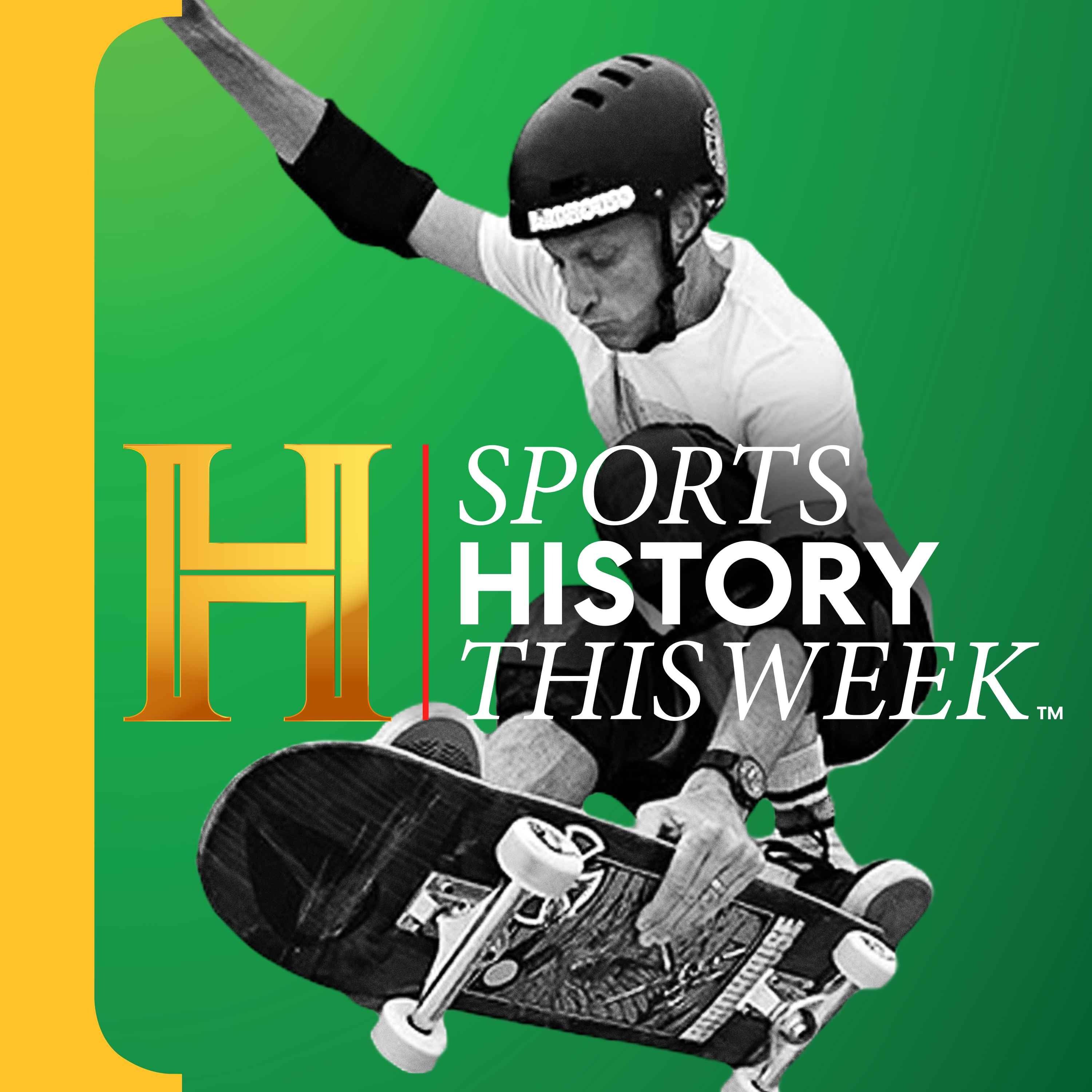
Tony Hawk's Perfect Storm (feat. Tony Hawk)
September 29, 1999. Mario Kart 64, The Legend of Zelda, and Donkey Kong sit atop the gaming world. A new franchise, though, is about to explode onto the scene: Tony Hawk Pro Skater.The hype wave has been building thanks to a free demo. And then at the X-Games – Tony Hawk lands the 900. All of the sudden, Hawk and skateboarding are thrust into the national spotlight. It's at this perfect moment the game is released. Within a few months, Tony Hawk Pro Skater becomes a national best-seller, and twenty-three years later the game has achieved unimaginable success, leading to 12 subsequent versions.Today, Tony Hawk's Pro Skater makes its global debut. What made this game uniquely special? And what legacy did it leave?Special thanks to our guests; Tony Hawk, pro skateboarder; Scott Pease, former Studio Development Director at Neversoft Entertainment; Mick West, co-founder of Neversoft Entertainment; Ludvig Gür, director of Pretending I’m A Superman; and Kofie Yeboah, engagement editor at Secret Base. Hosted on Acast. See acast.com/privacy for more information.
Tom Brady's Lucky Break
September 23, 2001. In his first game back after the tragic events of September 11th, Drew Bledsoe -- the highest paid quarterback in the NFL and the undisputed face of the New England Patriots -- is hoping to lead his team to his second Super Bowl appearance. But a brutal fourth quarter hit lands Bledsoe in the hospital, and his backup -- a relatively unknown late-round draft pick -- comes in and changes the fortunes of the franchise forever. His name is Tom Brady.How did Brady handle being thrust into the spotlight under such pressurized conditions? How did Bledsoe handle Brady's near-instant success? And what was it about Brady's skills, both on and off the field, that contributed to him becoming the most decorated quarterback in NFL history?Special thanks to our guests: Dan Shaughnessy, longtime Boston Globe sports columnist, Michael Smith, former ESPN and the Boston Globe sportswriter and now host of Brother From Another on Peacock, and Chad Brown, founder of Profile, a behavioral analysis service used by NFL teams during the NFL Draft. Hosted on Acast. See acast.com/privacy for more information.
The Birth of the NFL
September 17, 1920. Football in America has arrived. Team after team joins the growing landscape: the Muncie Flyers, the Rock Island Independents, the Decatur Staleys. While more teams are waiting in the wings, the on-field product is a bit of a mess.Few fans are interested, players are on shaky contracts, and—maybe most importantly—the game itself is boring. At a car dealership in Canton, Ohio, team representatives are gathered today with the ambitious goal of fixing football.Today, the precursor to the NFL is established. How did a small, underfunded football league, based largely in east coast cities and midwestern factory towns, morph into the NFL, a pop culture juggernaut that is now the richest sports league in the world?Special thanks to our guests John Eisenberg, author of The League, and Ken Crippen, former executive director of the Professional Football Researcher's Association and founder/lead instructor of the Football Learning Academy. Hosted on Acast. See acast.com/privacy for more information.
Deion Sanders Lights Up Atlanta
September 10, 1989. The Atlanta Falcons are excited to witness the debut of their highly-anticipated rookie, whom they took fifth overall in the NFL Draft earlier that year. He’s young, he’s flamboyant, and he has not one, but two already-famous nicknames: Neon Deion and Prime Time. This is Atlanta’s first introduction to Deion Sanders, who would become a sports and cultural icon for the city, as he’d eventually call Atlanta home for the early parts of his professional football and baseball careers. But along with the money, endorsements, and fame come scrutiny, misperceptions, and controversy, particularly when he attempts the unprecedented move of playing in an NFL and MLB game on the same day. Today, Deion Sanders makes his professional football debut. Why did he draw so much criticism from certain media members? And what made Deion Sanders a unique figure in sports history? Special thanks to our guests: Chris Miller, quarterback for the Atlanta Falcons from 1987-93; Mark Bradley, columnist for the Atlanta Journal-Constitution; Anne Scearce, former client services manager for Nike; Jimmy Raye II, NFL coach from 1977-2013; and Sid Bream, former first baseman for the Atlanta Braves. Hosted on Acast. See acast.com/privacy for more information.
Appalachian State vs. Goliath
September 1, 2007. A roaring crowd overlooks a football field in Ann Arbor, Michigan. The top-ranked University of Michigan team is going up against a small North Carolina school, Appalachian State University. Michigan paid App State to come to town... and lose. And yet, things have not gone as planned. Michigan trails by two points with just six seconds left in the game. They're positioned to kick a game-winning field goal, and the win all but certain. Today, David takes on Goliath. Can Appalachian State go into the Big House and pull off one of the biggest upsets in sports history? And how does this one game change the trajectory of a small North Carolina college town for years to come?Special thanks to David Jackson, former Appalachian State University play-by-play announcer; Jeff Dillman, former Appalachian State University strength and conditioning coach; CoCo Hillary, former Appalachian State University wide receiver; John Holt, former Appalachian State University right guard; Jay Sutton, former Appalachian State University associate athletic director; Charles Davis, former Big 10 lead analyst; Julian Rauch, former Appalachian State University kicker; and David Marmins and Steven Feit, co-authors of the book Appalachian State Silences The Big House. Hosted on Acast. See acast.com/privacy for more information.
Trans Rights Take Center Court at the U.S. Open
August 27, 1976. Renee Richards expects to play tennis at this year’s U.S. Open. Coming off several impressive performances in top amateur tournaments, she wants to try her hand against the best competition in the world. But today, shortly before the tournament is set to begin, the USTA bars her from playing on the basis of her gender identity. A media firestorm and a precedent-setting lawsuit soon followed, changing the landscape for trans athletes for generations to come. Why did the U.S. Open initially decide to keep Renee Richards from competing, only to reverse its decision 11 months later? And how does her landmark court case continue to impact trans athletes and other marginalized groups to this day?Special thanks to our guests; Joanna Harper, Ph.D researcher in transgender athletic performance at Loughborough University, author Sporting Gender: The History, Science, and Stories of Transgender and Intersex Athletes; Karleigh Webb, writer and contributor for SB Nation’s Outsports.com and host of the Trans Sporter Room Podcast; and Schuyler Bailar, a gender literacy and transgender advocate and educator, and creator of LaneChanger, an online gender literacy learning series. Hosted on Acast. See acast.com/privacy for more information.
The Longest Free Fall
August 16, 1960. Captain Joe Kittinger steps into the passenger compartment of a balloon. He's preparing to travel higher than anyone has ever been in open-air: more than 100,000 feet. From there, he plans to jump. Today, Joe Kittinger sets the unofficial record for longest and highest parachute jump along with the longest free fall in history. His success will change the future of space travel. What does Kittinger’s mission reveal about human’s ability to survive at altitudes never reached before? And will the mission be enough to inspire humans to travel beyond the Earth?Special thanks to Colonel Joe Kittinger himself, and Craig Ryan, co-author of Come Up And Get Me: An Autobiography of Colonel Joe Kittinger. Hosted on Acast. See acast.com/privacy for more information.
Michael Phelps Dominates at Beijing
August 11, 2008. It's Day 3 of the Summer Olympics in Beijing, and Michael Phelps is ready. This is the 4x100 freestyle, a swim relay race where Phelps and his team will look to overcome the odds and win gold. But for Phelps, one gold medal isn't enough. He wants to win eight of them. But this race will prove to be his largest obstacle yet. Today, Michael Phelps at the 2008 Beijing Olympics. How did Phelps and his team execute their mission to break record after record? And how did these Olympics prove he might be the greatest athlete of all time? Special thanks to our guests, Bob Bowman, the head swimming coach for Arizona State University and former coach of Michael Phelps and Team USA; Rowdy Gaines, three-time Olympic gold medalist and TV broadcaster; and Childs Walker, sports enterprise reporter for The Baltimore Sun. Hosted on Acast. See acast.com/privacy for more information.
The Fate of the Black Sox
August 2, 1921. Hundreds wait inside a Chicago courthouse for the verdict. Seven Chicago White Sox players are accused of intentionally throwing the World Series, losing on purpose to collect a payout. For decades, gambling has been a part of America's pastime, but this fix is too big to ignore. The nation feels betrayed, yet is transfixed by the scandal, spending months following the whirlwind case. Today, the 1919 Chicago Black Sox scandal comes to a head. How do these baseball players conspire to intentionally lose the World Series? And will their punishment be enough to root out gambling in the sport forever? Special thanks to Charles Fountain, author of The Betrayal: The 1919 World Series and the Birth of Modern Baseball, and Jacob Pomrenke, Director of Editorial Content for the Society of American Baseball Research. Hosted on Acast. See acast.com/privacy for more information.
One Inch Gives England Its Only World Cup
July 30, 1966. England wins their first, and so far only, World Cup. And yet even today, over half a century later, one specific element of that victory is still viewed by many as one of the all-time most controversial sports moments. What led to the controversy? Will it ever be resolved? And how did the 1966 England soccer team revolutionize the on-field tactics of how the game would be played for decades to come? Special thanks to our guests; John Stiles, a former professional footballer and son of 1966 England national team midfielder Nobby Stiles; David Tossell, who wrote biographies on Jimmy Greaves and Alan Ball, two key contributors to the 1966 team; and John Hughson, a professor of Sport and Cultural Studies at the University of Central Lancashire, and author of England and the 1966 World Cup, A Cultural History. Hosted on Acast. See acast.com/privacy for more information.
Three Boxers Take on the Cold War (A Partnership With Eclipsed)
July 19, 1980. Three young boxers are circling a track in front of thousands of people in downtown Moscow. Alberto Mercado, Jose Molina, and Luis Pizarro have found themselves as the sole representatives of Puerto Rico in this year’s controversial Summer Olympic Games. The young men are here in defiance of their own nation’s government and the government of the United States. The U.S. and 64 other countries are boycotting the Summer Olympics this year. The decision is meant to disavow the Soviet invasion of Afghanistan the year before. Puerto Rico is initially expected to boycott too, as an American territory. But they don’t.Today, why do these three boxers make the controversial choice to go compete behind the Iron Curtain? And is it worth the risk to defy the United States? Special thanks to Bijan Stephen and the Eclipsed podcast team. Hosted on Acast. See acast.com/privacy for more information.
The Land Speed Wars Reignite
July 17, 1964. Donald Campbell climbs into the cockpit of the Bluebird CN7 in the Australian desert with one goal in mind: breaking the world land speed record. In doing so, he sets off two incredible years of drama and heart-stopping competition between rivals, families, and even corporations, thousands of miles away in the United States. What incredible lengths did these competitors go to in order to win the never-ending arms race for the record? What propelled these men and women to such achievements? And what major innovation in the 1960s changed the world of speed forever? Special thanks to our guests, Louise Ann Noeth, author of Bonneville Salt Flats, and Tim Arfons, professional racer and son of former world land speed record holder Arthur Arfons. Hosted on Acast. See acast.com/privacy for more information.
Lou Gehrig Says Goodbye
July 4, 1939. In front of more than 60,000 fans, Lou Gehrig steps up to the microphone. The “Iron Horse” had played in 2,130 consecutive games for the New York Yankees, manning first base in the Bronx for 17 seasons. But because of a debilitating yet little-known illness, amyotrophic lateral sclerosis (or ALS), Gehrig’s career is forced to come to an end. So on this day, “Lou Gehrig Appreciation Day,” he’s asked to give an impromptu speech to thank Yankee fans for their years of support. Gehrig was legendarily shy—he never sought the spotlight—but what followed became one of the most famous speeches in American history. Today, how did Lou Gehrig become a legend in his own time? And what did it mean to have an athlete suffering from ALS consider himself “the luckiest man on the face of the earth”? Special thanks to Jonathan Eig, journalist and author of Luckiest Man: The Life and Death of Lou Gehrig. Hosted on Acast. See acast.com/privacy for more information.
The Dream Team Debuts Against the World
June 28, 1992. Michael Jordan, Larry Bird, Magic Johnson, Charles Barkley, and more step onto the court in public for the very first time as teammates. They take center stage against Cuba, in their first tune-up before they would become a truly global phenomenon at the ’92 Olympics in Barcelona. This is the world’s introduction to the Dream Team.Anyone who knew basketball had a pretty good idea that this team of future Hall-of-Famers would romp to a gold medal. But what they might not have known was the behind-the-scenes drama involved in putting together this legendary roster.How did this team change the way international basketball was played forever? What led to the sudden rule change that allowed pro basketball players in the Olympics after decades of America sending only amateurs? And just who was on the only team that did (privately) beat the Dream Team?Special thanks to our guests: Jack McCallum, senior writer for Sports Illustrated and author of the bestseller Dream Team, and Ken Rosenthal, senior writer for The Athletic who covered the Dream Team for the Baltimore Sun in 1992. Hosted on Acast. See acast.com/privacy for more information.
Title IX at 50 with Billie Jean King
June 23, 1972. President Richard Nixon’s men broke into the Watergate complex just six days earlier. He’s attempting some damage control, but in between meetings with his staff, Nixon signs a new bill into law – the Educational Amendments of 1972. He isn’t aware of it at the time, but Title IX of this law will change women’s sports forever. The bill’s passage comes after years of campaigning, and the most prominent face of this movement is one of the great athletes of her era: Billie Jean King. Today, Billie Jean King sits down with Sports History This Week to unpack her role in this monumental legislation. How did she use her platform to fight for gender equality in athletics? And after the passage of Title IX, how did she literally battle for women everywhere? Special thanks to our guests: Billie Jean King, a champion of tennis and of equality, and Susan Ware, historian and author of Game, Set, Match: Billie Jean King and the Revolution in Women's Sports. Hosted on Acast. See acast.com/privacy for more information.
Introducing: Sports History This Week
trailerSports History This Week, hosted by Kaelen Jones, brings to life moments in competition that redefined sports and our culture through gripping narratives, sounds from the archives, discussions with experts, and interviews with athletes who were there.For stories like this that go beyond the world of sports, check out History This Week wherever you get your podcasts. Hosted on Acast. See acast.com/privacy for more information.