
Social Science Bites
126 episodes — Page 2 of 3
Bobby Duffy on Generation Myths
In the West we routinely witness instances of intergenerational sniping – Boomers taking potshots at over-privileged and under-motivated Millennials, and Millennials responding with a curt, "OK, Boomer." What do we make of this, and is it anything new? These are questions Bobby Duffy, professor of public policy and director of the Policy Institute at Kings College London, addresses in his latest book, Generations – Does when you're born shape who you are? (published as The Generation Myth in the United States). In this Social Science Bites podcast, Duffy offers some key takeaways from the book and his research into the myths and stereotypes that have anchored themselves on generational trends. "My one-sentence overview of the book," Duffy tells interviewer David Edmonds, "is that generational thinking is a really big idea throughout the history of sociology and philosophy, but it's been horribly corrupted by a whole slew of terrible stereotypes, myths and cliches that we get fed from media and social media about these various differences between generations. My task is not to say whether it's all nonsense or it's all true; it's really to separate the myth from reality so we don't throw out the baby with the bathwater." One thing he's learned is that the template for generational conflict is fairly standard over time, even if the specifics of what's being contested are not. "The issues change," he explains, "but the gap between young and old at any one point in time is actually pretty constant. … We're not living through a time of particularly 'snowflake,' 'social justice warrior' young people vs. a very reactionary older group – it's just the issues have changed. The pattern is the same, but the issues have changed." Taking a look at climate change, for example, he notes that there's a narrative that caring young people are fighting a careless cadre of oldsters unwilling to sacrifice for the future good. Not so fast, Duffy says: "The myth that only young people care about climate is a myth. We are unthinkingly encouraging an ageism within climate campaigning that is not only incorrect, but it is self-destructive." That example, he notes, adds evidence to his contention that "the fake generational battles we have set up between the generations are just that – they are fake." In the podcast, Duffy outlines the breakdowns his book (and in general larger society) uses to identify cohorts of living generations: Pre-war generation, those born before the end of World War II in 1945. Duffy says this could be broken down further – the so-called Silent Generation or the Greatest Generation, for example – but for 2022 purposes the larger grouping serves well. Baby Boomers, born from 1945 to 1965 Generation X, 1966 to 1979 (This is Duffy's own generation, and so, with tongue in cheek, he calls it "the best generation"!) Millennials, 1980 to around 1995 And Gen Z, ending around 2012 He notes that people are already talking about Generation Alpha, but given that generation's youth it's hard to make good generalizations about them. These generation-based groupings are identity groups that only some people freely adopt. "We're not as clearly defined by these types of groupings as we are by, say, our age or educational status or our gender or our ethnicity." His research finds between a third and half of people do identify with their generation, and the only one with "a real demographic reality" (as opposed to a solely cultural one) is the Baby Boomers, who in two blasts really did create a demographic bulge. Duffy, in addition to his work at King's College London, is currently the chair of the Campaign for Social Science, the advocacy arm of Britain's Academy of Social Sciences. Over a 30-year career in policy research and evaluation, he has worked across most public policy areas, including being seconded to the Prime Minister's Strategy Unit. Before joining KCL he was global director of the Ipsos Social Research Institute. His first book, 2018's The Perils of Perception – Why we're wrong about nearly everything, draws on Ipsos's own Perils of Perception studies to examine how people misperceive key social realities.
Gerd Gigerenzer on Decision Making
Quite often the ideas of 'risk' and of 'uncertainty' get bandied about interchangeably, but there's a world of difference between them and it matters greatly when that distinction gets lost. That's a key message from psychologist Gerd Gigerenzer, who has created an impressive case for both understanding the distinction and then acting appropriately based on the distinction. "A situation with risk," he tells interviewer David Edmonds in this Social Science Bites podcast, "is one where you basically know everything. More precisely, you know everything that can happen in the future … you know the consequences and you know the probabilities." It is, as Bayesian decision theorist Jimmie Savage called it, "a small world." As an example, Gigerenzer takes us a spin on a roulette wheel – you may lose your money on a low-probability bet, but all the possible options were known in advance. Uncertainty, on the other hand, means that all future possible events aren't known, nor are their probabilities or their consequences. Rounding back to the roulette wheel, under risk all possibilities are constrained to the ball landing on a number between 1 and 36. "Under uncertainty, 37 can happen," he jokes. "Most situations in which we make decisions," says Gigerenzer, "involve some sort of uncertainty." Dealing with risk versus dealing with uncertainty requires different approaches. With risk, all you need is calculation. With uncertainty, "calculation may help you to some degree, but there is no way to calculate the optimal situation." Humans nonetheless have tools to address uncertainty. Four he identifies are heuristics, intuition, finding people to trust, and adopting narratives to sustain you. In this podcast, he focuses on heuristics, those mental shortcuts and rules of thumb that often get a bad rap. "Social science," he says, "should take uncertainty seriously, and heuristics seriously, and then we have a key to the real world." When asked, Gigerenzer lauds Daniel Kahneman and Amos Tversky for putting "the concept of heuristics back on the table." But he disagrees with their fast-slow thinking model that gives quick, so-called System 1 thinking less primacy than more deliberative thinking. "We have in the social sciences a kind of rhetoric that heuristics are always second best and maximizing would be always better. That's wrong. It is only true in a world of risk; it is not correct in a world of uncertainty, where by definition you can't find the best solution simply because you don't know the future." Researchers, he concludes, should "take uncertainty seriously and ask the question, 'In what situations do these heuristics that people use (and experts use) actually work?' and not just say, 'They must be wrong because they are a heuristic.'" Gigerenzer is the director of the Harding Center for Risk Literacy at the University of Potsdam and partner at Simply Rational – The Institute for Decisions. Before that he directed the Center for Adaptive Behavior and Cognition at the Max Planck Institute for Human Development and at the Max Planck Institute for Psychological Research. His books include general titles like Calculated Risks, Gut Feelings: The Intelligence of the Unconscious, and Risk Savvy: How to Make Good Decisions, as well as academic books such as Simple Heuristics That Make Us Smart, Rationality for Mortals, Simply Rational, and Bounded Rationality. Awards for his work include the American Association for the Advancement of Science Prize for Behavioral Science Research for the best article in the behavioral sciences in 1991, the Association of American Publishers Prize for the best book in the social and behavioral sciences for The probabilistic revolution, the German Psychology Award, and the Communicator Award of the German Research Foundation. He was a 2014 fellow at the SAGE Center for the Study of the Mind University of California, Santa Barbara (SAGE Publishing is the parent of Social Science Space) and a fellow of the Association for Psychological Science in 2008.
Ellen Peters on Numeracy
"It's been said there are three kinds of people in the world, those who can count and those who can't count." So reads a sentence in the book Innumeracy in the Wild: Misunderstanding and Misusing Numbers, published by Oxford University Press in 2020. The author of Innumeracy in the Wild is Ellen Peters, Philip H. Knight Chair and director of the Center for Science Communications Research at the University of Oregon. In this Social Science Bites podcast, Peters – who started as an engineer and then became a psychologist – explains to interviewer David Edmonds that despite the light tone of the quote, innumeracy is a serious issue both in scale and in effect. As to scale, she notes that a survey from the Organisation for Economic Co-operation and Development found 29 percent of the US adult population (and 24 percent in the UK) can only do simple number-based processes, things like counting, sorting, simple arithmetic and simple percentages. "What it means," she adds, "is that they probably can't do things like select a health plan; they probably can't figure out credit card debt," much less understand the figures swirling around vaccination or climate change. Peters groups numeracy into three (a real three this time) categories: Objective numeracy, the ability to navigate numbers that can be measured with a math test; subjective numeracy, which is "not your actual ability, but your confidence in your ability to understand numbers and to use numeric kinds of concepts;" and intuitive or evolutionary numeracy, a human being's natural ability to do things like quickly determine if a quantity is bigger or smaller than another quantity. That middle type of numeracy, the subjective, is measured by self-reporting. "The original reasons for developing some of these subjective numeracy scales had to do with them just being a proxy for objective numeracy," says Peters. "But what's really interesting is that having numeric confidence seems to free people to be able to use their numeric ability." While freedom is generally reckoned to be good – and objective results back this up – that's not the case for those confident about their abilities but actually bad with numbers. Similarly, those who have high ability but are underconfident also do poorly compared to high ability and high confidence individuals. "There are some very deep psychological habits that people who are very good with numbers have that people who are not as good with numbers don't have," Peters explains. "It is the case that people who are highly numerate are better at calculations, but they also just simply have a better, more developed set of habits with numbers." Less numerate people "are kind of stuck" with the numeric information as presented to them, rather than transforming the information into something that might better guide their decisions. Peters offered the example of a person with a serious disease being told that a life-saving treatment still has a 10 percent chance of killing them. Highly numerate people recognize that that means it has a 90 percent survival rate, but the less numerate might just fixate on the 10 percent chance of dying. Closing out the podcast, Peters offers some tips for addressing societal innumeracy. This matters because, she notes, research shows that despite high rates of innumeracy, providing numbers helps people make better decisions, with benefits for both their health and their wealth.
Jonathan Haskel on Intangibles
The knowledge economy. Intellectual property. Software. Maybe even bitcoin. All pretty much intangible, and yet all clearly real and genuinely valuable. This is the realm where economist Jonathan Haskel of Imperial College London mints his own non-physical scholarship. "In the old days," relates the co-author of Capitalism without Capital: The Rise of the Intangible Economy, "the assets of companies, the sort of secret sauce by which companies would generate their incomes and do their services for which they're employed for, was very tangible-based. These would be companies with lots of machines, these would be companies with oil tankers, with buildings, with vehicles to transport things around. Nowadays, companies like Google, like Microsoft, like LinkedIn, just look very different." And that difference, he explains to interviewer David Edmonds in this Social Science Bites podcast, is knowledge. "What they have is knowledge," says Haskel, "and it's knowledge assets, these intangible assets, which these companies are deploying." Intangible investments, as you might expect, have different properties than do tangible ones. Haskel dubbed them the four S's: Scale. Once you have a handle on a successful intangible, like software, that can generally scale up without more capital spending; Sunk Costs. These are invested costs you can't get back, such as the costs of developing software; Spillovers. Aspects of your intangibles that others can copy or adopt for themselves; and Synergies. "If you put all these intangibles together," he explains, "you get more than the sum of the parts." Meanwhile, intangibles help keep modern economies humming – we think. "Accountants and statistical agencies are quite reluctant to measure intangibles because it's -- intangible. It's a rather difficult thing to get at; these are often goods that aren't traded from one person to another …" Part of Haskel's research effort is to quantify how much investment in intangibles is going on "behind the scenes," which fits in with other interests of his such as re-engineering how gross domestic product gets measured. Businesses are now spending more on intangibles then on tangibles: Haskel's work reveals that for every monetary unit companies spend on tangible assets, they spend 1.15 on intangible ones. In addition to serving as a professor at the Imperial College Business School, Haskel is director of the Doctoral Programme at the Imperial. He is an elected member of the Conference on Research in Income and Wealth and a research associate of the Centre for Economic Policy Research, the Centre for Economic Performance, LSE, and the IZA, Bonn. Haskel has been a non-executive director of the UK Statistics Authority since 2016 and an external member of the Bank of England's Monetary Policy Committee since 2019.
Sheila Jasanoff on Science and Technology Studies
Sheila Jasanoff, the Pforzheimer Professor of Science and Technology Studies at Harvard University's John F. Kennedy School of Government, is a pioneer in the field of STS. That acronym can be unpacked as either 'science and technology studies' or 'science, technology and society.' Jasanoff -- who describes herself as a sociologist of knowledge and a constructivist, trained in law, working in the tradition of the interpretive social sciences – is content with either use. "I think that represents two phases of the same field," she tells interviewer David Edmonds in this Social Science Bites podcast. "First of all, it's the field that looks in detail at the institutions of science and technology and asks, 'What are they like?' 'What does it feel like to be doing them?' 'What do they operate like as social institutions, as cultures, as formations in society?' The other face of STS – science, technology and society – is more about how science and technology function when they get out into the world at large." Amid that expansive view, some areas, of course, particularly interest Jasanoff. "The more interesting turn," she details, "was the turn that tried to occupy the territory previously given to philosophy of science, and started asking sociological and political questions about it." One such question is the eternal "What is truth?" STS, a brash newcomer, took on the inquiry with gusto. "It took a kind of arrogance, if you will, certainly a bravery, in the 1970s, to say that, 'Hey, truth isn't just out there. It's not just a Platonic thing and we try to approximate it. We can actually study truth as if it was a social production.' That," she explains, "was the heartland of science and technology studies." In the interview, Jasanoff outlines how science is often presented as a capital-T repository of Truth even in an age where the 'death of the expert' has become a common trope. Citing the pandemic and how scientific advice changed on mask wearing, Jasanoff argues that "people should not be surprised that in crisis mode the way we know things changes and therefore the advice may change. Science has been sold as a bill of goods for so long that it is the Truth, it is reliable, a fact is always fact the moment we assert it, that these sorts of commonsensical things that we ought to understand have become difficult for people to grasp." (Jasanoff's own research often looks at cross-national differences in her research, and after looking at mask-wearing in 16 nations she reports that "only in America has it become an article of faith – are you for science or against science" – based on your mask usage.) Remember, she continues, "The expert is not an embodiment of scientific fact. An expert is a particular kind of person who is qualified in particular ways, and every time we say 'qualification,' something about the English language or about language in general, forces us to look at the skills that allow one to be considered qualified. "In fact, we should look at the external periphery of the qualification; a qualification sets boundaries on what you know, but it also sets boundaries on what you don't know." Expertise is this double edged-thing." Jasanoff is the founder and director of Harvard's Program on Science, Technology and Society. She's the author of several books aimed at both the academy and the public, such as 1990's The Fifth Branch: Science Advisers as Policymakers, 2012's Science and Public Reason, and Can Science Make Sense of Life? in 2019. The University of Bergen, acting for the Norwegian Ministry of Education and Research, awarded her the Holberg Prize in March. That was the latest in a slew of honors for her research, including the University of Ghent Sarton Chair and the Reimar Lüst Award from the Alexander von Humboldt and Fritz Thyssen Foundations, a Guggenheim fellowship in 2010, and in 2018 the Albert O. Hirschman Prize from the Social Science Research Council. She is an elected foreign member of the Royal Danish Academy of Sciences and Letters, and a fellow of the American Association for the Advancement of Science, where she served on the board of directors.
John List on Economic Field Experiments
Any work in social and behavioral science presumably – but not necessarily immediately - tells us something about humans in the real world. To come up with those insights, research usually occurs in laboratory settings, where the researchers control the independent variables and which, in essence, rules out research 'in the wild.' Enter John List. "For years," he tells interviewer David Edmonds in this Social Science Bites podcast, "economists thought that the world is so 'dirty' that you can't do field experiments. They had the mentality of a test tube in a chemistry lab, and what they had learned was that if there was a speck of dirt in that tube, you're in trouble because you can't control exactly what is happening." Since this complex real world isn't getting any cleaner, you could conclusively rule out field experiments, and that's what the 'giants' of economics did for years. Or you could learn to work around the 'dirt,' which is what List started doing around the turn of the millennium. "I actually use the world as my lab," the Kenneth C. Griffin Distinguished Service Professor of Economics at the University of Chicago says. Since an early start centering on sports trading cards and manure-fertilized crop land (real field work, a self-described "bucolic" List happily acknowledges), his university homepage details a raft of field experiments: "I have made use of several different markets, including using hospitals, pre-K, grammar, and high schools for educational field experiments, countless charitable fundraising field experiments to learn about the science of philanthropy, the Chicago Board of Trade, Costa Rican CEOs, the new automobile market, coin markets, auto repair markets, open air markets located throughout the globe, various venues on the internet, several auction settings, shopping malls, various labor markets, and partnered with various governmental agencies. More recently, I have been engaged in a series of field experiments with various publicly traded corporations—from car manufacturers to travel companies to ride-share." In the podcast, List explains, "I don't anticipate or assume that I have a 'clean test tube,' but what I do is I randomly place people into a treatment condition or a control condition, and then what I look at is their outcomes, and I take the difference between those outcomes. That differences out the 'dirt.' "I can go to really dirty settings where other empirical approaches really take dramatic assumptions. All I need is really randomization and a few other things in place and then if I just take the simple difference, I can get an average treatment effect from that setting." His work – in journal articles, popular books like The Voltage Effect and The Why Axis, in findings applied immediately outside of academe – has earned him widespread praise (Gary Becker terms his output as "revolutionary"), a huge list of honors, and a recurring spot on Nobel shortlists. For this podcast, List focuses on two of the many areas in which he's conducted field experiments: charitable giving and the gig economy. He describes one finding from working with different charities around the world over the last 25 years on what works best to raise money. For example, appeals to potential donors announcing their money would be matched when they gave, doubling or tripling a contribution's impact. When he started, it was presumed that the greater the leverage offered by a match, the more someone would give, since their total gift would be that much greater. "There was no science around it … it was art, or gut feeling." It was also wrong. List tested the assumption, offering four different appeals to four different groups: one with just an appeal for funding, one with a 1:1 match, one with a 2:1 match, and the last a 3:1 match. And the results bore out that matching a contribution amped up the results – but the leverage didn't matter. "Just having the match matters, but the rate of the match does not matter." List was later the chief economist with ride-share behemoth Uber – and then with its competitor, Lyft. He coined the term Ubernomics for his ability to manipulate the tsunami of data the company generated. "It's not only that you have access to a lot of data," he says, "it's also that you have access to generating a lot of new data. As a field economist, this is a playground that is very, very difficult to beat."
Kathelijne Koops on Chimps and Tools
Kathelijne Koops, a biological anthropologist at the University of Zurich, works to determine what makes us human. And she approaches this quest by intensely studying the use of tools by other species across sub-Saharan Africa. "Look at us now …" she tells interviewer David Edmonds in this Social Science Bites podcast. "We are really the ultimate technological species. And the question is, 'How did we get to where we are now?' If we want to know why we are so technological, and how do we acquire tool-use skills, etc., it's really interesting to look at our closest living relatives, chimpanzees and also bonobos. "Why do, or don't they use tools, and what do they use tools for, and what environmental pressures might influence their tool use." So Koops has been studying, first as a grad student and now as director of her own lab, the Ape Behaviour & Ecology Group at the University of Zurich, several groups of wild apes. (Chimps and bonobos, along with orangutans and gorillas, are labelled as great apes, and with humans, are members of the family Hominidae.) She also directs the Swiss National Science Foundation-funded Comparative Human and Ape Technology Project, which looks at ecological, social and cognitive factors on the development of tool use. In this interview, Koops focuses on two decades of work she and her team conducts, along with Guinean collaborators from the Institut de Recherche Environnementale de Bossou, in the Nimba Mountains in the southeastern portion of the West African country of Guinea. The field site is remote, and work takes place in 10-day shifts at one of two camps. Researchers gather data on the chimps during daylight hours – if the chimps cooperate. "If the chimpanzees want to get away they can," Koops details, "so even though we've worked there a long time you cannot follow them all day like you can at some other study sites." The researchers also use motion-triggered cameras near well-trod areas – the humans dubbed them "chimpanzee highways" – where the chimps frequent. Among the tool-using behaviors Koops has seen in the study group is seeing these chimps use long sticks to dig up ants for a snack without being devoured themselves, and using stones and branches to open up fruit casings. What this group doesn't do, she continued, is use "percussive techniques" to open up edible nuts, even though another population of chimps a few kilometers away does exactly that. To see if it is opportunity or is it necessity that spurred tool use and tool evolution, Koops' team "cranked opportunity up by a million" by scattering lots of nuts that were otherwise less common in the primary forest habitat of the Nimba residents alongside lots of handy stones good for nut-cracking. The result was … not much innovation by the chimps. "It really seems difficult to innovate on your own," she comments. "… They really need to see from another chimpanzee how to crack these nuts." In general, she notes, there's not much 'active teaching' among her subjects but a lot of observation of older individuals. She cites other experimenters' similar work on 4- and 5-year-old humans, which in turn saw similar low instances of innovation. While being careful not to overclaim, Koops says "it looks like some of the building blocks of our culture are really already there in chimps."
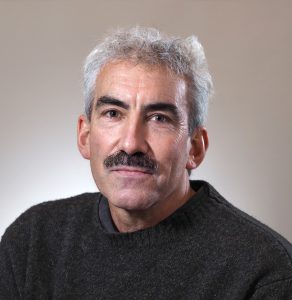
George Loewenstein on Hot and Cold Affect
The idea of walking a mile in someone else's shoes is often trotted out as a metaphor for understanding empathy. The act of imagining someone else's reactions may be hard, but based on the body of work by George Loewenstein, predicting how -- under varying circumstances -- we might walk in our own shoes may not be all that easier. Loewenstein is the Herbert A. Simon University Professor of Economics and Psychology at Carnegie Mellon University in Pittsburgh, Pennsylvania. His enormous range of research interests can be boiled down, after a lot of boiling, to applying psychology to economics and, more recently, economics to psychology. His career as a founder of both behavioral economics and neuro-economics has seen him delve deeply into how we react when our "affective state" is cold – when are emotions are absent and our physical needs are currently met – compared to when our affective state is hot. The latter is when out emotions are active or when our passions, as the old philosophers might term things like things hunger, thirst, pain, sexual desire, are pulling us. It turns out, as he explains to interview David Edmonds in this Social Science Bites podcast, "when we are in one affective state it's difficult for us to imagine how we would behave if we were in a different affective state. … The worst mistakes we make are when we are in a cold state, because we just can't imagine how we would behave if we were in a hot state." While this may seem like something we know intuitively (or after years of high-profile experiments by Lowenstein, his frequent collaborator Leaf VanBoven, and others have conducted, several described in this podcast), it's not something we act on intuitively. "No matter how many times we experience fluctuations in affective states," Loewenstein says, "it just seems we don't learn about this. We are always going to mis-predict how we're going to behave when we're in a hot state if we're making the prediction when we're in a cold state." This, in turn, affects the products of people who make predictions (or if you prefer, policy prescriptions) as a profession, he adds, such as economists. "According to conventional economics, when we make decisions about the future we should be thing about what it is will we want in the future. What all of these results show is that your current state influences your prediction about what you're going to want in the future; it influences these decisions that we make for the future in unproductive, self-destructive ways."
Joel Mokyr on Economic Lessons from the Past
"I tell my students, 'If somebody utters the sentence that starts with the words, "History teaches us" the rest of the sentence is probably wrong.' History has no direct lessons for almost anything. Our own age is sufficiently different, sufficiently unique, from what happened in the past that any facile lessons from history are more likely to mislead than to enlighten." That series of caveats comes from Joel Mokyr, who, perhaps counter-intuitively, is an economic historian. And in fact, the Robert H. Strotz Professor of Arts and Sciences and professor of economics and history at the Chicago-area Northwestern University shows in this Social Science Bites podcast that there's quite a bit to learn from history if you keep your expectations in check. For example, he explains that "the good old days weren't all that good and that the very best time to be born in human history is today. That sounds hard to believe in an age where we're all running around with face masks and facing quarantine, but it's still true." For his own part, Mokyr tells interviewer Dave Edmonds, "I use economics to understand history, and I use history to understand economics." Mokyr's ties to economic history are deep: he was president of the Economic History Association in 2003-04, spent four years in 1990s as senior editor of the Journal of Economic History, was editor-in-chief of the Oxford Encyclopedia of Economic History, and is currently editor-in-chief of the Princeton University Press Economic History of the Western World series of monographs. From that perch, he explains, presumably with a smile, that his peers work with 'expired data.' Economic historians "scour the past looking for large data sets that we can use in some way to make inferences. The issue of causality becomes somewhat of an obsession in economics these days, and economic history is very much a part of this." In this interview, Mokyr details how the improvement in the human condition he cited above is connected to the Industrial Revolution. "The Industrial Revolution is particularly important because that's where it all started -- before 1750 almost nowhere in the world were living standards approaching anything but miserable and poor." Economic activity before the year 1750 was mostly the story of trade, he explains, while after 1750, it became the story of knowledge. "The Industrial Revolution was the slow replacement of trade and finance and commerce by another thing, and that is growing knowledge of natural phenomena and rules that can be harnessed to material welfare of people." To demonstrate this approach, he offered the example of steel. While it has been made for centuries it wasn't until 1780 that anyone knew roughly why this alloy of iron and carbon resulted in such a useful metal, and therefore could exploit its properties more by design than by chance. "If you don't know why something works," Mokyr said, "it's very difficult to improve it, to tweak it." Mokyr's scholarship has earned him a variety of honors, including the biennial Heineken Prize by the Royal Dutch Academy of Sciences for a lifetime achievement in historical science in 2006. He has also written a number of prize-winning books, including The Lever of Riches: Technological Creativity and Economic Progress, The Gifts of Athena: Historical Origins of the Knowledge Economy, and most recently, A Culture of Growth.
Karin Barber on Verbal Arts
Verbal arts, explains Karin Barber, emeritus professor of African cultural anthropology at the University of Birmingham, are "any form of words that have been composed in order to attract attention or invite interpretation which is intended to be repeatable in some way." They are, she continues, central to all sorts of social processes, "just as much a part of people's lives as kinship or economic activities." In this Social Science Bites podcast, Barber offers a specific case study of the application of the verbal arts by examining in depth some of the genres common in the Yoruba-speaking areas of Western Africa. Barber said there are more than 30 million people who speak Yoruba, with the largest number in southwestern Nigeria, where much of Barber's own scholarship has taken place. She describes the study of Yoruba as a large field in academe, with "hundreds and hundreds" of Yoruba scholars building it up. Barber herself grew up in Yorkshire and did her first degree, in English, at Cambridge University. She next studied social anthropology at University College London and after a stint in Uganda was told that if she really wanted to pursue her examination of African theater she should go to Nigeria. Her Ph.D. – based on 37 months of field work studying oral poetic performance in everyday life in a Yoruba town - came from Nigeria's University of Ifẹ (now Ọbafẹmi Awolọwọ University). Barber then spent the next seven years as a lecturer in the Department of African Languages and Literatures at the University of Ifẹ, where courses were taught in Yoruba. Barber's scholarship has resulted in several notable books and monographs. The 1991 monograph I Could Speak Until Tomorrow: Oriki, Women and the Past in a Yoruba Town won the Amaury Talbot Prize for African Anthropology; 2000's The Generation of Plays: Yoruba Popular Life in Theatre won the Herskovits Award of the African Studies Association; The Anthropology of Texts, Persons and Publics from 2007 won the Susanne K. Langer Award of the Media Ecology Association; and 2012's Print Culture and the First Yoruba Novel won the Paul Hair Prize of the African Studies Association and the Association for the Preservation and Publication of African Historical Sources. In this interview, she tells host David Edmonds about two particular genres of Yoruba verbal arts: ifa, or divination poetry, and oríkì, translated as praise poetry. "Divination is how people govern and manage their lives," she explains, "so this poetry is really central to how people analyze what's happening to them and take steps to make sure that things work out as they wish." Praise poetry, "strings and strings of epithets hailing the subject's qualities," meanwhile, "celebrates and commemorates and highlights the essential characteristics of a person or god or a family or town or an animal. Somehow it evokes the inner essence, the inner properties, and activates them, galvanizes them." This genre, she details, has changed over the years, emphasizing wealth in the 19th century but more personal qualities and achievements today. "Changing power dynamics are revealed, not necessarily in what the verbal arts specifically say, but in the way they are formed, in the way they are transmitted, who reads them or who listens to them." And so verbal arts matter in a social science context. "All verbal arts are produced in an economic and institutional context. You could ask, why did this new genre appear in this context, this particular moment in history. What caused people to devise this way of commenting on society and formulating ides in this particular way? It's because of the prevailing interplay of social forces." For her work, Barber has received a number of high honors, ranging from a Yoruba chieftaincy title - she is the Iyamoye ("mother who has insights") of Okuku – to appointment as Commander of the Order of the British Empire in the 2012 and Dame Commander of the Order of the British Empire earlier this year.
Melanie Simms on Work
COVID-19 has changed everything, including how we work (and to be more precise, are employed). But in order to best understand how things have changed, and hopefully to grapple with how they will be, it helps to have studied how they were. Enter Melanie Simms, professor of work and employment at the University of Glasgow 's Adam Smith Business School, and the author – in 2019 – of What Do We Know and What Should We Do About the Future of Work? In this Social Science Bites podcast, Simms explains that while the idea of working from home seemed to be the dominant narrative during the pandemic, it's only one of two "real headlines." That's in large part because the people who talk publicly about working from home are academics and journalists, both groups that did work from home. In fact, Simms relates, in the United Kingdom about 70 percent of workers spent some or all of their time at their workplace. The less public headline, she notes, is that there seems to be a large group of people who have left the labor market during the pandemic – often women with children. And while improving options for childcare might see more mothers in employed positions, Simms notes a different trajectory for older workers -- almost anyone over 50 who has left the workforce in the last year-and-a-half struggles to re-enter it -- regardless of kind of work they do. In discussion with interviewer David Edmonds, Simms details that while she does look at global trends, her research mostly focuses on the United Kingdom, and thanks to the regulatory ecosystem and a skew toward the service economy, what's true in the UK can't automatically be applied elsewhere. Among the subjects Simms and Edmonds touch on are the "regrowth" of the middle class female workforce starting in the 1960s; the difficulties that a lack of childcare routinely creates for working women; the aging of the workforce as young people stay in school longer (delaying their entry into the labor marker) while at the same time older workers remain active in the labor market for longer; de-industrialization; labor unions; and the gig economy, which Simms sees as more about how work is allocated than a change in work itself.
Jeffrey Ian Ross on Convict Criminology
"Convict criminology," Jeffrey Ian Ross explains in this Social Science Bites podcast, is "a network, or platform, that's united in the perception that the convict voice has been either neglected or marginalized in scholarship or policy debates in the field of criminology in general, and corrections in particular." Ross, a professor in the School of Criminal Justice at the University of Baltimore, is one of the originators of the concept, he tells interviewer David Edmonds. Seeing "a big gap" in the work of criminology and corrections, in the early 1990s he and Stephen Richards focused on tapping "the lived experience of convicts" for this academic work. Both men had experience with the corrections system – Ross had worked for several years in a correctional institution and later was a social science analysts with U.S. Department of Justice, while Richards had spent three years in federal prison for marijuana distribution before becoming a professor. About half of the people in the field of convict criminology are either ex-convicts, have impacted by the prison system or are prison activists who have or are in the process of getting a PhD in criminology, Ross says. "Many people who have a criminal conviction try to keep it quiet," Ross says about jobseekers in academe (or anywhere), and he's proud of the strides convict criminologists have made. "We've managed to forge a beachhead and produce very impressive scholarship," he says, all the while offering authenticity and degree of inside knowledge. Convict criminology, he details, rests on three pillars: scholarly research, mentorship, and some sort of service or activism. All three pillars arise from a "desire and goal to make a meaningful impact on prison conditions." So mentorship, for example, might involve having ex-cons be mentors in re-entry programs, while scholarly research benefits from both having an inside view that pays extra dividends when interviewing incarcerated or formerly incarcerated subjects and in understanding the nuances of their accounts. Ross has written, co-written or edited a number of books on criminology, including the Routledge Handbook of Street Culture and Convict Criminology for the Future, both out this year. He has received a number of awards over the years, including the University of Baltimore's Distinguished Chair in Research Award in 2003; the Hans W. Mattick Award, "for an individual who has made a distinguished contribution to the field of criminology and criminal justice practice," from the University of Illinois at Chicago in 2018 Last year he received both the John Howard Award from the Academy of Criminal Justice Sciences' Division of Corrections and the John Keith Irwin Distinguished Professor Award from the American Society of Criminology's Division of Convict Criminology.
Molefi Kete Asante on Afrocentrism
Molefi Kete Asante, the chair of the Department of African American Studies at Philadelphia's Temple University, has long been at the forefront of developing the academic discipline of Black studies and in founding the theory of Afrocentrism, "the centering of African people in their own stories." In this Social Science Bites podcast, Asante offers an insiders view of the growth of the Afrocentric paradigm, from the founding of the Journal of Black Studies a half century ago to the debates over critical race theory today. "Afrocentricity," Asante tells interviewer David Edmonds, "is a paradigm, an orientation toward data, a perspective, that says that African people are subjects, rather than objects, and that in order to understand narratives of African history, culture, social institutions, you must allow Africans to see themselves as actors rather than on the margins of Europe, or the margins of the Arab culture, or the margins of Asian culture." While that might seem a mild prescription, it's one that has been often ignored. Asante offers the example that the waterfalls between Zimbabwe and Zambia had a name (Mosi-oa-Tunya for one) before European explorer David Livingstone arrived and dubbed them Victoria Falls. "Livingstone is operating in the midst of hundreds of thousands of African people – kings and queens and royal people – yet the story of southern Africa turns on David Livingstone. The Afrocentrist says that's nonsense; here's a white guy in the midst of Africa and that you turn the history of Southern Africa on him does not make any sense to us." Asante then details some of his own efforts in centering the stories of Africa and the African diaspora in their own narratives, including the founding of the first academic journal focused on doing so. He details how as a PhD student in 1969, he and Robert Singleton started the effort to create the Journal of Black Studies as a forum for the nascent academic discipline. (The story sees SAGE Publishing, the parent of Social Science Space, and its founder Sara Miller McCune taking an important role as the one publisher that embraced Asante's proposal in 1970.) "The journal survives," he explains 50 years later, "based on its relevance to contemporary as well as historical experiences." At the time the journal was founded, Asante directed the University of California Los Angeles' Center for Afro American Studies from 1969 to 1973. He chaired the Communication Department at State University of New York-Buffalo from 1973 to 1980. After two years training journalists in Zimbabwe, he became chair of the African American Studies Program at Temple University where he created the first Ph.D. Program in African American Studies in 1987. He has written prodigiously, publishing more than 75 books, ranging from poetry on Afrocentric themes to high school and university texts to the Encyclopedia of Black Studies.
Jennifer Richeson on Perceptions of Racial Inequality
There is inequality in the United States, a fact most people accept and which data certainly bears out. But how bad do you think that inequality is, say, based on comparing the wealth held by the average Black person in America and the average white person? This is one of the questions that Jennifer Richeson, a social psychologist at Yale University, studies. She has news -- bad news -- about both the actual gap and what people across the board think that gap is. First off, the facts. The Black-white wealth gap in the United States is, in Richeson's words, "staggeringly large." Citing figures from 2016, she notes that "the average Black family had about 10 percent of the wealth of the average white family." The actual percentage in wealth improved slightly in the five years since, "but the important thing is that it's a huge, staggering gap that has been persistent for 50 to 60 years." With the gap so large and so persistent, you might expect estimates of its size to reflect reality. You would be mistaken, as Richeson tells interviewer David Edmonds in this Social Science Bites podcast. "If you ask the average American on any given day, they will probably say the wealth gap is around 65, 70 percent. … That's not only wrong, it's very wrong compared to the actual wealth gap. … Part of the reason we're so wrong is because we really believe that since the 50s, 60s, 70s, 80s, things have gotten dramatically better and are continuing to get better." The perception is that roughly since the Civil Rights era the gap narrowed from about half to near parity. Respondents to these sorts of questions "feel compelled to conform to this narrative of racial progress" in their estimates, a narrative that Richeson has likened to a mythology. "No, things are not fine – they are similarly bad as they were in the 60s. That's true for the wealth gap, that's true for the wage gap. Income is slightly better, but not much. It's a persistent and pervasive staggering inequality that's stubborn, and our psychology refuses to believe that." Visions of this delusional economic advancement are shared broadly across the nation's economic and ethnic strata; "Black Americans," Richeson says, "are more accurate but still really wrong." Her research has found that the more you believe in a just world, the more your estimate will underestimate the gap. This suggests in part why Black Americans – with daily experiences of structural inequality – give estimates that are at least a little closer to the mark. "One reason we believe there is this gap between Black Americans and white Americans is because of the differential tendency to believe that outcomes are fair and only determined by your individual effort, talent, hard work." This massive misperception matters. While "being this wrong about anything is interesting" academically, Richeson says, the magnitude of this misperception affects individual and societal wellbeing; it also undermines the idea behind the so-called American dream, that American society is a meritocracy. American cannot, she says, "just know the truth and do nothing about it." Richeson, the Philip R. Allen Professor of Psychology at Yale, received the SAGE-CASBS Award in 2020 for her work and will deliver a COVID-delayed lecture at the Center for Advanced Study in the Behavioral Sciences at Stanford University later this year. That was one of a number of honors she has accumulated, including a 2007 John D. & Catherine T. MacArthur Foundation Fellowship (known as the "genius award"), a John Simon Guggenheim Memorial Foundation Fellowship (2015), the Mamie Phipps Clark and Kenneth B. Clark Distinguished Lecture Award from Columbia University (2019), the Career Trajectory Award from the Society of Experimental Social Psychology (2019), and a Carnegie Foundation Senior Fellowship (2020).
Jennifer Lee on Asian-Americans
The twin prods of a U.S. president trying to rebrand the coronavirus as the 'China virus' and a bloody attack in Atlanta that left six Asian women dead have brought to the fore a spate of questions about Asian Americans in the United States. Columbia University sociologist Jennifer Lee has been answering many of those questions her entire academic career, and across four books, dozens of journal articles and untold media appearances. One of the first questions she answers in this Social Science Bites podcast is who are 'Asian Americans'? As she tells interviewer David Edmonds, "No one comes to the United States and identifies as an Asian American." Instead, if asked, they are likely to identify with national origin or ethnicity – say Chinese, or Japanese, or Filipino – rather than with the umbrella construct of Asian American. "'Asian American,'" Lee explains, "was originally conceived as a political identity by student activists at Berkley in the 1960s who coined the term as a unifying pan-ethnic identity to advocate for Asian-American studies in university curricula and to build coalitions with other marginalized groups." Since then, it evolved into a demographic category, and in 1997 the U.S. Census Bureau grouped together people from East Asia, Southeast Asia and South Asia under the classification of 'Asian.' (Those regions, of course, don't include everyone from the continent of Asia – where are the Kazakhs and the Uzbeks, for example – and does include people from the islands adjacent to the land mass – Japanese, Malaysians, Filipinos.) "These are groups don't have a whole lot in common in terms of language, culture, religion, history," Lee notes, but they are bound by various forms of exclusion in the U.S. But their presence in the United States in growing rapidly. Combined, Asians are the fastest growing demographic in the U.S.; their population is up 27 percent in the last decade to about 23 million people, or 7 percent of the total U.S. population. Immigration is a key component of that growth, notes Lee, who herself emigrated to the U.S. with her Korean parents when she was 3. Some four out of five current Asian Americans are foreign-born, she explains, and continuing immigration replenishes the cohort of 'new' Asian Americans. That, she suggests, will keep the category of Asian-American alive for some time. Immigration also contributes to the trope – a trope Lee rejects – that "'Asians have some set of values that make them successful." Instead, she argues that due to who has emigrated, America "engineered this idea that Asians are successful." Asian immigrants coming to the United States are not just a random sample of the population in their countries of origin; they are extremely educated, more likely to hold a B.A. than those who don't immigrate, and they're also more likely to have a college degree than the U.S. mean. It's this 'hyper selectivity' that largely accounts for educational and economic accomplishments of America's Asians, she argues here and in her latest award-winning book, The Asian American Achievement Paradox, written with Min Zhou. Lee offers several data points during the podcast to buttress the idea that innate cultural values are not driving success. For one thing, the distribution of Asian American accomplishments are not evenly distributed: Indian-Americans have exceptionally high educational achievements while Cambodian, Laotian and Hmong Americans have relatively low graduation rates. Plus, Lee says, if 'values' drove the success, we'd see the same successes in the immigrants' Asian countries of origin or in other areas where Asian diasporas are represented – and we don't. Lee is the Julian Clarence Levi Professor of Social Sciences at Columbia and past president of the Eastern Sociological Society. She is or has been a fellow at the Center for the Study of Economy and Society, the Center for Advanced Study in the Behavioral Sciences at Stanford, the Center for the Study of Race, Politics and Culture at the University of Chicago, and a visiting scholar at the Russell Sage Foundation and a Fulbright Scholar to Japan. She will join the board of trustees for the Russell Sage Foundation this fall.
Martha Newson on Identity Fusion
Despite being someone who doesn't "particularly enjoy the game," cognitive anthropologist Martha Newson is drawn to football. "Football is one of the most exciting games to watch as an anthropologist," she explains in this Social Science Bites podcast. "I'm not watching the ball go around the pitch – I'm watching the fans. I'm transfixed by them! You go through all the emotions in a single match." Newson, based at the universities of Kent and Oxford, describes for interviewer David Edmonds how fans of football often fuse their own identities into a tightly bonded group (even as they retain their individuality). This "identity fusion," in which fans feel completely immersed in their group, is widely seen outside of sports. Some obvious venues are national identity, religion, or family group, places where individuals will go to extreme ends to defend or protect our group. "The research has expanded to look at how we can fuse to a value or an idea," Newson notes. But studying football (or soccer) offers some pragmatic advantages to the researcher. For one, the bonding is very public and very passionate. Fused fans will tattoo themselves, for example, an indelible statement that demonstrates they're much easier to access and observe than say a terrorist cell or secretive political group. And football fandom is diverse culturally and geographically. One study Newson is working on currently taps into fanbases in Indonesia, Australian, Britain, Brazil and Spain. While there are differences in each country, "the love of the fans is quite consistent." (And it is also love for the fans, Newson says, since it seems to be fusion to their fellow fans, and not necessarily the team or town, that's the real driving force of cohesion.) Newson has taken an innovative and interdisciplinary approach in her research, conducting surveys of fans, measuring their physiological responses and even drawing on existing and disparate databases like police records of fan violence. And while violence or hostility may be linked in the popular imagination with extreme fandom, Newson's research offers a more nuanced view. When someone feels their group is being threatened, like a mother bear they may wade in to defend their group. But when things are pleasant, like that same bear, so are they. "Fused fans preferred to be cooperative and altruistic to their rivals over being hostile toward them," Newson has found. "The more fused you are, you are more likely to be violent than the less-fused fans," she adds, "but that's only because you're looking out for your group in some way." Identity fusion research also finds that having bonded is a lifetime commitment, regardless of losses (and perhaps abetted by them!). "Once you are fused, you don't unfuse – fusion really sticks," Newson explains, adding that the primacy of the bond may wax and wane over time.
Olivier Sibony on Decision-Making
When human judgment enters the picture, so too will errors in human judgment. Think of this as "noise," just as you might think of a signal-to-noise ratio in an audio signal. And just as in listening to music, this noise is not a feature, but a flaw. In the context of human action, management professor at HEC Paris and former McKinsey senior partner Olivier Sibony defines "noise" as the unwanted variability in human judgment. "When you look at how people make a professional judgment, there is an average error … and that is what has traditionally been called bias in statistics and in the study of judgment. But when you have already identified bias, there is something left, and that is the unshared error, the unwanted variability of errors, that is noise." In a new book, Noise: A Flaw in Human Judgment, by psychologist and Bites alumnus Daniel Kahneman, Sibony, and Harvard law professor Cass Sunstein (author of Nudge), the trio look at the lottery that noise creates in social outcomes, and discuss ways to practice better "decision hygiene" to prevent noise from infecting important outcomes. Coinciding with the release of Noise, Sibony spoke with interviewer David Edmonds in this Social Science Bites podcast about noise as a concept, the types of noise, why acknowledging it matters, and a little on what we can do to avoid it. This is an area of great interest for Sibony, whose own research centers on reducing the impact of behavioral bias. "Bias and noise," Sibony explains, "are mathematically equivalent in the effect they have on error. Noise causes exactly as much error as bias does for the same quantity of noise or bias. "And so, if you can reduce noise, you can reduce error." Or put another way, make better decisions. He gives the example of insurance claims adjusters. "When you look at how two of these people judge the same case, what price they set on the same insurance policy or the price they set on the same claim, and you ask them how much they expect to disagree, they say, 'Of course we're not going to be in perfect agreement; it's a matter of judgment, after all. It's still a calculation – we're not just adding up numbers and saying, "The answer is X." Otherwise our job would just be automated. That's what makes the job interesting – it's a matter of judgment. So we expect some disagreement between us. But hey! We are all highly qualified, competent people, so we are more or less interchangeable depending on who is available.'" If you ask the adjusters, or their bosses, about how much variability they expect, the answers come back around 10 percent. And if you ask business executives in general what they would expect the difference to be – and Sibony talked to hundreds -- the answers came back at 10 to 15 percent. But looking at the actual variability in real life, he reveals, the differences vary by as much as 55 percent. This isn't just some peculiarity of insurance. "This was," Sibony said, "something we found everywhere we looked!" He offers many examples: assessments by financial professionals, x-rays read by skilled doctors, professors grading essays, and many more. What he terms "big differences" appeared repeatedly "More worrisome, perhaps, if you look at how judges sentence people who have been found guilty of a crime … [W]hen the average sentence is seven years in prison, the average difference, the mean difference between two judges is three-and-a-half." And so, as Sibony notes, when appearing before two judges, you've already been sentenced to five years, or to nine years, "just based on the luck of the draw." This variability, this happenstance in outcomes, matters for a trio of reasons: fairness ("when similarly located people are not treated similarly, it is unfair"); credibility of the underlying institutions; and because we're routinely making bad (or at least not the best) decisions. In addition to teaching strategy, decision making and problem solving at HEC Paris, Sibony is an associate fellow at Oxford University's Saïd Business School. He writes often on strategy and decision making in the academic and popular press, and his book Vous Allez Commettre Une Terrible Erreur ! (published in English as You're About to Make a Terrible Mistake!) received the was awarded the Manpower Foundation Grand Prize in 2019 for best management book. He is also a knight in the French Order of the Légion d'Honneur.
Whose Work Most Influenced You? Part 4
"That's such a hard question," Gina Neff, a sociologist at the Oxford Internet Institute, responds when asked what social science research or thinker most influenced her. "It's like a busman's holiday for an academic, because so many things have influenced my thinking." Her answer, by the way, was Ulrich Beck's concept of the risk society, as explained in this 1986 book. In this montage drawn from the last two years of Social Science Bites podcasts, interviewer David Edmonds poses the same question to 25 other notable social scientists. For many of the guests, the answer proves difficult to pin down to just one person or work ("That's like asking who's your favorite kid," was David Halpern's first response). For a few guests, the response is instant. "A simple answer, really," replies Rupert Brown, naming a fellow social psychologist, Turkish-American Muzafer Sherif, and his work in the 1950s. And sociologist Les Back, too, answers instantly: "Don't even have to think about it: WEB DuBois's The Souls of Black Folk. DuBois is the writer who captures both the heat and the passion of life and also the cool historical perspective and analysis in the most extraordinary compound of literary expression." Back, in turn, was mentioned by one scholar: Kayleigh Garthwaite as her great influencer. A number of the guests cited titans from the early days of social science – Max Weber, Karl Marx, Pierre Bourdieu, Emile Durkheim, while others named modern-era titans like Stephen Pinker, Daniel Kahneman, Jonathan Haidt or Jean Piaget. And many named creators of the new canon – Jim Scott cited A.P. Thompson's Making of the English Working Class, Alondra Nelson picked Troy Duster's Backdoor to Eugenics, and Gurminder Bhambra tabbed Danielle S. Allen's Talking to Strangers: Anxieties of Citizenship since Brown v. Board of Education. And no such list would be complete without a wild card, and for that we turn to Michelle Gelfand, who turned to Herodotus' The Histories and the lessons a 2,500-year-old post-mortem of an ancient war can teach us today: "He was a brilliant cross-cultural psychologist … he also had a really interesting observation — that all humans are ethnocentric. They don't just think that their culture is different, they think it's better." This is the fourth collection in this series (and the 100th Social Science Bites podcast).
Jim Scott on Resistance
When Jim Scott mentions 'resistance,' this recovering political scientist isn't usually talking about grand symbolic statements or large-scale synchronized actions by thousands or more battling an oppressive state. He's often referring to daily actions by average people, often not acting in concert and perhaps not even seeing themselves as 'resisting' at all. The 'problem' with political scientists, he tells interviewer David Edmonds, in this Social Science Bites podcast, "is that when they're talking about resistance they're tending to talk about overt declarations – protests in the streets, marches, or potentially armed combat. What I've found is that throughout history, open resistance of this kind is impossible or suicidal. The result is a lot of what I call 'unobtrusive forms of resistance.'" There are, he notes, "very many different kinds of resistance: forms of resistance that announce themselves publicly and forms that are more subtle and unobtrusive in order to protect the people who are protesting from massive retaliation." He offers several examples of this unobtrusive resistance, such as poaching, squatting, and desertion - "common weapons of people who don't have formal power." In this podcast, Scott draws on the year and half he spent in a Malaysian village, in the late 1970,s to discuss insights he gained about resistance (and which resulted in his Weapons of the Weak: Everyday Forms of Peasant Resistance). Scott learned the Malay language, acquainted himself with the local Kedah dialect, and studied first the rich and then the poor in this village. Mechanized, combine harvesters had taken over rice harvests in the area, leaving many people out of work and many tenants homeless. While there was no organized public protesting – that would have been foolhardy – he witnessed sabotage in the fields and ousted tenants killing the chickens of those who had evicted them. In a "a subtle showing of contempt," people who felt badly treated would look the other way when someone they hated crossed their path. "The kind of shunning was extraordinarily effective and humiliating in a face-to-face community of such a small size." It reflected, in turn, the psychic violence done to the poor -- "Inequality and injustice almost always is reflected in a loss of cultural dignity and standing." Scott sees resistance from several vantage points in large part because he's untethered himself from many academic restrictions, "defecting" from a discipline when he finds its approaches miss the point. He trained as a political scientist, for example, but as he saw how it studied elites and mass populations differently -- conducting social science "behind their backs," as he put it -- he decamped to anthropology. ( But he argues every anthropologist should come with a historian strapped to their back. "James Scott has taught us to see how art can fuel resistance, how social planning can undermine social justice, how anarchic principles inform everyday acts of resistance, and how agriculture led to the rise of state control," said Tamar Szabó Gendler, the dean of Yale's Faculty of Arts and Sciences, when the Social Science Research Council awarded him the Albert O. Hirschman Prize last year.
Michèle Lamont on Stigma
The study of stigma, , says Michèle Lamont, is a "booming field." That assessment can be both sad and hopeful, and in this Social Science Bites podcast the Harvard sociologist explains stigma's manifestations and ways to combat it, as well as what it takes for a researcher to actually study stigma. Lamont defines stigma "as the negative characterization of any social attribute," and offers examples such as mental illness, social status, or obesity as conditions routinely stigmatized. And while stigma can attach itself to an individual or to a group, stigma requires intersubjective agreement for it to function. As that intersubjectivity would suggest, the specifics of stigma varies by culture, a point brought home by Lamont's own research among stigmatized groups in the United States, Brazil, Israel (and which saw her 2016 co-authored book Getting Respect: Responding to Stigma and Discrimination in the United States, Brazil, and Israel). The work involved more than 400 interviews, conducted by members of the stigmatized groups, in the three countries, and Lamont offers insights into how stigma plays out. The project paid people $20 in the U.S. to be interviewed, but the Brazilian team said Brazilians would be insulted if they were offered money to participate. In Israel, Palestinians being surveyed didn't trust Tel Aviv University, so that created obstacles even though the team members were themselves Palestinian Lamont cites the work of Erving Goffman, who studied this experience of having a negative mark. (See this earlier Social Science Bites podcast for a look at Goffman's legacy.) One key concept is that of "front stage" and "back stage," where someone manages their life in a public way (the domain of stigma) but also in a private way. Lamont, professor of sociology and of African and African American studies and the Robert I. Goldman Professor of European Studies at Harvard, directs the Weatherhead Center for International Affairs. She was president of the American Sociological Association in 2016-17 and chaired the Council for European Studies from 2006-09. She received a John Simon Guggenheim Fellowship in 1996, a Gutenberg research award in 2014, the 2017 Erasmus Prize, and an Andrew Carnegie Fellowship for 2019-21. To download an MP3 of this podcast, right-click HERE and save.
Diego Gambetta on Signaling Theory
What we tell people about ourselves is not exclusively, or often not even majorly, what comes out of our mouths. A host of nonverbal messages emanate from us, many of them intentionally sent to create or reinforce a narrative for a recipient who is left trying to judge the veracity of the sum total of the information. The study of this signaling in the content of an asymmetry of information is known as 'signalling theory.' In this Social Science Bites podcast, Diego Gambetta, a professor of social theory at the European University Institute in Florence, discussing his research around signaling theory and the applications of his work, whether addressing courtship, organized crime of hailing a cab. "The theory," he tessl interview Dave Edmonds, "has to do with the unobservable qualities of interest. The question is, how much scope do we have to con each other, to cheat each other. … What I would like to know about you is more than is what is apparent. The things that we are interested in are not written on our foreheads." Signaling theory's value, he continues, comes in "trying to establish when truth can be communicated even in conditions that are difficult, in which we expect the interests of the parties communicating to diverge, or to not completely overlap." This gives the theory a wide range of applications, which is reflected in its own birthing. Initially formalized by economists, particularly Nobel Prize winner Michael Spence. Who used it to show how can an employer can determine if a job applicant in likely to be highly productive or not. At roughly the same time, Gambetta explains, there was a "an intuitive expression of the theory" by an animal behaviorist, Amotz Zahavi. In the social and behavioral realm where Gambetta works, signally theory shows in utility whether the parties are in conflict – hence his work examining the Italian mafia -- or cooperation – studying taxi drivers in Belfast and in New York City. "In a conflict," Gambetta details, "I may want to persuade you that I am really, really tough. If this is true, and you believe me, then we may sort the conflict out cheaply for both of us because we don't enter into a damaging fight." And in cooperation, how do you accept the accuracy of someone's representations (or convince someone of your own honest representation) that they do indeed possess the qualities they feel, or say, they have. Given the current mass trial of alleged members of the 'Ndrangheta crime syndicate in Italy, perhaps Gambetta's work among the mafiosos is is most salient at the moment. "I was alerted to the importance of symbolic communication in the mafia by the way they communicated with each other, and also, on a couple of occasions, with how they communicated with a researcher, myself included. They display a subtlety in communication that surprised me. We tend to expect an organized criminal to excel at brutality and intimidation, but we can't really expect them to be a lot subtler than we are in communicating." He gives the example of a Canadian researcher who announced plans to research the mafia. The researcher's car was burglarized, his dirty laundry stolen, and a few days later the laundry came back, cleaned and ironed, with a note that said, "Goodbye." It was, Gambetta noted, "a more enthusiastic rendition of 'I know where you live.'" "Violence," he adds, "is known to us because it leaves a body on the ground, it attracts attention. But there is a subtlety in threatening." And in Palermo, for instance, there is "an obsessive search for meaning" – the workaday side of the signaling theory coin. Another workaday aspect revolved around his work studying taxi drivers, who had to determine which passengers they would pick up based on the drivers' perception of the person hailing them being a fare that was safe and trustworthy. These instant assessments can rely, however, on short-cuts that reek of racial profiling. In New York, for example, Gambetta that even Black drivers wouldn't pick up young Black people. This essentially removes the service from that population – "the cost of proving your bona fides, that you are a real passenger despite your age and color, is too costly, is too complicated." In addition to his professorship at the European University Institute, Gambetta is the Carlo Alberto Chair at the Collegio Carlo Alberto in Turin, and an official fellow at Nuffield College, University of Oxford. Among his books are 2016's Engineers of Jihad, Codes of the Underworld: How Criminals Communicate from 2009, and 1993's The Sicilian Mafia. The Business of Private Protection.
Mike Tomasello on Becoming Human
Consider two different, but similar situations. In the first, children are asked to pull ropes together. Candy cascades down, but in unequal distribution – three for one child and one for the other. In the second situation, the children come across the sweets but without joint labor, and again find an uneven distribution. What usually happens next differs between the two situations. When the kids work together, they tend to willingly share the proceeds so everyone ends up with an equal share. But when the candy was discovered through individual serendipity, the children tend to accept the uneven outcome and don't equalize shares. The first situation involves what Mike Tomasello, the James F. Bonk Distinguished Professor of Psychology at Duke University, would call joint commitment; "When children produce sweets collaboratively they feel they should share them equally." There's no explicit promise of an equal share, but there is an implicit one that's just as recognizable and genuine. As Tomasello details to interviewer David Edmonds in this Social Science Bites podcast, "I can say I don't like it when you keep all the sweets – that's my personal opinion – but when I say 'you shouldn't do that, you mustn't do that, you must do this, you have to do that,' this is not my personal opinion. This is something objective." While this might be a normative bond that helps glue humans together, it's not a bond he finds in our closest relatives. Tomasello points out that among chimps – with which the longtime co-director of the Max Planck Institute for Evolutionary Anthropology has a deep background researching - the dominant partner takes the spoils in almost all cases. The "we-ness" that can mark human behavior is replaced by the "me-ness" of other primates. That difference between primates and people is the basis of much of Tomasello's career (see the work of the Tomasello Lab at Duke: "studying the development and evolution of social cognition, communication, and cooperation") and of his 2018 book, Becoming Human: A Theory of Ontogeny. Much of his effort has focused on great apes, our closest primate relatives, following a line of research that started with Jane Goodall learning that apes make and use tools. Great apes share many qualities with human beings – they understand causal relations, can work with the concept of quantities, can predict what others might do based on what they see and what their goal is, are good social learners, can communicate with gestures (and can learn new ones), and can work with one another in some cases. But Tomasello notes a key area in which apes and people differ. "Humans put their heads together, as a general phrase, to accomplish things that neither one can do on his or her own. So if you look at all the things you think are most amazing about humans – we're building skyscrapers, we have social institutions like governments, we have linguistic symbols, we have math symbols, we have all these things – not one of them is the product of a single mind. These are things that were invented collaboratively at the moment or else over time as individuals build on one another's accomplishments." Great apes and other creatures – ants and bees do offer a limited counter-example -- don't do that. Understanding this evolved capacity – Tomasello doesn't like using terms like "hard-wired" or "innate" – isn't just a matter for academic interest. While he shied away from talking about the normative implications of his research and theories, Tomasello noted the benefits of cooperation and collaboration (and also some of its less-welcome artefacts such as creating out-groups to discriminate against), whether in sports, or work, or society. While he wouldn't develop public policies, "If you want a more cooperative society, I can tell you some things that would help."
Belinda Winder on Pedophilia
Forensic psychologist Belinda Winder, who founded and heads the Sexual Offences, Crime and Misconduct Research Unit at Nottingham Trent University, wants society to understand one key aspect about pedophilia. "Many people understand pedophilia to be both a sexual attraction to children but also the act of committing abuse against children," she explains to interviewer David Edmonds in this Social Science Bites podcast. "And that's wrong." Those are two different things, she continues. "Pedophilia is sexual attraction – enduring and sustained sexual attraction. Not something that someone wakes up with one day, but something that people have come to realize, sometimes over many months, that they have a sexual attraction, maybe a sexual preference, for pre-pubescent children." Of course sexual abuse against children does occur, and Winder explains that's not pedophilia but pedophilic disorder, "where someone acts on their interests." The disorder also covers the significant mental difficulty, such as guilt or embarrassment, that having this attraction may cause. (And it's worth noting that Winder reports that more than half of the people convicted of committing sexual abuse against pre-pubescent children are not pedophilic.) Winder's research, conducted in the United Kingdom, United States, Canada, Australia and New Zealand, shows this distinction between urge and action matters greatly for addressing pedophilia. This is especially true in an environment where its merest whiff results in instant condemnation – and where the angry ornaments of that condemnation serve none of the victims of pedophilic disorder, whether the children or the offender. "Until we as a society can see there is a difference between a sexual preference for children which we cannot change and cannot do anything about and we did not choose, versus committing sex abuse against a child — which absolutely people should take responsibility for, which they do have control over and which they can change — then I think the world is going to be quite a difficult place for anyone who wants to step forward and say, 'This is me, what a most unfortunate sexual orientation to have.'" That awareness helps in therapies that have been shown to successfully address pedophilic disorder offenders. "It's taking the blame for the preference and the interest from people but putting the responsibility for their behavior squarely back with the person." Winder set up the Sexual Offences, Crime and Misconduct Research Unit in 2007 to build upon the collaborative relationship between Nottingham Trent's Psychology Department and the British prison Whatton, one of Europe's largest sex offender prisons with more than 830 convicted male sex offenders housed there. She is also co-founder, trustee, vice chair and head of research and evaluation for the 6-year-old Safer Living Foundation, a charity that conducts and evaluates initiatives that help to prevent further victims of sexual crime. In this podcast Winder discusses the prevalence of pedophilia, how it can be viewed as a sexual orientation, and what responses work – and which don't – in addressing the disorder. On the latter, Winder sees some popular responses to offenses as ineffective at best and harmful at worst. Imprisonment, Winder says, is appropriate for the crime but does little to deal with the underpinnings of why people committed child sex offenses. But some of the programs set up to address those underpinnings, like Britain's former Sex Offender Treatment Programme, don't work. "[SOTP] was carefully evaluated and some of the aspects of that which really didn't seem to work at all was the idea that we needed to encourage more empathy in people, the idea that empathy was important – if we encourage more empathy then people wouldn't offend – that's just too simplistic and has not been shown to work. Part of the SOTP was getting people to go through every minutiae of what they had done and the offense they had committed, and again, I think that's more to encourage shame, and shame can be very counterproductive. If you are dwelling in a pool of shame, then it may be you feel you are beyond saving." Exclusion also doesn't help, which is why Winder has a special scorn for sex-offender registries, which she calls "actively ineffective." "If what you need is to connect with other people – this is what helps you not offend again in the future. … Once you've been brought to task for your sexual offending you are highly unlikely to commit another one. But the thing that might push you to re-offending is not having people to talk to, not having a place to stay. So really we need to allow people to resettle."
Salma Mousa on Contact Theory (and Football)
There's an intuitive attraction to the idea that if we could just spend some quality time with someone from another group, we'd both come to appreciate, and maybe even like, the other person and perhaps even their group. Enormously simplified, that's the basis of contact theory, which Gordon Allport posited in the 1950s as the United States grappled with desegregating its public schools. If differing groups could be brought together cooperatively – not competitively – in a manner endorsed by both groups and where each side met on an equal footing, perhaps we could, as Salma Mousa puts it in this Social Science Bites podcast, "unlock tolerance on both sides and reduce prejudice." Mousa, currently a postdoctoral research fellow at Stanford University's Department of Political Science, tells interviewer David Edmonds that since Allport's heyday, "We have [had] a lot of studies about contact, but we need experimental tests of contact." She's been working to address that need, sometimes using the football pitch as a field site, with work that's caught both the public and the scientific imagination. One experiment she was part of examined the incidence of hate crimes once Mohamed "Mo" Salah, the talented Egyptian soccer star, signed with Liverpool Football Club. The results were heartening; Merseyside, where the club is located, experienced a 16 percent drop in hate crimes while anti-Muslim tweets from Liverpool's fans dropped to half the number compared to fans of other Premier League clubs. In this interview, Mousa details another experiment involving football and otherness, albeit an experiment made under harsher conditions: "We set out to learn if positive, social contact across social lines can reduce prejudice, can build friendships, can overall improve relationships between groups even in postwar settings, like Iraq." The experiment was conducted along the faultlines of northern Iraq where there's a Kurdish enclave. Working with a Christian community organization which was helping Christians and Muslims displaced by ISIS, the researchers recruited Christian amateur soccer players for a football league. They then added three or four players to each team, randomly adding either all Muslims or all Christians as the newcomers, and tracked player attitudes and actions on the field and off for a half year after the season ended. Amid some "really profound friendships" that formed, survey results and observed behavior showed that the Christian players came to be much more accepting and welcoming of their Muslim teammates. But that warming did not make the leap to their attitudes towards Muslims in general, suggesting some underlying prejudices remained in place. While her promising findings nonetheless were not the "home run" people of good will would have liked, the research earned the cover of the journal Science, and left Mousa feeling optimistic about further possibilities of contact theory. Given the difficult context of postwar Iraq and subjects scarred by their flight from ISIS, "to find some evidence that these guys actually became friends and we changed something in these communities, I think is positive, especially given that these communities are persecuted and highly distrustful." Fostering tolerance and eroding prejudice, especially in the Middle East, matters personally to Mousa, an Egyptian-Canadian who grew up in Saudi Arabia, the United Arab Emirates, Qatar and Canada. She's focused on helping "fix" the region's ethnic and religious divides: "I think of myself as an engineer but with a social science background." Mousa has held fellowships at the U.S. Institute of Peace, Stanford's Immigration Policy Lab, the Freeman Spogli Institute, the Stanford Center for International Conflict and Negotiation, the McCoy Center for Ethics in Society, and the Stanford Center on Philanthropy and Civil Society. Her work has been supported by the Abdul Latif Jameel Poverty Action Lab, the Innovations for Poverty Action Lab, the King Center on Global Development, the Institute for Research in the Social Sciences, the Program on Governance and Local Development, and the Abbasi Program in Islamic Studies.
Alondra Nelson on Genetic Testing
Sociologist Alondra Nelson calls it "root-seeking" – individuals wanting to know their ethnic background. Knowing who your people were as a way to know who you are verges on being a human need – witness the Hebrew Bible or the carefully tended genealogies of royal houses. In her own seeking, Nelson has studied the rise and use of direct-to-consumer genetic testing as made popular by companies like 23andme, Ancestry.com and AncestryDNA. Those firms and others promise to decode, at least in part, stories found in your own chromosomal makeup. As Nelson achieved other career milestones, including being the current president of the Social Science Research Council and the Harold F. Linder Professor at the Institute for Advanced Study, she's also spent close to two decades unraveling the story of consumer genetic testing, accounts of which resulted in two of her books, Genetics and the Unsettled Past: The Collision of DNA, Race, and History and the new The Social Life of DNA: Race, Reparations, and Reconciliation after the Genome. In this Social Science Bites podcast, Nelson describes her particular interest in those root-seekers whose journeys usually aren't captured in antebellum church registries or in tales passed down in the same hamlet through countless generations. She's focused on the descendants of people 'stolen from Africa' in the slave trade, who make up so much of the African diaspora. In surveys and later in extensive interviewing among the African-American community, Nelson found a great deal of interest among Black Americans in DNA testing despite some historical misgivings. "Marginalized communities, and in the context of the U.S., African-Americans in particular, have a very understandable historic distrust of genetic research and medical experimentation," she explains to interviewer David Edmonds. "So the fact that African Americans were early adopters in this space is surprising given that history. What's not surprising is the genealogical aspiration that many African Americans are trying to fulfill – a profound and pronounced and often very living and present longing sense of loss and longing about identity, original family names, of points and places on the continent of Africa where one's ancestors might have come from." She also learned, as her investigations branched out from surveys of the genealogical community to interviews with test-takers, that "getting the test results was really the beginning of the endeavor, rather than the end. "What in the world did you think you could do with this information, besides filing it away in a drawer and telling your family that we now know that we have Ibo, Yoruba, whatever the test provided for ancestry?" Answering that question meant Nelson's own approach must evolve. "That transformed the methodology to a kind of ethnographic methodology that I call the 'social life of DNA' in which I followed what happened with the test, what happened with the information, what did they think that these genetic inferences could do with the world. That really opens up a whole other space of thinking about the importance of genetic testing." Part of that space she explored is uniquely American. For much of (White) America, one's ethnic ties to the 'old country' – to be Irish or Italian, say -- are a linchpin of identity. "That's not been available to African Americans," she notes, whose roots are assigned to an amorphous blob of sub-Saharan Africa, since specific roots were eradicated when now enslaved peoples arrived in the New World. "People lost their given names, lost the languages of their foremothers and forefathers," Nelson said. "[P]art of the work of what slave-making entailed was taking people from often very different places on the continent of Africa, with different languages, cultural norms, religious backgrounds and to create out of a multicultural and multiethnic diverse group of people of different backgrounds a 'caste'." The dark-skinned newcomers were henceforth categorized as a race, and that race was assigned the caste of enslaved person. Genetic testing, in turn opens up that 'Black box' of lost identity and reveals what place and culture forebearers were likely ripped from. (Nelson, for example, had her own code analyzed and discovered a component of her heritage was from what is now Cameroon.) In this podcast, Nelson also talks about how Black Americans may respond to their growing awareness of their specific genetic identities, how this might impact the reparations debate in the United states, and why people are primed to be emotional at reveals of their genetic heritage. In addition to her two books on genetic testing, Nelson writes extensively at the nexus of science, technology, and social inequality. Her publications, for example, include the books Body and Soul: The Black Panther Party and the Fight against Medical Discrimination and Technicolor: Race, Technology, and Everyday Life. She is also editor of "Afrofuturism," an influential sp
Heidi Larson on Vaccine Skepticism
As the toll from the COVID-19 pandemic increased, polling suggests counterintuitively that resistance to a future vaccine has also risen. Anthropologist Heidi J. Larson identified several likely drivers of this, including political polarization, a focus on being 'natural,' the undercurrent of mistrusting the so-called elite. But in this Social Science Bites podcast, she tells interviewer Dave Edmonds that there's another driver. Scientists themselves. Families who have some expertise in running their own affairs can come to resent "the elitism of science, the language of science, the 'we know better'" which dismisses their experiences and more importantly, their questions. "A lot of parents feel very strongly feel that they have their own evidence of vaccine problems," she notes, and the medical establishment has often not invested a lot into bringing the public along – even as the number of vaccines and the expectation of being vaccinated grows. "[The public is] saying, wait a minute – we want to have say in this, we want to be able to ask some questions … [W]hen they feel like the door in closed on the questions, that shuts down the conversation. I think in order to become unstuck, we need to have more dialog and be open." Stuck is the name of Larson's new book. Besides the obvious pun in the title, Larson explains Stuck: How Vaccine Rumors Start -- and Why They Don't Go Away also refers to being "stuck in the conversation, why the public health community has been losing some of the public enthusiasm for vaccines." These are questions and concerns Larson routinely addresses in her role as director of the Vaccine Confidence Project, a World Health Organization (WHO) Centre of Excellence that addresses vaccine hesitancy, and as a professor of anthropology, risk and decision science at the London School of Hygiene & Tropical Medicine's Department of Infectious Disease Epidemiology. The first organized opposition to compulsory vaccination arose in the United Kingdom in the late 1800s, she explains, as a reaction to mandatory smallpox vaccinations. "To this day that is one of the persistent themes that has fueled some of this resistance." Nonetheless, as vaccinations remain one of the most remarkable health interventions available, the resistance that might be expected to erode in the face of a global health emergency hasn't faded. "Strangely, in the context of the pandemic, the already amplified skepticism has taken another level of resistance, which is surprising to many of us. You'd think with such a serious disease and a pandemic it would be a time where people would say, 'Wow, this is really an example of why we really need a vaccine.'" And the resistance, whether to a coronavirus vaccine or to vaccine in general, can be seen globally. In fact, Larson is seeing resistance groups linking up across borders – and an a most inopportune time. "I see the whole increase in the anti- and skepticism as being kind of a tipping point … We've always had all these other issues that have been challenging in getting enough people vaccinated, both from the supply of the vaccine and the access, logistics and all the rest. But this additional factor – we've stagnated in our global vaccination coverage and just can't seem to get above a certain amount." And those coverage levels in some cases fall below the thresholds needed for "herd immunity," which in turn means we can expect more cases, whether or COVID, measles or even polio. Social media has helped skeptics get their messages disseminated, and Larson notes that the Wakefield autism scare arose the same year as the start of Google. "The sentiments are not new," she says, "but the scale and intensity of them is." In addition to her position in London, Larson is also a clinical professor in the Department of Global Health at the University of Washington and a guest professor at the University of Antwerp. She previously headed global immunization communication at UNICEF, chaired the Advocacy Task Force for the Gates Foundation-sponsored Gavi, the Vaccine Alliance, and served on the WHO Strategic Advisory Group of Experts Working Group on vaccine hesitancy.
Sherman James on John Henryism
Have you always felt that you could make of your life pretty much what you want to make of it? Once I make up your mind to do something, do you stay with it until the job is completely done? And when things don't go the way you want them to, do you just work harder? And one last question – are your poor, or working class, or live in a highly segregated area? If you strongly agree with the first questions, and answer yes to the last one, your coping is likely putting you at greater risk for a raft of health problems. That's a key finding of Duke University epidemiologist Sherman James, who describes what he terms 'John Henryism' in this Social Science Bites podcast. The health effects, which James has studied since the 1980s, have come into sharper focus as the Coronavirus pandemic exacts a disproportionate toll on communities of color in the United States. Based on the John Henryism hypothesis, James tells interviewer David Edmonds, members of those communities are likely to develop the co-morbidities which help make COVID more deadly. And since many of them have to physically go to work, John Henryism helps "elucidate what some of these upstream drivers are." James defines John Henryism as "strong personality disposition to engage in high-effort coping with social and economic adversity. For racial and ethnic minorities … who live in wealthy, predominantly white countries – say, the United States – that adversity might include recurring interpersonal or systemic racial discrimination." It can be identified by using James' John Henryism Active Coping Scale, (JHAC12, pronounced 'jack'), which asks 12 questions with responses from 'strongly agree' to 'strongly disagree' on a 5-point Likert scale. High-effort coping, over years, results in excessive "wear and tear" on the body, damaging such things as the cardiovascular system, the immune system, and the metabolic system. Focusing on the cardiovascular system, James notes that this "enormous outpouring of energy and release of stress hormones" damages the blood vessels and the heart. James notes that the damage doesn't occur solely because someone is a Type A personality – it's the interaction with poverty or segregation that turns someone from a striver to a Sisyphus (with the attendant negative effects on their cardiovascular health). In fact, James says, research finds that having resources and a John Henry-esque personality does not lead to an earlier onset of cardiovascular disease. The eponymous John Henry is a figure from American folklore. The 'real' John Henry probably was a manual worker, perhaps an emancipated slave in the American South, James explains. His legendary doppelganger was a railroad worker, "renowned throughout the South for his amazing physical strength," especially when drilling holes into solid rock so that dynamite could be used. A boss challenged John Henry to compete against a mechanical steam drill. It was, says James, "an epic battle of man – John Henry – against the machine. John Henry actually beat the machine, but he died from complete mental and physical exhaustion following is victory." A folk song memorializes the battle. As one version (there are many, but all telling the same story) recounts: John Henry he hammered in the mountains His hammer was striking fire But he worked so hard, it broke his heart John Henry laid down his hammer and died, Lord, Lord John Henry laid down his hammer and died That narrative – dying from the stresses of being driven to perfection but in a dire environment – the Jim Crow South – gave its name to James' hypothesis. James himself grew up in small town in the rural American South, beginning his higher education in the early 1960s at the historically Black Talladega College near Birmingham, Alabama. Birmingham was the heart of the civil rights struggle in the Civil Rights era, and James was an activist, too. He decided then that "whatever I did would have to have some bearing on social justice, on working to make America a more just society in racial and social class terms." He trained as a social psychologist with a special emphasis on personality, earning his Ph.D. Washington University in St. Louis in 1973, and focused his career on identifying social conditions that drive health inequalities. His own studies conducted amid the farmers, truckers and laborers of eastern North Carolina provided early, and strong, confirmation for John Henryism. While John Henryism seems focused on African-American men, other research – in Finland, on African-American women, and more – bears out John Henryism's premise in the global population. In the podcast, James discusses a real John Henry – John Henry Martin – he met while doing research, and offers some societal prescriptions that would allow African Americans and others to "pursue their aspirations in ways that do not accelerate their risk for cardiovascular disease, morbidity and mortality" James is the Susan B. King Distinguished Professor Emeritus o
Gurminder K Bhambra on Postcolonial Social Science
"I grew up in this country," says Gurminder K Bhambra, a professor at the University of Sussex's School of Global Studies, "and [yet] I always thought I was an immigrant. School told me I was an immigrant; the media told me I was immigrant; everything around me was that I was immigrant. When the Brexit debates were happening, I was talking to my dad about this. He keeps things, so he pulled out his old passports, my grandparents' old passports, and all the passports were British." "So I've always been a British citizen, my parents have always been British citizens, and my grandparents have always been British citizens – not because we lived in Britain, but we lived in those parts of the world that were the British Empire at the time. Britain came to us, incorporated us within its polity, within its understanding. We were seen to be British, and yet when we traveled within the imperial polity and ended up in Britain, somehow we became migrants." This account and its summary – "people constructed their Britishness in opposition to me, as opposed to inclusive of me" – encapsulates Bhambra's academic field: postcolonial and decolonial studies. In this Social Science Bites podcast, she discusses with interviewer David Edmonds why we should speak about the Haitian revolution in the same breath as the contemporaneous American and French revolutions, how former empires conveniently forget the contributions of their colonies now that those empires have downgraded to mere 'nations,' and what lessons we should draw from the current iconoclastic impulse toward imperial statuary. (Bhambra says she's less focused on statues themselves than in "the histories that are embodied within them, and the extent to which people know and understand those histories and what it means for us, in the public sphere, to be defined by them.") Their talk begins with a quick primer of the origin of the complementary fields of post-colonialism and decoloniality. Each examines the legacy and lasting effects of European colonialism, but use different times and places as their starting points. Postcolonialism emerged after the publication of its "keystone text" - Edward Said's Orientalism – in 1978. "I don't think Said necessarily thought that he was setting out to create a field when he wrote this book," Bhambra explains. "But it was so influential – initially within English literature but then the humanities more generally – that it built up a body of scholarship in its wake that came to be understood as post-colonial studies." Initially, postcolonialism was interested in the interplay between the Middle East and South Asia and of Europe, generally starting around the 19th century. Decoloniality, in contrast, initially explored Europe and Latin America and the Caribbean beginning with Columbus encountering the Americas. As these fields expanded throughout the humanities and into areas such as historical sociology, scholars sought "what the place of the colonial was within their disciplines, find it missing, and seek to explain that absence." One absence that Bhambra herself explored in her own studies and her book Rethinking Modernity: Postcolonialism and the Sociological Imagination is how 'the modern' came to be seen as the province of Europe (and its North American domains) and their three revolutions, the American, French and Industrial. Her research quickly showed here that while sociologists might disagree on some particulars, they fully agreed that the modern world began with a dramatic break "between a pre-modern agrarian past and a modern industrial present, and that that temporal rupture could be located spatially within Europe, and that Europe (and North America is often encapsulated within this) marked a cultural separation from the rest of the world." That historical take is, she argues, a distortion. Modernity wasn't manufactured in Manchester or drafted in a salon in Paris; it arose from existing colonial connections. "Modernity isn't something that emerges endogenously and autonomously within Europe, from which it then spreads around the world. There were already global connections, and those connections were through processes of colonization, enslavement, imperialism, and so on. Those processes are the condition for things that we call modernity." The bill for that modernity, she adds, has yet to be paid in full. "There is no institution in Britain or France to which colonial wealth has not contributed ... anybody who has an historical connection to the empire has a right to the wealth and benefits of what is now the nation."
Ashley Mears on the Global Party Circuit
It's a scene you might recall from a music video or TV shows where a young alpha male goes to the club with his crew. They're parked at a table, order bottle service while flanked by a bevy of attractive if faceless young women, and after some overindulgence start spraying Cristal like dish soap in a squirt gun. That's life as Ashley Mears documents in a neat little ethnographic study just released in book form as Very Important People: Beauty and Status in the Global Party Circuit. Mears, an associate professor of sociology and women's, gender, and sexuality studies at Boston University, describes her 18 months of field work, and her findings, to interviewer David Edmonds in this Social Science Bites podcast. Their talk starts with a description of club life at the VIP level and the Veblen-esque conspicuous consumption, its "ritualized squandering" in Mears words, that is its hallmark. Addressing 'bottle service,' in which a customer essentially rents a table for the night and buys expensive alcohol by the bottle (and not drink-by drink), Mears offers a vivid picture: "The real action of the night happens when these bottles are bought in excess. The crowd will start to cheer and take pictures. The club has kinds of theatrics for the display of big purchases: DJs stopping the music to make an announcement, bottles and bottles coming out with these fireworks, really large bottles that come out and require really strong people to be able to carry them. Some people buy so many bottles of champagne that they can't even drink them – they'll gift them to everybody in the club, so everybody gets a bottle of Dom Pérignon champagne. They can't drink it, it's too much to be consumed, so people will start shaking the bottles up and spraying them and spraying each other, turning them up in the air and just dumping them – it's ritualized waste." It's a ritual that costs the "bread and butter" type VIP customers a couple thousand dollars an outing, but where a "whale" – one of the cadre of super-rich who often travel the party circuit around the planet – often drop substantially more. Mears cites the exploits of Low Taek Jho, a Malaysian businessman popularly known as Jho Low (and now on the run for allegedly looting his country's sovereign wealth fund) who spent more than a million U.S. dollars in just one night in San Tropez. It is, she explains, an esoteric world that has "made it into the mainstream as a sort of emblem of elite consumption." Still, she adds, it's a subculture of a subculture; the mobile and transnational whales represent a "very small, rarefied tribe of people that are partying together." And yet "most elites in the world wouldn't be caught dead in these places!" Mears describes an ecosystem with three main species – the rich men who do the spending, the pretty girls who draw the rich men, and the promoters who find and display the pretty girls (and 'girls' is the term used). Mears' own entry into the scenes came through associations with promoters – she interviewed 44 for the book – and tagging along on their peripatetic gyrations through New York, Miami and San Tropez. "The way that I got into it was by following this group of mostly men that work for the clubs to bring a so-called 'quality crowd' – mostly beautiful women – to sit at their tables. The idea is that the beautiful women will attract the big spenders. The 'quality' of a crowd comes down to two gendered components: men with money and women with beauty." That beauty is "the kind championed by the fashion model industry": young, thin, often white, and with that certain look championed by the fashion industry. And while the promoters do get paid, the women do not. Their compensation is the night on the town, or possibly a trip to some exotic place for a night on the town. That may sound like another profession … "It looks like sex work," Mears says, "even though [the promoters are] very clear that it's not." The promoters insist they are not pimps by another name, and while hookups do happen, that's not how they generate income. That said, the women in this triangle trade are, in essence, the coin of the realm. What turns Mears' work into more than an HBO series is the sociological lens she brings to the proceedings. She cites the roots of study into displays of wealth from Thorstein Veblen and Claude Lévi-Strauss to more modern scholars like the late Pierre Bourdieu and Gayle Rubin. She also discusses some of the methodology of ethnography, and how she opted for 'participatory observation' at some points to fully understand the terrain. She took a similar approach for her first book, 2011's Pricing Beauty: The Making of a Fashion Model, which drew on her own experiences in the industry.
Anne Case on Deaths of Despair
Political violence aside, the 20th century saw great progress. Looking at health progress, as one example, Princeton University economist Anne Case notes it was a century of expanding lifetimes. "Just to take one particular group," she tells interviewer David Edmonds in this Social Science Bites podcast, "if you look at people aged 45 to 54 in the U.S., back in 1900 the death rate was 1,500 per 100,000. By the end of the century, it was down below 400 per 100,000. "The risk of dying just fell dramatically and fairly smoothly. There were a couple of spikes -- one was the 1918 flu epidemic -- and a little plateau in the 1960s when people were dying from having smoked heavily in their 20s and 30s and 40s. But people stopped smoking, there was a medical advance as antihypertensives came on the scene, and progress continued from 1970 through to the end of the century." Even stubborn health disparities – such as the life expectancy gaps between say whites and blacks, or between the rich and the poor - narrowed in the century's second half. "We thought that sort of progress should continue," Case says. But as she and fellow Princeton economist Angus Deaton found as they sleuthed through the data, starting in the 1990s progress had reversed for a fairly large demographic in the U.S. population. "[W]hat Angus and I found was that after literally a century of progress, among whites without a college degree – these would be people without a four-year degree in the U.S. – mortality rates stopped falling and actually started to rise." The trend was clear: looking at figures from the 1990s to the most recent data available from 2018, mortality among middle-aged, non-college-educated white Americans rose, stalled, then rose again. "This was stunning news to us and we thought we must have done something wrong because this never happens, or if it had happened, it would have been reported," Case admits. But it was news, and Case and Deaton's findings and analysis – that controllable behaviors like drug addiction, suicide and alcohol addiction were driving the numbers – created a furor. Citing sociologist Emile Durkheim's argument that suicide is more likely when social integration breaks down, Case explains, "We think of all of these as a form of suicide – not necessarily that a drug addict wants to take him or herself out, but that it leads to that eventually." Meanwhile, Case and Deaton's shorthand expression 'deaths of despair' entered the common –not just the academic social science – lexicon. (It helped that they were speaking publicly about this "group that just wasn't on anyone's radar" at roughly the same time that a demographic both similar and similarly 'unknown' was seen as a surprise well of strength for the political maverick Donald Trump.) Deaths of Despair and the Future of Capitalism is also the name of the new bestselling book that Case and Deaton, her husband, have written for Princeton University Press. (Deaton, a Nobel laureate in economics, has also appeared on Social Science Bites.) The book looks at the physical and mental causes of these deaths – Case and Deaton count 150,000 of them in 2018 alone – and how aspects of America's unique medical and pharmaceutical system have resulted in this unique tragedy. Case explains that these deaths of despair didn't suddenly arise in the 1990s, but they had been obscured by advances made in treating heart disease (and obesity, despair, drugs, alcohol are all hard on the heart). "As deaths of despair got larger and larger, it would have taken more progress against heart disease for this to continue to fly under the radar. Instead what happened was we stopped making progress against heart disease." Also in the 1990s, prescription opioids became widely available in the United States – "a self-inflicted wound," Case says that made the existing trend "horrifically" worse. "In the U.S. in the mid-1990s Oxycontin was allowed onto the streets. Any doctor with a script could prescribe it. It's basically heroin in pill form with an FDA label on it, and they sprinkled it like jelly beans. It landed on very fertile soil." Between opioids and existing problems with America's mostly private health care system, deaths from despair keep rising. What might end this cycle? Something dramatic, Case says. And perhaps something already creating drama … "We think something is going to have to break, and break badly, in order for us to see reform. Maybe, possibly, COVID-19 is breaking things really badly and this might be a time when enough people in the middle of the distribution start talking about reform, then it might be possible to see change." Anne Case is the Alexander Stewart 1886 Professor of Economics and Public Affairs, Emeritus at Princeton, where she directs the Research Program in Development Studies. She's received numerous awards for her work on the nexus between economic health and physical health, including the Kenneth J. Arrow Prize in Health Economics from the Inter
Hetan Shah on Social Science and the Pandemic
The current pandemic has and will continue to mutate the social landscape of the world, but amid the lost lives and spoiled economies in its wake has come a new appreciation of what science and scientists contribute. "You don't have to go back many months," says Hetan Shah, the chief executive of the British Academy, "for a period when politicians were relatively dismissive of experts – and then suddenly we've seen a shift now to where they've moved very close to scientists. "And generally that's a very good thing." In this Social Science Bites podcast, Shah details how science, and social science in particular, has come to be deployed, how it's been a force for good throughout the COVID-19 pandemic, and how it can help policymakers understand and shape a better tomorrow. Arguably, even before coronavirus the British Academy, a national body of humanities and social science scholars, has served in similar roles. In addition to its well-known body of fellows, the academy funds new research and serves as a forum to discuss humanities' and social science's role and impact beyond academe. Shah took the reins of the academy in February, having headed the Royal Statistical Association for the eight years previous. Given that his time at the academy roughly mirrors COVID's arrival on the world stage, he's had to hit the ground running. "It's also been very interesting to see the government using the term, 'We are following the science.'" This has been a prime opportunity for social science to show its importance for the public, but also a chance for the public to consider what science is and isn't. "There isn't a single monolithic thing called 'The Science,'" Shah explains, adding, "I think governments have recognized that the pandemic is not just a medical phenomenon but a social and economic one." But even within the subcommunities of science there's no single 'Answer' to any given challenge. "It does feel to me the public has seemed to cope quite well and understood the level of uncertainty of the science. It's an argument for treating the public as grown-ups. "We are making decisions at speed. That data are limited and being gathered as we speak. This is how science happens. There may well be settled science on these matters [someday] – but that might take really quite a lot of time. "This is why none of us envy our decisionmakers. They're having to make decisions on imperfect knowledge." Even without those capital-A answers, established social science has been deployed to good effect already, Shah says. "Anthropologists who wouldn't have been surprised at all by the panic buying of toilet paper. They have known for a long, long time, rooted in the work of people like Mary Douglas, the cultural and symbolic importance of things like cleanliness and security in times of crises. " As other examples he offers the campaigns detailing how best to wash your hands, the crafting of the United Kingdom's economic package along needs rather than party lines, and how to enforce social distancing. It was social science that shows that rather than shaming – in essence, promoting -- the few people who are breaking rules, compliance increases if you praise those who are keeping the rules. And social science also helps address wicked problems that predate COVID but which now have new facets, such as the unequal impact the disease has on ethnic minority communities. There's even a lesson in how science gets applied, he suggests. Like those anthropologists … "[A]nthropology seems like it's for other people -- 'Other people have strange customs; we're normal in the West and what we do is normal' – but I think the key is to bring an anthropological lens to our own behavior. What are the practices that we have and how can we change them?" Arenas like critical thinking and psychology are also brought to bear tellingly on the home front: "Our leaders share our biases," he tells Edmonds, before detailing a number of logical traps policymakers and the populace currently share. The podcast closes out with a look to the future, both through specific initiatives Shah is part of, and in general. "I think there will be all sorts of fascinating data about how the pandemic has affected us," including, he made clear higher education and academic research itself. Shah, meanwhile, is acting chair of the Ada Lovelace Institute, which while looking at technical solutions to COVID also draws on social science insights, i.e. in digital contact tracing, it was revealed that those most vulnerable to COVID were also least likely to have a smart phone. And the British Academy itself, he noted, has a group of scholars assembled who will provide a rapid response to government inquiries and needs, as well as looking at some of the other implications of the future "that the government doesn't have the bandwidth for."
Ruth Wodak on How to Become a Far-Right Populist
Depending on your views, far-right populism can represent a welcome return to the past , or a worrying one. The former, argues sociolinguist Ruth Wodak in this Social Science Bites podcast, is one of the hallmarks of far-right populism – a yearning for an often mythical past where the "true people" were ascendant and comfortable. She's termed this blurred look backward retrotopia, "a nostalgia for a past where everything was much better," whether it was ever real or not. Wodak, who to be clear finds herself worrying and not welcoming, offers host David Edmonds a recipe for becoming a far-right populist. In her scholarship, she's identified four ingredients, or dimensions, to the ideology that often underlie populist far-right parties. The most apparent from the outside is a strong national chauvinism or even nativism. This nativism is very exclusive to a specific set of insiders, who focus on creating "an anti-pluralist country, a country which is allegedly homogeneous, which has one kind of people who all speak the same language, have the same culture, or look the same. [Having] this imaginary 'true people' is very important." is very, very important. Far-right populists decide who belongs and who does not belong to the 'true people.'" And just as important is then having a group of outsiders to cast as scapegoats responsible for major problems – making for "an easy narrative for very complex issues." It's probably no surprise, then, that "conspiracy theories are part and parcel of the far-right agenda. They are very supportive in constructing who is to blame, etc., for all the complex problems." Another ingredient is an anti-elitism that targets elites or 'the establishment', i.e. managers, teachers, journalists, intellectuals, liberals or your political opponents; "all the people who allegedly don't listen to 'us' and who have very different interests from 'the true people'." Next comes a focus on law and order ("an agenda of protecting this true people") enforced through a hierarchal party structure. This top-down structure frequently focuses on a charismatic leader who encapsulates the spirit of the 'true people' – and rejects the 'other.' "Along with the scapegoat," Wodak explains, "comes 'the topos of the savior' … the leader who will save the true American or the true Austrian or the true British people from those all dangers, they will 'solve' the problems, protect the people, and they promise hope." The final standard ingredient is endorsing conservative values and perceived cultural touchstones, such as Christianity in Europe. This recipe matters, of course, thanks to the rise of far-right populist politics across the Americas, Europe and Asia. Wodak herself is Austrian – she's professor in linguistics at the University of Vienna and emeritus distinguished professor and chair in Discourse Studies at Lancaster University – has seen plenty of recent natural experiments in populism throughout continental Europe. She cites several reasons for the popularity of far-right populism, including the end of the Cold War and the resultant increase in migration from Eastern Europe into the West. Those migrants, previously seen as refugees from communism who were welcomed and even feted, morphed into unwelcome and fear-inducing interlopers (and despite being white and from Christian cultures). Around the same time, she continues, neo-liberal policies changed labor policies in the West, creating inequalities that the right could build on – just as they did in the pro-business responses to the global financial crisis of 2008 ("saving the banks instead of the people") and globalization. In this podcast, Wodak also discusses how right-wing populism makes use of social media, how exploiting "otherness" helps roll over self-interest, what the role of a social scientist is in exploring fraught ideologies, and how someone might counteract malign politics. Wodak has studied right-wing discourse for years, work that is covered in 2015 book The Politics of Fear: What Right-Wing Populist Discourses Mean, which will see a second edition later this year. At present, she is senior visiting fellow at Vienna's Institut für die Wissenschaft des Menschen where with Markus Rheindorf she is examining "repoliticization from below."
Richard Layard on Happiness Economics
ichard Layard remembers being a history student sitting in Oxford's Bodleian Library on a misty morning, reading philosopher Jeremy Bentham (he of the famed "It is the greatest happiness of the greatest number that is the measure of right and wrong"). As he recounts to interviewer David Edmonds in this Social Science Bites podcast, he thought, "Oh yes, this is what it's all about." And while much has changed for the current Baron Layard FBA in the years since that epiphany, his laser-like focus on seeing happiness as the key product of any successful society has remained. Much of his effort as a labor (and Labour) economist has gone into popularizing the idea of happiness as the real measure of national success; he's written extensively about the concept, ranging from his 2005 book, Happiness: Lessons from a New Science, to his latest, just released this year, Can We Be Happier? (written with George Ward). Layard is also co-editor, with John F. Helliwell and Jeffrey Sachs, of the World Happiness Report. The fundamental impulse of a government, he insists, should be the creation of well-being, and not just wealth. Three basic principles underlie happiness economics, Layard explains: "The way we judge the situation or the state of a nation is by the happiness of the people, especially the happiness of the least-happy people." "We should try and produce the best state in the world that we can in the way that we live our lives and the people we touch or could touch. So we should be trying to produce the largest amount of happiness in the world that we can, especially taking into account the people who are least happy." "Governments should also be trying to produce the greatest happiness in people, especially preventing misery. That was the view of Thomas Jefferson; I think it was the right view." While not spoken about in government circles nearly as much as say gross domestic product, these ideas aren't revolutionary – both Bentham and Jefferson were active at the close of the 18th century, after all. "It always had some traction," Layard says, "but I think it's gaining more traction now, particularly because the new science of happiness is making it practical to aim at the happiness of people. And secondly, because people have become somewhat disillusioned with economic growth — even before the financial crash." New Zealand, Scotland and Iceland – all with female prime ministers, he notes – all have budgets aimed at wellbeing. In the podcast, Layard explains how a qualitative instrument – asking people how happy they are or are not – turns out be an excellent predictor of future lifespan, work productivity, and whether an incumbent government is re-elected. These happiness-generated predictions prove to be more accurate than predictions based on the economy. "Bill Clinton said, 'It's the economy, stupid.' I'm afraid he was the stupid one. … It is pretty clear in our mental fabric that how you feel is of ultimate importance, and these other things [such as wealth or health] are a means to that end." In 1990, Layard founded the Centre for Economic Performance at the London School of Economics, and was director of the center until 2003. His elevation to the House of Lords in 2000 was followed by some signal policy-oriented projects on happiness, mental health and even climate change. In addition to being a fellow of the British Academy, Layard was elected a Fellow of the Academy of Social Sciences in 2016.
Susan Michie on Behavioral Change
With each new year comes a wave of good intentions as people aim to be better. They want to lose weight, exercise more, be nicer, drink less and smoke not at all. They want to change behavior, and as Susan Michie knows well, "behavior is related to absolutely everything in life." Michie is a clinical and health psychologist who leads the Centre for Behaviour Change at University College London. She specializes in behavior related to health – for behavior or health practitioners, patients and population as a whole – and in looking at how behavior impacts the natural environment. And while you might think that the essentials of human behavior are pretty similar, one of the things Michie quickly tells interviewer Dave Edmonds in this Social Science Bites podcast is that it can be unwise to jump to conclusions when studying behavior (or trying to change it). She notes, for example, that lots of behavioral research is done in North America, where there's relatively abundant funding for studies, "but the biggest need [for research] is often where there's the least investment. There's no point in developing an intervention based on research evidence conducted in parts of the world that are very far away from the type of context we want to implement the findings in – only to find out it's not going to work." So yes, she says, do look at both the rigour of the research, but also base any potential application of the findings on deep understanding of local conditions and using local knowledge. Michie and her team describe this using a model, COM B, to account for the 'capability, 'opportunity' and 'motivation' necessary to change behavior. Changing behaviors is important – "In order to solve any of these big social challenges we need people at different positions in society to change their behavior" -- so these considerations matter. But that begs the questions of what behaviors need changing – and who decides what those selected behaviors are.. "There's a big issue about who decides what the key issues are," Michie says. "But I think there are certain problems which are very self-evident – there are people dying unnecessarily as a result of smoking, obesity but also environmental conditions – poor housing, etc. There are areas where the social consensus is that things needs to change, and I'd say those are the ones we start with." In the interview, Michie also addresses the ethics of behavior change and how algorithms and machine learning will be "absolutely vital" to parse through all the relevant data . Her own Human Behaviour Change Project is a collaboration between behavioral scientists and computer scientists combing the global literature to see what works, with an initial focus on smoking cessation. A comprehensive tobacco control strategy, she details, involves those infamous "nudges" beloved of policy makers, but also the legislation, services and taxation, that need to work synergistically to effect real change. Michie had a long career as a research fellow and clinician before joining the Psychology Department of University College London in 2002. She's a fellow of the Academy of Medical Sciences, the Academy of Social Sciences, the Academy of Behavioral Medicine Research, the Society of Behavioral Medicine, the European Health Psychology Society, the British Psychological Society and a Distinguished International Affiliate of the American Psychological Association.
Rupert Brown on Henri Tajfel
Henri Tajfel's early life – often awful in the living, exciting in the retelling – gave the pioneering social psychologist the fodder for his life's defining work: understanding the roots of prejudice. Born one hundred years ago into a Jewish family in the dawn of an independent Poland created from the detritus of three disintegrated empires, he left Poland to study chemistry in France in the late 1930s. When the Germans dismembered Poland, Tajfel joins a Polish unit in the French army, and is ultimately captured by the Germans. He survived the war as a POW, even as the Nazis exterminated most of his family. "From that moment on," his biographer Rupert Brown explains to Dave Edmonds in this Social Science Bites podcast, "one of his driving pre-occupations was to understand how could something like the Holocaust ever have happened." After the war, Tajfel worked in orphanages in France and Belgium and then in a displaced persons camp in Germany. At this time he met, and eventually married, a German Jewish woman who had emigrated to England before the war. This led him to move to Britain, where he studied and then taught psychology. His research at Oxford, and later and most notably at Bristol, focused on researching the cognitive roots of prejudice, discrimination and nationalism. "[H]e made," said Brown, "this really significant discovery that one doesn't need very much to invoke inter-group discrimination and prejudice. Simply being told that you're in one group or another seems to be enough to trigger that discrimination." Using a technique known as 'minimal group experiments' – creating kinship based on as little as what sort of abstract painting you like or what colour you prefer – Tajfel determined that "if you imposed categories on anything you are viewing or are living, people start exaggerating the differences between the two groups. He wondered, 'Could we observe the same thing in a real behavioural situation?'" Such questions conflicted with many of the then-prevailing notions of how prejudice arises, which Tajfel saw as too generic and too idiosyncratic. Based on the individual, they didn't account for the clear historical precedent, Germany in the 1930s, that Tajfel saw firsthand (nor current examples like Islamophobia). Can that come down a particular personality or a particular level of frustration, Brown recounts Tajfel thinking. "He just thought that didn't wash." As others have built on his insights, Tajfel's own work now sounds much like conventional wisdom, even if Tajfel himself didn't push into applications and left out issues like emotion and gender in his theorising. "In itself, social identity theory is rather an impoverished explanation for things like genocide, things like inter-group slaughter," Brown says. "Because what does it say – 'We want our group to be a little better than the other group,' 'we're looking for positive distinctiveness'? In trying to understand hatred, intergroup violence, we have to go beyond positive distinctiveness. There must be something else that drives people's anger and hostility." Of late, Tajfel's behaviour has overshadowed his contributions. He died in 1982, and in the 1960s and 1970s he was a serial sexual harasser of young women in his lab and elsewhere (and a difficult and demanding professor overall, as Brown, one of his former PhD students, confirmed). That legacy was known but ignored for years, and the European Association of Social Psychology instituted an important award for lifetime achievement in Tajfel's name the year he died. This autumn, however, the Association rethought that decision; "naming an award after a person suggests that this individual is a role model as a scientist and beyond," the organization stated as it announced renaming the award. Brown does not shy away from the conduct in this podcast or in his new book, Henri Tajfel: Explorer of Identity and Difference. Nor does he defend it, although he does question the renaming: "The prize wasn't given to recognise moral probity; it was given for contributions to the discipline." (Brown's research and his book were supported by a major research fellowship by The Leverhulme Trust and the European Association of Social Psychology itself.) Brown is an emeritus professor of social psychology at the University of Sussex and himself won a Tajfel medal in 2014. Among his achievements are writing several important texts on social identity and prejudice, including co-authoring Social Identity Processes in 2000 for the parent of Social Science Space, SAGE Publishing.
Michele Gelfand on Social Norms
Living in a loosely regulated society, the very term "social norms" can be vaguely threatening, as if these norms are a threat to freedom always lurking on the periphery. But cultural psychologist Michele J. Gelfand says norms are not the enemy – they are one of our most important inventions. "Culture," she says, "is this set of values, norms, and assumptions about the world that we're socialized into from the time we're babies. We follow social norms and we need social norms to navigate. It's really an incredible human invention that helps us predict each other's behavior and coordinate on large-scales on a regular basis." That said, Gelfand definitely understands that social norms can seem threatening – or reassuring – based on your perch. That's the basis of her substantial body of scholarship, and it's a concept neatly encapsulated in her 2016 book, Rule Makers, Rule Breakers: How Tight and Loose Cultures Wire Our World. In her work and her book, Gelfand explores the continuum between "tight cultures," which strictly enforce and adhere to social norms (think Singapore), and "loose cultures," which are much more permissive (such as the United States). But in all cultures norms, are, well, normal. We're constantly following norms – Gelfand points out how people always face the door of an elevator as they ride up and down – and it's only when we break them that we realize how important they are. "Social norms are the glue," she tells interviewer David Edmonds in this Social Science Bites podcast, "that keep people together." How much glue do we need? Gelfand describes the "simple tradeoff" between tight and loose cultures: tight opts for more order and so reaps some of the hallmarks of that, like less crime and more uniformity and more self-control, while loose aims for openness, which can result in more creativity, tolerance for differences, and openness to change. Gelfand also discusses factors that cause the evolution of these differences. One major contributor is the degree to which groups face ecological and human threats (think constant fury from Mother Nature or the threat of invasions). Groups that have a lot of threat need more rules to coordinate to survive—so they tighten, while groups that have less threat can afford to be more permissive. Other factors that promote the need for coordination also lead to tightness (like working in agriculture versus hunting and gathering). Asked if her depiction is a little too neat, Gelfand tells Edmonds she "love[s] the exceptions ... no theory can be a one-to-one prediction." Plus, her descriptions are "dynamic constructs – they are not static – they can change over time." As an example, during times of external threat, looser cultures may tighten up (although it takes much longer, she notes, for tight cultures to get demonstrably looser when pressure wanes). While Gelfand avoids saying one direction is better or worse than the other (and it is a spectrum, not a binary), the extremes of both – tight to repression, loose to chaos – are a concern. She notes that people experiencing either extreme, whether in a company or a country or a household, become dysfunctional. She calls this "the Goldilock's principle of Tight-Loose"—and argues that groups that are getting too tight need to insert some discretion (what she calls "flexible tightness") while groups that are getting too loose need to inserts some structure (what she calls "structured looseness"). Gelfand is a Distinguished University Professor in the Department of Psychology and affiliate of the RH Smith School of Business at the University of Maryland, where she runs the interdisciplinary Culture Lab in the school's the Social Decision and Organizational Sciences group. As she says on the lab's 'About' page, "We work with computer scientists, neuroscientists, political scientists, and--increasingly--biologists to understand all things cultural." In addition to her best-selling book, Gelfand has seen outside validation, such as from the American Academy of Arts and Sciences which elected her to membership in 2019; from the American Psychological Association, which named her the 2017 Outstanding International Psychologist; and the Society for Personality and Social Psychology, which gave her its Diener Award in 2016 and Outstanding Cultural Psychologist award in 2019; or the Alexander von Humboldt Foundation, which bestowed its Annaliese Research Award.
Shona Minson on Children of Imprisoned Mothers
When a mother with minor children is imprisoned, she is far from the only one facing consequences. Their children can end up cared for in multiple placements, they're often unable to attend school and they're stigmatised. These effects on the children of the incarcerated, although predictable, have been poorly understood precisely because almost no one has done that. But Minson, who practiced both criminal and family law before entering academe, did. Following up on issues she'd seen in her work as a lawyer and after taking a master's at the University of Surrey, she interviewed children, their caregivers and members of the Crown Court judiciary to see both how having a mom locked up affected children and how sentencing decisions that created those situations came about. Furthermore, she shared her findings with the authorities. "I didn't realize," she tells interviewer David Edmonds in this Social Science Bites podcast, "that academics didn't normally try to change things." And while that action might have been somewhat out of the ordinary , what happened next is even more unusual: the authorities listened. After telling the Parliamentary Joint Committee on Human Rights about her findings in March 2018, the committee held an enquiry centered on the rights of the children of the imprisoned, and on Tuesday, 1 October, new guidelines were released with the aim of strengthening female offenders' family and other relationships. Existing systemic problems, she believes, can be "more of a blind spot than a deliberate dismissal of these children." While the policy affect was likely the most gratifying reward, she also received this year's Outstanding Early Career Impact Prize awarded by the Economic and Social Research Council in association with SAGE Publishing (the parent of Social Science Space). In this podcast, Minson explains that the lack of research into the children of imprisoned women echoes scant data on the mothers themselves. No one knows exactly how many mothers are locked up in England and Wales because that information isn't collected, but a "best" guess follows by multiplying the results of a 1997 study that found 61 percent of women in prison were mothers by the rough daily headcount of 3,800 women in prison. Of that estimated maternal population of 2,300, most are single mothers incarcerated up to 60 miles from home, leaving their children in the hands of a variety of carers, ranging from grandparents to friends to, as a last resort, a local authority. "Most people don't want their children to go into the care system," Minson relates, "because it can be very, very difficult to get them back again. And often short sentences are given women ... so if they lose their children into care at that point, it can be years before they have them back even though they've only been in prison a few months." But those informal arrangements are also fraught, with children often living in multiple places during their mom's confinement. And because these particular children are not recognized as 'children in need,' they get no priority in school places – so carry-on issues with not being in school, stigma because their mother is in prison, and resulting damage to education all plant seeds for future problems. And some not so-future ones ... "Most of the children that I met just describe themselves as sad," Minson says. "They have this huge grief, and therapists have written about this, whether it's a disenfranchised grief where you're almost unentitled to it, or an ambiguous loss because of the uncertainty – a person hasn't died, but you don't know when they're coming back and you can't talk about in the way you might if your parents separated or divorced." In this podcast, Minson discusses why she chose not to interview the imprisoned mothers for her research, the surprising lack of knowledge about child issues she saw in the judges she talked with, and how new court rulings are opening up non-custodial sentencing options for some mothers. Minson is currently a British Academy post-doctoral fellow at the Centre for Criminology at the University of Oxford, where she is continuing to study children's rights, this time in the wake of both custodial and non-custodial sentences.
Harvey Whitehouse on Rituals
One of the most salient aspects of what generally makes a ritual a ritual is that you can't tell from the actions themselves why they have to be done that way – and that fascinates anthropologist Harvey Whitehouse. By his own admission, what intrigues the statutory chair in social anthropology and professorial fellow of Magdalen College, University of Oxford is that ritual is "behavior that is 'causally opaque' – by which I mean it has no transparent rational causal structure. "[Rituals] are that way," he tells interviewer David Edmonds in this Social Science Space podcast, "simply because by cultural convention and general stipulation that is the done and proper way to carry out the behavior." Rituals can range from collective events like funerals, initiations, political installations and liturgies to private acts like bedtime prayers or self-crossing before a crucial meeting. One thing that unites all of these is that they are faithfully copied and passed down through the generations. While the psychological causes of the ritual impulse are inherently interesting, Whitehouse's work also examines the consequences of ritual, and how rites can produce different intensities of social glue depending on their frequency and emotionality. For example, painful or frightening initiations tend to produce very strong "social glue," "fusing" individuals into a larger whole. This insight, partially derived from a visit to Libya in 2011 to study the groups engaged in the effort to overthrow Moammar Ghadafi, has implications, for example, in addressing extremism. By contrast some groups use "high frequency but relatively dull and boring rituals in order to establish a set of identity markers that can be maintained without radical mutation". Here the focus is more on ensuring conformity across a large population. Whitehouse's own journey into studying religiosity ("I'm not religious myself but deeply fascinated by what makes people religious") and ritual also are covered in the podcast. As a young academic, Whitehouse started by doing fieldwork in Papua New Guinea focused on economic anthropology. "The people I ended up living with for two years, deep in the rain forest, were very interested in telling me about their religious ideas and ritual practices. They were the ones who got me into the topic." It was less, he added, that they wanted to proselytize and more that "they got bored with my questions about production and consumption and exchange and all these boring economic things. I think people were starting to want to avoid me when they saw me coming with my notebooks." Whitehouse has created a number of academic research groups and is co-founder of the Centre for the Resolution of Intractable Conflicts at Harris Manchester College in 2014 and is the founding director of the Centre for the Study of Social Cohesion established last year.
Kayleigh Garthwaite on Foodbanks
In the most recent 12-month period for which is has data, the Trussell Trust – the largest foodbank trust in the United Kingdom – the trust passed out 1.6 million food parcels, with 500,000 of those going to children. More than 90 percent of the food donated came from the public, often though prompts seen supermarkets, and the remaining 10 percent came from corporations. Social scientist Kayleigh Garthwaite wanted to know more about the people behind those figures. Spurred on by numbers cited by politicians in a debate over foodbanks, she wondered, "What was it like for people to go to the foodbank? Why did they go there? Was there any stigma or shame? "I think the debate about why people use the foodbanks has become really politicized to the point where apparently individual faults and failings are the reason why people are using them," tells interviewer David Edmonds in this Social Science Bites podcast. To find out, Garthwaite engaged in some immersive sociology and volunteered to work at a Trussell foodbank. She went to the foodbank in northern England's city of Stockton, deploying ethnographic methods to learn from the workers and the food recipients. While Stockton was close to where Garthwaite earned her bachelors, masters and doctorate – in sociology, social research methods and human geography respectively -- at Durham University, Stockton also has the highest health inequalities in England. Statistically, those living in the city core will on average live 17 fewer years than someone in an affluent area just a few miles away. After 18 months at the foodbank, with 40,000 words in filed notes already, Garthwaite decided to write a book, and in 2016, Hunger Pains: Life inside foodbank Britain, came out. The book is unique, both an social scientific investigation of foodbank and a diary of Garthwaite's journey, sprinkled at various times with her trenchant observations about those who judge the hungry and those who hunger. And getting food isn't automatic. Someone wanting a parcel of three days' worth of emergency food – mainly processed, long-life foods, with fresh fruits and vegetables part of the package when available – must be referred by a so-called "referring care professional" like a teacher or social worker. "When you get into the foodbank you realize there is that bureaucracy of access in the red voucher in the first place, so people can't just turn up and say, 'Please give me food.'" Some have criticized the moral outsourcing involved in this vetting: "This voucher system already has that deserving or undeservedness built into it." There was a benefit to Garthwaite as an academic; "Me, as a researcher, I didn't want to be in that position of deciding whether somebody should or should not be receiving food." Rather than finding that most people spent their disposable cash on cigarettes and alcohol and then decided to hit up the local foodbank, Garthwaite says there are structural reasons that lead people to sue foodbanks. Even if people are buying cigarettes, she added, "that doesn't mean they don't have a right to food." She cites 'Paul,' who visited her foodbank at least nine times – and who spent his ready money on alcohol, drugs and food for his dog, But his "complex problems," including being an ex-felon and having mental health issues, defied simple strictures on being deserving or not. "People really did use the foodbank as a last resort; it wasn't something they enjoyed doing." Garthwaite is currently a Birmingham University Fellow in the Department of Social Policy, Sociology and Criminology. Off campus, she is a trustee of Independent Food Aid Network, a member of the Oxfam UK Poverty Policy Advisory Group and of the Trussell Trust 'State of Hunger' Advisory Board.
Jonathan Portes on the Economics of Immigration
"I cannot count the number of people who've told me on Twitter, 'Of course immigrants increase British unemployment! Of course immigrants drive down wages. It's just the law of supply and demand.' And it's an almost infallible rule that people who say that do not understand basic economics and do not understand supply and demand, because immigration adds to both supply and demand." So recounts Jonathan Portes, a professor of economics and public policy at the School of Politics & Economics of King's College, London and the former chief economist at the Cabinet Office, in this Social Science Bites podcast. Portes is explaining to interviewer David Edmonds how the "lump of labor fallacy" -- that there's only a certain number of jobs to go around when in fact the number of jobs in an economy is not fixed – often plays out in the popular debate on immigration. "The key here," Portes adds, "is that immigration leads to demand as well as supply." The economist has a long and storied career in British economics, having been chief economist at the Department for Work and Pensions before his stint in Cabinet and then director of the National Institute of Economic and Social Research from February 2011 until October 2015. His latest achievement is the release of What Do We Know, and What Should We Do About Immigration, one of three books in the debut release of SAGE Publishing's new 'What Do We Know' series of social science explainers. (SAGE is the parent of Social Science Space.) One of the things that he definitely knows is that for anyone who sees immigration as an unalloyed evil (or boon, for that matter) is certainly mistaken. He likens immigration to trade, which is generally reckoned to be a good thing. "Trade and immigration are in some way very closely analogous and that the results that you get about the overall benefits – with the possible issue of distributional consequences – are very similar." Those 'distributional consequences,' of course, often get the outsize headlines. "The UK has always been a country of immigration in some ways, going right back to the Norman conquests, if you like" Portes observes. Pre-European Union, surges in immigration often came from refugees like the Huguenots or from commonwealth countries. "Step change," he adds, did not accompany immediate entry in the EU, but did in the 1990s. "It coincided with Tony Blair's government and some of the policy changes that Blair introduced, but it wasn't driven by that, but by globalization." The number of arrivals tripled from about 50,000 a year net migration to 150,000 a year. Another jump came in 2004, when workers in the new Eastern European member states in the EU – Poland, Hungary, the Czech Republic, Estonia, Latvia, Lithuania, Slovakia, Slovenia – flocked to an open UK labor market. He offers quick correlation to test the direst worries about the continuing influx. He looks at two decades of heavy immigration into the UK, in particular in the last five years, and then at the unemployment figure, at 4 percent the lowest since the current way of measuring joblessness were instituted. "It doesn't prove anything, because of course there are lots of other things going on. But it does sort of tell you that if immigration really had a big negative effect on the employment of natives, that's not really consistent with the aggregate data." Portes admits that there's more to immigration that employment and wages; those just where the good data reside. "It's much harder when you're looking at more complicated issues – business startups, productivity, innovation. There is some evidence that immigration has had positive impacts ... but its more suggestive and more qualitative." So ever the academic, he does caveat. But being the former bureaucrat, he also interpolates. Portes offers Edmonds the example of British higher education. "Instinct tells me that [immigration has] been good. Would we have the world-leading universities that we have in London if we had to solely rely on Brits to fill the jobs? I think it's almost inconceivable that we would."
Sam Friedman on Class
Is education, by itself, the great equalizer? Will having the same education erase the benefit someone from a higher class has over someone from a lower class? "Education," says sociologist Sam Friedman, "doesn't wash away the effects of class background in terms of allocating opportunities. That's quite profound – I believe there are a lot of people who believe quite strongly that these sorts of educational institutions can and do act as sort of meritocratic sorting houses." Friedman, an assistant professor at the London School of Economics, doesn't deny education has some role – and some successes – in this role, but believes that education is not sufficient to achieve the goal of unbinding Britain's class system. Friedman tells interviewer David Edmonds in this Social Science Bites podcast that "it's a very long and protracted discussion that we could have about the meaning of class." He sees two ways to discuss it in sociological terms: the dominant model of what work do you do, and the Pierre Bourdieu-influenced idea of what resources -- or economic, cultural and social capital -- can you draw upon. Friedman's work tends to use that first definition: "What's the nature of that work in terms of both your level of autonomy at work as well as your earnings potential, and what is that work's nature." In turn, he focuses a lot on elite professions, as suggested by the title of the book he co-authored with Daniel Laurison, The Class Ceiling: Why it Pays to be Privileged. "You know, a lot of the emphasis in terms of understanding social mobility has tended to be on this ideas of 'access to the professions,'" he explains. "These are traditionally an area that have been the preserve of people from fairly privileged backgrounds and there's been a sort of enduring policy emphasis on opening them up, making those areas accessible to all based on merit, based on talent. I suppose we wanted to interrogate that in a way that was new and fresh and brought to bear new evidence." The goal, he adds, is to answer that question always lurking in the background of discussions by Britons about Britain: What sort of society do we live in? One where class still affects outcomes. While that might seem intuitive, Friedman's research has helped unpack exactly what's going on here, even when opportunity at the educational level evens out. His metric for measuring the residual disparity in classes is the pay gap – stubborn and measurable – in which people from working-class backgrounds who do score 'elite' jobs make 84 percent of what their coworkers from privileged backgrounds do. In this podcast, Freidman describes some of the reasons he's found for the persistence, including the ability of the well-off to draw from 'The Bank of Mum and Dad' throughout their lives, a financial lifeline which often gives them the flexibility to take chances that poorer colleagues fear. He also describes how sponsorship opportunities often go to not to the top performers but to people who share a cultural affinity with their potential mentor, or how behavioral codes tend to push down on people who weren't raised to be conversant in them. In addition to The Class Ceiling, Friedman has written widely on these issues of social mobility and inequality, including the 2014 book Distinction: The Cultural Currency of a 'Good' Sense of Humour. In 2015 he co-wrote Social Class in the 21st Century for Penguin. In the public sphere, he sits on the government's Social Mobility Commission. He's currently working with Aaron Reeves on analyzing the data contained in the 120 years of British Who's Who listings.
Monika Krause on Humanitarian Aid
Humanitarian aid organizations often find themselves torn by reasonable expectations – to address a pressing crisis and to show that what they are doing is actually helping. While these might not seem at odds, in practice, says Monika Krause, they often do. Krause, an assistant professor of sociology at the London School of Economics, is the author of The Good Project: Humanitarian Relief NGOs and the Fragmentation of Reason, an award-winning book from 2014. In her research, she conducted in-depth interviews with "desk officers" across a range of transnational non-governmental organizations (NGO) that respond to emergencies around the world distributing aid to save lives. ("For me," she tells interviewer David Edmonds in this Social Science Bites podcast, "headquarters themselves were the field.") While she found that NGOs were "relatively autonomous," their donors put pressure on them "to demonstrate results, and that pressure to show evidence, measurable results, may incentivize NGOs to do projects that are relatively easy to do. It certainly encourages NGOs to do kinds of work, and kinds of projects, where the success is more easily measured rather than other ones." While they may resemble businesses in some respect – and some use that observation as a pejorative, Krause notes -- they don't distribute aid by purchasing power, as a private sector organization would, but rather by need. The mechanics of this has meant that NGOs have become more focused on being accountable to the beneficiaries "rather than focus on more abstract and large-scale indicators" such as gross domestic product or greater employment which may ultimately improve the beneficiaries' ecosystem. It also means, in practice, that NGOs focus on meeting the metrics they set at the beginning of a project, which may not serve the entirety of an affected population in crisis. And so, "beneficiaries can become a means to an end rather than an end in themselves." That people outside an NGO feel comfortable critiquing them reflects the unique role that NGOs, as opposed to say private businesses, occupy. "[NGOs] seem to represent or speak for our highest ideals as individuals and as humankind," Krause says, which in turn can foster a sort of cynicism when the ideals the larger community expects aren't met. This tension has always intrigued the researcher, who had earlier won an ESRC Future Research Leaders Award to explore how organizations with values-based missions make decisions on how to deploy resources and who to help. In studying NGOs for The Good Project, "I was interested in the middle space, figuring out exactly how they do their work, how they confront the dilemmas that they must be facing ... about what to respond to and what not to respond to." Krause came to the London School of Economics in 2016 from Goldsmiths College, and at LSE is co-director of LSE Human Rights, a center for academic research, teaching and critical scholarship on human rights. In addition to her work on the logic of humanitarian aid, she is interested in the history of the social sciences and in social theory. Krause was a Poiesis Fellow at the Institute for Public Knowledge at her alma mater of New York University and a member of the Junior Fellows' network at the Centre for Interdisciplinary Research at the University of Bielefeld. She was a core fellow at the Helsinki Collegium for Advanced Studies 2016-17.
Erica Chenoweth on Nonviolent Resistance
You and a body of like-minded people want to reform a wretched regime, or perhaps just break away from it and create an independent state. Are you more likely to achieve your goals by a campaign of bombings, assassinations and riots, or by mass protests which are avowedly peaceful? Erica Chenoweth, a professor of public policy at Harvard Kennedy School and a Susan S. and Kenneth L. Wallach Professor at the Radcliffe Institute for Advanced Study, has studied this question in depth, her latest book being Civil Resistance: What Everyone Needs to Know. (And people do listen: In 2014 she received the Karl Deutsch Award, given annually by the International Studies Association to the scholar under 40 who has made the most significant impact on the field of international politics or peace research.) Starting in 2006, she and Maria Stephan, and later other colleagues, have collected and cataloged mass movements – those with at least a thousand participants and with repeated actions—since 1900, trying to see whether violence or nonviolence help bring reform. "Turns out," Chenoweth tells Dave Edmonds in this Social Science Bites podcast, "that the nonviolent campaigns in the data had about a two-to-one advantage in success rate over the violent campaigns." This isn't to say that violent movements have never worked, or that nonviolent ones always work (they fail as often as they succeed); it is saying that nonviolence tends to work better. One contributing factor seems to be that nonviolent campaigns are generally larger – 11 times larger, on average—than violent ones. "That allows them to activate many different elements of political power," Chenoweth notes. Success comes in various forms. In anti-dictatorial movements, the strongman's departure within a year of the peak of the movement—and with the movement being an obvious factor—would be considered a success; same for kicking out an occupying power or seceding from a larger entity Some notable nonviolent mass movements that succeeded were the Iranian Revolution (although a violent consolidation of power did follow the removal of the Shah) and the 2000 "Bulldozer Revolution" in Serbia which toppled Slobodan Milosevic. "There are hundreds if not thousands of techniques of nonviolent action," she explains. "It's any form of unarmed conflict where people actively confront an opponent without threatening or directly harming them physically. So it can be a protest, a sit-in, but it can also be a strike, a withdrawal of economic cooperation (like a boycott), a withdrawal of social cooperation (like refusing to wear a certain prescribed attire)." This is a subset of civil resistance movements, what Chenoweth calls "maximalist" movements, while the bigger tent of civil resistance would include the reformist efforts or Martin Luther King, Jr. or the Suffragettes. Chenoweth says she "errs on the conservative side" by classifying protests that involve destruction of property as violent, although she does study hybrid campaigns which are generally nonviolent but have "violent flanks," as long as those fringe actions are not inherently adopted, or are specifically rejected, by the larger movement. Chenoweth has worked diligently to spread her message outside of academia. In addition to her books and journal articles, she co-hosts the blog Political Violence @ a Glance, hosts the blog Rational Insurgent, and blogs occasionally at the Washington Post's The Monkey Cage. She directs, with Jeremy Pressman, the Crowd Counting Consortium, which has examined American political mobilization during the Trump years. Her 2012 book with Stephan, Why Civil Resistance Works, won the 2013 Grawemeyer Award for Ideas Improving World Order and the American Political Science Association's 2012 Woodrow Wilson Foundation Award. Some of her other books include the edited volume, The Oxford Handbook of Terrorism, with Richard English, Andreas Gofas, and Stathis N. Kalyvas; last year's The Politics of Terror with Pauline Moore; and the 2013 SAGE book Political Violence. Chenoweth is currently a research associate at the Peace Research Institute Oslo, a fellow at the One Earth Future Foundation, and a term member at the Council on Foreign Relations.
Gina Neff on Smart Devices
Data about us as individuals is usually conceived of as something gathered about us, whether siphoned from our Facebook or requested by bureaucrats. But data collected and displayed by the tracking applications on our iPhones and Fitbits is material we collect by ourselves and for ourselves. Well, maybe, says sociologist Gina Neff, who with Dawn Nafus (a senior research scientist at Intel Labs) wrote the recent book, Self-Tracking. In this Social Science Bites podcast, Neff tells interview David Edmonds that such information – your information -- is widely available to the device or software maker. Now combine that with social network data – and many apps essentially require you connect those dots – and what results is an unintentionally rich portrait of the user. And that digital you, your doppelgänger, gets shared widely, whether you want it to or even if it's an accurate depiction, at times making the difference in decisions of whether you worthy of that job or ought to be insured. Neff said she thinks of tracking devices as a sort of "bait and switch," since their outputs aren't wholly your own. As anthropologist Bill Maurer has said, data doesn't have ownership so much as having parents. But Neff doesn't approach smart devices as a Luddite or even that much of an alarmist; she bought first-generation Fitbit when they were brand new and virtually unknown (all of five years ago!). She approaches them as a sociologist, "looking at the practices of people who use digital devices to monitor, map and measure different aspects of their life." Many people with and without activity trackers feel they already track their lives – through a tally they keep in their head. Think of the item of clothing – say those 'skinny jeans' - you wear when you feel you're particularly slim. "One of the things that motivated us in thinking about the book were these qualitative measures that help people understand their lives and give them a sense of tracking that is more empowering in some ways." And one of the findings is that a low-common-denominator approach to the devices can prevent people from really taking control, or customizing the collection, of their own data. "For too many people," Neff says, "they can't access and control their own data on the devices in order to begin to frame the next question." Her findings on smart devices surprised her several times. For example, she explains, many of today's digital artifacts are anchored in much older sociological practices. She cites Lee Humprheys' examinations of how Twitter use lines up with how diaries were used in the 19th century: "Lo and behold, some of those same short entries – 'Had breakfast late,' 'It rained today' – that we think of as disposable and part of the digital era really are much older." Neff was also taken aback at who the audience is for self-tracking. "I thought I was going to study just these kind of geeky, West Coast, Silicon Valley, male types who wanted to engineer everything about their life. And boy, was I wrong." Users are much more diverse, and often less self-absorbed; some people are using the devices to stay on top of medical concerns, and other just want to be more productive in everyday life. And their devotion can be ephemeral – Neff said studies find 60 percent of activity trackers get disused within six months. Neff is an associate professor, senior research fellow, program director of the DPhil in information, communication and the social sciences at the Oxford Internet Institute. Self-Tracking, which reviewer Simon Head at The New York Review of Books described as "easily the best book I've come across on the subject," is her third book. Earlier volumes were 2012's Venture Labor: Work and the Burden of Risk in Innovative Industries, which won the 2013 American Sociological Association Communication and Information Technologies Best Book Award, and 2015's Surviving the New Economy (with John Amman and Tris Carpenter).
Les Back on Migrants
Sociologists Les Back and Shamser Sinha spent a decade following 30 migrants in London, a study that forms the narrative in their new book, Migrant City. But the book, which includes the names of three of their subjects as additional co-authors, doesn't focus the lives of 30 characters, but 31. "In the end," Back tells interviewer David Edmonds in this Social Science Bites podcast, "Shamser Sinha and I learned so much about not only the experience of migration, but about London as a space and a place that is made through migration. So this is not really just a migrants' story; it's the story of London but told through and eyes, ears and attentiveness of 30 adult migrants from all corners of the world." Given the focus on immigration at present – whether into the European Union from the developing world, into Britain from the rest of pre-Brexit Europe, or into the United states from points south – Edmonds inquires whether the immigrants were in London legally or not. They were both, although Back notes that migrants in general often pass between the two states. The question itself allows Back to expound on the way that that binary colors so much of the conversation about immigration. "The idea of the immigrant itself holds our thinking hostage very often; that's one of the big points we wanted to make. It's so coded, it's so symbolic in our political culture, particularly the legal/illegal ones that bear down on the public debates – the good migrants vs. the unwanted ones." Sinha and Back's work was part of a larger European Union-funded seven-country study of migration in Europe. The pair's longitudinal ethnography In, and of, London was accompanied by a conscious effort not just to "mine" the 30 migrants of their personal experiences and data; the sociologists were "doing research alongside people, instead of just in front of them and on them." Many of the migrants were happy to become more than mere subjects, hence the writing credit for three of them. "To say that the participants are co-authors, on the one hand, is an attempt to honor their contribution," Back recounts in explaining the unique two-plus-three byline. "On the other hand, we felt there was a bit of sleight of hand, because at the end of the day Shamser and I spent 10 years listening to people, thinking about the way they documented their own lives and observed their own lives and the way we made sense of that. At the end of the day, Shamser and I pulled this piece of writing together and shaped it. So it would be wrong to not acknowledge that." Back describes both the alienation the migrants experienced, but also their "enchantment" with being a London, a city which had often loomed large in their lives well before they set off to live there. "Very often, those young people were here because British interests, or London's interests specifically, had been alive in the places where they grew up, their hometowns and their far-off places. ... They are here because we were there, or continue to be there." A native Londoner, Back is a professor of sociology at Goldsmiths, University of London. He is both a student of Goldsmiths, having done undergraduate and postgraduate studies there, and since 1993 has been on the faculty there. In that time he's written number of books, including 2007's The Art of Listening; 2002's Out of Whiteness: Color, Politics and Culture (with Vron Ware); and 2001's The Changing Face of Football: racism, identity and multiculture in the English game (with Tim Crabbe and John Solomos). In 2016, his Academic Diary: Or Why Higher Education Still Matters, was the first book ever published by the then new Goldsmiths Press.
David Halpern on Nudging
Placing more nutritious food on a more visible shelf, informing lagging taxpayers that their neighbors have already paid up, or asking job seekers what they plan to do next week (instead of what they did – or didn't – do last week) – these are all well-known examples of behavioral spurs known as 'nudges.' Much of the reason such examples are known is because they emanate from the work of the Behavioural Insights Team – the so-called nudge unit. The United Kingdom's government set up the unit in 2010 (two years after Cass R. Sunstein and Richard H. Thaler's Nudge was published) to address "everyday" policy challenges where human behavior was a key component. Experimental psychologist David Halpern, the unit's chief executive, has led the team since its inception and through its limited privatization in 2014. In this Social Science Bites podcast, Halpern offers interviewer David Edmonds a quick primer on nudging, examples of nudges that worked (and one that didn't), how nudging differs between the UK and the United States, and the interface of applied nudging and academic behavioral science. "We tend to use mental shortcuts," Halpern explains, "to figure out what's going on. Now most of the time those mental shortcuts get us to where we want to go, it looks like, but they are subject to systematic error." This can matter, he continues, because humans don't always act in their best long-term interests, even as many policies are built on the assumption that they will. Enter the nudge, "A gentle instrument that is not a financial incentive or a legal mandate or a requirement – a much gentler prompt or intervention." Looking at the tax-payment nudge, he notes, "It doesn't infringe on your basic human rights; it just reminds you that other people are more virtuous than you thought they were." And as a result, more people pay up than would if they received a more-traditional scolding letter. While the prompt may be low-key, the applications – and results -- often are not. "These are actually big social policy issues," says Halpern. "My own view is you try and create almost collective mechanisms to set up. You can inject into that process an understanding of behavioral science and how people make decisions, and then we can collectively choose rather than just a few clever folks out in Whitehall or in Washington." He spends some time discussing the difference in nudging between those two hubs. What he terms the "North American view" the focus is on "choice enhancing, while in the UK "we take a slightly broader perspective, which is trying to introduce a more realistic model of human behavior." This is further demonstrated by the enactment process on each side of the Atlantic. In the U.S. version of the Nudge Unit, the Social and Behavioral Sciences Team, executive orders were used to enact nudging policies that had worked in experiments. In the UK, "We went down the route of "God, we don't actually know if this stuff works, so why don't we run – wherever we could – randomized controlled trials." "Our work," Halpern concludes, "is very hard-edged empirical. In fact, history may judge that the most important thing the Behavioural Insights Team brought was actually a very, very strong form of empiricism." Before leading the Nudge Unit, Halpern was the founding director of the Institute for Government and between 2001 and 2007 was the chief analyst at the Prime Minister's Strategy Unit. In 2013, he was appointed as the national adviser to What Works Network, which focuses improving the use of evidence in government decision making. Describing himself as a "recovering academic" (although he does have a visiting professorship at King's College London), before entering government, Halpern held tenure at Cambridge and taught at Oxford and Harvard. A fellow of the Academy of Social Sciences since 2016, Halpern has written or co-authored four books, including 2005's Social Capital and 2010's The Hidden Wealth of Nations.
James Robinson on Why Nations Fail
Metrics on the average living standards from the best-off countries in the world (say, Norway) to the worst-off (perhaps the Central African Republic) vary by a factor of 40 to 50. So notes James Robinson, the Reverend Dr. Richard L. Pearson Professor of Global Conflict at the University of Chicago and author, with Daron Acemoglu, of Why Nations Fail: The Origins of Power, Prosperity, and Poverty. What explains the living-standards gap? In this Social Science Bites podcast, interviewer David Edmonds posits -- and Robinson rebuts -- several traditional explanations for this inequality. While raw data shows that countries closer to the equator do more poorly than countries further away, Robinson acknowledges, that correlation doesn't extend to causation. "We try to show in our research in many different ways that things like geography or climate or temperature don't really predict patterns of economic development." Instead, institutional factors like colonialism or the slave trade are more likely to be culprits. Cultural factors? Robinson, the institute director for the Pearson Institute for the Study and Resolution of Global Conflicts, suggests that's wrong on its face. Drawing on his experience researching and teaching in sub-Saharan Africa and Latin America, he hasn't seen cultures that reward indolence. "People work pretty hard in Zimbabwe," he offers as an example. "They get up early and it's a struggle to make ends meet in a place like that when there's so many impediments to prosperity and so many blocks to incentives and opportunity." He adds that incentives to wealth creation matter, so knowing "some elites are going to expropriate the fruits of your labor" serves as a huge disincentive. Certainly having natural resources must play a role. "This is sort of an accounting relationship," Robinson counters. "Yes, it's true that Kuwait is sitting on a big pile of oil, but I guess the relevant question would be is, 'How rich will Kuwait be when the oil disappears?'" What does make a difference, Robinson insists, are institutions. Looking at a natural experiment like the Korean Peninsula, where a geographically, culturally and linguistically homogeneous population was walled off into two separate nations, supports his view that institutions are the key to understanding the uneven outcomes. But that creates the question of how to define what an 'institution' is. "Our view is that you have to take a pretty broad view of what institutions are. ... When we talk about institutions, we mean rules that humans create, which structure their interactions and incentives and opportunities. But I think those rules can be kind of informal – almost like social norms – not just written down in the constitution." And the institutions best at creating economic success, he continues, are the most inclusive ones. "Inclusivity is about harnessing all that latent talent, giving people opportunities, allowing them to get loans, enforce contracts." Given his belief in the importance of inclusive institutions, Robinson tells Edmonds nonetheless that his goal remains more to describe the world rather than to change it (a "morally fraught" undertaking). But that description, he adds, includes a possible route forward – a route signposted for those in the less-rich world to take, amend or reject on their own accord. Trained as an economist who "deprogrammed" himself from thinking as an economist, Robinson obtained his PhD from Yale University, his master's at the University of Warwick, and a Bachelor of Science degree from the London School of Economics and Political Science. Before coming to Chicago, he was the Wilbur A. Cowett Professor of Government at Harvard University and a faculty associate at Harvard's Institute for Quantitative Social Science and the Weatherhead Center for International Affairs. In addition to Why Nations Fail, Robinson and Acemoglu wrote Economic Origins of Dictatorship and Democracy, and in 2013 Robinson was named one of the "World Thinkers 2013" by Prospect magazine.
Nick Adams on Textual Analysis
Fake news, whether truly phony or merely unpalatable, has become an inescapable trope for modern media consumers. But apart from its propagandist provenance, misinformation and disinformation in our media diets is a genuine threat. Sociologist Nick Adams, in this Social Science Bites podcast, offers hope that a tool he's developed can improve the media literacy of the populace. That tool, known as Public Editor, allows trained volunteers to do one of seven assessment tasks within 15 minutes of looking at passages from a news article. Several volunteers will answer a series of questions based on the passage that's meant to elicit information about the passage's logical accuracy and critical thinking, and a 'credibility score' to be posted on the article results. Public Editor, Adams tells interview David Edmonds, will display "article labels that will show and point out for a news reader, as they are reading, inferential mistakes, argumentative fallacies, psychological biases." And because this will all be done within 30 minutes of the article arriving at Public Editor – and hence before readers can allow their biases to cement around what they've read -- "this is going to change how people read the news and raise their media literacy." While there will be naysayers, Adams defends Public Editor's intent and structure. "This whole endeavor is about building legitimacy, building trust, through a social process. We've codified that social process, and substantiated it, in code, in software, in a way that's totally transparent." Adams' wider interests dovetail with Public Editor – his interest in social science technology and on social issues. He earned his Ph.D. in sociology from the University of California Berkeley, where he founded the Computational Text Analysis Working Group at the university's D-Lab and the interdisciplinary Text Across Domains initiative at the Berkeley Institute for Data Science. He is currently the CEO of Thusly, Inc, which developed TagWorks, a web-based content analysis software for researchers. "Right now," he tells Edmonds, "we have more words to analyze than we've ever had in the history of history. That's because we're generating so many every single day but also because we're digitizing ancient records going back millennia. As a social scientist," he adds, "I'm really excited to get my hands on that data and get rich information out of it." Explaining that "rich data" can – but doesn't have to be – "big data," Adams drew an example from his own work. "So I might be looking at something like trying to understand police and protester interactions by looking at the Occupy movement. And I can look at 8,000 news articles, which is not very much – it's not even going to tax your laptop to process that amount of data. But when you start to put sociological concepts into the data as labels that you can count and then put into time series, multi-level models, you're starting to talk about very rich data that afford you the ability to understand social processes like we couldn't before."
Andrew Leigh on Randomistas
Andrew Leigh would take a daily a multivitamin, he says, until he learned that a randomized controlled trial, or RCT, found no increase in lifespan linked to taking them. So he stopped. Leigh isn't a nutritionist, he's an economist. But more to the point, Leigh is also an unrepentant 'randomista,' which is what he calls researchers who use RCT's to tackle thorny issues of public concern. (Leigh is also a politician, 2010 sitting since as the member of Australia's Parliament for the Division of Fenner, a Canberra suburb.) The word 'randomista,' Leigh tells interviewer David Edmonds in this Social Science Bites podcasts, was coined by Nobel laureate Angus Deaton (also a Bites alumnus) "as "a term almost of abuse – but I've turned it into a compliment!" (It's also the title of his new book, Randomistas: How Radical Researchers Are Changing Our World.) "Deaton had noticed that there were randomized trials proliferating across development economics," Leigh explains, "and felt that in some areas they were becoming almost theory-free. I think it's perhaps a reasonable criticism in some parts of development economics, but certainly for most questions, I think we're doing too few randomized trials instead of too many." For Leigh, the proper definition of a randomista is "someone who believes we can find answers to important questions by tossing a coin and putting people into a treatment and control group, comparing the outcome, and then using the randomization to get a true causal effect." Randomized controlled trials have been used for years in drug testing, but are increasingly being used in business, crime prevention, education and social science. The origin of RCTs is a matter of some dispute, but Leigh uses the scurvy trials of James Lind, whose apples-to-apples comparison of various anti-scorbutic therapies in vogue in the 18th century allowed the Royal Navy to beat its most deadly enemy – yes Bonaparte, but in reality scurvy itself. These days, RCTs are used as much to kill bad policies as they are to save lives. Leigh offers a litany of popular social programs that actual research demonstrated had the opposite effect of what they intended. For example, trials showed the Scared Straight program not only didn't keep nonserious juvenile offenders from committing more serious crimes, it may have increased the odds they would. Other RCTs showed that while microcredit has some benefits, it doesn't seem to improve household income, keep kids in school or improve women's lot in life. "Randomized trials are where scientific literacy meets modesty," Leigh quips. There are, of course, success stories, too, and Leigh cites drug courts and restorative justice as two public safety wins endorsed by RCTs. Leigh even used an RCT himself in naming his book, buying ads with various titles on Google to fine which resonated most. Total cost? About $50 and an hour of effort. "I am aware that I look a little bit like a man with a hammer ranging around hoping to find nails. If you want to know about the impact of denuclearization on the Korean peninsula, a randomized trial is probably not your best way of working it out. But there are surprising areas in which you can figure things out." Before Leigh ran for Parliament Leigh was a professor at the Australian National University. He is a graduate of the University of Sydney and a fellow of the Australian Academy of Social Sciences. His books include Disconnected (2010), Battlers and Billionaires (2013), The Economics of Just About Everything (2014), The Luck of Politics (2015), and Choosing Openness: Why Global Engagement is Best for Australia (2017).
Diane Reay on Education and Class
Diane Reay grew up in a council estate in a coal mining part of Derbyshire in England's East Midlands. Those working-class roots dogged her from the start of her formal schooling. "I had to fight not to be in the bottom set; I was told that girls like me don't go to university," Reay, now a renowned Cambridge University education professor, tells interviewer David Edmonds in this Social Science Bites podcast. "I think that spurred a strong interest in class inequalities and I became, like many working-class girls of my age, a primary school teacher." She in turn taught working-class children. Her primary motivation "was to make things better for them than it had been for me as a school pupil." To which, she adds, "and I failed. I failed for a whole lot of reasons, but mainly to do with poor policy and an increasing focus on performativity and competition rather than fulfilling a child's potential." Those experiences in turn had a big influence on her research interests into educational inequality and embrace of social justice. Some of her specific investigations have looked at boys' underachievement, supplementary schooling of black students, access to higher education, female management in schools, and pupil peer group cultures. One thing has become clear to her across this research - "It's primarily working-class children who turn out to be losers in the educational system." Whether it's through the worst-funded schools, least-qualified teachers, most-temporary teaching arrangements or narrowest curricula, students from working class backgrounds in the United Kingdom (and the United States) draw the shortest educational straws. Reay, under the banner of Britain's Economic and Social Research Council, is currently directing a project explores choice in education and how that affects white, middle-class identity. Her research is qualitative, albeit at a large scale (she tells Edmonds she's done 1,170 interviews). "I recognize that qualitative research can't tell us the entire story in toto. That's why I'm always very keen to use statistical data and quantitative research to support my qualitative analysis." Using that statistical material serves a check, too, on confirmation bias she might bring to a research question. That said, she adds, "Some very important things can't actually be counted. They can't be enumerated. And they're about the quality of the learning experience, the quality of the child's engagement with peers in the classroom, and with curriculum. I think this focus on counting means we have a very reductive curriculum." That policymakers see education as solely a means of preparing young people for the labor market, and not as an end in itself, as "inherently problematic." The perceived need to measure all outputs all the time and to focus on making future employees instead of future citizens are pernicious, Reay says, but there are policy-based remedies. She suggests, for example, mixed ability teaching, delaying assessment until children reach 16, collaborative learning and teaching critical thinking skills as counteracting some of the worst problems of the current system. This year, Policy Press published Reay's book Miseducation: Inequality, Education and the Working Classes, which draws from 500 of those interviews and a healthy heaping of statistical evidence supporting her conclusions. Reay is also an executive editor of British Journal of Sociology of Education, and is on the editorial boards of Cultural Sociology and the Journal of Education Policy.