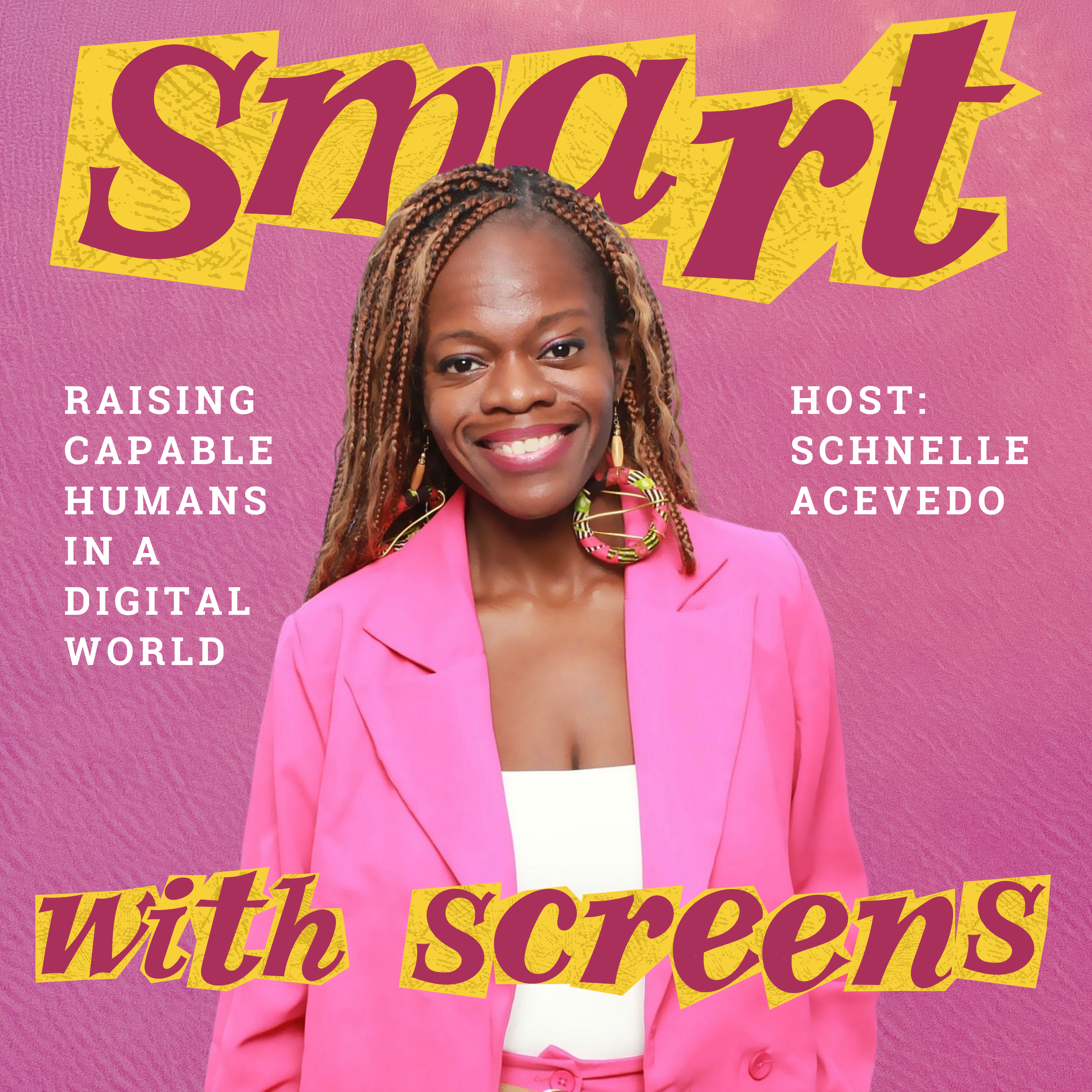
Smart With Screens With Schnelle Acevedo
Schnelle Acevedo - Digital Literacy Expert + Content Creator
Show overview
Smart With Screens With Schnelle Acevedo launched in 2025 and has put out 17 episodes in the time since. That works out to roughly 4 hours of audio in total. Releases follow a fortnightly cadence.
Episodes typically run ten to twenty minutes — most land between 10 min and 15 min — though episode length varies meaningfully from one episode to the next. None of the episodes are flagged explicit by the publisher. It is catalogued as a EN-language Technology show.
The show is actively publishing — the most recent episode landed 2 weeks ago, with 15 episodes already out so far this year. The busiest year was 2026, with 15 episodes published. Published by Schnelle Acevedo - Digital Literacy Expert + Content Creator.
From the publisher
Schnelle Acevedo is the founder of Brooklyn Active Mama, one of NYC's leading family lifestyle blogs with over 100,000 monthly visitors. She spent the past 14 years creating digital marketing campaigns for Disney, Netflix, Amazon, and P&G—learning exactly how algorithms, psychology, and data manipulation work from the inside.Now, as a certified digital literacy educator teaching workshops across NYC schools and libraries, she's pulling back the curtain on the systems that content creators, marketers, and tech companies use to capture attention.Smart With Screens delivers insider knowledge about technology that schools aren't teaching. From understanding how Instagram's algorithm decides what goes viral to spotting sophisticated AI scams, from navigating phone bans to using AI ethically—this podcast gives parents, educators, teens, and content creators the real information they need to thrive in a digital world.Each episode breaks down complex tech topics into practical, actionable strategies. Whether you're a parent worried about screen time, a teacher addressing AI in the classroom, a content creator trying to beat the algorithm, or a teen trying to understand social media—you'll find honest, jargon-free education here.Topics include: social media algorithms, content creation strategies, deepfakes, online scams, AI ethics, digital wellbeing, neurodivergence and technology, phone policies, and authentic digital citizenship education.Hosted by a Brooklyn native, former PTA President, Girl Scout leader, and founder of BAM Digital Media LLC (certified MWBE).New episodes weekly. Schedule a virtual or in person workshop at bamdigitalmedia.info
Latest Episodes
NYC Just Changed the Rules on AI in Schools — Here's What It Actually Means
Before They Meet You, They've Already Googled You.
Going Viral at What Cost — The Truth About Attention Addiction in Young Creators
She Never Looked Up — A Braiding Shop, a Child, and the Truth About Doom Scrolling
The Village Has to Show Up — What a Walk Across the Brooklyn Bridge Taught Me About Digital Literacy
From Consumers to Creators: Why Every Student Needs Digital Creation Skills
S1 Ep 11Five Strategies to Stop Doomscrolling (That Actually Work)
"I picked up my phone to check one text. 45 minutes later, I was deep in Instagram Reels watching someone organize their pantry. For the third time."Schnelle admits what we all know: even the experts doomscroll.But here's the thing—you're not powerless. There are actual strategies that work. Not perfectly. Not every time. But they genuinely reduce scrolling.In this episode, Schnelle shares five practical strategies she uses to break the doomscroll cycle. These aren't theoretical tips from someone who doesn't struggle. They're real tactics from someone who knows exactly how algorithms are designed to keep you hooked—and has figured out how to fight back.From creating friction between you and the scroll, to retraining your algorithm, to replacing habits you didn't even know you had—these strategies address why doomscrolling happens and how to interrupt it.The goal isn't perfection. It's awareness and intention. And if you can go from two hours of scrolling to 30 minutes? That's a win.Perfect for: Anyone who's ever lost an hour to social media and wants it back, parents trying to model healthy tech use, anyone ready to take control of their attention.Plus: How to teach these strategies to your kids without lecturing.📧 Digital wellbeing and creator workshops: [email protected]🌐 Learn more: https://bamdigitalmedia.infoVirtual programs for schools, parents & community groups nationwide
S1 Ep 10How Screenshot Culture Is Fueling School Conflict
"Most schools treat digital conflict like a discipline problem. It's not. It's a skills gap."Classroom conflict is rising, but it's not starting in classrooms. It's starting on phones the night before. An argument at 9:30 PM walks into first period at 8:00 AM—no cool-down, no separation, no reset.This episode breaks down three digital behaviors driving school conflict:1. Screenshot Culture Students screenshot everything: private conversations, group chats, arguments. Screenshots get forwarded, context disappears, and private becomes public in seconds. Students weaponize visibility.What's missing: Digital ethics and permanence awareness. When students understand digital actions create lasting records, escalation decreases.2. Algorithm Amplification Students believe what they see most. If their feed pushes drama, outrage, and aggression—they internalize it as normal. When students learn how algorithms work, they regain cognitive control and stop treating feeds as reality.3. Boundary Collapse Students don't separate school, home, social, and online life. Everything bleeds together. Prevention requires teaching emotional regulation online, slowing response cycles, and building pause habits.The reframe: This isn't "tech education"—it's conflict prevention infrastructure. When schools teach digital permanence, algorithm awareness, and emotional regulation, referrals decrease. Classroom tension decreases.Prevention is possible. It just has to be taught.Perfect for: School administrators, teachers, parents, anyone responsible for school climate.📧 Conflict prevention workshops: [email protected]🌐 Schedule: https://bamdigitalmedia.infoAvailable for NYC schools and virtually nationwide
S1 Ep 9Can AI Write Your Essay? (And Should It?)
"My kid says, 'Mom, everyone in my class is using ChatGPT for their homework.' This is the conversation we need to have."AI isn't just a threat—it's a tool kids are already using. The question is: Are they using it ethically, or are they cheating with better technology?Schnelle breaks down four scenarios:Using AI to write entire essays? Plagiarism with extra steps. Cheating.Using AI to brainstorm ideas? Like talking to a tutor—ethical (with transparency).Using AI to edit your writing? Gray area. Is it still your voice?Using AI to learn concepts? Absolutely ethical. This is AI as a learning tool.Schnelle's framework:✓ Ethical when: You're learning, doing your own thinking, could defend your work, being transparent✗ Cheating when: You're avoiding learning, passing off AI's work as yours, couldn't explain what you submittedThe key question: "Could I do this without AI? Did I learn something?"What kids need to learn:How to write good prompts (valuable skill)How to evaluate AI output critically (it makes mistakes)How to use AI as starting point, not replacementHow to maintain their own voiceFor parents: Have explicit conversations about AI ethics. Know your school's policy. Focus on learning over grades. Ask: "Are you using this to learn or avoid learning?"The bigger picture: AI isn't going away—banning it completely isn't realistic. But letting kids outsource all thinking isn't the answer either. This episode gives you a framework for the gray areas.Perfect for: Parents, teachers creating AI policies, students wanting to understand the ethical line.Next episode: Screenshot culture and what it means for our kids.📧 AI ethics workshops: [email protected]🌐 Schedule: https://bamdigitalmedia.infoVirtual programs for students, educators & parents nationwide
S1 Ep 82026 Digital Scams: The Call That Sounds Like Your Kid (But Isn't)
Online scams have evolved dramatically. This episode exposes the sophisticated AI-powered scams targeting families, seniors, teens, and professionals in 2026—and teaches you exactly how to protect yourself.Digital literacy educator Schnelle Acevedo breaks down seven scams happening right now using AI voice cloning, deepfake technology, and personalized psychological manipulation.Scams covered:AI voice cloning emergency calls (sounds exactly like your child)Deepfake video call fraud (fake boss, fake CEO)Too-good-to-be-true job offersFake package delivery phishingAI-powered romance scamsFake disaster charity fraudTech support pop-up scamsWhy these work: Scammers exploit the same psychological triggers used in digital marketing: urgency, fear, greed, love, and authority. The more stressed you are, the more vulnerable you become.Who's most vulnerable: Kids, adults, seniors—nobody is immune. This episode addresses age-specific vulnerabilities and provides practical protection strategies for every family member.Protection strategies: Family code words, verification through different channels, recognizing emotional manipulation, setting up protocols before emergencies happen.Connects to previous episodes on algorithms (same psychological tactics), deepfakes (same technology), and introduces next episode on AI ethics.📧 Scam prevention workshops: [email protected]🌐 Book virtual program: https://bamdigitalmedia.infoAvailable for schools, libraries, senior centers & organizations nationwide
S1 Ep 7Deepfakes! When You Can't Trust What You See Anymore
A few episodes ago, we talked about how social media algorithms work. But here's the thing: all of that assumes what you're seeing is real. And increasingly? It's not."Schnelle dives into deepfakes—AI-generated videos and images so convincing you cannot tell they're fake. This isn't future technology. This is happening now, and it's getting scarier by the month.What are deepfakes? Videos, images, or audio created using AI to make it look like someone said or did something they never actually did. The technology is now so sophisticated that even experts struggle to identify them.Why this matters now: Your kids are seeing this content on TikTok, YouTube, Instagram right now. And unless we teach them to question what they see, they're going to believe it.The creepy celebrity deepfakes: Tools like Sora (from OpenAI) generate incredibly realistic video from text descriptions. People are creating videos of dead celebrities—Tupac, Robin Williams, Marilyn Monroe—in new content.Schnelle finds this deeply unsettling. Not just ethically (these people can't consent), but because it normalizes the idea that videos aren't real. If everything can be fake, then nothing has to be real.How convincing are they? Early deepfakes had tells—weird blinking, unnatural movements. Now? Indistinguishable from real footage.Kids believe videos of their favorite influencers without question. Adults share content confirming their beliefs immediately. Elderly folks are especially vulnerable.Nobody is immune. Schnelle admits she's been fooled—and she teaches this for a living.What makes deepfakes dangerous:Emotionally convincing (you react before thinking)Exploit confirmation biasWeaponized for political manipulation, scams, bullying, misinformationWhat we can do:Teach skepticism, not cynicism – Verify before believing vs. "nothing is real"Introduce verification – Check multiple sources, find the original, look for reputable reportingTalk explicitly about deepfakes – Show kids examples, discuss what makes them hard to spotTeach the pause – Before sharing dramatic content, ask: "Do I know this is real?"Understand vulnerability – If someone can deepfake a celebrity, they can deepfake youLooking ahead: Next episode: Scams in 2026—deepfakes are just one tool scammers use. AI voice cloning, fake video calls, personalized manipulation.Perfect for: Parents teaching media literacy, educators addressing misinformation, anyone needing to understand that seeing is no longer believing.Digital literacy workshops covering deepfakes, AI, scams & more:📧 Email: [email protected]🗓️ Schedule: https://bamdigitalmedia.infoVirtual programs nationwide for students, educators, parents & seniors
S1 Ep 6When the Expert Feels Lost Too: Honest Talk About Parenting and Phones
Episode 6: When the Expert Feels Lost Too (Honest Talk About Parenting and Phones)"I need to be honest with you about something. I have 14 years of digital marketing experience. I teach digital literacy workshops across New York City. I know how algorithms work, the psychological tricks, the data collection practices. And I am still overwhelmed and scared as a parent."This is the most honest episode of the season. No expert tips from someone who has it all figured out. Just real talk from a mom who feels lost sometimes—even with all the insider knowledge.Schnelle shares what keeps her up at night: Kids seeing inappropriate content. Mental health impacts from social media. Online predators. Watching her kids struggle to put devices down. Data privacy violations. Misinformation, deepfakes, scams. The impossible balance of protection vs. independence.And here's the confession that makes this episode powerful: She paid good money for a monitoring app. Her oldest kid deleted it.That moment became a turning point—a choice between doubling down on surveillance or building trust.What doesn't work (from her own experience):Waiting until kids are older (not realistic for many families)Monitoring everything (made her anxious, her kid resentful, didn't actually work)Just saying no to everything (isolates kids from peers and learning)Ignoring it (doesn't feel right either)Five things she's actually doing instead:1. Having ongoing conversations (not one big talk) – Small, constant check-ins making tech talk normal, not scary.2. Teaching them to recognize manipulation – Using her marketing expertise to name the tactics so kids can spot them.3. Creating phone-free spaces (not phone-free lives) – Dinner table, bedrooms at night, family activities. Same rules for parents.4. Knowing she can't (and shouldn't) see everything – Accepting kids will make mistakes. Her job is making sure they know they can come to her when things go wrong.5. Focusing on building judgment, not just setting rules – Asking questions when kids want new apps: "What is it? Why do you want it? What would you do if someone made you uncomfortable?"The truth about "enough": Schnelle admits she's probably not doing enough by some standard. Her kids have more screen time than recommended. They've probably seen content she wishes they hadn't. She's been too controlling sometimes and too hands-off others.But she's trying. She's learning. She's doing her best with incomplete information in a constantly changing situation.This episode gives you permission: You don't have to have it all figured out.Perfect for: Any parent who's ever felt overwhelmed trying to "do technology right" with their kids. Any educator struggling with the same questions. Anyone who needs to hear that even the expert doesn't have perfect answers.This won't give you a foolproof system. It will give you solidarity, practical strategies one real parent is trying, and permission to not have it all together.Because if the person who teaches this for a living is still figuring it out—you're doing just fine.Want support navigating these conversations?Schnelle offers digital literacy workshops for parents, educators, and families—covering algorithms, AI ethics, and practical strategies for managing technology at home.📧 Email: [email protected]🗓️ Schedule: https://bamdigitalmedia.info
S1 Ep 5Why One-Size-Fits-All Digital Rules Don't Work
Not all kids have the same relationship with technology—and blanket screen time rules are failing neurodivergent children.Digital literacy educator Schnelle Acevedo explores why individualized approaches matter for kids with ADHD, autism, anxiety, and other neurodivergent traits.Topics covered:Self-Regulation & Screen TimeWhy some kids naturally limit device use while others struggleHow ADHD affects dopamine regulation and makes algorithms more addictiveWhy "just put the phone down" doesn't work for all kidsWhen Algorithms Actually HelpHow neurodivergent kids use technology as assistive toolsYouTube tutorials for kids with executive function challengesDiscord and gaming communities for autistic kidsAI apps designed specifically for neurodivergent childrenApps for anxiety and emotional regulationWhat Individualized Approaches Look LikeQuestions parents should ask instead of universal time limitsHow schools can differentiate digital support (like IEPs)Recognizing when apps are tools for functioning, not just entertainmentInspired by meeting an entrepreneur developing AI for neurodivergent kids, Schnelle challenges blanket phone bans and screen time rules. Instead: What does this specific child need to thrive with technology?Perfect for: ✓ Parents of neurodivergent children ✓ Special education teachers ✓ School administrators creating inclusive policies ✓ Anyone interested in disability justice and digital equityRelated topics: ADHD and screen time, autism and technology, assistive technology, inclusive digital policies, executive function support, digital wellbeing for neurodivergent studentsHosted by Schnelle Acevedo, founder of BAM Digital Media LLC (certified MWBE), former digital marketer for Disney/Netflix/Amazon, and digital literacy educator.Inclusive digital literacy workshops available:📧 Email: [email protected]🗓️ Schedule consultation: https://bamdigitalmedia.infoVirtual programs nationwide for students, educators, and parents
S1 Ep 4Positive Digital Affirmations (And Why We Need Them)
"I know, I know—affirmations can feel a little... woo-woo. But hear me out."We spend hours every day consuming content designed to make us feel inadequate, anxious, and like we're missing out. Algorithms literally optimize for content that triggers emotional responses—often negative ones, because those drive more engagement.So what if we spent just a few minutes actively countering that messaging?This episode is different from the others. No deep dives into how technology works. No scary statistics about scams or deepfakes. Just affirmations you can come back to when you need them.Schnelle shares affirmations for:Comparison – "My worth is not determined by likes, followers, or how I look in photos"FOMO – "I am exactly where I need to be right now"Screen time guilt – "Progress, not perfection. Every small choice matters"Social media anxiety – "I do not need to perform my life for an audience"Information overload – "I cannot consume every piece of news, and that's okay"Kids and teens – "My worth is not measured in likes or followers"Parents – "I am doing my best in a situation no generation has faced before"Content creators – "My value is not determined by engagement metrics"This is a short episode—just the affirmations with space to let them land. You can listen when you're feeling overwhelmed by social media. You can share specific affirmations with your kids. You can screenshot them and keep them as reminders.Why this matters:If platforms are intentionally manipulating us to feel certain ways to drive engagement, we need to be intentional about countering those feelings. These affirmations aren't magic. They won't fix everything. But they can help you reset, refocus, and remember what's actually true—not what the algorithm wants you to believe.Perfect for: Anyone who's ever felt inadequate after scrolling, parents wanting to help their kids build healthier self-talk around technology, educators looking for tools to support student wellbeing, or anyone needing a digital reset.Come back to this episode as often as you need it. It's here for the hard days.Want to bring digital literacy and wellbeing education to your community?Schnelle offers workshops that address both the mechanics of technology (algorithms, AI, scams) AND the emotional impact (comparison, anxiety, digital wellbeing). Programs available for students, educators, parents, and community groups—virtually and in-person.📧 Email: [email protected]🗓️ Schedule a consultation: https://bamdigitalmedia.info🗽 Based in Brooklyn, NY | Virtual workshops available nationwide
The Question That Stumped the Expert
What happens when a 15-year-old asks better questions than the digital literacy expert has answers for?Schnelle was interviewing with a teen council in Brooklyn—they were evaluating whether her workshops were right for their program. She was ready to impress them with her credentials, her insider knowledge, her 14 years in digital marketing.Then one young man asked: "Do you agree with the phone ban?"Simple question, right? Except it wasn't simple at all.Schnelle's mama heart screamed YES—ban the phones, protect the kids from algorithms and comparison and distraction.But her educator mind hesitated: Are we teaching kids to manage technology, or just removing it and hoping for the best?She gave him an answer: Yes, she agreed with the ban.And then he hit her with the follow-up that made her question everything."What if the good kids—the ones with amazing grades—got to have their phones, and the ones with terrible grades didn't?"In this episode, Schnelle unpacks why that question is so brilliant and so challenging. Because it exposes something we don't talk about enough: Are phone bans about protecting all kids, or about controlling the kids we don't trust?Then came question three: "Don't phones promote socialization through gaming and connecting?"And Schnelle gave the "right" answer (plenty of ways to socialize offline), but she could tell he wasn't buying it. Because he was seeing the limitation in her logic: We're telling kids that connection increasingly happens online while simultaneously restricting their access during huge parts of their day.This episode explores:The mama vs. educator tension in technology decisionsWhy "fair across the board" might not actually be fairWhether we're solving the right problem with phone bansHow kids perceive our contradictions around technologyWhat happens when the expert admits she doesn't have all the answersThis isn't a "here's what you should do about phones" episode. This is a "let's sit with the complexity and admit this is really hard" episode.And sometimes, that's the most valuable education of all.For parents: If you've struggled with phone rules and felt like there's no good answer—you're not alone. This episode validates that struggle.For educators: If you're creating or enforcing phone policies while feeling uncertain about them—this episode gives you permission to question.For teens: If you've felt like adults don't really understand your relationship with technology—this episode proves you're right.Bring nuanced digital literacy conversations to your community:Schnelle's workshops create space for real dialogue about technology—not just rules and restrictions, but understanding why these tools are so compelling and how to navigate them thoughtfully.📧 Contact: [email protected]🌐 Learn more: https://bamdigitalmedia.infoVirtual and in-person programs for schools, libraries, and organizations nationwide.
S1 Ep 2How Social Media Algorithms Actually Work (And Why You Can't Stop Scrolling)
"I need to confess something embarrassing: I know how algorithms work. I've built campaigns using them. I teach people about them. And I still fall victim to them."In this episode, Schnelle breaks down exactly how social media algorithms decide what you see when you open Instagram, TikTok, or YouTube. Not in vague terms like "the algorithm is watching you" (which sounds creepy but doesn't actually help), but in concrete "here's what's happening right now" terms.She explains the four-step process every algorithm uses:Watching everything you do (and we mean everything)Making predictions about what you'll engage with nextTesting and refining constantlyOptimizing for engagement metrics—not your wellbeingAnd here's where it gets personal: Schnelle admits she still doomscrolls. Even knowing every trick in the book, she still finds herself 45 minutes deep in Instagram feeling worse than when she started.But something's changed recently. She's started catching herself in the moment, asking "Wait, how is this video making me feel?" And if the answer is anxious, inadequate, or drained? She scrolls away.That awareness—recognizing when you're being manipulated—is the difference between being controlled by the algorithm and having some agency over it.The good news? You can train your algorithm.Schnelle teaches you how to be intentional about what you engage with, how to use the "Not Interested" button strategically, and how to reset when your feed has gotten too negative or anxiety-inducing.This isn't about deleting social media or going on a digital detox. It's about understanding the system well enough to use it on your terms.What you'll learn:The exact mechanism behind "why can't I stop scrolling?"Why negative content often gets more engagement than positive (and what that means for your feed)How to actively train your algorithm to show you better contentWhy platforms prioritize engagement over your mental health—and what you can do about itPractical strategies Schnelle uses herself (because she's still figuring this out too)If you've ever wondered why TikTok feels like it can read your mind, or why you open Instagram "just for a second" and lose an hour, this episode explains it all—from someone who built these campaigns professionally.Plus, she shares how this connects to digital literacy education for kids: teaching them they have more control than they think.Perfect for: Anyone who's ever said "I don't know how I ended up scrolling for so long" and wants to understand what's actually happening to their brain.Want to bring digital literacy education to your school, library, or organization?Schnelle offers customized workshops—virtual and in-person—that teach students, educators, parents, and community members how algorithms, manipulation tactics, and social media psychology actually work.Programs available for all ages: elementary students learning internet basics, teens understanding social media psychology, adults navigating digital wellbeing, and seniors protecting themselves online.📧 Email: [email protected]🗓️ Schedule a consultation: https://bamdigitalmedia.info🗽 Based in Brooklyn, NY | Virtual workshops available nationwideLearn the insider knowledge that makes the difference—from someone who's been on both sides of the screen.
S1 Ep 1Why a Digital Marketer is Teaching Digital Literacy
Episode 1: Why a Digital Marketer is Teaching Digital Literacy"My job was to get you to click, to scroll, to buy. I was really good at it. Now I'm teaching you how it all works."For 14 years, Schnelle Acevedo created digital marketing campaigns designed to capture and hold your attention. She worked with Disney, Netflix, Amazon, P&G—learning every psychological trick, every algorithmic strategy, every data manipulation tactic that makes social media so hard to put down.Then she had kids. Became a PTA President. Started seeing the disconnect between what schools were teaching about "internet safety" and what kids actually needed to know.So she made a career shift: from digital marketer to digital literacy educator.In this first episode, Schnelle pulls back the curtain on her transition and explains why she's the person to teach this. She's not theorizing about how platforms work—she helped build these campaigns. She's not guessing about manipulation tactics—she used them for major brands. And she's not speaking from ivory tower expertise—she's a Brooklyn mom raising kids in NYC public schools.This episode sets the stage for a season of honest, insider education about algorithms, AI, deepfakes, scams, and what it really takes to be smart with screens in 2026.No fear-mongering. No jargon. Just real talk from someone who knows.Interested in digital literacy workshops for your community? Schnelle teaches virtual and in-person sessions for schools, libraries, PTAs, senior centers, and organizations nationwide.📧 Contact: [email protected]🗓️ Schedule a call: https://bamdigitalmedia.infoCustomized programs available for elementary students, middle school, high school, educators, parents, seniors, and mixed-age community groups.