Sketchplanations - The Podcast
77 episodes — Page 1 of 2
The Diderot Effect
Is Your Country Double Landlocked? It's Highly Unlikely!
How To Become An Overnight Success.
Play Until Something Gets Broken
Submarine Lessons for Business Leadership
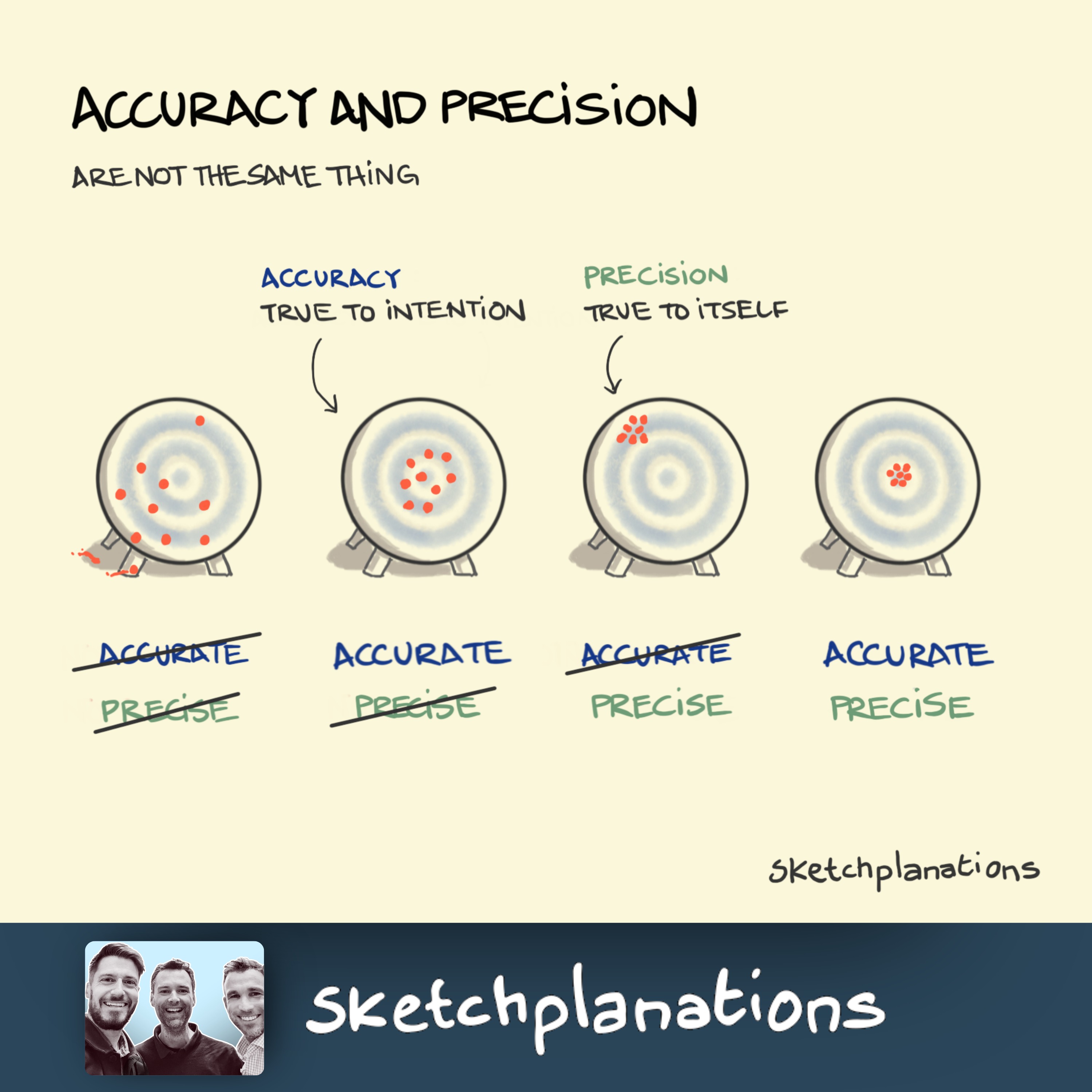
S5 Ep 12Hitting the Target: Accuracy vs. Precision
Using Jono’s sketch of four archery targets, we discuss why and how accuracy and precision differ.Using many different examples, we frame the distinction as “accuracy being true to intention and precision being true to itself,” also phrased as doing the right thing versus doing it right.The sketch is inspired by Simon Winchester's book, Exactly, where precision and accuracy are connected to the industrial revolution via Henry Maudsley’s innovative screw-cutting lathe, micrometer, and the concept of interchangeable parts. The conversation broadens to explore examples in food (McDonald’s vs artisan meals), recipes, recruiting, IQ tests (validity vs reliability), indoctrinated beliefs, gut feelings, culture’s return to individual craftsmanship, AI’s variable answers, LED mask wavelength tolerances, and targeting weapons.External linksAlso referenced in this episode:Jono's sketch that describes the difference between Reliability and Validity.Jono's sketch inspired by Roger Martin's Knowledge Funnel.Jono's sketch outlining The Beard Cycle.Episode Outline00:00 Accuracy vs Precision: the Four Target Sketch03:23 True to Intention04:11 Ball Through Window05:44 Precision Built World09:45 Food and Recipes13:27 Calibration and Scales14:47 Manufacturing Tolerances16:51 Hiring and Testing19:16 Beliefs and Education23:01 Culture and Craft26:09 Doctors Robots and AI29:03 Wrap Up and CreditsAll music on this podcast series is provided by the very talented Franc Cinelli and you can find more tracks at franccinelli.com Hosted on Acast. See acast.com/privacy for more information.
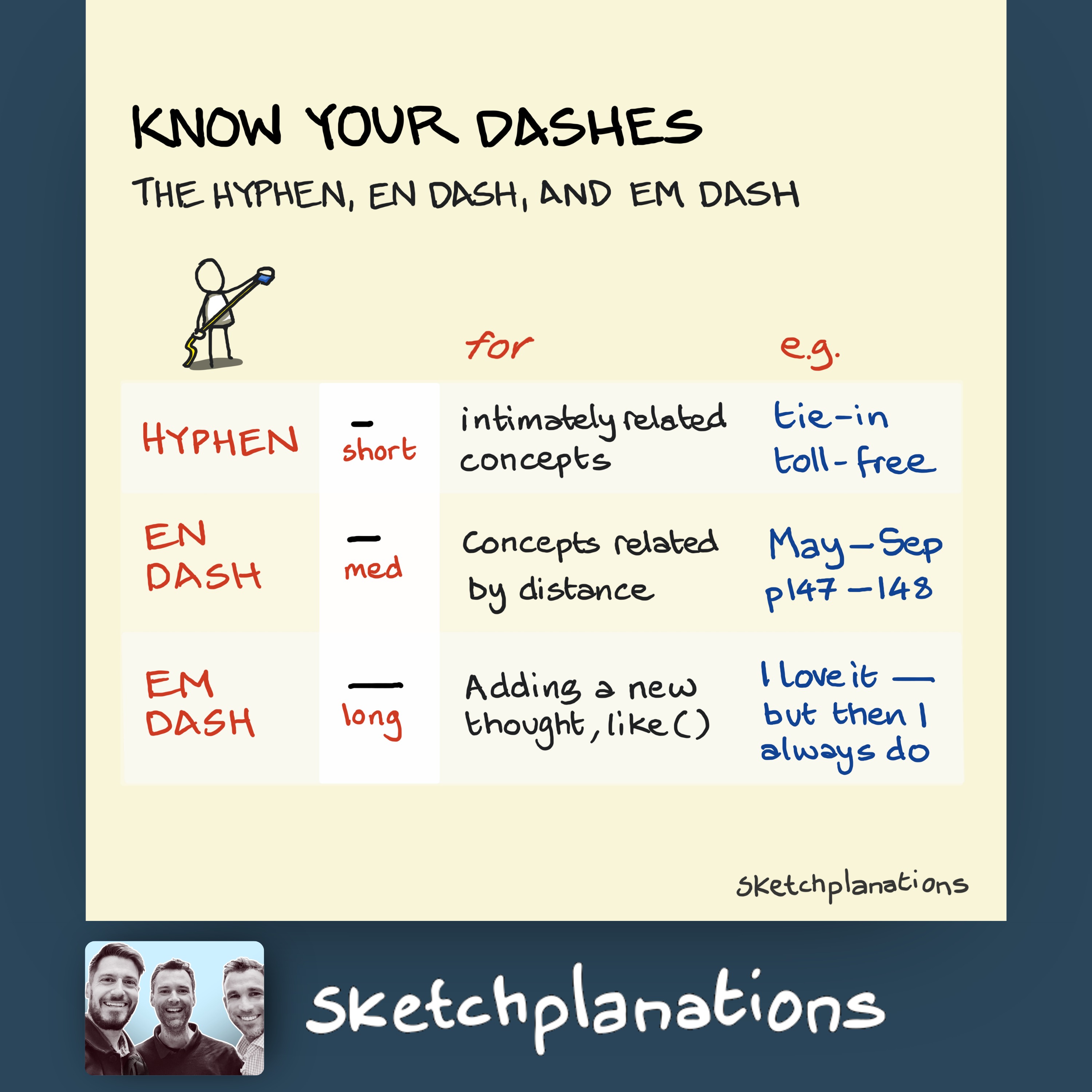
S5 Ep 11Do you Know Your Dashes?
If you like the finer details of grammar and punctuation, then you're gonna love this episode.We geek out on the subtle, but incredibly important and occasionally crucial differences between three little horizontal lines: the hyphen - the En Dash – and the Em Dash —Jono explains hyphens for line breaks and compound terms, how usage can evolve into single words (e.g., wildlife, wellbeing), and why hyphen placement can change meaning (e.g., five-dollar bills). The en dash is described as linking ranges and relationships (pages, dates, times, scores, routes, debates, partnerships, negotiations), with notes on how to type it. The em dash is framed as a stronger-than-comma interruption for added thoughts, with style cautions and typing methods. They discuss underscore origins from typewriters, punctuation differences across countries, and how AI popularized em dashes as a telltale sign of machine-written text.Most importantly though, we discuss why this matters and that if used correctly, they can help avoid misunderstandings.Episode Summary00:00 Welcome to Sketchplanations00:40 What Are Dashes03:09 Hyphen Basics04:32 Hyphenated Words05:35 Language Evolves07:00 Hyphen Pitfalls07:31 Tom on Hyphens10:38 Meet the En Dash11:41 Typing En Dashes12:32 En Dash Use Cases14:47 Spacing and Style15:30 Introducing Em Dash15:33 Em Dash Basics16:15 Style Guide Rules18:08 Brackets vs Speech18:57 Where Names Come From20:32 Underscore Origins22:05 Reading Dashes Aloud24:39 Does It Matter26:04 Oxford Comma Stakes28:36 AI Em Dash Tell29:59 Typing Em Dashes30:32 Punctuation By Country31:41 Morse Code And Minus32:43 Final Sign OffExternal LinkThere's only one link this week:Jono referenced the book Strunk and White : The Elements of StyleAll music on this podcast is provided by the very talented Franc Cinelli. Hosted on Acast. See acast.com/privacy for more information.
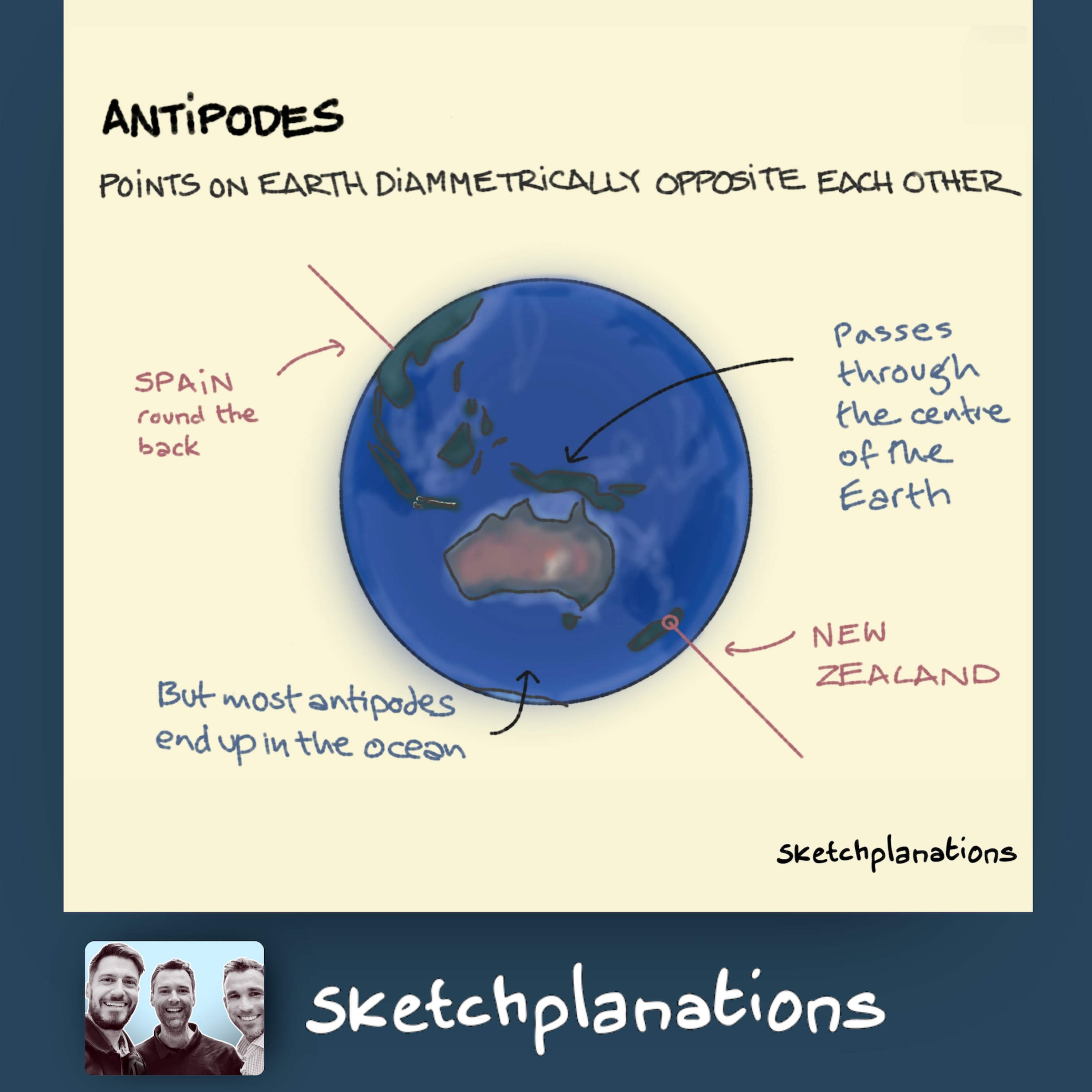
S5 Ep 10Digging Through the Planet: The Geography of Antipodes
Have you ever wondered what's happening on the exact opposite side of the world to you?Wherever you are on our planet, there's a good chance you'd need a snorkel.In this episode, we explore the concept of antipodes—the exact point on the opposite side of Earth from wherever you're standing. We discover why most antipodes end up in the ocean rather than on land and cover a whole host of fascinating geographic facts, including how the Northern Hemisphere contains the vast majority of Earth's land and population, how map projections distort our view of the planet, and why Earth's oblate spheroid shape means some antipode distances are longer than others.Along the way, we also raise the big questions like how deep have humans ever dug into Earth and how long it would take to fall through a frictionless tunnel to your antipode.External Links and mentions on the show:Jono's sketch that explains the Mercator Map Projection Jono references the Antipodal Map in the book Marvellous Maps by Simon KuestenmacherThe 7.6 mile deep hole Jono talks about is the Kola Superdeep Borehole in Russia, initiated by Soviet scientists in 1970, primarily to better understand the earth’s crust. Here's Jono's sketch about the thickness of the earth's crust being proportionally similar to the thickness of an apple's skin. And finally, if you want to know your exact antipode, you can look here on AntipodeMap.comEpisode Summary00:00 What Are Antipodes03:23 Land Distribution on Earth04:14 Map Projections and Perspectives07:19 Antipodal Map Overlay08:56 Cultural References Worldwide10:15 Etymology of Antipode10:41 Digging Through Earth12:44 UK Antipodes13:29 Great Circle Routes14:20 Earth's Oblate Shape15:25 Tunnel Through Earth16:34 Closing RemarksAll music on this podcast series is provided by the very talented Franc Cinelli Hosted on Acast. See acast.com/privacy for more information.
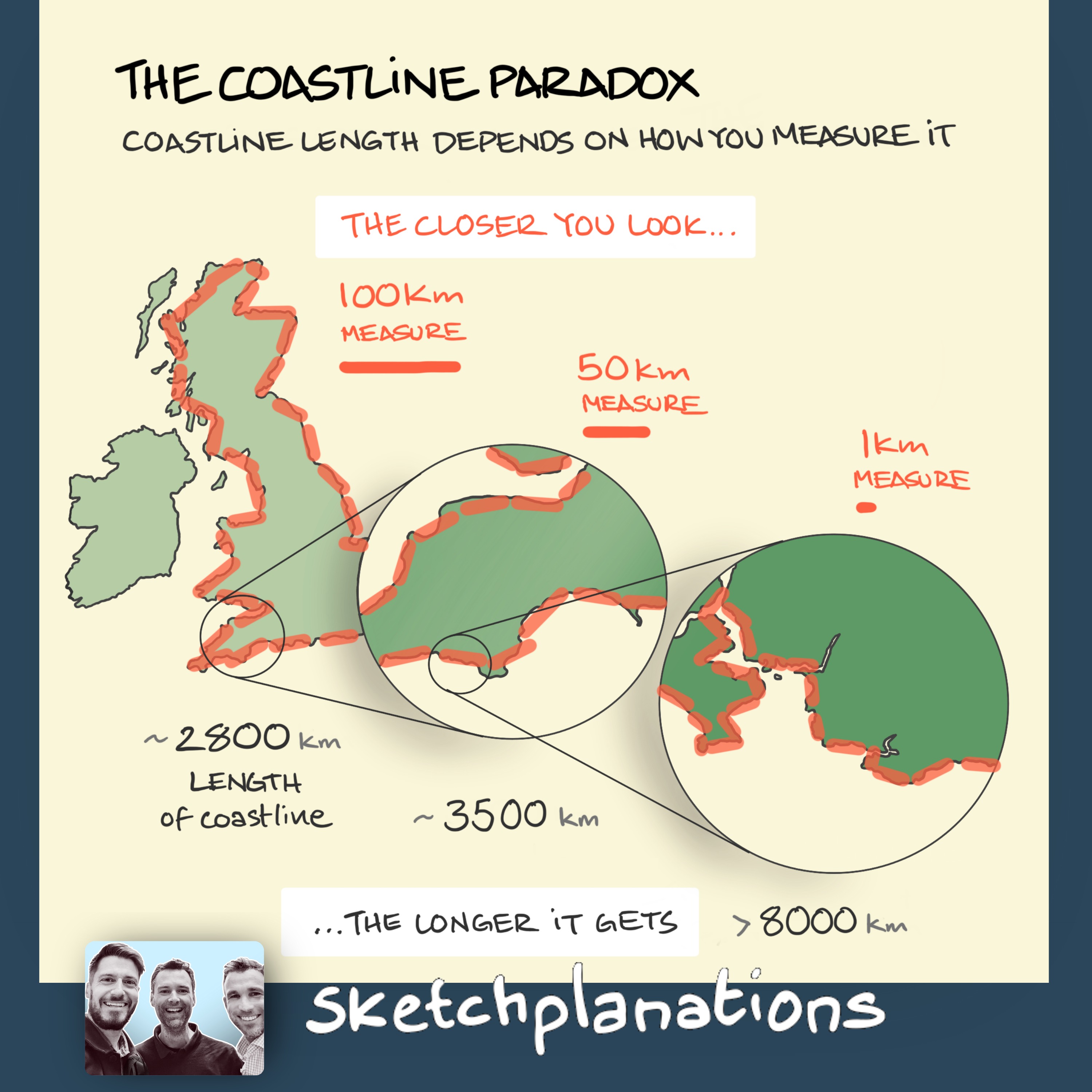
S5 Ep 9The closer you look, the longer it gets: The Coastline Paradox
When you want to measure something you take your ruler or tape measure and read off the length right?But when it comes to measuring the length of a coastline, things get a bit tricky and totally counter intuitive. 🌊The science and maths of measuring wiggly coastlines reveal that the smaller the unit of measure, the longer the coastline becomes. Jono recounts the origins of this phenomenon from polymath, Lewis Fry Richardson and its further exploration by Benoit B. Mandelbrot. The trio also relate the concept to various other real-world examples, including the surfaces of the brain and lungs, Romanesco cauliflower, and stock market patterns. Additionally, they touch on the philosophical implications of measurement and delve into the concept of infinity.Episode Summary:00:00 Introduction the Coastline Paradox04:12 Historical Context and Discovery14:10 Fractals and Natural World Applications17:26 Modern Implications and Analogies24:36 Conclusion and Final ThoughtsExternal Links and mentions on the show:Jono refers to and leans heavily on the writing of Geoffrey West in his book "Scale" to tell the story of how this was discovered.Rob's half-baked fact about The Standardised Meter can be expanded on here.This is what the self-similarity of a Romanesco Cauliflower looks likeHere is the avenue of trees in Bushy Park, in Southwest London that Jono slalomed.Here are more facts on who originally defined the number 'zero' as we know it today.All music on this podcast series is provided by the very talented Franc Cinelli Hosted on Acast. See acast.com/privacy for more information.
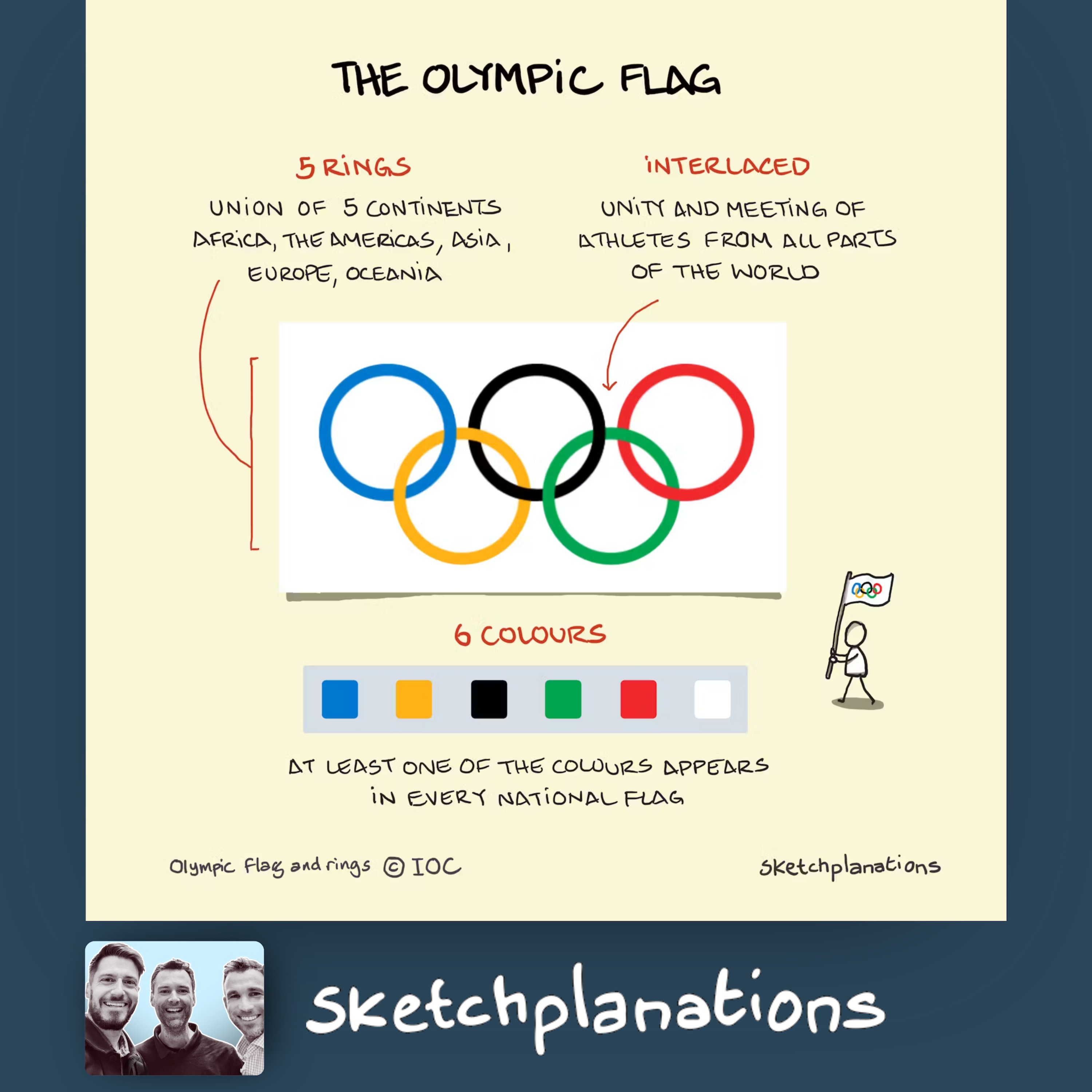
S5 Ep 8More Than Just Rings: Unity, History, and Ambition.
Have you ever wondered what the colours on the Olympic flag represent?The Olympic logo is a globally recognised brand and remarkably, it was designed over 100 years ago by the founder of the modern Olympic Games, Pierre de Coubertin.This time, we discuss the history and symbolism of this design icon ahead of the Winter Olympic Games in Milano Cortina, Italy. We find out about its representation of unity among the five (?) continents (one for each ring), and the careful selection of the flag's colours. The episode also delves into fascinating Olympic trivia, including the evolution of the games, historical moments, and the development of the Olympic motto. Rob also shares insights from filming at the Olympic Museum in Lausanne, Switzerland, for his series 'The Vault,' which explores Olympic history through artefacts found in their archives.You can watch all 10 episodes of The Vault for free here on the Olympics Channel.Episode Summary00:00 Introduction and Excitement for the Winter Olympics01:42 The Genesis of the Olympic Flag02:50 Symbolism and Design of the Olympic Flag05:06 Pierre de Coubertin: The Visionary Behind the Olympics05:21 Exploring Olympic History and Artifacts09:35 Evolution of the Olympic Games and Flag22:28 Conclusion and FarewellAll music on this podcast series is by the very talented Franc Cinelli. Hosted on Acast. See acast.com/privacy for more information.
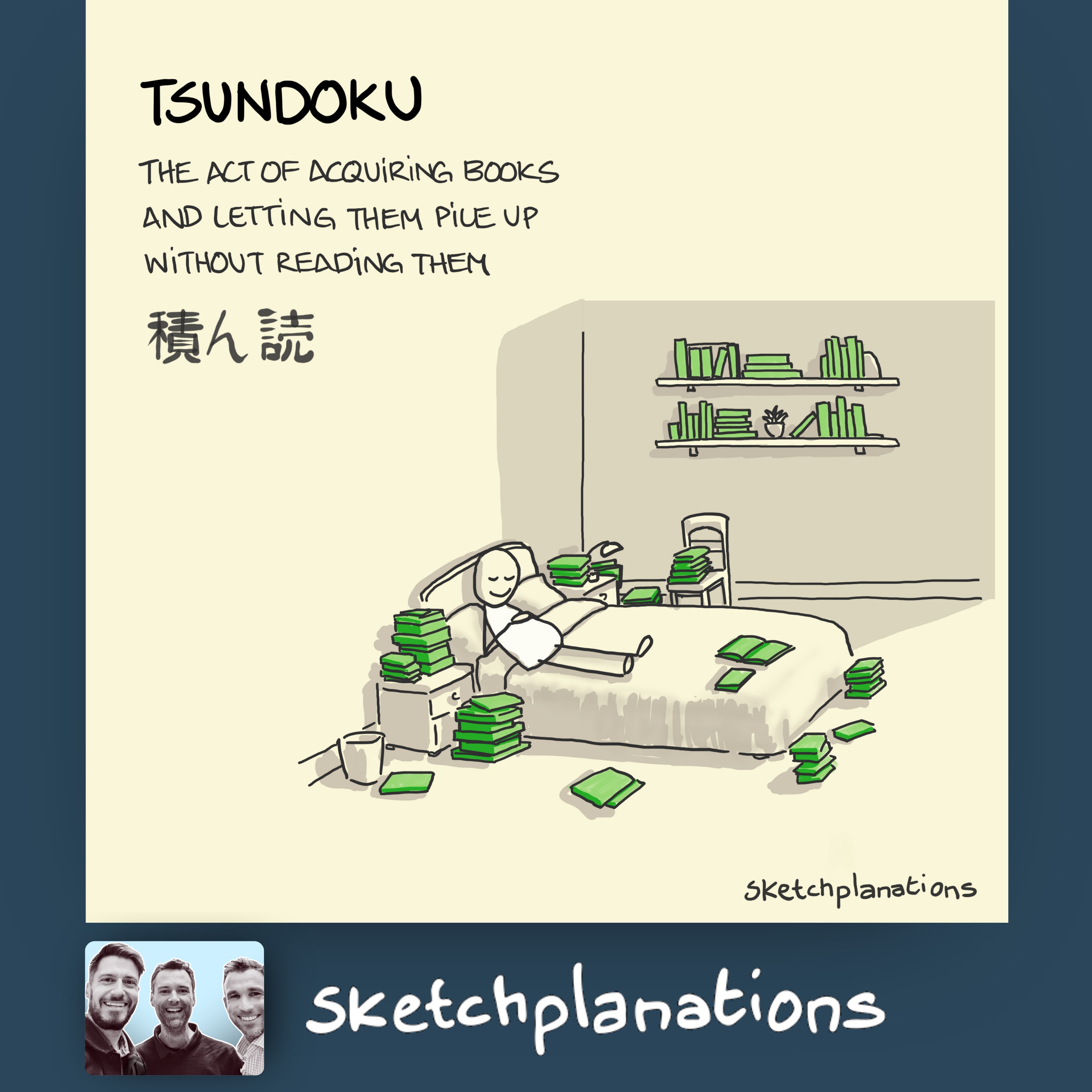
S5 Ep 7Tsundoku: Do you buy books faster than you can read them? 📚🤔
How big is that pile of books next to your bed?Tsundoku is a Japanese word for buying books and letting them pile up unread. It’s a familiar habit to book lovers everywhere — that growing stack of books you intend to read but haven’t yet. In this episode of Sketchplanations The Podcast, we explore why we buy books we don’t read, why unread books don’t always feel like a bad thing, and what this habit says about curiosity, identity, and our relationship with reading.In this episode we embrace Tsundoku and our conversation ranges from buying too many books to the joy and guilt of collecting unread books, and how tsundoku can extend to audiobooks, hobbies, and other unread things. If you’ve ever wondered why you buy books faster than you can read them — or felt conflicted about your own unread pile — this episode is for you.Links to items (mainly books) that we discussed:The book that changed Tom's life: Rocket Fuel by Gino Wickman and Mark WintersThe book from Jono's pile he next wants to start: A few short sentences about writing by Verlyn KlinkenborgRobbie is most looking forward to getting started on: Whatever will be will be by Felix WhiteJono recommends cartoons about books and reading by Tom GauldBig Ideas, Little Pictures is the Sketchplanations book by Jono HeySummary: 00:00 Introduction to Tsundoku: The Act of Collecting Unread Books02:52 Personal Stories and Reflections on Tsundoku05:20 The Broader Implications of Tsundoku07:49 Books as Gifts and Their Value10:03 The Joy and Guilt of Collecting Books17:14 Final Thoughts and Reflections19:34 Conclusion and FarewellAll music on this podcast series is by the very talented Franc Cinelli Hosted on Acast. See acast.com/privacy for more information.
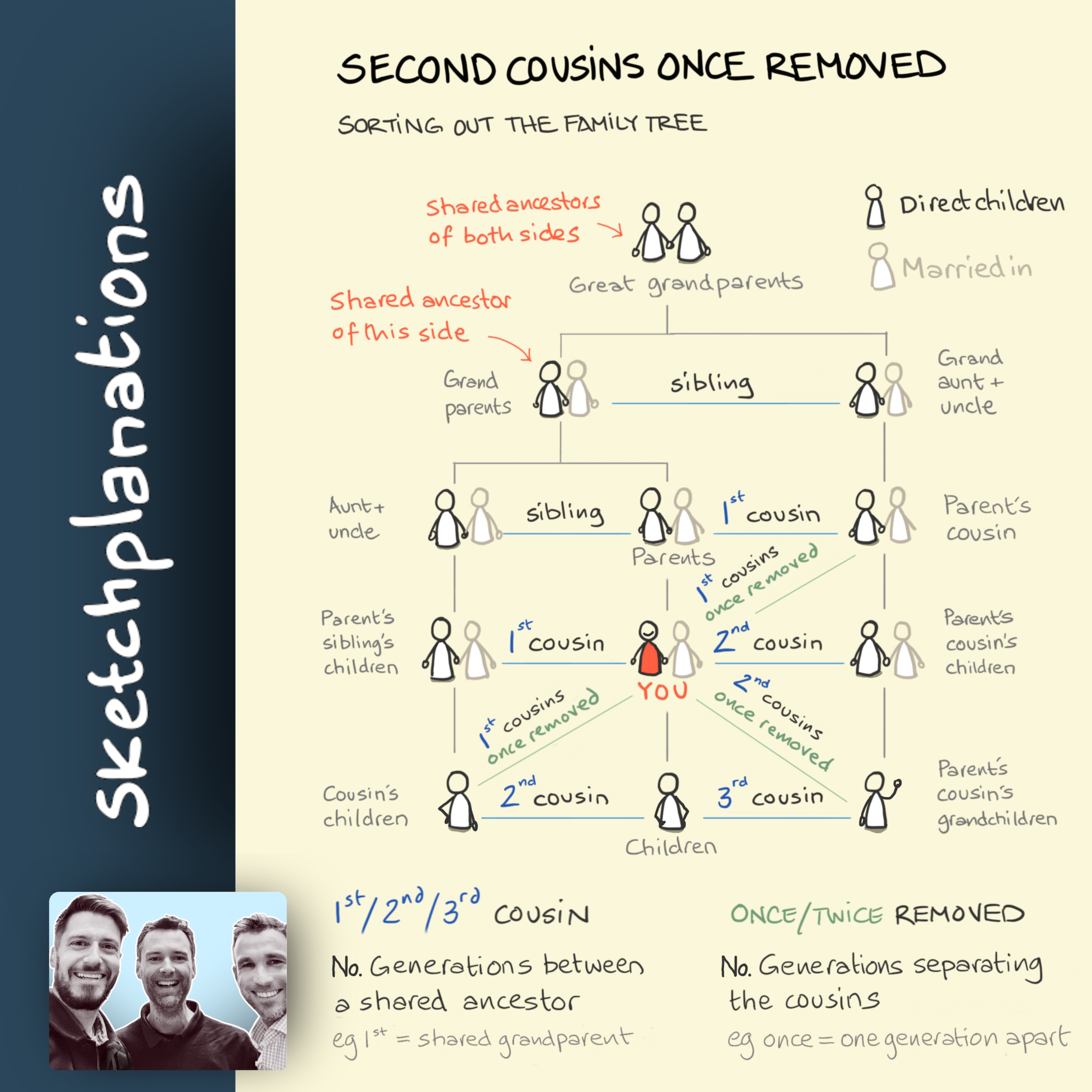
S5 Ep 6Family Tree Explainer
Do you know who your second cousins are or if you even have any? And what does "once removed" mean anyway?Tune in to this episode as we unravel the mysteries of family relations—which we figured would be particularly helpful at the festive time of year.We explore the subtleties of family trees, making our way to 'Second Cousins Once Removed'. We dig into the confusion around generational terms and the importance of knowing your extended family. We share a few family-related anecdotes and cultural differences, such as the Chinese family tree and Icelandic naming conventions. We strongly encourage you to follow along with the sketch at Sketchplanations.com to better understand your own family connections.Here are the Chinese family tree names mentioned.Episode Summary 00:00 Welcome to Sketchplanations00:47 Understanding Family Relations02:13 Exploring Second Cousins06:06 Generational Differences Explained11:48 Cultural Perspectives on Family Trees14:57 Famous Families and Their Connections15:08 The Mayflower Ancestor Story15:55 Family Trees and Their Complexity16:43 The Importance of Family Connections18:01 Tracing Family History21:07 Unique Family Names and Their Origins22:28 Surname Origins and Commonality25:58 Gender-Neutral Family Terms27:07 Concluding ThoughtsAll music on this podcast series is provided by the very talented Franc Cinelli Hosted on Acast. See acast.com/privacy for more information.
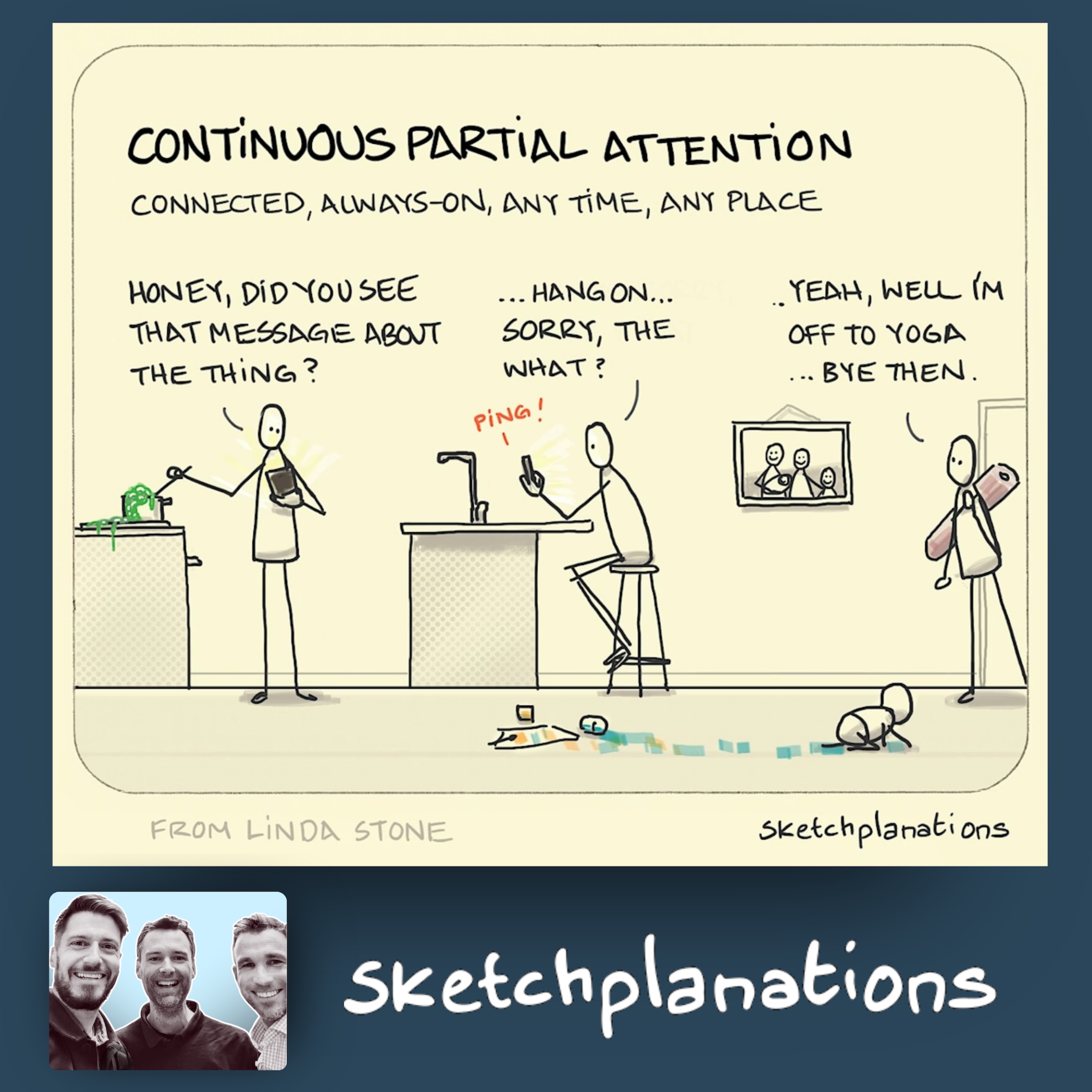
S5 Ep 5Continuous Partial Attention
Coined in the 1990s by Linda Stone, Continuous Partial Attention describes the state of being constantly connected; trying to do multiple things at once, which often leads to an ever-present, low-level form of stress. We explore how this phenomenon affects modern life, compare it to multitasking, and discuss both its positive and negative aspects. The podcast also highlights how technology has exacerbated this issue and considers potential solutions, such as mindfulness and turning off notifications, to better manage one's attention.Links to stuff we discussed:Dan KahnemanMind Over TechVideo of Woman who Walks into Fountain Whilst TextingThe Film: Her, starring Joaquin Phoenix.Other Sketches and podcast episodes referenced:Phubbing episode and sketchPhone Zombie sketchHegel's Dialectic: Thesis, Antithesis, Synthesis sketchYak Shaving episode and sketch5 Ways to Wellbeing episode and sketchEveryone's a Geek About Something episode and sketchHow to Instantly Feel Better episode and sketchPicking the Perfect Present episode and sketchBuy Jono's Book: Big Ideas, Little Pictures, for a loved one this Christmas - The Perfect Present and then some...Summary00:00 Introduction to Continuous Partial Attention01:31 Depicting Continuous Partial Attention in a Sketch04:25 Personal Experiences with Continuous Partial Attention05:54 The Impact of Technology on Attention08:49 Multitasking vs. Continuous Partial Attention11:15 The Challenge of Staying Focused17:05 The Role of Continuous Partial Attention in Different Professions20:38 The Dilemma of Turning Off Notifications21:15 Balancing Work and Family Life22:03 The Art of Multitasking22:59 The Pitfalls of Continuous Partial Attention23:49 Turning Cognition into Automation25:25 The Rise of Single Tasking27:54 The Productivity of Focused Work32:07 The Future of AI and Continuous Partial Attention34:20 Final Thoughts and RecommendationsAll music on this podcast is provided by the very talented Franc Cinelli. Hosted on Acast. See acast.com/privacy for more information.

S5 Ep 4Microlives & The Art of Uncertainty with Sir David Spiegelhalter
What's your life expectancy trade-off for enjoying a crispy bacon sandwich? 🥓Sir David Spiegelhalter is a celebrated Professor of Statistics at the University of Cambridge; widely accepted as one of the UK's foremost statisticians. He explains the concepts of 'micromorts' and 'microlives', which quantify risk and the impact of lifestyle choices on life expectancy. The discussion delves into acute vs. chronic risks, with practical examples such as the dangers of skydiving or how regular smoking affects longevity of life. The conversation also covers the application of statistics in medicine, the importance of randomisation in clinical trials, and the philosophical underpinnings of uncertainty. Additionally, David highlights the human capacity to judge risks, the pitfalls of intuition, and offers practical advice on dealing with uncertainty in everyday life. Lively anecdotes, insightful explanations, and practical takeaways make this episode a compelling listen for anyone interested in the intersection of statistics, risk, and daily decision-making.David's latest book, The Art of Uncertainty is available in all good bookshops and online.Here are some useful links to further explore some topics raised:The work of Ron Howard at Stanford UniversityJono's sketch on Word SpectrumsDavid's many other books - including Sex by NumbersPoisson Distribution explainedDavid tells the tale of Persi Diaconis - the Mathemagician.Episode Summary:00:00 Introduction, David's Background & Achievements01:43 The Wipeout Experience03:13 Understanding Micro-Morts04:27 Acute vs. Chronic Risks05:29 Micro-Morts in Everyday Activities12:05 Introduction to Micro-Lives18:03 Medical Applications of Data and Statistics21:27 The Role of Uncertainty in Life27:52 Building Resilience Over Robustness29:18 Embracing Uncertainty in Life33:35 Misuse of Statistics in Media and Politics40:30 The Gamblers Fallacy and Intuition42:29 The Uniqueness of Card Shuffles45:43 Common Misconceptions About Probability48:02 Practical Tips for Dealing with Uncertainty51:33 Final Thoughts and ReflectionsAll music is provided by Franc Cinelli. Hosted on Acast. See acast.com/privacy for more information.
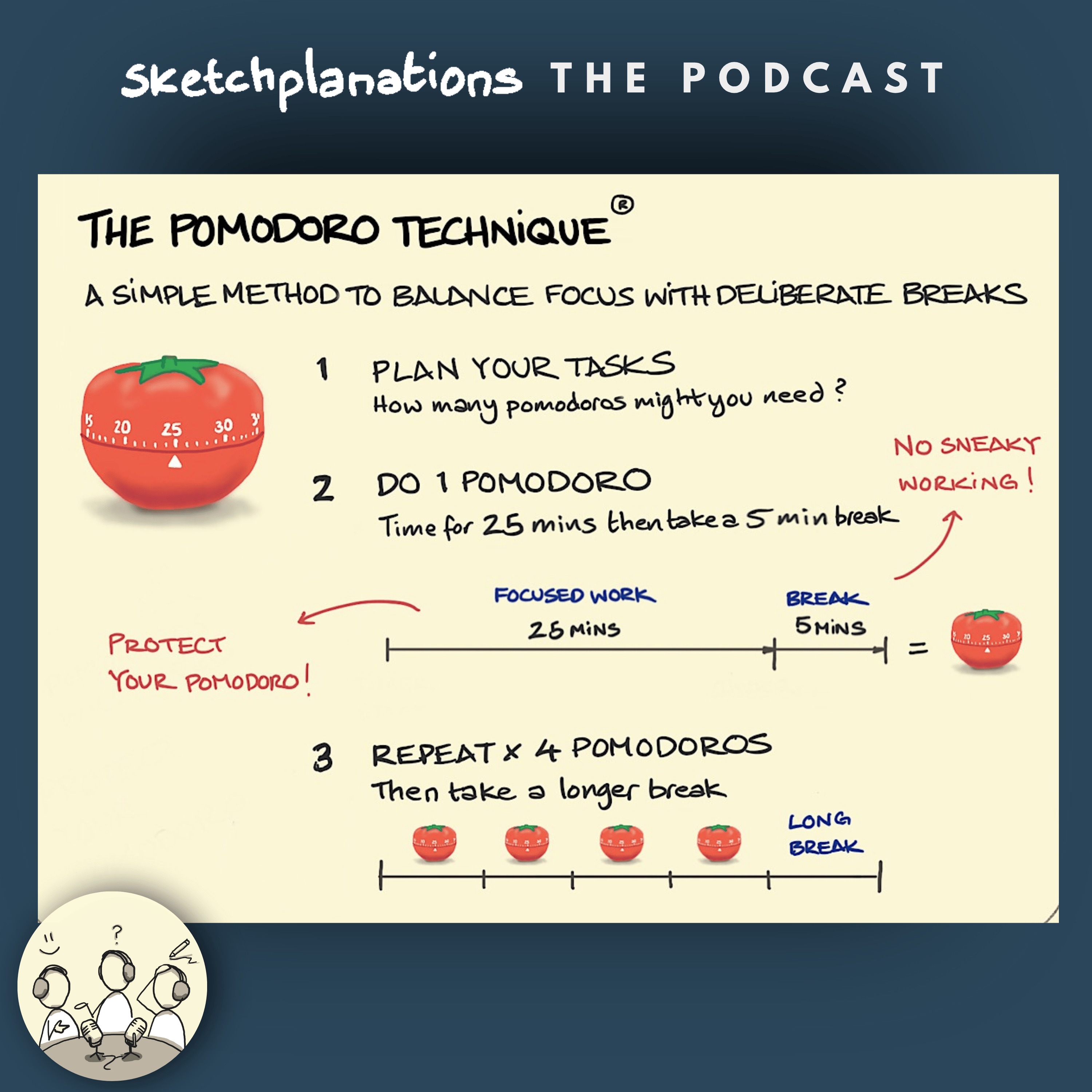
S5 Ep 3The Pomodoro Technique
This genius time management hack was conceived by Francesco Cirillo. The technique involves working for 25 minutes followed by a mandatory 5-minute break, repeating this cycle three to four times before taking a longer break. We share our personal attempts at using the method, explore the psychology behind productive work cycles, the importance of taking breaks and reflect on its effectiveness in both office and home environments. We also discuss the broader context of productivity obsession and share insights from using related tools eg. online "focus buddies". The session concludes with a follow-up on how the Pomodoro Technique has worked for them a week after recording the episode, reenforcing a lot of the theory we originally set out. Could this be our favourite procrastination buster yet!?!External linksIn the episode we reference a number of items you can find out more on here: Previous podcast episodes came up a lot (procrastination is a recurring theme for us): How to Instantly Feel Better; Yak Shaving; Goldilocks Tasks & The Fresh Start EffectRemarkably, there's currently no sketch for it, but Jono talks about The Red Queen Effect or Hypothesis - the concept of having to run to stay still.The Bear Focus Timer (used by Jono and now Tom as well). Available on Apple Store Examples of Focus Buddy or Accountability Partner websites include Focus Mate and Flow Club.Episode Summary00:00 Introduction to Sketchplanations Podcast00:29 Exploring the Pomodoro Technique01:03 Origins and Basics of the Pomodoro Technique02:57 Implementing the Pomodoro Technique in the Office07:23 Challenges and Adaptations of the Pomodoro Technique17:10 Alternative Productivity Methods18:53 Accountability and Shame in Productivity19:40 Origins of the Pomodoro Technique20:17 Applying Pomodoro in Different Environments21:32 Psychological Benefits of Time Blocking22:38 Challenges and Adaptations in the Office23:01 Personal Admin and Procrastination23:22 Flow and Creative Tasks26:16 Post-pod Findings on Pomodoro Technique Usage28:44 Final Thoughts and OutroAll music on this podcast series is kindly provided by the very talented Franc Cinelli. Hosted on Acast. See acast.com/privacy for more information.
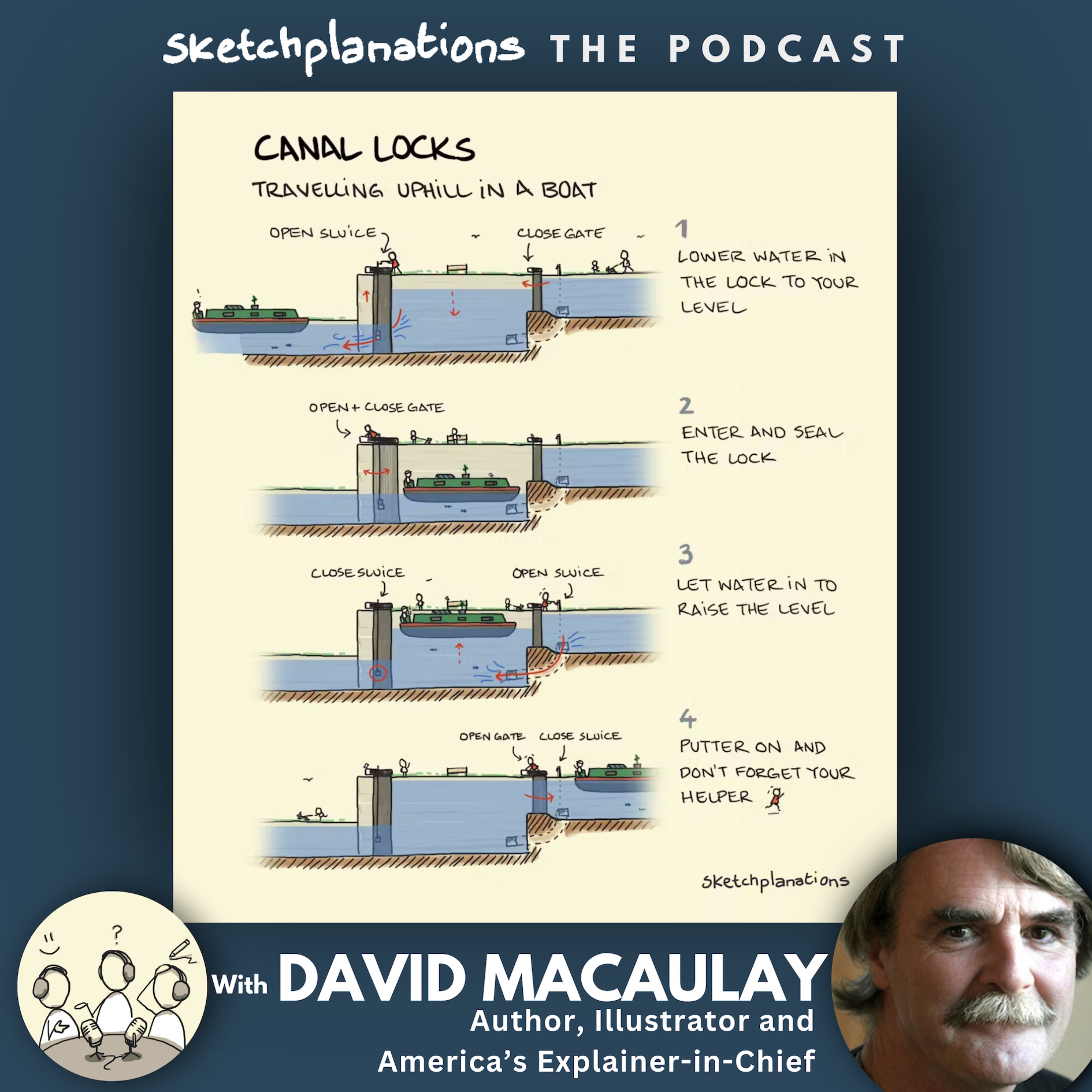
S5 Ep 2Canal Locks with David Macauley
In this episode, Jono meets one of his heroes, as we engage in a conversation with acclaimed author, illustrator and explainer, David Macaulay.We talk about David's journey from architecture to creating educational illustrations that make complex concepts understandable and engaging - and the Canal Lock is a great example of this from Jono's collection.We discuss the significance of sketching for understanding and teaching intricate ideas, and reflect on some of David's famous works, including his book, 'The Way Things Work.'David shares insights into his creative process, the importance of curiosity, and how integrating humour and playfulness in his illustrations can enhance learning.This conversation would not be complete without questioning David about his famous woolly mammoths - used in his illustrations to help explain machines, mechanics, physics and science. LinksSee here for more information about David as well as his bibliography.Jono specifically references David's maths book, Mammoth Maths, when comparing his own sketch on "Parts of a Circle".When addressing humour in Architecture, David talks about his book "Great Moments in Architecture".Summary00:00 Welcome to Sketchplanations - introducing David Macaulay01:30 David's Journey into Explanations03:42 The Way Things Work04:35 The Joy of Learning and Teaching04:47 Collaborating on The Way Things Work09:54 Exploring Canal Locks15:24 The Art of Sketching and Curiosity20:05 The Importance of Sketching20:34 Humour in Learning25:07 The Origin of the Woolly Mammoth in David’s drawings26:37 Balancing Humour and Information30:07 Encouraging Sketching in Education33:30 Everyday Wonders and Final Thoughts Hosted on Acast. See acast.com/privacy for more information.
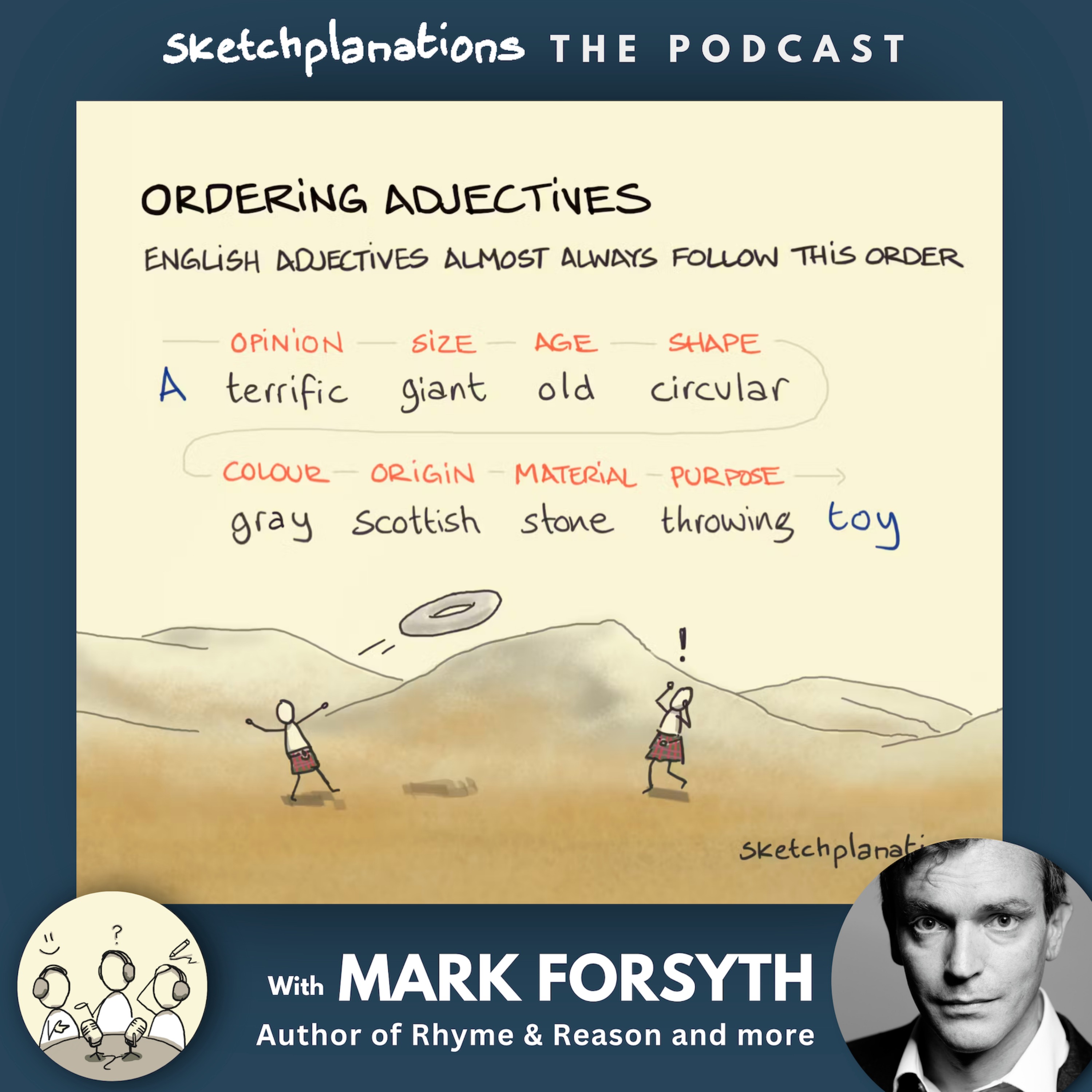
S5 Ep 1Ordering Adjectives with Author Mark Forsyth
When describing something with numerous adjectives (eg. the big brown dog, the heavy square steel door) there's a natural order we all instinctively follow as english speakers. I don't remember ever being taught it, nor would I be able to explain it to you, but my ear can definitely tell if someone gets it wrong!English adjectives follow a specific order. Who Knew?!?Well, there's one person for sure:What our special guest on this episode, award-winning author, journalist, and etymologist, Mark Forsyth, doesn't know about the English language, simply isn't worth knowing.In our conversation, Mark breaks down the correct traditional ordering of adjectives. And Mark's passion for the English language becomes clear as he walks us through other nuances of English, such as Ablaut Reduplication (why it's Zig Zag and Splish-Splash rather than Zag-Zig or Splash-Splish), Chiasmus (inverting phrases in a speech eg. “Ask not what your country can do for you — ask what you can do for your country.” — John F. Kennedy, Inaugural Address (1961)) and many more.Additionally, in celebration of Mark's latest book; "Rhyme and Reason : A short history of Poetry and People (for people who don’t usually read poetry)" we talk about the history of poetry and its impact on readers from medieval times to the present. We learn how poetry was once widely shared and enjoyed socially (a bit like sharing memes on social media today) and how English has natural cadences and rhythm to it, that we all make use of every day - again, without having a clue that we're doing it. And we also learn why most of us have been thinking about poetry all wrong ever since school.In the episode, we also reference Mark's other books such as The Etymologist and The Elements of Eloquence, which can all be found here.And you can follow Mark's musings and love of language on his blog as The Inky Fool, on Twitter, and on Instagram.Episode Summary00:00 Welcome & Introduction to Mark Forsyth: Wordsmith Extraordinaire01:05 Mark Forsyth's Journey with the English Language01:44 The Fascinating World of Words and Their Origins02:27 Mark Forsyth's Books and Their Unique Insights06:32 The Popularity of Poetry Through the Ages11:06 The Decline of Poetry and Rise of Pop Lyrics12:48 Exploring English Syntax and Adjective Order15:03 The Intricacies of English Grammar21:38 Fun with Language: Reduplication and Compounds27:38 Rhyme and Reason: Poetry in Society29:27 The Unsung Heroes of Songwriting30:42 The Evolution of Poetry's Popularity41:33 The Rhythms of English Language50:54 The Charm of Limericks54:49 The Joy of Reading Poetry Aloud56:45 Closing Thoughts and FarewellAll music on this podcast series is provided by the wonderfully talented Franc Cinelli. Hosted on Acast. See acast.com/privacy for more information.
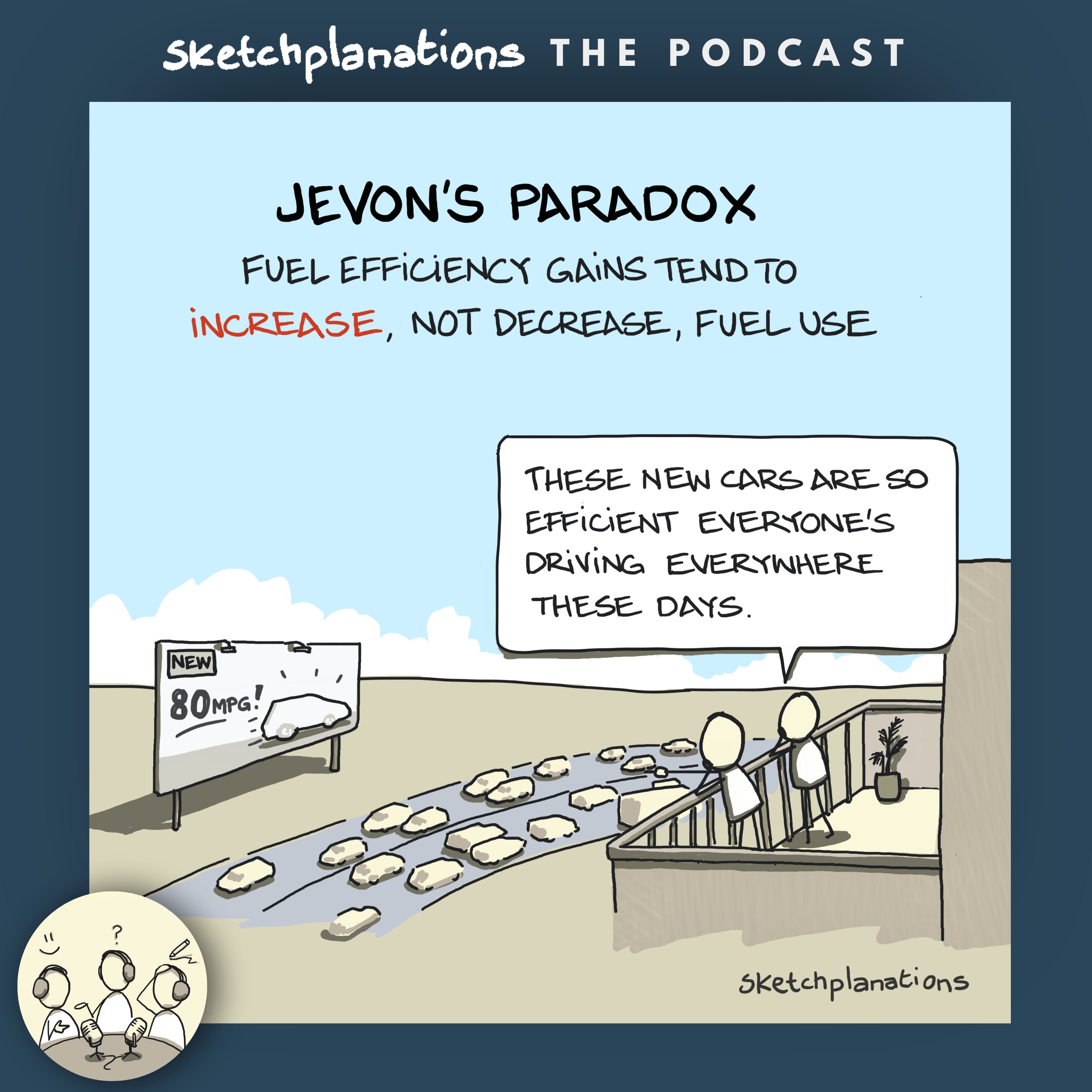
S4 Ep 12Jevon's Paradox
This time we discuss Jevons' Paradox, the counterintuitive concept that improvements in fuel efficiency can lead to increased overall fuel use. We explore the origin of this idea, dating back to 1865 by British economist William Stanley Jevons, and discuss its relevance today in areas such as car fuel efficiency, advances in battery technology, and even the proliferation of LED lighting in homes. Inevitably, the impact of emerging technologies like AI also arise. We also talk about the broader implications of Jevons' Paradox in everyday life and business, and how it can be managed through policies and smart design.Quick LinksSome links are included below to certain topics we reference in the chat:Other Sketchplanations referenced include: The Generalised Peter Principle, The Peter Principle, The Laws of ExpansionYou can also listen to our previous podcast on The Peter Principle.More Work For Mother book by Ruth CowanSummary00:00 Introduction to Sketchplanations Podcast00:33 Exploring Jevons Paradox01:11 Historical Context of Jevons Paradox02:37 Modern Examples of Jevons Paradox05:14 Personal Anecdotes and Parallels10:12 AI and Future Implications15:29 Energy Demands of AI and Nuclear Facilities15:51 The Evolution of Spreadsheets and Work Efficiency17:07 Jevons Paradox and Environmental Concerns17:29 Advancements in Battery and Water-Saving Technologies19:33 The Impact of Video Compression on the Internet21:47 LED Lights and Household Energy Consumption24:27 Government Policies and Behavioral Incentives26:10 Reflections on Jevons Paradox and Human Nature28:26 William Stanley Jevons' Insights and Predictions30:06 Conclusion and FarewellAll music on this podcast series is provided by the very talented Franc Cinelli. Hosted on Acast. See acast.com/privacy for more information.

S4 Ep 11Words of Wonder: Apricity - with Grant Snider
Do you like using interesting words in your conversations? We do. And there's one that's a tip top favourite...You're guaranteed* to learn loads of interesting words from this episode.Special guest Grant Snider - author, illustrator, poet (and orthodontist) talks about the illustration of interesting words, particularly obscure, outdated or esoteric ones. We kick off with a word both Jono and Grant have illustrated: 'apricity,' which means the warmth of the sun in winter and is a big favourite of ours - now that we know it. Grant shares his fascination with words and his 'Words of Wonder' series, where he illustrates intriguing words from his readings. We touch on the emotional connection words can create through compelling illustrations and delve into the creative processes behind these illustrations as well as the influence of childhood comics like Calvin and Hobbes.Links for further investigationApricity sketches: Jono's Sketchplanation & Grant's Words of WonderSome other of Jono's word-related Sketchplanations we reference are: Snerdle & GreeblePrevious podcast episodes we bring up include: Schadenfreude and we also talk about Apophenia in the episode on Crossmodal PerceptionSusie Dent's Word of the Day thread on X.Jono mentions the fun he had reading Etymologicon by Mark ForsythGrant's latest book Thinking About Thinking is available now. Episode Summary00:00 Introduction and Grant Snider's Background02:18 Exploring the Word 'Apricity'04:34 Grant's Words of Wonder Series07:24 The Joy of Learning New Words11:24 Favourite Words and Their Illustrations20:28 Exploring Obscure Words and Their Origins21:16 The Fascinating Concept of 'Greeble'22:50 The Joy of Discovering New Words23:52 Sketching Words and Their Meanings28:22 The Beauty of Children's Language Development30:35 Grant's New Book: Thinking About Thinking33:46 The Influence of Calvin and Hobbes37:04 Grant's Unique Use of Colour in Comics39:26 Final Thoughts and Upcoming Projects*We make no actual guarantees.All music on this podcast series is provided by the highly talented Franc Cinelli Hosted on Acast. See acast.com/privacy for more information.
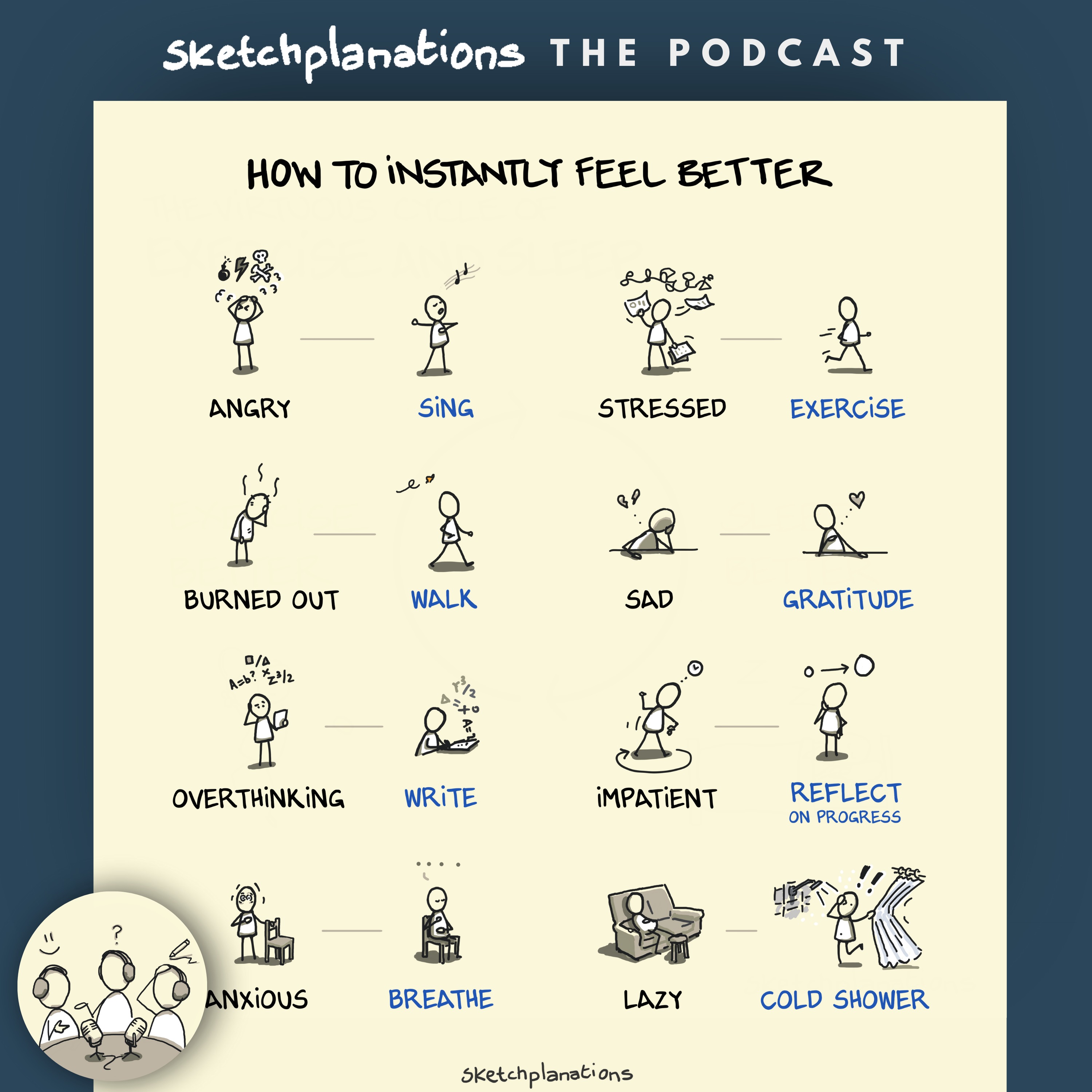
S4 Ep 10How to Instantly Feel Better
As we return from our summer break we discuss various ways to instantly feel better - timely perhaps for the Big Back to Work / School / Normality of September. We explore eight emotions—anger, burnout, overthinking, anxiety, stress, sadness, impatience, and laziness—and suggest instant proactive remedies to each. We highly encourage you to try these out whenever you're feeling any of the emotions discussed. Let us know if they work. Here are links to a few items we refer to in the chat:We reference a couple of previous podcast episodes: The Awkwardness Vortex, 5 Ways to WellbeingIn reference to when you're feeling anxious you can try Box Breathing. If all else fails, with any of these emotions you can instantly make yourself feel better by Walking in Nature. Gorefest: The Dutch (not Belgian as wrongly I said in the podcast) Death Metal band from the 90s who to the casual listener, their singing might sound like screaming. The Artist's Way by Julia Cameron. in reference to writing your "morning pages". Episode Summary00:00 Welcome Back to Sketchplanations00:53 Instant Ways to Feel Better03:16 The Power of Singing to Dispel Anger08:19 Walking Off Burnout11:46 Writing to Stop Overthinking16:20 Breathing Techniques for Anxiety20:49 The Power of Exercise for Stress Relief25:22 Gratitude as a Remedy for Sadness28:18 Reflecting on Progress to Combat Impatience30:56 Cold Showers to Overcome Laziness33:50 Final Thoughts and TakeawaysAll music on this podcast series is provided by the highly talented Franc Cinelli Hosted on Acast. See acast.com/privacy for more information.
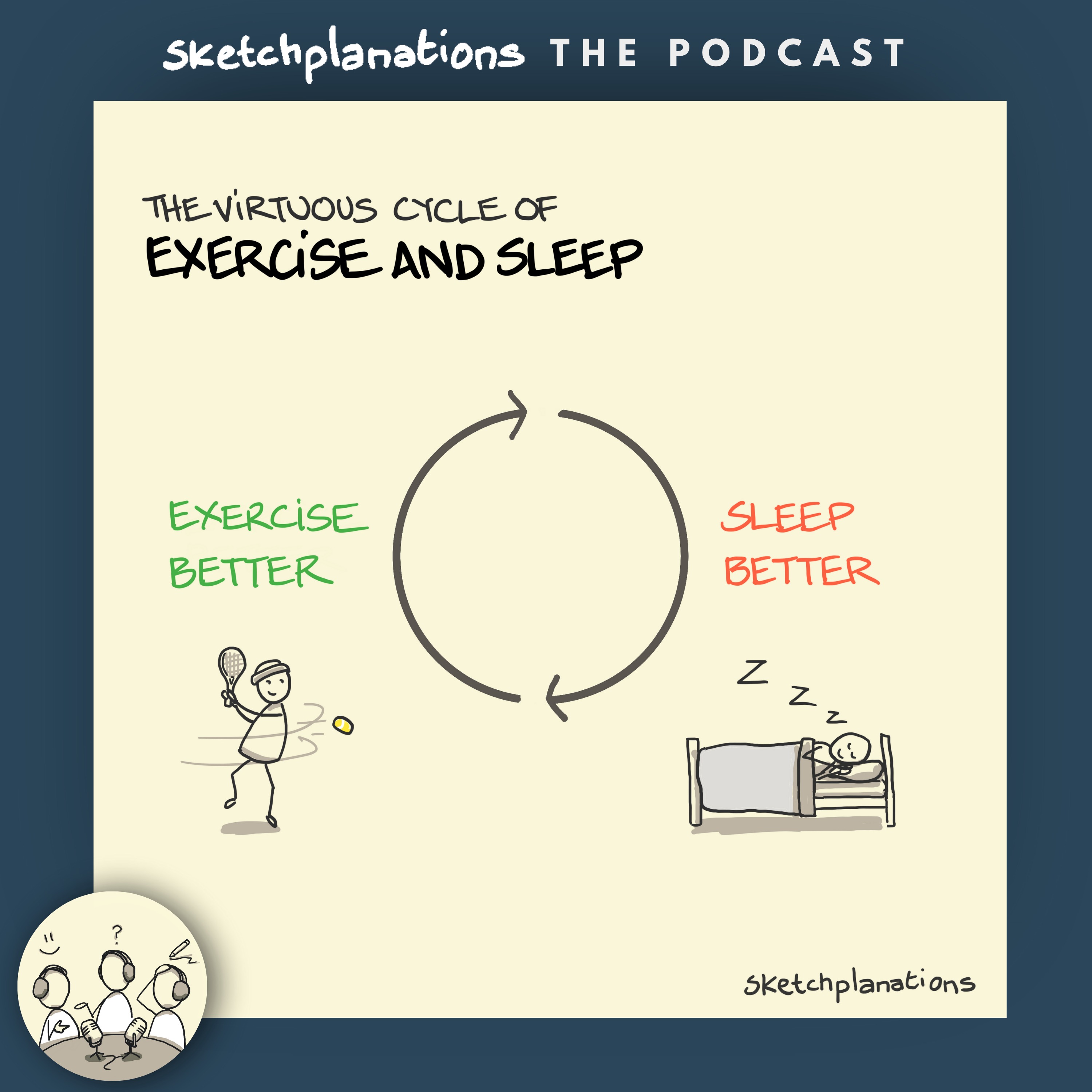
S4 Ep 9The Virtuous Cycle of Exercise & Sleep
Here on the podcast, we love our exercise and we love our sleep so in this summer break, check-in mini-episode, we discuss the interconnectedness of exercise and sleep, citing Novak Djokovic's book 'Serve to Win' as an influential source. While Tom shares his typical experience of staying active during holidays, Robbie bemoans the challenges of getting good sleep with young children, and Jono explores how his smart watch monitors his sleep and activity levels. In keeping with the holiday theme we also share tips for keeping kids entertained on long road trips.We'll be back with regular episodes in August.Until then, Go well, stay well and vacay well.In this mini-episode, we reference a previous podcast episode:Sharpen The Saw previous podcast episodeEpisode Summary00:00 Introduction and Summer Break Announcement00:35 The Virtuous Cycle of Exercise and Sleep01:39 Personal Experiences with Exercise and Sleep03:53 The Importance of Sleep on general wellbeing09:12 Keeping Kids Entertained on Long Trips11:23 Conclusion and FarewellAll music on the podcast series is provided by the hugely talented Franc Cinelli. Hosted on Acast. See acast.com/privacy for more information.
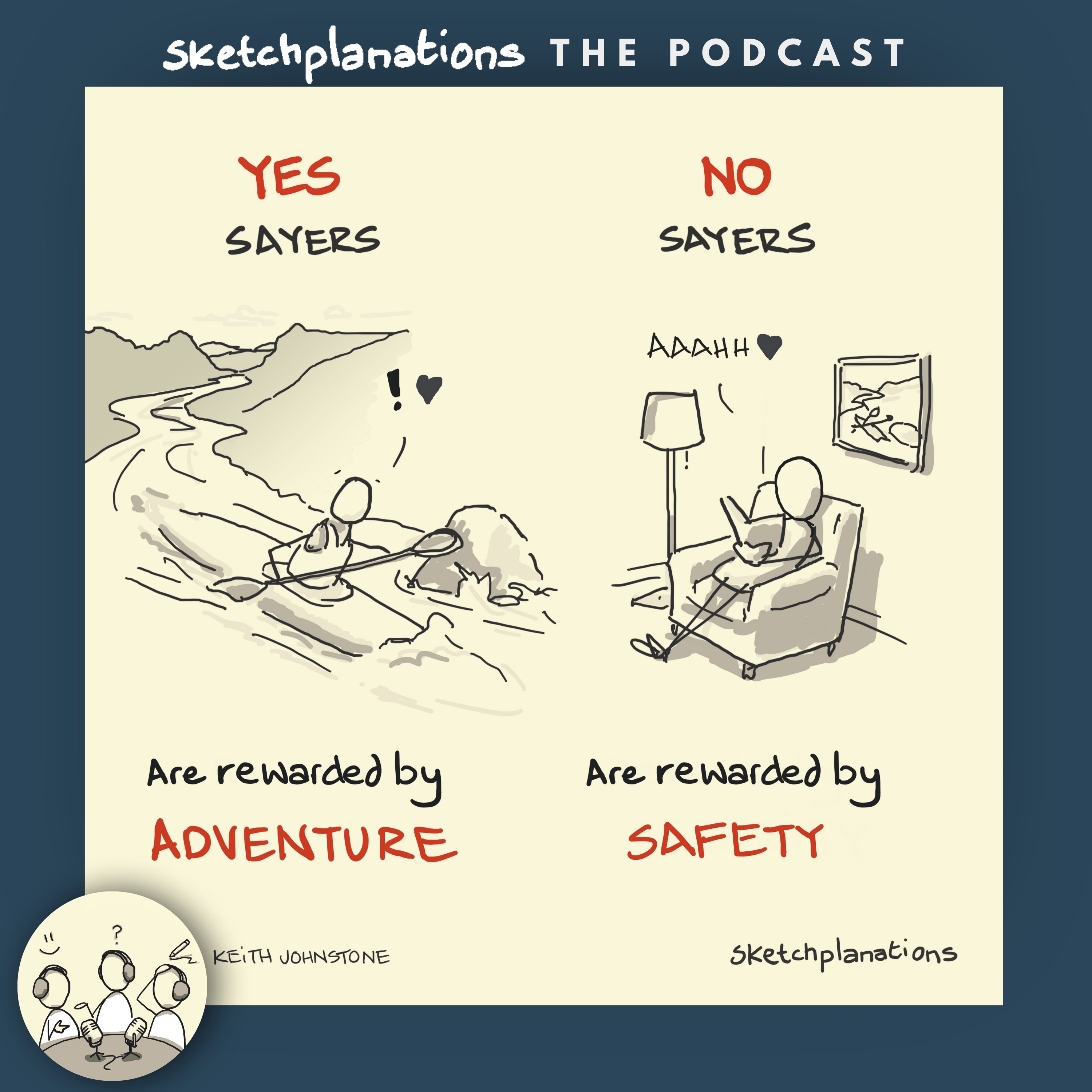
S4 Ep 8Yes Sayers & No Sayers
This time we explore whether it is better to generally say 'yes' or 'no' in various situations, and how each choice can offer distinct rewards. The conversation is framed by a quote from improvisation expert Keith Johnston, which asserts, 'Yes Sayers are rewarded by adventure and No Sayers are rewarded by safety.' The hosts consider personal anecdotes, the impact of these attitudes on careers, social settings, and mental well-being. They also touch on tools for making these decisions, such as the Eisenhower Matrix and the 'Hell Yes or Hell No' philosophy. The episode emphasizes the value of appreciating one's decisions, whether they lead to adventure or provide comfort and security.Here are links to a bunch of stuff we discuss in case you fancy reading a bit more about them:We reference a number of previous podcast episodes including: The Fun Scale, The Awkwardness Vortex, Finishing Lines, and Microadventures. Jono's sketch "Notice When You're Happy" and on "The Eisenhower Matrix"Improv Wisdom by Patricia Ryan MadsonDanny Wallace's book Yes ManDerek Sivers - The Hell Yes or Hell No philosophy and a video explaining the concept of The First Follower.Episode Summary00:00 Introduction and Hosts00:28 This Week's Sketch: Yes Sayers and No Sayers01:07 Exploring the Sketch03:45 Personal Reflections on Yes and No05:27 Social Dynamics of Yes and No19:44 Career Perspectives on Yes and No23:43 The Power of Saying No in Business25:01 The Benefits of Saying No25:45 The Adventure of Saying Yes26:34 Balancing Yes and No in Life30:17 Regrets of Not Saying Yes31:54 The Yes Man Experiment by Danny Wallace38:19 Deciding When to Say Yes or No41:55 Final Thoughts on Yes and NoAll music on this podcast series is provided by the highly talented Franc Cinelli Hosted on Acast. See acast.com/privacy for more information.
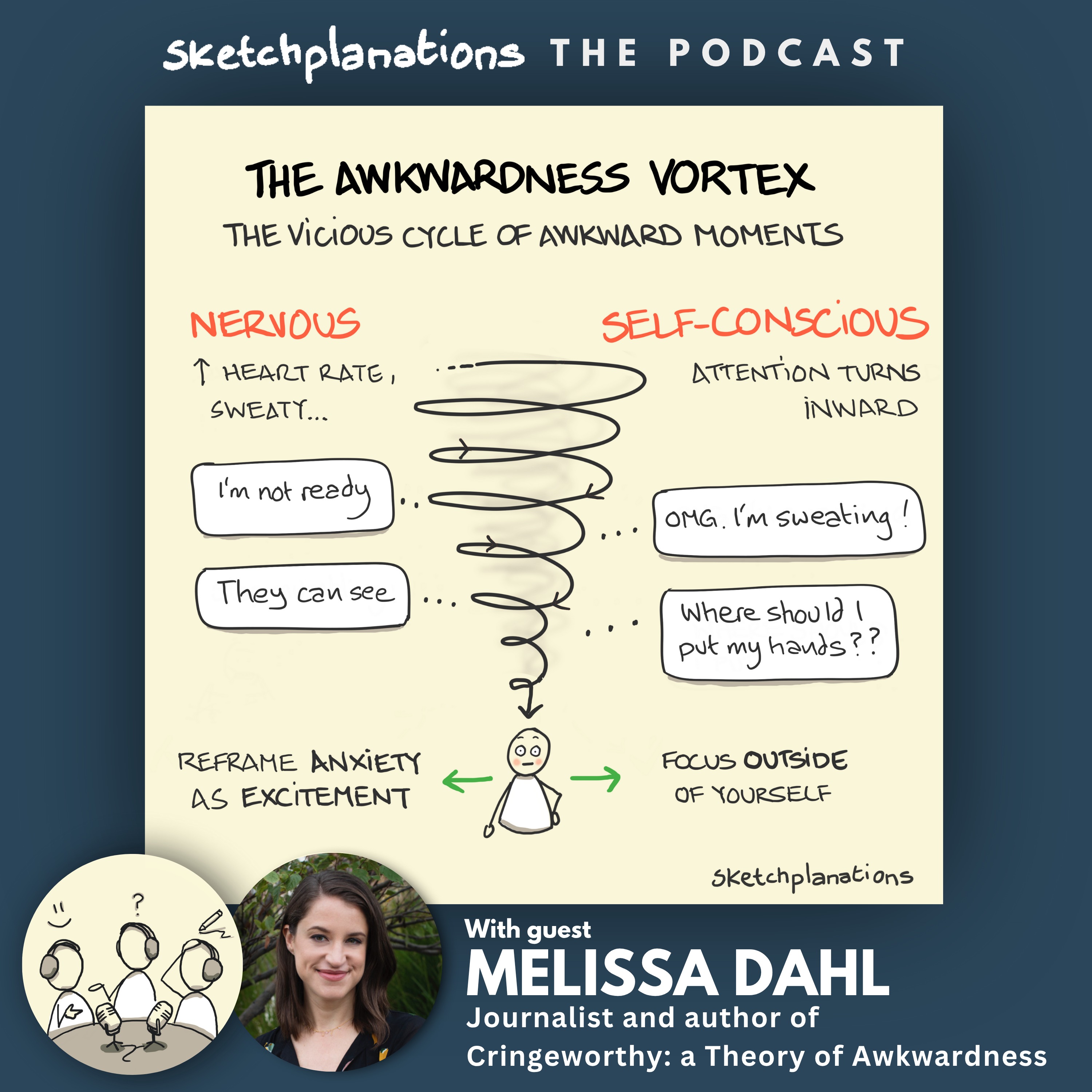
S4 Ep 7The Awkwardness Vortex with Melissa Dahl
Have you ever found yourself spiralling uncontrollably downwards in the "awkwardness vortex"? 🤔 Tune in to our latest podcast episode where we chat with celebrated science journalist Melissa Dahl about conquering those cringe-worthy moments and how awkwardness might just be a sign of empathy! This sketch is exclusive to the Sketchplanations Book : Big Ideas, Little Pictures - so check that out if you'd like to see this sketch in full (as well as number of other exclusive sketches). Melissa is a science journalist, specialising in Psychology, Health and Lifestyle, and author of the very well received book Cringeworthy: A Theory of Awkwardness.The conversation delves into retrospectively amusing personal experiences of social awkwardness, the psychological aspects behind it, and offers insights on how to manage and embrace these uncomfortable moments. Key tactics include focusing outside oneself, reappraising anxiety as excitement, and appreciating awkwardness as a sign of empathy. Melissa reflects on how researching awkwardness has changed her perspective, highlighting the growth and connection that can come from embracing this very human emotion. Melissa also shares how awkwardness can have a positive side, signalling empathy and social awareness. Tune in for a thought-provoking discussion that will have you rethinking your relationship with awkwardness.Here are links to a bunch of stuff we discuss in case you fancy reading a bit more about them:Barry Schwarz - Author of The Paradox of Choice : Why Less is More. Examples of the hugely effective End The Awkward campaign from Scope (a disability equality charity in England and Wales). Don’t Fill The Silence podcast episodeFront Stage / Back Stage podcast episodeEpisode Summary00:00 Introduction and Guest Welcome00:51 Exploring the Awkwardness Vortex02:51 Personal Experiences of Awkwardness05:51 The Science Behind Awkwardness08:49 Practical Tips to Overcome Awkwardness22:23 Awkwardness in Media and Comedy25:06 Exploring Empathy and Awkwardness25:41 The Science Behind Secondhand Embarrassment26:30 Empathy Spectrum and Social Interactions29:25 Awkwardness in Media and Society31:33 Cringe Mountain and Overcoming Embarrassment34:37 The Irreconcilable Gap and Self-Perception36:58 The Power of Awkward Silences39:16 Growth Through Awkwardness43:45 Final Thoughts and Upcoming ProjectsAll music on this podcast series is provided by the highly talented Franc Cinelli Hosted on Acast. See acast.com/privacy for more information.
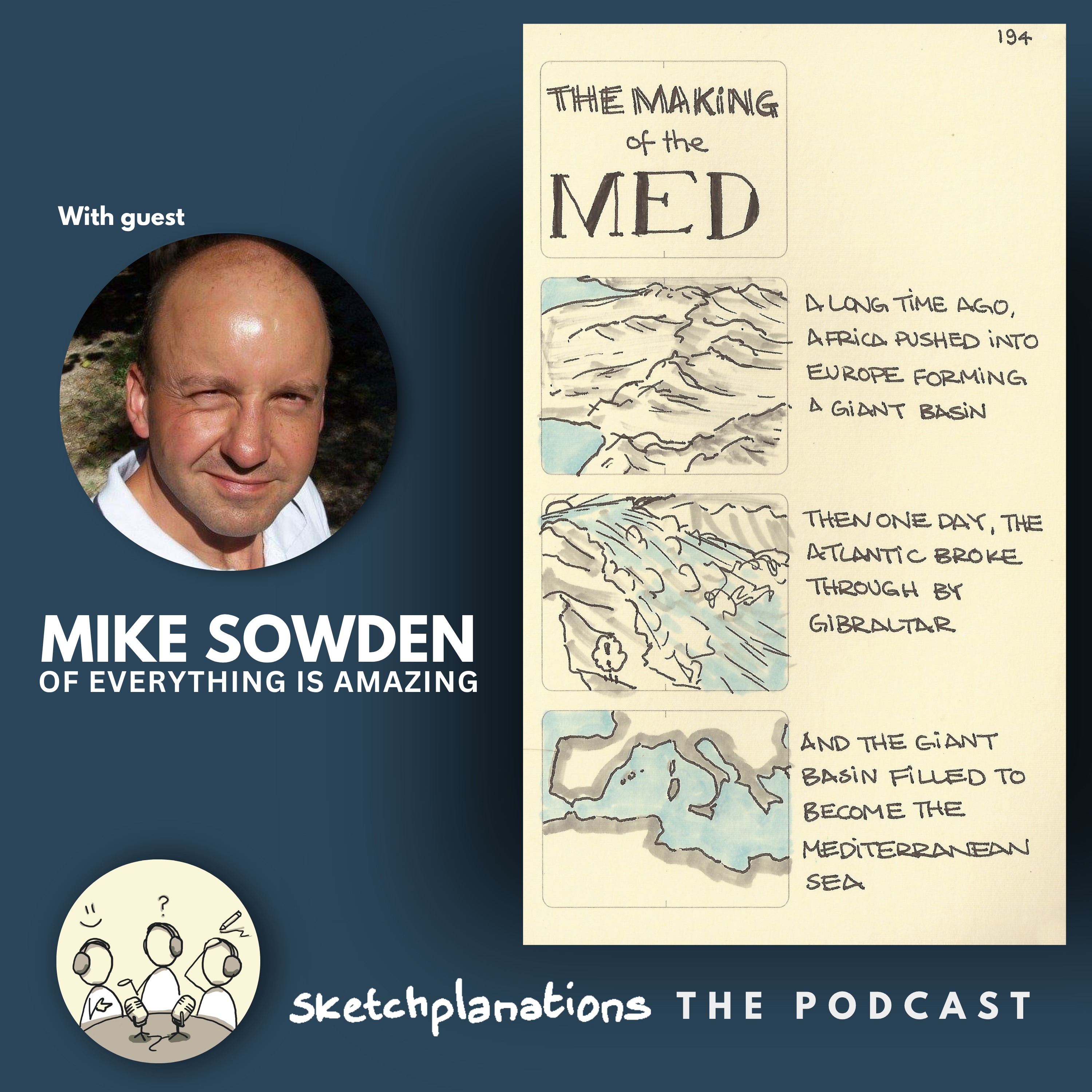
S4 Ep 6Zanclean Megaflood
We discuss the Zanclean Megaflood, a massive flood event that filled the Mediterranean Sea in a remarkably short period. The episode dives into the geological events and evidence leading up to this flood, challenging the earlier gradualist theories and promoting a catastrophic model.We are joined by Mike Sowden, whose engaging Twitter thread about the Zanclean Megaflood reached over 10 million people. Sowden, a travel writer and science communicator, shares insights on his curiosity-driven approach to science writing and storytelling. They explore other massive geological events, the nature of scientific discovery, and the human stories behind scientific advancements.The episode is filled with fascinating facts, storytelling techniques, and a deep appreciation for the wonders of our planet.If you want to find out more about certain topics that come up, you can try these:Julian May Sci-Fi books.Roland Emmerich disaster films.Previous Al Humphreys and Brendan Leonard podcast episodes.Missoula Floods in the USA.Episode Summary00:00 Introduction and Hosts00:45 Introducing the ZanClean Megaflood01:43 Special Guest: Mike Sowden03:01 Mike Sowden's Journey and Writing Style07:29 The ZanClean Megaflood: Geological Background12:55 The Catastrophic Flood Event17:25 Speculations and Analogies22:33 Doggerland and Other Historical Floods23:43 The Storegga Slide and Doggerland Tsunamis24:45 Dating the Storegga Slide25:06 The Zanclean Megaflood27:23 The Role of Storytelling in Science Communication32:23 The Human Element in Engineering34:30 The Fascination with Scientists' Obsessions40:54 Geological Events and Their Impact45:53 The Process of Science Writing50:42 Conclusion and Final ThoughtsAll music on this podcast series is provided by the highly talented Franc Cinelli Hosted on Acast. See acast.com/privacy for more information.
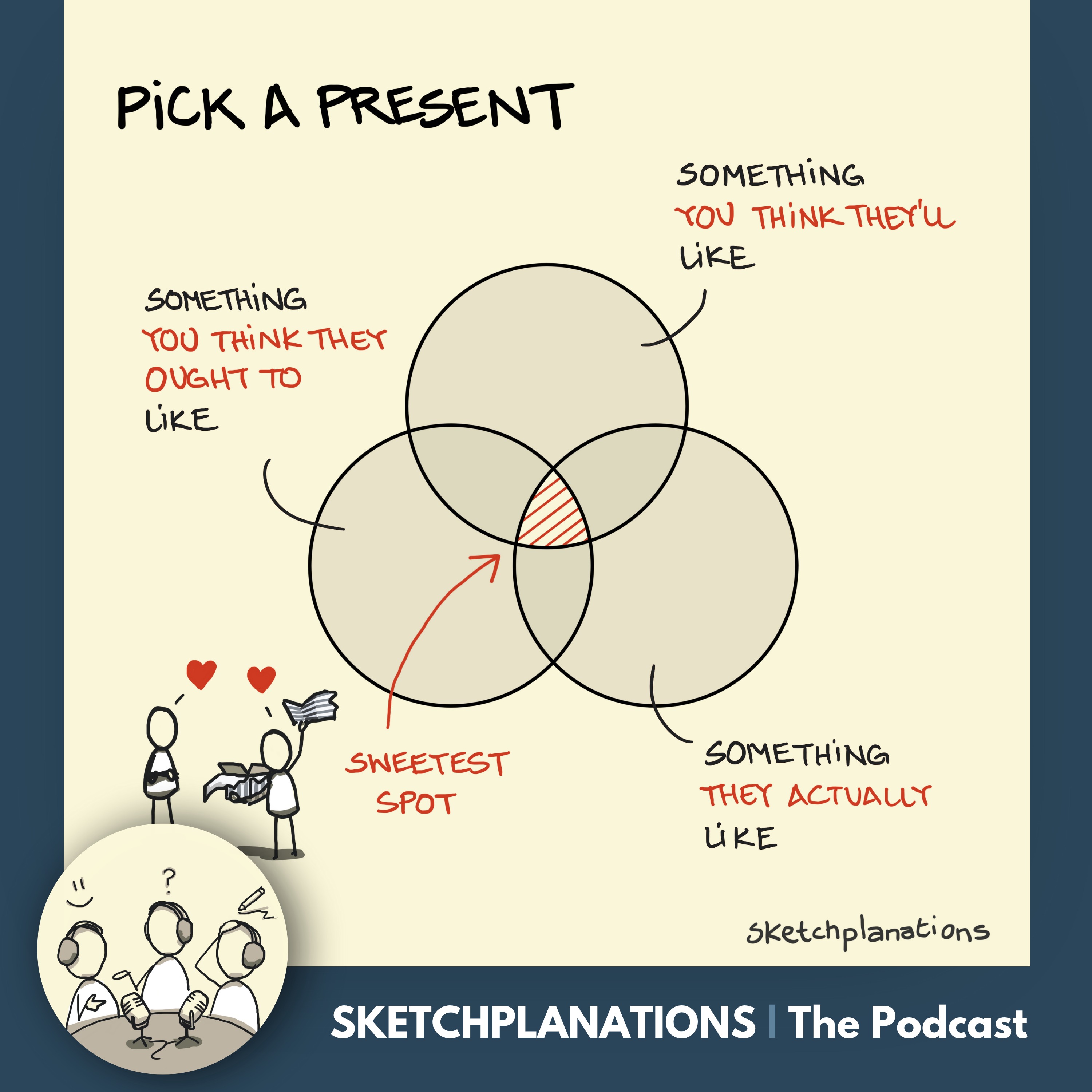
S4 Ep 5Picking A Present
This time, we delve into the complexities of choosing the perfect gift. The discussion is framed around a Venn diagram Sketchplanation that identifies three key factors in gift selection: what the recipient actually likes, what you think they like, and what you think they ought to like. We share personal anecdotes about both successful and less successful gifts we've given and received, emphasising the emotional aspects of gift-giving for both the giver and the recipient. We also touch on practical gift-giving strategies, such as buying from registries, focusing on useful and consumable items, and considering the recipient's values. The episode also addresses the challenges of buying gifts for individuals who have seemingly everything, and the importance of shared experiences in gift giving. And we invite you to share your own gift-giving experiences and tips, aiming to provide food for thought for anyone looking to improve their gift-giving skills.NB. In the podcast we reference how old this sketch is and that it was one of the first Jono did out of a collection that's now nearing 1000. Jono also suggested he might upgrade the sketch, which of course he has which is what you see as the artwork now. He's kept the original however, and you can see it here if you like. 00:00 Introduction to Gift Giving00:52 Welcome to Sketchplanations Podcast02:32 Exploring the Sketch: Picking a Present03:23 The Venn Diagram of Gift Giving06:50 Personal Experiences with Gift Giving16:18 The Art of Giving Useful Gifts20:15 Wedding Registry Dilemmas24:42 The Worst Gifts Ever Given26:15 Go-To Thank You Gifts27:53 The "Olive Oil" Story30:10 The Hunter-Gatherer Instinct in Gift Giving34:18 Challenges of Buying Gifts for Dads38:33 Designing Gifts for Others43:01 The Greatest Gift Ever Given45:10 Reflections on Gift GivingAll music on this podcast series is provided by Franc Cinelli. Hosted on Acast. See acast.com/privacy for more information.
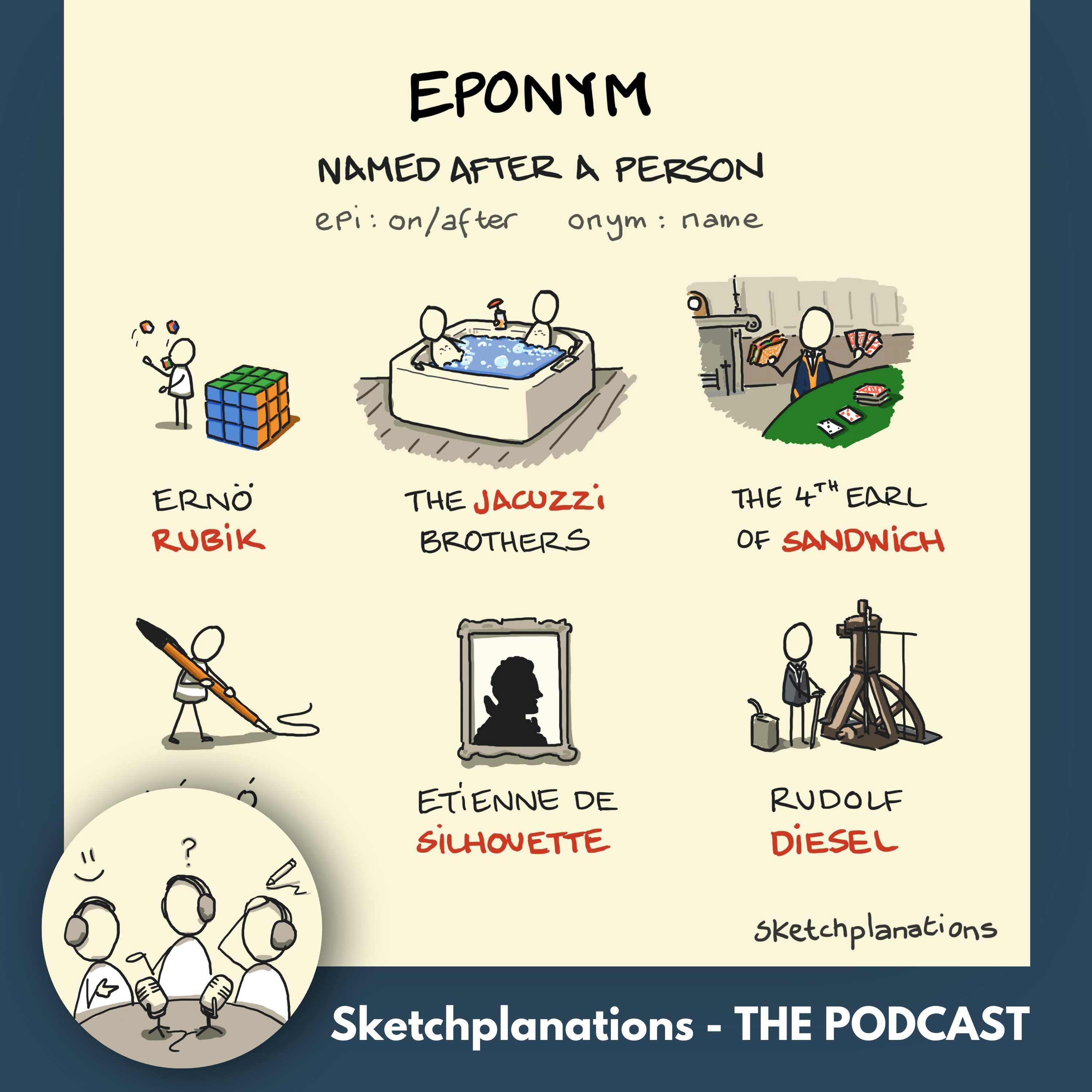
S4 Ep 4Eponyms
This time, we delve into the concept of eponyms—words or names derived from people's names or places that capture little slices of history. The discussion starts with general definitions and shares interesting examples like the Jacuzzi, named after the Jacuzzi brothers, and the sandwich named after the fourth Earl of Sandwich. The hosts explore how eponyms often tell compelling stories, sometimes reveal historical facts, and occasionally involve controversies or unintended legacies, such as the 'Pellereau,' a term humorously defined by Lord Sugar. They also touch on the potential pitfalls of eponyms associated with infamous figures, brands becoming generic terms, like 'Hoover' and 'Google,' and the implications of eponyms on intellectual property law. The episode is rich with anecdotes that illustrate the origin and importance of these linguistic phenomena.Apology: In the podcast Rob insists that the word for shadow in French is Silhouette and Jono confirms this. Strictly speaking, the word for shadow is "ombre", but silhouette is sometimes used.Below are links to more information and depth on topics and content we reference in the podcast:The 99% Invisible podcast with Roman MarsThe Don't Say Velcro SongMany more of Jono's sketches under the category of wordsPrevious Eponym podcast episodes include: The Peter Principle; Hanlon's Razor; Goldilocks Tasks; The Shirky Principle; Dunbar's Number; and Goodhart's Law.00:00 Introduction to Eponyms00:57 Meet the Hosts01:56 Exploring Famous Eponyms03:11 The Fun of Sketchplanations11:42 Scientific Eponyms17:31 Controversial and Historical Eponyms23:47 The Origin of Hoover24:58 Matthew McConaughey's Career Shift25:59 The Concept of Genericide28:12 Famous Eponyms: Zipper, Escalator, and More32:11 Boycott and Maverick: Stories Behind the Words35:42 Eponyms in Everyday Language38:19 The Art of Naming and Eponyms in History40:36 Final Thoughts and TakeawaysAll music on this podcast series is provided by Franc Cinelli. Hosted on Acast. See acast.com/privacy for more information.
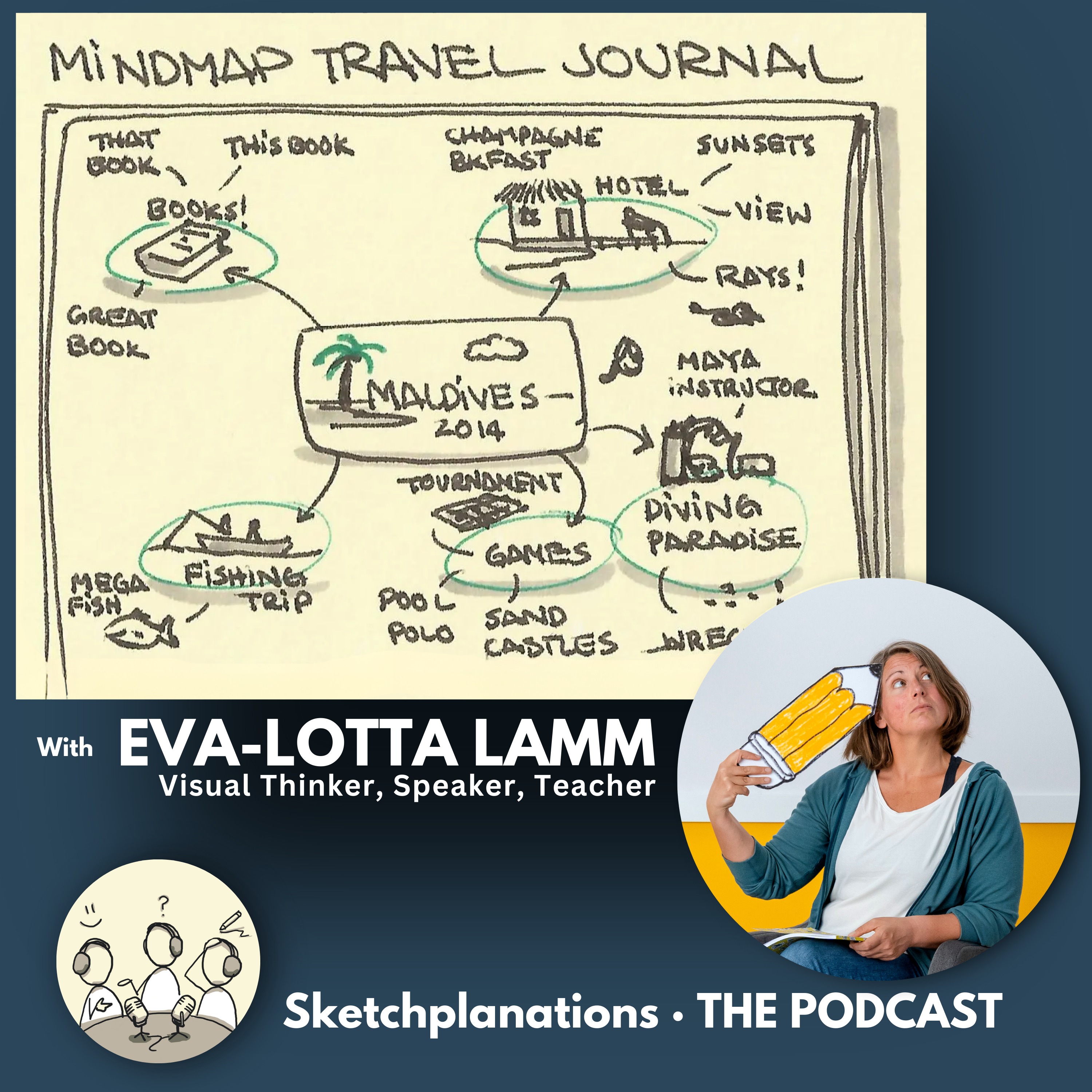
S4 Ep 3MindMap Travel Journal with Eva-Lotta Lamm
Before you go any further with this episode, check out both:Jono's mindmap travel journal from 7 months traveling in Central America, South East Asia, and South Africa, andEva-Lotta Lamm's sketchnotes from her 14-month world trip.With the help of visual thinking expert Eva-Lotta Lamm, in this episode we discuss how using techniques like sketch-noting and mind-mapping can enrich travel experiences, offer a deeper connection to the moment, and create engaging and memorable journals. Eva-Lotta shares her professional journey from UX designer to visual thinking consultant and provides practical tips for anyone looking to enhance their note-taking and journaling skills, no matter their drawing ability. The discussion covers the concept of improvisation in drawing, the benefits of using a pen instead of pencils to avoid early editing, the freedom of mind mapping compared to linear note-taking, and the guest's personal experiences with sketch noting during her 14-month global odyssey. Further information and links"The Godfather" of Sketch-noting - Mike RohdeMind-mapping guru - Tony BuzanImprovisation coach - Dan KleinExternal links to Eva-Lotta's work and classesYogaNotesEvaLotta.shop Instagram accountPragmatic Sketching MasterclassLittle People BasicsLittle People PairsPodcast Summary00:00 Introduction01:27 Meet Eva-Lotta Lamm02:23 Eva-Lotta's Career Journey05:09 Mind Map Travel Journals06:08 The Art of Visual Note-Taking07:37 The Evolution of Sketch Notes15:16 The Power of Analogies in Sketching21:01 Creating Mind Map Travel Journals27:48 Capturing Emotions in Sketches28:40 Travel Sketching Experiences30:20 The Concept of Aphantasia31:55 Improvisation in Sketching34:58 Analog vs Digital Sketching38:51 The Joy of Travel Journals40:46 Encouraging Visual Thinking44:41 Overcoming the Fear of Drawing52:33 Eva-Lotta's Teaching and Projects54:01 Conclusion and Farewell Hosted on Acast. See acast.com/privacy for more information.
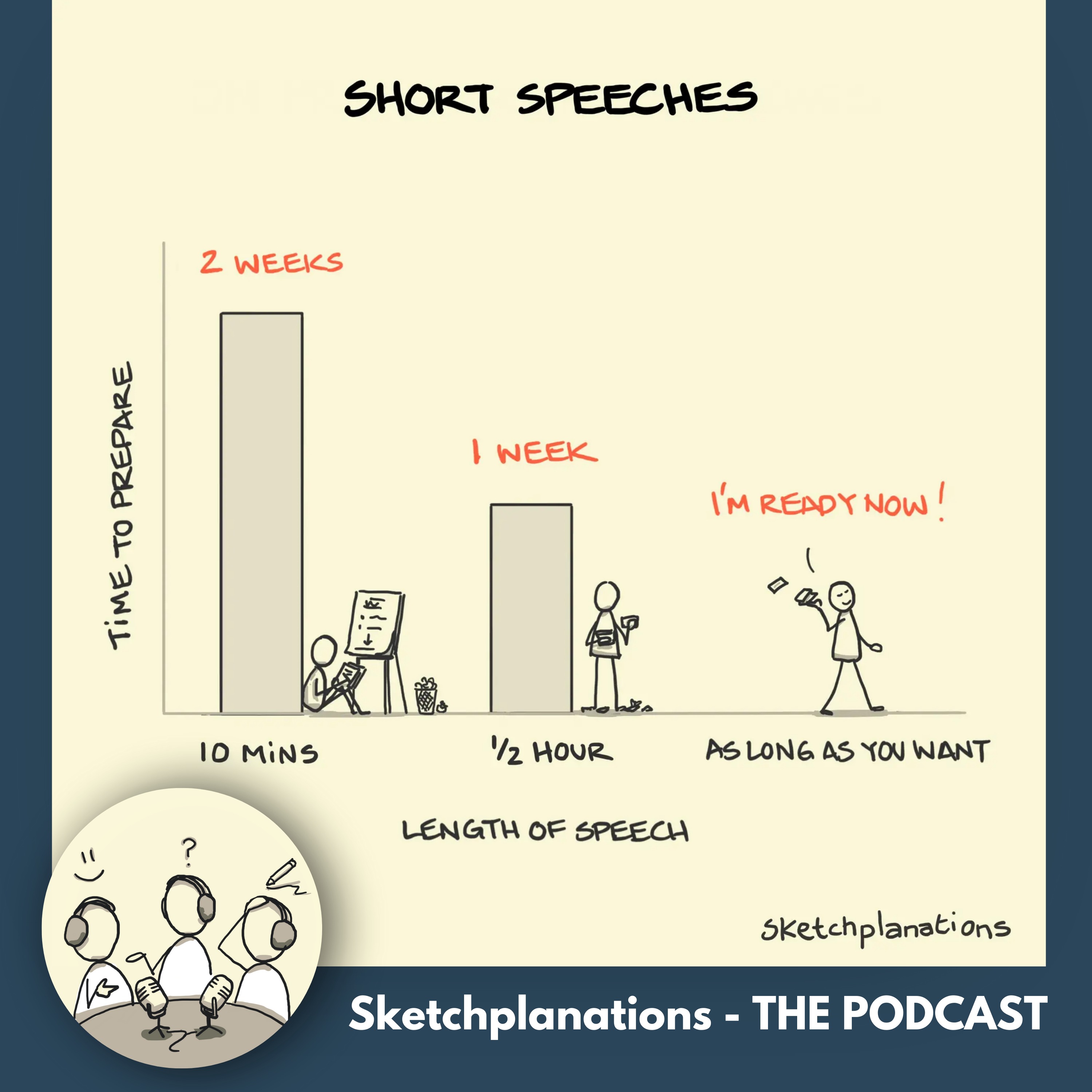
S4 Ep 2Short Speeches
What was the best speech you've ever heard?And how long was it?Are shorter speeches more effective than longer ones? In this episode, Rob Bell, Jono Hey, and Tom Pellereau dive into the concept that short speeches often take more time and effort to prepare. They discuss historical examples like the Gettysburg Address and Winston Churchill's wartime speeches, the importance of simplicity in communication, and even share personal anecdotes about delivering best man speeches and after dinner talks. The episode also touches on the impact of preparation, audience engagement, and the potential role of AI in summarising and organising content. Tune in to explore how less can indeed be more when it comes to effective communication.00:00 Introduction: The Power of Short Speeches00:57 The Concept of Short Speeches01:50 Jono's Inspiration and the Sketch02:40 The Importance of Preparation04:23 Examples of Short Speeches06:10 Personal Experiences with Speeches12:44 The Apprentice Application Process14:52 The Art of Concise Communication19:45 Podcasting vs Traditional Media21:29 Editing Challenges in Media Production22:42 Respecting Listeners' Time23:57 The Emotional Detachment in Editing24:24 Long-Form Media and Political Impact25:09 The Pressure of Impromptu Speeches26:53 Famous Short Speeches32:14 The Art of Simplifying Communication40:55 The Role of AI in Summarising Content42:24 Key Takeaways and ConclusionAll music on this podcast series is provided by the very talented Franc Cinelli. Hosted on Acast. See acast.com/privacy for more information.
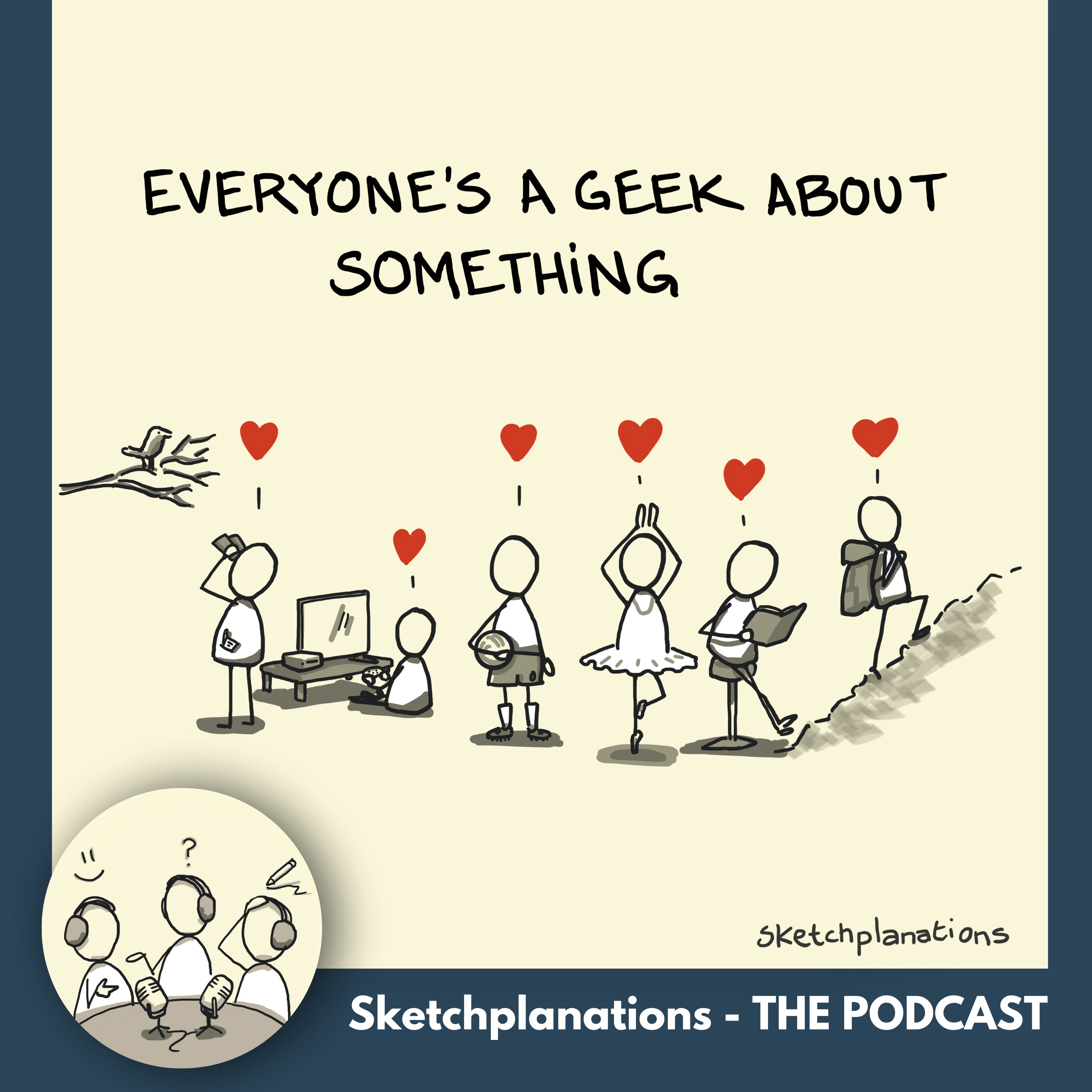
S4 Ep 1Everyone's a Geek About Something
This time, we explore the origins of the word 'geek,' its evolution from a negative to a positive term, and discuss why some subjects are more cool than others. We share our own personal geek topics and celebrate how social media and online communities have made it easier to find like-minded people. We argue that passion, knowledge and experience are all critical ingredients within the geek cocktail which may help differentiate between geekiness and professional expertise. Mainly though, this episode highlights the joy of discovering others' geekiness and we encourage our listeners to reflect on their own interests and support others in their passions.Join the conversation and share your own examples of geekiness by emailing [email protected] or by leaving us a voice note here. Don't forget to check out the episode artwork and visit sketchplanations.com for more insightful sketches!We reference the following in the podcast+ Book by Alexandra Robbins: The Geeks Shall Inherit The Earth+ Adam Smith - known as the Father of modern economics.+ Jono's sketch on "T-shape" people.+ Sketchplanations The Podcast episodes with James Wong; Part 1 & Part 2+ Subtly referenced by Jono, a song about artisan crafters whose work might be expensive, but it's expensive for a reason. Song: "It costs that much cos it takes me F-ing hours"Timeline of Topics Discussed00:00 Introduction to Sketchplanations Podcast01:14 Exploring the Sketch: Everyone's a Geek About Something04:21 Personal Geekiness and Social Perceptions06:43 The Evolution of the Term 'Geek'12:18 Finding Your Tribe in the Digital Age23:00 Diving into Copywriting23:39 Tom's Passion for Efficiency25:53 The Rise of Spreadsheet Geeks26:36 Professional Specialisation and Geekiness27:54 The Value of Multidisciplinary Teams31:36 Personal vs. Professional Geekiness33:28 The Intersection of Passion and Geekiness35:24 Defining Geekiness42:31 Famous Geeks and Their Impact44:03 Our own takeaways about Geekdom. All music on this podcast series is provided by the extremely talented Franc Cinelli. Hosted on Acast. See acast.com/privacy for more information.
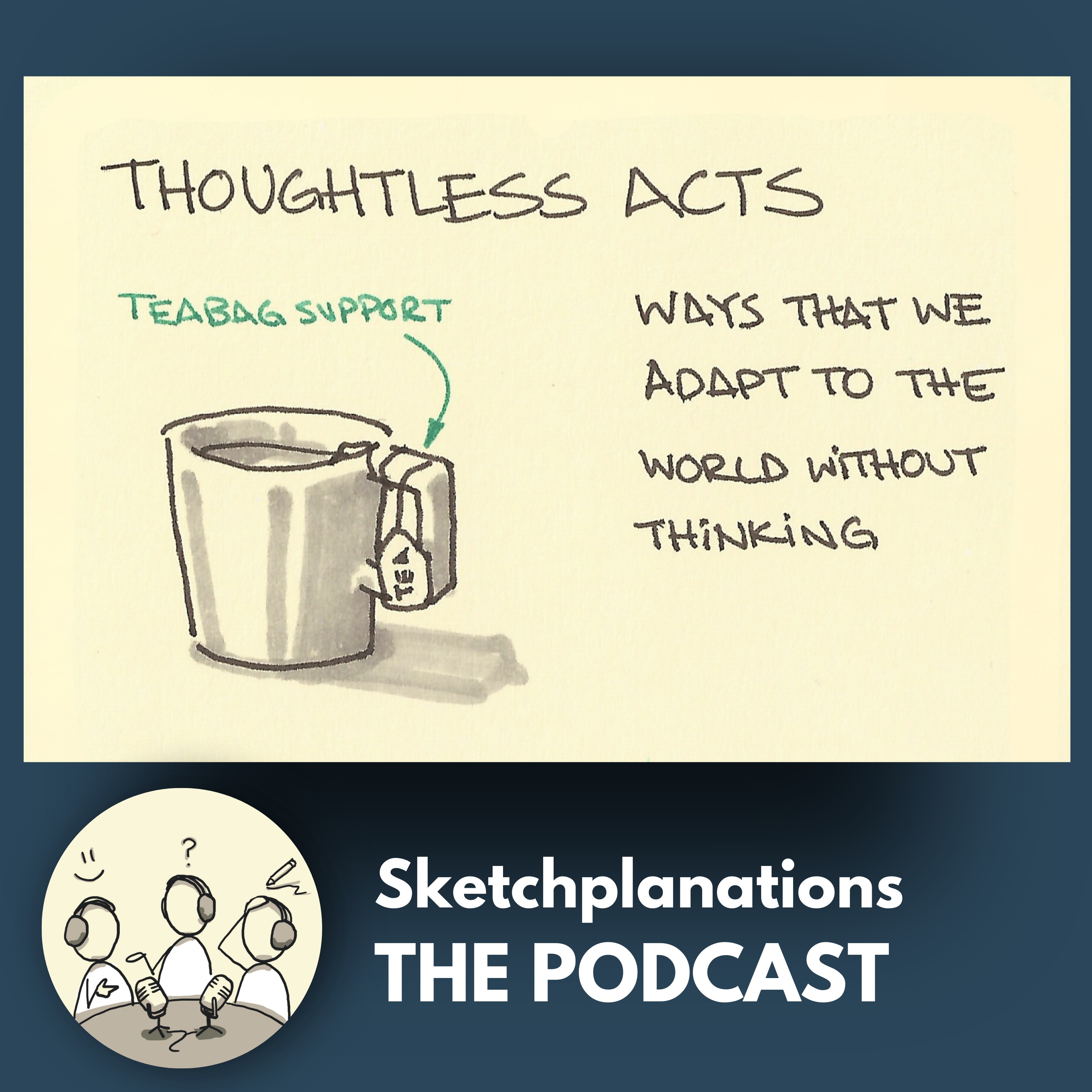
S3 Ep 14Thoughtless Acts
This time, we discuss the fascinating concept of 'Thoughtless Acts'—simple, everyday innovations people make to adapt to their environment without even thinking about it. From hanging tea bags on mug handles to hanging shirts on a washing machine door, we explore how unnoticed behaviours can inspire better design and usability. We also delve into the origins of the term inspired by the work and book from human factors researcher, Jane Fulton Suri and her work at IDEO. Once again, the team come prepared with buckets full of examples of Thoughtless Acts they've caught themselves doing or have observed in others - unsurprisingly, Tom brings ups dishwashers again! Join the conversation and share your own examples of thoughtless acts by emailing [email protected] or by leaving us a voice note here. Don't forget to check out the episode artwork and visit sketchplanations.com for more insightful sketches!Timeline of Topics Discussed00:00 Introduction to Thoughtless Acts01:53 Defining Thoughtless Acts03:24 Origins of the Concept05:58 Examples of Thoughtless Acts08:20 Degrees of Thoughtlessness11:12 Importance in Design12:40 Personal Hacks and Innovations15:27 Observations in Design21:26 Coffee Mugs and Shopping Trolleys22:19 Observing Daily Interactions24:04 Designing for Better Usability26:14 Everyday Improvisations32:02 Signalling and Subtle Messages33:58 Accidents and Tool Design37:17 Listener Engagement and ConclusionAll music on this podcast series is provided by the extremely talented Franc Cinelli. Hosted on Acast. See acast.com/privacy for more information.
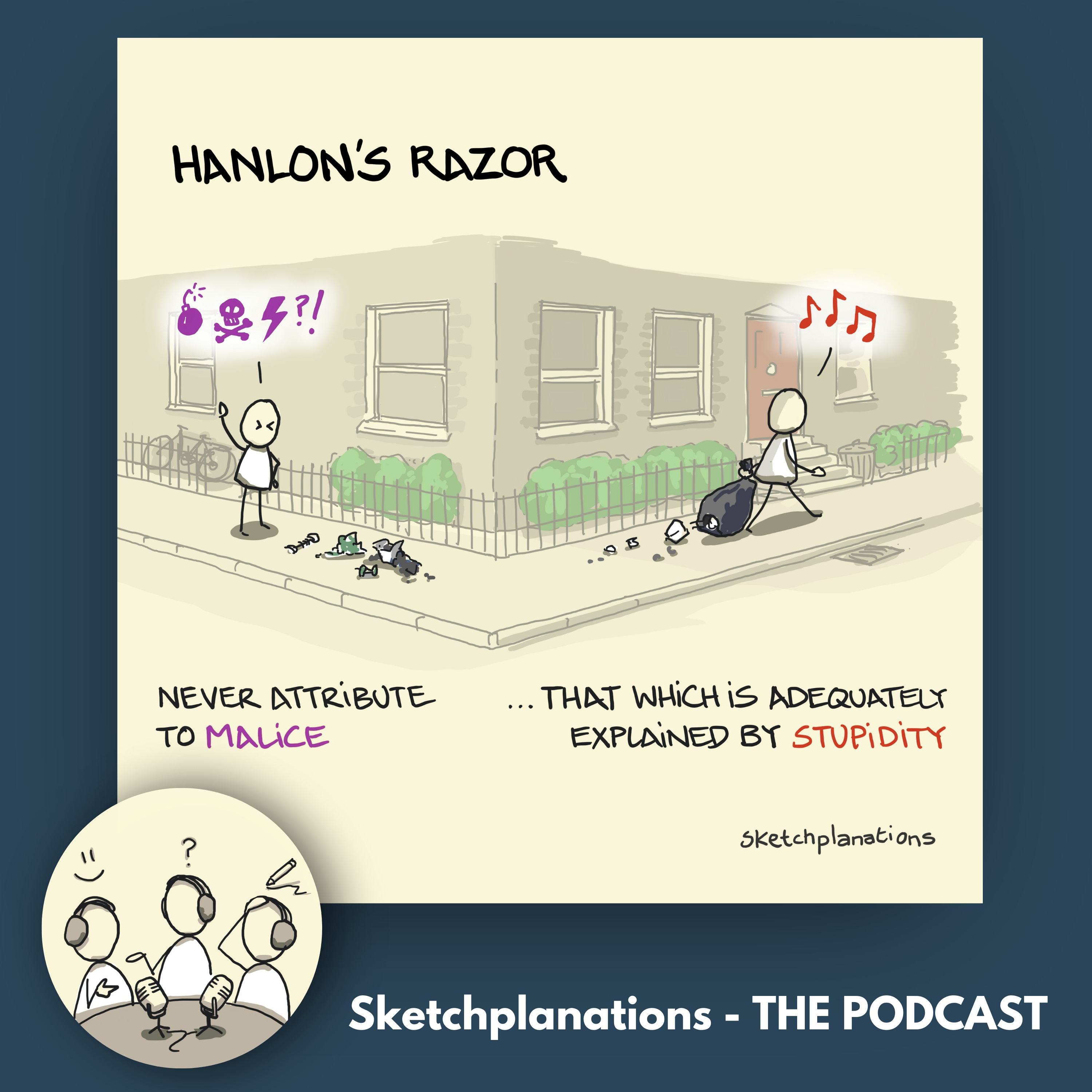
S3 Ep 13Hanlon's Razor
This episode is jam-packed with personal anecdotes and examples from real life of where we've fallen foul of Hanlon's Razor - wrongly attributing malice to a situation. The most recognisable is possibly in the car when someone cuts you up or pulls out in front of you. We cover a whole heap of other examples including misunderstandings during endurance swimming events, misplaced anger or frustration at home, and accidental mishaps in public places. We explore how acknowledging Hanlon's Razor can help reduce unnecessary stress and improve patience and understanding in everyday life. The episode wraps up with reflections on human nature, individual conditioning, and the importance of giving others the benefit of the doubt. Jono also shares related sketches and humorous laws from Murphy's Law book - where if something can go wrong, it will. You can send examples of your own stories and experiences of Hanlon's Razor in action to [email protected] OR leave us a voice note on the podcast website.We reference the following in the podcast: + Jono's Sketchplanation on Fundamental Attribution Error+ Murphy's Law Book 1 & Murphy's Law Book 2+ Jono's sketch on Narrative Bias+ William of Ockham and Occam's Razor.+ The previous podcast episode on The Peter Principle.Timeline of topics discussed:00:00 Introduction and Personal Anecdotes00:57 Hanlon's Razor Explained05:27 Examples of Hanlon's Razor in Action14:33 Philosophical Discussion on Human Nature22:09 Clearing Up the Confusion About Hanlon's Razor22:32 The Origin and Meaning of Occam's Razor24:27 Misunderstandings and Miscommunications26:10 More Real-Life Examples of Hanlon's Razor33:54 The Importance of Giving Others the Benefit of the Doubt38:21 Fun and Thought-Provoking Rules from Murphy's Law Book40:34 Conclusion and Final ThoughtsAll music on this podcast is provided by the very talented Franc Cinelli Hosted on Acast. See acast.com/privacy for more information.
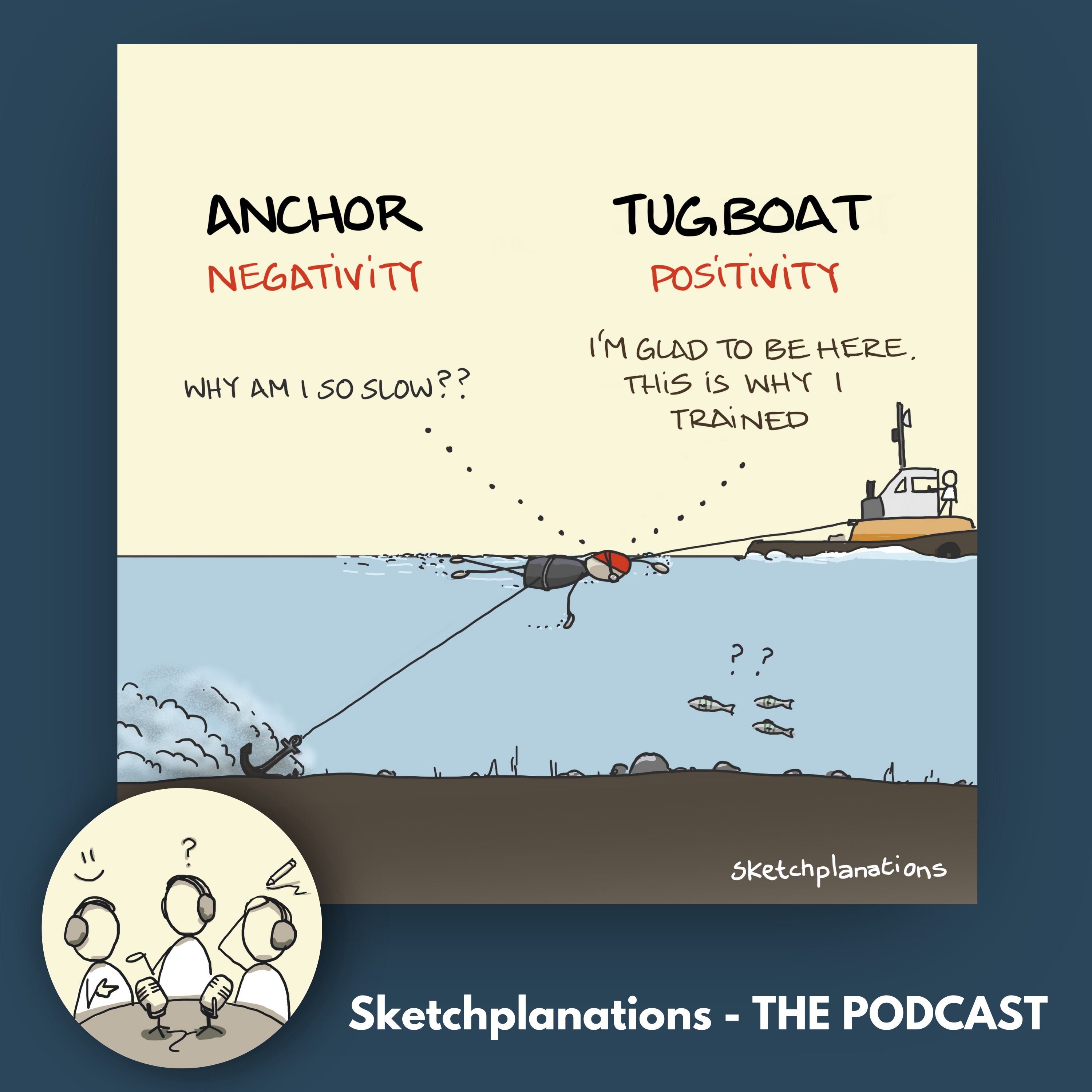
S3 Ep 12Anchors & Tugboats
Inspired by Sports Psychologist, Justin Ross on the Løw Tide Bøyz Podcast, this episode explores the metaphors of 'anchors' and 'tugboats' to illustrate the impact of negative and positive self-talk on our mental state and performance. We discuss how negative thoughts can anchor us down, whereas positive thinking acts as a tugboat, pulling us forward. We delve into examples from sports psychology, personal professional experiences, parenting and everyday scenarios to highlight the importance of being aware of our inner dialogue. The conversation also touches on the role of friends, the significance of small changes like having a snack, and practical tips for reframing negative thoughts. Join us as we navigate these concepts, and provide practical advice for turning your mental anchors into tugboats that propel you forward.We reference the following in the podcast: + Jono's Sketchplanations on The Stages of Competence Framework+ David Goggins' Book: Can’t Hurt me. + Jono's sketch on Complaining at the Weather+ Jono's Paradox of Choice sketch+ Tommy's positive manifestations of "There will be a parking space" - as popularised by Paul McKennaTimeline of topics discussed:00:00 Understanding the Power of Self-Talk00:57 Introducing Anchors and Tugboats02:11 The Origin of Anchors and Tugboats03:49 Applying the Metaphor to Sports and Life05:09 Awareness and Self-Talk06:00 The Role of Friends and Environment10:45 Personal Examples and Practical Tips18:33 Swimming and Self-Talk25:08 Understanding the Brain's Tactical Advantage25:35 The Accountability Mirror Technique26:12 The Importance of Eating for Energy28:03 Personal Experiences with Energy and Focus33:01 The Power of Positive Self-Talk36:04 Anchors and Tugboats: A Metaphor for Self-Talk40:49 The Role of Mental Training in Sports42:38 Toxic Language and Self-Talk46:27 Concluding Thoughts and SummaryAll music on this podcast is provided by the very talented Franc Cinelli Hosted on Acast. See acast.com/privacy for more information.
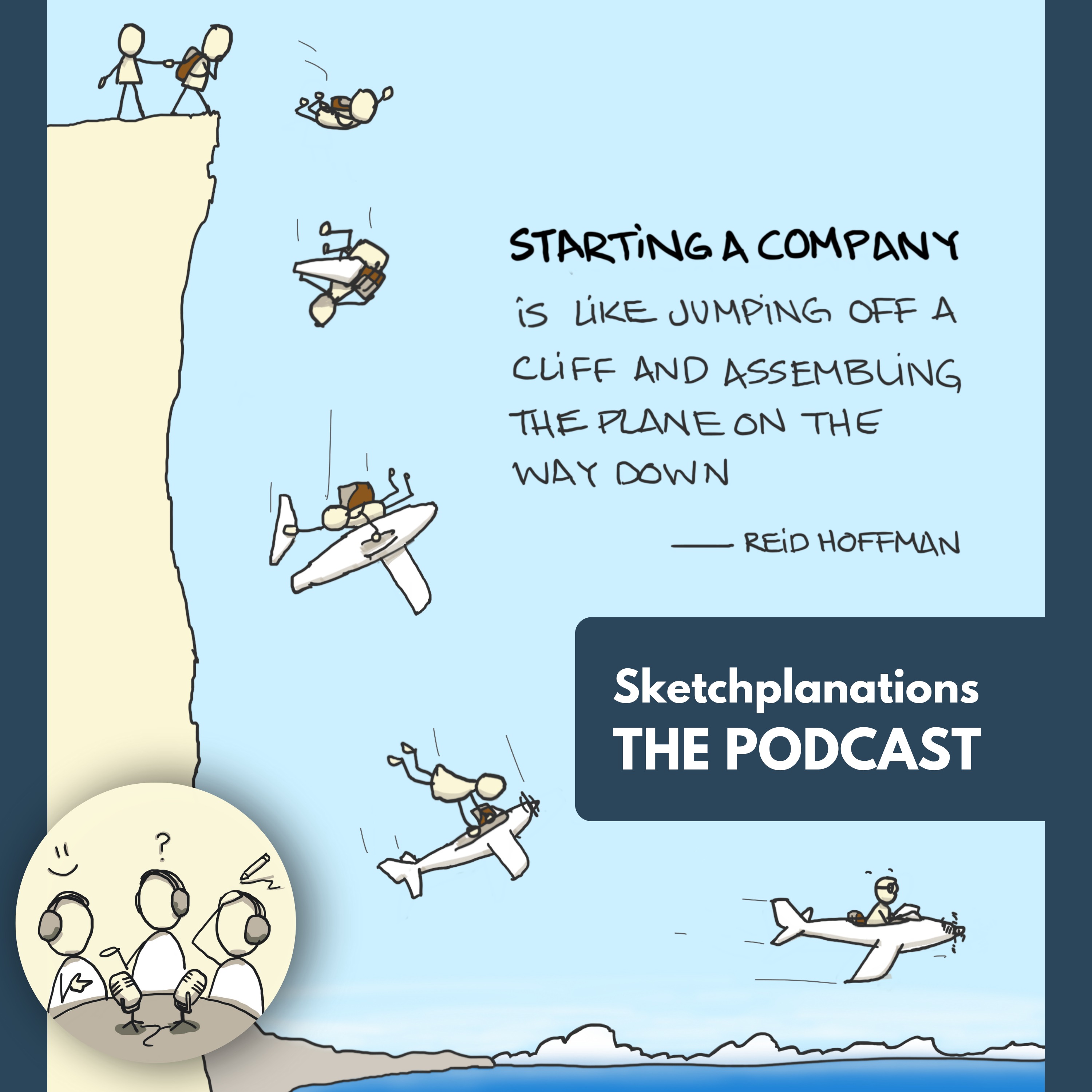
S3 Ep 11Starting a Company
In this episode, Rob, Tom and Jono discuss a compelling quote from American internet entrepreneur Reid Hoffman (who is also the founding host the Masters of Scale podcast), which compares starting a company to jumping off a cliff and assembling a plane on the way down. Tom and Jono share their personal experiences and insights into the chaos and exhilaration of entrepreneurship. We also explore the deeper meanings behind such journeys, offering advice for aspiring entrepreneurs and relating to various iconic metaphors. Highlights include the challenges and rewards of starting a business, the importance of having a supportive team, and advice for aspiring entrepreneurs. They also bring up Wallace and Gromit's hilarious train track scene and share insights into psychological and logistical hurdles faced while building a business.Other links to references made in the podcast include:+ A video of a lone dancer in a field at a festival who starts a craze - a very uplifting watch demonstrating the different roles of leadership and first follower.+ The Sketchplanations The Podcast episode on Optimism Bias - referencing a typical character trait of entrepreneurs.+ The Sketchplanation on The Twin Engines of Altruism and Ambition+ Big Ideas, Little Pictures: The Sketchplanations book where you can see the Starting a Company sketch with even more detail and on a double page spread.+ American writer Ray Bradbury and his wonderful quote about missing life if you don't jump off cliffs and build your wings on the way down.02:16 The Chaos of Starting a Company04:48 The Role of Money and Support in Entrepreneurship06:50 The Importance of Team and Adaptability10:05 The Reality of Entrepreneurial Risks and Rewards18:36 The Power of Early Adopters and Team Dynamics21:16 Wallace and Gromit: A Metaphor for Entrepreneurship23:14 Navigating Business Challenges23:52 Growth and Expansion Strategies24:18 Facing New Market Requirements25:34 Building a Supportive Team26:09 The Reality of Running a Business29:01 The Role of Optimism in Business33:53 The Rewards of Entrepreneurship37:16 Advice for Aspiring Entrepreneurs41:13 Closing Thoughts and ReflectionsAll music in this series is provided by Franc Cinelli. Hosted on Acast. See acast.com/privacy for more information.
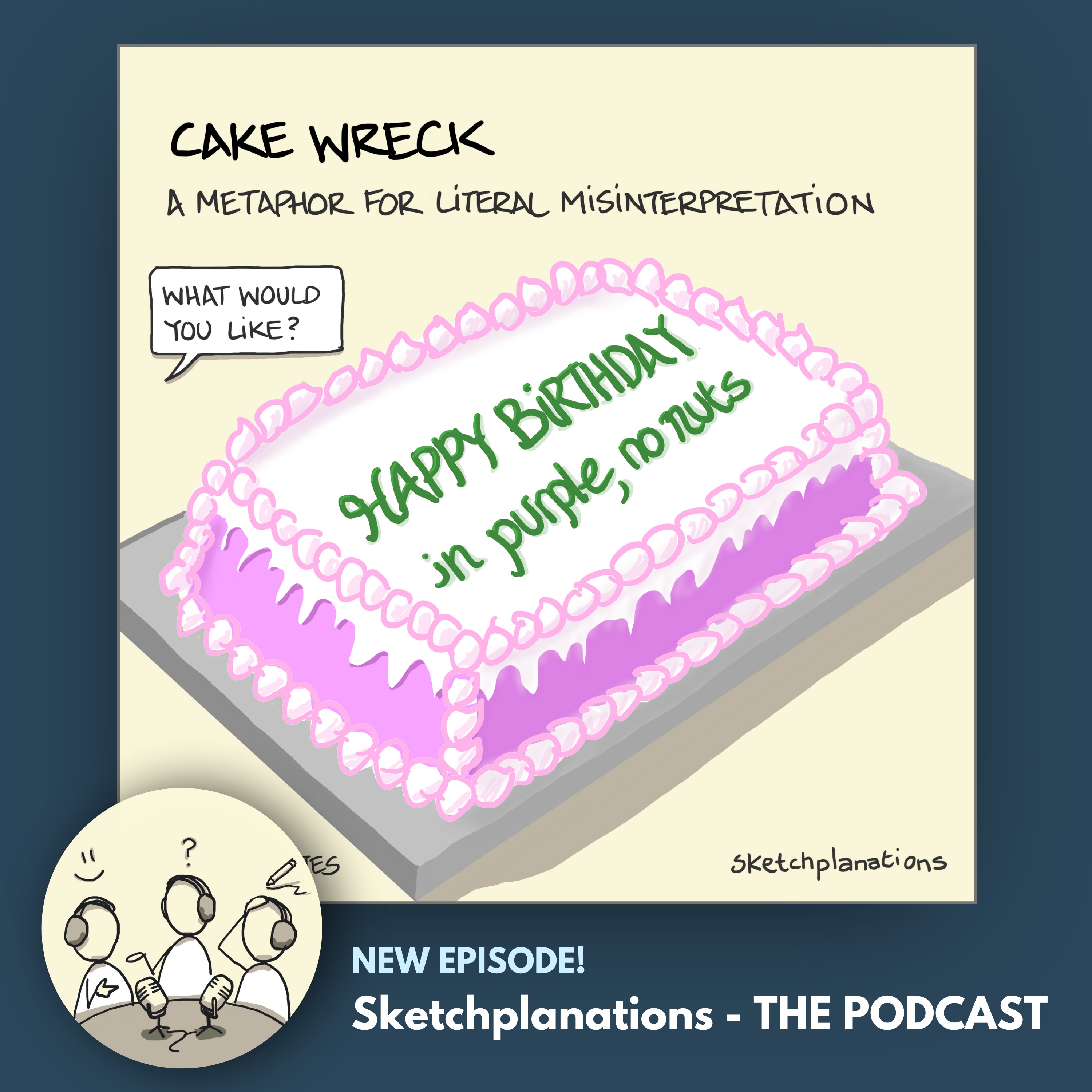
S3 Ep 10Cake Wrecks with guest John Cutler
Have you ever had your order or instructions (for a cake or otherwise) go hilariously awry? Oh dear... How funny. Never mind eh?!? I'm sure there's a lesson in these somewhere. In this episode, we discuss the phenomenon of 'Cake Wrecks,' where instructions for creating something go hilariously wrong, and how this applies broadly to miscommunication in product development. The conversation is joined by John Cutler, a prolific writer and ("on second") thought leader in digital product development. We delve into the importance of clear communication, prototypes, and iterative understanding in avoiding these 'wrecks' in both hardware and software realms. As always, we also touch on real-world examples, the role of user experience, and the necessity of involving all team members in the design process to ensure a shared and accurate understanding of project goals.Stay tuned for practical advice on improving clarity and collaboration in your projects.Topics Covered. 00:00 Introduction to Cakewrecks00:57 Everyday Essentials and the Magic of Three01:44 The Versatile Bic Four Colours Pen02:17 Reminiscing About Handwriting and Notes05:31 Introduction to the Podcast and Guest05:39 Exploring Cake Wrecks and Misinterpretation06:29 John Cutler's Journey and Insights13:47 Challenges in Product Development20:07 The Illusion of Fixing Decisions20:28 Challenges in Hardware Manufacturing21:13 The Importance of Clear Communication22:44 Prototyping and Specification23:46 Avoiding Misunderstandings in Projects25:20 Participatory Design and User Experience28:18 Embracing Diverse Perspectives34:48 The Role of Sketching in Communication37:55 Concluding Thoughts and ResourcesGet in TouchHave you ever had your instructions result in something way more literal than intended? Or did you mis-interpret the orders of someone else? Let us know:email us: [email protected] leave us a voice noteReference LinksIn this episode we also reference:YouTube clip of John's first digital product development project; the computer bar tending game, Last CallJen Yates' amusing blog on Cake WrecksJeff Patton's book; User Story MappingSpinal Tap's Cake Wreck moment when they accidentally order an 18" tall model of Stonehenge in stead of an 18' model. Bent Flyvbjerg and Dan Gardner's book, How Big Things Get DoneAll music on this podcast is provided by the very talented Franc Cinelli. Hosted on Acast. See acast.com/privacy for more information.
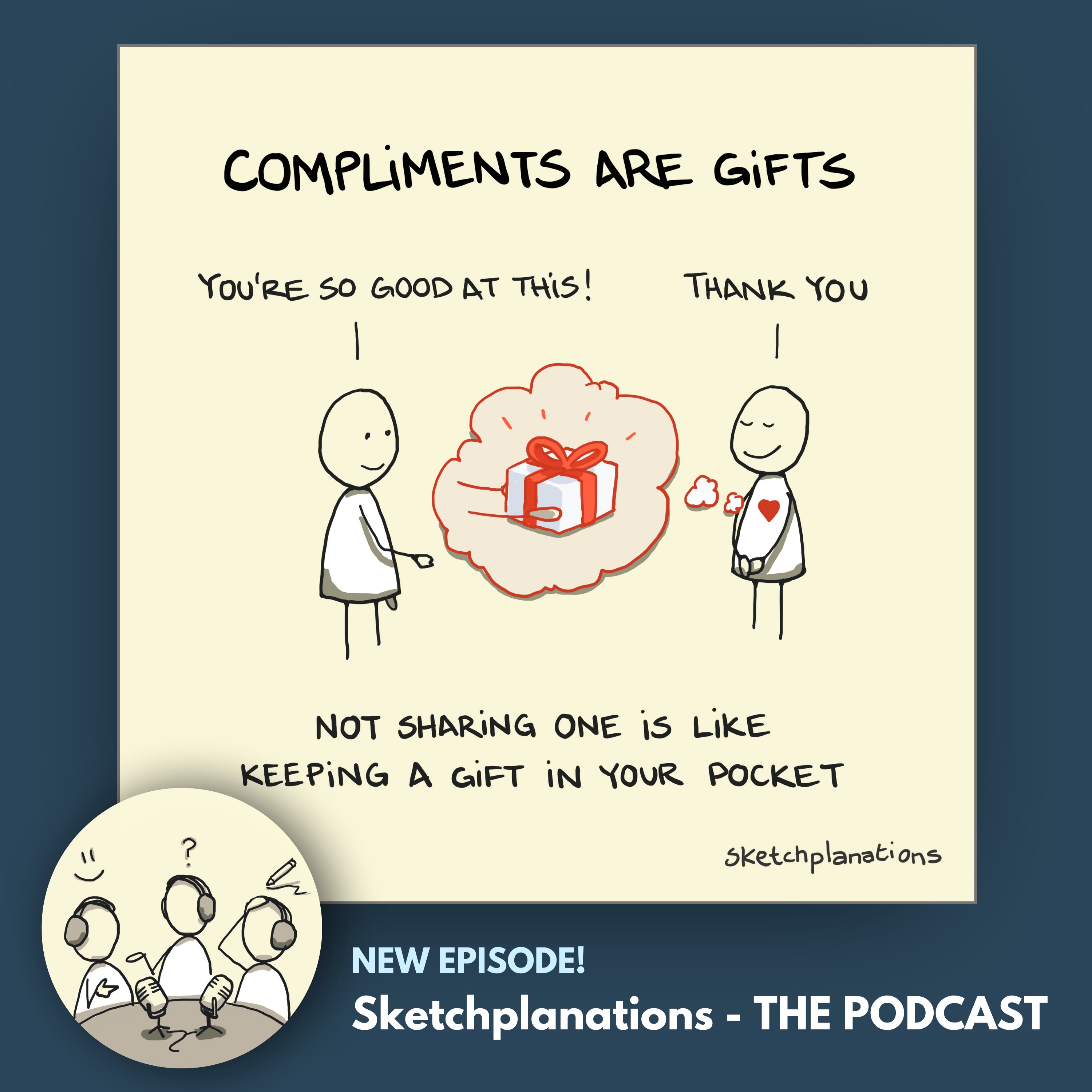
S3 Ep 9Compliments Are Gifts
Doesn't it feel good to be told something positive about yourself and vice versa if you notice something positive about others?So why wouldn't we compliment each other more often?In this episode, what with it being nearly Christmas, we use the metaphor that compliments are gifts - and not one you'd pick out of a lucky dip. These gifts have been made and wrapped especially for you. There's your name on the label and everything!Not only do we offer advice on noticing when you could give compliments more regularly, we discuss the etiquette in receiving compliments and make Tom feel very awkward with a little complimentary experiment!We apply our theories to the usual work, home and play scenarios and ponder why compliments from our parents mean so much.Get in TouchHow do you feel about compliments? Regular giver or a bit shy? How well do you receive a compliment?And if you want to rise to the challenge laid out in this episode and give 5 compliments you wouldn't have given otherwise in the next 2 weeks, then let us know how you get on.email us: [email protected] leave us a voice noteReference LinksIn this episode we also reference:Previous Podcast Episodes: 5 Ways to Wellbeing and Words & Language sketches compilation (@48m25 Compliment v Complement)Jono's sketch on how to Accept ComplimentsJono's sketch on Giving gifts others can giveJono's sketch on Extrinsic motivationAll music on this podcast is provided by the very talented Franc Cinelli. Hosted on Acast. See acast.com/privacy for more information.
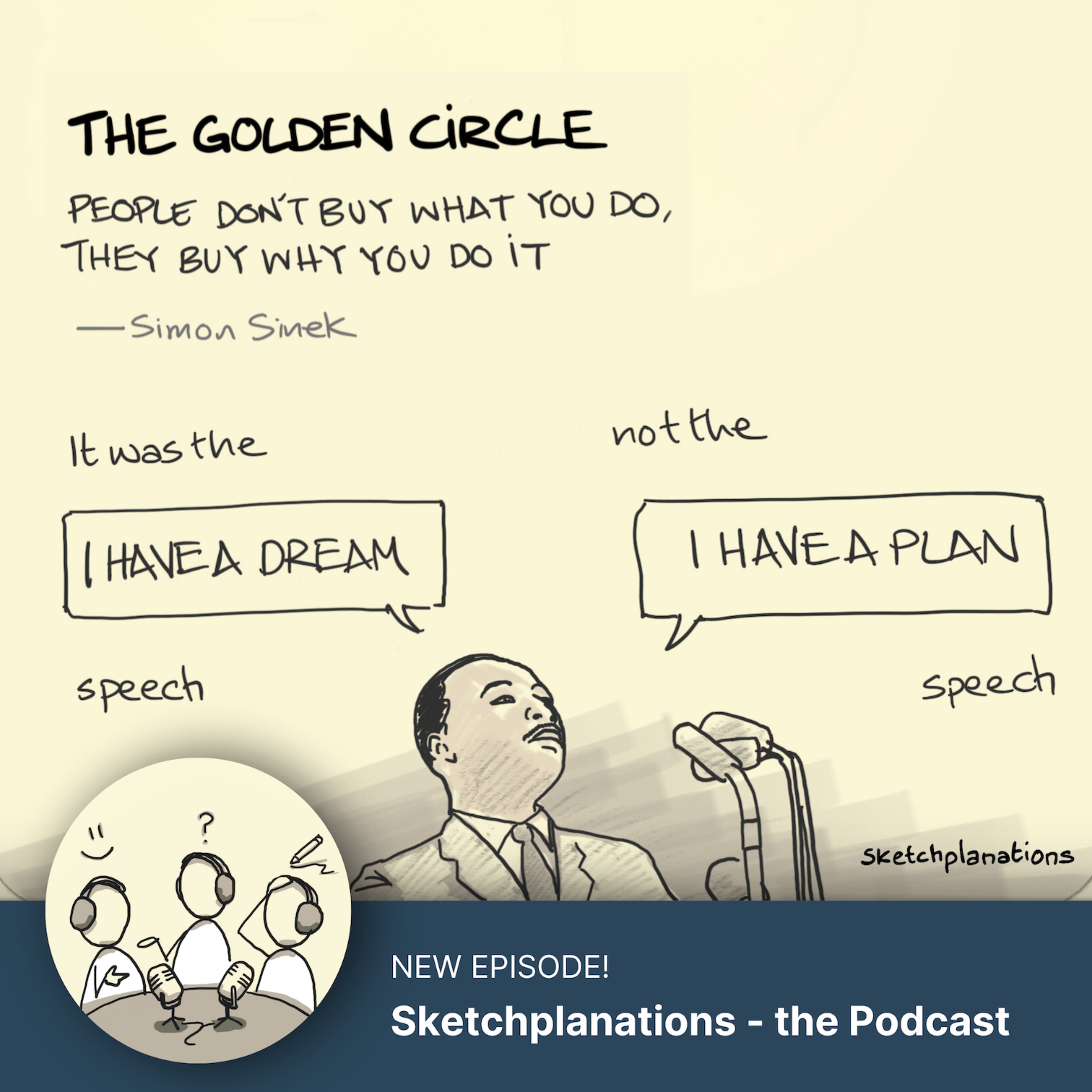
S3 Ep 8The Golden Circle
If you have a story to tell, a presentation to pitch, or a product to sell; in this episode on The Golden Circle, we explore the importance of focussing on the why before you expand into the how and the what.There's the old mantra that people do business with people and there's something a lot more human and emotive about explaining why you want to do or have done something, than just saying what you've done.Our guest for this discussion is the co-founder of Marloe Watch Company, Ollie Goffe. Along with his co-founder and business partner Gordon Fraser (our guest for the episode on Only Dead Fish Go With The Flow) they design and make watches. And boy, do these guys always have a beautifully compelling WHY behind each of their watch designs.As business leaders Ollie and Tom explain how crucial it is to instil the WHY behind a business into every employee but how much of a challenge that can become as the number of staff grows.We offer up a number of examples in brands, in sports and in family life of when the WHY is kept crystal clear to great effect.We talk how purpose-driven work can sometimes be exploited.And how sometimes the WHAT and the HOW are so compelling that we allow ourselves to ignore the WHY - even if we're sometimes a little embarrassed by it - think buying cheap products off Amazon.Get in TouchAre you conscious of the WHYs that drive your work or activities?What examples can you share with us where you've been seduced by someone's WHY?Let us know:email us: [email protected] leave us a voice noteReference LinksIn this episode we also reference:Simon Sinek's TED Talk - How Great Leaders Inspire ActionPatagonia founder, Yvon Chouinard's book: Let my people Go SurfingNike founder, Phil Knight's book: Shoe DogTeam GB Rowing's Ben Hunt-Davis & Harriet Beveridge's book: Will It Make The Boat Go Faster?All music on this podcast is provided by the very talented Franc Cinelli. Hosted on Acast. See acast.com/privacy for more information.
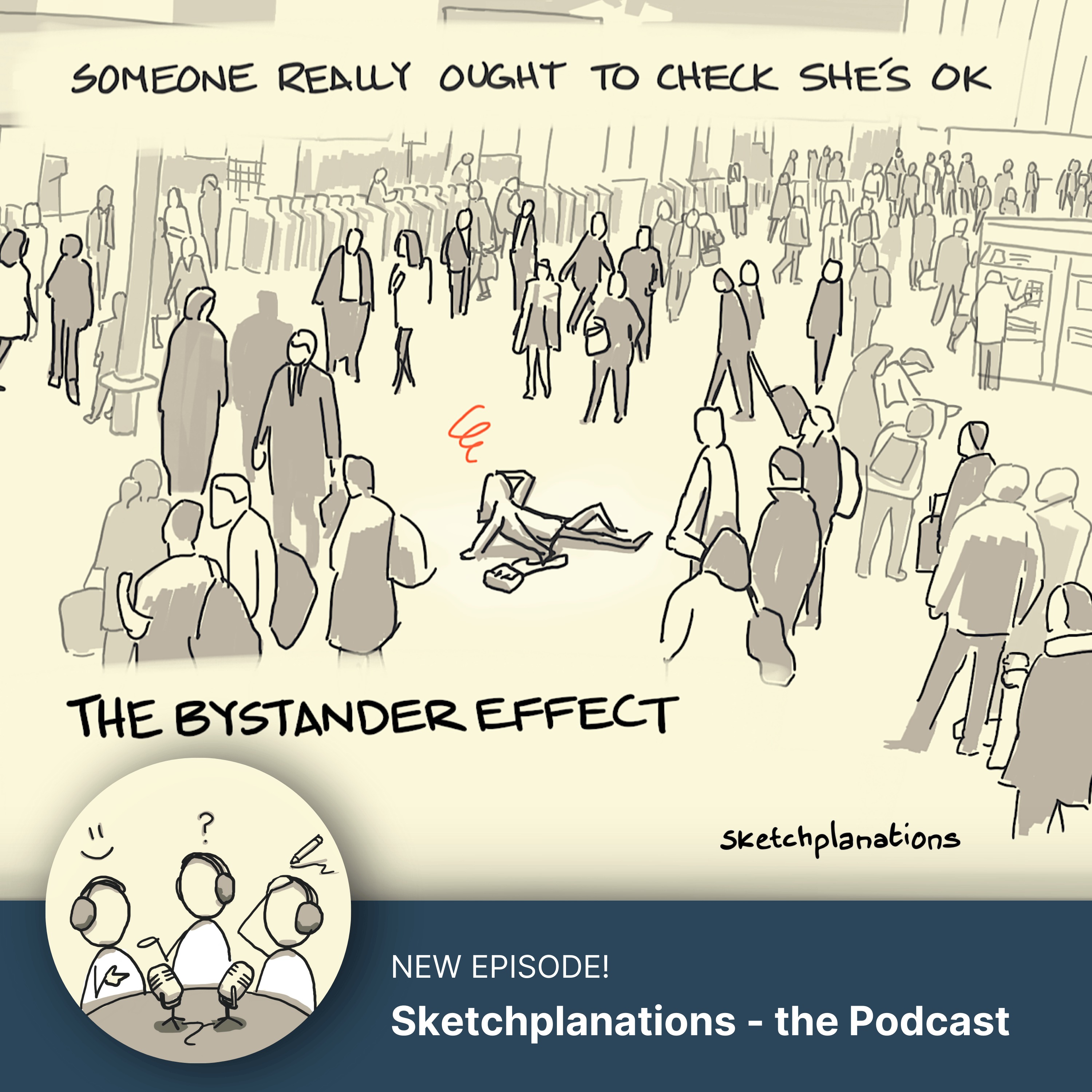
S3 Ep 7The Bystander Effect
This is another episode where we were all a little sheepish about telling stories of when we've observed The Bystander Effect in our own behaviour.Between us, we had lots of examples of where it's been observed in others. Of course we did.We discuss theories of why this is a human phenomenon and even examples of when we've been at the sharp end of it.The most innocuous and probably most common example was the WhatsApp Group chat.Who in your group is the one to take charge and suggest actual dates for things rather than the very non-committal "yeah - we should do that"?Jono describes solid works of research using CCTV footage that backs up the hypothesis and we ponder whether the effect is different in cultures and societies other than our own.Tell us your stories or examples of The Bystander Effect:[email protected] leave us a voice noteIn the episode we reference the following which you might like to read more into:The Whose Job Is It poem sketchThe Accountability Ladder podcast episode and sketchThe Ask The Question At Talks sketchAnd in the Listener Comments section at the end of the show we talked about:The Gartner Hype Cycle sketchThe Long Nose of Innovation sketchThe Learning Pit sketchThe Optimism Bias podcast episode and sketchThe Dunning-Kruger Effect sketch is exclusively in Jono's book Big Ideas, Little PicturesThe Hofstadter's Law sketchThe Cat-filter lawyer zoom call that went viral during Covid as an example of a Human Risk fail.All music expertly provided by Franc Cinelli. Hosted on Acast. See acast.com/privacy for more information.
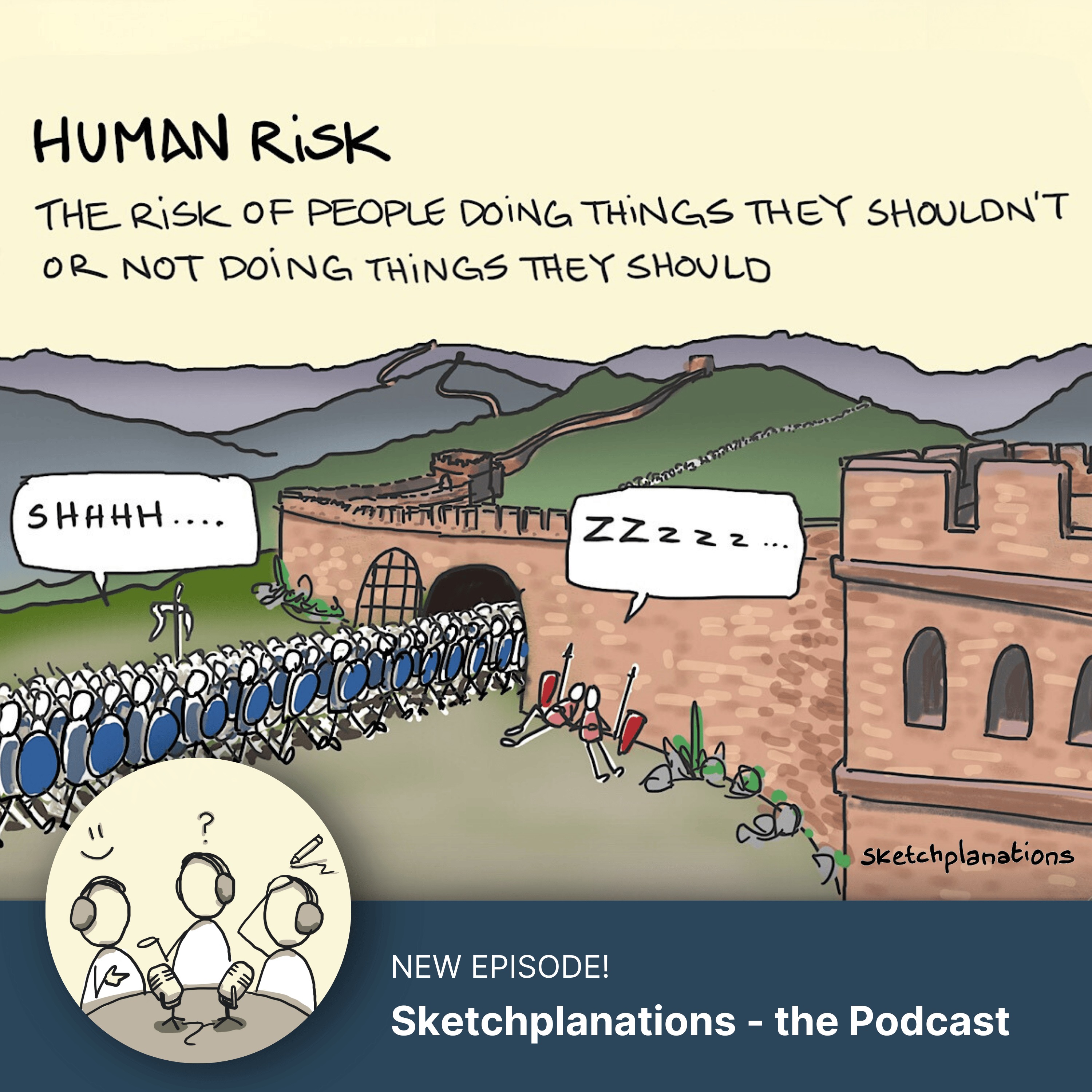
S3 Ep 6Human Risk with Christian Hunt
On the morning of your company's massive online shop launch, the only person who knows the crucial password misses their alarm, sleeps in and everyone's left waiting.Oh dear.In this episode we speak with the tireless behavioural scientist and Human Risk expert, Christian Hunt who tells us about the fundamental elements of human risk and how to avoid it; with plenty of juicy examples to bring this topic to life. Whilst the majority of the episode focuses on Human Risk in the professional environment, we also talk about how we all experience it in our day-to-day personal and family lives too; in Christian's own words, we all do stupid things every now and then.When Christian talks with companies about their Human Risk and how to mitigate it, he talks about "getting people to do what you want without p*ssing them off" - which we do reference a fair bit in the podcast. [potty mouths].Get in TouchYou will definitely have examples of Human Risk in your own personal or professional lives, and we'd love to hear about them. Anonymous submissions very welcome :-)email us: [email protected] leave us a voice noteReference LinksIn this episode we also reference:Jono's sketch on PhishingAbsolute carnage at the Oscars when the wrong film was read out for Best Picture. Kinda funny. Hugely awkward.In our Listener Comments at the end of the episode we reference an awesome inforgraphic on "The Emotion of Colour" in reference to our episode with Lucia Fraser on The Basic Colour Wheel. It's well worth a look.Guest ProfileChristian Hunt has over 27 years of experience in Financial Services, working in Investment Banking, Asset Management and a Family Office. His work benefits from the unique perspective of having held senior roles as both a Regulator and Risk & Compliance Officer.You can find more information about Christian and his services and his book, Humanizing Rules at www.human-risk.comYou can peruse his collection of amusing "Compliance in the Wild" spotting on LinkedIn.You can also listen to the Human Risk Podcast. All music on this podcast is provided by the very talented Franc Cinelli. Hosted on Acast. See acast.com/privacy for more information.
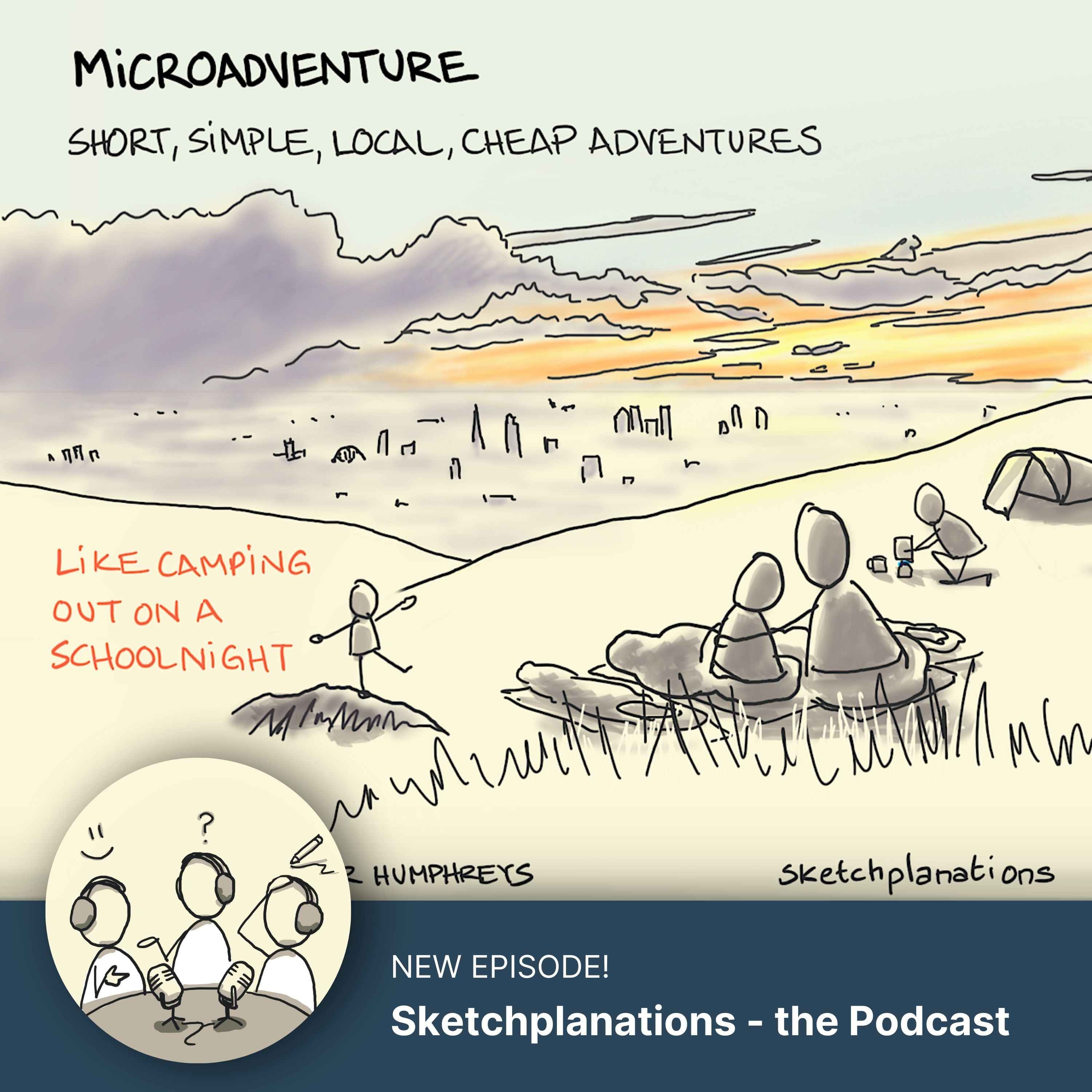
S3 Ep 5MicroAdventures with Al Humphreys
Do you like the thought of heading off on an adventure but don't really have the time to see it through?Why not try a MicroAdventure?They're smaller, achievable, won't break the bank and will go a long way to scratching that itch you might never have reached anyway.In this episode we speak with the charming and inspirational Al Humphreys about adventures in his life, before focussing on the smaller, more achievable things we could all fit into our busy lives to keep our thirst for fun, physical activity and spiritual reward truly quenched. Al is the author of 14 books to date, is an accomplished and entertaining public speaker, podcaster and general all-round good guy. Our conversation is packed full of ideas for things you can do from your own doorstep that will ensure you have some great stories (and maybe photos) to share with friends and family - in fact, why not share your MicroAdventures with them too?I know for a fact that since this conversation, Tommy climbs a tree near his office once a month during his lunch break!Amongst many topics, we talk about the character traits of someone who enjoys adventure and adversity, what drives us to seek adventure and the legal & moral wrangling of responsible wild camping.Get in TouchHow important is adventure in your life?Do you have examples of your own MicroAdventures?Let us know:email us: [email protected] leave us a voice noteReference LinksIn this episode we also reference:Custom Made Ordnance Survey MapsThe Fun Scale podcast episodeSmall Little People TRIZ Tool podcast episodeThe book "As I Walked Out One Midsummer Morning" by Laurie LeeExample of a simple Bivvy BagHow to find the halfway point between you and others to define the perfect place to meet.All music on this podcast is provided by the very talented Franc Cinelli. Hosted on Acast. See acast.com/privacy for more information.
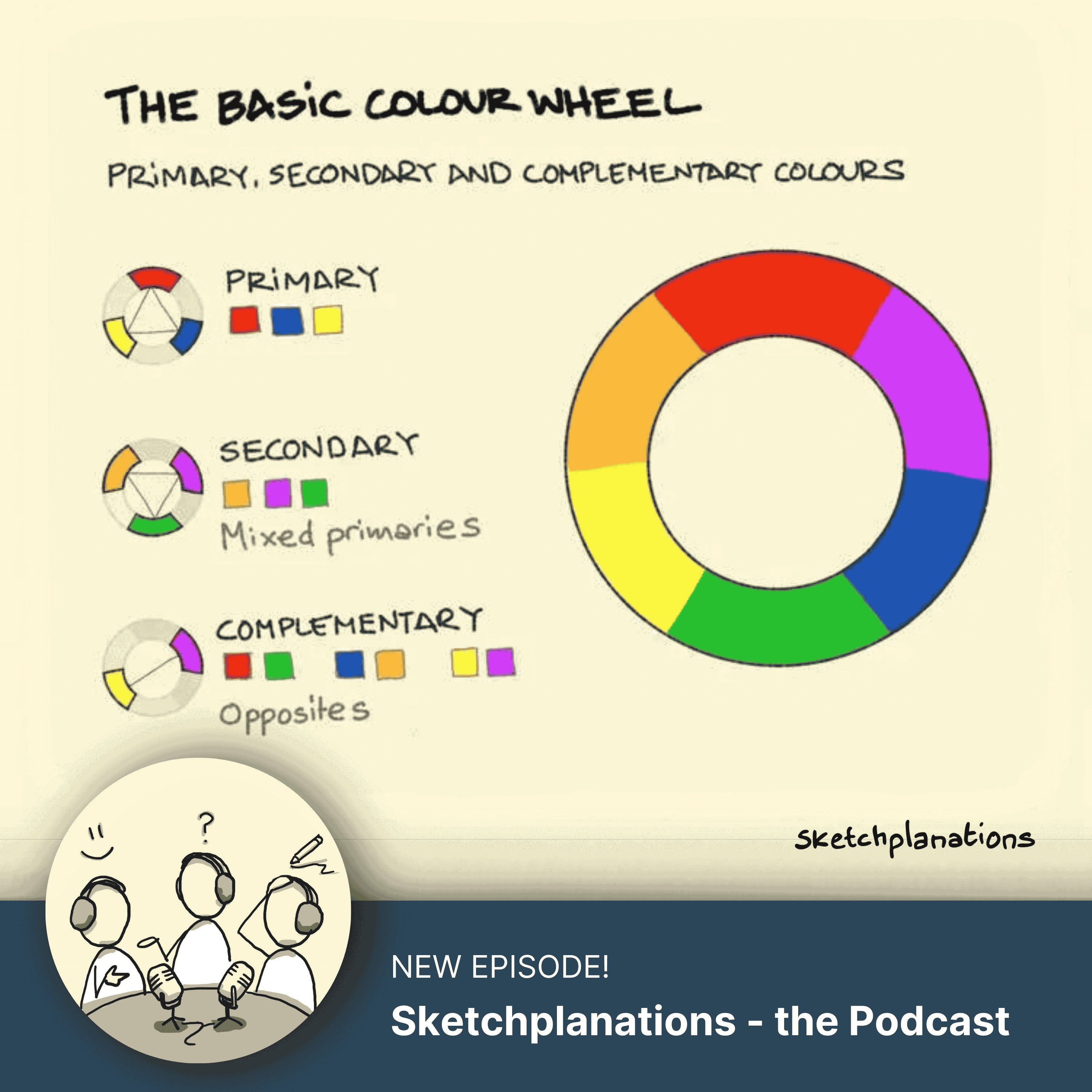
S3 Ep 4The Basic Colour Wheel (with Lucia Fraser)
Colour.Life wouldn’t be the same without it. But there are so many to choose from, how do we know which is the right colour?eg. What colour car would you buy? What colour shoes? What colour paint for the new feature wall in the kitchen? Sometimes you just instinctively know what colour(s) to choose. It’s a vibe thing.Other times, it’s nice to get a bit of help. And in this episode we speak with celebrated artist and ceramicist Lucia Fraser about the Basic Colour Wheel: Bringing a bit of structure and dare we say it, science to proceedings to help understand how colours relate to and complement each other. We also discuss how colour can affect and reflect our emotions.I particularly enjoyed our discussion about how brand logos are different to art when it comes to colour and that the colours chosen often have clear functions to play.Get in TouchHow important is colour in your life?Have you ever used the colour wheel to help make a decision on something?Let us know:email us: [email protected] leave us a voice noteLucia Fraser profileLucia studied for her Honours degree in Fine Art at the University of Newcastle-upon-Tyne. She has since exhibited her work in galleries across the UK and has collaborated with iconic British design brands such as Hobbs and Heal’s Furniture. Lucia is a friend of mine, and I’m very proud to say that I have a few bits of her work in my house, like this gorgeous landscape-inspired ink canvas.For more information on Lucia's work visit LuciaFraser.comAnd you can follow her antics on Instagram.Reference LinksIn this episode we also reference:The iconic Gulf Oil racing liveryJono's Sketchplanation on Atmospheric PerspectiveAll music on this podcast is provided by the very talented Franc Cinelli. Hosted on Acast. See acast.com/privacy for more information.

S3 Ep 3Goldilocks Tasks
Just like Goldilocks' porridge, often the most enjoyable activities and tasks are those in the sweet spot; where the balance between competence and the difficulty of the job at hand is juuuuuuuuust right. Making it a challenge, but not too much so. We discuss our own tolerances for menial tasks (such as loading the dishwasher) and find examples of our own Goldilocks Tasks (like tough IKEA furniture builds). Through this, we dissect what makes us feel motivated in the work we do, and more importantly the work we enjoy doing. How do ours compare to your Goldilocks Tasks? Where have you found your flow? Let us know:[email protected] leave us a voice noteIn the podcast we reference the following which you might like to read more into:The Basic Colour WheelBiz Stone's Book: Things a Little Bird Told MeMatch challenge with skills to avoid boredom and anxietyThe concept of FlowAll music provided by Franc Cinelli. Hosted on Acast. See acast.com/privacy for more information.
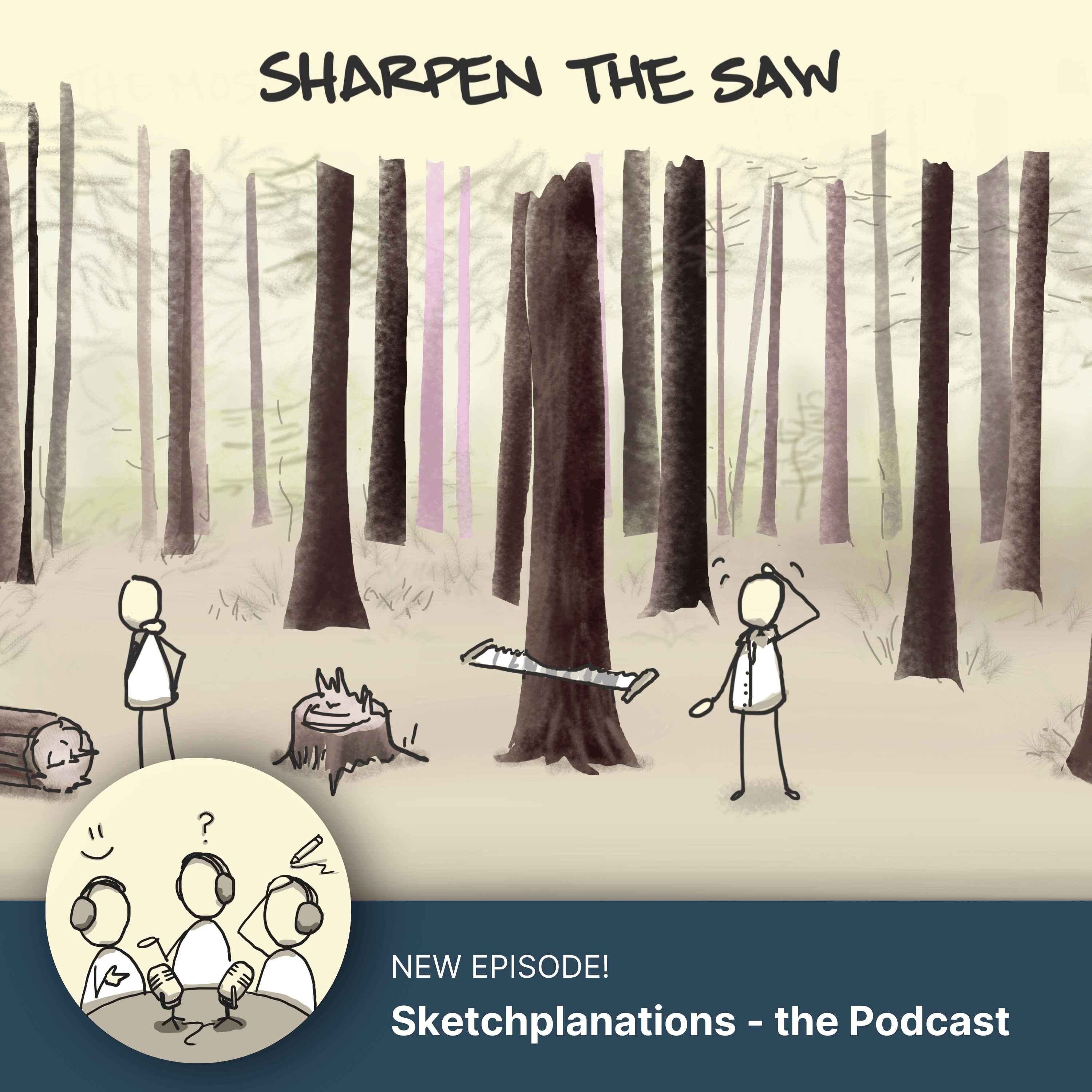
S3 Ep 2Sharpen The Saw
How easy do you find it to step back momentarily to gather your thoughts when your world continues at 100 mph?So often in our professional and personal lives we're too busy to ever pause, reflect, and recharge before continuing.One of the key mantras from Stephen Covey's book, 7 Habits of Highly Successful People is to stop and sharpen the saw every now and then to gain perspective, refresh thinking and re-prioritise.Jono & Tommy give examples from their lives about how this approach has helped them at work and at home.Rob brings the metaphor into the literal world with stories from his wood workshop.In our discussion, we mention the following items, which you might want to take a closer look at:This song, It Costs That Much did the rounds on social media a while back for frustrated makers and crafters. It made me laugh.We covered the 5 Ways to Wellbeing with wellness expert Nancy Hey in podcast #15 from Series 1.Here's an example of a 5-year journal that Tommy was talking about. (Tommy sent me one of these in the post after we recorded the episode! :-)Jono references Arnold Schwarzenegger's motivational speech. Here's a clipped edit of the 1-hour a day section.Sketchplanations referenced:Jólabókaflóð - Icelandic tradition of giving books at Christmas and staying in to read them.Forest Bathing - to soak in the atmosphere of a forestSolvitur Ambulando - It is solved by walkingFrom the postbag, Jono also references sketches to do with the dining / kitchen table:Kitchen Table Survival SkillsSet your table in time-honoured positionsTell us your stories or experiences with Sharpening The Saw.email: [email protected] or leave us a voice note by clicking the blue microphone button.All Music on this podcast series is provided by Franc Cinelli. Find many more tracks at franccinelli.com Hosted on Acast. See acast.com/privacy for more information.
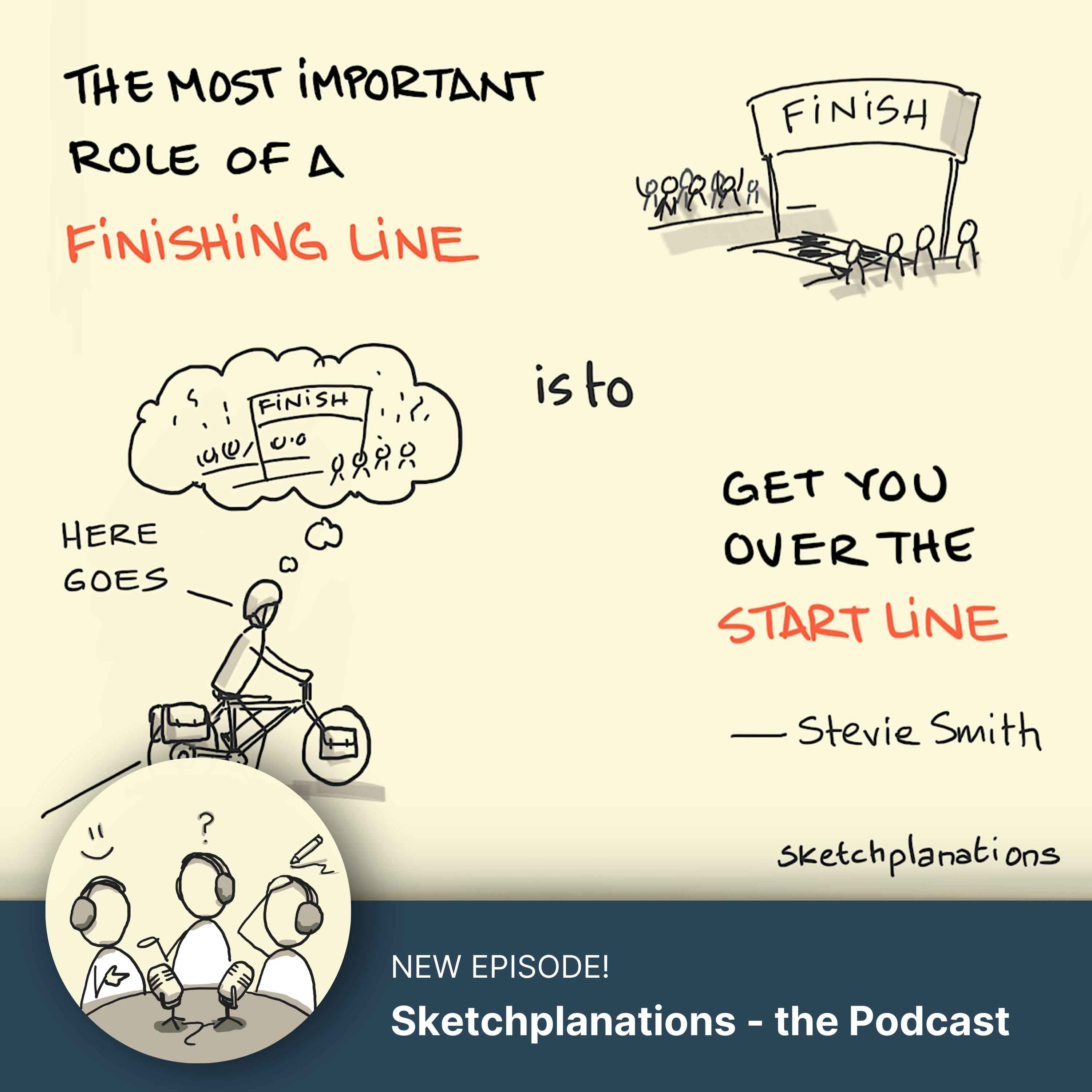
S3 Ep 1Finishing Lines - with Brendan Leonard
Whether it's a home renovation project, a presentation for work, a piece of writing or an actual race you need to train for, the thought of the finishing line can be the ultimate motivator to get you started.We chat with charming and witty, American author, illustrator, film-maker and ultra-runner Brendan Leonard about how he motivates himself to get going on various projects. Through his stories of physical adventure and creative endeavours we explore the different ways in which a definitive end-point to something (and sometimes a fear of it) can serve as the biggest kick.In this discussion we reference:Brendan's latest book; Ultra SomethingBrendan's book on the journey of creative expression; Make It - 50 Myths and Truths about CreatingBrendan's book on running; I Hate Running and You Can TooBrendan's film (and look out for the bit at the Finish Line that Brendan references in the podcast); How to Run 100 milesJono references his sketch on Forcing FunctionWe'd love to hear your stories of any experience with Finishing Lines. How much of a motivator are they for you? Ping us an email to: [email protected] or leave us a voice note when you click the blue microphone button on the website.All Music on this podcast series is provided by Franc Cinelli. Find many more tracks at franccinelli.com Hosted on Acast. See acast.com/privacy for more information.
S2 Ep 18Summer Break - place holder
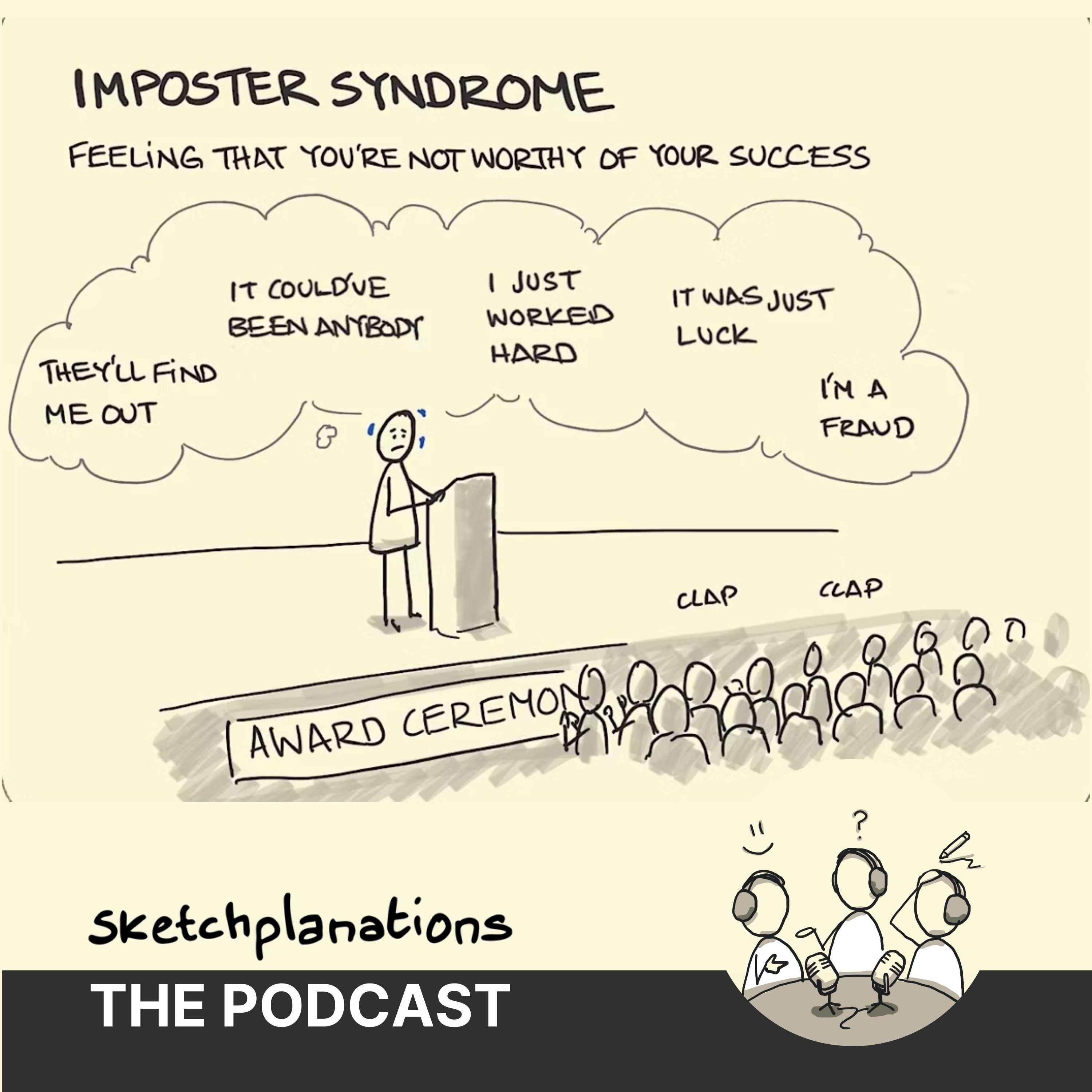
We're on our podcast summer holiday, but wanted to check in to let you know that we're still here, that we'll be back with Series 3 on Thursday 22nd August, and that you can vote for us in the British Podcast Awards - Listener's Choice category.As mentioned in the podcast, here's me on my 80s BMX with my 1st place trophy for cycling proficiency.And here's a clip of the awards ceremony Jono referenced with the inimitable Steve Martin.If you'd like to get in touch with us about any of our previous episode topics, your own experiences with the subjects we explore, or just to say hi, you can email us:[email protected] you can leave us a note or even a voice note on the podcast website.Oh - and here's Jono's Imposter Syndrome sketch which is the best possible artwork we could chose for this episode - and which I'm sure we'll come back to at some point for a full podcast as it feels like something a lot of people can probably relate to.Have a great summer and we'll see you in August. Hosted on Acast. See acast.com/privacy for more information.
S2 Ep 17Detecting Prostate Cancer
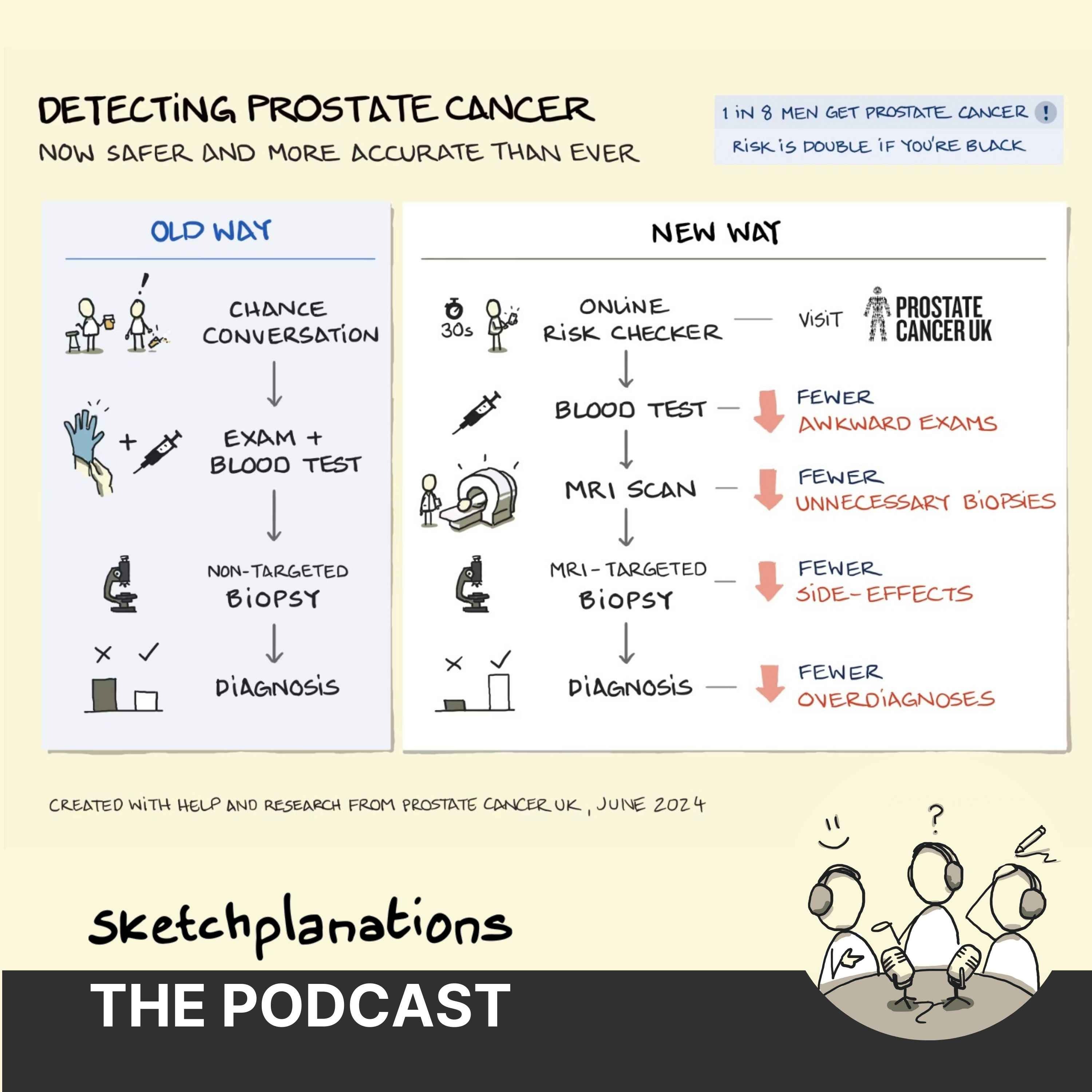
This week is International Men's Health Week and Sunday is Father's Day, so what better time to team up with life-saving charity Prostate Cancer UK for this episode of the podcast?1 in 8 men will be diagnosed with Prostate Cancer in their lifetime and that number rises to 1 in 4 for black men. Chances of survival increase dramatically with early diagnosis and so the best thing you can do as a man in the next 30 seconds is complete this Online Risk Checker which will guide you through your personal risk and advise on any next steps. There's not a latex glove in sight! And that's exactly the point with the new and improved way for detecting prostate cancer. We speak with Amy Rylance from Prostate Cancer UK to understand the new process for detecting prostate cancer and how it's both safer and more accurate. You can see a bigger version of this week's sketch here. We reference a number of research papers in the episode, which you can find here: The Lancet Commission on Prostate Cancer (gives a global perspective).The BJGP piece on how the evidence has shifted on the value of the digital rectal exam.If you have any thoughts or stories you'd like to share with us please email us: [email protected] Alternatively, leave us a message or even a voice note through the contact form .I'm so grateful for my Dad's early diagnosis and treatment and will be celebrating that this Sunday. And in case anyone's interested, I did phone up my GP after we recorded the podcast and was told my PSA blood results were normal. It feel good to have started the conversation with my doctor though. Find many more sketches at Sketchplanations.comAll Music on this podcast series is provided by Franc Cinelli. Find many more tracks at franccinelli.com Hosted on Acast. See acast.com/privacy for more information.
S2 Ep 16The Shirky Principle
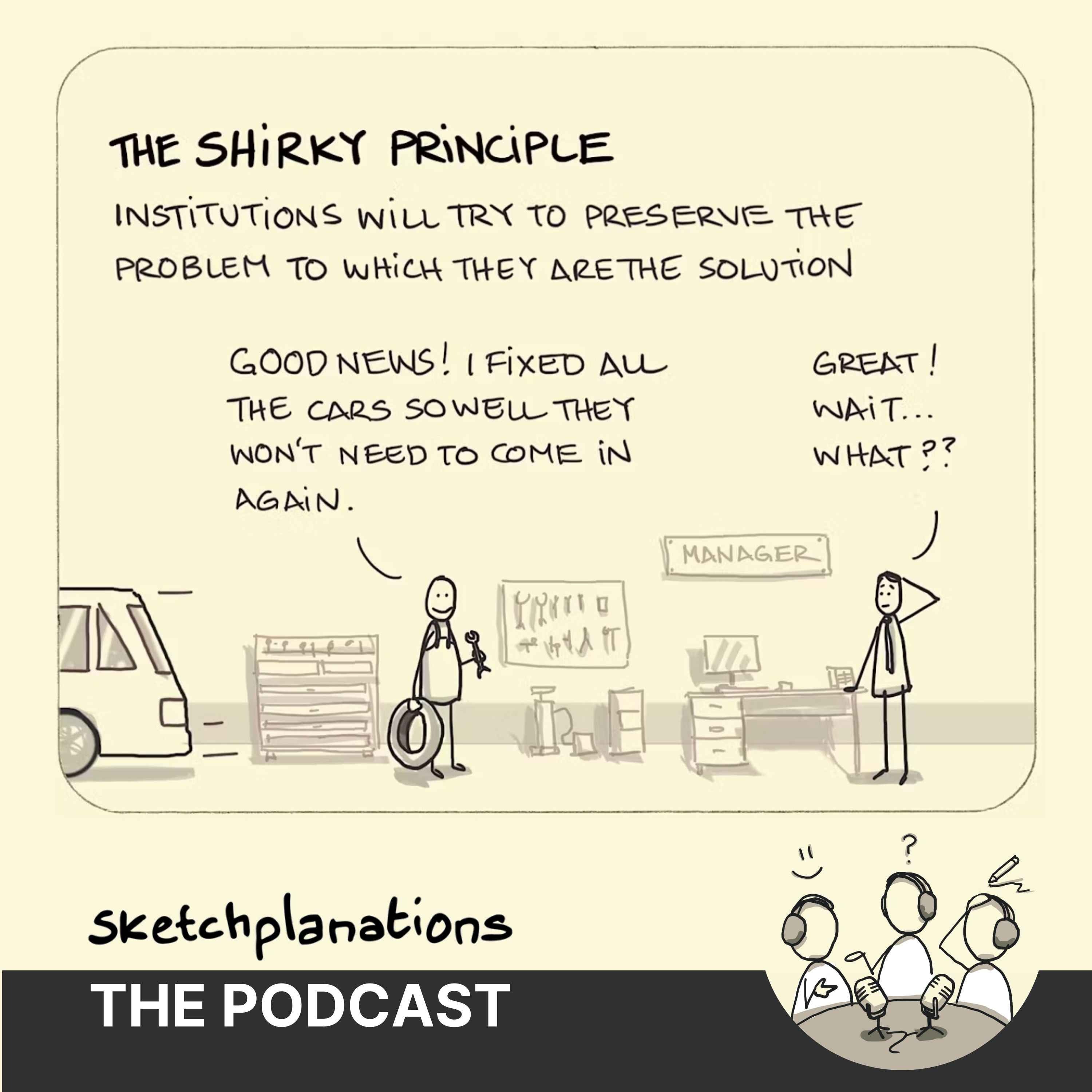
In this episode we discuss the phenomenon of organisations working to keep alive a problem for which they are the solution. It was observed and written about by American technology writer and consultant, Clay Shirky and has thus been given the name The Shirky Principle. Through many examples, we explore how prevalent it's been in the world of products and consumables and try (but in all honesty, probably fail) to offer advice on how to avoid falling foul of it oneself. We conclude that it's definitely something much easier to spot in others! Here are some useful links if you want to find out more about some of the bits we discussed:Clay Shirky's book on Cognitive SurplusJono's sketch on the Data, Information, Knowledge, Wisdom chain. Mitchell & Webb Toothbrush design marketing comedy sketchStructure of Scientific Revolutions by Thomas KuhnSketchplanations on the S-CurvePlease consider giving us a review or subscribing to our podcast on your podcast player. It really helps.We'd love to hear your stories of any experience with The Shirky Principle. Ping us an email to: [email protected] Music on this podcast series is provided by Franc Cinelli. Find many more tracks at franccinelli.com Hosted on Acast. See acast.com/privacy for more information.
S2 Ep 15Only Dead Fish Go with the Flow
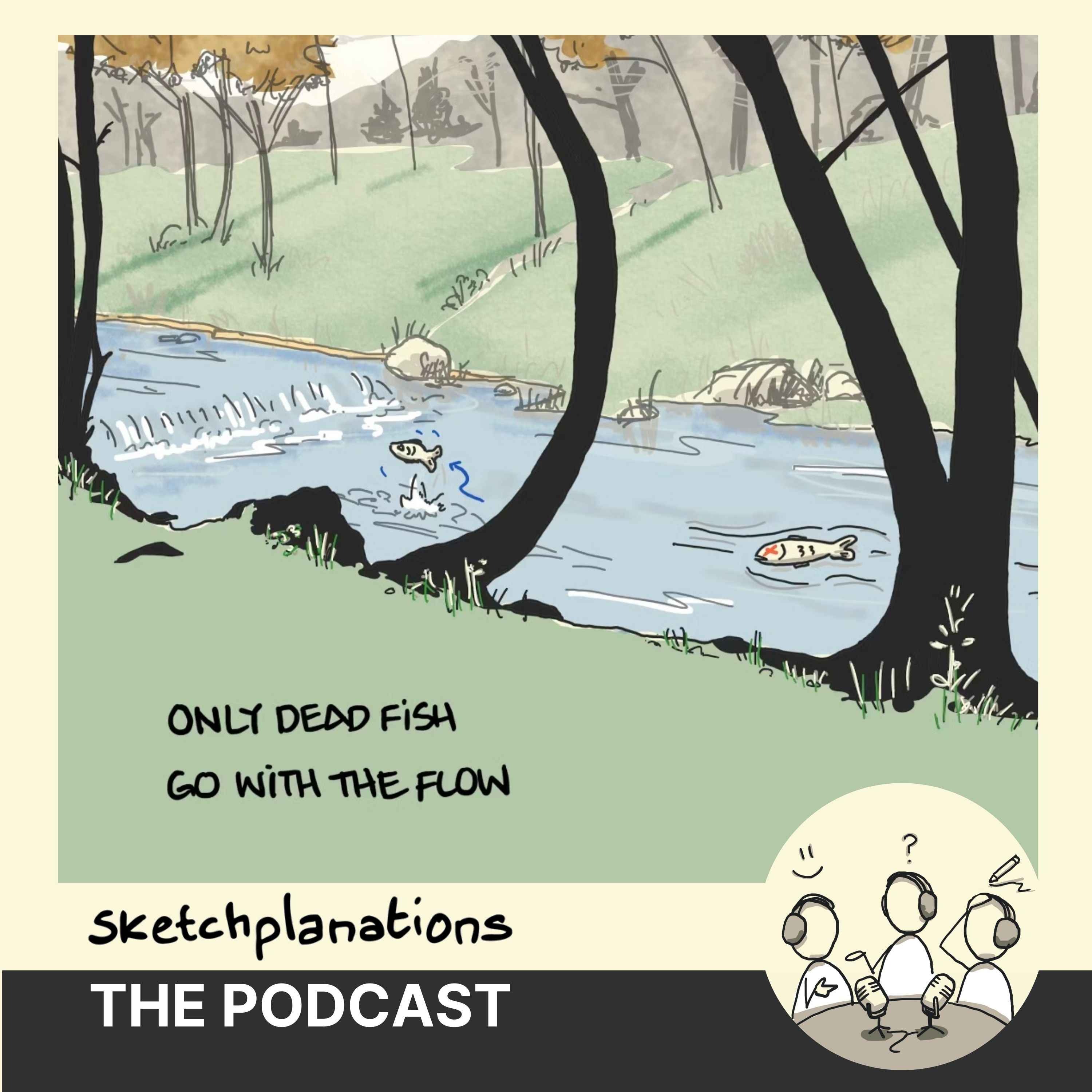
We spoke with mechanical wristwatch designer Gordon Fraser, of Marloe Watch Company, to hear his perspective on the pros and cons of product design when you set out to be different.It's not always a given that your customers want dramatically different and perhaps there are times when you should swim against the current and others when you should let yourself go with the flow.The real skill comes from experience, to know which mode to activate when.Gordon also speaks about the need to be allowed to dream as an antidote to creative blockages.Could this mindset help with any endeavours, be they creative or otherwise, in your world?Additionally, we reference:Jono's Prints & Performances sketch.Approach Buffet from both Sides sketchThe British Museum Clock GalleryPlease consider giving us a review or subscribing to our podcast on your podcast player. It really helps.Please also consider ordering a copy of Jono's Sketchplanations book: Big Ideas, Little Pictures. Out now!We'd love to hear your stories of creative mindsets and how you've overcome any barriers.Ping us an email to: [email protected] Music on this podcast series is provided by Franc Cinelli. Find many more tracks at franccinelli.com Hosted on Acast. See acast.com/privacy for more information.
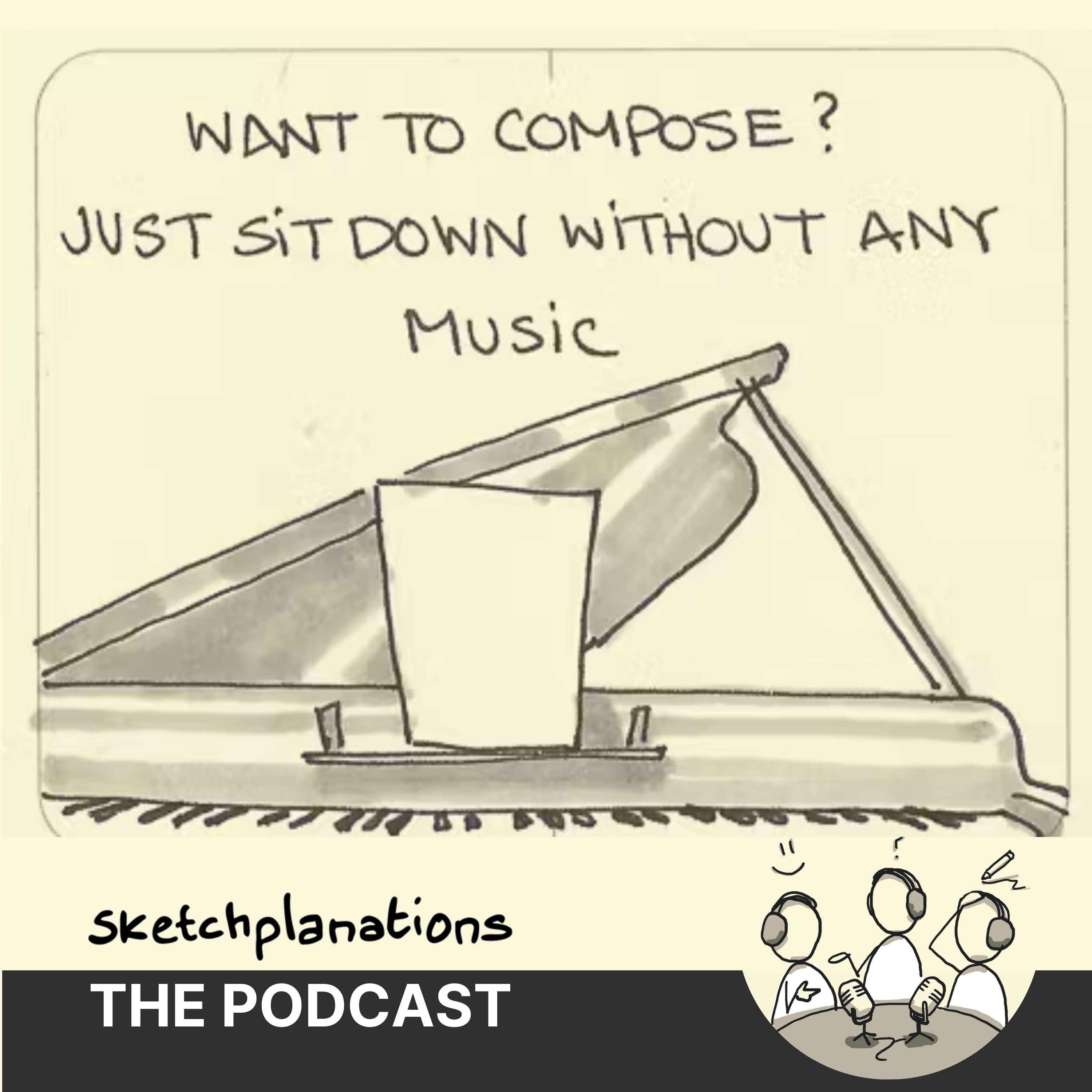
S2 Ep 14Creativity through Music Composition
Music.It can be a very personal thing. It can be most powerful when shared.It's on the radio, in our headphones on the commute, at the gym, on TV ads, in our favourite movies... what would the world be without it?And what would the world be without the people who create it?This episode, we interrogate singer, songwriter, producer, and friend of the show Franc Cinelli to find out how he goes about creating new music.Where does it come from?What are his processes?And how does creating music relate to other areas of creativity in our lives?if you're a regular listener you may or may not be aware that it's Franc's music we use on the podcast.Most notably:Driver - as our intro music.The Impossible Breaks Free - as our transition into the episode's sketch-specific discussionJulius Play His Winning Ace - (my favourite) at the end of the Listener Comments that round off each episode.Find his music here on Apple or SpotifyHere's some good stuff to check out that we reference in the podcast:Short Film: From Somewhere - Franc talks about his music makingAxis of Awesome - songs that use the same 4 chordsSteal Like An Artist - Book by Austin Kleon : 10 things nobody told you about being creativeAnd what would an episode of this podcast be without referring to another of Jono's sketches: 3,500 lifetime readsAs always, we'd love to know your thoughts about our discussion and you can email us here Hosted on Acast. See acast.com/privacy for more information.
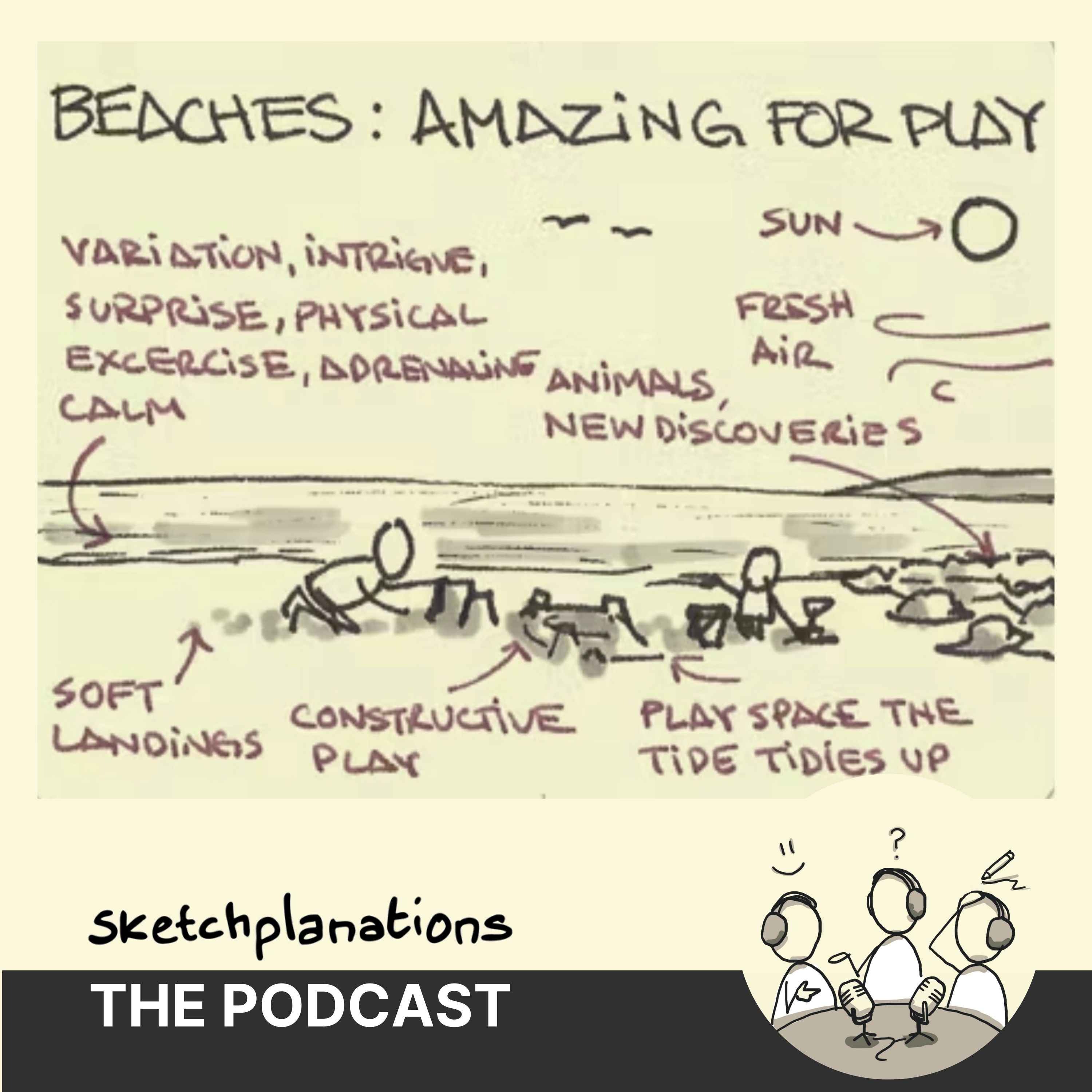
S2 Ep 13Fun at the Beach
We think beaches are great!What about you?In this episode:We discuss how beaches are prime spots for enjoyment for all ages and at any time of year.We talk about how they can be places for excitement and adrenaline; places to encourage creativity; places for quiet contemplation; and places that bring perspective to life.Tommy goads Jono into a debate about what's better: Mountains or Beaches.We share our best beach-find storiesand as ever, we bring in a few of Jono's other related sketches:+ Sea Jellies and Sea Stars+ Types of surf breaks (waves)+ The Anatomy of a wave+ The Strand LineAnd here's the photo of "the bomb" found on the beach up near Middlesbrough.We'd love to hear from you about your best finds or your most memorable moments at the beach.Email us: [email protected] music on this podcast series provided by the very talented Franc Cinelli. Hosted on Acast. See acast.com/privacy for more information.
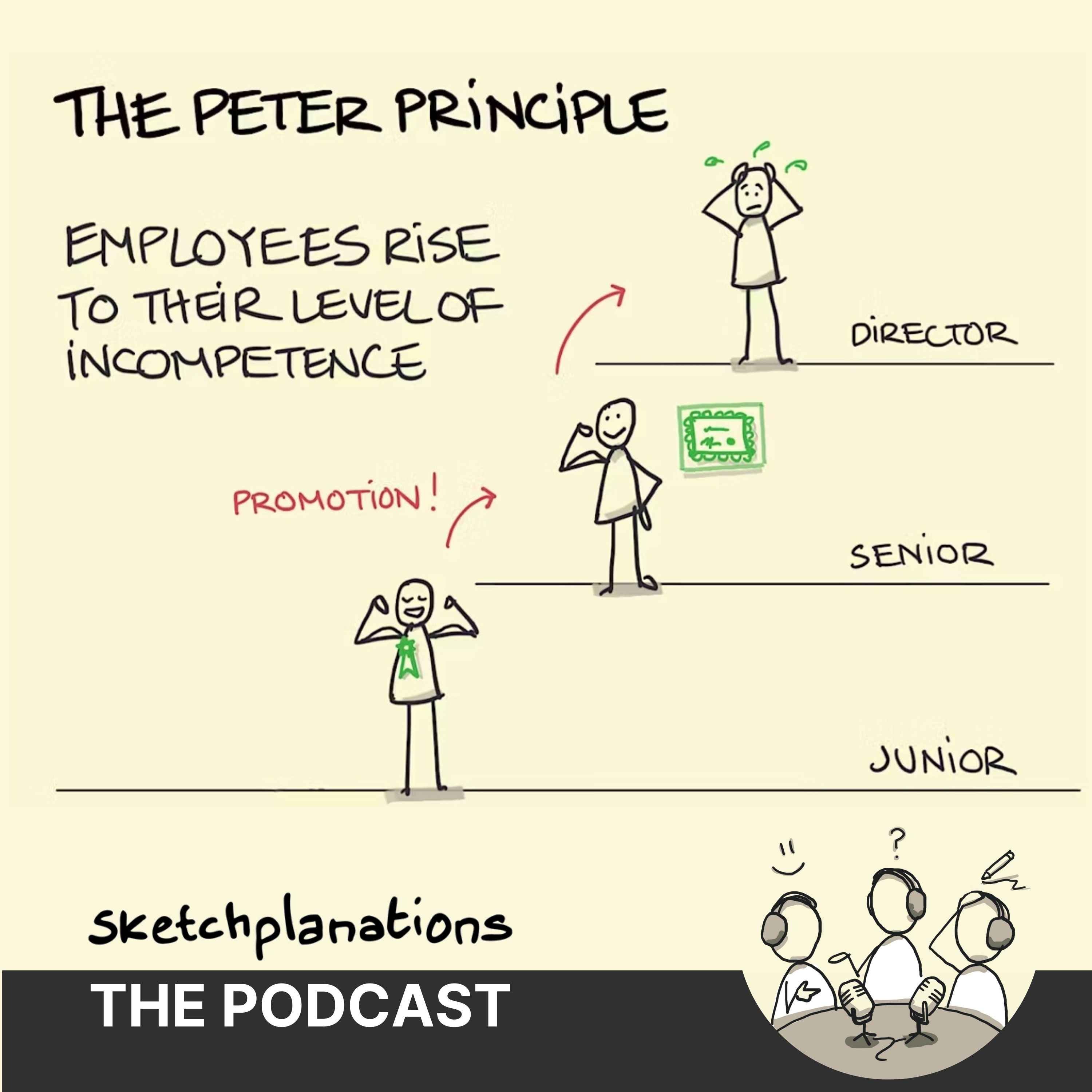
S2 Ep 12The Peter Principle
This week, we ask ourselves if we've reached our professional peaks and if we now fall foul to the Peter Principle, having tipped into our levels of incompetency.Amongst many other clever things, Jono applies the principle to Football Management.Tommy gives his insight to how relevant it is managing at the very top of a business.And I tell how my capacity to teach stuff is severely limited by exactly the kind of incompetence the Peter Principle is based on.Where do you feel you or maybe more interestingly, where do those around you sit within the Peter Principle?Here are some useful links if you want to find out more about some of the bits we discussed:The Peter Principle was first proposed by Canadian educator, Laurence J. Peter . In one of his books, he also said that "noblest of all dogs is the hot dog; it feeds the hand that bites it."Creator of The Paula Principle is Tom SchullerThe Dilbert PrincipleThe Generalised Peter Principle sketch#1 Rule of Indoor GamesThe BBC Peter Principle sitcom with Jim Broadbent on YouTubePlease consider giving us a review or subscribing to our podcast on your podcast player. It really helps.Please also consider putting in a pre-order for Jono's Sketchplanations book: Big Ideas, Little Pictures. Out very soon.We'd love to hear your stories of any experience with The Peter Principle.Ping us an email to: [email protected] Music on this podcast series is provided by Franc Cinelli. Find many more tracks at franccinelli.com Hosted on Acast. See acast.com/privacy for more information.