
Shared Security Podcast
575 episodes — Page 9 of 12

10 Year Anniversary Episode with Kevin Johnson and Jayson E. Street
In Episode 91 of this very special episode of our monthly show, Tom and Scott are joined by special guests Kevin Johnson and Jayson E. Street back to celebrate the 10 year anniversary of this podcast! We talk about the history of the show, what’s improved (or not improved) in the last 10 years from a cybersecurity and privacy perspective, Kevin’s Star Wars addiction, Jayson’s #HackerAdventures, and we have a very important debate about the future of security awareness and what can be done to provide better education on phishing which continues to be one of the top attack vectors we’ve seen in the last 10 years. Be sure to stay tuned to the end of the episode for some fun outtakes from this episode and some highlights from our very first episode which we recorded way back in August of 2009. You can also watch the full live stream of this episode on our YouTube channel. Thank you to all of our sponsors (Silent Pocket and Edgewise Networks), listeners, and previous guests for supporting the show over the last 10 years! We really appreciate it and we look forward to many more years of podcasting! Your hosts, Tom Eston and Scott Wright The post 10 Year Anniversary Episode with Kevin Johnson and Jayson E. Street appeared first on Shared Security Podcast.

New Facebook Privacy Controls, Apple iOS Patching Mistake, MoviePass Data Breach
You’re listening to the Shared Security Podcast, exploring the trust you put in people, apps, and technology…with your host, Tom Eston. In episode 83 for August 26th 2019: Facebook announces new off-Facebook activity privacy controls, how Apple made everyone’s iOS device vulnerable, and details on the massive MoviePass data breach. This week I read yet another news article that talked about how thieves stole a Tesla in about 30-seconds using what is known as a relay or key fob attack. The attack works by using a device to amplify the signal from the car thinking that the key fob is nearby. Once the device relays the signal back to the car, the door is unlocked and the thief can steal the car. This is also an issue for other car manufactures, it’s really any car that uses a technology called PKES or Passive Keyless Entry and Start. Besides disabling this feature, the easiest way to prevent this attack is to put your key fob in a faraday bag which is designed to block all wireless signals making an attack like this completely preventable. And if you want the finest faraday bags available, you’ll want to use one from Silent Pocket. In fact, Silent Pocket offers a key fob guard which is made to specifically to prevent a relay attack. Order one today by visiting silentpocket.com and receive 15% off your order using discount code “sharedsecurity” during checkout. Hi everyone, welcome to the Shared Security Weekly Blaze where we update you on the top 3 cybersecurity and privacy topics from the week. These podcasts are published every Monday and are 15 minutes or less quickly giving you “news that you can use”. Ever wonder how certain products that you were thinking about buying mysteriously show up as ads on your Facebook newsfeed? Is there some black magic going on here? Well it’s not black magic and is actually one of the many ways that Facebook serves you more ads. Last week Facebook announced that they are finally implementing new privacy controls around what they are calling “Off-Facebook Activity”. Off-Facebook activity is data that is collected from websites and apps about your online searches. This can only happen when websites and apps use the Facebook login feature or have enabled Facebook’s business tools. These sites and services send certain details about that activity to Facebook so that they can in turn show you ads about those specific products. This is why you see ads show up in Facebook for items or products that you’ve been searching for on the Internet. Now this is how off-Facebook activity works. Say you’re searching for a new backpack on a site that sells backpacks. That site can send information about your device, what was searched for and other details so that Facebook can match up that device to your Facebook account. This in turn sends you an ad about that backpack or company. Facebook has always said that the companies utilizing this feature do not get your personal information like name or email address. All they know about you is a unique device identifier which allows Facebook to match your device to your account. Now for the first time ever, Facebook is allowing more control over this data and is even allowing you to delete and disconnect this data from your Facebook account. Facebook will be slowly rolling this feature out to uses over the coming months. These new privacy settings will give you the ability to see a summary of information other apps and websites have sent Facebook, disconnect this information from your account, and choose to disconnect future off-Facebook activity, or just for specific apps and websites. So if you disconnect all this data from Facebook does that mean you’ll no longer see ads? Not really, you’ll still see ads but they will be less personalized than before. Keep in mind, this applies to Instagram too since Instagram is owned by Facebook and is tightly integrated into the Facebook Platform.So what do you think about this news? Is Facebook finally trying to focus on user privacy or is it too little, too late? This new privacy control is of course a response to the Cambridge Analytica scandal and the beating that Facebook has taken from privacy experts for months now. My take is that any control is only as good as the users that plan on using it and unless Facebook makes this an “opt-out” setting where by default your off-Facebook activity is automatically disconnected, I don’t see many users going through their Facebook settings turning these connections off. We will, of course, be updating our free Facebook Privacy and Security Guide when these settings start rolling out. In the meantime, check out our show notes for the link to download the current version of our Facebook Privacy and Security Guide today. Last week Apple made a huge error with their latest 12.4 iOS update. The problem? Well, it appears that they accidentally unpatched a ser

Biometric Security Data Breach, Critical Windows Vulnerabilities, FBI Data Harvesting
You’re listening to the Shared Security Podcast, exploring the trust you put in people, apps, and technology…with your host, Tom Eston. In episode 82 for August 19th 2019: The BioStar2 biometric security data breach, wormable vulnerabilities in Microsoft Windows, and the FBI trying to harvest your social media data. Can you believe that this week we’re celebrating the 10 year anniversary of this podcast? For the last 10 years we’ve been talking about how your private information can be exposed through data breaches, vulnerabilities, exploits, and even through the wireless capabilities of our smartphones and laptops. It seems that in the last 10 years it’s only gotten worse. That’s why I recommend the use of a Silent Pocket faraday bag to protect my smartphone and laptop so I can have true piece of mind that my devices are protected when I’m not using them. Visit silentpocket.com to check out Silent Pocket’s amazing line of faraday bags and other products built to protect your privacy. Don’t forget, as a listener of this podcast you receive 15% off your order at checkout using discount code “sharedsecurity”. Hi everyone, welcome to the Shared Security Weekly Blaze where we update you on the top 3 cybersecurity and privacy topics from the week. These podcasts are published every Monday and are 15 minutes or less quickly giving you “news that you can use”. On August 5th security researchers from vpnMentor disclosed a massive data breach in a biometrics security platform called BioStar2. vpnMentor has been doing a large web-mapping project across the internet which had identified this unsecured database. BioStar2 is a web based biometric security smart lock platform, built by a company called Suprema, and is used to administer physical access controls to facilities. The core technology of the product uses facial recognition and fingerprints to identify users. Suprema recently partnered with a firm to integrate the software into over 5,700 organizations in 83 countries. Most of these customers also happen to be in Europe. Shockingly, many European governments, banks and even the UK Metropolitan Police use this system for the security of their facilities. The data that was leaked in the breach, which totaled over 27.8 million records, included personal information of employees, unencrypted usernames and passwords, and to top it all off over 1 million fingerprint records and facial recognition data. We’re talking about the actual fingerprints and images of users which as you know can’t be changed like a password can. This alone is extremely concerning as this data combined with other personal information from the data leak are perfect for identity theft or other fraud. The good news is that after vpnMentor attempted several times to contact the company about the breach they finally took the database offline. Check out our show notes for links to further information as well as a listing of the companies and countries affected by this data breach. Last week Microsoft announced four new critical vulnerabilities for Windows that are wormable, meaning, they can be exploited by malware to install and propagate from one computer to another without any user interaction. The last time we had to deal with a wormable vulnerability like this was back in May of this year when Microsoft patched another serious vulnerability called ‘Bluekeep’ which at the time had a close resemblance to the WannaCry malware. WannaCry caused major issues for companies and individuals across the world back in 2017. The vulnerabilities in all of these cases reside in Remote Desktop Services (abbreviated as ‘RDP’) and more specifically have to do with vulnerabilities in the protocol itself. RDP is the service that allows a user to remotely connect to another Windows computer to view the desktop in real-time and these vulnerabilities can allow malware to do this without authentication making this vulnerability extremely dangerous. Microsoft stated that quote “no evidence that these vulnerabilities were known to any third party” and that quote “It is important that affected systems are patched as quickly as possible because of the elevated risks associated with wormable vulnerabilities like these.” Affected systems include all newer Microsoft operating systems starting with Windows 7 all the way to the current version of Windows 10 and related server versions. Like Microsoft said, you should update your version of Windows as soon as possible. To check to see if your version of Windows is updated, head to Settings -> Update & Security -> Windows Update and then look to see if KB4512501 from August 13th is installed. As a reminder you should always enable automatic updates for your Windows system so you always get the latest security patches as they are released. And now a word from our sponsor, Edgewise Networks.

BSides Las Vegas, iMessage Exploit, 5G and Stingray Surveillance
This is your Shared Security Weekly Blaze for August 12th 2019 with your host, Tom Eston. In this week’s episode: My summary of last week’s BSides Las Vegas security conference, how a single text message to your iPhone could get you hacked, and how Stingray surveillance devices can still be used on new 5G networks. Wireless technology such as Wi-Fi, Bluetooth, and RFID are integrated into every part of our daily lives. In fact, because everything these days is wireless we can often take the security risks for granted. So if you’re looking to have the ultimate peace of mind, you should use a faraday bag to protect your devices. A faraday bag blocks all wireless signals which makes any device that uses wireless technology completely undetectable. And using a faraday bag is so much faster than disabling the wireless on a laptop or smartphone. Just stick it in the bag! And if you want the best faraday bags on the market today, you’ll want to use one from Silent Pocket. Visit slientpocket.com and check out their great line of products and receive 15% off your order using discount code, “sharedsecurity”. Hi everyone, welcome to the Shared Security Weekly Blaze where we update you on the top 3 cybersecurity and privacy topics from the week. These podcasts are published every Monday and are 15 minutes or less quickly giving you “news that you can use”. The annual BSides Las Vegas security conference took place last week which also coincides with the Black Hat and infamous DEF CON hacking conference. This is the week that all of us in the cybersecurity industry lovingly call “security summer camp”. BSides would be considered the smaller conference of the three and in my opinion, provides a much more intimate experience to network with other cybersecurity and privacy professionals. As part of this year’s BSides conference, I participated in the “Proving Ground” speaking track where I was a mentor helping out a fantastic new speaker work on the talk that he gave at the conference. It was a very rewarding experience that I highly recommend other speakers volunteer for if they have the time to do so. I also attended several talks and met several speakers that had some very interesting research to share. While many of the talks at BSides were about all the latest topics on how anything is hackable, there were two talks in particular that were on topics that we don’t hear much about. These talks were “Satellite Vulnerabilities 101” by Elizabeth Wilson and “Human Honey Pots or How I learned to love the NFC implant” by Nick Koch. Satellites provide means for different forms of communication as well as GPS, military, and other critical systems. Elizabeth presented a really nice overview of the many different types of vulnerabilities that are present in satellites including everything from, timing of banking transactions, nation states using anti-satellite weapons, and even the threat of space junk. Here’s Elizabeth’s take on the threat of space junk and how this is a major problem. Elizabeth: The debris is growing and growing and the more you put up there the more potential damage you’re putting up as well. It’s like I said during my talk, the difference between a hundred .01 meter satellites and one single satellite that’s 1 meter is 30 times of an increase in risk. And when you consider that, the more you have these small hard to track things that sometimes don’t even have propulsion systems, yeah it’s going to create a lot of issues. This is one of the most pressing areas that we need. We really need some way to manage this debris. We need some sort of clean up system in a way. And there has been some ideas people have had on that like sending capture satellites up there to capture the debris and things but we don’t have anything yet that’s currently really viable. What I also found fascinating from her talk was that organizations that support satellites, like NASA, are getting hacked all the time. For example, in 2007 Chinese hackers actually gained access to NASA’s satellite control systems and came very close to issuing commands to these satellites. Thankfully, that did not happen. The other takeaway from this talk was how satellites are a lot like the “Internet of Things” devices where security was never built in because the threat model at the time didn’t conceive the types of attacks that we see today. By the way, the typical satellite has a lifespan of about 50 years! Is it even feasible to think that satellites can be patched and updated? Here’s Elizabeth speaking to me about this problem and what the solutions might be. Elizabeth: That is one of the big challenges right now because a lot of these systems, unless you’re going to completely replace it, you just can’t update it in some cases. And maybe the solution is we

Capital One Data Breach, Equifax Settlement Payouts, Nextdoor App Scams
This is your Shared Security Weekly Blaze for August 5th 2019 with your host, Tom Eston. In this week’s episode: everything you need to know about the Capital One data breach, changes in the payouts from the Equifax settlement, and Nextdoor app scams. If you happen to be in the cybersecurity industry this week is what we call “security summer camp” where thousands of cybersecurity professionals, enthusiasts, and even black hat hackers all meet in Las Vegas to attend the Bsides, BlackHat, and the infamous hacker conference, DEF CON. These conferences are probably the most dangerous place on the plant because your laptop or smart phone could easily be compromised since everyone is hacking everyone else either intentionally and even unintentionally as part of quote unquote “research”. I know that I’ll be using a faraday bag for all my devices while I’m at the conferences this week. That way I know my devices are completely secure and off the grid. If you’re heading to Vegas this week make sure you protect your devices with Silent Pocket’s great product line of faraday bags. In fact, stop by the Silent Pocket booth at DEF CON this weekend and check out their products for yourself while you’re at the conference. Don’t forget you can also visit slientpocket.com and receive 15% off your order using discount code, “sharedsecurity”. Stay safe this week and be sure to mind the grid! Hi everyone, welcome to the Shared Security Weekly Blaze where we update you on the top 3 cybersecurity and privacy topics from the week. These podcasts are published every Monday and are 15 minutes or less quickly giving you “news that you can use”. The big news last week was the massive Capital One data breach affecting more than 100 million customers in the US and 6 million in Canada. This is actually the third largest data breach in history with Equifax being number one followed by the Heartland Payment Systems data breach which took place in 2009. The 30 gigabytes of personal information exposed in this breach included names, addresses, phone numbers, email addresses, dates of birth, and self-reported income as well as 140,000 Social Security and 80,000 bank account numbers. All of this data appears to be from credit card applications dating back to 2005. In the announcement posted by Capital One the breach was discovered on July 19th and the person responsible, Paige Thompson a former Amazon employee, was arrested by the FBI. Perhaps the most interesting aspect of the breach is how the perpetrator was caught. Paige had posted details about the data she had stolen on her GitHub page and boasted about it on her Twitter account. Someone had saw this information posted in the GitHub account and sent an email to a Capital One’s security vulnerability disclosure email alerting them of the issue. So how did this data get compromised in the first place? Well she was able to download this data from an Amazon S3 bucket through a misconfigured web application firewall (which is also known as a WAF). Now this isn’t the typical Amazon S3 vulnerability we commonly hear about where this data was left wide-open for anyone to access and there is much debate in the security community about how the breach actually occurred. It’s largely suspected that one of the user roles that was assigned to the WAF may have been exposed through a Server Side Request Forgery (or SSRF) which is a vulnerability that affects public cloud environments like Amazon. What’s even more fascinating is how she tried to steal this data without getting caught. The official complaint filed by the FBI states that she attempted to cover up her tracks by using a VPN as well as Tor (which is also used to hide your IP address) when she was downloading Capital One data from the Amazon S3 server. However, that didn’t matter much when she discussed how she could steal data from Amazon S3 buckets on Twitter and in a Slack chat room, as well as storing the data in a public GitHub repository with her real name tied to it. It’s almost like she wanted to get caught! Quite the lesson of how criminals make mistakes and how those mistakes could put someone in prison for a very long time. In this case, the accused could face up to five years in prison and a $250,000 fine. Now we don’t know if this data was accessed by anyone else and Capital One has stated that they don’t think it has either. But I think some positives here are that Capital One did have a way for people to report security vulnerabilities and that the incident response from Capital One seemed to have been handled very quickly. It’s also the first data breach I’ve heard of where an arrest was made within days of the breach being detected. The negatives? Well, for starters be on the lookout for phishing emails capitalizing (no pun intended) on this data breach asking you to verify your

Medical Device Security with Special Guest John Nye
In episode 90 of our monthly show we discuss medical device security with John Nye, Senior Director of Cybersecurity Research and Communication at CynergisTek. Do you use an insulin pump, have a pacemaker or other medical device implant? Are you concerned about medical device security and what the future holds for technology like this? If so, this is one show not to miss! The Shared Security Podcast is proudly sponsored by Silent Pocket and Edgewise Networks. Here are show notes and topics we covered with John: Should we be concerned about medical device security? Are the attacks we hear about in the news theoretical or is there really cause for concern? Some recent medical device news stories that are concerning: Doctors concerned about medical device security, Insulin pump hacking How medical devices get hacked and what the real threat is What should hospitals and other health care organizations should do to help better secure medical devices What the FDA on other government regulators are doing What can the cybersecurity industry do to better secure medical devices Thanks again to John for being a guest on our show! Be sure to follow the Shared Security Podcast on Facebook, Twitter and Instagram for the latest news and commentary. If you have feedback or topic ideas for the show you can email us at feedback[aT]sharedsecurity.net. First time listener to the podcast? Please subscribe on your favorite podcast listening app or watch and subscribe on our YouTube channel. The post Medical Device Security with Special Guest John Nye appeared first on Shared Security Podcast.

Equifax Settlement, Android Video File Exploit, Encryption Backdoors
This is your Shared Security Weekly Blaze for July 29th 2019 with your host, Tom Eston. In this week’s episode: Details on the Equifax breach settlement, why your Android phone could be exploited by simply watching a video file, and encryption backdoors being requested by world-wide governments. Can you believe that its almost August and that summer is almost over? I was just in Target the other day and noticed that the school supplies are already out! Once you see that you know the Halloween supplies are also right around the corner. It’s totally crazy! I don’t know about you but I want to plan at least a few more short trips with my friends and family which is my own desperate way to hold on to the last few fleeting moments of summer. So don’t let protecting your digital privacy get in the way of your plans. You should be using a Silent Pocket faraday bag or phone case which will block all wireless signals keeping your devices secure and completely off the grid so you can be focused on your time away. As a listener of this podcast you get 15% off your order by using discount code, “sharedsecurity” at checkout. See Silent Pocket’s full line of products at silentpocket.com today before summer gets away. Hi everyone, welcome to the Shared Security Weekly Blaze where we update you on the top 3 cybersecurity and privacy topics from the week. These podcasts are published every Monday and are 15 minutes or less quickly giving you “news that you can use”. Everyone remember the Equifax breach that affected 147 million people? Do you think you may have been financially or otherwise impacted from this data breach? If so, you may be entitled to up to $20,000 for documented breach related expenses or 10 years of free credit monitoring services. You can also collect $125 if you already have a credit monitoring service (which, by the way, really doesn’t do much for you). This news broke last Monday when the FTC announced a proposed settlement that will cost Equifax $700 million dollars which will be the largest settlement related to a data breach in history. Equifax would be required to pay at least $300 million but up to $425 million and provide free credit monitoring for all victims of the data breach. In addition, Equifax will offer free resources for victims recovering from identity theft and six free credit reports for all US consumers starting in 2020. If you think you want to collect on this settlement, you’ll need to file a claim on the official claim site. Check out our show notes for a link to the FTC website which has all the details on where to file a claim. Note that fake sites are bound to pop up so be sure you only use the site linked from the FTC. If you think you may have a case to file a claim you’ll want to move quickly as you’ll only have 6 months to make your claim once the settlement is approved. So is this settlement too little, too late? Even with the FTC now requiring Equifax to overhaul their security procedures does a fine like this even matter much? Like I talked about on last week’s show the 5 billion dollar fine about to be issued to Facebook for their handling of the Cambridge Analytica scandal, Facebook was able to make most of this fine up through the jump in their stock price. I think we will see the same with Equifax but with the caveat that I’m sure security teams internally at Equifax will actually have money now to spend on security personnel and additional security controls including incident response. Are you going to at least make a claim for $125 of this settlement? I’d love to hear your thoughts on this topic for discussion on a future episode of the podcast. So visit our contact us page at sharedsecurity.net/contact and tell us what you think is needed to keep companies like Equifax more accountable for protecting our personal information. Do you happen to use an Android phone? Not only do you need to worry about malware, fake apps, and phishing attacks but now there is a new exploit making the rounds that’s delivered through simply playing a video on your Android device. According to the Hacker News, there is a remote code execution vulnerability that affects over 1 billion devices running Android versions 7 through 9. That would be Android Nougat, Oreo, and Pie. The vulnerability itself resides in the Android media framework which if exploited could allow an attacker full control of an Android device. The attack works by tricking the user to play a malicious video file within the native Android video player application. That is, the video player that’s installed by default on most Android devices. The good news is that Google has already released a patch earlier in July for this specific vulnerability but the bad news is that with the way Android patching works this update may or may not be pushed to Android devices depending on your carrier and device manufacture. This is one of the bi

FaceApp Privacy Panic, Facebook’s 5 Billion Dollar Fine, Amazon Brushing Scams
This is your Shared Security Weekly Blaze for July 22nd 2019 with your host, Tom Eston. In this week’s episode: The FaceApp privacy panic, Facebook’s 5 billion dollar fine from the FTC, and what you need to know about two new types of Amazon scams. Traveling internationally this summer? If so, make sure you protect one of the most valuable documents that you’re going to carry, and that’s your passport. Not only do you have to worry about losing your passport but you also need to consider the privacy issues if your passport information is exposed. Passport information is often exposed through simple information disclosure where you can be identified by shoulder surfing and having your nationality and other personal information on your passport exposed. Not only that, you need to protect your passport from damage and physical theft. My recommendation is to check out Silent Pocket’s Passport Wallet which provides a stylish way to protect your passport while you travel with the added benefit of RFID blocking. Pick one up today at slientpocket.com and use discount code “sharedsecurity” to receive 15% off of your order during checkout. Hi everyone, welcome to the Shared Security Weekly Blaze where we update you on the top 3 cybersecurity and privacy topics from the week. These podcasts are published every Monday and are 15 minutes or less quickly giving you “news that you can use”. The Federal Trade Commission has approved a 5 billion dollar settlement with Facebook over its investigation into their handling of the Cambridge Analytica privacy scandal which exposed the private information of 87 million users. According to the Wall Street Journal, the settlement also allows the FTC to have more oversight and restrictions on Facebook’s privacy practices. While 5 billion dollars seems like a lot, it’s really just a drop in the bucket for a company like Facebook. In fact, when the news hit last week about the FTC settlement, Facebook’s stock shares went up 1.8%. So let’s run the numbers, Facebook made $15.1 billion just in Q1 of this year and $5 billion is only about 9% of their total revenue for 2018 which came in at $55.83 billion. Again, this is not that big of a deal for Facebook when we’re talking about billions and billions in revenue. Now we do have to keep in mind this is the largest fine ever issued by the FTC. The last fine, which wasn’t even close to this magnitude, was the $22.5 million issued to Google in 2012 for their mishandling of privacy issues. A drop in the bucket compared to 5 billion but has the privacy issues and controversy stopped with Google? No, it hasn’t as we talk about privacy missteps from both Google and Facebook on this podcast almost every week. So are “massive” fines the solution for companies that mishandle our privacy? It certainly doesn’t seem like it. What do you think is needed besides fines? Perhaps jail time for CEOs? One thing is for sure, something else needs to be done besides fines. Do you read the privacy policies and the terms of service of the apps that you use? If not, the recent drama over an app called FaceApp may want to make you start reading these policies before you start using an app. FaceApp is an app that will make a selfie look younger, older, or turn yourself into the opposite sex all by using facial recognition and AI technology. The app went viral last week all over social media and has been downloaded over 95 million times across the world. So what’s the controversy? Well first, there were unfounded claims on social media that because the app is created by a Russian company, called Wireless Lab, that somehow there are ties to the Russian government in some giant conspiracy to harvest all the pictures on the devices of millions of users. The truth is that FaceApp only uploads the pictures you want to manipulate and those photos are actually sent to an Amazon AWS server which happens to be based in the US. But the bigger problem is what is said and in some cases, not said, in the FaceApp privacy policy and terms of service. First, you give FaceApp all rights to use the photos you upload for anything they want including using your photos for commercial purposes. Going further, your name, likeness, and other data like your voice can also be used for commercial purposes, forever. Now, this type of policy is not that much different than Facebook or other social apps but the recent drama of this particular app should be a good reminder for all of us to read these policies to make sure you know what data is collected about you and how it may be used. While I think the controversy over FaceApp is a little overblown think about all the similar or other “fun” apps like these that you may be using and think twice before allowing your data to be used for something you don’t approve of. And now a word from our sponsor, Edgewise Networks. The biggest problem in security that remain

Zoom Zero-Day, GDPR Fines, Google Assistant Recordings
This is your Shared Security Weekly Blaze for July 15th 2019 with your host, Tom Eston. In this week’s episode: Zoom video conferencing zero-day, massive fines being issued for violating GDPR, and who might be listening when you talk to your Google Assistant. Looking to protect your laptop, smartphone, and key fobs this summer? Well this week I’m excited to announce that you could win one of two Silent Pocket vacation prize packages which includes a passport wallet, medium faraday sleeve, and 5 liter drybag! Check out our post on Twitter @sharedsec or on Instagram @sharedsecurity for contest rules and how to enter. And don’t forget, listeners of this podcast receive 15% off at checkout using discount code “sharedsecurity”. Visit slientpocket.com to see the latest Silent Pocket products built to protect your digital privacy. Hi everyone, welcome to the Shared Security Weekly Blaze where we update you on the top 3 cybersecurity and privacy topics from the week. These podcasts are published every Monday and are 15 minutes or less quickly giving you “news that you can use”. Do you or your organization use Zoom for video conferencing? If so, and you happen to be using it on a Mac, you’ll want to pay close attention to this story. The problem? Well a security researcher last Monday disclosed that a vulnerable web server is automatically installed on Apple Mac computers during the installation of the Zoom client. What this means is that any website could be used to forcibly join a user to a Zoom call, with their video camera activated, and without the user’s permission. On top of that the researcher also discovered that the vulnerability would allow any webpage to conduct a Denial of Service attack on a victim’s Mac by constantly joining a user to an invalid call. And if that wasn’t enough when you uninstall the Zoom client, the web server continues to be installed and active. The researcher disclosed the vulnerability to Zoom back in March but after many meetings (and fixes that didn’t work) the researcher decided to disclose the vulnerability to the public. The next day Zoom issued a patch to remove the web server and to allow users to uninstall the Zoom client which will now fully remove the web server. Zoom’s CEO posted a blog post apologizing to customers and noting that they will be improving their bug bounty program as well as issuing another update that took place over the weekend of July 13th to further lock-down the “video on” by default setting. Also, Apple made a surprising move on Wednesday by issuing a silent update to all Macs automatically uninstalling the Zoom web server. Many people don’t realize that Apple has the power to issue patches and updates to Macs connected to the Internet at any time and while this seems creepy, it’s actually a good thing when Apple can take immediate and swift action to patch a critical vulnerability without user interaction. Check out our social media feeds for the latest updates on this developing story. The General Data Protection Regulation, or also known as GDPR, is now starting to penalize organizations which are found to have violated these now enforced consumer privacy protections in the European Union. Last week the Information Commissioner’s Office in the UK has issued British Airways a staggering fine of 183.4 million pounds (which is about $230 million dollars) because of the data breach affecting 500,000 customers last year. This $230 million dollar fine is roughly 1.5% of British Airways revenue and is the largest fine issued to date for violating GDPR regulations. And that’s not all, the global hotel giant Marriot was also issued a fine of $125 million for their data breach which impacted 339 million customers across the world. Of course both companies can contest the fines to make their case but this is the first time we’ve seen a large financial impact due to a GDPR violation. But does issuing fines for violating regulations actually help prevent data breaches? If we use PCI DSS compliance fines as an example, not much will probably change. PCI DSS (which stands for the Payment Card Industry Data Security Standards) is what US merchants who process and store credit card data need to comply with. Fines from the card brands can vary between $5,000 – $100,000 per month depending on lots of things like the size of your business and the type of non-compliance you happen to be violating. And in some extreme cases, violations can prevent a company from taking credit card payments. Now PCI has been around for a long time, and have we seen the amount of data breaches related to credit cards go down? Not reallly. In fact as I talk about on this podcast all the time, data breaches seem to be increasing. So is that the game that’s being played? The more data breaches that happen, the more money the regulators make? Look, I’m sure fin

Amazon Alexa Recordings, Facebook Malware Campaign, Top 3 Tips to Stay Private on Vacation
This is your Shared Security Weekly Blaze for July 8th 2019 with your host, Tom Eston. In this week’s episode: Amazon confirms that Alexa recordings are kept forever, details about one of the largest Facebook malware campaigns, and my top three tips for staying private on vacation. Summer is upon us and that means it’s time for some much needed vacation time with friends and family. Summer also means that you need to be aware of data privacy and how to protect your laptops, smartphones and key fobs while traveling. Airports, concert venues, festivals, beaches, and other public areas can often be targeted by attackers looking to gain access to your devices through their wireless signals. Instead of worrying about disabling or turning off wireless functions on these devices it’s so much easier to place them in a Faraday bag when they’re not being used. And if you want the best protection you can get; you want to be using Silent Pocket’s premium faraday bag product line that blocks all wireless signals keeping your devices secure from attackers. This summer, get your devices the protection they require before you head out on your vacation. Use discount code “sharedsecurity” and receive 15% off your order during checkout right now at silentpocket.com. In this week’s surprising but not so surprising news, Amazon has confirmed that Alexa voice recordings are kept by Amazon forever unless you manually delete each one. Apparently this revelation was noted in a letter from Amazon to US Senator Chris Coons who had asked Amazon about their data handling and privacy practices around Alexa recordings. Amazon stated that they keep transcripts and voice recordings indefinitely, and only removes them if they’re manually deleted by users. The letter went on to say that even if people manually delete their recordings some records and conversations may still remain on Amazon storage systems. Amazon is apparently conducting an ongoing effort to ensure deleted recordings are removed from various internal systems. Amazon and other tech companies have been under increasing pressure to take the privacy of user data more seriously due to the EU’s enforcement of GDPR and the fact that all of this new technology seems to always increase the demand for more and more of our private data. So will this latest revelation make you think twice before talking to Alexa? I think manually deleting each individual recording is a very poor solution and hopefully they take the approach of changing the retention policy on this data or allowing users to delete everything with one single action. But until that day comes (if it ever does) Amazon is going to hold our data indefinitely. Malware distribution has always been a problem on Facebook and this goes way back to the beginnings of the social network. In this most recent example, a malware campaign called “Operation Tripoli” was found that targeted tens of thousands of users in Libya but also had the side effect of impacting users in North America. The most interesting aspect of this particular campaign was that it was started by someone creating a Facebook page impersonating Khalifa Haftar who is the commander of the Libyan National Army. This Facebook page had over 11,000 followers and had links to various types of propaganda that when clicked on, let to the download of various remote access trojans and other spyware. According to researchers from Check Point Software who discovered this campaign, this looks to be the largest seen by the researchers. In fact, this particular campaign may have started all the way back in 2014 and the individual behind this page was found to have 30 other Facebook pages using the same techniques. One of these other pages had close to 140,000 followers. While this particular malware campaign was specifically targeting Libyan citizens, you can bet that other pages targeting you and your country most certainly exist. This is a great reminder for us all that impersonating other people on Facebook is almost too easy and we should be constantly aware of Facebook pages that may look legitimate but are really set up to impersonate a person or organization. Back in 2009 I jokingly talked about how easy it was to impersonate celebrities like Rick Astley on Facebook and Twitter by exploiting people’s trust and getting them to click on malicious links. This was demonstrated in some of the talks I gave at hacker conferences and was the start of my research on the privacy and security of social networks, and ironically the start of this podcast. By the way, at the end of August we’re celebrating the 10 year anniversary of this show! As part of that celebration we’ve recently released an updated version of our popular Facebook Privacy & Security Guide which walks you through the most appropriate privacy settings so that you can still be social. You can get your copy for free by visiting

US Cyber-Attack on Iran, Poor Government Cybersecurity, Malvertising Campaigns
This is your Shared Security Weekly Blaze for July 1st 2019 with your host, Tom Eston. In this week’s episode: The US cyber-attack on Iran, the sad state of cybersecurity in the US government, and what you need to know about malvertising campaigns. Don’t you hate air travel? I know I do! Rude people, crowds, the TSA searching you and your bags because of a toothbrush that for some reason looks like a weapon, and on top of that your flight has a very high chance of being delayed or cancelled! This is the unfortunate reality the minute you get to the airport. While you’re dealing with the stress related to all that, the last thing you need to worry about is your digital privacy while you’re at the airport. That’s why I recommend Silent Pocket’s product line of Faraday bags and wallets which block all wireless signals keeping your devices secure and completely off the grid. As a listener of this podcast you get 15% off your order by using discount code, “sharedsecurity” at checkout. Visit SilentPocket.com to check out their great line of products to make your air travel experience a little less stressful. Hi everyone, welcome to the Shared Security Weekly Blaze where we update you on the top 3 cybersecurity and privacy topics from the week. These podcasts are published every Monday and are 15 minutes or less quickly giving you “news that you can use”. Last week the United States launched a cyberattack directed towards Iran which disabled Iranian computer systems that controlled its rocket and missile launchers. This was a response to an escalation by Iran when they shot down a unarmed US drone apparently conducting surveillance in international airspace. Iran denies those claims and states the drone was violating their airspace. The attack was carried out by the US Cyber Command acting upon orders from US President Donald Trump. This was actually the second option to strike back at Iran as the first one was to launch a missile strike against Iranian radar bases which would have resulted in human casualties. According to cybersecurity firms FireEye and Crowdstrike, there has been a recent rise in Iranian attacks on US companies and government agencies as well as critical infrastructure such as the power grid which also prompted for the US government response. This is not the first cyberattack on Iran either. You may remember back in the late 2000’s it’s believed that the US and Israel targeted the Iranian nuclear program with the Stuxnet virus which essentially disabled most of their nuclear program at the time. I find this retaliation interesting as it seems that in more cases traditional warfare, like missile strikes, may start to be a thing of the past when cyberattacks may actually do more damage to critical infrastructure and send a more impactful message than just destroying buildings and killing a bunch of people. Of course, cyberattacks could potentially be used to kill people too. Especially ones that may be targeted towards hospitals or nuclear facilities which could malfunction due to a cyberattack. On the flip side, you may remember back in May Israel bombed a Palestinian Hamas military intelligence headquarters in retaliation for an attempted cyber-attack directed towards Israeli targets. This was the first time a nation state conducted a military strike in response to a cyber-attack. I guess it could go both ways and with the increase in cyber-attacks and capabilities that all nation states now have, it will be interesting to see how the future “cyber-war” may begin to play out. In other US government news, a new report published by the US Senate last week showed that eight government agencies have failed to follow basic cybersecurity protocols and have exposed US citizens private data for over a decade. The investigation itself took about ten months and reviewed the past ten years of compliance reports regarding federal information security standards that these agencies were supposed to follow. One of the eight agencies even included, guess who, the Department of Homeland Security. The biggest issue found was at the Department of Education where it was discovered that anyone could access and maintain a connection to the network for up to 90 seconds which is enough time to launch attacks against servers and systems. In addition to that, five of the eight agencies had not maintained current and complete IT asset inventories. This is a huge problem because if an agency doesn’t know what systems they have on their network, how can they patch, update and protect them? Because of poor asset inventory, six out of eight agencies were unable to deploy security patches or other critical updates. So why is basic network security and asset management so difficult for the government? Well for starters, there is a lot of politics and bureaucracy that takes place in these agencies. First, the people in charge, like the CIO’s don’t have auth

The Home Security Episode – Locks, Doors, Cameras, and More!
In episode 89 of our monthly show Scott and Tom discuss everything you need to know about home security with physical security expert, Patrick McNeil. We delve deep into the world of locks, lock bumping, doors, windows, surveillance cameras, alarms, and much more. If you’ve always wanted to know how best to protect your home or residence this is one episode not to miss! Check out the YouTube edition of this episode for Patrick’s presentation on lock bumping and the contest we had during the live stream of this episode. The Shared Security Podcast is proudly sponsored by Silent Pocket and Edgewise Networks. Subscribe to our getVokl channel and get notified when we’ll be live so you can chat and participate in our next show! Here are the home security topics we covered: What you need to know about locks, the quality of the lock you buy at “big box” hardware stores vs. what you get from a locksmith What is lock bumping and how is it performed? Windows and doors: how easy is it for a criminal to break in? What is the proper installation of a dead latch? Why you should hire a professional locksmith vs. trying to increase the security of your locks on your own Crime prevention through environmental design (CPTED) What should you look for in a surveillance camera and where should they be placed? Why dogs (even small ones) are a great deterrent Are alarms worth it and what about placing “fake” alarm company signs? Vulnerabilities in certain popular alarm systems What the number one thing that’s most overlooked with home and neighborhood security. The two talks that Patrick gave on “The Right Way To Do Wrong: Physical security secrets of criminals and professionals alike” at CackalackyCon and Layer8. Thanks again to Patrick for being a guest on our show! Be sure to follow the Shared Security Podcast on Facebook, Twitter and Instagram for the latest news and commentary. If you have feedback or topic ideas for the show you can email us at feedback[aT]sharedsecurity.net. First time listener to the podcast? Please subscribe on your favorite podcast listening app or watch and subscribe on our YouTube channel. The post The Home Security Episode – Locks, Doors, Cameras, and More! appeared first on Shared Security Podcast.

Facebook’s New Cryptocurrency, Firefox Zero Day, Smart TV Malware
This is your Shared Security Weekly Blaze for June 24th 2019 with your host, Tom Eston. In this week’s episode: Facebook announces a new cryptocurrency called Libra, two new zero-day vulnerabilities affecting Firefox, and should you be scanning your smart TV for malware? Protect your digital privacy with Silent Pocket’s product line of patented Faraday bags, phone cases, and wallets which will make your devices untrackable, unhackable and undetectable. Use discount code “sharedsecurity” to receive 15% off of your order during checkout. Visit silentpocket.com today to take advantage of this exclusive offer. Hi everyone, welcome to the Shared Security Weekly Blaze where we update you on the top 3 cybersecurity and privacy topics from the week. These podcasts are published every Monday and are 15 minutes or less quickly giving you “news that you can use”. Facebook was in the news this past week with the announcement of its own cryptocurrency called “Libra”. This new cryptocurrency will be available starting in the first half of 2020 and is being promoted as a way to buy things and send money with nearly zero fees. Users of Libra will be able to buy or cash out the cryptocurrency at exchange points, like at your grocery store, and use it by utilizing a wallet application like Facebook’s new Calibra cryptocurrency wallet which will be available in WhatsApp, Messenger and in a standalone app. What’s also interesting is that Facebook won’t totally control Libra but will get a share in governance and oversight with other large companies like Visa and Uber. You see, these companies all gave at least $10 million dollars to finance the new Libra Association which is responsible for promoting the Libra blockchain and working with developers that want to build functionality to support Libra payments. This association will also act as a financial reserve to prevent situations like the wild fluctuation we see in the current value of bitcoin. Calibra, which handles the wallet application, will also take care of user privacy and is said to never use or access your Facebook data with Libra payments and that your identity will never be tied to payments or transactions. As you know, privacy is not the first thing that comes to mind when we think of Facebook. And Facebook does make money by selling ads so this seems (from what we know so far) to be quite the departure for Facebook. So how will Facebook make money off this new form of cryptocurrency? Well from what we know so far, Facebook is seeing this as more of an investment in how business’ will want to sell more ads because more people will be using Calibra to buy and sell things using Facebook. I’m wondering if people will really start to use Libra to pay for things becoming something like a new “PayPal”. As we’ve discussed on the show before, there are lots of security issues around cryptocurrency and the blockchain. Crypto exchanges are always being hacked and the applications that are being developed, such as ones that power smart contracts and other apps that use the blockchain, have very unique vulnerabilities which are challenging to remediate. So with the money and influence of Facebook, do you think this is what will make cryptocurrency a mainstream and popular form of payment? If, of course, makes it past world financial regulators. Or is it just another way for Facebook to eventually make more money by selling even more ads. Using Firefox as your preferred web browser? Well Firefox released two critical updates last week to fix a “zero-day” security vulnerability that has been used in targeted attacks against (guess what) cryptocurrency exchanges like Coinbase. The exploit apparently chained together another similar vulnerability which was used in a phishing attack to drop and execute malicious payloads on machines of victims. This vulnerability, called a sandbox escape, was originally reported by Coinbase’s security team and would allow attackers to escape from the browser’s protective sandbox. But then later in the week it was discovered that chaining this vulnerability to the previous one would allow remote code execution. Even if you don’t happen to use Coinbase, attackers may leverage this vulnerability with other sites so you should update Firefox to version 67.0.4 as soon as possible. As a reminder to update Firefox, go to the Firefox menu, go to Help, then About Firefox. Firefox will then check for an update and install it. And now a word from our sponsor, Edgewise Networks. The biggest problem in security that remains unsolved is unprotected attack paths that allow threats to compromise vulnerable targets in the cloud and data center. But traditional microsegmentation is too complex and time consuming, and offers limited value that’s hard to measure. But there’s a better approach… Edgewise “Zero Trust Auto-Segmentation.” Ed

US Customs and Border Protection Data Breach, Sign in with Apple, Leaked Facebook Emails
This is your Shared Security Weekly Blaze for June 17th 2019 with your host, Tom Eston. In this week’s episode: the US Customs and Border Protection data breach, the new sign in with Apple button, and more leaked Facebook emails. Protect your digital privacy with Silent Pocket’s product line of patented Faraday bags, phone cases, and wallets which will make your devices untrackable, unhackable and undetectable. Use discount code “sharedsecurity” to receive 15% off of your order during checkout. Visit silentpocket.com today to take advantage of this exclusive offer. Hi everyone, welcome to the Shared Security Weekly Blaze where we update you on the top 3 cybersecurity and privacy topics from the week. These podcasts are published every Monday and are 15 minutes or less quickly giving you “news that you can use”. Apple made a few big privacy announcements at its Worldwide Developers Conference the other week including: updates to how Apple’s HomeKit securely transmits and stores video from home security systems, new permission settings in iOS 13 to further limit location sharing, heath data that is used by Apple Watch is now being encrypted and stored on your watch or within iCloud, and that you can now lock your Mac remotely through Apple’s activation lock feature if your Mac happens to be lost or stolen. But the biggest privacy announcement was “Sign in with Apple” which is a new feature that looks to roll out later in the year with iOS 13. Sign in with Apple is a button that is very similar to Facebook or Google’s “one-click” sign-on buttons you might see on many apps and websites. These buttons leverage your Facebook or Google accounts to sign you in without creating a separate login ID. The problem with this is that sometimes your personal information, which Facebook and Google collect about you, gets shared with these sites and can be used to track you. Apple’s one-click sign-on solution authenticates using Face ID without sending any personal information to a third-party company. On top of that Apple’s solution will auto-generate a random “relay” email address that will hide your real email address. I like this a lot as email addresses are commonly used as a user name and is one of the ways you happen to be linked back to a data breach. In addition, Apple says you’ll be able to disable these randomly generated email addresses if you don’t want to use an app anymore. Now the biggest challenge for Apple will be if developers will start using this new feature when developing their applications. Many have already been using Facebook and Google for one-click sign-on buttons, so Apple may have to find ways to convince developers that there is a more secure, and private approach to help protect their users personal information. Remember just recently on episode 88 of our monthly show I talked about how US Customs and Border Protection (or CBP) was now using facial recognition at several US airports in order to board flights? Well, it seems that a CBP database, storing images of travelers and license plates, was hacked and compromised. Apparently it was a subcontractor who had the data that had gotten compromised. It’s not known who the subcontractor is nor did CBP provide any other details except that the agency became aware that on May 31st the subcontractor had transferred the photos to its network. CBP also stated that this was a violation of their policies and that several members of Congress have been alerted and that law enforcement is investigating the incident. However, the Washington Post now reports that fewer than 100,000 people were impacted and that initial reports show that the hacked data included photographs of people in vehicles entering and exiting the US over a “single land border crossing” which the CBP did not name. Hmmm, I wonder if that’s Canada or Mexico. What do you think? This breach comes at a controversial time for the CBP as there have been many privacy concerns regarding the use of facial recognition at US airports and now the collection of social media names from foreigners visiting from other countries or applying for a visa. Now that we know that the data they have been collecting wasn’t properly protected, subcontractor or not, do you think this will halt CBPs expanse to collect and use more of our private data? As past government response to previous privacy concerns and data breaches show, probably not. And now a word from our sponsor, Edgewise Networks. The biggest problem in security that remains unsolved is unprotected attack paths that allow threats to compromise vulnerable targets in the cloud and data center. But traditional microsegmentation is too complex and time consuming, and offers limited value that’s hard to measure. But there’s a better approach… Edgewise “Zero Trust Auto-Segmentation.” Edgewise is impossibly si
Quest Diagnostics Data Breach, Google’s Network Outage, US Visa Applicants and Social Media Names
This is your Shared Security Weekly Blaze for June 10th 2019 with your host, Tom Eston. In this week’s episode: the Quest Diagnostics and LabCorp Data Breach, what happens to your smart devices when the Internet goes down, and US visa applicants now required to share their social media names. Protect your digital privacy with Silent Pocket’s product line of patented Faraday bags, phone cases, and wallets which will make your devices untrackable, unhackable and undetectable. Use discount code “sharedsecurity” to receive 15% off of your order during checkout. Visit silentpocket.com today to take advantage of this exclusive offer. Hi everyone, welcome to the Shared Security Weekly Blaze where we update you on the top 3 cybersecurity and privacy topics from the week. These podcasts are published every Monday and are 15 minutes or less quickly giving you “news that you can use”. Everyone ready for news about yet another massive data breach? Well, last Monday Quest Diagnostics (which is the world’s largest blood testing company) disclosed that a data breach affecting 11.9 million customers was due to a website breach of a third-party collections vendor called American Medical Collection Agency (or AMCA). This breach in particular was a little different because Quest uses a contractor (Optum360) which in turn uses another contractor, AMCA, for medical billing and collections. According to the SEC filing, the AMCA payment system was compromised on August 1st 2018 and was vulnerable until March 30th of this year. Information compromised included names, birth dates, address, phone number, dates of service, medical providers, and balance information. To make matters worse, LabCorp (who also used AMCA) disclosed later in the week that 7.7 million of their patients were also affected by this breach. LabCorp also indicated that about 200,000 people also had their credit cards and bank account information compromised as well. The only good news out of all this is that medical data and laboratory test results were not compromised. What this latest breach shows us that companies like Quest Diagnostics routinely outsource functions like billing and collections to third-party companies. In this case it was a contractor of a contractor but in many similar breaches, we never know how far or how deep the rabbit hole may go with all these third-party relationships. Third-party security is very challenging for organizations, especially when there are multiple parties involved processing and storing customer data. One thing is clear, I think we’ve all had enough of free credit monitoring for 24 months and statements like “we take the security and privacy of your data seriously” type responses we always hear after every data breach. I know personally, I’d like to hear more statements like: we are doing the following things to make sure a breach like this doesn’t happen again. Perhaps it’s just a pipe dream but for now, I guess we continue to let the data breaches flow. Last week Google had a major outage that affected YouTube, Gmail, G Suite, and several other services like Nest which by the way is now a Google owned company. While network outages are not that uncommon, in this case the outage caused Nest products to not function which left many customers without any way to control thermostats, security cameras, and other Nest products like their smart door locks. Now most of these devices have manual overrides in the case of an Internet outage, that is until they lose power or battery then you may be in trouble. It just depends on your device. For example, the Nest smart lock in particular has a way to use the key pad even if the battery is dead. This outage made me think that incidents like this may be a significant disadvantage of cloud controlled products like Nest. We often only think of the convenience of products like these but when the Internet or cloud infrastructure goes down, well they all go back to the “dumb” devices that they were. And why would we ever go back to using an old fashioned thermostat or door lock? This is crazy talk! Potential privacy and security concerns with Internet of Things devices aside, think for a minute about all the smart devices in your home and what you would do if you lost Internet or there was a large network outage or even loss of power to your home. If you have smart devices being used for security, what will your plan be so that you can continue to use these devices. And now a word from our sponsor, Edgewise Networks. The biggest problem in security that remains unsolved is unprotected attack paths that allow threats to compromise vulnerable targets in the cloud and data center. But traditional microsegmentation is too complex and time consuming, and offers limited value that’s hard to measure. But there’s a better approach… Edgewise “Zero Trust Auto-Segmentation.” Edgewise is impossibly simple micr

Ransomware Rampage, Mobile Phishing Attacks, iPhone App Ad Trackers
This is your Shared Security Weekly Blaze for June 3rd 2019 with your host, Tom Eston. In this week’s episode: US cities are being rampaged with ransomware, mobile phishing attacks on the rise, and do you know what your iPhone is doing while you sleep? Protect your digital privacy with Silent Pocket’s product line of patented Faraday bags, phone cases, and wallets which will make your devices untrackable, unhackable and undetectable. Use discount code “sharedsecurity” to receive 15% off of your order during checkout. Visit silentpocket.com today to take advantage of this exclusive offer. Hi everyone, welcome to the Shared Security Weekly Blaze where we update you on the top 3 cybersecurity and privacy topics from the week. These podcasts are published every Monday and are 15 minutes or less quickly giving you “news that you can use”. I was intrigued by an opinion piece posted to Dark Reading about the recent rise in ransomware attacks targeting cities and local governments. From Atlanta, Cleveland’s airport, and now the city of Baltimore, ransomware is grinding communication and critical processes to a halt in many cities across the country. Local governments are expected to provide certain critical services for citizens, such as obtaining permits, and closing home sales, so without computer systems working it’s like going back to the ice age with paper and a manual process. My hometown of Cleveland Ohio had a ransomware attack hit the airport but thankfully, only affected the flight and baggage information screens and not the security of flights or the airport itself. This latest string of ransomware attacks appears to be attributed to the previously leaked “EternalBlue” exploit back from 2017 which was created by the NSA. Anyone else find it ironic that our own cities are being used against us with the same tools and exploits designed to attack other nation states? One thing is clear, cyber criminals see a massive target in cities and local government because they know (as well as many of us) that IT budgets are tight and more often than not systems are not being patched or maintained. The other ethical dilemma this brings up is if cities should pay the ransom. While we always say to never give in and pay a ransom, the recent ransomware incident in Atlanta cost the city an estimated $17 million in recovery costs when the ransom was only $50,000. Now just paying the ransom may not work out either as there have been cases of criminals asking for more money or just not giving the keys to unlock the data regardless of being paid. It’s a tough situation for sure and will continue to be hotly debated as attacks on cities increase. From a prevention perspective, perhaps with limited IT and security budgets money may best spent by focusing on security awareness training. Many of these ransomware attacks start though a phishing email or by clicking on a malicious link to a compromised website which then allows the malware to propagate through the network. If the first line of defense, the users, knows how to identify a malicious email or link that alone may prevent the entire ransomware attack from happening. I started a Twitter post which I’ve linked in the show notes about this very topic so I’d love to hear your thoughts and ideas on how we can help the cities that we live in defend themselves from a ransomware attack. Speaking of social engineering, Phishlabs released a report on mobile phishing attacks which have not gotten the past attention like we see with email based attacks. With the rise in mobile phone usage there has been quite the increase in phishing attacks using SMS text messages and leveraging specially designed phishing exploit kits which mimic login screens of legitimate apps. According to the report, the financial industry appears to be the main target and attacks are looking to replicate your bank’s mobile login screen so that you’re tricked into entering credentials and even two-factor authentication codes. SMS phishing in particular is getting more complicated to prevent. For example, phone numbers can be easily spoofed and filtering of SMS or text based spam is pretty much non-existent. In addition, mobile phishing attacks take advantage of small screen sizes and uses techniques like URL padding which can hide the full URL making the site seem legitimate. Also in the report Phishlabs noted that Android is currently the number one target for mobile malware and that banking trojans are the most popular malware that’s being used today. Ironically the Bankbot Anubis malware uses a Twitter account for command and control of the malware to avoid detection. This is something myself and researchers Kevin Johnson and Robin Wood, who developed a proof of concept of this, first talked about in a DEF CON and subsequent ShmooCon talk way back in 2009. Crazy that this concept that I was a part of is actually
Equifax Downgraded, Huawei Ban, Google is Tracking Your Purchases
This is your Shared Security Weekly Blaze for May 27th 2019 with your host, Tom Eston. In this week’s episode: Investment firm Moody’s downgrades Equifax, Huawei’s US technology ban, and how Google is tracking all your purchases. Protect your digital privacy with Silent Pocket’s product line of patented Faraday bags, phone cases, and wallets which will make your devices untrackable, unhackable and undetectable. Use discount code “sharedsecurity” to receive 15% off of your order during checkout. Visit silentpocket.com today to take advantage of this exclusive offer. Hi everyone, welcome to the Shared Security Weekly Blaze where we update you on the top 3 cybersecurity and privacy topics from the week. These podcasts are published every Monday and are 15 minutes or less quickly giving you “news that you can use”. Equifax was back in the news late last week with the announcement that Moody’s has cut its rating outlook for Equifax, from stable to negative, because of their massive data breach of 146 million users which took place in 2017. This is the first time that a company has had its investment rating downgraded because of a data breach. Moody’s noted that the downgrade was due to the large expense that Equifax has had to pay such as $786.8 million in general costs, $82.8 million is data security costs, $12.5 million in legal fees, and $1.5 million in product liability charges. If you’re not familiar with the details about the Equifax breach we’ll have a link in our show notes to one of our previous episodes on the topic, but for a short recap, Equifax was breached due to a well-known vulnerability in Apache Struts that remained unpatched on an Equifax server. The breach could have been preventable since the patch for the vulnerability was released two months prior to the breach. Unless you work for Equifax, this is actually really good news and honestly I’m not feeling that sorry for Equifax. I’ve always said that until companies are held financially accountable for poor security, we will continue to see more breaches and unfortunately, more massive ones like Equifax. A few weeks ago the Trump administration banned US companies from doing business with the Chinese telecom giant, Huawei. This ban resulted in Google and many other tech firms halting business with them. While there has been no evidence produced or further details provided by the US government regarding the Huawei ban, Huawei in the past has been accused of intellectual property violations and theft of trade secrets not that long ago, not to mention some potential ties to the Chinese communist party. Now last week chip designer ARM has officially suspended all business with Huawei. This is a huge blow and will prevent Huawei from creating their own chips. What’s interesting is that ARM is based in the UK and owned by a Japanese company. However, ARM develops some possessors in the US which they feel put them in hot water with the US government if ARM was to continue selling to Huawei. Look from a cybersecurity perspective, my take is this has something to do with the potential and perhaps past evidence of Chinese spying on the US. The biggest issue is that Huawei is the one of the main suppliers for the technology that cell towers use to communicate with our devices. Now with the talk of 5G networks and upgrades to support this new technology there may be the threat of Chinese surveillance or backdoors in the backbone of mobile communication in the US. Is there evidence to support this? Who knows at this point. The US government isn’t saying but one thing is for sure, this won’t be the end of this story and neither will the impact of Huawei’s technology in the US. And now a word from our sponsor, Edgewise Networks. Organizations’ internal networks are overly permissive and can’t distinguish trusted from untrusted applications. Attackers abuse this condition to move laterally through networks, bypassing address-based controls to spread malware. Edgewise abstracts security policies away from traditional network controls that rely on IP addresses, ports, and protocols and instead ties controls directly to applications and their data paths. Edgewise allows organizations to analyze the network attack surface and segment workloads based on the software and how it’s communicating. Edgewise monitors applications and protects data paths using zero trust segmentation. Visit edgewise.net to get your free month of visibility. It should be no surprise that if you have a Google Gmail account you already know that while you’re signed into a Google account and browse the web, your search history is harvested for Google to serve you ads in your Gmail account. By the way, it’s a common misconception that Google scans your email to serve you ads through your Gmail account. Something that may be surprising though was the revela
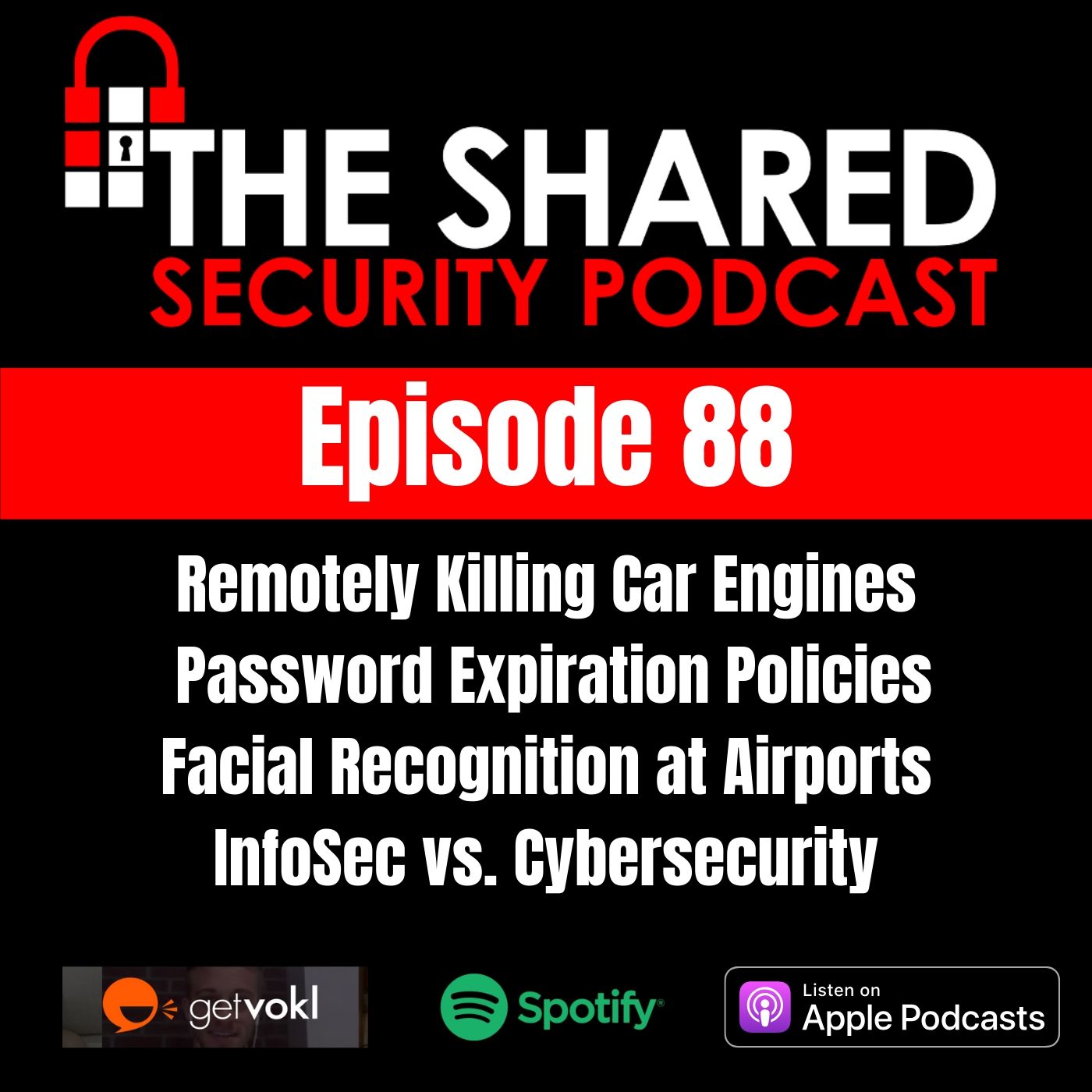
Remotely Killing Car Engines, Password Expiration Policies, Facial Recognition at Airports, InfoSec vs. Cybersecurity
In episode 88 of our monthly show we streamed live on GetVokl! Subscribe to our channel and get notified when we’ll be live so you can chat and participate in our next show! Here are the topics we covered and links to articles we discussed: Hacker Finds He Can Remotely Kill Car Engines After Breaking Into GPS Tracking A hacker by the name of L&M broke into to GPS systems from iTrack and ProTrack which are apps used to manage and monitor fleets of trucks and vehicles. About 27,000 accounts. He could track and shut down the engines of any vehicle either parked or driving under 12 miles per hour He found a flaw in their Android app which set the default password to 123456 for all new user accounts and brute forced the user names. He also wrote a script to login to the accounts. Microsoft says password expiration policies are stupid and will be removing them from their security baselines Skip the Surveillance By Opting Out of Face Recognition At Airports Debate: Is it InfoSec or Cybersecurity ? What do you think? Does the term “cybersecurity” best describe this industry? Send us a message on Instagram, Twitter, Facebook or by email (feedback[aT]sharedsecurity.net) to let us know! Check out Scott’s new company: ClickArmor More news about Scott’s new venture coming soon on the show! The Shared Security Podcast sponsored by Silent Pocket and Edgewise Networks. Be sure to follow the Shared Security Podcast on Facebook, Twitter and Instagram for the latest news and commentary. If you have feedback or topic ideas for the show you can email us at feedback[aT]sharedsecurity.net. First time listener to the podcast? Please subscribe on your favorite podcast listening app such as Apple Podcasts or watch and subscribe on our YouTube channel. The post Remotely Killing Car Engines, Password Expiration Policies, Facial Recognition at Airports, InfoSec vs. Cybersecurity appeared first on Shared Security Podcast.
Critical WhatsApp Vulnerability, Facial Recognition Ban, Wormable Flaw in Windows
This is your Shared Security Weekly Blaze for May 20th 2019 with your host, Tom Eston. In this week’s episode: A serious spyware vulnerability in WhatsApp, San Francisco bans facial recognition, and a wormable vulnerability in older Microsoft systems. Protect your digital privacy with Silent Pocket’s product line of patented Faraday bags, phone cases, and wallets which will make your devices untrackable, unhackable and undetectable. Use discount code “sharedsecurity” to receive 15% off of your order during checkout. Visit silentpocket.com today to take advantage of this exclusive offer. Hi everyone, welcome to the Shared Security Weekly Blaze where we update you on the top 3 cybersecurity and privacy topics from the week. These podcasts are published every Monday and are 15 minutes or less quickly giving you “news that you can use”. Facebook has revealed a major vulnerability in its popular WhatsApp messaging app which is used by 1.5 billion users. This vulnerability allows malicious spyware to be installed by initiating a call over WhatsApp’s voice calling feature. The vulnerability is so serious that the spyware would be installed even if the call wasn’t picked up. WhatsApp said that only a select number of users were victims and that the vulnerability affects all but the latest version available for Apple iOS and Android. Now it should be no surprise that this spyware was also linked back to the infamous Israeli NSO Group which is known for selling highly advanced spyware to governments and nation states. We’ve mentioned the NSO Group many times on the podcast before when we had talked about their Pegasus spyware which can read messages, turn on the microphone and camera and completely take over the device. Of course reports say that the NSO Group has denied any involvement in the WhatsApp vulnerability. WhatsApp has fixed the vulnerability and if you happen to use WhatsApp you need to update to the latest version immediately. What’s really disturbing about a vulnerability like this is that you as the victim can’t really do anything to protect yourself, except not have the app installed. We’re seeing more of these types of vulnerabilities and many of them are taking advantage of zero-day vulnerabilities where only the exploit developer has the exploit, and the device manufacture like Apple is unaware. This is not going to be the last time we see something as dangerous like this so our best advice is to keep your device and apps always updated. That’s about all you can do to protect yourself, or just not use a mobile phone. The other controversy around the WhatsApp vulnerability I want to talk about was a related story that came out in a Bloomberg article which said that end-to-end encryption is nothing but a marketing gimmick. The article went as far to say quote “End-to-end encryption is a marketing device used by companies such as Facebook to lull consumers wary about cyber-surveillance into a false sense of security.” end quote. First of all, this is wrong and extremely misleading. But don’t take my work for it, the cybersecurity community reaction on social media was swift to dismiss the FUD being thrown in this article. Look, zero-days and app vulnerabilities aside, end-to-end encryption is not a gimmick. It’s a real and very important technology to protect your information. End-to-end encryption has nothing to do with this particular vulnerability as the exploit completely compromises the device not the transit of messages themselves which is what end-to-end encryption protects. Oy vey. Check out our show notes to read this terrible article for yourself. And let’s hope news organizations like Bloomberg will learn that click-bait articles like this one are dangerous and don’t help anyone stay more secure. In breaking news last week, San Francisco became the first city in the US to ban the use of facial recognition by police and several other local government agencies. Facial recognition has been used by police and other law enforcement for over a decade now but more recently this technology has come under great scrutiny because of privacy concerns as well as the risk of government abuse. Not only that, but there is concern about facial recognition technology not having a 100% success rate, meaning, there is a risk of people being falsely identified if law enforcement was using this technology, in say an investigation. As I’ve mentioned on previous episodes of this podcast, US Customs and Boarder Protection are now using facial recognition at airports and ports of entry for the last several weeks now. There is some good news, that there seem to be ways to opt-out of facial recognition if you don’t want your face scanned, but reports say that if you’re not a US citizen you can’t opt-out. Now not being able to opt-out is one thing but what’s really fascinating

Israel Cyber-Attack Bombing, New Google Privacy Settings, Traditional Mail Blackmail Scam
This is your Shared Security Weekly Blaze for May 13th 2019 with your host, Tom Eston. In this week’s episode: Israel bombs a building in retaliation for a cyber-attack, Google adds more privacy settings, and a new blackmail scam that uses traditional mail. Protect your digital privacy with Silent Pocket’s product line of patented Faraday bags, phone cases, and wallets which will make your devices untrackable, unhackable and undetectable. Use discount code “sharedsecurity” to receive 15% off of your order during checkout. Visit silentpocket.com today to take advantage of this exclusive offer. Hi everyone, welcome to the Shared Security Weekly Blaze where we update you on the top 3 cybersecurity and privacy topics from the week. These podcasts are published every Monday and are 15 minutes or less quickly giving you “news that you can use”. In breaking news last week it was reported that the Israeli Defense Force, or also known as the IDF, launched an airstrike on the Palestinian Hamas military intelligence headquarters which apparently was the source of an attempted cyber-attack directed towards Israeli targets. The IDF on Twitter said quote “We thwarted an attempted Hamas cyber offensive against Israeli targets. Following our successful cyber defensive operation, we targeted a building where the Hamas cyber operatives work. HamasCyberHQ.exe has been removed” end quote. No further information or statement from the IDF has since been released. All I can say is, that escalated quickly and that this is the first time that I’ve heard of an actual real-time military strike in response to a cyber-attack. Now the US has done similar attacks in the past, using drones to target a ISIS hacker in 2015 and a British citizen who leaked information about US personnel online. However, those two attacks seemed to be planned out well in advance and were not an immediate response like the one just done by Israel. Now whether you agree with this response or not, it does set an interesting precedent that cyber-attacks could result in a military response especially between two nation states. I don’t know if we’ll see anything like this happen between two major superpowers like the US and Russia, even though there is apparently a lot of evidence that Russia has conducted cyber-attacks on the US. This is, of course, according to the US intelligence community. Now just remember folks, attribution is hard. In a surprise move last week, Google announced that it will be rolling out a feature that will allow users to delete some activity data like location history as well as web and app activity. Google users can also choose if they want this activity data saved for either 3 or 18 months, after which any old data will automatically be removed on a continual basis. Not going away is the current ability to manually delete your location history and app activity data. Now we all know that Google uses your data to recommend you various things like ads and other things based on your search queries and all the data you happen to give all the different Google products that you use. Given the recent privacy uprising over Facebook and even Google’s own grilling by Congress over their policy over user location tracking and data practices back in March, it should be no surprise that Google is now backtracking and finally allowing users more control over their data. I know it’s hard to remove yourself from Google services. Especially ones like Gmail and Google search which are in fact probably the best email and search engines out there. Sure, there are alternatives that we’ve talked about on the podcast but with the increasing concern over how large tech giants like Google are using our data, while not giving us a lot of control over it, are you ready to kick Google to the curb? Or do you think Google is started to change because of the new pressures governments and all of us users are putting on them. And now a word from our sponsor, Edgewise Networks. Organizations’ internal networks are overly permissive and can’t distinguish trusted from untrusted applications. Attackers abuse this condition to move laterally through networks, bypassing address-based controls to spread malware. Edgewise abstracts security policies away from traditional network controls that rely on IP addresses, ports, and protocols and instead ties controls directly to applications and their data paths. Edgewise allows organizations to analyze the network attack surface and segment workloads based on the software and how it’s communicating. Edgewise monitors applications and protects data paths using zero trust segmentation. Visit edgewise.net to get your free month of visibility. This past week I was made aware of a local news story about letters that were being sent to residents of a neighboring community which attempted to blackmail people for bitcoin. The letters, which c
The End of Password Expiration Policies, Seat-Back Camera’s on Airplanes, Unknown Data Breach
This is your Shared Security Weekly Blaze for May 6th 2019 with your host, Tom Eston. In this week’s episode: Is this the end of password expiration policies, are there camera’s recording you on an airplane, and the unknown data breach exposing 80 million records. Protect your digital privacy with Silent Pocket’s product line of patented Faraday bags, phone cases, and wallets which will make your devices untrackable, unhackable and undetectable. Use discount code “sharedsecurity” to receive 15% off of your order during checkout. Visit silentpocket.com today to take advantage of this exclusive offer. Hi everyone, welcome to the Shared Security Weekly Blaze where we update you on the top 3 cybersecurity and privacy topics from the week. These podcasts are published every Monday and are 15 minutes or less quickly giving you “news that you can use”. Last week Microsoft has come out and admitted that password expiration policies are essentially useless and said that these requirements are “an ancient and obsolete mitigation of very low value”. In a blog post about updated security baseline settings for Windows 10 and Windows Server, Microsoft says that password expiration policies really don’t provide additional security. Microsoft says that “If a password is never stolen, there’s no need to expire it. And if you have evidence that a password has been stolen, you would presumably act immediately rather than wait for expiration to fix the problem”. Now this doesn’t mean that password expiration’s are going away anytime soon but in regards to the Microsoft security baseline, it means that if an organization uses this baseline, password expiration will be optional and not enforced. The current recommendation in the industry is to use blacklists of banned passwords, implementation of multi-factor authentication, and detection of password guessing attempts. I can say that for once I actually agree with Microsoft here. Password expiration is really an outdated practice so it’s good to see Microsoft getting with the times. Be sure to check out our upcoming monthly show where Scott and I delve deeper into this topic. In the meantime, let’s see how many organizations follow this sound advice from Microsoft. In related news, the UK’s National Cyber Security Centre released an analysis of the 100,000 most common passwords from recent data breaches and hacking campaigns. The most common passwords consist of ‘123456’ at 23.2 million, ‘123456789’ at 7.7 million, followed by ‘qwerty’, ‘password’, and ‘111111’ . My non-scientific analysis tells me that people are just lazy picking weak passwords like this! Let’s hope that more sites use password blacklists that help prevent users from selecting these really poor passwords. If you fly United, Delta, or American Airlines, have you recently noticed that there is now a sticker over what looks to be a camera on the entertainment system that is found on the back of seats? If so, this is because of recent privacy complaints from passengers thinking that these cameras were recording them on the airplane. United told BuzzFeed News that the cameras were never activated and were installed by the manufacture for possible future applications such as video conferencing. As an additional measure all three airlines decided to put stickers on these cameras to alleviate any customer privacy concerns. You may remember that back in February a photo of a camera on a Singapore Airlines entertainment system went viral on Twitter and caused quite the privacy controversy. On top of that there has been a more recent concern over the use of facial recognition technology being used by Delta, JetBlue and other airlines to replace boarding passes. These new systems are being tested out by US Customs and Border Protection right now at certain airports to further screen passengers by matching the picture taken of you to your passport photo. In most cases you can opt-out of these scans but for non-US citizens traveling to or from the US you may not be able to opt-out. And now a word from our sponsor, Edgewise Networks. Organizations’ internal networks are overly permissive and can’t distinguish trusted from untrusted applications. Attackers abuse this condition to move laterally through networks, bypassing address-based controls to spread malware. Edgewise abstracts security policies away from traditional network controls that rely on IP addresses, ports, and protocols and instead ties controls directly to applications and their data paths. Edgewise allows organizations to analyze the network attack surface and segment workloads based on the software and how it’s communicating. Edgewise monitors applications and protects data paths using zero trust segmentation. Visit edgewise.net to get your free month of visibility. Security resear

All about VPN’s with Gaya Polat from vpnMentor
Protect your digital privacy with Silent Pocket’s product line of patented Faraday bags, phone cases, and wallets which will make your devices untrackable, unhackable and undetectable. Use discount code “sharedsecurity” to receive 15% off of your order during checkout. Visit silentpocket.com today to take advantage of this exclusive offer. Tom Eston: Joining me on the podcast to discuss VPNs is Gaya Polat from vpnMentor. Welcome, Gaya. Gaya Polat: Hello. Tom Eston: Alright. So first question about VPNs is, maybe for our audience that may not be familiar with VPNs, what is a VPN and why should someone use one? Gaya Polat: A VPN stands for virtual private network. Is a tool that routes your online information through specialized service. What this means is that it routes your traffic and then encrypts your data. So by doing so, VPNs hide your online activity and protect you from the many danger on the web, whether it’s hackers, data selling, identity theft, and more. So using a VPN keeps your online activity private and safe, therefore it minimizes the chance that you’ll be hacked. But there are other reasons people use VPNs. One of the more common reasons people have been using VPNs is to access geo-block content. And the way a lot of content online works, let’s say Netflix or Hulu, they have different catalogs based for different countries and places. So if you’re an American, for example, who now is spending a semester in England or anywhere else, you’re gonna see that your Netflix catalog has changed. So a lot of people have been using VPNs to access content that is blocked. Gaya Polat: Another very popular reason people have been using VPNs is, sports fans have found VPNs to be quite useful, because a lot of the times like let’s say you want to watch a certain UFC fight on your pay-for-view, it can cost around $80, but there’s a very likely chance that somewhere in a different country, let’s say the United Kingdom, France, or Canada even, you can watch the game on a regular cable channel. So by using a VPN, you can access that quite freely, and before every important boxing or UFC match, you can… We tell you the best way by using a VPN to watch the game or the fight. There’s also a different segment of people who use VPNs because they want to overcome their local censorship laws. Sadly, some countries don’t have free internet and free online access, and they simply need a VPN to use, for example, in Turkey, Wikipedia is blocked. So whenever someone from Turkey wants to access, say, Wikipedia, they need to use a VPN. Russia, almost all online social media is blocked. So we see a lot of users from Russia. That is it. Yeah. Those are I think the main reasons people use VPN. Tom Eston: Yeah, that’s great. Lots of good things, especially if you’re in a country that may be censored, like you said, or access to different types of entertainment content that may not be available in your region or region of the world. And of course user privacy which is definitely a big one. So having said that, with all the great use cases for a VPN, what are some of the disadvantages that come with using a VPN? Gaya Polat: So first of all, as you said, there are a lot of advantages to using a VPN, but it’s not a magic potion that you can use and everything will be great. For example, it will not protect you from phishing scams or having your personal data leaked in certain cases. For example, if you entered your personal information to Facebook and that is hacked, even if you use the best VPN, that will not save your private information. Gaya Polat: There is also an issue with speeds, because by default, what a VPN does, as I said, it is that it routes your internet data through a different server. So that means that by using a different server, it can add a bit of lag time to your speed. So when you choose a VPN, you want to choose a VPN that has servers in a lot of countries and a lot of servers. The more servers it has, the more the user usage of the different servers will be spread out, so there will be sort of less traffic. If you want, you can see on our website the different VPNs and the servers they have and the different speeds. But generally speaking, the top brands all have a lot of servers. Gaya Polat: And another thing that can be a big disadvantage when using a VPN has to do… If you turned copyrighted content, then you need to make sure that the VPN you use does not keep blocks because in some countries, like let’s say for the US, your ISP can be required to give your information if it is asked when turned in. And if the VPN keeps logs, then it has to give your information to the ISP. So if you’re using torrent websites, then you need to make sure, absolutely make sure that it could get you in a lot of hot waters. [chuckle] Gaya Polat: And the last thing to know about VPN usage is that some sites

The State of Cybersecurity Training and Certifications with Kevin Johnson
In episode 87 of our monthly show, frequent guest Kevin Johnson joins us to discuss the current state of cybersecurity training and certifications. If you’re currently in the industry or pursuing a career in cybersecurity this is one episode not to miss! Tom and Kevin cover the following topics: What’s the state of training and certifications in our industry? Why is some training so expensive? How did we get here? What’s the biggest challenge we face? What should we look for in a training provider and are certifications really worth it? What certifications are valuable? We also discuss the recent incident of Kevin’s training provider which was compromised a few weeks ago. Kevin talks about the way they handled the incident, how they disclosed to the public, and the right way to handle a data breach and incident. Full write up of the incident that we mention on the show: https://blog.secureideas.com/2019/04/we-take-security-seriously-and-other-trite-statements.html This episode was also streamed live over Twitch and YouTube Live! Be sure to subscribe to us on Twitch and YouTube to catch the next live episode. Special thanks to Kevin Johnson for being our guest. It’s always a pleasure to have Kevin on the show! The Shared Security Podcast sponsored by Silent Pocket and Edgewise Networks. Be sure to follow the Shared Security Podcast on Facebook, Twitter and Instagram for the latest news and commentary. If you have feedback or topic ideas for the show you can email us at feedback[aT]sharedsecurity.net. First time listener to the podcast? Please subscribe on your favorite podcast listening app such as Apple Podcasts or watch and subscribe on our YouTube channel. The post The State of Cybersecurity Training and Certifications with Kevin Johnson appeared first on Shared Security Podcast.

Microsoft Email Hacked, Instagram Nasty List Phishing Scam, Facebook Third-Party Data Deals
This is your Shared Security Weekly Blaze for April 22nd 2019 with your host, Tom Eston. In this week’s episode: Microsoft email services hacked, the Instagram “Nasty List” phishing scam, and Facebook’s attempted deals to sell your data. Protect your digital privacy with Silent Pocket’s product line of patented Faraday bags, phone cases, and wallets which will make your devices untrackable, unhackable and undetectable. Use discount code “sharedsecurity” to receive 15% off of your order during checkout. Visit silentpocket.com today to take advantage of this exclusive offer. Hi everyone, welcome to the Shared Security Weekly Blaze where we update you on the top 3 cybersecurity and privacy topics from the week. These podcasts are published every Monday and are 15 minutes or less quickly giving you “news that you can use”. Microsoft was in the hot seat this past week with the announcement that email services on Outlook.com, MSN, and Hotmail were breached from January to late March this year. This breach was due to the compromise of a support agent’s privileged credentials, most likely due to a targeted social engineering attack. The attackers apparently had access to email addresses, subject lines, names of people within conversations, and custom folder names. Accounts affected were only free consumer accounts and not accounts that businesses pay for. According to Motherboard, who broke the story, Microsoft has confirmed the breach and have sent breach notification emails to customers that have been affected but didn’t say how many users were impacted by the breach. Other details show that the source, who was used for the Motherboard story, noted that the attacker appeared to have used this access for what are called “iCloud unlocks”. This is where attackers will compromise a victim’s email or iCloud account to remove Apple’s ‘Activation Lock’ from a stolen iPhone. This security feature was implemented to prevent thieves from resetting stolen iPhones and selling them. My take is that this is one of those attacks that as users, is very hard, if not impossible to prevent. Even if you secure your account with multi-factor authentication, you’re still at the mercy of Microsoft and the administrators that may have their credentials compromised. In these cases, it comes down to how quickly a company can respond to a breach to limit impact to it’s customers. Have you been receiving strange messages on Instagram from your followers about you being on something called the “Nasty List”? If so, the message is actually a massive phishing campaign that is being spread though hacked Instagram accounts. The message will say something like quote “OMG your actually on here, @TheNastyList_(some number), your number is 15! Its really messed up” end quote. Grammar Nazis, your first clue that is that this is a scam is the spelling of “your” which should be “you’re”. Unless, of course, your friends naturally have bad grammar. Now if you visit the profile you will see an interesting URL in the profile link which will, you guessed it, take you to a fake Instagram login page. If you happen to enter in your Instagram credentials, you’ll be hacked yourself and your account will then become another zombie also sending out the same message to your followers. For more details on this scam check out the link in our show notes for a great article from Bleeping Computer. Hopefully, as a listener of this podcast, you didn’t fall for this scam but if you did change your password, re-edit your profile, and profusely apologize to your followers that you were hacked. And now a word from our sponsor, Edgewise Networks. Organizations’ internal networks are overly permissive and can’t distinguish trusted from untrusted applications. Attackers abuse this condition to move laterally through networks, bypassing address-based controls to spread malware. Edgewise abstracts security policies away from traditional network controls that rely on IP addresses, ports, and protocols and instead ties controls directly to applications and their data paths. Edgewise allows organizations to analyze the network attack surface and segment workloads based on the software and how it’s communicating. Edgewise monitors applications and protects data paths using zero trust segmentation. Visit edgewise.net to get your free month of visibility. I think I’m starting to sound like a broken record here but surprise, surprise, Facebook was in the news once again this week when NBC News reported that Facebook CEO Mark Zuckerberg once considered making deals with third-party developers to find out how much users’ data might actually be worth. In the report over 4,000 leaked pages of internal Facebook documents show that there were potentially 100 deals with third-party app de

Amazon Echo Recording Controversy, New Mobile Phone Scam, Hotels Leaking Data
This is your Shared Security Weekly Blaze for April 15th 2019 with your host, Tom Eston. In this week’s episode: Amazon Echo’s recording controversy, a new mobile phone scam, and hotels leaking your private information. Protect your digital privacy with Silent Pocket’s product line of patented Faraday bags, phone cases, and wallets which will make your devices untrackable, unhackable and undetectable. Use discount code “sharedsecurity” to receive 15% off of your order during checkout. Visit silentpocket.com today to take advantage of this exclusive offer. Hi everyone, welcome to the Shared Security Weekly Blaze where we update you on the top 3 cybersecurity and privacy topics from the week. These podcasts are published every Monday and are 15 minutes or less quickly giving you “news that you can use”. In late breaking news last week, it was reported by Bloomberg that Amazon employs thousands of workers to listen to what customers say to Amazon Echo devices. According to the report workers can listen to as many as 1,000 audio clips in 9 hour work shifts. Apparently, workers listen to audio clips that are “mundane” and even sometimes “possibly criminal”. Amazon responded to the report by saying that it only annotates “extremely small number of interactions from a random set of customers.” and that it uses “requests to Alexa to train our speech recognition and natural language understanding systems”. While Amazon employees don’t have access to names or addresses of customers, they do have access to the Amazon account number and device serial number. Amazon further clarified that no audio is stored unless the wake word is used to activate the Alexa-enabled device. While you can go in to the Alexa app to view the privacy configuration of your Echo device and individually delete audio clips, there currently is no way to completely opt-out of recording all together. The only option available is to disable the use of recordings for the development of new features. However, its reported that Amazon may still have recordings analyzed by hand over an occasional review process. A new scam, where someone calls asking for your mobile carrier’s verification code, has been making the rounds. The way it works is that you’ll receive an email which looks like it’s come from your mobile carrier, like Verizon, with the message saying that fraud has been found on your account and you need to call the number noted in the email immediately. If you call the number the scammer will say they need your verification PIN that you set up with them to verify your account. Once you do that, the scammer will reset your password and make themselves the “primary” account user. After that, the scammer will have full access to potentially buy devices at your carriers store as well as hijack your phone number to reset two-factor authentication on other critical accounts. In two recent cases that took place in Florida, scammers attempted to purchase several brand new phones from a Verizon store using this scam. Fortunately, police showed up at the store to arrest the perpetrators after being alerted by Verizon that something wasn’t quite right. So what can you do to prevent becoming a victim of a scam like this? First, even with the threat of phishing and social engineering, you should always have a PIN, or also known as a “port validation” code set up through your mobile carrier. See our show notes for a great guide on how to do this as each company has a different procedure. Also note, you should ensure that this passcode or PIN is unique and different than any other passcode or PIN that may be in use with your mobile carrier. Lastly, if you receive an email or phone call from someone that says they are from your mobile carrier, hang up. You’re not going to be contacted over the phone like this and if you are concerned about fraud or to find out if a request is legitimate or not, it’s best to just give your mobile carrier a call yourself. And now a word from our sponsor, Edgewise Networks. Organizations’ internal networks are overly permissive and can’t distinguish trusted from untrusted applications. Attackers abuse this condition to move laterally through networks, bypassing address-based controls to spread malware. Edgewise abstracts security policies away from traditional network controls that rely on IP addresses, ports, and protocols and instead ties controls directly to applications and their data paths. Edgewise allows organizations to analyze the network attack surface and segment workloads based on the software and how it’s communicating. Edgewise monitors applications and protects data paths using zero trust segmentation. Visit edgewise.net to get your free month of visibility. New research from Symantec shows that hotels are leaking detailed guest reservation da

Facebook’s Bad Week, Stalkerware, Tax Season Scams
This is your Shared Security Weekly Blaze for April 8th 2019 with your host, Tom Eston. In this week’s episode: Facebook’s very bad week, Stalkerware on the rise, and tax season scams. Protect your digital privacy with Silent Pocket’s product line of patented Faraday bags, phone cases, and wallets which will make your devices untrackable, unhackable and undetectable. Use discount code “sharedsecurity” to receive 15% off of your order during checkout. Visit silentpocket.com today to take advantage of this exclusive offer. Hi everyone, welcome to the Shared Security Weekly Blaze where we update you on the top 3 cybersecurity and privacy topics from the week. These podcasts are published every Monday and are 15 minutes or less quickly giving you “news that you can use”. I know you’ll be shocked to hear this but Facebook had yet another painful week of data breaches and controversy. First was the announcement that over 540 million Facebook user records and associated data was found unsecured on two Amazon AWS servers discovered earlier in the year by cybersecurity firm, UpGuard. The first server, belonging to a company called Cultura Colectiva, which is a Mexico based media platform, had the majority of the exposed data containing usernames, Facebook IDs, comments, likes, and other data that may have been used for social media analytics. The second server had data from a Facebook game called “At the Pool” which had details such as Facebook ID, friends list, likes, photos, groups, checkins, user interests, and of course 22,000 passwords. The passwords were apparently only for the game account and not the Facebook login, however, we all know that most people reuse passwords across the same sites and services that they use. Both servers are now locked down after quite the ordeal noted by UpGuard in their incident report which we’ll have linked in our show notes. This particular breach shows one of the many problems that Facebook has had with all the data that third-party app developers have been collecting over the years. Just like the Cambridge Analytica scandal, it’s nearly impossible for Facebook to oversee and regulate the security of user data that leaves the Facebook Platform. The second Facebook story that made the news last week was how Facebook is asking some new users to provide the password to their email account. Apparently, if you happen to use an email account from some email service providers like Yandex and GMX, you’ll be prompted to enter your email account password to confirm your email address. Once you do that, a pop-up appears stating that Facebook is importing your email contacts without any authorization by the user to do so. According to the report from Business Insider, Facebook stated that this “feature” is being discontinued but in the meantime, it’s set off groups like the Electronic Frontier Foundation which said that this “feature” is indistinguishable to a phishing attack which will also ask you to enter in passwords to verify who you say you are. According to anti-virus company Kaspersky over 58,000 Android users had “stalkerware” installed on their phones last year. 35,000 out of this number had no idea that they had stalkerware installed on their device until they installed Kaspersky’s mobile antivirus product. Stalkerware or also known as spouseware or legal spyware, is sold by various companies under the guise of an easy way to monitor your child’s activities or tracking employee device usage. In reality, most of these apps are being used maliciously and having these apps installed means that someone has had physical access to your device as the majority of these apps require someone to install the application manually, mostly because these apps require the device to be “jailbroken” or “rooted” so that the app can be installed. Last year, on episode 40 of the Weekly Blaze, we recorded an entire podcast about stalkerapps and spyware I encourage you to check out. This episode goes into more detail on how these apps work and what to look for if you suspect one of these apps are installed on your mobile device or laptop. In related news, Kaspersky has said that they will now start alerting Android users, that have their antivirus product, whenever a stalkerware app is installed on a user’s device. This push by Kaspersky was initiated by Eva Galperin head of the Electronic Frontier Foundation’s Threat Lab in which she’s spearheading a push in the cybersecurity industry to finally take the threat of stalkerware seriously. In her list of demands she’s asking antivirus companies to start detecting and alerting on these types of apps, asking Apple to allow antivirus apps in their app store (Apple currently does not allow this), have Apple alert and detect when an Apple device is jailbroken or rooted, and to hav

Apple Card, ASUS Live Update Backdoor, Statistics on Malware Attacks
This is your Shared Security Weekly Blaze for April 1st 2019 with your host, Tom Eston. In this week’s episode: Apple’s new privacy focused credit card, the ASUS live update software backdoor, and recent statistics on Malware attacks. Protect your digital privacy with Silent Pocket’s product line of patented Faraday bags, phone cases, and wallets which will make your devices untrackable, unhackable and undetectable. Use discount code “sharedsecurity” to receive 15% off of your order during checkout. Visit silentpocket.com today to take advantage of this exclusive offer. Hi everyone, welcome to the Shared Security Weekly Blaze where we update you on the top 3 cybersecurity and privacy topics from the week. These podcasts are published every Monday and are 15 minutes or less quickly giving you “news that you can use”. Apple announced last week that it’s partnered with financial firm Goldman Sachs on a new type of credit card which is focused on privacy and security. The credit card, which is called “Apple Card”, is paired with Apple Pay so you can use it like you normally do with your iPhone, but it also includes a traditional physical card made out of titanium, laser-etched and has no visible card number, CVV code, expiration date, or signature on the card itself. Now that credit card, completely has Apple written all over it. In regards to the technology, the credit card number will be stored in the iPhone’s Secure Element chip and all purchases must be authenticated through Touch ID or Face ID. Apple also says that they will not track what you’ve purchased, where you’ve shopped, or how much you’ve paid for purchases and that Goldman Sachs will not share or sell your data to third-party marketing firms. Other perks include a cash back program on all purchases, no annual fees, and insight into spending habits right on your iPhone. If this all sounds amazing, you may be asking yourself “What’s the catch?”. Well, the Apple Card is still a credit card so from what we know so far is that interest rates will vary between 13 and 24% and are based on your “creditworthiness” and that any late or missed payments will drive up your interest rate. My take is that I think it’s great to see Apple making more of their products and services with privacy and security in mind. I think we all give Apple some grief over their sometimes overly aggressive marketing campaigns like they did at CES in Las Vegas this year when they proclaimed on a large billboard “What happens on your iPhone, stays on your iPhone”. But perhaps, now we’re really starting to see Apple put their money where their mouth is. Computer hardware manufacture ASUS confirmed that their “live update” tool, which provides firmware updates, drivers, and patches for all of their laptops and other consumer hardware, was compromised by an Advanced Persistent Threat group. This is a great example of what is called a supply chain attack where a central update repository was compromised to spread malware. ASUS said in their press release that “a small number of devices have been implanted with malicious code through a sophisticated attack on our Live Update servers in an attempt to target a very small and specific user group”. ASUS also stated that it had reached out to affected users and worked with them to ensure any security risks were removed. Kaspersky, which makes anti-virus software, claims it’s detected the ASUS supply-chain malware, conveniently named ShadowHammer, on 57,000 computers. Kaspersky says that there may be even more devices that have been affected. In related news, TechCrunch reports that a security researcher warned ASUS about two months ago that ASUS developers were disclosing passwords within their GitHub code repositories which could be used to access the ASUS corporate network. These repositories were publicly available and the researcher notes that one of the repositories was a daily release mailbox where automated build notifications were sent. Within these emails contained the full file path of where drivers and other files were stored on the ASUS internal network. This information, combined with access to this mailbox could have easily have been used for phishing or targeting other developers via social engineering. While there have been no reports of compromised systems, it does show a lack of overall security awareness of ASUS’s developers. Now in regards to remediation, ASUS says the backdoor has been fixed and that ASUS users should update to the latest version of its “Live Update” software. Do you own a ASUS laptop or other device? If you do, be sure to check out our show notes for a link where you can download a tool from ASUS which will determine if your ASUS system was affected by the backdoor. And now a word from our sponsor, Edgewise Networks. Org
Facebook Passwords Exposed, Android Q Privacy, Microsoft Office Targeted
This is your Shared Security Weekly Blaze for March 25th 2019 with your host, Tom Eston. In this week’s episode: Facebook passwords exposed in plain text, Android Q’s new privacy features, and why Microsoft Office is the most popular target for cybercriminals. Protect your digital privacy with Silent Pocket’s product line of patented Faraday bags, phone cases, and wallets which will make your devices untrackable, unhackable and undetectable. Use discount code “sharedsecurity” to receive 15% off of your order during checkout. Visit silentpocket.com today to take advantage of this exclusive offer. Hi everyone, welcome to the Shared Security Weekly Blaze where we update you on the top 3 cybersecurity and privacy topics from the week. These podcasts are published every Monday and are 15 minutes or less quickly giving you “news that you can use”. I want to mention a correction from last week’s show when I talked about the service called CLEAR. CLEAR does not use Facial Recognition technology, they only use iris or fingerprint biometric scans. And now, on to this week’s news. In late breaking news last week Facebook announced that hundreds of millions of its users had their account passwords stored in plain-text going all the way back to 2012. Apparently, through an internal security review, Facebook had found these passwords exposed on internal servers. Apps affected include Facebook, Instagram and Facebook Lite, which is a version of Facebook made for underpowered phones and low speed connections. Famed reporter Brian Krebs from Krebsonsecurity.com said a source at Facebook told him that between 200 and 600 million Facebook users had their passwords stored in plain text and the data was searchable by over 20,000 Facebook employees. The source also said that about 2,000 internal developers made about 9 million queries for information that contained those plain text passwords. Facebook stated that it appears no one outside of Facebook had compromised this data and that (for now) there is no evidence that anyone internally at Facebook accessed or abused anyone’s password. Now, are you shocked to hear this latest news? If you’re not, how much more can we all take before it’s time to finally delete Facebook from our lives? It seems this is just yet another security and privacy blunder that continues to plague the world’s largest social network on pretty much a weekly basis. Our advice is if you plan on sticking around Facebook, change your Facebook and Instagram password, and if you haven’t already, enable two-factor authentication. In fact, if you have two-factor authentication already enabled on your account, you’re already a step ahead protecting your Facebook password from potential compromise. Android users rejoice! Android Q, Google’s new version of Android set to be released this summer, is coming with several new and exciting privacy features. Here’s our take on the top three features. First up is that Android apps can no longer access clipboard data, unless the app is actively being used. This can help prevent malicious apps from gaining access to copied clipboard data like passwords from a password manager. Next, MAC address randomization will be enabled by default. A MAC address is the unique ID that your Wi-Fi and Bluetooth chips installed on your devices use when communicating on a network. This feature was available in Android 6.0 but now will be enabled by default. This feature will also help prevent some data harvesting and tracking used by some third-party app providers. And probably the biggest new privacy feature is having more control over your location data. Android Q will now have a permissions prompt whenever an app wants to use your location data. So now you can give the app access to location data all the time, only when the app is in use, or completely deny the app access to your location data. Check out our show notes for a link to all the new privacy features coming in the upcoming release of Android Q. And now a word from our sponsor, Edgewise Networks. Organizations’ internal networks are overly permissive and can’t distinguish trusted from untrusted applications. Attackers abuse this condition to move laterally through networks, bypassing address-based controls to spread malware. Edgewise abstracts security policies away from traditional network controls that rely on IP addresses, ports, and protocols and instead ties controls directly to applications and their data paths. Edgewise allows organizations to analyze the network attack surface and segment workloads based on the software and how it’s communicating. Edgewise monitors applications and protects data paths using zero trust segmentation. Visit edgewise.net to get your free month of visibility. A recent report by threat intelligence firm Recorded Future, shows that for the second year in a row, Microsoft was the

Verifications.io Data Breach, Capsizing a Ship with a Cyberattack, World’s Most Dangerous Malware
In episode 86 of our monthly show we discuss Tom’s new garbage service (yep, that’s right) and why taking credit cards by filling out a form and mailing it is never a good idea, the Verifications.io data breach, how a cyberattack could capsize a ship, and the world’s most dangerous malware. This was also the first show we streamed live over Twitch. Be sure to subscribe to us on Twitch to get notified when we’ll be live! Links to articles mentioned on the show: Verifications.io data breach How a cyberattack can capsize a ship Triton is the world’s most murderous malware, and it’s spreading The Shared Security Podcast sponsored by Silent Pocket and Edgewise Networks. Be sure to follow the Shared Security Podcast on Facebook, Twitter and Instagram for the latest news and commentary. If you have feedback or topic ideas for the show you can email us at feedback[aT]sharedsecurity.net. First time listener to the podcast? Please subscribe on your favorite podcast listening app such as Apple Podcasts or watch and subscribe on our YouTube channel. The post Verifications.io Data Breach, Capsizing a Ship with a Cyberattack, World’s Most Dangerous Malware appeared first on Shared Security Podcast.

Equifax and Marriott Data Breach Updates, Facial Recognition at the Airport, Citrix Password Spraying Attack
** Correction about CLEAR as noted in this episode of the podcast. CLEAR does not use Facial Recognition technology, only iris or fingerprint biometric scans ** This is your Shared Security Weekly Blaze for March 18th 2019 with your host, Tom Eston. In this week’s episode: Equifax and Marriott data breach updates, facial recognition coming to 20 US airports, and the Citrix password spraying attack. Protect your digital privacy with Silent Pocket’s product line of patented Faraday bags, phone cases, and wallets which will make your devices untrackable, unhackable and undetectable. Use discount code “sharedsecurity” to receive 15% off of your order during checkout. Visit silentpocket.com today to take advantage of this exclusive offer. Hi everyone, welcome to the Shared Security Weekly Blaze where we update you on the top 3 cybersecurity and privacy topics from the week. These podcasts are published every Monday and are 15 minutes or less quickly giving you “news that you can use”. In data breach news, Equifax CEO Mark Begor and Marriott CEO Arne Sorenson appeared before a US Senate subcommittee to testify regarding the data breaches that both companies have suffered. While no new information was made about the Equifax breach (just the committee grilling Equifax’s CEO on the security controls and investments in security that they’ve put in place) several more technical details about the Marriott breach were revealed. In September of last year, Accenture, who managed the Starwood Guest Reservation Database, contacted Marriott’s IT team about a strange query from a legitimate administrator account. Marriot discovered that these credentials were stolen and began an investigation. Investigators first found a remote access trojan being used as well as a tool to reveal usernames and passwords in memory called MimiKatz. Investigators finally found two encrypted files that were deleted and then recovered. These two files were removed from the Starwood network on November 13th of last year. Shortly after, investigators were able to decrypt these files to show what type of data was stolen. Even though 383 million guest records were accessed, the good news was that 9.1 million credit card numbers in the stolen data was encrypted and there has been no evidence to indicate that the master encryption keys to decrypt the card data was accessed. Marriott also said that they have not received any claims of loss from fraud from the incident. This is quite surprising, given that attackers had breached the Starwood network for at least 4 years since 2014 well before Marriott acquired the hotel chain. In other Equifax news, famed reporter Brian Krebs reports that even if you already froze your credit files through Equifax after their data breach and were issued a PIN code, it still may be possible for an attacker to bypass your PIN and lift an existing credit freeze with just your name, social security number and birthday. Check out the link in our show notes to read the full article on this rather disturbing development. US Customs and Border Protection (or CBP) is beginning to implement facial-recognition technology at 20 airports across the US. These new systems will be used to verify the identities of passengers entering and exiting the country. The plan is to have this system in place across all US airports by 2020. The technology will measure what’s called facial landmarks, which is the distance between the eyes or from the forehead to the chin, and match that data to passport photos stored in a database. You might be surprised to hear this but similar commercial facial-recognition systems are already in use at many airports already. For example, Delta has a “curb-to-gate” facial recognition system for international travelers at Atlanta International Airport and other airlines like JetBlue, British Airways, and Lufthansa are running similar pilot programs of their own. You may have also seen a third-party service called “Clear” at over 27 US airports which are kiosks that use iris or fingerprint biometric scans. Clear allows you to basically jump to the front of the security screening line, and includes a bunch of other airline specific perks, which can significantly decrease the time it takes through airport security. The issue with Clear, is that it comes at a cost of about $15 a month. Facial-recognition technology seems to be implemented faster than we can understand the privacy ramifications. In a lot of ways, we’re starting to see the beginnings of a government funded massive surveillance network, now tied into the passport system, which has the potential to expand even outside of the airport. It’s also important to note that there are no laws that govern the use of facial recognition. Yet, the government is happy to roll this technology out, all in the name of your security. Third-parties like Clear, now make millions of d

Google Chrome Zero-Day, Facebook Phone Number Privacy, NSA Phone Data Collection Program
This is your Shared Security Weekly Blaze for March 11th 2019 with your host, Tom Eston. In this week’s episode: a new Google Chrome Zero-Day, how Facebook uses your phone number, and the shutdown of the NSA’s phone data collection program. Protect your digital privacy with Silent Pocket’s product line of patented Faraday bags, phone cases, and wallets which will make your devices untrackable, unhackable and undetectable. Use discount code “sharedsecurity” to receive 15% off of your order during checkout. Visit silentpocket.com today to take advantage of this exclusive offer. Hi everyone, welcome to the Shared Security Weekly Blaze where we update you on the top 3 cybersecurity and privacy topics from the week. These podcasts are published every Monday and are 15 minutes or less quickly giving you “news that you can use”. Google announced last week that a patch released on March 1st for the Google Chrome web browser was actually to fix a zero-day vulnerability that has been under active attack. The vulnerability, which is known as a use-after-free bug, is a type of memory error which can allow malicious code to escape Chrome’s built in security sandbox and will allow commands to be ran on the local operating system. This particular vulnerability was found in what’s known as the “FileReader API” that allows web applications to read the contents of files within a user’s computer. Google updated their original post about the patch to indicate that “Access to bug details and links may be kept restricted until a majority of users are updated with a fix”. This is, of course, done to prevent malicious actors from accessing details on how the vulnerability works so that it cannot be replicated. As always, ensure you keep your web browser of choice updated. In fact, all modern browsers have a nifty auto-update feature. The Chrome browser will show you a “green, orange, red” three dot indicator at the top right of your browser. If its green, an update has been available for 2 days, if it’s orange, 4 days, and if it’s red, 7 days. Click on the three dots and simply click “Update Google Chrome”. If you don’t see this button or any color indicators, you’re at the most current version. Our advice is to take a minute now to ensure you’re using the latest version of Chrome. First up in Facebook news last week was the controversy with how Facebook uses your phone number. The Electronic Frontier Foundation said that phone numbers in Facebook, which happen to be used for two-factor authentication, have the privacy setting set to searchable by “Everyone” as the default. In fact, Facebook only gives you the choice of “Everyone”, “Friends of Friends” and “Friends” which means there is no option to opt-out. Facebook is essentially forcing us into a trade-off between the security of two-factor authentication and privacy of our phone number. Keep in mind, back in April of last year, Facebook did remove the ability to search for a user by entering a phone number or email address in the Facebook search bar but it did not disable the ability for someone to search for you when they upload a list of their contacts, which happens to have your phone number in it. In other Facebook news, a report from the Guardian shows that Facebook targeted politicians around the world, promising various forms of investments and incentives so that they would lobby on Facebook’s behalf against data privacy legislation. This was all made public via a brand new leak of internal Facebook documents. And if that wasn’t enough Facebook news, Facebook CEO Mark Zuckerberg released a manifesto of sorts which details his vision for building a privacy-focused messaging and social networking platform. Check out our show notes if you’re interested in reading Mark’s full post but basically he wants to change Facebook so that it can have more private interactions, end-to-end encryption, reducing permanence, safety, interoperability, and secure data storage. So what do you think? With all the controversy and scandal going on with Facebook, do you think Mark’s intentions for a more secure and private Facebook are true? Or, do you feel that ultimately we are the product and at the end of the day, making money off of our private data is what Facebook is really about. Let us know your thoughts by sending us an email at [email protected] or through any of our social media channels and lets continue the conversation. And now a word from our sponsor, Edgewise Networks. Organizations’ internal networks are overly permissive and can’t distinguish trusted from untrusted applications. Attackers abuse this condition to move laterally through networks, bypassing address-based controls to spread malware. Edgewise abstracts security policies away from

Multi-Factor Authentication, New Attacks on 4G and 5G Mobile Networks
This is your Shared Security Weekly Blaze for March 4th 2019 with your host, Tom Eston. In this week’s episode: Multi-factor authentication to protect your credentials, and new attacks on 4G and 5G mobile networks. Protect your digital privacy with Silent Pocket’s product line of patented Faraday bags, phone cases, and wallets which will make your devices untrackable, unhackable and undetectable. Use discount code “sharedsecurity” to receive 15% off of your order during checkout. Visit silentpocket.com today to take advantage of this exclusive offer. Almost every day we hear about a new data breach or leak of personal data. In a lot of these stories, compromised credentials are used in what is known as a ‘credential stuffing’ attack in which stolen credentials, from large databases of past data breaches, are used to gain access to many different types of popular applications and services. Just last week, one of those services was Intuit’s TurboTax application which right now, because of tax season in the US, is extremely popular. Victims of this particular attack had their information like social security numbers, address, date of birth, driver’s license number, previous tax returns and other personal data compromised. That’s enough data for someone’s identity to be stolen! But even if we take the right precautions to use unique and complex passwords, many of us can still fall victim to a phishing or other social engineering attack where we may be convinced to giveaway our user credentials. In fact, in last week’s show I discussed a very realistic Facebook social login phishing campaign which looks so real that even cybersecurity professionals could fall for it. So what can you do to help better protect your user credentials? The answer is multi-factor authentication and you should always enable it if the apps and services you are using support it. Here to discuss what multi-factor authentication is and how it’s different than other forms of authentication is Ian Paterson, CEO of identity assurance company, Plurilock. Ian Paterson: Historically, authentication is based around what you know, which would be something like a password or a PIN number for your debit card; what you have, so that would be something like the debit card itself or maybe an RSA token; and something that you are, and that would be something like your fingerprint for touch ID or maybe your face for using facial recognition. And multi-factor authentication is when you have two or more of those factors. So you’re mixing and matching something that you know, something that you have, and something that you are. Ian Paterson: Traditional authentication is generally something that you know, and that would be passwords. And what the world has learned over the last five to 10 years, is that passwords, something that you know, are really a terrible way of protecting stuff. I would say ironically, but not ironically, I got a note in my inbox earlier this week from Have I Been Pwned, saying, “Congratulations. You have been subject to a data breach.” And the reality is if you’ve been around online for any amount of time, probably you’ve had your credentials breached. And I usually talk about, there’s two people in the world, people who know that they’ve been part of a data breach and people who don’t know. And that’s basically it. So, coming back to your question. So MFA is designed to mitigate some of the problems around traditional authentication, I.e., passwords and we’re starting to see more of… More consumer options, certainly, around being able to use MFA or two factors, so two-factor authentication and multi-factor authentication, we’re starting to see more of those options being available to consumers. Tom Eston: So, what are some of the issues that you’re seeing with the way that companies and applications and everyone is using multi-factor authentication right now? Ian Paterson: I think that there are some good ways of doing multi-factor authentication and there are some not good ways of doing multi-factor authentication. So some examples of maybe good attempts, but attempts that come up short, would be using two forms of something that you know. Ian Paterson: A lot of banks actually are still stuck with this. Where you’ll have a login and password and then if you get through the login and password, then they’ll ask you a security question. So it’s not actually multi-factor, they call it two-step verification in a lot of cases, which kinda sounds like two-factor authentication, but you’re still using two shared secrets, two something that you knows, in order to authenticate you as a person. And it’s a little bit better than just a password on its own, but not by much. And certainly it doesn’t meet a lot of the regulatory requirements around strong authenti

Google Nest’s Secret Microphone, Facebook Login Phishing, Password Manager Vulnerabilities
This is your Shared Security Weekly Blaze for February 25th 2019 with your host, Tom Eston. In this week’s episode: Google Nest’s secret microphone, a new Facebook login phishing campaign, and vulnerabilities in popular password managers. Silent Pocket is a proud sponsor of the Shared Security Podcast! Silent Pocket offers a patented Faraday cage product line of phone cases, wallets and bags that can block all wireless signals, which will make your devices instantly untrackable, unhackable and undetectable. Use discount code “sharedsecurity” to receive 15% off of your order. Visit silent-pocket.com to take advantage of this exclusive offer. Hi everyone, welcome to the Shared Security Weekly Blaze where we update you on the top 3 cybersecurity and privacy topics from the week. These podcasts are published every Monday and are 15 minutes or less quickly giving you “news that you can use”. Do you own or thinking about owning a Nest Secure security system? If so, did you know that Google secretly installed a microphone into the system as a previously undocumented opt-in feature? Well just last week Google announced that an update for its Nest Secure system would allow users to enable the Google Assistant (that’s Google’s voice activated product) so that users could use voice commands to enable and disable the alarm system. In a report from Business Insider last week, a Google spokesperson said that the company had made an error and that “the on-device microphone was never intended to be a secret and should have been listed in the tech specs”. Google said that the microphone was originally included in the system for the future possibility of new features, like the ability to detect broken glass. Google also stated that the microphone was always disabled. This news comes at a very challenging time for the tech giant as many consumers are increasingly worried about their privacy and companies like Google who have continued to demonstrate a lack of commitment to protecting our private information. In fact, a privacy group called EPIC which stands for the Electronic Privacy Information Center, is asking the Federal Trade Commission here in the United States to divest Nest from the rest of its parent company Google and disclose any data that these undocumented microphones may have been collecting. EPIC has, in the past, called for similar action against Google dating back to 2010 when Google was found to have been collecting Wi-Fi data from its Street View project which included Wi-Fi network names, MAC addresses, URLs, emails, and even passwords from unsecured Wi-Fi networks. So what do you think? Are you concerned about a microphone in your home security system? Or is the bigger issue that companies like Google are not being honest with consumers about the privacy impacting technology being used in their products. And now a word from our sponsor, Edgewise Networks. Organizations’ internal networks are overly permissive and can’t distinguish trusted from untrusted applications. Attackers abuse this condition to move laterally through networks, bypassing address-based controls to spread malware. Edgewise abstracts security policies away from traditional network controls that rely on IP addresses, ports, and protocols and instead ties controls directly to applications and their data paths. Edgewise allows organizations to analyze the network attack surface and segment workloads based on the software and how it’s communicating. Edgewise monitors applications and protects data paths using zero trust segmentation. Visit edgewise.net to get your free month of visibility. Last week password management company Myki posted about a new Facebook login phishing campaign making the rounds that looks so realistic that even cybersecurity professionals would have a hard time recognizing it. The attack takes advantage of the popular “social login” feature that is used for most web and mobile applications these days. Social logins gives you the option of logging in with your Facebook account instead of creating a new set of user credentials. This is often times more convenient than always creating a new user name and password combination. However, in the case of this new attack, convenience may come at a price. The way this particular attack works is that the attacker creates a very realistic-looking social login pop-up where everything from the status and navigation bar, graphics and more all look just like the real social login page. The user can even interact with the login box, just like the real one, by moving it around the screen and closing it. Once you fill out the form with your Facebook login credentials, they are then sent to the attacker. Check out the link in our show notes for a video demonstration of what the attack looks like but the only advice given to protect yourself is to try and drag the prompt away from the box that it is

Preventing Illegal Robocalls, Webcam Spying, Dating App Account Hacking
This is your Shared Security Weekly Blaze for February 18th 2019 with your host, Tom Eston. In this week’s episode: Preventing illegal robocalls, should you be scared of your laptop’s webcam, and recent hacks of popular dating apps. Silent Pocket is a proud sponsor of the Shared Security Podcast! Silent Pocket offers a patented Faraday cage product line of phone cases, wallets and bags that can block all wireless signals, which will make your devices instantly untrackable, unhackable and undetectable. Use discount code “sharedsecurity” to receive 15% off of your order. Visit silent-pocket.com to take advantage of this exclusive offer. Hi everyone, welcome to the Shared Security Weekly Blaze where we update you on the top 3 cybersecurity and privacy topics from the week. These podcasts are published every Monday and are 15 minutes or less quickly giving you “news that you can use”. I’ll bet you’re like me and whenever I see a phone call from a number I don’t recognize I refuse to answer it due to the amount of robocalls, scams and fraud attempts that I’m always receiving. In a previous podcast we referenced a report from a company called First Orion, that said nearly half of the mobile phone calls received in 2019 will be scams. Well, it’s 2019 and I’m starting to believe that it may even be higher than 50%! It really seems like the problem is getting worse. However, in a new report released from the FCC on the frequency and prevention of illegal robocalls shows that there is some progress being made to prevent these calls and to hold scammers accountable for their actions. In regards to call-blocking services the FCC states that hundreds of these services are now available, many of them for free, and that there has been significant progress made towards caller ID authentication through a new standard being implemented by the major telecom companies called STIR/SHAKEN. Umm…interesting martini reference there guys. Apparently, this standard verifies that caller ID’s are accurate and not spoofed or modified. Caller ID authentication is supposed to be implemented by all major telecom companies in the US by the end of this year. From a enforcement perspective, the FCC notes that they have proposed or imposed fines of around $245 million dollars just in the last two years against people and companies that have been found guilty of illegal robocalling. While all of these efforts seem to be making some progress, will caller ID authentication really drop the number of these robocalls? Time will tell but in the meantime, it’s probably best to get yourself one of the many free robocall and scam call blocking apps that are available. Check out our show notes for a link to many different types of popular apps that are available right now for you to use. And now a word from our sponsor, Edgewise Networks. Organizations’ internal networks are overly permissive and can’t distinguish trusted from untrusted applications. Attackers abuse this condition to move laterally through networks, bypassing address-based controls to spread malware. Edgewise abstracts security policies away from traditional network controls that rely on IP addresses, ports, and protocols and instead ties controls directly to applications and their data paths. Edgewise allows organizations to analyze the network attack surface and segment workloads based on the software and how it’s communicating. Edgewise monitors applications and protects data paths using zero trust segmentation. Visit edgewise.net to get your free month of visibility. I was intrigued by a story last week posted on ZDNet titled “Should you be scared of your laptop’s webcam” which talks about a recent Wall Street Journal story about a columnist who hired an ethical hacker to see if he could hack into the webcams of her two laptops and a baby monitor. This story was to see if you really need to put tape or purchase a cover for your webcam. By using a carefully crafted phishing email, with a link to a malicious file, the hacker was able to gain access to all her web cams and home network. But was it as easy as sending a simple phishing email? No, it actually wasn’t. The story pointed out that it took the columnist “performing some intentionally careless things for him to succeed”. So what careless things are we talking about? Well, the malicious file that was sent to the columnist via the phishing email was flagged by her operating system, anti-virus and even Microsoft Office. She had intentionally dismissed all the various warnings that were alerting her and even purposely disabled the various built in security controls within her operating system. By doing all of this it finally allowed the malicious document to be edited and therefore allowed the malware to execute. Now that was just on Windows but on her MacBook Air it took even more steps to

Artificial Intelligence in Cybersecurity, Apple FaceTime Bug, Nest Camera Passwords
In episode 85 of our monthly show we discuss artificial intelligence in cybersecurity, the recent Apple FaceTime bug, and the controversy over compromised Nest camera’s. This was also the first show we streamed live over YouTube! You can re-watch the live stream on our YouTube Channel. The Shared Security Podcast sponsored by Silent Pocket and Edgewise Networks. Be sure to follow the Shared Security Podcast on Facebook, Twitter and Instagram for the latest news and commentary. If you have feedback or topic ideas for the show you can email us at feedback[aT]sharedsecurity.net. First time listener to the podcast? Please subscribe on your favorite podcast listening app such as Apple Podcasts or watch and subscribe on our YouTube channel. The post Artificial Intelligence in Cybersecurity, Apple FaceTime Bug, Nest Camera Passwords appeared first on Shared Security Podcast.

DNA Testing and the FBI, $198 Million Dollar Cryptocurrency Password, Password Checkup Chrome Extension
This is your Shared Security Weekly Blaze for February 11th 2019 with your host, Tom Eston. In this week’s episode: DNA testing and the FBI, the $198 million dollar cryptocurrency password, and a new Chrome extension to protect your accounts from data breaches. Silent Pocket is a proud sponsor of the Shared Security Podcast! Silent Pocket offers a patented Faraday cage product line of phone cases, wallets and bags that can block all wireless signals, which will make your devices instantly untrackable, unhackable and undetectable. Use discount code “sharedsecurity” to receive 15% off of your order. Visit silent-pocket.com to take advantage of this exclusive offer. Hi everyone, welcome to the Shared Security Weekly Blaze where we update you on the top 3 cybersecurity and privacy topics from the week. These podcasts are published every Monday and are 15 minutes or less quickly giving you “news that you can use”. Before we get in to the news this week I wanted to update you all on the Apple FaceTime bug that we talked about in last week’s episode. Well Apple has finally released a patch! Make sure you update your Apple iOS device to 12.1.4 and any Apple system running macOS to version 10.14.3 of Mojave. Check our show notes for a link to all the details and instructions on updating. Now is a story about how one of the largest DNA testing companies, Family Tree DNA, is working with the FBI to allow them to search their massive genealogy database to solve crimes that have been nearly impossible to solve in the past. You may remember that this topic may sound very familiar as last year there was a story about how the “Golden State Killer” (Joseph DeAngelo) was convicted due to DNA information that was from an open source genealogy website called “GEDMatch”. Apparently, a distant relative of DeAngelo was found in the database which allowed law enforcement to pinpoint who the killer was through clues such as location, ethnicity and other characteristics. However, in this most recent story this is the first time that a private company has agreed to voluntarily allow database access to law enforcement. According to the article this new relationship with Family Tree allows the FBI to upload DNA samples and then have them matched to around a million DNA records contained in their database. It’s important to note that anyone can upload their own DNA profile to its service, not just paying customers. I think we’re starting to see a very dangerous precedent in regards to the privacy of our DNA and who can access these records without user consent. While all of us would agree that finding murderers and solving unsolved crimes is really important, at what cost are we willing to have our most sensitive information, like our DNA, involved in searches or matching of other people’s profiles? Now that DNA testing kits are given as gifts and as it seems like everyone is doing it, what are the privacy ramifications in the future? One important thing to note, if you’ve used one of these DNA testing services in the past, you can delete your DNA records (or also known as your ‘kit’) either by contacting the company’s customer service or through your profile settings within the DNA service web application. This process will vary between DNA companies but be sure to read the terms of service and privacy policies of the DNA company that you have used to see how they handle and potentially share your DNA records with other third-parties. What do you think? If you’ve used one of these DNA services in the past are you concerned about this recent news? Let us know by commenting on our website or social media so we can continue this very important conversation. And now a word from our sponsor, Edgewise Networks. Organizations’ internal networks are overly permissive and can’t distinguish trusted from untrusted applications. Attackers abuse this condition to move laterally through networks, bypassing address-based controls to spread malware. Edgewise abstracts security policies away from traditional network controls that rely on IP addresses, ports, and protocols and instead ties controls directly to applications and their data paths. Edgewise allows organizations to analyze the network attack surface and segment workloads based on the software and how it’s communicating. Edgewise monitors applications and protects data paths using zero trust segmentation. Visit edgewise.net to get your free month of visibility. Canadian bitcoin exchange, QuadrigaCX, owes its customers about $198 million dollars’ worth of cryptocurrency due to the sudden death of the company’s CEO, Gerry Cotton. The reason you may ask? Well the only person with the password to the offline storage wallet that stored the private encryption keys to unlock the cryptocurrency was the CEO. No other members of the company, nor the CEO’s wife had the pass

Massive Apple FaceTime Privacy Bug, Selling Your Privacy for Money, Insecure Smart Light Bulbs
This is your Shared Security Weekly Blaze for February 4th 2019 with your host, Tom Eston. In this week’s episode: The massive Apple FaceTime privacy bug, selling your privacy for money, and insecure smart light bulbs. Silent Pocket is a proud sponsor of the Shared Security Podcast! Silent Pocket offers a patented Faraday cage product line of phone cases, wallets and bags that can block all wireless signals, which will make your devices instantly untrackable, unhackable and undetectable. Use discount code “sharedsecurity” to receive 15% off of your order. Visit silent-pocket.com to take advantage of this exclusive offer. Hi everyone, welcome to the Shared Security Weekly Blaze where we update you on the top 3 cybersecurity and privacy topics from the week. These podcasts are published every Monday and are 15 minutes or less quickly giving you “news that you can use”. In breaking news this past week, a very serious privacy bug in Apple FaceTime was found by a 14-year-old high school student who was trying to FaceTime his friends while playing Fortnite. The bug allows someone to force other Apple devices that have FaceTime installed (everything from iPhones, iPads and laptops or Mac’s running newer versions of macOS) to answer a FaceTime call, even if the other person doesn’t take any action. Essentially, this turns an iPhone into a surveillance device where the microphone stays active. If you’re interested in learning more about the fascinating story on how this bug was discovered and the painful path that this 14-year-old and his parents had to take to notify Apple of the issue, check out the link provided in our show notes for this episode. In response to this bug, Apple has disabled group FaceTime functionality but it’s still not a bad idea to turn off FaceTime in your Apple device settings until a patch is released. Apple states that an update will be issued in coming weeks. In the meantime, be sure to follow the podcast on Twitter, Facebook and Instagram for the latest updates on when a patch will be released. Organizations’ internal networks are overly permissive and can’t distinguish trusted from untrusted applications. Attackers abuse this condition to move laterally through networks, bypassing address-based controls to spread malware. Edgewise abstracts security policies away from traditional network controls that rely on IP addresses, ports, and protocols and instead ties controls directly to applications and their data paths. Edgewise allows organizations to analyze the network attack surface and segment workloads based on the software and how it’s communicating. Edgewise monitors applications and protects data paths using zero trust segmentation. Visit edgewise.net to get your free month of visibility. Facebook was in the news once again this past week when it was revealed in a TechCrunch story that Facebook was secretly paying users, from 13 to 35 years old, up to $20 per month plus referral fees to install an app called “Facebook Research” or known internally at Facebook as “Project Atlas”. This app is essentially a VPN and allowed Facebook to capture almost all data being used on an a personal Apple device including messages, photos, phone call data, and web browsing history. Facebook even went as far as to distribute this app outside of the Apple AppStore through Apple’s Enterprise Developer Program, which Apple designed for companies to distribute apps within an organization. The TechCrunch story prompted Apple last week to revoke Facebook’s access to this program as a terms of service violation because Facebook was using the Enterprise Developer Program to distribute “internal only” apps to the public. Dan Goldstein, president and owner of Page 1 Solutions, a digital-marketing agency says “This shows, once again, that Facebook doesn’t value user privacy and goes to great lengths to collect private behavioral data to give it a competitive advantage. The FTC is already investigating Facebook’s privacy policies and practices. As Facebook’s efforts to collect and use private data continue to be exposed, it risks losing market share and may prompt additional governmental investigations and regulation”. In related news, Google has removed a similar app called “Screenwise Meter” from Apple’s Enterprise Developer Program in fear that Apple would also revoke their access to this program. Google was doing the exact same type of thing where they were using a program designed to be used internally by organizations to distribute an app to the public. Screenwise Meter is very similar to the Facebook Research app in that it collects similar data such as browsing history. It seems that we’re starting to see more instances of tech companies offering money or other incentives in return for your private data. What do you think? Is this cr

The Lack of US Privacy Regulations, Nest Camera’s Hijacked
This is your Shared Security Weekly Blaze for January 28th 2019 with your host, Tom Eston. In this week’s episode: Where are the US federal privacy regulations and details on Nest camera’s being hijacked in credential stuffing attacks. Silent Pocket is a proud sponsor of the Shared Security Podcast! Silent Pocket offers a patented Faraday cage product line of phone cases, wallets and bags that can block all wireless signals, which will make your devices instantly untrackable, unhackable and undetectable. Use discount code “sharedsecurity” to receive 15% off of your order. Visit silent-pocket.com to take advantage of this exclusive offer. Hi everyone, welcome to the Shared Security Weekly Blaze where we update you on the top 3 cybersecurity and privacy topics from the week. These podcasts are published every Monday and are 15 minutes or less quickly giving you “news that you can use”. January 28th is international data privacy day and ironically, it seems that we still have a major problem with protecting the privacy of our data. Data breach after data leak after countless examples of mishandling of our data by companies large and small, have led many of us to ask the question “Why isn’t there more laws and regulations in the US that are focused on data privacy?.” While Europe has the GDPR the United States seems drastically behind in a battle for the protection of our private data that seems to be getting worse every day. Eventually, something big with data privacy will have to happen to finally get the attention of Congress, right? How big of a data breach is big enough? Equifax, which impacted 143 million Americans, was one example of a huge breach of our private data, yet nothing has changed. Facebook’s Cambridge Analytica scandal sent Mark Zuckerberg to face questions by Congress, and again nothing changed. And now there are reports that major telecom companies are selling our location data to shady third-parties. So I ask you, will there finally be a bigger data breach that makes an even bigger impact this year which will drive a regulation from the federal level? Here’s Ameesh Divatia, CEO and co-founder of Baffle, a data encryption company, with his thoughts on the development of new data privacy laws and regulations in the United States this year. Ameesh: I think that would be very, very important because right now we have a mishmash of where every state has a notification law which means that you have to tell somebody and notify somebody about the fact that you’ve lost customers data. So a uniformed notification approach would definitely help. I think the key issue is the whole issue of fines. I think GDPR took it to a whole new level as how to fine entities that lose data. We need a more practical approach to that and I think that you’re going to see that. Where it hurts but doesn’t put you out of business because you do want data collection like I said very early on is very critical there is no way you’re going to get a lot of services without data being collected. But processing that data responsibly is what it’s all about. I always say security has traditionally been sort of sold with fear in the background. And that’s not good for anybody. What we see is a transition where being more secure and being able to protect the customers data is going to become a differentiator, a competitive differentiator versus the necessary evil that always gets in the way of business. And if that really starts happening that’s a true win, win for the industry as well as for the data aggregators. Tom: So what do you see happening with privacy this year? Ameesh: So what we see for 2019 is obviously a continued focus on the fact that privacy has to be taken seriously. I think you’re going to see some big fines being levied. Whether it’s the European Union or even the US states that are starting to catch up, I think that’s going to be another game changing event for 2019 where one of the large data aggregators is going to be fined. And that’s going to get the focus more and more on the fact that collecting data is the first step but making sure you protect it is a necessary second step. Tom: That was Ameesh Divatia from Baffle. Now, ironically just this past week we saw news stories that two major tech companies, Google and Facebook, are being fined or in the process of being fined. According to a report by the Washington Post, the Federal Trade Commission is planning on issuing a fine to Facebook because of the violation of an agreement dating back to 2012 stating that Facebook would keep certain user information private. No details on when this fine may happen or how much the fine will be, have been released. However, it’s sure to be much larger than the recent fine of €500,000 pounds issued by the United Kingdom to Facebook back in October of last year. Google, however, is right now being fined $57 million dollars

Ring Doorbell Privacy Concerns, Recent Password Breach News, Biometrics and Fifth Amendment Rights
This is your Shared Security Weekly Blaze for January 21st 2019 with your host, Tom Eston. In this week’s episode: Ring doorbell privacy concerns, news on a recent password breach, and a new ruling on biometrics and Fifth Amendment rights. Silent Pocket is a proud sponsor of the Shared Security Podcast! Silent Pocket offers a patented Faraday cage product line of phone cases, wallets and bags that can block all wireless signals, which will make your devices instantly untrackable, unhackable and undetectable. Use discount code “sharedsecurity” to receive 15% off of your order. Visit silent-pocket.com to take advantage of this exclusive offer. Hi everyone, welcome to the Shared Security Weekly Blaze where we update you on the top 3 cybersecurity and privacy topics from the week. These podcasts are published every Monday and are 15 minutes or less quickly giving you “news that you can use”. Amazon, who now owns popular smart doorbell maker Ring, is being accused of mishandling video footage from customers’ cameras. In a report from the Intercept, Ring is accused of mishandling videos that were taken from their line of smart home security cameras and allowing unrestricted access by internal employees to these videos. According to the article, in 2016 Ring moved its R&D operations to the Ukraine in a cost saving measure and the team had quote “unfettered access to a folder on Amazon’s S3 cloud storage service that contained every video created by every Ring camera around the world.” end quote On top of that, there was a database that allowed internal users access to run a search on any videos linked to a particular user and Ring executives and engineers in the US were allowed quote “unfiltered, round-the-clock live feeds from some customer cameras.” end quote Apparently, Ring uses this team in the Ukraine to manually tag videos so that one day Ring’s AI technology could be trained to leverage this type of metadata. Video’s from Ring’s line of smart cameras can contain video from outside and inside someone’s house. Ring responded to the Intercept article with the following statement quote “We take the privacy and security of our customers’ personal information extremely seriously. In order to improve our service, we view and annotate certain Ring videos. These videos are sourced exclusively from publicly shared Ring videos from the Neighbors app (in accordance with our terms of service), and from a small fraction of Ring users who have provided their explicit written consent to allow us to access and utilize their videos for such purposes.” end quote. There was more to their statement about their internal policies but I think you get the idea. The Intercepts sources for this story, of course, dispute these claims from Ring’s management. While one can argue the trustworthiness of this article, it does have a great point to it. If you’re using a smart device like a Ring doorbell camera that saves its video or data to the cloud, you should probably assume that someone else will most likely be able to view your data. Regardless of what the companies privacy policy or terms of use say, there will always be ways for internal employees to access this data. From customer support situations or using your data to improve their own technology, companies will find creative ways to leverage incredibly valuable private information, especially from video feeds. Organizations’ internal networks are overly permissive and can’t distinguish trusted from untrusted applications. Attackers abuse this condition to move laterally through networks, bypassing address-based controls to spread malware. Edgewise abstracts security policies away from traditional network controls that rely on IP addresses, ports, and protocols and instead ties controls directly to applications and their data paths. Edgewise allows organizations to analyze the network attack surface and segment workloads based on the software and how it’s communicating. Edgewise monitors applications and protects data paths using zero trust segmentation. Visit edgewise.net to get your free month of visibility. When you see articles with sensational titles like “Hack Brief: An Astonishing 773 Million Records Exposed in Monster Breach” you usually think that this is a pretty serious situation. However, in this day and age, don’t be so quick to jump to conclusions as in this case these 773 million records with 21 million unique passwords are actually a collection of past data from many different data breaches. This data dump called “Collection #1” is approximately 87GB in size and was first analyzed by Troy Hunt who manages the HaveIBeenPwned data breach notification service. Troy Hunt confirmed that this data was in fact made up of many different data breaches from many different sources. Brian Krebs from KrebsOnSecurity.Com went a st

US Government Shutdown, Privacy at CES 2019, Mobile Location Data Controversy
This is your Shared Security Weekly Blaze for January 14th 2019 with your host, Tom Eston. In this week’s episode: The US government shutdown and cybersecurity, privacy takes center stage at CES 2019, and a mobile location data controversy. Silent Pocket is a proud sponsor of the Shared Security Podcast! Silent Pocket offers a patented Faraday cage product line of phone cases, wallets and bags that can block all wireless signals, which will make your devices instantly untrackable, unhackable and undetectable. Use discount code “sharedsecurity” to receive 15% off of your order. Visit silent-pocket.com to take advantage of this exclusive offer. Hi everyone, welcome to the Shared Security Weekly Blaze where we update you on the top 3 cybersecurity and privacy topics from the week. These podcasts are published every Monday and are 15 minutes or less quickly giving you “news that you can use”. As of this podcast recording it’s been over 19 days since the US government shutdown due to Congress not able to agree on a bill for border security. This has meant that about a quarter of all federal departments (which is about 800,000 federal workers) are furloughed and the government is unable to pay people working for these departments. While we patiently wait for Congress to figure out how to end the shutdown, there is now cause for concern that because of this shutdown, US national security and cybersecurity may be affected, now and even into the future. Even in a government shutdown, cybersecurity threats to the nation are not going to stop and in fact, attackers love it when a company or government is in chaos which means attacks will increase. Key departments like the new, two month old, Cybersecurity and Infrastructure Security Agency (part of the Department of Homeland Security) has had about 45% of its staff furloughed. In addition, the DHS Office of Intelligence and Analysis, and the Office of Operations Coordination (which both provide security intelligence to the private sector and intelligence community is also on furlough. It’s also important to note other critical cybersecurity services like NIST (which stands for The National Institute of Standards and Technology) has 85% of its staff furloughed. NIST regulates federal agencies and provides security standards for the private sector which includes many new and updated risk management frameworks and guidelines on security controls. Besides cybersecurity, 90% of airport security TSA agents (who are actually quite underpaid) are working without pay and that has caused many agents to call off sick or quit their jobs. And that means longer lines for you at the airport. Let’s hope that Congress and the President can up to some type of compromise soon, or we may see more longer lasting impacts to US national cybersecurity. Organizations’ internal networks are overly permissive and can’t distinguish trusted from untrusted applications. Attackers abuse this condition to move laterally through networks, bypassing address-based controls to spread malware. Edgewise abstracts security policies away from traditional network controls that rely on IP addresses, ports, and protocols and instead ties controls directly to applications and their data paths. Edgewise allows organizations to analyze the network attack surface and segment workloads based on the software and how it’s communicating. Edgewise monitors applications and protects data paths using zero trust segmentation. Visit edgewise.net to get your free month of visibility. Privacy took center stage at the Consumer Electronics Show in Las Vegas last week when Apple placed a giant ad on a 13-story building, which happens to overlook the CES convention center with the message “What happens on your iPhone, stays on your iPhone.” This ad included a friendly link to apple.com/privacy, which talks about how your data is protected by using Apple products. This is obviously a direct stab at competitors like Amazon, Google, and Facebook which have been continuously in the news about privacy issues and breaches of user data. Many of these stories we cover on this podcast every week. But CES is also about new products and there have been a lot of privacy and security gadgets being shown off at this year’s show. All these new gadgets are connected to the Internet and almost all new products have some relation to privacy and security of user data. Smart speakers and their accessories in particular were a highlight of this year’s show. For example, a device called Mute+ from a startup called Smarte, creates a layer of protection to stop smart speakers from picking up sensitive conversations. And another product called Snips allows you to build voice activated products that run locally on the device and not in the cloud like Google and Amazon’s voice assistants. Because data is stored on the device, there is less of a data harvesting or privacy c

Cybersecurity Careers, Recruiting, and Volunteering with Kathleen Smith
New year, new Cybersecurity job? If you’re looking for a new job or just starting out in Cybersecurity you’ll want to listen to this episode of our monthly show where we’re joined by special guest Kathleen Smith, CMO of ClearedJobs.net and CyberSecJobs.com. We discuss Kathleen’s recent survey on people who advance their career by volunteering in the Cybersecurity community, the Hire Ground career track at the BSides Las Vegas cybersecurity conference, how to work with recruiters and job boards, why you should plan (rather than react) when you look for a new job, and much more! Thanks again to Kathleen for being a guest on our show! Be sure to connect with Kathleen on Twitter. The post Cybersecurity Careers, Recruiting, and Volunteering with Kathleen Smith appeared first on Shared Security Podcast.

Newspaper Ransomware Attack, How Facebook Tracks You on Android, USB-Type-C Authentication
This is the 50th episode of the Shared Security Weekly Blaze for January 7th 2019 with your host, Tom Eston. In this week’s episode: Newspaper Ransomware Attack, How Facebook Tracks You on Android, and USB-Type-C Authentication Silent Pocket is a proud sponsor of the Shared Security Podcast! Silent Pocket offers a patented Faraday cage product line of phone cases, wallets and bags that can block all wireless signals, which will make your devices instantly untrackable, unhackable and undetectable. Use discount code “sharedsecurity” to receive 15% off of your order. Visit silent-pocket.com to take advantage of this exclusive offer. Hi everyone, welcome to the Shared Security Weekly Blaze where we update you on the top 3 cybersecurity and privacy topics from the week. These podcasts are published every Monday and are 15 minutes or less quickly giving you “news that you can use”. Several large newspapers in the US, owned by media giant Tribune Publishing, started off 2019 by having to respond to a massive ransomware attack that caused major printing and delivery problems. Newspapers affected included the Chicago Tribune, Baltimore Sun, the Los Angeles Times as well as several other Tribune Publishing affiliates. The attack, which started on December 29th, targeted critical news production systems and other infrastructure responsible for the newspaper printing process. According to the Los Angeles Times, the attack appears to be carried out by a foreign state or other such organization and some sources with knowledge of the attack have said that the malware appears to be a form of “Ryuk” Ransomware which is typically very targeted and has been around since last August where one particular form of Ryuk was found to have collected about $640,000 worth of Bitcoin from victims. Of course, some are quick to blame the Russians due the .ryk naming convention found on the encrypted files that the malware left behind and because most attacks these days seem easy to attribute back to Russia. However, past origins of Ryuk ransomware may actually have its history tied to North Korea where was determined from a research report last year which reviled that some of the Ryuk source code was actually copied from the Hermes ransomware that was used by the Lazarus Group. The Lazarus Group just happens to be a nation state espionage team previously associated with North Korea. As we all know, attribution is hard. Source code of ransomware can be copied and easily reused by others. The best response for most organizations that are hit with ransomware, like in this most recent example, is to ensure you know how to respond to an attack like this as being hacked for most organizations will most likely happen sometime in the future. Organizations’ internal networks are overly permissive and can’t distinguish trusted from untrusted applications. Attackers abuse this condition to move laterally through networks, bypassing address-based controls to spread malware. Edgewise abstracts security policies away from traditional network controls that rely on IP addresses, ports, and protocols and instead ties controls directly to applications and their data paths. Edgewise allows organizations to analyze the network attack surface and segment workloads based on the software and how it’s communicating. Edgewise monitors applications and protects data paths using zero trust segmentation. Visit edgewise.net to get your free month of visibility. In a talk given by UK-based Privacy International at the 35th Chaos Communication Congress hacking conference last week shows that many popular Android applications are sending tracking information to Facebook without you even having a Facebook account. The research focused on 34 Android applications that have between 10 and 500 million users. By decrypting and analyzing all third-party trackers the apps were using, the researchers found that 23 of these apps were sending data to Facebook such as if the app was opened or closed, device information, language and time zone settings, and the user’s Google advertising ID which can allow companies like Facebook to conduct profile matching. The talk also pointed out that what Facebook is doing is also in common with what other companies like Google, Amazon and Twitter are doing, which offer analytics services for application developers. Other points from the talk include criticism of Facebook for only enforcing the collection of user information through contractual and legal means and that Facebook’s current opt-out cookie policy had no effect on the data the researchers have questioned. Facebook responded to the talk by noting that their upcoming “Clear History” feature, which was one of the developments from the Cambridge Analytica scandal, would be a way for users to remove this data sent by third-party apps. This is just the latest in a long string of seemingly endless data brea
Phishing Attack Targeting Two-Factor Authentication, Amazon Echo Eavesdropping, Netflix Email Scam – WB49
This is your Shared Security Weekly Blaze for December 31st 2018 with your host, Tom Eston. In this week’s episode: a new phishing attack targeting two-factor authentication, Amazon Echo eavesdropping, and a new Netflix email scam. Silent Pocket is a proud sponsor of the Shared Security Podcast! Silent Pocket offers a patented Faraday cage product line of phone cases, wallets and bags that can block all wireless signals, which will make your devices instantly untrackable, unhackable and undetectable. Use discount code “sharedsecurity” to receive 15% off of your order. Visit silent-pocket.com to take advantage of this exclusive offer. Hi everyone, welcome to the Shared Security Weekly Blaze where we update you on the top 3 cybersecurity and privacy topics from the week. These podcasts are published every Monday and are 15 minutes or less quickly giving you “news that you can use”. As this is the last episode in 2018, I wanted to thank all of you for listening and supporting the podcast this year! Happy New Year and we look forward to helping you stay more secure and private in 2019! A recent report from Amnesty International shows that there is a large phishing campaign taking place targeting hundreds of individuals in the Middle East and North Africa. The campaign seems to be targeting email accounts from Google, Yahoo as well as more secure email services from ProtonMail and Tutanota. In the case of attacks targeting ProtonMail and Tutanota, the attackers simply added the letter ‘e’ to the end of ‘proton’ in the domain name ‘protonmail.ch’ and with Tutanota they used the domain ‘tutanota.org’ when the real domain is ‘tutanota.com’. While these two techniques are very common with many similar phishing attacks, these are specifically designed to bypass common forms of two-factor authentication such as text message based methods. Essentially, the attackers set up a login page to an email service and in the background some fancy scripting acts as a proxy to the real email service while you enter your login credentials and then your two-factor authentication code sent to your phone. This attack could even work against app based two-factor authentication like Google Authenticator as well. Mitigations from this type of phishing attack are the typical ones we always recommend like carefully looking at the web address in the email or address bar of your web browser and using a newer but more secure form of two-factor authentication such as a hardware security key from companies like Yubikey and others. I found it interesting that the details in this report were specifically directed towards human rights defenders because they are almost always targeted by nation state governments through phishing attacks like these. But as we continue to see, what I would call the arms race, between us and attackers using more creative ways to conduct phishing campaigns, it’s more important than ever to take the stance of ‘think before you click’. In fact, phishing attacks, like the ones described in this report, are becoming so common that it’s advisable to never click on links in an email all together. Instead, manually type in the web address of the site you’re being prompted to click on. Edgewise Networks is the first zero trust platform that stops data breaches by allowing only verified software to communicate in your cloud and data center. Micro segmentation projects can be costly and difficult, but Edgewise offers a new approach: zero trust segmentation. Without any changes to your network environment, Edgewise puts your data at the heart of your security strategy, giving you: Visibility into workload communication pathways; Security policies built on the cryptographic fingerprint of the software; The ability to apply policies and segment your networks in one click; and A way to continuously monitor and assess risk. Edgewise recommends policies based on the identity of your software, and stops attackers’ lateral movements by requiring authentication and authorization with every workload communication. Visit edgewise.net to learn how Edgewise can eliminate network attack surface, stop lateral movement, and protect your applications. Did you receive an Amazon Echo device as a gift over the holidays? Well you may want to pay attention to this story as a man in Germany got much more than he asked for when requesting a copy of all the data Amazon had about him. Apparently, when Amazon sent him the download link to his data, he was accidentally given access to 1,700 private audio recordings from an Amazon Echo device that were generated by a completely different household. The man requesting his data from Amazon said he doesn’t even own or use an Amazon Echo device. A spokesman for Amazon told Reuters last week that, “This unfortunate case was the result of a human error and an isolated single case

The Year in Review and 2019 Predictions with Special Guest Kevin Johnson
Watch this episode on our YouTube channel! In this year end episode of the podcast, we’re joined by frequent guest Kevin Johnson to recap the big cybersecurity and privacy news of this past year, talk about a little movie called Star Wars, and have some fun discussing our “predictions” for what’s to come in 2019. The Shared Security Podcast sponsored by Silent Pocket and Edgewise Networks. Thank you to our listeners and sponsors for an amazing year! We really appreciate your support of the show! Be sure to follow the Shared Security Podcast on Facebook, Twitter and Instagram for the latest news and commentary. If you have feedback or topic ideas for the show you can email us at feedback[aT]sharedsecurity.net. First time listener to the podcast? Please subscribe on your favorite podcast listening app such as Apple Podcasts or watch and subscribe on our YouTube channel. The post The Year in Review and 2019 Predictions with Special Guest Kevin Johnson appeared first on Shared Security Podcast.

Healthcare Databases Exposed, Facebook’s Photo API Bug, Signal Speaks Out – WB48
Watch this episode on our YouTube channel! This is your Shared Security Weekly Blaze for December 24th 2018 with your host, Tom Eston. In this week’s episode: Healthcare databases exposed, Facebook’s Photo API bug, and Signal speaks out. Silent Pocket is a proud sponsor of the Shared Security Podcast! Silent Pocket offers a patented Faraday cage product line of phone cases, wallets and bags that can block all wireless signals, which will make your devices instantly untrackable, unhackable and undetectable. Use discount code “sharedsecurity” to receive 15% off of your order. Visit silent-pocket.com to take advantage of this exclusive offer. Hi everyone, welcome to the Shared Security Weekly Blaze where we update you on the top 3 cybersecurity and privacy topics from the week. These podcasts are published every Monday and are 15 minutes or less quickly giving you “news that you can use”. A new report called the “Chronic [Cyber] Pain: Exposed & Misconfigured Databases in the Healthcare Industry,” from threat intelligence firm IntSights shows that about 30 percent of all healthcare databases end up unsecured and exposed to the Internet. Some key findings during their research included spending 90 hours of research which found 15 databases exposed containing 1.5 million patient records. Based on their calculations this results in approximately 16,667 medical records discovered. Other interesting information from the report note that the estimated price on the black market is $1 for a single medical record. Exposed databases were found using popular cloud data storage and sharing databases like Elasticsearch or MongoDB. Exposed and misconfigured Elasticsearch databases in particular have been a source of countless data breaches this year including one that we discussed on the podcast, the Exactis data leak, which exposed 340 million records back in July. Other interesting attack vectors found that led to healthcare databases being exposed include legacy and outdated file sharing protocols such as SMB and FTP as well as misconfigured APIs and of course our favorite, weak passwords. Recommendations from the report note the always standard security recommendations such as enabling two-factor authentication for web applications, limit third-party access to databases, closely monitor databases for unusual reads or requests, limit database access to specific IP ranges and conduct penetration testing to find exposed systems and vulnerabilities. One recommendation I would add is for healthcare organizations to evaluate what systems and databases may be exposed to the Internet and to have a process for discovering exposed systems on a continual basis. Certainly, penetration testing can be used for a point-in-time assessment but using vulnerability scanning and other discovery services on all company owned or third-party managed systems that are exposed to the Internet should be part of any good cybersecurity program. Edgewise Networks is the first zero trust platform that stops data breaches by allowing only verified software to communicate in your cloud and data center. Micro segmentation projects can be costly and difficult, but Edgewise offers a new approach: zero trust segmentation. Without any changes to your network environment, Edgewise puts your data at the heart of your security strategy, giving you: Visibility into workload communication pathways; Security policies built on the cryptographic fingerprint of the software; The ability to apply policies and segment your networks in one click; and A way to continuously monitor and assess risk. Edgewise recommends policies based on the identity of your software, and stops attackers’ lateral movements by requiring authentication and authorization with every workload communication. Visit edgewise.net to learn how Edgewise can eliminate network attack surface, stop lateral movement, and protect your applications. Facebook recently announced yet another vulnerability that affected nearly 6.8 million of its users. Apparently, a bug in Facebook’s Photo API allowed third-party apps being used by Facebook developers to access more than the users private photos that were authorized to access, but also photos that were shared on Facebook’s Marketplace, Facebook Stories, or photos that were uploaded but not posted by the user. For example, if someone uploads a photo but doesn’t finish posting it, those photos may have been exposed. Facebook says that this bug only impacted users for 12 days, from September 13th to September 25th of this year and that this issue has been corrected. If you were impacted by this vulnerability Facebook states that you will see an alert pop up when you login to Facebook. Facebook also recommends logging into any apps with which you may have shared Facebook photos with to see which photos these apps may have access to. This most recent issue is a great reminder that you should frequ

Equifax Data Breach Details Released, More Google+ API Bugs, Supermicro Strikes Back – WB47
Watch this episode on our YouTube channel! This is your Shared Security Weekly Blaze for December 17th 2018 with your host, Tom Eston. In this week’s episode: Equifax data breach details released, more Google+ API bugs and Supermicro strikes back. Silent Pocket is a proud sponsor of the Shared Security Podcast! Silent Pocket offers a patented Faraday cage product line of phone cases, wallets and bags that can block all wireless signals, which will make your devices instantly untrackable, unhackable and undetectable. Use discount code “sharedsecurity” to receive 15% off of your order. Visit silent-pocket.com to take advantage of this exclusive offer. Hi everyone, welcome to the Shared Security Weekly Blaze where we update you on the top 3 cybersecurity and privacy topics from the week. These podcasts are published every Monday and are 15 minutes or less quickly giving you “news that you can use”. A report released last week from the U.S. House of Representatives Committee on Oversight and Government Reform about the Equifax data breach, known as the largest consumer data breach in US history, shows that the breach could have been entirely preventable. The 96-page report, which we’ve linked in the show notes for a very stimulating and exciting read, goes into great detail on how attackers were able to exploit an Apache Struts vulnerability on an application called the Automated Consumer Interview System (or known as ACIS). For 76 days Equifax failed to detect the breach even though massive amounts of data was being exfiltrated. The report said “Attackers sent 9,000 queries on these 48 databases, successfully locating unencrypted personally identifiable information (PII) data 265 times”. The breach went undetected because the device used to monitor ACIS network traffic was inactive for 19 months due to an expired SSL certificate on the data exfiltration monitoring system. Ironically, at the same time, Equifax had also allowed at least 324 other SSL certificates to expire and “including 79 certificates for monitoring business-critical domains”. Once the SSL certificate was renewed for the data exfiltration service, it was then immediately identified that a data breach was taking place. One of the interesting highlights I noticed in the report was about how the attackers were able to deploy 30 “web shells” (which are essentially backdoors) across the Equifax network due to the Apache Struts vulnerability. Because of these web shells, they were able to find a file containing unencrypted credentials which gave them access to 48 databases outside of the ACIS environment. After that, the rest is history. The other shocking, but not so shocking part of the report was the very passive and pretty much voluntary recommendations from the committee. Some of the recommendations include requiring credit agencies to offer a free summary of all data that they’ve collected about you, consider offering more than one year of pre-paid identity theft protection, and giving the Federal Trade Commission more power to monitor data security practices of credit agencies like Equifax. There was no mention of any federal law or government enforcement that would penalize credit agencies for maintaining poor cybersecurity. In my opinion, this is unacceptable. How many more data breaches will it take for the government to take the security and privacy of our personal data seriously? Only time will tell and we have a brand new year coming up to find out. Edgewise Networks is the first zero trust platform that stops data breaches by allowing only verified software to communicate in your cloud and data center. Micro segmentation projects can be costly and difficult, but Edgewise offers a new approach: zero trust segmentation. Without any changes to your network environment, Edgewise puts your data at the heart of your security strategy, giving you: Visibility into workload communication pathways; Security policies built on the cryptographic fingerprint of the software; The ability to apply policies and segment your networks in one click; and A way to continuously monitor and assess risk. Edgewise recommends policies based on the identity of your software, and stops attackers’ lateral movements by requiring authentication and authorization with every workload communication. Visit edgewise.net to learn how Edgewise can eliminate network attack surface, stop lateral movement, and protect your applications. Google announced this week that they are expediting the shutdown of Google+ from August 2019 to April and that the Google+ API will be retired in 90 days. Why the sudden change? Well, back in November a software update caused a vulnerability in the Google+ API that may have impacted 52.5 million users. This vulnerability was found through internal testing procedures and it was fixed within a week of it being found. The vulnerability caused apps that were using the Goo

The Quora Data Breach, Facebook’s Private Emails, Google Location Tracking – WB46
Watch this episode on our YouTube channel! This is your Shared Security Weekly Blaze for December 10th 2018 with your host, Tom Eston. In this week’s episode: In this week’s episode: the Quora data breach, Facebook’s private emails, and Google location tracking. Silent Pocket is a proud sponsor of the Shared Security Podcast! Silent Pocket offers a patented Faraday cage product line of phone cases, wallets and bags that can block all wireless signals, which will make your devices instantly untrackable, unhackable and undetectable. Use discount code “sharedsecurity” to receive 15% off of your order. Visit silent-pocket.com to take advantage of this exclusive offer. Be sure to enter our Silent Pocket Faraday Bag giveaway currently taking place until December 17th 2018. This prize package is valued at over $100! See our show notes for the link to enter and good luck! ENTER THE SILENT POCKET GIVEAWAY: https://kingsumo.com/g/ydnieb/silent-pocket-faraday-bag-prize-package Hi everyone, welcome to the Shared Security Weekly Blaze where we update you on the top 3 cybersecurity and privacy topics from the week. These podcasts are published every Monday and are 15 minutes or less quickly giving you “news that you can use”. Another week and yet another massive data breach. This time the company is Quora, the popular question-and-answer website. In an announcement last week Quora disclosed that 100 million users may have had their private information stolen when a malicious third-party gained access to one of Quora’s systems. Quora states that the issue was discovered on November 30th and that investigation is ongoing. However, they did disclose that account information which is name, email address, encrypted password hashes (apparently using bcrypt with a salt), data imported from linked networks, public content and actions as well as non-public content such as direct messages have all been compromised. One interesting point they made was that anonymous questions and answers were not affected by this breach because Quora does not store details of anonymous users using their site. If you’re a Quora user, the typical data breach recommendations apply. Change your password and don’t use the same password for every site and service that you use. I did find it surprising that they did not mention enabling two-factor authentication. That’s because, unfortunately, two-factor authentication is not available for Quora’s users (at least as of this podcast recording). Just two weeks ago Marriott announced that 500 million customers had their personal information stolen as well. Just as an update to this news, recent reports from Reuters now indicate that Chinese nation-state hackers may have been to blame as private investigators looking into the breach have found hacking tools and techniques previously attributed to China. Having yet another announcement of a data breach that reaches into the hundreds of millions is becoming so common, I think many of us believe that this is just the new normal. While there isn’t much we can do about how third-party companies are protecting our information, what is under our control though is the very basics of good cybersecurity practices and that is, password management. Which means you should be using a password manager, create complex and unique passwords for every site that you use, and always enable two-factor authentication if available. Edgewise Networks is the first zero trust platform that stops data breaches by allowing only verified software to communicate in your cloud and data center. Micro segmentation projects can be costly and difficult, but Edgewise offers a new approach: zero trust segmentation. Without any changes to your network environment, Edgewise puts your data at the heart of your security strategy, giving you: Visibility into workload communication pathways; Security policies built on the cryptographic fingerprint of the software; The ability to apply policies and segment your networks in one click; and A way to continuously monitor and assess risk. Edgewise recommends policies based on the identity of your software, and stops attackers’ lateral movements by requiring authentication and authorization with every workload communication. Visit edgewise.net to learn how Edgewise can eliminate network attack surface, stop lateral movement, and protect your applications. Facebook was in the news again this past week when private internal Facebook emails were disclosed in documents provided by the UK Parliament during a recent government panel that is investigating Facebook. The emails paint a very clear picture that back in 2012, many years before the Cambridge Analytica scandal, that Facebook was looking for ways to monetize the private information it had about its users. One of the ideas discussed with Facebook CEO Mark Zuckerburg was about charging apps and developers for access to user data, at

Massive Marriott Data Breach, Secure Holiday Shopping Tips, Phishing Sites Using HTTPS – WB45
Watch this episode on our YouTube channel! This is your Shared Security Weekly Blaze for December 3rd 2018 with your host, Tom Eston. In this week’s episode: the massive Marriott data breach, secure holiday shopping tips, and phishing sites using HTTPS. Silent Pocket is a proud sponsor of the Shared Security Podcast! Silent Pocket offers a patented Faraday cage product line of phone cases, wallets and bags that can block all wireless signals, which will make your devices instantly untrackable, unhackable and undetectable. Use discount code “sharedsecurity” to receive 15% off of your order. Visit silent-pocket.com to take advantage of this exclusive offer. Hi everyone, welcome to the Shared Security Weekly Blaze where we update you on the top 3 cybersecurity and privacy topics from the week. These podcasts are published every Monday and are 15 minutes or less quickly giving you “news that you can use”. In late breaking news last Friday Marriott, the world’s largest hotel chain, disclosed a massive data breach that was identified on September 8th of this year affecting up to 500 million guests. That will make this data breach one of the largest in history. Apparently, the Starwood guest reservation database had been accessed by an “unauthorized party” since 2014, yes that’s correct someone had access to this database for 4 years. Private information stolen was categorized by Marriott in two groups of guests. First, approximately 327 million guests had some combination of name, mailing address, phone number, email address, passport number, Starwood Preferred Guest account information, date of birth, gender, arrival and departure information, reservation date, and communication preferences accessed. Some of these guests also had their credit card information accessed, even though Marriott states it was encrypted. However, Marriot disclosed that two components used to encrypt the cards (aka: the encryption keys) were potentially stolen as well. For the remaining 173 million guests only name and sometimes other data such as mailing address, email address, or other information was accessed. In our show notes we’ve linked to a web page that Marriot has set up where you can find additional details as well as to sign up for your “complimentary” monitoring service if you’re one of the victims. If you happen to be a victim, like with other data breaches you should change your password for any Starwood Hotels or Marriott rewards program. And while you’re at it, ensure you’re not saving your credit card details for future use. In general, it’s always advisable to never store your credit card with the sites and services you use. While an inconvenience, the majority of the time, even when credit card data is encrypted, is usually compromised in a data breach when the encryption keys are also found. Per the other usual advice we give, enable two-factor authentication and of course, closely monitor your credit card statements for unusual activity. As this story will likely evolve throughout the week, we’ll keep you updated on our Twitter and Facebook with information about this data breach as we receive it. Edgewise Networks is the first zero trust platform that stops data breaches by allowing only verified software to communicate in your cloud and data center. Micro segmentation projects can be costly and difficult, but Edgewise offers a new approach: zero trust segmentation. Without any changes to your network environment, Edgewise puts your data at the heart of your security strategy, giving you: Visibility into workload communication pathways; Security policies built on the cryptographic fingerprint of the software; The ability to apply policies and segment your networks in one click; and A way to continuously monitor and assess risk. Edgewise recommends policies based on the identity of your software, and stops attackers’ lateral movements by requiring authentication and authorization with every workload communication. Visit edgewise.net to learn how Edgewise can eliminate network attack surface, stop lateral movement, and protect your applications. The holiday shopping season is upon us which means we all need to be more aware of fraud and scams that may targeting us while we shop online. According to an article from CBS News, Dave Kennedy from cybersecurity firm TrustedSec, says that they are seeing “a 317 percent increase in these attacks, compared to the average month”. Why might this be the case? Besides the fact that all of us are spending more money compared to other months, the holidays tend to add a lot of additional stress and pressure that can cause us to be more susceptible to scams and fraud. Scams to look out for this holiday season are ones that may lure you with online coupons, discounts, fake ads and threats like ones that state “you must act now because supplies are limited”. Th

Special Guest Tanya Janca, DevOps and AppSec, Women in Cybersecurity – #82
In this episode Tom and Scott are joined by special guest Tanya Janca who is a Senior Cloud Developer Advocate for Microsoft. We speak with Tanya about her journey into the world of AppSec, women and minorities in Cybersecurity, her advice for getting started in AppSec, her OWASP project (DevSlop), the current state of DevOps and privacy, and much more! Tanya is one of our most fun and engaging guests, it’s one not to miss! Below are show notes and links mentioned in the podcast: Tanya’s blog on Medium and her article on getting started in AppSec. Follow Tanya on Twitter. You can try connecting with her on LinkedIn but she’s maxed out her connections! (we didn’t even know this was possible) Tanya hosts a weekly live streaming OWASP DevSlop show every Sunday at 1pm Eastern. Check it out on Mixer, Twitch, or YouTube. You can also watch this episode with Tanya on YouTube! Be sure to follow the Shared Security Podcast on all the regular social media channels like Facebook, Twitter and Instagram for frequent posts, commentary and updates. If you have feedback or topic ideas for the show you can email us at feedback[aT]sharedsecurity.net. First time listener to the podcast? Please subscribe on your favorite podcast listening app such as Apple Podcasts or on our YouTube channel. Thanks for listening! The post Special Guest Tanya Janca, DevOps and AppSec, Women in Cybersecurity – #82 appeared first on Shared Security Podcast.

Vehicle Infotainment Privacy, Instagram’s Accidental Password Exposure, Firefox Monitor – WB44
This is your Shared Security Weekly Blaze for November 26th 2018 with your host, Tom Eston. In this week’s episode: Vehicle infotainment privacy, Instagram’s accidental password exposure, and the Firefox monitor data breach notification service. Silent Pocket is a proud sponsor of the Shared Security Podcast! Silent Pocket offers a patented Faraday cage product line of phone cases, wallets and bags that can block all wireless signals, which will make your devices instantly untrackable, unhackable and undetectable. Use discount code “sharedsecurity” to receive 15% off of your order. Visit silent-pocket.com to take advantage of this exclusive offer. Hi everyone, welcome to the Shared Security Weekly Blaze where we update you on the top 3 cybersecurity and privacy topics from the week. These podcasts are published every Monday and are 15 minutes or less quickly giving you “news that you can use”. A new Bluetooth vulnerability and exploit that affects millions of vehicles worldwide, called CarsBlues, was announced by Privacy4Cars founder Andrea Amico. The exploit, which has been disclosed to auto manufactures through the Automotive Information Sharing and Analysis Center (or Auto-ISAC as its also known) can be performed in a few minutes using inexpensive and readily available hardware and software and apparently does not require significant technical knowledge as well. Information that could be accessed through the vulnerability include stored contacts, call and text logs and text messages. While exact details on the vulnerability have not been released, Privacy4Cars has said that people most vulnerable would be those that may have synched their phones to cars that are no longer under their control like rental cars or leased vehicles. Privacy4Cars, which offers a free mobile app, that shows you how to delete your private data that you may have synced to a car, notes that “industry and consumers alike need to be proactive when it comes to deleting personally identifiable information from vehicle infotainment systems”. This recent news is a great reminder that we all need to be cautious syncing our phones and devices to our car. Especially when we’re syncing our phones to rental cars or we’re in situations where we may be dropping our cars off for repair. I know I’ve noticed that when simply plugging in my phone to the built in USB charger in a rental car, the infotainment system will often times automatically sync your contacts and text messages. If you’re not familiar with how to delete your synced information or if you need to find out how to reset the cars infotainment system, check out the Privacy4Cars app which we have linked in the show notes for this episode. Edgewise Networks is the first zero trust platform that stops data breaches by allowing only verified software to communicate in your cloud and data center. Micro segmentation projects can be costly and difficult, but Edgewise offers a new approach: zero trust segmentation. Without any changes to your network environment, Edgewise puts your data at the heart of your security strategy, giving you: Visibility into workload communication pathways; Security policies built on the cryptographic fingerprint of the software; The ability to apply policies and segment your networks in one click; and A way to continuously monitor and assess risk. Edgewise recommends policies based on the identity of your software, and stops attackers’ lateral movements by requiring authentication and authorization with every workload communication. Visit edgewise.net to learn how Edgewise can eliminate network attack surface, stop lateral movement, and protect your applications. Instagram said last week that they have fixed a vulnerability in its new “download your data” feature that may have inadvertently exposed user’s passwords. The download your data feature is a recently added privacy enhancement that allows you to download all your photos, comments, posts and other information you may have shared with Instagram. The issue was caused by a feature for added security where Instagram asks you for your password before downloading your data. A vulnerability in this security feature allowed the plain text password to be included in the URL as well as stored on Facebook’s servers. Both of these issues were identified by internal Instagram staff. As you all should be aware, Instagram is part of Facebook and uses Facebook’s servers and infrastructure. The good news is that the issue has been corrected and the password data has been deleted. If you happened to be affected, Instagram will notify you to update your password as well as clear your browser cache. It’s worth noting that Instagram added the “download your data” feature to comply with the new European data privacy regulations we all know and love as GDPR. Back in October, Facebook fixed a more serious vuln