
Seriously...
484 episodes — Page 3 of 10
Bad Blood - 6. Newgenics
Are we entering a ‘newgenic’ age - where cutting-edge technologies and the power of personal choice could achieve the kind of genetic perfection that 20th century eugenicists were after? In 2018, a Chinese scientist illegally attempted to precision edit the genome of two embryos. It didn’t work as intended. Twin sisters - Lulu and Nana - were later born, but their identity, and the status of their health, is shrouded in secrecy. They were the first designer babies. Other technological developments are also coming together in ways that could change reproduction: IVF can produce multiple viable embryos, and polygenic screening could be used to select between them. Increased understanding and control of our genetics is seen as a threat by some - an inevitable force for division. But instead of allowing genetics to separate and rank people, perhaps there’s a way it can be used - actively - to promote equality. Professor Paige Harden shares her suggestion of an anti-eugenic politics which makes use of genetic information.Contributors: Dr Helen O'Neill, lecturer in Reproductive and Molecular Genetics at University College London, Dr Jamie Metzl, author of Hacking Darwin, Professor Kathryn Paige Harden from the University of Texas and author of The Genetic Lottery: Why DNA Matters for Social Equality. Music and Sound design: Jon Nicholls Presenter: Adam Rutherford Producer: Ilan Goodman Clips: 28th Nov 2018 - BBC Newsday report, BBC Breakfast News / BBC Breakfast news report Chinese letter of condemnation / BBC Newsnight from 1988 on 10th anniversary of Louise Brown’s birth
Bad Blood - 5. The Curse of Mendel
A key goal of eugenics in the 20th century was to eliminate genetic defects from a population. Many countries pursued this with state-led programmes of involuntary sterilisation, even murder. We unpick some of the science behind this dark history, and consider the choices and challenges opened up by the science today.In the mid-19th century, an Augustinian friar called Gregor Mendel made a breakthrough. By breeding pea plants and observing how certain traits were passed on, Mendel realised there must be units - little packets - of information determining characteristics. He had effectively discovered the gene. His insights inspired eugenicists from the 1900s onwards. If traits were passed on by specific genes, then their policies should stop people with ‘bad’ genes from having children. Mendel’s ideas are still used in classrooms today - to teach about traits like eye colour. But the eugenicists thought Mendel's simple explanations applied to everything - from so-called ‘feeblemindedness’ to criminality and even pauperism. Today, we recognise certain genetic conditions as being passed on in a Mendelian way. Achondroplasia - which results in short stature - is one example, caused by a single genetic variant. We hear from Professor Tom Shakespeare about the condition, about his own decision to have children despite knowing the condition was heritable - and the reaction of the medical establishment. We also explore how genetics is taught in schools today - and the danger of relying on Mendel’s appealingly simple but misleading account. Contributors: Dr Brian Donovan, senior research scientist at BSCS; Professor Tom Shakespeare, disability researcher at London School of Hygiene and Tropical Medicine; and Dr Christine Patch, principal staff scientist in Genomic Counselling in the Society and Ethics Research group, part of Wellcome Connecting Science. Music: Jon Nicholls Presenter: Adam Rutherford Producer: Ilan Goodman
Bad Blood - 4. Rassenhygiene
In the name of eugenics, the Nazi state sterilised hundreds of thousands against their will, murdered disabled children and embarked on a programme of genocide. Why? We like to believe that Nazi atrocities were a unique aberration, a grotesque historical outlier. But it turns out that leading American eugenicists and lawmakers like Madison Grant and Harry Laughlin inspired many of the Nazi programmes, from the mass sterilisation of those deemed ‘unfit’ to the Nuremberg laws preventing the marriage of Jews and non-Jews. Indeed, before WW2, many eugenicists across the world regarded the Nazi regime with envious admiration. The Nazis went further, faster than anyone before them. But ultimately, the story of Nazi eugenics is one of international connection and continuity. Contributors: Professor Stefan Kühl from the University of Bielefield, Professor Amy Carney from Penn State Behrend, Dr Jonathan Spiro from Castleton University, Professor Sheila Weiss from Clarkson University and Dr Barbara Warnock from the Wiener Holocaust Library Music and Sound Design by Jon Nicholls Presented by Adam Rutherford Produced by IIan Goodman
Bad Blood - 3. Birth Controlled
Who should be prevented from having children? And who gets to decide? Across 20th century America, there was a battle to control birth - a battle which rages on to this day. In 1907, the state of Indiana passed the first sterilisation law in the world. Government-run institutions were granted the power to sterilise those deemed degenerate - often against their will. In the same period, women are becoming more educated, empowered and sexually liberated. In the Roaring Twenties, the flappers start dancing the Charleston and women win the right to vote. But contraception is still illegal and utterly taboo. The pioneering campaigner Margaret Sanger, begins her decades long activism to secure women access to birth control - the only way, she argues, women can be truly free. In the final part of the episode, sterilisation survivor and campaigner Elaine Riddick shares her painful but remarkable story. Contributors: Professor Alexandra Minna Stern from the UCLA Institue of Society and Genetics, Professor Wendy Kline from Purdue Univerity, Elaine and Tony Riddick from the Rebecca Project for Justice Featuring the voice of Joanna Monro Music and Sound Design by Jon Nicholls Presented by Adam Rutherford Produced by IIan Goodman Clips: Coverage of Dobbs v Jackson Supreme Court decision from June 24, 2022 including BBC News / CBS News correspondent Jan Crawford / BBC News Sarah Smith / audio of protesters from Channel 4 News. / Mike Wallace interviews Margaret Sanger, September 1957, from the archive at the Harry Ransom Center, University of Texas at Austin

Bad Blood - 2. You Will Not Replace Us
"You will not replace us" was the battle cry of white supremacists at a rally in Charlottesville in 2017. They were expressing an old fear - the idea that immigrants and people of colour will out-breed and replace the dominant white 'race'. Exactly the same idea suffused American culture in the first decades of the 1900s, as millions of immigrants arrived at Ellis island from southern and eastern Europe. The 'old-stock' Americans - the white elite who ruled industry and government - latched on to replacement theory and the eugenic idea of 'race suicide'. It's all there in The Great Gatsby - F.Scott Fitzgerald's novel set in 1922 - which takes us into the world of the super-rich - their parties and their politics. Amidst this febrile period of cultural and economic transformation, the Eugenics Record Office is established. Led by Charles Davenport and Harry Laughlin, it becomes a headquarters for the scientific and political advancement of eugenics. By 1924, the eugenically informed anti-immigrant movement has triumphed - America shut its doors with the Johnson-Reed Act, and the flow of immigrants is almost completely stoppped. Contributors: Dr Thomas Leonard, Professor Sarah Churchwell, Professor Joe Cain Featuring the voices of David Hounslow, Joanna Monro and Hughie O'Donnell Music and Sound Design by Jon Nicholls Presented by Adam Rutherford Produced by IIan Goodman Clips: BBC News, coverage of Charlottesville protests, 2017 / CNN, coverage of buffalo shooter, 2022 / MSNBC, coverage of buffalo shooter, 2022 / Edison, Orange, N.J, 1916, Don't bite the hand that's feeding you, Jimmie Morgan, Walter Van Brunt, Thomas Hoier / BBC Radio 4 Great Gatsby: Author, F Scott Fitzgerald Director: Gaynor Macfarlane, Dramatised by Robert Forrest.
Bad Blood - 1. You’ve Got Good Genes
In this 6-part series, we follow the story of eugenics from its origins in the middle-class salons of Victorian Britain, through the Fitter Family competitions and sterilisation laws of Gilded Age USA, to the full genocidal horrors of Nazi Germany. Episode 1: You’ve Got Good Genes Eugenics is born in Victorian Britain, christened by the eccentric gentleman-scientist Sir Francis Galton. It’s a movement to breed better humans, fusing new biological ideas with the politics of empire, and the inflexible snobbery of the middle-classes. The movement swiftly gains momentum - taken up by scientists, social reformers, and even novelists as a moral and political quest to address urgent social problems. By encouraging the right people to have babies, eugenicists believed we could breed ourselves to a brighter future; a future free from disease, disability, crime, even poverty. What, its proponents wondered, could be more noble? The story culminates in the First International Eugenics Congress of 1912, where a delegation of eminent public figures from around the world gather in South Kensington to advocate and develop the science – and ideology – of better breeding. Among them Winston Churchill, Arthur Balfour, the Dean of St Pauls, Charles Darwin's son, American professors and the ambassadors from Norway, Greece, and France: a global crusade in motion. But amidst the sweeping utopian rhetoric, the darker implications of eugenic ideas emerge: what of those deemed 'unfit'? What should happen to them? Contributors: Professor Joe Cain, Daniel Maier, Professor Philippa Levine, Professor Angelique Richardson Featuring the voices of David Hounslow, Joanna Monro and Hughie O'Donnell Music and Sound Design by Jon Nicholls Presented by Adam Rutherford Produced by IIan Goodman Clips: Trump addresses a rally in Bemidji, Minnesota in 2020, C-Span / Trump on his German blood, Kings of Kallstadt 2014, directed by Simone Wendel, produced by Michael Bogar, Mario Conte, Inka Dewitz, Thomas Hofmann / Julian Huxley - Heredity in Man, Eugenics Society, 1937
The Susurrations of the Sea
The Susurrations of the Sea is a collaboration between the poet Katrina Porteous, who lives right next to the North Sea in Beadnell, Northumberland; radio producer Julian May, who grew up close to the Atlantic in Cornwall; and with the sea itself. They gather the variety of its sounds, from gentle susurrations as the tide moves over mud, to the steady roar of surf and mighty waves crashing onto rocks.They weave these with the words of people who, more than most of us, listen to these sounds. Melissa Reid is a visually impaired competitive surfer at Porthtowan in Cornwall. The writer Lara Messersmith-Glavin grew up on a salmon seiner, fishing out of Kodiak Island, Alaska. Lara recalls how the sounds of the sea brought fear as well the comfort. David Woolf, in Orkney, who works on wave energy projects, tells the life story of a wave, and considers the role of the oceans in the climate crisis. Stephen Perham, rowing his picarooner out of Clovelly harbour, shows how, when fishing for herring without an engine or any modern equipment, learning the sounds of the sea is essential.The susurrations of the sea are culturally important, finding their way into language and music. At his piano the musician Martin Pacey illustrates how Benjamin Britten captures these in his Sea Interludes, and how these reflect mood and character. For Stephen and Katrina the words people use to describe that sea are themselves sea susurrations.Katrina writes a new sequence of poems in response to the sounds of the sea and these run through the programme like breaking waves, a choppy sea and an ocean swell.Producer: Julian May
A Bad Guy with a Gun
A bad guy with a gun.At 09:30am on the 14th December 2012, the staff at Sandy Hook Elementary School locked the school's doors, a security precaution they took every day. At 09:35 a gunman shot his way through a glass panel and entered the school. By 09:40am twenty children and six adults were dead.Surely something so horrific must be an isolated incident?It wasn’t.Since that day there have been active shooter incidents at almost 1000 schools and colleges across the US. In 2022 alone 47 people have been killed and 118 wounded by gunmen in American schools.We’ve all seen the aftermath of the shootings, the grieving families, the marches, the vows of ‘never again’ yet it does happen, again and again.America has a complicated relationship with guns, less than half of households claim to own one yet there are estimated to be 393 million firearms owned by American civilians. That’s a lot of guns.So where did it all start and why does the threat of gun violence provoke some politicians to loosen gun restrictions rather than increase them?It all starts and ends with a bad guy with a gun.Producer: Lizzy McNeill Narrator: Alison Shultes Editor: Penny Murphy Studio Manager: Rod FarquharThanks to the following for the use of their archive:The Revolutionary Institute The Nation Rifle Association TED x Boulder, Aaron Stark. Tiktok Cassie Walton
Falling Stars
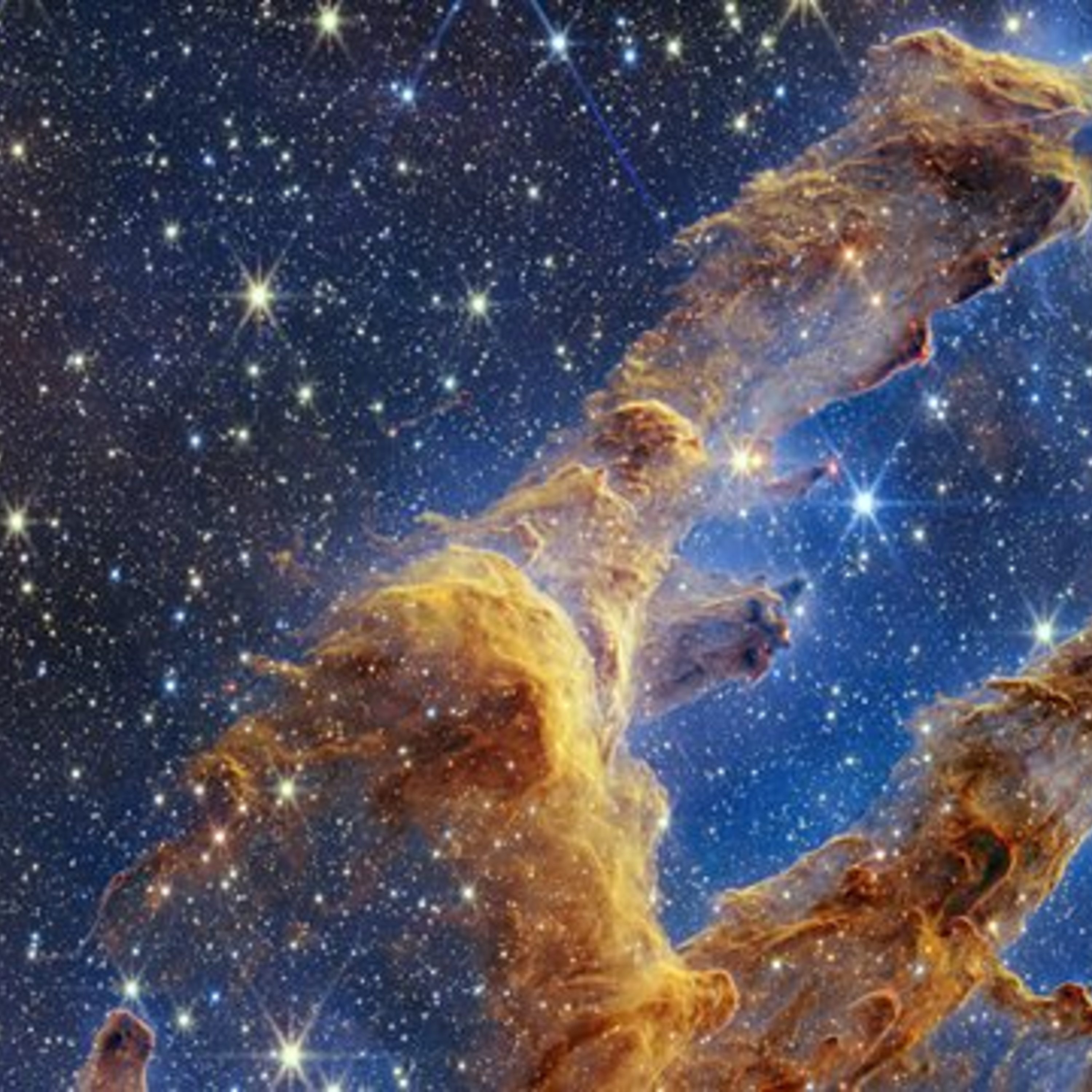
In the history of science, many individuals are honoured by having technical terms named after them. To modern sensibilities, this is sometimes regrettable. Poet Dr Sam Illingworth looks at the challenges of scientific terms named after people we perhaps wouldn't celebrate today. Who gets to choose them anyway? It's one thing to quietly change the name of a scientific prize, a research facility or a lecture theatre. But how would you rename an element or a famous equation? With a book, a record or a painting we can choose to leave them on the shelf if we so wish, but some scientific names seem as hard-wearing as concrete... Photo: The Pillars of Creation as captured by NASA’s James Webb Space Telescope/JWST Credit: NASA, ESA, CSA, STScI Written and presented by Sam Illingworth Produced by Alex Mansfield With contributions from: Dr Emma Chapman, University of Nottingham author of "First Light" Sam Kean, historian of science and author of "The Disappearing Spoon" and "The Icepick Surgeon". Prof Natalie Bann, University of Victoria, British Columbia Derek Robertson, artist, co-author of "Bho Bheul An Eòin / From The Bird's Mouth" Derek's exhibition of the project is at the Scottish Poetry Library, Edinburgh until Dec 31st 2022.
When Reality Breaks: Demystifying Paranoid Schizophrenia
Growing up in Canada, her father's delusions and paranoia gave Julia Shaw a front-row seat into an alternate reality Believing "they” were out to get him – including everyone from aliens to the Bin Laden family – he would later email her, warning that she too was targeted by those monitoring him. He believed that doctors too were part of the conspiracy - so has never had a diagnosis from a psychiatrist. Witnessing her father experiencing a parallel "reality" inspired Julia to look into the mind and she had a "lightbulb moment" at university studying psychology when she first heard a description of paranoid schizophrenia. We hear from Julia and her mum as they meet up, driving through Canada. The well-known "positive" signs of a psychotic episode like hallucinations, paranoia and deluded thoughts can feel frightening to witness but Julia learns how the some families find it hardest to live with the "negative" symptoms like a Iack of motivation and difficulty in concentrating. Julia talks to families who understand the demands of living with someone who has serious delusions – to hear what helped them to look after themselves as well as their loved one. We hear from Philippa whose son had his first episode of psychosis when he was at university. Although he now has the right medication to control his symptoms he struggles to motivate himself and a troubling side effect is weight gain which puts him at risk of physical health problems. Kate was only 11 when her cool, older brother Sean first showed the signs of schizophrenia. After numerous spells in hospital she remembers how he struggled to look after himself back in the community and became homeless, sometimes going missing Both women found support from Rethink Mental Illness, a charity which helps people severely affected by mental illness to improve their lives. Kirsty was 8 years old when she started going to workshops with her dad at the Our Time charity, which supports any child with a parent affected by mental illness. She says that role play and talking openly with others about mental health helped to prepare her for when her dad had a psychotic episode on her 13th birthday: although it was frightening she recognised the signs and knew that they wouldn't last. Another concern for Julia was the increased risk for family members who might inherit a disorder like paranoid schizophrenia. Dr Rick Adams explains how the risk is higher - at around 10%, it does mean there's a much higher likelihood that she hasn't inherited it. One voice Julia feels is missing is that of the person who hears voices and believes them: she hasn't been able to reach her father. Instead she talks to Ashley who's 25 and is living with a diagnosis of paranoid schizophrenia. Ashley explains how her voices were always male and it it's not a good idea for loved ones to tell a person having hallucinations that they're not real: they have to find this out for themselves. She says that educating herself about mental illness and her faith have helped her to keep calm, along with support from her family. Like the other families she's spoken to Julia feels guilt about her father and wonders if she could have done more to help him - but hearing about support from charities makes her hopeful. And despite all the difficulties, she also recognises how he has passed onto her a love of learning and to stand up for herself.Presenter: Julia Shaw Producer: Paula McGrath
The Name Is DeSantis
You may not know who he is - but you should. Under Donald Trump Ron DeSantis rode the MAGA wave to to the governor job in Florida. For some, he's a "smart Trump". For others, a "troll" who, with a series of eye-catching stunts and pronouncements, has dominated headlines and is now viewed as a serious contender for the Republican nomination in 2024. From transporting migrants to the millionaires' playground of Martha's Vineyard to taking on Disney over so-called "Don't Say Gay" legislation, this is a politician who has weaponised the culture wars to enormous effect. For liberals, he's a cruel, socially awkward bogeyman, to his supporters, a resolute strongman turning the tide against corrosive wokeism. James Naughtie profiles the man who, if he does turn his eye to The White House, may have to take the gloves off with the man who many say made him - Donald Trump. The programme features Fernanda Santos of Futuro Media, Mike Binder of the University of North Florida Public Opinion Research Lab and Rick Wilson, founder of The Lincoln Project. Presented by James Naughtie. Produced by Kevin Core.
Music to Scream to - The Hammer Horror Soundtracks
Curse of the Werewolf, The Brides of Dracula, Frankenstein and the Monster from Hell – films from the height of Hammer Films’ prolific output in the late 1950s and 1960s. Many of the horrific music soundtracks, carefully calibrated to set the pulse racing, were composed by leading British modernists of the late 20th century. Hammer’s music supervisor Philip Martell hired the brightest young avant-garde composers of the day – the likes of Malcolm Williamson (later Master of the Queen’s Music), Elisabeth Lutyens, Benjamin Frankel and Richard Rodney Bennett made a living scoring music to chill the bones to supplement their concert hall work. Prising open Dracula’s coffin to unearth the story of Hammer’s modernist soundtracks, composer and pianist Neil Brand explores the nuts and bolts of scary music – how it is designed to psychologically unsettle us – and explores why avant-garde music is such a good fit for horror. On his journey into the abyss, Neil visits the haunted mansion where many of the Hammer classics were made, at Bray Studios in Berkshire, and gets the low-down from Hammer aficionado Wayne Kinsey, film music historian David Huckvale, composer Richard Rodney Bennett, and one of Hammer’s on-screen scream queens, actress Madeline Smith. Producer: Graham Rogers
Desert Island Discoveries - Lauren Laverne and Vick Hope
Lauren shares handpicked gems from the Desert Island Discs back-catalogue with Radio 1 presenter Vick Hope, including Bob Mortimer, Maya Angelou, Joe Wicks, Sophia Loren, Tom Hanks, Dame Pat McGrath and Sinéad Burke.
The Other Black Door
Jack Fenwick explores how the think tanks and pressure groups behind the black door of an anonymous building in Westminster have shaped the last decade of British politics - and asks how they might shape the next few years. For this programme Jack has spoken to more than 50 current and former government insiders about how the organisations based at 55 Tufton Street have influenced British public life. He reveals how organisations including the Taxpayers Alliance, Brexit Central and the Global Warming Policy Foundation helped set the narrative on issues such as austerity, Brexit and climate change. He tracks how some of their ideas become government policy, explores the issue of whether the rules governing these organisations need to change and, with a new Prime Minister in Number 10, he asks how the ideas developed behind one black door might influence policy behind the most famous black door in Britain. Producer and presenter: Jack Fenwick Assistant producer: Maddy Trimmer.
Ugandan Asians: The Reckoning
General Idi Amin seized power in in Uganda in 1971. His brutal dictatorship is synonymous with the deportation of the country's 80,000-strong Asian population fifty years ago this year. As the popular story goes, Asians built the economy and the country. Then a brutish African leader exiled them from their adopted homeland. Some 28,000 arrived in the UK in the summer of 1972. The story of industrious, virtuous Asian families being thrown out for no reason and succeeding against all odds, has been endlessly recycled according to Ugandan-born journalist and broadcaster. But, she argues, though powerful and moving, it is incomplete and simplistic.Their story in East Africa has much more humble beginnings and goes as far back as the Victorian era. The colonial rulers had set Asians up to be the buffer between them and and the lowly black Africans. At the time native Ugandans had little or no education, little or no knowledge of how to do business, to access loans, trade etc. Asian middlemen ran everything and were seen as the oppressors. Among the reasons Amin gave for their expulsion were that they were exploiters who made no attempt to integrate with black African Ugandans and that they invested their profits abroad rather than in Uganda. Even though black Ugandans suffered most under Amin - the so-called "Butcher of Uganda" tortured his own people and killed an estimated million of them during his eight-year rule - yet there was still a sense of liberation when the Asians left. These, according to Yasmin, are inescapable truths - truths that Asians wished to forget but black Ugandans never have. Some still maintain that for all the terrible things Amin did, they finally got their country back. Yasmin delivers a sharp reappraisal of this secret history and delves into the forgotten, concealed past from which the Ugandan Asians do not escape without blame. Producer: Mohini Patel
The Scramble for Rare Earths - 5. The Great New Game
Misha Glenny explores the world of rare earth metals. In this final episode he hears how Russia's interest in Ukraine might be partially motivated by its huge mineral deposits.Guests: Rob Muggah is a co-founder of SecDev, a Canadian data, science and open intelligence company focused on mitigating risks and strengthening resilience. Dr Samuel Ramani teaches politics and international relations at Oxford University and is the author of two upcoming books on Wagner’s activities. Dr Julie Klinger, Assistant Professor in the Department of Geography and Spatial Sciences at the University of Delaware and author of Rare Earth Frontiers: From Terrestrial Subsoils to Lunar Landscapes.Producer: Ben Carter Editor: Hugh Levinson Sound engineer: James Beard Production coordinator: Janet Staples
The Scramble for Rare Earths - 4. The EU's Dependency on China
Misha Glenny explores the world of rare earth metals. He asks whether the EU can end its dependency on China's supply of critical raw materials to fuel the green transition.Guests:Olivia Lazard, fellow at Carnegie Europe. Maros Sefcovic, Vice President of the European Commission Dr Julie Klinger, author of Rare Earth Frontiers: From Terrestrial Subsoils to Lunar LandscapesProducer: Ben Carter Editor: Hugh Levinson Sound engineer: James Beard Production coordinator: Janet Staples
The Scramble for Rare Earths - 3. The Super Magnets
Misha Glenny explores the world of rare earth metals. Neodymium is vital for wind turbines and electric motors but can the world become less dependent on China to supply it?Guests: Dr Julie Klinger, Assistant Professor in the Department of Geography and Spatial Sciences at the University of Delaware and author of Rare Earth Frontiers: From Terrestrial Subsoils to Lunar Landscapes. Ian Higgins, managing director of Less Common Metals. Paul Atherley, chairman of Pensana.Producer: Ben Carter Editor: Hugh Levinson Sound engineer: James Beard Production coordinator: Janet Staples
The Scramble for Rare Earths - 2. The Hidden Paradox
Misha Glenny explores the world of rare earth metals. Reducing CO2 emissions requires critical raw materials like lithium, cobalt and nickel but mining and processing them can pose a serious threat to the environment. Can we solve the paradox?Guests: Dr Julie Klinger, Assistant Professor in the Department of Geography and Spatial Sciences at the University of Delaware and author of Rare Earth Frontiers: From Terrestrial Subsoils to Lunar Landscapes Teresa Ponce De Leao, chief executive of the Portuguese National Laboratory of Energy and Geology Henry Sanderson, author of Volt Rush Guillaume Pitron author of Rare Metals WarProducer: Ben Carter Editor: Hugh Levinson Sound engineer: James Beard Production coordinator: Janet Staples
The Scramble for Rare Earths - 1. The Magnificent 17
Misha Glenny explores the world of rare earth metals and other critical raw materials. They are vital for the future of technology and the green transition. But some see China's monopoly on production as a major global threat.In the first of five episodes, Misha finds out what the 17 rare earth metals are and hears about their weird and wonderful applications. He also discovers how China has managed to dominate the mining and refining of them.Guests: Dr Julie Klinger, Assistant Professor in the Department of Geography and Spatial Sciences at the University of Delaware and author of Rare Earth Frontiers: From Terrestrial Subsoils to Lunar Landscapes Sophia Kalantzakos, Global Distinguished Professor in Environmental Studies and Public Policy at New York University and the author of China and the Geopolitics of Rare EarthsProducer: Ben Carter Editor: Hugh Levinson Sound engineer: James Beard Production coordinator: Janet Staples
Will the US and China go to war over Taiwan?
A recent visit to Taiwan by Speaker of the US House of Representatives, Nancy Pelosi, has heightened tensions between the US and China. America has accused China of dangerous military provocations in the region. China has warned the US not to play with fire. Add to all that Russia’s invasion of Ukraine, and concerns that China could be contemplating something similar in Taiwan, and it’s time to ask the question: Will the US and China go to war over Taiwan?Contributors: James Lin from the University of Washington and expert on Taiwanese history Dr Yu Jie, Senior Research Fellow on China, Chatham House
The Dark Side of Direct Sales
Big money, glamorous work trips abroad, and becoming your own boss - the world of door-to-door selling and chugging on the high street has been rebooted for the social media age. The industry has been around for decades, but revenues have seen a boost over the last few years and it is now worth £2.6bn a year in the UK. Some direct selling firms in the UK are jumping on the popularity of trends such as hustle culture to recruit young, ambitious people into entry-level jobs in ‘marketing’ or ‘management’ and to work with big, well-known, clients. But as Lora Jones finds out, the reality is very different. She finds keen young people who have been sold the dream, only to find themselves working 80-hour weeks - for low rates of pay. So how exactly is that possible - and what's the set-up that can reel in so many hungry young recruits? And what protection do they really have from exploitation? Reporter: Lora Jones Producers: Jim Booth, Samantha Everett, Nalini Sivathasan Researchers: Star McFarlane, Jade Thompson Executive Producers: Gail Champion and Kim Rowell Production Manager: Jon Briest
Bhopal - 5. The Fatal Night
The Bhopal gas tragedy was the world's worst industrial accident. Tens of thousands of people died and many more suffered long term illnesses when lethal methyl isocyanate gas leaked from the Union Carbide plant in the city in central India on 2nd December 1984. For the previous two years one man had been predicting that Bhopal was an accident waiting to happen. Forty years ago this month the Bhopali journalist Rajkumar Keswani wrote his first article warning of the dangers posed by safety lapses at the plant. During a dogged investigation pitting him against political power, corporate money and the indifference of the media and public opinion, he never gave up. This cinematic documentary series tells his story for the first time. Episode 5. The Fatal Night As the city slept on the night of the 2nd December 1984, a huge leak of lethal methyl isocyanate escaped from the Bhopal Union Carbide chemical plant. Keswani realises his worst fears have come to pass. All his warnings have been ignored and now people are dying in their thousands before him. Union Carbide refuses to divulge what gas has been released and hospital doctors are helpless, not knowing what treatment to administer desperate patients. After the tragedy, Rajkumar Keswani is honoured with India's most prestigious award for journalism. In his acceptance speech he said he was receiving this award for his greatest journalistic failure. Narrator Narinder Samra Written and researched by Anubha Yadav and Radhika Kapur Music and Sound Design by Shreyan Chatterjee Studio Mix Donald McDonald Producer Neil McCarthy
Bhopal - 4. Bhopal on the Brink of Disaster
The Bhopal gas tragedy was the worlds worst industrial accident. Tens of thousands of people died and many more suffered long term illnesses when lethal methyl isocyanate gas leaked from the Union Carbide plant in the city in central India on 2nd December 1984. For the previous two years one man had been predicting that Bhopal was an accident waiting to happen. Forty years ago this month the Bhopali journalist Rajkumar Keswani wrote his first article warning of the dangers posed by safety lapses at the plant. During a dogged investigation pitting him against political power, corporate money and the indifference of the media and public opinion, he never gave up. This cinematic documentary series tells his story for the first time. Episode 4. Bhopal on the Brink of Disaster Keswani decides he must get the attention of law makers and show them his evidence. His safety concerns are raised in the State Assembly but the labour minister at the time bats them away giving Keswani the sense that Union Carbide is unimpeachable. He then petitions the Supreme Court of India, but gets no reply. Feeling somewhat defeated and with increasing financial woes, Keswani decides to take a steady job at a newspaper in a nearby city. But soon enough his conscience drags him back to Bhopal where he writes to the editors of national newspapers. He gets a big break, publishing a comprehensive account of his findings in a leading national daily. He waits for a response. Narrator Narinder Samra Written and researched by Anubha Yadav and Radhika Kapur Music and Sound Design by Shreyan Chatterjee Studio Mix by Donald McDonald Producer Neil McCarthy
Bhopal - 3. Friendly Business
The Bhopal gas tragedy was the worlds worst industrial accident. Tens of thousands of people died and many more suffered long term illnesses when lethal methyl isocyanate gas leaked from the Union Carbide plant in the city in central India on 2nd December 1984. For the previous two years one man had been predicting that Bhopal was an accident waiting to happen. Forty years ago this month the Bhopali journalist Rajkumar Keswani wrote his first article warning of the dangers posed by safety lapses at the plant. During a dogged investigation pitting him against political power, corporate money and the indifference of the media and public opinion, he never gave up. This cinematic documentary series tells his story for the first time. Episode 3. Friendly Business The more Keswani investigates the more he finds a cosy relationship between Union Carbide and local politicians and journalists. He's determined to expose the nepotism he uncovers but yet again, his written warning to the city falls on deaf ears. His friends and family don't believe him either, apart from his wife. Money troubles don't help. But Keswani is sure he has truth on his side, and sets his sights on the highest court in the land. Narrator Narinder Samra Written and researched by Anubha Yadav and Radhika Kapur Music and Sound Design by Shreyan Chatterjee Studio Mix by Donald McDonald Producer Neil McCarthy
Bhopal - 2. The Smell of Grass
The Bhopal gas tragedy was the worlds worst industrial accident. Tens of thousands of people died and many more suffered long term illnesses when lethal methyl isocyanate gas leaked from the Union Carbide plant in the city in central India on 2nd December 1984. For the previous two years one man had been predicting that Bhopal was an accident waiting to happen. Forty years ago this month the Bhopali journalist Rajkumar Keswani wrote his first article warning of the dangers posed by safety lapses at the plant. During a dogged investigation pitting him against political power, corporate money and the indifference of the media and public opinion, he never gave up. This cinematic documentary series tells his story for the first time. Episode 2. The Smell of Grass Keswani digs deeper and discovers that a town planning order to relocate the chemical plant to an industrial zone, away from densely populated areas, was ignored. Union leaders smuggle him into the factory where he sees first hand the lack of safety controls and general disrepair. He learns more about the chemicals being manufactured as pesticides inside Union Carbide and understands the danger if they were to leak. He sits down to write his first 'Rapat' newspaper article under the headline 'Save, Please Save this City', and waits for a response. Narrator Narinder Samra Written and researched by Anubha Yadav and Radhika Kapur Music and Sound Design by Shreyan Chatterjee Studio Mix by Donald McDonald Producer Neil McCarthy
Bhopal - 1. A Friend Dies
The Bhopal gas tragedy was the worlds worst industrial accident. Tens of thousands of people died and many more suffered long term illnesses when lethal methyl isocyanate gas leaked from the Union Carbide plant in the city in central India on 2nd December 1984. For the previous two years one man had been predicting that Bhopal was an accident waiting to happen. Forty years ago this month the Bhopali journalist Rajkumar Keswani wrote his first article warning of the dangers posed by safety lapses at the plant. During a dogged investigation pitting him against political power, corporate money and the indifference of the media and public opinion, he never gave up. This cinematic documentary series tells his story for the first time. Episode 1. A Friend Dies Keswani is the kind of journalist who finds his stories on the ground, talking to people in his native Bhopal. One evening he learns from his friend Ashraf, a worker at the Union Carbide chemical plant, that there are regular safety lapses and leaks. Shortly afterwards, Ashraf dies when he's exposed to lethal gases. A grief stricken Keswani decides he must find the truth behind safety concerns at the plant. But when questioning government officials he finds nothing but support for the multinational company that had chosen Bhopal as its base. He hears more worrying accounts from local union officials and when they are published in a small article, retribution follows. Keswani feels sure that something troubling is going on behind the scenes. Narrator Narinder Samra Written and researched by Anubha Yadav and Radhika Kapur Music and Sound Design by Shreyan Chatterjee Studio Mix by Donald McDonald Producer Neil McCarthy With thanks to Down To Earth
Recalculating Art
Art by women is literally undervalued. The highest price achieved by a contemporary female artist is $12.4m, while it is $91m for a man. If a painting is signed by a man it goes up in value, signed by a woman it goes down. We might expect this historically, but as the majority of art students today are women, why is there such a gender value gap now? To untangle this mystery, Mary Ann Sieghart enters a thrilling world of glitzy, high-stake auctions and make-or-break gallery decisions. She lifts the lid on the opaque world of art valuation, explores how punters react to genderless AI art, and uncovers historic collusion and contemporary bias. She asks if male artists are actually better than women and why, in the bible of the art world today, there is just one woman mentioned, as a footnote. Pinning down work being done to level this playing field, Mary Ann talks to the galleries showing more works by women, discovering powerful women shifting the attention and canny investors who are realising maybe it is just the right time to buy. Featured in the programme are: Frances Morris, director of Tate Modern; Prof of Finance, Renee Adams; from Sotheby’s Helena Newman and Marina Ruiz Colomer; philanthropist Valeria Napoleone, Bellatrix Hubert from David Zwirner gallery; author Helen Gorrill, art curator Naomi Polonsky, and the London Art Fair. Producer: Sarah Bowen
Leeds: Life in the Bus Lane
Rima Ahmed takes the bus into Leeds and tries to find out why it is “the biggest city in Western Europe without a mass transit system”. Rima meets passengers, campaigners and history buffs as well as local politicians to delve into why the city has had so many failed attempts to improve its public transport system since its tram was abolished in 1959.Leeds was a transport pioneer - it introduced the first electric trams and trolleybuses in the country. In the 1970s and 80s, local councillors proudly declared Leeds “the motorway city” hailing the building of a massive urban motorway right through the city centre. In the 1990s, Sheffield was already building its supertram network and Leeds was also asking government to fund its own version. Despite funding being approved in 2001, £70 million had been wasted by the time Leeds’s supertram project was pulled by Transport Secretary Alastair Darling in 2005. A “trolleybus” scheme mooted in 2012 was also scrapped.Now, the citizens of Leeds have been told that, if they are lucky, they may get a new mass transit system by 2040. Work may begin sometime by the end of the decade. In the meantime, the commuters of Leeds continue to live life in the bus lane.Presenter: Rima Ahmed Producer: Johnathan I'Anson Sound mix: Craig Boardman Production Co-ordinator: Janet Staples Editor: Nicola Addyman
Inheritors of partition
In homes across the UK, partition is not history but a live issue for its young descendants. Over the course of a year, Kavita Puri follows three people as they piece together parts of their complex family history and try to understand the legacy of partition and what it means to them today. She connects with a young man who goes to the Pakistani village where his Hindu grandfather was saved by Muslims; a woman who has always thought of herself as British Pakistani but a DNA test reveals she also has roots in India; a woman with Pakistani heritage and a man with Indian heritage plan their wedding and realise that their families actually originate from within an hour of each other in the Punjab. Five years after the award-winning series Partition Voices, Kavita Puri explores the 75th anniversary of the division of the Indian subcontinent through three stories from the third generation in Britain.
Generation Games
Can video games change lives? And, if so, how? 50 years after the arrival of Pong, gamer and writer Keza MacDonald considers what gaming has done for us. Using the rich BBC Archives, she explores how video games grew from a niche pursuit to a cultural phenomenon which stokes the imagination of, and offers agency to, those who fall for its charms. Games now influence who we are, what we think and how we act. Keza speaks to collectors, competitive gamers, psychologists, games designers and, mostly importantly, gamers young and old to find out what impact games have had on us. We hear about the deep relationships that millions cherish with Pac-Man, Space Invaders and Donkey Kong, and illustrate the entanglement of life and gaming that is increasingly impossible to sever. Presenter: Keza MacDonald Producer: Gary Milne
Welcome to Rwanda
The government has described Rwanda, where it intends to send some people who arrive illegally in the UK, as "one of the world's safest nations". But this small, landlocked country in east Africa divides opinion. To some, it’s the Singapore of Africa, with a burgeoning economy, clean streets and gleaming skyscrapers. It’s also heralded for having the highest proportion of women parliamentarians in the world. But to others, Rwanda is a frightening and repressive place. In this programme, Victoria Uwonkunda looks at what’s happening in the country of her birth, which she fled as a child during the genocide of 1994. Is this country a developmental model for the rest of the continent – or an autocratic and ruthless state?
Evacuated to Russia
More than a million refugees from the war in Ukraine have ended up in the arms of the enemy, Russia. Have they been rescued? Or illegally deported in another Kremlin war crime?
Schools Apart
Film and theatre producer Anwar Akhtar, Director of the educational charity Samosa Media, visits schools exploring diversity and the curriculum and asking questions about difficult topics such as segregation and the importance of an inclusive education. A Mancunian and first generation son of Pakistani immigrants, Anwar traces his career development to his school days at Loreto College in the 1980s. Educated with students from a range of multicultural backgrounds, he developed a sense of belonging. But he worries that some second and third generation youngsters from minority backgrounds have not had the same positive, inclusive experience. He has watched as many struggle, feeling marginalised and isolated. He considers why their experience has been so different from his own, exploring the problem of communities living and schooling apart from each other, focusing on the Pennine mill town of Oldham, a few miles from where he grew up. Anwar wants to explore solutions, how schools can help divided communities connect to each other. He revisits Loreto college to explore lessons from his own background. He looks at a radical integration project in Oldham in which segregated schools were merged. And he considers the central role of curriculum diversity in helping build a shared identity for young people, talking to pioneering teachers at two London schools, Stepney All Saints and Lilian Baylis in Lambeth. At the heart of the programme is Britain's island story, the shared solidarity and cultural capital which built the modern nation. If young people feel included in that story, and are helped in school to connect to it, we can help divided communities come together and help children fulfil their potential.Producers: Tom Edgington and Leala Padmanabhan
Ceausescu's Children
Today, the actor Ionica Adriana lives with her family in the North Yorkshire countryside - but her life could have turned out wildly different. Until the age of two-and-a-half, Ionica lived in an orphanage, in Transylvania, north-western Romania. From 1965-1989, the Communist dictator Nicolae Ceaușescu enforced a strict set of policies to set about vastly increasing the Romanian population. But widespread poverty meant it was impossible for many Romanian parents to look after their newborn children - and so many ended up in state-run institutions, where they received little care and attention, and where they were left in dirty clothes, to feed and fend for themselves. Ionica returns to Romania to uncover her past and the history of Ceaușescu’s barbaric orphanages. She explores what childcare and protection looks like in Romania today, meets someone who grew up in the state system his entire childhood and has an emotional encounter of her own. Producer: Sasha Edye-Lindner A Just Radio production for BBC Radio 4
London on the Line
This summer marks a decade since the 2012 Olympics - a moment of national pride when London represented Britain on the global stage. Ten years on from those Olympian heights, the capital is struggling. Scarred by the pandemic and entrenched inequality, London faces challenges which are often overlooked or ignored. Meanwhile a cultural backlash, an anti-Londonism, threatens a crisis of confidence - at a time when the city's success looks far from guaranteed. London expert Dr Jack Brown, who was born and still lives in the Olympic borough of Waltham Forest, talks to fellow residents about life in the capital. He hears from those who defy the 'liberal metropolitan elite' stereotypes - those who stay local and rarely, if ever, venture into Zone One, those of deep faith, and the gentrifiers who now can't afford their rent. He asks why London has attracted, magnet-like, so many negative associations, and how views of the city might change. Can London recapture the spirit of 2012? Can capital and country be at ease again? Producer: Emily Craig Executive producer: Leala Padmanabhan
The Dancer and Her Shoe Maker
A dancer at the top of her career can't do her job without the skill and attention to detail of their shoemaker. Francesca Hayward is a principal dancer for the Royal Ballet and Bob Martin is her shoemaker. It’s a very personal choice for a dancer to settle on the perfect shoe - each maker is different - and so once they've found one, they rely on the maker of that shoe for their whole career. Pointe shoe making is a dying craft which has recently been given heritage craft status in the UK. There are not many people left like Bob. This programme takes you behind the curtain to peep into a world of craft, sweat and determination. Rich in ballet music, this is an uplifting real life fairy tale of two people connected by a shoe. Producer: Catherine Robinson for BBC Audio Wales and West
Bound to the Mast
Why are people with mental illness committing themselves in advance, when well, to treatment that they know they may want to refuse when they become unwell? Sally Marlow investigates. Juan was diagnosed with bipolar in his late teens. In the decade that followed, he suffered an episode of severe mental illness once nearly every year, plagued by intense paranoid thoughts that distorted his thinking. Each time this happened, it got to the point that he could no longer care for himself and he was detained or ‘sectioned’ under the Mental Health Act for his own safety. Juan has enjoyed good mental health for the past three years and he hopes that it will stay that way. But, as a precaution, he has joined a pilot study taking place at South London and Maudsley NHS Foundation Trust. It's part of the reforms to the Mental Health Act which are underway to give service users more control, when well, over what happens to them when they become seriously ill. Sally Marlow talks to Juan who, as part of the pilot, has written an advance choice document. In this he summarises what it was like for him when he was unwell and how he’d like to be treated if it ever happens again. The document can include a range of preferences, within reason, such as which medication a person might prefer while in hospital and a request for admission earlier in an episode to avoid reaching crisis point. The person records their preferences when well so that they can be read and acted upon by the health professionals treating them if they become unwell in the future. Where reasonable, their preferences must be followed. This might seem straightforward but, as medical ethicist Tania Gergel explains, some people may choose to include a so-called ‘self-binding’ element, saying “this is what I want to happen, and when I’m ill over-rule me even if I say otherwise”. The powerful image of Odysseus bound to the mast to resist the Sirens’ song, captures the overwhelming role that distorted thinking can play in mental illness, and the therapeutic potential that binding oneself to a treatment decision in advance might have. It’s hoped that advance choice documents, including this 'self-binding' element, will help people who have fluctuating periods of mental ill health, such as those with bipolar, and a recent survey of hundreds of people with the condition largely agree. PRESENTER: Sally Marlow PRODUCER: Beth Eastwood
The Future Will Be Synthesised - Episode 5
What do we want the synthetic future to look like? It’s seeping into our everyday lives, but are we ready? We need a conversation about the legal, policy and ethical implications for society. Deepfakes’ murky origins are in a form of sexual image abuse that is being used against hundreds of thousands of people, most of them women. Presenter and synthetic media expert Henry Ajder speaks to journalist Sam Cole, who first reported on deepfakes in 2018. She uncovered a Reddit forum sharing pornographic videos with the faces of famous Hollywood actresses transposed on to the bodies of porn performers. Since then the technology has become much more accessible and ordinary women have become the target. Henry interviews a woman who was targeted with deepfake image abuse, and considers what we can do to protect citizens from synthetic media’s malicious uses. Interviewees: Sam Cole, Vice; Noelle Martin, campaigner; Jesselyn Cook, NBC
The Future Will Be Synthesised - Episode 4
If anything can be a deepfake, perhaps nothing can be trusted - and politicians can take advantage of the so called "Liars' dividend" by dismissing real media as fake. In satire, deepfakes have already had a controversial impact, targeting politicians, business leaders, and celebrities. Meanwhile, convincing deepfake audio and video have the potential to create a new wave of fraud where faces, voices and bodies can be stolen. These malicious uses of deepfake technology started out targeting celebrities and people in the public eye, but have become a mainstream challenge for cyber security professionals and ordinary individuals whose images have been used without their consent. Deepfakes can be used to defame or discredit people - but on the flip side, the cry of ‘deepfake’ could undermine trust in the use of video evidence in the justice system. What can we do to protect citizens from synthetic media’s malicious uses? And might there be some positive applications for deepfakes in politics? Interviewees: Sam Gregory, Witness; Nina Schick, author; Victor Riparbelli, Synthesia
The Future Will Be Synthesised - Episode 3
If anything can be a deepfake, perhaps nothing can be trusted - and politicians can take advantage of the so called "Liars' dividend" by dismissing real media as fake. In satire, deepfakes have already had a controversial impact, targeting politicians, business leaders, and celebrities. Meanwhile, convincing deepfake audio and video have the potential to create a new wave of fraud where faces, voices and bodies can be stolen. These malicious uses of deepfake technology started out targeting celebrities and people in the public eye, but have become a mainstream challenge for cyber security professionals and ordinary individuals whose images have been used without their consent. Deepfakes can be used to defame or discredit people - but on the flip side, the cry of ‘deepfake’ could undermine trust in the use of video evidence in the justice system. What can we do to protect citizens from synthetic media’s malicious uses? And might there be some positive applications for deepfakes in politics? Interviewees: Sam Gregory, Witness; Nina Schick, author; Victor Riparbelli, Synthesia
The Future Will Be Synthesised - Episode 2
Ever since the 2018 mid-term elections in the US, people have been sounding the alarm that a deepfake could be used to disrupt or compromise a democratic process. These fears have not yet come to pass, but recently deepfakes of Zelensky and Putin were deployed as the Ukrainian conflict escalated. How much disruption did these deepfakes cause? How convincing were they? And are they an omen of things to come? Could deepfakes enhance disinformation campaigns that already cause significant harm? Presenter and synthetic media expert Henry Ajder unpicks the most recent deepfake video and speaks to a journalist who reported on an unusual news report which used a deepfake news presenter to attempt to spread disinformation in Mali. Interviewees: Kateryna Fedotenko, Ukraine 24; Sam Gregory, Witness; Catherine Bennett, Le Monde/ France 24
The Future Will Be Synthesised - Episode 1
What do we want the synthetic future to look like? It’s seeping into our everyday lives, but are we ready? We need a conversation about the legal, policy and ethical implications for society. Deepfakes’ murky origins are in a form of sexual image abuse that is being used against hundreds of thousands of people, most of them women. Presenter and synthetic media expert Henry Ajder speaks to journalist Sam Cole, who first reported on deepfakes in 2018. She uncovered a Reddit forum sharing pornographic videos with the faces of famous Hollywood actresses transposed on to the bodies of porn performers. Since then the technology has become much more accessible and ordinary women have become the target. Henry interviews a woman who was targeted with deepfake image abuse, and considers what we can do to protect citizens from synthetic media’s malicious uses. Interviewees: Sam Cole, Vice; Noelle Martin, campaigner; Jesselyn Cook, NBC
The P Word
Is the use of the ‘P’ word ever acceptable? Prompted by the recent allegations of racism at Yorkshire CCC by cricketer Azeem Rafiq, Rajan Datar and producer Rajeev Gupta go on a journey of personal exploration. Like many South Asians in the 1970s and 80s, Rajan was routinely called the P-word as he walked to and from school, but a new generation of young British Asians say they now claim the word and it can be used within the community as a sign of power. Rajan finds out for himself how true this is and does a context in which the use of the word is acceptable actually exist? Produced by: Rajeev Gupta
Am I That Guy?
Scottish writer and broadcaster Alistair Heather is not proud of some of his past interactions with women. In a previous job as a builder’s labourer, he would watch and laugh as co-workers wolf-whistled and cat-called passing women. In the street, on trains, in cafes, bars and other public places, he would see it as his right to approach and talk to women. He knows that in behaving like that he has contributed to women and girls feeling excluded and unsafe. Now he wants to find out what he should be doing to help change the culture for the better. Alistair discusses ‘locker room talk’ with former Aston Villa youth player and Dundee United Hall of Famer Seán Dillon, challenges an old friend and explores Police Scotland’s much-praised campaign which urged men to address their attitudes to women with a hard-hitting viral video telling them: “sexual violence begins long before you think it does. Don’t be that guy". Producer Dave Howard Researcher Carys Wall Sound design Joel Cox
The Witches' Pardon
From allegations of cursing the king's ships, to shape-shifting into animals, or dancing with the devil, three centuries ago witch-hunting was a mania that spread right across Europe. But nowhere did it exert a greater grip than in Scotland, which had an execution rate five times higher than England's. It remains an example of just how vicious sexism and misogyny - exacerbated by superstitious beliefs and religious extremism - can be. Now campaigners are on course to win an official pardon for the estimated four thousand - mostly women - tried as witches. Leading QC Claire Mitchell, known for her prominent role in the Lockerbie appeal, is also fighting for an apology for all those accused, and for a national monument to mark the state-sanctioned atrocities she calls "the greatest miscarriage of justice in Scottish history." Claire Mitchell and co-founder Zoe Vendittozi hope that First Minister, Nicola Sturgeon will issue a formal apology. But will she? And why does it matter? Once again 'witch' is a name being levelled at women, usually in high profile cultural or political roles. It's not unusual to see figures like Hillary Clinton, Nicola Sturgeon, Professor Mary Beard, in twitter memes with green faces, stirring cauldrons and wearing pointy hats. Dani Garavelli takes a fresh look at the history and at why women were so often accused of being witches. She explores the campaign which has gained mass traction across the UK and Europe, and spawned a copy-cat campaign in Catalonia. Which power structures were being maintained then, and which ones now? Producer: Caitlin Smith Presenter: Dani Garavelli Sound Design: Joel Cox
Sir Alex Ferguson: Made in Govan
BBC Radio Manchester presenter Mike Sweeney and former Manchester United manager Sir Alex Ferguson go back a long way. They used to play football together and bonded over their love of music from the sixties. In this edition of Archive on 4, they sit down together to talk about Sir Alex as a young man and the influences which shaped his extraordinary career. Sir Alex reflects on his upbringing in Govan, the tenements where he lived and the people who first believed in him. He reveals how his early experiences as a working man left him with values that last to this day. He tells Mike about the magic of first playing football, and reflects on the ups and downs of his playing and coaching career and their impact on what came next. Moments from the BBC Archive help Mike tell Sir Alex's story.Presented by Mike Sweeney. Produced for BBC Audio in Bristol by Camellia Sinclair. Mixed by Michael Harrison.
Cold as a Mountain Top
WH Murray was one of a pioneering group of climbers in Scotland in the 1930’s, establishing new routes in Glencoe, Ben Nevis and The Cuillin. But it was one particular mountain that he loved – and climbed – the most; the iconic Buachaillie Etive Mor at Glencoe. This was the last mountain he climbed just before leaving for war in 1941. Murray was captured in the African desert but his life was saved when he uttered the words, ‘Cold as a mountain top.’ The German officer was also a mountaineer and took him prisoner instead of shooting him on the spot. During his imprisonment in Italy and Czechoslovakia he wrote the seminal ‘Mountaineering in Scotland’ completely from memory, recalling the intimate details of climbs he undertook in the 1930’s. The book has been a talismanic text for climbers like Robert Macfarlane. He's turned to it often, particularly when the cold of the mountain top has felt very far away during recent periods of confinement. In this immersive audio voyage, Robert returns to Murray’s beloved Buachaille with 'Mountaineering in Scotland' by his side. Produced by Helen Needham in Aberdeen. Readings by Cal MacAninch. Sound design and composition by Anthony Cowie. Sound consultation and mixing by Ron McCaskill. Our mountain Guide was Richard Parker. Thanks to Robin Lloyd-Jones, WH Murray's biographer, for help with the preparation of this programme.
Women in Stitches: The Making of the Bayeux Tapestry
The Bayeux Tapestry is coming to Britain in the near future. It’s among the world’s most famous works of art, but it's also a mystery: no one knows who made it. The stitching, though, is full of clues. Abigail Youngman seeks to reveal the truth about the lives of the women who stitched it, to unpick the secrets they left in plain sight, in the margins of the tapestry. The Bayeux Tapestry records great historical events but its humanity is in the details: the little boy holding his mother's hand tightly as they flee their burning home; scenes of sexual violence; bawdy jokes at the Normans' expense. Scholarly opinion is divided, but some think it was stitched by Anglo-Saxon women who had experienced war and occupation first-hand. The main panels were probably designed by an Important Man (hence the focus on battles, on big sexy horses – surely the BMWs of their day – and political propaganda). But the margins of the tapestry may have been left to the imagination of the stitchers themselves: probably English women. This 'freehand' marginalia tell a different story, sometimes undercutting the message of the Norman conquerors in surprising ways. We can imagine the camaraderie and humour of the women sewing it, talking, about their personal tragedies, the terror they survived, the soldiers who were husbands and sons. Read this way, the Tapestry becomes a tantalising portrait of a group of women who are largely unrepresented in history, speaking to us vividly from a thousand years ago. Abigail Youngman uncovers fascinating and intimate details of these women's lives with the help of Dr Alexandra Makin, Dr Daisy Black, Dr Christopher Monk, Professor Gail Owen-Crocker and Dr Michael Lewis. Producer...Mary Ward-Lowery
5. The Lowball Tapes – Hunting the Truth
EThe public had a chance to find out the truth about the Libor scandal in 2012 – but somehow they didn’t. Andy finds secrets kept from MPs and even the juries in the rate rigging trials. Can he find out where the instructions to lowball really came from? Presenter: Andy Verity Producer: Sarah Bowen Music: Oskar Jones