Show overview
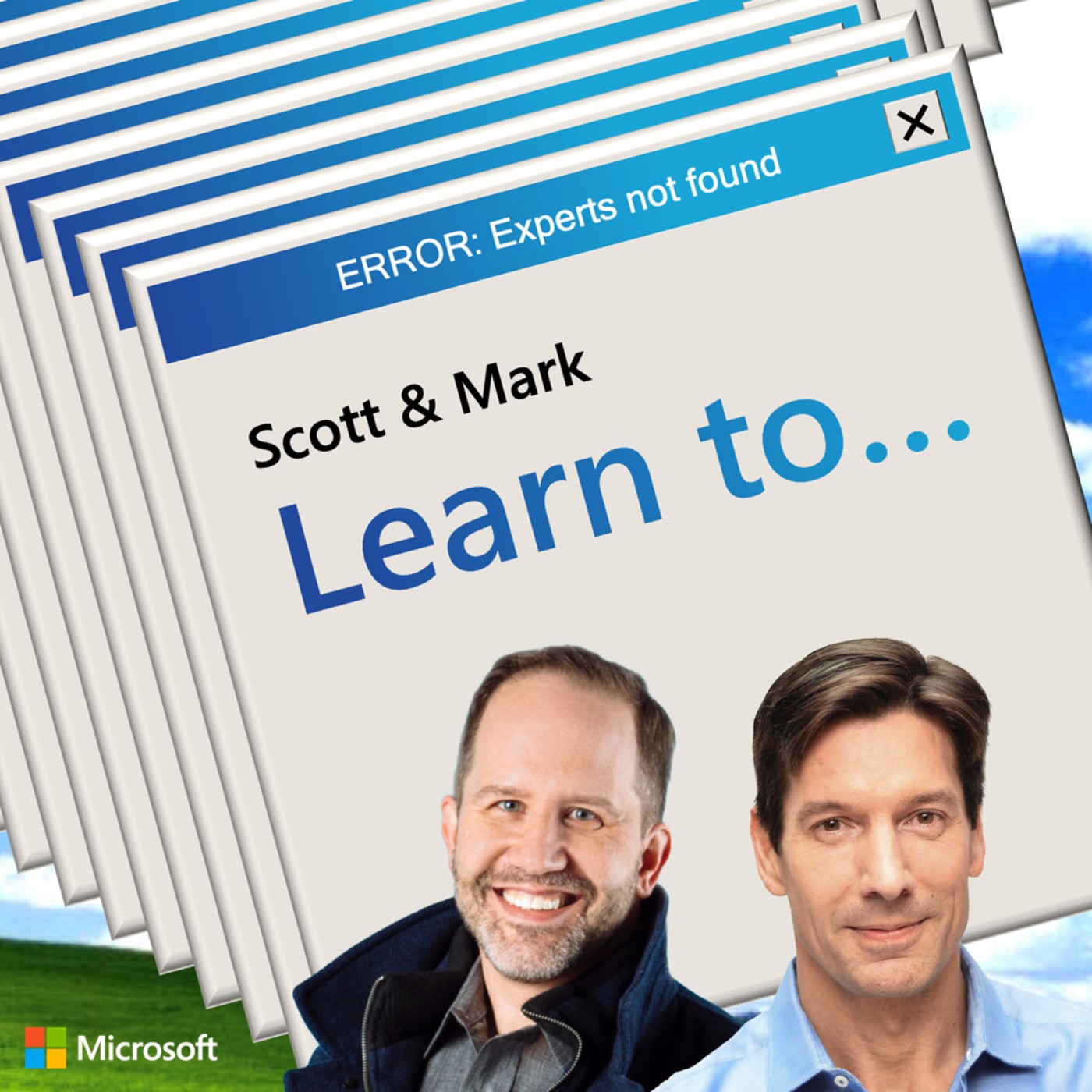
Scott & Mark Learn To... has been publishing since 2024, and across the 2 years since has built a catalogue of 39 episodes, alongside 2 trailers or bonus episodes. That works out to roughly 15 hours of audio in total. Releases follow a fortnightly cadence.
Episodes typically run twenty to thirty-five minutes — most land between 20 min and 28 min — and the run-time is fairly consistent across the catalogue. None of the episodes are flagged explicit by the publisher. It is catalogued as a EN-language Technology show.
The show is actively publishing — the most recent episode landed 1 weeks ago, with 8 episodes already out so far this year. The busiest year was 2025, with 23 episodes published. Published by Microsoft.
From the publisher
Join tech industry veterans Scott Hanselman and Mark Russinovich as they dive into the challenges and innovations of today’s fast-paced world. Whether you’re an experienced developer or simply curious about technology, each episode offers a fresh perspective on emerging trends, familiar topics, and insights that go beyond the strictly technical. From the latest in AI to effective ways to influence without authority, Scott and Mark set out to 'learn' something new in every episode, and they’re bringing you along for the ride. Join Scott and Mark for engaging discussions, expert advice, and a shared journey of learning and discovery. There's always something new to learn! Hosted on Acast. See acast.com/privacy for more information.
Latest Episodes
View all 39 episodesScott & Mark Learn To... ZoomIt, Evolved
Scott & Mark Learn To...Sculpt, not Spec

S1 Ep 35Scott & Mark Learn To... Beyond the Vibes: How Models Learn and Stitch Panoramas
In this episode, Scott Hanselman and Mark Russinovich unpack how AI systems actually behave beneath the surface, pushing past hype into the messy reality of how models are trained, aligned, and deployed. They explore whether AI systems are inherently benevolent or simply shaped by incentives, training data, and reinforcement learning, and why behaviors like deception can emerge under certain conditions. The conversation moves from philosophical questions about human nature versus machine behavior into the practical mechanics of large language models, including how reinforcement learning with human feedback shapes outputs and why alignment is far from perfect. Along the way, they ground the discussion in a real engineering challenge, stitching a scrolling panorama from screen captures, to show how complex systems come together through heuristics, edge cases, and iteration. Takeaways: AI behavior is shaped by training and incentives, not built-in intent or morality AI can accelerate coding, but testing, edge cases, and reliability require human oversight Reinforcement learning pushes models to be helpful and agreeable, sometimes at the cost of accuracy Who are they? View Scott Hanselman on LinkedIn View Mark Russinovich on LinkedIn Watch Scott and Mark Learn on YouTube Listen to other episodes at scottandmarklearn.to Discover and follow other Microsoft podcasts at microsoft.com/podcasts Hosted on Acast. See acast.com/privacy for more information.

S1 Ep 34Scott & Mark Learn To...Vibe Coding, for Real (Again)
In this episode, Scott Hanselman and Mark Russinovich dive into the realities of building complex software with AI coding agents. Mark shares his experience using modern models to implement a shared-memory transport for gRPC across Go and .NET, explaining how AI dramatically accelerated development while still requiring constant oversight. They discuss the surprising strengths and limitations of AI coding tools, to the massive productivity gains that make the frustration worthwhile. The conversation also explores the challenges of solving hard engineering problems, including an attempt to build a scrolling screenshot stitcher, and wraps with thoughts on the future of developer tooling and a potential live episode of the show. Takeaways: AI coding agents can speed up complex development but still require human oversight Developers often need to guide and correct the model throughout the process Even with challenges, AI can reduce months of work to days Who are they? View Scott Hanselman on LinkedIn View Mark Russinovich on LinkedIn Watch Scott and Mark Learn on YouTube Listen to other episodes at scottandmarklearn.to Discover and follow other Microsoft podcasts at microsoft.com/podcasts Hosted on Acast. See acast.com/privacy for more information.

S1 Ep 33Scott & Mark Learn To...A Public 1-1 for Software Engineering Preceptorship
In this episode, Scott Hanselman and Mark Russinovich discuss their recent ACM paper and explore a growing challenge in the tech industry: how to develop the next generation of engineers. They debate the idea of preceptorship programs that train early-career developers inside companies, why many organizations avoid investing in junior talent, and how universities could play a larger role in bridging the gap between education and real-world experience. The conversation looks at the economics of hiring juniors, the risk of companies poaching trained talent, and what it might take to build a scalable pipeline for future technical leaders. Takeaways: Many firms prefer hiring experienced engineers instead of developing new ones Universities could play a bigger role in connecting students with real industry work Retention incentives might help companies keep talent they train Who are they? View Scott Hanselman on LinkedIn View Mark Russinovich on LinkedIn Watch Scott and Mark Learn on YouTube Listen to other episodes at scottandmarklearn.to Discover and follow other Microsoft podcasts at microsoft.com/podcasts Hosted on Acast. See acast.com/privacy for more information.

S1 Ep 32Scott & Mark Learn To... Are Apps Dead?
In this episode, Scott Hanselman and Mark Russinovich dive into a wide-ranging conversation about the future of software, debating whether apps are dead in an era of AI agents, chat interfaces, and automation. They explore the resurgence of text-based and terminal user interfaces, the limits of using large language models as stand-ins for deterministic workflows, and why reliability, security, and repeatability still demand traditional applications and SaaS platforms. Along the way, they unpack common misconceptions about AI replacing apps, argue for better UX and APIs instead of throwing AI at broken systems, and emphasize that AI is best used for reasoning and ambiguity, not as a replacement for well-designed software. Takeaways: AI tools don’t eliminate the need for well-built apps Chat and terminal interfaces expand, not replace, software Dynamic interfaces blur boundaries, but durable apps still anchor workflows Who are they? View Scott Hanselman on LinkedIn View Mark Russinovich on LinkedIn Watch Scott and Mark Learn on YouTube Listen to other episodes at scottandmarklearn.to Discover and follow other Microsoft podcasts at microsoft.com/podcasts Hosted on Acast. See acast.com/privacy for more information.

S1 Ep 31Scott & Mark Learn To...Pilot Coding - Vibe Coding for Real
In this episode, Scott Hanselman and Mark Russinovich explore how AI-assisted vibe coding is changing the way complex software gets built, debugged, and refined. Mark walks through real-world experiments using AI to tackle difficult engineering problems, including gRPC shared memory, Win32 UI work, and major new features coming to ZoomIt. The conversation digs into where AI meaningfully accelerates development, where it still requires careful human oversight, and how tools like screenshots, debug output, MCP servers, and multimodal feedback loops are reshaping modern developer workflows. The result is an honest, technical discussion about productivity gains, limitations, and the evolving role of human judgment in AI-driven software engineering. Takeaways: Debug output and screenshots are critical for helping AI understand Faster iteration often leads to more polished software, not just quicker results Concurrency and low-level systems problems remain difficult for AI to solve without supervision Who are they? View Scott Hanselman on LinkedIn View Mark Russinovich on LinkedIn Watch Scott and Mark Learn on YouTube Listen to other episodes at scottandmarklearn.to Discover and follow other Microsoft podcasts at microsoft.com/podcasts Hosted on Acast. See acast.com/privacy for more information.

S1 Ep 30Scott & Mark Learn To... Get Ready for Ignite
In this episode, Scott Hanselman and Mark Russinovich pull back the curtain on what really goes into a large-scale conference talk, using their recent Ignite session as a case study. They reflect on the balance between educational and soft talks, the importance of credibility and audience expectations, and why not every talk needs a rigid takeaway to be valuable. The conversation traces a playful but technically deep journey through computing history, from early machine code and Altair systems to modern Azure infrastructure, massive virtual machines, and experimental demos that intentionally blur the line between serious engineering and creative exploration. Along the way, they share behind-the-scenes lessons about live demos, pacing, risk, and why delight, curiosity, and a bit of silliness still matter in technical storytelling. Takeaways: Setting expectations early helps the audience judge a talk on the right terms Credibility can come from perspective, not just authority Risky demos work when the fundamentals are solid Who are they? View Scott Hanselman on LinkedIn View Mark Russinovich on LinkedIn Watch Scott and Mark Learn on YouTube Listen to other episodes at scottandmarklearn.to Discover and follow other Microsoft podcasts at microsoft.com/podcasts Produced by Microsoft & Hangar Studios Hosted on Acast. See acast.com/privacy for more information.

S1 Ep 29Scott & Mark Learn To... Where to get news?
In this episode, Scott Hanselman and Mark Russinovich dive into where they get their tech news and how their habits have evolved from the early days of blogging and RSS to today’s AI-focused email newsletters. They reminisce about the heyday of blogs, the rise and fall of Google Reader, and Mark’s old NT Internals mailing list, which once had nearly 90,000 subscribers. They compare curated sources like Techmeme, The Verge, and The Information, and discuss how AI-driven newsletters have replaced RSS as the primary way they stay informed. The conversation also features a fun moment when Scott looks back at his 20-year-old blog posts and finds references to Mark’s tools that helped launch part of his career.Takeaways:Tech news consumption has shifted from RSS feeds to curated AI-driven newslettersBlogging is still valuable as a personal knowledge archive, even decades laterHow tech history lives in old URLs, broken links, and archived postsWho are they? View Scott Hanselman on LinkedInView Mark Russinovich on LinkedInWatch Scott and Mark Learn on YouTubeResources:Techmeme: https://www.techmeme.com– A leading tech news aggregator for technology business and breakthrough news.The Verge: https://www.theverge.com– Consumer technology news site covering tech, science, art, and culture.The Information: https://www.theinformation.com– A subscription-based publication focused on technology and business news.The Rundown AI: https://www.therundown.ai – Daily AI newsletter delivering news and practical applications in 5 minutes.Superhuman: https://www.superhuman.ai– Daily newsletter on AI tools, trends, and productivity tips.The Neuron: https://www.theneuron.ai– Daily AI newsletter with trends, tools, and tutorials for professionals.The Batch: https://www.deeplearning.ai/the-batch – Weekly newsletter curated by Andrew Ng’s team, focused on AI research and industry updates.Turing Post: https://www.turingpost.com – Newsletter exploring AI/ML trends, research, and interviews. Hosted on Acast. See acast.com/privacy for more information.

S1 Ep 28Scott & Mark Learn To… Second Brain
In this episode, Scott Hanselman and Mark Russinovich dive into how they each manage the flood of information, reminders, and ideas that fill their daily lives. From handwritten to-do lists to OneNote archives, they explore the balance between productivity tools and procrastination, and how offloading tasks can clear mental space. The two reflect on the psychology of lists, the illusion of control, and whether we’ll ever have a true second brain. A funny, self-aware, and relatable conversation about memory, focus, and the systems that keep us (mostly) functional. Takeaways: Writing things down can free up mental space and reduce cognitive load Procrastination can serve a purpose when your brain keeps working in the background Organization doesn’t have to be perfect to be effective Who are they? View Scott Hanselman on LinkedIn View Mark Russinovich on LinkedIn Watch Scott and Mark Learn on YouTube Listen to other episodes at scottandmarklearn.to Discover and follow other Microsoft podcasts at microsoft.com/podcasts Hosted on Acast. See acast.com/privacy for more information.

S1 Ep 27Scott & Mark Learn To… The AI Productivity Trap: Senior Boost, Junior Drag
In this episode, Scott Hanselman and Mark Russinovich explore how artificial intelligence is reshaping software engineering and the career paths of developers. They discuss the emerging “AI boost” for experienced engineers versus the “AI slowdown” that can hinder those early in their careers, emphasizing the need for companies to create structured learning environments rather than rely solely on AI-driven productivity. The conversation dives into mentorship, apprenticeship models, and how senior engineers must evolve into teachers to ensure vital knowledge transfer. Together, Scott and Mark challenge the industry to rethink how it trains, supports, and measures success for the next generation of software professionals. Takeaways: Companies should reward senior engineers who invest time in developing junior talent Critical thinking and troubleshooting skills can’t be automated or shortcut through AI tools Senior developers gain efficiency, while newcomers risk falling behind without proper guidance Who are they? View Scott Hanselman on LinkedIn View Mark Russinovich on LinkedIn Watch Scott and Mark Learn on YouTube Listen to other episodes at scottandmarklearn.to Discover and follow other Microsoft podcasts at microsoft.com/podcasts Hosted on Acast. See acast.com/privacy for more information.

S1 Ep 26Scott & Mark Learn To… AI-Assisted Coding: Can AI Take the Wheel?
In this episode, Scott Hanselman and Mark Russinovich dive deep into the promises and pitfalls of AI-assisted coding. They debate whether large language models can truly handle complex software projects, discuss the limitations of current AI systems in areas like synchronization, and explore the difference between human learning and machine pattern-matching. Along the way, they touch on the dangers of over-anthropomorphizing AI, the rise of “thinking tokens” in new models, and the impact these tools may have on junior developers learning the craft. Takeaways: The ongoing debate: can AI scale into true general intelligence or not? The risks of relying too heavily on AI when you don’t understand your own code What junior developers may lose and gain in a world of AI-assisted programming Who are they? View Scott Hanselman on LinkedIn View Mark Russinovich on LinkedIn Watch Scott and Mark Learn on YouTube Listen to other episodes at scottandmarklearn.to Discover and follow other Microsoft podcasts at microsoft.com/podcasts Hosted on Acast. See acast.com/privacy for more information.

S1 Ep 25Scott & Mark Learn To… Level Up: Navigating Career Growth in Microsoft
In this episode, Scott Hanselman and Mark Russinovich dive into the realities of career progression at Microsoft and in tech more broadly. They discuss the different paths engineers can take, whether through management, deep technical expertise, or individual innovation and the role that scope, impact, and even luck plays in promotions. Along the way, they reflect on the challenges of leveling, the importance of communication, and the balance between recognition, influence, and personal fulfillment in a long-term career. Takeaways: Engineers can advance without becoming managers through individual contributions Communication and influence are critical for advancing to senior levels Promotions hinge on measurable business outcomes, not just effort or shipped work Who are they? View Scott Hanselman on LinkedIn View Mark Russinovich on LinkedIn Watch Scott and Mark Learn on YouTube Listen to other episodes at scottandmarklearn.to Discover and follow other Microsoft podcasts at microsoft.com/podcasts Hosted on Acast. See acast.com/privacy for more information.

Scott & Mark Learn To… Chatbot, Another Vibe-Coded Project by Mark
In this episode, Scott Hanselman and Mark Russinovich dive into the technical side of modern AI research and development workflows. They discuss the power of remote development with VS Code, building custom chatbot tools for jailbreak testing, and exploring token probabilities with log probes. Mark also shares how he leveraged AI to generate a working UX in one shot, why temperature settings matter for model outputs, and his plans to open source his custom chatbot client. Takeaways: Discover how Mark uses VS Code split between local and cloud for AI researchExplore the risks and creativity behind context injection jailbreakGet insights into model temperature settings and output logprobsWho are they? View Scott Hanselman on LinkedIn View Mark Russinovich on LinkedIn Watch Scott and Mark Learn on YouTube Listen to other episodes at scottandmarklearn.to Discover and follow other Microsoft podcasts at microsoft.com/podcasts Hosted on Acast. See acast.com/privacy for more information.

S1 Ep 23Scott & Mark Learn To… Refchecker, a Useful Tool Coded by Mark and AI
In this episode, Scott Hanselman and Mark Russinovich explore the challenges and opportunities of coding with AI assistants. They compare different models, discuss the quirks of “vibe coding,” and share insights on building tools that bridge LLMs and APIs. Mark walks through his experience developing an academic reference checker, highlighting how AI can help structure messy data, uncover edge cases, and speed up complex development work. The conversation also touches on the evolving joy of coding, from puzzle-solving by hand to managing AI-driven workflows, and how these shifts are reshaping both productivity and creativity.Takeaways: Mark’s journey building an academic reference checker with AIHow AI assistants are changing the way developers find joy in codingRefChecker source code: https://github.com/markrussinovich/refchecker Who are they? View Scott Hanselman on LinkedIn View Mark Russinovich on LinkedIn Watch Scott and Mark Learn on YouTube Listen to other episodes at scottandmarklearn.to Discover and follow other Microsoft podcasts at microsoft.com/podcasts Hosted on Acast. See acast.com/privacy for more information.

S1 Ep 22Scott & Mark Learn To… What Makes Good 1-1s
In this episode, Scott Hanselman and Mark Russinovich share strategies for conducting more effective and purposeful one-on-one meetings. They emphasize the value of tailoring the approach to each individual, encouraging agenda-setting in advance, and prioritizing critical topics to ensure they are addressed. The discussion covers best practices for providing and receiving constructive feedback, maintaining visibility across teams, and striking a balance between trust and accountability. They also address the importance of recognizing contributions, differentiating between credit and “lift,” and using one-on-ones to proactively identify and remove obstacles.Takeaways: Tailor meeting style to each person’s preferences for communication and frequencyAvoid over-preparation or unnecessary large meetings when a small discussion will sufficeShare discussion topics ahead of one-on-ones with senior leaders to maximize valueWho are they? View Scott Hanselman on LinkedIn View Mark Russinovich on LinkedIn Watch Scott and Mark Learn on YouTube Listen to other episodes at scottandmarklearn.to Discover and follow other Microsoft podcasts at microsoft.com/podcasts Hosted on Acast. See acast.com/privacy for more information.

S1 Ep 21Live Vibe Coding - Who Talks More, Scott or Mark?
In this episode of Scott and Mark Learn To, Scott Hanselman and Mark Russinovich explore vibe coding with AI, testing how Copilot Agent Mode can analyze their transcripts to see who talks more on the show. They discuss coding with AI as a collaborative sculpting process, debate crediting AI for its contributions, and reflect on the human judgment still needed for prompting and refining outputs. Along the way, they generate graphs, poke fun at each other’s talk time, and share insights on how AI is changing coding and creative work. Takeaways: See how Copilot Agent Mode can generate graphs from transcripts Learn the difference between vibe coding and spec-driven development Explore the potential for interactive charts using D3.js for podcast data Who are they? View Scott Hanselman on LinkedIn View Mark Russinovich on LinkedIn Watch Scott and Mark Learn on YouTube Listen to other episodes at scottandmarklearn.to Discover and follow other Microsoft podcasts at microsoft.com/podcasts Hosted on Acast. See acast.com/privacy for more information.

S1 Ep 20Scott & Mark Learn To… Vibe Coding and Being Productive
In this episode of Scott and Mark Learn To, Scott Hanselman and Mark Russinovich discuss innovative tools they built with AI assistance: Mark’s smart directory navigation tool that streamlines moving through nested folders by typing partial names, and Scott’s study website that transforms complex topics into structured, digestible material with AI-generated answers and progress tracking. They explore the challenges of AI “hallucination,” where models invent detailed but fictional information, and share insights on computer science history, including Leslie Lamport’s contributions. Their conversation also touches on evolving UI design trends from minimalist styles to flashy effects like “liquid glass” and debates the balance between aesthetics, usability, and energy efficiency in modern technology. Takeaways: Challenges of owning gaps in knowledge and the value of asking questions boldly How AI can invent convincing but false project details Mark demonstrates his new AI-assisted directory navigation tool called MCD Who are they? View Scott Hanselman on LinkedIn View Mark Russinovich on LinkedIn Watch Scott and Mark Learn on YouTube Listen to other episodes at scottandmarklearn.to Discover and follow other Microsoft podcasts at microsoft.com/podcasts Hosted on Acast. See acast.com/privacy for more information.

S1 Ep 19How do executives at Microsoft manage their stress?
In this episode of Scott and Mark Learn To, Scott Hanselman and Mark Russinovich Scott shares the behind-the-scenes stress and preparation that went into his recent TEDx talk, which required memorizing a 12-minute script and performing it without a teleprompter. Mark Russinovich opens up about how he experiences stress when his schedule gets out of control, and both hosts discuss the importance of mindfulness, exercise, having work besties, and managing social energy. The episode is packed with practical tips, vulnerable moments, and reflections on what it really takes to perform at a high level, whether it’s on stage, at work, or in life. Takeaways: Trusted colleagues make high-pressure jobs sustainable Skill is built through reps, not just raw ability Repetition, feedback, and coaching turned Scott’s talk into something powerful Who are they? View Scott Hanselman on LinkedIn View Mark Russinovich on LinkedIn Watch Scott and Mark Learn on YouTube Listen to other episodes at scottandmarklearn.to Discover and follow other Microsoft podcasts at microsoft.com/podcasts Hosted on Acast. See acast.com/privacy for more information.

S1 Ep 18Scott & Mark Learn To… Self-Promotion
In this episode of Scott and Mark Learn To, Scott Hanselman and Mark Russinovich dive deep into the topic of self-promotion, visibility, and personal branding. They explore the blurry lines between promoting your work, representing your company, and building a personal brand—whether intentional or not. With humor, honesty, and vulnerability, they reflect on online criticism, handling stress, and the challenge of staying authentic while being visible. Takeaways: Why personal branding doesn’t always mean having a “strategy” How to balance work visibility with personal authenticity The challenge of managing side projects and perception within corporate environments Who are they? View Scott Hanselman on LinkedIn View Mark Russinovich on LinkedIn Watch Scott and Mark Learn on YouTube Listen to other episodes at scottandmarklearn.to Discover and follow other Microsoft podcasts at microsoft.com/podcasts Hosted on Acast. See acast.com/privacy for more information.