Show overview
Rolling Dice & Taking Names Gaming Podcast has been publishing since 2012, and across the 14 years since has built a catalogue of 417 episodes, alongside 4 trailers or bonus episodes. That works out to roughly 580 hours of audio in total. Releases follow a fortnightly cadence.
Episodes typically run an hour to ninety minutes — most land between 1h 13m and 1h 38m — and the run-time is fairly consistent across the catalogue. None of the episodes are flagged explicit by the publisher. It is catalogued as a EN-language Leisure show.
The show is actively publishing — the most recent episode landed 2 days ago, with 24 episodes already out so far this year. The busiest year was 2013, with 43 episodes published. Published by Pickaxe.
From the publisher
Rolling Dice and Taking Names is a podcast where two seasoned tabletop gamers have discussions about board games, RPGs, and miniatures that are entertaining and informative to casual gamers and experienced hobbyists alike. The level of conversation would be similar to friends sitting around the kitchen table playing the latest game, discussing their likes and dislikes of a style of game, or just trying to make sense of the latest gaming news. In addition, special guests add their gaming knowledge to help the hosts sound more credible. Family friendly, informative and always striving to be entertaining.
Latest Episodes
View all 417 episodesEpisode 387: Hell of a Deal, Kano w/ guest Chaz Marler
Designer Series: Justin Jacobson & Rob Daviau - The King's Gambit
Designer Series: Samuel Bailey - Old Ones: Origins
Episode 386: Lord of the Rings Circle of Conflict, Cyberpunk 2077 TCG, Cat Trick
Episode 385: Abroad, Bunny Kingdom Town, All Mine
Episode 384: Greylune, Gunsen: The Battle for Toshi Ranbo, Mythologies
Episode 383: Hunt for Blackbeard, Star Wars Unlimited Galactic Championship, Southern Fried Gaming Expo
Designer Series: David Thompson - Rebels Against Rebellion
Episode 382: Container, Dogfight: 1917, Moonrollers, Southeast Game Exchange
Episode 381: Realm of Reckoning and Devious
Episode 380: Obsession, Bomb Busters, Lincoln, El Grande and Top 3 Lord of the Rings Games
Episode 379: Zombie Princess, Chang’an, Comic Book Boom w/Chaz Marler
Episode 378: Castelnuovo 1539, Rebuilding Chicago, Toy Battle
Episode 377: Diplomacy - The Golden Blade, Luz, Fruit Island, Altay - Seafarers, Brave & Bold
Episode 376: Rising Cultures, Frenzy Falls, Got Five, and a bunch of Taste Buds
Screening, Streaming or Steaming: 2026 Summer Movie Preview
Episode 375: Wispwood, Moytura, All In: Predictions, Arkham Horror Investigator Decks & Torchlit
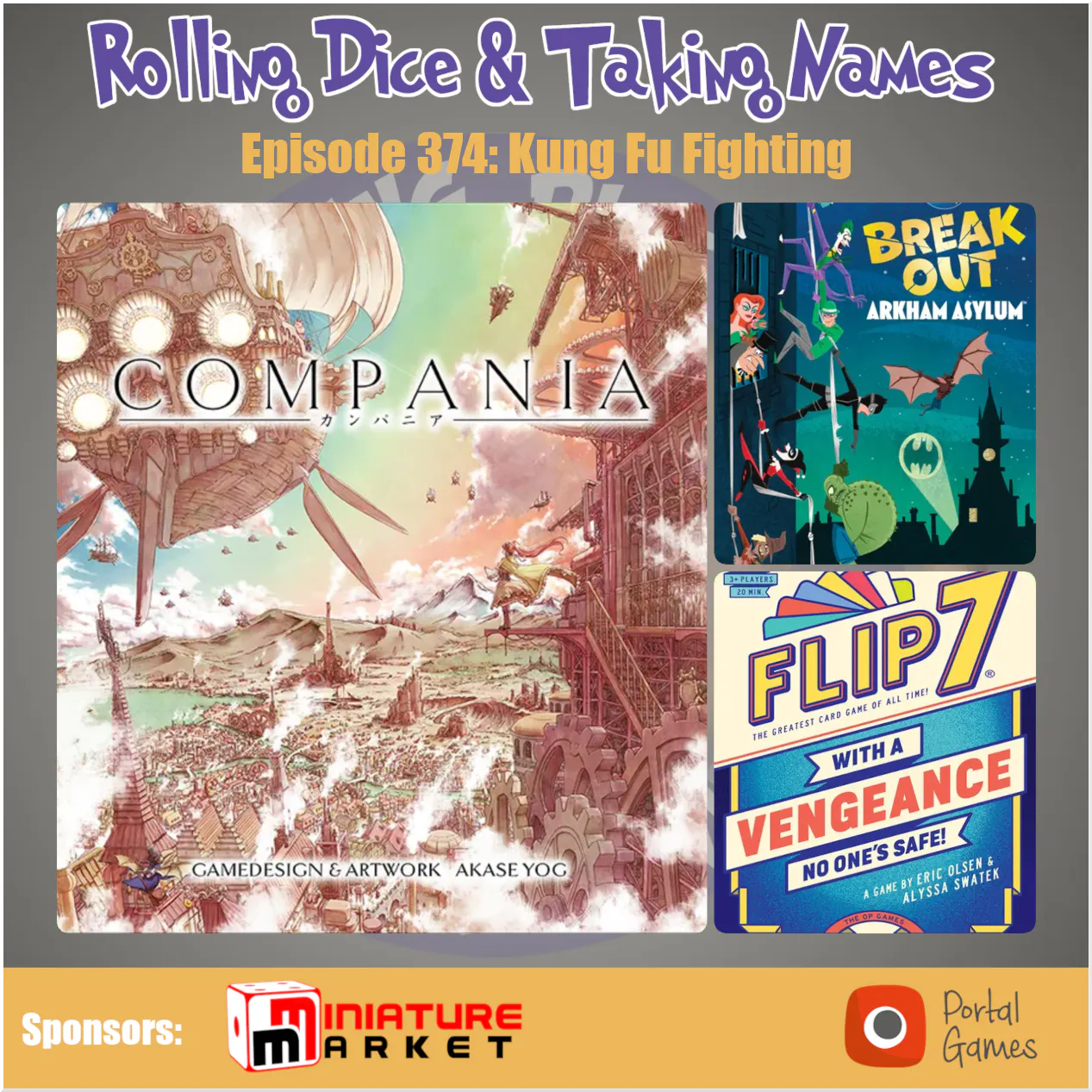
Episode 374: Compania, Flip 7 with a Vengeance, DC Break Out: Arkham Asylum
00:01:30 Intro00:05:30 TCG Storage Solutions00:09:30 SWU Progressive Tournament00:13:00 Red Pill or Blue Pill00:16:00 King’s Gambit – Restoration Games00:20:45 The Rant00:29:30 Arkham Horror LCG Demos00:32:00 Taste Buds00:34:45 Portal Games00:35:45 DC Breakout: Arkham Asylum00:43:30 Compania01:03:45 Miniature Market01:05:15 Flip 7 with a Vengeance01:09:00 Ewin Racing Desk01:12:00 Outro Compania, Flip 7 With a Vengeance, and DC Breakout each scratch a very different itch, but together they paint a fun snapshot of where modern tabletop design is heading. Compania leans into the current wave of streamlined games, that incorporate two types of mechanics, worker placement and area majority. It’s the kind of design where every turn feels consequential—don’t plan accordingly and be challenged to catch up to the other players. The game’s charm comes from how accessible it feels despite its core; turns are quick, the iconography is clean, and the tension ramps steadily as players jockey for position on a board that never quite seems to have enough to go around. Flip 7 With a Vengeance takes the opposite approach, embracing chaotic, push‑your‑luck energy with a theatrical flair. It builds on the original Flip 7 formula but adds a layer of “gotcha” cards and combo‑driven moments that make the table erupt. It’s fast, loud, and intentionally swingy—the kind of filler that shines when you want to reset the mood or get a group laughing. DC Breakout, meanwhile, provides quick, fun experience in a racing game where random dice roll meets strategic position that allows for some tense situations as players jockey for the finish line. Thanks for listening and hope you are able to get one of the games above to the table. Learn more about your ad choices. Visit podcastchoices.com/adchoices
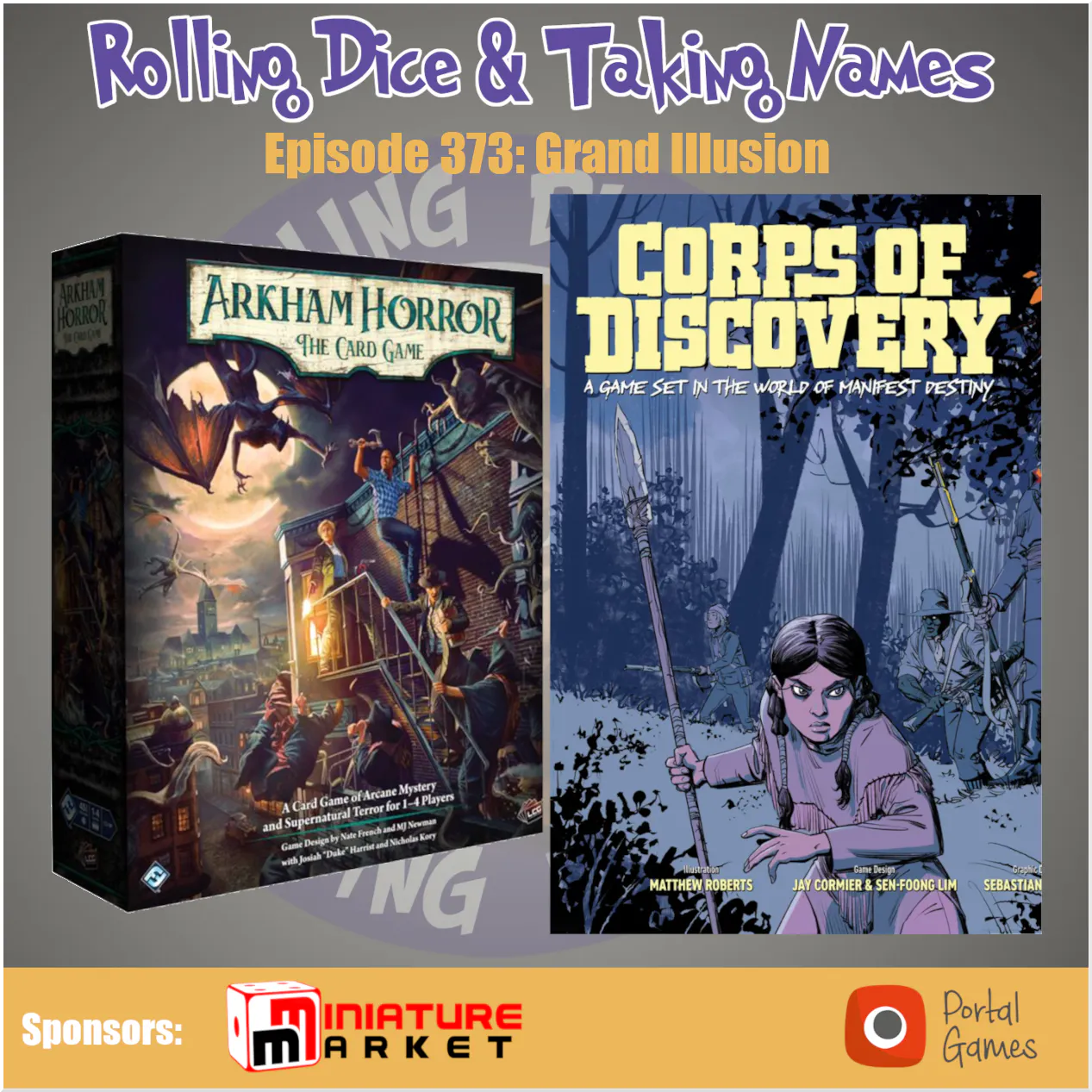
Episode 373: Arkham Horror LCG Chapter 2 Core Set, Corps of Discovery and Other Stuff
00:01:30 Intro00:03:30 Please Sub and Review00:04:30 Granddaddy Stories00:08:30 SWU Update – A Lawless Time00:17:00 TCG News00:21:00 Reality TV – Traitors00:24:30 Firefly Again?00:31:30 Miniature Market00:32:30 Corps of Discovery00:46:00 Portal Games00:47:00 Arkham Horror LCG Chapter 201:13:00 Outro Two cooperative games hit the table this episode, along with a few thoughts on the Star Wars TCG. It’s always refreshing to switch gears and dive into something fully co‑op, where the tension comes from the puzzle instead of the players. And no, your ears aren’t deceiving you—Marty actually convinced Vanessa to join him for a discussion about Arkham. Who knows… maybe this is the start of her becoming an investigator convert. Corps of Discovery invites players to retrace the legendary Lewis and Clark expedition, but with a sharper strategic edge than you might expect from a historical adventure. You’re managing a small but determined team as you push westward, balancing resource scarcity, shifting terrain, and the constant pressure of the unknown. The game thrives on its tension: every decision feels like a trade‑off between speed and sustainability, and the modular map keeps each journey fresh. It’s a thoughtful blend of exploration and logistics, capturing both the wonder and the hardship of charting unmapped territory. Arkham Horror: The Card Game, by contrast, plunges you into a very different kind of expedition—one into cosmic dread and psychological unraveling. Its living‑card‑game structure turns every campaign into a branching narrative where your deck evolves alongside your investigator’s triumphs, traumas, and terrible choices. Scenarios twist the rules, warp the environment, and force you to improvise under pressure, making each session feel like a bespoke horror story. Where Corps of Discovery celebrates discovery and perseverance, Arkham Horror LCG revels in uncertainty and creeping doom, offering a deeply immersive experience that rewards clever deckbuilding and narrative investment. Thanks for listening and please take a moment to sub or rank if you so desire. Learn more about your ad choices. Visit podcastchoices.com/adchoices
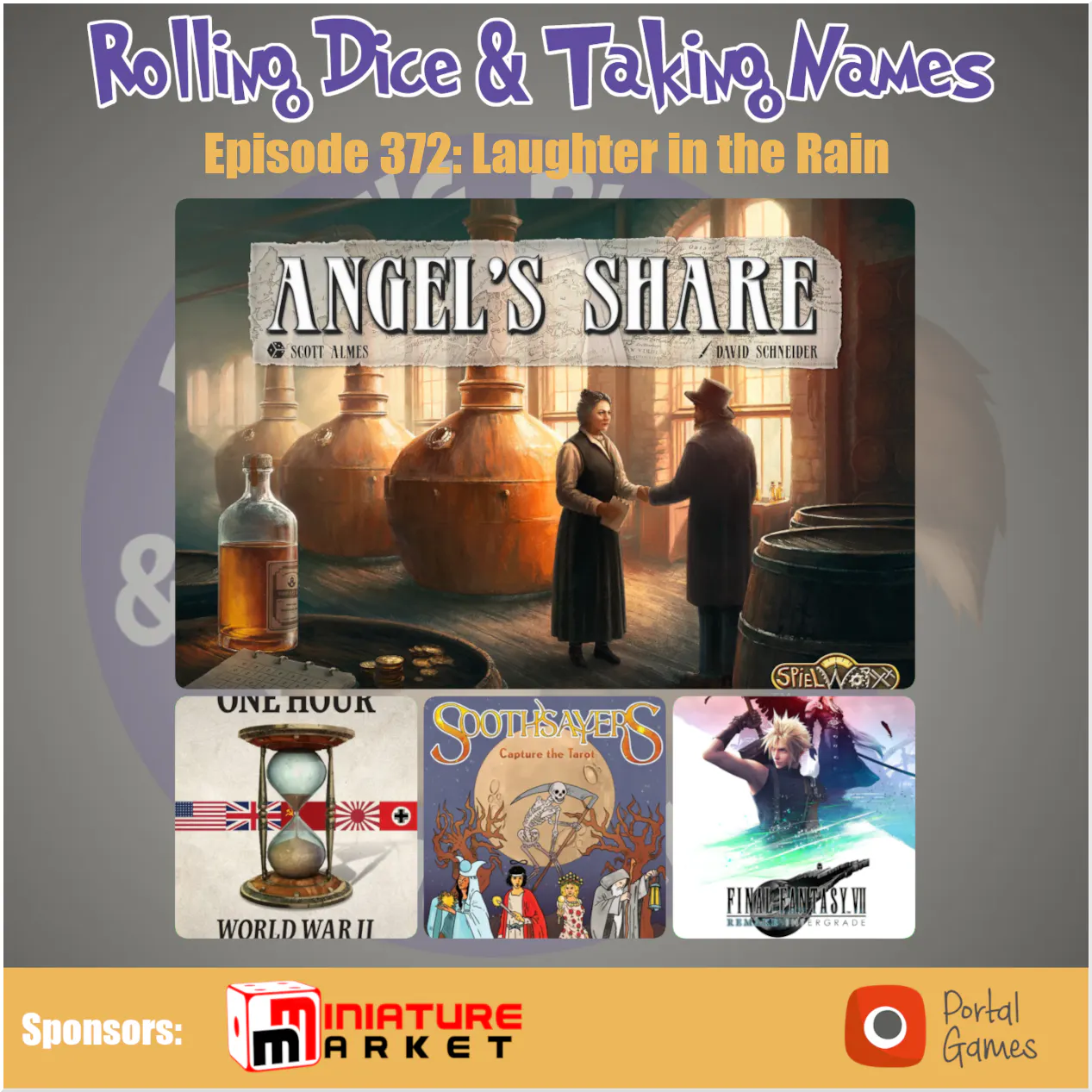
Episode 372: Angel’s Share, Soothsayers, One Hour World War II
00:01:30 Intro00:04:30 What is old is new again00:12:00 One Hour World War II00:20:45 America 250 NC00:26:00 Miniature Market00:27:30 Angel’s Share00:54:30 Portal Games00:56:00 Soothsayers01:05:00 Pokemon Remake Interest01:07:00 Final Fantasy VII01:11:30 Outro Every now and then, three games land on the table that have nothing in common thematically yet feel spiritually linked by the way they create tension and leave players talking long after the last turn. Angel’s Share, Soothsayers, and One Hour World War II each approach strategy from a different angle—one slow and atmospheric, one mystical and tactical, and one brisk and historical—but all three deliver that satisfying “let’s run it back” energy we love to highlight. Angel’s Share wraps its theme around you like koozie around a can your favorite beverage. It’s a game about aging spirits, but more importantly, it’s a game about timing—when to wait, when to bottle, and when to accept that the angels are going to take their cut whether you like it or not. The tension builds slowly as barrels mature and opportunities evaporate, and the emotional arc is surprisingly rich for such a streamlined design. Every choice feels like a negotiation with time itself, and the payoff—good or bad—lands with a satisfying thud. Soothsayers is a sharp, thematic card game where players become mystics interpreting omens to shape the future in their favor. At its heart, it’s a tableau‑building and card‑manipulation puzzle: each turn you’re choosing which actions to take, trying not to hand your opponents an advantage, and racing to assemble a tableau that makes everyone else wonder where things went sideways. The tension comes from reading both the shifting cards on the table and the intentions of the players around you—every decision feels like a moment of doubt, a quiet question of whether you made the right call or just sealed your fate among the stars. One Hour World War II does exactly what its title promises: it delivers a full, satisfying wargame experience in the time it takes to watch a TV episode. Despite its brevity, it captures the sweep of WWII with asymmetric powers, meaningful tactical choices, and a tempo that never drags. The design rewards bold plays and clever positioning, offering just enough historical flavor without bogging down in simulation. It’s an ideal entry point for players curious about wargames and a refreshing palate cleanser for veterans who want strategy without the marathon. Thanks for listening and appreciate all the support Learn more about your ad choices. Visit podcastchoices.com/adchoices