Resourceful Designer: Strategies for running a graphic design business
301 episodes — Page 6 of 7
Ep 128You Can't Rationalize Value - RD128
You can't grow your design business if you rationalize the value of what you do. Most designers don't get paid what they're worth. The reason they don't is that they rationalize the value of the service they provide. What I mean by this is they try to justify why they are charging the price they do for their designs by itemizing what's involved in their creation process. A logo will cost this amount of dollars because it will take me X hours of research, and another Y hours of development and finalization. Since my hourly rate is Z, the cost of the logo is (X+Y) x Z Cost of design = hours invested X hourly rate. This formula works for many designers and they're happy with running their business this way. But the problem with this scenario is you're trading time for money. Yes, it's a tried and true method used across many industries. But it shouldn't be used for design. Or at least it shouldn't be the sole method of calculating what you charge your clients. How much you earn running your graphic design business should not be related to how many hours you put in. It should be connected to the value you provide. Face it; we live in a world where we assign a dollar amount to most services. A haircut costs this much. A cab ride downtown costs this much. Having your car serviced costs this much. But even simple things such as these have variations based on value. My daughter changed her hair colour recently. It's not the first time she's changed the colour, but this time she decided to go to a different salon. One that charges almost double what her usual salon does. Why? Because the man running the new salon has a reputation for excellence and the perceived value of the service he provides is worth that much more to those who go there. In the end, my daughter paid a much higher price for her new hair colour than she used to. She loves her new look and is getting compliments left and right so in her mind it was well worth it. It's a perceived value. The same scenario applies to cars. When you have a problem with your vehicle you can take it to a privately owned garage, maybe a national chain such as a Walmart garage or you can have it serviced at the dealership. From my experience, the dealership is always more expensive. But think of it from a value perspective. If you drive a Honda, who is more equipped and more knowledgeable about your car than the Honda dealership? That perceived value is why some people are willing to pay more to have their car serviced by the dealer. What does this have to do with your design business? The services you provide as a web designer or graphic designer are not commodities like haircuts or oil changes. There is no one price fits all. Or at least there shouldn't be. A logo for a local bricklayer should not cost the same as one for a regional airline because they bring different values to each client. The representation the logo brings to each client affects them each differently. You may design a great logo for the bricklayer but what's he going to do with it? Stick it on the side of his truck and his business cards. That may be it. Most of his work will come via word of mouth referrals and through contractors. What his logo looks like may not have that much impact on his business. The airline, on the other hand, is going to showcase their logo on everything to bring awareness to their business. It will be on their planes, their building, their uniforms, their tickets, even on the cups and napkins they serve on their planes. And that's not counting the vast marketing campaign they will use it on. Their logo will be displayed everywhere, and over time the logo you designed will come to represent an excellent, reliable airline, that offers quality flights with courteous, friendly staff. For that reason alone the airline's logo should cost way more than the bricklayer's logo. It doesn't matter that both logos took you the same amount of time to design. Their value is different. And yet many designers would still charge for both logos solely on the time they spent designing them. When you start trying to rationalize what it is you do by focusing on things like time and effort, you lower the value of the service you provide. This rationalization devalues what design is all about. Designing is all about vision. It's about emotional impact. Giving a visual voice to what the design represents. It's about problem-solving. Both the bricklayer and airline needed a logo, but the problem that logo is solving for each company is vastly different. Instead of rationalizing your pricing to your clients by explaining every little thing you are charging for, or how much time a project will take, you need to explain to your clients how they will benefit from your designs. How design is an investment and not just an expense. When done right and with proper focus, a well-implemented design can skyrocket a company's growth. When explained this way, a client will begin to see the value you bring. Will t

Ep 12710 Things To Avoid While Running Your Freelance Design Business - RD127
Avoid these 10 things to grow your design business. To run a home-based freelance design business you need to know what to do for it to succeed. You also need to know what to avoid doing so as not to fail. You've done it. You're running your own design business. It's a fantastic feeling, isn't it? The freedom and the power it brings you. The counterweight is the responsibility and pressures you face because everything is now on your shoulders. When done right, running your own business can be the most satisfying occupation there is. Just ask any successful entrepreneur. But if things go wrong, you have nobody to blame but yourself. When it comes to starting a home-based freelance design business, most people research how to go about starting one. They read up on the things they need to get. They make lists upon lists of what they need to do to give themselves the best chance of success. That's how you should do it. However, what often happens along the way is you pick up bad habits that can affect you and your business negatively. Here are 10 things you need to avoid while running your freelance design business. 1) Avoid Slacking Off One of the most significant obstacles to overcome when running your own design business is the illusion of the freedom it brings. Don't get me wrong. Setting your hours and taking time off whenever you want without having to ask for permission is a definite perk when it comes to freelancing. However, I said the illusion of freedom for a reason. Freelancing doesn't mean fewer hours and less stress. It's the opposite in fact. You are running a business on top of designing for your clients. That doubles your responsibilities. This holds especially true for new businesses. You may find your social life suffering as you devote countless hours to get things off the ground. Avoid slacking off. 2) Avoid A Lack Of Direction Maybe running your own home-based design business was always your dream. Perhaps you ended up here unexpectedly through lack of employment. Regardless of why you are doing it, you need to have goals if you want to succeed. What do you want to accomplish with your business? Do you want to conquer a particular niche? Do you want to become known for a specific skill? It's nice to have design work that pays the bills, but if you don't have goals and you don't push yourself towards those goals, you will not improve as a designer. As a design professional, you should have a mindset that design can change the world. Set goals to grow your business and to grow as a designer and don't get left behind. Avoid a lack of direction. 3) Avoid Isolating Yourself From Other Designers As a freelance designer, you spend a lot of time by yourself, sitting in front of your computer designing amazing things for your clients. But how do you expect to improve as a designer if you're not communicating with other designers? There's only so much you can learn from articles, videos and yes, even podcasts. You need people you can bounce ideas off of and get real criticism from. People who are not afraid to tell you when you're going in the wrong direction. Clients don't count. Sure clients give you valuable feedback on what you're doing. But they will never be able to view your work with the critical eye you need to improve your skills as a designer and business person. I'm talking about your peers. Other designers. People who not only understand what it is you do but how you do it. People in the same trenches as you. One of the biggest mistakes Freelancers make is not keeping in touch with other designers. Find people to discuss design ideas with, to get critiques from, to solicit business advice. The more designers you are in contact with the more you'll grow. Avoid isolating yourself from other designers. 4) Avoid Being Exploited One of the problems of running a home-based design business is that many people don't see it as a real business. They imagine you as an unemployed designer who sits at home binge-watching Netflix and occasionally designing something whenever someone calls upon you. To them, it's like designing has become your hobby and you're lucky enough that some people pay you for it. Because of this perception, friends, family and acquaintances may ask you to design for them as a favour. If they do offer to pay you, it's rarely what you merit. After all, you're not doing anything, and it shouldn't take you long. Plus, they'll help you out by spreading the word of what a great designer you are. Maybe they're hoping this exposure will lead to employment for you. Don't fall for it. Sure it's OK to design your sister's baby announcement cards as a gift. But if your brother, your uncle joe or your old college roommate asks you to design a logo for a new business, they need to pay you. Give them a discount if you want, but let them know you're not at their beckon call. You are running a business, and they will treat them as clients. Not sure where to draw the line? Look at it this way.

Ep 126When Life Interferes With Your Design Business - RD126
When Life Interferes With Your Design Business Running a home-based design business is the best thing any designer could do. At least that's my opinion, but I could be biased since I've been doing it for over 13 years now and I love what I do. But running a home-based design business does have its drawbacks. Such as when life interferes with your plans. Running a home-based design business is great. You can set your hours and work as much or as little as you want. You decide how much you want to charge and if you wish to charge by the hour or by the job. You also get to choose what clients you want to work with or not. Meaning you have the option of turning down any jobs that don't interest you. Plus, you have nobody to answer to since you work from home all by yourself. OK, you have to answer to your clients. But at least you don't have a boss breathing down your neck to get the job out, or else. Yup, being a home-based designer is great. However, there is one major drawback to running a home-based design business. And that's when life interferes. Life has a way of messing with you in unexpected ways. Some days are good, some are bad, and some can send you into a panic. I'm talking about the latter one. When life throws something in your path that grinds your design business to a halt. I'm talking about sickness, accidents, family emergencies, even death. There are also grand scale emergencies like natural disasters such as floods, hurricanes or earthquakes. And don't forget uncontrolled events such as power outages or having your equipment stolen. All of these can have a negative impact on your design business. Don't get me wrong, not everything that affects your business is a bad thing. Marriages, births, vacations, etc. also affect your business. Life interferes, and the status quo of your business changes. So what can you do when life interferes with your design business? Prepare for expected breaks In some cases, such as vacations, marriages, births (to some extent) and even things like surgeries can all be scheduled. Advanced knowledge of these events gives you an opportunity to prepare for the time your business is affected. In some cases, your business may be shut down for a few days, but it could also be affected for several weeks or months. When you know a break is coming, you should warn your clients well in advance of these shutdowns. To help ease the pressure, you can try to get things done before your time off. Or you can tell your clients you cannot work on their project until after a specific date. I never start any new projects during the two weeks leading up to a break. This buffer could cause problems for some clients, but you'll have to live with your choice. Yes, you may lose some work because of it. But that's life. Prepare for unexpected breaks What do you do when life interferes with your business in unexpected ways? First things first, when life interferes in an unexpected way, notify your clients. They will understand. No client will respond with "sorry about the death in your family, but I have this job I need you to finish by Thursday, can you handle it?". Your clients knew you were a home-based designer when they hired you. They knew the benefits of working with you also came with some risks. One of those risks is the possibility of you needing unexpected time off. There may be deadlines, and yes, you may feel bad about missing them, but you might be surprised how many deadlines you can miss without any ill effects. Unless there's a firm date in place, such as for scheduled events most deadlines have flexibility built into them. Once you've notified your clients, try to figure out if there's anything you can do. Maybe it's providing a list of compatible designers your clients can use in your absence. In cases of natural disasters or equipment failure, you could try and find ways to get back up and running while trying to minimise your time away. Even if it's merely so you can get the most pressing things done? Get Help from other designers If you are running a studio as I talked about in episode 125, you may have people on your team that can handle the work for you. If you don't have contractors in place, you may need to turn to a friend or colleague and see if they can take on some of your work while you are incapable. There's always a risk any time you direct a client to a new designer. The client may like the other designer and decide to stick with them. You'll have to take that risk and rely on the relationship you've built up with your client to bring them back. If you are worried, you could try to minimise the risk with a contract between you and the other designer saying they will not poach your clients. But if you're in a pinch due to some emergency situation, worrying about a contract is the last thing you want to be doing. Besides, chances are if your client realises they like working with a different designer better than you, there's not much you can do about it. Lon
Ep 125Freelancer or Design Studio: Defining Your Design Businesses - RD125
Freelancer or Design Studio, which is best for your home-based business? I talk a lot on the Resourceful Designer podcast about running a home-based design business. In fact, it's why I started the podcast in the first place. Like my catchphrase says, I'm doing this to help designers like you streamline your business so you can get back to what you do best, designing. I've covered many topics in the previous 124 episodes over the past few years. Things like pricing strategies, attracting new clients, coping with the isolation when working from home and many more. However, I've never talked about what options you have in the type of design business you run. Deciding what type of home-based business you run is important because the direction you take could determine the kind of clients you attract and the growth of your design business. Including how much money you can potentially make. The options I'm talking about are whether you define yourself as a Freelancer or Design Studio. There is a third option available, a Design Agency. The reason I'm omitting Design Agency is that by definition, a Design Agency is made up of several people, all with different talents working on all aspects of client projects and usually all working under one roof. Perhaps you fit that category, but as I stated earlier, Resourceful Designer was created to help home-based designers, and I don't think many home-based designers run agencies. That leaves two options, Freelancer or Design Studio Calling yourself a Freelancer According to dictionary.com, a Freelancer is a person who sells work or services by the hour, day, job, etc., rather than working on a regular salary basis for one employer. Cambridge Dictionary defines Freelancer as someone who works on different projects with different companies instead of being a company employee. And finally, Merriam-Webster says a Freelancer is a person who pursues a profession without a long-term commitment to any one employer I've never called myself a Freelancer. I've always found the term derogatory and noncommital. I always viewed the term as a kind of fly-by-night thing where the client will never be sure if the Freelancer will be there for them. Remember the Merriam-Webster definition was someone who pursues a profession without a long-term commitment. Not to mention my business is registered, so in a roundabout way, I can say that I'm an employee of my own company, therefore, as an employee, I cannot be a Freelancer. But that's neither here nor there. For this article, a Freelancer is merely a one-man band when it comes to design services. As a Freelancer, you are everything from an art director, to a designer, to a coder, to handling accounts receivable and payable, etc. You do it all, and there's nothing wrong with that. When I first started my own home-based design business, I did precisely that. I handled everything. I was a one-man band. And if I didn't think I could do something in a project, I didn't take on the job. Defining yourself as a Freelancer, meaning it's just you, limits the type of clients you can take on by the skills and services you offer. If you're not a web designer, you don't take on web clients and vice versa. Freelancers tend to attract smaller clients such as Start-Ups or the "quick" clients. Those who call you up and need something done this week, or worse yet, they need it tomorrow. The average freelance designer takes on clients and jobs in the $500-$5000 range. Calling yourself a Design Studio Remember above when I said a Design Agency is made up of multiple people working together under one roof? A Design Studio is similar to an agency in that is offers a wide variety of skills and services, but some of those skills and services come from third-party contractors. As a Design Studio, you still run your home-based design business like a Freelancer does, however, rather than offering a full range of services under one roof like an agency, you subcontract the parts of a project that you can't or don't want to handle yourself. Things like photography, coding, copywriting, illustration, etc. Being a Desing Studio allows you to take on larger clients with more significant projects and spread out the work to get jobs done more efficiently. With a Design Studio, everything is processed through your business and clients deal directly with you instead of dealing with multiple businesses. You take on the role of art director and manage the subcontractors working on the projects with you. Design Studios tend to attract small to mid-sized companies as clients. Companies that may have a marketing department but don't have an in-house creative team. The Design Studio acts as their creative team. Clients seeking Design Studios often have budgets ranging from $5,000-$20,000 or more. Freelancer or Design Studio, what's right for you? Choosing between a Freelancer or Design Studio is a matter of choice. The difference between the two is your willingness to work with subcont

Ep 124Referral Partners 10 People to get Design Referrals From - RD124
Referral Partners 10 People to get Design Referrals From It's confusing for wannabe entrepreneurs to start a business. Their confusion creates an excellent opportunity for you, as a designer to team up with referral partners and not only help these entrepreneurs get started, but it also helps grow your and your referral partners' businesses. Starting a business is a daunting task. You don't just get out of bed one morning and think to yourself "What should I do today? I know, I'll start a business." That's not how it works. There are so many steps involved in starting a business that it's difficult to know where to start. That's why most people wanting to start a new business seek guidance, help and advice in their endeavour. Since there's no Start Here button to push whenever someone wants to start a business, that guidance, help and advice they seek out can come from anywhere and anyone, including you, their designer. If you want to help these new entrepreneurs to the best of your ability you should have referral partners that can lend a hand. What is a referral partner? A Referral Partner is as simple as it sounds. It's partners that refer to each other. If someone comes to you for advice on starting a business, you refer them to the partner that would best help them, and vice versa, whenever someone goes to one of your partners, and they require design services, your partner refers them to you. That's all there is to it. Choosing your referral partners. A referral partner should be someone integral in the development of new businesses that complement what you do as a designer. Here is a list of 10 people you should approach to become referral partners. Industry suppliers Industry suppliers include printers, sign makers, vehicle wrappers, and anyone else within your industry but who don't compete with you for design. When a new startup hires you to design their new logo, you can refer them to these people to get the rest of their branding and marketing material produced. When a client contacts one of these partners asking about their services, the partner can send the client your way for design and web work. Lawyers A lawyer may be the first person contacted when someone is thinking of starting a business. Partner with them and they can refer these new business people your way. When a new client comes to you at the start of their business journey you could recommend them to the lawyer. Accountants Just like a lawyer, some people will talk to their accountants before deciding on a course of action for their business. Team up with one and send clients both ways. Financial Institutions Financial institutions include banks, credit unions, financial advisors, money lenders, venture capitalists or anyone involved with financing business. Financial institutions make great partners. Local business offices Most places require businesses to register their name, obtain a license, submit a business plan etc. Partner with these places to get more clients. Chamber of Commerce Most communities have a Chamber of Commerce. They make great referral partners. You may have to become a member to partner with them, but it's well worth the cost to gain more clients. Local business groups Municipalities often have private business groups made up of local business people that handle specific areas of a community. For example, a Downtown Business Group, or Waterfront Business Group. Contact these groups and ask them to refer any new businesses in their area to you. Commercial real estate agents Partner up with commercial real estate agents and send growing clients their way when they need to expand and ask them to refer similar businesses back to you. Business schools Contact local schools to see if they offer business classes or workshops for new entrepreneurs. Ask to speak to the class about the importance of good branding. You can also ask them to refer students your way. Unions Approach Union offices and ask them to refer any union members who are thinking of starting a business. How to reach out to referral partners Becoming a referral partner with someone is easy. Send them an email or better yet drop in and talk to them. Explain the mutual benefit. How from time to time your clients ask for advice that they would be better-suited providing and you could refer your clients to them. In exchange, when they have a client that is in need of design services you would appreciate them giving out your name. It's that easy. You can have more than one referral partner in an industry It's ok to be referral partners with multiple people in the same industry. Give your clients various options when referring them to someone. Be sure to tell your client to mention you, so your referral partner knows the client came from you. You should also send an email to your referral partner letting them know that you gave their name to someone. That way your partner will know you are helping them out even if the client never contacts them. Have you e
Ep 123Using Google AdWords to Attract Design Clients - RD123
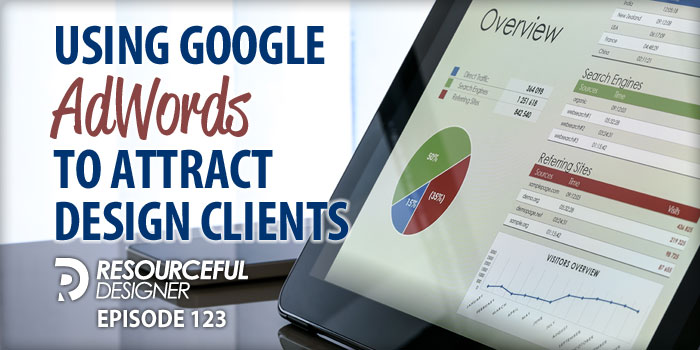
Using Google AdWords to Attract Design Clients Any time designers get together in person or online on platforms like Facebook, LinkedIn or Reddit, you're sure to hear someone ask how to attract more clients. It's one of, if not the most significant problem faced by designers. Without clients, your business fails. It doesn't matter how good a designer you are if you don't have people paying for your services your business will not survive. There are many ways you can attract new clients. Last week I shared 12 inexpensive ways for you to promote your design business. A couple of years ago I wrote a blog post where I shared 10 proven ways to attract design clients. All methods I've used myself to gain clients. Today I want to talk about a great way to attract clients that for some reason, not many graphic designers or web designers are taking advantage of. Google AdWords. How do clients find you? Ask most designers, and they will tell you the number one way they gain new clients is through word of mouth referrals. Referrals are great. But what if you don't have a large catalogue of clients advocating for your business? Let's look at it from a client's perspective. Let's say you need a plumber. Who will you call? Your first choice would be to call a plumber you know, or at least one you've heard of before. Your Second choice would be to ask family, friends, co-workers and associates who they would recommend. That's the referral part. If it doesn't work, you would probably turn to a search engine and look for plumbers in your area. Design clients do the same thing. They contact a designer they know or have heard of before. That's where brand awareness comes in. Second, they ask family, friends, colleagues, associates etc. That's where referrals come in. But when that fails, clients will turn to the internet and search for a designer online. And chances are they will formulate their search to look for someone in their local area. That last part is a huge benefit for you, especially if you are using Google AdWords to get in front of them. If you're already familiar with how AdWords works, you're probably nodding your head right now in agreement with me, but I'm going to continue with the assumption that you are not familiar with Google AdWords. Forgive me if I'm wrong. For the record, Yahoo and Bing also have similar advertising platforms, but since the majority of people use Google, I'm going to concentrate on it. So how does Google AdWords work for attracting design clients? Let me break it down into the simplest terms using only three steps, You figure out what keywords people are searching. You create an ad that Google puts in front of people actively searching for those keywords. You pay Google for the people that click on your ads. That's all there is to it. The best part about Google AdWords is you only pay when your ads are working, and people engage with them. If they don't click, you don't pay. Now of course, "when your ads are working" is a relative term. In this case, it means when people click on your ad. Whether or not they become a client after clicking on your ad is not Google's concern. A deeper dive into AdWords. I won't go into the technical nitty gritty of setting up a successful AdWords campaign. There are plenty of other resources where you can learn the ins and outs of fine-tuning your ad campaign to get the most bang for your buck. I will, however, elaborate on the three steps I mentioned above. Create an AdWords Account The first step is creating a free AdWords account and telling Google how to charge you for your ads. They have to make their money after all. Once your account set up, you can create your first ad campaign by choosing the type of ads you want to run. There are several options, but in my opinion Search Ads are the best ones for attracting new design clients. Next, you select the campaign type. I suggest you choose website traffic and don't include Google Search Partners or the Ad Display Network. Both are good for driving traffic to a product or resource, but your goal is to attract clients. Set up the delivery What makes Google AdWords such a valuable marketing tool is the ability to pick the geographic location where your ads will appear. If you live in Cleaveland Ohio, you can set up your campaign so that only people in Cleaveland will see it. There are several reasons to limit your search to particular geographic regions. Top among them is the amount of competition you face the broader your target area. If you set your campaign to all of the USA you are competing with every other designer across the whole country. It is possible to win in that scenario, but since a kind of bidding/auction system is used to determine ad placement, it could get costly. Of course, there's a lot more to the whole thing that I'm not getting into which is why I suggest you take an AdWords course before starting. But basically, targetting an entire country is just too difficult for someone just

Ep 12212 Inexpensive (or free) Ways to Promote your Design Business - RD122
You need to promote your design business if you want it to grow. Just like any other endeavour, if you don't promote your design business you are drastically impeeding its chance to grow. It's called brand recognition, which you being a designer should know. The idea is that when someone is in need of a service, you offer, there's a good chance they will choose to work with someone they know, or at least someone they've heard of. It's up to you to get your name out there so that the "someone they've heard of" is you. I've put together a list of 12 inexpensive or free ways you can promote your design business. I go into much more detail on each one in the podcast. Be sure to listen for the full story. 12 Inexpensive (or free) ways to promote your design business. Newsletters/Bulletins Many organizations, service clubs, churches, charities and such put out electronic or printed newsletters or bulletins for members and followers. If you belong to any such organization, you should reach out to them about advertising your business in their newsletter or bulletin. Most organizations would be happy to promote a member for a small fee. Recipients of these newsletters and bulletins are often inclined to support fellow members and use your services when needed. Sponsor a Team or Club Local sports teams and clubs are often looking for donations to fund their events. In exchange, your business name becomes associated with the team or club and is mentioned along with them in news articles. By sponsoring a team or club, you are not only helping your community, but you are spreading the word about your business and the goodwill associated with your donation. As an added benefit, some teams or clubs will offer you a tax receipt so you can write off the donation as a business expense. Promotional Events Businesses, non-profits, charities, and organizations will often put on an event attracting a gathering of people. These events often include draws, prizes, giveaways or some other form of incentives for attendees. Offer a discount or coupon towards your services to be included amongst the incentives. For example; offer a free business card layout design with every logo design project or one year of free website hosting with every website project. Silent Auctions Similar to promotional events, silent auctions are a way for an organization to raise funds. Most items in a silent auction are provided by local businesses. Offer a coupon towards a service you offer showing the value of the offer. For example, $300 off design services or a free year of web hosting (a $xxx value). The people who bid on your service are people who are in need of your help. Those who don't bid will at least see your item in the auction and hopefully remember your brand should they ever need it. Business Card Boards Have you ever been to an establishment that has a board or wall filled with peoples business cards? Why not add your own. It doesn't cost you anything, and if someone who requires your services spots your card, there's a good chance they contact you. Wear a T-Shirt Promoting Your Services When I first started my business, I had a T-Shirt made that said "Hi, I'm a web designer. Is your website working for you?". I wore that shirt everywhere potential clients might be. I was amazed how many people approached me with questions about their website or asking about my services. Many become clients. If you want to try this yourself, I created a couple of T-Shirts you can purchase at http://resourcefuldesigner.com/tshirt Claim Your Online Local Listings If you haven't done so already, you should claim your free local business listing on Google Places, Yahoo Local and Bing Places for Business. Sign up and be found in your local areal. Warning, you have to enter an address to claim your listing. If you work from home, you may want to think twice before proceeding unless you have a separate business address you can use. Community Sites and Local Directories Search for online directories in your area to list your business. Some such as your local Chamber of Commerce business directory may require a membership but other directories, such as your local municipality may be free. Car Magnets If you use your vehicle for both business and personal use, you may not want permanent signage affixed to it. Car Magnets are a great way to promote your business while out on business errands and are easily removable during your time out with family and friends. Press Releases Sending out press releases is a great way to get free promotion for your business. Send out a press release any time you or your business does something newsworthy. Have you won an award? Are you offering a new service? Have you been involved in promoting some local event or charity? Send out a press release every time you have news to spread. News outlets may not publish every press release you send out, but those they do will be free promotion for your business. Run a Workshop You are a profe

Ep 121Most Design Clients Are Ignorant - RD121
Most Design Clients Are Ignorant When I say that most design clients are ignorant I'm not trying to be mean or derogatory. I'm simply stating a fact. The definition of "Ignorant" is someone who is lacking in knowledge or information as to a particular subject. That description is a perfect fit for design clients who often don't understand what it is you do, or how you do it. Design clients don't understand how the creative process works. They don't know how much effort goes into even the simplest of designs. They have no idea of what is involved in maintaining a website. In some cases, they don't understand the language or terms you use. In all of these areas, design clients are ignorant. It's OK if your design clients are ignorant because It's not their job to understand what you do. Their job is to hire someone to handle the things they don't understand and on that part they're brilliant because they hired you. And your job is to make sure that even though your clients are ignorant of what you do, they should not be confused by what you do. You have to put them at ease, so they know that hiring you was the right decision. There's a comedian by the name of Dane Cook that does a routine about dealing with auto mechanics. In his comedy routine, Cook says that when an auto mechanic explains what's wrong with a vehicle, most people smile and nod while hearing a little voice in their head saying "this guy could be feeding me B.S. and I wouldn't know the difference." Don't be the designer that clients listen to and think "this guy could be feeding me B.S. and I wouldn't know the difference." Learn how to talk to design clients One area that could confuse clients is the way you talk. Just like any industry or sector, you have a language as a designer filled with jargon and acronyms that most clients have never heard or don't know what they mean.. Clients are not designers; you shouldn't expect them to think like designers. The best way to avoid this is to minimize or even eliminate the jargon, acronyms, and other industry words that could confuse them. Or, you need to educate them on the meaning of those confusing words and terms. Terms we take for granted like SEO, Keywords, Back-end, Dashboard, SER, CMS, Bleeds, Plug-ins etc. need to be explained so that your client clearly understands what it is you are saying. If you can explain design jargon and acronyms in a way that makes a client feel comfortable and doesn't make them feel ignorant, they'll appreciate you for it. If you can communicate in a way that they understand what it is you are telling them, they will feel comfortable dealing with you and are much more inclined to hire you for the job. Learn how to listen to design clients Sometimes a client comes to you with a clear idea of what they need. However, many times, the client doesn't even know what it is they need or why they need it. A client may contact you saying they need a website but when you ask them why, their answer is because everyone says they need a site. That's not a good reason. In the last episode of the podcast, I talked about the Discovery Process and how the purpose of design is to solve a problem. Many clients don't know what their problem is. Some don't even realize there is a problem. Those that do may know there's a problem, but they're often looking for a solution to the wrong thing. Your job as a designer is to get to the core of the problem and to provide the best solution. Does your client need a website to bring awareness to their brand? Do they need one to automate service calls? Sell their products? Advertise an event? Sometimes a client may think they want one thing when something entirely different might be a better solution. A client comes to you looking for a folded brochure may not realize that their minimal text is better suited to a rack card. A client wanting a payment system on their website to accept multiple currencies may actually need a way to display their pricing in a visitor's native currency while still conducting the transaction in the client's currency. That's why discovery is so important. It allows you to converse with the client to discover the exact purpose of the item or feature it is they are asking of you. Because design clients are ignorant, sometimes what they are asking for isn't what they need. It won't solve their problem. Part of your job as the designer is pinpointing their actual problem and communicating to them what can be done to address it. When in doubt, ask for examples. It can be difficult talking to clients. Especially when both sides think they are discussing the same thing while both are imagining something completely different. A "modern" looking design could have two entirely different looks depending on who is imagining it. The easiest way to understand what a client is telling you is to ask for examples. Don't leave things up to chance. Your homework is the discovery process. Give your client homework as well. Ask them to provi

Ep 120Discovery Process - Doing It Right - RD120
How in depth is your Discovery Process? The Discovery Process is kind of like dating, or at least what I can remember from my dating days. It's done at a point in your client relationship when you want to get to know them better. What are their goals, what makes them feel good, what frustrates them, what do they like, dislike? Why do they want to work with you? This conversation reveals the thoughts and feelings your client has towards their business, product or service. Larger agencies have people who are responsible for the discovery process. They meet with the clients, define the strategy and goals of those clients, and create a creative brief, or a project plan for a design department will follow. All the designer has to do is read the detailed brief and start designing. As a freelancer or home-based designer, you don't have that luxury. Sure some clients may give you a design brief, but can you trust it to be what you need to create the best designs for them? No, when you're on your own, the discovery process, as well as the design process, is all your responsibility. What is the Discovery Process? The Discovery Process is a fact-finding mission. A way to learn more about your client and to learn what they expect from hiring you for their design project. Discovery should be the cornerstone of every new relationship with a client and of every new design project you do for those clients. Discovery not only helps you learn what you need to know before starting a design project, but it's also an essential step in building relationships with your clients. During a discovery process, you will learn your client's needs, you'll learn their challenges, and you'll also learn the results they're expecting from you. Discovery should be a two-way streak. Not only will you learn what you need to know about your clients and their projects. But your clients will learn about you as well. How you work, your thought process, how you tackle a problem, and so on. More importantly, they will learn things about themselves they may not have thought of before. All of this is vastly important because to design without the proper focus is a waste of time. When it comes to any design project, designing is one of the last steps of the process. As you know Design solves a problem, and if you don't know for sure what problem it is you're facing, how are you suppose to create a design that addresses it? Before you can define the problem that your designs will solve you need to go through a discovery process. A process that takes into account analytics, brand standards if they exist, goals for the project, and many other things to figure out what direction your creativity will take. Plus, keep in mind that while you make the required steps during your discovery process to find solutions to a given problem, you may trigger additional insights or even more questions about the problem that might lead you in whole new directions. That's why the discovery process is so important. Steps in the discovery process. 1- Define your client's goals. The first step in the discovery process is to determine what your client's goals are. This is a two-way conversation between you and the client. The trick is narrowing down those goals to SMART goals (Specific, Measurable, Achievable, Relevant/Realistic, Trackable/Time-Related). Ask your clients lots of questions and listen carefully to what they tell you. Because sometimes what they say isn't really what they mean and they don't realise it. Your client may think their problem is they need to generate more leads but in reality what they need is better leads that convert into sales. Designing something to get more leads is entirely different to designing something to get better leads. Determining not only what your client says, but what your client needs, could take the design you create in a whole different direction. Your job in defining your client's goals is to ask the right questions to get to the heart of the problem they hired you to solve. Speaking of questions, I've put together a list of questions you could use in your discovery process while talking with your clients. The list is too long for me to go over during this podcast, but if you are interested you can get it by visiting resourcefuldesigner.com/discovery 2 - Study your client's competition. To find the solution to your client's problem, you will need to know more about their industry. What they do, who they serve, how they go about doing it. The best way to learn this is to study the competition. Things to look for when studying the competition might be. What makes your client different from their competition? What would make people choose your client over them? What hurdles do customers face when dealing with the competition that your client could address? How does your client's pricing compare to the competition? What marketing strategy is the competition using and is it working? What are people saying, both negative and positive ab
Ep 119Being Effective vs Being Productive - RD119
How effective are you when you work? I don't know if it's because it's springtime or if there's some national or international initiative going on, but a lot of podcasts and blogs have been talking about productivity lately. Covering things such as ways to get things done more proficiently. Ways to make your job easier. Ways to not only do more but do more in less time. These articles and podcasts also talk about the wide variety of apps, journals and other tools to help increase your productivity. These resources are a great help because after all, being productive means getting a great deal of work done in a relatively short period, and by using as little resources as you can. Many of those podcasts and blog articles had such great advice on being more productive that I wrote quite a few down so that I could talk about them in future episodes of the podcast. But one of the things I noticed while reading or listening to what they had to say is that a lot of energy and effort is going into teaching you how to be more productive. But unless that information is pointing you in the right direction, it can be downright ineffective. You see, being productive is only a good thing if you are also effective during the process. How to be effective while being productive. Have you ever worked hard on a project, maybe a logo design or a website, only to discover that you've wasted your time because your client doesn't like what you did? Have you ever told a client that you would provide 3, or 5 or maybe even ten different design ideas from which they can choose? How effective do you think that is? You may feel like you poured your heart and soul into your creativity and felt like you delivered great design ideas to your client, only to be bewildered as to why your client is indecisive or outright rejects your designs. Chances are, you were very productive during the design process, but you were not effective. Being effective doesn't mean getting a great deal of work done in a short period. It means getting the right work done in the time you spend doing it. To be effective, you need to do a thorough job beforehand researching and ascertaining the actual goals and objectives of each project. Because without laying down that initial groundwork, without starting your creative process on a solid foundation. It doesn't matter how productive you are because that productivity probably won't be effective. Your job as a designer is not to create great designs for your clients. It's to create the right designs for your clients. Thinking back upon all the productivity tips I've been hearing and reading lately; I've concluded that merely being productive without the proper alignment of goals, without a purpose behind what you're doing, without a focused vision of what your client wants, is an easy way to be ineffective. You need to do your absolute best to tune yourself into the vision behind the goals set out for you by your clients. Not just once, but on every project, you take on. Only that way can you indeed be effective in your use of all the productivity tools, strategies and advice that are at our disposal to make our lives easier. The next time you are whipping along in a design frenzy, feeling very productive, I want you to take a quick break to stop and ask yourself. I'm very productive, but just how effective am I right now? How do you balance being effective vs being productive? Let me know by leaving a comment for this episode. Questions of the Week Submit your question to be featured in a future episode of the podcast by visiting the feedback page. This week's question comes from Phill What are some strong points of advice for an early 20s individual who wants to move from an industrial manufacturing work place to the world of web design/development? To find out what I told Phill you'll have to listen to the podcast. Resource of the week Wordpress 5.0 Gutenburg Wordpress 5.0 Gutenburg will be released in a few weeks and from what I've seen the newly revised editor will make our jobs as web designers easier. But don't take my word on it, have a look at what web242.com has to say. Listen to the podcast on the go. Listen on Apple Podcasts Listen on Spotify Listen on Stitcher Listen on Android Listen on Google Play Music Listen on iHeartRadio Contact me I would love to hear from you. You can send me questions and feedback using my feedback form. Follow me on Twitter, Facebook and Instagram I want to help you. Running a graphic design or web design business all by yourself isn't easy. If there are any struggles you face running your design business, please reach out to me. I'll do my best to help you by addressing your issues in a future blog post or podcast episode here at Resourceful Designer. You can reach me at [email protected]

Ep 118Minimising Back and Neck Pain From Long Days Designing - RD118
Do you suffer from back or neck pain? The other day at dinner during some idle chit-chat with my wife she mentioned a presentation she attended about ergonomics and how to minimise back and neck pain from sitting at a computer all day. The following morning at breakfast I found presentation handouts she had left on our kitchen table, and I started skimming over them. Before I knew it, I had read them all. They were so informative that after breakfast I came into my office and made some adjustments to my workspace. Then I thought to myself if this information is useful enough for me to make changes. Then I'm sure you could benefit from this as well. After all, as designers, we spend most of our time sitting in front of a computer or staring at a smartphone or tablet. I go into much more detail in the podcast so be sure to listen to this episode to learn more. Setting up your workstation to minimise back and neck pain. Adjusting your chair Your chair and how it's adjusted is a significant factor in minimising back and neck pain. When you are sitting in your chair, the ideal position should follow the 90/90/90 principle throughout your body. Meaning your back should be at a 90-degree angle to your hips. Your thighs should be at a 90-degree angle to your legs and spine, with your feet flat on the floor. Your elbows should be at your side, and your upper and lower arms should make a 90-degree angle with your wrists parallel to your forearms. Adjust the height of your chair or keyboard tray so that your arms remain at this neutral position while typing. If your chair has armrests, adjust them to this level as well. If you have short legs, you may want to get a footrest. The 90/90/90 principle is the ideal position to minimise strain on your joints and muscles. The critical thing here is to have a good chair. I know it's sometimes hard to justify spending money on an expensive chair. But try to remember, you will be sitting in it every day week after week, year after year. It's worth investing in something that is not only comfortable but something that will support you adequately. Setting up your computer. It doesn't matter what setup you use as your workstation there are ways of optimising it to minimise back and neck pain. Here are a few different scenarios. Laptop Users Laptops are very convenient for people on the go. However, if you use one as your regular workstation here are some things you should consider. To prevent neck strain, you should position your laptop so that the top of your laptop screen is at your eye level. You may need to use a laptop pedestal or something to raise it up to the right level. Even a few reams of paper or books can act as a pedestal. Naturally raising your laptop will make it difficult to type so you may want to get a separate keyboard and mouse that you can connect directly to the laptop or a docking station. Desktop users Desktop users should follow a similar plan to laptop users. The top of your monitor should be at eye level. There are stylish stands available to raise your computer or monitor to the proper level. Ideally, your screen should be at arm's length away. Meaning you should be able to fully extend your arm and touch it. If need be, adjust the resolution or magnification so that everything is easily readable. Tablet Users If you use a tablet on a regular basis, such as an iPad a Surface or any other Drawing Tablet, you may want to look into a stand or easel that will hold it at the proper position to minimise neck strain. Looking down at a tablet can create the equivalent of 27kb (60lbs) of stress on your neck and spine. Standing Desks If you are someone who uses a standing desk, it's a good idea to get a footstool and alternate elevating one foot at a time to relieve stress on your back. Remember to Use A Neutral Position When Working A lot of this sounds like common sense, but the fact is we don't always follow what common sense tells us. After reading these papers, my wife left behind I made some adjustments to my chair and workstation. In the days since I've already noticed some differences. Don't forget to stretch Setting up a proper workstation is only half the solution. Our bodies are made to move. Don't let it seize up by sitting in your chair for hours at a time. Set yourself a reminder to get up out of your chair at least once an hour. Even if it's just to stretch your body and sit back down. Yes, it's common sense but how many people do it? What do you do to minimise back and neck pain? Let me know by leaving a comment for this episode. Questions of the Week Submit your question to be featured in a future episode of the podcast by visiting the feedback page. This week's question comes from Chris I'm a young kid (16) and I would like to do some volunteer work for graphic design. I have a small portfolio of "personal projects" and i've practiced graphic design for the last 4 years and am ready to delve into client work. How would you recommend finding vol

Ep 117Calling Myself A Design Consultant Grew My Business - RD117
What's in a title? Since the inception of the design industry we designers have struggled with what title to give ourselves. I started my career calling myself a Graphic Artist. Later I changed to Graphic Designer and stuck with it until just recently when I took on the title of Design Consultant. Even though the bulk of my work these days is web design I've never called myself a Web Designer unless I paired it with Graphic Designer. As in, I'm a Graphic/Web Designer. In my experience, the title Graphic Designer encompasses a broad array of work, possibly including web design. However, the title Web Designer limits you skill wise to only web design. Graphic Designer and Web Designer are but two of the many titles designers call themselves. Some others include; Creative Designer Visual Designer Visual Artist Artistic Designer Communication Designer Multimedia Designer Commercial Artist Commercial Designer As well as some more focused titles such as; Logo Designer Brand Identity Designer Motion Designer Video Designer Package Designer UX or UI Designer Shouldn't your work be more important than your title? I always thought the title you used wasn't as important as your portfolio of design work. After all, isn't that why clients hire you? Then something happened recently, and I realised how people perceive you based on the title you use. For the longest time, whenever I would meet someone new and our conversation would inevitably turn to what we did for a living. I would answer the question saying I'm a Graphic Designer. The most often reply to this is, "what sort of things do you design?" To which I would go into my long-practised routine of telling them that I design everything from logos, business cards, posters, magazine ads to websites and online advertising etc. Most of the time the response I would get would be something along the lines of "That sounds interesting" before whoever I was talking to quickly changed the subject. Sure, on some occasions the person was interested and ask me to elaborate. Sometimes those conversations would lead to a proposal and maybe even a design project. But most of the time the discussion about what I did for a living just stopped there. The effects of calling myself a Design Consultant. A few months ago, I was at a local gathering, and I met someone who asked me that oft-asked question, what do you do for a living? Instead of my standard response of "I'm a Graphic Designer", for some reason, on a whim, I told them I was a Design Consultant. The reaction I received was noticeably different than previous encounters. Instead of asking what type of things I designed, the person asked what a Design Consultant does. I quickly made up an elevator pitch on the spot. I told him I help businesses fine-tune their brand strategy through the proper use of graphic and web design which helps them attract more clients. To find out more about elevator pitches and how mine has evolved since that meeting, listen to episode 116 of Resourceful Designer After blurting out the random title of Design Consultant and giving an impromptu elevator pitch, the person took me by surprise by asking how much I charge for a design consultation. I wasn't prepared for that question so I blurted out the first thing that popped into my head. $200 for a 1-hour session. The guy handed me a business card and asked when I was available to meet to go over his company's brand strategy. To make a long story short. I set up a meeting to go over his company's brand identity and current marketing material. He's now hired me to not only refresh his website and print material but to act as a design advisor to ensure he keeps on track with his brand strategy going forward. I genuinely believe I landed this client because of the title I gave him when he asked me what I did for a living. My new title as Design Consultant is not a fluke. Since that day, I've been using the title of Design Consultant, and I've discovered that what transpired with that gentleman is repeatable. Every new client I've met with since then has agreed to my fee to meet with them and go over what could work for their business. The best part is, clients are now interested in discussing their entire brand strategies, not just logos, business cards and websites. We examine everything including uniforms, vehicle colours, office decorations and more. Things that are not graphics or web related, but do play a part of their overall brand strategy. For me, this translates into clients with bigger initial budgets. In fact, since implementing my new title, I've landed clients with bigger starting budgets than most clients I've worked with in the past. Weeding out undesirable clients. Another benefit of calling myself a design consultant and charging a consultation fee for our initial meeting is it weeds out clients that would otherwise take up my precious time. I've had a few people say they can't afford my consultation fee. If they can't afford my consultati

Ep 116Crafting Your Elevator Pitch - RD116
Do you have an elevator pitch? Imagine running into an old high school classmate at the airport. Someone you haven't talked to in years. After exchanging some pleasantries, you realise they would be a perfect design client for you. They ask you what you do for a living, and as you start thinking of the best way to pitch your services to them, their flight is called, and you've lost your chance. That's where having an elevator pitch could have helped you. What is an elevator pitch? An elevator pitch sometimes referred to as an elevator speech, or elevator statement is a short persuasive speech you give to people that explains who you are in such a way that it sparks an interest in the listener. It typically explains what it is you do, who your services are for, why the people may need those services and how you go about completing those services. Your elevator pitch needs to be interesting, succinct, memorable and it needs to describe how you are unique amongst all the other designers out there. It also needs to be short. An elevator pitch of around 20-30 seconds works best. When to use an Elevator Pitch. You should use your elevator pitch any time you are talking about yourself and your business. Use it whenever you meet a new potential client. Use it whenever you are introduced to someone, and they ask what you do for a living. Use it as an introductory paragraph on your website. You should use your elevator pitch every chance you get. How to construct an Elevator Pitch. Your Elevator Pitch will evolve and may change depending on who you are talking with. You may even have more than one Elevator Pitch depending on the situation. Regardless, it should follow these basic rules. 1) Explain who you are. Start off by introducing yourself and your business. If you're already acquainted with the person you are talking to you may skip this part for obvious reasons. 2) Explain what it is you do. For an elevator pitch to succeed, it needs to explain what it is you and your business does. Remember, an elevator pitch should be interesting and memorable. Don't say that you design websites or logos or flyers. Those things are boring to everyone but you. Instead, explain what sort of problems you solve for your clients. Give the listener something to remember about you. For example. Instead of saying "I design responsive websites". You could say something like "I design websites that let my clients communicate to their target market in the most efficient way possible regardless of what device they are using." Isn't that more interesting than just saying "I design responsive websites"? If what you are saying doesn't excite you, then it certainly won't excite the person listening to you. Your pitch should make you smile. The person listening may not remember everything you say, but they will remember the enthusiasm in your voice when you said it. 3) Explain your Unique Selling Proposition. A Unique Selling Proposition often referred to as a USP, is what makes you different from all the other designers competing for the same clients. It needs to be something that will make the listener take notice and want to work with you. For example, you could say something like this. "When it comes to websites, I take the time to research and get to know my client and their target market before ever sitting down to design their site. This allows me to create something that not only looks great, but something that appeals to the site visitors and truly represents the core of who my client is." 4) Finish by asking the listener a question. The whole point of an elevator pitch is to start a meaningful conversation. To do that you need to make sure you finish your pitch with a question that gets the person thinking and forces them into a discussion with you. Make sure you ask a question that cannot be answered by a simple "Yes" or "No" answer. You might ask something like "What kind of return are you getting from your website?" 5) Combine everything together When you put all these previous steps together, you should have a solid 20-30 second elevator pitch to impress potential clients. Time yourself. If it's too long, you risk losing the person's interest. Find ways to shorten it. Here's how the examples I gave earlier come together. "I design websites that let my clients communicate to their target market in the most efficient way possible regardless of what device they are using." "When it comes to websites, I take the time to research and get to know my client and their target market before ever sitting down to design their site. This allows me to create something that not only looks great, but something that appeals to the site visitors and truly represents the core of who my client is." "What kind of return are you getting from your website?" See how it all works together? 6) Practice, practice, practice. Your elevator pitch needs to sound natural, not rehearsed. How you say it is as important as what you say. You may have to edit it a

Ep 115Stop Treating Design As A Commodity - RD115
Design should not be a commodity. I recently saw a conversation in a Facebook group discussing price lists on design websites. The consensus was that including fixed or package prices on your site diminishes the value of your services as a designer. This got me thinking. Are designers who include price lists positioning themselves as a commodity? What is a commodity? Let me share three definitions of a commodity that I found online. A commodity is a physical substance, which is interchangeable with another product of the same type. A commodity is a good or service whose wide availability typically leads to smaller profit margins and diminishes the importance of factors other than price. A commodity is a good for which there is demand, but which is supplied without qualitative differentiation across a market. Do any of those pertain to design? Are the designs you create easily interchangeable with designs from other designers? Are the services you offer so widely available from other designers that it diminishes the importance of your skills on every level other than price? Are the services you provide without qualitative differentiation from those of other designers? If you answered yes to any of those questions then maybe you've positioned yourself as a commodity. If you have, I'm telling you right now that you need to change the way you think about your skills and your services. Especially if you offer your services as "package deals" or fixed prices based on the services you provide because all that does is diminish the value you bring to your clients. What is Design? Without getting too philosophical, design is simply a solution to a problem. Clients come to you because they have a problem to solve. They need an identity for their business. They have a product they need to market. They need to generate leads, they need to increase awareness for their brand, they need to convert sales. These are all problems your clients face. Your job as a designer is finding the most appropriate solution to those problems. You know the saying "think outside the box"? That's where you are, and it's why clients hire you. Because you are "outside their box". You have a different perspective then they do about their business, and they are looking to you for solutions to their problems. There's a catch. When it comes to design, there is no one solution. Every designer out there will come up with their unique solution to any giving problem. That means that the solutions vary in quality and price depending on what designer a client chooses. It's a case of "you get what you pay for". Back in episode 71 of the podcast, I talked about Good Design, Quick Design or Cheap design and how you can only offer two at a time to a client. How are you supposed to provide solutions to your client's unique problems if you limit yourself to the cost of a predefined design package? When you do, you've already chosen one of the three options, cheap design. Design should be a consultancy process. As a designer, your job is not to do what the client asks you to do. Your job is to get to know your client, understand their business, find out what their goals are, study their products, learn their process. Once you know everything you need to know about your client, your job then shifts to providing designs to your client that specifically addresses their problem. Making a visually pleasing website that's also user-friendly, or making a brochure that stands out amongst the rest is icing on the cake. It's a byproduct of everything you do for your clients. Your primary job should always be to help your clients succeed in their goals, whether that's generating leads, or generating conversions. You do that by using your skills as a designer to help your clients. Clients are not hiring you for a logo, a brochure or a website. They may think that's why they are hiring you. But in fact, they are hiring you for your knowledge, your experience and your ability to help them with their problem through the use of proper design. Your design skills are merely the tool you use to complement those goals. When you start thinking about yourself and your business in this way. You'll realise that Fixed pricing or package deals are not a way to grow a successful design business You are worth more than you give yourself credit. Design is like a fine dining experience. Think of going to a nice restaurant. The cost of your meal is more than merely the food you eat. You are also paying for everything from the time it took to prepare, to the skills of the chef or cook, to the presentation of the plate, to the atmosphere of the restaurant, to the service and experience they provide you from before you walk in their door to long after you leave. The same applies to your designs. Your client isn't just paying for a logo. They're paying for everything that goes into the designing of that logo and everything they will get out of that logo design. Continuing with the analogy, fixe

Ep 114Observations From New Entrepreneurs - RD114
What I learned by talking to new entrepreneurs I had the honour of presenting a "Branding Your Business" seminar to a group of new entrepreneurs this week. It was one of six in a recurring seminar series put on by my municipality's Business Enterprise Centre. They decided this time around that adding a "graphics" related seminar would be valuable to new business owners and they asked if I would be interested in presenting. The seminar I presented was advertised with the title "Graphic Design Basics" but, with permission from the person in charge of the seminar series I changed it to "Branding Your Business". I knew I could provide more value to new entrepreneurs by teaching them the importance of proper branding over simply giving them graphic design tips, although I did interweave some into my talk. My decision to change the direction of the seminar proved the right one as the engagement and feedback I received both during and after presenting was all positive. In fact the Business Enterprise Centre asked me after the seminar if I would like to become a permanent speaker for all their future seminar series. I'm not writing this to pat myself on the back. Even though I was the one teaching these new entrepreneurs the value of proper branding I learnt a few things myself that designers can use when dealing with new clients. I go into much more detail on the podcast so be sure to listen for the full story. New entrepreneurs are often new to the business world One thing I noticed during my presentation is that of the couple dozen people in attendance, almost all of them had zero business experience before becoming new entrepreneurs. Talking to them, I realised just how naive they were when it comes to marketing their business. This got me thinking about all the times I hear of designers struggling to attract new clients. If you are trying to build your design clientele all you have to do is put in a bit of effort and you will be rewarded. There are hundreds, if not thousands of businesses all around you that are in need of your services if you just educated them on why they need you. What talking to new entrepreneurs taught me Here are a few of the things I picked up while presenting to this group that I believe could help you in landing new clients. Choosing a business name The majority of the people I talked to told me that they had trouble choosing a name for their business. Some of them even delayed starting their business because they were not happy with the name they had chosen. This is a real issue with some people. If you as a designer offered a service that helps people with choosing a business name you can attract clients at the foundation of their business and them help them build upon that foundation with proper branding going forward. New entrepreneurs don't think beyond the logo At the start of my seminar, I asked how happy the audience was with their brand identity. Most of them said they were satisfied with what they had chosen. After my presentation on Branding Your Business, I asked the same question again with different results. Almost everyone who was satisfied at the start admitted that they were going to revisit their brand strategy and find ways to improve it. There is a huge opportunity for you as a designer to work with new entrepreneurs if you showed them the effect proper branding can have on their business success. Colour pallets were not even a thought Almost all of the attendees I talked to had not considered a colour pallet for their business. They may have selected specific colours for their logo, but they hadn't thought of incorporating those colours into the rest of their marketing materials. You know that the key to a good brand is consistency. Lucky for you most new entrepreneurs don't. This creates the perfect opportunity for you to educate them and become vital to their overall brand strategy. Trademarks, copyrights and other legalities When it comes to the dos and don'ts of the design world, new entrepreneurs don't have the knowledge or experience you have. By talking to them about what they can and cannot do in regards to photos, slogans or, borrowing design elements from others, you can save them from the legal troubles ahead. Once they realise there is a line they shouldn't cross they may find it easier to let you handle all the design decisions for them. Design is a burdensome expense Many new entrepreneurs think of design as a burdensome expense. They think they are outsmarting the system and saving money by creating their own marketing material. As a designer, this is the perfect opportunity for you to educate them on how design should be viewed as an investment in their business, not simply an expense. Once they realise this, they will be much more open to working with you. Why invest in a website when Facebook is free? I missed this in my presentation. It was afterwards when some of the people came to talk to me that I realised there is a consensual mentality amon

Ep 113Design Discounts: Pros, Cons and Alternatives - RD113
Should you offer design discounts to your clients? Let me start off by saying I'm not a fan of offering discounts for design services. And by the looks of it, I'm not alone. In preparing for episode 113 of the Resourceful Designer podcast, I read a lot of articles about the pros and cons of offering design discounts, and almost all of them said it was a bad idea. The main reason is that offering a discount lessens the perceived value of you, your services and the overall brand you are building for yourself. By offering a discount people will start to view you as a discount designer. Once you've been given that label, it's hard to escape from it. However, that's not to say you should never offer discounts to your clients. Here are six situations that may merit design discounts. When to offer design discounts. There are occasions when offering a discount can strengthen your perceived value and your brand. 1) Passing on a discount. Passing a discount you receive from a supplier onto a client is a great way to build loyalty towards your business. This works great for things like registering domain names or website hosting. As well as physical things such as T-Shirts or print runs. If your supplier is having a sale or is offering you a discount, think about passing the savings onto your clients. They'll appreciate you more for it. 2) Recurring revenue. Anything that helps you earn recurring revenue is a good thing, including offering a discount. Offering a discount on items like monthly web maintenance packages or design retainers can be the deciding factor in signing up clients. A monthly recurring maintenance package may be easier to sell if you offer either a free month or a monetary discount if the client pays for a full year in advance. Discounts for early renewals are another great way to ensure your clients stick with you. 3) Larger Print orders. This isn't a discount but it will save your clients money, and they'll appreciate you for it. Whenever ordering printed material, you get better prices by ordering greater quantities. When a client requests a print job through you, ask them if they have anything else to be printed. Let them know that you can save them money if they increase their quantities. For example; ordering 1000 business cards for a new employee may cost them $100. But if three other employees are running low on cards, and you combine their orders with the new one, the print job will cost $80 per 1000 cards. Your client will appreciate the money you are saving them. 4) Your client is a reseller. Whenever you are working for a reseller/wholesaler, you should be offering a discount for your service. This will allow them to charge their client a similar price that you would have charged them directly. Designing for a reseller/wholesaler usually means more and consistent work. Therefore the design discounts you offer are offset by the volume of work they are bringing in. 5) When the client merits it. I know I said that I'm not a fan of offering design discounts. But sometimes the client does merit it. For example, I recently met with a new client to discuss an overall brand refresh for her business. The project will encompass many areas of her business including a new logo design. During my meeting with the client, I got a feel for who she is, what she stands for and the image she wants to portray to her clients. By the end of the meeting, I already had a very good idea of what her new logo should look like. Before leaving, she handed me a rough sketch she had drawn of the type of logo she thought would suit her business. To my surprise, it was very close to the vision I had in my head. I told her as much, and then I offered her a discount on the logo portion of the project. After all, I didn't feel right charging her my full rate for a logo design considering it would be very close to her idea. 6) When you feel like giving a discount. This is the one time I agree that a design discount is in order. Discounts are fine as a special gift, not as an umbrella deal. Meaning, it's fine to offer a single client a discount for a special reason. For example, a loyal client that brings you regular work asks you to design invitations for his daughter's wedding. You might consider offering him a discount as a form of thank you for the past and future work he sends your way. When not to offer a discount. There are certain times that may merit a design discount, but there are also occasions when you should not be offering a discount at all. 1) When a client asks for it. Some clients will try to pressure you into giving them a discount. Don't be lured into this trap. Remember what I said about being perceived as a discount designer? That's precisely what will happen if you give into a client's demands. Any client that threatens to seek design services elsewhere if you don't lower your price is not worth having as a client. 2) Additional design services. This relates to designing something at your regular rate

Ep 112How I Found International Design Clients - RD112
Taking your design business international. There are many ways to attract international design clients. You can travel the world and talk to people about your business. You can invest in an international marketing campaign. You can become an SEO wizard and draw clients from around the world to you. Or, you can do what I did and give something away for free. My first international client, without even trying. If you listen to the Resourceful Designer podcast, you may have heard me mention bits and pieces this story, but I don't think I've ever shared it all in one place. I started podcasting in 2013 doing TV Fan Podcasts for some of the television shows I enjoy. I have podcasts covering the TV shows Under The Dome, Orphan Black, Killjoys, and The Expanse. You can find all of them on my podcast network at solotalkmedia.com Unbeknownst to me, the journey that led me to have international design clients started with my podcast for the television show Under The Dome. While making that podcast, I met Wayne Henderson from California and Troy Heinritz from Illinois, two friends who were podcasting together about the same Under The Dome TV show. You might think that two podcasts talking about the same TV show would become rivals but the podcasting world is different. Podcasters are mostly outgoing people, and we like to help each other out, even when our shows are on the same topic. It didn't take long for Wayne, Troy and I became friends. In fact, Wayne is the man with the sultry voice you hear at the beginning of every episode of the Resourceful Designer podcast. How does this relate to designing for international clients? I'm the type of designer that doesn't like creating things without purpose. Any time I test out new software, buy a new Photoshop or Illustrator plugin, acquire a new font, or obtain anything else, I like to test them out on real projects. Often those projects are current client projects but if I don't have a client project suitable for me to "experiment" on I will find something else that may need a redesign and experiment on that. Even if it's not something I was hired to do. Like many podcasters, Wayne had multiple podcasts. One of those podcasts was on the subject of Voice-Over Artists. I don't want to sound mean towards a friend, but the artwork for Wayne's podcast was horrible. So when I purchased a Design Cuts bundle and acquired a fancy new font with multiple variations for each character, I decided to experiment with it by designing a new logo for Wayne's podcast. My goal wasn't to design a new logo; it was just to experiment with the font. But if I ended up creating something I liked, it might as well be something useful, and that's what happened. After experimenting for a while I liked what I had created, so I decided to spend a bit more time fine-tuning the design. The artwork was useless to me so I offered it to Wayne free of charge and told him he could use it if he wanted to, no obligations. Wayne loved the artwork and immediately replaced his old artwork with my new design. Not just that, he was so grateful for the unexpected gift that he started telling everyone in the podcasting space about the great artwork I created for him. A month or so later, I subscribed to the stock photo site GraphicStock (now StoryBlocks). While searching through the stock images, I saw one of a football on turf that caught my eye. A design idea popped into my head, and I downloaded the image. By coincidence. Wayne and Troy have another podcast together for their favourite NFL football team, the Green Bay Packers. Once again, the artwork wasn't the greatest. So using the stock image as inspiration, I designed new artwork for that podcast and gave it to them. Again, with no obligation for them to use it. Both Wayne and Troy were so pleased that once again they started sharing what I did on social media and the two became ambassadors for my design business. After that, every time they saw a post in a Facebook group where someone asked a question about a design they would share my name. I would get a notification that my name was mentioned, and I would join the conversation. Most of the time I would just help the person out with advice or give my opinion on a design they already had. I didn't try to sell my services. After a while, people started to notice that every time there was a design related question, I would provide a useful comment. It didn't take long for one of those people to reach out to me to have something designed. The first was a woman from California. I created podcast cover art and a website for her. She was so pleased that she started sharing my name on both her podcast and on social media. I was then contacted and hired to create podcast cover art by a couple of her listeners who heard her talk about me with high praise. One of them was from Hong Kong and another from London, my first overseas international clients. The client in Hong Kong liked working with me enough that he hired me

Ep 111How Good Impressions Can Help Your Design Business - RD111
What makes up good impressions? The impressions you leave on your clients determine their willingness to work with you in the future. When good impressions outweigh bad impressions, clients will want to do business with you again. So how do you ensure you are making good impressions while dealing with your clients? Let me tell you a story About a year ago something happened to our washing machine. Every time we tried to do a load of clothes the washer would start up and then stop. Lights on the front panel would start flashing but nothing else. I tried the first trick in the book and banged it a few times, but it didn't help. It was time to make a service call. I called an appliance repair guy I had used in the past only to discover he had retired. He was kind enough to give me the names of several people I could contact, and I dialled the first one on the list. A woman answered the phone and seemed confused when I started talking. She interrupted me, asked me to "hold on" and put the phone down for what seemed like minutes before a man finally picked up. I told him what my problem was and made an appointment for the next day at 10 am. The following morning at 11:20 am a rusty pickup truck with a magnetic sign on the door advertising the repair business pulls into my driveway. A couple of minutes later a middle-aged gentleman walked up to my door wearing sweatpants and an old Van Halen T-shirt. His branded sweat-stained baseball cap confirmed what the tuck said. This was the repair guy. The first thing out of his mouth was an apology for being late. Apparently, there was a long lineup at the drive-through coffee shop that put him behind schedule and then he got lost trying to find my place. I invited him in and showed him the washing machine. The first thing he did is start a wash cycle that ended with the same results I had been getting. He then proceeded to press a certain combination of buttons that put the washing machine into a diagnosis mode which allowed him to see what error codes the machine was generating by what lights flashed on the console. He then pulled out a sheet of paper and compared the flashing lights on the washer to their error code on the sheet. At that point, I asked him what his thoughts were, but he told me he still had to run more tests before deciding. I let him get back to work without any more interruptions. After watching him for several minutes, I started to understand what he was doing even though I didn't understand what the flashing lights meant. Finally, after several minutes he told me that it was the same error code that kept coming up. This confused me since I was seeing different lights flashing every time he did something. But I'm not an appliance repair guy, so I took his word for it. He then told me the error code indicated a faulty motherboard and on a machine as old as mine he didn't think it was worth repairing. I thanked him very much. He wrote me an invoice. I gave him a check and sent him on his way. For some reason, I wasn't feeling confident with his assessment. So I called my wife, explained the situation and told her that before we run out and purchase a brand new washing machine, I would like to have someone else come in and look at it. It may cost us a bit more, but I would feel better after a second opinion. I went back to the list of names my retired appliance repair guy gave me and called the second one on the list. This time a man answered and introduced himself as Dave from, and he mentioned his company name. I explained my washer problem, and he asked a few questions. He then told me he was booked up for the week but his last appointment for that day wasn't that far from where I live, and he could stop by afterwards if that were OK. At 5:05 pm Dave called me to confirm I was still home and told me he would be there in 15 minutes. At exactly 5:20 pm a white van with professionally applied graphics of Dave's logo and contact information on the side, pulled into my driveway. When I opened my door, Dave was there wearing blue work pants, work boots and a blue button shirt with his logo embroidered on the pocket. Before stepping into the house, he took out a pair of disposable booties and put them over his work boots so not to damage my floors. I showed Dave the washing machine, and he started doing the same thing the first guy had done. Except, Dave didn't have a paper to refer to, and he explained everything he was doing to me. He described how diagnosis mode worked and what each flashing light we were seeing represented. He then explained how he had to press a specific button combination to reset the machine after each test. Otherwise, it would give him random errors codes, and he wouldn't be able to diagnose the problem. To my knowledge, the first repair guy never did that. After only a couple of minutes looking at the machine, Dave told me he thought a drum sensor that was causing the problem. He explained to me that there's a sensor under the dru

Ep 110Value-Based Pricing: How To Do It Right! - RD110
What Is Value-Based Pricing? Value-based pricing is a way to not only get paid for your time and expenses but a way to get paid for the value of the services and products you provide to your clients. Value-Based Pricing = Time + Expenses + Value. With hourly pricing and project-based pricing, you are compensated only for your time and expenses. This way is ok for newer designers just starting out. But once you've established yourself and start to build a reputation as a skilled designer, you become more valuable to your clients than merely the time you spend on a project. At that point, you may want to consider switching your pricing method to value-based pricing. After all, If that new website or logo your designing will help your client's business grow and perhaps earn them a half million dollars over its lifetime, that's a great value to them, and your prices should reflect it. Establish a baseline price. Before you start using value-based pricing, you need to establish a baseline price. Your baseline price will be different depending on the scope of each project, but they all start off the same way. When submitting a quote using value-based pricing, it's important to remember the formula: Value-Based Pricing = Time + Expenses + Value. To start, you need to estimate how long you think a project will take and multiply it by your hourly rate. Make sure your hourly rate reflects your skills as a designer. Once you have your time figured out, estimate your expenses for the project. Not just project specific expenses but business expenses as well. Business expenses are something many designers overlook when quoting. How much electricity will you be consuming while working on the project? If you are renting space, you should know how much per hour it costs you and include it as an expense. How much does your Adobe Creative Cloud subscription cost per hour of use? All of these are considered expenses and you should bill for them. Just because it's a business expense doesn't mean you can't charge your clients for it. Remember that besides your time, you should be charging enough to keep the light on and keep your business running as well. Taking all of this into consideration, you will have a different baseline price for every project. A website will take more time to develop than designing a business card will. Don't forget to add a buffer to your baseline price. We all know about scope creep so compensate for it in advance by adding anywhere from 5-20% or more to your baseline price. Once you've determined your baseline price for a project, you can then adjust your quote based on the projected value of the project to your client, that's value-based pricing. Determining the value of a project Determining the value part of value-based pricing is tricky. Through back and forth conversations with your clients, you need to figure out what sort of return they expect to achieve with what you provide them. Only then can you figure out a percentage of that amount as the value part of your price equation. When first starting out with value-based pricing it's normal to offer lower prices as you get used to the concept of how much value design can provide. Over time as you practice and gain experience, you will get better at determining the true value of a project. The trick is to try and let your clients estimate the value for you by asking lots of questions about their business. Be more than a designer When you first start your business, chances are you'll run it more like a technician. A client tells you what they want, you design it for them, and they pay you. Many designers continue using that model their entire career. And there's nothing wrong with that. But If you want to use value-based pricing you need to do more. You need to establish yourself not only as a designer but as a design consultant. As a designer, most of the communication goes in one direction. From the client to you. As a design consultant, communication evens out or even tips in the other direction with you directing the project more than the client does. To establish yourself as a design consultant, you need to be inquisitive about a client's business. Ask them questions like "What sort of growth do you anticipate for this upcoming year?" or "How do you think this proposed design project will affect your bottom line?" or "How much money are you willing to invest to ensure the success of your business?" By asking these types of questions from the start, questions that have nothing to do with the actual designing of the project, your clients will realise that you bring much more to the table than merely your design skills. You deliver insight and value that will continue long after you've completed their project. If you establish yourself as a problem solver, which is what a consultant should be, and you approach clients with confidence, you will build trust with them, and they will be much more willing to open up to you about their business. Once

Ep 1097 Tips For Building Design Client Loyalty - RD109
How much thought do you give client loyalty? When it comes to your business, everything you do and everything you don't do tells your clients how they should feel about you and your business. Being a great designer isn't enough to garner client loyalty. There are plenty of great designers out there. So why should someone choose you over any of them? It's even more difficult in today's market with all the inexpensive crowdsourced or contest oriented design options available to clients these days. Not only do you need to prove you're a good designer, but you also need to show you are worth the money you're charging for your services. You need to do everything you can to prove to your clients that their money is better spent with you. When you achieve that, you'll be rewarded with a client that is loyal to you and your design business. So how do you accomplish this? Here are seven tips to help you build client loyalty. 1) Do What You Say You'll Do The ability to follow through on your commitments is extremely valuable when it comes to client loyalty. When you tell a client you're going to do something, follow through and do it. Clients hear your comments as promises. So if you don't do what you said you would do, it's like you broke a promise with them and they will lose trust in you. It doesn't matter how long you've been working with a client, or how much trust you've built up. Failing to follow through on something you said you would, will ruin all the goodwill and client loyalty you've been building up. It's very hard to recover once someone loses trust in you. If for some reason you are not able to follow through on something you told your client you would do, give your clients ample notice. Most clients will understand if you let them know in advance that you can't hold to your word. Apologizing after the fact is too late. Remember, actions speak louder than words. Follow through on what you say you'll do. 2) Share your discoveries. In your line of work, you get to talk to a lot of different people in various fields. Some of the conversations you have or the news you hear may not be of interest to you, but it may be of interest to your clients. Whenever you hear something you think one of your clients might be interested in, pass it along. Merely passing on information is a great way to stay in touch with your clients and it shows them that you care about them. This will go a long way towards building client loyalty. 3) Get to know your clients Building client loyalty is all about building relationships, the cornerstone of any great partnership. Designer and client included. It's so important that I've talked about client relationships on over 25 episodes of the podcast. To build a client relationship you need to learn things about your client. Find out when their birthday is. Learn who their family members are and what they do. Discover what hobbies and interests your client has. Later, when talking to your client, bring up some of this information in the conversation. Ask about their daughter's recital. Inquire how a family member is doing since they had surgery. Find out how their son's team is doing. Just by discussing things that are related to your client's personal life, you too, become part of their personal life. This shows your client that you care about them more than just on a working basis and it will make them think twice before every hiring a different designer. 4) Provide added Value Go above and beyond if you can. Tip #1 I was about keeping promises. What if you promise to deliver something by Friday and you give it to your client two days early on Wednesday? To your clients, this is an added value they will appreciate, and it didn't cost you anything. Another thing you can do is provide little extras that other designers don't. Create short instruction videos using software like Screenflow to show your clients how to use their newly launched website. Teach them how to log in, how to create or edit posts, how to upload media files, etc. Not only does this go above and beyond to provide added value to your clients. It also lessens your workload because your client won't be contacting you asking "how do I do that again?" If you design a logo for a client, include a PDF explaining all the different file formats you are providing them. List each one and explain when and why each format should be used. This could be the same PDF you share with all your clients. To them, it's an added value. Anything you do to create added value goes a long way to strengthen client loyalty. 5) Engage your clients and give them a reason to come back Once a project is over, it doesn't mean your communications with your client should be over as well. Keep in touch with them. Let them know of new or improved services you offer. Are you getting into the Facebook advertising game? Let your clients know about it. Have you discovered a new supplier that provides some new and innovative marketing dohickey? Mention to y

Ep 1085 Things To Consider Before You Become a Freelance Designer - RD108
Are you looking to become a freelance designer? At one point or another, every designer wonders what it would be like to become a freelance designer. Maybe you're a student dreaming of tackling the world after graduation. Perhaps you're an in-house designer tired of working 9-5 designing similar things for the same company year after year. Maybe you work for a design agency as part of a larger team of experienced designers, and you feel like you are not being used to your full potential. Regardless of where you are in your design career, the thought of becoming a freelance designer, to run your own business from home, to be your own boss, might be something going through your head. I'm a big advocate of freelancers. I've focused Resourceful Designer specifically on helping home-based designers. But I'm also the first person to say that not every designer is suited to freelancer life. That's why I put together this list of 5 things you should consider before deciding to become a freelance designer. Why do you want to become a freelance designer? The first thing you need to ask yourself before handing in your resignation letter is why do you want to become a freelance designer? Is it for the flexible schedule? Is it for the ability to choose your clients and projects? Is it for the tax write-offs? Is it for the ability to work in your pyjamas at any hour of the day? Is it simply to be your own boss? Whatever your reasons, make sure they are good ones before you make the leap and start your design business. Here are five things to consider before deciding to become a freelance designer. 1) How will you deal with the isolation of working from home? Working from home can get lonely. In fact, it's one of the main reasons designers give up the freelance life and go back to a 9-5 job. It's a big enough issue that there's an entire episode of Resourceful Designer where I talk about coping with isolation when working from home. Ask any home-based designer, and they will tell you that isolation is a real issue. If you are someone who enjoys talking face to face with colleagues throughout the day, it's something to keep in mind. Before you decide to become a freelance designer make sure you can handle the loneliness that comes with being by yourself most of the time. 2) How good are you at time management? When you are an employee, chances are someone is telling you, or at least directing you in what you need to do on a daily basis. Once you become a freelance designer, you won't have someone telling you what to do anymore. Some people see this as a benefit, but you need to make sure you are disciplined enough to not only create a work schedule for yourself but to stick to it. It's not as easy as it sounds. Not having a boss looking over your shoulder and keeping you in check can lead you astray. Without someone making sure you're working on what you are supposed to be working on when you're supposed to be working on it makes it very easy to get caught up on tangents. Before you know it, you're spending way too much time on YouTube or Facebook, or succumbing to the temptation of that brand new season of your favourite show that just dropped on Netflix. Make sure you know how to manage your time and make sure you know how to stick to a schedule, even one you made for yourself. 3) Can you plan for the future? Running your own design business is not about the here and now. It's about the future. When you are an employee, chances are there's someone else worrying about the future of the business where you work. But when that business is your own, it's your responsibility to ensure for your future. No matter how good your clients are, or how big the projects your working on become, there is no guarantee they will still be around in a few months. You need to be able to look ahead and prepare for slow times by continuingly looking for new projects and new clients to sustain your business. A home-based designer's life is full of ups and downs when it comes to projects. The trick is to minimize those downward curves by preparing ahead for them. 4) Can you be your own boss? When you become a freelance designer, you don't give up a boss. You become the boss. But are you boss material? Are you able to keep yourself accountable to not only get the design work done but to handle the other day to day activities that running a business requires? Designers thinking about freelancing don't often think about everything involved. Running your own design business is much more than just designing. If you want to know what else is involved in running a home-based design business, listen to episode 38 of Resourceful Designer: The Many Hats Of A Home Based Graphic Designer. 5) How good are you at finances? One of the many hats you will need to wear after you become a freelance designer is that of an accountant. Freelancing is not a financially stable profession. You don't get a steady paycheck every week. Some months lots of money may come in

Ep 107Landing New Clients, It's All About The Follow-Up - RD107
If you want more design clients you need to follow-up. It requires many hats to run a successful home-based design business. Beyond being a designer, you need to wear the hat of a bookkeeper, a receptionist, a marketer, a salesperson and many more. Often it's the salesperson hat that scares people away, but it's one of the most important ones you will have to wear. To have a successful design business, you need to be a competent salesperson. You don't have to be great. You don't even have to be that good at it. Just being competent is all you need to succeed. I know that being a salesperson has a certain stigma to it. Salespeople are often depicted on TV and the big screen as annoying, slimy people. But the fact of the matter is, everyone is a salesperson in one way or another. If you've ever convinced your spouse to go out for Italian food when they were in the mood for Mexican, you're a salesperson. If you've ever told your kids they can get a dessert if they eat all their vegetables, you're a salesperson. If you've ever sold your design services to a client, you're a salesperson. Being a salesperson One thing all good salespeople have in common is persistence. Without persistence, they would never make a sale. As the salesperson for your design business, you have to be persistent when searching for new clients. That persistence requires you to follow-up with someone after your first contact with them. All salespeople know that the majority of successful sales happen during the follow-up. The same applies when you are pitching new clients. Rarely will a potential client hire you the first time you meet them. But if you are persistent and follow-up with them, you drastically improve your chances of winning them over. When to follow-up You need to follow up any time you meet a potential client for the first time. Some of these situations may include; Cold calling (email, phone or in person) Client presentations (When a client ask you to meet them for the first time) Pitches (When you are one of many designers pitching a proposal to a client) Request For Proposals (Either RFPs you've been asked to submit or those you've discovered yourself) If you don't follow up, you are leaving things open for someone else to sweep in and use your initial effort as traction to win over your potential client. Your follow-ups should continue until you establish a conversation with the client or they decline your requests for further communication. More on that last part later. How to follow-up There are many ways to follow-up with someone, and there are different stages to the follow-up to which you should adhere. Work your way through the follow-up stages until you establish a communication with the client. Here are a few things you can try. After your first in-person meeting or phone conversation. Within two days of the meeting, you should thank them for taking the time to talk to you. Nothing more. One to two weeks after the meeting, Send them a message asking if they have had a chance to think about what you had discussed. If you do not get a response after your second follow-up, you could send them a message saying you understand they may not be ready to proceed with anything now, but you can follow up again with you in a few months. Mark your calendar and follow-up again after the time you specified in step 3. After sending a first contact email or voicemail. Usually, this falls under the scope of cold calling. You send a potential client an email or leave them a voicemail message introducing yourself. Don't worry if you don't immediately hear back from them. Follow these steps for more engagement. After a few days, call or email them again and ask if they received your first message. After one or two weeks contact them again and politely tell them you have not heard back from them and you were just wondering if your messages were getting to them. If they still don't respond, you can follow-up by saying you understand they are busy so you will reach out to them again in a few months. Mark your calendar and follow-up again after the time you specified in step 3. Keep following up until you hear "no." Remember that the trick to being a good salesperson is to remain persistent until you either get the sale, or you're offer is rejected. Most people, even if they are interested in your services, won't respond to the first contact. It takes several tries before they are ready to commit. If you are not following up you are missing out on a lot of opportunities in gaining new clients. That's why following up is essential. You will get a higher number of people responding to your second and third contact request. By showing them your persistence, you are proving your value and dedication, both useful traits in someone worth hiring. Keep trying until they tell you they are not interested or have no need for your services. Until they decline, you should continue to treat them as potential clients. Pick another fish If you are try

Ep 106Making Progress Every Day Equals Business Success - RD106
Make a little progress every day to reach the next level. Building a successful design business isn't easy. It takes skill, it takes time, and it takes effort, a lot of effort. Think of your design business's success as a journey. One where you strive every day to make progress towards that next level of success. Every business starts off new, with all the potential in the world. To grow your business, you need to have a destination in mind of what next level you want to reach. Then you get to work and make progress towards that goal. Maybe that destination is to land that first paying design client. Maybe it's to see something you designed in print. Maybe it's hearing from your client that they've made their first sale on a website you built for them. Whatever your destination is, you need to work hard until you reach it. Of course, reaching that destination is not the end. It's a new beginning. Once you've reached that destination and achieved that goal, the next step is to progress to the next level. You do that by setting a new destination for yourself and setting off on that path. Maybe your new destination is to get your second client. Maybe it's to design something portfolio worthy. Maybe it's to see your design on store shelves. Whatever your goals are, or whatever path you take, you get there by putting one foot in front of the other until your next destination is reached. Overcoming doubt. Like any journey, there will be bumps along the way that may cause you to doubt yourself. Am I a good enough a designer to be doing this? Why would someone hire me instead of one of the other talented and more experienced designers offering similar work? Can I create a design that truly reflects who the client is? Am I charging too much or too little for my work? These are all normal questions to be thinking. Some designers don't even realize they doubt themselves by asking them. But it's ok; all designers do it. And you know what? Doubting yourself is healthy. If you didn't doubt yourself, there would be nothing to keep you in check. Nothing to cause you to stop and think is this the best idea or direction. Nothing stopping you from taking a wrong path that leads you away from the destination you set for yourself. The trick is to use that doubt to help you navigate to that next level. This goes for whether you're just starting out in your design business or you've been doing this for many years. The next level is still the next level. It's the place you haven't been before with your business. Another step on the road to success. One of the big challenges of reaching those next levels is self-doubt, the uncertainty and the lack of clarity about how to get there. We all experience it. There have been several times over the years when I wasn't sure about what I should do next, or how I should proceed with my business either. I doubted myself. When I switched from hourly billing to fixed and value-based billing, I wondered if it was the right move. When I went from charging hundreds of dollars for a website to charging thousands of dollars I was worried that nobody would hire me anymore. When I decided to give up hand coding websites and focus solely on building Wordpress websites I was worried that I wasn't being true to my design roots. Heck, when I was thinking of starting the Resourceful Designer podcast I had doubts. I didn't know how the show would be received. Would people like you enjoy it? Would you find the topics I talk about interesting and informative? Would you even bother listening to someone like me who isn't a big name in the design world? All of these were next levels in my design career that I chose as destinations to reach. And I reached them by getting over my self-doubt. Maybe you don't have your own design business yet. Maybe you've recently started one and are in the process of growing it. Maybe you are running a part-time freelance business while working a full-time job. Or Maybe you've been at this a long time and already feel successful. Regardless of where you are in your career, there will always be a next level to reach. Reaching the next level. If you want your design business to progress towards a next level, you have to be clear on what that next level is. Then do whatever you can to avoid distractions as you work towards it. Remember, How you get to the next level isn't as important as what that next level is. If your goal is to build $20k websites, maybe you decide to give up everything besides designing websites. You give up designing logos, posters, brochures, trade show booths, mobile apps, etc. and focus just on websites. You spend all your time working on one website after another, going from one client to another building up your skill and reputation until you land that big fish, the $20k website. Or, maybe you decide to take it in smaller steps by building long-term relationships with your clients. You spend time helping them develop their brand and grow their business over

Ep 105Coping With Isolation When Working From Home - RD105
Do you worry about isolation while working from home? Isolation is one of the major concerns when running a home-based design business. Spending day after day, week after week having minimal contact with other people can take its toll on some people. That's why working from home is not for everyone. When asked about working from home most people will give one of two responses. I wish I could do that. Be my own boss, work my own hours with nobody looking over your shoulder. I don't think I could do that. It would drive me crazy being by myself all the time. The type of person you are will determine if isolating yourself to run a home-based design business is right for you. After all, to live a healthy and fulfilling life you need to have close, interpersonal relationships. Which isn't always easy for home-based designers. Before I go any further, let me just state that I am not a qualified therapist or health professional. If you are feeling the effects of isolation to the point where you are feeling lonely or depressed, please seek professional help. Ways to cope with isolation when working from home. Create a happy work environment A key factor to a pleasant work at home experience is working in a space you enjoy. If at all possible, have a dedicated room in your home for your workspace. If your living arrangements don't allow for this try dedicating a corner of a room with a desk and other things you need to run your business. Liven up your workspace with artwork and mementoes that make you feel good. Work with music if that's something you like, or if you find music too distracting you can try soothing sounds of nature. And make sure you have good lighting. Natural light from a window is best, but a good daylight lamp will suffice if need be. If you like your working environment, chances are you will feel less isolated when you spend time in it. Get out for a bit Whenever you start to feel isolated, it may be a good time to take a break and get out. Go for a walk in a park or spend some time at a mall. Just being around other people, even if you don't interact with them will help alleviate some of your feelings of isolation. Move your workspace If you work on a laptop or tablet why not take it to a coffee shop or some other place with wifi. You could also try a shared workspace. Many cities now offer short-term office space rentals. Think about renting a space for a couple of hours once per week. Shared office paces give you the opportunity to work on your business while still being around others. Simply being around other people can have a therapeutic effect when you're struggling with isolation. Become part of a community Try joining groups or clubs in your area. Joining a group or club is a great way to meet new people and give you a chance to interact outside of a work environment. Check your local community centre for recreational sports leagues or other social gatherings. For a quick fix from feeling isolated don't discount the power of social media. Being part of an online community can help take the stress out of your busy work life. Mastermind and networking groups are another great way to interact with like-minded people. See if there are any in your area you could join. Sometimes, all it takes to get over that feeling of isolation is to share your thoughts and experiences with other people. Get a pet This might not be for everyone, but having a pet in your house can help you feel less alone. Pets are very therapeutic and have been proven to reduce stress and anxiety. Dogs are great listeners and give you their undivided attention when you need it, and cats have a way of knowing when you need a little affection. If cats or dogs are not an option, perhaps you may want to try a fish or some other less demanding animal. Simply having another living being in your house can help curb that feeling of isolation. Talk to yourself I know, it sounds crazy. But when you're in a pinch talking to yourself can be a way of feeling less alone. Simply hearing a voice, even if it's your own can relieve stress and soothe you. After all, who better to discuss your design and business issues with than the person who knows you best, you. There are far worse things you can do than have a conversation with yourself when you are feeling isolated. Working from home can be a wonderful experience. It does take discipline and willpower, but if you can get over the isolation, you shouldn't have any problems. How do you cope with isolation? Let me know by leaving a comment for this episode. Questions of the Week Submit your question to be featured in a future episode of the podcast by visiting the feedback page. This week's question comes from Shenai I'm listening to episode 93 and you just hit on a problem that I've been struggling with. Having a main business and then a separate brand for a niche. I have been struggling back and forth with the idea of using my own name or a business name that I already have picked out. I w

Ep 104Why Your To-Do List May Be Failing - RD104
Are you failing on your To-Do list? One of the biggest mistakes people make on To-Do lists is mixing projects with tasks. A To-Do list should only contain tasks, items that require you to do only one thing to complete them. Projects, on the other hand, should be on a completely separate list. By separating the tasks from the projects, you make it much easier to organize, and your To-Do list will seem much less daunting. I talked about To-Do Lists, Tasks and Projects in episode 66 of the podcast titled "Tackle Your To-Do List With Tasks and Projects". If you haven't listened to that episode yet, I suggest you do before continuing with this one. The Project List Your project list is where you keep track of the various routines, responsibilities and of course, projects on your schedule. These items may be one time projects or recurring routines and responsibilities you don't want to forget about. Example of Projects Design new website for Good Sole Shoe Company Create a Facebook Ad campaign for Pump-R-Up Fitness and Spa. Update brochure for Sullivan and Sullivan Law Office with the new location and new partner bios. Design T-Shirt for the Heart & Stroke Foundation charity marathon. Examples of Routines and Responsibilities Send out weekly invoices and statements Check client websites and update themes and plugins Write weekly blog post for website Attend bi-weekly networking meeting The purpose of a Project List is to have one place that lists everything you need to do or work on. As new projects, routines and responsibilities arrive you add them to the list. The Project list should be checked at least once per day if only so you can decide what tasks to add from it to your To-Do list. The To-Do List Your to-do list is where you keep track of the individual tasks that need to be done to wrap up the items on your Project List. You should be referring to this list every time you complete a task to know what needs to be done next. Each task on the list should require only one action to complete. That action may take only a couple of minutes or it could take several hours to complete but it is still only one action. Examples of a Task on a To-Do list. Chose possible fonts for Heart & Stroke Foundation T-Shirt Choose number of colours for the T-Shirt design Decide what type of image to use in the T-Shirt design Decide size of design to go on T-Shirt Iron clothes for networking meeting Choose topic for blog post Touch up and crop photos of Sullivan and Sullivan Law Office new partners. Each one of these items requires only one thing to do on your part before you can check them off the list. To help prioritize, you can divide your To-Do list into things that need to be done today, tomorrow, this week, or whenever. Having a well-organized system composed of a Project List and a To-Do list will make you a more productive designer as well as a more productive business person. As a more productive person, you will find that you waste less time trying to figure out what needs to be done next. Which translates into more tasks being completed, which means more projects finished, which means more money coming in for you. So take control of your Project list and To-Do list and get back to work. How do you organize and keep track of your workload? Let me know by leaving a comment for this episode. Questions of the Week Submit your question to be featured in a future episode of the podcast by visiting the feedback page. This week's question comes from Jax I'm considering an occupation change to graphic design. But I'm a beginner. Like just leaning the basics on Adobe Illustarator beginner. I've always been very artistic and I love creating so I think over time I'll be able to make the occupational transition. My question is, what steps should I take and what suggestions do you have for a newbie? What are things I should be working on and how to I start building a portfolio? To find out what I told Jax you'll have to listen to the podcast. Tip of the week Highlight sections that need editing? This week I want to share a tip. This is something I've been doing for years that has helped me get jobs done more quickly and make sure I don't miss anything. Whenever I create a template for a job, or I use a previous version of a project for a job, the first thing I do is change the colour of the text in all the sections that will need editing. In my case, I usually change the colour to magenta. This way, whenever I open the document, I can immediately see what parts of it require new information and what parts I don't have to bother with. This method works great with my design contact. There are parts of the contract that remain the same regardless of who the client is or what the project is. Not having to read or verify those sections is a time saver when writing a contract for a new project. All I have to do is make changes to the sections where the font is magenta, and I know it's done. Subscribe to the podcast Subscribe on iTunes Su

Ep 1035 Overlooked Opportunities To Grow Your Design Business - RD103
Are you looking for opportunities to grow your business? [sc name="pod_ad"]It's a given, you want your design business to succeed. To accomplish that, you need to find opportunities to grow. Some of those opportunities take time and money and are well worth the effort. But some opportunities to grow are so small and simple that they are often overlooked. On this episode of the podcast, I share five such opportunities you can implement today to help grow your design business. Be sure to listen to the podcast for the full story, but here's a sample of what I discussed. 5 Overlooked Opportunities To Grow Your Design Business 1) Your Email Signature Most people's email signature consists of their name, title, perhaps their business name and contact information. If this sounds like your email signature, you are missing out on an opportunity to grow your design business. Include a short sentence or a bullet list mentioning the services you offer. Be specific. Go beyond simple print and web design and mentions things like trade show displays, T-shirt designs, Facebook and Google Ads, vehicle wraps, signage and anything else you may offer. You never know when someone might see it and think "I didn't know they did that. I should contact them about it". 2) Your About Page The About Page on a website is something many people get wrong. Don't be one of them. An About Page is not there for people to learn about you, it's there to help people decide if you are someone they want to work with on their next project. If your about page isn't formatted correctly, you are missing out on a HUGE opportunity to grow your business. To learn more about the proper way to construct an about page listen to episode 52 of the podcast titled How A Great About Page Can Attract Design Clients. 3) The Back Of Your Business Cards Why do people leave the back of their business cards blank? It's such a waste of valuable real estate and a lost opportunity to help grow their business. Face it, most of your clients don't know what you do for a living. They hired you for one thing, and as far as they know, that's the only thing you do. The back of your business card should be used to list your services so naive clients can see everything you offer and perhaps give you more work. Whenever you hand out a business card, make sure you mention your list of services on the back. You never know who will end up with one of your cards and contact you because of a service you list on your card. Don't miss out on this opportunity to grow your business. 4) Your Social Media Profiles Just like your email signature and the back of your business cards, you are missing a huge opportunity if you don't list your services on your social media profiles. Every social media platform allows you to write a description of yourself. Simply saying you are a graphic and/or web designer isn't good enough because it doesn't mean anything to a lot of people. Use this space to list your services. Your social media posts should speak for themselves. But if the person viewing them wants to know more about you, don't make them jump through hoops. A link to your website or portfolio is a must in your profile but listing your services is an even better way to attract people's attention. Many designers find new clients via social media so don't neglect this opportunity to grow your business. 5) Your Out Of Office Reply A typical out of office reply looks something like this; Hi, thank you for your message. I'm out of the office and will not be replying to emails until my return. If a reply is required I will get back to you the week of [week of return] Thanks, If this is the type of out of office reply you are using you are missing out on a huge opportunity to grow your business. Use this space to interact with the person emailing you and start a conversation you can continue upon your return. Something like this; Hi, thank you for your message. I can't wait to talk to you about ways to improve your website's search engine rankings. Unfortunately I'm out of the office right now and won't be replying to emails until my return. I'm back the week of [week of return] and I'll get back to you then and we can discuss your website or anything else you want to talk about. Thanks, I recently used this as my out of office reply with amazing results. 75% of the people who received this message asked me about search engine rankings upon my return. 25% of them converted into new website projects. Best of all, none of the people who received my out of office reply was contacting me about their websites. It just goes to show you that there are opportunities to grow your design business where you least expect them. What overlooked opportunities to grow are you using? Let us know what small and simple things are growing your business by leaving a comment for this episode. Questions of the Week Submit your question to be featured in a future episode of the podcast by visiting the feedback page. This we
Ep 102Retaining Your Existing Design Clients - RD102
How do you retain your design clients? As a designer, you know how much work goes into acquiring new design clients. However, you also need to put some effort into retaining your existing design clients, or they may be taken away from you. The design industry is not like the retail market where people walk into a store, browse around and then decide if they want to make a purchase. Nor are we like other service businesses such as plumbers or auto mechanics. In those businesses, their clients call upon them whenever they have a problem that needs fixing like a leaky toilet or a car that won't start. Unfortunately, when it comes to the design industry, things are not so cut and dry. There are many businesses that would benefit from working with a designer, but they don't because they don't see the value in hiring a professional like you. They don't understand how a professional designer can help boost their business. Even worse, they do know the value of good design, but they are either misled to believe that cheep crowd designed alternatives are just as good as working one on one with a professional designer. Or they think their branding and marketing material is something they can handle themselves. I wish there was an easy way to show these businesses the benefits professional designers bring to the table and how hiring you could help their bottom line. But, there isn't. That's why it's so important that when you start working with a new client, you do everything you can to retain that client once the project is over. In this episode of the Resourceful Designer podcast, I share tips and tricks to increase your chances of retaining those design clients. Here's an overview of what I talk about but for the full story be sure to listen to the episode. Better yet, subscribe to the podcast and never miss a single episode. Retaining your design clients requires effort. Just like any business It takes a bit of marketing to ensure your existing clients remain your clients. In essence, you need to stay in contact with your clients even when you are not working on projects for them. Because if you are not staying in touch, you are opening the door for someone else to step in and sway those design clients away from you. Think of it this way… Do you always bring your car to the same place for service? Most people do. They find a service shop they like, and they stick with it. They go there for minor things like oil changes and tire rotations as well as bigger things like transmission problems and engine issues. But what if another shop offers you a more convenient option for oil changes? Maybe they are less expensive. Maybe they offer a faster turnaround; Maybe they don't require an appointment so you can go whenever you have 30 minutes to spare as opposed to your current garage that tells you when it's convenient for them to take you. Would any of these options entice you to go to this new place? It's only an oil change after all. You can still get your other services done at your normal garage. What has your garage done AFTER you've left their establishment to maintain your loyalty? Chances are they haven't done anything. They just expect you to keep coming back time after time because you always have. But without their even realizing it, you've found a new place to have your car's oil changed. And now that you've made that first step it will be much easier for you to go elsewhere when another shop offers you a convenient option for a different service. The same can happen with your design business. Just because you've done multiple jobs for a client doesn't necessarily mean they will bring their next job to you. You have to stay in touch and keep working on retaining those clients if you want them to keep coming back to you. How to retain your existing design clients. Open communication Encourage open communication with your clients by requesting feedback and suggestions from them. Reach out to them after each project and ask them what they thought. Ask them if there were any steps in the process that could have been handled better? Establishing a communication like this will make the client feel closer to you and make it harder for them to leave you for someone new. Send follow-up notes Shortly after a project is finished you should reach out to your client with an email or better yet, a handwritten thank you note thanking them for allowing you to work on their job. Be sure to mention what you liked about working on that project and with them. If you learned a new skill along the way be sure to mention it. Clients love knowing how they helped contribute to you and your businesses growth. Don't forget to take this opportunity to offer related services you could do for them. Mention a few other things they could get from you or services you offer that they might not know about. Trust me; most clients don't know all the services you can offer them. Feature your clients Did you design something really good for a client
Ep 101The 3Cs To A Successful Design Business - RD101
Do you have the 3Cs required to run a successful design business? There's a lot more to running a successful design business than just being a good designer. In fact, being a good designer may be the least important thing for your design business. Don't get me wrong. If you're a bad designer chances are your business won't succeed. However, I know many great designers who don't have what it takes to run a successful design business either. There's nothing wrong with working for an employer throughout your design career. Just like are some chefs are destined to run their own restaurants while other chefs are content working in someone else's kitchen. But if you are a designer who wants to run your own design business, it will take skill, determination and perseverance. Plus a little thing I like to call the 3 Cs. Be sure to listen to the podcast where I go into more detail on each of the following. Curiosity. As a designer, you need to be curious. Curiosity is what will keep you growing as designers. Curiosity is what helps you to keep up with trends or learn from the past. Curiosity is what keeps you in the know on new software, apps and gadgets to help you in your work. It's your curiosity that ensures you don't get left behind. Competence. You have to have a level of competence if you want to succeed as a designer and as a business person. It's not necessary that you be a great designer to run a successful design business, but it sure helps. Competence is what helps you grow and master your craft. You may be good at what you do, but imagine how much better you can be if you continue to pursue it and get better at it. That takes competence. Confidence. If you have unwavering confidence in yourself, chances are you are going to succeed. Having confidence means that even when you fail you succeed because you have the confidence to learn from your failure and become better for it. Look at Thomas Edison, the man who said he failed himself to success. In his quest to invent the light bulb he had many failures before succeeding. In fact, there's a famous quote by Edison that goes. "I have not failed. I've just found 10,000 ways that won't work." Seeing failure as an opportunity to learn takes confidence. The same goes if you want to run a successful design business. When a client doesn't like a design or a direction you are taking. Don't see it as a failure. See it as a learning opportunity and grow from it. Even the greatest designers in the world get it wrong more often than they get it right. But when they do get it right, it's great. It's all part of the process. Having confidence in yourself and your abilities will go a long way in ensuring your business's success. The 3Cs There you have it. The 3 Cs to a successful design business. Curiosity Competence Confidence When you have all three, your road to success will be almost guaranteed. How are you with the 3Cs? Let me know by leaving a comment for this episode. Questions of the Week Submit your question to be featured in a future episode of the podcast by visiting the feedback page. This week's question comes from Rich I am starting a website design and media company and I want to offer reseller hosting. It seems like I have heard you say that you offer hosting to your clients but I haven't heard any specifics. Do you have any specific/detailed advice for getting started with reseller hosting? To find out what I told Rich you'll have to listen to the podcast. Resource of the week BackupBuddy I've shared BackupBuddy as a resource before. The reason I'm doing so again is that iThemes just released an update to this great WordPress plugin that makes it even easier for web designers to work between staging sites and live sites. The new and improved Push & Pull features means never having to make changes on a live site again, potentially breaking it. With BackupBuddy you simply pull the most recent live site to your testing server. Make and test the changes, and then push them out to the live site. It's that easy. Episode Sponsors Thank you to this week's sponsors. Save on Millions of stock photos, vectors and more with an exclusive deal for Resourceful Designer listeners by visiting http://storyblocks.com/resourcefuldesigner. Take control of your band with Brandfolder, the solution for digital brand assets. Get a 90-day free trial by visiting http://brandfolder.com/resourcefuldesigner Subscribe to the podcast Subscribe on iTunes Subscribe on Stitcher Subscribe on Android Subscribe on Google Play Music Contact me Send me feedback Follow me on Twitter and Facebook I want to help you. Running a graphic design or web design business all by yourself isn't easy. If there are any struggles you face running your design business, please reach out to me. I'll do my best to help you by addressing your issues in a future blog post or podcast episode here at Resourceful Designer. You can reach me at [email protected]

Ep 100What Being A Graphic Designer Means To Me - RD100
Celebrating 100 episodes of Resourceful Designer. [sc name="pod_ad"]To celebrate this 100 episodes milestone, I want to do something a bit different and share with you what being a graphic designer means to me. Please listen to the episode to get the full story. But before I do that, I want to take a quick moment to thank everyone who has helped Resourceful Designer become what it is. Wayne Henderson for his great podcast intro clips. Justin for the amazing job he does editing my shows. And of course, you, for being a loyal listener. Without you, there would be no Resourceful Designer. In case you don't know my history you can read it here. But the short version is, I didn't always want to be a graphic designer. I fell into this profession by accident and never looked back. My life as a graphic designer Graphic designers look at the world differently than everyone else. Most people see a billboard on the side of the road and either acknowledge the message or don't. However, being a graphic designer allows me to look at the world differently. Whenever I see a billboard, I examine the font to see if it's easy to read. I do a word count to see if I can get the full message in the short time the billboard is visible to me. I look at the overall message being presented and try to determine if it's effective. And so much more. Who else but a graphic designer would look at a billboard that way? The same goes for junk mail. Most people simply throw it out. I do the same, but not before examining the layouts, colour usage, font choices, etc. It's still junk mail, but even junk mail has a design beauty worth admiring. Whenever I go to a restaurant, I can't help but examine the menu. Not just for the food choices, but for the design choices. A well-designed menu can tell you a lot about a restaurant. Chalk sidewalk signs are another thing. I don't have the skill to create those beautiful attractions myself, but as a designer, I can appreciate the craftsmanship that goes into each stroke of a letter, the precision layout to make everything fit on the board and the creativity involved. Everywhere I look my designer's eye sees things to admire, examine, break apart and learn from. So many opportunities to learn As a designer, there are so many opportunities to learn new skills, techniques and ideas all around me. From examining ads in old waiting room magazines to the window dressings in shopping malls. Everywhere I look there is something to admire and learn from. Things that non-designers don't appreciate. I look at these things with a distinctive designer's eye. I examine layouts and learn from them. I examine font usage and pick up tricks. I examine background imagery and wonder how the designer made it and try to figure out how I would go about recreating it. Walking through a bookstore opens up a cornucopia of designs for me to look at. I love browsing the aisles at a bookstore examining the different cover designs, title treatments, colour choices and type pairings. Almost everywhere I look there is something that was thought up by a designer. Magazines on the rack, graphic t-shirts on the people around me, greeting cards handed out on special occasions, the products on grocery store shelves. All of these can be admired and learned from. There are some drawbacks to being a designer Of course being a designer isn't all unicorns and rainbows. There's the frustration when a client doesn't see the vision in an amazing design I create for them. There's also the way seeing a bad design choice can affect me more than it does non-designers. Something like bad kerning will stand out like a sore thumb to me when others won't even notice it. There are the time losses I experience while emersed in a design project. Before I know it it's dinner time, and I realize that I never even had lunch. How many other professions experience any of these? There are other drawbacks, but never enough to unbalance my love of being a graphic designer. I share even more reason of why I love being a designer on the podcast so be sure to listen to this episode. We're lucky to be designers We're lucky. There are not a lot of professions out there that allow someone to make a living from their creativity. Whether it's designing for clients or doing something like designing and selling T-Shirts to make money on the side. We have options. And no matter how advanced technology becomes and how easy it is to push pixels across a screen. There will always be a need for designers to make things look good. It takes more than just talent to succeed in this business. It takes a passion for design which I know you have. Because you're taking the time to read this, and hopefully to listen to the podcast as well. Why else would you be doing that unless you too are passionate about your career path? So once again thank you for being part of Resourceful Designer, Thank you for reaching out and sharing your journey with me. And thank you for giving me the motivat

Ep 99Offering The World To A Shop Local Mentality - RD099
Does your community promote "Shop Local"? A "Shop Local" campaign is quite common in smaller communities. Especially those near large metropolitan areas. The purpose of these campaigns is to encourage people to support local businesses by shopping in their hometown. The city of Cornwall Ontario where I'm from is 1 hour from Ottawa Ontario, Canada's capital, and 1 hour from Montreal Quebec, one of the largest cities in North America. With both of these metropolises so close, Cornwall is constantly encouraging its citizens to "Shop Local". Their marketing campaigns explain things like: The convenience shopping locally offers. Getting to know the people you deal with on a first name basis. Developing a sense of pride in supporting your community. Sure, these "Shop Local" campaigns are more geared towards retail stores, encouraging people to buy their groceries, clothing, and household items nearby. But these same principles are also adopted by many local businesses. It's inevitable that as a designer, whether you do print design, web design or any other type of design, you will be approached by local people wanting to hire you because they want to shop locally. This creates a great opportunity for you if you live in a small community where you don't have a lot of competition. You can become the go-to person for anything design related. However, there is a problem when a client takes the whole shop local thing a bit too far. That's when they want you to deal locally as well. That's what I really wanted to talk about today. When "Shop Local" tethers your ability to do your job. I'm talking about clients that insist any help you get or any products you source are acquired locally. Maybe you offer print brokering as part of your business. In my business, I have a few local printers available to me. However, I get much better prices from printers that are not in my local area. The same goes for things like T-Shirts. Sure I can get them printed locally but at almost double the cost of my non-local supplier. So what can you do when your client insists you shop locally? You have two options. Use the local talent and charge your clients accordingly. Or, you can explain to your clients that they have nothing to worry about because by dealing with you, they are shopping locally. Just like a local caterer is not required to source their food locally, you shouldn't be required to source your products locally either. Where the people on your team are located or where you get your supplies from shouldn't matter to your client. Simply by dealing with you, they are shopping locally and reinvesting in their community. After all, your business is part of their community. If you explain it to your clients this way and show them how you can possibly save them money along the way, you should be able to convince them that hiring your local business is in their best interest. Have you ever had issues with clients wanting you to shop locally? Let me know how it worked out for you by leaving a comment for this episode. Questions of the Week Submit your question to be featured in a future episode of the podcast by visiting the feedback page. This week's question comes from Elly I've been having some problems with meeting new design clients in a neutral location. If we've only spoken on the phone or by email, they don't recognise me and walk right past! I often intercept clients speaking to other people in a café asking if they're me, and it's embarassing, let alone not creating a proffessional first impression to the client. I'm young and prehaps I don't look like the clients' idea of a graphic designer. How can I get clients to recognise me when I'm meeting them? To find out what I told Elly you'll have to listen to the podcast. Resource of the week WhatTheFont Mobile App The new WhatTheFont Mobile App version 2.0 is a game changer in font identification. Made by myfonts.com and available on both IOS and Android, this new version of the app makes identifying fonts as easy as point and click. To know more about this new App you can read the article I wrote about it. Episode Sponsors Thank you to this week's sponsors. Save on Millions of stock photos, vectors and more with an exclusive deal for Resourceful Designer listeners by visiting http://storyblocks.com/resourcefuldesigner. Take control of your band with Brandfolder, the solution for digital brand assets. Get a 90-day free trial by visiting http://brandfolder.com/resourcefuldesigner Subscribe to the podcast Subscribe on iTunes Subscribe on Stitcher Subscribe on Android Subscribe on Google Play Music Contact me Send me feedback Follow me on Twitter and Facebook I want to help you. Running a graphic design or web design business all by yourself isn't easy. If there are any struggles you face running your design business please reach out to me. I'll do my best to help you by addressing your issues in a future blog post or podcast episode here at Resourceful Designer. You can reach me
Ep 98Evaluating Your Design Business's Touchpoints - RD098
How good are your Touchpoints? You know the saying you're only as strong as your weakest link? When it comes to the success of your design business, you're only As Strong As Your Weakest Touchpoint. What is a touchpoint? Touchpoints happen every time someone interacts directly with your brand. Touchpoints are the pivotal gateways when a potential client decides whether they want to take the next step towards working with you or to back away and look elsewhere. It doesn't matter how good a designer you are, if you have touchpoints that fail, you may be losing potential clients before they even get a chance to discover how great you are. Take inventory of your touchpoints. There are many touchpoints to ever business. They include everything from your website to business cards, flyers, any blog posts you write, and any advertising you do. They also include your voicemail message, your tradeshow presence, and the clothing you wear. Touchpoints include anything a potential client comes in "touch" with before, during and after they meet you. Simply having touchpoints is not good enough. Each one of them must properly represent your brand because they are where potential clients will form opinions of you and your business. In order to evaluate your touchpoints, it may help if you take a step back and look at your brand from an unbiased perspective. You are used to seeing your business from your side. But how does the world see you and your business? All touchpoints matter. When it comes to your business, every touchpoint matters. But if every touchpoint matters, then how do you manage each touchpoint so that it properly reflects your brand? The answer can be found in a three-step process. List Evaluate Take Action Managing your touchpoints through this formula will make sure each touchpoint is optimized, satisfies its need, and is inviting to clients. Step 1) List your touchpoints Start off by listing all of the current touchpoints you can think of. The key word here is "all." Include things like; your website your emails address and email signatures your marketing material including business cards and stationery Any advertising you do your voicemail and phone greeting your vehicle your office space your personal appearance any others you can think of Once you've listed all your touchpoints, you then need to evaluate each one based on your brand. Step 2) Evaluate your touchpoints Once you have your list, you need to evaluate each touchpoint individually. It might be easier if you have someone else do this for you because the goal is to find the weaknesses in your touchpoints. If you do it yourself you may tend to overlook any failures. The purpose of this discovery phase is to help you to find the opportunities so you can make improvements. Remember, a touchpoint may not be bad, but it may have room to improve. Step 3) Take Action Once you've discovered which touchpoints are your weakest links, you can now take the necessary steps to improve them. Keep in mind that any deficits you found are actually opportunities to better your brand image. The smallest details can influence someone's decision on whether or not they want to work with you. Evaluating touchpoints is an ongoing task Now that you have your list of touchpoints, set yourself reminders to revisit them on a regular basis to see if there are new ways to improve them. As technology changes, so will the effectiveness of each touchpoint. Some helpful, powerful tools you can use are customer evaluations and site surveys. Ask your current clients for help evaluating your touchpoints. Remember that this is not about a single touchpoint, but about all of them. Take the time to evaluate them individually and as a group. When it comes to marketing yourself and your design business, every touchpoint is an opportunity to attract new clients and grow your business. When was the last time you evaluated your touchpoints? Let me know your thoughts on this subject by leaving a comment for this episode. Questions of the Week Submit your question to be featured in a future episode of the podcast by visiting the feedback page. This week's question comes from Summer When I am designing logos and need to purchase a font for it, do I buy the license for myself or do I buy it for the client the logo is for? I would not be giving the font to the client, only an outlined vector file of the final logo (plus jpeg, png and so forth). In these situations, who should own the license? To find out what I told Summer you'll have to listen to the podcast. Resource of the week Peek by UserTesting UserTesting.com provides qualitative research by real people when testing your website, app, prototypes, wireframes, email campaigns and more. You can even test your competitors' sites. Tests are performed by real people in the right target market and provide valuable insights on how people interact with your products. After the test, you get video, audio and written feedback that can help you spo

Ep 97Explaining Target Markets To Your Design Clients - RD097
Do your clients understand who their target markets are? As a designer, you need to know what target markets you are going after if you want your design campaigns to succeed. Every design campaign should have a type or group of people to target. Maybe you're designing for women between the ages of 25-35 with a toddler at home. Maybe it's balding men over the age of 50. It could be weekend warriors who like to surf. How about black businessmen between the ages of 22-35 who like driving fancy sports cars and jetting off for weekend parties in Las Vegas? All of these are target markets. Whatever target markets you are designing for, it's your job to get into the heads of those people and design something that appeals to them. But what happens when the marketing message your client wants you to create is more geared towards them than their target market? In this episode of the Resourceful Designer podcast, I discuss your position as the designer and how it's your job to educate your clients on what will and what won't work for their marketing campaign. Be sure to listen to the podcast for the expanded story. Some clients don't understand the difference. Some clients have a hard time distinguishing between what interests them and what interests their target market. A new restaurant owner is probably very interested in what brand of pots and pans they use in their kitchen, whether they have a gas or electric stove, where they get their meats, produce, spices. All of these things contribute to a successful business. Patrons of the restaurant, on the other hand, don't care about the pots and pans or where the spices came from. They're interested in a good tasting meal eaten in a good atmosphere. Both sides are interested in the restaurant, but they are interested in different things about the restaurant. It's your job as the designer to weed through the information provided to you by your clients and pick out those bits that are of interest to the target markets. Changing the message but keeping the meaning. Sometimes, the success of a marketing campaign all comes down to the wording used in the campaign. Hiring a copywriter or wordsmith can help focus the message, but budgets don't always allow for them. Look at the information provided by your client and try to determine the impact it will have on its target market. Adjust the information if needed to appeal to the target markets you are going after. A paint shop that advertises "We can match any colour with a 95% accuracy" isn't as appealing as a paint shop that advertises "Show us a colour and we can match it almost perfectly". Both messages mean the same thing, but to a customer wanting a special colour paint, the second one is more likely to get them to purchase their paint at that store. Explaining it to your clients. Some clients understand the concept of target markets naturally. But for those who don't, it may seem like a daunting task to explain it to them. You may be inclined to simply use the information they provide you and create their marketing campaign as is. If you do that, you will be doing your clients a disservice. Point out the differences between what they think is important in their business and what their target market thinks is important. Use the restaurant analogy from above if it helps. If you can get them to understand, it will make it much easier working with them going forward. If you point out the miscommunication between your client and their target markets you can improve the message they want to get out. Not only will you be creating better-focused marketing material, but you are also building a bond between you and your client that could last for many years. The next time that clients need something they will trust your judgement more. Have you dealt with clients who didn't understand target markets? Let me know by leaving a comment for this episode. Questions of the Week Submit your question to be featured in a future episode of the podcast by visiting the feedback page. This week's question comes from Elly My question for the podcast is about internships; would you take on an intern in your business as a home based designer? What would you look for in an intern? How importat do you think internships are in building a successful design career? I'd love your view on internsips both as a business owner and a former design student who has built a succeesful career. To find out what I told Jordan you'll have to listen to the podcast. Tip of the week Sales Running a graphic design business can get expensive. Not only is the hardware required very pricey, but some software has recurring pricing which becomes a monthly or yearly expense. Taking advantage of special sales such as Black Friday, Cyber Monday and Boxing Day sales can save you a lot of money. Even if your subscriptions are not due at that time of year, you can probably extend them by purchasing or upgrading during a sale. Pay now to save later. After all, every cent you don

Ep 96Attending Trade Shows To Find Design Clients - RD096
Are you leveraging trade shows to your advantage? One of the most asked questions I receive here at Resourceful Designer is "how do I find design clients?" I want to share one way with you today and that's trade shows. Below is the general outline of the episode but I go into greater details in the podcast so be sure to listen. For the purpose of this topic, I'm using "Trade Shows" as an all-encompassing term meaning any organized gathering where businesses get to showcase themselves to the masses, such as network events or convention. These gatherings may be niche specific or they may be more general, such as a spring or fall show. What they all have in common is a gathering of interested people looking for information. Trade shows happen just about everywhere, small cities have them and so do large metropolises. If you're lucky there may be a venue close to where you live that specializes in trade shows and offers them on a regular basis. Trade shows are a great place to drum up new clients. Those attending are there to either discover something new or to find ways to improve something to do with their current situation. That something could be you. Attending Trade Shows There are two ways you can leverage trade shows for your business. By attending as an exhibitor or by attending as a guest. Attending as an Exhibitor One of the bests things about exhibiting at a trade show is potential clients come to you. If someone is in need of your services they will stop by your booth and talk to you. Anyone who does is genuinely curious about your business and are good targets to become clients. When someone stops by your booth you only have a minute or two to explain your value and why they should work with you. To make the most of this sparse time, pay attention to what they say and compose your comments and question towards them. If you show them you have answers to their problems It will go a long way to winning them over. Drawbacks of being an exhibitor at trade shows Trade shows are a great place to meet new clients. Unfortunately, having a booth at a trade show costs money, sometimes a lot of money. You need to make sure the cost justifies the results and that you can attract enough new clients to cover that cost. One option is to share booth space with someone else to cut down costs. Reach out to peers in a related field and split the booth with them. Attending as a guest Attending trade shows as a guest gives you more freedom to come and go as you please and move around freely talking to whoever you want. Conversations can go longer since there are no pressures to move on to the next person in line. Find booths of companies you would like to work with and make your pitch to the owner or manager. If the owner or manager isn't there ask for their name and contact information and then take some time to learn a bit about the business. This knowledge will be valuable when you do talk to them. Be sure to leave your business card for them. Another option is to talk to fellow attendees. If you can, listen to the conversations they have with exhibitors to learn a bit about them and then approach them if you think they may be a good fit as a client. Drawbacks of being a guest at a trade show In order to pick up clients as a guest attendee, you have to be proactive. This may be difficult for introverted designers. As an exhibitor, you have the convenience of people coming to you asking about design. As a guest, you have to make the effort to put yourself out there to be noticed. Etiquette when attending trade shows Whether you are attending a trade show as an exhibitor or as a guest there are certain things to be aware of when presenting yourself to potential clients. Use approachable body language by standing at your booth, never sit. Make sure you smile, and keep your hands at your sides, not in your pockets or folded at your chest. Stay attentive. Don't look at your phone or laptop. Don't solicit guests in the aisles. Let them show interest by arriving at your booth. Be prepared to answer basic questions but make sure you listen and offer solutions to any problems you detect. Don't be afraid to say "I don't know" and offer to get back to them. Don't eat or drink at the booth. Hide food, trash, and supplies behind a backdrop or under a skirted table. Dress appropriately, and avoid wearing too much or too little. There is nothing worse than freezing or sweating at a trade show. Dress in comfortable layers that you can easily add or remove as needed. Be aware of your personal hygiene. Use mints or gum to keep your breath fresh and avoid overpowering fragrances. Avoid gaudy jewellery and flashy clothing. You want to be remembered for your personality and conversation, not what you're wearing. Trade shows are a great place to meet new clients. If you approach the day with these things in mind you may come out of it new and exciting design work. What's your experience with Trade Shows? Let me know by leaving a comment f
Ep 95Designing Under A Non-Disclosure Agreement (NDA) - RD095
NDA and how it affects your design business NDA stands for non-disclosure agreement, a legal contract between at least two parties outlining information that is shared between the parties that must remain confidential. A non-disclosure agreement (NDA) can also be called a confidentiality agreement (CA), confidential disclosure agreement (CDA), proprietary information agreement (PIA), or secrecy agreement (SA), Regardless of the term used, it is a contract through which parties agree not to disclose information covered by the agreement. As a designer, you may be asked by your clients to sign an NDA before receiving information required to work on their design project. In this episode of the Resourceful Designer podcast, I discuss what goes into an NDA and how it affects your design business. I go into much more detail on the podcast so please listen to hear the full story. When should you agree to sign an NDA? There are many instances when you may be asked to sign an NDA, but the main one is when your client needs to share valuable information with you and wants to ensure you don't steal or use that information without their approval. Here are some examples of when you may be asked to sign an NDA. You are asked to design something that will be used to present to potential partners, investors or distributors. You will be designing something that includes financial, marketing and other sensitive information that could hurt your client if that information got out. You are asked to design something that is to be kept confidential until a certain date or a fixed amount of time passes. You are asked to design something that will give you access to sensitive, confidential or proprietary information. Mutual and Non-Mutual NDAs There are two kinds of NDAs, mutual and non-mutual. As a designer, you will most likely be dealing with the non-mutual version. A Mutual NDA is used when both parties will be sharing confidential information with each other. A Non-Mutual NDA is used when only one of the parties will be sharing confidential information with the other party. What are the key elements of an NDA? An NDA doesn't have to be complicated. In fact, an NDA could be written in just a few paragraphs. Regardless of its length, an NDA should contain the following key elements. Identification of all parties involved. If you work with a team or any third parties will be involved with the project you will want to ensure that any NDA you sign allows for you to share the confidential information with them. Definition of what is deemed to be confidential. The NDA should state what information is deemed confidential. Your client may want all shared information to be included, but you should request clarification as to exactly what you are and are not allowed to divulge. Stating your obligations are after signing the NDA. You are responsible for making sure the information in your care doesn't get out. This includes any information shared with your team since you are responsible for them under the NDA. You are also obliged to refrain from using any information shared with you for your own ends. What is excluded from the NDA Information that is too broad or too burdensome for you to keep confidential should be excluded from the NDA. Also, any information that you already knew before taking on the project such as information that is public knowledge or information provided to you by a third party who is not under an NDA. Any requests to obtain the confidential information presented to you through a legal process should supercede the NDA. Terms of the agreement. The terms of the agreement should state the duration of the NDA, and what you can do after the NDA ends. As a designer, this section is important as it should state if and when you may be able to use your designed pieces in your portfolio and whether or not you can claim a working relationship with the client. An NDA is a contract Since an NDA is a contract, it can be negotiated. Don't be afraid to question any parts of the NDA or to request changes if you find parts of the NDA are not in your best interest. An NDA offers protection for all involved parties so make sure your interests are covered. Consequences of breaking an NDA Because an NDA is a contract, breaking it can have severe consequences. Not only can you lose the project and the client if you break an NDA, but the damage to your reputation as a designer and business person could be irreparable. More severe consequences can include a court-ordered cease and desist, being sued for damages by the client and even prosecution depending on the sensitivity of the information involved. Issuing your own NDA Up until this point, I've been talking about NDAs issued by your clients. However, as a designer and business owner you may find it necessary to issue your own NDA to contractors, team members, and third parties for certain projects you are working on. Everything discussed above still applies but from the point of view o

Ep 94Just In Time Learning - Learning What Instead Of How - RD094
Do you practice Just In Time Learning? I first talked about Just In Time Learning in episode 8 of the podcast. If you haven't heard that episode I suggest you listen to it before continuing with this one. In case you're not familiar with the term, Just In Time Learning essentially means you only learn things that you will need for your next task at hand. Learning things you don't need right now is a waste of time. There are only so many hours you can work in a day. No matter how good you are at time management, there will never be enough time to get everything done. That's a fact. In order to make the most of your time, you should be spending it on what makes you the most productive and what brings in money. There are many things that take up your time during a typical workday. Things that are not considered productive or that don't generate money for you. In this episode of the podcast, I talk about just one of them, learning. Whether you're learning something new or you're brushing up on a seldom used skill, learning can take up a lot of time. Often, it's time you don't need to spend learning. To get the full story from this episode I recommend you listen to the podcast where I go into more detail than what is written here. Learning can be done in many ways. You could read books, manuals and magazines You could take a class at a learning institute You could take a free or paid online course You could watch a webinar You could read blog posts You could watch tutorial videos You could learn from a mentor or peer. And I'm sure there are many others I'm missing. Learning can take up only a few minutes of your time, or it could take several hours, days even. The time you spend learning is time you are not spending running your design business and earning money. Don't get me wrong. You need to learn. Learning is what keeps you current. Learning helps you develop your skills. Learning helps you broaden yourself as a designer and as a person. I'm not at all saying you shouldn't be spending your time learning. What I'm saying, is you should be spending your learning time wisely. That's where Just In Time Learning comes in. As I stated earlier. Just In Time Learning means you only learn the things that you need when you need them. Let me give you an example to put this in perspective. You stumble upon a YouTube video teaching how to create a wonderful effect in Photoshop. You think to yourself, that looks cool, I'd love to know how they did that. So you spend the time watching the 20-minute video teaching you how to create that effect. Great. Now here's the issue. You don't have any projects you're currently working on that require that effect. In fact, you may never have a need for that effect at all. But you spent 20 minutes learning it and you're happy. Chalk up one more thing you know how to do in Photoshop. A year later you find yourself working on a client project that could use some sort of effect on it. You remember that video you watched and think that effect would be perfect. The problem is, you don't remember how to do it. So you go back to YouTube and search for that video. If you're lucky you'll find the same one you watched, or perhaps another one teaching the same thing. You watch it again and complete the effect much to the delight of your client. So in hindsight, what you did was spend 40 minutes learning something that should have only taken you 20 minutes to learn. Learning what instead of how The trick with Just In Time Learning is not to learn how to do things when you find the instructions, but to learn what can be done and file it away to learn when the time comes and you do need it. In other words. You didn't need to learn how to create that effect in Photoshop a year ago. At the time all you needed to learn was that that effect is achievable in Photoshop. Then, if or when you ever need to achieve that effect that's when you learn how to do it. Just In Time Learning, it's that simple. A library of future knowledge What do you do when you come across an amazing course or tutorial for something you think may be useful but isn't something you need to know right now? You add it to your library of future knowledge. A library of future knowledge is a place where you keep track of all the tutorials, manuals, courses, instructional videos and links to useful material that you may need to know someday. I use Evernote for this but I'm sure there are other programs or Apps you could use. Every time I come across a blog post, an online course, a YouTube video or anything that I think contains useful knowledge, I tag it and add it to Evernote for the day I may need it. That day may never come, but if it does I'll be ready. Evernote allows you to create Notebooks for storing information. I have Notebooks for Photoshop, Illustrator, WordPress, CSS, Divi and many other programs and areas I may need to learn more about. Every time I come across an interesting link on how to do something I add it to the appro

Ep 93Targeting A Design Niche - RD093
Do you service a design niche? According to Lynda Falkenstein, author of Nichecraft: Using Your Specialness to Focus Your Business, Corner Your Market and Make Customers Seek You Out. "Many people talk about 'finding' a niche as if it were something under a rock or at the end of the rainbow, ready-made. That's nonsense," she says "Good niches don't just fall into your lap; they must be carefully crafted." Back in episode 54 of the Resourceful Designer podcast, I talked about what a design niche is and the benefits of working in one. If you haven't listened to that episode yet I suggest you do before continuing. But just to elaborate a bit more on the subject, a design niche and a field are not the same things. If you specialize in designing for the medical industry you are targetting a field. However, If you specialize in designing websites for dentists, you are targetting a niche within the medical field. There's nothing wrong with focusing on a field instead of a design niche. I just want you to know the difference. And remember, you can do both. Even if you specialize in designing websites for dentists, there is nothing stopping you from taking on a chiropractor as a client. It's ok to have more than one niche or to branch out and take clients outside your niche. It's your business after all. All of this is discussed in greater detail on this episode of the podcast. Please listen to get the full story. Now you may be wondering, "If I can work with anyone even though I'm targeting a niche, what's the point of even having a niche?" I discussed this in episode 54 but here are the main points of why you may want to have a niche. It's easier to identify potential clients. You become a sought out expert in the niche You get better referrals within the niche There will be less competition in the niche You can have more focused marketing material Increased chance of repeat business So how do you choose a design niche to target? Determining your niche. What type of client do you want to design for? Be very specific. Identify things like geographic areas, the types of businesses or customers you want to target. If you are not sure whom you want to work with, it will be a lot harder to make contact with them. The smaller and more focused the design niche is the better your chance of succeeding within it. Targeting Startup companies may be too broad a niche. But aiming at startup companies that create green, eco-friendly products out of bamboo is a better goal. Keep in mind that it's always best to find a niche that you are familiar with and possibly have a passion for. Look at your interests and hobbies. Maybe there's something there you could target. Marketing to your niche. Marketing to a specific design niche is easier than marketing to a non-niche. All of your marketing material, be it your website, brochures, Facebook ads, business cards, can be designed specifically to appeal to that niche, which will make them easier to spot by people within that niche. Look to see what type of visuals and wording is already being used in your target design niche and structure your marketing material to follow suit. Present relevant work in your portfolio. The best way to win over a client is to showcase work that appeals to them. If your target niche is yoga studios, you don't want your portfolio to showcase the website and poster you designed for a monster truck show. If you're going after a niche within the design space such as Logo Design, then you better have some good logo designs to show off. And perhaps remove any unrelated projects such as car wraps and websites from your portfolio. Anything that distracts from your skills at logo design should be minimized. Remember, you can have more than one design niche, so save that other work for a different portfolio on your website, or better yet, on a completely different website. You'll have a much better chance of being hired if you showcase projects that are similar to the niche market you want to work in. Start promoting yourself. Now that your marketing material is in line with the design niche you're targetting it's time to start promoting yourself. This is the grunt work that will lead to your success. Create social media accounts that are consistent with the niche you are targetting. Drop by and introduce yourself to related businesses in your area. Do some research, Invest in some stamps, and mail out brochures, postcards, business cards, to anyone who may be a potential client. This is a great opportunity to use a virtual assistant as I explain in Episode 62 of the podcast: How to use a virtual assistant for your graphic design business. Find out where people in your target niche meet up and go see them face to face. Imagine a convention for restauranteurs. Everyone there owns a restaurant and is there to learn ways to grow and improve their own restaurant. They may be interested in other attendees but there's little they can actually gain from them. Now imagine y

Ep 92Balancing Your Design Life with your Personal Life - RD092
Is your design life and personal life balanced? Face it, being a home-based graphic designer is challenging enough without having your design life interrupted by the personal life that surrounds you each and every day. Not only do you have to deal with clients and deadlines but you also have to deal with family and friends who for some reason think that since you work from home, you must be available whenever they need you. It'challengingng to say the least. The problem is When you work from home, not only are you always at home, but you are also always at work. So keeping that work/life balance is not an easy task. I go into greater detail about all of this in the podcast so be sure to listen. Here are the four tips I discuss to help you maintain some semblance of balance. Set Boundaries between your personal and design life. No matter what your family and friends may think, the fact of the matter is even though you are at home, you are still at work. You need to set boundaries for them, so they recognize the difference and ask them to respect your workday. That means limiting phone calls, pop-in visits, social nudges, requests to go out, etc. Everything they do that can become a distraction from your work. Divide your living space and workspace I talked about having your own workspace in episode 88 A Designer's Home Office Essentials, and I'm going to talk about it again today. When you are working from home it's imperative you have a workspace that is separate from your living space. Your dining room table isn't good enough unless that the only thing it's used for, and everyone in your household knows it. Having a separate room with a door is even better. Choose a room or a section of a room specifically to use as your design studio and only use that space for your work. This is especially important if you have children. Having a dedicated workspace will accomplish two things: Whenever you enter your workspace, you will know you are at work. You'll instantly have that work mindset that allows you to focus on the projects at hand. And then, when you get up and leave your workspace you will know you are no longer at work. Having a dedicated workspace will teach your family members to respect your space and your time. If you're sitting in the living room with your laptop on your lap, your family doesn't know if you are working or simply checking out the latest gossip on social media. But if you go into your designated workspace there's no question about what you're up to. Even young kids can be taught not to disturb mommy or daddy when they are in their workspace. Take Breaks If you worked at an office or agency, you would be reminded to take regular breaks, and you would be given a designated time for lunch. Don't forgo these perks just because you're working from home. Sometimes, working in isolation can be a distraction in itself for the important things. I'm guilty of this as well. The fact of the matter is, It doesn't matter how busy you are at work, it's important that you take breaks. Stop for lunch, stop for snacks, stop just to stretch. Get out of the house if you can. Take your dog for a walk. Stand on your front porch or balcony and breath in some outside air. Go out for a coffee if that's your thing. Taking breaks is good for you both physically and mentally. It get's your blood flowing, and it clears your head which helps your creativity. Enjoy family time outside your design life Family time is very important. It doesn't matter if you are still living with your parents, you bunk with a boyfriend or girlfriend or you're married with kids. It's important that you spend time with the people that are important in your life. When you're working from home, it's very tempting to hunker down and spend as much time as you can on that big project you're working on. It's easy to ignore everything that is going on around you. The problem is, it's not healthy to do so. You need to leave your office space and live a life outside of your design life. My working hours are from 9-5, just like if I was working for an agency or design studio. I suggest you do something similar and let your clients know these boundaries. If you have clients in different time zones or around the world, clearly define to them what hours you can be reached by phone or email. Yes, there will be times that you'll need to burn the midnight oil, and being a home-based designer makes that very convenient, but it should be an exception, not a regular occurrence. Plus, there is no reason for your clients to know what time of day you are working on their projects. There you have it, balancing your design life and your personal life. Set boundaries with family and friends, define your workspace, learn to take breaks, and be sure to enjoy your personal life outside of your design life. If you can remember these four things, you will be a much healthier and happier designer. How do you balance your personal and design life? Let me know by leav

Ep 91Zeigarnik Effect: More Tension Equals Better Designs - RD091
Have you heard of the Zeigarnik Effect? I read an article recently about the Zeigarnik Effect. The article I read was aimed at writers and not graphic designers but I found a lot of it relates to what we do as designers. Here's a quick background on the Zeigarnik Effect in case you've never heard of it before. Back in the 1920's Psychologist Kurt Lewin noticed that a waiter at a local restaurant remembered all the orders from each table until the bill was paid. Once the bill was paid, he couldn't remember the orders anymore. Bluma Zeigarnik, a student of Lewin, studied this phenomenon. Her research explored the idea that a task that has been started but not completed creates a task-specific tension in our mind and allows us to focus more clearly on it. In other words, when you start a task, your mind is set in motion and a tension builds until that task is completed. This explains why we feel good when we finish some tasks. Finishing things like crossword puzzles, a good book, an exercise routine or a design project brings us a sense of joy and satisfaction. Get started on that design You may have never heard of the Zeigarnik Effect, but I'm sure you've noticed that when it comes to designing, starting the design is often half the battle. If you want to design something, the most important thing you can do is start designing it. Even if your ideas are not concrete and you don't know what direction you want to take. By simply putting things down on paper or on a computer you get your mind thinking about it in different ways. This is when the Zeigarnik Effect kicks in, by creating a kind of tension that your mind wants to satisfy so it devotes more power to it, boosting your ideas and creativity. Simply get the ball rolling by jotting down anything and everything you can to start the design process. Tension accumulates Sometimes, when we have a lot of design projects to work on we start to feel overloaded. The Zeigarnik Effect states that that overloaded feeling comes from too many unfinished tasks that your mind wants to finish and forget about. Your brain doesn't really distinguish between the amount of time a task takes. Whether it's emailing a client, finding a stock image, updating a name on a business card, or designing an entire website. Your brain doesn't know one task requires more time than another, it just knows you have a bunch of things that are not done. In episode 66 of the Resourceful Designer podcast, I discussed how to Tackle Your To-Do List With Tasks and Projects. In it, I explained how every project can be broken down into either smaller projects or individual tasks. By completing those individual tasks you are able to check off more items from your To-Do list and feel better about yourself. At the time of that episode I hadn't heard of the Zeigarnik Effect, but in hindsight, it's exactly what I was talking about. Completing a task eliminates the tension associated with it and frees up your mind for other things. Eliminate tension If you find yourself with too many things to do, one solution is to simply eliminate some. Get better at ditching, delegating and doing the little things quickly so you have the mental space for the important projects. Tackle the quick items first. Delete unimportant things from your To-Do list. Hire someone such as a Virtual Assistant to take on some of the work for you. And remember the Zeigarnik Effect. Once a task is completed, or no longer on your To-Do list, your mind is free to forget about it and concentrate its creative juices on the remaining tasks at hand. Did you know about the Zeigarnik Effect? Let me know by leaving a comment for this episode. Questions of the Week Submit your question to be featured in a future episode of the podcast by visiting the feedback page. This week's question comes from Sunil This is Sunil from India, I have started a design consultancy as a soal-pruner currently. I have boldly dropped my regular job as a senior graphic designer after 12+ years of experience with handling top notch brands on a large scale, from design to execution. Here's my question. Even after serving as a senior Graphics designer and having 12+ years of experience, there is some kind of fear in me that is stopping me to move ahead. Kindly help me in removing/getting out of this barrier of fear to move ahead and also when meeting the clients? To find out what I told Sunil you'll have to listen to the podcast. Resource of the week Paparazzi! Simply put, Paparazzi! is a simple application (Mac only) that allows you to take screenshots of an entire webpage, even the parts not visible in your browser window. Simply enter a URL in Paparazzi! and save the page as a PDF, JPG, PNG or TIFF file. It's as simple as that. Subscribe to the podcast Subscribe on iTunes Subscribe on Stitcher Subscribe on Android Subscribe on Google Play Music Contact me Send me feedback Follow me on Twitter and Facebook I want to help you. Running a graphic design or web design busines

Ep 90Peripherals For Your Design Business - RD090
What peripherals do you use for your design business? Peripherals, often forgotten until they are needed, are an essential addition to any graphic design business. In episode 88 of the Resourceful Designer podcast, titled A Designer's Home Office Essentials, I covered some items you should have in your home office. This is kind of a sequel to that episode with a few more things to consider. I go into more detail on the podcast for each of the following items so be sure to listen for the full story. UPS (Uninterrupted Power Supply) An Uninterrupted Power Supply, also referred as a UPS is an essential peripheral for your business. A UPS provides a constant steady stream of power for your electronic devices through the use of a rechargeable battery. Think of it as a glorified power bar. Because your computer and other devices are powered via the UPS's battery you don't have to worry about power dips or spikes that may harm your equipment. Even a power outage is not an issue. The battery gives you sufficient time to save your work and power down your equipment in a safe manner. Surge Protector If you are not plugged into a UPS, then a surge protector is an absolute must. Most power bars have built-in surge protectors but double check before purchasing one. Surge protectors act as a buffer between a power outlet and your electronic devices protecting them against power surges. Should a surge occur the fuse or breaker in the surge protector will trip saving your devices from harm. Pantone Color System A Pantone colour book is essential for a print designer. The ability to choose and match colours is an integral part of our business. Recognized worldwide, using the Pantone colour system ensures you get the perfect printing results every time from every printer. External Hard Drives External Hard Drives are another great peripheral to have for your business. They allow for easy backup and storage of less often accessed files. External Hard Drives should not be your only solution for backups. For off-site backups I recommend Backblaze. Tablets Many designers use tablets such as iPads, Microsoft Surface, or those by Wacom in their business. If you are a designer who enjoys the hands-on feel of designing then a tablet may be the perfect peripheral for you. Webcam Many computers and laptops come with built-in webcams. However, these cameras are not always practical. A USB webcam such as the Logitech HD Pro C920, the one I use, allows you to position the camera at the ideal spot for best picture and lighting. Powered USB Hub Peripherals are great, but most computers can only accommodate so many at a time. A Powered USB Hub increases your USB port real estate so you can connect more devices. I suggest a powered port to accommodate multiple devices that draw their power via the USB connection. Line Gage A Line Gage can refer to many different tools. The one I'm talking about is a clear piece of mylar or plastic with useful measurement tools printed on it. A line gage allows you to measure things like font size, line spacing (leading), stroke thickness, etc. I designed my own Line Gage years ago and use it on a regular basis. If you want to see what I'm talking about you can download a PDF of my Line Gage and have one made for yourself. CD/DVD Burner Sure DVDs are going the way of the dinosaurs, but until they do it might be a good idea for you to have a way to read and burn disks. Some computers have a CD/DVD reader/burner built in, but companies such as Apple have done away with them. USB CD/DVD Burners are not very expensive and are a great peripheral to have on hand should you need it. Dedicated Phone Number I talked about phone numbers in episode 7 and episode 14 of the podcast. The fact is, if you are running any sort of business from your home, be it full-time, part-time, or just doing casual freelance jobs, you should have a dedicated phone number for your business. Contact your phone company or look into services such as Google Voice or eVoice and get a business number. Extra Cables Don't throw out those old cables when you upgrade your devices. you never know when you may need to connect something to your computer and require one of them. I personally have a box containing many different kinds of connector cables that I can pull out should a client supply me with an external hard drive or camera or whatever. Computer Glasses If you wear glasses for reading you may be pleased to know you can get special computer glasses that are specifically adjusted to the distance you sit from your computer screen. These glasses will reduce eye strain as well as back strain from having to lean in towards the screen in order to see it clearly. You can also get a special coating on the glasses to prevent eye strain by the blue light emitted by computer monitors. This blue light can cause headaches as well as interrupt your sleep if you look at your monitor too close to bedtime. Inquire wherever you get your glasses if computer gla

Ep 89Checklists And Your Design Business - RD089
Do you use checklists in your design business? What does your morning routine look like? Do you follow mental checklists to prepare yourself for the day? Do you get out of bed and immediately take a shower? Do you head to the kitchen for your morning coffee? Do you turn on the TV or pull out your phone, tablet or computer to get caught up on the news from around the world? Whatever your morning routine is, chances are you do just about the same thing every day. Without even thinking about it, you've created a mental checklist for yourself which you subconsciously check off items as you progress through your morning routine. The same goes for your design business. We all use mental checklists to keep on top of what we have to do so things don't get out of hand. You probably have a mental checklist for the first contact with a new client, a different one for putting a website together, another before submitting a proof to a client, and a very important one before sending a job to be printed. Checklists are a must for running an efficient design business. If you can manage your checklists all in your head than kudos to you. But let me get back to your morning routine and ask you a question. Have you ever left the house and later realized you forgot to brush your teeth? How could that have happened? You followed the same mental checklists you do every day. And yet you somehow forgot to brush your teeth. It's not that big a deal; you can always rub your teeth with your finger or tissue. Maybe chew a stick of gum. It's not the same as brushing your teeth, but you can still make it through the day. But what happens if you forget something from one of your businesses mental checklists? What if you forgot to spell check a document before sending it to be printed? Or you launch a website without verifying all the links are working? These kinds of mistakes can hurt you financially, as well as hurt your reputation. That's why I'm a strong believer in physical checklists. If you had a piece of paper with your morning routine on it, you would never forget to brush your teeth because you would see it was still unchecked. Now I'm not suggesting you create checklists for your daily life. But some parts of your design business could benefit from a digital or physical checklist. Things like Web Design Client questions Proofing jobs Invoicing clients Contracts Getting files ready for Print Handing over completed projects These are all areas that could benefit from checklists. Web Design Checklists Let's take web design for example. I have a checklist I use each and every time I begin a new web design project. It includes all the steps I do when I install Wordpress. The settings I change, including deleting the default Admin user and creating a more secure one. It also includes all the default plugins I install. I have a list of certain plugins that I install on every single website I design. Every time I start a new web design project I pull out my checklist and go through it one by one, so I make sure nothing is overlooked. Once my list is completed I can then start designing the site. Click here to download my checklist Client Questions Back in episode 15 of the Resourceful Designer podcast, I went over 50 questions to ask before every new design project. In it, I covered categories like... Questions about the company hiring you for a design project Questions about the company's target audience Questions about the company's brand Questions about the company's design preferences Questions about the design project's scale, timeframe and budget All of these questions could be made into checklists to ask clients when discussing a new design project. Proofing Jobs I mentioned spell checking earlier, but there are many other things to look out for when proofing a job. You should be looking out for things like... Orphans Widows Rivers in your text. Line spacing Font Styling Colour spaces These are just some of the things that need to be checked. Creating checklists for these things ensures you never forget an important step. Invoicing clients Keep an itemized list of everything you do on a client project and check them off as you add them to the final invoice. Contracts Have a checklist of all the sections in your contract that need to be updated before sending it to a client. You don't want to be embarrassed by sending a contract that still has placeholder text on it. Getting files ready for Print Before sending any print project to the printer, you need to verify that everything is in order. Create a checklist to make sure nothing costly is overlooked. Things like... Trapping if needed Rich black RGB-CMYK, Low Res images RGB converted to CMYK Low-Res images replaced Hi-Res versions. Handing over completed projects Once a project is completed, and it's time to hand everything over to your client. Have checklists on hand to ensure nothing is forgotten. Some items to include are... Signed copies of rights ownership transfer sheets.
Ep 88A Designer's Home Office Essentials - RD088
What's in your home office? A home office is essential if you plan on running your graphic design business for any length of time. Sure the kitchen table can make due in a pinch, but if you're serious about your business, you will want to carve out a bit of that home real estate and claim it as your own. But once you've planted your flag and claimed the space in the name of your graphic design business what do you do with it? In this episode of the Resourceful Designer podcast, I go over some essentials to make your home office reflect you and your business. Be sure to listen to the episode for the full story. Better yet, subscribe and never miss an episode. Essentials for your home office space A dedicated room A dedicated room in your home devoted solely to your home office will solidify the feeling of running a business. Not to mention that having a dedicated home office makes it much easier come tax time for calculating deductions you can claim as a home based graphic design business. A door Sounds crazy but being able to close a door while you are working can establish not only your working space but your working hours. The rest of your family will quickly learn not to disturb you when the door is closed. A door also helps you focus by cutting you off from the rest of the household. A good environment Make sure the room you choose has proper ventilation and good lighting. You will be spending a lot of time in your home office, so it's essential to make it as comfortable as possible. Essential equipment for your home office A good computer This one is a given. As a graphic designer, your computer is your main tool when it comes to earning your living. Whether you choose a laptop or desktop, Mac or PC, be sure to choose a computer that will be powerful enough for the projects you will be working on and one durable enough, so you don't have to replace it too often. A desk Unless you're a fly-by-night freelancer who likes to sprawl out on the living room couch with your laptop, you're going to need a desk. A desk is a long term purchase so choose one that will fit your needs. Keep storage space in mind when shopping for your desk. There are some beautiful minimalistic styles out there, but they are not very practical for someone who will be using it every day. An office chair Do not skimp on your chair! Your chair could be one of the most important investments you make in your business. You will be sitting in your chair for hours on end, day after day so choose one that is comfortable for you. Spend some time trying out different styles and find the one that fits your body type. A desk lamp Face it, as a home-based designer you will probably find yourself working at all hours of the day. A good desk lamp is essential when burning the midnight oil. Choose one that is not too harsh, and that won't affect the way you see colours in your room. Printer/Scanner A printer/scanner is something every office should have. Depending on your needs, you may be able to get away with one of the less expensive models available. Filing cabinet I mentioned storage space earlier. A filing cabinet is a great way to keep track of papers and remove clutter from your room. A paper shredder Depending on your clients, you may come into possession of some sensitive documents. When it comes time to discard of them, a shredder is the only way short of burning them. Essential home office supplies File Storage Every office should have disposable storage devices such as DVDs or flash drives for giving files to clients. Do not always count on cloud based storage systems. Some clients will want something physical they can hold. Spill proof mug Staying hydrated is important for your health so expect to drink throughout the day. However, liquids and computer equipment don't get along very well. Invest in a spill proof mug or bottle and never worry about knocking it over. Wire organizers Face it, between your computer, external drives, phone wires, charging cables and who knows what other wires. The space behind your computer probably looks like a spider's web. Purchase inexpensive wire organizers and keep your wires nice and tidy. Miscellaneous essentials If you're like most home-based designers, you will spend more time in your home office than any other room in your house (awake that is). So it's essential that you make this space your own. Decorate it with things that inspire your creativity such as books, artwork, knick knacks, plants, etc. Anything and everything that makes you feel good. Having a happy environment will make you a more productive designer. If you share your home with little ones, either children or pets, be sure to include a space for them so they can be close to you without getting in your way. A pet bed or a bean bag chair can go a long way to satisfy young hearts. What essentials do you have in your home office? Let me know by leaving a comment for this episode. Questions of the Week Submit your question to be featur

Ep 87Mastering Your Emotional Intelligence - RD087
What is Emotional Intelligence? According to Psychology Today; Emotional intelligence is the ability to identify and manage your own emotions and the emotions of others. It's the capacity to be aware of, control, and express your emotions, and to handle interpersonal relationships judiciously and empathetically. In other words, Emotional intelligence impacts your thinking and behaviour when dealing with your clients and is a crucial part of building client relationships. In this episode of the Resourceful Designer podcast, I discuss how to be aware of your emotional intelligence and use it to grow your design business. Be sure to listen to the podcast for the full story. Emotional Intelligence and your design business. It's a given that client satisfaction and their repeated business is based on their emotional connection to you the designer. If a client likes you, they are more likely to hire you again for future projects. That's why Emotional Intelligence is something you should be aware of at all times. There are many different aspects involved when building relationships with your graphic design clients. Emotional Intelligence plays a major role in that process. Being aware of your Emotional Intelligence means being aware that emotions can impact your behaviour and can impact other people's behaviour, both positively and negatively. Learning how to manage those emotions, both your own and those of other people, is a key part of building relationships with your design clients. Here are a few tips for improving your emotional intelligence: Learn to be self-aware of your own emotions. Think about how your emotions have affected the way you react in various situations. If you are the type of person who is always on the defensive you need to learn to recognize and control these emotions. Take responsibility for your feelings and behaviour. When criticized or challenged, rather than taking offence ask yourself, "What can I learn from this situation?" If you lash out it will affect your client's emotions. Likewise, if you hurt someone's feelings, offer a sincere apology. Learn how to respond to a situation rather than react to it. Reacting typically involves an emotional behaviour, whereas, responding involves deciding how you want to behave. All client interactions should be conducted in a technology-free environment. Avoid distractions from text messages, emails, and voicemails, and give customers your undivided attention. Distractions create negative emotions in your clients. Take a moment to consider your actions before speaking or acting. This can help you manage your emotions and help you be more thoughtful and less emotional when responding to a situation. It also makes you look more impressive when your client sees you take the time to ponder their questions and comments. Increasing your empathy can go a long way in relationship building. Practice understanding why someone feels or behaves in a certain way and communicate that understanding to them. Practice makes perfect If the above is something you struggle with, try scheduling a couple of minutes at the end of the day to reflect on your daily actions and how you handled yourself. We all learn through actions. Think back on your client interactions and try to identify areas you could have done better. The relationships you build with your clients are the most important part of your design business. As I said in episode 85 of the podcast which was titled Reel in Repeat Clients, a client would much rather work with a good designer they like, than work with a great designer they don't like. If you learn to identify and master your Emotional Intelligence you will become the designer your clients like. Do you struggle with your Emotional Intelligence? Let me know your goals by leaving a comment for this episode. Questions of the Week Submit your question to be featured in a future episode of the podcast by visiting the feedback page. This week's question comes from Travis I just finished the episode on hourly rates, and you brought up the niche topic. I target the church/ministry niche, personally, and have several years' experience in this niche. However, it's a niche that typically is not willing to pay standard rates (because they are usually non-profit). The idea of charging more in this niche seems impossible. Do you have any experience with working for non-profit clients, or any feedback on how to develop good quotes for those in the non-profit sector? Recently I've been asking them first to let me know what they have budgeted, but they often have no idea what to expect, or simply don't know what to budget. I try to help them come up with a good number, and then I adjust how much time I spend on the project accordingly. To find out what I told Travis you'll have to listen to the podcast. Tip of the week Hand Written Thank You Cards. A great way to solidify your client relationships is by sending them a hand written thank you card after a project is

Ep 86Handling Criticism - RD086
How do you handle criticism? As a designer, you will receive criticism on your work. How you deal with that criticism will determine what kind of designer you are. In this episode of Resourceful Designer, I discuss why criticism is essential to your growth as a designer. Listen to the podcast for the full story. One of the advantages of attending a design school is the opportunity to experience criticism from your teachers and classmates. It's not fun, but it does prepare you for the real world where clients don't hold back their feelings about your work. We all have blind spots we can't see. Through criticism, you learn to identify those blind spots and improve on them, which moulds you into a better designer. Perfection is unattainable My brother was an artist. After watching him sign his name to a painting he just completed I asked him how he knew it was done? He replied to me that it wasn't done and it never would be done. He signed his name to it not because the painting was done, but because he was done with the painting. The same goes for design. At some point, you simply have to say the design is complete and move on. Remember, the design you create is not for yourself, it's for your client. They are the ones that will see and use it on a regular basis. They are the ones that have to be happy with the design. So listen to the criticism they give you. Impart your design knowledge upon them if you find their suggestions don't align with your idea but ultimately, they must be satisfied with what you give them. After a time, you will come to know your client's likes and dislikes. As your relationship grows, you will receive less and less criticism from them. When that happens, you will know you have become a better designer. In the meantime, embrace all the criticism directed your way and use it to grow as a designer and as a person. What's your experience with handling criticism? Let me know by leaving a comment for this episode. Questions of the Week Submit your question to be featured in a future episode of the podcast by visiting the feedback page. This week's question comes from Antony I am just starting off graphic and web design here in Kenya and have been thinking of doing this as a business. Most of my questions have been addressed in the podcasts I have listened to but there is one area on which I would like advice on. What are the best terms of payment when doing graphic design work? What works for many service businesses over here is asking for a deposit and the rest paid after the work is delivered. What is your take on this and what has worked for you? To find out what I told Antony you'll have to listen to the podcast. Resource of the week Backblaze Never Lose a File Again with the World's Easiest Cloud Backup. Backblaze gives you peace of mind knowing your files are backed up securely in the cloud. Simply set it up and forget about it. Backblaze works in the background and automatically backs up new and modified files. Hard drive crashes are only one thing you need to worry about. Your files are also vulnerable to hardware theft and natural disasters such as floods, fires, earthquakes etc. With Backblaze you can rest at ease knowing your business files are safe no matter what happens. Backblaze works on Mac or PC and is just $50/year. If you are currently using CrashPlan as your backup solution you may want to consider switching to Backblaze. CrashPlan announced that they will no longer provide consumer backup services. Subscribe to the podcast Subscribe on iTunes Subscribe on Stitcher Subscribe on Android Subscribe on Google Play Music Contact me Send me feedback Follow me on Twitter and Facebook I want to help you. Running a graphic design or web design business all by yourself isn't easy. If there are any struggles you face running your design business please reach out to me. I'll do my best to help you by addressing your issues in a future blog post or podcast episode here at Resourceful Designer. You can reach me at [email protected]
Ep 85Reel In Repeat Clients - RD085
Turn all clients into repeat clients. Your goal as a designer is to turn all your clients into repeat clients. But you can't do that unless you build a relationship with them. Many new designers worry too much about the designs they create than they do about the relationships they build with their clients. Don't get me wrong, good design skills are a key element in building a strong graphic design business. But they're only one part of the equation. You could even say that your ability to build client relationships is more important than being a great designer. After all, clients would much rather deal with a good designer they like, than a great designer they don't like. I cover this topic in greater detail in the podcast so be sure to listen. Here is some of what I talked about. What's the big deal about repeat clients? You may be thinking "what's the big deal? If a client likes what I do they'll come back." Unfortunately, that isn't always the case. Clients don't want to work with someone they don't like no matter how talented you are. And if they do end up working with you and discovering they don't like you, the chances of them becoming repeat clients once that first project is done are very slim. However, if they enjoyed working with you, they are much more likely to come back to you instead of looking for a new designer. After all, time is money and if they don't have to spend time looking for a new designer then you saved them money. After all, time is money and if they don't have to spend time looking for a new designer then you saved them money. What are the benefits of repeat clients? Once you build relationships with your clients it becomes much easier to pitch new ideas to them. They become much more receptive to your ideas and directions. Trust is another key factor. If your clients don't have to explain their business to you before every job, they are more likely to give you more freedom in your design choices. Not to mention the money. Would you prefer work on a $5k job for a one-time client, or on a $1k job for a client that comes back with more work every few months? In the long run, you'd be better off with the second client. That's why you should be trying to get repeat clients. Your business success depends on it. How do you turn clients into repeat clients? The formula is quite simple really. If you do good design work and treat your clients well, there's a very good chance they become repeat clients. It's that simple. Think about any restaurant you've visited. If you enjoyed the food and had great service, wouldn't you go back? On the other hand, if either the food or the service was subpar there's a good chance you would avoid that restaurant in the future. But treating your clients well goes beyond simply doing what they ask of you. In episode 84 of the podcast, I talked about being more than a "Yes Man or Woman" and becoming a problem solver for your clients. You need to become more than just someone your clients like. You need to become someone they value. If you do it right, you may even become someone they can't imagine not working with. The best way to turn clients into repeat clients is to let them know what other services you can offer them. You need to make suggestions for things they haven't thought about. Be a Problem Solver. The best problem solvers find solutions to problems the clients didn't know they had. If you can do that, you've won yourself a repeat client for life. What's your strategy for getting repeat clients? Let me know by leaving a comment for this episode. Questions of the Week Submit your question to be featured in a future episode of the podcast by visiting the feedback page. This week's question comes from Barbie When is the best time to ask your clients for testimonials and what is the best way to ask them? To find out what I told Barbie you'll have to listen to the podcast. Resource of the week: Coming Soon Page & Maintenance Mode This week's resource is a Wordpress plugin I install on each and every website I build. It's called Coming Soon Page & Maintenance Mode by SeedProd. This plugin has two functions. The first allows you to display a customized "Coming Soon" page on a domain while the site is being built. The second allows you to create a custom "Maintenance Mode" page to display any time you are doing work on a live site. I always design these custom pages with the site company's logo and contact information so that even with the website down visitors are still able to get a hold of the company. It's also very handy for blocking out curious eyes while a site is under construction. When it's time to show your client something you simply turn it off and allow them to look. You can then turn it back on again to continue working in private. Subscribe to the podcast Subscribe on iTunes Subscribe on Stitcher Subscribe on Android Subscribe on Google Play Music Contact me Send me feedback Follow me on Twitter and Facebook I want to help you. Running a

Ep 84You're More Than A Designer, You're A Problem Solver - RD084
Have you ever heard the term "Yes Man" or "Yes Woman"? A Yes Man or Woman is someone who follows orders without questioning them. Whatever is asked of them is what they do. A good designer can't be a Yes Man or Woman. As a designer, you are also a problem solver. Your job is not to do what the client asks without question, but to question what the client asks. Your job is not to do what the client asks without question, but to question what the client asks. When a client presents you with a brief for a new project you need to be able to examine the outline and explain to them why something will or won't work. And if something won't work, you need to be able to provide alternative solutions. You need to solve the problem. Some clients have no idea what it is they want or need. That's why they come to you. As the problem solver, they are trusting you to have the solutions. If you can provide those solutions you become much more than just their designer. You become a valuable asset to their business. And that translates into a loyal client for life. For a more in depth discussion on this topic please listen to episode 84 of the podcast. How have you been a problem solver for your clients? Let me know what problems you have solved for your clients be leaving me a comment for this episode. Questions of the Week Submit your question to be featured in a future episode of the podcast by visiting the feedback page. This week's question comes from Joseph How do I introduce a design that I feel like a company really needs? Details I went to a vegan restaurant and noticed their menus are homemade or crafted by Fiverr's finest. I really want to give them the menu they deserve and maybe need. I'm a designer who's still in college pursing my design degree. The problem is this will be my first time pitching. I usually just get a referral for work so this is new to me. I'm not shy or nervous with people but some tips for the approach would be great. To find out what I told Joseph you'll have to listen to the podcast. Resource of the week 21 Stock Image Sites Every Designer Should Know About Love 'em or hate 'em, stock image sites are the backbone of any graphic design business. As such, every graphic designer should have a repertoire of good quality stock image sites in their toolbox for when the need arises. I've gathered 21 such stock image sites that I believe every designer should know about. Some are premium sites, some offer inexpensive stock photos and images and some are completely free. All offer quality stock images that can be used for commercial use by your graphic design business. Subscribe to the podcast Subscribe on iTunes Subscribe on Stitcher Subscribe on Android Subscribe on Google Play Music Contact me Send me feedback Follow me on Twitter and Facebook I want to help you. Running a graphic design or web design business all by yourself isn't easy. If there are any struggles you face running your design business please reach out to me. I'll do my best to help you by addressing your issues in a future blog post or podcast episode here at Resourceful Designer. You can reach me at [email protected]

Ep 83Setting Your Hourly Design Rate - RD083
What's your hourly design rate? What you should charge as your hourly design rate is an often debated topic amongst designers. Everybody seems to have their own opinion as to how to calculate what you should charge. I guess I'm no different because on this episode of the Resourceful Designer podcast I do just that. I give you my opinion of how you may want to choose your hourly design rate. One of the biggest issues I see is designers undercharging for their services. They're either not confident enough in their skills and abilities and are afraid to charge a high enough fee. Or they feel they can't charge higher fees because they're only designing part time. Regardless of how long you've been designing or the amount of time you currently spend designing you're probably not charging enough for your services, but that's the topic for another day. Today I want to share why you need an hourly design rate and ways to determine the rate that's best for you. Why you need an hourly design rate. Even if you normally use project based or value based pricing you still need to know how much you are worth per hour. Even if it's just to know whether or not you are under or over charging on your projects. You also need to know how much you're worth if someone asks you for your time. Perhaps as a design consultant. Without knowing your hourly rate how will you know what to charge for your time? What determines your hourly design rate. Your hourly design rate depends on many factors and differs for each designer. Where you live, what sort of clients you're going after, your experience, your skill all play factors in determining what you should charge. Specializing in a niche can also play a factor. A designer who specializes in a certain industry should command higher prices than a designer not familiar with it. All of these things should be taken into considering when determining what your hourly design rate will be. Determining your hourly design rate. Ok, here's the nitty gritty of it. Ways for you to determine exactly what you should charge per hour. You will need to decide which method, if any, is best suited to your situation. Guess It sounds crazy but guessing is actually a pretty popular method used by many designers. I'm not saying it's a good method, just that it's a popular one. Some designers simply pick a number out of thin air and use it as their hourly design rate. Most of the time the number they choose is much lower than they should be charging but guessing is a viable option for choosing. Spy on your competition Tried and true for generations, spying on your competition is an easy way to judge what the going market is for designers in your area. Simply call them up, or have a friend do it for you, and request quotes. Use those quotes to determine what they are charging and to set a baseline for your own pricing. Adjust as needed for experience and skill and then start hunting for clients. Research industry averages There are many organizations that compile design salaries around the globe. The AIGA and RGD are great resources in North America. Research what designer in your area are making and base your hourly rate to match. Calculate your hourly rate Probably the most accurate way to determine your hourly design rate is to calculate it yourself. Add up all your expenses including general expenses and labour expenses, savings, etc.. Then estimate the number of billable hours you expect to work each week. Divide the first number by the second number to determine your hourly design rate. For example: Your monthly expenses including mortgage, utilities, car payment, fuel, groceries, medication, etc. = $4000/month A spending allowance for things like movies, restaurants, treats, etc. = $400/month Money you put aside in savings = $400/month Total $4800/month Billable hours you want to charge per month = 80 (20/week) Remember that billable hours and working hours are two different things. You will only be able to bill for some of the hours you spend working each month. Divide your monthly expenses by the number of billable hours to determine your hourly design rate. $4800 ÷ 80 hours = $60 per hour. In this example, the designer needs to charge $60 per hour and work a minimum of 20 billable hours per week in order to cover their expenses and savings. Keep in mind that this is just a base and is intended to give you an idea of where to start. You do not need to use this number as your hourly design rate. Your personal situation will also factor into this equation. If you're a student living with your parents you may not have as many expenses as someone renting or paying a mortgage. What should you do? I can't tell you which method is best for you. Only you can decide that. I can tell you that establishing an hourly design rate will help you regardless of whether or not you bill by the hour. If you don't have one yet, I highly encourage you to determine your hourly rate as soon as possible. How did you determine y

Ep 82Building Client Loyalty Through Legacy Plans - RD082
Legacy Plans help build client loyalty What are Legacy Plans you ask? Legacy Plans are when someone continues to pay a certain price when everyone else is paying more for the same service. Physical fitness gyms do this best. When you join a gym chances are your monthly fee is fixed for life. As long as you remain a member your fee will never go up. But if you let your membership expire and then decide to come back, you will be forced to pay the same higher fee newer members are paying. In this week's episode of the Resourceful Designer podcast, I discuss ways to use legacy plans with your design business. Be sure to listen to the episode for the full story. How to use legacy plans with your design business When you raise your design rates. The best time to introduce legacy plans in your design business is any time you raise your design rates. Every time you raise your rates you have an opportunity to lock in your current clients at your old rate. I don't suggest you do this with every client. But good recurring clients who would benefit from the discount are perfect candidates for legacy plans. By placing good clients on legacy plans you send them a message that you care for them. This builds loyalty and trust which translates into more business and referrals from your clients. Maintenance plans Maintenance plans are another opportunity to introduce legacy plans. Informing your clients that you've raised your monthly maintenance fee for managing their website is never fun. But if you tell them you've raised your rates but they're locked in at the old rate they'll appreciate your services that much more. Retainer agreements Legacy plans and retainer agreements go hand in hand. Informing a client that your retainer rates are going up but it doesn't affect theirs for as long as they keep paying is a great way to build client loyalty and guarantee your steady retainer income. Knowing their retainer rate will go up if they stop paying it is a great incentive for clients to keep sending you money month after month. Even if they don't have work for you. Things to keep in mind with legacy plans Make them feel special When informing your clients about their legacy plans be sure to make them feel special. Tell them not all your clients are being offered this special deal. By showing the scarcity of the plan you show your clients how important they are to you. Have an escape clause. You can set an expiry date for any legacy plan, telling your client it will expire in one, two or three years at which point they will be billed your going rate. You could also leave the end date open. Let your clients know that you don't know how long you will keep these legacy plans going but you will let them know well in advance should you decide to do away with them. The last thing you want is to start resenting a client years from now because they're only paying you $20 per hour when everyone else is paying you $100. So make sure you leave yourself a way to end the plan on your terms. Do you use legacy plans with your design business? Let me know by leaving a comment for this episode. Questions of the Week There's no question to answer this week but I would love to answer one of yours. Submit your question to be featured in a future episode of the podcast by visiting the feedback page. Tip of the week Outlining Text in Adobe Acrobat This week's tip was shared by Dana in the Facebook Group. If you've ever had to extract some design element from a PDF file you've probably encountered the dreaded "font missing" message. Your choices are to accept a substitute font or try to match the original with the closest font you have available. Neither is the best scenario. This week's tip offers another work around. By following the steps mentioned on this page you can create a new PDF file with the fonts outlined, making it possible to extract your needed elements the way they are meant to look. Give it a try. Subscribe to the podcast Subscribe on iTunes Subscribe on Stitcher Subscribe on Android Subscribe on Google Play Music Contact me Send me feedback Follow me on Twitter and Facebook I want to help you. Running a graphic design or web design business all by yourself isn't easy. If there are any struggles you face running your design business please reach out to me. I'll do my best to help you by addressing your issues in a future blog post or podcast episode here at Resourceful Designer. You can reach me at [email protected]
Ep 81Protecting Yourself From Proofing Errors - RD081
Have you ever been burned due to proofing errors? Proofing errors are the bane of all graphic designers. Anyone who has been in this business long enough knows that clients will almost always try to blame you when they find errors on their project. You can't really blame them, it's human instinct to try and pass the blame. We've been doing it since we were young. Even a toddler who sneaks a cookie might try to blame it on one of his siblings or maybe even on the family dog. It's because of this instinct that we need to protect ourselves. Because when it comes to proofing errors on graphic design jobs, especially when printing is involved, there's a lot more at stake than a simple reprimand for eating a cookie. It's not as big a deal when it's a website or some other digital piece. Those errors can easily be fixed. But fixing an error on a printed job could cost thousands if not hundreds of thousands of dollars. And you don't want that on you. On this episode of the Resourceful Designer podcast, I discuss ways to protect yourself from proofing errors. Be sure to listen to the episode for the full story. How do you protect yourself from proofing errors? You can't. Proofing errors are going to happen. It's the blame you need to protect yourself from and it all starts with your contract. Your contract may be full of unintelligible legalese but all that bloated wording is there for a reason, to protect you. On your contract, you must include a clause absolving you of any blame once the client approves and signs off on a job. Once they sign off, it's in their hands and you are clear of any blame. For this reason, you should NEVER ACCEPT an approval from your client that says something like "we approve this job with this one small change". No matter how trivial the change is, you need to have it viewed and approved by the client. You may think to yourself "that paragraph that's missing a period at the end isn't a big deal. I'll just add the period and send the file to print." Don't do it. Every time you touch a project there's a possibility of something going wrong, something shifting, something changing. So don't take any chances. Get the client to approve every change they ask for. Even if it means delaying a deadline to get that approval. Here's an example of how a simple revision could go wrong. A client tells you the job is approved once you change "S. Thompson" to "Steve Thompson" on page 3. You go to page 3, find "S. Thompson" and charge it, as requested to "Steve Thompson" and send the job to print. But unknown to you, "S. Thompson" appears 2 times on the third page. The client wasn't specific and you didn't realize there were multiple occurrences and only changed the first one. What started out as a simple change turns into a costly error that could have been avoided if only the client had seen the revision before it went to print. Regarding your contract. Your contract should state that the client is fully responsible for making sure every aspect of the job is satisfactory to their liking. This includes layout, text, copy, images, colours, folding, etc. Your contract should also state that the client is ultimately responsible for any errors, EVEN IF THE COPY THEY SUPPLIED YOU WAS CORRECT. This is a very important one. Clients will often proofread their copy before providing it to you and think they don't have to proofread it afterwards. You need to make sure the client still proofreads it to make sure nothing has changed between the time they supplied it and the time they approve it. Remind your client that you are not responsible for any errors should the client not proof the job carefully. Beyond the contract Even with a clause in your contract absolving you of any errors due to improper proofing, you should take it upon yourself to remind the client with every proof you supply them. A simple statement told to them or a small paragraph in an email stating once again that you are not responsible for any errors or omissions once they sign off on the job. The more you remind them, the less chance they come after you should an error be found afterwards. Things that could help prevent errors. Don't forget to use your computer's Spell Check/Grammar Check features. It's such an easy thing to forget to do but it could save you many headaches down the road. Proofread your work. You are not responsible for spelling errors but they still look bad on a piece you designed. Read everything yourself to see if you can spot any problems. Tip, read from right to left, one word at a time. This will force you to read each word individually and you'll catch more spelling errors that way. The mind is a wonderful but weird tool. You can easily overlook misspelt words that are right in front of you as you are reading. Have you ever seen this paragraph before? Every word is misspelt. The first and last letters are correct but the middle letters are mixed up. And yet you can still read the paragraph easily enough. This goes to
Ep 80Explain Why, Not How - RD080
Do you explain why you took the direction you did when presenting designs to your clients? If you belong to any graphic design groups on Facebook or Linkedin you've seen people post their work for critique. Why not, it's a great place to get the opinion of fellow designers. However, one problem that happens over and over when people explain their work is they usually explain how they designed it when what they should do is explain why they designed it. That's the topic I cover in this week's Resourceful Designer podcast. Be sure to listen to the episode for the full story. Explain why you designed it, not how you designed it. Face it, clients hire you for one reason and one reason only. Your ability to get the job done. They don't care how you get it done. All they care about is the finished product. As long as you can produce good quality work in a timely fashion they will be happy. Think of a carpenter hired to build a cabinet. The client doesn't care what tools the carpenter uses. Nor does he care what skills or techniques he employs. All the client cares about is having a well crafted and functional cabinet. The same goes for design work. It's the finished product that matters, not the journey you took to get there. Explain why and avoid going back to the drawing board. Client's don't reside in our world. They don't live and breath design the way we do. Because of this we sometimes forget that clients may not see our designs the same way we do. If you take the time to enlighten the client and explain why you designed something a certain way, there's a good chance they will appreciate the design much more and you avoid having to go back to the drawing board to change a perfectly good design. Present in a way that allows you to explain why. Obviously, the best way to present your designs to a client is in person. Unfortunately, it's not always possible to meet face to face with them. Therefore it's up to you to present your designs in a way that allows you to talk to the client as they're seeing the design for the first time. Set up a video or phone call and email or provide a link to your design for the client to see while you're talking to them. Record a screen capture video explaining your design to the client and send it to them. However you can manage it, try to be present when your client sees the design for the first time. Explain what they are seeing and explain why you chose to design it that way. Your explanation will go a long way in showing the client the value in the design. How do you explain your designs to your clients? Let me know by leaving a comment for this episode. Questions of the Week Submit your question to be featured in a future episode of the podcast by visiting the feedback page. This week's question comes from Jordan I was wondering what types of content I can post for my business on social media? I've started creating blog posts. But, I know brands are about 70% content 30% selling when it comes to social media. If you're a potato chip company for example... you can post a picture of your potato chips and say "Have a great summer with acme potato chips". If you're an music entertainment company you can post "It's Miley Cyrus' birthday today. #HappyBirthdayMiley". But, I'm at a loss for what content would be valuable to clients of a graphic design/web developing business and not just targeting other graphic designers, developers, and creatives who aren't my clientele. To find out what I told Jordan you'll have to listen to the podcast. Resource of the week; Four Week Marketing Boost. I put this guide together in the hopes to encourage you to look at your own brand and image. The daily tasks in my guide require only 15-30 minute of your time and focus on the parts of your marketing material that are often overlooked or neglected. After completing this four-week plan you will be in a better position to present yourself to, and win over new clients. You can download the Four Week Marketing Boost by visiting marketingboost.net. Or, if you are in the U.S.A. you can text the word MARKETINGBOOST to 44222. Improve your business' image and create the best first impression possible to attract more clients. Subscribe to the podcast Subscribe on iTunes Subscribe on Stitcher Subscribe on Android Subscribe on Google Play Music Contact me Send me feedback Follow me on Twitter and Facebook I want to help you. Running a graphic design or web design business all by yourself isn't easy. If there are any struggles you face running your design business please reach out to me. I'll do my best to help you by addressing your issues in a future blog post or podcast episode here at Resourceful Designer. You can reach me at [email protected]

Ep 79Word Of Mouth Referrals For Your Design Business - RD079
Do you get word of mouth referrals for your design business? Growing your design business takes a lot of hard work. Especially when first starting out. Word of mouth referrals are and always will be the most effective way of achieving this growth. Back in episode 67 of the podcast, I shared a proven strategy for getting design referrals. That episode was more geared to designers working in a specific niche. I received a lot of great feedback on that episode but one question kept coming up. How do I get design referrals if I don't have a niche? Hence this episode, be sure to listen to the podcast for all the details. As designers, we work in a world of marketing, advertising, promoting, social sharing and so much more, but nothing beats an evangelist who spreads the word about you and your services by word of mouth. When you break it down to its core elements, there are only two main ingredients to garner word of mouth referrals. You need to offer great designs to your clients You need to offer great service to your clients That's it. If you can offer both of those you are on your way to getting word of mouth referrals. It all comes down to client relationships. The better the relationship with your client the better the chance they will refer someone to you. Why is word of mouth so important? Here are some stats I came across while researching this episode. 92% of consumers are influenced by word of mouth. This means 92% of potential clients will choose a designer based on what they are told over what they see or read in advertising. 76% of consumers refer a company they trust. This means 76% of your clients will refer you to someone else providing they have a good relationship with you. 59% of business will ask their peers for advice before making a purchase This means 59% of business owners, your potential clients, will ask other business owners their advice before choosing a designer. With these numbers already in your favour, why not give them a little push. Don't sit back and wait to see what will happen. Be proactive and take charge of your own word of mouth campaign. How you should promote word of mouth referrals Be proactive. Don't wait until after the project is done to ask for referrals. Ask for referrals up front. Tell your clients from the start what services you will be providing them and ask that they share what you're doing with others. Tell them that if they're happy working with you, you would be grateful if they would pass on your name to friends, family and colleagues who might require similar work. Be sure to mention other services you do that they could refer you for. Who knows, you may even get more work from them. Offer an expiring incentive for referrals. Even with the best of intentions clients will probably forget to refer you when the chance arises. But if you offer them an incentive, especially one with an expiry date, they will be more inclined to think about who could use your services. Offering a gift card for every referral they send your way is nice. However, offering a gift card for every referral they send your way within the next 30 days gives them a lot more incentive to talk about you. Give them an easy way to make referrals. The easier you make it for them the more chance they will refer you. Give them extra business cards to hand out. Provide them with your social media profiles to share. Create a referral form on your website they can use to introduce potential clients to you. Thank them and keep on thanking them. As soon as you hear from a referred client, even if they don't hire you, you should thank the person that referred them to you. Letting your client know how much you appreciate the referral will go a long way to garner even more referrals. If the referred client does hire you, let the client that referred them know how the project turned out. You can even send them a thank you gift afterwards regardless if you gave them a referral incentive or not. The bigger the project the more personal the thank you should be. It's all up to you. By taking advantage of these simple tools you will become more visible, gain the trust of your clients, build better relationships with them, and increase your bottom line. Start your word of mouth campaign today! How have you promoted word of mouth referrals for your design business? Let me know by leaving a comment for this episode. Questions of the Week Submit your question to be featured in a future episode of the podcast by visiting the feedback page. This week's question comes from James Thank you for your article on retainer agreements. I had a question. How do you handle the assignment of rights for the artwork. What if it is likely that one will be designing logos or original characters under a retainer agreement? To find out what I told James you'll have to listen to the podcast. Tip of the week The Golden Ratio I'm not going to go into the mathematics of the Golden Ratio (or Golden Spiral). Simply put, it's a formula