
Audio is streamed directly from the publisher (traffic.megaphone.fm) as published in their RSS feed. Play Podcasts does not host this file. Rights-holders can request removal through the copyright & takedown page.
Show Notes
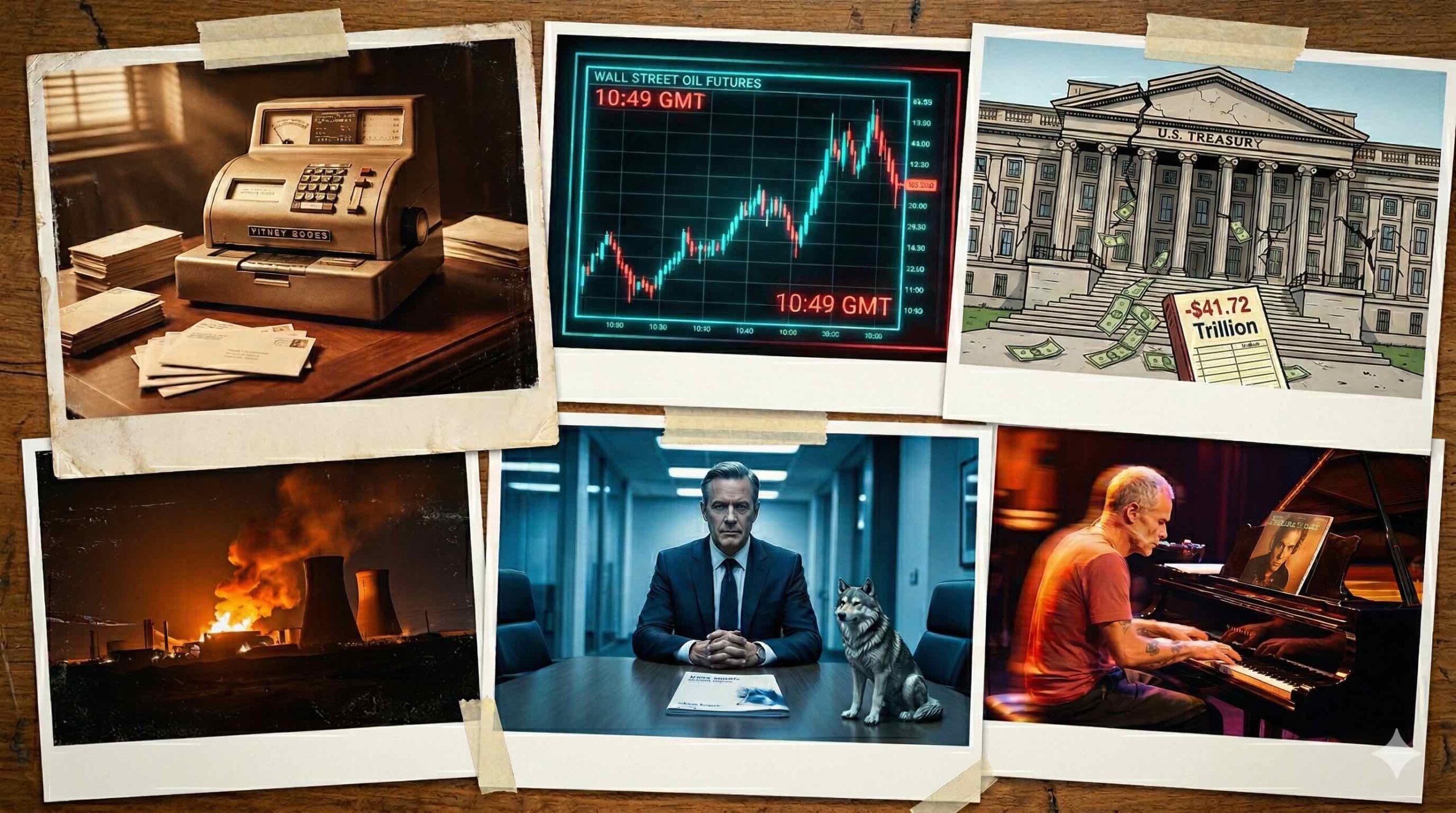
Episode 46 of QAV America opens on Tony Kynaston’s birthday — complete with a QAV cap gift — before Cameron and Tony dig into a week of market chaos, with their main US portfolio down 12% over 30 days but still up an extraordinary 83% since inception in September 2023 versus the S&P’s 42%. The guys tackle the big macro picture, riffing on a Fortune article declaring US government insolvency (liabilities nearly 8x assets), the mysterious $500 million oil futures trade placed 15 minutes before Trump’s Iran announcement, and the aluminum supply chain crisis triggered by Iranian strikes on Middle East smelters. The episode’s centrepiece is Cameron’s Pulled Pork deep dive on Pitney Bowes (PBI) — the century-old postage meter pioneer turned digital shipping play — covering its disastrous Global eCommerce venture, the activist takeover by deep value investor Kurt Wolf of Hestia Capital, and why the stock’s QAV score of 0.16 and solid cash generation make it a compelling cigar-butt turnaround play.
This week’s full episode is for QAV Club members only. The free episode is available below. Also check out our podcast archives link and our pages on Apple Podcasts or Spotify or watch clips on TikTok. Or visit our homepage to learn more about QAV and how it works as a value investing system that you can learn and apply to beat the market.
Transcription
QAV AMERICAN 46 Club
[00:00:00]
[00:00:00] Cameron Reilly: Welcome back to QAV America, episode 46. Tony Eson. How are you?
[00:00:08] TK: Very good. You wouldn’t know it’s QAV with my QAV shirt on and QAV cap on.
[00:00:13] Cameron Reilly: For people that aren’t watching the video feed. Yeah, it’s Tony’s birthday, so I gave him a QAV cap ’cause I ran out of ideas and time. Uh, well, you know, it’s some, it’s something you should be proud of. Your contribution to the world of investing. You’re a given, not a taker. That’s what they said about you in prison anyway.
[00:00:39] Cameron Reilly: Um, that’s what you had to establish yourself. Very early on in Bogger Road, very famous prison in Brisbane where my grandfather actually went and learned to play chess, which was a great thing. It’s become a family tradition now.
[00:00:54] TK: chess or he was there and he learned how to play chess.
[00:00:56] Cameron Reilly: I, that’s the way I sell it. Yeah. He, he thought, where’s the best place I can [00:01:00] learn chess for free?
[00:01:00] Cameron Reilly: I’ll go do, go do two years in Bogger Road.
[00:01:05] TK: Oh, okay. We’re
[00:01:08] Cameron Reilly: Tony.
[00:01:09] TK: before too.
[00:01:09] Cameron Reilly: Yeah, yeah, yeah. I was gonna say it’s a great, and then he started a great family tradition. What gonna prison? No playing chess. Yeah. Well, so far, yeah. Yeah. Breaking and entering.
[00:01:21] TK: Oh, was it? I was gonna say, was it annoying people
[00:01:24] Cameron Reilly: Uh,
[00:01:25] TK: the public?
[00:01:26] Cameron Reilly: you can’t go to prison for that yet, Tony. Um. It’s been a crazy week on the, well, just in the world, um, in the, uh, stock market. Of course, it’s been a crazy week. I think as, uh, we’re recording this, which is the 31st of March, Australian time. The Dow Jones over the last week is down the s and p 500. Over the last week is very much down our portfolios in the us.[00:02:00]
[00:02:00] Cameron Reilly: I can’t get this to gimme a week, but in the last month, our US main US portfolio, the one we’ve been running for a few years is down 12% in the last 30 days versus the s and p down 8%. But for all time, and this goes back to September, 2023, our portfolio is up 83% versus the s and p up 42%. So we’re basically doing double market over the whatever, two and a half years.
[00:02:34] Cameron Reilly: Is that two and a half years? Seven, five, yes. Two and a half years. Which is not too shabby. Um, happy with that. The light portfolio that I’ve started late last year, 22nd and December for the last 30 days is actually up 4% in the last 30 days when everything else is crashing. Yeah. The s and p is down 8%.
[00:02:58] Cameron Reilly: We’re up [00:03:00] 4%.
[00:03:00] TK: Didn’t, uh, happen to trade some oil futures 15 minutes before a major announcement. Do it.
[00:03:04] Cameron Reilly: No, that was not me. Uh, I did buy some oil stocks in this portfolio, though. Uh, so yeah, that’s probably had a lot to do with it all times since, uh, 22nd of December we’re only up 2% versus the s and p down 8%. So, uh, we’re still outperforming, um, some of the big wins. Remember last week we talked about Eastman Kodak.
[00:03:26] TK: Yeah.
[00:03:27] Cameron Reilly: when I checked it was up 21%. Since I added it the previous Monday, it’s come, it came back a bit last night. Now it’s up 12%. I dunno why Kodak dropped overnight, but um, some of the stocks are doing great. Cord energy is up 53% in the light portfolio. Eco petrol is up 21. Murphy Oil, we only talked about it, we added a few weeks ago, is up 21.
[00:03:52] Cameron Reilly: Neighbor Industries. Neighbors Industries, NBR, the um. Uh, energy industry technology [00:04:00] provider firm is up 12%. Geo Park is up 11 SSPW Scripps, we talked about the television stations. Business is up 10%. Um, so yeah, all doing, uh, quite well despite a chaotic market. Um.
[00:04:20] TK: And, and of course, you know, we, we were buying all. Companies before recent spike on the oil price, but it hasn’t, it certainly hasn’t hurt. Um, and these stocks could come back if there’s a breakout of peace and sanity in the, in the world, what, what’s the likelihood of that?
[00:04:41] Cameron Reilly: Yeah, not much chance of that with the current administrations that we have around the world. I think Tony, um.
[00:04:47] TK: I was gonna say is that we are ready for it. If they do come back, we’ve got our sell
[00:04:51] Cameron Reilly: Yeah.
[00:04:52] TK: and procedures, so yeah.
[00:04:54] Cameron Reilly: Yeah. Things have been going, uh, very well despite the [00:05:00] chaos.
Marker
[00:05:01] Cameron Reilly: Trump wants another $200 billion to finish the war that he said was won a month ago.
[00:05:07] TK: Well, all he has to do is, as we know, is to, is to get into the, your market 15 minutes before he posts on true social. And he’s got that, that inflow to do whatever he wants. Yeah.
[00:05:17] Cameron Reilly: I am not sure he is gonna spend that profit on, uh, financing the war. Um. So, yeah, we, you mentioned this article, so I saw this in Fortune the other day, the, this is by Steve Hanky, who’s a professor of Applied Economics at the Johns Hopkins University, and a member of the board of Directors at the Federal Fiscal Sustainability Foundation. He says The treasury just declared the US insolvent. The media missed it. The US government is insolvent. That’s not hyperbole. It’s the conclusion drawn directly from the treasury department’s own consolidated financial statements for fiscal year 2025, released last week to near total media silence. The numbers 6.06 trillion in [00:06:00] total assets against 47.78 trillion in total liabilities as of September 30th, 2025. Importantly, the 47.78 trillion in reported liabilities does not include the unfunded obligations of social insurance programs like Social Security and Medicare. Those are the close separately in the off balance sheet.
[00:06:23] Cameron Reilly: Statement of social infrastructure, consolidated balance sheet position, excluding the SOSI. Deteriorated nearly 2.07 trillion between FY 24 and FY 25, reaching a staggering negative 41.72 trillion. liabilities are now nearly eight times the value of reported assets. The largest drivers were a $2 trillion increase in federal debt and interest payable.
[00:06:54] Cameron Reilly: Now 30.33 trillion and a 438.8 billion increase in federal [00:07:00] employee and veteran benefits payable. Now 15.47 trillion goes on and on and on. But, um, the, sort of the, they break it down into more relatable numbers later on. said most people cannot relate to trillion dollar figures on a government ledger.
[00:07:17] Cameron Reilly: So consider this, this is their, uh, coffee shop analogy. Divide every number by a hundred million. Drop eight zeros in federal finances look like a household budget and free fall. That household earns $52,456 and spends 73,378 running a 20,932 annual deficit. total liabilities in unfunded promises amount to 1.361 million against just $60,554 in assets leaving at 1.3 million in the whole Uncle Sam by any accounting standard is insolvent. Congress has clearly lost control of the nation’s [00:08:00] finances. America is facing a fiscal catastrophe. The reckoning, long deferred is becoming impossible to ignore.
[00:08:08] TK: The coffee shop analogy is the right one to use. Uh, except that misses one important factor, and that is that in the coffee shop that the US government runs, they have a magic printing press in the basement. And uh, they can keep. Funding their liabilities by either printing more money or issuing more debt.
[00:08:28] TK: Um, I, I did a bit of research into this article ’cause it, it’s, it’s always bothered me. Um, and this isn’t the first year the US government’s been insolvent on any sort of balance sheet reckoning. It’s the 29th year that the, um, the, uh, what’s it called? The GOA, the government, whatever the government agency is, that signs off on these accounts has refused to sign off on the account.
[00:08:53] Cameron Reilly: Government accounting office or
[00:08:55] TK: Yeah, that’s it. GAO. So they haven’t signed off on the accounts for 29 years for [00:09:00] the reason that it’s technically insolvent. And again, it, it gets back to this. Cycle of lowering interest rates that, that governments could just keep issuing debt, which became cheaper and cheaper and kicked the can down the road for the day when debt starts to increase.
[00:09:15] TK: And then they can’t service that debt. And so they have to print money, um, to, to help do that. So it’s, it’s not a good situation and it doesn’t mean it’s not gonna go on for another 29 years, but what’s gonna happen at some stages is either gonna be a reckoning, uh, you know, a serious recession or depression when inflation gets really high, when the US currency gets the value.
[00:09:39] TK: Uh, ’cause you can’t keep. Printing money forever without the currency going down in value, or, which is probably the most likely option. There’s another default currency and a better government, um, issuing or a better government, uh, risk in terms of being able to issue bonds, which is probably gonna be China, I would’ve thought, um, down the track.
[00:09:59] TK: And [00:10:00] then the US has some real trouble then because it’s traded on the fact that you can always issue bonds at a cheap or cheaper rate than anybody else, any other government, and its currency is the default world currency that helps prop up this house of cards. Um, and it may continue to for another 10, 29 years, but it, it won’t do it forever.
[00:10:20] TK: Um, so.
[00:10:20] Cameron Reilly: privilege as called it, I think it was the, uh, British Foreign Minister back in the fifties or something, the exorbitant privilege.
[00:10:32] TK: Yeah, and I mean, you compare, I, I compared it to Australia just to see if we were on the same sort of, um, dimension as the US and we’re not. We we’re all along the way, but we’re not as bad. So, uh, in the Australian case, we have total assets of 9 25 0.8 billion total liabilities at approximately 1.570 billion.
[00:10:59] TK: Um, so [00:11:00] negative 644 billion and net debt estimated to be about the same at 587 billion, which is still reasonably high. 20% of GDP. And we are running a deficit, but it’s, it’s the kind of deficit that the government can get back into surplus if it needs to. So it’s not a runaway deficit like the US is. And hence, Australia is one of a small number of countries.
[00:11:22] TK: I think there’s 11 in the world, which still have AAA rating with all three agencies. Um. Around the world. So, you know, standard and pause, uh, Fitch and I’ve forgotten the third one. Uh, but, so that’s countries like Australia, Canada, Denmark, Germany, et cetera, et cetera, Singapore, Sweden. Um, so we’re kind of managing this much better than the US is, but we don’t have the, we don’t have the assets.
[00:11:50] TK: The US has no one’s, you know, our government bonds are more expensive. In terms of what you need to pay as a yield to attract people. Our currency isn’t the reserve currency, so we’ve gotta be more [00:12:00] responsible. Um, when the US kind of starts to lose those privileges as it will one day, then they’re gonna have to be more responsible, but they’re further down the track, and it’s gonna be a real problem for whoever who inherits that.
[00:12:11] TK: Uh, and I remember Warren Buffet going on about this for a long, long, long time, and he, he talked about, uh, the US maxing out its credit card back in the nineties and living beyond its mean. And he had a, he had a, what he called his five minute solution to the problem. He proposed that if the federal deficit exceeds 3% of GDP, all sitting of members of Congress should be ineligible for reelection, which is not a bad solution.
[00:12:38] TK: Um, so yeah, so it’s not a, it’s not an immediate problem, but it’s not a great framework to go forward with.
[00:12:44] Cameron Reilly: that’s like my lie detector for politicians that I’ve been pushing for 20 years.
[00:12:50] TK: Lie detector test?
[00:12:52] Cameron Reilly: You remember that one?
[00:12:53] TK: No. What’s the question gonna be?
[00:12:55] Cameron Reilly: No. It’s always, well, if, um, uh, well, I, I have. [00:13:00] Two, two tests. But one is if you make a campaign promise
[00:13:04] TK: Mm-hmm.
[00:13:04] Cameron Reilly: and then you get elected and you break that promise, you immediately get five years
[00:13:09] TK: You don’t know you. You don’t remember why the politician’s strength is it’s word salad. Right? So you put them on,
[00:13:18] Cameron Reilly: Doesn’t
[00:13:18] TK: did you break this campaign promise? Well, the economy changed. The boils stopped.
[00:13:23] Cameron Reilly: And there’s no excuses. That’s the thing. Did you promise something? Did you deliver on it? No. Five years hard time.
[00:13:30] TK: So then you get election campaigns like we’ve had in the past where the opposition just says no, and that doesn’t develop any policies. A small target campaign.
[00:13:38] Cameron Reilly: That’s okay. Just don’t promise stuff and don’t deliver it. That’s okay. I don’t mind if you don’t promise stuff. Just don’t promise stuff that you can’t deliver on.
[00:13:45] TK: Yeah. Okay. That’s, that’s
[00:13:48] Cameron Reilly: is
[00:13:49] TK: of an issue. But,
[00:13:50] Cameron Reilly: Politicians need to set a lie detector test, once a year they fail five years.
[00:13:56] TK: but the fundamental problem with democracy is [00:14:00] that we, the people don’t set the agenda, right? We should, we should be a board which says, um, we’re gonna have an election. Everyone’s gonna vote. Who can best sort out these problems? And here is a list of the problems they have to sort out. We decided, so we have a referendum first, and we say, you know, there’s only, we are only allowed to vote on 10 issues, top 10 because, and you’ve got four years to fix them.
[00:14:22] TK: And we all agree on the top 10. And then we say, okay, we’re gonna vote for A, B, and C to do that. And in four years time we’re gonna say, here’s a scoreboard, here’s a scorecard. You in all, you’re out.
[00:14:32] Cameron Reilly: Love it. Love it. By the way, it was, uh, the guy who came up with exorbitant privilege wasn’t British, he was French. His, uh, name was, uh, re he was the French foreign Minister in 1965. He, uh, um. Oh, he’s the one who put the specific phrase into the public record. The intellectual architecture behind, behind the critique came from Mabb, [00:15:00] Jacque Ruth, a French economist, an influential advisor to Charles Dega, famously described the American situation as a deficit without tears that the US was the only nation that could run massive trade deficits and pay for them by simply printing its own currency, which other nations were then forced to hold as reserves.
[00:15:19] Cameron Reilly: And that was in 1965.
[00:15:21] TK: Wow. And of course, that’s the other reason why the gold price has been going up is because central banks are buying gold, knowing that at some stage the US is gonna have to print a lot of money to pay its debt or devalue its currency and they don’t want to be holding US dollars, uh, without a. Hedge when that happens.
[00:15:39] Cameron Reilly: Well, and you know, uh, apart from the extra $200 billion that the Trump administration wants to finish the war, he’s already won with Iran. Is, uh, in add that’s in addition to a massive $1.5 trillion base [00:16:00] defense budget or war budget. Now that it’s the Department of War, I guess, for fiscal year 2027, which is a 66% increase over previous levels.
[00:16:09] TK: Well, that was the other thing I noticed in that article when you sent it through about the US deficit, the GAO said the numbers they were using were approximate because they can’t get mon, they can’t get numbers out of them. Ministry of Defense or Ministry of War, whatever it’s called now.
[00:16:23] Cameron Reilly: Yeah.
[00:16:25] TK: So it’s probably a.
[00:16:27] Cameron Reilly: Talking about US issues. Um, this isn’t in my notes, but I, ’cause I just saw it a little while ago. This is in Reuters today. Uh, Iran blows hole in US aluminum supply chain with smelter strikes, with attacks on the two biggest aluminum smelters in the Middle East. Over the weekend, Iran struck at major supplies to the United States of a strategic metal.
[00:16:50] Cameron Reilly: The world’s biggest economy does not produce nearly enough of domestically. Analysts said the weekend disruption from the Iran War centered around the difficulty of [00:17:00] shipping aluminum and raw materials through the strait of mush, which has been effectively closed by Teran. But on Saturday, Emirates Global Aluminum said it’s roughly 1.5 million metric ton per year. Al we last site in Abu Dhabi had sustained significant damage from Iranian attacks. Aluminum. Bahrain said it’s 1.6 million ton per year plant was targeted on the same day. the US um, only produces about 40% of the, uh, aluminum that it needs every year. And aluminum prices lept 6% to $3,492 a ton, close to a four year high. So we may see, um, aluminum stocks back
[00:17:47] TK: Yeah.
[00:17:48] Cameron Reilly: buy list very soon.
[00:17:50] TK: Capra comes to mind,
[00:17:51] Cameron Reilly: Uh
[00:17:53] TK: but um, like it’s again, just a, another one of these shortsighted issues and it’s Trump’s been, you know, [00:18:00] walking around like a rooster saying, well, we don’t need oil from the Middle East. Haha, you can fix it Europe, but it’s, but there, oil isn’t the only thing that comes outta the Middle East.
[00:18:10] TK: And I remember going to Dubai for a, a holiday and seeing the huge aluminum smelter on the side of the coast there. Um, yeah, I can’t remember the exact details, but there was like a desal plant, which of course they need, and a huge elec electricity, uh, generator, um, which both an aluminum smelter and a desal plant knee.
[00:18:33] TK: So they put them side by side and stuck a generator next to them. Um, and uh, yeah, it was big. Let me tell you, it was like a big refinery.
[00:18:42] Cameron Reilly: I am, uh, aluminum’s already a buy on our buy list. So, yeah, I, I did see a couple of stories in the news this morning that Trump’s number one strategic objective in Iran now is to open the Strait of ous. So the thing that the war created is now the number one strategic objective of the [00:19:00] war. His war blocked it. Now he needs to open it.
[00:19:05] TK: Well it’s, that was, I was gonna make that point, but when moved on, when you were reading the article out, it said, when Iran, since Iran closed the Straits F on war, I’m thinking they didn’t close it. It was the US and the Israel that closed it.
[00:19:18] Cameron Reilly: Yeah. Oh dear me.
[00:19:22] TK: There’s also been, there’s also a debate around CAA about whether Bo site was the relevant commodity or aluminum.
[00:19:28] Cameron Reilly: Right
[00:19:29] TK: ‘ cause aluminum itself isn’t really a commodity, it’s the output of refining bulk site. Yeah.
[00:19:34] Cameron Reilly: Yeah. Right. August last year looks like it was the last time it was on our buy list. Well, fun and games. Uh, the other story, of course is uh, traders bet $500 million on oil price just before Trump’s post on delay to Iran attack traders bet heavily on crude 15 minutes before Trump announced delay to attack [00:20:00] oil prices plunged 15% after Trump’s post on Iran talks. Yes. I wonder who that could have been that had 15 minutes warning
[00:20:14] TK: I wonder. But um, the interesting thing is it’s, that happened, it’s almost a week ago now. Not quite. Perhaps it was a week ago. I think it was this, this time last week we were talking about it. Um, and no one knows who benefited, like.
[00:20:29] Cameron Reilly: Yeah.
[00:20:29] TK: It’s on, it’s on a publicly traded platform, probably nymex, which is where the US WTI, um, works.
[00:20:38] TK: West Texas. Intermediate oil gets traded. Uh, so open platform, it’s, it’s not like someone ducked into a alleyway and saw a guy in a fedora and sunglasses and the raincoat who said, you wanna buy some oil. It’s like, it’s on a public platform. Buyer and seller. Someone needs to know who’s on both sides of those trades.
[00:20:59] TK: Now [00:21:00] there’s probably, there’s probably privacy issues. Like I get that, but ha has reporting sunk to such a low debt that no one can work out who actually benefited from that trade.
[00:21:11] Cameron Reilly: Don’t worry Tony to Donald Trump has his best people looking into it right now.
[00:21:16] TK: That’s why we don’t know after a week.
[00:21:18] Cameron Reilly: It’s like trying to get information out of, uh, the Pentagon where all the money’s going. Don’t worry about it. We’ll get
[00:21:25] TK: Yeah.
[00:21:26] Cameron Reilly: that. Yeah, we’ve got our best people. Our best people are working on it.
[00:21:29] TK: Hey, by the way, going back to those, um, US accounts, hasn’t Doge made a big difference to the cost base?
[00:21:35] Cameron Reilly: Yeah. Fantastic. Doge. Such a win.
[00:21:38] TK: Mm. Winning.
[00:21:40] Cameron Reilly: the oil price, Dr. Was at $97. It dropped down to 88. It’s now $102 50. This is, uh, WTI.
[00:21:49] TK: Yeah. Right.
[00:21:50] Cameron Reilly: whoever shorted it got out pretty quickly because it didn’t stay down for very
[00:21:55] TK: It didn’t, did it? No, that’s right. Well, I think they were selling, so [00:22:00] they didn’t, I don’t, I think the story is they sold their, their holdings of oil. So that’s the other thing too, like, again, it shouldn’t be too hard for someone to dig into the paperwork and find out who holds that much oil to sell.
[00:22:13] TK: Narrow it down, dig around and find out who benefited, where’s, where’s wood and Bernstein these days.
[00:22:19] Cameron Reilly: They sold futures. LSEG data shows that between 10 49 and 10 50 GMT traders placed bets on 5,100 lots of Brent and WTI crude futures worth well over 500 million based on a Reuters calculation.
[00:22:35] TK: Okay, so maybe they didn’t have o Oftentimes a professional unit trading a commodity like that in the futures will have some kind of real asset backing in case it goes south. Um, but they can do it what’s called a naked trade and do the futures without that commodity backing. But either way, there’s a paper trail.
[00:22:53] Cameron Reilly: yeah.
[00:22:53] TK: How, how do you know you’re gonna get paid if you don’t know who the counterparty is
[00:22:57] Cameron Reilly: Yeah. Yeah, yeah, [00:23:00] yeah, yeah, yeah, yeah,
[00:23:01] TK: or somebody doesn’t know who the counterparty is?
[00:23:03] Cameron Reilly: Well, the United States Securities and Exchange Commission when asked about this, declined to comment, and the Commodity Futures Trading Commission was not immediately available for comment. So it’s just No comment. Tony
[00:23:19] TK: Everyone knows which side of the bread their butters on in the US, don’t they?
[00:23:23] Cameron Reilly: No idea what’s going on. Uh,
[00:23:26] TK: We’re looking into it so we can do it ourselves next time. So bugger off.
[00:23:30] Cameron Reilly: We’re gonna have a, we’re gonna have a complete investigation
[00:23:33] TK: Yeah,
[00:23:34] Cameron Reilly: this. Uh,
[00:23:36] TK: time.
[00:23:37] Cameron Reilly: the, uh, chairman of the, uh, SEC is a chap by the name of Paul Atkins. Paul Atkins, uh, was appointed or nominated by President-Elect Trump December, 2024. And, uh, yeah, so, you know, I’m [00:24:00] sure he is. I’m sure he is doing a great job. Great job.
[00:24:03] TK: Well, I’m sure he is too de, depending on your perspective. Profiting from chaos. That should be the title.
[00:24:09] Cameron Reilly: Oh, that’s, well, yeah, that’s pretty good. So today, Tony, in my deep dive, my pulled pork, I’m talking about a company called Pitney Bows, which I feel like I’ve heard of.
[00:24:24] TK: Yeah, we have,
[00:24:25] Cameron Reilly: Have we? Oh,
[00:24:26] TK: I have, oh yeah, it’s,
[00:24:27] Cameron Reilly: okay.
[00:24:28] TK: um, supplies and I think in the past paper, I’m, I’m gonna look it up, but I wouldn’t mind betting it was the basis for the office. The sitcom,
[00:24:40] Cameron Reilly: The British show.
[00:24:42] TK: well, originally British, but uh, now Amer the American version. I’m just gonna see what
[00:24:48] Cameron Reilly: I think the British version was the inspiration for the American version.
[00:24:52] TK: Yeah, it was, but I wouldn’t be
[00:24:54] Cameron Reilly: I don’t think they were a paper supplier though. These guys, they’re, um. Mostly male sorting. [00:25:00] Anyway, if you’d asked me before I did this, what they, what Pitney bows did, I would’ve said toilet paper. So I would’ve been, uh, not in tissues.
[00:25:08] Cameron Reilly: So I would’ve like Kleenex. I would’ve been completely wrong. Anyway, they’re listed on the New York Stock Exchange, uh, market cap of about $1.63 billion. Their website says Pitney Bows is a technology driven company that provides digital shipping solutions, mailing innovation, pre-sort mailing services with a nationwide.
[00:25:30] Cameron Reilly: Footprint across the United States and financial services to clients around the world, including more than 90% of the Fortune 500 small businesses to large enterprises and government entities rely on Pitney bows to reduce the complexity, increase the security, and eliminate the potential for fraud in the sending of mail.
[00:25:49] Cameron Reilly: And parcels wonder if they include electoral votes, postal votes.
[00:25:56] TK: Dun, the Mifflin was. The name of the office in the us [00:26:00] so
[00:26:00] Cameron Reilly: right.
[00:26:00] TK: it is a paper company though, so it may not be based on the ChatGPT says that neither was based on a specific company.
[00:26:07] Cameron Reilly: Right. So Pitney Bowes has been around since 1920, founded by Arthur Pitney, the inventor of the first commercially available postage meter. He merged forces with Walter Bows of the Universal Stamping Machine Company. Now, um, interesting backstory with these guys. Pitney had worked as a clerk in a wallpaper store where he identified a problem that was costing his firm time and money.
[00:26:40] Cameron Reilly: Fixing postage stamps to hundreds of envelopes. And it also led to stamp theft apparently. So he was like, there’s gotta be a better way of putting stamps on envelopes.
[00:26:52] TK: Well, I don’t know about you, but I’m old enough to remember the franking machines. Do you, you ever use one of those in an office?
[00:26:58] Cameron Reilly: I did, and I’m glad you [00:27:00] mentioned that because do you know where the word franking machine comes from? Why it’s called a franking machine?
[00:27:05] TK: It was what? Either Pitney or Mr. Pitney or Mr. Bows called Frank.
[00:27:10] Cameron Reilly: If you, if you look it up in Wikipedia, as I did, it says there was a guy called Edward Franks, whose real name was Engel Franken mla, who was a Norwegian inventor who invented the franking machine and had the Franking Machine of America and blah, blah, blah, blah, blah. Then Gemini says, yeah, that’s a myth he never invented.
[00:27:36] Cameron Reilly: There’s no, no evidence of a Franking Machine of America company ever existed. It’s a myth that has been around for a long time and it keeps popping, getting back into, keeps getting removed from Wikipedia, keeps getting put back in, keeps getting removed. It.
[00:27:52] TK: So Wikipedia hallucinates as well, does it
[00:27:55] Cameron Reilly: Well, the people who write things in Wikipedia, halluc, but it is in books, so [00:28:00] there, his name appears in books. Somebody reads a book, they go and add it to Wikipedia, but it’s according to Gemini anyway, and I checked it in a couple of places. Yeah, it’s not true. I checked it in, I did my Dave verification in Grok and um, and, uh, Claude and they both said this is, uh, true.
[00:28:18] Cameron Reilly: So, uh, franking comes from the word Franks. Which means free in Latin, but it means free in Latin. As in, uh, do you mind if I speak frankly, Tony for a second? Means freely, right? Comes from the same route.
[00:28:31] TK: Yeah. Right.
[00:28:32] Cameron Reilly: It comes because the Franks, the Germanic people who conquered Gaul modern France in the fifth century, they were the ruling class and they were the only class that had full civic rights and were free from the obligations of the rest of the citizens, their Gallo, Roman population.
[00:28:54] Cameron Reilly: And by the 12th century, the name of the tribe had become synonymous with the status of being a [00:29:00] free man. I’m a frank, so I’m free. So yeah, the, the word sort of evolved into Frank, meaning free, frankly, Frank King. Yeah. So in Old French, uh, Frank meant free So. Uh, in the 17th century, it began to get used, I think it was like 1660, the right of certain officials in England, members of Parliament to send mail for free.
[00:29:31] Cameron Reilly: They would sign their name on the envelope to Frank. It.
[00:29:34] TK: Ah, okay.
[00:29:35] Cameron Reilly: Indicating that it was exempt from postage, and then it eventually shifted to the privilege of free mail and the physical act of marking or stamping any mail to show that postage had been paid. You had the franking machine in the context of the Australian tax system, which will mean nothing to American listeners, but for Australians.
[00:29:57] Cameron Reilly: We know that we have franked credits, [00:30:00] franking credits, CEO of Frank Dividend, where a company’s already paid, uh, corporate tax on their profits so you don’t have to pay, uh, additional taxes on the profits. By the way, diesel, I did a deep dive on diesel and the history of diesel the other day and was surprised to learn that it was named after its inventor, Rudolph Diesel, and he’s not a meth.
[00:30:24] Cameron Reilly: Apparently. Rudolph Diesel was not a myth.
[00:30:27] TK: Not and, and not diesel, the guitar player.
[00:30:30] Cameron Reilly: Johnny Diesel. Yeah, I thought that’s where I was gonna say, yeah. Johnny Diesel, Australian. Pop star from the eighties. Um, Walter Bowes, the second part of Pitney Bowes was an English born salesman. In 1908, he was selling check endorsing machines. A year later, he bought the Universal Stamping Machine Company, and within a few years had established relationships with the US Postal Service, providing stamp canceling machines to them on a rental basis.
[00:30:58] Cameron Reilly: While he was [00:31:00] successful, he felt that postage stamps would soon become obsolete. And guitar bands were on their way out as a record producer Told the Beatles in 1963. He thought that we should be a more automated way to apply postage, and a postal office worker suggested he contact Arthur Pitney, who had been working on a device for nearly 20 years.
[00:31:22] Cameron Reilly: They met in 1919. Pitney had already invested $90,000 in his business, but the patents were expiring, and his company, the American Postage Meter company, wasn’t doing very well, so they merged. The two companies together came up with the Pitney Bows postage meter company, built on the idea that businesses would pay to automate their mail.
[00:31:46] TK: Well, it’s not a big stretch from going from a machine, which stamps a stamped to say it’s been used to which stamps a letter to say the postage has been paid. It’s sort of
[00:31:58] Cameron Reilly: Yeah.
[00:31:59] TK: really, isn’t it? [00:32:00] Yeah.
[00:32:00] Cameron Reilly: Simple idea to solve what was a big problem.
[00:32:02] TK: Yeah.
[00:32:03] Cameron Reilly: Pitney was the inventor. Bows concentrated his activities lobbying in Washington for the passage of LE legislation that would open the door for the postage meter. In 1920. A year after they merged the United States Congress passed the enabling legislation and the first piece of metered mail, which was a letter from bows to his wife, was posted on December 10th, 1920.
[00:32:30] TK: So all this talk of postage reminds me of the old Dave Letterman. Choke, which you can edit out if you need to, about, uh, about LA issuing a stamp to celebrate the, the hookers on the boulevards. And it’s a 25 cents stamp, but it’s a dollar 20 if you lick it.
[00:32:47] Cameron Reilly: David Letterman said that.
[00:32:50] TK: I
[00:32:50] Cameron Reilly: Really? Wow.
[00:32:52] TK: with someone like that. Yeah.
[00:32:53] Cameron Reilly: Good joke.
[00:32:54] Cameron Reilly: Oh, I’ve got so many, so many jokes I could move into now, but I shouldn’t. Tell you off [00:33:00] air by 19 22, 400 meters were in service accounting for more than 4 million in postage. They went public on the New York Stock Exchange in 1950, but sadly, the partnership didn’t work out very well. They, they hated each other, had a dispute in 1924, they’d only been together for five years.
[00:33:20] Cameron Reilly: Pitney resigned. And said that the creation of the whole thing in his efforts brought him very little joy. Bows got no joy out of it either. Pitney suffered a stroke in 1927 and died in 1933. A 1939 article in time notes that Walter Bowser’s nervous, restless, he hates a desk in office hours, prefers to putter about his home.
[00:33:45] Cameron Reilly: He ended up spending most of his time racing yachts and horses. So he is your kind of guy. In 1929, he sailed his six meter sima to an international yachting championship. So there you go. Didn’t wanna work for a living, would race horses [00:34:00] and sail yachts. He was a man of after your own heart.
[00:34:03] TK: Yeah. Well, based on Frankie.
[00:34:05] Cameron Reilly: Yeah. So the core business of Pitney Bowes today, um, basically they’re the unglamorous plumbing of American Business Mail.
[00:34:14] Cameron Reilly: If FedEx is the company that delivers things to your door, these are the back office guys that sort it and meter it and route it. Uh, they tried to go into business against FedEx, didn’t work out too well. I’ll tell you that story in a minute. They make their money. Sorry.
[00:34:30] TK: gonna say, just before you leave that topic, I mean, this is a bit like a broadcast TV station. It, it’s, it can’t be year on year. There’s gotta be less letters in circulation. I mean,
[00:34:41] Cameron Reilly: There is. There are.
[00:34:43] TK: Den Denmark or somewhere has stopped delivering letters. Doesn’t,
[00:34:46] Cameron Reilly: Have they?
[00:34:47] TK: post post delivery anymore.
[00:34:48] TK: Yeah.
[00:34:48] Cameron Reilly: Well, there was some talk of Australia Post doing that a couple of years ago too. It’s
[00:34:52] TK: to every second day now, aren’t they? Mm-hmm.
[00:34:55] Cameron Reilly: they’re bleeding money.
[00:34:57] TK: Yeah.
[00:34:58] Cameron Reilly: It’s probably ’cause the [00:35:00] CEO was. Buying gold watches for everybody or something. Can’t remember what that scandal was, but it was a scandal a year or so ago.
[00:35:06] TK: The
[00:35:07] Cameron Reilly: That was it.
[00:35:08] TK: Yeah. Cartier watches.
[00:35:09] Cameron Reilly: Gold watches
[00:35:11] TK: Yeah. And do you have a good re
[00:35:13] Cameron Reilly: you get a QAV hat, so come on. Like that’s your bonus for the year. You get a QAV hat.
[00:35:21] TK: Yeah. Any company watching or listening to this podcast can send me their hat and I’ll wear it.
[00:35:26] Cameron Reilly: Oh, okay. Yeah. Had a week. That’s good.
[00:35:29] TK: included
[00:35:30] Cameron Reilly: Yeah, so the, here’s the. Lemme take you through the key segments of Pitney Bows. So Send Tech is the main engine room of the business. Imagine you’ve got a mid-size business, like a law firm. Every day you’re mailing off invoices, legal notices, correspondence, instead of buying stamps at the post office, having somebody lick them.
[00:35:56] Cameron Reilly: Stick ’em on. You have a Pitney bows machine sitting on a [00:36:00] desk. It weighs the envelope. They kind of, I saw, like, I’ve never seen one of these things in real life, but I saw a photo of one on Wikipedia. I think it looks like a fax machine or a photocopier. Weighs the envelope. Prints the exact postage. Like I haven’t worked in an office for 25 years.
[00:36:15] Cameron Reilly: People cut me some slack when I last worked in an office. We had fax machines. No, I don’t know. I do remember the fact we’ve talked about this before. I remember when I worked at Citibank where your wife was working at the same time in the same office or the same building
[00:36:30] TK: Wow.
[00:36:31] Cameron Reilly: 20 years before we knew each other.
[00:36:33] Cameron Reilly: Um, my floor, I think it was my floor, had a telex room enclosed in glass telex, operators in there with lab coats and white gloves. Um, you, you weren’t allowed to go into the room. You had to write your telex and put it in an in tray and they’d come and get it and they’d go in there and they’d type it in.
[00:36:55] Cameron Reilly: And then I remember when we got our first fax machine and we were like, ho, ho [00:37:00] we, we have, we have the power.
[00:37:03] TK: Can’t wait for somebody else to buy another one.
[00:37:05] Cameron Reilly: Yeah, well there was someone in New York, in Citibank, in New York that had another one, so we were email, uh, faxing the people in New York. It was a big thing. You could send your own messages and they’d get it within a couple of minutes.
[00:37:20] Cameron Reilly: In New York, it was crazy. Uh, anywho. So, uh, these things weigh the envelope, print the exact postage directly onto it, and then deduct that amount from a prepaid account. You don’t have to go to the post office. No overpaying a stamp, licked or not. They lease these machines and charge a monthly fee, plus a small margin on every dollar of postage that flows through the device.
[00:37:47] Cameron Reilly: So literally punching the card every time it goes through. It’s the original, maybe punch the card business model. And they do this for over 90% of Fortune [00:38:00] 500 companies and hundreds of thousands of small to medium sized businesses. And it’s obviously
[00:38:08] TK: though mails in decline, it’s still a very big business, isn’t it?
[00:38:10] Cameron Reilly: huge and it’s not. Disappearing. I mean, it’s been declining for years, but it’s not disappearing overnight. And it’s a recurring revenue model. Basically a software as a service business from the 1950s.
[00:38:24] TK: Well, the other thing too is like in Australia, we do a lot more digitally than, uh, compared to when I was living in Canada six or seven years ago,
[00:38:32] Cameron Reilly: Hmm.
[00:38:32] TK: may have changed, but like, um, there was no, uh, account to account. Payment available in Canadian banking. So like if you wanted to pay your rent, you wrote a check to the landlord and posted
[00:38:44] Cameron Reilly: my God.
[00:38:45] TK: yeah. So like mail was still a big thing or
[00:38:49] Cameron Reilly: Yeah.
[00:38:49] TK: there? Yeah.
[00:38:50] Cameron Reilly: Hmm. I remember when, um, you know, Chrissy and I would go visit her mother. Um. Before she had Alzheimer’s, um, 10 years ago, [00:39:00] uh, in Utah, and she was still writing checks for everything and sending ’em off to pay bills coming from Australia. That was like, what,
[00:39:07] TK: haven’t, I
[00:39:08] Cameron Reilly: nine?
[00:39:09] TK: in I don’t know how many
[00:39:10] Cameron Reilly: Yeah. 1985. Called Wants your checks back.
[00:39:16] Cameron Reilly: Um, so revenue’s obviously been declining as physical mail volumes fall, but the cash conversion is really, really solid. They also hold the PB Bank, which manages $575 million in client deposits. The. So clients park money in the deposit account, in the postage account, and they earn float interest on that, uh, while they’re waiting for people to spend it on stamps.
[00:39:42] Cameron Reilly: So I’m surprised BRK hasn’t bought this in the past and, uh, added it to the Geico float business. You know,
[00:39:52] TK: Yeah.
[00:39:53] Cameron Reilly: maybe 575 million’s, not big enough for Warren to be interested in. The other sort of the [00:40:00] business is what’s called pre-sort, which is like pre-crime In minority report, they can tell you before you even.
[00:40:12] Cameron Reilly: Put something in an envelope, what you’re gonna be putting in it. No, pre-sort is, uh, pretty clever. Uh, so the US Postal Service apparently offers huge discounts to mailers who pre-sort their mail by zip code before handing it over. ’cause it saves the USPS labor costs.
[00:40:31] TK: Mm-hmm.
[00:40:32] Cameron Reilly: The more mail you pre-sort, the bigger the discount.
[00:40:36] Cameron Reilly: But the discount tiers require huge volumes that most individual businesses can’t get to by themselves. So Pitney Bows acts as an aggregator. They pre-sort the mail, they get the discount, they pass some of that onto the businesses. And you know, it’s a great business, right? They can do it in volume. Yeah.
[00:40:58] Cameron Reilly: Really clever. It [00:41:00] is like an arbitra, a log logistics arbitrage play. Um, that
[00:41:05] TK: when I, when I ran a company called My Direct, we had a pre-sort, um, system. It’s like a whole series of conveyor belts and gates that open and close to
[00:41:15] Cameron Reilly: Wow,
[00:41:15] TK: into
[00:41:16] Cameron Reilly: that was 30 years ago.
[00:41:18] TK: Yeah.
[00:41:18] Cameron Reilly: years ago. Yeah.
[00:41:20] TK: Australia Post trucks, depending on where they were going. And then we
[00:41:22] Cameron Reilly: Wow.
[00:41:23] TK: a the rate for doing that.
[00:41:25] TK: Yeah.
[00:41:26] Cameron Reilly: Look at you. You know, all of this stuff. You’ve been around. Oh, hold on. Here’s my, uh, green smoothie delivery service. Thank you, ma’am. It’s not very green. We still had a spinach. Yeah. Mm. Don’t mind me. Well, I get my protein shake. So that’s a bit of a moat. I think this pre-sort thing. Um, again, it’s gonna be declining, but it’s a great, great little business.
[00:41:52] Cameron Reilly: They did have a business division called Global e-Commerce, GEC, which is dead. And this was [00:42:00] their attempt to compete with UPS and FedEx in the last mile delivery. Um, Claude called it one of the more,