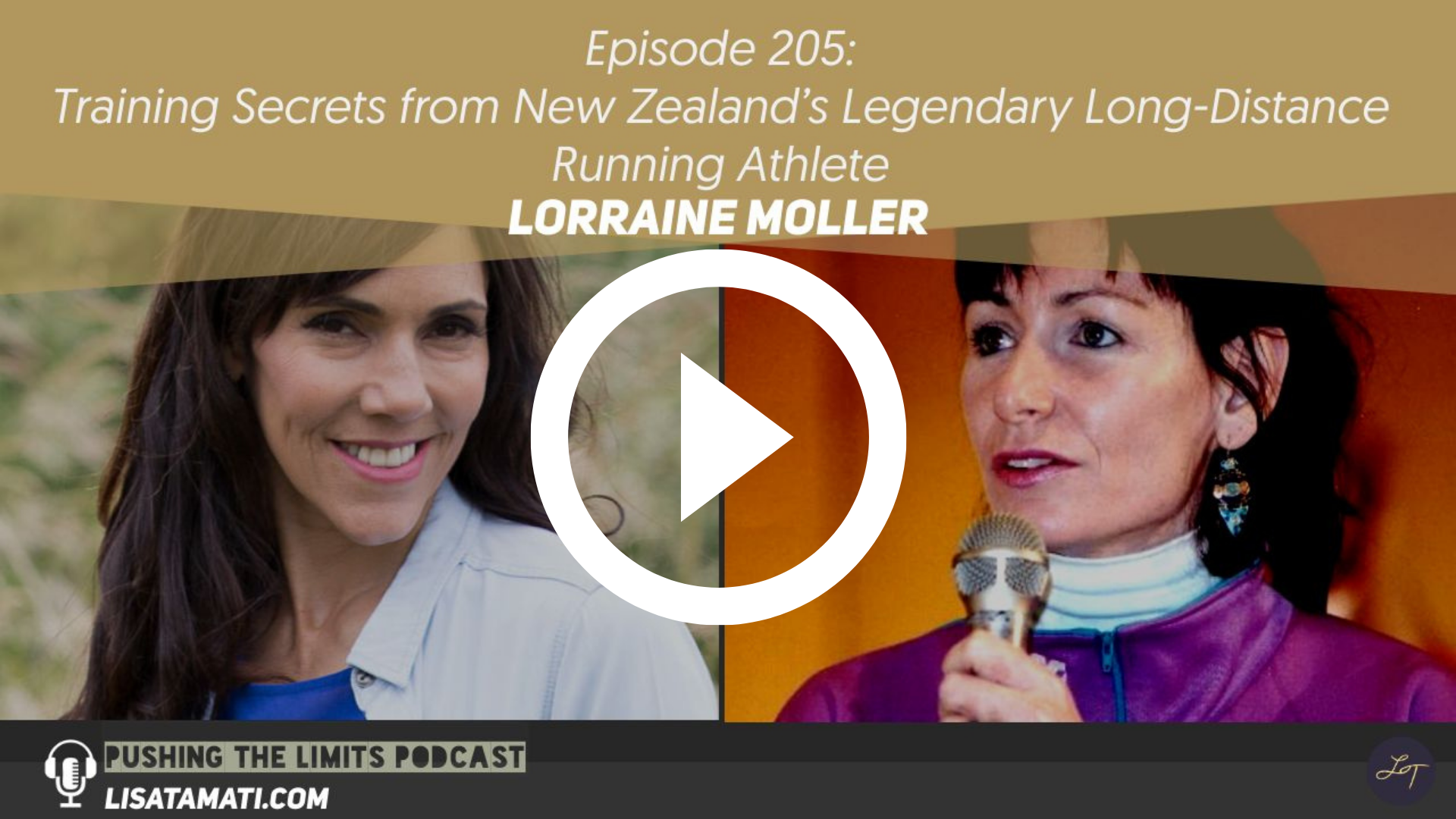
Training Secrets from New Zealand's Legendary Long-Distance Running Athlete with Lorraine Moller
Audio is streamed directly from the publisher (dts.podtrac.com) as published in their RSS feed. Play Podcasts does not host this file. Rights-holders can request removal through the copyright & takedown page.
Show Notes
You've heard it before: go hard, go long. But do we need to go hard all the time? Many people think that harder is better. However, overtraining and overexertion can reduce your gains and also be detrimental to your long-term health. Let go of this mindset and take on a healthier view of your body.
Legendary long-distance running athlete Lorraine Moller joins us in this episode to talk about how training and racing should not be about winning at the expense of your own body. It's all about your personal journey of learning more about yourself and growing from it. With the Lydiard approach, Lorraine shares how her career was mostly injury-free. Her body's performance is stellar, proving the merits of her training!
If you want to know how you can adopt a holistic approach to your training, then this episode is for you.
Get Customised Guidance for Your Genetic Make-Up
For our epigenetics health program, all about optimising your fitness, lifestyle, nutrition and mind performance to your particular genes, go to https://www.lisatamati.com/page/epigenetics-and-health-coaching/.
You can also join their free live webinar on epigenetics.
Customised Online Coaching for Runners
CUSTOMISED RUN COACHING PLANS — How to Run Faster, Be Stronger, Run Longer Without Burnout & Injuries
Have you struggled to fit in training in your busy life? Maybe you don't know where to start, or perhaps you have done a few races but keep having motivation or injury troubles?
Do you want to beat last year's time or finish at the front of the pack? Want to run your first 5-km or run a 100-miler?
Do you want a holistic programme that is personalised & customised to your ability, goals, and lifestyle?
Go to www.runninghotcoaching.com for our online run training coaching.
Health Optimisation and Life Coaching
If you are struggling with a health issue and need people who look outside the square and are connected to some of the greatest science and health minds in the world, then reach out to us at [email protected], we can jump on a call to see if we are a good fit for you.
If you have a big challenge ahead, are dealing with adversity, or want to take your performance to the next level and want to learn how to increase your mental toughness, emotional resilience, foundational health, and more, then contact us at [email protected].
Order My Books
My latest book Relentless chronicles the inspiring journey about how my mother and I defied the odds after an aneurysm left my mum Isobel with massive brain damage at age 74. The medical professionals told me there was absolutely no hope of any quality of life again, but I used every mindset tool, years of research and incredible tenacity to prove them wrong and bring my mother back to full health within three years. Get your copy here: https://shop.lisatamati.com/collections/books/products/relentless.
For my other two best-selling books Running Hot and Running to Extremes, chronicling my ultrarunning adventures and expeditions all around the world, go to https://shop.lisatamati.com/collections/books.
Lisa's Anti-Ageing and Longevity Supplements
NMN: Nicotinamide Mononucleotide, an NAD+ precursor
Feel Healthier and Younger*Researchers have found that Nicotinamide Adenine Dinucleotide or NAD+, a master regulator of metabolism and a molecule essential for the functionality of all human cells, is being dramatically decreased over time.
What is NMN?
NMN Bio offers a cutting edge Vitamin B3 derivative named NMN (beta Nicotinamide Mononucleotide) that can boost the levels of NAD+ in muscle tissue and liver. Take charge of your energy levels, focus, metabolism and overall health so you can live a happy, fulfilling life.
Founded by scientists, NMN Bio offers supplements of the highest purity and rigorously tested by an independent, third party lab. Start your cellular rejuvenation journey today.
Support Your Healthy AgeingWe offer powerful, third-party tested NAD+ boosting supplements so you can start your healthy ageing journey today.
Shop now: https://nmnbio.nz/collections/all
- NMN (beta Nicotinamide Mononucleotide) 250mg | 30 capsules
- NMN (beta Nicotinamide Mononucleotide) 500mg | 30 capsules
- 6 Bottles | NMN (beta Nicotinamide Mononucleotide) 250mg | 30 Capsules
- 6 Bottles | NMN (beta Nicotinamide Mononucleotide) 500mg | 30 Capsules
Our premium range of anti-ageing nutraceuticals (supplements that combine Mother Nature with cutting edge science) combats the effects of aging while designed to boost NAD+ levels. Manufactured in an ISO9001 certified facility
Boost Your NAD+ Levels — Healthy Ageing: Redefined- Cellular Health
- Energy & Focus
- Bone Density
- Skin Elasticity
- DNA Repair
- Cardiovascular Health
- Brain Health
- Metabolic Health
My 'Fierce' Sports Jewellery Collection
For my gorgeous and inspiring sports jewellery collection, 'Fierce', go to https://shop.lisatamati.com/collections/lisa-tamati-bespoke-jewellery-collection.
Here are three reasons why you should listen to the full episode:
- Learn how the Lydiard approach to training is a safer and healthier way.
- Discover the ways we can achieve peak performance and how to remove the obstacles towards it.
- Understand the ways your body adapts and why it's essential to listen to it.
Resources
- Gain exclusive access and bonuses to Pushing the Limits Podcast by becoming a patron!
- Harness the power of NAD and NMN for anti-aging and longevity with NMN Bio.
- On the Wings of Mercury by Lorraine Moller
- Listen to other Pushing the Limits episodes:
-
- Episode 27 - Gary Moller - Functional Nutrition Consultant, Elite Age-Level Mountain Biker
- Episode 189 - Understanding Autophagy and Increasing Your Longevity with Dr Elena Seranova
- Episode 183 - Sirtuins and NAD Supplements for Longevity with Dr Elena Seranova
- Episode 194 - Inside the Mind of New Zealand Olympic Runner Rod Dixon
- Connect with Lorraine: Lydiard Foundation | Email
Episode Highlights [05:19] Lorraine's Background
- Lorraine grew up naturally active and part of nature. She was engaged in the community and local athletics.
- At some point, Lorraine became more interested in her school running events and just kept going.
- During the 60s and 70s, being a professional athlete wasn't a career choice. It was commonly discouraged and seen as for men.
- When Lorraine's talent was discovered, she was brought to a neighbouring town to train. She competed against women a lot older than her.
- By 16, Lorraine was representing New Zealand. Listen to the full episode to learn about Lorraine's running journey!
- The Lydiard approach to training is primarily based on endurance training.
- Building your aerobic capacity is the core of the Lydiard approach.
- In a way, Lydiard is the father of periodisation. He found what worked and incorporated it into training.
- Lorraine shares that you need to understand the principles first then apply your own perspective in training.
- Some people get lost when looking at the details. You need to know the overall picture first.
- When you don't understand the overall picture, you may overshoot the mark and get burnt out.
- We have a culture that thinks more is better.
- But training can give you more than the capacity to win.
- It's really about the inner journey taking place and what you're learning along the way.
- As you're growing, you are influenced by external factors like other people's expectations.
- But you'll also reach a point where you start dismantling these expectations to uncover your true self.
- Running was a choice Lorraine made for herself. Through this, she developed a deep connection with her father.
- When Lorraine didn't do that well, she kept things in perspective.
- She always came back to being in love with the journey of the race.
- In Lorraine's experience, long-distance running doesn't make you slower.
- You'll need to do the work to run faster, but long-distance running lets you sustain your fastest possible pace.
- The body responds to whatever stimuli it receives, which is why a holistic approach is vital for achieving the best results.
- The Lydiard training, for example, has different phases for training that consider more than just your endurance.
- Don't neglect the foundational elements of mobility, coordination, and strength.
- The Lydiard training first started with helping people with cardiac problems fit enough to finish a marathon.
- The approach is considerably different from the ones professional athletes consider. But, the Lydiard training is safer long-term.
- People can adapt to different situations. You can direct your body into what you want to be.
- Pay attention to your body, especially when it gives danger signals. Learn to back off and give yourself recovery time.
- Burnout and overtraining usually come from a lack of confidence and trust in your own body.
- Hard work is redundant. Things don't have to be hard — just do the work!
- Lorraine feels a state of flow and happiness in races. The flow state is peak performance manifesting as coordination of body, heart, mind, and spirit.
- People often don't reach this state of flow because of tension and excess energy.
- If you don't give yourself time to rest when your body needs it, it will become detrimental to your health over time.
- You need to identify the fine line between putting your body under strain to get stronger versus pushing it until you break.
- People need challenges and goals no matter their age.
- Invite new experiences and learnings into your life.
- Don't let age stop you from living your best life.
- As we get older, we also accumulate more wisdom.
- Society needs to acknowledge the value of elders more from that perspective.
- You don't need to be perfect; you just need to inch your way forward on your own time.
- There is a way back even if you've beaten your body with overtraining.
- Your body is strong enough to regenerate itself.
7 Powerful Quotes from this Episode
'What I did with the Lydiard system was look at what were the principles, not looking at the hard and fast rules. Because as soon as you start looking at rules you have limited yourself, and it doesn't work that way. It's an experiment of one. Your journey as an athlete is completely unique.'
'I think the journey of the athlete is a wonderful way to get to know yourself and to be able to tap that in the knowledge and to learn.'
'That's the beauty I think of the Lydiard training is that It is holistic. It puts all the energy systems and every type of training response in its rightful place. So that you can be at your peak on the day that it counts.'
'And that's why you go on principles. So you look at what you're trying to achieve, and then how best to achieve it based on the level of that person.'
'You want a cooperative relationship with your own body and it will give you the information that it has and which is better than if you're trying to perform to these external measures.'
'We approach a lot of the things that we wish to do, or the things we wish to create in our lives from a state of fear… And then we can't get into this natural flow. '
'I think that as we get older, our world should be getting bigger, not smaller. You know, and, and I do think that a lot of what we attribute to old age is just bad habit.'
About Lorraine
Lorraine Moller is the only woman to have run all of the 20th century Olympic marathons for women. She is a 4-time Olympian, Olympic bronze medalist, world track and field finalist, multiple Commonwealth Games track medalist, and winner of 16 major international marathons, including the Boston Marathon.
Lorraine's career started as an exceptional 14-year-old middle-distance runner, coached by John Davies. This continued into a 28-year stellar career as an undefeated master runner. Her wide range of accomplishments earned her title as 'New Zealand's greatest women's distance runner'.
Lorraine credits her mostly injury-free career and high-performance longevity to the Lydiard training approach combined with her unique 'inside-out process' philosophy towards competition.
Since retiring in 1996, Lorraine has helped establish charity running events in Cambodia, Mongolia and East Timor, served as vice-president of Hearts of Gold and NGO in Japan and co-founded the Lydiard Foundation, which educates coaches and athletes on endurance training. Lorraine also wrote her autobiography, On the Wings of Mercury, which became #2 on the New Zealand Best Seller List.
"Sports is a powerful spiritual path. When one seeks their most excellent self, they invite the noblest of human qualities into their lives."
Interested in Lorraine's work? Check out the Lydiard Foundation.
Reach out to Lorraine through [email protected].
Enjoyed This Podcast?
If you did, be sure to subscribe and share it with your friends!
Post a review and share it! If you enjoyed tuning in, then leave us a review. You can also share this with your family and friends so they can learn why it's vital to listen to their bodies.
Have any questions? You can contact me through email ([email protected]) or find me on Facebook, Twitter, Instagram and YouTube.
For more episode updates, visit my website. You may also tune in on Apple Podcasts.
To pushing the limits,
Lisa
Full Transcript Of The Podcast
Welcome to Pushing The Limits, the show that helps you reach your full potential with your host Lisa Tamati, brought to you by www.lisatamati.com.
Lisa Tamati: Hello everyone and welcome back to Pushing The Limits this week. Today, I have another athlete to guest, for a change. It's not a doctor or scientist, it's an athlete. This is an incredible athlete. One of my role models from childhood, Lorraine Moller. Lorraine, if you don't know her, she's an absolute legend. She's a four-time Olympian. She won the Boston Marathon, that's a serious marathon, that one. She has won the Osaka marathon four times. She was in the first four marathons for women in the Olympics, which is an incredible thing. She also was a middle distance runner before doing marathon.
She's also the sister of my good friend, Gary Moller, who I've had on the show previously. Lorraine, she has her insights on what it is to be an elite athlete. Lorraine is still training athletes today as part of the Lydiard Foundation. After Lydiard she came through that school, of Arthur Lydiard's training style. It was really interesting to talk to her and sort of go head to head on ideas around coaching. She is available there for help if anyone wants to find out more.
Yeah, really interesting conversation with a very, on-to-it lady. I hope you enjoy this conversation. I certainly did. It's really nice when you get to meet your heroes from yesteryear, so to speak, or when you were a kid, and they're just as cool as you thought they would be. Before we go over to the show, make sure you check out our patron program. If you haven't joined already on the podcast family, we would love you to be a part of our VIP family. There are a lot of member benefits when you do, if you wouldn't mind helping us out. Keeping this great content coming to ear, we've been doing it for five and a half years now. It's a globally top 200 ranked podcast now on health, fitness and medicine.
We need your help to stay there, we need your help to keep bringing this content out. It's a huge labor of love. I've been doing it for five and a half years, and guys, I can really do with a bit of a hand. So for the price of a cup of coffee a month, it's really a very small contribution. If you would like to become a member, please go over to patron.lisatamati.com.
I'd like to also remind you to head on over to our website, www.lisatamati.com. Check out our image genetics program. This is all about understanding your genetics and how to optimize them, and this is our flagship program, the one that we've been doing for a number of years, we've taken literally hundreds of people through this program. It's been a huge success for people changing their lives and helping them optimize so they're no longer doing the whole trial and error thing or the one size fits all. Medicine and fitness and all of these areas, nutrition should all be personalized now according to your genetics, and that's what you should expect from your health professionals. This is a very powerful program that can help you sort of optimize that so go and check that out at www.lisatamati.com and hit the 'Work With Us' button.
We also have our NMN, our longevity supplement, an anti-ageing supplement that I'm recently started bringing into the country and from New Zealand or Australia. I've teamed up with molecular biologist Dr. Elena Seranova. This is an independently-certified, scientist backed and developed product. This is a longevity supplement that is aimed at upregulating the sirtuin genes, which are longevity genes in the body and science, it's too complicated to name here.
But I would love you to check out those two episodes that I've done with Dr. Elena Seranova. Also, head on over to nmnbio.nz. That's N-M-N-bio.nz, if you'd like more information and more on the science behind it, or reach out to me and I can send you a whole lot of information around it. I've been on it now for over seven months and my mom's been on it too for that period of time. I've had huge changes. Actually my whole family has, and we've all had different things that it's really helped us with. It's working on a number of levels, so make sure you check that out. Right over to the show now with Lorraine Moller.
Hi, everybody, and welcome back to Pushing The Limits. Today, I have an amazing woman to guest, certainly one of my role models, Lorraine Moller, welcome to the show. Fantastic to have you here with me.
Lorraine Moller: Thank you, Lisa. Fantastic to be here with you.
Lisa: I'm excited for this conversation already. Before we got recording, we already dealt with some deep topics so who knows where this conversation is going to go, but I think it will go pretty deep. You are a legend in the world of running. You have so many, four times Olympian you've won the Boston Marathon, you've won the Osaka marathon three times, you're an author, you're still involved with running. Lorraine, can you just give us a little bit of your background for starters? When did you realize that you were this amazing, incredible athlete? What was your childhood like? Should we go back that far?
Lorraine: Usually, not in my childhood, although, you know, we were brought up in a time where we were naturally active and very just a part of nature and engaged in the community and local athletics and swimming and you know, all those things. Walked their feet and just went to the beach on the weekends and got sunburned. All those sorts of things. So it was a very lovely, free, close-to-nature sort of upbringing in my little town of Putāruru, right in the middle of the North Island, and where everybody knew everybody and it was just pretty easy-living, and our needs were pretty simple.
Those were the times when we had the quarter-acre section, with the garden out the back and like okay, go get a cabbage for tea. So you'd go cut one and bring it in. So it was, yeah, I suppose it sounds idyllic, but in certain terms that was. It was just a fabulous basis for growing up healthy. I had my trials as a kid. I was in the hospital a few times, and just that separation, and just the emotional eggs have been taken away from my family for long periods of time. It's very lonely.
I think that was, I think, you know, we have things that happen to us, and they sort of set you up. They set your story up, and then it's like, okay, go see what you make of it. So I had, I think, running for me was a real freedom. Something that just, I don't think it was something that I really decided to do. I just think it's something that took me.
Lisa: It happened to you.
Lorraine: One of the key events was, when I went to high school, and we graduated from the little kiddies athletics, doing 50 yards, 100 yards, you know, yeah, I met all that was. We graduated to being able to do the full 40 yards. In my first full 40 yard race at the local club, I could beat the girls who beat me in the sprint. It took me a little bit longer, but I've got your number, you know. So I was really excited by that.
So I started to get really keen and show up during the school events, and I won just about everything in the school events.
Lisa: Just naturally talented at the event, sort of.
Lorraine: Yeah, but you know, at that time, and that would be in the 60s, there was, it wasn't like the girl thing to do. It was nothing in your vocabulary. The four-bill athlete or woman-athlete, professional athlete, even, that just didn't exist back then. That was not a career choice, being an athlete. It was even discouraged, somewhat. It was considered as a man's sport. If you did too much of it, you would become manly and—
Lisa: Your uterus might fall out, as Catherine told me once.
Lorraine: That's universal, you know. People tell you that all across the world I think, that yeah, that was just a popular meme. You had to wear clean underwear in case you got run over and taken to the hospital, they find out you've got dirty underwear on. Those things sort of just become popular culture, but nobody really thinks about how true they are or whether they really apply. We just accept them.
I accepted that as a girl, we didn't have longer events, that we didn't have official events. The cross country was unofficial, usually. So we would have a men's race. Then they would have a little short bill's race, but, you know, that's just the way that it was, I didn't think I was disadvantaged in any way. You just get on with what's available and go like it, and I loved it.
Lisa: How did you develop, because even back in the 60s and 70s, there wasn't any official thing that you could go to. How did you actually get—I mean your later career was phenomenal. How did you actually bridge that? Was it a time change too that in the 70s, things started to open up, and or how did that sort of unfold?
Lorraine: People were really kind and the club system was very nurturing. So as soon as they realized I had some talent, they took me in hand. I was taken to a neighboring town of Tokoroa, which was sort of like a big town, and introduced to John Davies, who was the bronze medalist from the 1964 Olympics in Tokyo. They wanted me to have a proper coach. I was introduced into the Lydiard training theory, from about the age of 14, and for races, et cetera. My event was the 80 yards. I really loved it, and so laps of the track.
I also did cross country. But those events I competed in, there were no junior woman. So I was competing against women who were probably 18 years my senior. I did go to my first national championships and the senior women's at the age of 14. Yeah, and I made the final. I came last in the final. We're like a mate. We're pretty darn good. You know?
Lisa: Yeah. You were 14?
Lorraine: Yeah, sort of, like hanging on, I can remember coming around the straight. I had two people behind me, and I could just see them going, 'I'm not letting this kid beat me.' Yeah, threw me off, but you know. I was going—representing New Zealand from the time I was 16. That provided opportunity, and that was so damn exciting. Just to be going overseas, and wearing the silver uniform, and getting on a plane and going somewhere, and it was just the most amazing time, and I absolutely loved it. I was put into a competition at a time when I was young enough not to have any respect.
Lisa: You had no idea what was coming at you yet.
Lorraine: So I sort of figured I could run with the best of them. Yeah, so that was sort of part of my make-up or my set up. Which really, you know, it just went from there, until finally, I sort of took off on my own and went to the US and just sort of, seeking greener pastures. That makes a big wide world and yeah.
Lisa: Oh, wow. So tell me a little bit, like Arthur Lydiard. What was he like? Tell us a little bit, you know, so I've heard you say on articles or something, there's a bit of a misrepresentation of how he trained. What was his actual philosophy as an athlete that was actually in under him for a while? What was he like, and what sort of training regime did you have, and how did that develop you?
Lorraine: Yeah, I think I was really, really fortunate to grow up in New Zealand, and his system was pretty much adopted by the New Zealand running culture, and I think still has—is part of the culture, yeah. It's based on endurance training. So that's the first thing that John Davies did, was give me a training program. He used to write it, handwrite it on a— and send it to me by mail. So I would get a letter with my training program written down. It would be so exciting.
I ran with my dad. So my dad didn't want me going out there by myself, or we ran on the bush a lot. We got lost a lot, but wouldn't have me there by myself. Although I'm sure if I'd navigated, we wouldn't have got lost, but anyway. Yeah, I mean, we just—and we had a great time. It was really fun for me to get to know my dad. I don't think I would have developed that closeness without having that running. It was just fantastic. So we just ended up doing longer and longer runs. It was just building up mileage, just getting some aerobic base, which is really the crux of the Lydiard training, is that you build your aerobic capacity, and that's the main engine.
Lisa: Yeah. Because a lot of them, you know, like I had Rod Dixon on last week, on the show. He's also trained under that. Of course, a lot of the great runners that have come out of New Zealand, and there's been many, have trained on that system. Then, you know, was it a real high mileage system? Like, was it—is there anything that you do different now? Because I know, you're still involved with Arthur Lydiard? The groups that you're taking through now, is there any change in the approach that you've had? Because you know, a lot of the listeners out there are runners that are listening to this. So is there anything that you've learned along the way that you do differently now?
Lorraine: No, no, the Lydiard system was sound. I mean, the only thing was, as an athlete, I'd come off a season and then I'd go, 'I'm gonna just train harder than I've ever trained before,' and then I jump in and overdo it and sort of mess it up. That's what we do, we overtrain. So the Lydiard system itself, I think if you just take the way that he put it together, and the, he was the grandfather of periodization, we didn't call it periodization. The exercise physiologist came along a lot later and then just started to put the jargon onto it, and all there is.
Arthur was very practical. So it's just what worked, it was about 60 years in the making. So you will find Lydiard, that he evolved it with just trial and error. Then, as more people started to do research, he started to incorporate other things. But he was really like, just what works, and what he put together worked really well. What I did with the Lydiard system was look at what were the principles, not looking at the hard and fast rules here, because as soon as you start looking at rules, you have limited yourself, and it doesn't work that way. It's an experiment of one, and your journey as an athlete is completely unique. You occupy your own place, and space and time that nobody else can occupy. If you can respect that, and get away from any sort of cookie-cutter staff.
Lisa: I love that personalization approach. That's what I'm heavily into now. It's not like we have access to genetic testing and things like that now, where we can actually tailor things to people's genetics even. But back then that wasn't the case. But to make it your own, so here's the framework, and then you make it yours. That fits with you and your style of being, in your style of life, and in everything that fits to you, rather than just forcing yourself into the confines of just, this is black and white. I think that that's pretty insightful, especially back then. Yeah.
Lorraine: Yeah. So what I'm teaching now, and I teach courses through the Lydiard Foundation, two coaches, on how to apply the Lydiard training. The big thing, I think, is to look at things and the overall picture because the, you might say the devils in the details, but the details can completely tell, like the devil, the wrong story So it's very easy for people to, and most common, I think, to overshoot the mark. To put in too much. Then if you put in too much energy into the task at hand, you will get the opposite of what you intended.
Lisa: Yeah, overtraining and burnout.
Lorraine: Also we live in this culture where we think more is better. He said also, we pander to outsourcing our information, and so not tapping into this incredible vehicle that we have that can synthesize and put the information together that is specifically tailor-made to you. That is there. It's innate within all of us. We're just not tapping it. I think the journey of the athlete is a wonderful way to get to know yourself and to be able to tap that in the knowledge and to learn.
So the focus, and this happened to me, during my own running, there was, initially you're motivated by the—just winning or getting a faster time and all those kinds of things. Then you think, well, what is it really payback? It's pretty silly, you know, you're all just running around the house and in circles. Somebody goes, 'Oh, I'm really great, because I finished in front of you.' You get all worked up. Does that really matter, in the big scheme of things?
Well, in certain terms, it doesn't. The exercise is, and I just gave a talk to our advanced classes on the hero's journey. The hero's journey is that the focus is then on the inner journey that's taking place. Yeah, and is a path for us to get to know ourselves. Socrates said, 'Know thyself.' It's really sound advice, because, I mean, what else are you going to do to see, you know, you go through life, and then suddenly you get to the other end?
Lisa: You don't know what the hell it was about. I mean, this is, this is exactly in line with what I like to talk about, which is like, you know, that we, we learn so much when we do these, you know, athletic endeavors, and I don't care whether you're good, or you're really not talented, and you don't have any ability. It's all about yours—your personal journey. That's why any athlete who's just starting out and doing the first kilometer, you know, is on a journey, to get to know their own body, their own mind, what they're capable of, and we find it, you know, and it's, I hate comparing, you know, like, the actual winning of races and stuff is amazing, but how many of us are actually going to have a career like yours, where you're actually at the top of the podium?
For 99% of the people, it's about what they learn along the way, the health benefits that they gather from the training, the strength—mentally. All of these aspects are just even more important, I think, than the, getting the gold medal put around your neck, or the silver or the bronze. It is much more about a personal journey for most people. I mean, you as an elite athlete, at the top of the pyramid, so to speak, did you find that as well? Has it had a bigger implication on your entire life and your life philosophies than just winning? Part of it?
Lorraine: Oh, yeah. In the end, though, the inner journey became more important to me than the outer journey. In a way, I think with life, you have your experiences and you're influenced by your parents and your upbringing and your ancestors and all the rest. So we have all these influences that make up who we think we are I think then—and then we go into our older adult life, and we proceed accordingly with this concept of self, which then I think starts to happen. You start to dismantle that concept themselves, and you start gradually stripping it away, so that, hopefully, when you're ready to go out the other end, you have connected with the essence of who you truly are. Not just all these roles and the expectations and put on yourself, you know.
Lisa: Was it for you,was there a lot of expectation, you know, like, I had a lot of expectation in my early years from my dad, who I loved dearly, and wanted to impress and wanted to please and so I had a lot of expectation all the way through. So a lot of the things that I did weren't necessarily what I wanted to be doing. They were things that I felt compelled to do, or expected to do. Was that a part of your journey with running? Or was that more, you just had this passion and actual, like Rod just loved running. You know? What was it like for you? Was it a cut and dried thing that this was a passion of yours, or was it more of an expectation that you would—because you were so good?
Lorraine: Yeah. No, it was mine. I mean, it was completely driven by me, instigated and driven by me. My family was really supportive. My dad got on board with it. So my dad got into running because I was a teenager that got into running. He figured he was like the canary in the coal mine. If there was—if I was doing too much or overdoing it, you know, and he did the same as me. Well, then he would clog up before I would. That was very nice of him. He did, you know he actually died while he was out running. That was the way he wanted to exit. So he did.
Lisa: Well, yeah, it's never a good thing to go. But if you're going to go, I suppose doing something and being healthy until the last moment is the way that most of us would like to exit this world.
Lorraine: My parents were, oh, they were obviously proud. I mean, you get out there, and especially when you're in an Olympics, or Commonwealth Games, or something that's really big for your country, you do feel the expectation of your country and how you do and you know it really matters. It's quite personal. Sometimes when I didn't do that, well, and you get refreshed.
Lisa: That's harsh.
Lorraine: Yeah. Yeah, it is. You just, you know—I don't know, you get over it with pursued— you realize that you have to keep things in perspective. I think one thing I could always come back to and just be in love with the journey of the race and yeah. That it didn't go away.
Lisa: That passion stayed right throughout you. So let's talk now a little bit about the actual—some of the highlights of your career because this is like for most of us, we're never gonna get to do these sorts of things at this level. What was it like to go to the Olympics? What's it like to compete in the first marathons that women were allowed to do in the Olympics? What was that like for you?
Lorraine: Well, the first marathons, my foray into marathons was another thing. That was sort of serendipity in a way. It just sort of came to me, and maybe there was a certain, I don't know, maybe openness, the new experience, I think that yeah, that just led me into different sorts of places. But what happened in—when I left school, and I was already a nationally recognized runner as a high school kid, and what to do? I didn't know what to do, so I decided to go to phys ed school because it was the closest thing that I could think of that's for a woman.
Lisa: It is, exactly. That's all we had back then.
Lorraine: Yeah, yeah, you just, that's what sporty girls do, become a phys ed teacher. Gary was, my brother, was already at the phys ed school underneath. So it seemed really easy to hit off down to the need. I thought that was really great because it was really a long way from home. Yeah, you know, and I just loved being a student. I just thought that was so fantastic.
So the first day I was there at the phys ed school I got, I was standing on the steps of the phys ed school, and I was sort of looking to my left and looking to my right, and I didn't know where anything was or which way to go for my run. This group of guys came running past. They were a bunch of lunchtime runners, and some of them are very good runners. One of them looked up and saw me standing there in my running shoes and shorts and said, 'Hey, chick, you gotta come and run with the boys today.'
Okay, there's an invitation I can't refuse. Down the steps, I glommed on to the back of this group, I could barely keep up. But we did this run. The next day, I was there again, and the next day, and so I became the girl that ran with this group of guys.
Lisa: Crazy girl.
Lorraine: Yeah, and they sort of took me under their wing. So I did all the rounds with them. Sunday was like the Needham version of the white tacori run, was the white Eddie's. It's just, just, you run out somewhere over a mountain and down the other side and you've gotten 20 miles, you know. So I started doing those every Sunday with the guys. As a 800-meter runner, you know, I was building this incredible base, and I just got stronger and stronger.
Lisa: Did it make you slower doing the long stuff, for the actual short track races?
Lorraine: I'm glad you asked. Yeah. No, that's not true, that. Yeah. Endurance running does not make you slow. No, it does not. Though, you do need to do the faster work to bring on your speed. But the endurance will enable you, eventually, to be able to sustain your fastest possible pace. That's the basis of endurance. So nearly all events over two minutes would derive their energy mostly from aerobic means, right? So the greater aerobic capacity you have, the greater capacity you have for any event over two minutes.
Lisa: But what about, I've never been fast, that's why we're long. So I don't have a comparison really, of having lost speed because I never had any to begin with. But doing the super long stuff, you know, the ultra marathon distances, I got dreadfully slow when it comes to the shorter distances over time. I always put that down to my muscle, fast twitch fibers mainly tuned into slow twitch fibers.
Now, actually, like, in the last five years, where I stopped doing the ultra marathons, and I've been concentrating more on shorter, sharper, I'm still not fast by any stretch of the imagination, but I'm a heck of a lot faster than I used to be over the short distance. So even in your 50s, you can start to go back the other way. But it's interesting to hear you say that, no, you don't find that. Because that's—yeah, interesting.
Lorraine: With some caveats in matters that, if you—your body will respond to what you give it. In terms of training, stimulus response, so what training is, you are giving the body a specific stimulus to get a specific response from the body. It will do that really well. So the thing about the Lydiard pyramid is that you build the endurance, but you don't do that ad infinitum. Right? So then you go on and then you go through the faster phases and you develop the muscles on faster twitch and the different ones, right through to your peak events.
So, we have quite a few ultra runners who come and do our coaching courses. They get in and they get really excited about doing the phases and getting the full development. That's the beauty I think of the Lydiard training, is that it is holistic. It puts all the energy systems and every type of training response in its rightful place, so that you can be at your peak on the day that counts. What I find with a lot of ultra people is that they've just lost their flexibility and range of motion because they haven't practiced it.
Lisa: That's definitely a big part of our training and how we coach—a lot of strength and a lot of mobility, in proprioception, work and coordination and drills and things that traditionally, when I, because when I started back in the dark ages to when we had no idea, and I certainly had no coaching back in the day, I just ran and ran long, because I wasn't very fast, so just run longer than everybody else and I was good at that.
But now I understand and what you know, that whole mobility piece of the puzzle is absolutely crucial, and the drills and the form and the strength training or all the foundational elements, to be able to run the mileage, you know, it's like a pyramid for us, how we how we build it. So yeah, I totally agree, and I think most ultra runners neglect that part. That's where they come unstuck to some degree. You get very slow and stiff. There's reasons for that. But you managed to finish the distance, but the quality sometimes goes down with the length of time you're out there.
Lorraine: Also, if you're out there for a heck of a long time, you don't want to spend much time in the air. You don't need a lot of upwards motion, or that long, beautiful stride, et cetera. You develop a bit of a shuffle, it's just being efficient at the distance that you're doing, yes.
Just interrupting the program briefly to let you know that we have a new patron program for the podcast. Now, if you enjoy Pushing The Limits, if you get great value out of it, we would love you to come and join the program. We've been doing this now for five and a half years and we need your help to keep it on here. It's been a public service free for everybody, and we want to keep it that way. But to do that we need like minded souls who are on this mission with us to help us out. So if you're interested in becoming a patron for Pushing The Limits podcast, then check out everything on patron.lisatamati.com. That's P-A-T-R-O-N dot lisatamati.com.
We have two patron levels to choose from: you can do it for as little as $7 a month, New Zealand, or $15 a month if you really want to support us. So we are grateful if you do. There are so many membership benefits you're going to get if you join us. Everything from workbooks for all the podcasts, the strength guide for runners, the power to vote on future episodes, webinars that we're going to be holding, all of my documentaries and much more. So check out all the details: patron.lisatamati.com, and thanks very much for joining us.
Lisa: Yeah, that's really fascinating. It is like, I did, like I said at the beginning, everything wrong that you