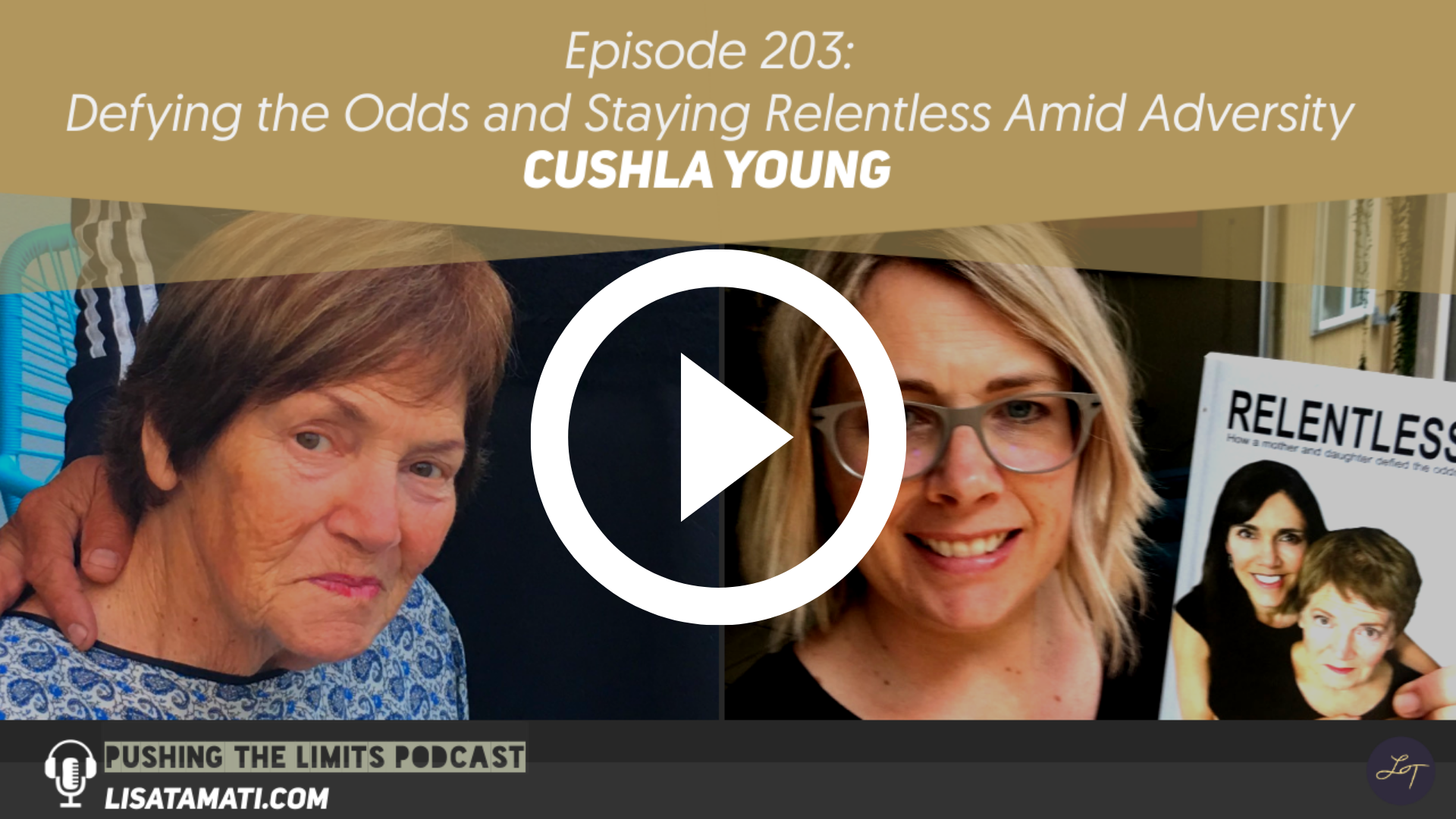
Defying the Odds and Staying Relentless Amid Adversity with Cushla Young
Audio is streamed directly from the publisher (dts.podtrac.com) as published in their RSS feed. Play Podcasts does not host this file. Rights-holders can request removal through the copyright & takedown page.
Show Notes
When your loved one has a serious illness, the world feels a bit darker. But you shouldn't lose hope. In this episode, I talk to Cushla Young, my lifelong friend and the co-author of Relentless. This book recounts my mother's road to recovery despite seemingly insurmountable odds.
Cushla and I talk about the challenges my family and I face to cope with my mum's sudden illness. You'll also hear a little from my mum and her experiences through this ordeal.
Our circumstances didn't stop me from being relentless. My goal was for my mum to recover, despite the experts saying otherwise. I wanted to extend my mother's lifespan and give her the best quality of life I can. Throughout my mother's treatment and rehabilitation, I had to step up and take control. I managed to compartmentalise things before they got out of hand.
If you want to learn about my relentless effort to defy the odds, this episode is for you. You will gain insights into how I challenged myself to keep my family together in a time of crisis.
Get Customised Guidance for Your Genetic Make-Up
For our epigenetics health program all about optimising your fitness, lifestyle, nutrition and mind performance to your particular genes, go to https://www.lisatamati.com/page/epigenetics-and-health-coaching/.
Customised Online Coaching for Runners
CUSTOMISED RUN COACHING PLANS — How to Run Faster, Be Stronger, Run Longer Without Burnout & Injuries
Have you struggled to fit in training in your busy life? Maybe you don't know where to start, or perhaps you have done a few races but keep having motivation or injury troubles?
Do you want to beat last year's time or finish at the front of the pack? Want to run your first 5-km or run a 100-miler?
Do you want a holistic programme that is personalised & customised to your ability, your goals and your lifestyle?
Go to www.runninghotcoaching.com for our online run training coaching.
Health Optimisation and Life Coaching
If you are struggling with a health issue and need people who look outside the square and are connected to some of the greatest science and health minds in the world, then reach out to us at [email protected], we can jump on a call to see if we are a good fit for you.
If you have a big challenge ahead, are dealing with adversity or are wanting to take your performance to the next level and want to learn how to increase your mental toughness, emotional resilience, foundational health and more, then contact us at [email protected].
Order My Books
My latest book Relentless chronicles the inspiring journey about how my mother and I defied the odds after an aneurysm left my mum Isobel with massive brain damage at age 74. The medical professionals told me there was absolutely no hope of any quality of life again, but I used every mindset tool, years of research and incredible tenacity to prove them wrong and bring my mother back to full health within 3 years. Get your copy here: https://shop.lisatamati.com/collections/books/products/relentless.
For my other two best-selling books Running Hot and Running to Extremes chronicling my ultrarunning adventures and expeditions all around the world, go to https://shop.lisatamati.com/collections/books.
Lisa's Anti-Ageing and Longevity Supplements
NMN: Nicotinamide Mononucleotide, a NAD+ precursor
Feel Healthier and Younger*Researchers have found that Nicotinamide Adenine Dinucleotide or NAD+, a master regulator of metabolism and a molecule essential for the functionality of all human cells, is being dramatically decreased over time.
What is NMN?
NMN Bio offers a cutting edge Vitamin B3 derivative named NMN (beta Nicotinamide Mononucleotide) that is capable of boosting the levels of NAD+ in muscle tissue and liver. Take charge of your energy levels, focus, metabolism and overall health so you can live a happy, fulfilling life.
Founded by scientists, NMN Bio offers supplements that are of highest purity and rigorously tested by an independent, third party lab. Start your cellular rejuvenation journey today.
Support Your Healthy AgeingWe offer powerful, third party tested, NAD+ boosting supplements so you can start your healthy ageing journey today.
Shop now: https://nmnbio.nz/collections/all
- NMN (beta Nicotinamide Mononucleotide) 250mg | 30 capsules
- NMN (beta Nicotinamide Mononucleotide) 500mg | 30 capsules
- 6 Bottles | NMN (beta Nicotinamide Mononucleotide) 250mg | 30 Capsules
- 6 Bottles | NMN (beta Nicotinamide Mononucleotide) 500mg | 30 Capsules
Our premium range of anti-ageing nutraceuticals (supplements that combine Mother Nature with cutting edge science) combat the effects of aging, while designed to boost NAD+ levels. Manufactured in an ISO9001 certified facility
Boost Your NAD+ Levels — Healthy Ageing: Redefined- Cellular Health
- Energy & Focus
- Bone Density
- Skin Elasticity
- DNA Repair
- Cardiovascular Health
- Brain Health
- Metabolic Health
My 'Fierce' Sports Jewellery Collection
For my gorgeous and inspiring sports jewellery collection 'Fierce', go to https://shop.lisatamati.com/collections/lisa-tamati-bespoke-jewellery-collection.
Here are three reasons why you should listen to the full episode:
- Discover my relentless journey of helping my mother recover from aneurysm.
- Learn important lessons about the value of health and extending your loved ones' lifespan.
- Gain insights from how I maintained my composure and became the backbone of my family in these difficult times.
Resources
- Gain exclusive access and bonuses to Pushing the Limits Podcast by becoming a patron!
- Relentless: How a mother and daughter defied the odds
- Listen to other Pushing the Limits Episodes:
- As an educator, Isobel shares that she felt terrible when the doctors told her about what she can't do after the aneurysm.
- Getting a driver's license boosted Isobel's confidence.
- Isobel advises people who are going through a rough time to hang in there and continue to fight.
- To maintain her health, Isobel is currently going to the gym, taking yoga, undergoing hyperbaric treatment and attending art classes. She feels amazing about herself.
- After the aneurysm, Isobel went from an active individual to someone who couldn't function.
- Lisa shares some medical mishaps on the day her mum was rushed to the hospital. These mishaps caused delays in Isobel's surgery.
- It took 18 hours for Isobel to be taken into surgery because she had to be airlifted to another hospital.
- The fear of death coming to her mum was a big wake up call for Lisa.
- In the initial phases, Lisa was in shock and was extremely terrified. After processing the situation, she was in a 'mission mode'.
- Lisa's father came up to her, saying that they needed to plan the funeral despite Isobel still being alive.
- When people are in crisis, you need to take control and give them jobs, so they don't panic.
- Over the next few weeks, Lisa was relentless in organising her family and the logistics surrounding her mum's medical needs.
- Lisa shares her experience crossing the Libyan desert with an abusive boyfriend. During that extreme situation, she learned to compartmentalise.
- She will fall apart, but not right now when there's something that needs to be done.
- Lisa and her family had to stay with Isobel in the hospital around the clock for she could go any moment.
- Lisa also had to learn a lot about aneurysms, medicine and rehabilitation.
- Amidst all this, Lisa's dad experienced heart problems, so he had to go home.
- Lisa knows the value of exercise and having fresh air from time to time.
- She made sure to take at least half an hour to an hour for herself.
- When you're in stressful situations, you tend to put self-care aside.
- However, it's vital to have systems in place to manage the stress so that you're prepared to continue fighting.
- Lisa's brothers were very supportive throughout the whole process.
- Lisa's family trusted her and what she told them to do. Her father also stepped up to help.
- He was relentless in caring for and supporting his wife's recovery.
- Lisa was happy that her mother was stable. But she is also worried during the flight because any dropping of pressure could cause Isobel's death.
- Lisa sneaked into the hospital to have a friend check her mother for sleep apnea. And the results confirmed her suspicions.
- She had to convince the medical staff to provide her mother with a C-pap machine.
- Her mother could breathe properly with the machine.
- Lisa shared how they came up against people who insisted on having her mother placed in a facility.
- A social worker was against them having a caregiver.
- Lisa shares that she had to fight for the resources she wanted for her mother.
- Lisa and her family were willing and able to care for Isobel in the comforts of their home.
- A social worker told her that they wouldn't be able to care for her mother adequately.
- But Lisa remained relentless in the face of all these judgements. She and her family wouldn't go down without a fight.
- Professionals show you statistics based on their knowledge and experience. Don't discount their expertise, but don't lose hope.
- How you approach things is critical. You have the power to control your health and well-being.
- Lisa brings her mum to the gym daily for this reason. Lisa wants Isobel surrounded by athletes pushing their limits.
- If you want to stay alive, you need to work hard to keep fit and healthy.
- Living a relentless life means taking lots of small steps and letting them accumulate.
- By being relentless, you'll find more fulfilment and last longer.
- Lisa shares that she wants to push degeneration out for as long as possible.
- There's a lot of research now that helps you live longer and better. Don't feel guilty for investing in your health.
- If you want to learn more about how Lisa takes care of her body and her family, tune in to the full episode.
'She was really the rock of my world. And then that turned upside down very much overnight. And you go from being this adult kid to complete role reversal where you're now having to do everything for your mum.'
'We need to set up systems and processes and understand our own bodies and how our bodies work so that we can manage the stress levels.'
'What I want people to understand is you have to fight for the resources that you want for your loved one.'
'I'm only ever going to listen to the ones that tell me I can do, not the ones that I tell me I can't do. They may be right. I'm not saying they're not right, but I'm gonna throw the book at this. I'm gonna do whatever it takes.'
'They're (professionals) making educated guesses, based on the statistics of the past whatever and their experiences. And I get that. And we can't give people false hope. But we've also can't take away all hope.'
'The older you get, the more effort you have to put into [working hard] if you want to stay alive... If you still want to be alive and enjoy life, then you have to fight for it.'
'If you have some self-care and take those small steps, whatever that may look like for you at the time of your life, then you are living a life that is relentless.'
About Cushla
Cushla Young is a life-long friend of Lisa. They met in a running retreat they both participated in 7 to 8 years ago. She is also the co-author of Lisa's book, Relentless: How a mother and daughter defied the odds.
Cushla is a teacher at the St. John Bosco School, New Plymouth. She is also a Trustee and Educational Coordinator at the Taranaki Gifted Community Trust. Having an interest in gifted education, Cushla provides intellectual and creative ways to support students with advanced and complex learning skills.
The other things Cushla is passionate about are digital technology, literacy and pedagogy. Cushla currently lives in New Zealand with her family.
If you want to reach out to Cushla, you can find her on Twitter.
Enjoyed This Podcast?
If you did, be sure to subscribe and share it with your friends!
Post a review and share it! If you enjoyed tuning in, then leave us a review. You can also share this with your family and friends so they can find comfort and hope in fighting for their loved ones' lives.
Have any questions? You can contact me through email ([email protected]) or find me on Facebook, Twitter, Instagram and YouTube.
For more episode updates, visit my website. You may also tune in on Apple Podcasts.
To pushing the limits,
Lisa
Full Transcript Of The Podcast
Welcome to Pushing the Limits, the show that helps you reach your full potential. With your host Lisa Tamati, brought to you by lisatamati.com.
Lisa Tamati: Hey everyone. And before we get on the way with the show today, I just want to remind you to check out all our great programs that we have. We have our www.runninghotcoaching.com, where you can find out all about our online run training system, we get video analysis, your customised personalised plan made specifically for you, and ongoing support and help and education around everything running. So check that out at runninghotcoaching.com.
We also have our flagship epigenetics program, which is all about optimising your genetics and making the best out of them and how to do that. Understanding what your genes are all about and how to get the right food, the right exercise, the right timings for everything. Understanding every aspect of your life, your place, your career, your social environment, all of these things, your predispositions and much more. So check that out. Go to lisatamati.com and hit the work with us button and you'll see our Peak Epigenetics program right there.
Also a reminder to check out the longevity and anti-ageing supplement that I am now importing into New Zealand and Australia in conjunction with Dr Elena Seranova, a molecular biologist who is behind this product. Now this is all about the sirtuin genes basically, which are all your longevity genes. Now NMN is a precursor to something called NAD, nicotinamide adenine dinucleotide. And this is an absolutely essential compound for every in every single molecule— every single cell, I should say, of your body. It's very important in regards to ATP production, and in regards to metabolic health, in regards to autophagy, in regards to sirtuin genes and upregulating those. Make sure you check out the episodes that I did with Dr. Elena Seranova and head on over to www.nmnbio.nz if you want to find more about the science of that, and why I am super excited about this product, this longevity and anti ageing product, NMN.
Right. Now, today I have something very, very different. I've turned the tables on myself and I have a very dear friend interviewing me about our book that we wrote together. Cushla Young, she's a, got a master's in English and she is the person who helped me rescue my book when I had a hell of a mess, basically. So I hope you're gonna enjoy this interview. This is all about my mum's story. It's about mindset. It's about going up against all the odds, it's about going against the establishment. So it's a lot of things we cover in this interview. So you're also going to hear from my very special mummy. She's going to come to work and tell us a little bit before she heads off on her coffee date. So now over to the show with Cushla Young and Isobel.
Well hi, everybody. Welcome to Pushing the Limits. Today I am doing something very unusual. And so hi everybody in YouTube land who's listening to this as well. I want to introduce my best friend, Cushla Young. Cushla, welcome to the show.
Cushla Young: Thank you.
Lisa: For starters. Now I'll give you guys a bit of background. Cushla and I have been friends for now, a decade or so. Cushla is the lady that helped me write this book. Without her it would not exist. It wouldn't have come out before Cushla came along. The book is Relentless: How A Mother and Daughter Defied the Odds. It's my latest book, and Cushla is the magic behind that book. What we're going to be doing today is talking about what the book is about, which is the story of bringing my mum back from a mess of aneurysm, major brain damage at the age of 74, when it was against all the odds, when the medical professionals were telling me the brain damage is so bad that she's never going to recover.
Being an athlete I went, 'No that's not happening, and we'll find a way.' This is going to be all about that story. Now I'm going to hand over the reins to Krishna to actually interview me, but I've actually got a very, very special guest sitting here next to me, who is the actual star of the show. And so Cushla is going to, she's going to take off for a coffee date. So I'll have to let her come to work first. So I'm going to pass you over to my very special mummy. There she is, Isobel. And she's gonna talk to Cushla for a second so I'll just pass over the headphones.
Cushla: Hand over the reins.
Lisa: You're on, Isobel.
Isobel: Okay.
Cushla: Hi Isobel, morning.
Isobel: Good morning, Cushla. How are you?
Cushla: Taking off for a coffee date soon, are you?
Isobel: Yes.
Cushla: So you are a guest of honor for a few minutes on this podcast. This is, I'm going to be a little bit different because I get to interview your daughter rather than her interview others today.
Isobel: That's good.
Cushla: So, but we'll start with you. So you have been on one heck of a journey over the last few years.
Isobel: I sure have.
Cushla: So how can we start with how you're feeling now?
Isobel: I'm feeling good.
Cushla: You're looking great.
Isobel: I can go for a coffee and I can go walking on my own. And I can do almost anything.
Cushla: When Isobel left my house after a lovely glass of wine the other day, you didn't have one, but Lisa did. You drove, didn't you? You drove her home?
Isobel: I did. Yes. I can drive now. That's good. Especially if Lisa's having a wine.
Cushla: You get to be a mum.
Isobel: I do, I get, revert back to being mum. Yeah.
Cushla: Yeah, and that must have given you a lot of independence that you have lost for quite a few years.
Isobel: Yes. It's awesome. You don't realise how isolated people are. They haven't got— We all have a way of getting around here. It's isolating. Yeah.
Cushla: And can you tell us a bit about what you have been getting up to? I understand you've been doing some art classes with your sister. How's that going?
Isobel: Not as well as I would like to but it's, we're doing all right, you know?
Cushla: Yeah.
Isobel: I'd like the results to be a bit more spectacular. But—
Cushla: It must be nice to be creative.
Isobel: Oh it is. It's good, it does me good.
Cushla: Now, do you have much of a memory of the hospital time?
Isobel: No.
Cushla: No. What's your first memory that you can recall?
Isobel: Probably where we went to a meeting with all the big guns—
Lisa: At the hospital.
Isobel: At the hospital, and they wrote me off, really.
Cushla: Did they? They underestimated you as well.
Isobel: I can remember saying—
Lisa: I was feeling good. I was feeling good.
Isobel: I was, I was feeling fine before this. Now. I'm feeling terrible. I have been demoted, I've been, lost my independence. Just because they were talking like they were, they shouldn't have done that.
Lisa: They took away all your confidence. And—
Isobel: Yeah, they just.
Cushla: And so your background is similar to mine. You're an educator.
Isobel: Yeah.
Cushla: Have been for decades and decades. You must understand how demotivating it is when somebody tells you what you can't do rather than what you can do.
Isobel: Yeah, that's it exactly.
Cushla: So when did it change for you after that meeting? What were some of the first things that happened that gave you a bit more confidence?
Lisa: Driving?
Isobel: Getting on a driver's license probably was a major breakthrough. Lisa took me down to the dam by the port and just—
Lisa: It's been months.
Isobel: Happier—
Cushla: Round and round you.
Isobel: You will, 'now you drive.' I was totally gobsmacked.
Cushla: But you did it.
Isobel: I did it.
Cushla: And I understand the doctor was utterly shocked—
Isobel: He was.
Cushla: —when you went in to get your medical for your license.
Isobel: Totally blown away.
Cushla: Yeah.
Isobel: That was a blow away.
Cushla: It had probably been a while since the doctor had responded that way.
Isobel: Yeah, I think so. He was a nice doctor. So that was good.
Cushla: So could you give some advice to someone who might be going through something pretty tough at the moment. What would you say to them?
Isobel: Just hang in there and—
Lisa: Fight.
Isobel: Fight hard. Yeah. Yeah. You've got to grit your teeth and just carry on, really. Yeah.
Cushla: You're one tough lady, aren't you?
Isobel: I must be.
Cushla: Definitely.
Isobel: So that's what we did.
Cushla: Can you describe some of the routines of things that you do at the moment that keep you in such good health?
Isobel: I go to the gym most days.
Lisa: Do weight training, cardio.
Isobel: I do weights, I do cardio, I do walking on the treadmill, yoga.
Cushla: And you still do your hyperbaric as well?
Isobel: Yes, every day at the moment.
Cushla: Everyday? Wonderful. Still eat the smoothies that Lisa makes you in the mornings?
Isobel: They're pretty terrible.
Cushla: But they're good for you, right?
Isobel: But they are good for me. Broccoli is not exciting, and it's sickening.
Cushla: What we've noticed is, about over even the last six months, is how fit and agile and glowing that you are. That's amazing.
Isobel: It is amazing. It's amazing that you said that. I don't always feel it.
Cushla: Right.
Isobel: It's hard to know where you're at, so.
Cushla: Yeah, I think sometimes what you see is yourself reflected in others' eyes, and that's a really good indication of how far you've come.
Isobel: Yeah, and I have come a long way.
Cushla: Really.
Isobel: Yeah, a really long way.
Lisa: A bloody long way. All right, now you can go get coffee.
Isobel: I'll pass you back to Lisa—
Lisa: —and get yourself a coffee date.
Cushla: Enjoy!
Isobel: I will.
Lisa: Thanks, Mummy.
Isobel: Okay.
Lisa: She's an absolute legend. Thanks, you have a nice coffee. We're now actually going to get into her backstory. Because, I would have done it the other way around and had her at the end of the show. But she needed to get to a coffee date. So she's just rolling. Yeah, we're rolling with the punches.
But Cushla, this— can you, I'm gonna pass the reins over to you fully. Because you know the story, you lived it with me, you helped me from the get-go pretty much. So over to you. Oh now I'm an interviewee.
Cushla: Got you. We're flipping the tables, aren't we?
Lisa: Yeah, we sure are.
Cushla: To be interviewed for once, which is fabulous. So this has been a long journey for you and your mum and your family, and you're right. I was, I had known you for a few years before this happened. I think from my perspective, the thing that was so shocking about what originally, with the aneurysm, with your mum, was just how quick things changed overnight. I think we see Isobel now and— how old is mum?
Lisa: She's 79.
Cushla: 79. So we're going back quite a few years, and I used to often pop into the shop and see your mum, and just pop in and say hello. And she is now but she also was been a very intelligent, clear spoken woman that used to do acro-aerobics all the time, she was very fit and healthy, very independent, working still pretty much full-time.
Lisa: Yeah, she was.
Cushla: For somebody watching, to see overnight that she went from that, from a completely functioning full-time working adult, to just being, nothing was there. Overnight, the aneurysm took her from being completely functional to nothing. I think the shock in that first visit and I saw her quite a few weeks after the aneurysm, and you're back up to New Plymouth. You'd been in Wellington. The shock of seeing her lying there, she had aged a decade overnight.
Lisa: Yeah.
Cushla: It's hard. Hard to see. I think the shock of that must've ripped through your family quite viciously. You notice that change overnight.
Lisa: It was huge. Yeah, to have growing up with mum being always the one supporting me. And the one that was there for me in all the phases of my crazy, upside down life that I've had, you know, with all my adventures supporting me with all lower— dramas and relationship breakups and divorces and business growing.
Cushla: Rooting for you at most of your races.
Lisa: Oh, yes. Yeah. She'd seen, been there, done that with me, I can tell you that she had a hard life with me. She had a good life, she had exciting times with me. She was really the rock of my world. And then that turned upside down very much overnight. And, you know, you go from being this adult kid to a complete role reversal, where you're now you know, having to do everything for your mum, you are advocating, you're fighting, you grow up really quickly, even as a fully-grown adult. Obviously, I still am very much, when you've got a parent, you're still like a kid in a way to them. That is that was a biggest shocker for me I think was to be, no, now you are the one that's caring for your mum, and you are going to have to pull out all the stops to help her and it's you know, no longer about you being the selfish egotistical athlete, and there's nothing wrong with it, if you're an athlete, you have to be if you want to reach, know, do the stuff that I did. But that was a shocker.
And then not, like the— we had medical research mishaps from the very get-go when mum had this aneurysm that happened early in the morning. And an ambulance driver came into the house, you know, they got her into the ambulance up to the hospital, he knew already that she was having a neurological event. And he told the doctor so much, and he just ignored it. He ignored it.
He said, 'No, she's having a migraine, I think. So we'll just leave it for a few hours and observe her and give her some painkillers.' Well, you know, 'Thanks very much for that.' The first six hours not knowing, and she was dying, basically. She was dying. And I knew she was in deep trouble. And I didn't know what to do. Because at that point in my life, I had no idea of anything like this. So I was never, you know, in a situation like this, I didn't know what was wrong with her. But I knew we were in trouble. And that was a very big wake up call. I actually got our mutual friend, Megan Stewart, who's a paramedic here and the head of the ambulance here. And she came up to the hospital at that time. She sort of rattled some bloody cages very quickly. And because she knew immediately what was happening, stroke or aneurysm or something neurological, migraines. She went and told this doctor what for. He then relented, and we got a CT scan. And that's when we saw the blood right throughout the brain. So that was a very big wake up call for me in a number of ways. Obviously, the shock of it happening to your mum, the fear of her dying, she's being very, very, very close to death at this point. And then realising that, you know, the medical system had not worked for us. And I'm not— you know, we're all human, and we all make mistakes and stuff. But that was a pretty big one. That was a pretty big one.
Cushla: I think, in those situations, we want to trust the people that are— the medical professionals that are around us. For the most part in ED, they're an amazing group of people. But I think also there is a lot to be said for your mum. You knew what a migraine looked like, you should have before. And it's a matter of trusting yourself, isn't it, enough to then think, this isn't to your question what you're saying, and then fight as hard as you can for a different outcome. Because my understanding about aneurysm is there's a golden hour, or it's really important to be treated.
Lisa: Exactly.
Cushla: A short time.
Lisa: Surgery, that's the golden hour, they talk about getting you into surgery within the hour. It took 18 hours. 18 hours, because not only do we have the medical mishap and we also had the fact that we had to get to our Main Hospital down in Wellington, neurological. Living in a regional area, unfortunately, that's just the way it is. But we had to wait another 12 hours for the air ambulance to actually get to us, and when you're over 65, you're sort of bumped down the hierarchy, especially if you— if they don't think you're a good, you got good odds. So, you know, we— there were, at that time we had a baby that needed help, and that was more urgent than mum. They have to make those calls. I understand. I don't like it; I understand it. It's your loved one and you don't really give up.
Cushla: Not at the time because you're also going through the shock of what's happening and trying to process that. In that moment, can you describe, I suppose I want to focus a little bit on what was happening to you and your body. Because I think the thing about this really, this story is that it's not just about a mum surviving an aneurysm, but it's also about you and your family and how you've managed to pull yourself back together as well. So not just Isobel but yourself. I know that a lot of us, all of us will face a moment in our lives where we have to handle a bit of trauma.
Lisa: Yep.
Lisa: What was going on in your body and how did you cope so that you had the ability to fight for your mum? What are you doing in your mind?
Lisa: So in the initial phases, Cushla, you know, you are in shock, you're out, you're terrified. But very, very quickly, oh, especially after the mishap, once I realised what had just happened and the ball's up that that was, and that it was likely going to cost your life. I just went into what I call mission mode. Like, 'Okay, right, I am not going— I'm going to research the hell out of this. I'm going to learn everything I can. I'm going to be hypervigilant. I'm going to watch everything they do. I'm going to question everything they do. I'm going to get my family organised.' Because I had get them down to Wellington. My father was, of course, falling to pieces because it's the love of his life. He's been, you know, married to her for 55 years. He came up to me already in the ED and said, 'We better start planning the funeral.' Because they were, you know, saying to us, she's like, unlikely to survive. And I'm like, 'Dad, we're not even considering that. She's alive, she's still breathing, and we're gonna fight with everything we have. Here's a list of jobs to do: I want you to go ring so and so, organise this, get the boys down, my brothers down to Wellington, blah, blah, blah.'
When people are in a crisis, you need to take control and give them jobs to do so that they, their, you know, their amygdala, that their permanent part of the brain doesn't go into complete full-blown panic, and which doesn't always work. And I'll relay a story a little bit later, where I did go into full blown panic. It's all very well and good to say this. But at that point in time, I was like, 'Dad', I shook him, I grabbed him, I held him and I said, 'No, you've got this and this job to do, we're going to do it, and follow me, dad. Follow me.' And that was basically how it was then for the next few years. Yeah. My brothers as well, they were very much, 'What do we do?' I had no idea at the time, but I pretended like I did. Fake it till you make it. What we're doing this is how we're going to operate over the next few weeks. So it was being down on Wellington together, organising the family to be down there, all the logistics that go along with that, and your jobs and your, you know, partners and all the rest of it. And then a 24-hour watch over Mum, and being hypervigilant, explaining to the boys everything that I was learning medically, because I was like, studying forever, I was just going, going, heart out, trying to understand and get up to speed on something that I was completely not aware of prior to this, learning what an aneurysm does, what vasospasms are, what I've been looking for, what they— signs.
We were only in the neurological unit, we weren't in the ICU, which, looking back when I arrived, what the hell. When she got down to Wellington, they get straight into surgery, they started draining her blood off the brain. She started to— start to have that pressure released. But then we had to decide the next, in the next couple of days, though it had stopped bleeding at that point, but it was about to go out in time again, it could go at any moment. How do we clamp it? What do we do? Would we cut into her brain and put a physical clamp over the area? And it was a mess of aneurysm. Like we're talking a 16 millimeter huge aneurysm. We went up through the femoral artery, and we weighed up the pros and cons and you make that call. She's got a 50% chance of dying this way, she's got a 30% chance of dying that way, pretty much. So we'll take the lesser evil, but she was going to have to have two operations and in that way you know. So that was gonna be really touch and go, really touch and go. I remember them wheeling her off for that operation. I think it was on day two, through the doors, and you just don't know if it's the last time you're going to see them alive, and the whole just trying to hold your shit together.
Cushla: I know that you're very good at compartmentalising parts of the— of something when it happens. What I remember you talking about when we were writing the book, was how you were able to put the jobs that needed to be done in that box. The research you were doing in this box, your family in that box, and probably, and I know this because we had phone calls and I was in touch with you at the time, your emotions and your shock and your trauma in this box. It was a matter of kind of keeping you know, all those juggling balls in the air at one time. But also, and importantly allowing you to have that emotional spot as well. And I know that you were very good at compartmentalising and giving yourself time to do that, but not letting it overtake you, letting you drop all the other balls at the time when you were dealing with the emotional side of it. I think that's really important because I know— so when Lisa and I first met, I was a bit of a Lisa Tamati fangirl, before we became friends, and I got to know you really well.
Lisa: And then realised, oh no.
Cushla: Yeah. I mean, we just saw you as Wonder Woman. You know, there's tough, tough, you know, athlete. Then I got to know you, as a human being, of course, a woman, there's a vulnerable side to you. But what I think is really important at that time, an immediate trauma time, as you gave yourself time to release a bit of that stress and that trauma by leaning on your husband Haisley, by your phone calls to me. But also, like, I know that you went for some runs, went to get gym, threshed it out, you probably screamed at the ocean at one point. Do you know? That's also important, isn't it? It's not just—
Lisa: If you want to sustain— we knew this was going to be a long, long, long battle. While we hoped it was going to be a long battle, a short option was not a good one. This is something that I've learned doing ultra marathons: is to— in particular in the Libyan desert crossing, where you have to read the book for the whole story. But I did an expedition across the Libyan desert with three other guys, one of them being this abusive boyfriend that I was with at the time. There was a very extreme situation that we were in, we needed two liters of water a day, etcetera. And I'm having this big domestic fight with the boyfriend right in the middle of the Libyan desert.
Cushla: In the most extreme environment on the planet.
Lisa: In the most extreme environment, walking 45 kilometers a day with 35-kilo backpacks and only two litres of water a day in a military bad zone, not a good time to breakup with a boyfriend of five years. And in that moment, when he left me and disappeared over the sand dunes, that was a turning point for me, and I fell apart initially. And I was like, 'Oh, God,' started crying in the rails. I can't afford to lose any more tears here. I've got to pull my shit together, because I cannot let the energy dissipate that at the rate of I want to actually survive. It was getting down to that sort of level of you know, you're going to survive this or not. And so I learned in that moment, really a very hard lesson in compartmentalising things in your brain. So like, 'I'm going to fall apart, but not right now. I'm going to put that off right now because I have to focus on this, and getting through the desert and surviving.' That's been actually a really good lesson. It's never a pleasant one to actually have to instigate where you have to actually compartmentalise.
Just interrupting the program briefly to let you know that we have a new Patron program for the podcast. Now, if you enjoy Pushing the Limits, if you get great value out of it, we would love you to come and join our Patron membership program. We've been doing this now for five and a half years and we need your help to keep it on air. It's been a public service free for everybody. And we want to keep it that way. But to do that we need like-minded souls who are on this mission with us to help us out. So if you're interested in becoming a patron for Pushing the Limits podcast, then check out everything on www.patron.lisatamati.com. That's P-A-T-R-O-N dot lisatamati.com. We have two Patron levels to choose from. You can do it for as little as $7 a month, New Zealand, or $15 a month if you really want to support us. So we are grateful if you do. There are so many membership benefits you're going to get if you join us. Everything from workbooks for all the podcasts, the strength guide for runners, the power to vote on future episodes, webinars that we're going to be holding, all of my documentaries and much much more. So check out all the details: patron.lisatamati.com. And thanks very much for joining us.
Lisa: But in this in this situation where you're dealing with— you're having to study like really hard. And we have access now to the greatest minds on the world that come in, all those information about out there that you can study. So I was studying all the drugs that they had on, all the procedures they were doing, what is the normal plan, and what happens when you have an aneurysm, what are of the some of the dangers, or of the things that I should be looking out for, what are the signs in your body. You know, all of these types of things in the initial phase and then later on at it went into rehabilitation research and study. And so that was one aspect of it. And then we had a 24-hour clock system, much to the disgust of the people at the hospital because they didn't want us there 24 hours. They don't like that. There was no way I was leaving my mother when she could die at any minute alone. No way.
So I had massive battles with the hospital, for them to be able to allow us in. And then having to fight for that. So you're fighting on all these fronts, you're already fighting with— your mum's in deep, deep trouble, and then you're fighting against these systems. And they may have some good reasons for those systems. But there was no way I was leaving my mother alone when she could die any second. A family member had to be with her at all times. And I was very, very strict on that. We had some big blow-ups at the hospital. We got through really in the end. And we tried to be as unobtrusive as possible when we did what we were. And we picked up things that they missed, because she was on a neurological ward, they only come around a couple of hours into obviously, patients. But going back to the whole compartmentalising things. I know how to manage my body really well, and how to pace myself really well from doing ultra marathons and stuff, and expeditions. And so I knew that we were going to be in the for the long haul, I knew sleep deprivation was going to be a problem, I knew that the family dynamics were going to be a problem, that there was going to be fighting because of the stress there was it we were under, and we were all living in one motel unit. And that mum was in deep crap, we had my father to look after who was just, you know.
Cushla: And he was down with you in the initial stage.
Lisa: He was here, he was; and he's very much, was a homebody. He didn't like to be out of his garden and sheep. So he was very, very stressed on that front, and of course his wife in such dire straits. He was, but he— so we managed to, had him to manage home because he started having heart problems. And so I had to eventually actually send my dad back home and actually lied to my dad that, 'She's okay now, we've got her, Dad. She's all good.' Because I think that we're gonna lose him. I was making those sorts of decisions and just running the ship. Like you said, I know the importance of, for me, especially exercise and fresh air for my mental well-being, that if I was going to sustain it, I had to have at least half an hour to an hour every day out from this whole thing, where I just go and do a workout.
Again, all the fear, the cortisol, the adrenaline that's running through my body flat stuck and try to manage it, and making sure that she was looked after, and that time. You know, you feel guilty and everything for leaving the hospital all. But you had to do that after a few days. You know, just a couple of days, I didn't, but after that. It was— it's setting all these things in place. And we need to do that in our daily lives. We need to set up systems and processes and understand our own bodies and how our bodies work so that we can manage the stress levels an