
Psychology in the Classroom
Lucinda Powell · Lucinda powell
Show overview
Psychology in the Classroom has been publishing since 2020, and across the 6 years since has built a catalogue of 234 episodes, alongside 3 trailers or bonus episodes. That works out to roughly 120 hours of audio in total. Releases follow a fortnightly cadence, with the show now in its 14th season.
Episodes typically run twenty to thirty-five minutes — most land between 16 min and 40 min — with run-times ranging widely across the catalogue. None of the episodes are flagged explicit by the publisher. It is catalogued as a EN-language Education show.
The show is actively publishing — the most recent episode landed 3 weeks ago, with 14 episodes already out so far this year. The busiest year was 2022, with 51 episodes published. Published by Lucinda powell.
From the publisher
The show that takes psychological research and translates it for classroom teachers so they can effectively apply it to their teaching practice to help improve outcomes for their students. Interviews with leading psychologists and other experts in the field of education, as well as deep dives into educational theory and a little bit of neuromyth busting.
Latest Episodes
View all 234 episodesAddressing the Mental Health Crisis in Schools: Challenges, Solutions, and the Road Ahead
Exploring the Complex Role of Emotions in Student Motivation, Performance, and Well-Being
What Is Test Anxiety and How Can We Help Students Overcome It?
Why school exams don't prepare you for University (and that's Okay!)
The Power of Professional Dialogue: Turning Lesson Observations into Meaningful Conversations for Growth
Gender Identity Decoded: How Biology and Society Shape Who We Are
Changing the Narrative Around Neurodivergence in Schools
How Do Habits Shape Students' Use of Effective Learning Strategies?
How Can Positive Psychology Transform Wellbeing in Secondary Schools?
Spring Takeover: Exploring the Multi-Store Model of Memory and the Rise of AI in Psychotherapy

S14 Ep 17Dilemmas in the Classroom: How to Balance Inclusion and Individual Needs
...with Dr Tracy Edwards In this episode, Tracy Edwards, senior lecturer at Leeds Beckett University and author of Severe and Profound and Multiple Learning Difficulties in Schools, explores the ethical and practical dilemmas teachers face when supporting learners with complex needs. Drawing on her experience in both mainstream and special education, Tracy discusses inclusion, differentiation, and the importance of reflective, learner-centred practice. She highlights the value of embracing difference, fostering choice, and maintaining high aspirations for all pupils. This insightful conversation offers practical guidance and reassurance for secondary teachers navigating the challenges of inclusive education in UK schools. Useful Links: Severe, profound and multiple learning difficulties in school: considering ethical and dilemma-based perspectives by Tracy Edwards: https://www.routledge.com/Severe-Profound-and-Multiple-Learning-Difficulties-in-School-Considering-Ethical-and-Dilemma-Based-Perspectives/Edwards/p/book/9781032888750 Beyond the 'Dilemma of difference': an analysis of stories from expereinced teachers about their inclusive practice: https://bera-journals.onlinelibrary.wiley.com/doi/10.1002/berj.4129 Simmons, B. (2021) 'How special are mainstream schools? Reflections on social spaces for children with profound and multiple learning difficulties.' : https://researchspace.bathspa.ac.uk/14531/ BBC Articles on the topics mentioned in the podcast: https://www.bbc.co.uk/news/articles/cpr0xwx9e7jo https://www.bbc.co.uk/news/articles/cx2r8y0v6l7o https://www.bbc.co.uk/news/articles/cjw0e3zjx2lo Bullet point summary: Special and inclusive education challenges for teachers. Dilemmas faced by educators working with learners with complex special educational needs. Inclusion versus exclusion in educational settings. Ethical considerations in teaching and decision-making. The role of special schools compared to mainstream schools. Importance of "craft knowledge" in navigating educational dilemmas. The impact of systemic failures on students with special needs. The significance of choice and flexible differentiation in pedagogy. The relationship between classroom practices and student engagement. The need for ongoing reflection and ethical engagement in inclusive education.

S14 Ep 16Mental Health Research: Practical Tips for Teachers and Practitioners to Navigate the Evidence
...with Andre Tomlin In this episode, Andre from The Mental Elf discusses how we can make mental health research accessible and useful for teachers and practitioners. The conversation tackles the challenges of jargon, paywalls, and misleading headlines, sharing practical tips for spotting reliable studies and avoiding common pitfalls. Andre highlights the power of co-producing interventions with young people, the importance of prevention, and the value of focusing on emotions and relationships in schools. *Trigger Warning* - the discussion is focussed on mental health and there is brief discussion of suicide. Links to the resources mentioned are below: The Mental Elf: nationalelfservice.net/mental-health André Tomlin - LinkedIn https://www.linkedin.com/in/andretomlin/ The ReSET Podcast Series https://resetproject.co.uk/the-reset-podcast/ Schools in Mind — free, evidence-based resources specifically for schools: https://www.annafreud.org/resources/schools-and-colleges/schools-in-mind/ Mentally Healthy Schools website — helps schools navigate what actually works https://www.mentallyhealthyschools.org.uk/ Children and Young People's Mental Health Coalition https://cypmhc.org.uk/ Kiva Podcast with Julia Badger: https://changingstatesofmind.libsyn.com/unpacking-the-complexities-of-bullying-from-counter-connecting-to-whole-school-solutions Kiva Podcast with Lucy Bowes: https://changingstatesofmind.libsyn.com/bullying-its-everybodys-problem More Mental Health podcasts from Psychology in the Classroom: https://changingstatesofmind.com/mental-health-%26-wellbeing Bullet point outline: Challenges in making mental health research accessible to non-researchers, particularly educators and practitioners. The gap between published research and its practical application in real-world settings. Issues with paywalls, academic jargon, and the complexity of research language. Importance of critically evaluating research headlines and studies, including understanding correlation versus causation. Key factors for assessing research quality, such as peer review, study design, and effect size. The role of mixed methods research in providing a comprehensive understanding of mental health interventions. The significance of co-production with young people in developing effective mental health programs. The distinction between efficacy and effectiveness trials in evaluating interventions. Common myths about mental health research in schools and the importance of evidence-based prevention. Resources and platforms that help bridge the gap between mental health research and practical application for educators.

S14 Ep 15The Power of Voice in the Classroom
...With Professor Silke Paulmann In this episode I am joined by Professor Silke Paulmann to discuss why how we sound matters just as much as what we say - the irony, as you will hear, being that my voice this week is far from fine! We often focus on the words we use to support student autonomy—offering choice and avoiding pressure—but Professor Paulmann's research reveals that our vocal tone is a primary carrier of psychological information. Whether you are teaching Early Years or Secondary, the way you modulate your voice can directly impact a student's sense of autonomy, competence, and relatedness. From reducing classroom anxiety to helping students feel truly "heard," your voice is one of the most powerful psychological tools in your teaching toolkit. Learn some easy to implement strategies to help your vocal tone. You can find out more here: https://www.tone4you.co.uk/ Key Moments: Introduction to Professor Silke Paulmann: A look at her background in cognitive science and her research on voice as a biomarker. The "Why" Behind the Voice: Why tone carries as much weight as our actual words in autonomy-supportive teaching. Needs-Based Learning: How voice influences the three basic psychological needs: autonomy, competence, and relatedness. Controlling vs. Supportive Voices: The difference between a "rushed" voice and a "grounded" voice. Breathing Awareness: An exercise to find your breath and use it to reduce anxiety. Tension Release: Using the "Sigh of Relief" and "Motorboat" sounds to loosen the vocal apparatus. The Siren & Range: Stretching the voice to ensure it remains flexible rather than rigid. Finding Your "Centered" Voice: A trick to stop speaking at an unnaturally high pitch. The Practice Round: Lucinda tries out three different ways to say "Take your time" (Neutral, Pressuring, and Supportive). Impact on Student Memory: Why slowing down doesn't just improve wellbeing, but also helps students remember more. Closing Thoughts & Cool Down: A final breath exercise and a reminder that your voice is a psychological tool.

S14 Ep 14How Can We Combat Cyber Aggression in Schools Today
...With Protyasha Bhattacharyya Kicking off 2026 this episode dives into the latest research on cyber aggression and its effects on young people. We explore new findings about how different parenting styles can influence online behaviour, and why fostering psychological safety in schools is more crucial than ever. Listeners will discover practical, up-to-date strategies for teachers to help students navigate digital spaces safely and kindly. The episode concludes with a curated list of fresh resources for continued learning, setting a positive tone for the year ahead and empowering everyone to create kinder, safer online communities. Background and qualifications of Protyasha Bhattacharya in psychology and criminology. Definition and implications of cyber aggression, including its distinction from traditional bullying. Impact of cyber aggression on young people's mental health, motivation, and academic performance. Influence of parenting styles on adolescents' experiences with cyber aggression. Overview of the four parenting styles and their potential relationship with cyber aggression. Challenges in researching cyber aggression, including data collection and sample size limitations. Demographic factors that may predict cyber aggression, such as educational attainment. Recommendations for educators to address and reduce cyber aggression in schools. Importance of ongoing research into cyber aggression, including cultural factors and digital environment influences. Resources: Childnet International: https://www.childnet.com/ UK Safer Internet Centre: https://saferinternet.org.uk/ UK Department for Education - Preventing Bullying: https://www.gov.uk/government/publications/preventing-and-tackling-bullying DfE Online Safety Guidance: https://www.gov.uk/government/publications/teaching-online-safety-in-schools/teaching-online-safety-in-schools Journals: Computers in Human Behavior: https://www.sciencedirect.com/journal/computers-in-human-behavior Journal of Adolescent Health: https://www.jahonline.org/ Cyberpsychology, Behavior, and Social Networking: https://journals.sagepub.com/home/cyba
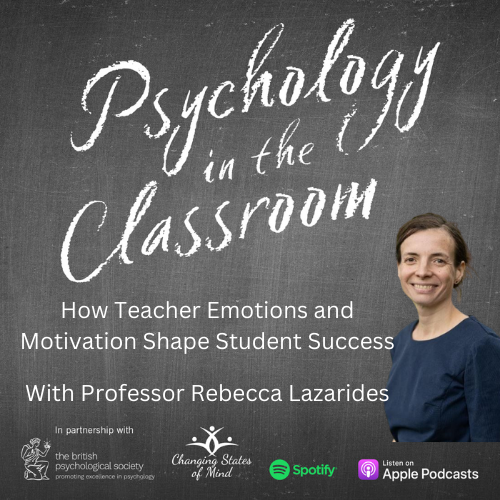
S14 Ep 13How Teacher Emotions and Motivation Shape Student Success
With Prof. Rebecca Lazarides In this motivational end-of-term episode, Professor Rebecca Lazarides (Professor for Empirical Research on Instruction and Schools at the University of Potsdam, Germany) discusses what keeps teachers motivated - even when energy is running low. Rebecca shares insights from her work on teacher motivation, explaining how self-reflection, supportive colleagues, and celebrating small wins can help teachers stay positive. The conversation explores practical strategies for managing emotions, the importance of authentic enthusiasm, and how school environments shape motivation. Listeners are encouraged to reflect on their successes and try new ideas, leaving them with a boost of encouragement as they head into a well-deserved break. The podcast in bullet points: Teacher motivation and its impact on teaching quality. The distinction between enthusiasm for the subject and enthusiasm for teaching. The role of teacher emotions in classroom dynamics and student motivation. External factors affecting teacher motivation, such as school environment and job demands. Strategies for teachers to manage emotions and maintain motivation. The importance of strong student-teacher relationships in fostering motivation. Emotional regulation as a critical skill for teachers. The influence of self-efficacy on teacher motivation and performance. The significance of reflective practices in enhancing teacher motivation. The situational nature of teacher motivation and its variability across different teaching contexts. The British Journal of Educational Psychology Special Edition is available on this link: https://bpspsychub.onlinelibrary.wiley.com/toc/20448279/2025/95/4
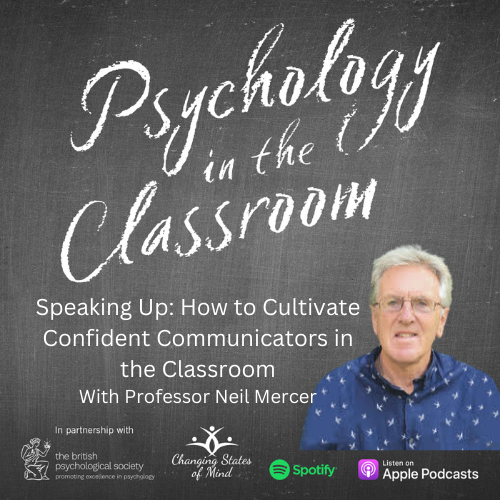
S14 Ep 12Speaking Up: How to Cultivate Confident Communicators in the Classroom
...With Prof. Neil Mercer Neil Mercer is Emeritus Professor of Education at the University of Cambridge and a psychologist and in this episode we discuss the pivotal role of spoken language and oracy in education. We explored how classroom dialogue, reasoned discussion, and public speaking can be systematically taught to enhance students' thinking and communication skills. Neil shared insights on the impact of the pandemic on language development, practical strategies for fostering effective dialogue, and the importance of classroom culture and listening. We also discussed the value of public speaking for all students and highlighted resources for teachers to support spoken language development. The discussion in bullet points: Importance of spoken language in education. Development of children's language and thinking skills. Role of reasoned discussion and dialogue in classrooms. Influence of educational theorists like Vygotsky on language development. Impact of the COVID-19 pandemic on children's language skills. Practical strategies for teaching reasoned discussion. Challenges teachers face in fostering effective dialogue. Benefits of group work and whole-class discussions for student engagement. The significance of classroom culture in promoting open discussion. The necessity of public speaking skills in education and its role in democratic participation. Links: Find out more about Neil's work: https://oracycambridge.org/ Blog: https://oracycambridge.org/blog/ Neil's Book - Oracy: The Transformative Power of Finding Your Voice https://www.penguin.co.uk/books/467731/oracy-by-mercer-neil/9781847928566 BPS Psychologist Article on Oracy 'Is it only words' https://www.bps.org.uk/psychologist/it-only-words I'll be sharing some older episodes that link to this about speech and language over the break so please do sign up to my newsletter: https://changingstatesofmind.com/contact-me
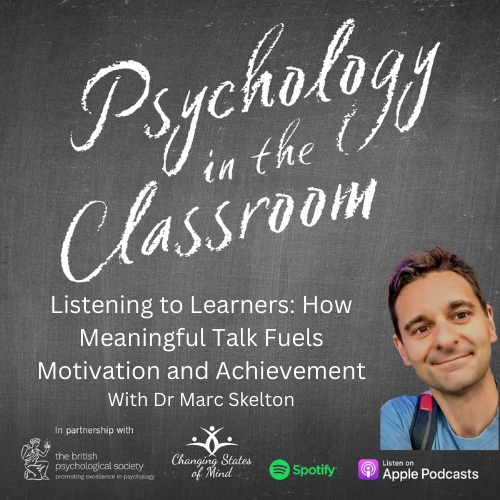
S14 Ep 11Listening to Learners: How Meaningful Talk Fuels Motivation and Achievement
…with Dr. Marc Skelton. In this episode we bridge the gap between classroom practice and psychological theory to share actionable strategies for fostering student success. Drawing on years of teaching experience to research at the University of Warwick, Marc breaks down what truly drives student engagement. Marc introduces us to Paulo Freire's "banking model" of education, and advocates for a shift to active, meaningful learning where students are co-creators of knowledge. The core of the conversation centres on Self-Regulated Learning (SRL), exploring Barry Zimmerman's three phases: Forethought (planning), Performance (the "missing middle" of self-monitoring), and Self-Reflection (learning from experience). We then dive into the Transformative Power of Goal Setting, emphasizing that success requires both Agency ("I can do this") and Pathways (concrete plans). Learn about the impact of Goal Diaries and the critical role of Meaningful Talk and Social Support in sustaining motivation. Finally, we discuss how educators can redefine success by celebrating Achievement (personal growth) over mere Attainment (grades), creating classrooms where every student thrives. Bullet points: Dual role of the speaker as a teacher and researcher in educational psychology. Journey into teaching mathematics and interest in educational psychology. Exploration of student motivation and engagement in learning. Influence of Paulo Freire's pedagogy and Albert Bandura's agency theory on educational practices. Development of a tutor time program focused on metacognition and self-regulated learning. Insights from research on definitions and perceptions of learning among students and teachers. Distinction between attainment (external measures) and achievement (personal significance) in education. Importance of self-regulated learning, goal setting, and meaningful communication in enhancing student motivation. Findings on the impact of social interaction and support on students' goal achievement and well-being. Advocacy for integrating psychological principles into educational practices to foster meaningful learning experiences. Marc's Website visit www.positivelearningpsychology.com Theories, Books and Researchers "Pedagogy of the Oppressed" and "Pedagogy of Hope" by Paulo Freire Albert Bandura - agency theory Martin Seligman - Positive Psychology George Kelly - Personal Construct Psychology Carl Rogers - Person-Centered Approach Carol Dweck - growth mindset Zimmerman & Schunk (1989) Self-regulated learning and academic achievement: Theory, research, and practice Ryan and Deci (2000) - Self determination theory Paul A. Kirschner, John Sweller & Richard E. Clark - Why Minimal Guidance During Instruction Does Not Work: An Analysis of the Failure of Constructivist, Discovery, Problem-Based, Experiential, and Inquiry-Based Teaching Snyder (2000) Hope Theory Barbara Fredrickson - Broaden and Build Theory Rosenshine's principles of instruction Key Stage Three: The Wasted Years? Department for education
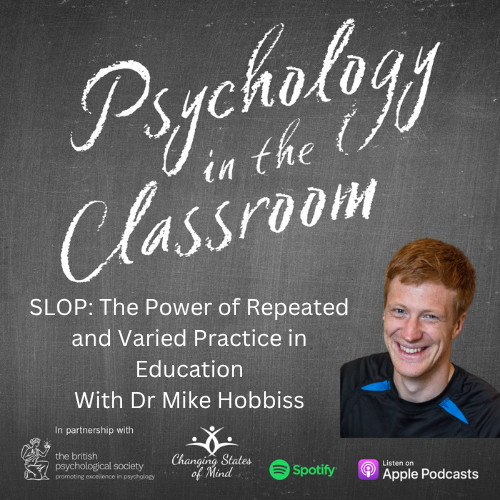
S14 Ep 10SLOP: The Power of Repeated and Varied Practice in Education
...with Dr Mike Hobbiss Mike is an experienced psychology teacher and co-author of "How to Teach Psychology: An Evidence-Informed Approach." In this episode Mike explains how learning and disciplinary fundamentals shape classroom practice, and introduces the SLOP (Shed Loads of Practice) approach, emphasizing varied, repeated practice for deeper understanding. Despite examples and context being set within Psychology as a subject, the concepts and practice is applicable to a wide range of subjects. The discussion explores practical strategies, the importance of building flexible schemas, and how these principles apply beyond psychology. For Mike's blog please visit: hobbolog.wordpress.com/author/michaelhobbiss/ His book can be found here: www.amazon.co.uk/dp/1915261953 Key points from the episode: Mike's background in psychology and philosophy, including his teaching experience in the UK and internationally. Overview of his book, How to Teach Psychology: An Evidence-Informed Approach, and its relevance to various subjects beyond psychology. Theoretical framework for effective psychology teaching, combining general learning fundamentals with subject-specific principles. Pedagogical implications derived from the framework, including seven key principles for classroom practice. The concept of SLOP (Shed Loads of Practice) and its emphasis on repeated and varied practice for deeper understanding. The importance of understanding subject-specific nuances in teaching different disciplines. The role of schemas in learning and their significance for applying knowledge flexibly in various contexts. Distinction between performance and learning, highlighting the need for long-term retention and application of knowledge. Use of examples and non-examples in teaching to clarify concepts and address misconceptions. The value of engaging with educators through blogs and social media to share resources and foster discussions on teaching practices.
S14 Ep 9Zines and Emotional Literacy: A Fun and Engaging Path to Better Mental Health
…with Julie Kane In today's educational landscape, supporting young people's mental health and emotional literacy is more important than ever. We know that many young people are struggling with managing their emotions and this impacts their education in a range of ways. Julie is a third-year PhD student at Aston University, and discusses her innovative research using zines to support emotional literacy and mental health in young people. Julie shares how her background in psychology and art inspired her to develop creative workshops for primary and secondary students. We discuss the benefits of arts-based approaches, the flexibility and community-building power of zines, and the positive feedback from schools. Julie also highlights practical resources for teachers and her ongoing efforts to adapt and expand this project. "It's like reading literacy—you can read words but not comprehend them. Emotional literacy involves both naming emotions and truly understanding them." – Julie Kane Zelp on Breath Education: https://breathe-edu.co.uk/zelp/ Key points of the discussion: Research on zines as a tool for improving emotional literacy and mental health in young people. Julie's background in psychology and child development, combined with interests in art and creative expression led to this research. Definition and importance of emotional literacy in understanding and expressing emotions. The role of arts-based projects in enhancing mental health and providing alternative forms of expression. Description and characteristics of zines as self-published materials for personal expression. The collaborative and solitary aspects of zine-making and its impact on community building. Implementation of zine workshops in primary schools and their structure, including psychoeducation lessons. Positive feedback from children participating in zine workshops and its effects on their emotional literacy. Adaptation of zine workshop materials for secondary school students and the challenges faced. Resources and support for teachers to implement zine-making in educational settings, including animated videos and lesson plans. Sign up to the newsletter: https://changingstatesofmind.com/contact-me
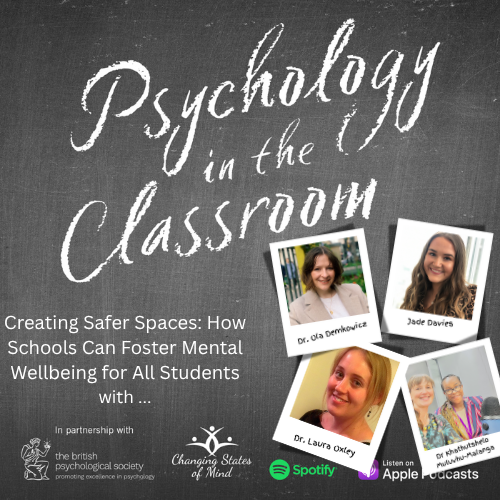
S14 Ep 8Creating Safer Spaces: How Schools Can Foster Mental Wellbeing for All Students
With Jade Davies, Dr Ola Demkowicz, Dr Khathustshelo Muluvhu-Malanga and Dr Laura Oxley In this final episode from the BPS Psychology of Education Setion's conference we hear from four experts on different elements of mental health in schools. We explore how social media impacts teenagers' wellbeing, the unique mental health challenges faced by adolescent girls, effective counseling models for supporting students towards academic excellence, and the importance of teacher wellbeing. The guests share research insights and practical advice, emphasising the need for open conversations, systemic change, and collaborative support. Together, they highlight the complexities of mental health in education and the importance of empathetic, evidence-based approaches for both students and teachers. Key points from the episode: Mental health in schools Impact of social media on young people's mental health Adolescent girls' mental health challenges Gender mental health gap and contributing factors Counseling models to support student wellbeing Teacher wellbeing and its relationship to student behavior Systemic changes needed to improve mental health support in schools Importance of open conversations between adults and young people regarding social media Strategies for teachers to manage student conduct and support mental health Collaboration among educators, parents, and institutions to enhance student support systems Time stamps Jade Davies: 2mins 6secs Ola Demkowicz: 14mins 28 secs Khathustshelo Muluvhu-Malanga: 25mins 16 secs Laura Oxley: 32mins 34secs