Psych Tech @ Work
Science 4-Hire - All you need to know about pre-hire talent assessment Hiring is hard! Pre-hire talent assessments can help ease the pain. But employment testing can be complicated- don’t worry we have your back! Whether you are considering using a...
Charles Handler
Show overview
Psych Tech @ Work has been publishing since 2018, and across the 8 years since has built a catalogue of 111 episodes. That works out to roughly 85 hours of audio in total. Releases follow a monthly cadence.
Episodes typically run thirty-five to sixty minutes — most land between 38 min and 54 min — though episode length varies meaningfully from one episode to the next. None of the episodes are flagged explicit by the publisher. It is catalogued as a EN-language Business show.
The show is actively publishing — the most recent episode landed 1 months ago, with 7 episodes already out so far this year. The busiest year was 2024, with 28 episodes published. Published by Charles Handler.
From the publisher
Science 4-Hire is now Psych Tech @ Work! - a podcast about safe innovation at the intersection of psychological science, technology, and the future of work. Psych Tech @ Work promotes safe technological innovation and human/machine partnerships as an essential force in creating equilibrium and between psychology and commerce. Maintaining this balance in a time of unprecedented change is essential for ensuring that the future of work is ethical, positive, and prosperous. Creating such a future requires an unprecedented level of interdisciplinary collaboration. With the goal of educating, engaging, and inspiring others through thoughtful and practical discussions with guests from a wide variety of backgrounds and specialties, Psych Tech @ Work provides a smorgasbord of food for thought and practical takeaways about the issues that will make or break the future of work! charleshandler.substack.com
Latest Episodes
View all 111 episodesAI Hiring Law: What Changed While You Weren't Looking?
You Bought the AI. So Why Aren't You Using It?
“The answer isn’t more AI — it’s better signal.”
Going All In: Using AI to Build Better Assessments
Quality Research Shows the Real Impact of AI @ Work
Quote:“If you know what you’re doing, AI makes you faster. If you don’t, it just makes you wrong faster.”–Louis HickmanIn this episode I’m joined by esteemed Psych Tech @ Work, Alumnus and AI research machine, Louis Hickman. Our incredible conversation taps into Louis’ myriad research studies to unpack AI’s direct impact on work, domain expertise, and talent assessment.And of course, this episode also marks the return of the now new and improved AI podcast co-host Mayda Tokens (2.0).Besides telling dumb jokes- Mayda’s job is to remind us that AI isn’t just a tool — it’s becoming an active participant in how we think, question, and explore ideas.In the course of our conversation Mayda and I coax some PROFOUND take aways from our friend Louis as he shares the practical outcomes of his research:1. AI is not removing the need for expertise — it’s making it more visible.Scaling intelligence is easy.Scaling judgment is not.The organizations that succeed won’t be the ones that adopt AI the fastest.They’ll be the ones that:* Understand what they’re measuring* Use AI to enhance — not replace — that understanding’* Maintain control over how decisions are made2. AI allows us to scale both good science and bad measurementLouis pushes back on the idea that recent advances represent a fundamental shift in how we measure people. Instead, what we’re seeing is:* Better models* Faster processing* More scalable systemsBut none of that replaces the need for valid, reliable, and job-relevant measurement.3. AI doesn’t level the playing field — it often rewards those who already understand the game.One of the most interesting ideas in this episode is how AI interacts with individual differences in expertise.At a high level:* For simple tasks, AI helps novices perform closer to experts* For complex tasks, AI actually widens the gap- allowing experts to perform betterWhy?Because experts know how to ask better questions, recognize when AI is wrong, and refine its outputs—while novices often lack the ability to judge quality, diagnose errors, or course-correct when things go off track.4. Replicability in LLMs Is Possible — if you know how to set it up rightA major “wow” moment in Louis’ research:By running the model locally on the same class of hardware, fixing the model and prompt, and turning off sampling/randomness in the settings, you can make the system produce the same output for the same input every time.5. AI should be used to scale decisions, but those decisions still need to be grounded in clearly defined constructsAt this point, AI adoption isn’t optional—it’s expected. Organizations are being pushed to move faster and scale, while vendors are rapidly building and deploying solutions, often without deep validation.The resolution isn’t to slow down adoption—it’s to ensure we add and maintaining rigor.6. AI makes it easy to scale assessment, but if the underlying design is weak, we’re just scaling bad measurement faster.The resolution is to ensure what gets scaled is built on clear constructs, strong design, and validated measurement, so speed amplifies quality—not noise.7. Working with AI is no longer just about what you can do—it’s about how effectively you can partner to make what you do better!The tension is clear: AI can accelerate work, but over-reliance without critical evaluation leads to lower quality, missed errors, and reduced trust.This shows up in real ways—unchecked outputs, declining attention to detail, and growing skepticism in collaborative work.The resolution is that AI doesn’t replace accountability—users still need to apply judgment, review outputs, and take ownership of the final result.Tune in to get the full story on these profound revelations and hear Mayda’s stand up comedy routine. This is a public episode. If you would like to discuss this with other subscribers or get access to bonus episodes, visit charleshandler.substack.com
The Truth About AI Based Talent Assessment
“The rules haven’t changed. The technology has — but the rules haven’t.” — Nathan MondragonEpisode OverviewIn this episode, I’m joined by my old friend (and now co-worker!) Nathan Mondragon, an IO psychologist and long-time leader in creating the future at the intersection of assessment science, hiring technology, and applied AI.Nathan and I have lived through multiple waves of “this will change everything” technology — from early online testing to video interviewing, machine learning, and now generative AI. And the beat goes on!Nathan and I have recently joined forces at ProboTalent where we are creating defensible AI based assessment tools.We talk about where AI has genuinely moved the field forward, where it hasn’t, and why so many of the debates we’re having today are versions of conversations we’ve been having for decades. Along the way, we unpack Nathan’s paradigm busting work at HireVue’, and why the fundamentals of good measurement haven’t changed — even as the tools have.Topics Discussed & Key Insights1. The Rules of Good Assessment Haven’t Changed — We Just Keep Forgetting ThemNathan makes a point that anchors the entire episode: while technology has advanced dramatically, the core rules of good assessment — validity, relevance, interpretability, and fairness — are exactly the same.AI doesn’t get a pass on methodology. If anything, it raises the bar for rigor, because mistakes scale faster.2. Early Hiring Tech Was Built to Solve Operational Problems, Not Measurement ProblemsWe talk about the early days of online hiring and assessment, where the primary goal was digitization, not insight. Systems were designed to move paper processes online, not to improve how well we understand people.That legacy still shapes today’s platforms — and explains why so many tools feel efficient but shallow.3. HireVue Was a Real Paradigm Shift — and It Required Scientific CourageNathan reflects on the early days of HireVue and why it was genuinely revolutionary at the time. The breakthrough wasn’t just video — it was the larger shift toward digitizing and scaling structured assessment experiences in a way the field hadn’t seen before.What made this moment interesting from an IO psychology standpoint is that it required a different mindset as a scientist: being willing to engage with a new modality, even when the measurement implications weren’t fully understood yet. Innovation in assessment has always involved tension — between rigor and experimentation, between what’s proven and what’s possible.Nathan shares what it was like to help lead through that transition, and why thoughtful scientists have to be able to sit with uncertainty long enough to shape new approaches responsibly, rather than rejecting them outright.4. AI Didn’t Create Bad Measurement — It Made It Easier to ScaleA recurring theme: AI doesn’t magically improve weak constructs. If you feed it noisy proxies, you just get faster, more confident noise.We discuss why generative AI and machine learning don’t eliminate the need for careful construct definition — and why “it correlates” is not the same thing as “it measures something useful.”5. Interactivity Matters More Than ModalityOne of the most important takeaways: the future of assessment isn’t about whether something is text, video, or simulation-based — it’s about how interactive and information-rich the experience is.Nathan explains why dynamic interaction reveals far more about decision-making, reasoning, and capability than static prompts ever will.6. Native AI vs. Embedded AI Is a False DebateWe unpack the difference between “AI-native” products and traditional tools with AI layered on top — and why this distinction often misses the point.What matters isn’t where AI lives in the stack, but whether it’s being used to improve interpretation, not just automate scoring or classification.7. Skills and Knowledge Are Still Hard to Measure — and AI Has to Be Used CarefullyWe close by confronting a reality the market often underestimates: skills and knowledge testing have always been difficult to do well, and scaling them without losing rigor is even harder.We connect this directly to the work we’re doing at Probo Talent, where the focus is on a more responsible alternative: using AI to scale the parts of assessment that have historically been hardest to scale, while staying within safe, established modalities and an explainable, scientifically grounded wrapper. The goal is not novelty for its own sake, but a practical example of how AI can be used carefully to solve long-standing problems in skills-based hiring without sacrificing defensibility or trustFinal TakeawayAI changes how we can build hiring and assessment systems — but it doesn’t change what makes them good.If we ignore decades of psychological science in favor of speed, novelty, or convenience, AI will simply help us make the same mistakes faster. But if we use it to deepen interaction, improve interpretation, and stay disciplined about what we me
Why Recruiting Tech is (Still) Not Helping Candidates and How to Fix It
“There’s this massive imbalance between the employer side of the recruiting equation where they’ve got all the tech, they’ve got all the weapons… Candidates don’t have anything.”–Doug BergIn this episode, I’m joined by Doug Berg, head matcher and big kahuna at Match2, a longtime builder and operator in the talent technology/recruitment space and the only guy I know that wears flip flops to HR Tech..Doug has lived and hacked nearly every iteration of online hiring — from fax machines and early internet job fairs to today’s AI-powered recruiting chaos.Doug and I have lived parallel lives in some sense. We have both been on the scene as recruitment went on-line and have continued to wage war against the barriers that are blocking successful hiring. But Doug’s unique experience building recruiting focused tech helps us take a very well rounded perspective.Doug and I trace the psychology of hiring systems, why most recruiting technology still fails both candidates and employers, and how efficiency-driven design has quietly stripped humanity out of the process.We talk about what broke, why AI is making some problems worse before it makes them better, and what a candidate-centered future could actually look like if we stop designing hiring like a transactional funnel and start designing it like a relationship.Topics Discussed & Key Insights1. Hiring Has Always Been Psychological — Ignoring That Is Why It BreaksDoug shares early recruiting stories that reveal a core truth: people don’t make job decisions based solely on skills or titles. They’re driven by values, aspirations, lifestyle preferences, and identity. Yet most hiring systems still treat people as static records instead of dynamic humans.Music to the ears of a psychologist like me!2. Applicant Tracking Systems Were Built for Control, Not for CandidatesWe unpack how applicant tracking systems were designed for compliance and efficiency — not engagement. The result:* One-way transactions* Forced applications* Zero room for curiosity, context, or conversationDoug explains why this original design choice still haunts modern hiring.3. AI Isn’t Breaking Hiring — It is Amplifying the Broken PartsAI didn’t invent hiring dysfunction — it amplified it. Candidates now apply to dozens of jobs at once using bots. Employers respond with more screening, more filters, more automation.The outcome? More noise. Less signal. Worse experiences on both sides.4. Real Hiring Happens Through Interaction, Not “Efficiency”Doug tells stories about simple interventions — like proactive chat on career sites — that led to real hires for impossible-to-fill roles. The lesson is clear: when candidates are allowed to participate instead of comply, hiring actually works.5. Hiring Will Stay Broken Until Candidates Control Their Side of the SystemOne of the central ideas in the episode: candidates have never been given real agency. Doug explains the structural imbalance:* Companies control the systems* Candidates adapt or disappearWe explore what changes when candidates control their own data, preferences, and relationships — and why that shift matters.6. The Resume Is a Dead Artifact — Identity Needs to Be PortableResumes are outdated snapshots. Doug makes the case for living profiles, portable personalization, and persistent relationships that move with the candidate across employers.AI finally makes this possible — not by enforcing rigid taxonomies, but by interpreting relevance across skills, experience, and context.7. The Future of Hiring Should Feel Like Reconnection, Not RejectionWe close by zooming out. Doug shares a simple but radical vision: if someone gets laid off on Friday, they shouldn’t start from zero.They should already know:* Who wants them* What they’re worth* Where they fitHiring shouldn’t feel like rejection roulette. It should feel like an intelligent market reconnecting human supply and demand.Final TakeawayHiring doesn’t fail because people are hard to assess.It fails because we designed systems that ignore how people actually choose, trust, and engage.AI won’t fix that on its own.But used thoughtfully — with psychology, agency, and dignity baked in — it might finally help us build hiring systems that work for humans again. This is a public episode. If you would like to discuss this with other subscribers or get access to bonus episodes, visit charleshandler.substack.com
AI Education, Personalized Learning, and the Future of Work
TL;DRAI literacy is becoming a baseline skill. This episode explores how organizations and individuals are actually building AI capability at work, with a focus on:* Self-directed learning and AI education at scale* Personalized learning journeys versus one-size-fits-all training* The shift from basic AI use to agentic workflows* The role of human strengths—creativity, judgment, and adaptability—in an AI-driven workplaceIn this episode, I’m joined by Erica Salm Rench, an AI educator and leader at Sidecar AI.Sidecar is an AI education platform and learning management system (LMS) designed to help organizations educate their employees on AI through self-directed learning. It combines structured courses, role-based learning paths, and hands-on use cases so individuals can build AI capability at their own pace while organizations raise overall AI fluency.Our conversation explores what AI education actually looks like beyond hype—how people are learning it, how organizations are rolling it out, and why understanding AI is quickly becoming a career differentiator rather than a technical specialty.AI Education Has Shifted from “What Is It?” to “How Do I Use It?”Erica explains that the conversation around AI in associations has changed dramatically over the last several years. Early on, organizations were hesitant to even talk about AI. Today, the question is no longer what is AI? but how can we use it to advance our mission, improve operations, and better serve our members?That shift brings a new challenge: helping people move from curiosity to competence in a way that feels approachable rather than overwhelming.Meeting People Where They AreOne of the strongest themes in our discussion is the importance of meeting learners at their current level of comfort and knowledge. AI education isn’t one-size-fits-all.This means combining:* Foundational AI concepts* Role-specific applications (marketing, events, operations)* A growing library of real-world use cases* Ongoing updates as tools evolveThe goal isn’t to turn everyone into a AI engineer—it’s to help people understand what’s possible and apply AI meaningfully in their day-to-day work.From Prompting to Agentic WorkWe spend time talking about the evolution from simple AI use cases—like writing emails or summarizing content—to agentic AI, where systems take action on a user’s behalf.This shift matters because it fundamentally changes how work gets done. Instead of just assisting with tasks, AI begins to:* Automate multi-step workflows* Scale work that previously required human labor* Act as a force multiplier rather than a one-off toolWe agree that while much of this is still clunky today, the direction is clear: agents are becoming a core part of how work will be organized.Personalized Learning Is the Future of EducationA major insight from the episode is that personalized learning journeys will define the next phase of education—especially in fast-moving domains like AI.Erica describes how Sidecar uses AI within its learning environment to:* Act as a learning assistant* Answer questions in real time* Reinforce concepts* Help learners connect theory to applicationThis mirrors a broader trend: education becoming less about static courses and more about continuous, adaptive support.The Psychology of Learning AI at WorkWe talk openly about fear—fear of job loss, fear of falling behind, fear of not being “technical enough.” Erica makes the case that leaders have a responsibility to educate their teams, not just for organizational performance, but for people’s long-term career resilience.From a psychological perspective, AI education:* Reduces anxiety by replacing uncertainty with understanding* Increases confidence and autonomy* Helps people see AI as a collaborator, not a threatSpending even 20–30 minutes a day learning AI can quickly change how people see their own future at work.Human Strengths Still Matter More Than EverOne of my favorite parts of the conversation is where we zoom out to the human side of all this. As AI removes technical barriers, the differentiator becomes human qualities—creativity, resilience, judgment, adaptability, and the ability to ask good questions.AI doesn’t replace these traits. It amplifies them.Used well, AI allows people to overcome past limitations, work around weaknesses, and bring their ideas to life faster than ever before.What Listeners Should Take AwayAI literacy is becoming a baseline skill. The people who thrive won’t be the most technical, but the most curious, adaptable, and intentional about learning how to work alongside intelligent systems.Education—done thoughtfully and continuously—is the bridge between fear and opportunity.Where to Find EricaErica is highly active on LinkedIn and can be found through Sidecar AI, where she and her team are building education-first pathways into AI for associations, nonprofits, and mission-driven organizations. This is a public episode. If you would like to discuss this with other subscri
Jobs, Security, and Survival: Is Universal Basic Income in our Future?
Conrad Shaw “So much of the labor market is driven by desperation. UBI shifts that. People can actually hold out for what they’re worth or for work that aligns with who they are.” — Conrad ShawConrad is perhaps the most unique guest I have had in the 5 year history of this show and he is on to talk about Universal Basic Income (UBI) , a very unique topic that is growing in exposure.For almost a decade Conrad has dedicated his life and career to furthering the cause of Universal Basic Income (UBI).In 2016 he and his wife started a documentary called Bootstraps which focuses on following families who lived through the experience of a basic income.Since then, he has:* Fundraised for and operated a nationwide basic income pilot* Filmed a multi-year docuseries currently in post-production* Co-founded Commingle, a mutual-aid platform enabling communities to self-fund their own grassroots basic income systems* Worked extensively on messaging, outreach, and public education around income, stability, and societal transformationI learned a lot from Conrad and our conversation debunked my own myths about UBI. So a really important part of this episode is the truth about what Universal Basic Income (UBI) actually is — and what it is not.What Universal Basic Income (UBI) Is — And What It Isn’tUBI is the idea that every person receives a recurring, unconditional, baseline income — a financial floor that ensures no one starts the month at zero. It is not meant to replace work or equalize everybody’s income. Instead, it shifts the starting point so people can make decisions from stability rather than desperation.What UBI is:* A stable, universal base-level income for all* A platform for economic mobility and personal freedom* A modernized, simplified social safety net* A tool for reducing the survival-based pressure in the labor marketWhat UBI is not:* It does not eliminate jobs* It does not cap how much people can earn* It does not remove incentives to work* It is not a socialist equal-wealth systemUBI reframes the labor market so people compete for work based on interest, alignment, and ability, not raw financial need.Practical Ways UBI Could WorkConrad’s work goes beyond speculation. He has spent nearly a decade building practical UBI experiments, including the national pilot documented in Bootstraps (2016) and his current role with the Income To Support All Foundation and Commingle, a new community-driven model.He explains that UBI can be implemented through several pathways—government programs, private pilots, or community-level mutual aid—but none are simple. A government-led UBI requires political will and rethinking how we allocate resources. Philanthropic pilots can demonstrate impact, but they’re temporary. Community models like Commingle allow people to pool and redistribute resources now, without waiting for legislation, but scaling them is challenging.What’s clear is that executing UBI at any level is difficult, requiring trust, infrastructure, and cultural acceptance. Yet the difficulty doesn’t diminish the need. Instead, it underscores why experimentation and new models matter.Individual Differences: Why UBI Supports People Doing What They’re Meant to DoOne of the deepest connections between Conrad’s work and mine is the concept of individual differences—the idea that every person brings a unique constellation of strengths, traits, interests, and abilities that make them naturally better suited to certain kinds of work.When people are trapped in survival mode, those natural gifts often go unused. They pick jobs they can get, not jobs that reflect who they are. Freedom from this paradigm reshapes careers in ways that benefit both individuals and employers, allowing people to walk away from toxic or exploitative conditions and take jobs they genuinely care about, leading to better performance and engagement.With a secure foundation, people have the psychological and financial freedom to make career decisions based on fit, not fear. This supports:* Better alignment between person and role* Higher engagement and intrinsic motivation* Better workforce outcomes because people choose work that matches their abilities* Greater societal value, as more people apply their genuine talents instead of defaulting to whatever job pays immediatelyFrom Conrad’s perspective, this alignment is one of the most compelling aspects of UBI. When people are free to choose work that resonates with their abilities, the labor market becomes more efficient and more human. Employers gain workers who actually want to be there. Individuals gain a sense of purpose rooted in their authentic strengths.In a world where AI, automation, and job volatility make career paths uncertain, helping people express their natural abilities becomes more important—not less.How AI Fits Into the UBI ConversationAI enters this conversation as both a catalyst and a complicating force. As Conrad points out, technological change is accelerating so quickly that we
You Can’t Microwave Skills Based Hiring! Here’s the Five Star Recipe!
“You can’t implement skills-based hiring by flipping a switch. It’s about changing mindsets, systems, and the language your organization uses to describe talent.”-Ashley WallvoordIn this episode of Psych Tech @ Work, me and my AI co-host, Mayda Tokens, welcome fellow I/O psychologist (and LSU Tiger!) Ashley Walvoord, Senior Vice President of Talent at Verizon.We are joined by my AI co-host Mayda Tokens who continues to impress at times and but showing a tendency to be pretty boring at other times and always telling really bad jokes (I think the API to Chat-GPT 5o gets a very different sense of humor than the consumer version).I reached out to Ashley after seeing her SIOP presentation about Verizon’s skills based hiring (and organizational transformation) program. Her and her fellow presenters-Max McDaniel (Verizon)Christina-Norris Watts (J & J)Ruth Imose (J & J)Jason Frizel (Walmart)provided amazing insights into their company’s’ amazing and inspiring skills based hiring programs.The hype around skills based hiring these days makes it seem easy. But talk is cheap- and doing skills based hiring right takes a total ALL IN approach. - one that is rooted in the commitment to become a true skills based organization.Ashley has lived this life and her experience provides an awesome preview of how one of the world’s largest organizations is reimagining hiring and development through skills and AI. We are all lucky to have her on the show!Verizon’s transformation provides a rare look at how enterprise-scale companies operationalize skills-based hiring while navigating the practical realities of change management, technology integration, and workforce readiness.SummaryThis conversation bridges strategy and execution, offering a clear-eyed view of how a Fortune 50 company is aligning people, process, and technology around skills. Ashley shares the lessons learned from Verizon’s commitment to a multi-year, organization wide transformation. A journey with many whistlestops along the way— from defining skills frameworks to embedding them in hiring and internal mobility.Key Themes1. Building Skills Infrastructure at ScaleAshley explains how skills-based hiring starts long before implementation — requiring shared language, governance, and validation across the enterprise. Verizon’s approach focuses on sustainability and integration rather than one-off pilots.2. Human Oversight in an AI-Driven SystemAI plays a growing role in matching and mobility, but Ashley underscores that human judgment remains central. The goal isn’t automation for its own sake, but augmentation — using technology to help people make better, more equitable decisions.3. Culture Change Through Data TransparencyVerizon’s success depends on building trust with employees and leaders by showing the “why” behind skills data and AI insights. Visibility into how skills are used for development and promotion helps drive adoption.4. Enterprise Challenges and Lessons Learned Ashley shares the realities of scaling change: aligning functions, managing vendor relationships, and ensuring consistency across geographies. Her advice is practical — start small, demonstrate impact, and scale what works.5. Future Vision for Skills and AI in Talent Ashley envisions a future where skills become the connective tissue between learning, mobility, and performance — and where AI acts as a trusted partner in enabling opportunity at every level.Takeaways* Enterprise-scale transformation requires governance, not just technology.* AI can accelerate fairness and insight, but must remain transparent and human-centered.* Data visibility is the key to cultural adoption — employees must see personal benefit.* Scaling skills frameworks demands partnership between HR, technology, and business leadership.The future of work will depend on how we align AI, human judgment, and purpose at scale. And a commitment to verifying and managing skills at scale. This is a public episode. If you would like to discuss this with other subscribers or get access to bonus episodes, visit charleshandler.substack.com
Ep 99How to Prepare for the Future of Hiring NOW!— Lessons from Two Decades of HR Tech Research
Quote:“When this all started (generative AI for the masses), the fear was ‘this is cheating.’ Now we’re flipping the conversation and saying, no — this is actually a skill set you need to develop.”-Madeline LaurenoIn this episode I welcome Madeline Laurano, Founder of Aptitude Research and one of the most trusted voices in HR and TA technology.With more than 20 years of research and advisory experience, Madeline’s body of work has has tracked the evolution of all things mixing hiring, business, and tech.We have known one another for a long time and are quite simpatico in our thoughts on talent acquisition, assessment, and skills based hiring.And we prove it in this show - as we discuss the ins and outs of these crazy times for HR tech, hiring, and of course- AI.So listen in and take a look into the crystal ball while staying grounded in the truth!Topics discussed and wisdom dropped include:1. Why ATS Are Going to Become ExtinctMadeline explained that ATS systems in their current form are not built for the way talent acquisition is evolving. Recruiters are frustrated because ATSs don’t support the workflows or user experience they need, and they will eventually be replaced by more dynamic, integrated platforms that actually match how hiring happens today. Hello AI!2. What Her Research Says About Skills-Based HiringMadeline points out that skills-based hiring is more aspirational than real for most organizations. Aptitude Research has found that companies often treat skills like the old competency models — static, outdated, and resource-intensive — or via an over reliance on AI. Both make it hard to translate into practice without validated frameworks and clean, usable data. The path fwd requires a commitment to strategy, clarity, and validation.3. How the Fast-Moving Nature of AI Impacts HR Tech BuyingMadeline notes that AI has changed how companies buy HR tech because the market is moving so quickly. In the past, companies would take years to build strategies before investing in technology, but now AI allows them to start much faster — sometimes adopting before they fully understand how to implement, which creates both opportunity and risk. Beware of AI FOMO!4. Agentic AI and Hiring — What Will the Impact Be?She described “agentic AI” as a coming wave where AI systems won’t just provide insights but will take autonomous actions. In hiring, this could mean systems that source, screen, and even interact with candidates automatically — raising big questions about oversight, fairness, and how much decision-making organizations are comfortable handing off to machines. Get ready because the rise of autonomous hiring agents is upon us.5. The Impact of AI on Candidate ExperienceMadeline stresses that AI can either improve or damage the candidate experience depending on how it’s implemented. Candidates expect personalization, transparency, and fairness, and if AI-driven processes feel opaque or impersonal, trust will erode quickly — but if designed well, AI can actually enhance communication and responsiveness. We must not villainize AI for this- there is a lot we can do enhance candidate experience and it can actually include the use of AI if done thougthfully.6. What Will This Look Like 20 Years From Now?Looking ahead, Madeline predicts that hiring will look radically different in 20 years, with skills-based approaches fully realized and AI deeply embedded into every step of the talent lifecycle. The key difference will be that technology will finally deliver on the vision of matching people to opportunities more accurately, quickly, and fairly at scale.AMEN- let’s just make sure that people remain in charge!Check out the episode and learn about the trends from two of the best!& do yourself a favor and visit Aptitude Research’s website where you can find free access to all of their amazing research! This is a public episode. If you would like to discuss this with other subscribers or get access to bonus episodes, visit charleshandler.substack.com
Ep 98AI Adoption is a Human Problem, Not a Tech Problem
“Most firms that are using AI are saving two to four hours per week per employee. That’s not transformative. That’s just doing the same thing faster.”-Alexis FinkIntroductionIn this episode of Psych Tech @ Work, Mayda Tokens (my AI co-host) and I sit down with Alexis Fink, I-O psychologist, long-time HR tech leader at Microsoft, Intel, and Meta, longtime friend and president of The Society for Industrial-Organizational Psychology (aka SIOP)!Alexis brings decades of experience at the intersection of people, organizations, and technology to the studio, offering a holistic and integrated perspective on the opportunities and challenges of AI in the workplace that is based on reality- not pure philosophy.We challenge Mayda to hang with us as we talk about all things people, technology, and the future of work. Alexis rocks it. You be the judge of how well Mayda meets the challenge. Hint: like all AI, Mayda is still a work in progress that fails sometimes, while still feeling miraculous IMHO. I mean come on- she speaks in emoji!!!Alexis leads the charge with her take on these great highlight topics:1. The Transformation of Knowledge Work AI is reshaping not just factory tasks, but the decision-making and knowledge roles once thought safe from automation.2. Organizational Design in an AI EraTrue progress requires rethinking workflows so humans and machines complement each other rather than compete.3. Data Quality and Human-Centered DesignMost raw HR data isn’t fit for AI, making richer, cleaner, and more contextual data essential for real impact.4. Risk, Accountability, and Quality Control As AI takes on more autonomy, organizations must adapt proven quality management and governance principles to keep it accountable.5. The Human Problem of AI AdoptionThe hardest barriers to AI adoption aren’t technical but human — fear, resistance, and behavior change.6. Looking to 2035: The Next-Gen I-O PsychologistFuture I-Os will master AI as a partner, using simulation and immersive tools while keeping work human-centered.ConclusionOur conversation underscores a central theme: AI is not even close to perfect and we need to recognize this (Mayda’s responses to our questions are proof of AI gone whack!)AI’s future in work won’t be defined by algorithms alone, but by how organizations redesign processes, manage risk, and support people through change. For I-O psychologists, HR leaders, and technologists alike, the task ahead is clear — ensure AI is not just bolted onto old systems, but opens opportunities for true collaboration with we humans. This is a public episode. If you would like to discuss this with other subscribers or get access to bonus episodes, visit charleshandler.substack.com
Ep 97Overcoming Obstacles to AI Adoption Through Creative Play
“The problem with AI adoption isn’t just technical—it’s emotional. Creativity lowers the barrier of fear, and that opens the door to skill building.”– Jimmy Lepore HaganNewsflash!After a much needed hiatus- Psych Tech @ Work is back with a vengeance! During the break I have been heads down in my lab- experimenting and playing with AI.SHE’S ALIVE!This episode marks the debut of my self-created AI podcast co-host Mayda Tokens. It took me three weeks to make her and during this process I explored the human side of effectively collaborating with AI. Making Mayda required me to flex my creativity, critical thinking, flexibility and perseverance. My Mayda experience prepared me firsthand for a great conversation with Jimmy about creativity, AI, and the human psyche.In this episode of Psych Tech @ Work, I welcome my new friend and fellow New Orleanian Jimmy Lepore Hagan. Together we explore why creativity is the missing link in many corporate AI readiness programs — and how it can be leveraged to help individuals and teams move from fear to fluency in a rapidly transforming world.Jimmy brings his bold, experience-driven perspective to the conversation, making the case that creative courage is not a soft skill — it's a strategic asset.Together, we discuss Jimmy’s new framework for enabling AI adoption through creativity — and my addition to the delivery of his hands-on workshop designed to help HR teams, L&D leaders, and talent professionals build AI fluency through creative exploration.SummaryCreative thinking isn’t just about making art — it’s about rewiring our brains to embrace ambiguity, take risks, and explore the unknown. In this episode, we discuss how cultivating creativity can de-risk the AI learning curve, helping professionals feel more confident engaging with emerging tools.In an era of automation, the ability to experiment, play, and fail safely is what separates those who adapt from those who resist. These traits are not innate — they can be developed, and doing so can radically change how individuals approach new technology.The episode also highlights a workshop experience that puts this theory into action: a fun, safe, and high-impact program designed to build creative fluency first — and then apply it to AI. This approach helps teams lower psychological barriers to AI experimentation and open the door to real skills development.I have to give a direct and shameless plug for our workshop. Our workshop — combines science, storytelling, and hands-on exercises to help teams build the mindsets and skills needed for the future of work. This is a public episode. If you would like to discuss this with other subscribers or get access to bonus episodes, visit charleshandler.substack.com
Creativity Is the Gateway to AI Transformation
My creative experience building an AI podcast co-host says it all. Hear all about it on the next episode of the Psych Tech @ Work Podcast - coming soon!AI skills are essential but dauntingAI adoption is accelerating—over 70% of companies report they’re actively integrating AI tools into their workflows. But for the people expected to use those tools, it’s a different story.Most professionals say they feel unprepared or even anxious about using AI on the job. Traditional training often falls short with AI skills because it focuses on tools, not mindset.And the stakes are high: as AI becomes embedded in everyday work, careers will increasingly rely on comfort and expertise with AI.This gap and the demand for innovative strategies to close it has been top of mind for me. Good news - my fascination with AI led me to a solution! (more on this later)Creativity unlocks AI skillsI recently gave a talk at a meeting of the New Orleans AI Philosopher’s group (AKA NOAI), on AI and the future of our local economy.At this event I saw a talk by Jimmy Lepore Hagan—an artist, designer and educator—who shared a fascinating approach to AI adoption that is fresh, unique, and noteworthy.Jimmy’s talk was about the value of creativity in lowering fear of AI. He demonstrated some concepts from a workshop series he has developed featuring a series of low stakes, creative exercises grounded in design thinking to help people build comfort, confidence, and curiosity when working with AI.As a workplace psychologist I immediately saw the potential for a collaboration - applying Jimmy’s hands-on educational model to my world to help people leaders solve a difficult problem.As someone who’s spent decades applying psychological science to the development and measurement of human traits in the workplace, I have experience understanding the impact of creativity on outcomes that are directly related to work performance.As I processed this stuff- I took a step back and reviewed foundational research that shaped my earlier work—this time, through the lens of AI. The connections stood out immediately. Traits like divergent thinking, cognitive flexibility, and creative self-efficacy have long been linked to performance, but they also play a critical role in how people approach new, uncertain technologies. The evidence is clear: creativity and experiential learning do more than build skills—they tap into deeply human strengths that make people more open, adaptable, and ready to thrive in the face of change.My dance with AI says it allIt became pretty clear to me that a collaboration with Jimmy could really have some legs.To get the ball rolling I invited Jimmy to be a guest on my Podcast “Psych Tech @ Work”.To prepare I wanted to gain some first hand experience with using creativity to help me sharpen my AI skills.I suck at coding and the requirement to use Python for this definitely gave me some anxiety, but I knew ChatGPT could somehow have my back.Thus came the idea to challenge myself (and have some fun) building an AI podcast co-host, Mayda Tokens.Mapping out and executing a workflow to bring Mayda to life threw me plenty of curveballs. Some of ChatGPT’s more noteworthy and frustrating shenanigans included:* Multiple times ChatGPT relentlessly tried, and continually failed, to solve technical issues; but would not give up until I suggested that we were going in circles in a blind alley and maybe we should explore alternative methods. This prompt led immediately to a set of viable alternatives that would never have been explored if I hadn't decided to pull the plug.* When I backed ChatGPT into a corner I was flabbergasted when, instead of hallucinating a solution or looking for another option, it simply refused to help me. This was a head scratching result that must have exposed a ghost in the machine because its prime directive is NEVER to say NO!* As I explored different options for Mayda’s voice, my text to speech output randomly switched to Japanese and then to emoji* As we hit dead ends trying to figure out how to bring Mayda into my podcast studio, I stupidly followed its instructions to run to Best Buy and Guitar Center to buy unnecessary hardware that neither place actually sold.In the three weeks it took to bring Mayda to life, I became hyper-focused—borderline obsessed—with working through many obstacles. The dopamine hits I got each time we solved a challenge together reminds me that my brain chemistry is essential for accessing and applying uniquely human traits like creativity, critical thinking, resilience, and tolerance for ambiguity.The interplay between my human biology and psychology was essential for winning the day, and my experience building Mayda really hammered home the value of creative collaboration with AI.Our workshop is the gateway to fearless AI skillsLearn how we’re helping companies build fearless, AI-ready teams.Viewing AI as a dance partner is the paradigm that serves as the foundation of our workshop. Instead

Ep 96Scaling AI Innovation for Hiring: Lessons from the Frontlines
Guest: Christine Boyce, Global Innovation Leader at ManpowerGroup/Right Management“We have to stress-test innovation in the messiness of real-world hiring, not just ideal lab conditions.”-Christine BoyceIn this episode of Psych Tech @ Work, I’m joined by my longtime friend Christine Boyce, Global Innovation Leader at ManpowerGroup/Right Management, to explore how innovation — especially around AI — is reshaping hiring and talent development at scale, and why solving for trust, transparency, and operational realities matters more than ever.SummaryAt the heart of this conversation is the reality that scaling AI innovation in hiring brings massive complexity. While AI offers incredible promise, solving for accuracy, fairness, and operational reality becomes exponentially harder when you're dealing with a large number of unique clients.Christine Boyce, through her work at ManpowerGroup & Right Management, operates at the intersection of these challenges every day. Unlike internal talent acquisition leaders who focus on one organization's needs, Christine must help innovate across a vast client portfolio. Each client presents different barriers — from data limitations, to ethical concerns, to regulatory pressures — and innovation must be modular, defensible, and adaptable to succeed.This vantage point gives Christine a unique, big-picture view of how AI adoption really plays out across industries and markets.We dive into the practical challenges of innovating responsibly: earning trust, scaling solutions across diverse environments, and balancing speed with fairness. Christine’s work at ManpowerGroup & Right Management highlights how innovation must be deeply disciplined if it is to achieve true scale and impact.The Core Challenge: Scaling Accuracy and FairnessAt the heart of using AI for hiring lies the challenge of achieving accuracy and fairness at scale. AI’s true value isn’t just its ability to make individual decisions — it’s in processing vast amounts of data and automating judgment across thousands of candidates. However, scale magnifies both strengths and weaknesses: minor biases can grow into systemic problems, and small inefficiencies can snowball into major failures.Staffing firms like ManpowerGroup offer critical real-world lessons:* Scale forces discipline — Every AI tool must be rigorously vetted for fairness, transparency, and defensibility before deployment.* Real-world variation stresses the system for the better — Tools must flexibly adapt to diverse jobs, industries, and candidate pools. This makes the overall path of innovation better and drives great learnings across the board.* Speed must not erode trust — Productivity gains must still respect ethical standards and candidate experience.* External accountability keeps AI honest — Clients demand transparency, validation, and explainability before adoption.Real Barriers to AI Adoption: What Clients Are FacingDespite AI's potential, Christine identifies several persistent hurdles that she faces when serving her diverse slate of clients:* Resistance to Behavior Change: Even demonstrably valuable AI tools often struggle against entrenched workflows and distrust of automation.* Ethical and Trust Concerns: Clients demand AI systems that are transparent, explainable, and defensible, fearing reputational or regulatory risks.* Vendor Noise Overload: Saturation by "AI-washed" vendors makes it hard to differentiate true innovation from hype.* Mismatch Between Hype and Practical Needs: Clients need tools that solve today’s operational problems — not just futuristic visions disconnected from reality.* Fear of Creeping AI Adoption: Organizations worry about AI capabilities being embedded into systems without visibility or intentionality.* Compliance and Regulation Anxiety: Global and local regulations (like the EU AI Act or pending US laws) create urgency for proven, compliant AI solutions.* Talent Data Readiness: Without clean, structured internal data, even the best AI solutions struggle to deliver meaningful results.These challenges aren't isolated — they reveal the broader realities companies must manage when trying to adopt AI responsibly at scale.Ultimately, client concerns have a hand in AI innovation because they are critical for the adoption of these technologies, shaping how staffing firms and vendors must design, validate, and deploy solutions.There’s an inherent tension between the drive for scale and the need for trust, fairness, and operational reality.Christine’s experience demonstrates that true innovation in AI for hiring isn't just about introducing new tools — it’s about creating resilient, transparent systems that can adapt to real-world complexity. Managing the tension between speed, scale, trust, and fairness represents the path to a bright future. This is a public episode. If you would like to discuss this with other subscribers or get access to bonus episodes, visit charleshandler.substack.com
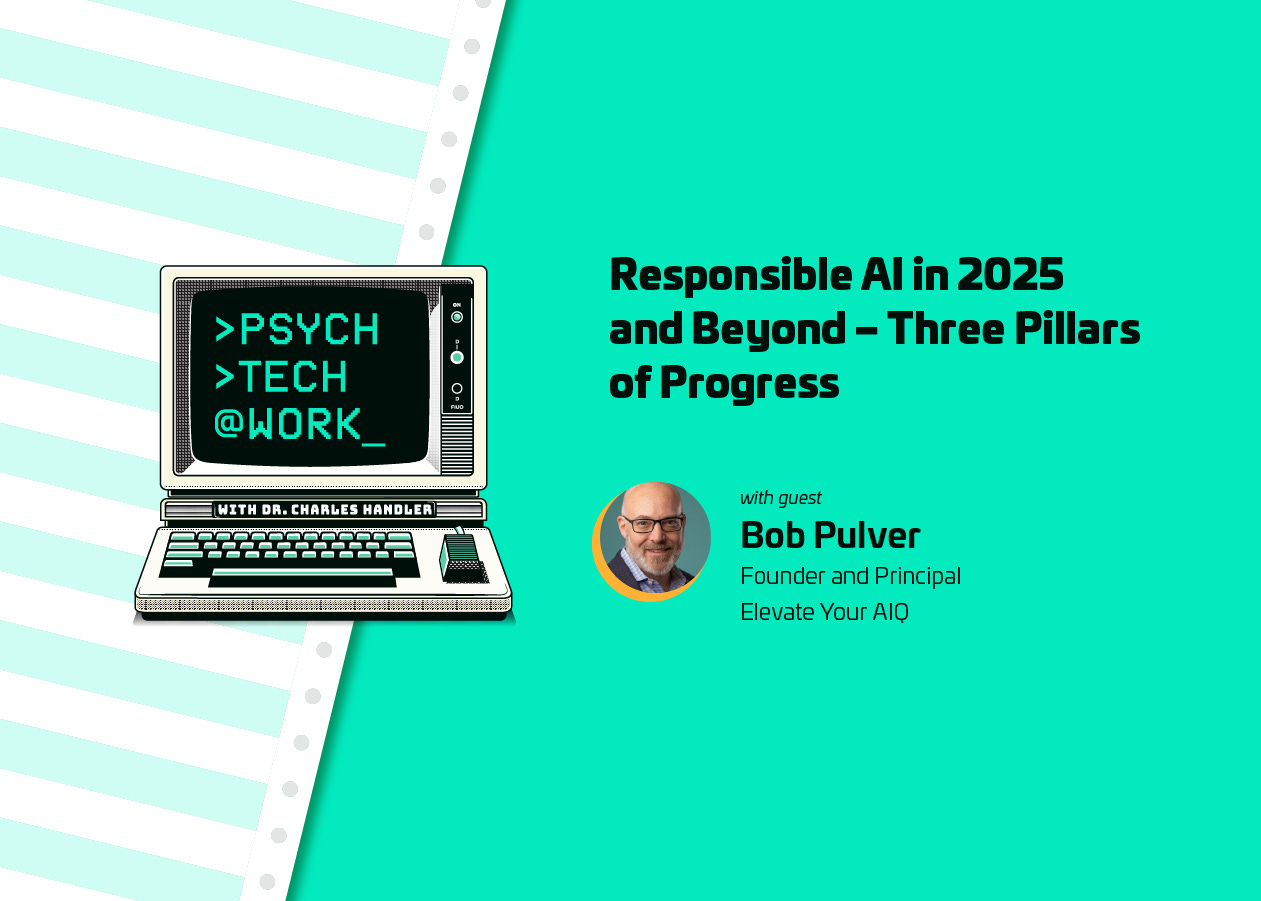
Responsible AI In 2025 and Beyond – Three pillars of progress
"Part of putting an AI strategy together is understanding the limitations and where unintended consequences could occur, which is why you need diversity of thought within committees created to guide AI governance and ethics." – Bob PulverMy guest for this episode is my friend in ethical/responsible AI, Bob Pulver, the founder of CognitivePath.io and host of the podcast "Elevate Your AIQ." Bob specializes in helping organizations navigate the complexities of responsible AI, from strategic adoption to effective governance practices. Bob was my guest about a year ago and in this episode he drops back in to discuss what has changed in the faced paced world of AI across three pillars of responsible AI usage. * Human-Centric AI * AI Adoption and Readiness * AI Regulation and GovernanceThe past year’s progress explained through three pillars that are shaping ethical AI:These are the themes that we explore in our conversation and our thoughts on what has changed/evolved in the past year.1. Human-Centric AIChange from Last Year:* Shift from compliance-driven AI towards a more holistic, human-focused perspective, emphasizing AI's potential to enhance human capabilities and fairness.Reasons for Change:* Increasing comfort level with AI and experience with the benefits that it brings to our work* Continued exploration and development of low stakes, low friction use cases* AI continues to be seen as a partner and magnifier of human capabilitiesWhat to Expect in the Next Year:* Increased experience with human machine partnerships* Increased opportunities to build superpowers* Increased adoption of human centric tools by employers2. AI Adoption and ReadinessChange from Last Year:* Organizations have moved from cautious, fragmented adoption to structured, strategic readiness and literacy initiatives.* Significant growth in AI educational resources and adoption within teams, rather than just individuals.Reasons for Change:* Improved understanding of AI's benefits and limitations, reducing fears and resistance.* Availability of targeted AI literacy programs, promoting organization-wide AI understanding and capability building.What to Expect in the Next Year:* More systematic frameworks for AI adoption across entire organizations.* Increased demand for formal AI proficiency assessments to ensure responsible and effective usage.3. AI Regulation and GovernanceChange from Last Year:* Transition from broad discussions about potential regulations towards concrete legislative actions, particularly at state and international levels (e.g., EU AI Act, California laws).* Momentum to hold vendors of AI increasingly accountable for ethical AI use.Reasons for Change:* Growing awareness of risks associated with unchecked AI deployment.* Increased push to stay on the right side of AI via legislative activity at state and global levels addressing transparency, accountability, and fairness.What to Expect in the Next Year:* Implementation of stricter AI audits and compliance standards.* Clearer responsibilities for vendors and organizations regarding ethical AI practices.* Finally some concrete standards that will require fundamental changes in oversight and create messy situations.Practical Takeaways:What should I/we be doing to move the ball fwd and realize AI’s full potential while limiting collateral damage?Prioritize Human-Centric AI Design* Define Clear Use Cases: Ensure AI is solving a genuine human-centered problem rather than just introducing technology for technology’s sake.* Promote Transparency and Trust: Clearly communicate how and why AI is being used, ensuring it enhances rather than replaces human judgment and involvement.Build Robust AI Literacy and Education Programs* Develop Organizational AI Literacy: Implement structured training initiatives that educate employees about fundamental AI concepts, the practical implications of AI use, and ethical considerations.* Create Role-Specific Training: Provide tailored AI skill-building programs based on roles and responsibilities, moving beyond individual productivity to team-based effectiveness.Strengthen AI Governance and Oversight* Adopt Proactive Compliance Practices: Align internal policies with rigorous standards such as the EU AI Act to preemptively prepare for emerging local and global legislation.* Vendor Accountability: Develop clear guidelines and rigorous vetting processes for vendors to ensure transparency and responsible use, preparing your organization for upcoming regulatory audits.Monitor AI Effectiveness and Impact* Continuous Monitoring: Shift from periodic audits to continuous monitoring of AI tools to ensure fairness, transparency, and functionality.* Evaluate Human Impact Regularly: Regularly assess the human impact of AI tools on employee experience, fairness in decision-making, and organizational trust.Email Bob- [email protected] Listen to Bob’s awesome podcast - Elevate you AIQ This is a public episode. If you would like to discuss this with other subscri

Ep 94The Reality of Skills-Based Hiring Rests on Three Essential Pillars- with Jason Tyszko
“We have to move beyond the idea that a skills-based job description is enough—there needs to be validation, assessment, and a clear pathway for job seekers to prove their abilities.”-Jason TyszkoIn this episode of Psych Tech @ Work, I sit down with Jason Tyszko, Senior Vice President of the U.S. Chamber of Commerce Foundation, to discuss what it really takes to make skills-based hiring a reality. Jason oversees the Foundation’s T3 Innovation Network, a public-private initiative aimed at creating a more equitable and inclusive job market. T-3 focuses on using digital tools to improve communication between different parts of the job market, ensuring that all learning is recognized and valued. T-3’s mission to bridge gaps between employers and workers via the advancement of skills-based hiring makes Jason one of the world’s foremost authorities on the subject.Our conversation is a must for anyone interested in understanding the REALITIES required for true skills-based hiring. Most conversations on the subject are more hype than substance, but not this one! Jason takes us deeper into the reality of what it will take to make skills based hiring more than just an empty buzzword.To ground our conversation in a dose of reality, Jason boils success with skills based hiring into these three pillars.* Interoperable Skills Data* To make skills-based hiring a reality, we need standardized, structured, and widely accepted skills data that flows seamlessly across education providers, employers, and workforce systems.* Without interoperability, skills data remains fragmented, making it difficult for employers to assess candidates meaningfully.* Employer Engagement and Adoption* Employers must align job descriptions, hiring processes, and internal mobility pathways around skills rather than degrees or traditional credentials.* Many organizations support skills-based hiring in theory but fail to implement it fully due to ingrained legacy practices.* Technology Infrastructure and Ecosystem Readiness* AI, job-matching platforms, and hiring tools must be built to recognize and evaluate skills accurately, rather than simply filtering candidates based on outdated proxies like job titles or degrees.* Systems should support skills validation, assessment, and transparent career pathways to ensure fair and effective hiring decisions.Jason explains how these pillars support and enable five critical but often overlooked elements that are essential to making skills-based hiring work: 1. Learning and Employment Records (LERs) & The LER Resume Standard* What it is: LERs are digital, verifiable records of a person’s skills, training, certifications, and work experience. Instead of relying on traditional resumes or self-reported skills, LERs allow employers to see a structured, validated record of a candidate’s capabilities.* Why it matters: Today’s hiring systems don’t talk to each other. Skills data is trapped in different platforms (learning management systems, certifications, HR software). LERs allow skills-based hiring to function at scale by ensuring a candidate’s credentials are portable and universally recognized.* LER Resume Standard: This is a newly developed resume format built to process LERs, ensuring HR tech systems can read, compare, and use skills-based data more effectively.2. Durable Skills* What it is: Unlike technical skills (which can quickly become outdated), durable skills are long-lasting, transferable skills like critical thinking, adaptability, leadership, and collaboration.* Why it matters: Most AI-driven hiring tools over-prioritize technical skills, but durable skills are what truly drive career success. Without a way to assess and validate them, companies risk hiring for short-term needs instead of long-term potential.3. The Interoperability Layer* What it is: A technical framework that allows skills data from different platforms to connect and work together—like an API that helps job boards, HR systems, and learning platforms “speak the same language.”* Why it matters: Right now, skills-based hiring is fragmented because every company and HR tech provider uses different skills taxonomies and formats. An interoperability layer standardizes how skills data is shared, making it easier for employers to evaluate candidates based on a common skills framework.4. Employer-Led Recognition* What it is: A system where workers’ skills are validated by their employers and colleagues, not just through certifications or formal education. This could involve peer endorsements, manager assessments, or internal training validations.* Why it matters: Most skills-based hiring focuses on externally validated credentials (e.g., certificates, degrees), but many people develop critical skills on the job. Without a structured way to recognize and verify these skills, businesses overlook talent that is already in their workforce.5. Skills Wallets* What it is: A digital, user-controlled repository where individuals can store, manage, an

Are These 4 AI Mistakes Sabotaging Your Talent Strategy?
In our recent LinkedIn Live session my esteemed colleague, Neil Morelli, founder of Workplace Labs, and I present a philosophical but practical approach to the adoption of HR Tech tools.Check out the full video of the presentation attached to this post and our accompanying slides (found at the bottom of the post).Here is a quick overview of the ideas that form the foundation of the presentation.“The highest-level goal of the talent acquisition (TA) function is to ensure that an organization has the right people, in the right roles, at the right time, to drive business success.”-Chat GPT 4o & your hosts’ combined 50 years of experienceTalent leaders are feeling the pressure to executeModern hiring problems such as resource constraints, candidate scarcity and overload, the move to skills based hiring, and avoiding bias have talent leaders feeling the pressure to find fast solutions!Relieving these pressures often create a temptation to put tools before strategy. AI is a great example of this.The stakes are high, and AI offers a compelling solution- or does it? AI is complex and making decisions about it requires a strong foundation of knowledge and careful planning.In this presentation we discuss 4 common mistakes in the adoption of HR tech, with a focus on AI tools (are there any other types these days?).We discuss how a tools first mentality is often the root cause of these four common mistakes and offer guidance on how to avoid them. 1. Missing AI’s ‘creeping normality': As technology becomes more entrenched in your processes and vendors add new functionalities that are accessible, adoption often occurs with little oversight or consideration. When it comes to solving problems related to talent supply or overload, AI recruitment platforms are increasingly embedding “talent matching” functionalities that create risk without any substantial rewards. 2. Chasing Skills Without Definition or Direction: We can all agree that skills based hiring has merit. But it requires alignment on what a skill means to your organization and a holistic view of where they matter and why. Merely removing resumes from the evaluation process or adopting tools, AI or otherwise, that claim to support skills based hiring without a holistic strategy is a dead end street.3. Failing to evaluate your firm’s culture and climate for adopting AI based tools: There is a maturity required for the successful adoption of AI based tools. Understanding your firm’s readiness for AI based tools, and ensuring that you are ready to go all in is essential. Education on, and knowledge of, AI across the entire organization is a big part of successful adoption. 4. Letting vendors dictate strategy and adoption: Most vendors do offer products that can have an impact, and their messages make it tempting to jump right in. Before biting on a shiny new object, adoption of any AI based tool should be pre-empted by a house made strategy. Vendors must be held to a standard evaluated by domain experts using a framework built on the principles of ethical and effective use of AI.At the end of the presentation we provide a case study that probably feels pretty relatable to any talent acquisition professional. Here we tell a story of how mistakes are made and provide insights to help create the awareness needed to avoid them.No one is perfect - but AI alone will not create perfection. Keeping things in perspective and a thoughtful and methodical process that is not driven by fear is essential to the successful adoption of AI technologies.Download our slides here This is a public episode. If you would like to discuss this with other subscribers or get access to bonus episodes, visit charleshandler.substack.com
Recruiting Tech’s Past, Present and Future- W/Jeff Taylor: OG, Founder @ Monster.com & Boomband
"The hiring industry is at a breaking point—AI is putting pressure on old systems that were never designed for this level of automation."–Jeff TaylorIn this episode of Psych Tech @ Work, I am joined by Jeff Taylor, serial entrepreneur and founder of Monster.com, & Boomband a revolutionary new platform that is looking to turn hiring on its ear.Few people have shaped the hiring industry as profoundly as Jeff, whose vision transformed job search from a niche experiment into an industry standard. Jeff’s journey—from building the first large-scale job board to continuously innovating in the talent acquisition space—gives him a unique perspective on where hiring technology has been and where it’s headed, making him the perfect guest to explore the next big disruptions in talent acquisition and how AI is reshaping the hiring process.. In our time together we reminisce about the story behind Monster’s memorable Superbowl ads. (Who can forget the kid saying: “I want to claw my way up to middle management!” ) and the formative impact my job at Monster (circa 2000) has had on my career. But enough about me! Our conversation explores the rapid acceleration of AI in recruiting, from automating sourcing and matching to the potential risks of AI-generated applications flooding hiring systems. Jeff happily shares his candid thoughts on why hiring technology has stagnated, how AI is creating new challenges for recruiters, and what companies must do to stay ahead in an increasingly automated hiring landscape. We also discuss the core concepts behind Boomband, Jeff’s new social hiring platform.Topics Covered:* Monster.com’s origin story and how it transformed hiring and created the “job board” industry.* The shift from traditional job search to AI-driven sourcing and candidate matching and what this means for the future of hiring.* The pros and cons of AI-generated resumes and job applications—are we heading toward an overload of unqualified applicants?* The failure of legacy hiring systems to keep up with modern job-seeker behavior.* The potential for AI to create more personalized and predictive hiring experiences and Boomband Jeff’s new venture that is focused on creating a new paradigm for hiring (again!).Takeaways:* Job boards revolutionized hiring—but they haven’t evolved fast enough. The core concept of posting jobs and waiting for applications hasn’t fundamentally changed in decades.* AI is making job search more efficient but also more chaotic. Automated resume generation and mass applications are overwhelming recruiters and breaking traditional applicant tracking systems.* Legacy hiring technology is struggling to adapt. The demand for AI-powered sourcing and skills-based hiring is exposing the limitations of old-school job posting and resume-matching platforms.* The next frontier of hiring is predictive and personalized. Jeff envisions AI-driven career pathing, real-time job market intelligence, and new ways to match candidates based on abilities, not just experience.Jeff’s perspective on AI-driven hiring, the changing nature of job search, and where hiring technology must go next makes this conversation a must-listen for anyone interested in the future of work. This is a public episode. If you would like to discuss this with other subscribers or get access to bonus episodes, visit charleshandler.substack.com
AI’s Role in Redefining the Future of Psychometric Assessments (and Hiring)
“The future of assessments is about customization at scale. AI allows us to generate and adapt assessments in real-time, making them more relevant to specific job roles.”–Ben WilliamsIntroduction: In this episode of Psych Tech @ Work, I sit down with Ben Williams, Managing Director of Sten 10, to discuss how AI is reshaping the field of psychometric assessments and hiring processes. Our conversation dives into the evolving landscape of AI-driven assessments, the ethical considerations of using AI in hiring, and the challenges of maintaining transparency and fairness while incorporating new technologies. Ben shares insights into blending AI with traditional assessment tools and how this impacts the future of selection processes.Key Topics Covered:* The role of AI in automating and customizing assessments* Emerging challenges in trust, fairness, and explainability in AI-powered hiring* The importance of designing job-specific psychometric tools that align with organizational needs* AI's potential in generating, scoring, and validating assessments* Future implications of AI on entry-level and senior hiring rolesSummary:We explore AI’s role in streamlining psychometric assessments while addressing challenges in maintaining transparency and fairness. Ben describes how Sten 10 has integrated AI to make assessment processes faster and more personalized without losing the critical human oversight needed for ethical hiring practices. We also discuss prompt engineering, AI literacy, and the limitations of AI-generated assessments. One significant takeaway is the growing importance of designing highly contextual and customized assessments using AI while ensuring they remain interpretable and meaningful.We touch on real-world examples, including how AI can generate coaching tips and personality profiles, as well as potential concerns regarding the over-reliance on AI outputs. The conversation also highlights emerging roles related to AI governance and the need for regulatory oversight to ensure fair hiring practices.Key Takeaways:* AI augments, but doesn’t replace human oversight: While AI is making assessments faster and more scalable, the need for human validation remains critical to ensuring fairness.* Custom psychometric assessments are the future: Moving beyond off-the-shelf tools, companies can develop highly specific and job-relevant assessments using AI.* Prompt engineering for assessments: Organizations can create better assessment tools by focusing on AI prompt development and optimization.* AI literacy is essential for hiring professionals: As AI becomes more embedded in hiring, HR professionals need to understand its benefits and limitations to apply it responsibly.* Trust and explainability are key: Companies must prioritize transparency to gain candidate trust and meet regulatory standards.Conclusion:AI’s role in hiring is evolving rapidly, and the opportunities for innovation are endless. However, as Ben notes, the path forward requires a careful balance between technological advances and maintaining human control. By designing psychometric tools with AI and human collaboration, organizations can achieve a fairer and more effective hiring process.Take It or Leave It? Articles:* “Ineffective Human-AI Interactions and Solutions” — Oxford Review* Summary: This article delves into the factors influencing human-AI collaboration, including cognitive load and decision control. Ben highlights how integrating AI into familiar tools like Slack and Word can reduce friction and improve adoption.* “AI and Public Perception: What Americans Really Think” — Center for Data Innovation* Summary: A survey reveals mixed feelings about AI, with curiosity decreasing and negative emotions on the rise. Ben critiques the contradictions in public attitudes toward AI and how these perceptions could shape its future adoption in hiring. This is a public episode. If you would like to discuss this with other subscribers or get access to bonus episodes, visit charleshandler.substack.com