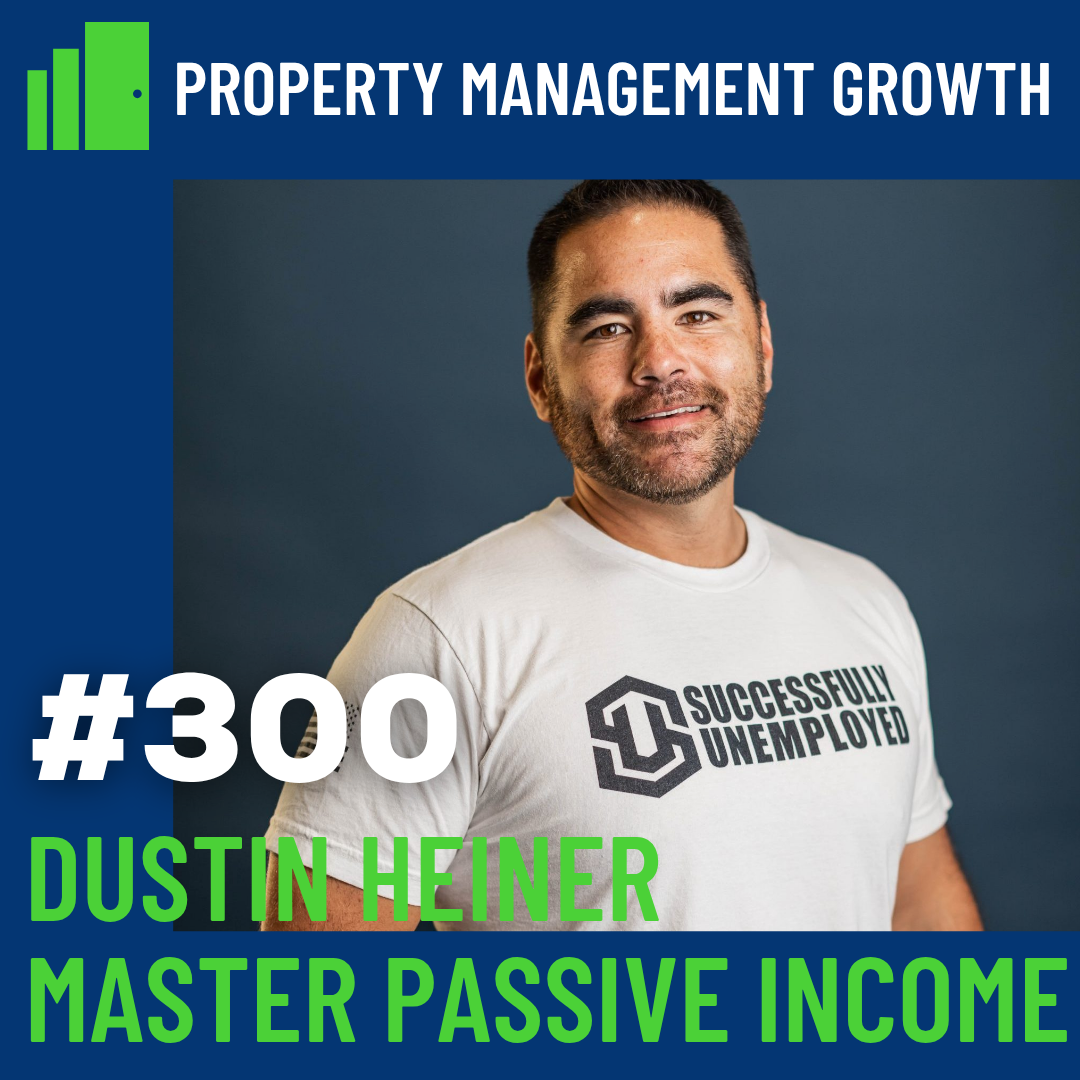
DGS 300: Building Wealth with Rental Properties with Dustin Heiner
Property Management Growth with DoorGrow · Jason Hull
Audio is streamed directly from the publisher (traffic.libsyn.com) as published in their RSS feed. Play Podcasts does not host this file. Rights-holders can request removal through the copyright & takedown page.
Show Notes
As a property manager, you know the value you provide to real estate investors. You offer peace of mind, safety and certainty, and expertise. What if every investor found a property manager to partner with before even contacting a realtor?
On today's episode of the #DoorGrowShow, property management growth expert Jason Hull sits down with real estate investing author and coach Dustin Heiner to talk about building wealth through real estate investing and the role of property managers.
You'll Learn[06:06] Dustin's Journey to Financial Independence
[17:48] The Importance of Property Management in Real Investing
[30:04] The Importance of Finding Clients You Want to Work With
[41:42] Investing as A Property Management Business Owner
Quotables"If you try to serve people, then your life is going to get better."
"If you don't have your business that could run itself, then you're going to be losing money."
"Your property manager is absolutely your quarterback."
Resources TranscriptDustin Heiner (00:00)
this is the number one thing that I teach all my students, the first thing they always say, Hey Dustin, I found a great city to invest in. I've already got five realtors sending me deals. said, Whoa, Whoa, Whoa, Whoa. Let's say you bought one of those properties. Who's going to manage that? And they said, I don't know. I said come on. Like you, you're putting the cart way before the horse realtors are the last thing because you need to make sure that the
business is going to run perpetually without you. Cause the last thing you want is another job.
Jason Hull (00:26)
All right, we are live. I am Jason Hull, the founder and CEO of DoorGrow, and we have the world's leading and most comprehensive coaching and consulting firm for long-term residential property management entrepreneurs. For over a decade and a half, we have brought innovative strategies and optimization to the property management industry. At DoorGrow, we have spoken to thousands of property management business owners, coached, consulted,
cleaned up hundreds of businesses, helping them add doors, improve pricing, increase profit, simplify operations, and build and replace teams. We are like bar rescue for property managers. In fact, we have cleaned up and rebranded over 300 businesses, and we run the leading property management mastermind with more video testimonials and reviews than any other coach or consultant in the industry. At DoorGrow we believe that good property managers can change the world and that property management is the ultimate
high trust gateway to real estate deals, relationships, and residual income. At DoorGrow, we are on a mission to transform property management business owners and their businesses. We want to transform the industry, eliminate the BS, build awareness, change perception, expand the market, and help the best property management entrepreneurs win. Now, let's get into the show. I'm hanging out today with Dustin Heiner who is successfully unemployed, according to his shirt.
it for those that can't see this later. So Dustin, welcome to the DoorGrow show.
Dustin Heiner (01:53)
Jason, thank you so much for having me on the show. just love, I love property managers. I'm a real estate investor, bought property since 2006. Just, I don't know, I've got 30 plus properties, 750 apartment unit complexes and hotels I invest in. And I love not doing any work because my property managers are amazing. it takes a lot of time finding the right property managers, but in the end they make my life easier and I love paying them. They're only one of two people I love to pay, my accountant
and my property managers, because they make my life easier. I love that you have this show. I'm super pumped to be on, so thank you so much for having me.
Jason Hull (02:31)
Awesome. I love the positivity because a lot of my clients get a lot of... How do we say it? Shit. Really. And you know, they feel unappreciated in a lot of... So I know there's a lot of listening. They're like, man, I want investors like this guy. But yeah, I love that you love paying property managers. I think I've said on one of my TikToks or reels, I said, the biggest mistake landlords make...
with rental properties is not hiring a property manager. And during this process.
Dustin Heiner (03:01)
I don't want to deal
with tenants personally. I invested so that my property would work for me and I did not want to handle talking to tenants. In fact, I did at the beginning, I started talking to tenants, but I found out I'm a pushover because it's my property and I'm trying to be nice and everything like that. And it's so much better when there's a middle man that's going to be there. I tell my property managers, use me as the bad guy. Like say, this landlord, he's a jerk, but this is what we got to do.
I want to help them to make it easier on them, but in the end they make my life easier. yeah, I absolutely love that. Well, one thing you and I both know, property managers should be investing themselves too. They should be grabbing properties. if you know of a, if you're a property manager, you will eventually know somebody, an investor, who's going to be selling a house. Well, shoot. Instead of like, oh, point this over to investor, which I get lots of property managers sending me deals, say, hey, this guy's looking to sell. I'm like, great, and I'll buy it.
how much better would be if you guys bought
Jason Hull (04:00)
Yeah, absolutely. I mean if you're a property manager you should really understand and know real estate investing like you're you're basically the advisor for your clients to do this and You have a pulse You know an understanding of the market that nobody else has and so leaning on a good property manager It can also be they could be an invaluable resource
of knowledge. if you before you get into a property one of the smartest things you could do is go ask the property managers is this a good investment or is this a good area or is this like is this a good idea and they're like no you should not have a short-term rental property out in the middle of the desert that nobody wants to go to like it's not you're not gonna cash flow but the you know the guru I'd listen to said I could you know yeah don't do that
Dustin Heiner (04:47)
I've got, yeah, no, and you're 100 % right. So I personally, I've coached thousands of people to buy properties and I like buy and hold. Like it could be long-term, short-term, medium-term, even co-living, but we're gonna buy and hold these properties. Like we've got five kids. So I'll give these properties to my kids. I started investing back in 2006, just kept buying property after property. And then I realized when you get cashflow, when you get money coming in every single month from every single property, then you get financial independence and everything else on top of that is just gravy.
Jason Hull (04:47)
Okay.
Dustin Heiner (05:15)
And I consider my property manager, my quarterback of my team, like the football football team, they're going to make me money. They're going to protect me. They're going to make sure that everything is going right there. They're the, they're the quarterback of my team. And so when I find a good property manager, I hold onto them. In fact, I love find, well, here's what I do also. So in finding a good property manager, I do interviewing. I don't just grab first person because I personally feel like it's best to, you know, not everybody can work with everybody meaning
Somebody might not work well with me. I might have a bad personality of them. They're like, I don't like this guy. He's too hyper. He's got too much energy. Or they might say, hey, this is a great person to work with. And so what I love to do is when I grab a property manager and I just keep buying properties and keep giving it to the property manager, they keep doing well. But I mean, honestly, in the end, I wanted financial freedom and I knew that as I bought real estate over time, the value goes up. But the biggest thing is I invest for cash flow so that
Jason Hull (05:48)
Bye.
Dustin Heiner (06:10)
Money comes in every single month and give you case in point, your property managers are sending money. Like if you're a property manager, you're sending money to your investors, which is great because you're, making money, but you're also making them money. But at the same time, imagine that money coming into your pocket.
Jason Hull (06:27)
Okay, I love this. think the clients listen to this or even property managers just listen to this and be like, I should probably send this out to all my clients so they should they can listen to this because this guy knows something and I want all my clients to see us in this light. This is a great light to see us in. So let's let's go back because we skipped qualifying you. Let tell us about yourself. Qualify yourself. Why should investors that
that these property managers send this podcast episode to and say, listen to this guy Dustin, you should be, you want to be like Dustin. Why should investors be listening to you?
Dustin Heiner (07:00)
Absolutely, totally.
you know what, I'm even gonna tell you a quick story of what really shoved me into real estate investing. I started investing back in 2006, but I was not born with money. In fact, I was born into a very poor family, and I did what everybody is taught. We're taught this same exact path. You go to school, you get good grades. You take those good grades, and you go to college or university and get thousands and thousands of dollars into debt.
and then you get a piece of paper or a degree, that's what it's called, and you take that degree and you shop around and you try to find a job, a quote unquote career from someplace. And so I'm doing that exact same thing. In fact, Jason, I get the most stable, secure job you can ever think of. I got a job in the local county government in California doing IT. So California is not going away, government's not going away, and IT is definitely not going away, because I'm just like risk averse. Well, at the same time, I bought one rental property.
And that one rental property, I remember that check I got from the property manager. It was $317. Like, this is great. I need to buy more and more properties. But you know what happens? Life started getting in the way. My wife and I started having kids, after kid. Eventually, and this is what really got me to make sure I started investing. So I stopped because life got in the way, buying properties. But my wife and I started having kids. And when my wife had our fourth child, I went on paternity leave. That's where the dad stays home with the mom, changes poopy diapers, all that good stuff.
Well, after two weeks, I go back to work and on a Friday at 3.30 in the afternoon, I get a call from my boss's boss's boss's secretary, like the top dog. she says, Dustin, would you please come in the office? I said, sure. And I paused for a second. I hung up the phone. thought, why in the world are they calling me in the office? Like, this isn't normal. It's not normal. And I've also seen plenty of movies Friday at 3.30 is not a good sign. And I remembered a little bit before, right before I went on paternity leave.
Jason Hull (08:48)
now.
Dustin Heiner (08:51)
There was some rumors or some rumbly going on in the county that there could potentially be layoffs. And he really shook it off. said, there's no way I've got great seniority here. My boss is thinking of doing a great job. So I get up and I walked down the hallway to my boss's office. Now this hallway isn't very long. In fact, it's kind of short, but every single step that it took, felt like the hallway got longer and longer and longer. And it felt like my feet became lead bricks because as I was walking, I started thinking I could potentially get laid off while I get down the hallway.
Jason Hull (09:01)
Amen.
huh.
Dustin Heiner (09:20)
I turn the corner and I see my boss's door. His door is closed and I see his secretary there, super sweet, nice old lady. She says, Dustin, would you please have a seat? And I go and I take my seat and she's kind of sheepishly grinning at me, trying to console me with her eyes, because she knows everything about what's going on. I know nothing about what's going on. So I take my seat and I started thinking about my life. This entire plan that other people told me, I started thinking, if I lose my job, did I just waste my life doing this? And my goodness, we just had our fourth child.
Jason Hull (09:38)
man.
Dustin Heiner (09:50)
If I can't provide for our kids, does that make me a failure as a father? Does that make me a failure as a husband, as a man trying to provide for his family? Well, as I'm sitting there, my hands get all clammy, my forehead gets all sweaty because the nerves are just crushing me. Well, the door to my boss's office opens up and out walks a coworker of mine with a piece of paper in her hands. She is noticeably distraught, very upset. She's not necessarily crying, but you could tell her world has been rocked. She passes by me and my boss says, Dustin, would you please come in the office?
Jason Hull (09:54)
Hmm.
Dustin Heiner (10:19)
So I get up and I go into his office and I get laid off. And this is the government. Nobody gets fired or laid off from the government, but I did. And this is the reason why I tell the story. So I take that layoff notice and I go back to my desk and I realized two things sitting there at my desk, just getting laid off. Number one, I need to get another job to be able to provide for my family. So really blessed, praise the Lord to find another job in the same county, another department wasn't having those issues. Second thing I realized, I need to make sure this never.
Jason Hull (10:24)
Hmm.
Dustin Heiner (10:48)
ever happens to me again. I didn't make sure that nobody can take away my ability to feed my family. So right then and there, I said, I am an investor. It may so happen that 100 % of my money came from my job. That's now my part-time job. I'm a full-time investor. So quickly fast forward the story. Started buying property after property after property, each one making me 250, 350, $550 a month. I still own all of them. And now fast forward, I go to my new boss after 30 plus properties. say, Hey boss,
Jason Hull (10:57)
No.
Dustin Heiner (11:17)
I'm laying you off. laugh and it says Dustin, what are you gonna do? I said, I don't have to do anything. I own real estate that makes me money without even working. So last quick part of the story. Remember that short hallway that got longer and longer and longer? Well, I would walk to and from my car to my job a mile and a half every day. I was too frugal to pay for parking. Well, this last walk, I felt like I was walking on clouds because I knew I would never need a job again because I had money coming in from my property. So for you listening,
I want you to realize if you have your own business, if you're working for somebody else, if you have real estate that makes you money without even working grows over time. In fact, every 15 years, real estate doubles in value. mean, that alone is just should blow your mind. And then the cash flow that it makes. So in the end, what I suggest is if you make your own value coming from what you put into your own investments, IE rental properties, you're actually going to have
a floor of income. Now, just same thing with a property manager. You get your landlords and let's say you have 100 units. Well, you have a floor of income because that's normal income that comes in. Same thing with real estate investing. Let's say, God forbid, all those landlords to say this is not working out, we're moving. Well, you have your properties that has a floor of income coming in for you and then it takes so much stress off of you. So I'll pause the story because you've probably got plenty of questions, Jason.
Jason Hull (12:43)
I love it. what a journey. there's always something that of thrusts us into a new state or even into entrepreneurism. I was suddenly a single dad trying to figure out how do I have time to spend with my kids when I'm stuck at a job at HP because I was in IT.
I'm like, I haven't even earned a week off yet. And I'm gonna get them for a week to spend time with them? How's that gonna work? How do I get to be dad? so, yeah, so sometimes I joke my kids are what made me finally leap to become an entrepreneur. so.
I love this idea of real estate allowing you to fire your boss or fire yourself from the job. Explain to people now what you do and your programs and all the stuff that you've built since, because you've done a lot of big things. I want people to make sure they understand Dustin's a badass and he knows a few things.
Dustin Heiner (13:36)
Yeah.
Thanks, man. Well, here's what really
happened. So as I was quitting my job 2014 2015 inch I was 37 years old and I had so many people asking me how I was not working for somebody else and still making money if I feed my family I told them I invest in real estate and they would always ask the second question. Well, can you show me and so I just started showing friends and family members how to do it and then I realized two things number one was fun and number two I had plenty of free time because when you're not working for somebody else
When you're not having like, if you're a property manager, you have many bosses. Let's say you have 10 different landlords, working with 10 different bosses. That's really what it comes down to. And if you don't have any bosses bossing you around, you have 40 plus or more hours of your life back to do whatever you want. And so I just started helping people. So fast forward, I started a podcast, the master passive income podcast, you were on it. And that podcast in 2015, over 2 million downloads now with me just coaching. It's usually a solo show, like literally a solo show where I don't even
It's just me teaching how to do this, but over 2 million downloads because I just want to give this out. Then wrote three, no, four books, coach thousands of people. Now even have a live event, bring in hundreds of real estate investors together, but all for a goal. Here's the main goal. It's to help 1 million people to invest in real estate. And the big reason why I decided to have this goal was because the more people that I serve in my life, the more money they make and the more money I make in the end.
And so now everything from coaching thousands of people to having live events where we're just coaching even more and helping even more to books and podcasts, YouTube, you name it, like social media, Instagram, I'm over a hundred, 200,000, almost 200,000 followers on it now, just giving. And here's the big thing, a takeaway that I would love to share with everybody listening. For you listening, you need to realize if you serve and if you try to serve people, then your life is going to get better. The more people that I serve,
My goodness, I make so much more money, but the great thing is it's not a win-lose. It's not like somebody loses in order for me to win. No, it should be a win-win-win. And so now everything I do at Master Passive Income, to the free courses, to the paid coaching, all that sort of stuff, it's to help people to invest in real estate to get 40 plus hours of their life back and become successfully unemployed.
Jason Hull (15:59)
It's amazing. And that's just really, really awesome. You're doing big things. You're doing big things. And you're not the typical property management client. How many different property managers do you have? Because your portfolio is spread out now, or is it all in your network? Five different states.
Dustin Heiner (16:14)
Five different states? Yeah, correct. Five different states.
I think we have five main property managers. ⁓ Yeah, five main property managers that I work with.
Jason Hull (16:20)
Yeah.
And how many units in total do you?
Dustin Heiner (16:26)
So
single family home, like I might say single family, four units and below. So I would consider anything four units and below be residential. We have 33, 32, 30 plus single family homes, short term, midterm and even long term. Then we have two large apartment complexes, one's near Nashville, 350 units and other one's in Chattanooga, Tennessee, 325 units. And so we have great property managers for those properties. Then also,
I've invested in some hotels and so we have the, you know, the management company for that. But, what I found, and this is the number one thing that I teach all my students, all my students, lots of them, because here's what the first thing they always say, Hey Dustin, I found a great city to invest in. I've already got five realtors sending me deals. said, Whoa, Whoa, Whoa, Whoa. Let's say you bought one of those properties. Who's going to manage that? And they said, I don't know. I said come on. Like you, you're putting the cart way before the horse realtors are the last thing because you need to make sure that the
business is going to run perpetually without you. Cause the last thing you want is another job. In fact, this is the one big thing that I see when a mom and pop investor, somebody buys one property and then they buy a second or third, maybe they get to five, six, maybe seven or eight and they're managing it themselves and they cannot scale. And I know your audience, everybody knows about scaling cause you want to scale your business, the property management business. Well, you can't scale if you're the only person doing all this sort of stuff. And so,
Here's another question I get that people, other investors or even my students say, Dustin, how do you afford a property manager in your properties? I say, I don't afford a property manager. Like I don't pay my taxes on any of my properties. I don't pay my insurance. I don't pay for my property manager. I don't pay for repairs. Meaning I don't have to get a job to pay for any of that. My tenants pay that in the form of rents. And then I make sure I do not buy a property.
unless all of those expenses are accounted for even repairs, vacancy factor, and especially property manager. And that's the thing that most people don't do is realize, let's account for all those expenses, but then utilizing your property manager well enough. Here's the big question. And so all your audience is property managers. So they're going to, they probably rarely get this question, but here's my favorite question that I ever asked property managers. One of the first ones that said, if you would invest your money in this city now,
Jason Hull (18:37)
Mmm.
Dustin Heiner (18:48)
What area would it be? What zip code, where would it be? That is gold. I've asked actually the opposite question. Where should I not invest that city? And property managers say, I probably shouldn't answer that because discrimination and all that sort of stuff. so the question is better. Where would you invest your money? And then, yeah, you're gonna understand the entire market because the property manager, but you also Jason, we're awesome. The question is,
Jason Hull (18:51)
Mm-hmm.
Yeah, wherever you...
Dustin Heiner (19:12)
Would you manage this property not after you bought the property, but before you buy the property? That's a big thing. Cause a lot of people buy a house because they listen to tick-tock gurus and they just bought a house and they, Oh yeah, it should work out. Well, if you don't have any of the manage it, it's no longer an asset. It's a liability. So how much better is you ask the property manager beforehand, especially if you are investing, you're seeing, or sorry, if you're a property manager, you're seeing where the best properties are, where the best clients are, the best tenants, all that sort of stuff.
Jason Hull (19:19)
Yeah.
Yeah, sometimes 100, 1000 times over. Like they have a lot of anecdotal data, right? And data data. So the bad path then is you kind of mentioned is to go to a realtor first, get a property, and then maybe go find a property manager. That's a really bad path. And that's kind of the default path that a lot of people would go down. And they're just headed towards a potential train wreck. Odds are
that the realtors incentive is not to just get you into the best investment solution. You get the most money on a deal and then you're going to you're picking this property and you have no idea if it's going to work out and then you might not even realize you need a property manager and you're saying start with the property manager. Ask them the area.
Dustin Heiner (20:16)
No, it's to sell a property. That's all it is.
Absolutely.
Jason Hull (20:34)
get their advice and clarity and find the property manager that you would want to be able to manage this. Like find a good property manager first and then make some good decisions. make some, let them help you make some good decisions.
Dustin Heiner (20:48)
Well,
how I would explain it is I'm going to find the experts and it could be also definitely property management, but think of also inspectors, mortgage brokers, contractors, plumbers, handymen, insurance agents. I'm not the expert. In fact, like I said, I've coached thousands of people now to invest in real estate successfully. And sometimes they'll ask me, hey, Dustin, you invest in this city.
You're the expert. Tell me like, where should I? Tell me all this stuff. said, Whoa, I'm not the expert at all. In fact, I don't want to, I might know a little bit, but I don't want to be the expert. I hire experts. I hire them. So if you're a property manager, what you need to be thinking is, well, number one, you are the expert in that area because you're currently investing your time in your business to build up for landlords to utilize you. Well, that's number one, but who else would you actually want to start working with?
Now, personally, what I find is the property manager. so if you're not a property manager, if you're an investor listening to this, your property manager is absolutely your quarterback. I treat them as best as I can. Like I treat them so well because they take care of me and they want to take care of me. If I'm a jerk, if I'm like, you know, withholding, withholding money or like, we don't need those repairs. And they're trying to do their job and I'm holding them back from it. They're not.
excited about working with me. And so what I want is as best I can, my property manager to look favorable on me so they could take care of my property so I can have all my life back to play with my kids.
Jason Hull (22:15)
Yeah, I mean this very much goes along with like Benjamin Hardy and Dan Sullivan's idea of who not how. Like finding the right who instead of going around and trying to just find the what like a property. Go find the who that can help you figure out how to do this instead of trying to figure out how to do everything on your own. Which is the slowest path to growth. Period. You know, is to do everything on your own.
Dustin Heiner (22:39)
Well, you can't scale that way.
Yeah, you can't scale. If it's all about yourself, you can't scale. can't get like all my 30 plus properties. I love saying this. So a lot of people have heard of the book, the four hour work week. Good book and all. Basically, the premise is make your life so that you only have to work four hours a week. Well, honestly, I think working four hours a week is for suckers. I don't want to work four hours a week. I don't even want to work four hours a month. I maybe work 30 minutes a month on all of my properties because they get the property management statements.
I verify everything that's good, but I'll say this also. My daughter who's 16 years old, because I've coached a thousand people now, I coached her, she's my oldest and all my other kids are going to do it. She bought her first property four months ago and I coached her. She now does all the bookkeeping, all the, basically instead of me doing the work, 30 minutes, I pay her to do it and she oversees her property as well. And it is so much better when you have the experts first. One quick last thing, because you mentioned a really key, most people, and I did this too.
Jason Hull (23:32)
if
Dustin Heiner (23:36)
I wouldn't write to how do we find properties? In fact, my most downloaded podcasts are because on Master Passive Income, have lots of like how to find properties, how to fund properties, how to find property management. Like literally, it's just coaching. And the most downloaded are how to find and how to fund. Those are by far because people think those are the that's number one things that they don't have, but they believe that they need, which is not necessarily the case. Same thing on my YouTube channel. The most downloaded videos I have one.
That's like think like 16 different ways to get creative financing. If you don't have money yourself, how to buy properties with creative financing. I'm the most downloaded, but that's here's here's what I definitely got to say this. If you don't have your business that could run itself, because I always talk about building your business first. If you don't have your business that could run itself, then you're going to be losing money. And they give you a quick example what that looks like. I buy a property that's going to be making me money every single month and I don't buy it unless all expenses.
Jason Hull (24:11)
Yeah.
Dustin Heiner (24:34)
property manager included, vacancy factor, repairs, all included. And I add on my profit. If I want to make $400 a month, I don't buy a house unless the price is low enough, interest rates right, all the expenses are right to where I'm making that profit every single month on that property. And then obviously rents go up. But here's what it's like if you do not build a business, you do not get the right people in place. Imagine a convenience store. You're to start a convenience store, know, candy bars and soda machines and all that sort of stuff. Well, you will not sign a lease on a location.
open the doors and set a box of candy bars in on the ground. You wouldn't do that. You go out of business in two seconds. But what you would do is you would get, you'd build the business first. You get the gondolas, the shelving units, and all the candy bars go on the countertops, cold storage, bank accounts, cash registers, insurance, managers, everything in the business before you buy any inventory. Same thing with real estate investing. You build the entire business, get everybody the right people in the business, and then every property that I own,
is a piece of inventory that I put into my business. When you start realizing that even though you're an investor, you are a business owner that has inventory. Because I remember in 2006 when I first started investing, 2008 happened. 2008 happened and the crash happened. I knew so many real estate investors went bankrupt. fact, still talk, if anybody was investing back then, most likely you ask them, how did you do in 2008? I went bankrupt.
Jason Hull (25:44)
Thanks.
out
Dustin Heiner (25:57)
Honestly, that's literally, that's conversation happen all the time. But for me, I made more money. I was blown away. In fact, I was worried because I was just new to this. And because I was solely investing for cashflow. Now appreciation will come. That's great. But I'm going to give these properties to my kids. But I was solely investing for cashflow, $500 a month, $600 a month. And because of that, sadly, people, they had to get foreclosure because of the economy and all that sort of stuff.
but what did to the pool of renters, the pool went up. So there's more demand, supply's the same. In fact, I just buy properties and there's more renters. So my rents went up. I made more money in the crash when everybody else was going bankrupt because I was solely investing for cashflow. One quick, let me say one more thing, because I definitely want you to jump in. One more quick thing. Imagine that candy bar that you would buy to sell. If you had a candy bar business,
If you can buy it for 50 cents and sell it for a dollar and you knew all day every day, you can buy it for 50 cents, sell it for a dollar. You think, how can I get more money? Well, you'll make money. But let's say this is a great thing about real estate investing. Let's say you didn't even have 50 cents. It took you 25 cents to borrow 50. Well, you're out of pocket 75 cents. You still sell it for a dollar and you make 25 cents every single time. You would do that deal every day and you would think, how can I get more money? You'd borrow it. But here's one thing you would not do. Same thing with real estate investing.
You would not buy a candy bar for $2 if you could only sell it for a dollar. You do not do business to lose money. So I'll pause it because you could probably have plenty of questions, but we want to build a business and make money.
Jason Hull (27:26)
Perfect.
No, love your analogies. I love that you're equating it to like even just buying and selling candy bars, which maybe some of us did in elementary school as a side hustle, or our kids do sometimes. My daughter makes little rubber bands, like little bracelets with different colors, and she goes and sells them. And the materials cost very little. And then she's like building these bracelets and ask them what colors they want. And then she's selling them at a market. She's like, I made like 20 bucks, you know.
Dustin Heiner (27:48)
yeah.
Jason Hull (28:00)
Yeah, so, you know, we've done this as kids, but when you equate it to something so simple, because we look at raw real estate and the complexity and all the numbers and we're like, this might make sense in the long run with some depreciation and then like, yeah, and you're like, let's keep this really simple. Let's like equate it to a candy bar.
Dustin Heiner (28:21)
Because all that will come
like appreciation, depreciation, tax benefits, market appreciation over time, forced appreciation. Like when you buy a house, you fix it up, you guys know it'll make more money or it'll be worth more. All that will come, but income does not always come. So if you buy for income every single month from your property, could be long term, midterm, know, 30, 69 days, short term, or even co-living. If you buy for that, you will always get wealth.
If you buy, I'm hoping it'll go up in value. Like I hope this candy bar, I'll buy it for $2. Hopefully from a dollar now it'll be a $3. If you hope you're going to be stuck holding the bag and it's going to hurt. And so what you want to do is you want to make sure that you are investing for income. Cause when you invest for income, everything else will always come. But if you invest for just appreciation, you will not necessarily get income. You won't necessarily get all the benefits of everything that comes with real estate.
Jason Hull (29:17)
Yeah, the other thing is the property managers often are one of the first to know if an existing client or owner wants to sell that property off. So they're great people to know if you want access to off market deals. I'm sure the property managers you have would love to get all of their clients to sell their properties and give them to you because you're easy. You're like their dream client because they'll have a one off like super emotional accidental investor that couldn't sell the property that's like.
driving them nuts and like they want it to be a perfect time capsule for a year because grandma planted the flower bed and like Timmy has his height in the door frame and like they want it to be perfect so they can sell it a year later and they're like, and it's like 10 times to 100 times harder to deal with operationally for them. The operational costs are really extreme. It doesn't sound like you're calling your property managers all the time.
Dustin Heiner (29:53)
Ha ha!
Let me just say this. I don't want to talk to my property managers like month after month after month. I don't want, I just want the money. And as long as everything's going well, which is here's another thing. So if you're an investor, you want to make sure that your property managers understand your systems and procedures and processes. Like I have different property managers. They all treat all their landlords, everybody differently. But I say, when you're working with my properties, here's exactly how I want you to do it. And it's very simple things like
Jason Hull (30:13)
Fuck it.
Dustin Heiner (30:37)
Hey, rent's due on the first, late after the third, then you put a three day notice on the door if they don't need to get a late fee. And then once that three day notice is up, you start the eviction process. Like that's clockwork. It's most non-discriminate, yes.
Jason Hull (30:47)
And this is pretty typical.
This is pretty typical, like decent property managers are already doing this anyway. Like this is really standard stuff.
Dustin Heiner (30:55)
They should be. But I don't want to talk to the property manager. They're great people. I don't hire them unless
I like them. But at the same time, leave me alone so I can play with my kids. I could go to golf. could go to, I'm going to South Africa tomorrow for an investor trip. You know, I just want to live my life. Property manager, you take care of it. And if they are doing what I honestly like, I, they don't do well, meaning if they, if there's, it's not getting rented or there's that's a month after month where we're not getting,
rents paid, if things like that, then I'm like, I gotta find somebody else. Cause I don't want to have to think about it. If I have to think about the property, then why do I need you?
Jason Hull (31:29)
Yeah, this is a challenge. They're property managers listening right now. Pay attention to this. Because a lot of property management business owners that come to us, they're not setting healthy boundaries with their clients. Because their clients don't know what they need. And so a lot of times the clients will artificially create a worse property manager. Because they're like, I need like this and I need that. I want, how's the renting process going? And did you talk to some people? Did you show it? And like what they think.
and they want to be so involved in the whole process, they're trying to micromanage the manager. And the manager's way better at this than them. By their own admission, they suck at this stuff, and they don't like it. But then they're trying to micromanage the manager, and bad property managers let them do it. Like the worst property managers usually have the highest operational costs in their business because they give every tenant and every owner a blank check for their time.
call me anytime and they phone system stuff so you can call them anytime and ask any question and they don't have a good system and so then they're wondering why they have, I had a client company once with 600 units under management in their business and they were making zero dollars. Property management can easily be death by a thousand cuts. I have seen inside thousands of property management companies and there are a lot that are making very little money.
And then like my wife Sarah, she had a property management business with 260 units. She was pulling in 90, 60 to 90 % profit margin. It took her, it was a part-time job for her really. And she moved to Austin with me and she managed these remotely. And these were C-class properties in Pennsylvania. We're talking $1,000 rent or less. This is like ghetto, like difficult tenants, difficult situations. And she had such strong boundaries.
and such good relationships with their owners in setting those boundaries that if they got needy or whatever, she would tell them that she was gonna fire them. And they were desperate to keep her because most property managers suck because of some of these reasons. And so she set really strong boundaries. And so her business was easy. She eventually installed one part-time person boots on the ground to help her open up property, show property, whatever, because she couldn't be there to do that and to pick up the mail.
and she had 60 to 90 % profit margin. It's like ridiculous. And so this is one of the trainings we have in our platform that we coach clients on, but property management could be death by a thousand cuts very easily. so it's just as important as it is for you to find a good manager to partner with, for them to find good clients to partner with and to be picky about their clients.
or to at least set better boundaries and expectations with their clients to help them be more like you.
Dustin Heiner (34:16)
Absolutely. And it has to be a beneficial event where you guys are working together, a relationship. And like I said in the very beginning, I try to serve as many people as possible. The more people I serve in this life, the better my life gets, better their life gets. And as long as it's a win-win, in fact, one of my property managers, I paid him 12 % of the rent. the rent used to be, yeah, like when I, so this is when I first started investing in, it was in Ohio in 2006.
prices of rent were like 500 bucks. from 10, 10 % to 12%, it was like, you know, five bucks. And I was like, yes, go ahead. Now these are renting for a thousand dollars, but it's a hard area. It's like D plus C minus. I mean, it's a really rough area. In fact, I don't suggest any of my students invest there anymore because it's really, really rough. It's hard to find, like this property manager, I found them diamond in the rough, they worked with them for 10 years and then he retired and his daughter took over. So she's doing great too, but
All that to say, what you need to do is as you're hiring, finding the right property manager. So if you're an investor and you were trying to find a right property manager, you really need to make sure that you're paying them accordingly. That's going to be like, like I said, 10 % to 12%. Exactly. Exactly. Like they're going to make my life easier. What I need to do as an investor, if I need to pay more for a property manager, I need to buy the property for less.
Jason Hull (35:26)
Yeah, don't try to cheat out on them. Yeah.
Dustin Heiner (35:38)
I don't buy the property unless it pays for that good property manager. If I have to pay 15 % for good property manager, I don't buy the house unless I can afford that 15%. And in the end, my property manager in that one specific area, that's like C or D, D plus to C minus, I don't talk to her because she's so fantastic and she just doesn't bother me. I just let her run with it she does such a great job. And so it's such a great beneficial environment.
Jason Hull (36:03)
Yeah, love it. I'm biased, but obviously, but I believe DoorGrow creates the best property managers because we help them figure some of these really simple things that they need to get down in. Sometimes they can't even see. Like one of the things we've been rolling out with clients is a three tier hybrid model because different investors have different strategies. There's really three psychological profiles of buyers that are taught in pricing psychology and those are the cheapos, the normals, and the premiums.
And so you need a pricing model that is a better fit for them. And the cheapos usually are really hyper concerned about price. They're not really focused on the long term as much. They're short-sighted. And so they're looking at what's the lowest fee I could get and they're like, cheaping out and they're making some big mistakes in the long run.
Dustin Heiner (36:46)
Let me add, let
me add one thing with the cheapos. The cheapos will be the worst clientele. They will be the most problematic. It's just how life is. In fact, I'll give you.
Jason Hull (36:53)
Next.
Operational cost
is the highest with the cheapos and so So one of the things that we coach our clients on is to make sure that they have these pricing models that balance between The a la carte of a cheapo and like you're gonna pay for everything extra so that they because then you're they're trying to gamble against the house Property managers the house and the property management should be winning right but a lot of times what property managers mistakenly do
Dustin Heiner (37:00)
Absolutely.
Jason Hull (37:25)
is they subsidize all of their lowest rent properties and their worst owners with their highest rent properties and their best owners. And they have properties in their portfolio they're actually losing money on. And sometimes they don't even realize this because they're not assessing them individually. We're like, yeah, you should fire thos