
Product Fields
155 episodes — Page 2 of 4
S6 Ep 25#105 The Future of Agile with Jose Casal
In this conversation, the Sander Dur and Jose Casal discuss finding happiness in everyday life and the importance of incremental achievements. They also explore the role of leaders as organizational gardeners and the need to create environments for people to thrive. The definition of business agility is examined, along with the future of Agile and business agility. Jose shares insights on the evolution of work and hierarchy, the need for better incentives, and the surprises of change and transformation. Sander and Jose discuss the future of large organizations and the concept of a federation of micro businesses. The conversation concludes with a focus on dynamic team formation and the importance of cleaning up legacy products and services.Check out our sponsor:www.xebia.comwww.scrummatch.comwww.wiserbees.comwww.masteringagility.orgHosted on Ausha. See ausha.co/privacy-policy for more information.
#104 The Happiness Blueprint with Antoni Tzavelas
SummaryIn this conversation, Anthony shares his insights on happiness and its impact on individuals and teams. He discusses the challenges he faced in his life and how he overcame them to find happiness. Anthony emphasizes the importance of self-reflection, empathy, and a positive mindset in fostering happiness. He also introduces the concept of the happiness blueprint, which includes elements like inspiration, mindset, power, alliance, care, and transformation. Anthony highlights the need for organizations to prioritize happiness in the workforce and shares the success story of a high-performing team. He concludes by offering advice on improving daily scrum or stand-up meetings.TakeawaysSelf-reflection and self-awareness are key to finding and maintaining happiness.Empathy and kindness towards oneself and others contribute to happiness.The happiness blueprint includes inspiration, mindset, power, alliance, care, and transformation.Happiness positively impacts individuals, teams, and organizations, leading to higher engagement and performance.Chapters00:00Introduction and Tough Crowd01:23Discovering the Importance of Happiness03:28The Impact of Challenging Experiences on Happiness04:56Overcoming Challenges and Making a Change06:22The Impact of Challenging Experiences on Family07:49Feeling Lucky and Grateful09:13The Influence of Upbringing on Happiness10:09The Meaning of Happiness10:58Inspiration from Others11:55The Happiness Blueprint13:24The Dangers of Toxic Positivity14:22Dealing with Bad Days15:21Resources for Practicing Happiness21:56Accepting and Embracing Yourself23:25Dealing with Turmoil and Anger25:56Developing Emotional Intelligence27:04Empathy vs Sympathy28:17The Importance of Self-Change29:42The Search for Dopamine Hits30:26The Impact of Happiness on the Workforce34:18The Resistance to Happiness in Organizations37:41Success Story of a High-Performing Team40:36Improving Daily Scrum or Stand-Up42:04Question for the Next GuestCheck out our sponsor:www.xebia.comwww.scrummatch.comwww.wiserbees.comwww.masteringagility.orgHosted on Ausha. See ausha.co/privacy-policy for more information.
S6 Ep 24#103 Lean Portfolio Management and OKRs with Yuval Yeret
SummaryIn this conversation, Jim, Sander, and their guest Yuval discuss various topics including SAFE, lean portfolio management, and OKRs. They explore the misconceptions and polarizing nature of SAFE, the difference between a traditional PMO and a lean portfolio, and the challenges of managing different ways of working within a global organization. They also delve into the concept of OKRs, the importance of setting realistic goals, and the potential pitfalls of tying incentives to OKRs. The conversation concludes with a discussion on metrics and the value of thinking in bets.TakeawaysSAFe is often misunderstood and polarizing, but it has valuable ideas and good information on its website.Lean portfolio management focuses on managing different types of work within an organization's portfolio and measuring different things for different investments.OKRs should be specific and motivating, but too many goals can be confusing and demotivating.Tying incentives to OKRs can lead to unintended consequences and the wrong behavior.Metrics such as lead time, cycle time, and customer satisfaction are important for measuring progress and making data-driven decisions.Thinking in bets and adopting a VC mindset can help make better decisions and navigate uncertainty in business.Check out our sponsor:www.xebia.comwww.scrummatch.comwww.wiserbees.comwww.masteringagility.orgHosted on Ausha. See ausha.co/privacy-policy for more information.
S6 Ep 23#102 "No Matter What" with Agavni Jessaijan
SummaryIn this conversation, Sander Dur and Agavni Jessaijan discuss her diverse creative skills and her journey to self-employment. They explore the importance of communication and the belief that everything is possible. Agavni shares her experiences as an entrepreneur and the challenges she faced during the pandemic. They also discuss her participation in a special forces TV show and the lessons she learned from it. The conversation highlights the importance of autonomy, mastery, and purpose in motivation and the need for trust and teamwork. Agavni reflects on her experience on the TV show 'Kamp van Koningsbrugge' and how it taught her the importance of speaking her truth and staying true to her core. She discusses her physical and mental challenges during the show and how they helped her overcome her insecurities. Agavni emphasizes the need for compassionate communication and the integration of the head, heart, and gut brains in personal leadership. She also talks about her upcoming book, 'No Matter What,' which shares her personal journey and offers insights and wise questions for personal growth and development.TakeawaysDiverse skills and experiences can lead to personal and professional growth.Effective communication is essential for success, both personally and within organizations.Believing that everything is possible can lead to innovation and problem-solving.Entrepreneurship requires risk-taking and the ability to adapt to challenges.Motivation is driven by autonomy, mastery, and purpose.Trust and teamwork are crucial for achieving goals and overcoming obstacles. Speaking your truth and staying true to your core is essential in personal leadership.Physical and mental challenges can help you overcome insecurities and develop resilience.Compassionate communication and integrating the head, heart, and gut brains are key in personal leadership.Asking wise questions can lead to personal growth and development.Check out our sponsor:www.xebia.comwww.scrummatch.comwww.wiserbees.comwww.masteringagility.orgHosted on Ausha. See ausha.co/privacy-policy for more information.
S6 Ep 22#101 Fred Deichler on The Agile Coaching Growth Wheel
SummaryIn this conversation, Fred reflects on his experience speaking at Scan Agile and shares his biggest lesson learned. He also discusses the Agile Coaching Growth Wheel and the need for unifying standards in the agile coaching profession. The conversation explores the difference between agile coaches and scrum masters and the importance of theory and practical experience. Fred emphasizes the value of diversity in agile teams and shares insights on articulating the value of agile coaches. Check out our sponsor:www.xebia.comwww.scrummatch.comwww.wiserbees.comwww.masteringagility.orgHosted on Ausha. See ausha.co/privacy-policy for more information.
S6 Ep 21#100 Denise Tilles on Product Operations
SummaryDenise discusses the concept of product operations and its role in helping product managers make faster and better quality decisions. Product operations involves providing PMs with the necessary inputs and support to set strategy, prioritize, create roadmaps, and collaborate effectively with stakeholders. It differs from traditional agile approaches by focusing on the system around teams rather than just the teams themselves. Denise also highlights the importance of defining the product and understanding the problem to be solved. She emphasizes the need for buy-in from leadership and the importance of clear communication and stakeholder management in implementing product operations. In this part of the conversation, Denise discusses the challenges of stakeholder discussions and balancing strategic decisions with short-term opportunities. She also talks about the relationship between strategy and incentives in a product organization. The conversation then shifts to the topic of Denise's book on product operations and why she decided to write it. She emphasizes the importance of understanding what product operations is and how it can be implemented in different areas of a company. The chapter ends with a discussion on scaling challenges and the role of go-to-market alignment and data in product operations. In this conversation, Yuval and Jim discuss various topics related to agile portfolio management and OKRs. They explore the challenges and benefits of implementing agile practices in traditional project management offices (PMOs) and the importance of aligning goals and strategies at different levels of the organization. They also delve into the use of OKRs as a tool for setting and measuring goals, emphasizing the need for outcome-oriented goals and collaboration in their development. Throughout the conversation, they highlight the importance of continuous improvement and adaptability in managing portfolios and achieving organizational success.TakeawaysProduct operations helps PMs make faster and better quality decisions by providing the necessary inputs and support.Product operations focuses on the system around teams, rather than just the teams themselves, setting it apart from traditional agile approaches.Defining the product and understanding the problem to be solved are crucial for effective product operations.Buy-in from leadership is essential for implementing product operations.Clear communication and stakeholder management are key to successful product operations. Balancing stakeholder discussions and strategic decisions can be challenging, especially when short-term opportunities arise.The relationship between strategy and incentives in a product organization is complex and can lead to conflicting goals.Product operations is a key function in a company and understanding its role and potential is crucial.Implementing product operations requires considering areas of deficit and opportunity within the organization.Denise's book on product operations provides actionable tips and real-life experiences to help companies navigate these challenges. Agile practices can be challenging to implement in traditional PMOs, but they offer benefits such as increased alignment and adaptability.OKRs are a useful tool for setting and measuring goals, but they should be outcome-oriented and developed collaboratively with the people doing the work.Continuous improvement and adaptability are key to managing portfolios effectively and achieving organizational success.Experimentation and learning are crucial for driving innovation and differentiation in portfolio management.Check out our sponsor:www.xebia.comwww.scrummatch.comwww.wiserbees.comwww.masteringagility.orgHosted on Ausha. See ausha.co/privacy-policy for more information.
S6 Ep 20S07 E08 Cliff Hazel and Chris Stone on Going for Chaos
SummaryThe conversation explores the overuse of the phrase 'it depends' and the importance of providing context and honesty in responses. The speakers discuss the value of understanding the starting point and the direction one is moving in. They also emphasize the need to optimize for value rather than efficiency and consider the broader impacts and trade-offs of decisions. The role of fun in retrospectives is highlighted, as well as the importance of finding a sustainable pace and taking care of administrative tasks. The conversation concludes with the question of the biggest learning for the year.TakeawaysAvoid overusing the phrase 'it depends' and provide context and honesty in responses.Understand the starting point and the direction one is moving in.Optimize for value rather than efficiency and consider the broader impacts and trade-offs of decisions.Incorporate fun into retrospectives to keep participants engaged and improve the quality of actions.Find a sustainable pace and take care of administrative tasks to avoid burnout.Continuously learn and adapt to improve and grow.Check out our sponsor:www.xebia.comwww.scrummatch.comwww.wiserbees.comwww.masteringagility.orgHosted on Ausha. See ausha.co/privacy-policy for more information.
S6 Ep 19S07 E07 Evelien Hölsken on Free A Girl
SummaryEvelien Hölsken, founder of the Free A GIrl Foundation, discusses her work to end sexual exploitation of children. She shares her journey from a commercial background to the nonprofit sector and explains how she was inspired to start her own foundation. Evelien discusses the challenges of fundraising and the need for transparency in the nonprofit sector. She also highlights the importance of education and prevention in combating child exploitation. Evelien shares heartbreaking stories of children trapped in the sex trade and the impact her foundation has had in rescuing and rehabilitating survivors. She emphasizes the need for continued efforts to bring justice to perpetrators and support survivors.Want to donate or contribute? Check out the website:https://www.freeagirl.us/Keywordssexual exploitation, children, nonprofit sector, fundraising, transparency, education, prevention, rescue, rehabilitation, justiceTakeawaysThe Free A Girl Foundation works to end thesexual exploitation of children and has rescued almost 8,000 children so far.The foundation focuses on both rescue and rehabilitation, as well as prevention and raising awareness.There are challenges in fundraising, but transparency and personal connections with donors can help.The justice system needs improvement to ensure perpetrators are convicted and survivors feel safe to report cases.Education and prevention are crucial in combating child exploitation, and the foundation runs programs to empower survivors and educate communities.The foundation aims to continue its work until there is no more sexual exploitation of children.TitlesEmpowering Survivors: Education and AwarenessChallenges and Triumphs: Fundraising for a NonprofitCheck out our sponsor:www.xebia.comwww.scrummatch.comwww.wiserbees.comwww.masteringagility.orgSound Bites"The direct impact, the outputs, the results are the rescue of almost 8,000 children.""There's lots of impunity. So perpetrators are arrested, they are hardly convicted.""We educate survivors to become lawyers themselves, or judges, or prosecutors or other kind of professions that have to do with human rights."Chapters00:00Introduction and Background08:04Rescue and Impact21:32Empowering Survivors25:26Fundraising and Awareness33:37Call to ActionHosted on Ausha. See ausha.co/privacy-policy for more information.
S6 Ep 18S07 E06 Joe Krebs on Agile Katas
SummaryIn this conversation, Joe Krebs joins us at the ScanAgile24 conference in Helsinki. He discusses the concept of Agile Kata and its role in continuous improvement. He shares his passion for this topic and how it originated from his experience with agile transformations. Joe emphasizes the importance of challenging existing processes and habits to drive meaningful change. He also highlights the need for a continuous improvement mindset and the challenges organizations face in embracing it. Joe shares success stories of organizations applying Kata and the potential benefits it brings. He concludes by discussing the importance of building the Agile Kata community and the slow progress in doing so.TakeawaysAgile Kata is a pattern for continuous improvement that can enhance the world of Agile.Agile transformations should not be treated as projects with an end date but as ongoing journeys of improvement.Kata introduces scientific thinking and challenges existing habits and processes.The biggest challenge in embracing continuous learning and improvement is breaking through existing habits and routines.Chapters00:00Introduction and Background02:24The Importance of Continuous Improvement04:17The Misconception of Agile Transformation05:14Evolution of the Talk on Agile Kata06:12The Challenge of Embracing Continuous Learning07:40Challenges in Challenging Existing Processes09:07The Time Investment for Creating New Habits10:08Using Kata to Improve Business Situations11:36Success Stories of Applying Kata13:31Applying Kata in Lean Manufacturing Environments14:55The Challenge of Having a Continuous Improvement Mindset15:23The Danger of Zombie Scrum20:35Challenging the Sprint-Based Approach24:21Applying Kata in Simple Product Spaces25:20The Slow Progress of Building the Agile Kata Community27:35Question for the Next GuestHosted on Ausha. See ausha.co/privacy-policy for more information.
S6 Ep 17S07 E05 Esther Derby on Gearing Positive Change
SummaryThis conversation explores the concept of empathy and its importance in various contexts. Esther Derby gives valuable insights into defining empathy, the possibility of having too much empathy, and practical tips for practicing empathy. The conversation also delves into the role of empathy in product design, overcoming barriers to empathy, and effective communication. Additionally, it highlights the importance of creating a safe environment for empathy and discusses the challenges and benefits of empathy in virtual settings.TakeawaysEmpathy is the ability to understand and share the feelings of others.Having too much empathy can lead to over-indexing on others' emotions and neglecting one's own needs.Practicing empathy involves actively listening, asking open-ended questions, and seeking to understand others' perspectives.Empathy plays a crucial role in product design, customer satisfaction, and effective communication.7 Rules for Positive, Productive Change: Micro Shifts, Macro Resultshttps://a.co/d/iUONUbZCheck out our sponsors:www.wiserbees.comwww.xebia.comwww.scrummatch.comwww.masteringagility.orgHosted on Ausha. See ausha.co/privacy-policy for more information.
S6 Ep 16S07 E04 Amber Vanderburg on Communicating Technical Ideas to non-Technical Audiences
SummaryIn this conversation, Amber shares insights on leading change and higher performance within teams. She emphasizes the importance of inspiring action rather than commanding action, drawing parallels between sports teams and product development teams. Amber also discusses the power of debriefing and learning from failure, as well as the need for effective communication and understanding of technical concepts for different audiences. She highlights the value of asking the right questions to assess baseline knowledge and prioritize information. Amber concludes by expressing her interest in seeing more discussions on talent development and the growth of individuals in the workplace.TakeawaysInspire action rather than command action to lead change and drive higher performance within teams.Debriefing and learning from failure are essential for continuous improvement and success.Effective communication involves understanding and translating technical concepts for different audiences.Asking the right questions helps assess baseline knowledge and prioritize information.Talent development is crucial for individuals to elevate their knowledge, skills, and abilities in the workplace.Check out our sponsors:www.wiserbees.comwww.xebia.comwww.scrummatch.comwww.masteringagility.orgHosted on Ausha. See ausha.co/privacy-policy for more information.
S6 Ep 15S07 E03 Chris Williams on the Art of Simplicity
The conversation explores the concept of simplicity and its challenges in various contexts. It delves into the importance of feedback, organizational and cultural change, and the friction between doing the thing right and doing the right thing. The difficulty of simplicity is discussed, along with the power of simple solutions. The conversation explores the importance of simplicity in product development and the challenges organizations face in achieving it. The three main drivers in the workforce are identified as community, cause, and compensation, with their importance varying depending on career stage. Perks and benefits, such as ping pong tables and beer on tap, are no longer sufficient to attract and retain talent. The focus should be on creating work that matters and providing employees with a sense of purpose. Short-term focus and financial stress can hinder organizations and individuals from achieving simplicity. It is crucial to let go of unnecessary tasks and amplify the value of the work being done.TakeawaysSimplicity is the antithesis to complexity and is essential in various domains, including software development and product design.Feedback is crucial in achieving simplicity and ensuring that the right solutions are developed.Organizational and cultural change are necessary to foster simplicity and create an environment that values simplicity.There is often a friction between doing the thing right (craftsmanship) and doing the right thing (meeting customer needs and business goals). Balancing these two aspects is essential.Simple solutions can be powerful and effective, and often the simplest solution is the best one. The three main drivers in the workforce are community, cause, and compensation, with their importance varying depending on career stage.Perks and benefits are no longer sufficient to attract and retain talent; the focus should be on creating work that matters and providing employees with a sense of purpose.Short-term focus and financial stress can hinder organizations and individuals from achieving simplicity.It is crucial to let go of unnecessary tasks and amplify the value of the work being doneCheck out our sponsors:www.wiserbees.comwww.xebia.comwww.scrummatch.comwww.masteringagility.orgHosted on Ausha. See ausha.co/privacy-policy for more information.
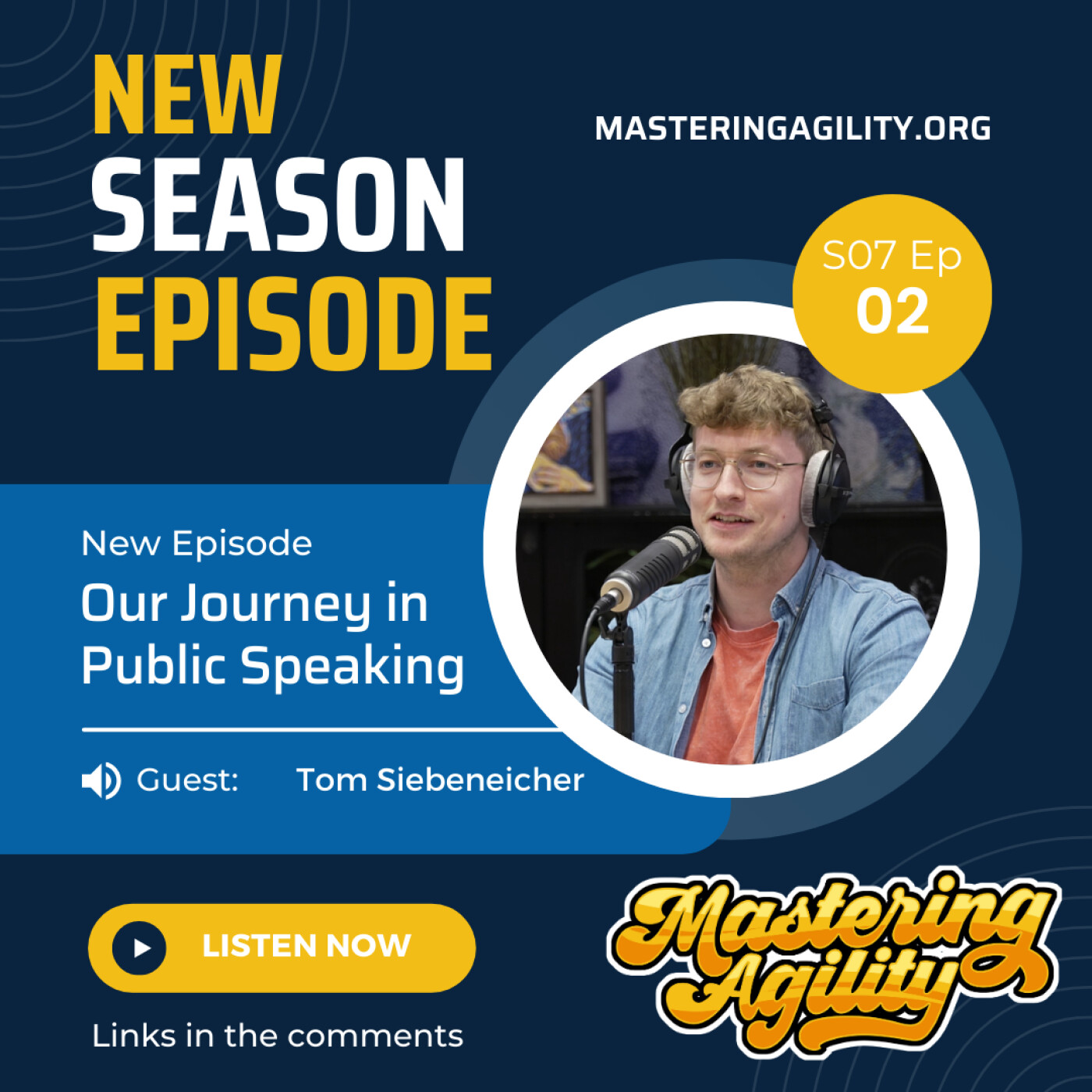
S6 Ep 14S07 E02 Tom Siebeneicher on Our Journey in Public Speaking
Summary In this conversation, Sander and Don discuss their journey in public speaking and share their experiences and insights. They talk about how they started doing public speaking, the challenges they faced, and the lessons they learned along the way. They emphasize the importance of having a supportive network, being open to feedback, and continuously improving their presentations. They also discuss the cultural differences they encountered at different conferences and the impact of their talks on the audience. They conclude by sharing their plans for the future, including exploring speaking opportunities outside of the agile community. Keywords public speaking, journey, challenges, lessons, feedback, cultural differences, networking, improvement, future plans Takeaways Start doing public speaking by finding a supportive network and being open to feedback. Continuously improve your presentations based on feedback and lessons learned. Be aware of cultural differences at different conferences and adapt your approach accordingly. Engage with the audience and create a dialogue during your talk. Explore speaking opportunities outside of your comfort zone to gain new perspectives and experiences. Check out our sponsors: www.wiserbees.com www.xebia.com www.scrummatch.com www.masteringagility.org Chapters 00:00 Introduction and Background 01:00 Starting in Public Speaking 10:30 Supportive Network and Structure 13:20 Lessons Learned and Continuous Improvement 21:30 Choosing Conferences and Networking 25:40 Feedback and Integration 31:00 Future Plans and TopicsHosted on Ausha. See ausha.co/privacy-policy for more information.
S6 Ep 13S07 E01 Gojko Adzic on Specification By Example
SummaryIn this episode, Goiko shares his experiences and insights on visualizing specifications, writing Specification by Example, and solving communication problems in software development. He discusses the challenges and patterns in the adoption of Spec by Example and the importance of identifying bottlenecks and visualizing problems. Goiko also talks about causing organizational change and the evolution of software development solutions. He concludes by discussing the promise and reality of no-code tools and sharing his recent work and projects. The conversation explores various themes related to software development and its impact on organizations and society. It discusses the power of expressing human knowledge in software and the role of visualization tools in increasing shared understanding. The shift from specialists to generalists in the software industry is examined, as well as the potential for smaller organizations and general-purpose work. The conversation also delves into the role of AI in minimizing political games in organizations and the responsibility of software professionals in creating good software. The need for spending more time on edge cases and negative use cases is highlighted, along with the societal impact of bad software and the potential for IT to become a profession. The conservation and shifting of complexity in software development is explored, and the conversation concludes with a discussion on the impact of shoddy software on people's lives.TakeawaysVisualizing specifications can help improve understanding and reduce rework in software development.The adoption of Spec by Example and other agile practices can be hindered by organizational politics and resistance to change.Identifying bottlenecks and visualizing problems can lead to effective solutions and improvements in software development processes.No-code tools have the potential to democratize software development and empower non-technical users to create automation. Visualization tools like FigJam and Zeppelin increase shared understanding in organizations.The software industry is shifting towards smaller organizations and general-purpose work.AI cannot eliminate political games in organizations, as they are driven by cultural factors.There is a need for more focus on edge cases and negative use cases in software development.The responsibility of software professionals is to create good software and address the societal impact of bad software.Gojko's booksCheck out our sponsors:www.xebia.comwww.wiserbees.comwww.scrummatch.comwww.masteringagility.orgSound BitesChapters00:00Introduction01:21Visualizing Specifications03:04Early Experiences with Software Quality04:09Solving Communication Problems05:31Validating Real-World Usage of Spec by Example06:29Getting Permission from Companies for Case Studies08:28Persistent Challenges and Positive Patterns09:49Adoption of Given-When-Then and Consolidation of Tools11:42Identifying Bottlenecks and Visualizing Problems13:01Causing Organizational Change14:09The Challenge of Change Resistance16:30The Evolution of Software Development Solutions26:48Goiko's Recent Work and Projects35:26The Power of Expressing Human Knowledge in Software36:03Visualization Tools and Increased Shared Understanding37:27Specialists vs. Generalists in the Software Industry38:49The Shift Towards Smaller Organizations and General Purpose Work41:49The Role of AI in Minimizing Political Games in Organizations42:54The Responsibility of Software Professionals in Creating Good Software51:01The Need for Spending More Time on Edge Cases and Negative Use Cases53:31The Societal Impact of Bad Software and the Role of Governments57:41The Potential for IT to Become a Profession01:01:29The Conservation and Shifting of Complexity in Software Development01:04:43The Impact of Shoddy Software on People's Lives
S6 Ep 12S06 E19 David Asch on the Agile Enterprise
SummaryIn this conversation, David Ash discusses his book, The Agile Enterprise, and his experiences applying Agile principles across companies. He shares his initial hesitation about writing the book and his journey of self-discovery and overcoming imposter syndrome. David emphasizes the importance of leaders who think differently and the need for organizations to prevent and address fires rather than constantly firefighting. He also explores the role of AI and technology in augmenting work and the challenges of quantifying the costs of technical debt. The conversation concludes with a question for the next guest about the future of development and incorporating new technologies.TakeawaysOvercoming imposter syndrome is a common challenge, but recognizing one's expertise and unique perspectives can lead to valuable contributions.Applying Agile principles beyond software development can lead to success in various departments and stages of company growth.Leadership is not determined by job titles, but by individuals who take initiative and think differently.Preventing and addressing fires in organizations requires a balance between firefighting and proactive measures to improve processes and prevent future issues.AI and technology should be seen as tools to augment work and should be incorporated thoughtfully to enhance productivity and outcomes.Breaking the chain of technical debt requires a collaborative effort between technical teams and the business side of the company to prioritize and address issues.Hosted on Ausha. See ausha.co/privacy-policy for more information.
S6 Ep 11S06 E18 Johannes Geske and Stephen Sykes on ScrumMatch
SummaryIn this conversation, Sander Dur and his guests discuss the biggest lessons learned during the week and the importance of user feedback in the release strategy. They introduce Scrum Match, a platform that connects companies with true Scrum Masters who can deliver business value. They highlight the need for true Scrum Masters who can use Scrum as a means to an end and differentiate them from Scrum Masters in name only. The hosts also discuss the future of Scrum Match and the scaling of the platform. They emphasize the importance of focus and the value of feedback for both Scrum Masters and employers. In this conversation, the hosts discuss the importance of sponsorship in podcasting and share insights on building and maintaining relationships with sponsors. They emphasize the need to deliver value to sponsors and measure the success of sponsorships. The conversation also covers negotiation strategies for sponsorship deals.TakeawaysUser feedback is crucial in determining the best release strategy and ensuring that clients and users can absorb and work with new features.The industry has produced many Scrum Masters who fail to deliver business results, leading to a lack of trust in the Scrum framework.There is a need for a profession for Scrum Masters to separate those who can deliver value from those who cannot.Scrum Match aims to connect employers with true Scrum Masters who have the practical experience and skills to deliver business value.The future of Scrum Match involves scaling the platform, building partnerships, and expanding beyond just Scrum Masters. Hosted on Ausha. See ausha.co/privacy-policy for more information.
S6 Ep 10S06 E17 Dan Balcauski on Pricing Strategies
SummaryThe conversation explores various aspects of pricing strategies, including benefits framing, pricing orientations, value-based pricing, and the challenges associated with it. The importance of regularly reviewing pricing and making incremental changes is emphasized. The fear of pricing conversations and risk mitigation strategies are discussed. The emotional relationship with money and its impact on pricing decisions is explored. The chapter concludes with a discussion on bundling price increases with value increases. The conversation explores the topics of costs, value, different business models, adjusting pricing based on value, defining value, and getting started with pricing strategy. It also touches on the concept of overpriced products.TakeawaysRegularly review and update pricing strategies to align with market changes and customer value.Consider benefits framing and value-based pricing to effectively communicate the value of products or services.Understand the emotional relationship customers have with money and the impact it has on pricing decisions.Mitigate risks associated with pricing changes by conducting market research, testing, and communicating effectively with customers. Consider the costs and value of your product or service when determining pricing.Different business models, such as razor and razor blades, can impact pricing strategies.Adjust pricing based on the value customers receive from your product or service.Define value by understanding the functional, emotional, and social jobs your product or service fulfills.Start thinking about your pricing strategy early in your company's development and treat it as an ongoing process.Perceived value plays a significant role in customers' willingness to pay.Be mindful of unexpected fees and their impact on customers' perception of value.The most overpriced products can vary based on individual perspectives and preferences.Hosted on Ausha. See ausha.co/privacy-policy for more information.
S6 Ep 9S06 E16 Fred Deichler on Zelda's Guide to Agile
Summary In this conversation, Sander, Jim and their guest Fred Deichler discuss various topics related to public speaking, conferences, and agile practices. They explore the importance of creating a positive work environment and advocating for clear direction and autonomy in teams. Fred shares his journey as a speaker and the nervousness he still experiences before each talk. They also discuss the impact of conferences and the value of networking and building relationships with experienced speakers. The conversation concludes with a discussion on the power of storytelling in talks and the importance of tangible takeaways for the audience. Takeaways · Advocate for a positive work environment that promotes clear direction and autonomy in teams.· Embrace nervousness as a speaker and use transparency to create empathy with the audience.· Build relationships with experienced speakers and learn from their experiences.· Name concepts and techniques to make them more memorable and easier to discuss.· Focus on education and providing tangible takeaways for the audience in talks.If you like our podcast, please leave us a review. This helps us to grow the show and bring in even bigger guests. Sponsors:ScrumMatch: https://scrummatch.com/enXebia Academy: https://xebia.com/academy/nl/ Hosted on Ausha. See ausha.co/privacy-policy for more information.
S6 Ep 8S06 E15 Becky Savill on Workplace Learning for Human Beings
SummaryIn this conversation, Becky Savill discusses her recently launched book and the importance of workplace learning for humans. She shares her experience of unpacking the physical copy of her book and the pride she felt in achieving this milestone. Becky emphasizes the need for self-directed learning and the limitations of traditional learning approaches. She also discusses her career transition from audio engineer to scrum master and the skills she gained from her previous profession. The conversation highlights the importance of creating space for learning in organizations and the cultural shift needed to prioritize learning investments. The conversation explores the importance of seeking diverse perspectives and learning from others. It emphasizes the value of being the smartest person in the room and the benefits of expanding perspectives beyond the agile field. The discussion also touches on the experience of writing a book as a couple and provides advice for personal growth and development.TakeawaysSelf-directed learning is more effective and engaging than traditional approaches.Creating space and a culture that supports learning is essential for individual and organizational growth.Learning communities, such as communities of practice, provide valuable opportunities for collaboration and knowledge sharing.Balancing structure and flexibility in learning approaches allows for individual preferences and needs to be met.Investing in learning and development is crucial for attracting and retaining top talent in organizations. Seek opportunities to be the smartest person in the room and help others, but also gravitate towards rooms where you can learn from experienced individuals.Expand your perspectives beyond the agile field and seek agility outside of agility.Collaborating on a project with your partner can be a rewarding experience that strengthens your relationship.Be curious and ask open-ended questions to learn from others and seek diverse perspectives.Don't overthink and be brave in pursuing your goals and seeking feedback.If you like our podcast, please leave us a review. This helps us to grow the show and bring in even bigger guests.Sponsors:ScrumMatch: https://scrummatch.com/enXebia Academy: https://xebia.com/academy/nl/Hosted on Ausha. See ausha.co/privacy-policy for more information.
S6 Ep 7S06 E14 Teresa Torres on Leading Products through Discovery
Summary In this conversation, Teresa Torres discusses the importance of product discovery and how it differs from product development. She emphasizes the need to focus on building the right things and highlights the value of talking to customers regularly. Torres provides practical tips for engaging customers in the discovery process, including how to conduct effective interviews and use data to enhance the conversation. She also addresses organizational resistance and offers strategies for bridging the gap between product and sales teams. Overall, the conversation highlights the significance of customer-centricity in product development. In this conversation, Teresa Torres discusses various aspects of the discovery process in product management. She provides insights on dealing with unwilling participants in interviews, the use of recordings to involve the entire team, and the role of AI tools in synthesis. Torres also shares her perspective on roadmaps in the discovery process and how they can be adapted to represent ambiguity and uncertainty. Additionally, she shares a story about discovering the team was building the wrong thing and highlights the workplace depicted in the TV show 'The West Wing' as an ideal environment.TakeawaysProduct discovery focuses on building the right things, while product development focuses on how to build them.Regularly talking to customers is essential for understanding their needs and building the right products.Effective customer interviews involve asking open-ended questions and collecting specific stories about past behavior.Overcoming organizational resistance requires starting small, building rapport with stakeholders, and demonstrating the value of customer insights.Find out more about Teresa's content:The book: https://www.producttalk.org/The blog: https://www.producttalk.org/blog/The course: https://learn.producttalk.org/homeCheck out our sponsor: www.scrummatch.comwww.xebia.com Hosted on Ausha. See ausha.co/privacy-policy for more information.
S6 Ep 6S06 E13 Cliff Hazell on Lessons from working at Spotify
SummaryThe conversation covers topics such as dealing with remote teams, clear communication in remote work, the future of remote work, managing information overload, maintaining structure in communication tools, the importance of facilitation in meetings, balancing autonomy and alignment, the danger of focusing on shiny new tools, the shift from output to outcome, optimizing what we build, measuring output, outcomes, and impacts, finding the balance between autonomy and constraints, funding and budgeting agile work, and balancing autonomy and constraints in product design. In this conversation, Cliff Hazell shares insights on Spotify's product development approach and the challenges of implementing change in organizations. He emphasizes the importance of empowering product owners and managers to make decisions and secure the necessary budget. Cliff also discusses the need to treat investments differently, depending on the desired outcomes. He highlights the cultural challenges of working in diverse teams and the importance of open communication and understanding. The conversation also touches on budgeting in government organizations and offers advice on how to increase the chances of getting hired at Spotify.TakeawaysInvest in good, clear, written communication in remote teams.Focus on outcomes rather than just output.Balance autonomy and alignment in organizations.Avoid over-focusing on shiny new tools and frameworks.Regularly review and measure the impact of the work being done.Create a balance between autonomy and constraints in product design.Consider a rolling window approach to funding and budgeting work.If you like our podcast, please leave us a review. This helps us to grow the show and bring in even bigger guests. Sponsors:ScrumMatch: https://scrummatch.com/enXebia Academy: https://xebia.com/academy/nl/Hosted on Ausha. See ausha.co/privacy-policy for more information.
S6 Ep 5S06 E12 Omnipresence and Needing to be Perfect
SummaryIn this second part of the conversation, Jim and Sander discuss their holiday plans and reflect on the highlights of the podcast in 2023. They also share their dream guests for future episodes and discuss the importance of understanding root causes in problem-solving. They explore how Scrum Masters can help teams become more effective and the need to build environments for product success. They also discuss the challenges of avoiding reactive approaches and the importance of continuous improvement. Finally, they discuss the importance of recognizing blind spots and areas for improvement. In this conversation, Jim and Sander discuss various topics related to their professional lives and personal preferences. They explore the balance between quality and satisfaction, the importance of professional emotional regulation, and the need to bury unwanted concepts. They also touch on the issue of hate and ad hominem attacks on social media and the value of constructive feedback. The conversation concludes with a discussion about the misuse of the Shu-Ha-Ri model and the joy of holiday food traditions.TakeawaysReflecting on the highlights of the past year can provide valuable insights and learning opportunities.Understanding root causes is important for effective problem-solving and preventing recurring issues.Scrum Masters can have a wider impact by building their skills and focusing on continuous improvement.Creating environments for product success is crucial for long-term value creation.Avoiding reactive approaches and focusing on proactive measures can lead to better outcomes.Recognizing blind spots and areas for improvement is essential for personal and professional growth. Balancing quality and satisfaction is important in professional work.Professional emotional regulation is crucial for maintaining composure and being a calming influence.It's okay to have strengths and weaknesses, and not everyone has to be good at everything.Unwanted concepts and practices should be buried to make room for more effective approaches.Hate and ad hominem attacks on social media should be replaced with constructive feedback.Being candid is important, but it's essential to avoid being an asshole.Teaching should be focused on practical application rather than just theoretical knowledge.Being a little like Mr. Miyagi and withholding certain information can be beneficial in facilitating learning.Helping others should not be driven by selfish motives.Identifying as a teacher or educator depends on the specific context and knowledge.Food and holiday traditions bring joy and create memorable experiences.Don't forget to check out our sponsor: https://scrummatch.com/enHosted on Ausha. See ausha.co/privacy-policy for more information.
S6 Ep 4S06 E11 2023 Reflections and Finding Root Causes
SummaryIn this conversation, Jim and Sander discuss their holiday plans and reflect on the highlights of the podcast in 2023. They also share their dream guests for future episodes and discuss the importance of understanding root causes in problem-solving. They explore how Scrum Masters can help teams become more effective and the need to build environments for product success. They also discuss the challenges of avoiding reactive approaches and the importance of continuous improvement. Finally, they discuss the importance of recognizing blind spots and areas for improvement. In this conversation, Jim and Sander discuss various topics related to their professional lives and personal preferences. They explore the balance between quality and satisfaction, the importance of professional emotional regulation, and the need to bury unwanted concepts. They also touch on the issue of hate and ad hominem attacks on social media and the value of constructive feedback. The conversation concludes with a discussion about the misuse of the Shu-Ha-Ri model and the joy of holiday food traditions.TakeawaysReflecting on the highlights of the past year can provide valuable insights and learning opportunities.Understanding root causes is important for effective problem-solving and preventing recurring issues.Scrum Masters can have a wider impact by building their skills and focusing on continuous improvement.Creating environments for product success is crucial for long-term value creation.Avoiding reactive approaches and focusing on proactive measures can lead to better outcomes.Recognizing blind spots and areas for improvement is essential for personal and professional growth. Balancing quality and satisfaction is important in professional work.Professional emotional regulation is crucial for maintaining composure and being a calming influence.It's okay to have strengths and weaknesses, and not everyone has to be good at everything.Unwanted concepts and practices should be buried to make room for more effective approaches.Hate and ad hominem attacks on social media should be replaced with constructive feedback.Being candid is important, but it's essential to avoid being an asshole.Teaching should be focused on practical application rather than just theoretical knowledge.Being a little like Mr. Miyagi and withholding certain information can be beneficial in facilitating learning.Helping others should not be driven by selfish motives.Identifying as a teacher or educator depends on the specific context and knowledge.Food and holiday traditions bring joy and create memorable experiences.Hosted on Ausha. See ausha.co/privacy-policy for more information.
S6 Ep 3S06 E10 Dave Snowden on Organizing for Emergence
In this conversation, Dave Snowden discusses various topics related to complexity, agility, and decision-making. He shares his experiences with travel and speaking engagements, emphasizing the importance of listening to the audience and adapting his presentations accordingly. Dave highlights patterns and cynicism in the Agile community, cautioning against the commoditization of Agile and the reliance on motivational speakers. He explains the principles of organizing for emergence and complexity, emphasizing the need to work with how things are and focus on local interactions. Dave also discusses the outcome of complexity models, the risk of losing purpose in breaking things down, and the challenge of organizational attention span. He concludes by discussing the contribution opportunities for Hexi and the importance of creating a capability to handle unknown unknowables. The conversation explores the concept of constant complexity in the world and the need for adaptability and strategic thinking. The impact of AI and ecological collapse is discussed, highlighting the potential risks and opportunities they present. The tension between control and empowerment in organizations is examined, along with the role of risk in decision-making. The importance of building ecosystems and embracing distributed decision-making is emphasized. The conversation concludes with a reflection on the impact of work and the future of the Agile landscape.TakeawaysListen to the audience and adapt presentations accordinglyBeware of the commoditization of Agile and the reliance on motivational speakersOrganize for emergence and complexity by working with how things are and focusing on local interactionsQuantify human judgment and detect anomalies to make better decisionsCreate a capability to handle unknown unknowables and shift to a profession mindset The world is experiencing constant complexity, and organizations need to adapt and embrace strategic thinking to navigate this reality.AI and ecological collapse are significant factors that are changing the business landscape and require proactive preparation.Overdependence on technology can hinder adaptability and resilience, and organizations should strive for a balance between technology and human intelligence.Risk should be considered in decision-making, and organizations should focus on reducing risk through distributed decision-making and building ecosystems.The impact of work extends beyond individual contributions, and collective efforts and teamwork are essential for long-term success.The Agile landscape should focus on collaboration, innovation, and addressing unarticulated problems to become a sustainable movement.For questions or requests that you would like us to check on, please drop a message on LinkedIn or join the Mastering Agility Discord community!Participate as an audience memberMastering Agility MuralMastering Agility merchHosted on Ausha. See ausha.co/privacy-policy for more information.
S6 Ep 2S06 E09 Starting with Scrum and forming your Scrum Team
For questions or requests that you would like us to check on, please drop a message on LinkedIn or join the Mastering Agility Discord community! Participate as an audience member Mastering Agility Mural Mastering Agility merch Sander Dur Sander Dur is a Professional Scrum Trainer at Scrum.org, podcast host of Mastering Agility, Professional Scrum Master and Lead Agile Consultant, and trainer at Xebia. Besides this, he's an avid writer for predominantly Serious Scrum on Medium.com. Sander has a major passion for the human side in complex domains. Ensuring a high level of psychological safety, therefore, is a critical part of his work. Organizations in complex domains can only survive when innovating. Innovation can only take place with the right balance between low social friction and high intellectual friction. While most organizations now understand how to apply Agile frameworks, they struggle with the delivery of value. Psychological safety is the next step in this evolution and Sander has a huge drive to help organizations reach that step. Sander is enthusiastic, open-minded, and ambitious. He finds interpersonal relationships and intrinsic motivations very important in team dynamics. Besides his work, Sander loves to spend time with his family, enjoys sports and eating healthy, barbecuing, riding his motorcycle, and traveling. Jim Sammons My passion is helping people to: Do more of the right work (and less of the wrong work). Create more actual teams than just groups of people who work together. Learning how to improve themselves, their team, and their organization incrementally. Understand that less, not more, is usually part of the answer to some of the hardest questions we all face. See their workplaces, teams, and their sphere of influence as something that is evolving, which requires an evolution of all of its parts to adapt. Throughout my career, I have worked with clients of all sizes, industries, and technologies. Whether it’s leading a transformative strategy at a Fortune 100 or helping a new startup understand its unique value proposition the common focus I bring to each role is “making people better.” Contact us at: Masteringagility.org https://xebia.com/academy/nl/trainers/sander-dur https://www.linkedin.com/in/jamessammons/ https://www.linkedin.com/in/sanderdur/ Hosted on Ausha. See ausha.co/privacy-policy for more information.
S6 Ep 2S06 E08 Unlocking Business Agility with EBM with Patricia Kong, Ryan Ripley, Todd Miller, and Kurt Bittner
For questions or requests that you would like us to check on, please drop a message on LinkedIn or join the Mastering Agility Discord community! Participate as an audience member Mastering Agility Mural Mastering Agility merch Sander Dur Sander Dur is a Professional Scrum Trainer at Scrum.org, podcast host of Mastering Agility, Professional Scrum Master and Lead Agile Consultant, and trainer at Xebia. Besides this, he's an avid writer for predominantly Serious Scrum on Medium.com. Sander has a major passion for the human side in complex domains. Ensuring a high level of psychological safety, therefore, is a critical part of his work. Organizations in complex domains can only survive when innovating. Innovation can only take place with the right balance between low social friction and high intellectual friction. While most organizations now understand how to apply Agile frameworks, they struggle with the delivery of value. Psychological safety is the next step in this evolution and Sander has a huge drive to help organizations reach that step. Sander is enthusiastic, open-minded, and ambitious. He finds interpersonal relationships and intrinsic motivations very important in team dynamics. Besides his work, Sander loves to spend time with his family, enjoys sports and eating healthy, barbecuing, riding his motorcycle, and traveling. Jim Sammons My passion is helping people to: Do more of the right work (and less of the wrong work). Create more actual teams than just groups of people who work together. Learning how to improve themselves, their team, and their organization incrementally. Understand that less, not more, is usually part of the answer to some of the hardest questions we all face. See their workplaces, teams, and their sphere of influence as something that is evolving, which requires an evolution of all of its parts to adapt. Throughout my career, I have worked with clients of all sizes, industries, and technologies. Whether it’s leading a transformative strategy at a Fortune 100 or helping a new startup understand its unique value proposition the common focus I bring to each role is “making people better.” Contact us at: Masteringagility.org https://xebia.com/academy/nl/trainers/sander-dur https://www.linkedin.com/in/jamessammons/ https://www.linkedin.com/in/sanderdur/ Hosted on Ausha. See ausha.co/privacy-policy for more information.
S6 Ep 1S06 E07 Visualisation Superpowers and the Importance of Testing with Brendan Gardner
For questions or requests that you would like us to check on, please drop a message on LinkedIn or join the Mastering Agility Discord community!Participate as an audience memberMastering Agility MuralMastering Agility merchSander DurSander Dur is a Professional Scrum Trainer at Scrum.org, podcast host of Mastering Agility, Professional Scrum Master and Lead Agile Consultant, and trainer at Xebia. Besides this, he's an avid writer for predominantly Serious Scrum on Medium.com. Sander has a major passion for the human side in complex domains. Ensuring a high level of psychological safety, therefore, is a critical part of his work. Organizations in complex domains can only survive when innovating. Innovation can only take place with the right balance between low social friction and high intellectual friction. While most organizations now understand how to apply Agile frameworks, they struggle with the delivery of value. Psychological safety is the next step in this evolution and Sander has a huge drive to help organizations reach that step. Sander is enthusiastic, open-minded, and ambitious. He finds interpersonal relationships and intrinsic motivations very important in team dynamics. Besides his work, Sander loves to spend time with his family, enjoys sports and eating healthy, barbecuing, riding his motorcycle, and traveling.Jim SammonsMy passion is helping people to:Do more of the right work (and less of the wrong work).Create more actual teams than just groups of people who work together.Learning how to improve themselves, their team, and their organization incrementally.Understand that less, not more, is usually part of the answer to some of the hardest questions we all face.See their workplaces, teams, and their sphere of influence as something that is evolving, which requires an evolution of all of its parts to adapt.Throughout my career, I have worked with clients of all sizes, industries, and technologies. Whether it’s leading a transformative strategy at a Fortune 100 or helping a new startup understand its unique value proposition the common focus I bring to each role is “making people better.”Support the showContact us at:Masteringagility.orghttps://xebia.com/academy/nl/trainers/sander-durhttps://www.linkedin.com/in/jamessammons/https://www.linkedin.com/in/sanderdur/Hosted on Ausha. See ausha.co/privacy-policy for more information.
S1 Ep 1S06 E06 Driving Value with Sprint Goals with Maarten Dalmijn
For questions or requests that you would like us to check on, please drop a message on LinkedIn or join the Mastering Agility Discord community!Participate as an audience memberMastering Agility MuralMastering Agility merchSander DurSander Dur is a Professional Scrum Trainer at Scrum.org, podcast host of Mastering Agility, Professional Scrum Master and Lead Agile Consultant, and trainer at Xebia. Besides this, he's an avid writer for predominantly Serious Scrum on Medium.com. Sander has a major passion for the human side in complex domains. Ensuring a high level of psychological safety, therefore, is a critical part of his work. Organizations in complex domains can only survive when innovating. Innovation can only take place with the right balance between low social friction and high intellectual friction. While most organizations now understand how to apply Agile frameworks, they struggle with the delivery of value. Psychological safety is the next step in this evolution and Sander has a huge drive to help organizations reach that step. Sander is enthusiastic, open-minded, and ambitious. He finds interpersonal relationships and intrinsic motivations very important in team dynamics. Besides his work, Sander loves to spend time with his family, enjoys sports and eating healthy, barbecuing, riding his motorcycle, and traveling.Jim SammonsMy passion is helping people to:Do more of the right work (and less of the wrong work).Create more actual teams than just groups of people who work together.Learning how to improve themselves, their team, and their organization incrementally.Understand that less, not more, is usually part of the answer to some of the hardest questions we all face.See their workplaces, teams, and their sphere of influence as something that is evolving, which requires an evolution of all of its parts to adapt.Throughout my career, I have worked with clients of all sizes, industries, and technologies. Whether it’s leading a transformative strategy at a Fortune 100 or helping a new startup understand its unique value proposition the common focus I bring to each role is “making people better.”Support the showContact us at:Masteringagility.orghttps://xebia.com/academy/nl/trainers/sander-durhttps://www.linkedin.com/in/jamessammons/https://www.linkedin.com/in/sanderdur/Hosted on Ausha. See ausha.co/privacy-policy for more information.
S6 Ep 1S06 E05 Making Change Last and a Thousand Tangents
For questions or requests that you would like us to check on, please drop a message on LinkedIn or join the Mastering Agility Discord community!Participate as an audience memberMastering Agility MuralMastering Agility merchSander DurSander Dur is a Professional Scrum Trainer at Scrum.org, podcast host of Mastering Agility, Professional Scrum Master and Lead Agile Consultant, and trainer at Xebia. Besides this, he's an avid writer for predominantly Serious Scrum on Medium.com. Sander has a major passion for the human side in complex domains. Ensuring a high level of psychological safety, therefore, is a critical part of his work. Organizations in complex domains can only survive when innovating. Innovation can only take place with the right balance between low social friction and high intellectual friction. While most organizations now understand how to apply Agile frameworks, they struggle with the delivery of value. Psychological safety is the next step in this evolution and Sander has a huge drive to help organizations reach that step. Sander is enthusiastic, open-minded, and ambitious. He finds interpersonal relationships and intrinsic motivations very important in team dynamics. Besides his work, Sander loves to spend time with his family, enjoys sports and eating healthy, barbecuing, riding his motorcycle, and traveling.Jim SammonsMy passion is helping people to:Do more of the right work (and less of the wrong work).Create more actual teams than just groups of people who work together.Learning how to improve themselves, their team, and their organization incrementally.Understand that less, not more, is usually part of the answer to some of the hardest questions we all face.See their workplaces, teams, and their sphere of influence as something that is evolving, which requires an evolution of all of its parts to adapt.Throughout my career, I have worked with clients of all sizes, industries, and technologies. Whether it’s leading a transformative strategy at a Fortune 100 or helping a new startup understand its unique value proposition the common focus I bring to each role is “making people better.”Support the showContact us at:Masteringagility.orghttps://xebia.com/academy/nl/trainers/sander-durhttps://www.linkedin.com/in/jamessammons/https://www.linkedin.com/in/sanderdur/Hosted on Ausha. See ausha.co/privacy-policy for more information.
S1 Ep 1S06 E03 Public Speaking with Artur Margonari part 2
For questions or requests that you would like us to check on, please drop a message on LinkedIn or join the Mastering Agility Discord community!Participate as an audience memberMastering Agility MuralMastering Agility merchSander DurSander Dur is a Professional Scrum Trainer at Scrum.org, podcast host of Mastering Agility, Professional Scrum Master and Lead Agile Consultant, and trainer at Xebia. Besides this, he's an avid writer for predominantly Serious Scrum on Medium.com. Sander has a major passion for the human side in complex domains. Ensuring a high level of psychological safety, therefore, is a critical part of his work. Organizations in complex domains can only survive when innovating. Innovation can only take place with the right balance between low social friction and high intellectual friction. While most organizations now understand how to apply Agile frameworks, they struggle with the delivery of value. Psychological safety is the next step in this evolution and Sander has a huge drive to help organizations reach that step. Sander is enthusiastic, open-minded, and ambitious. He finds interpersonal relationships and intrinsic motivations very important in team dynamics. Besides his work, Sander loves to spend time with his family, enjoys sports and eating healthy, barbecuing, riding his motorcycle, and traveling.Jim SammonsMy passion is helping people to:Do more of the right work (and less of the wrong work).Create more actual teams than just groups of people who work together.Learning how to improve themselves, their team, and their organization incrementally.Understand that less, not more, is usually part of the answer to some of the hardest questions we all face.See their workplaces, teams, and their sphere of influence as something that is evolving, which requires an evolution of all of its parts to adapt.Throughout my career, I have worked with clients of all sizes, industries, and technologies. Whether it’s leading a transformative strategy at a Fortune 100 or helping a new startup understand its unique value proposition the common focus I bring to each role is “making people better.”Support the showContact us at:Masteringagility.orghttps://xebia.com/academy/nl/trainers/sander-durhttps://www.linkedin.com/in/jamessammons/https://www.linkedin.com/in/sanderdur/Hosted on Ausha. See ausha.co/privacy-policy for more information.
S1 Ep 21S06 E03 Public Speaking with Artur Margonari part I
For questions or requests that you would like us to check on, please drop a message on LinkedIn or join the Mastering Agility Discord community!Participate as an audience memberMastering Agility MuralMastering Agility merchSander DurSander Dur is a Professional Scrum Trainer at Scrum.org, podcast host of Mastering Agility, Professional Scrum Master and Lead Agile Consultant, and trainer at Xebia. Besides this, he's an avid writer for predominantly Serious Scrum on Medium.com. Sander has a major passion for the human side in complex domains. Ensuring a high level of psychological safety, therefore, is a critical part of his work. Organizations in complex domains can only survive when innovating. Innovation can only take place with the right balance between low social friction and high intellectual friction. While most organizations now understand how to apply Agile frameworks, they struggle with the delivery of value. Psychological safety is the next step in this evolution and Sander has a huge drive to help organizations reach that step. Sander is enthusiastic, open-minded, and ambitious. He finds interpersonal relationships and intrinsic motivations very important in team dynamics. Besides his work, Sander loves to spend time with his family, enjoys sports and eating healthy, barbecuing, riding his motorcycle, and traveling.Jim SammonsMy passion is helping people to:Do more of the right work (and less of the wrong work).Create more actual teams than just groups of people who work together.Learning how to improve themselves, their team, and their organization incrementally.Understand that less, not more, is usually part of the answer to some of the hardest questions we all face.See their workplaces, teams, and their sphere of influence as something that is evolving, which requires an evolution of all of its parts to adapt.Throughout my career, I have worked with clients of all sizes, industries, and technologies. Whether it’s leading a transformative strategy at a Fortune 100 or helping a new startup understand its unique value proposition the common focus I bring to each role is “making people better.”Support the showContact us at:Masteringagility.orghttps://xebia.com/academy/nl/trainers/sander-durhttps://www.linkedin.com/in/jamessammons/https://www.linkedin.com/in/sanderdur/Hosted on Ausha. See ausha.co/privacy-policy for more information.
S5 Ep 1S06 E02 Hot takes with Gillie and Sabrina
For questions or requests that you would like us to check on, please drop a message on LinkedIn or join the Mastering Agility Discord community!Participate as an audience memberMastering Agility MuralMastering Agility merchSander DurSander Dur is a Professional Scrum Trainer at Scrum.org, podcast host of Mastering Agility, Professional Scrum Master and Lead Agile Consultant, and trainer at Xebia. Besides this, he's an avid writer for predominantly Serious Scrum on Medium.com. Sander has a major passion for the human side in complex domains. Ensuring a high level of psychological safety, therefore, is a critical part of his work. Organizations in complex domains can only survive when innovating. Innovation can only take place with the right balance between low social friction and high intellectual friction. While most organizations now understand how to apply Agile frameworks, they struggle with the delivery of value. Psychological safety is the next step in this evolution and Sander has a huge drive to help organizations reach that step. Sander is enthusiastic, open-minded, and ambitious. He finds interpersonal relationships and intrinsic motivations very important in team dynamics. Besides his work, Sander loves to spend time with his family, enjoys sports and eating healthy, barbecuing, riding his motorcycle, and traveling.Jim SammonsMy passion is helping people to:Do more of the right work (and less of the wrong work).Create more actual teams than just groups of people who work together.Learning how to improve themselves, their team, and their organization incrementally.Understand that less, not more, is usually part of the answer to some of the hardest questions we all face.See their workplaces, teams, and their sphere of influence as something that is evolving, which requires an evolution of all of its parts to adapt.Throughout my career, I have worked with clients of all sizes, industries, and technologies. Whether it’s leading a transformative strategy at a Fortune 100 or helping a new startup understand its unique value proposition the common focus I bring to each role is “making people better.”Support the showContact us at:Masteringagility.orghttps://xebia.com/academy/nl/trainers/sander-durhttps://www.linkedin.com/in/jamessammons/https://www.linkedin.com/in/sanderdur/Hosted on Ausha. See ausha.co/privacy-policy for more information.
S4 Ep 13S06 E01 Forever Employable with Jeff Gothelf
For questions or requests that you would like us to check on, please drop a message on LinkedIn or join the Mastering Agility Discord community!Participate as an audience memberMastering Agility MuralMastering Agility merchSander DurSander Dur is a Professional Scrum Trainer at Scrum.org, podcast host of Mastering Agility, Professional Scrum Master and Lead Agile Consultant, and trainer at Xebia. Besides this, he's an avid writer for predominantly Serious Scrum on Medium.com. Sander has a major passion for the human side in complex domains. Ensuring a high level of psychological safety, therefore, is a critical part of his work. Organizations in complex domains can only survive when innovating. Innovation can only take place with the right balance between low social friction and high intellectual friction. While most organizations now understand how to apply Agile frameworks, they struggle with the delivery of value. Psychological safety is the next step in this evolution and Sander has a huge drive to help organizations reach that step. Sander is enthusiastic, open-minded, and ambitious. He finds interpersonal relationships and intrinsic motivations very important in team dynamics. Besides his work, Sander loves to spend time with his family, enjoys sports and eating healthy, barbecuing, riding his motorcycle, and traveling.Jim SammonsMy passion is helping people to:Do more of the right work (and less of the wrong work).Create more actual teams than just groups of people who work together.Learning how to improve themselves, their team, and their organization incrementally.Understand that less, not more, is usually part of the answer to some of the hardest questions we all face.See their workplaces, teams, and their sphere of influence as something that is evolving, which requires an evolution of all of its parts to adapt.Throughout my career, I have worked with clients of all sizes, industries, and technologies. Whether it’s leading a transformative strategy at a Fortune 100 or helping a new startup understand its unique value proposition the common focus I bring to each role is “making people better.”Support the showContact us at:Masteringagility.orghttps://xebia.com/academy/nl/trainers/sander-durhttps://www.linkedin.com/in/jamessammons/https://www.linkedin.com/in/sanderdur/Hosted on Ausha. See ausha.co/privacy-policy for more information.
S2 Ep 18S05 E12 You Are Enough
For questions or requests that you would like us to check on, please drop a message on LinkedIn or join the Mastering Agility Discord community!Participate as an audience memberMastering Agility MuralSander DurSander Dur is a Professional Scrum Trainer at Scrum.org, podcast host of Mastering Agility, Professional Scrum Master and Lead Agile Consultant, and trainer at Xebia. Besides this, he's an avid writer for predominantly Serious Scrum on Medium.com. Sander has a major passion for the human side in complex domains. Ensuring a high level of psychological safety, therefore, is a critical part of his work. Organizations in complex domains can only survive when innovating. Innovation can only take place with the right balance between low social friction and high intellectual friction. While most organizations now understand how to apply Agile frameworks, they struggle with the delivery of value. Psychological safety is the next step in this evolution and Sander has a huge drive to help organizations reach that step. Sander is enthusiastic, open-minded, and ambitious. He finds interpersonal relationships and intrinsic motivations very important in team dynamics. Besides his work, Sander loves to spend time with his family, enjoys sports and eating healthy, barbecuing, riding his motorcycle, and traveling.Jim SammonsMy passion is helping people to:Do more of the right work (and less of the wrong work).Create more actual teams than just groups of people who work together.Learning how to improve themselves, their team, and their organization incrementally.Understand that less, not more, is usually part of the answer to some of the hardest questions we all face.See their workplaces, teams, and their sphere of influence as something that is evolving, which requires an evolution of all of its parts to adapt.Throughout my career, I have worked with clients of all sizes, industries, and technologies. Whether it’s leading a transformative strategy at a Fortune 100 or helping a new startup understand its unique value proposition the common focus I bring to each role is “making people better.”Support the showContact us at:Masteringagility.orghttps://xebia.com/academy/nl/trainers/sander-durhttps://www.linkedin.com/in/jamessammons/https://www.linkedin.com/in/sanderdur/Hosted on Ausha. See ausha.co/privacy-policy for more information.
S3 Ep 12S05 E11 Dealing with scattered SDLC processes
For questions or requests that you would like us to check on, please drop a message on LinkedIn or join the Mastering Agility Discord community!Participate as an audience memberMastering Agility MuralSander DurSander Dur is a Professional Scrum Trainer at Scrum.org, podcast host of Mastering Agility, Professional Scrum Master and Lead Agile Consultant, and trainer at Xebia. Besides this, he's an avid writer for predominantly Serious Scrum on Medium.com. Sander has a major passion for the human side in complex domains. Ensuring a high level of psychological safety, therefore, is a critical part of his work. Organizations in complex domains can only survive when innovating. Innovation can only take place with the right balance between low social friction and high intellectual friction. While most organizations now understand how to apply Agile frameworks, they struggle with the delivery of value. Psychological safety is the next step in this evolution and Sander has a huge drive to help organizations reach that step. Sander is enthusiastic, open-minded, and ambitious. He finds interpersonal relationships and intrinsic motivations very important in team dynamics. Besides his work, Sander loves to spend time with his family, enjoys sports and eating healthy, barbecuing, riding his motorcycle, and traveling.Jim SammonsMy passion is helping people to:Do more of the right work (and less of the wrong work).Create more actual teams than just groups of people who work together.Learning how to improve themselves, their team, and their organization incrementally.Understand that less, not more, is usually part of the answer to some of the hardest questions we all face.See their workplaces, teams, and their sphere of influence as something that is evolving, which requires an evolution of all of its parts to adapt.Throughout my career, I have worked with clients of all sizes, industries, and technologies. Whether it’s leading a transformative strategy at a Fortune 100 or helping a new startup understand its unique value proposition the common focus I bring to each role is “making people better.”Support the showContact us at:Masteringagility.orghttps://xebia.com/academy/nl/trainers/sander-durhttps://www.linkedin.com/in/jamessammons/https://www.linkedin.com/in/sanderdur/Hosted on Ausha. See ausha.co/privacy-policy for more information.
S3 Ep 1S05 E10 A Mystery Koala guest and the R Word
For questions or requests that you would like us to check on, please drop a message on LinkedIn or join the Mastering Agility Discord community!Participate as an audience memberMastering Agility MuralSander DurSander Dur is a Professional Scrum Trainer at Scrum.org, podcast host of Mastering Agility, Professional Scrum Master and Lead Agile Consultant, and trainer at Xebia. Besides this, he's an avid writer for predominantly Serious Scrum on Medium.com. Sander has a major passion for the human side in complex domains. Ensuring a high level of psychological safety, therefore, is a critical part of his work. Organizations in complex domains can only survive when innovating. Innovation can only take place with the right balance between low social friction and high intellectual friction. While most organizations now understand how to apply Agile frameworks, they struggle with the delivery of value. Psychological safety is the next step in this evolution and Sander has a huge drive to help organizations reach that step. Sander is enthusiastic, open-minded, and ambitious. He finds interpersonal relationships and intrinsic motivations very important in team dynamics. Besides his work, Sander loves to spend time with his family, enjoys sports and eating healthy, barbecuing, riding his motorcycle, and traveling.Jim SammonsMy passion is helping people to:Do more of the right work (and less of the wrong work).Create more actual teams than just groups of people who work together.Learning how to improve themselves, their team, and their organization incrementally.Understand that less, not more, is usually part of the answer to some of the hardest questions we all face.See their workplaces, teams, and their sphere of influence as something that is evolving, which requires an evolution of all of its parts to adapt.Throughout my career, I have worked with clients of all sizes, industries, and technologies. Whether it’s leading a transformative strategy at a Fortune 100 or helping a new startup understand its unique value proposition the common focus I bring to each role is “making people better.”Support the showContact us at:Masteringagility.orghttps://xebia.com/academy/nl/trainers/sander-durhttps://www.linkedin.com/in/jamessammons/https://www.linkedin.com/in/sanderdur/Hosted on Ausha. See ausha.co/privacy-policy for more information.
S5 Ep 8S05 E09 Ron Eringa, Tony Hinkley, Stas Pavlov, and Jim Sammons live at Scrum.org's Face2Face in London
For questions or requests that you would like us to check on, please drop a message on LinkedIn or join the Mastering Agility Discord community!Participate as an audience memberMastering Agility MuralSander DurSander Dur is a Professional Scrum Trainer at Scrum.org, podcast host of Mastering Agility, Professional Scrum Master and Lead Agile Consultant, and trainer at Xebia. Besides this, he's an avid writer for predominantly Serious Scrum on Medium.com. Sander has a major passion for the human side in complex domains. Ensuring a high level of psychological safety, therefore, is a critical part of his work. Organizations in complex domains can only survive when innovating. Innovation can only take place with the right balance between low social friction and high intellectual friction. While most organizations now understand how to apply Agile frameworks, they struggle with the delivery of value. Psychological safety is the next step in this evolution and Sander has a huge drive to help organizations reach that step. Sander is enthusiastic, open-minded, and ambitious. He finds interpersonal relationships and intrinsic motivations very important in team dynamics. Besides his work, Sander loves to spend time with his family, enjoys sports and eating healthy, barbecuing, riding his motorcycle, and traveling.Jim SammonsMy passion is helping people to:Do more of the right work (and less of the wrong work).Create more actual teams than just groups of people who work together.Learning how to improve themselves, their team, and their organization incrementally.Understand that less, not more, is usually part of the answer to some of the hardest questions we all face.See their workplaces, teams, and their sphere of influence as something that is evolving, which requires an evolution of all of its parts to adapt.Throughout my career, I have worked with clients of all sizes, industries, and technologies. Whether it’s leading a transformative strategy at a Fortune 100 or helping a new startup understand its unique value proposition the common focus I bring to each role is “making people better.”Support the showContact us at:Masteringagility.orghttps://xebia.com/academy/nl/trainers/sander-durhttps://www.linkedin.com/in/jamessammons/https://www.linkedin.com/in/sanderdur/Hosted on Ausha. See ausha.co/privacy-policy for more information.
S5 Ep 7S05 E08 Graveyard Backlogs
For questions or requests that you would like us to check on, please drop a message on LinkedIn or join the Mastering Agility Discord community!Participate as an audience memberMastering Agility MuralSander DurSander Dur is a Professional Scrum Trainer at Scrum.org, podcast host of Mastering Agility, Professional Scrum Master and Lead Agile Consultant, and trainer at Xebia. Besides this, he's an avid writer for predominantly Serious Scrum on Medium.com. Sander has a major passion for the human side in complex domains. Ensuring a high level of psychological safety, therefore, is a critical part of his work. Organizations in complex domains can only survive when innovating. Innovation can only take place with the right balance between low social friction and high intellectual friction. While most organizations now understand how to apply Agile frameworks, they struggle with the delivery of value. Psychological safety is the next step in this evolution and Sander has a huge drive to help organizations reach that step. Sander is enthusiastic, open-minded, and ambitious. He finds interpersonal relationships and intrinsic motivations very important in team dynamics. Besides his work, Sander loves to spend time with his family, enjoys sports and eating healthy, barbecuing, riding his motorcycle, and traveling.Jim SammonsMy passion is helping people to:Do more of the right work (and less of the wrong work).Create more actual teams than just groups of people who work together.Learning how to improve themselves, their team, and their organization incrementally.Understand that less, not more, is usually part of the answer to some of the hardest questions we all face.See their workplaces, teams, and their sphere of influence as something that is evolving, which requires an evolution of all of its parts to adapt.Throughout my career, I have worked with clients of all sizes, industries, and technologies. Whether it’s leading a transformative strategy at a Fortune 100 or helping a new startup understand its unique value proposition the common focus I bring to each role is “making people better.”Support the showContact us at:Masteringagility.orghttps://xebia.com/academy/nl/trainers/sander-durhttps://www.linkedin.com/in/jamessammons/https://www.linkedin.com/in/sanderdur/Hosted on Ausha. See ausha.co/privacy-policy for more information.
S5 Ep 6S05 E07 Lead without Blame with Tricia Broderick part 2
For questions or requests that you would like us to check on, please drop a message on LinkedIn or join the Mastering Agility Discord community!Participate as an audience memberMastering Agility MuralTricia BroderickAre you struggling to lead your teams toward success during these chaotic times?Tricia Broderick, co-author of Lead without Blame, focuses on this specific challenge. She is a leadership and organizational advisor. With over twenty-five years of experience, her transformational leadership ignites the growth of leaders and teams to deliver quality outcomes. Tricia boldly role models putting people first. Her aim is to create inclusive connections and collaborations that challenge and support people in an authentic, vulnerable, and engaging way. She is a highly-rated trainer, coach, facilitator, and motivational keynote speaker.In 2022, she co-authored with Diana Larsen, Lead without Blame. A detailed framework for leaders to move past outdated workplace blame and shame strategies to cultivate resilient teams capable of facing adversity and setbacks confidently.Sander DurSander Dur is a Professional Scrum Trainer at Scrum.org, podcast host of Mastering Agility, Professional Scrum Master and Lead Agile Consultant, and trainer at Xebia. Besides this, he's an avid writer for predominantly Serious Scrum on Medium.com. Sander has a major passion for the human side in complex domains. Ensuring a high level of psychological safety, therefore, is a critical part of his work. Organizations in complex domains can only survive when innovating. Innovation can only take place with the right balance between low social friction and high intellectual friction. While most organizations now understand how to apply Agile frameworks, they struggle with the delivery of value. Psychological safety is the next step in this evolution and Sander has a huge drive to help organizations reach that step. Sander is enthusiastic, open-minded, and ambitious. He finds interpersonal relationships and intrinsic motivations very important in team dynamics. Besides his work, Sander loves to spend time with his family, enjoys sports and eating healthy, barbecuing, riding his motorcycle, and traveling.Jim SammonsMy passion is helping people to:Do more of the right work (and less of the wrong work).Create more actual teams than just groups of people who work together.Learning how to improve themselves, their team, and their organization incrementally.Understand that less, not more, is usually part of the answer to some of the hardest questions we all face.See their workplaces, teams, and their sphere of influence as something that is evolving, which requires an evolution of all of its parts to adapt.Throughout my career, I have worked with clients of all sizes, industries, and technologies. Whether it’s leading a transformative strategy at a Fortune 100 or helping a new startup understand its unique value proposition the common focus I bring to each role is “making people better.”Support the showContact us at:Masteringagility.orghttps://xebia.com/academy/nl/trainers/sander-durhttps://www.linkedin.com/in/jamessammons/https://www.linkedin.com/in/sanderdur/Hosted on Ausha. See ausha.co/privacy-policy for more information.
S5 Ep 5S05 E06 Lead without Blame with Tricia Broderick part I
For questions or requests that you would like us to check on, please drop a message on LinkedIn or join the Mastering Agility Discord community!Participate as an audience memberMastering Agility MuralTricia BroderickAre you struggling to lead your teams toward success during these chaotic times? Tricia Broderick, co-author of Lead without Blame, focuses on this specific challenge. She is a leadership and organizational advisor. With over twenty-five years of experience, her transformational leadership ignites the growth of leaders and teams to deliver quality outcomes. Tricia boldly role models putting people first. Her aim is to create inclusive connections and collaborations that challenge and support people in an authentic, vulnerable, and engaging way. She is a highly-rated trainer, coach, facilitator, and motivational keynote speaker. In 2022, she co-authored with Diana Larsen, Lead without Blame. A detailed framework for leaders to move past outdated workplace blame and shame strategies to cultivate resilient teams capable of facing adversity and setbacks confidently.Sander DurSander Dur is a Professional Scrum Trainer at Scrum.org, podcast host of Mastering Agility, Professional Scrum Master and Lead Agile Consultant, and trainer at Xebia. Besides this, he's an avid writer for predominantly Serious Scrum on Medium.com. Sander has a major passion for the human side in complex domains. Ensuring a high level of psychological safety, therefore, is a critical part of his work. Organizations in complex domains can only survive when innovating. Innovation can only take place with the right balance between low social friction and high intellectual friction. While most organizations now understand how to apply Agile frameworks, they struggle with the delivery of value. Psychological safety is the next step in this evolution and Sander has a huge drive to help organizations reach that step. Sander is enthusiastic, open-minded, and ambitious. He finds interpersonal relationships and intrinsic motivations very important in team dynamics. Besides his work, Sander loves to spend time with his family, enjoys sports and eating healthy, barbecuing, riding his motorcycle, and traveling.Jim SammonsMy passion is helping people to:Do more of the right work (and less of the wrong work).Create more actual teams than just groups of people who work together.Learning how to improve themselves, their team, and their organization incrementally.Understand that less, not more, is usually part of the answer to some of the hardest questions we all face.See their workplaces, teams, and their sphere of influence as something that is evolving, which requires an evolution of all of its parts to adapt.Throughout my career, I have worked with clients of all sizes, industries, and technologies. Whether it’s leading a transformative strategy at a Fortune 100 or helping a new startup understand its unique value proposition the common focus I bring to each role is “making people better.”Support the showContact us at:Masteringagility.orghttps://xebia.com/academy/nl/trainers/sander-durhttps://www.linkedin.com/in/jamessammons/https://www.linkedin.com/in/sanderdur/Hosted on Ausha. See ausha.co/privacy-policy for more information.
S5 Ep 4S05 E05 A typical Scrum Master day and fostering self-management
For questions or requests that you would like us to check on, please drop a message on LinkedIn or join the Mastering Agility Discord community!Participate as an audience memberMastering Agility MuralSander DurSander Dur is a Professional Scrum Trainer at Scrum.org, podcast host of Mastering Agility, Professional Scrum Master and Lead Agile Consultant, and trainer at Xebia. Besides this, he's an avid writer for predominantly Serious Scrum on Medium.com. Sander has a major passion for the human side in complex domains. Ensuring a high level of psychological safety, therefore, is a critical part of his work. Organizations in complex domains can only survive when innovating. Innovation can only take place with the right balance between low social friction and high intellectual friction. While most organizations now understand how to apply Agile frameworks, they struggle with the delivery of value. Psychological safety is the next step in this evolution and Sander has a huge drive to help organizations reach that step. Sander is enthusiastic, open-minded, and ambitious. He finds interpersonal relationships and intrinsic motivations very important in team dynamics. Besides his work, Sander loves to spend time with his family, enjoys sports and eating healthy, barbecuing, riding his motorcycle, and traveling.Jim SammonsMy passion is helping people to:Do more of the right work (and less of the wrong work).Create more actual teams than just groups of people who work together.Learning how to improve themselves, their team, and their organization incrementally.Understand that less, not more, is usually part of the answer to some of the hardest questions we all face.See their workplaces, teams, and their sphere of influence as something that is evolving, which requires an evolution of all of its parts to adapt.Throughout my career, I have worked with clients of all sizes, industries, and technologies. Whether it’s leading a transformative strategy at a Fortune 100 or helping a new startup understand its unique value proposition the common focus I bring to each role is “making people better.”Support the showContact us at:Masteringagility.orghttps://xebia.com/academy/nl/trainers/sander-durhttps://www.linkedin.com/in/jamessammons/https://www.linkedin.com/in/sanderdur/Hosted on Ausha. See ausha.co/privacy-policy for more information.
S5 Ep 3S05 E04 Sociocracy 3.0 with Serge Beaumont
For questions or requests that you would like us to check on, please drop a message on LinkedIn or join the Mastering Agility Discord community!Participate as an audience memberMastering Agility MuralSander DurSander Dur is a Professional Scrum Trainer at Scrum.org, podcast host of Mastering Agility, Professional Scrum Master and Lead Agile Consultant, and trainer at Xebia. Besides this, he's an avid writer for predominantly Serious Scrum on Medium.com. Sander has a major passion for the human side in complex domains. Ensuring a high level of psychological safety, therefore, is a critical part of his work. Organizations in complex domains can only survive when innovating. Innovation can only take place with the right balance between low social friction and high intellectual friction. While most organizations now understand how to apply Agile frameworks, they struggle with the delivery of value. Psychological safety is the next step in this evolution and Sander has a huge drive to help organizations reach that step. Sander is enthusiastic, open-minded, and ambitious. He finds interpersonal relationships and intrinsic motivations very important in team dynamics. Besides his work, Sander loves to spend time with his family, enjoys sports and eating healthy, barbecuing, riding his motorcycle, and traveling.Jim SammonsMy passion is helping people to:Do more of the right work (and less of the wrong work).Create more actual teams than just groups of people who work together.Learning how to improve themselves, their team, and their organization incrementally.Understand that less, not more, is usually part of the answer to some of the hardest questions we all face.See their workplaces, teams, and their sphere of influence as something that is evolving, which requires an evolution of all of its parts to adapt.Throughout my career, I have worked with clients of all sizes, industries, and technologies. Whether it’s leading a transformative strategy at a Fortune 100 or helping a new startup understand its unique value proposition the common focus I bring to each role is “making people better.”Support the showContact us at:Masteringagility.orghttps://xebia.com/academy/nl/trainers/sander-durhttps://www.linkedin.com/in/jamessammons/https://www.linkedin.com/in/sanderdur/Hosted on Ausha. See ausha.co/privacy-policy for more information.
S5 Ep 2S05 E03 A New Hope .... For Dependencies
For questions or requests that you would like us to check on, please drop a message on LinkedIn or join the Mastering Agility Discord community!Participate as an audience memberMastering Agility MuralSander DurSander Dur is a Professional Scrum Trainer at Scrum.org, podcast host of Mastering Agility, Professional Scrum Master and Lead Agile Consultant, and trainer at Xebia. Besides this, he's an avid writer for predominantly Serious Scrum on Medium.com. Sander has a major passion for the human side in complex domains. Ensuring a high level of psychological safety, therefore, is a critical part of his work. Organizations in complex domains can only survive when innovating. Innovation can only take place with the right balance between low social friction and high intellectual friction. While most organizations now understand how to apply Agile frameworks, they struggle with the delivery of value. Psychological safety is the next step in this evolution and Sander has a huge drive to help organizations reach that step. Sander is enthusiastic, open-minded, and ambitious. He finds interpersonal relationships and intrinsic motivations very important in team dynamics. Besides his work, Sander loves to spend time with his family, enjoys sports and eating healthy, barbecuing, riding his motorcycle, and traveling.Jim SammonsMy passion is helping people to:Do more of the right work (and less of the wrong work).Create more actual teams than just groups of people who work together.Learning how to improve themselves, their team, and their organization incrementally.Understand that less, not more, is usually part of the answer to some of the hardest questions we all face.See their workplaces, teams, and their sphere of influence as something that is evolving, which requires an evolution of all of its parts to adapt.Throughout my career, I have worked with clients of all sizes, industries, and technologies. Whether it’s leading a transformative strategy at a Fortune 100 or helping a new startup understand its unique value proposition the common focus I bring to each role is “making people better.”Support the showContact us at:Masteringagility.orghttps://xebia.com/academy/nl/trainers/sander-durhttps://www.linkedin.com/in/jamessammons/https://www.linkedin.com/in/sanderdur/Hosted on Ausha. See ausha.co/privacy-policy for more information.
S5 Ep 1S05 E02 Invest in Yourself
For questions or requests that you would like us to check on, please drop a message on LinkedIn or join the Mastering Agility Discord community!Mastering Agility MuralSander Dur (host)Scrum Master, Agile Coach, trainer, and podcast host for ‘Mastering Agility”Sander Dur is a Professional Scrum Trainer at Scrum.org, podcast host of Mastering Agility, Professional Scrum Master and Lead Agile Consultant, and trainer at Xebia. Besides this, he's an avid writer for predominantly Serious Scrum on Medium.com. Sander has a major passion for the human side in complex domains. Ensuring a high level of psychological safety, therefore, is a critical part of his work. Organizations in complex domains can only survive when innovating. Innovation can only take place with the right balance between low social friction and high intellectual friction. While most organizations now understand how to apply Agile frameworks, they struggle with the delivery of value. Psychological safety is the next step in this evolution and Sander has a huge drive to help organizations reach that step. Sander is enthusiastic, open-minded, and ambitious. He finds interpersonal relationships and intrinsic motivations very important in team dynamics. Besides his work, Sander loves to spend time with his family, enjoys sports and eating healthy, barbecuing, riding his motorcycle, and traveling.Jim SammonsMy passion is helping people to:Do more of the right work (and less of the wrong work).Create more actual teams than just groups of people who work together.Learning how to improve themselves, their team, and their organization incrementally.Understand that less, not more, is usually part of the answer to some of the hardest questions we all face.See their workplaces, teams, and their sphere of influence as something that is evolving, which requires an evolution of all of its parts to adapt.Throughout my career, I have worked with clients of all sizes, industries, and technologies. Whether it’s leading a transformative strategy at a Fortune 100 or helping a new startup understand its unique value proposition the common focus I bring to each role is “making people better.” I strive to help those around me improve through mentorship, training, workshops, or just grabbing a coffee and lending an ear to their experiences. This focus on continuous improvement and servant leadership is why I love what I do each day. In my spare time, I enjoy making things out of wood, metal, and other materials (like coffee). I also enjoy hiking, board games, jigsaw puzzles, and playing with my Golden Doodle puppy Roxy (agile is her middle name), and I am usually listening to an audiobook or podcast.Contact Jim:https://www.linkedin.com/in/jamessammons/Support the showContact us at:Masteringagility.orghttps://xebia.com/academy/nl/trainers/sander-durhttps://www.linkedin.com/in/jamessammons/https://www.linkedin.com/in/sanderdur/Hosted on Ausha. See ausha.co/privacy-policy for more information.
S5 Ep 1S05 E01 What does a PO do all day and defining Scrum
If you have questions or requests that you would like us to check on, please drop a message on LinkedIn or join the Mastering Agility Discord community!Mastering Agility MuralSander Dur (host)Scrum Master, Agile Coach, trainer, and podcast host for ‘Mastering Agility”Sander Dur is a Professional Scrum Trainer at Scrum.org, podcast host of Mastering Agility, Professional Scrum Master and Lead Agile Consultant, and trainer at Xebia. Besides this, he's an avid writer for predominantly Serious Scrum on Medium.com. Sander has a major passion for the human side in complex domains. Ensuring a high level of psychological safety, therefore, is a critical part of his work. Organizations in complex domains can only survive when innovating. Innovation can only take place with the right balance between low social friction and high intellectual friction. While most organizations now understand how to apply Agile frameworks, they struggle with the delivery of value. Psychological safety is the next step in this evolution and Sander has a huge drive to help organizations reach that step. He gained experience as a Scrum Master, Agile Coach, and Leadership consultant in many different top-tier organizations, including Nike and ASML. Sander is enthusiastic, open-minded, and ambitious. He finds interpersonal relationships and intrinsic motivations very important in team dynamics. Besides his work, Sander loves to spend time with his family, enjoys sports and eating healthy, barbecuing, riding his motorcycle, and traveling. Let’s connect! Sander is always up for new connections and discussions! Masteringagility.orghttps://xebia.com/academy/nl/trainers/sander-durJim SammonsMy passion is helping people to:Do more of the right work (and less of the wrong work).Create more actual teams than just groups of people who work together.Learning how to improve themselves, their team, and their organization incrementally.Understand that less, not more, is usually part of the answer to some of the hardest questions we all face.See their workplaces, teams, and their sphere of influence as something that is evolving, which requires an evolution of all of its parts to adapt.Throughout my career, I have worked with clients of all sizes, industries, and technologies. Whether it’s leading a transformative strategy at a Fortune 100 or helping a new startup understand its unique value proposition the common focus I bring to each role is “making people better.” I strive to help those around me improve through mentorship, training, workshops, or just grabbing a coffee and lending an ear to their experiences. This focus on continuous improvement and servant leadership is why I love what I do each day. In my spare time, I enjoy making things out of wood, metal, and other materials (like coffee). I also enjoy hiking, board games, jigsaw puzzles, and playing with my Golden Doodle puppy Roxy (agile is her middle name), and I am usuSupport the showContact us at:Masteringagility.orghttps://xebia.com/academy/nl/trainers/sander-durhttps://www.linkedin.com/in/jamessammons/https://www.linkedin.com/in/sanderdur/Hosted on Ausha. See ausha.co/privacy-policy for more information.
S4 Ep 12S04 E09 Professional Agile Leadership with Joanna Plaskonka
Professional Agile Leadership is vastly different from traditional management. In fact, management does not mean leadership by default. However, quite often managers are looked upon to be leaders in an Agile organization, while they are rarely involved.But what should Professional Agile Leadership look like? Join Sander Dur and Joanna Plaskonka to find out! What you’ll discover in this show:– Leadership means leading; showing by example, paving the way forward – Massive changes are needed in our university system in order to set future leaders up for success– Leaders ensure psychological safety Speakers:Joanna PlaskonkaAgile Coach, Consultant, and Professional Scrum TrainerAgile Coach, Visual Facilitator, and Part-Time Illustrator! My educational background is related to Control Engineering and Robotics. I did not become an engineer automating a chocolate factory (like most children would dream to be), however, I learned a lot and finished my Ph.D. studies in Robotics with honors. My professional career started in the field of Software Configuration Management. It quickly turned out to be that supporting people in creating effective processes and valuable products is what propels my career positively. My adventure with Scrum and Agile began in 2010 and continues to this day. I am currently a Professional Scrum Trainer, Agile Coach, and consultant. My mission is to deliver the best learning experience and have a positive impact on people and organizations. Contact Joanna: https://www.linkedin.com/in/joanna-plaskonka/ Sander Dur (host)Scrum Master, Agile Coach, trainer, and podcast host for ‘Mastering Agility”Sander Dur is a Professional Scrum Trainer at Scrum.org, podcast host of Mastering Agility, Professional Scrum Master, and Lead Agile Consultant and trainer at Xebia. Besides this, he’s an avid writer for predominantly Serious Scrum on Medium.com. Sander has a major passion for the human side in complex domains. Ensuring a high level of psychological safety, therefore, is a critical part of his work. Organizations in complex domains can only survive when innovating. Innovation can only take place with the right balance between low social friction and high intellectual friction. While most organizations now understand how to apply Agile frameworks, they struggle with the delivery of value. Psychological safety is the next step in this evolution and Sander has a huge drive to help organizations reach that step. He gained experience as a Scrum Master, Agile Coach, and Leadership consultant in many different top-tier organizations, including Nike and ASML. Sander is enthusiastic, open-minded, and ambitious. He finds interpersonal relationships and intrinsic motivations very important in team dynamics. Besides his work, Sander loves to spend time with his family, enjoys sports and eating healthy, barbecuing, riding his motorcycle, and traveling. Let’s connect! Sander is always up for new connections and discussions! Masteringagility.orghttps://www.linkedin.com/in/sanderdur/ https://xebia.com/academy/nl/trainers/sander-dur hSupport the showContact us at:Masteringagility.orghttps://xebia.com/academy/nl/trainers/sander-durhttps://www.linkedin.com/in/jamessammons/https://www.linkedin.com/in/sanderdur/Hosted on Ausha. See ausha.co/privacy-policy for more information.
S4 Ep 11S04 E08 Estimation with John Coleman
Support the showContact us at:Masteringagility.orghttps://xebia.com/academy/nl/trainers/sander-durhttps://www.linkedin.com/in/jamessammons/https://www.linkedin.com/in/sanderdur/Hosted on Ausha. See ausha.co/privacy-policy for more information.
S4 Ep 10S04 E07 Graphic Facilitation with Gemma Honour
Graphic Facilitation is a lot more than just drawing nice pictures. Of course, it’s nice when you create beautiful sketches, but there is more to it than meets the eye at first glance.Join Sander Dur and Gemma Honour in this inspiring, open, and at times even intimate conversation about Gemma’s passion, experience, and personal stories. What you’ll discover in this show:– It’s not as hard to start making awesome sketches as you might think– You can tap into a different part of the brain by using a pern– Creative thinking can overcome problems that mere discussion might not fixSpeakers:Gemma HonourAgile Coach, Graphic Recorder and Visual FacilitatorAgile Coach, Visual Facilitator and Part Time Illustrator!🦸♀️ I work with teams to help them uncover their super-powers! A Professional Scrum Master (PSMII), I use scrum and scrum with Kanban to help teams achieve business agility.👁🗨 Visual Facilitator - highly skilled in creating and holding memorable workshops and coaching sessions that get people sharing understanding, thinking creatively, and working together effectively.✏️ Illustrator - I specialize in illustrating thought-provoking graphics and templates for coaching and scrum professionals so that they can have bespoke coaching tools and social media images tailored to their brand and message. Contact Gemma:https://www.linkedin.com/in/gemma-honour-4b404487/Sander Dur (host)Scrum Master, Agile Coach, trainer, and podcast host for ‘Mastering Agility”Sander Dur is a Professional Scrum Trainer at Scrum.org, podcast host of Mastering Agility, Professional Scrum Master and Lead Agile Consultant and trainer at Xebia. Besides this, he’s an avid writer for predominantly Serious Scrum on Medium.com. Sander has a major passion for the human side in complex domains. Ensuring a high level of psychological safety therefore is a critical part of his work. Organizations in complex domains can only survive when innovating. Innovation can only take place with the right balance between low social friction and high intellectual friction. While most organizations now understand how to apply Agile frameworks, they struggle with delivery of value. Psychological safety is the next step in this evolution and Sander has a huge drive to help organizations reach that step.He gained experience as a Scrum Master, Agile Coach, and Leadership consultant in many different top-tier organizations, including Nike and ASML. Sander is enthusiastic, open-minded, and ambitious. He finds interpersonal relationships and intrinsic motivations very important in team dynamics. Besides his work, Sander loves to spend time with his family, enjoys sports and eating healthy, barbecuing, riding his motorcycle, and traveling.Let’s connect! Sander is always up for new connections and discussions!Masteringagility.orghttps://www.linkedin.com/in/sanderdur/https://xebia.com/academy/nl/trainers/sander-durhttps://sander-dur.medium.com/ Additional resources: https://www.adventureswithagile.coSupport the showContact us at:Masteringagility.orghttps://xebia.com/academy/nl/trainers/sander-durhttps://www.linkedin.com/in/jamessammons/https://www.linkedin.com/in/sanderdur/Hosted on Ausha. See ausha.co/privacy-policy for more information.
S4 Ep 9S04 E06 Learning from Failure - Mastering Agility x the Agile Wire
If you have questions or requests that you would like us to check on, please drop a message on LinkedIn or join the Mastering Agility Discord community!Sander Dur (host)Scrum Master, Agile Coach, trainer, and podcast host for ‘Mastering Agility”Sander Dur is a Professional Scrum Trainer at Scrum.org, podcast host of Mastering Agility, Professional Scrum Master and Lead Agile Consultant, and trainer at Xebia. Besides this, he's an avid writer for predominantly Serious Scrum on Medium.com. Sander has a major passion for the human side in complex domains. Ensuring a high level of psychological safety, therefore, is a critical part of his work. Organizations in complex domains can only survive when innovating. Innovation can only take place with the right balance between low social friction and high intellectual friction. While most organizations now understand how to apply Agile frameworks, they struggle with the delivery of value. Psychological safety is the next step in this evolution and Sander has a huge drive to help organizations reach that step. He gained experience as a Scrum Master, Agile Coach, and Leadership consultant in many different top-tier organizations, including Nike and ASML. Sander is enthusiastic, open-minded, and ambitious. He finds interpersonal relationships and intrinsic motivations very important in team dynamics. Besides his work, Sander loves to spend time with his family, enjoys sports and eating healthy, barbecuing, riding his motorcycle, and traveling. Let’s connect! Sander is always up for new connections and discussions! Masteringagility.orghttps://xebia.com/academy/nl/trainers/sander-durhttps://sander-dur.medium.com/ Additional resources: Discord community:https://discord.gg/v9dySNdKSupport the showSupport the showContact us at:Masteringagility.orghttps://xebia.com/academy/nl/trainers/sander-durhttps://www.linkedin.com/in/jamessammons/https://www.linkedin.com/in/sanderdur/Hosted on Ausha. See ausha.co/privacy-policy for more information.
S4 Ep 8S04 E05 Humour in the Workspace with Sanjeev NC
The workplace is often a very serious place to be in. Face all tightened up, shoulders raised, and way too few smiles. Humour can do so much for people’s motivation and general atmosphere. Sanjeev NC creates wonderful content on serious topics and is one of the geniuses behind Supermeme.ai, an AI machine that generates memes on business content. He joins Sander to talk about Humour in the Workspace. What you’ll discover in this show:– How Supermeme.ai can help your business – The wonderful videos and other content by Sanjeev – What a smile can doSanjeev NCSupermeme.ai - AI memes | Office Meetings TikTok Videos | Product @ SuperOps.ai | Business HumorA generalist, by default. I truly believe in the generalist vision and I'm working on building a wide array of skills in the first 10 years of my career. I started my career in customer support, then transitioned into sales, then moved into marketing, and now a product manager. I started selling when I was in support, started speaking at conferences when I was in sales, and started building products when I was in marketing. The transition was natural. I want to change the way technology is being supported right now and I believe that I will one day make a team of Customer Experience Engineers whose prime focus would actually be to focus on great customer experience rather than their individual roles (Sales, Pre Sales, Support, Marketing or Success). Contact Sanjeev: https://www.linkedin.com/in/sanjeev-nc/ Sander Dur (host)Scrum Master, Agile Coach, trainer, and podcast host for ‘Mastering Agility”Sander Dur is a Professional Scrum Trainer at Scrum.org, podcast host of Mastering Agility, Professional Scrum Master, and Lead Agile Consultant and trainer at Xebia. Besides this, he’s an avid writer for predominantly Serious Scrum on Medium.com. Sander has a major passion for the human side in complex domains. Ensuring a high level of psychological safety, therefore, is a critical part of his work. Organizations in complex domains can only survive when innovating. Innovation can only take place with the right balance between low social friction and high intellectual friction. While most organizations now understand how to apply Agile frameworks, they struggle with the delivery of value. Psychological safety is the next step in this evolution and Sander has a huge drive to help organizations reach that step. Sander is enthusiastic, open-minded, and ambitious. He finds interpersonal relationships and intrinsic motivations very important in team dynamics. Besides his work, Sander loves spending time with his family, enjoys sports, eating healthy, barbecuing, riding his motorcycle, and traveling. Masteringagility.org https://www.linkedin.com/in/sanderdur/ https://xebia.com/academy/nl/trainers/sander-dur https://sander-dur.medium.com/ Additional resources: https://www.supermeme.ai/ Support the showContact us at:Masteringagility.orghttps://xebia.com/academy/nl/trainers/sander-durhttps://www.linkedin.com/in/jamessammons/https://www.linkedin.com/in/sanderdur/Hosted on Ausha. See ausha.co/privacy-policy for more information.