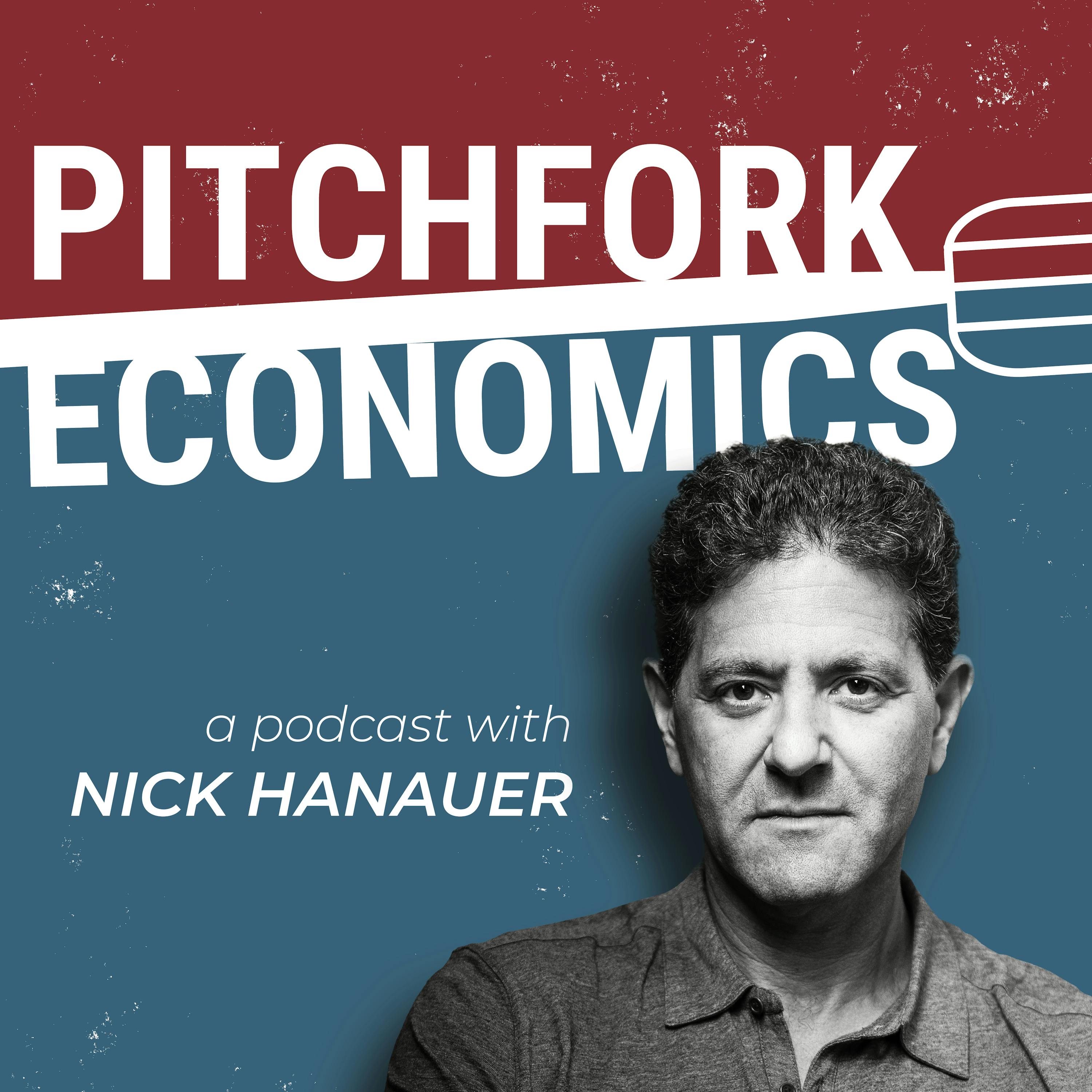
Pitchfork Economics with Nick Hanauer
449 episodes — Page 3 of 9
Why do you continue to do this work?
It’s our 300th episode! To mark this milestone, we’ve gathered some of the most thoughtful and inspiring answers to one of our favorite questions: Why do you do this work? Plus, Nick and Goldy share what keeps them in the fight for a better economy. We're deeply grateful for the wisdom of our incredible guests and, most of all, for YOU—our listeners—who’ve supported us along the way. Here’s to many more conversations unpacking who gets what and why in our economy, and how to build the economy from the middle out. Love what you’re hearing on the pod? Follow us on social media using the links below for updates and spicy takes on the economy! And if you haven’t already, make sure to follow the show so you never miss an episode. While you’re at it, give us a rating and leave a review wherever you get your podcasts—it helps us reach more people interested in rethinking or better understanding the economy and want to build a better future. Thanks for listening! Guests Featured: Jared Bernstein - Chair, White House Council of Economic Advisors Reshma Saujani - Founder, Girls Who Code and the Marshall Plan for Moms Mark Blyth - Political Economist and author of Diminishing Returns: The New Politics of Growth and Stagnation Rohit Chopra - Director, Consumer Financial Protection Bureau (CFPB) Joseph Stiglitz (3-time guest) - Economist and author of The Road to Freedom: Economics and the Good Society Caitlin Myers - Professor of Economics at Middlebury College and Co-Director of the Middlebury Initiative for Data and Digital Methods. Kim Stanley Robinson - American Science Fiction writer and author of The Ministry for the Future Marshall Steinbaum (2-time guest) - Assistant Professor of Economics at the University of Utah and a Senior Fellow in Higher Education Finance at Jain Family Institute. Elizabeth Anderson - Professor of Public Philosophy at the University of Michigan and author of Hijacked: How Neoliberalism Turned the Work Ethic against Workers and How Workers Can Take It Back Bharat Ramamurti - Former Deputy Director of the White House National Economic Council Elizabeth Wilkins - Senior Fellow at the American Economic Liberties Project and former Director of the Office of Policy and Planning at the Federal Trade Commission Website: http://pitchforkeconomics.com Twitter: @PitchforkEcon, @NickHanauer, @civicaction Instagram: @pitchforkeconomics Threads: pitchforkeconomics YouTube: @pitchforkeconomics Substack: The Pitch
Economics Needs More Socioeconomic Diversity (with Anna Stansbury)
This week, Nick and Goldy are joined by MIT economist Anna Stansbury to discuss the troubling lack of socioeconomic diversity within the economics profession. Stansbury discusses her research from a paper she co-authored with Robert Schultz titled “The Economics Profession’s Socioeconomic Diversity Problem”, which reveals that a strikingly low percentage of economists come from less-advantaged backgrounds. They have a thoughtful discussion about how that lack of diversity affects the profession's ability to address issues of power, inequality, and social problems, and they highlight the need for more diverse perspectives in the profession to ensure a more inclusive and equitable approach to economic analysis. They also point out that diversifying the field is not just a matter of equity but is crucial for fostering innovative solutions to economic challenges. Anna Stansbury is an economist and Assistant Professor of Work and Organization Studies at MIT Sloan School of Management. She is also a nonresident senior fellow at the Peterson Institute for International Economics. Her research primarily focuses on labor economics, with a particular emphasis on wage inequality, labor market power, and the dynamics of worker power within organizations. She recently co-authored a paper with Robert Schutls, “Socioeconomic Diversity of Economics Ph.Ds,” published by the Journal of Economic Perspectives. Twitter: @annastansbury Further reading: Socioeconomic Diversity of Economics PhDs Website: http://pitchforkeconomics.com Twitter: @PitchforkEcon, @NickHanauer, @civicaction Instagram: @pitchforkeconomics Threads: pitchforkeconomics YouTube: @pitchforkeconomics Substack: The Pitch
Capitalism and Crises (with Colin Mayer)
This week, Nick and Goldy talk to esteemed economist Colin Mayer, author of the book Capitalism and Crises: How to Fix Them, to explore the deep-seated issues plaguing modern capitalism, including rising inequality and environmental degradation. Mayer argues that the current profit-driven mindset of corporations often leads to societal harm, and he advocates for a paradigm shift towards a model where businesses profit by solving real human problems rather than creating them. Their conversation dissects the historical evolution of corporate responsibility, critiques neoliberal economics, and proposes solutions that redirect corporate focus toward societal benefit, and the urgent need for a more equitable economic structure that uplifts the middle class. Colin Mayer is a distinguished academic in the field of finance and economics. He is the Peter Moores Professor of Management Studies at the Saïd Business School at the University of Oxford. With a background in economics and finance, Mayer has conducted extensive research on corporate finance, governance, and the role of business in society. His work has been widely published in academic journals, and he is the author of several books, including "Capitalism and Crises." Further reading: Capitalism and Crises: How to Fix Them Website: http://pitchforkeconomics.com Twitter: @PitchforkEcon, @NickHanauer, @civicaction Instagram: @pitchforkeconomics Threads: pitchforkeconomics YouTube: @pitchforkeconomics Substack: The Pitch
Kamala Harris and the New Democratic Economic Paradigm
In the wake of the Democratic National Convention, Nick and Goldy take a close look at how middle-out economics has become the new center of the Democratic Party's economic policies, championing a new era of economic thinking that puts workers, families and taking on corporate power at the center, and breaking away from decades of top-down, trickle-down approaches. With echoes of President Joe Biden’s—and now former President Bill Clinton’s—call to build the economy from the bottom up and the middle out, Vice President Harris is seizing the middle-out mantle by declaring that building the middle class will be a defining goal of her presidency because in her words, “When our middle class is strong, America is strong.” Join us as we discuss how invigorating it was to see the Democratic Party coalescing around the idea that their economic policies should benefit the vast majority of working people in order to grow the economy. Further reading: The New Kamala - The American Prospect Kamala Harris and the New Democratic Economic Paradigm - The New Yorker Say It to My Face -The American Prospect Website: http://pitchforkeconomics.com Twitter: @PitchforkEcon, @NickHanauer, @civicaction Instagram: @pitchforkeconomics Threads: pitchforkeconomics YouTube: @pitchforkeconomics Substack: The Pitch
Revisiting the Legacy of the Fight for $15 (with Yannet Lathrop and Dr. T. William Lester)
Over ten years ago, activists and civic leaders ignited the Fight for $15, a movement that was once seen as radical—even Forbes labeled Nick's support for a $15 minimum wage as “near-insane.” Today, the movement's achievements are undeniable: Higher wages for millions of workers, increased union membership, reducing the racial wealth gap, and now raising the federal minimum wage to $15/ hr is one of the central issues in the 2024 presidential campaign, with two-thirds of voters in support. We thought it would be a good time to revisit this episode from 2023, where Yannet Lathrop and Dr. T. William Lester discuss their report from the National Economic Law Project examining the legacy of the movement and all it has accomplished over the last decade. This episode originally aired on January 24, 2023. Yannet Lathrop is a Senior Researcher and Policy Analyst for the National Employment Law Project. Dr. T. William Lester is Professor and Acting Chair of Urban and Regional Planning at San José State University and Research Professor at UNC Chapel Hill. Twitter: @NELPnews Further reading: Ten-Year Legacy of the Fight for $15 and a Union Movement Website: http://pitchforkeconomics.com Twitter: @PitchforkEcon, @NickHanauer, @civicaction Instagram: @pitchforkeconomics Threads: pitchforkeconomics YouTube: @pitchforkeconomics Substack: The Pitch
The Crisis of Democratic Capitalism (with Martin Wolf)
Martin Wolf, chief economics commentator at the Financial Times, joins Nick and Goldy to discuss his new book, "The Crisis of Democratic Capitalism." They explore the important-yet-fragile connection between capitalism and democracy, particularly in the context of rising inequality and political instability. Wolf articulates how the perceived success of democratic capitalism has begun to falter under the onslaught of economic policies favoring the wealthy and eroding the middle class. Ultimately, Wolf advocates for stronger social safety nets to ensure that democratic systems, as well as working and middle-class families, can thrive in an era dominated by economic upheaval. Martin Wolf is the chief economics commentator at the Financial Times, known for his incisive analyses and authoritative perspectives on global economics and policy. With a distinguished career spanning several decades, Wolf has shaped public discourse on economic matters through his insightful columns and books. His latest book, "The Crisis of Democratic Capitalism," details how and why the marriage between democracy and capitalism is coming undone and what can be done to reverse this terrifying dynamic. Twitter: @martinwolf_ Further reading: The Crisis of Democratic Capitalism Website: http://pitchforkeconomics.com Twitter: @PitchforkEcon, @NickHanauer, @civicaction Instagram: @pitchforkeconomics Threads: pitchforkeconomics YouTube: @pitchforkeconomics Substack: The Pitch
How the Anti-Tax Movement Hijacked America (with Michael Graetz)
This week, Nick and Goldy are joined by Michael Graetz to discuss his new book, "The Power to Destroy: How the Anti-Tax Movement Hijacked America.” Graetz asserts that while the anti-tax movement is often overlooked, it has shaped policy by intertwining with issues of race and economic ideology, diverging from Keynesian economics in favor of neoliberal supply-side economics that results in extreme wealth accumulation at the top. He argues for major tax reforms, including a carbon tax and the implementation of a value-added tax, as potential solutions to creating a more equitable and sustainable tax code that would benefit the middle class. Their conversation also revisits the historical origins of the anti-tax movement in the United States and highlights how tax policy is not just shaped by economic theory— it’s also shaped by cultural and social differences. Michael Graetz is a professor emeritus at Columbia Law School and Yale Law School and a leading authority on tax politics and policy. He served in the U.S. Treasury’s Office of Tax Policy and is the author and co-author of many books, including Death by a Thousand Cuts: The Fight over Taxing Inherited Wealth and The Burger Court and the Rise of the Judicial Right. Further reading: The Power to Destroy: How the Antitax Movement Hijacked America The Graetz Competitive Tax Plan, Updated for 2022 Death by a Thousand Cuts: The Fight over Taxing Inherited Wealth Website: http://pitchforkeconomics.com Twitter: @PitchforkEcon, @NickHanauer, @civicaction Instagram: @pitchforkeconomics Threads: pitchforkeconomics YouTube: @pitchforkeconomics Substack: The Pitch
2024 Summer Reading List
It’s Paul and Goldy’s summer reading list! In this week’s special episode, Civic Ventures Senior Fellow David “Goldy” Goldstein and Civic Ventures Writer Paul Constant recommend some of the hottest new economic and political books for your beach reading pleasure. We want to know what you’re reading, too. Leave us a comment on Instagram, Twitter, Threads or YouTube! Remember to shop local and small when you can, or order from IndieBound or Bookshop.org—both of which support independent bookstores! All of these books are also likely available through your local library. Every book mentioned in this episode: In This Economy?: How Money & Markets Really Work - Kyla Scanlon End Times: Elites, Counter-Elites, and the Path of Political Disintegration - Peter Turchin The Chile Project: The Story of the Chicago Boys and the Downfall of Neoliberalism - Sebastian Edwards Our Malady: Lessons in Liberty from a Hospital Diary - Timothy Snyder Growth: A History and a Reckoning - Daniel Susskind Empty Planet: The Shock of Global Population Decline - Darrell Bricker & John Ibbitson A Fabulous Failure: The Clinton Presidency and the Transformation of American Capitalism - Nelson Lichtenstein & Judith Stein The Power Broker: Robert Moses and the Fall of New York - Robert A. Caro The Road to Freedom: Economics and the Good Society - Joseph E. Stiglitz Work, Retire, Repeat: The Uncertainty of Retirement in the New Economy - Teresa Ghilarducci New Nigeria County - Clare Brown Unruly: The Ridiculous History of England's Kings and Queens - David Mitchell Website: http://pitchforkeconomics.com Twitter: @PitchforkEcon, @NickHanauer, @civicaction Instagram: @pitchforkeconomics Threads: pitchforkeconomics YouTube: @pitchforkeconomics Substack: The Pitch
How Outsized Corporate Profits Raised Prices (with Lindsay Owens)
This week, Nick and Goldy are joined by Lindsay Owens, Executive Director of the Groundwork Collaborative, to discuss Groundwork’s recent reports on corporate profiteering and price gouging during and after the pandemic. Owens attributes the record increases in corporate profits in the last few years to growing corporate concentration and lack of competition. She argues that these two factors gave companies an unprecedented level of market power, and therefore pricing power, which allowed them to exploit the supply chain crisis caused by COVID to drastically raise prices. Owens stresses the need for policy interventions to promote competition, transparency, and fair pricing in the market to ensure a more competitive and consumer-friendly economy. Lindsay Owens is the Executive Director of the Groundwork Collaborative, known for her expertise in economic policymaking and her work on exposing corporate profiteering in price increases. She leads the organization's mission to create a more equitable economy, providing media commentary and advising policymakers such as Senator Elizabeth Warren, Minnesota Attorney General Keith Ellison, and Congressional Progressive Caucus Chair Pramila Jayapal. Twitter: @owenslindsay1 Further reading: New Groundwork Report Finds Corporate Profits Driving More Than Half of Inflation Inflation Revelation: How Outsized Corporate Profits Drive Rising Costs Big Profits in Small Packages Website: http://pitchforkeconomics.com Twitter: @PitchforkEcon Instagram: @pitchforkeconomics Nick’s twitter: @NickHanauer
Connecting the dots on Biden's middle-out economic policies (with Heather Boushey)
This week Nick & Goldy are joined by Heather Boushey, Chief Economist for President Biden's Invest in America Cabinet, for a deep dive into the transformative economic policies of the Biden administration. Boushey discusses the paradigm shift towards a middle-out economic approach to crafting economic policy and the impact of legislation like the American Rescue Plan, CHIPS Act, Bipartisan Infrastructure Law, and Inflation Reduction Act. Their conversation explores the importance of investing in infrastructure, clean energy, and manufacturing to drive growth and create good jobs. They also discuss the challenges of implementation, the success of the administration’s industrial policy, and its remarkable economic outcomes including record low Black unemployment, high new business applications, and equitable wage growth. Even though this episode was recorded before President Biden announced he was withdrawing from the presidential campaign and endorsing Vice President Harris, this wide-ranging conversation offers plenty of valuable insight into the past, present, and future of middle-out economics. Heather Boushey is a distinguished American economist who specializes in economic inequality and public policy. She serves on President Biden’s Council of Economic Advisers and is the Chief Economist for the Invest in America Cabinet. Before joining the Biden Administration, she was the co-founder and President of the Washington Center for Equitable Growth, a research organization dedicated to advancing evidence-backed ideas and policies that promote economic growth and reduce inequality. Twitter: @HBoushey Further reading: Invest.gov The Productivity–Pay Gap Website: http://pitchforkeconomics.com Twitter: @PitchforkEcon Instagram: @pitchforkeconomics Nick’s twitter: @NickHanauer
The Road to Freedom (with Joseph Stiglitz)
Nobel Prize-winning economist Joseph Stiglitz joins Nick and Goldy to talk about his new book, "The Road to Freedom: Economics and the Good Society.” Stiglitz challenges the orthodox economic theories that have shaped our understanding of capitalism and argues for a new approach called progressive capitalism. Stiglitz also discusses the flaws of neoliberalism, popular misconceptions about freedom, and the widespread benefits of addressing issues like climate change and inequality. He shares insights on the need for a broader set of economic policies that prioritize the well-being of all people, not just the wealthy. Their discussion sheds light on the evolving landscape of economic thought and the hope for a more equitable and sustainable future. Joseph Stiglitz is a Nobel Prize-winning economist and the best-selling author of multiple books on economics. He was also chairman of the Council of Economic Advisers under President Clinton and chief economist of the World Bank. He now teaches at Columbia University and is chief economist of the Roosevelt Institute. His latest book, The Road to Freedom: Economics and the Good Society, delves into the failures of the neoliberal economic model and presents a comprehensive critique of how "free" markets have led to various crises, including financial instability, inequality, and social unrest. Twitter: @JosephEStiglitz Further reading: The Road to Freedom: Economics and the Good Society More from Joseph Stiglitz: People, Power, and Profits: Progressive Capitalism for an Age of Discontent For Good Measure: An Agenda for Moving Beyond GDP Globalization and Its Discontents Revisited: Anti-Globalization in the Era of Trump The Price of Inequality Website: http://pitchforkeconomics.com Twitter: @PitchforkEcon Instagram: @pitchforkeconomics Nick’s twitter: @NickHanauer
Making Sense of Chaos (with Doyne Farmer)
This week, Nick and Goldy talk to Doyne Farmer, a renowned physicist and mathematician, to discuss his new book, "Making Sense of Chaos: A Better Economics for a Better World." Farmer, who is a professor at the Institute for New Economic Thinking, challenges traditional orthodox economic frameworks by applying complex systems theory. Their conversation explores the limitations of mainstream economic models, the importance of incorporating uncertainty into economic thinking, and the potential for complexity economics to provide better guidance for policymakers in addressing pressing issues like climate change and inequality. It’s a thoughtful discussion that explores more effective approaches to understanding and managing complex economic systems. Doyne Farmer is a renowned physicist and mathematician who is currently a Professor at the Institute for New Economic Thinking at the University of Oxford and the Director of the Complexity Economics program. He is also an author known for his groundbreaking work in the field of complex systems and chaos theory. His recent book, "Making Sense of Chaos: A Better Economics for a Better World," delves into how chaos theory can be applied to understand and address the complexities of modern economic systems. Twitter: @doyne_farmer Further reading: Making Sense of Chaos: A Better Economics for a Better World Website: http://pitchforkeconomics.com Twitter: @PitchforkEcon Instagram: @pitchforkeconomics Nick’s twitter: @NickHanauer
The Code of Capital (with Katharina Pistor)
This week, Nick and Goldy talk to Katharina Pistor, a legal scholar and professor at Columbia Law School, about her book "The Code of Capital: How the Law Creates Wealth and Inequality.” Pistor sheds light on how the law shapes the distribution of power and wealth in society. They explore the way that law's prioritization of capital has changed over time and its contribution to rising economic inequality within and between nations. Pistor also explains how we can reconfigure the legal playing field to address economic inequality. Katharina Pistor is a legal scholar and author known for her expertise in the fields of law and finance. She is currently the Edwin B. Parker Professor of Comparative Law at Columbia Law School, where she also serves as the Director of the Center on Global Legal Transformation. Pistor has published extensively on topics such as property rights, financial regulation, and the role of law in shaping economic systems. Her most recent book, "The Code of Capital: How the Law Creates Wealth and Inequality," explores the ways in which legal systems around the world have been designed to benefit capital owners and perpetuate wealth inequality. Further reading: The Code of Capital: How the Law Creates Wealth and Inequality Website: http://pitchforkeconomics.com Twitter: @PitchforkEcon Instagram: @pitchforkeconomics Nick’s twitter: @NickHanauer
The Failed Southern Economic Development Model (with Chandra Childers)
This week, Goldy and Paul talk to Chandra Childers, a senior policy and economic analyst at the Economic Policy Institute and author of their recent report on the Southern economic development model. Although the Southern economic development model is touted as a business-friendly strategy, it has devastating consequences for workers and families in Southern states. Childers explains how this economic model is rooted in racism and economic exploitation and has led to lower wages, weaker safety nets, and fewer opportunities for workers. They also discuss how some Southern states are bucking this trend and attempting to adopt more progressive policies, as well as the potential impact of renewed unionization efforts in the region. Chandra Childers is a senior policy and economic analyst with the Economic Analysis and Research Network (EARN) at the Economic Policy Institute. Her work is primarily focused on supporting EARN’s state and local policy research and advocacy network in the Southern United States. Before joining the EARN team at EPI, Childers was a Study Director at the Institute for Women’s Policy Research. Twitter: @ChandraChilders Further reading: Breaking down the South’s economic underperformance The evolution of the Southern economic development strategy Rooted in racism and economic exploitation Website: http://pitchforkeconomics.com Twitter: @PitchforkEcon Instagram: @pitchforkeconomics Nick’s twitter: @NickHanauer
Democracy in Default (with Brian Judge)
This week, Nick and Goldy are joined by political scientist Brian Judge, author of "Democracy in Default: Finance and the Rise of Neoliberalism in America." They delve into the historical roots of our current democratic crisis, exploring the role of liberalism in depoliticizing distributive conflicts and paving the way for the rise of neoliberalism. Judge sheds light on the impact of neoliberal ideologies on American policymaking and how liberalism's attempts to manage distributive conflict through the market have shaped our economic and political landscape—which gave leaders the opportunity to use the economic slowdown of the 1970s to install neoliberal policies that enriched the wealthy few for decades. Brian Judge is an author and policy fellow at the Center for Human-Compatible Artificial Intelligence and the Berkeley Roundtable on the International Economy at the University of California, Berkeley. He is recognized for his recently published book, "Democracy in Default: Finance and the Rise of Neoliberalism in America," which delves into the intricate relationship between finance and politics in shaping the neoliberal economic landscape in the United States Twitter: @realbrianjudge Further reading: Democracy in Default: Finance and the Rise of Neoliberalism in America Website: http://pitchforkeconomics.com Twitter: @PitchforkEcon Instagram: @pitchforkeconomics Nick’s twitter: @NickHanauer
The FTC's Renewed Fight Against Corporate Power (with Elizabeth Wilkins)
After decades of slow and cautious movement, the Federal Trade Commission has suddenly kicked into overdrive. You’ve likely seen headlines about the FTC challenging corporate mergers and monopolies, loosening Big Tech’s chokehold on our digital lives, and fighting power imbalances that favor big corporations over American consumers. Elizabeth Wilkins, former Chief of Staff and Director of the Office of Policy and Planning at the FTC, joins Nick and Goldy to give a status update on the FTC's renewed focus on competition and broader antitrust enforcement, and to explain how the historical evolution of the agency has led to a lack of regulation and oversight in maintaining fair competition and consumer protection. Elizabeth Wilkins is an expert in consumer protection and competition policy and a newly minted Senior Fellow at the American Economic Liberties Project. Previously, she was the Chief of Staff to the Chair and Director of the Office of Policy and Planning at the Federal Trade Commission. Before joining the FTC, Wilkins served as Senior Advisor to White House Chief of Staff Ron Klain. Twitter: @ewwilkins Website: http://pitchforkeconomics.com Twitter: @PitchforkEcon Instagram: @pitchforkeconomics Nick’s twitter: @NickHanauer
Ours Was the Shining Future (with David Leonhardt)
This week, Nick and Goldy are joined by Pulitzer Prize-winning columnist David Leonhardt to discuss his latest book, Ours Was the Shining Future: The Story of the American Dream. They discuss the relationship between academic economics and the forces that sought to dismantle the mid-century consensus that promoted shared economic growth in the post-World War II era. Leonhardt shares anecdotes from his extensive research, highlighting what lessons from the past could guide us toward a more equitable future. David Leonhardt is a Pulitzer Prize-winning journalist and columnist for The New York Times, where he writes its flagship newsletter, “The Morning.” He has also been the newspaper’s Washington bureau chief, an op-ed columnist, a staff writer for The New York Times Magazine, and the founding editor of “The Upshot.” Twitter: @DLeonhardt Further reading: Ours Was the Shining Future: The Story of the American Dream New York Times: Why Are Republican Presidents So Bad for the Economy? The Great Exception: The New Deal and the Limits of American Politics Website: http://pitchforkeconomics.com Twitter: @PitchforkEcon Instagram: @pitchforkeconomics Nick’s twitter: @NickHanauer
What Does Obama’s Chief Economist Think About Bidenomics? (with Jason Furman)
This week, Nick and Goldy have a wide-ranging conversation with Jason Furman, who served as Chairman of the Council of Economic Advisers under President Obama. Furman brings a wealth of experience to the discussion, which covers America’s post-pandemic recovery, the global inflation crisis, and reviving industrial policy. He also provides insight into the overall impact of President Biden's policies on the broader economic landscape. Jason Furman is a prominent economist who served as the Chairman of the Council of Economic Advisers under President Obama from 2013 to 2017. He is currently a Professor of the Practice of Economic Policy at the Harvard Kennedy School and a Senior Fellow at the Peterson Institute for International Economics. Furman is known for his expertise in economic policy, particularly in the areas of tax policy, healthcare, and labor markets. Twitter: @jasonfurman Website: http://pitchforkeconomics.com Twitter: @PitchforkEcon Instagram: @pitchforkeconomics Nick’s twitter: @NickHanauer
Unpacking America’s Housing Affordability Crisis (with Whitney Airgood-Obrycki)
This week, Nick and Goldy are joined by Whitney Airgood-Obrycki from the Joint Center for Housing Studies at Harvard University to discuss the urgent issue of housing affordability in the United States. Despite its status as the wealthiest country in the world, America is grappling with a housing crisis, marked by record-high levels of homelessness and a growing number of individuals spending between 30% to 50% or more of their income on rent. Together, they unpack the housing affordability crisis, discuss how it contributes to the perception of a struggling economy, and explore the innovative solutions local governments are proposing to address it. Whitney Airgood-Obrycki is a Senior Research Associate at the Joint Center for Housing Studies at Harvard University. She conducts research on affordable rental housing for low-income households and served as the project manager and lead author of their recent report on America’s Rental Housing. Dr. Airgood-Obrycki's latest research includes affordable housing policy, housing affordability measures, rental housing markets, and suburban neighborhood change. Twitter: @airbrycki, @Harvard_JCHS America’s Rental Housing 2024 Montgomery County has found a way to reinvigorate public housing in America What if public housing were for everyone? Website: http://pitchforkeconomics.com Twitter: @PitchforkEcon Instagram: @pitchforkeconomics Nick’s twitter: @NickHanauer
Junking Junk Fees (with Rohit Chopra)
This week, Nick and Goldy sit down with Rohit Chopra, the Director of the Consumer Financial Protection Bureau, to explore the agency's efforts to lower financial costs for working Americans. From cracking down on credit card late fees to tackling medical debt on credit reports and regulating bank overdraft charges, Director Chopra sheds light on the CFPB's various initiatives to promote transparency and competition in financial products and services. Chopra argues that by advocating for consumer rights and protections, the CFPB is shaping a more equitable economic landscape for all Americans. UPDATE: This episode was recorded before yesterday’s breaking news that a Texas judge issued a last-minute order temporarily blocking the CFPB’s plan to cap credit card late fees. Find more information about the injunction, and the Chamber of Commerce’s case against the cap, here: https://www.cnn.com/2024/05/11/business/credit-card-late-fees-regulation-cfpb/index.html Rohit Chopra is the Director of the Consumer Financial Protection Bureau (CFPB), a federal agency dedicated to protecting consumers in the financial marketplace. Prior to leading the CFPB, he served as a Commissioner at the Federal Trade Commission, where he focused on promoting fair competition and protecting consumers from deceptive practices. Twitter: @chopracfpb, @CFPB Further reading: www.consumerfinance.gov Submit a complaint about a financial product or service CFPB Bans Excessive Credit Card Late Fees, Lowers Typical Fee from $32 to $8 Website: http://pitchforkeconomics.com Twitter: @PitchforkEcon Instagram: @pitchforkeconomics Nick’s twitter: @NickHanauer
Decoding the Tech Layoff Panic of 2024 (with Jeffrey Shulman)
Even though the American labor market is currently stronger than it has been in decades, earlier this year Big Tech companies were laying off workers at an alarming pace. Economists struggled to understand why some 25,000 tech workers were losing their jobs, even as the media panicked about whether those layoffs were a warning sign of an oncoming recession. University of Washington Professor Jeff Shulman joins us to uncover the real reasons behind Big Tech’s layoffs, and to explain their implications for workers. Jeffrey Shulman is a professor at the Foster School of Business at the University of Washington. He’s also a podcaster and filmmaker with a diverse range of expertise in pricing, entrepreneurial marketing, and product management. As a professor, he is known for his innovative research and teaching methods that delve into the intricacies of economic principles and their practical applications in the business world. Recently, Shulman has gained recognition for his insightful commentary on the highly publicized layoffs in the tech industry. More from Professor Shulman: Nearly 25,000 tech workers were laid off in the first weeks of 2024. Why is that? Why widespread tech layoffs keep happening despite a strong U.S. economy How To Succeed In Product Management on Apple Podcasts How To Succeed In Product Management on Spotify Seattle Growth Podcast on Apple Podcasts On The Brink: A Film via PBS Website: http://pitchforkeconomics.com Twitter: @PitchforkEcon Instagram: @pitchforkeconomics Nick’s twitter: @NickHanauer
How to Build a Just Economy (with Nick Romeo)
Journalist Nick Romeo joins us to discuss his new book "The Alternative: How to Build a Just Economy." Romeo argues that the conventional economic wisdom has fostered political and economic instability, resulting in widening inequality, environmental degradation, and the exploitation of workers. He also highlights innovative solutions and success stories—including worker cooperatives, public-option marketplaces, and job guarantee programs— that paint a picture of how we can design systems in a market economy that truly work for everyone. Nick Romeo is a journalist, critic, and essayist who has spent years covering policy and ideas for The New Yorker magazine. He also teaches at the Graduate School of Journalism at UC Berkeley. The Alternative: How to Build a Just Economy The New Yorker: Nick Romeo Website: http://pitchforkeconomics.com Twitter: @PitchforkEcon Instagram: @pitchforkeconomics Nick’s twitter: @NickHanauer
The Case Against Extreme Wealth (with Ingrid Robeyns)
This week, Nick and Goldy sit down with ethics professor Ingrid Robeyns to discuss her groundbreaking new book, Limitarianism: The Case Against Extreme Wealth. Robeyns challenges the idea that it’s acceptable to allow extreme wealth concentration and inequality to persist, advocating instead for a hard cap on wealth accumulation. Nick and Goldy navigate the moral and practical implications of wealth limits on society, democracy, and ecological sustainability. Ingrid Robeyns is a distinguished scholar and Professor of Ethics of Institutions at Utrecht University, and author of the new book, Limitarianism: The Case Against Extreme Wealth. Professor Robeyns’ research in the field of Ethics and Political Philosophy focuses on issues of justice, inequality, well-being, and the ethical dimensions of societal structures and policies. Twitter: @IngridRobeyns Limitarianism: The Case Against Extreme Wealth Website: http://pitchforkeconomics.com Twitter: @PitchforkEcon Instagram: @pitchforkeconomics Nick’s twitter: @NickHanauer
LIVE from DC: Redefining the Center (with Heather Boushey)
This special episode of Pitchfork Economics features a live conversation from the "Redefining the Center: How to Make Middle-Out Economics the New Mainstream" conference hosted by Democracy Journal in Washington, D.C. Heather Boushey, a member of the White House Council of Economic Advisors, joins Nick for a wide-ranging discussion moderated by Michael Tomasky, editor of Democracy Journal. Hanauer & Boushey explore the policy initiatives being pursued by the Biden administration that prioritize working families and promote economic growth from the middle out and discuss the crucial role of the middle out as a paradigm shift in how people think about economic cause and effect. This dynamic and thought-provoking discussion was a great start to an outstanding conference. Heather Boushey is an economist and policy advisor who serves as a key member of President Biden's White House Council of Economic Advisors and Chief Economist for the President’s Invest in America Cabinet. Prior to joining the Biden administration, she was the President and CEO of the Washington Center for Equitable Growth, a think tank focused on advancing evidence-based policies to reduce inequality. In her role in the White House, she plays a crucial role in shaping economic policy and advising the President on issues related to labor, income inequality, and economic opportunity. Twitter: @hboushey46 Further reading: The Middle-Out Moment Is Here Website: http://pitchforkeconomics.com Twitter: @PitchforkEcon Instagram: @pitchforkeconomics Nick’s twitter: @NickHanauer
The True Crime of Wage Theft (with Terri Gerstein)
In the shadows of corporate greed and exploitation lies a sinister crime that is silently perpetrated, leaving countless victims in its wake—a crime that affects millions of hardworking Americans every year and sucks billions out of our economy —Wage Theft. No industry is immune to this insidious crime, from restaurant workers to construction laborers. On this episode of Pitchfork Economics, we are joined by Terri Gerstein, Director of the Labor Initiative at NYU Robert F. Wagner Graduate School of Public Service, to unpack the chilling truth behind these workplace crimes, learn who the perpetrators are, and uncover how they get away with it. Most importantly, what can be done to stop them? Terri Gerstein is the Director of the NYU Wagner Labor Initiative, at NYU’s Robert F. Wagner Graduate School of Public Service, which explores and helps activate the often-untapped potential of government in safeguarding and advancing workers' rights. Previously, Terri enforced labor laws in New York for 17 years, including as Labor Bureau Chief in the New York State Attorney General’s Office. Crime music bed by Power Music Factory News clips from CBS News, CBS Miami, and CBS Philadelphia Twitter: @TerriGerstein NYU Wagner Labor Initiative Further reading: Prosecute Bad Bosses: More district attorneys are cracking down on abusive employers. It's about time Report mentioned in the episode from the National Coalition Against Insurance Fraud: The Costly Crime and Impact of Workers’ Comp Premium Fraud The Role of State Attorneys General in Protecting Workers’ Rights Report: How district attorneys and state attorneys general are fighting workplace abuses More states should follow new Colorado policy on wage theft Website: http://pitchforkeconomics.com Twitter: @PitchforkEcon Instagram: @pitchforkeconomics Nick’s twitter: @NickHanauer
Productivity is a Policy Choice (with Preston Mui)
Preston Mui, Senior Economist at Employ America, recently authored a report titled "The Dream of the 90s is Alive in 2024: How Policy Can Revive Productivity Growth." The report offers a blueprint for policymakers seeking to emulate the successes of an unparalleled period of productivity in the United States. Mui joins us to examine and reflect on the policy decisions which drove the strong productivity growth of the 1990s, and he also identifies dynamic new strategies for revitalizing American production in the present. Preston Mui is a Senior Economist at Employ America, a macroeconomic policy research and advocacy organization committed to achieving and sustaining full employment outcomes. Twitter: @PrestonMui Three Motivations for Interest Rate Normalization: A Playbook for Fed Policy in 2024 The Dream of the 90's is Alive in 2024: How Policy Can Revive Productivity Growth Preston Mui's thread on the “Dream of the 90's” series and report by Employ America Website: http://pitchforkeconomics.com Twitter: @PitchforkEcon Instagram: @pitchforkeconomics Nick’s twitter: @NickHanauer
Why Wages Are Growing From the Bottom Up and Middle Out (with Arin Dube)
Today, Arin Dube, Professor of Economics at the University of Massachusetts Amherst, joins us to discuss his latest research, which suggests that the American labor market is undergoing a remarkable transformation. The widespread wage inequality that rapidly expanded between 1980 and 2019 is finally reversing, and American paychecks are growing again—especially at the bottom end of the income scale. In this enlightening conversation, Dube explains how and why the labor market has changed, how that's affecting wages, and how it all contributes to a virtual cycle of middle-out economic growth. Arin Dube is a Professor of Economics at the University of Massachusetts Amherst, well-known for his expertise in labor economics and public policy and his groundbreaking empirical research on minimum wage. His work often involves empirical analysis and utilizes large-scale datasets to provide evidence-based insights into the effects of various policy interventions. Dube's research has been widely recognized and cited, contributing to the ongoing discussions among policymakers and economists around labor market dynamics and policy design. Twitter: @arindube The Unexpected Compression thread https://twitter.com/arindube/status/1724147807563477440 NBER Working Paper https://www.nber.org/system/files/working_papers/w31010/w31010.pdf Website: http://pitchforkeconomics.com Twitter: @PitchforkEcon Instagram: @pitchforkeconomics Nick’s twitter: @NickHanauer
The True Cost of Trump’s Tax Plan (with Samantha Jacoby)
In his State of the Union Address, President Biden made it clear that taxes and tax policy were his next big target for a middle-out makeover. However, we can't talk about the future of taxes without discussing the potential expiration of Trump’s’ 2017 tax law. Samantha Jacoby, a senior tax analyst at the Center on Budget and Policy Priorities, joins us today to help us understand the repercussions of Trump's tax policies and the opportunities ahead. Trump’s tax law was marketed as a boon for every working American, promising an average annual benefit of $4,000. But Jacoby unveils the true economic reality behind the Trump tax law: the primary beneficiaries were the wealthiest individuals and corporations; they did not pay for themselves as promised; and despite the trillions of tax giveaways to people at the top, most Americans saw no tangible economic benefit. Samantha Jacoby is a Senior Tax Analyst with the Center on Budget and Policy Priorities. Before joining the Center in 2018, she practiced tax law at two international law firms in New York and Washington, D.C. Previously, she worked as a policy and research analyst at the Solar Energy Industries Association, where she focused on the impact of tax incentives on the renewable energy industry. Twitter: @jacsamoby The 2017 Trump Tax Law Was Skewed to the Rich, Expensive, and Failed to Deliver on Its Promises https://www.cbpp.org/research/federal-tax/the-2017-trump-tax-law-was-skewed-to-the-rich-expensive-and-failed-to-deliver IRS Funding thread by Samantha on Twitter https://x.com/jacsamoby/status/1752088112291807298?s=20 After Decades of Costly, Regressive, and Ineffective Tax Cuts, a New Course Is Needed Bipartisan Senate Action Passes Minimal Test for IRS Funding While Multiple House Republican Bills Fail https://www.cbpp.org/research/federal-tax/after-decades-of-costly-regressive-and-ineffective-tax-cuts-a-new-course-is Website: http://pitchforkeconomics.com Twitter: @PitchforkEcon Instagram: @pitchforkeconomics Nick’s twitter: @NickHanauer
Middle Out to Mainstream
Eleven years ago, Democracy Journal released a special issue on "The Middle Out Moment" that explored the implications of what was then the brand-new theory of middle-out economics. The moment may not have fully arrived back in 2013, but no doubt it's here now. So this week, Democracy Journal is publishing a follow-up edition called "The Middle Out Moment Part Two," marking the fact that what was once a new idea has now gone mainstream. In this episode, we'll hear from several of the economists, researchers, and former administration officials who contributed to the special issue as they explore how middle-out economics has been put into practice — and discuss the work that lies ahead as middle-out economics becomes the new mainstream. Guests include: Felicia Wong, Bharat Ramamurti, Tara McGuinness, Sandeep Vaheesan, Todd Tucker, Ronnie Chatterji, Neale Mahoney, and Heidi Shierholz The Middle-Out Moment is Here: https://democracyjournal.org/category/magazine/72 Twitter: Michael Tomasky - @mtomasky Felicia Wong - @FeliciaWongRI Bharat Ramamurti - @BharatRamamurti Tara McGuinness - @taradmcguinness Sandeep Vaheesan - @sandeepvaheesan Todd Tucker - @toddntucker Ronnie Chatterji - @RonnieChatterji Neale Mahoney - @nealemahoney Heidi Shierholz - @hshierholz Website: http://pitchforkeconomics.com Twitter: @PitchforkEcon Instagram: @pitchforkeconomics Nick’s twitter: @NickHanauer
Why Americans are so displeased with the economy (with Aaron Sojourner)
The latest economic indicators show a historically strong economy. Over the past couple of years, the unemployment rate has consistently stayed below 4%, real wages have been growing faster than they have in decades, and economic growth has been strong. And yet, public opinion surveys consistently show dissatisfaction with economic conditions. Aaron Sojourner, a labor economist from the Upjohn Institute, joins us to discuss his research findings into why Americans are so displeased with the economy. Aaron helps us unpack the complicated relationship between news coverage of the economy and its effect on consumer sentiment. Aaron Sojourner is a labor economist and senior researcher at the Upjohn Institute for Employment Research. His research focuses on the effects of labor-market institutions, policies to promote efficient and equitable development of human capital, and behavioral economic approaches to consumer finance decisions. He’s also served as the senior economist for labor on the U.S. Council of Economic Advisers for Presidents Obama and Trump. Twitter: @aaronsojourner BlueSky: @aaronsojourner.bsky.social Threads: aaronsojourner Why are Americans so displeased with the economy? https://www.brookings.edu/articles/why-are-americans-so-displeased-with-the-economy Aaron’s thread on within-worker real wage growth on Threads: https://www.threads.net/@aaronsojourner/post/C3OVo8FrDgV/?igshid=NTc4MTIwNjQ2YQ== Tax Subsidies for Journalism Are Only for Rich People: Perry Bacon Edition https://cepr.net/tax-subsidies-for-journalism-are-only-for-rich-people-perry-bacon-edition Website: http://pitchforkeconomics.com Twitter: @PitchforkEcon Instagram: @pitchforkeconomics Nick’s twitter: @NickHanauer
A Tale of Two Tax Systems (with David Cay Johnston)
While the average American worker is subject to a progressive income tax system where tax rates increase as income rises, the wealthy often exploit a range of loopholes and deductions that significantly reduce their tax burden—sometimes to the point where the biggest corporations and one-percenters pay nothing at all. David Cay Johnston, a tax policy expert and former investigative journalist for the New York Times, joins us today to help unravel the complexity of the American tax system, which has functionally created two different tax systems: One for the wealthy and powerful and one for everyone else. David Cay Johnston is an award-winning investigative journalist and author known for his expertise in tax policy and economic inequality. Johnston worked as a tax reporter for The New York Times for over a decade. At the Times, he won the Pulitzer Prize for Beat Reporting in 2001 for his coverage of tax loopholes and corporate tax evasion. Throughout his career, Johnston has authored several critically acclaimed books, including "Perfectly Legal: The Covert Campaign to Rig Our Tax System to Benefit the Super Rich—and Cheat Everybody Else" and “Divided: The Perils of Our Growing Inequality.” Twitter: @DavidCayJ The Whiteness of Wealth: How the Tax System Impoverishes Black Americans--and How We Can Fix It by Dorothy Brown https://bookshop.org/a/101360/9780525577331 More from David Cay Johnston: “Alvin Bragg’s roadmap to convict Donald Trump” https://www.nydailynews.com/2023/01/08/alvin-braggs-roadmap-to-convict-donald-trump/ Perfectly Legal: The Covert Campaign to Rig Our Tax System to Benefit the Super Rich--and Cheat Everybody Else https://bookshop.org/a/101360/9781591840695 Free Lunch: How the Wealthiest Americans Enrich Themselves at Government Expense (and Stick You with the Bill) https://bookshop.org/a/101360/9781591842484 Divided: The Perils of Our Growing Inequality https://bookshop.org/a/101360/9781595589231 Website: http://pitchforkeconomics.com Twitter: @PitchforkEcon Instagram: @pitchforkeconomics Nick’s twitter: @NickHanauer
Why Flying Is Miserable And How to Fix It (with Ganesh Sitaraman)
Ganesh Sitaraman joins us today to discuss his new book, Why Flying Is Miserable And How to Fix It. Air travel has become an increasingly frustrating experience, with countless horror stories of cancellations, delays, lost baggage, cramped seats, and poor service. For most of the 20th century flying was luxurious and fun, so it’s especially baffling that air travel is plagued by these problems in the 21st century. Sitaraman delves into the reasons behind this dismal state of affairs, tracing it back to a deliberate choice made by elected leaders in the 1970s to roll back regulations, supposedly in order to increase competition and improve the experience of flying for everyone. After enduring half a century of turbulence caused by deregulation, people are fed up with the state of air travel, and Sitaraman gives us some insight into how we can begin to fix it. Ganesh Sitaraman is a law professor and the director of the Vanderbilt Policy Accelerator for Political Economy and Regulation. He was previously a senior advisor to Senator Elizabeth Warren on her presidential campaign and is a member of the Administrative Conference of the United States and the FAA’s Commercial Space Transportation Advisory Committee. Sitaraman is the author of several influential books, including "The Crisis of the Middle-Class Constitution," "The Public Option: How to Expand Freedom, Increase Opportunity, and Promote Equality," and his most recent book, “Why Flying Is Miserable And How to Fix It.” Twitter: @GaneshSitaraman Why Flying Is Miserable And How to Fix It https://bookshop.org/a/101360/9798987053584 Book Website https://globalreports.columbia.edu/books/why-flying-is-miserable/ More from Ganesh Sitaraman: The Atlantic - Airlines Are Just Banks Now https://www.theatlantic.com/ideas/archive/2023/09/airlines-banks-mileage-programs/675374/ The Crisis of the Middle-Class Constitution https://bookshop.org/a/101360/9781101973455 Website: http://pitchforkeconomics.com Twitter: @PitchforkEcon Instagram: @pitchforkeconomics Nick’s twitter: @NickHanauer
The Future of Bidenomics (with Jared Bernstein)
President Biden’s economic policies mark a paradigm shift away from the trickle-down economics that have held sway over Washington DC for the past 40 years. Bidenomics recognizes that a strong and inclusive economy grows from the middle class outwards, centering working Americans and their families rather than relying on a top-down approach that benefits the wealthy first and foremost. In this episode, President Biden’s chief economic advisor, Jared Bernstein, joins us to unpack the key ideas behind this middleout understanding of how the economy really works, and to explain how Bidenomics is reshaping the economy to truly work for all Americans—not just a wealthy few at the top. After helping to engineer a best-in-the-world economic recovery from the pandemic, Bernstein explains what's next for Bidenomics and the American economy. Jared Bernstein is a prominent economist and author who is widely recognized for his expertise in labor economics and income inequality. As the chair of the United States Council of Economic Advisers, he serves as President Biden’s top economic adviser. From 2009 to 2011. From 2009 to 2011, he served as Chief Economist and Economic Advisor to then-Vice President Biden. Bernstein is a prolific writer and commentator whose work emphasizes the importance of addressing income inequality and promoting policies that benefit working families and the broader economy. Twitter: @econjared46 Website: http://pitchforkeconomics.com Twitter: @PitchforkEcon Instagram: @pitchforkeconomics Nick’s twitter: @NickHanauer
Making a case for the inheritance tax (with David Stasavage)
Over the next two decades, $30 trillion of wealth is expected to be transferred from Baby Boomers to their heirs. Journalists and financial experts have been referring to this event as the “Great Wealth Transfer,” and it's important that we understand the policies that make such a monumental transferral of generational wealth possible—not to mention the tremendous economic and societal implications of this unprecedented economic activity. In this episode, we have the privilege of speaking with David Stasavage, a renowned expert in taxation, inequality, and political economy, to help us unpack the origins and rationale behind the creation of the inheritance tax, and to explore the policies we can use to lessen economic inequality and put some of the Great Wealth Transfer to work for all Americans—not just the children of the wealthy few. David Stasavage is a prominent political scientist known for his expertise in taxation, inequality, and political economy. He is currently the Julius Silver Professor of Politics at New York University and a Fellow at the Center for Advanced Study in the Behavioral Sciences at Stanford University. He has conducted extensive research on taxation, particularly on the taxation of the wealthy and the role of inheritance taxes in addressing income inequality. His collaboration with Kenneth Scheve on inheritance taxes has shed light on public opinion and the potential effectiveness of these taxes in promoting economic fairness. He’s also the author of several books, including "States of Credit: Size, Power, and the Development of European Polities,” "Taxing the Rich: A History of Fiscal Fairness in the United States and Europe,” and “The Decline and Rise of Democracy.” Twitter: @stasavage Democracy, War, and Wealth: Lessons from Two Centuries of Inheritance Taxation https://kfscheve.files.wordpress.com/2020/09/schevestasavage_twocenturies_apsr_2012.pdf States of Credit: Size, Power, and the Development of European Polities https://bookshop.org/book/9780691166735 Taxing the Rich: A History of Fiscal Fairness in the United States and Europe https://bookshop.org/book/9780691165455 The Decline and Rise of Democracy https://bookshop.org/book/9780691228976 Website: http://pitchforkeconomics.com Twitter: @PitchforkEcon Instagram: @pitchforkeconomics Nick’s twitter: @NickHanauer
How a New Economics Went Mainstream (with Suzanne Kahn)
Over the past few decades, economists have gathered a lot of empirical evidence supporting the underlying truth of middle-out economics: that a thriving middle class is the cause of economic growth. Our friends at the Roosevelt Institute have produced a new report which outlines the events that led to our new understanding of how the economy really works. Suzanne Kahn, Vice President of the Think Tank at the Roosevelt Institute, joins us to talk about what's in the report and share how the progressive economic policies of the Biden Administration could mark a lasting shift away from neoliberal, trickle-down economics and toward a new era of middle-out economics. Suzanne Kahn serves as the Vice President of the Think Tank at the Roosevelt Institute, where she oversees and manages projects to develop critical research and policy to rebalance power in our society and economy. Previously, Suzanne was Roosevelt’s director of education, jobs, and worker power and the Great Democracy Initiative. Her research and writing focus on building a network of robust public goods—for example public higher education—and labor organizations that together can empower workers to counter corporate power in the labor market and public sphere. Suzanne Kahn @SuzMKahn Roosevelt Institute @rooseveltinst Think Tank at the Roosevelt Institute @RooseveltFwd Sea Change: How a New Economics Went Mainstream https://rooseveltinstitute.org/publications/sea-change Website: http://pitchforkeconomics.com Twitter: @PitchforkEcon Instagram: @pitchforkeconomics Nick’s twitter: @NickHanauer
Revisiting the Child Tax Credit (with Wendy Bach)
A bipartisan group of lawmakers has agreed to expand the Child Tax Credit again, but it will be smaller than the pandemic-era credit was. If this version of the Child Tax Credit is passed by Congress and signed into law, it would benefit 16 million children in low-income families and lift at least half a million kids out of poverty. We thought it would be a good time to revisit this episode from 2021 with professor Wendy Bach, in which she explains everything you need to know about what the Child Tax Credit actually is, why it's a good policy, and how it impacts people's lives. This episode originally aired on August 24, 2021. Wendy Bach is a legal scholar and professor specializing in poverty law, criminal justice, and social welfare policy. She is currently a professor of law at the University of Tennessee College of Law. Bach's work focuses on the intersection of poverty, race, and the criminal justice system, with a particular emphasis on the rights and experiences of low-income individuals. She is the author of the book Prosecuting Poverty, Criminalizing Care. She is a nationally recognized expert on poverty law and criminal justice issues. Twitter: @wendyabach Congress is close to expanding the child tax credit again − with a smaller boost for families this time https://theconversation.com/congress-is-close-to-expanding-the-child-tax-credit-again-with-a-smaller-boost-for-families-this-time-221382# What’s in the New Child Tax Credit Proposal https://newrepublic.com/article/178131/bipartisan-expanded-child-tax-credit Prosecuting Poverty, Criminalizing Care https://bookshop.org/p/books/prosecuting-poverty-criminalizing-care-wendy-a-bach/18739149?ean=9781108465533 Biden’s child tax credit is a step away from a discriminatory system https://qz.com/2034199/how-does-the-us-child-tax-credit-work Two-thirds of people now receive monthly benefit checks https://www.peoplespolicyproject.org/2021/07/19/two-thirds-of-people-now-receive-monthly-benefit-checks The time tax https://www.theatlantic.com/politics/archive/2021/07/how-government-learned-waste-your-time-tax/619568 Website: http://pitchforkeconomics.com Twitter: @PitchforkEcon Instagram: @pitchforkeconomics Nick’s twitter: @NickHanauer
Medicare Drug Price Negotiations with (Margarida Jorge)
The pharmaceutical industry is one of the most opaque industries in America, and they take advantage of this lack of transparency by setting ever-higher prices for lifesaving prescription drugs like insulin. But provisions in the Inflation Reduction Act are curtailing the exorbitant price-gouging strategies that the pharmaceutical industry uses to pump up their profit margins at the expense of seniors and people with disabilities who use Medicare. This week, we’re talking to Margarida Jorge, the Executive Director of Health Care for America Now, to help us understand more about drug pricing and the impact that drug price negotiations will have on Medicare and its recipients. We apologize for the background noise you hear during this episode. We strive to provide you with the best possible audio quality, but sometimes external factors (like construction nearby) are beyond our control. Margarida Jorge is the Executive Director of Health Care for America Now. She has been a prominent advocate for affordable and accessible healthcare for three decades, and she was the chief architect of the 47-state field program that helped win the Affordable Care Act under President Obama. Margarida has played a key role in shaping healthcare policy and has been instrumental in shaping policy discussions, advocating for reforms that prioritize the needs of patients over the profits of pharmaceutical companies, lowering drug prices, and ensuring access to life-saving medications for all. Twitter: @MargaridaJorg17 Health Care for America Now: https://www.healthcareforamericanow.org Lower Drug Prices Now: https://www.lowerdrugpricesnow.org Explaining the Prescription Drug Provisions in the Inflation Reduction Act: https://www.kff.org/medicare/issue-brief/explaining-the-prescription-drug-provisions-in-the-inflation-reduction-act/#bullet01 Big Drug Companies Are in Court to Stop Medicare Negotiation and Protect Their Sky-High Profits: https://www.protectourcare.org/big-drug-companies-are-in-court-to-stop-medicare-negotiation-and-protect-their-sky-high-profits How Prices for the First 10 Drugs Up for U.S. Medicare Price Negotiations Compare Internationally: https://www.commonwealthfund.org/publications/2024/jan/how-prices-first-10-drugs-medicare-negotiations-compare-internationally Drug Companies Continue To Hike Prices Above Inflation: https://www.americanprogress.org/article/drug-companies-continue-to-hike-prices-above-inflation U.S. Prescription Drug Prices Are 2.56 Times Those in Other Countries: https://www.rand.org/pubs/research_reports/RR2956.html Website: http://pitchforkeconomics.com Twitter: @PitchforkEcon Instagram: @pitchforkeconomics Nick’s twitter: @NickHanauer
Three Economic Issues that Could Shape the 2024 Elections
National elections are won and lost on the economy. Of course they are: the state of the economy affects individuals' job security, income levels, access to healthcare, education, and overall quality of life, so it's not surprising that voters evaluate candidates based on their proposed economic policies and their ability to address pressing economic challenges. As we kick off a big year for elections and the economy, we take time in this episode to discuss the three most important economic issues that could shape the 2024 elections, especially at the presidential level. These are big challenges our country currently faces, and big challenges ought to be met with big transformative ideas that will improve people’s lives and grow the economy from the middle out. Subscribe to Civic Ventures President Zach Silk’s Substack, The Pitch: civicventures.substack.com Dig into the biggest economic stories by visiting the Civic Ventures YouTube channel Who Gets What and Why: youtube.com/@WGWAW Website: http://pitchforkeconomics.com Twitter: @PitchforkEcon Instagram: @pitchforkeconomics Nick’s twitter: @NickHanauer
Seizing the Middle Out Moment
When Pitchfork Economics was started, our ideas about economic cause and effect were way outside the economic mainstream, and so much has changed in the last ten years. The economic world is shifting its thinking away from neoclassical ideas, and the primary middle-out economics messenger driving this paradigm shift is in the Oval Office. In this episode, Nick and Goldy explain how the podcast will sharpen our focus on how best to build the economy from the middle out. They’ll also distinguish the difference between Middle-Out Economics and Bidenomics and how Bidenomics is a departure from the trickle-down economics of Reaganism. Website: http://pitchforkeconomics.com Twitter: @PitchforkEcon Instagram: @pitchforkeconomics Nick’s twitter: @NickHanauer
Middle-Out Wins
2023 was a big year for middle-out policy and research, so we are recapping some of the biggest middle-out moments that are improving people's lives and helping us close the book on America’s neoliberal era. Today, Civic Ventures writer Paul Constant joins Goldy to help recap the biggest middle-out successes of 2023 that have benefited workers, and are changing the way people think about economic cause and effect. This episode shines a light on policies, movements, labor actions/strikes, groundbreaking reports, and research that have made a real difference in people's lives and is changing the way economists and policymakers think about and manage economic policy. Voicemail: 731-388-9334 Email: [email protected] Bidenomics is Real Economics https://time.com/6343967/bidenomics-is-real-economics The Transformation at the Heart of Biden’s Middle-Out Economic Agenda https://prospect.org/economy/2023-02-09-biden-middle-out-agenda Minimum Wage Effects and Monopsony Explanations https://justinwiltshire.com/minimum-wage-effects-and-monopsony-explanations Website: http://pitchforkeconomics.com Twitter: @PitchforkEcon Instagram: @pitchforkeconomics Nick’s twitter: @NickHanauer
How the UAW strike benefits all workers (with Kate Bahn)
Business reporting on labor unions tends to focus on speculation about how much striking workers might hurt the economy. But the reality is that successful strikes have a long-term positive impact on economic growth because they raise wages for all workers. Economist and researcher Kate Bahn, Director of Research from WorkRise argues that strikes, especially historic strikes such as the recent UAW strike, benefit both unionized and non-union workers, and have much broader ripple effects across the whole economy because they increase worker power and competition for workers across various sectors and industries. Kate Bahn is an economist and researcher, currently serving as the Director of Research for WorkRise, a research-to-action network hosted by the Urban Institute. Bahn's expertise lies in labor markets, gender economics, and income inequality. She has conducted extensive research on topics such as the gender wage gap, paid family leave, and the impact of automation on employment. Bahn's work combines rigorous analysis with a commitment to addressing the needs and challenges faced by marginalized communities. Twitter: @LipstickEcon How the UAW strike might benefit all workers: https://www.cnn.com/2023/09/15/opinions/union-member-negotiations-uaw-pay-bahn/index.html Labor unions are good for workers, and here’s why they also make good business sense: https://www.marketwatch.com/story/labor-unions-are-good-for-workers-and-heres-why-they-also-make-good-business-sense-a39f3697 Website: http://pitchforkeconomics.com Twitter: @PitchforkEcon Instagram: @pitchforkeconomics Nick’s twitter: @NickHanauer
How Economists Invented Austerity and Paved the Way to Fascism (with Clara Mattei)
We already know that many mainstream economists advocate against the economic interests of the majority of working Americans and for the benefit of a tiny handful of super-rich people and corporations. But Clara Mattei argues that economists are actually guilty of something even more insidious: By promoting austerity measures that destabilize working people and consolidate wealth and power at the very top of the income scale, economists have created the perfect conditions for fascism to take root around the world. Is it too late to rebuild our democratic institutions through a new economic understanding? Clara Mattei is a distinguished academic in the field of economics and an Associate Professor of Economics at The New School for Social Research in New York City. Her research examines the history of capitalism, exploring the critical relationship between economic ideas and technocratic policymaking. She’s the author of the book, The Capital Order: How Economists Invented Austerity and Paved the Way to Fascism. Twitter: @claraemattei The Capital Order: How Economists Invented Austerity and Paved the Way to Fascism https://press.uchicago.edu/ucp/books/book/chicago/C/bo181707138.html Website: http://pitchforkeconomics.com Twitter: @PitchforkEcon Instagram: @pitchforkeconomics Nick’s twitter: @NickHanauer
Revisiting the history of Middle-Out Economics (with Michael Tomasky)
We’ve lived in the shadow of trickle-down economics for over 40 years. During that time, our leaders unquestioningly embraced economic policies that prioritize the wealthiest and most powerful, with the idea that their wealth will eventually “trickle down” to everyone else.Of course, that wealth never has trickled down. Thankfully, our economic understanding has finally started to shift. This has been a landmark year in passing middle-out economic policies that prioritize the vast majority of working Americans over the wealthy few. In a future episode we’ll be discussing the middle-out research and policies that are making a real difference in people's lives, thereby changing the way we think about economic cause and effect. But before we look ahead to the glorious middle-out future, it’s important to revisit the history of middle-out economics via a conversation with journalist Michael Tomasky, author of a recent book detailing the rise of progressive economics in the United States. This episode originally aired on October 18, 2022 Michael Tomasky is a journalist and author. He’s top editor of The New Republic. He’s editor of Democracy: A Journal of Ideas, as well as a contributing opinion writer for The New York Times. Twitter: @mtomasky The Middle Out https://www.penguinrandomhouse.com/books/671443/the-middle-out-by-michael-tomasky Website: http://pitchforkeconomics.com Twitter: @PitchforkEcon Instagram: @pitchforkeconomics Nick’s twitter: @NickHanauer
Working Toward a Full Employment Economy (with Arnab Datta)
In its quest to combat inflation the Federal Reserve has seemingly done everything in its power to engineer a recession, which would throw millions of people out of work. Rather than question the Fed’s actions, mainstream economists cheered them on, claiming that we need multiple months of high unemployment to bring inflation down. But do we really need to immiserate America’s working class in order to save the economy? Today’s guest, Arnab Datta, and his colleagues at Employ America are producing research that suggests we should instead be using macroeconomic policies to steer the economy to high employment and robust wage growth—which would reduce inequity, spur economic development, and expand the availability of good-paying jobs for all Americans. Arnab Datta serves as the Senior Counsel for Employ America, which is an organization focused on economic policy research and advocacy that prioritizes full employment, wage growth, and economic stability. Employ America seeks to influence economic policy discussions and shape the narrative around employment and economic well-being. Twitter: @ArnabDatta321, @employamerica Website: www.employamerica.org The Fed Is Trying To Engineer A Recession https://www.employamerica.org/blog/the-fed-is-trying In The Right Context, Full Employment Can Support A Pickup In Productivity https://www.employamerica.org/blog/in-the-right-context-full-employment-can-support-a-pickup-in-productivity Website: http://pitchforkeconomics.com Twitter: @PitchforkEcon Instagram: @pitchforkeconomics Nick’s twitter: @NickHanauer
Understanding the Sahm Rule (with economist Claudia Sahm)
Mainstream economists have been predicting a recession on the horizon for over a year, with some doomsayers even making up something called “a non-recession recession” to characterize the state of the economy. There’s no better person to cut through all this bluster and nonsense than the creator of one of the most reliable economic indicators created in the last few decades: the Sahm Rule, which aims to predict and track recessions in real time. Former Federal Reserve economist Claudia Sahm joins the podcast to walk us through the Sahm Rule’s methodology and explains how it utilizes timely data to provide early warnings of economic downturns, offering policymakers, businesses, and individuals a valuable tool for proactive decision-making. Claudia Sahm is an esteemed economist and policy expert who has served as director of macroeconomic policy at the Washington Center for Equitable Growth, Senior Economist at the Federal Reserve, and economist for the White House Council of Economic Advisers under President Obama. She’s known for her contributions to macroeconomics and the development of the Sahm Rule, her research on monetary policy, labor markets, and macroeconomic stabilization has made her a trusted advisor and consultant to policymakers and organizations seeking evidence-based insights. Twitter: @Claudia_Sahm Claudia Sahm Substack: https://stayathomemacro.substack.com/ ‘We do not need a recession, but we may get one’: https://www.ft.com/content/3213f700-26a7-4d84-aca0-d7cc5bf11484 Nick's new book, Corporate Bullsh*t, is out now! https://www.corporatebsbook.com Website: http://pitchforkeconomics.com Twitter: @PitchforkEcon Instagram: @pitchforkeconomics Nick’s twitter: @NickHanauer
Exploring American Inequality (with Nobel Laureate Angus Deaton)
No matter which indicator you’re using, American inequality has been increasing in recent decades. Whether you’re measuring the growing wealth gap, the stagnant wages of the middle class, or the concentration of wealth and power among a small group of elites, every indicator unfailingly suggests that inequality is getting worse. Nobel Laureate Angus Deaton joins the podcast to talk about his recent book on the subject, Economics in America: An Immigrant Economist Explores the Land of Inequality, in which he explains how his own experience as an immigrant has shaped his understanding of American inequality and its impact on upward mobility. Angus Deaton is a renowned economist and author known for his groundbreaking work in the fields of poverty, inequality, and health. He is a 2015 Nobel Prize Laureate and is currently a Senior Scholar and the Dwight D. Eisenhower Professor of Economics and International Affairs Emeritus at the Princeton School of Public and International Affairs at Princeton University. Twitter: @DeatonAngus Economics in America: An Immigrant Economist Explores the Land of Inequality https://bookshop.org/p/books/economics-in-america-an-immigrant-economist-explores-the-land-of-inequality-angus-deaton/19785471?ean=9780691247625 Nick's new book, Corporate Bullsh*t, is out now! https://www.corporatebsbook.com Website: http://pitchforkeconomics.com Twitter: @PitchforkEcon Instagram: @pitchforkeconomics Nick’s twitter: @NickHanauer
The return of child labor (with Nina Mast and Jennifer Sherer)
At a time when violations of child labor laws are on the rise nationally, state lawmakers around the country are successfully rolling back child labor protections. Jennifer Sherer and Nina Mast from the Economic Policy Institute have authored an article that insists lawmakers must act to strengthen standards, not erode the existing minimal standards designed to safeguard children from exploitation. They share insights into why weakening child labor protections could have detrimental effects on the middle class and the overall economy. Nina Mast is an economic analyst for the Economic Analysis and Research Network (EARN) at EPI. She also worked on issue campaigns at The Hub Project and efforts to advance a progressive economic worldview at the Groundwork Collaborative. Jennifer Sherer is the director of the Economic Analysis and Research Network (EARN) State Worker Power Initiative. Her work focuses on expanding the ability of working people to achieve racial, gender, and economic justice through organizing, collective bargaining, and public policies that promote worker voice. Twitter: @EconomicPolicy Florida legislature proposes dangerous rollback of child labor protections https://www.epi.org/blog/florida-legislature-proposes-dangerous-roll-back-of-child-labor-protections-at-least-16-states-have-introduced-bills-putting-children-at-risk Nick's new book, Corporate Bullsh*t, is out now! https://www.corporatebsbook.com Website: http://pitchforkeconomics.com Twitter: @PitchforkEcon Instagram: @pitchforkeconomics Nick’s twitter: @NickHanauer
The path of political disintegration (with Peter Turchin)
When Nick warned back in 2013 that the pitchforks were coming, he meant that if we continued immiserating the majority of citizens by enriching a wealthy few at the expense of everyone else, an uprising was inevitable. Unfortunately, this warning is still just as relevant ten years later. Peter Turchin joins the podcast to discuss his new book, End Times: Elites, Counter-Elites, and the Path of Political Disintegration, which looks to history (as well as the current turmoil in the United States) to better understand exactly what causes political communities to fall apart. Peter Turchin is Project Leader at the Complexity Science Hub in Vienna, Research Associate at University of Oxford, and Emeritus Professor at the University of Connecticut. End Times https://www.penguinrandomhouse.com/books/703238/end-times-by-peter-turchin Nick's new book, Corporate Bullsh*t, is out now! https://www.corporatebsbook.com Website: http://pitchforkeconomics.com Twitter: @PitchforkEcon Instagram: @pitchforkeconomics Nick’s twitter: @NickHanauer
Corporate Bullsh*t (with Joan Walsh and Donald Cohen)
Politicians and business interests have lied to the American people for centuries in order to protect their power and profits—and they tell the exact same lies every single time. Nick has co-written a book titled Corporate Bullsh*t with Joan Walsh and Donald Cohen, which reveals this trickle-down duplicity as plain as day by placing egregious past quotes from corporate executives and politicians next to equally outrageous contemporary arguments—all of which justify outcomes that line the pockets of the wealthy and powerful while harming everyone else. Joan and Donald join the show to discuss why they wrote this book and to explain why it’s a must-read for anyone who's tired of getting conned, bamboozled, and ripped off. Joan Walsh is national affairs correspondent for The Nation, the co-producer of the Emmy-nominated documentary The Sit-In: Harry Belafonte Hosts the Tonight Show, and the author of What’s the Matter with White People? Donald Cohen is the founder and executive director of the research and policy center In the Public Interest and the co-author (with Allen Mikaelian) of The Privatization of Everything. Pre-Order Nick's new book, Corporate Bullsh*t https://www.corporatebsbook.com Website: http://pitchforkeconomics.com Twitter: @PitchforkEcon Instagram: @pitchforkeconomics Nick’s twitter: @NickHanauer
The economics of belonging (with john a. powell)
If you’re a long-time listener, you’ve definitely heard us discuss the golden rule of middle out economics: The more people you include in the economy, the faster and more prosperous it grows for everybody. The Director of the Othering & Belonging Institute, john a. powell, agrees that inclusion is the key to a thriving economy, and he joins us to explain why the concept of belonging is so important for a healthy community. This episode originally aired on May 24, 2022. john a. powell is the Director of the Othering & Belonging Institute at the University of California, Berkeley. Twitter: @profjohnapowell Targeted universalism: a solution for inequality? https://www.cbs8.com/article/news/local/california/targeted-universalism/509-2127090b-7f50-4a91-91e7-04c47acf3309 Othering & Belonging Institute https://belonging.berkeley.edu/john-powell Pre-Order Nick's new book, Corporate Bullsh*t https://www.corporatebsbook.com Website: http://pitchforkeconomics.com Twitter: @PitchforkEcon Instagram: @pitchforkeconomics Nick’s twitter: @NickHanauer