Linking silicon T centres with light offers a route to fault-tolerant quantum computing
Audio is streamed directly from the publisher (media.blubrry.com) as published in their RSS feed. Play Podcasts does not host this file. Rights-holders can request removal through the copyright & takedown page.
Show Notes
Today’s noisy quantum processors are prone to errors that can quickly knock a quantum calculation off course. As a result, quantum error correction schemes are used to make some nascent quantum computers more tolerant to such faults.
This involves using a large number of qubits – called “physical” qubits – to create one fault-tolerant “logical” qubit. A useful fault-tolerant quantum computer would have thousands of logical qubits and this would require the integration of millions of physical qubits, which remains a formidable challenge.
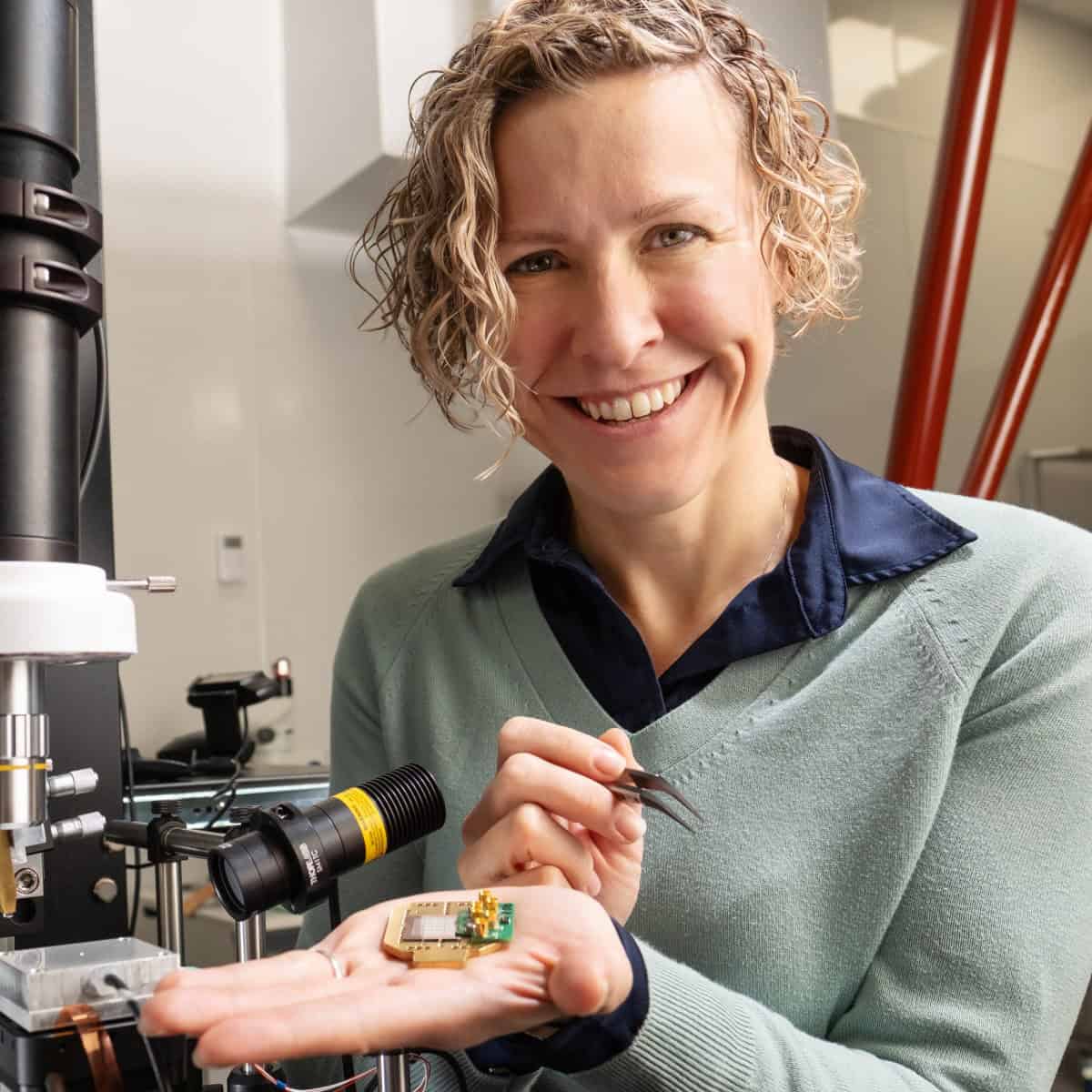
In this episode of the Physics World Weekly podcast, I am in conversation with Stephanie Simmons, who is founder and chief quantum officer at Photonic Inc. The Vancouver-based company is developing optically-linked silicon spin qubits – and it has recently announced that it has distributed quantum entanglement between two of its modules.
I spoke with Simmons earlier this month in London at Commercialising Quantum Global 2024, which was organized by Economist Impact. She explains how the company’s qubits – based on T-centre spins in silicon – are connected using telecoms-band photons. Simmons makes the case that the technology can be integrated and scaled to create fault-tolerant computers. We also chat about the company’s manufacturing programme and career opportunities for physicists at the firm.