Audio is streamed directly from the publisher (media.blubrry.com) as published in their RSS feed. Play Podcasts does not host this file. Rights-holders can request removal through the copyright & takedown page.
Show Notes
Christina is off this week. Jeff interviews Brett about why and how he builds the tools he builds.
Sponsor
SimpliSafe has everything you need to keep your home safe — from entry and motion sensors to indoor and outdoor cameras. Visit simplisafe.com/overtired and claim a free indoor security camera plus 20% off with Interactive Monitoring.
Show Links
- Brett’s new EP!
- Quick Question: Remember the illusive answer to a persistant question
- doing: Remember what I was doing or feeling and when
- bunch: Remember how I like my computer environment to be set up in countless contexts
- Howzit: Remember how I built or configured a thing
- Tag Filer: Remember where my documents go
- podtagger: Remember how to do podcast metadata
- Cheaters: Remember my keyboard shortcuts and commands
- Markdown service tools: Remember Markdown syntax and apply it
- na: Remember what my next steps are in this directory/project
- Peek
- TaskPaper
Join the Conversation
Thanks!
You’re downloading today’s show from CacheFly’s network
BackBeat Media Podcast Network
Check out more episodes at overtiredpod.com and subscribe on Apple Podcasts, Spotify, or your favorite podcast app. Find Brett as @ttscoff, Christina as @film_girl, Jeff as @jeffreyguntzel, and follow Overtired at @ovrtrd on Twitter.
Transcript
Why Brett Builds What He Builds
Jeffrey: [00:00:00] Hello everybody. And welcome to another episode of Overtired. It’s me, Jeff. I’m here with Brett we’re alone. Christina could not be here this week. She’s traveling. Uh, she’s in Chicago. I believe so. Brett, it’s just you and me. How do you feel about that?
Brett: I’m I’m, you know, I love you. I always, I miss Christina, miss Christina, I feel like the three of us have a, a really good thing going, but you know, the beauty of having three co-hosts is if one person needs a week off, the show can go on
Jeffrey: That’s true. The show must go on. You could say that probably. Um, and, and in, in this case, the show is going on, despite the fact that your face is completely, uh, uh, ripped up and bloodied. What, what happened to you?
Brett: So I, I was on my hands and knees working on my Sonology. Um, had, I had just, I had just unwrapped [00:01:00] a 16 terabyte, hard drive and. What I meant to do was sit up and what happened was I went forward and I don’t know exactly. All I know is like, instead of coming eye to eye with the Sonology on the networking shelf, I suddenly was seeing stars.
And I had plowed my face into the carpet. I have like a throw rug down around this. And, and I just face first into the throw rug, took a chunk outta my nose, scraped up my forehead, ripped up my elbow. It was, and then I sat up and I’m, I had no idea what had happened. Like, it was very confusing to me. And I looked down and there’s like blood all over my hand.
And I wa like in a days, wandered upstairs and I was like, oh my God, what happened? And like, well, I kind of just faceplanted into the carpet for no apparent reason. So she [00:02:00] wants me to go to the doctor now. Which I, I will do out of respect. Uh, if
Jeffrey: Uh, out of concern for the why or out of concern
Brett: the why?
Jeffrey: a rug destroyed
Brett: No, no. Out of the why, like why did you go down instead of up when, when, when you sent the signal to stand up, why did you instead ke forward?
Jeffrey: Is it one of those things where you were, you were seated and in order to get up, you had to kind of lean forward to get a little momentum to get up, and then you just didn’t do the other steps,
Brett: I, I just, I skip some steps.
Jeffrey: bad program,
Brett: Yeah. Yeah.
Jeffrey: I’m sorry. Well, I support as, as a, as a co-host and I know I speak for Christina as well. We support you, uh, at going into the doctor. We agree with L uh, maybe it was like a blood pressure thing. Right? Who
Brett: could be, yeah. Could be medication related. I have a lot of meds that affect my balance and woo. And.
Jeffrey: Wow. Um, I really wish [00:03:00] Sonology was a sponsor. So somehow we could wrap this up into a sponsor read, and then maybe go to like Z doc. Um, I mean, I really feel like we’re living into a possible sponsor situation here.
Brett: Bunch of bunch of corporate tie-ins for this one,
Jeffrey: We’re gonna have to get everybody on the fifth floor on that. Um, let’s see if they can, they can work on it up there in sales. Um, well I’m glad you’re okay. That’s crazy. Oh, I see your cat. So we’re gonna do a little more, Brett. It is the 19th birthday of the everlasting cat. Yeti, who has just, I wouldn’t say marched into the screen.
Brett: I said to knock on wood, cuz you went and jinx it.
Jeffrey: What happened? Everlasting?
Brett: said everlasting cat. I, I guarantee you. He is not everlasting. The day will.
Jeffrey: Oh man. Okay. So 19 years old though, Yeti is a part of.
Brett: yet. Yeah, yet he is, I, other than a couple like brief trips out of town, I have seen Yeti every day for 19 years. [00:04:00] And like, I’ve had him from the day of his birth. Uh, his mom had FIV and we had to take her kittens away and she got euthanized and we, we raised the kittens and, uh, yeah, it was, it was, uh, be born of tragedy, but we immediately like, and I honestly like when there was a litter of six kittens and I wanted the tuxedo one, um, because I had recently lost my cat trouble to a pit bull, a pit bull had.
Jeffrey: That’s not funny, but you did just say I lost my cat trouble to a pit bull. It sounds like the lyrics to a song. I don’t want to hear.
Brett: She, she had, she had unbeknownst to me, had a litter of kittens in the closet, um, because I was a young irresponsible person who didn’t spay their cat. And she, I lived in a, will say a less than sanitary living situation. And she [00:05:00] would escape through a broken window at night and she got pregnant and gave birth and I was oblivious to the whole thing.
Um, but then she ends up trying to defend her litter against a pit bull that was visiting our house. And she lost that fight. And that kind of fucked me up for a while. So when I’m faced with this litter of kittens and there’s one tuxedo kitten in the litter and I, that was the one that I was gonna take.
Um, and my. My, at that point, fiance’s mom convinced me to take the one that looked like Eddie Munster. Um, and, and over the course of the next couple years, Yeti, Eddie Munster, Yeti Munster, um, Yeti became my cat, just, we just bonded. And like he would fetch, I could throw a toy and he would run down the [00:06:00] hall and come back going and like, bring me the, bring me like the foil ball back.
And we would play fetch and, and he slept with me and we just, we became inseparable.
Jeffrey: well, and I I’ve, I’ve experienced not just in recording this podcast on video, but also in, in our many, many, many zoom meetings together, Yeti can just kind of walk up on your desk and just start staring at you and I’ll see the back of his head. And yet he’s just staring at you.
Brett: yeah.
Jeffrey: Now I have to ask this was Minneapolis with the, with the cat trouble and the pit.
So there’s a, there’s a pit bull in a house with a, with a broken window. I gotta say it. What that tells me is you were living with crusty punks.
Brett: I was well, okay, wait, no, actually, actually I take that back. I had moved out of the crusty punk house and I was living with a bunch of junkies who were also models.
Jeffrey: Wow. Models. Like what hand models? Body models.
Brett: body [00:07:00] models. We’re talking, we’re talking Abercrombie and Fitch type of models, not Abercrombie and Fitch. They were doing smaller time stuff, but like they would get makeup to cover up their track marks. And, and it was actually a very different living situation than the punk house. Um, but we were all severely addicted to heroin and, uh, that kind of ran that the house was kind of built around heroin a.
Jeffrey: Yeah. Yeah. So funny. I lived in houses like that in Minneapolis in the day, but I never was doing any drugs at all, but everyone around me was doing those drugs. I remember I lived in a house where I had a roommate who had an AK 47 with no safety that just laid, uh, against the wall next to his bed.
Brett: Yeah, we, we did not have
Jeffrey: at one point, and this, I bet you’ll relate to.
At one point in the living room of this house, we were in, this was a house that was in like a permanent state of foreclosure that a, a friend of mine [00:08:00] kind of got hold of. And, and we were paying like almost nothing, no utilities or anything. It was over by MCAT or by the, the art art Institute in the art school.
Brett: That’s where I was living on
Jeffrey: was it, we surely we ran into each other, but there was a point where there was about seven of us living in this place. I kind of like hid in my room all day, uh, working on my, my super radical politics zine called wake up, wake up. Um, but outside me, like I remember one day we spilled a five gallon bucket of paint that we had for reasons I don’t understand.
And we were also eating taco bell. And for the rest of the time I lived in that house, there was a spilled thing of paint with taco bell, wrappers stuck in it. And I, I still wonder to this day, I’m like, okay, so you weren’t, you weren’t a junkie you didn’t know drugs at all. Like how did you find yourself in these situations?
Jeff? Cause that one, woo. There are some stories and that was like a famous, not famous. It was a, it was a barely known, um, punk [00:09:00] rock house where like the first time green day came through town, they slept on the floor of
Brett: wasn’t not castle chaos, right?
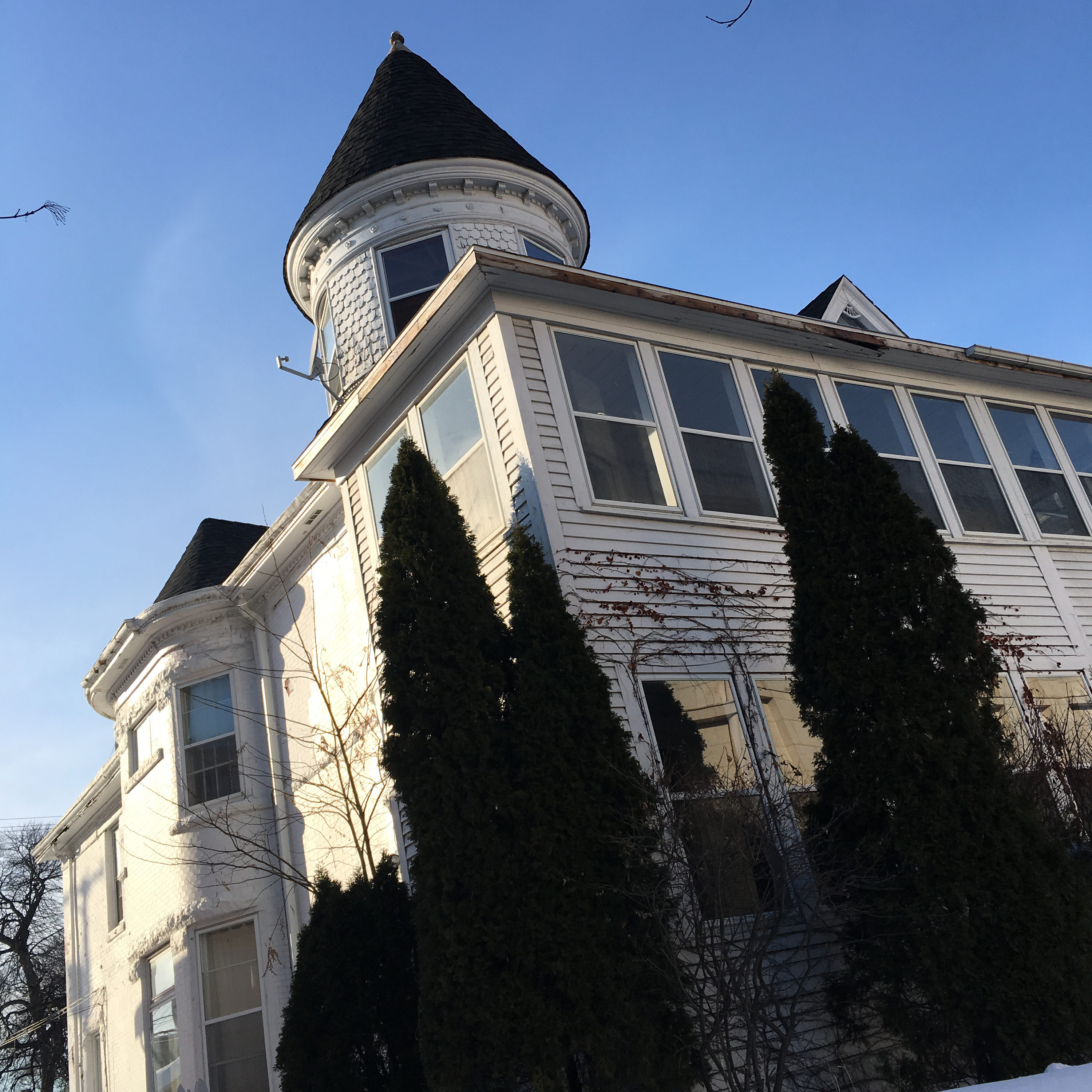
Jeffrey: Oh, my God. I think that’s what it was. It’s got the turret, the turret on top.
Yeah. That’s it. Castle chaos. I didn’t know it when it was castle
Brett: I’ve been to basement shows there
Jeffrey: Oh my God. See, we only had the second and third floor of castle chaos. And so wait a minute, wait a minute. Wait a minute. This is crazy. So I moved in at basically after castle chaos, as it was known ended. The next scenario was this scenario.
I was in with the guy with the AK 47 and we had a meth dealer who also did shitty tattoos. Um, his name was lips, which we called them. It was short for apocalypse, which was the smell of his feet. Um, and he would and he would give tattoos for, for
Brett: face tattoos.
Jeffrey: no face tattoos in his case, maybe he would give them, he didn’t have them.
Brett: I knew multiple people from castle chaos that had full face tattoos.
Jeffrey: Oh, my [00:10:00] God castle chaos. Okay. So just for my own sake, because this house enters my dreams really, honestly, a few times a year, it was a, it was a strange, magical portal of a place. Um, and it was called a castle because it had this like turret or this almost like Rapunzel
Brett: Uhhuh.
Jeffrey: Um, and, and, and it was so unique and it was so, so stunning of a house, but it was a total piece of shit.
Brett: Yes.
Jeffrey: I mean, for God’s sake, it was called castle chaos for how many years. So what, how did you enter castle chaos?
Brett: uh, punk rock. Like I was in a punk rock band and it was just kind of a, it was a mainstay of the punk rock scene, like parties and the occasional basement show. And, and you just, you knew like you see the face tattoos and you’d be like, Hey, castle, chaos. Yep. Castle chaos.
Jeffrey: Yeah. Cause they, cuz you could get your face tattoos there.
Brett: I, I don’t know where all the face tattoos came from, but these are the people that worked at like Sunnyside up, uh, the breakfast [00:11:00] joint with all the punk rockers
Jeffrey: Yep.
Brett: um, yeah.
Jeffrey: Wow. That’s amazing. That’s amazing. Well, I loved living there and what I thought about the reason I even brought it up is my, my roommate there had two cats, one cat was named yo and the other cat was named Corma and we call them Yagi and corny. And at one point, the ceiling in my room gave way and my room flooded.
And, um, and, and once we cleaned it all up, it was still a completely destroyed ceiling, but the water was cleaned up. Cause the part of living there for almost free was that no, one’s gonna come and help you when the ceiling explodes. Right. But then the cats disappeared for a while, but they would appear every once in a while when I was sleeping, they would just show up in the ceiling, above my head and look down at me, you know, just like, let me know they’re okay.
But I could totally imagine them having a litter of cats in the, in the ceiling of this place.
Brett: before I lived, before I lived on Clinton avenue, I lived on east Hennepin and we had a house where the landlord had. [00:12:00] Basically, let us move in. We were renting the whole house for about a thousand dollars a month. Um, and there were, I think, eight of us. And, um, I was the only person in the group who held on a job.
So to this day, everyone owes me thousands of dollars, but, uh, but he basically told us that when we moved out, he was gonna tear it down and he did not give a shit what we did to that house.
Jeffrey: Yeah. We had a similar situation.
Brett: paint, everywhere. We would like we would have parties where people would literally go through walls and we just, that place was demolished.
By the time we left
Jeffrey: Yeah. Yeah. Oh man. I don’t know how many, how many of our listeners start listening and going? Oh, I relate.
Brett: relatable.
Jeffrey: relatable. Um, yeah. Okay. Okay. That was fun. Um, I mean, I’m just delighted that we shared some history of that space together. Um, okay. Why don’t we, why don’t we [00:13:00] do a little mental health corner? I would love to hear how you are doing, and then, uh, I am going to, I’m gonna interview Brett for this episode. I already started in a way, except it ended up being such a shared history, shared history of complete fuckery episode title.
Mental Health Corner
Jeffrey: Anyway, how you doing?
Brett: I’m I’m stable. I’m in that, that kind of stable spot where I’m starting to get like bored, but grateful that I’m sleeping well. And, um, just kind of emotionally at rest, uh, kind of getting worked on. I’m still BA I’m on the depressed side of stable still. Um, but it was a pretty light depression this time around, um, I did last night have trouble sleeping and had to take some, uh, over the counter sleeping meds.
Uh, which worries me because last, my [00:14:00] last manic episode, which was a little more intense than it had been, uh, started with 10 days of kind of shitty sleep. Uh, and then all of a sudden it like clicked and I was manic and, and off to the races and learning swift and writing
Jeffrey: Yeah, right. I was and, and posting a blog post every 45 minutes.
Brett: Right. Um, and, and it started with, with getting completely worn down by just waking up at three or 4:00 AM every morning and not like staying in bed, not getting up and coding like I do when I’m manic. Uh, but just staying in bed and tossing and turning for hours. And then like finally getting up at six and, and drinking coffee and going about my day.
But, uh, this is how it began and I’m trying to figure out if there’s something I can do now, I have a therapy appointment today and my therapist is pretty [00:15:00] damn well versed in bipolar. So I’m gonna talk to him and see if there’s something I can do at this point. Well, before I manic to try to, uh, control it a little bit, try to keep it manageable.
Jeffrey: Yeah,
Brett: Yeah.
Jeffrey: it’s so awesome. You have somebody
Brett: thanks. Yeah, it took me, took me long enough to find a therapist, but yeah, I think he’s good.
Jeffrey: yeah. That’s how it goes. Takes people long enough,
Brett: I’m going, I’m going in for the in person. So far, we’ve only known videos. So today I get to, I get to meet him in person and, and I’ll let you know how that goes.
Jeffrey: man. I, my therapist only does, um, telehealth and I’m getting to a point where I wish I could do in person
Brett: Yeah. Well, I’m curious, I’m curious what the difference is. Like, like he’s hybrid, he’ll do whatever works best for his clients. Um, but I was very curious to like, just [00:16:00] see what the difference is like in person, in someone else’s environment. Um, I just, I’m curious how I will react to opening up in an unfamiliar space instead of in my very cozy office where I feel very at home.
Uh, maybe it’ll be better. Maybe it’ll be worse. Uh, we’re gonna find out.
Jeffrey: Yeah. I personally find it easier
Brett: Yeah.
Jeffrey: Yeah. Especially if the therapist has put some, some care into the, the room and the, and the appearance and the feeling of the place. And so that there are just plenty of signals that you are in, you are in a therapeutic space. Your only job is to be here at this time now,
Brett: Yeah. Well, it’s kind of
Jeffrey: see the other cues in your room.
Brett: I haven’t been to a yoga class in person for a couple years now. Um, and my therapist actually suggested I try going in person again. Now that that’s an option. [00:17:00] Um, cuz it wasn’t, I mean pandemic for a while there, everything was zoom based. Um, but then, uh, L my, my girlfriend, who’s also my favorite yoga instructor.
Um, she started doing classes at the studio again, but also zooming them. Um, and I just stuck with zoom cuz I gained weight, not because of the pandemic. I just, I gained weight. I was feeling not very confident about my body. Um, and it was easier for me just to be on zoom with the video off and just do the, do the class on my own.
But I, I do think there would be a benefit to, uh, like when I’m zooming yoga on my own. There’s a pretty good chance. I check my email in the middle of class
Jeffrey: Yeah.
Brett: in person in a zoo, in a like live studio, yoga class. I would never check my email and, and [00:18:00] it would be better for me. I would get more out of yoga if I didn’t stop to check my email.
How’s how’s your mental health, Jeff.
Jeffrey: Um, I’m, I’m doing all right. I, one thing I’ve been really not focusing on that I need to, uh, is, so I take, um, I take medication that helps me sleep. I also take medication that, um, helps me to not have horrible, uh, nightmares, which has been a problem of mine for some time. And, um, and this medication works beautifully for that every once in a while, one breaks through and I wake up and I’m just like, damn it.
How did you get through and why? Um, and the, how did you get through and why is something I’m working on right now, which is mostly, looks like me thinking about not acting yet, but thinking about, um, my transition to sleep, because I have a tendency to just sort of. Collapse into [00:19:00] sleep, basically from the day, there’s not much of a transition at all.
There’s like a pile of clothes by the side of the bed and, and, uh, and an iPad on top of that when I’m, when I’m done reading or whatever. Um, and, uh, and so I’m trying to work on, uh, sort of long longish set of sort of signals to my brain that it’s time to time to go to sleep, time to rest. Um, and one thing that I know I shouldn’t do is work on configuring shit on my laptop until I’m ready to go to bed and leave my laptop next to me, cuz that makes it, that always makes for a bad sleep night, cuz my brain wants to keep solving problems.
Um, and uh, and it just knows that the computer’s right there. So like an example is I know to not have my laptop near my bed and have it downstairs. Um, but anyway, I’m just kind of working on that because you know, my sleep’s been great ever since we sort of dialed in. What I needed medication wise, but there’s, you know, there are things that [00:20:00] medication can’t solve alone and, and that’s what I’m sort of putting my attention to.
So, which, I mean, and to say, like, I went so long, really almost from the beginning of the pandemic until about four or five months ago, six months ago, I was waking up multiple times at night, often waking up on the hour at night, not like exactly on the hour, like public radio style, but like inside of every hour, basically.
And man did that do a number on me. And so I am every day grateful when I wake up, when I realized I only woke up once and I slept really, really good. So anyway, sleep, sleep.
Brett: And you’re back on your ADHD meds now. How’s that gone?
Jeffrey: I am. I’m taking my Viva again. Um, that’s going well. I haven’t really, I I’m trying to figure out the sweet spot for taking it. Like sometimes I take it right after breakfast. Sometimes I take it just before lunch. [00:21:00] I have taken it in the early afternoon.
Brett: Oh, Jesus.
Jeffrey: which has isn’t bad for, well, it should be part of my sleep, uh, factoring.
Shouldn’t it. Um, but
Brett: it has like, it has like a 16 hour, half life.
Jeffrey: I know mostly I take it before 11:00 AM, but I haven’t found like a sweet spot for it,
Brett: For me for me, it’s seven. Am I take it religiously? Seven? Am I take my meds at 7:00 AM and 7:00 PM and, and yeah, 7:00 AM is the sweet spot for me, for sure. With five minutes, if I want, cuz I go to bed at like 9:00 PM.
Jeffrey: Yeah.
Brett: I’m an early, I’m an early to bed guy. Um, and, and, uh, taking it at 7:00 AM means I’m winding down by 9:00 PM.
Jeffrey: right. Yeah. That’s smart. Yeah. Yeah. I need to dial that in, but I mean, the good thing is it’s, it’s working out for me. I I’m on a very low dose, which is what I need. And, and, [00:22:00] um, for anybody who’s considering something like an ADHD drug, just, just be so mindful of, of does this dose feel right? Cause I’ve had so many friends who, who were given a higher dose and probably they should right away or were bumped up significantly after starting at a low dose.
Brett: So because I recommend Vivance to so many people newly diagnosed with ADHD. Tell me what a low dose is.
Jeffrey: 20 milligrams
Brett: 20. Okay.
Jeffrey: I’ve had, I’ve taken as much as 60.
Brett: yeah, I take 60. It, it goes up to 70, 60 is kind of where I found my sweet spot. Um, but yeah, like as far as ADHD, medication goes, five is in my experience, the most mellow, um, it, and to, to, to that end, it’s the least effective for me, but with my bipolar, it’s the one that plays the [00:23:00] nicest, um, that if it, if it weren’t for Vivance, I probably wouldn’t be able to be on any ADHD meds right now because everything else is so prone to triggering manic episodes for me.
Um, and Vivance just kind of fits the bill for that. Uh, some people like you react strongly to it and, and it’s all they need at 20 milligrams. Vivance works great. Uh, for me, 60 milligrams is still like, um, I’m still scattered and have trouble with motivation, uh, which I, I don’t on a drug like Focalin or Adderall.
Uh, motivation is fine for me. Uh, Vivance does not solve that issue. Um, but it also, it doesn’t cause me other problems. So it’s kind of a, a good drug for that.
Jeffrey: Right, right. Yeah, man. Yeah. Medications um, [00:24:00] alright, Brett Terpstra.
Brett: by the way, um,
Jeffrey: read.
Brett: I talked to, I talked to a friend of the show, Erin Dawson and she is totally down to make us some theme music. For, for like mental health corner and gratitude that we can,
Jeffrey: Awesome.
Brett: we can play in. We can we can, we can break up our segments with a little theme music. Uh, she just, she just wants some idea where to begin with it, uh, some, some direction and, uh, and we can make this happen.
Jeffrey: Awesome. That’s
Brett: coming, coming soon to a podcast near you. So, uh, yeah, here’s a question.
Jeffrey: Yeah.
Sponsor: SimpliSafe
Brett: Is there anything that matters more than the safety of you and your loved ones?
Jeffrey: Well, hold on. That’s the rest of the podcast right there. Oh, sorry. Sponsor Reid. Go ahead.
Brett: of course not. So isn’t it strange then that many home security companies don’t act that way. This is why we use and [00:25:00] trust simply safe home security. Their advanced security technology helps us sleep at night and they always put our family’s safety first. Here’s why I love it with 24 7 professional monitoring.
Simply save agents, call you the moment of threats, detected and dispatch police, or first responders in an emergency. Even if you’re not home or can’t be reached simply safes monitoring agents truly care about your wellbeing and are highly trained to help you keep calm and safe during stressful situations.
Staying on the line with you until help arrives. Simply saves customer first policies. Make sure that you are taken care of with affordable plan starting at less than a dollar a day and no long term contract or hidden fees, because feeling safe at home shouldn’t break the bank. Customize the perfect system for your home and just a few [email protected] slash Overtired.
That’s S I M P L I S a e.com/ Overtired. [00:26:00] Go today and claim a free indoor security camera. Plus 20% off with interactive monitoring. Go to simply safe.com/ Overtired. I have, I have over the course of having simply safe as a sponsor. I have really gotten better at saying the word monitoring.
Jeffrey: Oh,
Brett: that is a really hard word for me because my brain wants to go monitoring, monitoring,
Jeffrey: Monitoring word becomes the sound
Brett: I over enunciate it, but out of necessity
Jeffrey: well, I’m glad to see your growth in that area.
Brett: thanks, man.
Promo: Soul Forge
Brett: Let’s talk about another podcast.
Jeffrey: So forge podcast, what is that? It is the ultimate source for learning to live your best life episodes have covered heartbreak, dementia, suicide, and transgender issues. And there are episodes on sex, tattoos, collecting, road trips and puppies, [00:27:00] exclamation point. You never know what the next episode will bring. So come on and forge your soul with the soul forge podcast.
It’s everywhere you find podcasts.
Brett’s New Song Drops!
Brett: I put out music every once in a while. and it gets zero traction. Like I have dad jokes that get more response than the music I put out, which really leads me to
Jeffrey: you just put music out?
Brett: I did just put, uh, a cover of the kinks. Um, not like everybody else. Um, and yeah, and, and I really enjoyed doing a, uh, fun cover of it.
But man, like my SoundCloud, I get like nine listens. I’ll like, I’ll like tweet about it. I’ll Facebook about it, you know, and I’ve got a fair number of followers and nine people will go check it out and, and they,
Jeffrey: 10. I
Brett: and they, and they won’t say anything like I’ll get zero comments about it. And I’ll just [00:28:00] assume
Jeffrey: feels good.
Brett: I’ll assume it was so bad that people listened to it and just like embarrassed for me.
You ever been at a party where like the host, like corners you in his bedroom and makes you listen to his demo tape?
Jeffrey: Uh, be less specific.
Brett: it’s happened to me more than once. That’s why I consider this a generality.
Jeffrey: Uh, got it.
Brett: like when I was touring with a band and we’d go to like, after show parties, so frequently would like a, a host of, of whatever house we were at. Be like, Hey, come here, come here, come here. You gotta hear this. You gotta hear my one man.
Four track demo tape. And then for like 30 minutes would like pumble you with sounds you just could not get excited about.
Jeffrey: I, um, I did two things to prevent [00:29:00] that kind of thing from happening to me on tour. one is I played drums in a way that I I’ve come to learn scared people and the other is. I slept in the van, no matter what the fuck we were doing, I was like, I am not going in there. I am not going through that portal in fucking Missoula, Montana.
like, I have no idea what’s gonna happen in there. I want nothing to do with it. I sleep in the van.
Brett: so what you’re saying is I played bass too approachable.
Jeffrey: yeah, you play face too approachable. I’m always, oh, people say I’m nice guy, but get this that I’m scary.
Brett: I used, I often people would tell me when they first met me, they thought I was gonna punch them. And I have never once met someone and thought I was gonna punch
Jeffrey: Yeah,
Brett: Um, well, okay. It I’m sure it has happened, but for the most part, I’m super into meeting people. And, uh, [00:30:00] I guess I used to come off as very intense.
Um, and I it’s still to this day, I don’t know what that’s about, but I apparently it’s gotten better because people tell me I’m a God like these days.
Jeffrey: Ah, sucks, except for whoever punched you in the face. Oh, wait, that was your carpet.
Brett: yeah, we, we have a history now.
Why Brett Makes the Tools He Makes
Jeffrey: Um, okay. I wanna talk to you about something and we’re, we’ve, we’ve gone pretty deep into the episode, but I want to try it anyhow. Um, and see, so I’ve been, I, I have used so many of your tools, Brett. It’s how I came to be a guest on your podcast. Systematic way, way, way back in the day was I followed your blog and you put out a call, uh, for guests or guest suggestions.
And one of my colleagues submitted me. I jokingly call the collection of tools that I use your collection of tools that I use Terpstra OS. [00:31:00] Um, and I’ve been sort of revisiting some of them. Recently just cuz you have, you know, in the last couple years you’ve added a lot to, a lot of the things that I like to use.
Um, but I wanted to talk to you about something that just struck me so hard. So the thing that I love about your tools is that they allow me to forget. They give me confidence that I can remember. Um, and for me not remembering is an extreme source of anxiety and can be a source of panic. And knowing that I can forget, therefore brings me a sense of peace and ease. I listed this list here. I listed your apps that I used and your tools that I use. And then I made a remembering statement next to them. Cause I was so struck by this. So I’m just gonna go through this. It’s bear with me. All right.
Brett: [00:32:00] Yeah,
Jeffrey: First one quick question. Remember the elusive answer to a persistent question doing, remember what I was doing or feeling, and when bunch, remember how I like my computer environment to be set up in countless contexts? How’s it remember how I built or configured a thing. Tag filer, which doesn’t get talked about much.
Brett: it. Doesn’t.
Jeffrey: remember where my documents go. Pod Tager. Remember how to do podcast metadata, cheaters. Oh, cheaters. Remember my keyboard shortcuts and commands and, and various little bits about my apps. And then markdown service tools, remember markdown syntax and apply it, right.
It leaves out your writing stuff. NV, NV, ultra marked gather for gathering up markdown from a webpage, you know, mark down, editing for sublime text, which you don’t control anymore, but which [00:33:00] you wrote. And I still use, I think you still use it. Right. Um, but it’s so intense to me and it’s intense how easy it is to make a remember statement for all your tools.
When I read that list, what, what do you think?
Brett: So I, I would like to, okay. I, I have multiple things, but, uh, first of all, uh, uh, I like Terpstra OS. Jay Miller came up with the term TT tools,
Jeffrey: Ooh.
Brett: which I, I like cuz my name is B R E TT. And my handle is TT scoff and we just go with TT tools. Um, I, when I realized it came up on my calendar that it was Yeti’s birthday, but I could not remember how old he was.
And I remembered that I had had this question in years past and all I had to do in my terminal was type QQ. Yeti’s how old is Yeti QQ? How old is Yeti? [00:34:00] And my, my computer was able to immediately tell me what year he was born and, and extrapolate from there. Um, and that absolutely memory. I have a, I have a shit memory.
I have an ADHD person’s memory, uh, that has been affected by drug use and, and the meds I take. Um, I was on like, uh, stuff like, uh, what’s shoot, um, sleeping pills, uh, ambient type of pills for a long time, which just decimated my memory. And a lot of the tools I make are very much about being able to answer my own questions.
Um, when I Google for the answer to a problem, there’s a 50% chance I get my own blog back as a response. And that’s where [00:35:00] search link came from. Like
Jeffrey: Search link. Oh, right. Search link. Yeah.
Brett: search search link was a way for me to, to find answers on my own blog without constantly switching to a web browser and yeah. Memory, it, it you’re, you are a hundred percent correct.
So many of my tools are just about being able to remember and being able to feel confident because it is, uh, it is very it’s disconcerting and, and anxiety producing to, to, to know that you figure something out, but that you will forget it. Um, and in my case, I’ll forget it in a week. It’s not a matter of like a year later it’s it’s a week or less that I will forget that I found the answer to something and, and that produces anxiety.
And just having ways, uh, goes back to like, when I first read, uh, GT D by David Allen, this whole idea of mine, like water and being able to [00:36:00] have a trusted, a trusted bucket where you could dump the things you needed to do. And know that you wouldn’t forget them, that you would be able to find them and that you would be able to get them done.
And, and my brain extrapolated that to, I need a trusted bucket for literally everything. I learn everything. I figure out everything that I do. I need a way to have some faith that I will be able to rediscover this in the future. Um, and yeah, things like QQ and, and doing definitely are like, that’s a core principle of them.
Jeffrey: Wait. I remember you had a, I don’t know if it was a bookmarklet or it was a tool that, um, helped to, uh, that helped to sort of document your stack overflow queries. What was that? Describe that.
Brett: so, and, and that’s what gather has become now. Um, uh, I had [00:37:00] bullseye. Which when I, when I found an answer it, and it worked with Marky, the mark down to fire, which was the web API version of gather. Um, and it would basically, you would, you would click on a stack overflow solution page. You would just click inside the answer you wanted to save, and it would create a markdown version for you that you could pop right into envy or into envy ultra, um, and marking the markdown.
A fire has fallen by the wayside, uh, but gather the tool I most recently updated, uh, in a manic episode, um, can, it has special handling built in for stack overflow pages. So if you, and, and it has options, you can choose to only save the accepted answer. you can choose to include or exclude comments because a lot of times the answer you want, the [00:38:00] actual answer will be in the comments to the answer.
Like someone will say, this didn’t work. Why and someone else will say do it this way. Um, so there are times that I do or, or don’t want to include the comments. Um, and all of that is now built into gather as options and basically can save any time. I find what I’m looking for in stack overflow, which is the most common place I find programming answers.
Um, I can save it as a markdown file, easily searchable, instantly indexed in NVI ultra.
Jeffrey: I remember once you, when we first started working together, I mean, just for people’s background, you started working with me really as a consultant on workflows and, um, things related to my investigative work and, and that kind of grew into some real meaningful tool building. We first started working together.
I was . I remember [00:39:00] I, I wrote you and I said, oh my God, I just dove into bunch, but here’s the thing off the record. Are you gonna be developing this thing for a while? Because I’m about to go deep, right? Cause it had been kinda left alone for a while and you’re like, no, no, it’s it’s there, it’s there. And so I said, will you send me just a couple of your own bunch files so I can get a feel for it?
And what I learned and have learned from you since is that often your tools, which have a million wonderful tentacles, you’re only really employing. A handful of them.
Brett: Yeah.
Jeffrey: Is that the case with most of your tools?
Brett: It, when I first started programming, I was only coding for myself. I was solving problems like it started like my first programming was basic. And then, uh, like I moved on to Pascal and did a bunch of like game programming in high school. Uh, but most of where I really got into creative programming was with like VB script in an old app called [00:40:00] home sea, uh, which was a home automation app on PC.
And, uh,
Jeffrey: like around what year-ish
Brett: this would’ve been like 97, 98, no,
Jeffrey: was being automated.
Brett: no, 2000, 2000, 2001. Um, X, 10 X, 10 home appliance automation. Um, but. I, I didn’t, I had never released, I had never shared any of these automations. They were just for me and I wasn’t active on like the message boards or anything. And it wasn’t until I got a Mac, uh, that I actually made something worth sharing or that I considered like maybe other people would want this.
And the thing I learned very quickly is that everyone has their own needs. And as someone who eventually became part of, kind of the software ecosystem for [00:41:00] max, uh, which didn’t start for me until 2000, um, uh, I, I, I learned that there’s kind of a standard number of features that make things generally usable.
And I be, I over time got really good at predicting what people, what feature requests were gonna come in. So, so it can do this, but here’s what I need to do. Um, and, and I learned how to build something that had more general appeal, uh, than just solving my problem and to make something that could solve other people’s problems.
And that’s kind of the core of everything I do is I made this to solve a problem I had, but I understood that my problems might not be universal. So I made it more general, uh, so that it could solve other pre other people’s problems as [00:42:00] well.
Jeffrey: And well, and in doing so you, one of the other sort of tenants of everything you build is it gives the user such a sense of control, um, that would otherwise, like you have to have a little bit of literacy to get. To get deep into any of your tools, but only a little bit and, and having a little bit, and then having your tools like it’s a to use a military analogy, it’s a force multiplier.
It’s like, I can’t believe, I mean, uh, bunch is such a great example, right? I can write a text file and bunch that had, I tried to do this without bunch. Would’ve been a really complex script that would’ve had to spend a year studying a language to do.
Brett: Well, and the beauty of bunch is nobody does the same thing with it. No two people are using it to do the exact same thing. And you can share bunches with people as kind of an example. Here’s what you can do, but it is 100% you [00:43:00] customize it to your specific needs and it is built to, to handle the most esoteric of, of requirements.
Uh, the first, the first app, the first editor I used on Mac OS was text made. it blew me away. Having spent a lifetime using windows and, and kind of limited apps that you had to have a, a higher level of proficiency in order to customize, uh, than I had at the time. Um, I started using text mate and I learned Ruby just to write text mad extensions, uh, but it provided, it provided this framework that I could make it do anything, any, any text editing tool I wanted, I could just make, and it was worth learning a new programming language just to be able to extend this app and the [00:44:00] extensibility of, of text mate.
It leads to problems for developers because not only are you supporting your own software, now you’re supporting everything your users wanna do with your software. um, and it’s, you’re opening up a whole can of worms, but like it’s the reason I built custom processors into marked. Uh, so people could make it work with pan doc or ask EOC or whatever processor they wanted to preview their, their text files with was all kind of this text BA mentality of extensibility that the user should be able to extend what you’ve done.
Jeffrey: Well, then it’s interesting that you bring up the, you had said, you know, in, in, in developing something like text mate, the developers had to support their app and all the things people wanted to do with it. You kind of walk this line where you make your tools. It almost seems like as extensible as possible, but you do stop [00:45:00] short of making it so that everyone’s making their own plugins.
For instance, is that intentional?
Brett: Um, so part of that is a lack of skill on my, on my part, um, doing is the first app I’ve ever written that allows, uh, truly has a plugin architecture. Um, and, and I don’t think I, to this day, I don’t think anyone’s attempted to use it yet, but these
Jeffrey: I was even aware of the
Brett: yeah, these days when I add a new feature to doing I U I do it through a plugin architecture, uh, where each feature exists as, as a plugin that you can add and remove and doing even has built in commands for adding and removing its own sub
Jeffrey: Yes. Okay. Yes. Yeah, yeah, yeah. Yeah.
Brett: