
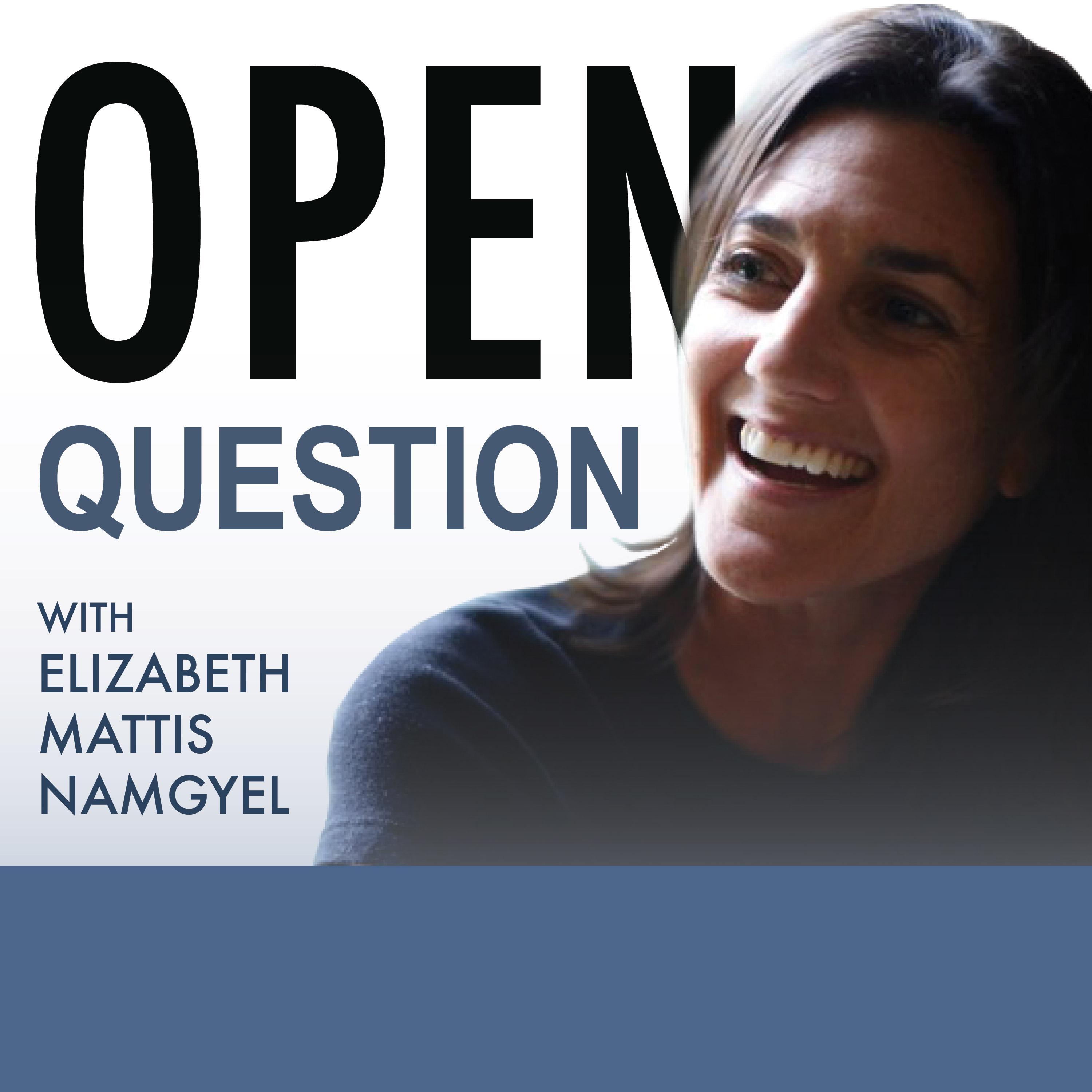
Open Question
40 episodes
OQ 703 - TWO TRUTHS: NOT TWO, NOT TRUE
OQ 702 - What Am I Looking At?
S7 Ep 701OQ 701 - The Great Escape
In episode 701, Elizabeth takes us through a classical teaching on the 12 links of dependent origination, which explores the genesis of our confusion, the dazzling spectacle of samsara, and how we can free ourselves from it. "When we feel confused about why we are practicing" she suggests, "just look at the wheel of becoming and it will remind you that there is nothing mystical about liberation. It is very matter-of-fact and within our reach."
S6 Ep 603OQ 603 - DISRUPTION!
Elizabeth explores absolute bodhicitta through the story of the 11th century spiritual quest of Naropa. His training, under Mahasiddha Tilopa, illustrates the necessity of disrupting delusion in the context of spiritual awakening. At the heart of it all lies a deep examination of the meaning and experience of what is real.
S6 Ep 602OQ 602 - Sujata's Offering
In the context of a recent pilgrimage in India, Elizabeth opens up the topic of "engaged" bodhicitta and the six paramitas. She weaves in the story of Sujata, the young woman known for generously offering a bowl of sweet milk-rice to Siddhartha who was debilitated after years of austerities. Revived and refocused, Siddhartha then made his way to the shade of a pipal tree and attained enlightenment, becoming The Buddha. Join the pilgrimage and explore India's conspiracy of great giving.
S6 Ep 601OQ 601 - Across The Valley
In episode 601, Across the Valley, Elizabeth uses the analogy of two communities situated on opposite sides of the valley where she lives to consider our tendencies towards fundamentalism and rightness. "What happens" she asks, "when everyone feels absolutely right?" The Bodhisattva Vow is a commitment to create connection with others, without bias, by looking inward at the mechanisms of reification, and then applying the Buddha's Middle Way Beyond The Extremes.
S5 Ep 505OQ 505 - Looking Into the World
In this episode Elizabeth reflects upon the provocative poem by renowned Buddhist teacher, Chogyam Trungpa Rinpoche, entitled, "Looking Into the World." "It's not a cozy poem," she says, "It's an incantation to NOT trust, a reflection on loneliness, and a tribute to the freedom and confidence that comes from standing on our own two feet." You have to put your familiar views aside to explore this one!
S5 Ep 504OQ 504 - Hook And Ring
Devotion is one of the many expressions of faith. When understood clearly, devotion can hasten the process of awakening for the student on the spiritual path, ripening and maturing them in a simple and direct way. Elizabeth brings us through various definitions of devotion, explores devotion as an experience, and considers the cultural and interpersonal challenges that can arise through misunderstanding the nature of the teacher/student dynamic.
S5 Ep 503OQ 503 - The Ineffable
All great spiritual lineages point us back to that which defies concept and language. Authentic practitioners describe awakening as being touched by a sense of awe, overcome by the beauty, fierceness and power of being. To be in AWE is a natural human experience. Ironically, so is the discomfort that leaves us restless with the experience, making it almost impossible to bear. Our inability to bear the ineffable gives rise to dualism and our conflict with faith.
S5 Ep 502OQ 502 - Hail The Impossible!
At 7:15 am on August 7th, 1974, 1,300 feet above a gathering crowd, French high wire artist, Philip Petit, renowned for his unauthorized public stunts, stepped onto a 131-foot wire rigged between the twin towers of New York City's World Trade Center. In this episode, Elizabeth recalls Petit 's "impossible" display of human courage and confidenceas an analogy for faith, why we need to cultivate it, what it is, and how it works.
S5 Ep 501OQ 501 - The F Word
In this episode, Elizabeth takes us on a journey through the term 'faith.' We may assume we know what faith is, but most of us have never truly explored its nuance or spectrum of meanings. We often use the term faith to refer to: dogma, fundamentalism, doctrine, confidence, devotion conviction, just to name a few. In the context of contemporary culture, there are those who suggest that we replace the world faith with spirituality, but Elizabeth requests us not to write-off faith so glibly. Faith carries with it the undeniable tension between our search for security and the limits of our ability to know. Faith keeps us connected to the heart of the human condition.
S4 Ep 405OQ 405 - The Self: Bearing Witness
Elizabeth shares the classic Buddhist narrative of Avaloketeshvara, the bodhisattva of compassion, and asks us to contemplate the story carefully, adding, "because something similar could happen to you." Continuing her exploration of the self, Elizabeth navigates the common responses to our challenging human experience: fixing, despairing or withdrawing…all of which are rooted in misunderstanding. Elizabeth takes inspiration, instead, from Avaloketeshvara's example to bear steadfast witness to experience.
S4 Ep 404OQ 404 - The Self: When Does Bread Become Toast?
In previous episodes we engaged in the liberating practice of looking and not finding, as we searched for something singular or independent. In this episode, Elizabeth explores the topic of permanence - the 3rd in this triad of classical Middle Way inquiries. Elizabeth drops back into her grandmother's kitchen for a tour of the nature of time, what it might mean to 'live in the moment,' and the difference between impermanence and emptiness.
S4 Ep 403OQ 403 - The Self: Into The Watery Depths
Continuing with the theme - The Self: Walking the Middle Way Path, we meet the 2nd Century spiritual genius, Nagarjuna, who is considered the father of the Middle Way school. Nagarjuna once paid homage to the Buddha, saying, "I prostrate to he who has abandoned all views." Looking into the topic of views, Elizabeth will take us on a fascinating quest.

S4 Ep 402OQ 402 - The Self: Mind and Its World
The most intimate relationship you will ever have is the relationship you have with your SELF! Ironically, when looking for a singular, permanent or autonomous self, all we find is a myriad of dynamic, contingent relationships. In this episode, Elizabeth introduces us to the Buddha's most essential insight - dependent arising - and guides us through a classic Middle Way investigation, leading us to a deeper understanding of mind and its world.

S4 Ep 401OQ 401 - The Self: Beyond Existence and Extinction
Many of us can recall our earliest encounters with the quandary of death. As children, we possess a natural longing to make sense of the world; to find explanations for things that disturb or amaze us. Throughout our lives, we are continually confronted by the conundrum of existence and extinction. How do we straddle the tension between our longing to exist and our fear of extinction? Are these dualistic constructs an accurate framework? And what does it mean to either be or not be?
S3 Ep 305OQ 305 - Sacred World: Life is Rich!
Our life - our world - can be rich…and it can also be a bitch. We walk the terrain of multiple - maybe infinite - grounds. We move in and out of these overlapping spaces.They are not geographical territories, but rather various ways we encounter our human condition as our mind and its world engage in the playful exchange we call, 'experience.'
S3 Ep 304OQ 304 - Sacred World: Where is "THE" World?
What do you see when you think about the world? You might picture a rainforest or desert. You might envision a crowded subway terminal. You might imagine a household or a war zone. You might think: "the world is a mess," or feel touched by the beauty and the beings that inhabit it. Where exactly is "the" world? Is it conscious or material? Does it exist within our individual mind streams or outside of us? Is it cruel, mundane or sacred? Is it one or many? Is "the" world even findable?
S3 Ep 303OQ 303 - Sacred World: The Shimmering Apparition
In Open Question 303, Elizabeth explores the power of words and what it means to go beyond them in the tradition of Prajnaparamita.
S3 Ep 302OQ 302 - Sacred World: Awakening Natural Intelligence
The Buddha Nature teachings of Mahayana Buddhism reason that all beings possess natural intelligence. We can observe in ourselves and others that the instinct for wellbeing drives everything we do. We bend toward wellbeing like a plant bends toward the light of a sunny window. How is it then, that we create so much suffering? To bring our actions together with our true intentions requires discernment, or prajna. Prajna is our inherent resource—but unrecognized, it remains dormant. How do we wake it up?
S3 Ep 301OQ 301 - Sacred World: Through the Eyes of Prajnaparamita
Most spiritual traditions offer teachings on "sacred world"-the promise of a life beyond struggle-the search for a place of ease. This is a noble human quest. And yet, the "sacred" often seems to be a place other than where we find ourselves now. How do we reconcile the tension between the spiritual and temporal aspects of life? This is our conundrum
S2 Ep 209OQ 209 - The Beloved Community
Marc Andrus is the Bishop of the Episcopal Diocese of California. His leadership is focused on key issues related to peace and justice, civil rights, and the environment. Bishop Andrus has just released a new book: Brothers in the Beloved Community: The Friendship of Thich Nhat Hanh and Martin Luther King Jr. In this interview, Elizabeth and Bishop Marc discuss the powerful connection between spirituality and activism, the nature of interdependence, and bodhisattvas in our world.
S2 Ep 208OQ 208 - Opening the Heart Sutra
In this episode Elizabeth shares her love of the most quintessential text of Mahayana Buddhism: The Heart Sutra. She weaves heartfelt commentary through a musical composition of the text, performed by Chime Mattis. This insightful and devotional presentation can be used as both practice and contemplation.
S2 Ep 207OQ 207 - Our Human Being
Elizabeth shares that, as machine intelligence and global culture become more a part of our world, she feels a need to examine and clarify what it means to be human. She brings the inquiry into a Buddhist context by questioning the Buddha's assertion that the human realm provides the great potential for awakening. "We often don't appreciate the power of our plight and our gifts. There is something both tragic and touching about it all." Is spirituality a way to transcend our human being?
S2 Ep 206OQ 206 - Don't Be So Predictable
In this episode, Elizabeth and her son, Dungse Jampal Norbu, discuss his project the "Everybodhi Podcast". In his podcast, and this interview, Dungse Jampal offers a fresh and contemporary look at one of Mahayana Buddhism's seminal texts - "The Seven Points on Mind Training", or as it's more commonly known, Lojong. Elizabeth and Dungse la discuss several of Lojong's 59 pithy and playful slogans which were intended to challenge, open and counter our ordinary, habitual mind. It is easy to misinterpret these short slogans and misunderstand their sometimes provocative tone. Dungse Jampal shares his deeply reasoned appreciation of the many precious commentaries available to dharma students today.
S2 Ep 205OQ 205 - Science Magic Grace
In this episode, Elizabeth speaks with her dharma friend, Jakob Leschly, a long time practitioner, teacher and translator for Siddhartha's Intent. They cover many topics in this conversation, including the differences between modern science and Buddhist science, the practice of critical inquiry and the challenges of looking at our own mind. At the heart of the discussion they share their experiences of the late master, Dilgo Khyentse Rinpoche, and his impact on their lives.
S2 Ep 204OQ 204 - These Dark Times
Elizabeth explores the process of finding courage in the face of adversity. "It is only through looking life squarely in the face," she says, "that we find liberation." She reminds us that this world we try so desperately to secure, doesn't ultimately lend itself to trustworthiness, and that, our relentless attempt to secure this world, defines samsara. Elizabeth suggests that there is another way of being in life that is empowered and courageous. However that approach, ironically, relies on our acceptance of the frailty and poignancy of being human.
S2 Ep 203OQ 203 - Dwelling Place of the Ancestors
In this episode, Elizabeth speaks with Buddhist teacher and author, Judy Lief, about the future of Buddhism in the context of lineage in contemporary culture. Judy candidly shares her thoughts on creating welcoming dharma environments; the tension between innovation and tradition and the pre-conceptions of studentship, referring often to her own experiences with the Tibetan master, Chögyam Trungpa Rinpoche.
S2 Ep 202OQ 202 - Seagull on a Buoy
In this episode, Elizabeth explores the idea and experience of lineage. Lineage is an important part of human existence and culture. What we know and how we see life, has something to do with a continuum of worldview and experience that has been passed down to us. In the context of Buddhism, lineage keeps us in the boundary of our intention to connect with our innate wisdom. "Interfacing with a lineage as a living experience," as she puts it "keeps us on the edge of continuous discovery."
S2 Ep 201OQ 201 - Unconditional Well Being
Elizabeth speaks with her own teacher, Dzigar Kongtrul Rinpoche, about the practice of patience. This practice, Rinpoche says, can protect our hearts and minds in a complex world, opening up new vistas of peace and richness for ourselves and others. It is, as the Buddha said, "a great armor." Together Elizabeth and Rinpoche explore what it means to practice patience as a skillful means on the spiritual path.
S1 Ep 110OQ 110 - Dharma in Hell
In this final episode of Open Question season one, Elizabeth speaks with Fleet Maull, prison activist, Buddhist practitioner, and author of "Dharma in Hell" and "Radical Responsibility." He has a fascinating story to tell us about his 14 years of Buddhist practice in prison, starting the first prison hospice program, and the practice of bearing witness. One of the messages Elizabeth took away from this conversation with Fleet, was the need to take ownership of one's life circumstances. Fleet uses the term "radical responsibility" to describe how agency comes from accepting our own karma. Fleet's example shows us that it is possible to find agency even in an environment like prison, which, by all conventional definitions, is the antithesis of freedom.
S1 Ep 109OQ 109 - A Student's Sacred Outlook
The Buddha said: "You are the agent of your own awakening, there is no other agent than you." This is an empowering statement, but it also implies that we need to take up the task of our own spiritual evolution. In this conversation, Elizabeth and Willa Miller, an authorized dharma teacher and spiritual director of Natural Dharma Fellowship, explore the importance of humility, what it means to trust one's own discernment, the important distinction between giving up the ego and abdicating agency, and the purpose of devotion in the Varjayana Buddhist tradition.
S1 Ep 108OQ 108 - Taming the Wild Horse: the Ritual of Well-Being
Elizabeth explores the value and potency of ritual in our personal lives, culture, and spiritual practice. She also shares a meaningful conversation she had with Chief Arvol Looking Horse, the head of the Lakota, Dakota, and Nakota Nations, about the role of ritual and ceremony in indigenous culture.
S1 Ep 107OQ 107 - Every Breath a Prayer
Lyla June Johnston is an indigenous environmental scientist, doctoral student, educator, community organizer and musician of Din-ay (or Navajo), Cheyenne, and European lineages. She is from Taos, NM. Elizabeth first encountered Lyla at The Festival of Faiths annual gathering in Louisville, KY. She was struck by Lyla's fierce presence, which she interpreted as a strong connection to the wisdom of her spiritual lineage. In this interview Elizabeth and Lyla discuss the nature of creativity, prayer, self love, and the notion that "all we have to do is change everything."
S1 Ep 106OQ 106 - Expanding the Self to Include Others: A Meditative Inquiry
In this episode, Elizabeth guides us through a process of inquiry and meditation grounded in the path of the bodhisattva. These teachings provide us with a clear and practical directive for cultivating a healthy relationship with others. We often look at the "ego" as a hindrance to spiritual liberation, but here, the instructions not only suggest that we don't have to get rid of the ego, but rather make it as big as possible, in order to include others, and make them the recipients of the love and care, we usually only reserve for ourselves.
S1 Ep 105OQ 105 - A Deep Dive
Elizabeth speaks with Lama Willa Miller, a teacher in the Kagud lineage of Tibetan Buddhism. Lama Willa is the spiritual director of Natural Dharma Fellowship, located in Boston. Starting from their initial meeting 35 years ago, Elizabeth and Lama Willa discuss entering a lineage, the value of mediation, and the significance of heartbreak. https://www.elizabethmattisnamgyel.com/lama-willa-miller
S1 Ep 104OQ 104 - Natural Vitality: a Meditative Inquiry
The natural expression of mind will never cease. To stop experience is not the point of meditation. The crucial question is: How do we poise the mind in meditation? Is there a way to clearly observe the rich energy of mind regardless of it expression? Is it possible to allow ourselves to have a full experience? …and perhaps even enjoy it?
S1 Ep 103OQ 103 - The Haunted Dominion of Mind
Anam Thubten Rinpoche joins Elizabeth to discuss how, as spiritual practitioners, our traditions provide us with tools to work with challenge. In particular, their dialogue brings us to our "inner cemetery" - the shadowy territory of experience we often leave uncharted. https://www.elizabethmattisnamgyel.com/anam-thubten
S1 Ep 102OQ 102 - A Moment of High Magic
Elizabeth speaks with her dear friend and teacher, Lorain Fox Davis, both a Cree and Blackfeet elder. They discuss the tremendous possibility in home sheltering, the difference between being alone and feeling isolated, the unstoppable movement of life, and the nature of prayer.
S1 Ep 101OQ 101 - A Call to Inner Brilliance
In this episode, Elizabeth explores the term "Open Question" and how the practice of "Open Questioning" has been such a powerful approach along her own spiritual path. https://www.elizabethmattisnamgyel.com/OQpodcast-introduction