Open Data Institute Podcasts
316 episodes — Page 4 of 7

Standards - Community Voices - Jean-Noé Landry
We interview Jean-Noé Landry, Executive Director at Open North about his experiences of working with open standards for data

Standards - Community Voices - Juan Pane
We interview Juan Pane, Technical Co-ordinator at the Latin America Open Data Initiative about his experience of working with open standards for data.

Standards - Community Voices - Serah Rono
We interview Serah Rono, Developer Advocate at Open Knowledge about her experiences of working with open standards for data

Standards - Community Voices - Matthew Wood-Hill
We interview Matthew Wood-Hill of the Future Cities Catapult about his experiences of working with open standards for data

Standards - Community Voices - Tim Davies
We interview Tim Davies of Open Data Services about his experiences of working with open standards for data

Standards - Community Voices - Mike Thacker
We interview Mike Thacker, Owner of Porism Ltd, about his experiences of working with open standards for data

Standards - Community Voices - Tim McGarr
We interview Tim McGarr, Market Development Manager for Digital at the BSI about his experiences of working with open standards for data

Standards - Community Voices - Rachel Rank
We interview Rachel Rank, CEO of 360 Giving about her experiences of working with open standards for data
ODI Friday Lunchtime Lecture: Why can’t I find data?
ODI Friday Lunchtime Lecture: Why can’t I find data? by The Open Data Institute
Friday lunchtime lecture: Where the suits meet the sneakers
You can find Roland's slides here https://www.slideshare.net/rolandharwood/mind-the-gap-where-the-suits-meet-the-sneakers-90083493 In this interactive lunchtime talk, Roland Harwood will describe the challenges and opportunities of corporate and start-up collaboration. By providing a range of practical case studies from the likes of LEGO, UBS, and Ford, he will share lessons learned and practical tools for combining and aligning cultures, data and processes to create valuable new partnerships and networks. About the speaker Roland Harwood is Co-founder and Managing Director at 100%Open, the global open innovation agency that works with the likes of LEGO, Ford, Unilever, UBS, Oxfam and Governments around the world to co-innovate with their partners. It was a spin-out from NESTA in 2010, the UK Innovation Agency and Investment Fund, where he was Director of Open Innovation. Graduating with a PhD in Physics from Edinburgh University, he has held senior innovation roles in the public and private sector. In addition has worked with hundreds of start-ups to raise venture capital and commercialise technology. He is both a failed astronaut and a keen piano player and has produced TV and film music for SonyBMG. Last but not least, he is a proud and often exhausted dad of three kids under 10.

Friday lunchtime lecture: Securing data flows post-Brexit
With the UK leaving the EU one of the key issues facing the tech sector is how to ensure data can continue to flow between the UK and EU post-Brexit. The free flow of data is crucial to the tech sector, and many other industries. There are a number of options available but only one that represents a suitable solution for the entire economy. The UK and EU must seek mutual adequacy decisions, and during the talk Jeremy Lilley, techUK’s Policy Manager, will explain why, what that is and how to go about it. About the speaker Jeremy is a Policy Manager at techUK, responsible for techUK’s work on Data Protection policy, including the incoming General Data Protection Regulation, ePrivacy and International Data Transfers. He also leads techUK’s Intellectual Property and Copyright work, including the Intellectual Property Policy Group, as well as being involved in techUK’s policy work on Brexit and online platforms, amongst other tech policy areas.
Friday lunchtime lecture: Capitalising on open banking
Open Banking will introduce a new level of competition, one for the attention of banking customers. In a world where customers can get their banking data analysed anywhere, why would they choose their bank? Jamie from Bud will share insights and practical product information on how to deliver more value to customers and compete in this new world. This talk is useful for anyone responsibly for open banking strategies, innovation departments and banks, or anyone looking to take advantage of new data sets, in transactional data, and offering their customers financial services. Bud is the financial network, connecting over 70 fintech and financial services into one platform. Banks leverage Bud’s marketplace and aggregation tools to offer new experiences to their customers. About the speaker Jamie Campbell's main focus is on increasing awareness of Bud and its partners. As one of the first employees at the company he has helped build a strong customer base and has helped develop new banking relationships. He is also a faculty member of the Finance Innovation Lab’s fellowship programme. Before Bud, Jamie worked in Advertising as a strategist for clients such as Coca-cola, Heineken and SSE.
Friday lunchtime lecture: how open data revolutionised London transport
Research released by Deloitte in October this year showed that the release of open data by Transport for London (TfL) is generating annual economic benefits and savings of up to £130m a year For almost ten years, TfL has been releasing a significant amount of open data, from air quality information to wifi access points, allowing developers and partners to bring new products and services to market more quickly. TfL has worked with a wide range of professional and amateur developers, ranging from start-ups to global innovators, to deliver new products in the form that customers want. This has led to more than 600 apps now being powered specifically using TfL's open data feeds, used by 42 per cent of Londoners. Rikesh Shah, Head of Commercial Innovation at TfL, will talk about their open data journey, how open data has created an eco-system of innovators. Rikesh will also highlight the successful factors and outcomes around start-up engagement with corporates and some of the challenges around procurement. About the speaker Rikesh Shah is the Head of Commercial Innovation at Transport for London, the authority responsible for delivering the London Mayor’s transport strategy. He has been at TfL for over 16 years, previously in the areas of commercial development, communications and digital. He is responsible for creating value in the future mobility space from market innovators including start ups, academics, transport operators, regional agencies, R&D organisations and corporates. This involves on-going engagement with this community, utilising the right procurement processes, developing the right culture and providing the right level of access to data and policy makers. Previous to this role, Rikesh led TfL’s open data programme, digital commercial activity, stakeholder engagement and communications supporting TfL’s digital transformation strategy. By building digital and data partnerships with start- ups, as well as leading technology platforms including Twitter, Amazon and Google, Rikesh has been at the forefront of TfL’s Open Data provision to over 13,000 developers producing over 600 customer facing travel apps used by 42% of Londoners. This has placed customer digital at the core of TfL’s business.
Friday Lunchtime Lecture: Data as creative material
Using data as the seed in their creative process, Kultur Design produce art, design and visualisation that has the uniqueness and serendipity of the data embedded within it. In this talk, Mike Brondbjerg from Kultur Design will look at how data, in one form or another, connects many of Kultur Design’s projects, and how they've visualised data in very different, creative ways. This talk might interest data viz developers looking for some inspiration, or motion / graphic designers wanting to learn about using data and generative processes in creative projects. About the speaker Mike Brondbjerg is a partner at Kultur Design, a creative studio specialising in using data, both creatively and analytically, in information and generative design projects, data visualisation and data art. Kultur Design produce print, motion and web projects for clients like Kano Computers, Datameer, Heineken, Reasons To, Abbott Laboratories & King’s College. Mike has spoken about his creative data projects previously at various conferences & meetups, including: ReasonsTo Conference, Visualising Data London, Data + Visual, University of Greenwich, University of Lincoln and The Financial Times.
ODI Podcast: The African Open Data Leaders Network
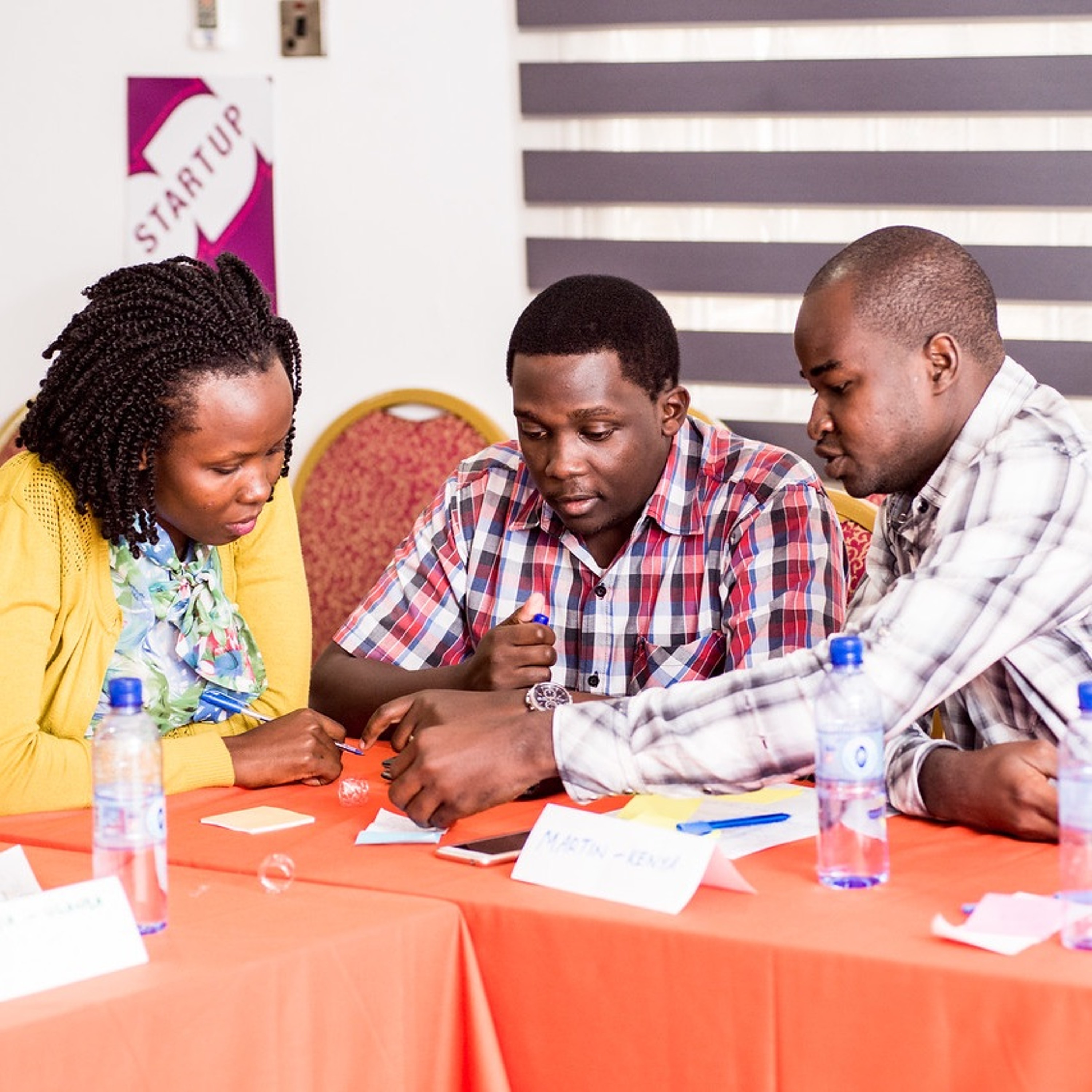
The Open Data Leaders Network connects and supports a peer network of data pioneers in governments from all around the world. In this podcast, we look at the African Open Data Leaders Network, a regional variation of the programme that took place this year in Accra, Ghana. We hear from Fiona Smith about the methodology behind the programme, and from various open data leaders on the continent about their experience, and the main obstacles they face in advocating for open data in the region.
Friday lunchtime lecture: Hidden in plain sight (by the ODI artist in residence)
This talk will outline the recent work of BAFTA-winning artist Dan Hett around encryption issues and technologies, including a detailed examination of his recent ODI commission: two large, vibrant paintings that each contain a securely encrypted (but boldly painted) transmission, created for the ODI's upcoming LMAO exhibition and marking the beginning of a new arc of work. The key to unlocking the encrypted messages is stored on an RFID chip, which was implanted directly into the artist's hand earlier this year, making the content stored within these works accessible only to him. The talk will look at the on-site production of the works at the ODI, and will discuss the issues and ethics around current government policy around encryption technology, which gained particular significance for the artist when he became directly involved in the Manchester terror attack in May 2017. Although the themes and issues discussed are rooted in technology, this talk will be completely suitable for everyone. Please note: Dan will discuss potentially distressing themes around the Manchester attack, and the talk will also contain a few images of an implant being put into skin. you can watch the lecture here https://www.youtube.com/watch?v=n8KgiJM_348 About the speaker Dan Hett is a BAFTA-winning artist and creative technologist from Manchester, currently working as a selected artist on FutureEverything's cutting-edge FAULT LINES program.
Friday lunchtime lecture: The local authority that went 'guerrilla'
Most UK local authorities have embraced the concept of open data, slowly but surely opening up new data sets. Andy Radford, Transport Planner at Birmingham City Council, had a very different experience. Let him take you back to 2014... "My colleague had masterminded a successful bid for a European Project, Opticities, and then abruptly left the organisation. My task was to open up real-time transport datasets in a matter of months, with very little budget and no background in open data. "What followed did not follow a traditional route – the only goal was to get the data from our internal systems onto the internet as quickly as possible. Once that was done, I entered a world completely unfamiliar to the average local authority transport planner – working in partnership with SME’s, Universities, the ODI etc. "The session will be particularly appropriate for local authority staff, but anyone working with open data or in the transport field should learn something useful. Not everything was a bed of roses - I learned some lessons the hard way, so that you won’t have to. "This talk will tell a heart-warming tale of what can be achieved in the local authority environment with people who are willing to learn and have a can-do attitude." About the speaker Andy Radford has worked as a transport planner at Birmingham City Council for 17 years. In his current role as Principal Infrastructure Delivery Officer, he has responsibility for a number of grant funded transport research and innovation projects, focussed in the field of intelligent mobility.
Friday lunchtime lecture: Switching on Christmas lights in an automated home
Over the past two years we have seen swaths of manufacture attempt to bribe us with technology to “make our lives better”. As a result we now have big technology manufacturers competing to be our virtual assistants with smart speakers. In this lecture lecture ODI Data Scientist David Tarrant looks at how these platforms are competing and producing a confusing set of services and why simple to use open standards are going to be the key to winning in the home automation market. “OK Google, tell Alexa to ask Siri to book me a place on this amazing sounding lecture!” About the speaker David joined the ODI from the University of Southampton where he was a Lecturer in the Web and Internet Science Group. He was responsible for creating the world's first undergraduate course in open data. Since joining the ODI David has put in place key educational content that has helped transform governments and unlock over $15m for startups. Additionally David has applied his data science skills to build policy making tools for open data leaders, including the Open Data Barometer visualisation. This tool has been used to guide policy development and allow leaders to compare and contrast their open data initiatives with other similar initiatives globally. As Learning Skills Lead, David is responsible for the direction and quality of the ODI's learning offering. Products include face to face training, eLearning and the ODI's Learning Records System (LRS). Underpinned by the skills framework, all of these products put together ensure that the ODI can offer high quality online and face to face training to as many people as possible.
Friday Lunchtime Lecture: Can't find the right code? Explain yourself!
Data standards almost always have two fundamental components: syntax and semantics. The syntax is established by a schema, which specifies how the data should be structured. Should it be saved as XML, JSON, CSV? Should dates be written YYYY-MM-DD? What order should the columns be in? These types of questions are essential and catered for in most well-established data standards. Semantics are more abstract. Questions arise, like: what does this data tell me about the world? What does this number mean? What is the purpose of that transaction? Answering these is more variable and often less formal than the syntax. The most common and trusted technique is to create a codelist – a dictionary of terms which establishes the semantics for a given data point. They can be simple sets of terms – detailing transaction types which can be published in a standard – all the way to rich hierarchical taxonomies. They all associate a code with a meaning, to allow people to communicate with them. This talk explores the changing role of codelists in a time when textual data analysis is advancing rapidly. The root question is this: is it still best to start giving meaning to your data by looking for a codelist and a code, or can we use description text itself, trusting modern data analysis to do the heavy lifting? First, we'll consider and contextualise the use of codelists within standards like Open Contracting, IATI, and 360Giving. Then we'll look at how meaning can be established in text where no standard exists – online reviews for restaurants, for example – by applying machine learning (live demo alert!). Finally, we'll apply the same approach to description text found in established open data standards and compare our results. Rory Scott is a member of the Open Data Services Cooperative, working with national governments, multilateral organisations, and civil society to better share, understand, and use open data about international development and humanitarian financing. He does this primarily by talking to people about their data, writing Python and R code, and wrangling spreadsheets.
Friday lunchtime lecture: Empty homes and house prices: is there a relationship?
House prices are a popular topic of conversation in the UK. Less popular is the rate the prices are increasing. The UK average house price has increased 30% since the 2008 crash, and London house prices have gone up 75%, according to the Land Registry House price index from September 2008 to September 2017. In London, price increases are often blamed on empty homes bought as investments by rich foreigners. Areas such as Cornwall and the Lake District blame price increases on holiday homes bought by rich Londoners. However, there is very little data supporting or against these beliefs. Jonathan Bourne spent a year sending Freedom of Information requests to gather a dataset from over 100 local authorities. He was interested in data on 'low use properties', which are domestic properties that contain no full-time resident. The data covers 22 million people and 330,000 low-use properties. The data shows a clear relationship between price and low-use properties. In this talk, Jonathan will discuss his findings, showing how London is affected in the same way as the rest of the country and that building more houses may not help solve the problem of high prices. He will also describe how he got the data and what he learned about the Freedom of Information Act. Jonathan Bourne is a data scientist who previously worked in the energy industry and is currently studying for a PhD in Complex Networks at University College London. When he has the time, he blogs on SomeSquaredError.
Friday Lunchtime Lecture: Where is Open Banking now
A study by the Consumer Market Authority showed that older and larger banks do not have to compete hard enough for customers’ business, and smaller and newer banks find it difficult to grow. This means that many people are paying more than they should for their banking activities and are not benefiting from new services. As a result, Open Banking was set up in September 2016 to enable personal customers and small businesses to share their data securely with other banks and with third parties, allowing them to compare products on the basis of their own requirements and to manage their accounts without having to use their bank. To deliver Open Banking, a new organisation was created - the Open Banking Implementation Entity – which is funded by the nine largest current account providers in the UK (Allied Irish Bank, Bank of Ireland, Barclays, Danske, HSBC, Lloyds Banking Group, Nationwide, RBS Group, Santander), as well as Challenger Banks, Fintechs, Third Parties, Consumer Groups and other parties to define and develop the required Application Programme Interfaces (APIs), security and data standards that underpin Open Banking. Imran Gulamhuseinwala OBE, Implementation Trustee of the Open Banking Implementation Entity will talk about the challenges and the progress made to date on Open Banking. About the speaker Imran Gulamhuseinwala OBE was appointed as Trustee for the Open Banking Implementation Entity on 13 April 2017. In his role as Trustee, he has oversight and responsibility for Open Banking’s development and delivery of the common technical standards underpinning the Competition and Market Authority’s (CMA) open banking initiative. He is seconded to Open Banking from Ernst & Young LLP (EY) where he is a London-based partner in its financial services practice. He is also EY’s Global Head of FinTech. He joined EY in 2014. At EY, he has worked closely with government, regulators and industry bodies to drive the FinTech agenda, leading studies for both UK Trade & Investment and HM Treasury to measure the size and growth of the FinTech sector in the UK and develop a strategy for future growth. Prior to joining Open Banking, he has been involved with the Entity’s work through its stakeholder working groups and has been active in financial technology as both an investor and a start-up Founder. He has worked in financial services for 18 years and spent eight years investing in the fintech sector. He is the co-founder of CommuterClub, a FinTech 50 start-up which helps commuters to access savings for annual travel season tickets. He was awarded an OBE in the New Year’s Honours list for his contribution to the financial services Sector. He has a Masters in Engineering from Cambridge University and is a CFA charter holder.
Friday Lunchtime Lecture: Leveraging data insights through storytelling
Corporations are often overwhelmed with the amount of information they create. IBM estimates that around 2.5 quintillion bytes of data are created every day. The rise of big and open data has exposed the struggle to communicate insights to an untrained audience. With the growth of open data, the challenge has grown from being able to analyse data to being able to share it in engaging ways. Applying practical steps can help you to use data in storytelling while creating a clear and convincing argument. About the speaker Isabelle Marchand is a senior data journalist for Lloyds Banking Group (LBG). She has produced visualisations, infographics, interactive infographics and online tests for companies such as Dropbox, the Ford Motor Company and the World Bank. She has been a guest speaker at a number of events including Viz-Fest and the Open Data Summit. Isabelle has completed a Master’s Degree in International Journalism at Brunel University, as well as a Master’s Degree in Written Press at the French Ecole Superieure de Journalisme de Paris.
Friday Lunchtime Lecture: Sir Nigel Shadbolt - What's the future of open data?
AI Expert Professor Sir Nigel Shadbolt will be asking whether the open data movement has succeeded and what the next steps should be to secure its foundation for our economies and societies We have seen many achievements in open data, by governments and NGOs, large corporates and startups, collectives and individuals. This talk will reflect on and review some of these achievements and look to the future, asking questions like ‘How does open data relate to data that is closed or shared?’ and ‘Does open data help us empower individuals?’ About the speaker Professor Sir Nigel Shadbolt is Chairman and Co-Founder of the Open Data Institute. He is also Professor of Artificial Intelligence and Head of the Web and Internet Science Group, Electronics and Computer Science, University of Southampton. With over 400 publications he has researched on topics ranging from cognitive psychology to computational neuroscience, Artificial Intelligence to the Semantic Web. He was one of the originators of the interdisciplinary field of Web Science and is a Director of the Web Science Trust which seeks to advance our understanding of the Web and promote the Web’s positive impact on society. In 2009 the Prime Minister appointed him and Sir Tim Berners-Lee as Information Advisors to transform access to Public Sector Information. This work led to the highly acclaimed data.gov.uk site that now provides a portal to over 9,000 datasets. In May 2010 he was asked by the UK Coalition Government to join the Public Sector Transparency Board – this oversees Open Data releases across the public sector. In April 2011 he became Chair of the UK Government’s midata programme – whose goal is to empower consumers by releasing their data back to them. In the November 2011 Autumn statement he was awarded £10M funding via the Technology Strategy Board to set up the Open Data Institute with Sir Tim Berners-Lee.
Friday Lunchtime Lecture: Data protection in developing countries
With technology becoming ever more widely used in our daily activities, our digital footprints are getting bigger. Our online activities are being captured – from shopping to socialising – and creating an unprecedented number of data points. More and more companies are creating and selling their products with customer demographics in mind. Central to this issue the control and use of personal data - and how people's privacy and personal data are being protected. Yet legislative protections and practices are often weak, particularly in low- and middle-income countries, where much of the world's population is just getting online. This discussion will present the challenges to developing and enforcing data protection legislation in such countries, drawing on recent research compiled by the Web Foundation. About the speaker Craig leads the Web Foundation’s policy work across our digital equality and citizen participation programmes. He brings to the role a wealth of expertise in governance, transparency, development, and using technology for social change.

Friday lunchtime lecture: Rob's comedy bots
Friday lunchtime lecture: Rob's comedy bots by The Open Data Institute
Friday lunchtime lecture: How we made 2.1 million homes appear
Leasehold Knowledge Partnership's (LKP) data journey began in 2014 when they discovered that the government estimate of about 2 million leasehold homes in England and Wales was totally wrong. In the first half of 2014 they worked with the government to allow them to agree a new "official" estimate of 4.1 million privately owned leasehold homes in England as at 2012/13. The data in this sector has been so poor in the past that fundamental misconceptions have been allowed to develop. The government believed leasehold was somehow a lower cost form of tenure. They thought that almost 50% of properties were overseen by regulated professional property managers. We now know that leasehold construction has grown to become almost 50% of all new housing stock. Martin and Sebastian, Trustees of the Leasehold Knowledge Partnership, explain how the unreliable data came about and how this has meant until recently many of our housing policies have been predicated on entirely false assumptions. The journey to uncovering much of the detailed leasehold data is ongoing and will need the support of the Land Registry and others. About the speakers Both Sebastian O’Kelly and Martin Boyd act as Trustees of the Leasehold Knowledge Partnership and now also act as the Secretariat of the All Party Parliamentary Group on Leasehold and Commonhold reform. The Leasehold Knowledge Partnership is a charity incubated by the ODI.
Friday Lunchtime Lecture: Is open data and journalism a match doomed to fail?
Journalists have been slow to approach open data as a source of information, often relying on traditional approaches such as Freedom of Information requests. In 2015, Jonathan Stoneman wrote a working paper “Does Open Data Need Journalism?” to show how things were slowly changing. With projects such as OpenCorporates and OpenPrescribing, access to data for journalists was becoming easier than ever. But is it enough? And have there been too many missed opportunities for open data and journalism to truly live happily ever after? About the speaker Jonathan Stoneman is an ODI Registered Trainer, specialising in data journalism. He was a BBC journalist for 20 years, culminating as Head of World Service Training. Data work is the element of his freelance work which he enjoys most: he has delivered training to more than 600 BBC journalists, and likes nothing more than to curl up on his sofa with a good dataset!
Brexit and open government in the UK: 11 months of May
How has Brexit influenced the UK’s transparency regime and how, in turn, will openness will shape Brexit? There are three ways of looking at Brexit and open government: 1) possible changes to old policies and new ones being pushed, 2) the new Prime Minister either championing transparency or supporting secrecy, and 3) the openness of the Brexit process itself, which has so far struggled between the executive’s secretive prerogative powers and the legislature’s rights to know. May’s government will be seen as one that prized secrecy but conceded openness, an object (and abject) lesson in how hard it is to keep government closed in the 21st century. The May administration 2016–2017 is likely to be remembered as a secretive one, headed by a Prime Minister that wished to govern through confidentiality and closed networks. There were some high-profile openness policies, but they were inherited and slow. In this lecture, Ben Worthy will explain how Brexit shows how badly the approach misfired. The government’s plan of no ‘running commentary’ and secrecy was undermined by the Supreme Court, the UK Parliament and the EU Commission – who all forced greater transparency and greatly limited May’s room for manoeuvre and concealment. The three institutions – creating and using ‘institution friction’ to open up government – also exposed the government’s lack of preparation and undermined the UK’s credibility and leverage even before Brexit began. Speaker biography Ben Worthy is a lecturer in Politics at Birkbeck College, University of London. He has written extensively on issues around Transparency, Openness and Freedom of Information including co-authoring the book Does FOI Work? His latest book is ‘The Politics of Freedom of Information: How and Why Governments Pass Laws That Threaten Their Power’ (Manchester: MUP) and you can read an extract here. He is also researching the impact of the UK Government’s Transparency Agenda and is also the Independent Reporter on the UK’s Open Government National Action Plan for the Open Government Partnership. He was previously Research Associate in Freedom of Information at UCL’s Constitution Unit.
Friday lunchtime lecture: Making governments work better with open data
From real estate in Estonia to search and rescue in Ireland, find out how the OpenGovIntelligence project aims to use open data to improve the way government works. The OpenGovIntelligence project is a three year EU funded research project involving twelve partners from seven countries. It aims to demonstrate how better use of data and ‘co-creation’ of public services leads to benefits for citizens and businesses. The project involves 6 pilots, each with two partners: a technical partner tasked with developing software tools and preparing and publishing the appropriate open data, and a public sector partner with understanding of public service challenges, who will test out the new approaches in a practical setting. Speaker biography Sarah Roberts works on communications, training, strategy and events for Swirrl, the data publishers. She leads Swirrl’s dissemination of the OpenGovIntelligence project to help maximise its impact.
Friday lunchtime lecture: Measuring the entire charity sector
Until now some people have been looking at and analysing certain pockets of that data, but nobody has taken impact data for the whole sector and put it in one structured place. In this talk, CEO and Co-founder of SoGive, Sanjay Joshi, will talk about the challenges of creating a suitable data structure for something that is intrinsically hard to quantify, how to create a social enterprise and a business from a dataset, and how this data could help individual charity donors make more of an impact. About the speaker Sanjay Joshi is CEO and Co-Founder of SoGive, a tool that enables charities to measure their impact on the world. He has been active in the charity sector for the last 15 years, having been on the board of around half a dozen charities, provided consultancy services for a few weeks at a time for around half a dozen charities across the globe, and has been involved in around half a dozen groups to encourage philanthropy. He has previously worked in a niche strategy consultancy and for a major credit ratings agency, among other financial roles.
ODI Friday Lunchtime Lecture: How you (yes, you!) can contribute to open data
We often associate open data with the publication of data by governments and businesses. But openly licensed data is also being collected, curated and maintained by a variety of communities across the web. Whether you're interested in music or maps, comics or comets there are ways that we can all contribute directly to the creation of some unique open datasets. In this talk I'll be exploring some of those projects to highlight their work, how they're being used and thinking about what they can teach us about building a sustainable open data commons. About Leigh Dodds Leigh is an experienced software engineer, product manager and technical consultant. He spent 10 years working in the publishing industry dealing with data integration and management issues. As CTO of Publishing Technology’s scholarly division, Leigh was responsible for designing an innovative publishing framework based on semantic web technology. On moving to Talis Group in 2011, Leigh looked after their “Data as a Service” products, overseeing product development and launching their Linked Data consulting business.
ODI Lunchtime Lecture: Opening up White House data
Come join Matt Laessig, COO and co-founder of data.world, as he talks about the open data in government movement in the United States. Showcasing some of the work data.world has done with key federal organisations like the US Census, the Department of Defense, and the White House, Matt will talk about how data.world has helped to make data more accessible and drive more collaboration and a more engaged community around it. He'll trace its history from its origins – in the Presidential Memo out of a newly minted President Obama's office on the first day of his new administration – to the role of data.gov as a platform for agencies and departments to share their data. We'll also briefly discuss key legislation, including the Digital Accountability and Transparency Act of 2014 (DATA Act) focused on transparency in financial reporting, as well as the Open Government Data Act, which is currently before Congress and would codify requirements for a new more rigorous open data programme in the federal government. Please note: This lunchtime lecture is taking place on a Wednesday, not our usual Friday slot. About Matt Laessig Matt Laessig is the co-founder and COO of data.world, a leading collaboration and community platform which makes it easier for people to work on data projects. Matt has been an entrepreneur and executive in the technology industry for the last 20 years. Previous to data.world, Matt held multiple leadership roles at HomeAway, the world’s leading vacation rental marketplace, including as Vice President of Global Business Development and General Manager of BedandBreakfast.com. HomeAway was acquired by Expedia in December of 2015 for $3.9 billion, making it the largest acquisition in the history of the online travel category. Prior to HomeAway, Matt served as Vice President of Business Development at Bazaarvoice, the global leader in social commerce solutions. Matt is a graduate of both the Wharton Business School (MBA, ’98) and the Lauder Institute of International Studies and Management (MA, ’98). Matt is also an eight-time competitor on NBC’s American Ninja Warrior, the world’s toughest obstacle course competition.
Friday lunchtime lecture: The tenacity of building a business from FOI and open data
In November 2015, Gavin Chait set out to create a service that 66 local authorities claimed would cause a crime wave. After researching this and rejecting their conclusions, Gavin pursued the case through the Information Commissioner. In February 2017, a decision was reached, and he won. Gavin was seeking to create a data service offering all entrepreneurs access to quality business intelligence usually only affordable to corporations. His first task was to secure the data he needed, and make it open. Find out what happened next, and what Gavin Chait has learned from the data released from authorities which have finally been forced to publish. About Gavin Chait Gavin Chait is an economist, engineer, data scientist, sometime-traveller, and author. He has written two science fiction novels, “Lament for the Fallen” published in 2016 and “Our Memory Like Dust” to be released on 27 July 2017. He has consulted on open data for the World Bank and WHO, and led open data projects as far afield as Tanzania, Pakistan, Nigeria, Mexico and Australia. He founded Pikhaya in 2015, and is currently working with the Gates Foundation and WHO on a global public health data-sharing project. He also drinks a great deal of coffee.
Friday Lunchtime Lecture: Using data to scrutinise decision-making
At the ODI Summit in November 2016, web inventor Sir Tim Berners-Lee spoke about the need for scrutiny in decision-making, saying ‘show me the data, show me its provenance’. In this lunchtime lecture, Jamie Whyte will look at how linked data can be used to support this level of scrutiny. He’ll show us how combining documents on the internet (webpages, pdfs, visualisations, etc) with the web of data to allow evidence to be baked into narratives such as Government white papers, news articles, visualisations and more, enabling anyone to easily check the provenance of the data, and explore related datasets. About the speaker Jamie is an ODI learning associate and led the Trafford Innovation Lab until the end of 2016, when he left to found Propolis Open Data Factory. He is currently working with Swirrl on helping public sector organisations to share and use their data more effectively. Category
ODI Friday Lunchtime Lecture: Open your offing data
One of the UK’s regulators, Ofcom, published new research on offensive language last year. It hit the headlines and was a nice opportunity for papers and websites to make cheap gags about swear words. As well as opening up the opportunity to make cheap gags, it also gave our Head of Policy, Peter Wells, an opportunity to open up some data, talk to people about swear words and the importance of context, and to wonder whether that data can be used to make better decisions about swearing. WARNING: Contains strong language About Peter Wells Peter Wells is a open data policy expert and Head of Policy at the ODI.
Friday Lunchtime Lecture: using open data to understand the causes of genetic birth defects
Many birth defects are caused by gene mutations, which can prevent an embryo from developing as it should. Genetic heart conditions, for example, affect around 1% of all newborns, and in around 10 times as many cases they may lead to miscarriage. If we want to prevent or treat birth defects, it’s vital that we understand how different gene mutations affect embryos as they develop. The DMDD (Deciphering the Mechanisms of Developmental Disorders) programme is tacking this issue by studying the effects of 240 different gene mutations in mouse embryos. In the spirit of open data, the project has made all its data freely available, to encourage collaboration and, ultimately, lead to better understanding of genetic disease. About the speaker Dr Tim Mohun is a developmental biologist at the Francis Crick Institute in central London. His research group studies the genetic controls that regulate embryo development, focussing on how the heart is formed. Much of his work uses animal models such as the mouse. Tim also coordinates the DMDD programme. Please note: The DMDD’s work is based on studies with mice and subscribe to the highest standards for animal welfare in their research. The lecture will include some examples of this work.
Friday Lunchtime Lecture: mapping the open source landscape
Libraries.io is a free utility that helps developers and maintainers make more informed decisions about the software they use. In this lunchtime lecture Ben takes a look at the techniques Libraries.io uses to ‘map the open source landscape’, presents some of the issues surrounding software development, distribution and packaging and finally talks about why Libraries.io is much more than a discovery service. About the speaker Ben Nickolls is a software developer by training but a product person at heart. These days you’re just as likely to find him scrawling on an A3 pad as you are staring at a terminal. Outside of the office Ben enjoys designing board games and racing bicycles.
Lecture 31 03 17 Friday Lunchtime Lecture: Making open data happen in local governmentBounce
Open data can help local governments engage more with communities, improve public services and create opportunities for innovation. But how do they get started? In this lecture, Lucy Knight will share how her team at Devon County Council got to grips with open data through training, trying cheap tools and making critical friends. Lucy will explain how they created an environment where good data is valued as a resource and the goal is to make it as useful as possible with a ‘fail fast, fail cheaply’ attitude and rapid prototyping. Along with some of DCC’s open data projects, Lucy will share some of the cultural and technical challenges they have met, and how they’re overcoming them. About the speaker Lucy Knight is Data Lead for Devon County Council, co-founder of ODI Devon, and an ODI Training Associate.
ODI Friday Lunchtime Lecture: Transforming charitable giving with open data
t’s not currently possible to find a complete dataset on all charitable grants in the UK. 360Giving exists to change this. Its vision is that UK grantmaking is more informed, effective and strategic. 360Giving supports organisations to publish their grants data in an open, standardised way and helps people to understand and use the data in order to support decision-making and learning across the charitable giving sector. They’ve developed an open data standard as part of their work – the 360Giving Standard – and already some of the largest UK grantmakers are using it to share information about thousands of grants worth billions of pounds. 360Giving is also supporting the development of tools and platforms that allow easy access and use of the data, including Beehive Giving and GrantNav. As the dataset grows, they’re starting to test its usefulness via a series of data use pilots, starting in Manchester. This lunchtime lecture will focus on 360’s progress so far, including challenges and lessons learned. The 360Giving team is also interested to hear from ODI staff about implementing behaviour change within organisations based on better access to information and open data. About the speakers Rachel Rank is Chief Executive of 360Giving. She was formerly Deputy Director of Publish What You Fund, where she led its research and monitoring work. She has written widely on transparency, good governance and accountability, and held positions with the Commonwealth Secretariat, the UK Department for International Development, DAI, Transparency International and the Overseas Development Institute. Katherine Duerden leads 360Giving’s outreach and engagement with grantmakers, supporting them to publish their grants data openly, and building partnerships to support more informed and strategic grantmaking. She was formerly Membership Relationship Manager for the Association of Charitable Foundations, where she was responsible for the recruitment and retention of foundations in membership, answering queries and overseeing the use and development of the CRM database. Katherine has previously held positions with the Eve Appeal, a cancer research fundraising charity and carers support organisation in Lambeth.
ODI Friday lunchtime lecture: Opening up the Science Museum
Museum collection catalogues are a perpetual work in progress. Over the years, they have evolved from straight-up inventory management to online publications with digitised images for all to see. In early 2017 the Science Museum Group relaunched its online collection of digitised objects, under a Creative Commons licence via a public API. The museum hopes that the open data will be used in many ways. Researchers might use it to explore the collection using computation analysis, software programmers might use it to explore new interfaces and discovery tools for the collection, and creatives might use the data and images in their work. This lecture will present the outcomes from a hack day held in February to bring together technologists, designers and creatives to experiment with how this open data could be used. The hack day was run as part of the museum’s Digital Lab initiative, supported by Samsung. About the speakers John Stack is Digital Director of the Science Museum Group. He joined the group in 2015 and is responsible for setting and delivering the group’s digital strategy. Prior to joining the Science Museum Group, he was Head of Digital at Tate for ten years. Dave Patten is Head of New Media at the Science Museum. He manages all aspects of new media from conceptual design to prototyping and production. He has a background in electronics and computer science, and has worked at the Science Museum for over 30 years. Jamie Unwin is Technical Architect for the Science Museum’s Collection Online. Since building a web-based London Underground route finder for his BSc project in 1995, Jamie helped launch The Guardian website and later set up a platform used by the BBC, The Guardian, Sony Playstation and London 2012 Olympics. In 2015 he joined the Science Museum to wrangle data and systems to relaunch the collection website.
Friday Lunchtime Lecture: From private art collections to open culture
The digitisation of public collections has made great works of art available globally, at the click of a mouse. In this talk we’ll look at tax exempt art, Britain’s most obscure public art collection and ask what’s the future for open culture. About the speaker Jo Pugh is a research engineer and a member of the Centre for Digital Heritage at the University of York. He is the founder of Open Inheritance Art, a project to collect images of tax exempt art from around the UK.
ODI Podcast: Open data stories from Argentina and Kenya
Linet Kwamboka, coordinator of Kenya’s Open Data Initiative, and Sandra Elena, coordinator of the Open Justice Programme at Argentina’s Ministry of Justice and Human Rights, share stories from their experiences running open data initiatives and how we can improve equality of opportunity in data and tech.
Friday Lunchtime Lecture: Robert Palmer - Defending openness in a post-truth world
In a post-truth world, where experts are dismissed and populism is on the rise, how do those of us that support openness in government fight back? For at least the last ten years there has been growing support for the idea that greater government transparency and evidence-based policy making will improve the lives of citizens. This is now under threat. In his talk, Robert Palmer will explore how the transparency and open data movements can work to defend the gains made to date and continue to make our institutions deliver for us. About the speaker Robert Palmer, is the Partnerships and Communication Director for the Open Data Charter, a network of governments and organisations committed to achieving a world where data is used as a public good. Previously he was at Global Witness, where he led a global movement to expose how the financial system facilitates corruption.
Friday Lunchtime Lecture: How much faith should be have in data?
We often talk about ‘evidence-based decision making’ or becoming ‘data-driven organisations’. But how much faith should we put in data? ODI CEO Jeni Tennison will look at how complex using data in decision making can be, and how, to get the best result, sometimes we should limit our use of data. About Jeni Tennison Jeni Tennison is the CEO of the Open Data Institute. She gained her PhD from the University of Nottingham then worked as an independent consultant, specialising in open data publishing and consumption, before joining the ODI in 2012. Jeni was awarded an OBE for services to technology and open data in the 2014 New Year Honours.
ODI Friday Lunchtime Lecture: The ups and downs of data journalism
With increasing accusations of ‘fake news’, spin and highly influential public relations flying around, data is becoming more widely used in stories to back up their claims with evidence their readers can verify. How has data journalism developed? What are the challenges and opportunities that data can present to journalists? How easy is it for journalists to access useful data and build stories from it? Londonist Editor James Drury will explore these questions, using real-life examples from Londonist.com and others, and whether the most important newsroom resource of the future could be Excel. About James Drury A journalist for 18 years, James is currently Editor in Chief at londonist.com, a website all about London. Through its editorial, videos, weekly podcast and daily newsletters it is read by two million people every month, and has almost two million social media followers.
ODI Friday Lunchtime Lecture: Can open beneficial data help curb corruption?
Watch a video of the lecture here https://www.youtube.com/watch?v=raEEWlwfzUA&index=1&list=PL6DDzoHu1cx1ozmghXXCgzwHF8Ln8Tlv8 Each year, over billions of dollars in illicit funds – the fruits of crime, corruption or tax evasion – pass through anonymous shell companies. Their owners remain hidden, escaping accountability and passing the costs of their illicit activities onto communities. How can beneficial ownership data help solve these problems? Why should it be available as open data? And what are the lessons learned from the UK’s first ever open data register of beneficial ownership? In this lecture, Zosia Sztykowski from OpenOwnership will answer the questions and give a sneak peak of the OpenOwnership Register – a platform for global beneficial ownership information being developed by OpenCorporates, Global Witness, Open Contracting Partnership, The B Team, The Web Foundation and Transparency International. About the speaker Zosia Sztykowski is the Project Coordinator for OpenOwnership, a new project to build a open register of global beneficial ownership in the public interest. With a background in cultural analysis and feminist organising, Zosia is dedicated to effecting policy and shifting norms in the interest of a more equal, more open society. Zosia recently graduated with an MSc in cultural sociology from the London School of Economics, where she earned the Hobhouse Memorial Prize for her dissertation research.
ODI Friday Lunchtime Lecture: Bringing Ghost Data Back From the Dead
The shape, architecture and deployment of data are subject to much debate. Digital technology has helped us to optimise the utility of data sources for future applications. That said, the digital revolution has also led to the destruction of many paper records and datasets in obsolete formats. In many cases, corporate knowledge, along with its underpinning data, has actually declined over the past two decades. In this lecture, Michael Weatherburn will share his insights into the scale of this issue, and discuss how we can recover important data to fill gaps in knowledge. About the speaker Michael Weatherburn is Deputy Field Leader at Imperial College where he completed his PhD on the long-term development of the consultancy sector. In 2017 he founded Project Hindsight, a consultancy that works with clients to unlock and optimise high-value corporate knowledge.
Friday Lunchtime Lecture: How can banks keep up with FinTech?
Watch the lecture here https://www.youtube.com/watch?v=I18oS3vKqm0 Easy and convenient access to financial services is becoming more important as more of us expect to be able to bank with our smartphones. How are traditional banks reacting to consumer trends towards financial technology (FinTech), why it is important for FinTech providers to rely on traditional banks, and what role can big data play? Various tools and solutions are emerging to help banks and other financial institutions join the growing trend towards FinTech, to support their existing customers better and make their operations more efficient. In this lecture, Anna Krause will explain some solutions, the FinBot platform in particular, and why open source remains a priority for widespread transparency. About the speaker Anna Krause works on the FinBot platform and on the peer-2-peer app Paylet. She was previously a part of the Future Entrepreneurs of Denmark, where she developed FinTech solutions. Anna specialises in payment systems, behavioural research in millennials, bots and blockchain solutions. Finbot is an ODI Member.
Friday lunchtime lecture: Who'll run the law, wo(man) or machine?
Watch the lecture here https://www.youtube.com/watch?v=tYB0mrwimZM Interpreting the law requires years of study. In any case you need to carefully and objectively analyse the facts and judge them based on legal precedent and principles of justice. Open data and digital technologies are arguably bringing about an unprecedented change in how we engage with the law, since more firms are adopting machine learning to help with due diligence, compliance and contract review. As legal aid budgets get smaller, is the legal sector ready for online dispute resolution to democratise access to legal information? In this lecture, Callum Murray sets out what he foresees as the future of machine learning in the legal sector and the open legal data infrastructure that underpins it. About the speaker Callum Murray is CEO of graduated ODI Startup Amiqus, which uses machine learning and open data to build tools that make civil justice available to everyone. Callum is also an RSE Enterprise Fellow at the University of Edinburgh, where he focuses on commercialising machine learning and the intelligent analysis of legal data.
Friday Lunchtime Lecture Holiday Special: Algorithmic and Mechanical Music
Watch a video of the performance here https://www.youtube.com/edit?video_id=9XGWx2N7AKM&video_referrer=watch It’s that time of year again, when team ODI welcome special guests for a festive Friday lunchtime lecture. This year, sound artists David Littler and Alex McLean will describe and demonstrate their musical collaboration, fusing new and old technologies; namely the algorithmic music through live coding, and mechanical music through music boxes fed by punched paper strips. The lecture begins with a performance by David Littler, followed by a performance by Alex McLean before they come together for a joint improvisation. Alex and David are part of the Thinking Out Loud exhibition currently on show at the ODI until March 2017, including using music box compositions created by ODI visitors and residents.