
No Driving Gloves
415 episodes — Page 3 of 9

Ep 320Zora Duntov The Christmas Baby December 25, 1909 320s
Today No Driving Gloves celebrates Christmas and the birthday of Zora Arkus-Duntov savior of the Corvette and a mention of a small factoid you may never have known.www.nodrivingloves.com#cars #car #collectorcars #oldcars #cartalk #electriccars #ev #hotrod #carhistory #automotivehistory #automobile #thisdayinautomotivehistory #thisdayinhistory #classiccars #onthisday #ithappenedtoday #december25 #merrychristmas #corvette #porsche #zora #c8 Image by 6493990 from Pixabay

Ep 319On This Day Before Christmas 319s
heartfelt thank you for enjoying and sharing No Driving Gloves. I though we should be a little joyful on this day.www.nodrivingloves.com#cars #car #collectorcars #oldcars #cartalk #electriccars #ev #hotrod #carhistory #automotivehistory #automobile #thisdayinautomotivehistory #thisdayinhistory #classiccars #onthisday #ithappenedtoday #december4 #merrychristmasImage by Sharon from PixabayMusic by Lesiakower from Pixabay

Ep 318Unveiling the Visionary Excellence On This Day Dec 22, 1900 318s
The article delves into the birth of this groundbreaking automobile, embodying innovation in design and performance, was not only a symbol of automotive excellence but also carried a significant familial connection, shaping a legacy that persists in automotive history.www.nodrivingloves.com#cars #car #collectorcars #oldcars #cartalk #electriccars #ev #hotrod #carhistory #automotivehistory #automobile #thisdayinautomotivehistory #thisdayinhistory #classiccars #onthisday #ithappenedtoday #december22 #mercedes #benz #mercedesbenz

Ep 317Bear in the Air On This Day Dec 21, 1922 317s
So when did bears take to the skies? Who might have been the first victim of a bear attack from above? No Driving GLoves On This Day Might have the answer.www.nodrivingloves.com#cars #car #collectorcars #oldcars #cartalk #electriccars #ev #hotrod #carhistory #automotivehistory #automobile #thisdayinautomotivehistory #thisdayinhistory #classiccars #onthisday #ithappenedtoday #december17 #GM #Toyota #airplace $speedingticket #bearintheair

Ep 316Rolling Revolution On This Day December 19 316s
A little discussion about a creation, that was much more than a Rolling Revolution.www.nodrivinggloves.com

Ep 315Reflections and Honesty 315
We stray off cars for a topic and ask you for feedback on the show. We reflect on the past and even discuss some of our regrets about the show and the last year. While not cars it is a raw episode, that Derek suggested I edit very little to not impact ANY of the messages discussed.

Ep 314The Birth of Harmony at NUMMI Dec. 18, 1984 314s
In the bustling city of Fremont, California, on a momentous Monday, December 18, 1984, the automotive world witnessed the joyous spectacle of the first car produced by the groundbreaking collaboration between Toyota and General Motors at New United Motor Manufacturing Inc. (NUMMI). The air was filled with cheers, and toasts were raised with non-alcoholic cider as the four-door subcompact, the Chevrolet Nova, gracefully rolled off the assembly line, signaling the dawn of a new era in automotive partnership.www.nodrivingloves.com#cars #car #collectorcars #oldcars #cartalk #electriccars #ev #hotrod #carhistory #automotivehistory #automobile #thisdayinautomotivehistory #thisdayinhistory #classiccars #onthisday #NaPodPoMo #ithappenedtoday #december17 #GM #Toyota #nummi #nova #chevrolet

Ep 313The Triumphs, The Struggles, and The Legacy December 15 On This Day 313s
So much of automotive history is the passing of things and people. On this day the last Plymouth Superbird was made, Sir George Cayley, the father of aerodynamics passed, the Silver Bridge that joined Point Pleasant West Va, and Gallipolis, Ohio collapsed, on the bright side Charles Duryea was born! I am going to focus on a death that I am torn about. One hand says it shouldn’t have happened as it did, the other understands the thinking behind it.Show Artwork is Peter Gregg during the 1968 Darlington 250, Gregg finished 7th, 11 laps down in the NASCAR Grand Touring race.www.nodrivinggloves.com#cars #car #collectorcars #oldcars #cartalk #electriccars #ev #hotrod #carhistory #automotivehistory #automobile #thisdayinautomotivehistory #thisdayinhistory #classiccars #onthisday #NaPodPoMo #ithappenedtoday #december15 #24hrslemans #petergregg #suicide

Ep 312Little did Bill Know, He had a "monster" of an Idea On the Day December 14, 1947 312s
On a dark desert highway, Oh wait that is a different hotel, this one is East of Omaha and the date is December 14, 1947. But in that little hotel, a huge idea was born.www.nodrivinggloves.com#cars #car #collectorcars #oldcars #cartalk #electriccars #ev #hotrod #carhistory #automotivehistory #automobile #thisdayinautomotivehistory #thisdayinhistory #classiccars #onthisday #NaPodPoMo #ithappenedtoday #december14 #nascar #bigbill #daytona #daytonabeach

Ep 311Fun, Fun, Fun, Until Fordd Took the T-Bird Away 12/13/23 311s
The End of an Era: Farewell to the Two-Seat ThunderbirdOn this day, December 13,1957, automotive enthusiasts bid farewell to an iconic chapter in Americanautomotive history—the two-seat Ford Thunderbird. As production came to a closeon that fateful day, it marked the end of an era that had captivated the heartsof drivers across the nation.During its brief butimpactful run, the two-seat Thunderbird had major implications on theautomotive landscape. Introduced in 1955 as Ford's response to the ChevroletCorvette, the Thunderbird quickly gained a reputation for blending sportinesswith luxury. Over the course of its three-year production span, a total of53,166 units were manufactured.The two-seat Thunderbirdwas born into a market that would be shared with the Chevrolet Corvette, whichhad been introduced in 1953. While the Corvette leaned heavily into its sportscar image, the Thunderbird carved its niche as a "personal luxurycar," providing a more refined driving experience by offering a uniquecombination of performance and comfort.Performance-wise, in 1955 theThunderbird and Corvette were closely matched. Both cars boasted V8 engines,offering drivers a thrilling and powerful ride. The Thunderbird's 312cubic-inch V8 engine, producing 245 horsepower, provided a spirited performancethat rivaled the Corvette's capabilities. When it comes to these two icons onewould not exist without the other. The T-Bird was created to help fill the voidin its product line up that was caused by the Corvette. Ironically withextremely low sales by 1955 General Motors was considering canceling theCorvette. With the Thunderbird coming to market (and a little Zora Duntov) GMdecided to continue the Corvette. So Ford peep’s thank the Vette guys, andVette guys show some respect for the Bird.Where the Thunderbirdtruly stood out was in its interior design and features. The Thunderbird wasequipped with amenities that were uncommon in sports cars of the era, such aspower windows, power seats, and a removable hardtop. This focus on comfort andconvenience made the Thunderbird an appealing option for those who sought bothperformance and sophistication.Despite its initialsuccess, the two-seat Thunderbird faced challenges in the market. Ford observeda shifting consumer preference towards larger, more family-oriented vehicles.In response to this trend, Ford made the strategic decision to discontinue thetwo-seat Thunderbird in favor of a new four-seat model that would debut in1958.Today, the two-seatThunderbird is a cherished classic among collectors and enthusiasts. Itslimited production run and distinctive design have contributed to itsdesirability. The Thunderbird'sdeparture from the market marked the end of an era but paved the way for newchapters in Ford's legacy. The two-seat Thunderbird remains a symbol of abygone era, a time when American automakers embraced innovation andcompetition, leaving an enduring impact on the automotive landscape.www.nodrivinggloves.com

Ep 310Tech in the Dash 310
After an episode of On This Day, john was inspired to dive into the evolution of the technology of our in-dash entertainment and how it started to crossover the complete dashboard.www.nodrivinggloves.com

Ep 309An ACE was lost today December 11, 1922 309s
A visionary and trailblazer in the early 20th-century motorcycle industry, WilliamG. Henderson left an indelible mark with his contributions as the co-founderof Henderson Motorcycles and later as the founder of Ace Motor Corporation.Born in 1886, in Scottland, Henderson's fascination with mechanical engineeringmanifested at an early age. His passion for innovation and machinery set thestage for a remarkable career that would shape the landscape of Americanmotorcycles.In 1911, Henderson, alongside his brother Tom, embarked on a journey that woulddefine his legacy. Together, they founded the Henderson Motorcycle Company inDetroit, Michigan. The company quickly gained acclaim for producing powerful,reliable, and well-engineered motorcycles. Henderson's keen engineering acumenwas evident in the inline four-cylinder inline engines that powered theirmotorcycles, setting them apart from the competition.The pinnacle of Henderson's early career came with the introduction of theHenderson Model D, which featured a groundbreaking 1,301 cc engine. Launched in1912, the Model D became an icon of American motorcycle design, admired for itsspeed and innovative features. Henderson Motorcycles established a reputationfor excellence, earning the loyalty of riders who sought performance andquality. Alan Bedell was one of those riders, on June 13, 1917 Bedwell traversed his Henderson from Los Angeles, California, to New York City, roughly 3300 miles in seven days, sixteen hours, and fifteen minutes,breaking the record set by “Cannonball” Baker on an Indian Twin. It was such a proudmoment for the Henderson brothers that beer was free in Detroit that day.Despite their record-breaking and endurance racing success, the industry was notwithout its challenges. In 1917, as the United States entered World War I, thegovernment redirected manufacturing efforts toward the war. HendersonMotorcycles, like many other companies, shifted production to support the wareffort by providing motorcycles for military use.Henderson faced financial difficulties, and in 1917, the Henderson brothers sold theircompany to Ignaz Schwinn, the owner of Excelsior Motor Manufacturing &Supply Company. Despite parting ways with the company he co-founded, William G.Henderson's passion for motorcycles persisted.Determined to make another mark on the industry, Henderson didn't stay on the sidelinesfor long. In 1919, he founded the Ace Motor Corporation in Philadelphia,Pennsylvania. With a renewed commitment to innovation, Henderson set out tocreate motorcycles that would captivate enthusiasts once again.Under Henderson's leadership, Ace Motor Corporation introduced the Ace Four,featuring Henderson’s tried and true inline 4-cyl, a powerful 1,047 cc engine wascreated, and carefully designed so as not to infringe on any of Schwinn’s patents.Henderson's dedication to engineering excellence and performance shone through,and the Ace Four garnered acclaim for its advanced features, including atriple-speed transmission and a modern fork design.William G. Henderson tragically perished on this day December 11, 1922, after collidingwith a delivery truck while testing a prototype ACE Sporting Solo. Henderson’simpact on the motorcycle industry was profound. His commitment to engineeringexcellence and innovation continues to be celebrated, with the motorcycles heplayed a key role in designing becoming revered classics. Henderson's legacylives on in the spirit of motorcycle enthusiasts who appreciate the pioneeringcontributions of this visionary figure in the early history of...

Ep 308Today There is no Razzle On This Day December 8 308s
Rock and Cars collided On This Day, taking a potentially great band away, and leaving others in great pain emotionally and physically (not mentioned in the episode the two teenagers in the other car both were paralyzed from this incident)www.nodrivingloves.com#cars #car #collectorcars #oldcars #cartalk #electriccars #ev #hotrod #carhistory #automotivehistory #automobile #thisdayinautomotivehistory #thisdayinhistory #classiccars #onthisday #NaPodPoMo #ithappenedtoday #december8 #motleycrue #razzle #dui #drinkinganddriving

Ep 307The Tired Tale of John Boyd It Happen Today December 7, 1888 307s
Sit right back and be agas at the Tire"d" story of John Boyd. Honestly we didn't mean to do back-to-back airbag stories, but you can't dictate history.

Ep 306Tags 'n" Bags One This Day Dec 6 306s
We cover TWO things that happened on this day, December 6

Ep 305It is Time we Embrace All AKA Be like Jay ep 305
Long Episode Tuesday and we take the gloves off. We speak our minds about the closed minds in car culture that are killing the hobby. It isn't a lack of interest from the new generation that is killing car culture. The lack of embracing new thinking, styles, and ideas is what will kill the collector car hobby. This is a prelude to a live stream coming in January 2024 to really dive into the topic.www.nodrivinggloves.com

Ep 304For $1299 Clarion Changed the World 304
Clarion changed the world on this day (maybe, we could be a month early). Either way, you gotta love Clarion for what they did or then again you might resent them.www.nodrivingloves.com#cars #car #collectorcars #oldcars #cartalk #electriccars #ev #hotrod #carhistory #automotivehistory #automobile #thisdayinautomotivehistory #thisdayinhistory #classiccars #onthisday #NaPodPoMo #ithappenedtoday #december4 #clarion #electronics #carstereo

Ep 303Ransom Olds Invented it, Henry Ford Perfected it December 1, 1913 303s
Henry Ford introduced possibly the most impactful invention at the end of the Industrial Revolution. An invention that impacts everyone every day, even if you have never heard of it.Find all episodes long and short at nodrivinggloves.com#cars #car #collectorcars #oldcars #cartalk #electriccars #ev #hotrod #carhistory #automotivehistory #automobile #thisdayinautomotivehistory #thisdayinhistory #classiccars #onthisday #NaPodPoMo #ithappenedtoday #november26 #ford

Ep 302McCormick, Deering, Morgan and Louie November 30, 1902 302s
Guys, dirt, imagination, creations It all came together "On This Day", November 30, 1902.

Ep 301Admiral Byrd Gives a Cold Shoulder to Floyd Bennett November 29, 1928 Ep300s
Someone thinks there should be an airport at the South Pole

Ep 300Saftey Requires the Whole Picture Ep300
When you get your specialty vehicle what do you modify, or do you? Do you do it correctly? Do you look at the whole picture regarding your chosen modification? We dive into this and try to see the 1,000 unseen words that can't be ignored.www.nodrivinggloves.com

Ep 299A Century of Progress comes to and End On This Day November 27, 1901 299s
On this day an often-overlooked automotive visionary passed away in 1901. Starting a solo entrepreneur with a small blacksmith shop, he grew to have all 4 brothers become partners. He changed the way the Midwest was traveled. He altered the way the gold rush ventures reached their destinations. His beliefs led to a gallant attempt to make electric cars. His visions created a once-great automobile manufacturer. www.nodrivinggloves.com#cars #car #collectorcars #oldcars #cartalk #electriccars #ev #hotrod #carhistory #automotivehistory #automobile #thisdayinautomotivehistory #thisdayinhistory #classiccars #onthisday #NaPodPoMo #ithappenedtoday #november26 #avanti #studebaker

Ep 298Henry Ford Accepts Change On This Day November 26 298s
Henry thought the Model T was the car to end all cars. He might have been incorrect. www.nodrivingloves.com#cars #car #collectorcars #oldcars #cartalk #electriccars #ev #hotrod #carhistory #automotivehistory #automobile #thisdayinautomotivehistory #thisdayinhistory #classiccars #onthisday #NaPodPoMo #ithappenedtoday #november26 #ford #modelA #fordmodelA

Ep 297A Thanksgiving Tale First Told Today November 25, 1987 297s
Breaking boundaries, today's episode is for the family. Join NDG as we tell a tale about a story, first told to the public on November 25, 1987. www.nodrivingloves.com#cars #car #collectorcars #oldcars #cartalk #electriccars #ev #hotrod #carhistory #automotivehistory #automobile #thisdayinautomotivehistory #thisdayinhistory #classiccars #onthisday #NaPodPoMo #ithappenedtoday #planestrainsandautomobiles #stevemartin #johncandy #comedy #november25

Ep 296An Arrow Pierces Buffalo's Twilight, Pierce Arrow's First Drive 296s
Listen as you are told the tale of what happened on the evening of November 24, 1901, in Buffalo, New York

Ep 295Thankful the First Automobile Race in the USA was on Thanksgiving 295s
First American Car RaceInstead of celebrating what happened on this date, today we are actually celebrating what happened on this day, America's first car race on a blizzard-stricken Thanksgiving Day in 1895.The concept for the inaugural American car race was conceived by H.H. Kohlsaat, publisher of the Chicago Times Herald, inspired by a recent race in France. Kolstadt recognized the potential to propel the burgeoning automobile industry and simultaneously boost newspaper sales. A substantial purse of $5,000 (equivalent to nearly $150,000 today) was offered to attract inventors to create functional self-propelled vehicles, with a $2,000 prize (around $50,000 today) for the winner.Initially planned as a 92-mile journey, the route was shortened to 54 miles from Chicago to Evanston and back due to poor road conditions. The event was rescheduled twice – from July 4th to Labor Day and finally to Thanksgiving 1895 – due to competitors requesting more preparation time.A snowstorm struck Chicago on the eve of the race, reducing the number of participants from 89 promised entrants to six at the starting line. These included three Benz vehicles from Germany, one modified by Mueller Company; an American gas-powered Duryea with a three-speed transmission built by brothers J. Frank and Charles Duryea; and two electric vehicles, showcasing early interest in electric propulsion for racing.The staggered start saw the Duryea set off at 9 a.m., each vehicle accompanied by an umpire to enforce rules. The harsh conditions led to high attrition rates: both electric cars withdrew early on, with only two vehicles completing the course. The Duryea emerged victorious after 10 hours and 23 minutes (7 hours and 53 minutes of actual running time), averaging a blistering speed of 6.6 miles per hour.Muller-Benz finished second under dramatic circumstances: Oscar Mueller was replaced by his umpire at the wheel amid rumors of fatigue, exposure, or intoxication.Despite fewer finishers than hoped for, the race showcased the automobile's capabilities and resilience against harsh elements. The Duryea leveraged its victory to become the first to Win on Sunday and sell on Monday, selling more vehicles (13) than any other U.S. carmaker the following year.While the winning Duryea has been lost to history due to an unfortunate misunderstanding, Mueller-Benz is displayed at the Mueller Museum in Decatur, Illinois. This pioneering event paved the way for auto racing in America. On Thanksgiving, we reflect on gratitude and celebrate this historic milestone that sparked American auto racing over a century ago.

Ep 294Celebrating Harley Earl's Legacy on His Birthday, The Father of Automotive Design 294s
The Father of Automotive Design: Celebrating Harley Earl's Legacy on His BirthdayToday, we celebrate the birthday of a pioneer whose influence has left an indelible mark on the automotive industry – Harley Earl. Born on November 22, 1893, in Los Angeles, California, Earl became a trailblazer in the industry, earning the title of the "Father of Automotive Design" for his revolutionary contributions.Harley J. Earl's journey into the world of automobiles began in the early 20th century. His father, J.W. Earl, operated a coach-building shop in LA, exposing young Harley to the intricacies of automotive craftsmanship. Earl's keen interest and innate artistic talent, along with the family business, led him to pursue a career in car design, eventually catching the eye of General Motors (GM) founder William C. Durant.In 1927, Harley Earl joined General Motors, marking the beginning of a transformative era in automotive design. Earl's appointment as the head of GM's Art and Color Section signaled a paradigm shift. He introduced the concept of "styling" to the automotive world, emphasizing the importance of aesthetics alongside functionality.Under Earl's leadership, the 1927 LaSalle became the first production car to feature stylistic input from an in-house design team, setting the stage for a new era of automotive elegance. Earl's vision went beyond mere functionality – he believed cars should be works of art, capturing the spirit of the times.One of Harley Earl's most iconic contributions was the introduction of tailfins in the 1948 Cadillac. Inspired by World War II fighter planes, these sleek and distinctive fins became synonymous with post-war American automotive design. Earl's daring innovations set trends that influenced the industry for decades.Earl's creative genius extended beyond Cadillac to other GM brands like Chevrolet, Buick, and Oldsmobile. The '50s and '60s saw the birth of iconic models such as the Chevrolet Corvette and the Buick Riviera, solidifying GM's position as a leader in automotive design.Harley Earl retired from General Motors in 1958, leaving behind a legacy that transformed the automotive landscape. His impact on the industry was not just about designing cars; it was about shaping the very culture of American automobiles. Earl's emphasis on design as a driving force in the automotive world paved the way for future generations of designers to consider form as much as function.Harley Earl's birthday serves as a reminder of the enduring legacy of a man whose creative vision transformed the automotive industry. From the introduction of stylistic design to the iconic tailfin era, Earl's impact is woven into the fabric of American automotive history. So, as we honor the "Father of Automotive Design" on his 130th birthday, let's reflect on the beauty and artistry that he brought to the world of cars, shaping an industry that continues to captivate us to this day.www.nodrivingloves.com#cars #car #collectorcars #oldcars #cartalk #electriccars #ev #hotrod #carhistory #automotivehistory #automobile #thisdayinautomotivehistory #thisdayinhistory #classiccars #onthisday #NaPodPoMo #ithappenedtoday #design #harleyearl #fatherofautomotivedesign

Ep 293Holiday Gift Suggestions from No Driving Gloves Ep 293
No "it happened today" today. Long Episode Tuesday! We are giving you our annual Christmas Gift idea list. This time before Black Friday as opposed to a week before Christmas! www.nodrivinggloves.comJohn's IdeasPhilips GoPure GP5212 High Performance HEPA Air Purifier for CarITEQ Brake Fluid Liquid Tester PenSTUPID Car Tray - Classic Car Tray BundleFebreze Car Air Freshener Vent Clip2 Pack Car Seat Gap FillerCar Cleaning Gel KitDerek's IdeasDURATECH Flexible Tool TrayFluke 62 Max Industrial Infrared ThermometerDEWALT Torque Wrench, Micro Adjust, 3/8" DriveKlein Tools 69149P Electrical Test Kit with Digital MultimeterDEWALT 20V MAX Hammer Drill and Impact Driver, Cordless Power Tool Combo Kit with 2 Batteries and ChargerCRAFTSMAN Screwdriver Set, 12PieceDEWALT Mechanics Tool Set, SAE and Metric, 192-Piece“As an Amazon Associate, I earn from qualifying purchases.”#cars #car #collectorcars #oldcars #cartalk #electriccars #ev #hotrod #carhistory #automotivehistory #automobile #thisdayinautomotivehistory #thisdayinhistory #classiccars #onthisday #NaPodPoMo #ithappenedtoday #christmaslist #christmasforcarguys

Ep 292A Cautionary Tale of Yellow Traffic Lights 292s
Origins of the Yellow LightThe origin of the yellow caution light is somewhat ambiguous. A narrative exists crediting William Potts, a Detroit policeman, with integrating a yellow light into traffic signals on November 20th, 1920, to indicate an impending change. However, it is also on this date in 1923 that Garrett Morgan's patent emerges, adding to the historical puzzle.Policeman William Potts engineered the first three-color traffic signals to address Detroit's early automotive era. Red light violations became increasingly problematic due to congested streets filled with cars, horses, and carts. Officer Potts introduced an intermediate warning phase now universally recognized as the yellow light. This innovation was subsequently integrated into global traffic systems.Today Commemorates a century since Garrett Morgan's patent for his traffic signal—a precursor featuring a cautionary phase allowing all directions to stop—highlights this enduring challenge. Morgan's innovation aimed to curb impatience among motorists, exemplified by honking at green lights—a behavior still present today.Morgan's invention emerged during the nascent days of widespread automobile ownership in America when chaotic traffic conditions prevailed due to inexperienced drivers and diverse modes of transportation sharing roadways. After witnessing a traumatic accident, Morgan crafted a T-shaped mechanical signal that could be manually operated, distinctively incorporating an all-clear interval before movement resumed—the predecessor of today's yellow light.Morgan's patent acknowledged that this feature would mitigate collisions caused by drivers' eagerness at signal changes. His design was particularly relevant during an era lacking widespread electricity, offering flexibility for varying urban settings. Following public demonstrations in Ohio and General Electric's acquisition of Morgan's patent for $40,000, his concept laid the groundwork for modern traffic control systems designed with safety as a paramount concern.Understanding the yellow signal is crucial for drivers. A steady yellow light indicates an imminent switch to red; drivers already in the intersection should continue cautiously, while those approaching should prepare to stop if safely possible. A flashing yellow advises drivers to proceed through intersections with heightened awareness and reduced speed. The steady yellow arrow warns of limited time to clear the intersection, permitting passage only when safe, although its usage is not uniform across all states. The newer flashing yellow arrow allows drivers to proceed without halting but mandates yielding to oncoming traffic and pedestrians—typically transitioning to a steady yellow or green arrow.Appropriately timed yellow lights prevent accidents, particularly since over 20% of traffic collisions occur at intersections. Road speed limits influence these timings; for example, a road with a 55-mile-per-hour limit requires a longer yellow phase than one with a 45-mile-per-hour limit to accommodate safe deceleration. Insufficiently timed lights can lead to rear-end collisions and red light running. Traffic management entities worldwide strive to optimize these intervals, considering factors such as urban density and traffic volume.For those interested in the evolution of traffic signals and their future adaptations for autonomous vehicles, further exploration will be available on "No Driving Gloves." An upcoming episode will delve into the potential introduction of a fourth signal color designed to facilitate self-driving technology. so be sure to subscribe to hear more about this and many other facets of the automotive realm.www.nodrivingloves.com#cars #car #collectorcars #oldcars #cartalk #electriccars #ev #hotrod #carhistory #automotivehistory #automobile...

Ep 291Farewell to Edsel: A Mosaic of Memories as the Curtain Falls 291s
"Farewell to Edsel: A Mosaic of Memories as the Curtain Falls"In the quiet corridors of automotive history, a chapter comes to a close as we bid a poignant farewell to Edsel, the once-bold venture that dared to dream in hues of innovation and elegance. Like a vibrant mural fading with time, the final strokes of Edsel's narrative evoke a spectrum of emotions, from nostalgia to a tinge of melancholy.As the sun sets on this automotive icon, we are reminded of the kaleidoscope of aspirations that painted its inception. Named after Edsel Ford, the son of the legendary Henry Ford, the brand emerged in the late 1950s with a promise to redefine the driving experience. From the outset, Edsel was conceived as an embodiment of American optimism, with sleek designs and cutting-edge features destined to captivate the hearts of a burgeoning post-war society.Picture the showroom floors, once aglow with the radiant sheen of chrome and the lustrous curves of Edsel's signature grille. Rows of cars, each a canvas of craftsmanship, stood poised to embark on a journey through the colorful tapestry of American roads. The distinct vertical grille, affectionately dubbed the "horse collar," reflected a bold departure from the conventional, a testament to Edsel's audacious spirit.Alas, as the years unfolded, the automotive landscape shifted, and Edsel found itself navigating a labyrinth of challenges. Market dynamics, unforeseen obstacles, and perhaps an overzealous ambition to stand out in a sea of rivals all played a part in the eventual decline. The automotive ballet once choreographed with precision, stumbled into a melancholic pas de deux.The news of Edsel's closure, like a sudden gust extinguishing the flames of a once-brilliant fire, left enthusiasts and nostalgists in a quiet reflection. Each model, from the Pacer to the Corsair, had etched its mark in the annals of automotive design. The Edsel Citation, a symbol of elegance, and the Edsel Ranger, a paragon of reliability, both found themselves stranded in the realm of automotive history.Walking through the remnants of Edsel dealerships now echoes of a bygone era, one can almost hear the whispers of conversations that once animated these spaces. Salesmen extolling the virtues of a sleek convertible, families debating the merits of each model, and the hum of engines awakening a sense of anticipation—all now linger like spectral imprints on the showroom floor.Yet, as we mourn the sunset of Edsel, we must also celebrate the indelible mark it left on the automotive canvas. In its brief existence, Edsel dared to dream in Technicolor, introducing innovations that would eventually influence the industry. The iconic teletouch transmission, a futuristic touch-button gear selector, was a testament to Edsel's commitment to pushing the boundaries of automotive technology.As we bid adieu to Edsel, let us remember it not as a failure, but as a symphony that, for a fleeting moment, played a unique melody in the grand opera of automotive history. The curtain falls, but the resonance of Edsel's colorful overture will forever echo in the collective memory of those who marveled at its brilliance.

Ep 290DeSoto's Legacy: Triumph and Demise November 18 1960 290s
DeSoto's Legacy: Triumph and Demise November 18 1960As the sun dipped low, casting its final rays upon the DeSoto Automobile Company, the twilight of an era approached, leaving in its wake a legacy that once roared with the vibrant promise of American automotive ingenuity. The tale of DeSoto's demise is one of triumph and tribulation, of a shifting landscape within the industry.Chrysler thrust DeSoto on the automotive landscape in 1928, DeSoto filled the void between modest Plymouths and opulent Chryslers. Inspired by Spanish explorer Hernando DeSoto, the brand swiftly gained traction with its eye-catching designs and groundbreaking features. In the 1930s and 40s, DeSoto pioneered innovations futuristic designs like the Airflow – initially met with skepticism, it later propelled aerodynamic advancements in the industry.Post-World War II, DeSoto surfed the crest of an economic boom. The 1950s witnessed the birth of iconic models like the Firedome and Adventurer, encapsulating an optimistic and prosperous America. Sleek designs and robust V-8 engines carved (yes they even put a HEMI in it) a niche in American car enthusiasts' hearts.Yet as the 1960s dawned, a shifting market and intensifying competition posed challenges for DeSoto. Struggling to maintain its identity amidst Chrysler's diverse offerings and evolving consumer preferences further eroded DeSoto's foothold. In a staggering turn of events on November 18, 1960, Chrysler President William C. Newberg pronounced the end of DeSoto's line – a shock to dealerships and loyal customers alike.The 1961 model year marked DeSoto's swan song – a brand once emblematic of American automotive innovation. Though its closure signaled a significant chapter's end in automotive history, DeSoto's legacy lingers in memories of those who reveled in its artful designs and sturdy engines.Enthusiasts and collectors still cherish remaining DeSoto vehicles, parading them at car shows and events dedicated to preserving classic automobiles' heritage. DeSoto's conclusion prompts contemplation on the ever-changing automotive industry, a reminder that even the most established and inventive brands can falter in a perpetually evolving market.The story of DeSoto is not merely a company's end; it mirrors broader forces shaping industries and society's influence on customer preferences. Ultimately, DeSoto's closure was not just an American car brand's death knell; it marked the finale of a story woven into the fabric of American automotive history. The echoes of DeSoto's legacy persist, evoking an era when the open road called, and the roar of a DeSoto engine mirrored a nation's aspirations on the move.www.nodrivingloves.com#cars #car #collectorcars #oldcars #cartalk #electriccars #ev #hotrod #carhistory #automotivehistory #automobile #thisdayinautomotivehistory #thisdayinhistory #classiccars #onthisday #NaPodPoMo #ithappenedtoday #chrysler #desoto #airflow

Ep 289The Day All Sportscars Became Red, The Birth of Ferrari 289s
Birth of Scuderia Ferrari November 16In the heart of Italy, on this day, November 16th, 1929, the racing legacy of Scuderia Ferrari was born. A tapestry of roaring engines and burning passion unfurled, weaving one of the most storied and triumphant chapters in motorsports history.The roots of Scuderia Ferrari burrow deep into the zeal and vision of its founder, Enzo Ferrari. Born in 1898, Enzo's soul was intertwined with cars and racing from his earliest memories. His automotive odyssey ignited as a test driver for a humble automobile manufacturer. Yet it was his time with Alfa Romeo in the 20s that molded his destiny.Enzo swiftly garnered a reputation as a masterful racer and shrewd businessman. In 1929, he established Scuderia Ferrari initially as Alfa Romeo's racing division. The term "Scuderia" translates to "stable" in Italian, underlining the team's dedication to stable and competitive racing.Under the banner of Scuderia Ferrari, Enzo helmed Alfa Romeo's racing endeavors, amassing a legion of gifted drivers and engineers. Throughout the early 30s, Scuderia Ferrari thrived as Alfa Romeo's racing arm, snatching victories in prestigious races like the Mille Emilia and Targa Florio – solidifying its stature as an unstoppable force in the racing realm.The 1930s marked a pivotal transition for Scuderia Ferrari. In 1939, Enzo severed ties with Alfa Romeo, birthing an independent racing team crowned with the iconic prancing horse emblem. Inspired by an emblem on World War I ace Francisco Baracca's fighter plane, the prancing horse became synonymous with Ferrari's racing prowess.Post-World War II, Scuderia Ferrari faced challenges in rebuilding amid a shifting racing landscape. Yet in 1947, they made a triumphant return, securing victory at the Rome Grand Prix with the 125S – Ferrari's first production car.The 50s heralded Scuderia Ferrari's dominance in Formula One. Legendary drivers like Alberto Ascari and Juan Manuel Fangio steered the team to multiple championships. Ferrari's red cars became emblematic of speed, passion, and victory.Scuderia Ferrari's legacy transcends the racetrack. Enzo's unwavering commitment to excellence and innovation forged a brand that surpasses racing. The iconic Rosso Corsa racing red hue and the distinctive roar of a Ferrari engine evolved into symbols of automotive elegance and luxury.Across decades, Scuderia Ferrari has weathered the highs and lows of motorsport, from the Schumacher era's dominance to recent challenges. Their dedication to success remains steadfast.In conclusion, Enzo Ferrari's founding of Scuderia Ferrari forever altered the landscape of motorsports. From its humble inception as an Alfa Romeo racing division to its current status as an iconic racing team and luxury brand, Scuderia Ferrari embodies passion, competition, and excellence in the world of racing.www.nodrivingloves.com#cars #car #collectorcars #oldcars #cartalk #electriccars #ev #hotrod #carhistory #automotivehistory #automobile #thisdayinautomotivehistory #thisdayinhistory #classiccars #onthisday #NaPodPoMo #ithappenedtoday #ferrari #cosa #tesstarossa #enzo

Ep 288Riker's Electric Torpedo: A Racing Legacy 288s
Riker's Electric Torpedo: A Racing LegacyIn 1901, the Riker Torpedo Race Car bolted onto the scene, a testament to the genius of its creator, Andrew Riker. An early believer in electric vehicles, Riker designed this battery-powered speed demon that would go on to shatter world records.On November 16, 1901, at Coney Island, New York, the Torpedo Racer zipped down a one-mile dirt track, reaching an astonishing 57.1 mph. In that moment, it claimed the title of the world’s fastest electric car and held it for an entire decade.Unlike many electric cars emerging during that era, Riker's focus was not solely on creating a personal car for the masses but rather on harnessing the allure of speed and power that captivated automotive enthusiasts. He crafted not just electric cars but electric race cars, securing his company's lead in the market and earning glory in both long-distance and short-track races.Born in New York City on October 22, 1868, Riker's journey began with the Riker Electric Motor Company in 1888 before evolving into the Riker Electric Vehicle Company in 1889. Riker's first electric car emerged in 1894, built upon a pair of Remington bicycles. By 1896, his company was winning races and earning recognition. Sadly, Riker Electric Vehicle Company was absorbed by the Electric Vehicle Company in late 1901. Despite his triumphs, Riker lost faith in electricity. In 1902 he joined Locomobile and began designing gasoline-powered automobiles - a far cry from his battery-powered racers, though in 1906 he aided in the engineering of Locomobile’s entry into the Vanderbilt Cup Race, this same car would win the 1908 race, now famously known as ‘Old 16’.Andrew Riker passed away in 1930 at age 62. His legacy includes a variety of vehicles and heavy electric trucks and becoming the first president of the Society of Automobile Engineers, now the Society of Automotive Engineers.One can only wonder what pioneers like Riker would think of today's automotive industry. Are we simply witnessing a rise and fall of trends as we return to the roots of classic car history in search of the future? For over a century, electric cars took a backseat to their gas-guzzling counterparts. But now as we come full circle, we must ask: Are electric cars here to stay? Regardless of the answer, we owe much to Andrew Riker and his groundbreaking Torpedo Racer.The Henry Ford in Dearborn, Michigan holds two Rikers: an 1896 three-wheel electric Riker which is currently displayed in the Driving America exhibit, and the 1901 Riker electric racer that set the world speed record, which is not currently on exhibit. The Henry Ford also holds the famed Locomobile ‘Old 16’ race car on exhibit in Driven to Win: Racing in America.www,nodrivinggloves.com#cars #car #collectorcars #oldcars #cartalk #electriccars #ev #hotrod #carhistory #automotivehistory #automobile #thisdayinautomotivehistory #thisdayinhistory #classiccars #onthisday #NaPodPoMo #ev1 #ithappenedtoday #riker #earlyEV

Ep 287Revolutionary EV1: Igniting Change 287s
Revolutionary EV1: Igniting Change November 15As the late 1990s saw a surge in concerns over environmental sustainability and the impact of traditional automobiles, General Motors boldly embarked on a revolutionary journey with the introduction of the EV1—an electric vehicle marking a significant milestone in automotive history. Launched November 14, 1996, the EV1 was far more than just a car; it was a daring statement about the future of transportation.In an era when electric vehicles were mere fledglings, GM seized the reins, crafting a car that challenged the status quo and carved a path toward a greener automotive future. The EV1's design and technology were undeniably ahead of their time. Its sleek aerodynamic body resembled a futuristic two-seater coupe, while its lightweight aluminum frame bolstered efficiency. Equipped with advanced features such as regenerative braking, which transformed kinetic energy back into electricity to extend its range, the EV1's electric motor delivered impressive acceleration and boasted an admirable range on a single charge—especially considering the era's technological limitations.Although innovative in design and well-received by those fortunate enough to drive it, the EV1 faced challenges and controversies. Limited range, concerns over battery technology, and high production costs led GM to restrict EV1 production. Furthermore, the decision to lease rather than sell outright contributed to exclusivity and uncertainty among customers. Ultimately, in 2003, GM made the contentious decision to recall and crush most leased EV1s, sparking criticism from both EV enthusiasts and environmentalists.The reasons cited for the EV1's demise included high maintenance costs, challenges in servicing limited production vehicles, and a belief that advancements in hybrid technology would eclipse all-electric vehicles. Yet its legacy endures. The trailblazing EV1 reshaped perceptions about electric vehicles, showcasing their potential for sleekness, efficiency, and mainstream use. In doing so, it inspired other automakers to invest in electric technology.In retrospect, the GM EV1 set the stage for the electric vehicle revolution now sweeping the automotive industry. Lessons learned from the EV1 experience, both technologically and in terms of society's shift toward sustainable transportation, continue to influence modern electric cars. Today, electric vehicles are no longer a niche concept but a growing segment of the automotive market, and the EV1 played an indispensable role in igniting this transformation.www.nodrivinggloves.com#cars #car #collectorcars #oldcars #cartalk #electriccars #ev #hotrod #carhistory #automotivehistory #automobile #thisdayinautomotivehistory #thisdayinhistory #classiccars #onthisday #NaPodPoMo #ev1 #ithappenedtoday #tesla

Ep 286This and That Ep286
Ram Dakota- Haven't we heard this line before?Folding Honda Electric "Scooter" Do you want one?Another Delorean. This time with the GTO suffixWolf of Wall Street Wrecked Lambo What is worth and what is worth to you? ANd is it a car or art at this point?www.nodrivingloves.com#cars #car #collectorcars #oldcars #cartalk #electriccars #ev #hotrod #carhistory #automotivehistory #automobile #thisdayinautomotivehistory #thisdayinhistory #classiccars #onthisday #NaPodPoMo #ithappenedtoday #delorean #Dakota #Dodge #Ram #wolfofwallstreet #lamborghini

Ep 285Ford Gets 'Dodge'd Ep285s
Dodge Brothers: Automotive Pioneers Nov 14, 1914Born in Niles, Michigan, John and Horace Dodge blossomed into craftsmen renowned for their dedication to quality and excellence in the automotive realm. In the early 1900s, the name Dodge seeped into American households like a sweet perfume. Born in Niles, Michigan, John and Horace Dodge were pioneers, setting America's wheels in motion during the dawn of automotive manufacturing. In 1900, Detroit bloomed like a mechanical rose as industries converged, and the brothers established a modest machine shop.Soon their workshop expanded, bustling with 200 men, crafting the Evans and Dodge bicycle. These bicycles quenched the thirst for transportation for many. Yet the brothers' ambitions stretched further, to conquer the automobile industry.In 1902, Olds Motor Works of Detroit entrusted them with an order for 3,000 transmissions. The brothers mingled with automotive giants like Henry Leland and W.C. Leland, crafting steering parts and axles. By 1903, they abandoned bicycles to focus on automobiles.Henry Ford, tantalized by their skills, offered the brothers a 10% stake in his fledgling Ford Motor Company in exchange for their mechanical expertise. Thus, the Dodges found themselves forging the engines, transmissions, and other vital components of the quintessential all-American car—the Model T.The Dodge brothers soared to new heights, owning 10% of Ford while running their own empire. They built a sprawling 24-acre plant in Hamtramck, Michigan. As Henry Ford expanded his reach, the brothers sought independence and envisioned their own car.On July 17, 1914, they sold $5 million worth of public stock. The first Dodge model rolled off the assembly line on November 14 that year – a practical design selling for $785. These cars boasted a 110-inch wheelbase powered by a four-cylinder 35-horsepower engine.In 1915, their touring car burgeoned in popularity, attracting 21,000 dealership applications. Bolstered by their stellar reputation, sales soared as the brand cemented its foundations on dependability. Within five short years, they produced 121,000 cars and amassed sales of $24 million. Tragedy struck in 1920 both siblings were swept away by the treacherous currents of the influenza pandemic. Yet their legacy of resilience persisted. In 1922, Dodge pioneered the first steel-bodied closed car—an innovation that would echo through history.Their widows sold their interests in 1925, and three years later, Walter P. Chrysler acquired Dodge for $170 million, calling it "one of the soundest acts of my life." The Dodge brothers' legacy lives on, forever entwined with our automotive heritage.
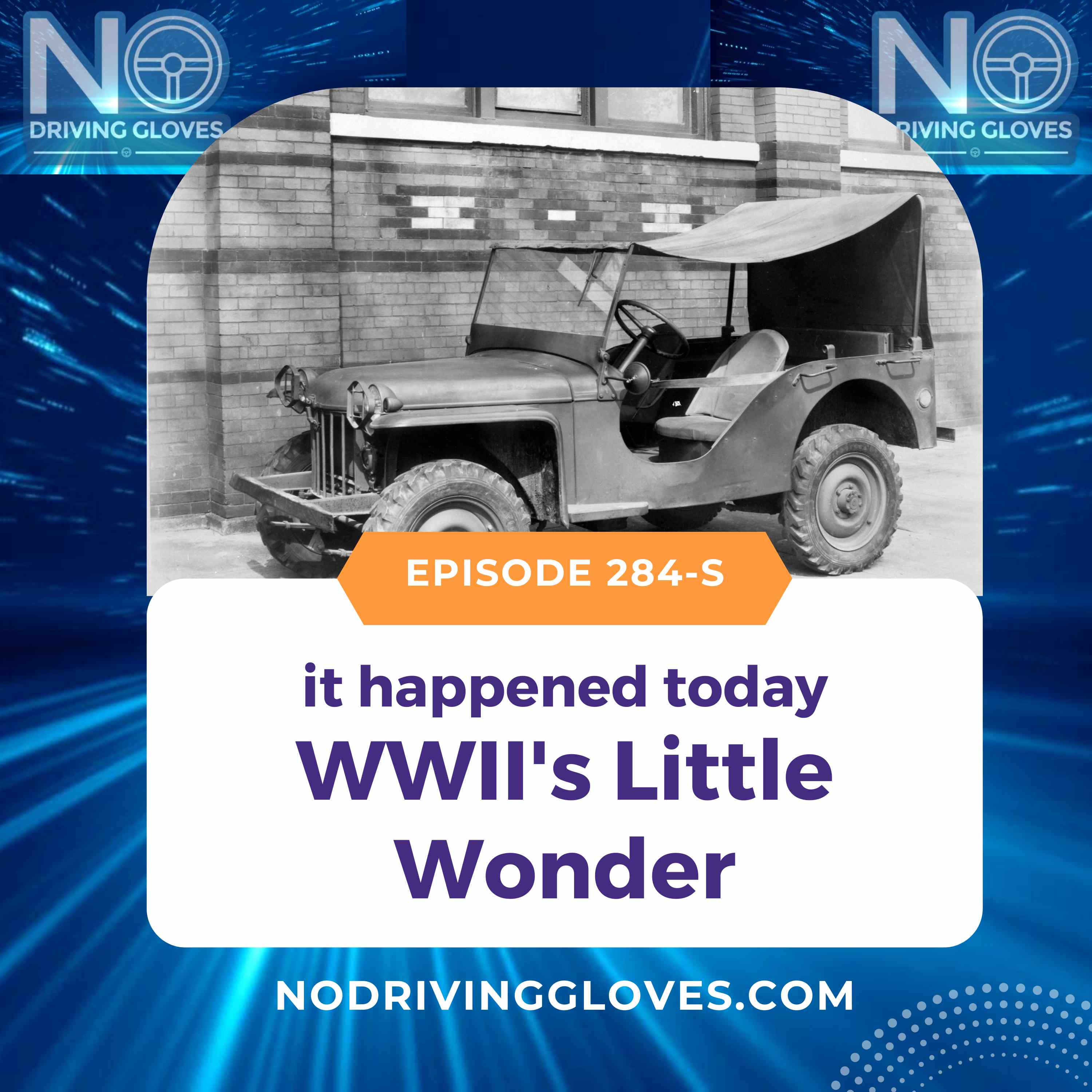
Ep 284Jeep- World War 2's Little Wonder 284s
Historic Jeep Prototype November 13As global war loomed in 1940, the Army sought a swift reconnaissance vehicle to navigate rugged terrain and deliver firepower to the front lines. Bantam, a small and agile company experienced in building light four-cylinder cars, appeared ideal for the task. On September 23, 1940, they delivered the world's first Jeep prototype – the Bantam reconnaissance car.However, both Willys and Ford expressed interest in competing for the contract. The Army shared Bantam's designs with them, leading to Willys submitting its MA Quad on November 13 and Ford submitting two prototypes – the Pygmy GP-001 and GP-002 – on November 23.Although none of the prototypes met the Army's desired weight of less than 1,300 pounds, Ford's Pygmy introduced several innovations such as hinged headlamps for engine bay illumination and a second top bow to prevent driver discomfort. Despite their differences, all three competitors received orders for 1,500 vehicles each.Ultimately, the final standardized version became the Willys MB, which Ford also built as the GPW during the war. Roughly 660,000 Jeeps were built, roughly 18% of all motorized manufacturing during the war The rugged Jeep quickly became an icon of World War II and a symbol of wartime production by the auto industry. As Pulitzer Prize-winning war correspondent Ernie Pyle put it: "It's as faithful as a dog, strong as a mule, and as agile as a goat." Edwell Bourne Sr., a World War II veteran and mechanic, also praised the Jeep's durability: "It's very rare to trace a whole class of vehicles to a single one, but this is where it all began."Several theories surround the origin of the name Jeep. Some suggest it derives from a slurring of "GPV," an acronym for General Purpose Vehicle or Government Purpose. Others attribute it to Eugene the Jeep, Popeye's resourceful jungle pet. However, the term "Jeep" was already used by the Army in 1914 to describe new test vehicles.While Bantam's Reconnaissance Car and Willys' Quad have since vanished or been wrecked, today, GP No. 1 Ford's first prototype still exists- the oldest known Jeep now resides at the Veterans Memorial Museum in Huntsville, Alabama, while another prototype – Bantam serial number 1007 – is on display at the National Museum of American History. Both now honor the greatest generation's fight and Detroit's role in the arsenal of democracy, standing testament to America's ingenuity during World War II.www.nodrivingloves.com#cars #car #collectorcars #oldcars #cartalk #electriccars #ev #hotrod #carhistory #automotivehistory #automobile #thisdayinautomotivehistory #thisdayinhistory #classiccars #onthisday #NaPodPoMo #ithappenedtoday #jeep #ww2

Ep 283Merger of Equals Ep 283s
Daimler-Chrysler: Merger LessonsOn November 12, 1998, shareholders of automotive world voting in favor surprising union: Germany's Daimler-Benz AG and America's Chrysler Corporation merged, promising to reshape the car market's landscape. The Daimler-Chrysler alliance blended German engineering finesse with American innovation and mass appeal. Yet, this perfect union on paper became a complex, challenging journey falling short of expectations.Intending to create an automotive juggernaut, Daimler-Benz sought to tap into the American market, while Chrysler aimed to harness German technological prowess. Synergies appeared promising, but reality proved far more intricate.The primary challenge lay in clashing corporate cultures. Bridging the vast differences in management styles, communication approaches, and organizational structures proved daunting, hindering the merger's full potential. Daimler's luxury focus conflicted with Chrysler's mass appeal emphasis, rendering product integration and economies of scale unsuccessful.As time elapsed, cultural and strategic misalignments eroded synergies. Promised cost savings and market presence remained elusive, frustrating shareholders. In 2007, Daimler parted ways with Chrysler, selling it to Cerberus Capital Management—ending the Daimler-Chrysler era.This cautionary tale underscores the importance of cultural integration and strategic alignment in mergers. The failed mega-merger highlights the nuances of cross-border collaborations beyond financial considerations. The Daimler-Chrysler merger remains a pivotal moment in automotive history, offering lessons on global business partnerships' complexities and ingredients for a successful merger.www.nodrivingloves.com#cars #car #collectorcars #oldcars #cartalk #electriccars #ev #hotrod #carhistory #automotivehistory #automobile #thisdayinautomotivehistory #thisdayinhistory #classiccars #onthisday #NaPodPoMo #mergerofequals #mercedes #mercedes-benz #chrysler #bigbusiness

Ep 282Jumpin' General EP 282s Dukes of Hazard
General Lee's Iconic First JumpOn November 11th, 1978, during the filming of One-Armed Bandits, a stuntman launched the iconic General Lee off a makeshift dirt ramp and over a police car on the Georgia set of The Dukes of Hazzard, TV history was made. This 16-foot-high and 82-foot-long leap resulted in a totaled car but secured its place in every episode's opening credits.As countless stunts unfolded on screen, nearly every car met its demise, prompting prop masters to scour the country for every 1969 Dodge Charger they could find. Outfitted with roll cages, nose-mounted push bars, and upgraded suspensions, these cars braced themselves for inevitable landings. Brakes were tampered with to perfect the 180-degree bootlegger's turn, while concrete or lead-filled trunks prevented mid-air flips.Despite these reinforcements, landing those jumps must have been a jarring experience for the stunt drivers – let alone Bo, Luke, Daisy, or dear old Uncle Jesse.This orange Charger – adorned with "01" on its doors, a Confederate flag on its roof, and a horn that played Dixie's first twelve notes – belonged to Bo and Luke Duke themselves. With it, they evaded corrupt County Commissioner Boss Hogg in thrilling chases and narrow escapes.While on air, the General Lee received 35,000 fan letters monthly. Enthusiasts purchased millions of toys and remote-controlled replicas of the car, with some even modifying their own vehicles to resemble the Duke's Charger. In 2006, Travis Bell rescued "Lee 1," the original General Lee from that jump, from an Atlanta-area junkyard where it had sat for 23 years. The car underwent a full restoration before selling to golfer Bubba Watson at a Scottsdale Barrett-Jackson auction in 2012. The Dukes of Hazzard aired on CBS from 1979 until 1985.www.nodrivingloves.com#cars #car #collectorcars #oldcars #cartalk #electriccars #ev #hotrod #carhistory #automotivehistory #automobile #thisdayinautomotivehistory #thisdayinhistory #classiccars #onthisday #NaPodPoMo #Dukes #dukeboys #hazzardcounty #generallee

Ep 281Birth of the First Motorcycle, Maybe Ep281s
Birth of the First Motorcycle- Episode 281In 1885, the Reitwagen, or "riding car," emerged as the first motorcycle, a creation of Gottlieb Daimler and Wilhelm Maybach. Despite earlier steam-powered two-wheelers like the Michoud-Péry and Roper of 1867-1869 and the 1884 Copeland, Daimler's invention earned him the title of "father of the motorcycle."The Reitwagen's claim to being the first motorcycle hinges on its internal combustion engine. The Oxford English Dictionary uses this criteria, but some argue that its four wheels instead of two raise doubts. These outriggers, acting as auxiliary stabilizers, point to a deeper issue: Daimler's invention needed training wheels due to lacking well-understood principles of rake and trail.The Reitwagen's engine was a compact high-speed single-cylinder model patented in 1885 as the "grandfather clock engine." It featured a float-metered carburetor, mushroom intake valves, hot tube ignition, twin flywheels, and an aluminum crankcase. With its 264 cubic centimeter engine mounted on rubber blocks and spring-loaded outrigger wheels for stability, it reached speeds of about seven miles per hour.Daimler's son Paul took the first ride on November 10, 1885. Though its seat caught fire due to the engine's hot tube ignition beneath it, by 1886, despite improvements, the Reitwagen had served its purpose, and Daimler halted the project in 1886 to chase four-wheel dreams. A fire devoured the original creation in 1903, but replicas echo its memory today.Some speculated that Daimler never intended to craft a motorcycle, but the engine's small size demanded it. He never pursued two-wheelers after the Riewagen, and mass-produced motorcycles only appeared in 1894.The Riewagen remains the cornerstone of all automobiles – air, sea, land – igniting the internal combustion engine motorcycle revolution. As electric powertrains loom on the horizon, gas-powered motorcycles will become even more cherished. So ride with fervor on your fire-breathing steed and savor these final decades before exhaust notes surrender to whirring whispers.

Ep 280McNamara's Impact on Ford 280s
Episode 280s McNamara's Impact on Ford In 1946, as Henry Ford II grappled with the chaos his grandfather had left behind, the company lost a staggering $85 million (about $1.4 Billion today) within eight months. Enter Robert S. McNamara, the brightest star among the Whiz Kids – a group of ten highly educated and ambitious men who had worked together in the U.S. Army's Air Force. Together, they breathed new life into Ford Motor Company.Did Henry Ford II seek the brilliance of General Motors' Alfred P. Sloan when he named Robert S. McNamara as president of Ford Motor Company? As GM's dominance grew in the 1920s and '30s, Ford aspired to surpass them. McNamara, a non-Ford family member, infused modernity into the company like an invigorating breath of fresh air. However, while Sloan sculpted the contemporary automotive corporation, McNamara embodied a sterile, numbers-driven manager.Both Sloan and McNamara were modern managers; however, McNamara was cold and distant—a bean counter who prioritized statistical analysis over product innovation.As Ford's fortunes were resurrected, Henry Ford II savored an additional triumph – in 1957, Ford outsold Chevrolet for the first time in over two decades. Observers noted McNamara's quick adaptability and his establishment of robust financial controls but struggled to pinpoint a lasting legacy.McNamara's ascent to Ford's presidency symbolized the rise of the modern manager, but would he be considered for such a position today? Doubtful. The legendary Robert Lutz should remind us that product reigns supreme. Today, bringing in someone without strong industry experience is risky.In 1960, McNamara retired from Ford, less than a month after becoming President, to accept President John F. Kennedy's invitation to serve as Secretary of Defense. He remained in this post after Kennedy's death to support President Lyndon B. Johnson during the tumultuous Vietnam War era. Through war and peace, Robert S. McNamara's sharp intellect and sense of fiscal responsibility helped preserve Ford Motor Company during a time of crisis.www.nodrivinggloves.com#cars #car #collectorcars oldcars #cartalk #electriccars #ev #hotrod #carhistory #automotivehistory #automobile #thisdayinautomotivehistory #thisdayinhistory #classiccars #sloan #fordfalcon #secertaryofdefense #NaPodPoMo

Ep 279The Underbird 279 SH
The Polish Prince's Victory LapOn November 6, 1988, the air at Phoenix International Raceway crackled with excitement as Alan Kulwicki, the Polish Prince, tasted victory in his first NASCAR Winston Cup race. Adrenaline coursed through his veins like wildfire, fueling his daring decision to steer his car against the tide of the inaugural Checker 500. This bold act on that fateful autumn day breathed life into the now-famous Polish Victory Lap.A celebrated tradition in the world of auto racing, the Polish Victory Lap sees the triumphant driver defying convention and speeding around the track in reverse, checkered flag proudly waving like a battle standard outside their window. Kulwicki's Polish heritage lent itself to both his nickname and this unique celebration of victory.Kulwicki not only created that unforgettable victory dance, According to NASCAR lore, prior to the 1992 Hooters 500 (the final race of the season), Kulwicki got permission from Ford to change the "Thunderbird" lettering on his bumper to "Underbird," because he considered his team to be an underdog in the championship race. Despite breaking the first gear in his transmission during his first pit stop, Kulwicki employed a brilliant fuel-saving plan that helped him finish second in the race. With the great finish, Kulwicki capped off a six-race string that allowed him to overcome a 278-point deficit to capture the Winston Cup and made the Underbird part of NASCAR history.Tragically, in 1993, a light aircraft accident snatched Kulwicki away from the racing world. Though he never got to defend his 1992 Winston Cup Championship, his legacy as a successful NASCAR driver—including earning Rookie of the Year in 1986—remains immortalized through the exhilarating ritual of the Polish Victory Lap.www.nodrivinggloves.com#cars #car #collectorcars oldcars #cartalk #electriccars #ev #hotrod #carhistory #automotivehistory #automobile #thisdayinautomotivehistory #thisdayinhistory #classiccars #underbird #NASCAR #WinstonCup

Ep 278The Rise and Fall of Hupp Motorcar 278 SHORT NaPodPoMo
The Hupp Motor Company, a serious carmaker with a whimsical name, emerged from the ambition of Robert Craig Hupp. Born in Grand Rapids and raised in Detroit, Hupp's journey began at Olds Motor Works and continued at Ford Motor Company, where he honed his skills on the Model K.Leaving Ford in 1907, Hupp set out to create a lightweight car tailored for American roads. With funds from J. Walter Drake, Joseph R. Drake, and John E. Baker, the Hupp Motor Car Company was born in 1908. As capital dwindled, Charles D. Hastings stepped in to finance a prototype for the upcoming Detroit Auto Show.On a frigid night, snow drifting into their makeshift workspace, Hupp and Hastings feverishly completed their masterpiece: the two-seater Huppmobile Model 20. At its debut on February 15, 1909, the car garnered enough interest and $50 deposits to raise $25,000 and propel the company into production.From rented factories to larger facilities, production soared from 1,618 cars in 1909 to 12,543 by 1913. The Huppmobile's reputation for affordability and reliability led to its selection as Detroit's first police cars.A bold marketing stunt saw three men drive a Huppmobile around the world from November 10, 1910 to January 24, 1912. The 49,000-mile journey captured imaginations worldwide and solidified the Huppmobile as a global export. This heroic journey was covered in the book "Three Men in a Hupp: Around the World by Automobile, 1910-1912" by James A. Ward, link in the show notes.However, two critical factors hampered success. First, Hupp ceased production of their lightweight model; secondly, he sold his stock and left his company in September 1911 due to differing visions.Hupp started other car ventures without achieving similar success; most notably the Hupp Yates Electric Car Company with his brother Lewis. After legal disputes and rebranding to RCH Company, Hupp eventually joined Monarch Motor Car Company. By 1920, electric cars had lost popularity, and the RCH Hupp Yates was discontinued.Meanwhile, the Hupp Motor Car Company continued to expand its operations, creating a legacy that would endure for over three decades.The automaker's sales swelled like a tidal wave; from 15,000 units in 1921 to a staggering 65,000 by 1928. In a bid to capture the founder's magic, Hump Motor launched a cross-country odyssey on August 28, 1916. The Humpmobile Model N danced through all 48 state capitals, traversing 18,430 miles over four months.Robert Hupp's flame was extinguished on December 7, 1931, at age 55. Only to prove Bobby right, the company forged ahead into luxury, only to crumble under the weight of bankruptcy on November 1, 1940. Sales peaked in 1928 but quickly plummeted to around 17,500 in 1931.Resurrected as Hupp Incorporated in 1941, the company shifted its focus from cars to air conditioning and heating units. The old Hupp facility passed through various hands until it was demolished in '80-'81, giving way to General Motors' Poletown plant.www.nodrivinggloves.com"Three Men in a Hupp: Around the World by Automobile, 1910-1912" by James A. Ward,#cars #car #collectorcars #cartalk #carhistory #automotivehistory #automobile #thisdayinautomotivehistory #thisdayinhistory #classiccars #hupmobile #aaca #NaPosPoMo

Ep 277"Perception vs. Reality: The Changing Landscape of Automotive Swap Meets" 277 FULL EPISODE
The Survival of Swap Meets: We discuss the rumors surrounding the decline of automotive swap meets. While some argue that these events are dying, we uncover a different perspective. We shed light on successful management strategies, like the one employed by Carlisle, which have helped revive the interest and appeal of swap meets. It's a fascinating exploration of how these events have adapted to the changing times. 🔄If you're a car enthusiast or simply curious about the world of automotive swap meets, this episode is a must-listen! 🎧 Share it with your friends who share the same passion, and let's keep the conversation going. Together, we can celebrate the rich history and exciting future of car culture. 🌟Listen to the full episode on our podcast, No Driving Gloves, available on all major podcast platforms. 🎧 And don't forget to subscribe for more engaging discussions about cars, experience, knowledge, and controversy! 🚗💬Enjoy the ride! 🏁00:01:28 Swap meets are evolving, not dying.00:07:24 Hershey swap meet attendance increased.00:18:59 Swap meets need to adapt.00:23:13 Inclusive approach needed for car enthusiasts.00:32:36 Swap meets need to adapt.00:34:29 Swap meets are evolving with car culture.#NoDrivingGloves #PodcastEpisode #AutomotiveSwapMeets #CarCulture #CarEnthusiasts #EngagingDiscussions #SubscribeNow #EnjoyTheRide 🎧🚗💨
Ep 276Galloping Gertie's Tragic Collapse, RIP Tubby 276 Bonus NaPodPoMo
The 1940 Tacoma Narrows Bridge, a once-majestic suspension bridge, stretched across Washington State's Puget Sound like a steel spider's web. It served as a vital link between Tacoma and the Kitsap Peninsula. However, on November 7, 1940, the bridge succumbed to a deadly dance with gravity, collapsing into the watery depths below.Dubbed "Galloping Gertie" by its builders, the bridge was known for its mysterious vertical undulations in the wind. Despite attempts to tame its movements, it met its demise in 40 mph winds that morning. The twisting motion grew increasingly violent until the deck tore apart, leaving only remnants of towers and cables as silent witnesses to the catastrophe.The fallen bridge now lies beneath the waves as an artificial reef while its successor, built in 1950, stands proudly upon the original pedestals. This tragic collapse served as a catalyst for advancements in bridge aerodynamics and aeroelastics, shaping future suspension bridge designs.As early as 1923, engineers like Joseph B. Strauss and David B. Steinman were consulted for ideas to connect Tacoma with the Kitsap Peninsula. However, funding challenges and disagreements on design approaches plagued the project from its inception.The innovative design proposed by Leon Moisseiff ultimately won out over Clark Eldridge's conventional design due to cost savings and elegance. Moisseiff's theory of elastic distribution promised to absorb wind pressure and transmit energy to anchorages and towers. Unfortunately, this approach proved insufficient in preventing disaster.The Tacoma Narrows Bridge collapse remains a cautionary tale for future generations of engineers and scientists alike – an unforgettable reminder that nature's forces can humble even our greatest creations.On September 27, 1938, construction commenced on the Tacoma Narrows Bridge, a $6.4 million marvel stretching 2,800 feet as the world's third-longest suspension bridge. The slender structure, designed with only two lanes and a mere 39 feet in width, earned its nickname "Galloping Gerty" from the workers who witnessed her dance amid moderate winds.Despite attempts to steady her rhythmic swaying - from anchoring cables to concrete blocks or installing hydraulic buffers - all efforts fell short. Professor Frederik Falkenhusen proposed drilling holes for airflow or adding deflector vanes for aerodynamics, but fate intervened; the bridge collapsed five days after his recommendations.Leonardo Coatsworth, the last driver on the trembling titan, recounted crawling on hands and knees towards safety while the bridge crumbled around him. His car and Tubby, his daughter's Cocker Spaniel, plunged into the abyss below - the sole fatality of this disaster.Captured on film by camera shop owners Barney Elliott and Harboring Monroe, the Tacoma Narrows Bridge collapse now serves as a cautionary tale for engineering and architecture students worldwide.Silent film, etched in monochrome, danced at mismatched tempos. Monroe's lens captured 24 frames per second, while Elliott's waltzed at a languid 16. The bridge's oscillations - a frantic ballet, pirouetting 50% faster than reality. In 2019, a second reel surfaced - Arthur Leach's view from Gig Harbor's edge. A civil engineer and toll collector, he bore witness as the last soul to cross westward before the collapse. Determined, he halted others from stepping onto the disintegrating stage.#cars #car #collectorcars oldcars #cartalk #carhistory #automotivehistory #automobile #thisdayinautomotivehistory #thisdayinhistory #classiccars #gigharbor #tacoma #NaPosPoMo
Ep 275Senator Henry Ford? Did you know? What would have happened? 274 Bonus NAPODPOMO
1918 Newberry-Ford Senatorial ShowdownVisit the website www.nodrivinggloves.comThe 1918 Michigan senatorial race ignited national concern for regulating political campaign funds. Wealthy Republican industrialist Truman H. Newberry and Democratic automobile magnate Henry Ford clashed like titans. President Woodrow Wilson's favored candidate, Ford, ran in both the Republican and Democratic primaries.Desperate to prevent Ford's sweeping victory, Newberry's team unleashed a torrent of ads and scathing accusations, painting Ford as a pacifist and anti-Semite. Consequently, Newberry claimed the Republican nomination while Ford secured the Democratic.In November 1918, despite Ford's renowned status, Newberry triumphed in the general election, sparking outrage from citizens appalled by his campaign's lavish spending. Calls for his removal echoed throughout newspapers and among Republicans.Newberry's troubles began even before his victory as allegations of excessive campaign expenses surfaced. The Senate Committee on Privileges and Elections investigated these claims alongside petitions from Henry Ford contesting the election results.Although Newberry faced criminal charges for violating federal and state campaign laws, the Supreme Court overturned his conviction in 1921. However, his battles within the Senate persisted.After recounting ballots and investigating fraud allegations, the majority of the Senate committee found no evidence of improper use of money and exonerated Newberry. Dissenting Democrats insisted he knew about excessive expenditures and argued for his removal.Debates raged in the Senate chambers until January 1922, with opponents asserting that Newberry's massive spending could not have gone unnoticed. Progressive Senator George W. Norris warned of a Senate dominated by wealthy men if Newberry were cleared.On January 12, 1922, the Senate condemned Newberry's excessive expenditures as harmful to its honor and dignity, yet voted 46 to 41 in favor of him as a duly elected Senator from Michigan. The vote divided along party lines, with independent and radical Republicans siding with Democrats against Newberry while regular Republicans supported him. This concluded the formal Senate action in the Newberry-Ford contest.Henry Ford, relentless when angered, seemed unwilling to accept the decision. Faced with Ford's looming challenge and a shifting political landscape, Newberry resigned on November 18, 1922. He returned to his business in Michigan until his death in 1945.The Newberry-Ford saga drew national attention to the power of wealthy candidates. Both enjoyed political benefits from their fortunes—Ford pursued his grievance in court when insulted by Newberry's campaign. Though a personal vendetta, Ford's success hinged on public support for progressive ideals seeking to eliminate financial corruption from politics.The Supreme Court's ruling in Newberry v. United States weakened attempts to control federal campaign expenditures. In response, Congress passed the Federal Corrupt Practices Act in 1925. Despite these efforts, financial irregularities persisted in congressional campaigns for decades.#ford #politics #election #cars #car #collectorcars oldcars #cartalk #electriccars #ev #hotrod #carhistory #classiccars #thisdayinhistory #thisdayinautomotivehistory #automobile #automotivehistory
Ep 274It Takes Work To Be Lucky Today in Automtive History Nov 4, 2000 Bonus274 NAPODPOMO4
It Takes Work To Be LuckyCharlie Maxwell, a confidant and longtime employee of Harold Lemay, at a Lakewood Historical Society event, narrated tales of the man behind the Pierce County Refuse Company. From a single garbage truck in 1942, Lemay's empire swelled, becoming Washington's largest trash removal service and the 10th largest nationally. Yet, it was his fixation on vintage cars that brought Harold LeMay true fame.Like a vine reaching for sunlight, his car collection burgeoned to over 3,000 vehicles, crowning him in the Guinness Book of World Records as the possessor of the largest privately owned automobile collection. When Harold passed in 2000, his wife Nancy and son Doug continued the family business and preserved the car collection while maintaining their annual August open house tradition – an event held at their, as Harold was called it, a three-story home with a 300-car garage.In 2008, Waste Connections Incorporated bought Pierce County Refuse. Two years later, the Lemay Family Collection Foundation emerged as a non-profit corporation, welcoming visitors to explore its treasures at the former Marymount Military Academy in Spanaway. In June 2012, America's Car Museum sprouted in downtown Tacoma beside the iconic Tacoma Dome.Harold E. LeMay's love for automobiles transcended all boundaries, capturing stories from countless individuals at his annual car show. His passion propelled him to purchase cars for their historical and cultural significance rather than as investments. He once remarked, "I don't go for just the dollar value of a car. If it's unusual, I like it." Dubbed "Lucky" in his youth, Harold adhered to his mantra: "It takes a lot of hard work to be lucky." And luck indeed followed him as he amassed an unparalleled collection.Lucky's Garage stands as a tribute to Harold E. LeMay – an enduring exhibit at America's Car Museum. Meanwhile, the LeMay Family Collection at the Marymount Event Center continues to showcase over 500 vintage vehicles, primarily American-made cars, trucks, buses, fire engines, and motorcycles. This ever-growing collection, which began with Harold and Nancy LeMay, remains an emblem of their enduring legacy.Unfortunately, Harold passed away on this day in 2000.www.nodrivinggloves.com#cars #car #collectorcars #oldcars #cartalk #electriccars #ev #hotrod #carhistory #automotivehistory #automobile #thisdayinautomotivehistory #thisdayinhistory #classiccars #napodpomo ##americascarmuseum #lemaycollection
Ep 273Horseless Horse Show This Date In Automotive History Nov 3, 1900 Bonus273 NAPODPOMO3
First Grand Auto Show, 1900 Nov 3On this day in 1900, the first modern automotive spectacle ignited Madison Square Garden in New York City. Though there had been other auto shows, it was the first colossal display, and the first endorsed by an automobile group, the Automobile Club of America. For a staggering $0.50 – roughly $18.50 today – guests marveled at over 66 exhibitors, presenting a mere 31 vehicles to over 10,000 awestruck attendees.The week-long extravaganza, known as the Horseless Horse Show, showcased breathtaking feats of braking and acceleration. A specially crafted ramp exhibited the hill-climbing prowess of various automobiles. Among the highlights was Ransom E. Ohl's unveiling of his curved-dash runabout prototype, the first mass-produced car in the world. Between 1901 and 1907, it retailed for $650 – approximately $24,000 today.Curiously, none of the automakers participating in this historic event have survived to this day.www.nodrivinggloves.com#cars #car #collectorcars oldcars #cartalk #electriccars #ev #hotrod #carhistory #automotivehistory #automobile #thisdayinautomotivehistory #thisdayinhistory #classiccars #napodpomo #autoshow #carshow
Ep 272Minivans: Revolutionizing Family Transportation Today in Automotive History Nov 2, 1983 Bonus272 NAPODPOMO2
Minivans: Revolutionizing Family Transportation Nov 2This month, we're trying something new for No Driving Gloves. It's part of National Podcasting Month or NAPODPOMO. The challenge is to create a daily podcast episode for 30 days. We'll still release our regular episodes every Tuesday, along with daily episodes about Today in Automotive History.Give us your feedback and let us know what you think. Depending on your response, we may create a separate feed or include it in our main one. Visit nodrivinggloves.com to share your thoughts.Minivans, never have received wide spread respect and are often dismissed as uncool. Yet, their boxy proportions make them adept at ferrying people and luggage with ease. They outperform most passenger cars and even the "cooler" sport utility vehicle. Chrysler's introduction of the Dodge Caravan and Plymouth Voyager in 1983 revolutionized the market, quickly overshadowing the iconic station wagon.The minivan was a blend of station wagon and conventional van, small enough to fit into most garages. Its affordability made it a staple for many families. Chrysler sold over 209,000 in its first year alone, peaking at 600,000 in the late 1990s.Despite its homely pedigree, the Chrysler minivan transformed the American automotive landscape. It took what today might be considered corporate espionage, defected Ford executives Hal Spurlock and Lee Iacocca to bring it to life at Chrysler. With a range of small front-wheel drive platforms at their disposal, they accelerated the plan using a variation of unibody construction found in other K-Car.The minivan revolution dubbed the "Magic Wagon," combined comfort, versatility, and practicality. Its front-engine and front-wheel-drive design created a flat floor interior with easy access through sliding doors and foldable seats. The Dodge Caravan and Plymouth Voyager debuted in 1983 as convenient alternatives to bulky full-size vans.Innovations continued throughout the years, with flexible seating options, towing packages, and even seating that would fold flat into a bed with a tent that attached to the side door. allowed the T-115 (Chrysler's internal code for the Caravan/Voyager twins) allowed them to cater to various needs. The humble minivan played a significant role in restoring Chrysler to profitability while etching itself into the memories of countless families.Millions of minivans, like a symphony of metal and rubber, find their way into the eager hands of consumers.Don't forget to check out Episode 265 to hear my feelings on Minivans.www.nodrivinggloves.com#cars #car #collectorcars oldcars #cartalk #electriccars #ev #hotrod #carhistory #automotivehistory #automobile #thisdayinautomotivehistory #thisdayinhistory #classiccars #napodpomo #minivans #minivan
Ep 271American Motor League This Day in Automotive History Nov 1 1900 Bonus271
Daily Automotive History PodcastThis month, we're trying something new for No Driving Gloves. It's part of National Podcasting Month, or NAPODPOMO. The challenge is to create a daily podcast episode for 30 days. We'll still release our regular episodes every Tuesday, along with daily episodes about Today in Automotive History.Give us your feedback and let us know what you think. Depending on your response, we may create a separate feed or include it in our main one. Visit nodrivinggloves.com to share your thoughts.Now, let's dive into our first bit of automotive history: November 1st, 1895. On this day, the American Motor League (AML), the first US automobile club, held its preliminary meeting in Chicago. Sixty people attended the meeting at the Chicago School of Electricity on Dearborn Street.The club aimed to promote technological innovations for automobiles, which were still in their early stages of development. Attendees included notable automotive pioneers like Charles and Frank Duryea, Charles Bradley King, Henry G. Morris and Pedro S. Salomon, and Sterling Elliott.Dr. J. Allen Hornsby was named temporary president at the meeting, and Charles Duryea became AML's president a month later. Although AML was a trailblazer for US automobile clubs, it merged with the American Automobile Association in 1904.www.nodrivinggloves.com#cars #car #collectorcars #oldcars #cartalk #electriccars #ev #hotrod #carhistory #automotivehistory #automobile #auto #thisdayinautomotivehistory #thisdayinhistory #classiccars #minivan #NAPODPOMO(1)