
New Books in Political Science
3,548 episodes — Page 18 of 71
Ep 186Jeremy Garlick, "Advantage China: Agent of Change in an Era of Global Disruption" (Bloomsbury, 2023)
China’s rise to global prominence is a pretty good contender for the most important world development in the past 30 years. But now the question is how Beijing managed to be successful on the international stage–let alone how large that success is—with fierce debates between hawks and doves in the West and elsewhere. Jeremy Garlick tries to offer an explanation of China’s success and how Beijing is trying to remake the international system in Advantage China: Agent of Change in an Era of Global Disruption (Bloomsbury, 2023) Jeremy is an associate professor in the Department of International and Diplomatic Studies at the Prague University of Economics and Business and the director of the Jan Masaryk Centre for International Studies. His first book is The Impact of China’s Belt and Road Initiative: From Asia to Europe (Routledge: 2019), and his second is Reconfiguring the China-Pakistan Economic Corridor (Routledge: 2022) You can find more reviews, excerpts, interviews, and essays at The Asian Review of Books, including its review of Advantage China. Follow on Twitter at @BookReviewsAsia. Nicholas Gordon is an editor for a global magazine, and a reviewer for the Asian Review of Books. He can be found on Twitter at@nickrigordon. Learn more about your ad choices. Visit megaphone.fm/adchoices Support our show by becoming a premium member! https://newbooksnetwork.supportingcast.fm/political-science
Ep 119David Tal, "The Making of an Alliance: The Origins and Development of the US-Israel Relationship" (Cambridge UP, 2022)
Laying the foundation for an understanding of US-Israeli relations, this lively and accessible book provides critical background on the origins and development of the 'special' relations between Israel and the United States. Questioning the usual neo-realist approach to understanding this relationship, David Tal instead suggests that the relations between the two nations were constructed on idealism, political culture, and strategic ties. Based on a diverse range of primary sources collected in archives in both Israel and the United States, The Making of an Alliance: The Origins and Development of the US-Israel Relationship (Cambridge UP, 2022) discusses the development of relations built through constant contact between people and ideas, showing how presidents and Prime Ministers, state officials, and ordinary people from both countries, impacted one another. It was this constancy of religion, values, and history, serving the bedrock of the relations between the two countries and peoples, over which the ephemeral was negotiated. The author, David Tal, is Professor and Yossi Harel Chair in Modern Israel Studies in the Department of History at the University of Sussex. A historian of diplomatic and military history, he has published extensively on Israeli diplomatic and military history, and U.S. diplomatic history and disarmament policies. Learn more about your ad choices. Visit megaphone.fm/adchoices Support our show by becoming a premium member! https://newbooksnetwork.supportingcast.fm/political-science
Ep 714James Wolfinger, "If There Is No Struggle There Is No Progress: Black Politics in Twentieth-Century Philadelphia" (Temple UP, 2022)
If There Is No Struggle There Is No Progress: Black Politics in Twentieth-Century Philadelphia (Temple UP, 2022) provides an in-depth historical analysis of Philadelphia politics from the days of the Great Migration to the present. Philadelphia has long been a crucial site for the development of Black politics across the nation and this volume emphasizes how Black activists have long protested against police abuse, pushed for education reform, challenged job and housing discrimination, and put presidents in the White House. If There Is No Struggle There Is No Progress demonstrates that “Philadelphia must be central to any analysis of African American political history.” But politics means more than elected office and the book highlights political strategies such as the "Don't Buy Where You Can't Work" movement and the Double V campaign. It demonstrates how Black activism helped shift Philadelphia from the Republican machine to Democratic leaders in the 1950s and highlights the election of politicians like Robert N. C. Nix, Sr., the first African American representative from Philadelphia. The book highlights grassroots movements and the intersection of race, gender, class, and politics in the 1960s and shows how African Americans from the 1970s to the present challenged (white) Mayor Frank Rizzo and helped elect (Black) Mayors Wilson Goode, John Street, and Michael Nutter. Dean James Wolfinger (he/him/his) serves as dean of the School of Education at St. John’s University in Queens, New York. Dr. Stanley Arnold (he/him/his) is an Associate Professor of American History at Northern Illinois University. Dr. Alyssa Ribeiro (she/her/hers) is the Henry A Logan, Sr, Professor of American History at Allegheny College in Meadville, Pennsylvania. Ms. Daniela Lavergne at Saint Joseph’s University served as the editorial assistant for this podcast. Learn more about your ad choices. Visit megaphone.fm/adchoices Support our show by becoming a premium member! https://newbooksnetwork.supportingcast.fm/political-science
Ep 542Donald Stoker, "Why America Loses Wars: Limited War and US Strategy from the Korean War to the Present" (Cambridge UP, 2019)
In this provocative challenge to United States policy and strategy, former Professor of Strategy & Policy at the US Naval War College, and author or editor of eleven books, Dr. Donald Stoker argues that America endures endless wars because its leaders no longer know how to think about war in strategic terms and he reveals how ideas on limited war and war in general have evolved against the backdrop of American conflicts in Korea, Vietnam, and Iraq. These ideas, he shows, were and are flawed and have undermined America's ability to understand, wage, and win its wars, and to secure peace afterwards. America's leaders he argues have too often taken the nation to war without understanding what they want or valuing victory, leading to the “forever wars” of today in Afghanistan and Iraq. Why America Loses Wars: Limited War and US Strategy from the Korean War to the Present(Cambridge University Press, 2019) dismantles seventy years of misguided thinking and lays the foundations for a new approach to the wars of tomorrow. Why American Loses War is a must read for policy practitioners, serving soldiers and the lay educated public. Charles Coutinho has a doctorate in history from New York University. Where he studied with Tony Judt, Stewart Stehlin and McGeorge Bundy. His Ph. D. dissertation was on Anglo-American relations in the run-up to the Suez Crisis of 1956. His area of specialization is 19th and 20th-century European, American diplomatic and political history. He has written recently for the Journal of Intelligence History and Chatham House’s International Affairs. It you have a recent title to suggest for a podcast, please send an e-mail to [email protected]. Learn more about your ad choices. Visit megaphone.fm/adchoices Support our show by becoming a premium member! https://newbooksnetwork.supportingcast.fm/political-science
Ep 715Tanisha M. Fazal, "Military Medicine and the Hidden Costs of War" (Oxford UP, 2024)
Decisions to go to war are often framed in cost-benefit terms, and typically such assessments do not factor in longer term costs. However, recent dramatic improvements in American military medicine have had an unanticipated effect: saving more soldiers' lives has vastly increased long-term, downstream costs of war with profound consequences for global politics in an era of heightened great power competition. In Military Medicine and the Hidden Costs of War (Oxford UP, 2024), Tanisha Fazal traces the modern history of medical treatment and casualty rates in American conflicts from the Civil War to the more recent counterinsurgency wars. As she shows, wars became increasingly survivable for wounded troops, to the point now where a large majority of wounded soldiers survive. Yet the human and financial implications of this steep increase in the wounded-to-killed ratio are dramatic, and her powerful analysis of this shift provides a necessary corrective to how we understand the costs of war. For each major conflict, Fazal analyzes the weapons used, injuries sustained, and policies put in place for veterans' care and pensions. As she argues, these improvements have significant financial and deeply personal implications for the returned wounded and their families, as well as the US government and its citizenry. Fazal's analysis highlights the significance of policymakers underestimating the costs of war, which in turn makes it easier both to initiate and continue military action abroad, contributing to Americas' penchant for engaging in so-called "endless wars." Tanisha Fazal is a Professor of Political Science at the University of Minnesota. Her scholarship focuses on sovereignty, international law, and armed conflict. In addition to her new book, she is the author of two award-winning books and numerous articles in academic and policy journals. From 2021-2023, she was an Andrew Carnegie Fellow Lamis Abdelaaty is an associate professor of political science at the Maxwell School of Syracuse University. She is the author of Discrimination and Delegation: Explaining State Responses to Refugees (Oxford University Press, 2021). Email her comments at [email protected] Learn more about your ad choices. Visit megaphone.fm/adchoices Support our show by becoming a premium member! https://newbooksnetwork.supportingcast.fm/political-science
Ep 93Harris Mylonas and Maya Tudor, "Varieties of Nationalism: Communities, Narratives, Identities" (Cambridge UP, 2023)
Nationalism has long been a normatively and empirically contested concept, associated with democratic revolutions and public goods provision, but also with xenophobia, genocide, and wars. Moving beyond facile distinctions between 'good' and 'bad' nationalisms, Varieties of Nationalism: Communities, Narratives, Identities (Cambridge University Press 2023) argues that nationalism is an empirically variegated ideology. Definitional disagreements, Eurocentric conceptualizations, and linear associations between ethnicity and nationalism have hampered our ability to synthesize insights. This book proposes that nationalism can be broken down productively into parts based on three key questions: 1. Does a nation exist? 2. How do national narratives vary? 3. When do national narratives matter? The answers to these questions generate five dimensions along which nationalism varies: elite fragmentation and popular fragmentation of national communities; ascriptiveness and thickness of national narratives; and salience of national identities. Our guests are: Maya Tudor, who is an Associate Professor of Politics and Public Policy at the Blavatnik School of Government at the University of Oxford. And Harris Mylonas, who is an Associate Professor of Political Science and International Affairs at George Washington University. Our host is Eleonora Mattiacci, an Assistant Professor of Political Science at Amherst College. She is the author of "Volatile States in International Politics" (Oxford University Press, 2023). Learn more about your ad choices. Visit megaphone.fm/adchoices Support our show by becoming a premium member! https://newbooksnetwork.supportingcast.fm/political-science
Ep 144The Rhetoric of Crisis in Israel-Palestine: A Discussion with Amos Goldberg
This week, RBI Director John Torpey speaks with Amos Goldberg, Professor of Holocaust History at the Department of Jewish History and Contemporary Jewry at the Hebrew University of Jerusalem, about the ongoing war between Israel and Hamas. Among other rhetorical aspects of the conflict, Goldberg reflects on the meaning of such slogans as “From the river to the sea, Palestine will be free.” They also discuss the question whether Israel is committing genocide and what that means. Finally, the conversation addresses how the conflict might end, an especially appropriate question as the parties seem to be returning to the bargaining table in a serious way. Learn more about your ad choices. Visit megaphone.fm/adchoices Support our show by becoming a premium member! https://newbooksnetwork.supportingcast.fm/political-science
Ep 341J. P. Messina, "Private Censorship" (Oxford UP, 2024)
When we think of censorship, our minds might turn to state agencies exercising power to silence dissent. However, contemporary concerns about censorship arise in contexts where non-state actors suppress expression and communication. There are subtle and not-so-subtle forms of interference that come from social groups, employers, media corporations, and even search engines. Should these “new” forms of censorship alarm us? Should we assess them in ways that mirror our typical views about state-enacted censorship? If not, how should we think about non-state modes of censorship? In Private Censorship (Oxford University Press, 2024), JP Messina takes up these broad questions. He examines a range of emerging sites of non-state censorship – what he calls “private” censorship – and sorts through the normative, political, and legal issues. Learn more about your ad choices. Visit megaphone.fm/adchoices Support our show by becoming a premium member! https://newbooksnetwork.supportingcast.fm/political-science
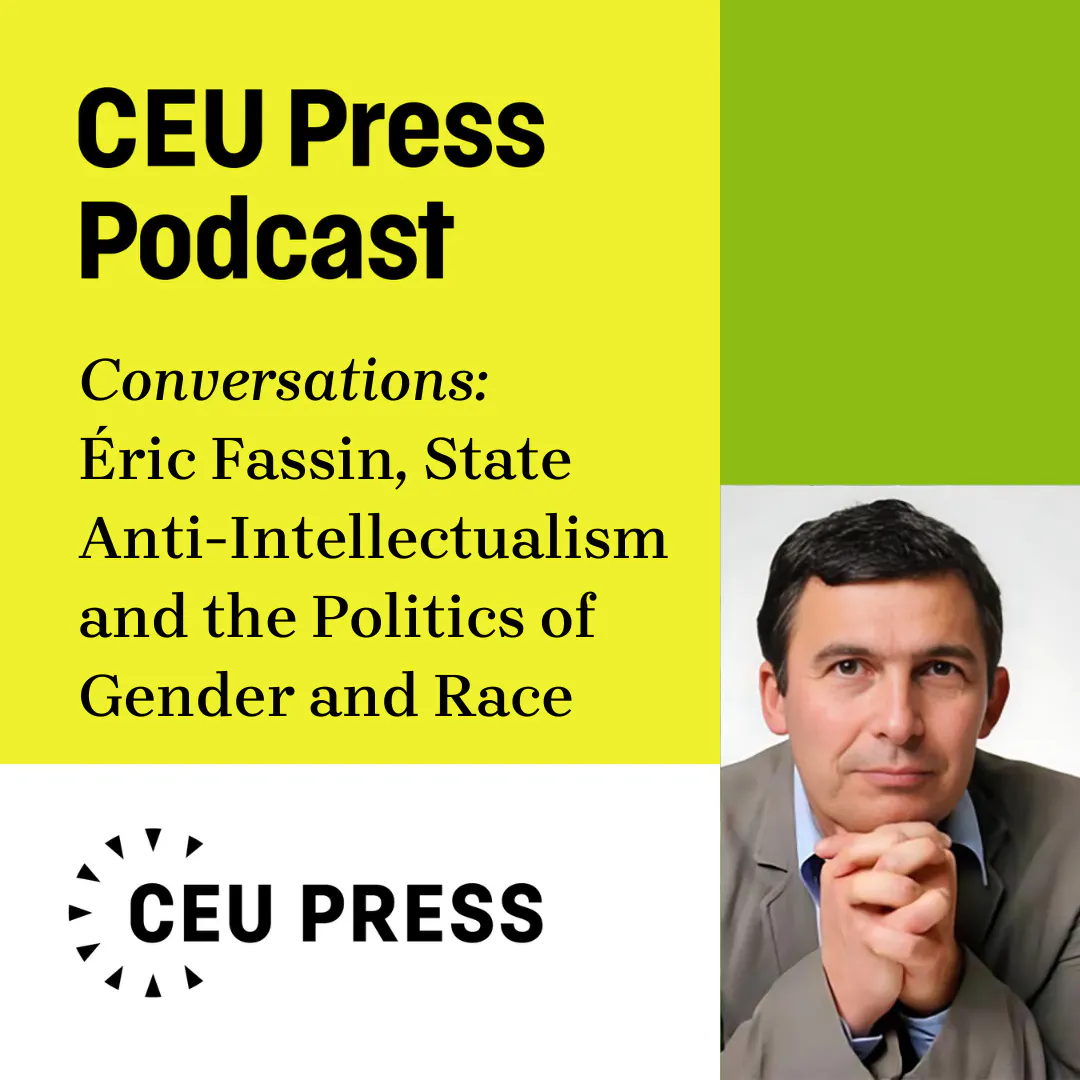
Ep 13Éric Fassin, "State Anti-Intellectualism and the Politics of Gender and Race: Illiberal France and Beyond" (CEU Press, 2024)
In this episode of the CEU Press Podcast, host Andrea Talabér (CEU Press/CEU Review of Books) sat down with Éric Fassin (Université Paris 8) to discuss his new book with CEU Press entitled, State Anti-Intellectualism and the Politics of Gender and Race: Illiberal France and Beyond (2024). Éric Fassin examines the trend of state anti-intellectualism in France using the nation as a case study to demonstrate that this tendency is not limited to ostensibly illiberal regimes. He argues that today’s world requires an examination of this phenomenon beyond Cold War geopolitical divisions and highlights a global shift towards authoritarian neoliberalism. His book is a plea for the political urgency of intellectual work in a global moment of political anti-intellectualism. Éric’s book is part of our new series, CEU Press Perspectives. The series offers the latest viewpoints on both new and perennial issues, these books address a wide range of topics of critical importance today. The new series, originating from an international collection of leading authors, encourages us to look at issues from a different viewpoint, to think outside the box, and to stimulate debate. You can learn more about the series here. The CEU Press Podcast delves into various aspects of the publishing process: from crafting a book proposal, finding a publisher, responding to peer review feedback on the manuscript, to the subsequent distribution, promotion and marketing of academic books. We will also talk to series editors and authors, who will share their experiences of getting published and talk about their series or books. Interested in CEU Press’s publications? Click here to find out more here. Stay tuned for future episodes and subscribe to our podcast to be the first to be notified. Learn more about your ad choices. Visit megaphone.fm/adchoices Support our show by becoming a premium member! https://newbooksnetwork.supportingcast.fm/political-science
Ep 473George R. Boyer, "The Winding Road to the Welfare State: Economic Insecurity and Social Welfare Policy in Britain" (Princeton UP, 2019)
The creation of the postwar welfare state in Great Britain did not represent the logical progression of governmental policy over a period of generations. As George R. Boyer details in The Winding Road to the Welfare State: Economic Insecurity and Social Welfare Policy in Britain (Princeton University Press, 2019), it only emerged after decades of different legislative responses to the problems of poverty that reflected shifting societal attitudes on the subject. As Boyer explains, welfare policy in the early 19th century primarily consisted of cash or in-kind payments provided for people living in their homes. This changed with the Poor Law Amendment Act of 1834, which replaced it with the infamous workhouse system. Though this brought down expenditures on the poor, the expectation that poverty was being reduced was belied by a series of reports at the end of the century which exposed the extent of urban poverty to a shocked nation. In response, the Liberal governments of the early 20th century passed a series of laws that established unemployment insurance and pensions for the elderly. While these expanded considerably the role of the state in providing for the poor, Boyer demonstrates that they fell well short of a comprehensive system, one which William Beveridge detailed in a famous 1942 report that served as the blueprint for the legislation passed by the Labour government after the Second World War. Learn more about your ad choices. Visit megaphone.fm/adchoices Support our show by becoming a premium member! https://newbooksnetwork.supportingcast.fm/political-science
Ep 61David Pozen, "The Constitution of the War on Drugs" (Oxford UP, 2024)
David Pozen is the Charles Keller Beekman Professor of Law at Columbia Law School and the author of the new book, The Constitution of the War on Drugs (Oxford UP, 2024). An expert in constitutional law, Pozen argues that the drug war has been an unmitigated disaster, in terms of money, efficacy, and human rights. But even as activists peel off the drug war’s more unsavory aspects through cannabis and psychedelic legalization, Pozen also argues that they’ve neglected to consider the impact America’s courts could have on rectifying oppressive drug laws. It wasn’t always this way. The Constitution of the War on Drugs also details the “hidden history” of a brief legal moment in the late 1960s and early 1970s when lawyers effectively argued for liberalized drug policies – on the sound basis of the Constitution. The moment was eventually overturned, but Pozen argues it could be a useful historical lesson for people interested in the effects of constitutional law on the drug war today. A link to the digital edition of The Constitution of the War on Drugs will soon be available here. Emily Dufton is the author of Grass Roots: The Rise and Fall and Rise of Marijuana in America (Basic Books, 2017). A drug historian and writer, her second book, on the development of the opioid addiction medication industry, is coming out soon from the University of Chicago Press. Learn more about your ad choices. Visit megaphone.fm/adchoices Support our show by becoming a premium member! https://newbooksnetwork.supportingcast.fm/political-science
Ep 218India Votes 2024
What is at stake at the 2024 Indian national elections? And, what can we expect if the incumbent prime minister Narendra Modi wins another five years in office? From April to June 2024, close to one billion Indian voters can cast their ballot at what is set to be the largest democratic exercise in world history. India is often spoken about as the world’s largest democracy, and the current Indian government describes the country as “the mother of democracy”. But there are also indications that Indian democracy is on the decline. Global indices now place India among the top “autocratizing countries” in the world, categorising it as an electoral autocracy. And, under Modi, the space for dissent has narrowed, the freedom of the media been undermined, and religious minorities and oppositional groups in civil society targeted and repressed. In this episode, Kenneth Bo Nielsen talks to Arild Engelsen Ruud and Francesca Jensenius about the 2024 elections and the future of Indian democracy. Arild Engelsen Ruud is Professor of South Asia Studies at the University of Oslo Francesca Jensenius is Professor of Political Science at the University of Oslo Kenneth Bo Nielsen is a social anthropologist based in Oslo, and one of the leaders of the Norwegian Network for Asian Studies. Learn more about your ad choices. Visit megaphone.fm/adchoices Support our show by becoming a premium member! https://newbooksnetwork.supportingcast.fm/political-science
Ep 258Dana Gorzelany-Mostak, "Tracks on the Trail: Popular Music, Race, and the US Presidency" (U Michigan Press, 2023)
From Bill Clinton playing his saxophone on The Arsenio Hall Show to Barack Obama referencing Jay-Z's song "Dirt Off Your Shoulder," politicians have used music not only to construct their personal presidential identities but to create the broader identity of the American presidency. Through music, candidates can appear relatable, show cultural competency, communicate values and ideas, or connect with a specific constituency. On a less explicit level, episodes such as Clinton's sax-playing and Obama's shoulder brush operate as aural and visual articulations of race and racial identity. But why do candidates choose to engage with race in this manner? And why do supporters and detractors on YouTube and the Twittersphere similarly engage with race when they create music videos or remixes in homage to their favorite candidates? With Barack Obama, Ben Carson, Kamala Harris, and Donald Trump as case studies, Tracks on the Trail: Popular Music, Race, and the US Presidency (U Michigan Press, 2023) sheds light on the factors that motivate candidates and constituents alike to articulate race through music on the campaign trail and shows how the racialization of sound intersects with other markers of difference and ultimately shapes the public discourse surrounding candidates, popular music, and the meanings attached to race in the 21st century. Gorzelany-Mostak explores musical engagement broadly, including official music in the form of candidate playlists and launch event setlists, as well as unofficial music in the form of newly composed campaign songs, mashups, parodies, and remixes. This interview was conducted by Dr. Miranda Melcher whose new book focuses on post-conflict military integration, understanding treaty negotiation and implementation in civil war contexts, with qualitative analysis of the Angolan and Mozambican civil wars. Learn more about your ad choices. Visit megaphone.fm/adchoices Support our show by becoming a premium member! https://newbooksnetwork.supportingcast.fm/political-science
Ep 187Boubacar N’Diaye, "Mauritania's Colonels: Political Leadership, Civil-Military Relations and Democratization" (Routledge, 2017)
Boubacar N’Diaye's book Mauritania's Colonels: Political Leadership, Civil-Military Relations and Democratization (Routledge, 2017), the result of more than a decade of research, focuses on the socio-political dynamics and civil-military relations in a little studied country: Mauritania, located in the troubled North-western part of Africa. Boubacar N'Diaye brings into light the political evolution of this country which holds lessons for African politics, and could affect the future of the West African sub-region. Mauritania's Colonels examines the personalities and policy of five military officers turned heads of state who ruled Mauritania for nearly forty years. After comparing and contrasting the personal traits, social origins, itineraries, and evolution as military officers, it critically evaluates the policies they enacted to address four key challenges their country faces. These are, namely, the difficult cohabitation between the country's ethno-cultural communities, the illusive democratization and military withdrawal from politics, the judicious management of the country's abundant natural resources to meet the socioeconomic needs of their people, and the prudent conduct of foreign policy given Mauritania's location, straddling Arab North Africa and Sub-Saharan Africa. Showing the impact that each Colonel has had on the evolution of Mauritania, this book will be of interest to students and scholars of West Africa, African politics, civil-military relations and democratization processes. Learn more about your ad choices. Visit megaphone.fm/adchoices Support our show by becoming a premium member! https://newbooksnetwork.supportingcast.fm/political-science
Ep 364Anu Bradford, "Digital Empires: The Global Battle to Regulate Technology" (Oxford UP, 2023)
The global battle among the three dominant digital powers―the United States, China, and the European Union―is intensifying. All three regimes are racing to regulate tech companies, with each advancing a competing vision for the digital economy while attempting to expand its sphere of influence in the digital world. In Digital Empires: The Global Battle to Regulate Technology (Oxford UP, 2023), her provocative follow-up to The Brussels Effect, Anu Bradford explores a rivalry that will shape the world in the decades to come. Across the globe, people dependent on digital technologies have become increasingly alarmed that their rapid adoption and transformation have ushered in an exceedingly concentrated economy where a few powerful companies control vast economic wealth and political power, undermine data privacy, and widen the gap between economic winners and losers. In response, world leaders are variously embracing the idea of reining in the most dominant tech companies. Bradford examines three competing regulatory approaches―the American market-driven model, the Chinese state-driven model, and the European rights-driven regulatory model―and discusses how governments and tech companies navigate the inevitable conflicts that arise when these regulatory approaches collide in the international domain. Which digital empire will prevail in the contest for global influence remains an open question, yet their contrasting strategies are increasingly clear. Digital societies are at an inflection point. In the midst of these unfolding regulatory battles, governments, tech companies, and digital citizens are making important choices that will shape the future ethos of the digital society. Digital Empires lays bare the choices we face as societies and individuals, explains the forces that shape those choices, and illuminates the immense stakes involved for everyone who uses digital technologies. Jake Chanenson is a computer science Ph.D. student and law student at the University of Chicago. Broadly, Jake is interested in topics relating to HCI, privacy, and tech policy. Jake’s work has been published in top venues such as ACM’s CHI Conference on Human Factors in Computing Systems. Learn more about your ad choices. Visit megaphone.fm/adchoices Support our show by becoming a premium member! https://newbooksnetwork.supportingcast.fm/political-science
Ep 13Social media’s business model is changing democracy, and not for the better
Democracies in Europe and the world over are grappling with the challenges posed by social media. In this episode, Charlotte Galpin and Verena Brändle talk with host Licia Cianetti about the multiple ways in which the online and the offline intersect in contemporary democracies, and how the engagement-maximising business model of privately owned social media platforms drives polarisation, undermines the quality of traditional media, and pushes extreme content onto unsuspecting users. There is no easy solution, but democracies must grapple with this new reality. Charlotte Galpin is Associate Professor in German and European Politics at the University of Birmingham. Verena Brändle is Assistant Professor in Political Science and International Studies at the University of Birmingham. Licia Cianetti is Lecturer in Political Science and International Studies at the University of Birmingham and Deputy Founding Director of CEDAR. The People, Power, Politics podcast brings you the latest insights into the factors that are shaping and re-shaping our political world. It is brought to you by the Centre for Elections, Democracy, Accountability and Representation (CEDAR) based at the University of Birmingham, United Kingdom. Join us to better understand the factors that promote and undermine democratic government around the world and follow us on Twitter at @CEDAR_Bham! Learn more about your ad choices. Visit megaphone.fm/adchoices Support our show by becoming a premium member! https://newbooksnetwork.supportingcast.fm/political-science
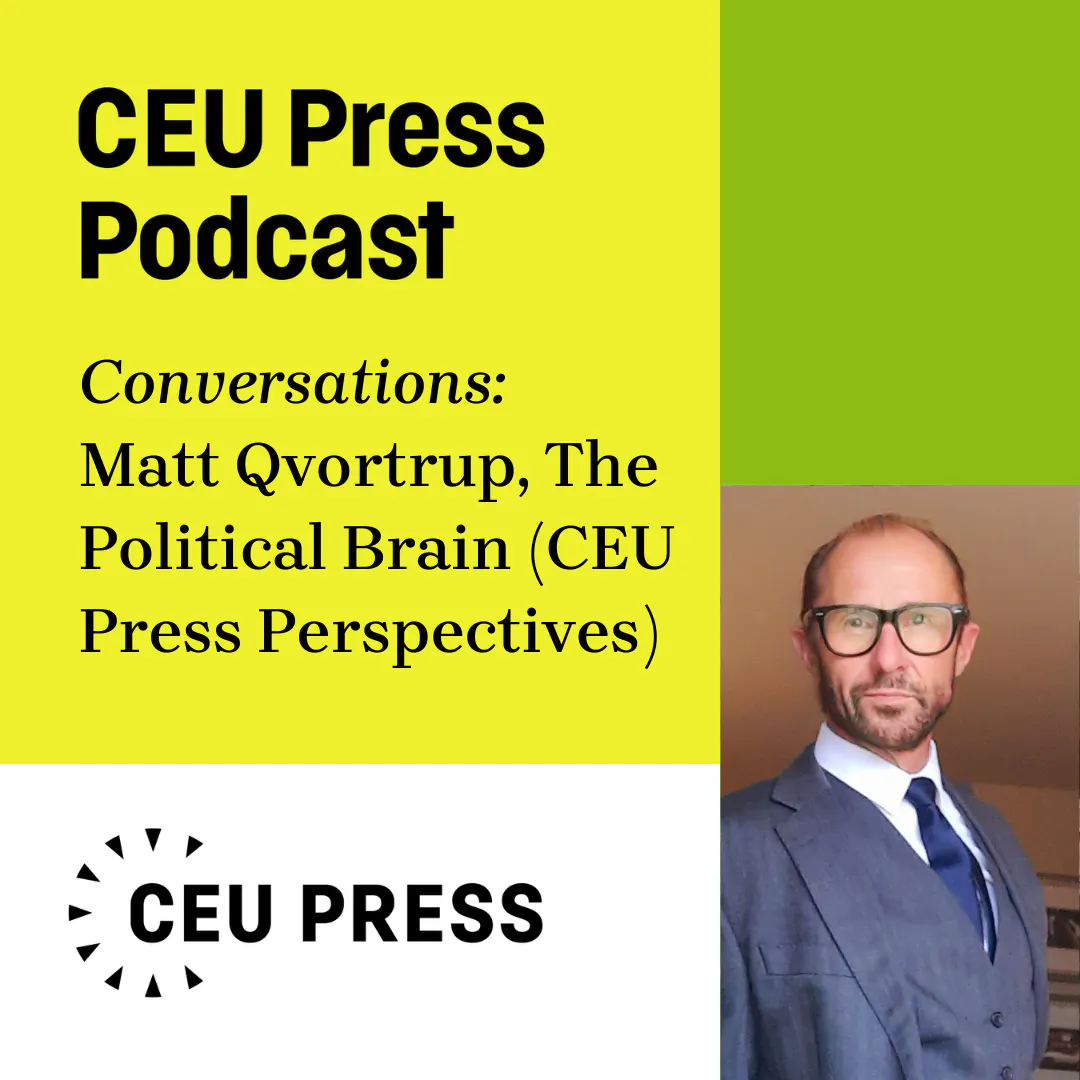
Ep 12Matt Qvortrup, "The Political Brain: The Emergence of Neuropolitics" (CEU Press, 2024)
In this episode of the CEU Press Podcast, host Andrea Talabér (CEU Press/CEU Review of Books) sat down with Matt Qvortrup (Coventry University) to discuss his new book with CEU Press entitled, The Political Brain: The Emergence of Neuropolitics (CEU Press, 2024). Putting the “science” back into political science, The Political Brain shows how fMRI-scans can identify differences between liberals and conservatives, can predict our behaviour, and can explain the biology of uprisings, revolutions, and wars. The book also provides an overview of the state-of-the-art knowledge of the organ that shapes our politics. It warns that if we rely on the evolutionarily primitive parts of the midbrain, those engaged when we succumb to polarised politics, we stand in danger of squandering the gains we made through the last eight million years. Matt’s book is part of our new series, CEU Press Perspectives. The series offers the latest viewpoints on both new and perennial issues, these books address a wide range of topics of critical importance today. The new series, originating from an international collection of leading authors, encourages us to look at issues from a different viewpoint, to think outside the box, and to stimulate debate. You can learn more about the series here. The CEU Press Podcast delves into various aspects of the publishing process: from crafting a book proposal, finding a publisher, responding to peer review feedback on the manuscript, to the subsequent distribution, promotion and marketing of academic books. We will also talk to series editors and authors, who will share their experiences of getting published and talk about their series or books. Interested in CEU Press’s publications? Click here to find out more: https://ceupress.com/ Stay tuned for future episodes and subscribe to our podcast to be the first to be notified. Learn more about your ad choices. Visit megaphone.fm/adchoices Support our show by becoming a premium member! https://newbooksnetwork.supportingcast.fm/political-science
Ep 148Michael J. Graetz, "The Power to Destroy: How the Antitax Movement Hijacked America" (Princeton UP, 2024)
The anti-tax movement is "the most important overlooked social and political movement of the last half century", according to our guest Michael J. Graetz. In his book The Power to Destroy: How the Antitax Movement Hijacked America (Princeton UP, 2024), Graetz chronicles the movement from a fringe theory promoted by zealous outsiders using false economic claims and thinly veiled racist rhetoric to a highly organized mainstream lobbying force, funded by billionaires, that dominates and distorts politics. Building on vague and disproven theories about "supply side" economics, the movement has undermined long-held beliefs that taxes are a reasonable price to pay for civil society, sound infrastructure, national security, and shared prosperity. Leaders have attacked the IRS, protected tax loopholes, and pushed aggressively for tax cuts from Ronald Reagan to Donald Trump. Also known as "trickle-down" or "voodoo" economics, these theories falsely claim that tax cuts will pay for themselves, when in fact they have led to the need for increased debt, including massive foreign debt, to pay for critical national investments. The antitax movement has expanded to include anti-government ideas and now, as told by Graetz, threatens the nation’s social safety net, increases inequality, saps American financial strength, and undermines the status of the US dollar. In 1819, Chief Justice John Marshall declared that the power to tax entails “the power to destroy.” In this book Graetz argues that it is the antitax movement itself that wields this destructive power. Suggested reading: Cloud Cuckoo Land, by Anthony Doerr Learn more about your ad choices. Visit megaphone.fm/adchoices Support our show by becoming a premium member! https://newbooksnetwork.supportingcast.fm/political-science
Ep 181Rogers M. Smith and Desmond King, "America’s New Racial Battle Lines: Protect Versus Repair" (U Chicago Press, 2024)
What is happening to the politics of race in America? In America’s New Racial Battle Lines: Protect Versus Repair (U Chicago Press, 2024), Rogers Smith and Desmond King argue that the nation has entered a new, more severely polarized era of racial policy disputes, displacing older debates over color-blind versus race-targeted measures. Drawing on primary sources, interviews, and studies of federal, state, and local initiatives linked to global developments, the authors map the memberships and the goals of two rival racial policy alliances, comprised of grassroots activists, NGOs, government agencies, and wealthy funders on both sides. Today's conservatives promise to "protect" traditionalist Americans against assaults from what they see as a radical American Left. Today's progressives seek to "repair" all American institutions and practices that embody systemic racism. Though these sides have some common ground, they advance sharply opposed visions of America that threaten to make profound racial policy conflicts, sometimes erupting into violence, all too pervasive in the nation's present and future. Professor Rogers Smith is Christopher H. Browne Distinguished Emeritus Professor of Political Science at the University of Pennsylvania. Professor Desmond King is Andrew W. Mellon professor of American Government at Nuffield College, University of Oxford. Host Dr Ursula Hackett is a Reader in Politics at Royal Holloway, University of London. She is the author of America’s Voucher Politics: How Elites Learned to Hide the State (Cambridge University Press, 2020). Learn more about your ad choices. Visit megaphone.fm/adchoices Support our show by becoming a premium member! https://newbooksnetwork.supportingcast.fm/political-science
Ep 261Ahmed M. Abozaid, "Undesired Revolution: The Arab Uprising in Egypt--A Three Level Analysis" (Brill, 2023)
Ahmed M. Abozaid’s Undesired Revolution: The Arab Uprising in Egypt--A Three Level Analysis (Brill, 2023) introduces new non-Western perspectives on the Arab Uprisings, decentering and decolonizing International Relations, and Middle Eastern Studies. Drawing on over ten years of fieldwork, ethnography, over 250 interviews, and empirical research, it is one of the first books to evaluate the position of International Relations theorists towards studying the Arab Uprisings. It relies on local IR scholarship from the region, which is rarely considered. It provides a critical account of why democratic revolutions have failed, how counterrevolutions and authoritarianism have fortified, and why revolutions will once again experience a resurgence in this part of the world. Ibrahim Fawzy is a literary translator and academic based in Egypt. His interests include translation studies, Arabic literature, ecocriticism, and disability studies. Learn more about your ad choices. Visit megaphone.fm/adchoices Support our show by becoming a premium member! https://newbooksnetwork.supportingcast.fm/political-science
Ep 215Lorenza B. Fontana, "Recognition Politics: Indigenous Rights and Ethnic Conflict in the Andes" (Cambridge UP, 2022)
Recognition Politics: Indigenous Rights and Ethnic Conflict in the Andes (Cambridge University Press, 2023) by Dr. Lorenza B. Fontana is a pioneering work that explores a new wave of widely overlooked conflicts that have emerged across the Andean region, coinciding with the implementation of internationally acclaimed indigenous rights. Why are groups that have peacefully cohabited for decades suddenly engaging in hostile and, at times, violent behaviours? What is the link between these conflicts and changes in collective self-identification, claim-making, and rent-seeking dynamics? And how, in turn, are these changes driven by broader institutional, legal and policy reforms? By shifting the focus to the 'post-recognition,' this unique study sets the agenda for a new generation of research on the practical consequences of the employment of ethnic-based rights. To develop the core argument on the links between recognition reforms and 'recognition conflicts', Lorenza Fontana draws on extensive empirical material and case studies from three Andean countries – Bolivia, Colombia and Peru – which have been global forerunners in the implementation of recognition politics. This interview was conducted by Dr. Miranda Melcher whose new book focuses on post-conflict military integration, understanding treaty negotiation and implementation in civil war contexts, with qualitative analysis of the Angolan and Mozambican civil wars. Learn more about your ad choices. Visit megaphone.fm/adchoices Support our show by becoming a premium member! https://newbooksnetwork.supportingcast.fm/political-science
Ep 104Plutarch as Philosopher and Political Thinker: A Conversation with Hugh Liebert
Plutarch is one of history's most influential authors: his insights were foundational to thinkers ranging from William Shakespeare to Alexander Hamilton, Nietzsche to Montesquieu. Yet, today his writings have fallen out of favor, in part because the genre he pioneered, biography, has fallen out of favor within academia, though it retains popularity among the general public. West Point political scientist Hugh Liebert delves into Plutarch's thought, revealing that Plutarch had profound philosophical insights despite his reputation as a historian. Along the way, he illustrates areas where Plutarch's thought might seem foreign to us versus those where his insights are evergreen, and makes the case for the continued importance of the biographical genre. Hugh Liebert is Professor of Political Science in the Department of Social Sciences at the United States Military Academy in West Point, New York. There, he serves as Director of the West Point Graduate Scholarship Program and Co-Director of the American Foundations minor. He is the author or editor of seven books, including Plutarch’s Politics (Cambridge University Press, 2016), recipient of the Delba Winthrop Award for Excellence in Political Science, and Gibbon’s Christianity (Penn State University Press, 2022). He is currently at 2023-24 Visiting Fellow here at the James Madison Program. Contributions to and/or sponsorship of any event does not constitute departmental or institutional endorsement of the specific program, speakers or views presented. Annika Nordquist is the Communications Coordinator of Princeton University’s James Madison Program in American Ideals and Institutions and host of the Program’s podcast, Madison’s Notes. Learn more about your ad choices. Visit megaphone.fm/adchoices Support our show by becoming a premium member! https://newbooksnetwork.supportingcast.fm/political-science
Ep 143Words of Attack: Rhetoric Against Liberal Democratic Values with James McAdams
With a presidential campaign in the US just around the corner and populist and authoritarian thinkers gaining broader platforms, University of Notre Dame political scientist A. James McAdams shines a light on the terms being used today by the Far Right to undermine liberal democracy. How successful are these thinkers in changing public views? And how worried should we be about what they are doing? These are among the topics McAdams addresses in his conversation with RBI Director John Torpey. McAdams' most recent book (co-edited with Samuel Piccolo) is Far-Right Newspeak and the Future of Liberal Democracy (Routledge, 2024). Learn more about your ad choices. Visit megaphone.fm/adchoices Support our show by becoming a premium member! https://newbooksnetwork.supportingcast.fm/political-science
Ep 207D. J. Taylor, "Who Is Big Brother?: A Reader's Guide to George Orwell" (Yale UP, 2024)
An intellectual who hated intellectuals, a socialist who didn't trust the state--our foremost political essayist and author of Animal Farm and Nineteen Eighty-Four was a man of stark, puzzling contradictions. Knowing Orwell's life and reading Orwell's works produces just as many questions as it answers. Celebrated Orwell biographer D. J. Taylor guides fans and new readers alike through the many twists and turns of Orwell's books, life and thought. As a writer he intended his works to be transparent and instantly accessible, yet they are also full of secrets and surprises, tantalising private histories, and psychological quirks. From his conflicted relationship with religion to his competing anti-imperialism and fascination with empire, Who Is Big Brother?: A Reader's Guide to George Orwell (Yale UP, 2024) delves into the complex development of this essential yet enigmatic voice. Taylor leads us through Orwell's principal writings and complex life--crafting an illuminating guide to one of the most enduringly relevant writers in the English language. Learn more about your ad choices. Visit megaphone.fm/adchoices Support our show by becoming a premium member! https://newbooksnetwork.supportingcast.fm/political-science
Ep 143Elliott Prasse-Freeman, "Rights Refused: Grassroots Activism and State Violence in Myanmar" (Stanford UP, 2023)
Over three years have passed since a military coup of February 2021 in Myanmar precipitated a popular uprising that has since transformed into a revolutionary situation. While researchers and writers have cobbled together edited books trying to come to terms with all that has happened and how we might interpret it in relation to Myanmar’s recent past, Elliott Prasse Freeman’s Rights Refused: Grassroots Activism and State Violence in Myanmar (Stanford University Press, 2023) is the first authoritative monographic study of the transitional 2010s and early revolutionary 2020s. Freeman spent the decade prior to the coup living and working with activists in Myanmar, and after it he did further digital ethnographic research and interviews. He combines a trove of data generated over these years with a sharp appreciation of social scientific theory to produce an account of the state in Myanmar as bluntly biopolitical. Mark Goodale writes in the book's foreword that Rights Refused is noteworthy for its stunning ambition, both intellectual and political; its synthesis of debates, theories and methodology from across a range of disciplines; and, its movements across multiple registers, scales and temporalities. That makes it both a demanding and rewarding book — and so too is this episode of New Books in Southeast Asian Studies! Elliott manages the Burma Studies Group online, which features weekly updates of new publications on Burma aka Myanmar, like those forthcoming books he mentions at the end of this episode. Looking for things to read? Elliott recommends Elsa Dorlin's Self Defense, and Neferti Tadiar's Remaindered Life. Like this interview? You might also be interested in Gerard McCarthy’s Outsourcing the Polity; and, The Politics of Love in Myanmar by Lynette Chua. Learn more about your ad choices. Visit megaphone.fm/adchoices Support our show by becoming a premium member! https://newbooksnetwork.supportingcast.fm/political-science
Ep 713Melvin L. Rogers, "The Darkened Light of Faith: Race, Democracy, and Freedom in African American Political Thought" (Princeton UP, 2023)
Political Theorist Melvin L. Rogers has a deep and rich new book delving into the work of a host of different African American political thinkers. But this work is much more than an exploration of some of the writings by African American thinkers, it importantly tells the story of America. The Darkened Light of Faith: Race, Democracy, and Freedom in African American Political Thought (Princeton UP, 2023) takes the reader on a journey through distinct work and pieces by David Walker, Frederick Douglass, W.E.B. Du Bois, Ida B. Wells, Billie Holiday, James Baldwin, and others not in an effort to be exhaustive or completist in examining their work, but in teasing out vital thematic approaches to consider race, democracy, and freedom in the American republic. Rogers starts from a foundation in considering the idea of democracy—what are the habits and sensibilities that are located in the people who compose a democracy, or, more precisely, “who are we?” in the understanding of “we the people” or in the we of “we hold these truths to be self-evident.” While there is attention to the institutions that structure our democracy, Rogers reads many of these authors to expand that focus, to think about what the culture, the societal concepts, and the community define as who we are and who we might hope to be. Thus, as Rogers weaves together chronological approaches to considering these ideas from the authors and artists included in the conversation, he is also toggling together components that are often considered separately: political standing and culture standing, and how individuals, particularly black individuals, are situated in each. The Darkened Light of Faith is deeply engaged with the conceptual duality of a place and an idea – the United States – that is at once mired in the tragic history of enslavement and, at the same time, moving (maybe?) towards the promise of a democracy that holds freedom among its most important qualities. This tension is also the darkened light of faith and hope that the thinkers, activists, and artists wrap themselves and their work in as they consider the opportunities and problematics that are America. Rogers does not confine his analysis to the written word. There is an exploration of anti-slavery pamphlets by abolitionist David Walker, who wrote and advocated against slavery in the 1820s and 1803s. The anti-republican nature of enslavement in the United States is another dimension of the book, examining the conflict inherent in a republican society that incorporates racial domination. Furthering this discussion, Rogers considers the idea of “the people” and how this concept is complicated by the exclusionary nature of slavery and categorization of individuals into groups of citizens who are included and others who are excluded based on race. The second part of the book pivots to the 20th century and expands the dimensions of thinking about these tensions and conflicts that are at the heart of the United States. The Darkened Light of Faith explores not just the extra-judicial nature of lynching, but how this is also a site of invisible laws that make lynching, by white Americans, possible without any threat or potential for penalties. This section weaves together work and advocacy by Ida B. Well, Billie Holiday’s song and performances of Strange Fruit, and the NAACP’s campaign using images of lynched bodies to focus on the horror of lynching and the undermining of democratic ethos in the U.S. The final sections of the book take up work by W.E.B. Du Bois and James Baldwin as they write about and comment on the complexity of American life, noting that charting a path forward towards the promise of the American experiment cannot leave untold or unknown the history in slavery and domination. Learn more about your ad choices. Visit megaphone.fm/adchoices Support our show by becoming a premium member! https://newbooksnetwork.supportingcast.fm/political-science
Ep 266Egor Lazarev, "State-Building as Lawfare: Custom, Sharia, and State Law in Postwar Chechnya" (Cambridge UP, 2023)
State-Building as Lawfare: Custom, Sharia, and State Law in Postwar Chechnya (Cambridge University Press, 2023) by Dr. Egor Lazarev explores the use of state and non-state legal systems by both politicians and ordinary people in postwar Chechnya. The book addresses two interrelated puzzles: why do local rulers tolerate and even promote non-state legal systems at the expense of state law, and why do some members of repressed ethnic minorities choose to resolve their everyday disputes using state legal systems instead of non-state alternatives? The book documents how the rulers of Chechnya promote and reinvent customary law and Sharia in order to borrow legitimacy from tradition and religion, increase autonomy from the metropole, and accommodate communal authorities and former rebels. At the same time, the book shows how prolonged armed conflict disrupted the traditional social hierarchies and pushed some Chechen women to use state law, spurring state formation from below. This interview was conducted by Dr. Miranda Melcher whose forthcoming book focuses on post-conflict military integration, understanding treaty negotiation and implementation in civil war contexts, with qualitative analysis of the Angolan and Mozambican civil wars. Learn more about your ad choices. Visit megaphone.fm/adchoices Support our show by becoming a premium member! https://newbooksnetwork.supportingcast.fm/political-science
Ep 30Maria Snegovaya, "When Left Moves Right: The Decline of the Left and the Rise of the Populist Right in Postcommunist Europe" (Oxford UP, 2024)
In her new book, When Left Moves Right: The Decline of the Left and the Rise of the Populist Right in Postcommunist Europe (Oxford University Press, 2024), Maria Snegovaya argues that, contrary to the view that emphasizes the sociocultural aspects (xenophobia, anti-immigrant sentiment, etc.) of the rise of the populist right, especially in postcommunist Europe, the rise of the populist right is inextricably linked to the pro-market, Neoliberal reforms of the left, which had the effect of disenfranchising working-class and other voters, and providing an natural opportunity for the right to gain power. Jeff Adler is an ex-linguist and occasional contributor to New Books Network! Learn more about your ad choices. Visit megaphone.fm/adchoices Support our show by becoming a premium member! https://newbooksnetwork.supportingcast.fm/political-science
Ep 182Robert D. Kaplan, "The Loom of Time: Between Empire and Anarchy, from the Mediterranean to China" (Random House, 2023)
The Middle East remains one of the world’s most complicated, thorny—and, uncharitably, unstable—parts of the world, as countless headlines make clear. Internal strife, regional competition and external interventions have been the region’s history for the past several decades. Robert Kaplan—author, foreign policy thinker, longtime writer on international affairs—has written about what he terms the “Greater Middle East”, a region that spans from the Mediterranean, south to Ethiopia and eastwards to Afghanistan and Pakistan, for decades. These insights are the foundation of his latest book: The Loom of Time: Between Empire and Anarchy, from the Mediterranean to China (Random House, 2023) In his book, Kaplan criticizes how the U.S. has approached the region—intervention and regime change (including his own mea culpa for his previous support for the 2003 invasion of Iraq, only for Washington to look somewhere else when newly-formed regimes inevitably disappoint. In this interview, Robert and I talk about his idea of the “Greater Middle East,” some of the experiences that most stood out to him, and his conclusions on how to think about democracy, order, and anarchy in this part of the world. Robert D. Kaplan is the bestselling author of twenty books on foreign affairs and travel, including Adriatic: A Concert of Civilizations at the End of the Modern Age (Random House: 2022), The Good American: The Epic Life of Bob Gersony, the U.S. Government's Greatest Humanitarian (Random House: 2021), The Revenge of Geography: What the Map Tells Us About Coming Conflicts and the Battle Against Fate (Random House: 2012), Asia's Cauldron: The South China Sea and the End of a Stable Pacific (Random House: 2014), Monsoon: The Indian Ocean and the Future of American Power (Random House: 2010), The Coming Anarchy: Shattering the Dreams of the Post Cold War (Random House: 2000), and Balkan Ghosts: A Journey Through History (St. Martins Press: 1993). He holds the Robert Strausz-Hupé Chair in Geopolitics at the Foreign Policy Research Institute. For three decades he reported on foreign affairs for The Atlantic. He was a member of the Pentagon’s Defense Policy Board and the U.S. Navy’s Executive Panel. Learn more about your ad choices. Visit megaphone.fm/adchoices Support our show by becoming a premium member! https://newbooksnetwork.supportingcast.fm/political-science
Ep 103Hume, the Epicureans, and the Origins of Liberalism
Enlightenment philosopher David Hume enjoyed a tremendous influence on intellectual history. What did Hume believe, why was it so controversial at the time, and why to many does it seem so common-sensical now? What can Humian thought explain, and where does it fall short? To discuss, Aaron Zubia, Assistant Professor at the University of Florida's Hamilton Program and 2019-2020 Thomas W. Smith Postdoctoral Fellow here at the Princeton's James Madison Program joins the show to delve into his new book, The Political Thought of David Hume: The Origins of Liberalism and the Modern Political Imagination (U Notre Dame Press, 2024). Annika Nordquist is the Communications Coordinator of Princeton University’s James Madison Program in American Ideals and Institutions and host of the Program’s podcast, Madison’s Notes. Learn more about your ad choices. Visit megaphone.fm/adchoices Support our show by becoming a premium member! https://newbooksnetwork.supportingcast.fm/political-science
Ep 117Eric Hoffer's "The True Believer: Thoughts on the Nature of Mass Movements" (1951)
A stevedore on the San Francisco docks in the 1940s, who eventually taught at the University of California at Berkeley, Eric Hoffer wrote philosophical treatises in his spare time while living in the railroad yards. The True Believer: Thoughts on the Nature of Mass Movements—the first and most famous of his books—was made into a bestseller when President Eisenhower cited it during one of the earliest television press conferences. Called a “brilliant and original inquiry” and “a genuine contribution to our social thought” by Arthur Schlesinger, Jr., this landmark in the field of social psychology is completely relevant and essential for understanding the world today. It delivers a visionary, highly provocative look into the mind of the fanatic and a penetrating study of how an individual becomes one. When it was first published in 1951. the New Yorker wrote, “Its theme is political fanaticism, with which it deals severely and brilliantly.” The Wall Street Journal agreed, calling The True Believer the famous bestseller with “concise insight into what drives the mind of the fanatic and the dynamics of a mass movement” by the legendary San Francisco longshoreman. Learn more about your ad choices. Visit megaphone.fm/adchoices Support our show by becoming a premium member! https://newbooksnetwork.supportingcast.fm/political-science
Ep 711Sumita Pahwa, "Politics as Worship: Righteous Activism and the Egyptian Muslim Brothers" (Syracuse UP, 2023)
Despite expectations that the deeply held political and religious organizing principles at the heart of the Muslim Brotherhood would prove incompatible and contentious should the organization ever come to power, the Brotherhood succeeded in maintaining a united identity following the 2011 ousting of Hosni Mubarak and the election of a Brotherhood-majority government. To understand how the movement threaded these disparate missions, Politics as Worship: Righteous Activism and the Egyptian Muslim Brothers (Syracuse UP, 2023) examines the movement's internal debates on preaching, activism, and social reform from the 1980s through the 2000s. In doing so, Sumita Pahwa finds that the framing of political work as ethical conduct has been critical to the organization's functioning. Through a comprehensive analysis of texts, speeches, public communications, interviews, and internal training documents, Pahwa shows how Islamic and religious ideals have been folded into the political discourse of the Brotherhood, enabling the leadership to shift the boundaries of justifiable and righteous action. Over a period of three decades, the movement has built an influential Islamic political project and carved a unified identity around how to "work for God." Sumita Pahwa is an Associate Professor of Politics at Scripps College in Claremont CA, where she also teaches in the Middle East and North Africa Studies program. She grew up in India, and received her PhD from the Johns Hopkins University and a BA from Middlebury College. Her research focuses on religion and politics and social movements in South Asia and the Middle East, with older research on Egypt and Morocco, and newer research on civil society in India. Cooking and gardening are her main hobbies, and she has done informal comparative research on mango varieties in Egypt and India. Lamis Abdelaaty is an associate professor of political science at the Maxwell School of Syracuse University. She is the author of Discrimination and Delegation: Explaining State Responses to Refugees (Oxford University Press, 2021). Email her comments at [email protected] Learn more about your ad choices. Visit megaphone.fm/adchoices Support our show by becoming a premium member! https://newbooksnetwork.supportingcast.fm/political-science
Ep 712Christopher Michael Blakley, "Empire of Brutality: Enslaved People and Animals in the British Atlantic World" (Louisiana State UP, 2023)
Historians of early America, slavery, early African American history, the history of science, and environmental history have interrogated the complex ways in which enslaved people were thought about and treated as human but also dehumanized to be understood as private property or chattel. The comparison of enslaved people to animals, particularly dogs, cattle, or horses, was a common device deployed by enslavers. The letters, memoirs, and philosophical treatises of the enslaved and formerly enslaved reveal the complex ways in which enslaved people analyzed and fought these comparisons. Dr. Chris Blakely focuses on human-animal relationships to unpack “how, where, and when did such decisions regarding the chattel nature of human captives take place?” In Empire of Brutality: Enslaved People and Animals in the British Atlantic World (LSU Press, 2023), they argue that slaving and slavery relied on and generated complex human-animal networks and relations. Exploring these groupings leads to a deeper understanding of how enslavers worked out the process of turning people into chattel and laid the foundations of slavery by mingling enslaved people with nonhuman animals. Efforts to remake people into property akin to animals involved exchange and trade, scientific fieldwork that exploited curiosity, and forms of labor. Using the correspondence of the Royal African Company, specimen catalogs and scientific papers of the Royal Society, plantation inventories and manuals, and diaries kept by slaveholders, Dr. Blakley describes human-animal networks spanning from Britain's slave castles and outposts throughout western Africa to plantations in the Caribbean and the American Southeast. They combine approaches from environmental history, history of science, and philosophy to examine slavery from the ground up and from the perspectives of the enslaved. Dr. Chris Blakley is a visiting assistant professor in the Core Program at Occidental College and a historian interested in more-than-human relationships with a focus on racialization and empire-building. Empire of Brutality: Enslaved People and Animals in the British Atlantic World is their first book and they are just beginning a second project on science, race, and the senses in the nineteenth century. Daniela Lavergne served as the editorial assistant for this podcast. Learn more about your ad choices. Visit megaphone.fm/adchoices Support our show by becoming a premium member! https://newbooksnetwork.supportingcast.fm/political-science
Ep 328Annika Schmeding, "Sufi Civilities: Religious Authority and Political Change in Afghanistan" (Stanford UP, 2023)
Annika Schmeding’s new book Sufi Civilities: Religious Authority and Political Change in Afghanistan (Stanford UP, 2023) is a deeply sensitive and rich study of a variety of facets of Sufism in contemporary Afghanistan. Focused on the intersection and interaction of Sufism and Afghan civil society, this book simultaneously offers a layered and often moving account of Sufism in Afghanistan, while also presenting an excellent critique of Western NGO driven understandings of civility and civil society. The book also engages a number of themes connected to Sufism in Afghanistan including Sufism and the state, gender and Sufism, Sufis and the ‘ulama’, and Sufi religious authority through the oneiric imagination. This wonderfully written book will also be a pleasure to teach in the classroom. Learn more about your ad choices. Visit megaphone.fm/adchoices Support our show by becoming a premium member! https://newbooksnetwork.supportingcast.fm/political-science
Ep 232Jonathan W. Hackett, "Theory of Irregular War" (McFarland, 2024)
From Afghanistan to Angola, Indonesia to Iran, and Colombia to Congo, violent reactions erupt, states collapse, and militaries relentlessly pursue operations doomed to fail. And yet, no useful theory exists to explain this common tragedy. All over the world, people and states clash violently outside their established political systems, as unfulfilled demands of control and productivity bend the modern state to a breaking point. Jonathan W. Hackett's Theory of Irregular War (McFarland, 2023) lays out how dysfunctional governments disrupt social orders, make territory insecure, and interfere with political-economic institutions. These give rise to a form of organized violence against the state known as irregular war. Research reveals why this frequent phenomenon is so poorly understood among conventional forces in those conflicts and the states who send their children to die in them. Jonathan W. Hackett is a U.S. Marine with two decades of experience. He has held positions at the Defense Intelligence Agency, National Security Agency, Marine Forces Special Operations Command, and the Marine Corps operating forces prior to teaching full spectrum human intelligence operations and security cooperation in Dam Neck, Virginia. Learn more about your ad choices. Visit megaphone.fm/adchoices Support our show by becoming a premium member! https://newbooksnetwork.supportingcast.fm/political-science
Ep 213Marc Edelman, "Peasant Politics of the Twenty-First Century: Transnational Social Movements and Agrarian Change" (Cornell UP, 2024)
Peasant Politics of the Twenty-First Century: Transnational Social Movements and Agrarian Change (Cornell University Press, 2024) by Dr. Marc Edelman illuminates the transnational agrarian movements that are remaking rural society and the world's food and agriculture systems. Dr. Edelman explains how peasant movements are staking their claims from farmers' fields to massive protests around the world, shaping heated debates over peasants' rights and the very category of "peasant" within the agrarian organisations and in the United Nations. Dr. Edelman chronicles the rise of these movements, their objectives, and their alliances with environmental, human rights, women's, and food justice groups. The book scrutinises high-profile activists and the forgotten genealogies and policy implications of foundational analytical frameworks like "moral economy," and concepts, such as "food sovereignty" and "civil society." Peasant Politics of the Twenty-First Century charts the struggle of agrarian movements in the face of land grabbing, counter agrarian reform, and a looming climate catastrophe, and celebrates engaged research from Central America to the UN Human Rights Council in Geneva. This interview was conducted by Dr. Miranda Melcher whose forthcoming book focuses on post-conflict military integration, understanding treaty negotiation and implementation in civil war contexts, with qualitative analysis of the Angolan and Mozambican civil wars. Learn more about your ad choices. Visit megaphone.fm/adchoices Support our show by becoming a premium member! https://newbooksnetwork.supportingcast.fm/political-science
Ep 92Matthieu Grandpierron, "Nostalgic Virility as a Cause of War: How Leaders of Great Powers Cope with Status Decline" (McGill-Queen's Press, 2024)
Why do great powers go to war? Why are non-violent, diplomatic options not prioritised? Nostalgic Virility as a Cause of War: How Leaders of Great Powers Cope with Status Decline (McGill-Queen's Press, 2024) by Dr. Matthieu Grandpierron argues that world leaders react to status decline by going to war, guided by a nostalgic, virile understanding of what it means to be powerful. This nostalgic virility - a system of subjective beliefs about power, bravery, strength, morality, and health - acts as a filter through which leaders articulate glorified interpretations of history and assess their power and their country’s status on the international stage. In this rigorous study of France, the United Kingdom, and the United States, Dr. Grandpierron tests the theory of nostalgic virility against the two more common theoretical frameworks of realism and the diversionary theory of war. Consulting thousands of newly declassified government documents at the highest levels of decision making, Dr. Grandpierron examines three specific cases - the early years of the Indochina War (1945-47), the British reconquest of the Falklands in 1982, and the US invasion of Grenada in 1983 - convincingly contending that status-seeking behaviour and nostalgic virility are more relevant in explaining why a leader chooses war and conflict over non-violent, diplomatic options than the dominant frameworks. Looking to the recent past, Nostalgic Virility as a Cause of War considers how this new model can be applied to current conflicts - from the Russian war in Ukraine to Chinese actions in the South China Sea - and provides surprising ways of thinking about the relationship between power, decision makers, and causes of war. This interview was conducted by Dr. Miranda Melcher whose forthcoming book focuses on post-conflict military integration, understanding treaty negotiation and implementation in civil war contexts, with qualitative analysis of the Angolan and Mozambican civil wars. Learn more about your ad choices. Visit megaphone.fm/adchoices Support our show by becoming a premium member! https://newbooksnetwork.supportingcast.fm/political-science
Ep 223Rina Verma Williams, "Marginalized, Mobilized, Incorporated: Women and Religious Nationalism in Indian Democracy" (Oxford UP, 2023)
How has the participation of women in Hindu nationalist politics in India changed over time? More broadly, what has their changing participation meant for women, Hindu nationalism, and Indian democracy? In Marginalized, Mobilized, Incorporated: Women and Religious Nationalism in Indian Democracy (Oxford UP, 2023), Rina Verma Williams places women's participation in religious politics in India into historical and comparative perspective through a focus on the most important Hindu nationalist political parties in modern Indian history: the All-India Hindu Mahasabha (HMS) and the Bharatiya Janata Party (BJP). She compares three critical periods to show the increasing involvement of women in Hindu nationalist politics over time. In its formative years in the early 1900s, the HMS marginalized women; in the 1980s, the BJP began to mobilize them; and in the contemporary period, as the BJP returned to power in 2014, it has incorporated women into its structures and activities. Williams contends that the incorporation of women into Hindu nationalist politics has significantly advanced the BJP's electoral success compared to prior periods when women were either marginalized or mobilized in more limited ways. Given that the BJP is one of the most dynamic religious/ethno-nationalist parties in the world at present, Williams' account of how it incorporated masses of women into its coalition is essential reading for scholars and students interested not just in India, but in the relationship between gender and right-wing populist politics globally. Yash Sharma is a PhD student in Political Science at the School of Public and International Affairs, University of Cincinnati. His research is focused on the interactions of political mobilization and anti-minority violence within Hindu nationalist organizations in India. Twitter. Email: [email protected] Learn more about your ad choices. Visit megaphone.fm/adchoices Support our show by becoming a premium member! https://newbooksnetwork.supportingcast.fm/political-science
Ep 255Diane Winston, "Righting the American Dream: How the Media Mainstreamed Reagan's Evangelical Vision" (U Chicago Press, 2023)
After two years in the White House, an aging and increasingly unpopular Ronald Reagan looked like a one-term president, but in 1983 something changed. Reagan spoke of his embattled agenda as a spiritual rather than a political project and cast his vision for limited government and market economics as the natural outworking of religious conviction. The news media broadcast this message with enthusiasm, and white evangelicals rallied to the president’s cause. With their support, Reagan won reelection and continued to dismantle the welfare state, unravelling a political consensus that stood for half a century. In Righting the American Dream: How the Media Mainstreamed Reagan’s Evangelical Vision (University of Chicago Press, 2023), Dr. Diane Winston reveals how support for Reagan emerged from a new religious vision of American identity circulating in the popular press. Through four key events—the “evil empire” speech, AIDS outbreak, invasion of Grenada, and rise in American poverty rates—Dr. Winston shows that many journalists uncritically adopted Reagan’s religious rhetoric and ultimately mainstreamed otherwise unpopular evangelical ideas about individual responsibility. The result is a provocative new account of how Reagan together with the press turned America to the right and initiated a social revolution that continues today. This interview was conducted by Dr. Miranda Melcher whose forthcoming book focuses on post-conflict military integration, understanding treaty negotiation and implementation in civil war contexts, with qualitative analysis of the Angolan and Mozambican civil wars. Learn more about your ad choices. Visit megaphone.fm/adchoices Support our show by becoming a premium member! https://newbooksnetwork.supportingcast.fm/political-science
Ep 217W. B. Allen, "Montesquieu's 'The Spirit of the Laws': A Critical Edition" (Anthem Press, 2023)
The Spirit of the Laws not only systematizes the foundational ideas of “separation of powers” and “balances and checks,” it provides the decisive response to the question of whether power in the nation-state can be limited in the aftermath of the Westphalian settlement of 1648. It describes a civilizational change through which power becomes domesticated, with built-in resistance to attempts to absolutize (or make total) political power. As such, it is the Bible of modern politics, now made more accessible to English readers than it ever has been. There have been in English only two prior translations of this work that first appeared in 1748. The deficiencies of those two efforts have been broadly identified in the scholarship. Although the text is still used with regularity in university instruction (having been recovered after a lull in the 1950s and 60s), it deserves – and now receives – a presentation that enhances its usefulness in the analysis both of politics and the philosophical foundations of human life. Montesquieu’s singularity – the first secular argument against race-based slavery and only the second secular argument against the servitude of women – provides a special heritage for the modern word to preserve and a key to making operational those fundamental insights within the context of sustained political and cultural development. The replacement of blood and tribe with the universal attributes of humanity (while recognizing the highly variable ecologies of communities) constitutes the single-most important moral and political development of the modern world. And The Spirit of the Laws bears a primary responsibility for that accomplishment. Montesquieu's 'The Spirit of the Laws': A Critical Edition (Anthem Press, 2024) is a worthy translation. W. B. Allen studies and writes broadly in political philosophy and history, with special focus on traditions of self-government and liberalism. Learn more about your ad choices. Visit megaphone.fm/adchoices Support our show by becoming a premium member! https://newbooksnetwork.supportingcast.fm/political-science
Ep 217Yuliya Zabyelina, "Between Immunity and Impunity: External Accountability of Political Elites for Transnational Crime" (Cambridge UP, 2023)
How do top-level public officials take advantage of immunity from foreign jurisdiction afforded to them by international law? How does the immunity entitlement allow them to thwart investigations and trial proceedings in foreign courts? What responses exist to prevent and punish such conduct? In Between Immunity and Impunity: External Accountability of Political Elites for Transnational Crime (Cambridge University Press, 2023), Dr. Yuliya Zabyelina unravels the intricate layers of impunity of political elites complicit in transnational crimes. By examining cases of trafficking in persons and drugs, corruption, and money laundering that implicate heads of state and of government, ministers, diplomats, and international civil servants, she shows that, despite the potential of international law immunity to impede or delay justice, there are prominent instruments of external accountability. Accessible and compelling, this book provides novel insights for readers interested in the close-knit bond between power, illicit wealth, and impunity. This interview was conducted by Dr. Miranda Melcher whose forthcoming book focuses on post-conflict military integration, understanding treaty negotiation and implementation in civil war contexts, with qualitative analysis of the Angolan and Mozambican civil wars. Learn more about your ad choices. Visit megaphone.fm/adchoices Support our show by becoming a premium member! https://newbooksnetwork.supportingcast.fm/political-science
Ep 348Ya-Wen Lei, "The Gilded Cage: Technology, Development, and State Capitalism in China" (Princeton UP, 2023)
Since the mid-2000s, the Chinese state has increasingly shifted away from labor-intensive, export-oriented manufacturing to a process of socioeconomic development centered on science and technology. In The Gilded Cage: Technology, Development, and State Capitalism in China (Princeton University Press, 2023) Ya-Wen Lei traces the contours of this techno-developmental regime and its resulting form of techno-state capitalism, telling the stories of those whose lives have been transformed—for better and worse—by China’s rapid rise to economic and technological dominance. Drawing on groundbreaking fieldwork and a wealth of in-depth interviews with managers, business owners, workers, software engineers, and local government officials, Lei describes the vastly unequal values assigned to economic sectors deemed “high-end” versus “low-end,” and the massive expansion of technical and legal instruments used to measure and control workers and capital. She shows how China’s rise has been uniquely shaped by its time-compressed development, the complex relationship between the nation’s authoritarian state and its increasingly powerful but unruly tech companies, and an ideology that fuses nationalism with high modernism, technological fetishism, and meritocracy. Some have compared China’s extraordinary transformation to America’s Gilded Age. This provocative book reveals how it is more like a gilded cage, one in which the Chinese state and tech capital are producing rising inequality and new forms of social exclusion. Ya-Wen Lei is professor of sociology at Harvard University, where she is affiliated with the Fairbank Center for Chinese Studies and the Weatherhead Center for International Affairs. Caleb Zakarin is Editor at the New Books Network. Learn more about your ad choices. Visit megaphone.fm/adchoices Support our show by becoming a premium member! https://newbooksnetwork.supportingcast.fm/political-science
Ep 249Paul Carter, "Richard Nixon: California's Native Son" (U Nebraska Press, 2023)
Born in Yorba Linda and raised in Whittier, California, Nixon succeeded early in life, excelling in academics while enjoying athletics through high school. At Whittier College he graduated at the top of his class and was voted Best Man on Campus. During his career at Whittier's oldest law firm, he was respected professionally and became a chief trial attorney. As a military man in the South Pacific during World War II, he was admired by his fellow servicemen. Returning to his Quaker roots after the war, he was elected to the U.S. House of Representatives, the Senate, and the vice presidency, all within six short years. After losing to John Kennedy in the 1960 presidential campaign, Nixon returned to Southern California to practice law. After losing his gubernatorial race he reinvented himself: he moved to New York and was elected president of the United States in 1968. He returned to Southern California after Watergate and his resignation to heal before once again taking a place on the world stage. Richard Nixon: California's Native Son (University of Nebraska Press, 2023) is the story of Nixon's Southern California journey from his birth in Yorba Linda to his final resting place just a few yards from the home in which he was born. Paul Carter is an attorney with more than twenty years of experience in investigation and trial work. Caleb Zakarin is an Editor at New Books Network. Learn more about your ad choices. Visit megaphone.fm/adchoices Support our show by becoming a premium member! https://newbooksnetwork.supportingcast.fm/political-science
Ep 141Citizenship Across Time and Space with David Jacobson
In this episode of International Horizons, RBI director John Torpey discusses the past and future of citizenship with David Jacobson, Professor of Sociology at the University of South Florida (Tampa). They discuss the origins of the concept of citizenship in the ancient Near East a few thousand years ago and how kinship notions shape the debate on citizenship even in our own time. In their recent book Citizenship: The Third Revolution (Oxford UP, 2023), Jacobson and his co-author, Manlio Cinalli, turn to the experience of the medieval guilds as an alternative that may help rejuvenate the institution of citizenship today. The conversation closes with a discussion of Jacobson’s project on violence among the Vikings and how the monopolization of the legitimate means of violence contributes to the decline of violence in societies, as Norbert Elias argued that it did. Learn more about your ad choices. Visit megaphone.fm/adchoices Support our show by becoming a premium member! https://newbooksnetwork.supportingcast.fm/political-science
Ep 216Michael Davis, "Freedom Undone: The Assault on Liberal Values in Hong Kong" (Association for Asian Studies, 2023)
"What happened in Hong Kong is not an anomaly but a warning" - Hong Kong Human Rights defender Chow Hang Tung, speech written from prison upon receiving a human rights award. In our interview today, I spoke with Professor Michael C. Davis, author of Freedom Undone: The Assault on Liberal Values and Institutions in Hong Kong (AAS and Columbia UP, 2024). In his latest book, he writes about how one of the world's most free-wheeling cities has transitioned from a vibrant global center of culture and finance into an illiberal regime. We spoke about the progressive shifts towards authoritarian governance in Hong Kong's post-colonial period, leading up to the introduction of the National Security Law of 2020, and the rapid erosion of human rights and liberal freedoms since. Professor Davis explained the significance of Hong Kong's new domestic National Security Law, introduced last week, and its implications for the erosion of global democratic institutions globally. Professor Michael C. Davis is a former long-time professor at the University of Hong Kong and prior to that at the Chinese University of Hong Kong, where he taught course on human rights and constitutional development. He is currently a Global Fellow at the Woodrow Wilson International Centre for Scholars, a Senior Research Associate at the Weatherhead East Asia Institute at Columbia University, and a Professor of Law and International Affairs at O.P. Jindal Global University in India. He also enjoys research affiliations at New York University and the University of Notre Dame. You can listen to our earlier interview, about Professor Davis' book, Making Hong Kong China: The Rollback of Human Rights and the Rule of Law (Columbia UP, 2020) here. Learn more about your ad choices. Visit megaphone.fm/adchoices Support our show by becoming a premium member! https://newbooksnetwork.supportingcast.fm/political-science
Ep 12Party People: Candidates and Party Evolution
Contemporary politics is characterized by the rise (and fall) of many new parties. But what tools do political scientists have to map and measure electoral volatility? How can we best capture this change? And what insights can political scientists draw from other disciplines? Join host Tim Haughton for a discussion with Allan Sikk and Philipp Köker, the authors of a new book, Party People: Candidates and Party Evolution (Oxford University Press, 2023). Their book draws on a database of 200 000 electoral candidates from over 60 elections across nine democracies. Allan Sikk is Associate Professor at University College London’s School of Slavonic and East European Studies. Philipp Köker is Lecturer and Research Fellow at Leibniz University in Hannover. Tim Haughton is Professor of Comparative and European Politics and a founding co-director of CEDAR at the University of Birmingham. The People, Power, Politics podcast brings you the latest insights into the factors that are shaping and re-shaping our political world. It is brought to you by the Centre for Elections, Democracy, Accountability and Representation (CEDAR) based at the University of Birmingham, United Kingdom. Join us to better understand the factors that promote and undermine democratic government around the world and follow us on Twitter at @CEDAR_Bham! Learn more about your ad choices. Visit megaphone.fm/adchoices Support our show by becoming a premium member! https://newbooksnetwork.supportingcast.fm/political-science
Ep 254William W. Parsons and Regina M. Matheson, "The Pink Wave: Women Running for Office After Trump" (NYU Press, 2023)
How and why the election of Donald Trump inspired more women to enter politics. Donald Trump's victory over Hillary Clinton in the 2016 presidential election shocked and dismayed many women, and motivated many to run for office at all levels of government. In The Pink Wave: Women Running for Office After Trump (NYU Press, 2023), Regina M. Matheson and William W. Parsons explore this inspiring phenomenon and its impact on women's representation. Drawing on national surveys and in-depth interviews of over 900 women, across almost every state, Matheson and Parsons show us why more women decided to run for state legislature during the Trump administration, the obstacles they faced on the campaign trail, and whether they ultimately succeeded or failed in their bid for office. Candidates share valuable lessons they learned from their recent campaign experiences, providing future insight for women--on both sides of the aisle--who may be inspired to follow in their footsteps. Matheson and Parsons examine the impact Donald Trump had on women candidates--both positive and negative--and women's ambitions to pursue political office. The Pink Wave celebrates the hundreds of trailblazing women creating new political opportunities for representation, now and in the future. Learn more about your ad choices. Visit megaphone.fm/adchoices Support our show by becoming a premium member! https://newbooksnetwork.supportingcast.fm/political-science
Ep 264Kevin P. Reihle, "The Russian FSB: A Concise History of the Federal Security Service" (Georgetown UP, 2024)
Since its founding in 1995, the FSB, Russia's Federal Security Service, has regained the majority of the domestic security functions of the Soviet-era KGB. Under Vladimir Putin, who served as FSB director just before becoming president, the agency has grown to be one of the most powerful and favored organizations in Russia. The FSB not only conducts internal security but also has primacy in intelligence operations in former Soviet states. Their activities include anti-dissident operations at home and abroad, counterintelligence, counterterrorism, criminal investigations of crimes against the state, and guarding Russia's borders. In The Russian FSB: A Concise History of the Federal Security Service (Georgetown University Press, 2024), Kevin P. Riehle provides a brief history of the FSB's origins, placed within the context of Russian history, the government's power structure, and Russia's wider culture. He describes how the FSB's mindset and priorities show continuities from the tsarist regimes and the Soviet era. The book's chapters analyze origins, organizational structure, missions, leaders, international partners, and cultural representations such as the FSB in film and television. Based on both English and Russian sources, this book is a well-researched introduction to understanding the FSB and its central role in Putin's Russia. Kevin P. Riehle is lecturer in intelligence and security studies at Brunel University London. He also spent over 30 years in the US government as a counterintelligence analyst. He is the author of two previous books, including Soviet Defectors: Revelations of Renegade Intelligence Officers, 1924-1954 (2020). Learn more about your ad choices. Visit megaphone.fm/adchoices Support our show by becoming a premium member! https://newbooksnetwork.supportingcast.fm/political-science
Ep 446Anita R. Gohdes, "Repression in the Digital Age: Surveillance, Censorship, and the Dynamics of State Violence" (Oxford UP, 2023)
Global adoption of the Internet has exploded, yet we are only beginning to understand the Internet's profound political consequences. Authoritarian states are digitally catching up with their democratic counterparts, and both are showing a growing interest in the use of cyber controls--online censorship and surveillance technologies--that allow governments to exercise control over the Internet. Under what conditions does a digitally connected society actually help states target their enemies? Why do repressive governments sometimes shut down the Internet when faced with uprisings? And how have cyber controls become a dependable tool in the weapons arsenal that states use in civil conflict? In Repression in the Digital Age: Surveillance, Censorship, and the Dynamics of State Violence (Oxford University Press, 2023), Dr. Anita R. Gohdes addresses these questions, and provides an original and in-depth look into the relationship between digital technologies and state violence. Drawing on large-scale analyses of fine-grained data on the Syrian conflict, qualitative case evidence from Iran, and the first global comparative analysis on Internet outages and state repression, Dr. Gohdes makes the case that digital infrastructure supports security forces in their use of violent state repression. More specifically, she argues that mass access to the Internet presents governments who fear for their political survival with a set of response options. When faced with a political threat, they can either temporarily restrict or block online public access or they can expand mass access to online information and monitor it to their own advantage. Surveillance allows security forces to target opponents of the state more selectively, while extreme forms of censorship or shutdowns of the Internet occur in conjunction with larger and more indiscriminate repression. As digital communication has become a bedrock of modern opposition and protest movements, Repression in the Digital Age breaks new ground in examining state repression in the information age. This interview was conducted by Dr. Miranda Melcher whose forthcoming book focuses on post-conflict military integration, understanding treaty negotiation and implementation in civil war contexts, with qualitative analysis of the Angolan and Mozambican civil wars. Learn more about your ad choices. Visit megaphone.fm/adchoices Support our show by becoming a premium member! https://newbooksnetwork.supportingcast.fm/political-science
Ep 203William Bain, "Political Theology of International Order" (Oxford UP, 2020)
Is contemporary international order truly a secular arrangement? Theorists of international relations typically adhere to a narrative that portrays the modern states system as the product of a gradual process of secularization that transcended the religiosity of medieval Christendom. William Bain's Political Theology of International Order (Oxford University Press, 2020) challenges this narrative by arguing that modern theories of international order reflect ideas that originate in medieval theology. They are, in other words, worldly applications of a theological pattern. This ground-breaking book makes two key contributions to scholarship on international order. First, it provides a thorough intellectual history of medieval and early modern traditions of thought and the way in which they shape modern thinking about international order. It explores the ideas of Augustine, Thomas Aquinas, William of Ockham, Martin Luther, and other theologians to rise above the sharp differentiation of medieval and modern that underpins most international thought. Uncovering this theological inheritance invites a fundamental reassessment of canonical figures, such as Hugo Grotius and Thomas Hobbes, and their contribution to theorizing international order. Second, this book shows how theological ideas continue to shape modern theories of international order by structuring the questions theorists ask as well as the answer they provide. It argues that the dominant vocabulary of international order, system and society, anarchy, balance of power, and constitutionalism, is mediated by the intellectual commitments of nominalist theology. It concludes by exploring the implications of thinking in terms of this theological inheritance, albeit in a world where God is only one of several possibilities that can called upon to secure the regularity of order. William Bain is Associate Professor of International Relations at National University of Singapore. He is the author of Between Anarchy and Society: Trusteeship and the Obligations of Power (OUP, 2003) and editor of, and contributor to, Medieval Foundations of International Relations (Routledge, 2016) and The Empire of Security and the Safety of the People (Routledge, 2006). He has written widely on the theory of international society and the history of international thought. Learn more about your ad choices. Visit megaphone.fm/adchoices Support our show by becoming a premium member! https://newbooksnetwork.supportingcast.fm/political-science