
New Books in Political Science
3,548 episodes — Page 10 of 71
Ep 126Martin Thomas, "The End of Empires and a World Remade: A Global History of Decolonization" (Princeton UP, 2024)
Empires, until recently, were everywhere. They shaped borders, stirred conflicts, and set the terms of international politics. With the collapse of empire came a fundamental reorganization of our world. Decolonization unfolded across territories as well as within them. Its struggles became internationalized and transnational, as much global campaigns of moral disarmament against colonial injustice as local contests of arms. In this expansive history, Martin Thomas tells the story of decolonization and its intrinsic link to globalization. He traces the connections between these two transformative processes: the end of formal empire and the acceleration of global integration, market reorganization, cultural exchange, and migration. The End of Empires and a World Remade: A Global History of Decolonization (Princeton UP, 2024) shows how profoundly decolonization shaped the process of globalization in the wake of empire collapse. In the second half of the twentieth century, decolonization catalyzed new international coalitions; it triggered partitions and wars; and it reshaped North-South dynamics. Globalization promised the decolonized greater access to essential resources, to wider networks of influence, and to worldwide audiences, but its neoliberal variant has reinforced economic inequalities and imperial forms of political and cultural influences. In surveying these two codependent histories across the world, from Latin America to Asia, Thomas explains why the deck was so heavily stacked against newly independent nations.Decolonization stands alongside the great world wars as the most transformative event of twentieth-century history. In The End of Empires and a World Remade, Thomas offers a masterful analysis of the greatest process of state-making (and empire-unmaking) in modern history. Martin Thomas is professor of imperial history and director of the Centre for Histories of Violence and Conflict at the University of Exeter. A fellow of the Leverhulme Trust and the Independent Social Research Foundation, he is the author of Violence and Colonial Order: Police, Workers and Protest in the European Colonial Empires, 1918–1940; Fight or Flight: Britain, France, and the Roads from Empire; and other books. Morteza Hajizadeh is a Ph.D. graduate in English from the University of Auckland in New Zealand. His research interests are Cultural Studies; Critical Theory; Environmental History; Medieval (Intellectual) History; Gothic Studies; 18th and 19th Century British Literature. YouTube channel. Twitter. Learn more about your ad choices. Visit megaphone.fm/adchoices Support our show by becoming a premium member! https://newbooksnetwork.supportingcast.fm/political-science
Ep 29Time to Rethink Democracy: Participatory and More-Than-Human Perspectives
This is a special episode that features a conversation between Sonia Bussu and Hans Asenbaum on democracy, capitalism, climate and the practices and prospects of participatory, deliberative and more-than-human democracy to transform their relationship. Can we rethink democracy beyond the liberal-democratic institutions that were created as part of the bargain for fossil-fuel-driven, Western-centric economic growth? What does and could democratic participation look like? What does it mean to include the non-human in our understanding of democracy? Sonia Bussu is Associate Professor in Public Policy at the University of Birmingham. She researches participatory democracy and in her work she uses participatory and creative methods for research and public engagement. She has led on projects on youth participation to influence mental health policy, youth employment policies, as well as coproduction of research on health and social care integration, and leadership styles within collaborative governance. She is scientific coordinator of a Horizon Europe project on participatory policymaking, INSPIRE. She is co-editor of Reclaiming Participatory Governance: Social Movements and the Reinvention of Democratic Innovation. Routledge. Hans Asenbaum is a Senior Research Fellow at the Centre for Deliberative Democracy and Global Governance at the University of Canberra. His research interests include radical democracy, queer and gender studies, digital politics, and participatory research methods. In 2022 he received the ECPR Rising Star Award. Hans is the author of The Politics of Becoming: Anonymity and Democracy in the Digital Age (Oxford University Press, 2023) and co-editor of Research Methods in Deliberative Democracy (with Ercan, Curato and Mendonça, Oxford University Press, 2022). His work has been published in the American Political Science Review, New Media & Society, Politics & Gender, and the International Journal of Qualitative Methods. The People, Power, Politics podcast brings you the latest insights into the factors that are shaping and re-shaping our political world. It is brought to you by the Centre for Elections, Democracy, Accountability and Representation (CEDAR) based at the University of Birmingham, United Kingdom. Join us to better understand the factors that promote and undermine democratic government around the world and follow us on Twitter at @CEDAR_Bham! Learn more about your ad choices. Visit megaphone.fm/adchoices Support our show by becoming a premium member! https://newbooksnetwork.supportingcast.fm/political-science
Ep 768Stephen H. Legomsky, "Reimagining the American Union: The Case for Abolishing State Government" (Cambridge UP, 2024)
Since American president Donald Trump was elected to a second term, it is common to hear citizens, journalists, and public officials distinguish between the laws and leaders of their states and the national government. Those who oppose Trump’s policies with regard to reproductive rights, gun violence, LGBTQ+, education, police, and voting often present state constitutions, courts, laws, culture, and leaders as a bulwark against Trump’s autocratic rule. But Professor Stephen H. Legomsky sees it differently. His new book, Reimagining the American Union: The Case for Abolishing State Government (Cambridge University Press 2025) argues that – if we care about democracy – we should imagine an America without state government. No longer a union of arbitrarily constructed states, the country would become a union of one American people. Reimagining the American Union understands state government as the root cause of the gravest threats to American democracy. While some of those threats are baked into the Constitution, the book argues that others are the product of state legislatures abusing their powers through gerrymanders, voter suppression, and other less-publicized manipulations that often target African-Americans and other minority voters. Reimagining the American Union interrogates how having national, state and local legislative bodies, taxation, bureaucracy, and regulation wastes taxpayer money and burdens the citizenry. After assessing the supposed benefits of state government, Professor Legomsky argues for a new, unitary American republic with only national and local governments. Stephen H. Legomsky is the John S. Lehmann University Professor Emeritus at the Washington University School of Law. Professor Legomsky has published scholarly books on immigration and refugee law, courts, and constitutional law. He served in the Obama Administration as Chief Counsel of U.S. Citizenship and Immigration Services and later as Senior Counselor to Secretary of Homeland Security Jeh Johnson. He was a member of President-Elect Biden’s transition team, has testified often before Congress, and has worked with state, local, UN, and foreign governments. Mentioned: Cambridge University press is offering a 20% discount here (until October) Susan’s NBN interview with Richard Kreitner on Break It Up: Secession, Division, and The Secret History of America’s Imperfect Union Jonathan A. Rodden’s Why Cities Lose: The Deep Roots of the Urban-Rural Political Divide (Basic Books 2019) Hendrik Hertzberg’s review of Robert A. Dahl’s How Democratic Is the American Constitution (Yale) Shelby County v. Holder, the Supreme Court case that overturned the Voting Rights Act of 1965’s pre-clearance requirement for historically discriminating districts Learn more about your ad choices. Visit megaphone.fm/adchoices Support our show by becoming a premium member! https://newbooksnetwork.supportingcast.fm/political-science
Ep 177Jerome Powell: “We don't think you're a straight shooter"
More than any one institution, the US Federal Reserve drives global capital markets with its decisions and communications. While its interest rates are set by a committee, for almost a century, the Fed’s philosophy and operational approach have been moulded by one person: the Chair of the Board of Governors. In the first series of The Chair, Tim Gwynn Jones talked to authors of books about the Fed's foundational Chairs – Marriner Eccles, Bill Martin, Arthur Burns, and Paul Volcker. In this second series, he covers the people who chaired the Fed through the post-1990 period of financialisation, globalisation, and – perhaps today – deglobalisation. This eighth and final episode covers the life and times of the current chair, Jerome ("Jay") Powell - the technocratic lawyer-turned-banker who managed the global economy through two unprecedented disasters: the Covid pandemic and Donald Trump’s protectionist trade policies. As the episodes about Martin, Burns, and Volcker all attest, Powell isn't the first chairman to face political blowback. But he is the first to be publicly denounced as “Mr Too Late” and a “major loser” by a president intent on removing him from office before his term ends in mid-2026. To discuss Powell, Tim is joined by Nick Timiraos, author of Trillion Dollar Triage: How Jay Powell and the Fed Battled a President and a Pandemic and Prevented Economic Disaster (Little, Brown, 2022). “If people think you're not going to act in the country's best interest, that's bad for the Fed,” he says. “The next time the Fed decides it needs to do something that actually is ‘exigent and unusual’, people will say: ‘Well, wait a minute, the last time you did this, we thought you were a toady for the Democrats or a toady for the Republicans. We don't think you're a straight shooter. We're not going to let you raise interest rates by 25 basis points. We're not going to give you money to backstop your purchases of corporate credit’. Those are the kind of medium and long term risks from a fight with the White House. I think, for Powell, the worst outcome is that people don't think you have an independent central bank anymore. Your monetary policy won't be credible. Why not just roll that thing into the Treasury Department if that's what you're going to do?” Since 2017, Nick Timiraos has been the chief economics correspondent at The Wall Street Journal and has developed an unrivalled reputation as the "Fed whisperer". Learn more about your ad choices. Visit megaphone.fm/adchoices Support our show by becoming a premium member! https://newbooksnetwork.supportingcast.fm/political-science
Ep 173Janet Yellen: “She had a view that the world was on fire”
More than any other single institution, the US Federal Reserve drives global capital markets with its decisions and communications. While its interest rates are set by a committee, for almost a century, the Fed’s philosophy and operational approach have been moulded by one person: the Chair of the Board of Governors. In the first series of The Chair, Tim Gwynn Jones talked to authors of books about the Fed's foundational Chairs – Marriner Eccles, Bill Martin, Arthur Burns, and Paul Volcker. In this second series, he covers the people who chaired the Fed through the post-1990 period of financialisation, globalisation, and – perhaps today – deglobalisation. The third episode of the second series covers Janet Yellen – not only the first woman to become Fed Chair but the first person of either sex to lead the Fed, the Treasury, and the Council of Economic Advisors. To discuss Ben Bernanke’s successor, Tim is joined by Jon Hilsenrath, author of Yellen: The Trailblazing Economist Who Navigated an Era of Upheaval (Harper Collins, 2022). “Bernanke was a consensus builder,” says Hilsenrath. “He wasn't the kind of guy who was going to push people on a personal level out of their comfort zones … Yellen was a bit of a bulldog there, but she was also a bulldog with the Fed staff. I mean, she had a view that the world was on fire and that they, you know, and that they had to be moving like people putting out a fire”. In 2023, Hilsenrath left the Wall Street Journal after a 26-year career during which he developed a market reputation as a pre-eminent Fed-watcher. He’s still watching the Fed but now for his own advisory firm. Learn more about your ad choices. Visit megaphone.fm/adchoices Support our show by becoming a premium member! https://newbooksnetwork.supportingcast.fm/political-science

Ep 172Ben Bernanke: “Like being a paleontologist”
More than any other single institution, the US Federal Reserve drives global capital markets with its decisions and communications. While its interest rates are set by a committee, for almost a century, the Fed’s philosophy and operational approach have been moulded by one person: the Chair of the Board of Governors. In the first series of The Chair, Tim Gwynn Jones talked to authors of books about the Fed's foundational Chairs – Marriner Eccles, Bill Martin, Arthur Burns, and Paul Volcker. In this second series, he covers the people who chaired the Fed through the post-1990 period of financialisation, globalisation, and – perhaps today – deglobalisation. Episode two of the second series covers the life and crisis-era times of Ben Bernanke, the man who filled Alan Greenspan’s big shoes and ran the Fed from 2006 to 2014. A shy but world-renowned monetary economist and historian of the Great Depression, Bernanke was left holding the proverbial bomb when the financial system came close to collapse in 2008. To discuss Bernanke, Tim is joined by David Wessel, author of In FED We Trust: Ben Bernanke's War on the Great Panic (Crown, 2010). “It wasn't obvious when he was appointed to the Fed in 2006 that having somebody who had spent their life studying the Great Depression would be well equipped to be Alan Greenspan's successor,” says Wessel. “I have sometimes said it was a like being a paleontologist. It's very nice that you know a lot about dinosaurs, but what use is that to us today until one day a Stegosaurus appears on the horizon. And it was remarkable good fortune for the country and the world that there was a guy who happened to have studied all the mistakes that the Fed made in the 1920s and the 1930s in a position to do something about it when a situation, not all that dissimilar, appears both to his surprise and to almost everybody else's”. Wessel is two-time Pulitzer Prize winning journalist who now runs the Hutchins Center on Fiscal and Monetary Policy at the Brookings Institution. For 30 years, he worked at the Wall Street Journal - reporting mostly from Washington and covering economics and the Fed. Learn more about your ad choices. Visit megaphone.fm/adchoices Support our show by becoming a premium member! https://newbooksnetwork.supportingcast.fm/political-science
Ep 174Alan Greenspan: “The man who knew”
More than any other single institution, the US Federal Reserve drives global capital markets with its decisions and communications. While its interest rates are set by a committee, for almost a century, the Fed’s philosophy and operational approach have been moulded by one person: the Chair of the Board of Governors. In the first series of The Chair, Tim Gwynn Jones talked to authors of books about the Fed's foundational Chairs – Marriner Eccles, Bill Martin, Arthur Burns, and Paul Volcker. In this second series, he covers the people who chaired the Fed through the post-1990 period of financialisation, globalisation, and – perhaps today – deglobalisation. The first episode of the second series explores Alan Greenspan, the chairman who followed Paul Volcker and ran the Fed from 1987 until 2006. Once bestowed with “Maestro” status, Greenspan – who turns 100 in March 2026 – has seen his reputation deflate in the wake of the post-2008 financial crisis. To discuss the fallen Maestro, Tim is joined by Sebastian Mallaby, author of The Man Who Knew: The Life and Times of Alan Greenspan (Bloomsbury, 2016). “Greenspan was the man who knew,” says Mallaby. “He was the man who knew that bubbles were extremely destructive, and yet he was not the man who acted against those bubbles. So, whilst he was great on inflation and on stabilising the price of eggs, he was not good on asset-price inflation or stabilising the price of nest eggs”. A former journalist at The Economist and the Washington Post, Mallaby is the prize-winning author of The World's Banker – a portrait of the World Bank under James Wolfensohn – and More Money Than God: Hedge Funds and the Making of a New Elite. He is now the Paul A. Volcker senior fellow for international economics at the Council on Foreign Relations. Learn more about your ad choices. Visit megaphone.fm/adchoices Support our show by becoming a premium member! https://newbooksnetwork.supportingcast.fm/political-science
Ep 128Nicholas D. Anderson, "Inadvertent Expansion: How Peripheral Agents Shape World Politics" (Cornell UP, 2025)
Territorial expansion is typically understood as a centrally driven and often strategic activity. But Nicholas D. Anderson’s new book, Inadvertent Expansion (Cornell University Press, 2025), shows that nearly a quarter of great power coercive territorial acquisitions since the nineteenth century have in fact been instances of what the author calls “inadvertent expansion.” A two-step process, inadvertent expansion first involves agents on the periphery of a state or empire acquiring territory without the authorization or knowledge of higher-ups. Leaders in the capital must then decide whether to accept or reject the already-acquired territory. Through cases ranging from those of the United States in Florida and Texas to Japan in Manchuria and Germany in East Africa, Anderson shows that inadvertent expansion is rooted in a principal-agent problem. When leaders in the capital fail to exert or have limited control over their agents on the periphery, unauthorized efforts to take territory are more likely to occur. Yet it is only when the geopolitical risks associated with keeping the acquired territory are perceived to be low that leaders are more likely to accept such expansion. Accentuating the influence of small, seemingly insignificant actors over the foreign policy behavior of powerful states, Inadvertent Expansion offers new insights into how the boundaries of states and empires came to be and captures timeless dynamics between state leaders and their peripheral agents. Our guest is Nicholas D. Anderson, an Assistant Professor of Political Science and International Affairs at The George Washington University. Our host is Eleonora Mattiacci, an Associate Professor of Political Science at Amherst College. She is the author of "Volatile States in International Politics" (Oxford University Press, 2023). Learn more about your ad choices. Visit megaphone.fm/adchoices Support our show by becoming a premium member! https://newbooksnetwork.supportingcast.fm/political-science
Ep 11The Vote Gap: What’s Pulling Young Men and Women Apart?
Why are young men leaning right while young women shift left? Hosts Nina dos Santos and Owen Bennett-Jones speak with NYU’s Scott Galloway, political analyst Sophie Stowers, and commentator Oliver Dean to explore the forces behind this growing divide. Whether it’s a broken social contract where young people no longer believe they will lead better, more prosperous lives than their parents or the work of algorithms that feed off rage and division, the implications are profound. This podcast was recorded live at NYU London, in front of an audience of students who are part of a generation searching for increasingly radical solutions to fix society. Guests Scott Galloway is a Professor of Marketing at NYU Stern School of Business where he teaches Brand Strategy and Digital Marketing to second-year MBA students. He is also a Bestselling author, professor and entrepreneur. Sophie Stowers - A Research Associate at UK in a Changing Europe. Her background is in British and European politics, and her research focuses on UK-EU relations, British politics and parties, and public opinion. She previously worked as a Parliamentary Assistant. Oliver Dean a political commentator with Young Voices UK. He studies History and Politics at the London School of Economics and Political Science where he is the Treasurer of the LSE Hayek Society. Producer: Pearse Lynch Executive Producer: Lucinda Knight Learn more about your ad choices. Visit megaphone.fm/adchoices Support our show by becoming a premium member! https://newbooksnetwork.supportingcast.fm/political-science
Ep 165The Good Father Syndrome: Why Strongmen Still Seduce
In this episode of International Horizons, RBI director John Torpey speaks with Stephen Hanson and Jeffrey Kopstein, co-authors of The Assault on the State: How the Global Attack on Modern Government Endangers Our Future (Polity Press, 2024). In this conversation, they discuss how today’s right-wing movements, from the United States to Hungary, are waging a new form of politics that undermines the very foundations of the modern, rules-based state. Drawing on Max Weber’s concept of “patrimonialism,” Hanson and Kopstein explore how these leaders erode public trust, demolish impersonal bureaucracies, and replace rational governance with personal loyalty and whim. Along the way, they examine the role of conspiracy theories, the rise of “deep state” narratives, and the uneasy alliances connecting libertarians, Christian nationalists, and advocates of an all-powerful executive. Learn more about your ad choices. Visit megaphone.fm/adchoices Support our show by becoming a premium member! https://newbooksnetwork.supportingcast.fm/political-science
Ep 767Caitlin Killian, "Understanding Reproduction in Social Contexts" (Bloomsbury, 2025)
In today's post-Roe v. Wade world, U.S. maternal mortality is on the rise and laws regarding contraception, involuntary sterilization, access to reproductive health services, and criminalization of people who are gestating are changing by the minute. Today I’m joined by Dr. Caitlin Killian, the editor of and one of the contributors to a new book from Bloomsbury Academic, Understanding Reproduction in Social Contexts: A Reader. I’m also pleased to host two of the chapter authors, Drs. Nancy Hiemstra and Jaya Keaney. Using a reproductive justice framework, Understanding Reproduction in Social Contexts walks students through the social landscape around reproduction through the life course. Chapters by cutting-edge reproductive scholars, practitioners, and advocates address the social control of fertility and pregnancy, the promises and perils of assisted reproductive technologies, experiences of pregnancy, miscarriage, abortion, and birth, and how individuals make sense of and respond to the cultural, social, and political forces that condition their reproductive lives. The book takes an intersectional approach and considers how gender, sexuality, fatness, disability, class, race, and immigration status impact both an individual's health and the healthcare they receive. The reader includes timely topics such as increased legal limitations on abortion, transpeople and reproduction, and new developments in assisted reproduction and family formation. The book can support undergraduate and graduate courses on families, gender, public health, reproduction, and sexuality – and I’m pleased to have contributed a chapter. Dr. Caitlin Killian is a Professor of Sociology at Drew University specializing in gender, families, reproduction, and immigration. We featured her book, Failing Moms: Social Condemnation and Criminalization of Mothers (Polity 2023) previously on New Books Network. Her articles have appeared in Contexts magazine and The Conversation, as well as numerous academic journals, and she has done work for the United Nations on sexual and reproductive health and rights and on Syrian refugee women Dr. Nancy Hiemstra is a political, cultural, and feminist geographer and Associate Professor in the Department of Women's, Gender, and Sexuality Studies at Stony Brook University. Her scholarship focuses on how border and immigration policies shape patterns and consequences of human mobility. Her 2019 book Detain and Deport: The Chaotic U.S. Immigration Enforcement Regime examined the U.S. detention and deportation system, and her forthcoming book (with Deirdre Conlon) Immigration Detention Inc: The Big Business of Locking Up Migrants scrutinizes how profit making goals drive the expanding use of detention. Dr Jaya Keaney is Lecturer in Gender Studies in the School of Social and Political Sciences at the University of Melbourne. She writes, researches, and teaches in the fields of feminist technoscience, queer and feminist theory, and cultural studies. Her research across these fields explores reproduction, racism, and queer feminist practices of embodiment and inheritance. Jaya is the author of Making Gaybies: Queer Reproduction and Multiracial Feeling (Duke University Press, 2023), which was a finalist for the 2024 Rachel Carson Prize. Her writing has also appeared in journals such as Body and Society, Science Technology & Human Values, and the Duke University Press edited collection Long Term: Essays on Queer Commitment (2021). Mentioned: Susan’s interview with Caitlin on Failing Moms: The Social Condemnation and Criminalization of Mothers (Polity, 2024). Learn more about your ad choices. Visit megaphone.fm/adchoices Support our show by becoming a premium member! https://newbooksnetwork.supportingcast.fm/political-science
Ep 207Ian Boyd, "Science and Politics" (Polity, 2024)
The recent coronavirus pandemic proved that the time-old notion seems now truer than ever: that science and politics represent a clash of cultures. But why should scientists simply “stick to the facts” and leave politics to the politicians when the world seems to be falling down around us? Drawing on his experience as both a research scientist and an expert advisor at the centre of government, Ian Boyd takes an empirical approach to examining the current state of the relationship between science and politics. He argues that the way politicians and scientists work together today results in a science that is on tap for ideological (mis)use, and governance that fails to serve humanity’s most fundamental needs. Justice is unlikely―perhaps impossible―while science is not a fully integrated part of the systems for collective decision-making across society. In Science and Politics (Polity, 2024), Boyd presents an impassioned argument for a series of conceptual and structural innovations that could resolve this fundamental tension, revealing how a radical intermingling of these (apparently contradictory) professions might provide the world with better politics and better science. Professor Sir Ian Boyd is currently a professor at the University of St Andrews and Chair of the UK Research Integrity Office. He was Chief Scientific Adviser to the UK Government on Food and the Environment (2012-2019). He is a marine and polar scientist and previously served as the first Director of the Scottish Oceans Institute at St Andrews Morteza Hajizadeh is a Ph.D. graduate in English from the University of Auckland in New Zealand. His research interests are Cultural Studies; Critical Theory; Environmental History; Medieval (Intellectual) History; Gothic Studies; 18th and 19th Century British Literature. YouTube channel. Twitter. Learn more about your ad choices. Visit megaphone.fm/adchoices Support our show by becoming a premium member! https://newbooksnetwork.supportingcast.fm/political-science
Ep 527Russell Blackford, "How We Became Post-Liberal: The Rise and Fall of Toleration" (Bloomsbury, 2023)
Liberalism is in trouble. As a set of ideas, it has lost much of its historical authority in guiding public policy and personal behaviour. In this post-liberal climate, Russell Blackford asks whether liberalism is truly over. How We Became Post-Liberal: The Rise and Fall of Toleration (Bloomsbury, 2023) examines how Western liberal democracies became nations where traditional liberal principles of toleration (religious and otherwise), individual liberty and freedom of speech are frequently dismissed as outdated or twisted to support conservative policies. Blackford traces the lineage of liberalism from problems of toleration that emerged when Christianity triumphed in the late centuries of classical antiquity, with comparison to non-Western civilizations. The political and philosophical story culminates in the recent development – over the past 30 to 50 years – of post-liberal ideologies in the West. At each stage, Blackford discusses arguments for and against liberal principles, identifying why no argument to date has been totally successful in convincing opponents, while maintaining that liberalism's ideas and language are still worth saving. From campus wars over academic freedom to the Charlie Hebdo attack and the murder of Samuel Paty, this is an indispensable guide for anyone wanting to understand the why, what and how of the post-liberal world. Russell Blackford is a philosopher, legal scholar, literary critic based at the University of Newcastle, New South Wales, Australia. He is the author of Freedom of Religion and the Secular State (2012), Humanity Enhanced (2014), The Mystery of Moral Authority (2016), and Science Fiction and the Moral Imagination (2017). In 2014, he was inducted as a Laureate of the International Academy of Humanism. Morteza Hajizadeh is a Ph.D. graduate in English from the University of Auckland in New Zealand. His research interests are Cultural Studies; Critical Theory; Environmental History; Medieval (Intellectual) History; Gothic Studies; 18th and 19th Century British Literature. YouTube channel. Twitter. Let's face it, most of the popular podcasts out there are dumb. NBN features scholars (like you!), providing an enriching alternative to students. We partner with presses like Oxford, Princeton, and Cambridge to make academic research accessible to all. Please consider sharing the New Books Network with your students. Download this poster here to spread the word. Please share this interview on Instagram, LinkedIn, or Bluesky. Don't forget to subscribe to our Substack here to receive our weekly newsletter. Learn more about your ad choices. Visit megaphone.fm/adchoices Support our show by becoming a premium member! https://newbooksnetwork.supportingcast.fm/political-science
Randy Laist and Brian Dixon, "Figures of Freedom: Representations of Agency in a Time of Crisis" (Fourth Horseman, 2024)
Figures of Freedom: Representations of Agency in a Time of Crisis takes on the idea and terminology of freedom, examining our understanding of this concept and our relationship to the word itself as well as what it means to society, culture, and politics. Randy Laist and Brian A. Dixon, two scholars who often explore popular culture to better understand the society and politics all around us, have brought their admirable skills to Figures of Freedom, where they have assembled a broad array of contributors exploring freedom in a host of different venues and artifacts. The thrust of the book is to examine representations of freedom in the early 21st century, and the authors look at this evolving nature of freedom in popular culture 21st century texts, where they trace this shifting discourse across time and geography. Broad questions are at the heart of Figures of Freedom: who gets to be free? What is freedom? How does freedom work or play out in different situations and settings? Is freedom itself an archaic idea in the face of rising dictatorships and authoritarian governments, where voices of freedom are being silenced? Freedom is often a concept and term that one understands from an individualistic perspective—my freedom is constrained by governmental actions or limited by societal norms or protected by the Bill of Rights. Liberty, which is often connected to freedom, especially in American discourse, is considered by these authors as more communal, and as part of a delicate balance within the U.S. constitutional system, but the advocacy for individual freedom has eclipsed liberty in the 21st century. Laist and Dixon frame their book by examining some of the facets of freedom, which may be ugly (Elizabeth Anker’s conception in her 2022 book), or masculinized (Linda Zerilli’s idea in her 2005 book), or colonial (Mimi Thi Nguyen thoughts in her 2012 book), or otherwise characterized by some quality constraining some dimensions of freedom. The contributing authors take up many of these concepts and use them to explore these ideas within a variety of narrative popular culture artifacts from the first part of the 21st century. These include, but are not limited to, Matthew Weiner’s television series Mad Men, Don DeLillo’s Zero K, Jonathan Franzen’s Freedom, Ta-Nehisi Coate’s Between the World and Me, Colson Whitehead’s Underground Railroad, Pixar’s Toy Story films, Sam Esmail’s television series Mr. Robot, and many more. Figures of Freedom: Representations of Agency in a Time on Crisis wrestles with what it means to be free and how we, as citizens, consume this idea through many of our cultural artifacts. At times, we may feel free but are, in fact, limited by unseen or unknown political, cultural, or societal constraints. Laist and Dixon compel us to consider our own understanding of freedom, particular in context of the idea of liberty, and how these ideas are shaped and shifted by the world around us, especially in the ways we see freedom represented within film and literary narratives. Lilly J. Goren is a professor of political science at Carroll University in Waukesha, WI. She is co-editor of The Politics of the Marvel Cinematic Universe (University Press of Kansas, 2022), as well as co-editor of the award winning book, Women and the White House: Gender, Popular Culture, and Presidential Politics (University Press of Kentucky, 2012). Email her at [email protected] or find her at Bluesky: @gorenlj.bsky.social Learn more about your ad choices. Visit megaphone.fm/adchoices Support our show by becoming a premium member! https://newbooksnetwork.supportingcast.fm/political-science
Ep 44Maurizio Ferrera, "Politics and Social Visions: Ideology, Conflict, and Solidarity in the EU" (Oxford UP, 2024)
The starting point of this book is the 'civil war' of ideas that broke out during the early 2010s about the purpose and even the desirability of the European Union as a polity, with a number of right-wing populist formations openly advocating for exiting the Union. The sovereign debt crisis triggered a spiral of ideological decommunalization: national leaders seemed to have lost that sense of 'togetherness' and mutual bonds that had been laboriously developed over decades of integration. Politics and Social Visions: Ideology, Conflict, and Solidarity in the EU (Oxford UP, 2024) explores this politically disruptive process from an ideational perspective, on the assumption that symbols and visions play a crucial role. In processes of polity formation, ideologies offer competing partisan views, but tend to converge along the 'communal' dimension, which defines the nature and boundaries of the emerging polity. This convergence has been a challenge for the EU since its origins, as it has required the construction of a coherent and acceptable image of Europe as a compound polity of nation-states with a divisive past. Maurizio Ferrera offers a reconstruction of how the main ideological currents have struggled - and often failed - to reconfigure their horizontal profiles (i.e. their images of the national within Europe) into a new vertical profile (i.e. an image of the European within the national). The challenge has been especially demanding for European left-wing parties, which have been largely unable to forge a shared and recognizable 'social vision' of the European Union. Only during the COVID pandemic have the seeds of a novel communal consensus emerged that might prove capable of defeating the anti-communal views of Eurosceptic ideologies and free market technocrats. Learn more about your ad choices. Visit megaphone.fm/adchoices Support our show by becoming a premium member! https://newbooksnetwork.supportingcast.fm/political-science
Ep 10China’s Trade War Strategy: How Xi Jinping Uses Autocracy, Fear, and Innovation to Compete with the West
Hosts Nina dos Santos and Owen Bennett-Jones analyze the global fallout after Donald Trump plunged America and the world into a trade war with China. David Rennie, The Economist’s geopolitics editor and former Beijing and Washington D.C. bureau chief, joins the podcast to unpack how Xi Jinping is playing the long game and playing to win. In this episode, we explore Xi’s high-stakes strategy in the global trade war. From embracing economic pain to fostering innovation under autocracy, China is challenging Western dominance on every front. However, as the controversy over British Steel demonstrates, Beijing’s drive to exert control often at the expense of freedoms abroad—risks alienating future partners. In the second half, activist Chloe Chung shares her personal story of falling afoul of the Chinese authorities. A pro-democracy campaigner, Chloe awoke in December to news that police in Hong Kong had issued a HK$1 million ($128,000; £102,000) bounty for information leading to her capture abroad. With democracy under pressure, this is more than just a trade war—it’s a battle for the future of the global order. Producer: Pearse Lynch Executive Producer: Lucinda Knight Learn more about your ad choices. Visit megaphone.fm/adchoices Support our show by becoming a premium member! https://newbooksnetwork.supportingcast.fm/political-science
Ep 21Marcus Kreuzer, "The Grammar of Time: A Toolbox for Comparative Historical Analysis" (Cambridge UP, 2023)
In The Grammar of Time: A Toolbox for Comparative Historical Analysis (Cambridge UP, 2023), political scientist Marcus Kreuzer synthesises the different strands and traditions of Comparative Historical Analysis to show how interpretive and positivist research designs might complement rather than compete with one another. Like the contents of the book, our discussion on this episode of New Books in Interpretive Political and Social Science is wide-ranging and lively, addressing topics like the many types of time, the meaning of its “grammar”, the importance of context, debates over transparency and replicability, and why pedagogy matters. Whether you are persuaded by Kreuzer’s advocacy for CHA or not, you will surely appreciate his enthusiasm to communicate about it, his deep knowledge of methodology and respect for its various traditions, and his concern to build (rather than burn) methodological bridges. Like this episode? Why not check out others in this special series on the political science channel of the New Books Network, including the previous episode, also from the Methods for Social Inquiry book series, with John Boswell and Jack Corbett talking about The Art and Craft of Comparison. Looking for something to read? Marcus recommends Arlie Hochschild’s Stolen Pride, Carol Kaesuk Yoon’s Naming Nature, and How the Heartland Went Red, by Stephanie Ternullo, whom Miranda Melcher has interviewed for the American Studies channel of our Network. Learn more about your ad choices. Visit megaphone.fm/adchoices Support our show by becoming a premium member! https://newbooksnetwork.supportingcast.fm/political-science
Ep 40Postscript: Political Scientists Ring Alarm Bell Over Trump’s Second Administration
After being sworn in as the 47th president, President Donald Trump quickly altered American government – and political discourse. He issued a slew of executive orders that affected how American government functions and he spoke about officers of the government, federal agencies, executive power, the press, the Constitution, and the rule of law in ways that surprised citizens, journalists, and many scholars. Postscript has devoted three podcasts to how professional historians have assessed Trump’s actions. Today, we look at how political scientists understand the second Trump presidency and how they have organized to amplify their concerns. Over 1200 trained political scientists signed a statement that lays out alarming changes to American government – and today’s podcast features the incoming president of the American Political Science Association, Dr. Susan Stokes, to discuss the statement and what it means for so many political scientists to sign it. With her forthcoming book, The Backsliders: Why Leaders Undermine Their Own Democracies (Princeton University Press), Sue Stokes is the perfect person to assess democratic erosion and autocracy. Our conversation provides insights into the state of American politics, resources for people who want to oppose democratic erosion, and particular suggestions for teachers – and sneak peak into her new book. Dr. Susan Stokes is the Tiffany and Margaret Blake Distinguished Service Professor of political science and Director of the Chicago Center on Democracy at The University of Chicago. She is a member of the National Academy of Sciences and the American Academy of Arts and Sciences. She is co-director of Bright Line Watch, a group of political scientists who monitor democratic practices, their resilience, and potential threats. Dr. Stokes has spent her career unpacking how democracy functions in developing societies, distributive politics, and comparative political behavior. Her books include Brokers, Voters, and Clientelism: The Puzzle of Distributive Politics (Cambridge, 2013), and Why Bother? Rethinking Participation in Elections and Protests, co-authored with S. Erdem Aytaç (Cambridge, 2019). Mentioned: Statement signed by over 1200 political scientists (closed for signatures) Bright Line Watch: political scientists monitor democratic practices, resilience, and potential threats APSA “take action” suggestions (really helpful if you are calling or writing your leaders) APSA public statements and letters Nancy Bermeo, “On Democratic Backsliding,” Journal of Democracy (2016) Timothy Snyder, On Freedom (2024) and On Tyranny: Twenty Lessons from the Twentieth Century (2017) Steven Levitsky and Daniel Ziblatt, Tyranny of the Minority: How to Reverse an Authoritarian Turn, and Force a Democracy for All (2024), New Books Interview with Levitsky and Ziblatt by Karyne Messina Steven Levitsky and Daniel Ziblatt, How Democracies Die (2018), New Books Interview with Daniel Ziblatt by Jenna Spinelle Brendan Nyhan’s work and commentary Democratic Erosion Consortium (nonpartisan effort with resources) Learn more about your ad choices. Visit megaphone.fm/adchoices Support our show by becoming a premium member! https://newbooksnetwork.supportingcast.fm/political-science
Ep 765Fernanda Gallo, "Hegel and Italian Political Thought: The Practice of Ideas, 1832-1900" (Cambridge UP, 2024)
Political Theorist Fernanda Gallo (Homerton College, University of Cambridge) has a fascinating new book, Hegel and Italian Political Thought: The Practice of Ideas, 1832-1900 (Cambridge UP, 2024), about how Georg Hegel’s philosophical thought made its way to Italy and how it was integrated into the various schools of thought within Italy. This is a fascinating exploration of the history of ideas, especially more recent thinking, tracing not only the ideas themselves, but the ways in which they were adapted by different theorists and cultural approaches. Gallo provides the reader with deep historical insights alongside the explication of complex theoretical understandings, noting how ideas travel across language, time, geography, and cultures. Gallo’s project here is to weave together history, politics, and ideas more fully to understand ideas in different spaces, providing a transnational perspective of Hegel’s thinking and how it evolved in other places, with other thinkers. Italy often finds itself the “forgotten stepchild” in political theory, even though it sits at the intersection of the global North and South, as well as the global East and global West, where ideas from different parts of the world intertwine with each other. The physical space where Italy is located provides this connectivity not only between geographical regions and ideas, but it is also where goods are exchanged alongside intellectual ideas. One of the key lines of interrogation in Hegel and Italian Political Thought is how Hegelian ideas were put into practice in different parts of Italy and what those ideas looked like in practice. For Italy, given the regional distinctions and the seven different states within the peninsula in the early 1800s, Hegel’s ideas contributed to a variety of paths towards nation and state building. Gallo examines the ways in which many of the Italian intellectuals during this period were also politicians involved in their respective states, and many of them looked towards Hegel’s considerations, mixing them with Italian culture, to rethink how Italy should be structured to function as a modern nation-state, or an array of states within the nation. Gallo and I have a great conversation about the interweaving of Hegel with Italian political thought. We also discuss the rise of the mafia in southern Italy during this period, and how this is connected to these broader ideas of the state’s monopoly on violence, issues of freedom and liberty, and how power and power vacuums contribute to the form of the state. This is a lively discussion of the history of ideas, the particular dimensions of Italy and Italian political thought and praxis, Hegel’s concepts that apply to the state, and what we can learn from how all of these components were woven together during the 19th century in the Mediterranean. Lilly J. Goren is a professor of political science at Carroll University in Waukesha, WI. She is co-editor of The Politics of the Marvel Cinematic Universe (University Press of Kansas, 2022), as well as co-editor of the award winning book, Women and the White House: Gender, Popular Culture, and Presidential Politics (University Press of Kentucky, 2012), Email her comments at [email protected] or find her at Bluesky @gorenlj.bsky.social. Learn more about your ad choices. Visit megaphone.fm/adchoices Support our show by becoming a premium member! https://newbooksnetwork.supportingcast.fm/political-science
Ep 360Agnieszka Pasieka, "Living Right: Far-Right Youth Activists in Contemporary Europe" (Princeton UP, 2024)
Radical nationalism is on the rise in Europe and throughout the world. Living Right: Far-Right Youth Activists in Contemporary Europe (Princeton University Press, 2024) provides an in-depth account of the ideas and practices that are driving the varied forms of far-right activism by young people from all walks of life, revealing how these social movements offer the promise of comradery, purpose, and a moral calling to self-sacrifice, and demonstrating how far-right ideas are understood and lived in ways that speak to a variety of experiences. In this eye-opening book, Agnieszka Pasieka draws on her own sometimes harrowing fieldwork among Italian, Polish, and Hungarian militant youths, painting unforgettable portraits of students, laborers, entrepreneurs, musicians, and activists from well-off middle class backgrounds who have all found a nurturing home in the far right. Providing an in-depth account of radical nationalist communities and networks that are taking root across Europe, she shows how the simultaneous orientation of these groups toward the local and the transnational is a key to their success. With a focus on far-right morality that challenges commonly held ideas about the right, Pasieka describes how far-right movements afford opportunities to the young to be active members of tightly bonded comradeships while sharing in a broader project with global ramifications. Required reading for anthropologists and anyone concerned about the resurgence of far-right militancy today, Living Right sheds necessary light on the forces that have made the growing appeal of fascist idealism for young people one of the most alarming trends of our time. Agnieszka Pasieka is assistant professor of anthropology at the University of Montreal. * This episode is part of a special collaboration between the New Books Network and the Society for the Anthropology of Europe, a section of the American Anthropological Association. Together, we’re highlighting exciting new work in Europeanist anthropology—featuring authors from across the field, including winners of the William A. Douglass Book Prize and contributors to the European Anthropology in Translation series published by Berghahn Books. Learn more about your ad choices. Visit megaphone.fm/adchoices Support our show by becoming a premium member! https://newbooksnetwork.supportingcast.fm/political-science
Ep 244Political Mythmaking in Nepal
How and why do local political processes in rural Nepal become an arena for political mythmaking? And, how do political myths obscure their own historical construction, thereby making hierarchical power structures appear inevitable? In this episode we discuss these questions with Ankita Shrestha whose ethnographic explorations into these issues foreground the persistent centrality of caste, gender and indigeneity to everyday forms of domination and hierarchy in contemporary rural Nepal. Ankita Shrestha holds a PhD in human geography from the University of Oslo. Kenneth Bo Nielsen, a social anthropologist based in Oslo, and the leader of the centre for South Asian Democracy. Learn more about your ad choices. Visit megaphone.fm/adchoices Support our show by becoming a premium member! https://newbooksnetwork.supportingcast.fm/political-science
Ep 28Is Democracy and Peace Possible in Myanmar? A Conversation with Claire Smith
As the civil conflict in Myanmar passes its fourth anniversary, is this ethnically complex country any closer to a peaceful resolution of its internal conflict? Do opposition forces have a singular vision for what a post-conflict Myanmar might look like, or could the country simply break apart? Join Petra Alderman as she talks to Claire Smith about the evolution of Myanmar’s ongoing conflict, the different domestic and international actors involved, potential pathways for peace, and the broader regional and geopolitical implications of intervention in Myanmar. *This episode was recorded prior to the March 2025 earthquake* Project website (with links to conflict & peace backgrounder and poster) *** This episode was originally recorded in early December 2024. *** Claire Smith is a Senior Lecturer at the Department of Politics and International Relations at the University of York (UK). She works on the comparative politics of conflict management, intervention and peacebuilding in the context of political transition in Southeast Asia, especially in Indonesia and Myanmar. Claire’s research has appeared in leading conflict and peace journals including Conflict, Security and Development, Third World Quarterly, Global Responsibility to Protect and Peacebuilding. Her research has been funded by the ESRC, GCRF, The Asia Foundation, the ISRF and The World Peace Foundation. Claire Smith Transcript Petra Alderman is a researcher, CEDAR affiliate, and a manager of the LSE Saw Swee Hock Southeast Asia Centre. The People, Power, Politics podcast brings you the latest insights into the factors that are shaping and re-shaping our political world. It is brought to you by the Centre for Elections, Democracy, Accountability and Representation (CEDAR) based at the University of Birmingham, United Kingdom. Join us to better understand the factors that promote and undermine democratic government around the world and follow us on X (Twitter) at @CEDAR_Bham Learn more about your ad choices. Visit megaphone.fm/adchoices Support our show by becoming a premium member! https://newbooksnetwork.supportingcast.fm/political-science
S2 Ep 1Is Liberal Democracy Dying?
Live from the Frontline Club in London, Ctrl Alt Deceit is back for its second season. Hosts Nina dos Santos and Owen Bennett-Jones host a fascinating discussion on the myriad threats to democracy, particularly in light of Trump's re-election. Joined by Gabriel Gatehouse is an award-winning BBC journalist and broadcaster, formerly International Editor of Newsnight and host of the award winning podcast The Coming Storm. And Connor Tomlinson is a commentator and writer, contributing to Ayaan Hirsi Ali's Courage Media and presenting the Deprogrammed podcast at the New Culture Forum. He previously hosted Tomlinson Talks on LotusEaters.com In this provocative and timely discussion, big ideas collide as our panel tackles the fault lines shaking the foundations of the democratic world. As power shifts, authoritarianism rises, and ideological battles intensify, is liberal democracy collapsing under its own contradictions—or is it still the best system we’ve got? From Silicon Valley’s techno-libertarian ambitions to the push for a return to a more rigidly defined Western identity, our panel will explore the competing visions for the future. Has democracy been hijacked by global institutions that sideline voters? Was the dream of a liberal world order always doomed to fail? And if democracy is in decline—what comes next? Producer: Pearse Lynch Exec Producer: Lucinda Knight Learn more about your ad choices. Visit megaphone.fm/adchoices Support our show by becoming a premium member! https://newbooksnetwork.supportingcast.fm/political-science
Ep 115Engage and Evade in 2025: Asad L. Asad on Latino Immigrants in America
Today I’m speaking with Asad L. Asad, Assistant Professor of Sociology at Stanford University. He is the author of Engage and Evade: How Latino Immigrant Families Manage Surveillance in Everyday Life (Princeton UP, 2023). A highly relevant book, Engage and Evade documents the interactions between undocumented people and the agents and institutions of government. One might expect undocumented people to avoid the IRS, but as Asad demonstrates, many engage with government institutions in the hopes that positive interactions and compliance might help their immigration cases down the road. Published in 2023, immigration policy and treatment of undocumented people by the government has shifted dramatically in a short time. I’m grateful today to be able to speak with Asad about this thoughtful book. Learn more about your ad choices. Visit megaphone.fm/adchoices Support our show by becoming a premium member! https://newbooksnetwork.supportingcast.fm/political-science
Ep 764Dána-Ain Davis and Christa Craven, "Feminist Ethnography: Thinking Through Methodologies, Challenges, and Possibilities" (Rowman & Littlefield, 2022)
How do we acquire knowledge about societies? Does how we acquire social knowledge shape what we know? How conscious must we be of our own experiences as we do our research? What does feminism add to our methods and modes of research? Now in its second edition, Feminist Ethnography: Thinking through Methodologies, Challenges, and Possibilities (Rowman and Littlefield, 2022) by Drs. Crista Craven and Dána-Ain Davis answers these questions. The book is at once a how-to manual for doing feminist ethnography and a compendium of contributions from influential feminist ethnographers. Designed for students, scholars, community activists, and anyone interested in social knowledge, the book is multi-vocal and interdisciplinary and promotes critical methodologies as sites for reflection, collaboration, and creativity. It is a particularly important work for this moment in which anti-DEI efforts aim to minimize the work and perspectives of minoritized groups. Dr. Christa Craven (she/her/hers) is a Professor of Anthropology and Women’s, Gender & Sexuality Studies at the College of Wooster, and co-founder of the Global Queer Studies minor. She has published four books, including Feminist Ethnography. Her 2019 monograph, Reproductive Losses: Challenges to LGBTQ Family-Making was awarded the Council on Anthropology & Reproduction’s Book Prize in 2021, and selected by Women.com as a book that puts “the long, complicated history of reproductive rights into sharp focus.” Dr. Dána-Ain Davis is Professor of Urban Studies at Queens College, City University of New York and on the faculty of the PhD Programs in Anthropology and Critical Psychology. She is the director of the Center for the Study of Women and Society at the CUNY Graduate Center. Davis is the author, co-author, or co-editor of five books including Feminist Ethnography. NYU Press published Davis’s Reproductive Injustice: Racism, Pregnancy, and Premature Birth in 2019 and the book received the Eileen Basker Memorial Prize from the Society for Medical Anthropology and The Senior Book Prize from the Association of Feminist Anthropology. Dr. Davis is also a doula. Mentioned in the Podcast: Feminist Activist Ethnography:Counterpoints to Neoliberalism in North America, edited by Christa Craven and Dána-Ain Davis Jafari S. Allen’s The Anthropology of ‘What is Utterly Precious: Black Feminists, Black Queer Habits of Mind, and the ‘Object’ of Ethnography,” in Unsettling Queer Anthropology: Foundations, Reorientations, and Departures, edited by Margot Weiss Wiki Education help for faculty. Sign up for their info sessions! College of Wooster’s Women’s Gender and Sexuality Studies’s oral histories Learn more about your ad choices. Visit megaphone.fm/adchoices Support our show by becoming a premium member! https://newbooksnetwork.supportingcast.fm/political-science
David Wiles, "Democracy, Theatre and Performance: From the Greeks to Gandhi" (Cambridge UP, 2024)
Democracy, argues David Wiles, is actually a form of theatre. In making his case, the author deftly investigates orators at the foundational moments of ancient and modern democracy, demonstrating how their performative skills were used to try to create a better world. People often complain about demagogues, or wish that politicians might be more sincere. But to do good, politicians (paradoxically) must be hypocrites - or actors. Moving from Athens to Indian independence via three great revolutions – in Puritan England, republican France and liberal America – Democracy, Theatre and Performance: From the Greeks to Gandhi (Cambridge UP, 2024) opens up larger questions about the nature of democracy. When in the classical past Plato condemned rhetoric, the only alternative he could offer was authoritarianism. Wiles' bold historical study has profound implications for our present: calls for personal authenticity, he suggests, are not an effective way to counter the rise of populism. Brilliantly reveals the ways in which culture shapes politics, with apposite historical examples Reframes politics as theatre, allowing politically-minded readers to reflect upon the way performance must always shape the democratic process and in turn allowing theatrically-oriented readers to look afresh at political processes Proposes a novel and striking historical framing of contemporary issues – Brexit, Trump, political polarization – by using theatre as a tool to imaginatively unlock these issues Deploys wide-ranging case studies to contrast the ancient Greek city-state with modern electoral democracy around the world David Wiles is Emeritus Professor of Drama at the University of Exeter. A British theatre historian, he specialises in classical and early modern theatre and has spent his career in departments of drama, where his teaching has always engaged with practice. His research interests include performance space and time, mask, acting and citizenship. Morteza Hajizadeh is a Ph.D. graduate in English from the University of Auckland in New Zealand. His research interests are Cultural Studies; Critical Theory; Environmental History; Medieval (Intellectual) History; Gothic Studies; 18th and 19th Century British Literature. YouTube channel. Twitter. Learn more about your ad choices. Visit megaphone.fm/adchoices Support our show by becoming a premium member! https://newbooksnetwork.supportingcast.fm/political-science
Ep 20Pandemic Power: The Covid Response and the Erosion of Democracy - A Liberal Critique
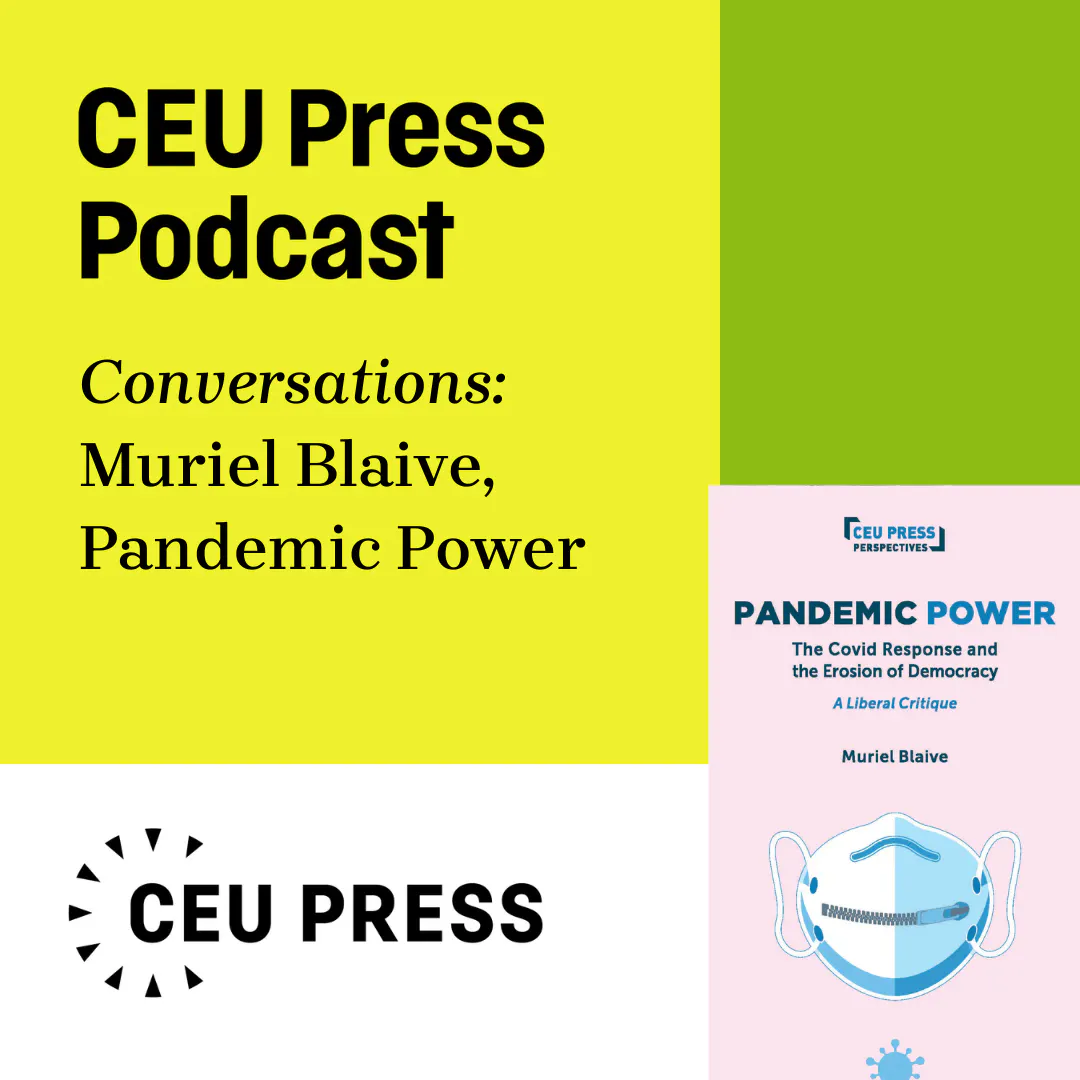
In this episode, host Andrea Talabér (CEU Press) sat down with Muriel Blaive to talk about her new book with CEU Press, Pandemic Power: The Covid Response and the Erosion of Democracy - A Liberal Critique. In the podcast we talked about the (failure of the) pandemic response, the necessity of critique, being shadowbanned on Facebook, censorship, and about liberal intellectuals abandoning their core values. Pandemic Power is available in Open Access, thanks to the support of the Austrian Science Fund. You can download a PDF copy here. You can purchase a physical copy here. During the podcast, we discussed the following article: Laura Spinney, “Five years on, the right’s Covid narrative has been turbo-charged into the mainstream”, The Observer, 9 March 2025. Muriel frequently posts on X. The CEU Press Podcast delves into various aspects of the publishing process: from crafting a book proposal, finding a publisher, responding to peer review feedback on the manuscript, to the subsequent distribution, promotion and marketing of academic books. We also talk to series editors and authors, who will share their experiences of getting published and discuss their series or books. Interested in CEU Press’s publications? Click here to find out more: https://ceupress.com/ Stay tuned for future episodes and subscribe to our podcast to be the first to be notified. Learn more about your ad choices. Visit megaphone.fm/adchoices Support our show by becoming a premium member! https://newbooksnetwork.supportingcast.fm/political-science
Ep 139James Davison Hunter, "Democracy and Solidarity: On the Cultural Roots of America's Political Crisis" (Yale UP, 2024)
Liberal democracy in America has always contained contradictions—most notably, a noble but abstract commitment to freedom, justice, and equality that, tragically, has seldom been realized in practice. While these contradictions have caused dissent and even violence, there was always an underlying and evolving solidarity drawn from the cultural resources of America’s “hybrid Enlightenment.” James Davison Hunter, who introduced the concept of “culture wars” thirty years ago, tells us in Democracy and Solidarity: On the Cultural Roots of America's Political Crisis (Yale UP, 2024) that those historic sources of national solidarity have now largely dissolved. While a deepening political polarization is the most obvious sign of this, the true problem is not polarization per se but the absence of cultural resources to work through what divides us. The destructive logic that has filled the void only makes bridging our differences more challenging. In the end, all political regimes require some level of unity. If it cannot be generated organically, it will be imposed by force. Can America’s political crisis be fixed? Can an Enlightenment-era institution—liberal democracy—survive and thrive in a post-Enlightenment world? If, for some, salvaging the older sources of national solidarity is neither possible sociologically, nor desirable politically or ethically, what cultural resources will support liberal democracy in the future? Learn more about your ad choices. Visit megaphone.fm/adchoices Support our show by becoming a premium member! https://newbooksnetwork.supportingcast.fm/political-science
Matthew D'Auria et al., "The Cambridge History of Nationhood and Nationalism" (Cambridge UP, 2024)
The origins and nature of nationhood and nationalism continue to be topics of heated scholarly debate. This major new reference work with contributions from an international team of scholars provides a comprehensive account of ideas and practices of nationhood and nationalism from antiquity to the present. It considers both continuities and discontinuities, engaging critically and analytically with the scholarly literature in the field. The Cambridge History of Nationhood and Nationalism (Cambridge UP, 2024) also explores nationhood and nationalism's relationships with a wide variety of cultural practices and social institutions, in addition to the phenomenon's crucial political dimensions. Its wide range of regional case studies brings a truly global, comparative perspective to a field long constrained by Eurocentric assumptions. Volume I tracks turning points in the history of nationhood and nationalism from ancient times to the twentieth century. Volume II theorizes the connections between nationhood/nationalism and ideology, religion and culture. Together, they enable readers to understand the roots of how nationhood and nationalism function in the present day. Cathie Carmichael is Professor of European History at the University of East Anglia, Norwich. Matthew D'Auria is a Lecturer in Modern European History at the University of East Anglia. Aviel Roshwald is an American historian and Professor of history at Georgetown University. Morteza Hajizadeh is a Ph.D. graduate in English from the University of Auckland in New Zealand. His research interests are Cultural Studies; Critical Theory; Environmental History; Medieval (Intellectual) History; Gothic Studies; 18th and 19th Century British Literature. YouTube channel. Twitter. Learn more about your ad choices. Visit megaphone.fm/adchoices Support our show by becoming a premium member! https://newbooksnetwork.supportingcast.fm/political-science
Ep 206Benjamin M. Studebaker, "Legitimacy in Liberal Democracies" (Edinburgh UP, 2024)
Liberal democracies don’t age gracefully. Established systems of governance like those of the UK and the US which once served as blueprints are today experiencing a profound crisis of legitimacy. In Britain, a landslide general election result was quickly followed by a catastrophic tumble in approval ratings. In the US presidential campaign, meanwhile, voters were told that democracy itself was on the ballot, with both candidates suggesting the election might well be the last one ever. The consensus underpinning the world’s most powerful democracies is, indeed, waning. The populaces have developed a deep dissatisfaction with their governments’ political procedures, yet no credible alternatives have emerged. In his latest book Legitimacy in Liberal Democracies (Edinburgh UP, 2024), Benjamin Studebaker argues that the kinds of disagreements which historically led to political violence today instead just linger throughout the state and society. Without alternatives, liberal democracy’s legitimation crisis leads to neither reform nor revolution. Studebaker depicts a legitimacy crisis rife with state capacity problems, in which citizens tell each other many conflicting legitimation stories as they search for ways to live with a dissatisfying political system they cannot replace. As different factions try to ‘save’ democracy in their own ways, they appear authoritarian to one another. Efforts to build legitimacy thus only spark greater inequality, pluralism, and ever-tighter gridlock. Benjamin Studebaker is a political theorist. He holds a PhD in Politics and International Studies from the University of Cambridge. He has written for Aeon, Sublation, Compact, Current Affairs, The Bellows, and Huffington Post, among others. He hosts Political Theory 101 and co-hosts the film podcast The Lack. Benjamin is also the author of The Chronic Crisis of American Democracy which we spoke about in 2023. Learn more about your ad choices. Visit megaphone.fm/adchoices Support our show by becoming a premium member! https://newbooksnetwork.supportingcast.fm/political-science
Ep 150Adam J. Berinsky, "Political Rumors: Why We Accept Misinformation and How to Fight It" (Princeton UP, 2023)
Political rumors and misinformation pollute the political landscape. This is not a recent phenomenon; before the currently rampant and unfounded rumors about a stolen election and vote-rigging, there were other rumors that continued to spread even after they were thoroughly debunked, including doubts about 9/11 (an “inside job”) and the furor over President Obama’s birthplace and birth certificate. If misinformation crowds out the truth, how can Americans communicate with one another about important issues? In Political Rumors: Why We Accept Misinformation and How to Fight It (Princeton UP, 2023), Adam Berinsky examines why political rumors exist and persist despite their unsubstantiated and refuted claims, who is most likely to believe them, and how to combat them. Drawing on original survey and experimental data, Berinsky shows that a tendency toward conspiratorial thinking and vehement partisan attachment fuel belief in rumors. Yet the reach of rumors is wide, and Berinsky argues that in fighting misinformation, it is as important to target the undecided and the uncertain as it is the true believers. We’re all vulnerable to misinformation, and public skepticism about the veracity of political facts is damaging to democracy. Moreover, in a world where most people simply don’t pay attention to politics, political leaders are often guilty of disseminating false information—and failing to correct it when it is proven wrong. Berinsky suggests that we should focus on the messenger as much as the message of rumors. Just as important as how misinformation is debunked is who does the debunking. Adam J. Berinsky is the Mitsui Professor of Political Science at MIT and the founding director of the MIT Political Experiments Research Lab. A specialist in the fields of political behavior and public opinion, he is the author of Silent Voices: Public Opinion and Political Participation in America (Princeton) and In Time of War: Understanding American Public Opinion from World War II to Iraq. Morteza Hajizadeh is a Ph.D. graduate in English from the University of Auckland in New Zealand. His research interests are Cultural Studies; Critical Theory; Environmental History; Medieval (Intellectual) History; Gothic Studies; 18th and 19th Century British Literature. YouTube channel. Twitter. Learn more about your ad choices. Visit megaphone.fm/adchoices Support our show by becoming a premium member! https://newbooksnetwork.supportingcast.fm/political-science
Ep 262Eric Min, "Words of War: Negotiation as a Tool of Conflict" (Cornell UP, 2025)
Of all interstate conflicts across the last two centuries, two-thirds have ended through negotiated agreement. Wartime diplomacy is thus commonly seen as a costless and mechanical process solely designed to end fighting. But as Dr. Eric Min argues in Words of War: Negotiation as a Tool of Conflict (Cornell University Press, 2025), that wartime negotiations are not just peacemaking tools. They are in fact a highly strategic activity that can also help states manage, fight, and potentially win wars. To demonstrate that wartime talk does more than simply end hostilities, Dr. Min distinguishes between two kinds of negotiations: sincere and insincere. Whereas sincere negotiations are good faith honest attempts to reach peace, insincere negotiations exploit diplomacy for some other purpose, such as currying gaining political support or remobilizing forces. Two factors determine whether and how belligerents will negotiate: the amount of pressure that outside parties can place on belligerents them to engage in diplomacy, and information obtained from fighting on the battlefield. Combining statistical and computational text analyses with qualitative case studies ranging from the War of the Roman Republic to the Korean War, Dr. Min shows that negotiations are more likely to occur with strong external pressures. A combination of such pressures and indeterminate battlefield activity, however, will most likely leads to insincere negotiations that may stoke fighting rather than end it. By revealing that diplomacy can sometimes be counterproductive to peace, Words of War compels us to rethink the assumption that it "cannot hurt" to promote diplomacy during war. This interview was conducted by Dr. Miranda Melcher whose new book focuses on post-conflict military integration, understanding treaty negotiation and implementation in civil war contexts, with qualitative analysis of the Angolan and Mozambican civil wars. You can find Miranda’s episodes on New Books with Miranda Melcher, wherever you get your podcasts. Learn more about your ad choices. Visit megaphone.fm/adchoices Support our show by becoming a premium member! https://newbooksnetwork.supportingcast.fm/political-science
Ep 263Frances Yaping Wang, "The Art of State Persuasion: China's Strategic Use of Media in Interstate Disputes" (Oxford UP, 2024)
Why do nations actively publicize previously overlooked disputes? And why does this domestic mobilization sometimes fail to result in aggressive policy measures? The Art of State Persuasion (Oxford UP, 2024) delves into China's strategic use of state propaganda during crucial crisis events, particularly focusing on border disputes. Frances Wang aims to explain the diverse strategies employed in Chinese state media, analyzing why certain disputes are amplified while others are downplayed. This variation, as proposed, is contingent on the degree of alignment between Chinese state policy and public opinion. When public sentiment is more moderate than the state's foreign policy objectives, the government initiates a "mobilization campaign." Conversely, if public opinion is more hawkish than state policy, the authorities deploy a "pacification campaign" to mollify public sentiment. Through a comprehensive examination of medium-N and case-study analyses, Wang elucidates these arguments. The research incorporates extensive textual analyses of media reports, interviews with officials and journalists, and archival data. The book also illuminates the mechanics of mobilization and pacification media campaigns, enabling policy makers to distinguish varying state foreign policy intentions. This book not only acknowledges the significance of public opinion but also illustrates how fluctuating public sentiment is delicately managed by the state through diverse discursive tactics. By highlighting the existence and relevance of pacification campaigns, The Art of State Persuasion enhances our understanding of propaganda, and challenges the traditional view of China's propaganda as uniformly aggressive, bringing to light a more nuanced picture especially in the domain of foreign policy. Learn more about your ad choices. Visit megaphone.fm/adchoices Support our show by becoming a premium member! https://newbooksnetwork.supportingcast.fm/political-science
Ep 166Populism, Power, and the Crisis of Globalism: A Conversation with Wolfgang Streeck
What explains the growing divide between elites and the broader public in democracies across Europe and the United States? In this episode of International Horizons, sociologist Wolfgang Streeck joins RBI director John Torpey to discuss the rise of populism, the limits of globalism, and the tensions between democracy and capitalism. Drawing from his recent book, Taking Back Control? States and State Systems After Globalism (Verso, 2024), Streeck examines how market forces, technocracy, and the erosion of national sovereignty have fueled discontent across the transatlantic world. He also reflects on the educational divide shaping political cleavages, the challenges posed by immigration, and the implications of U.S. foreign policy and security commitments in Europe and beyond. The conversation explores the shifting foundations of the postwar international order and the prospects for a more democratic and egalitarian global system. Learn more about your ad choices. Visit megaphone.fm/adchoices Support our show by becoming a premium member! https://newbooksnetwork.supportingcast.fm/political-science
Ep 27Colonial Origins of Democracy and Dictatorship: A Discussion with Alexander Lee and Jack Paine
The debate about the impact of colonialism on the prospects for democracy and development continues to rage. Was the legacy of colonialism equally destructive everywhere? Or were some forms of colonial rule more likely to give rise to stable and effective democracies? Join Nic Cheeseman as he talks to Alexander Lee and Jack Paine about their important new book, The Colonial Origins of Democracy and Dictatorship (Cambridge UP, 2024), which makes a compelling new contribution to the debate. Find out why countries with lengthy exposure to competitive colonial institutions tended to consolidate democracies after independence, and how regime trajectories shaped by colonial rule persist to the present day. Guest: Alexander Lee is an Associate Professor of Political Science at the University of Rochester. His work has made important contributions to a number of areas, including gender quotas, affirmative action, the political economy of South Asia and the legacy of colonialism. His most recent book, Colonial Origins of Democracy and Dictatorship has been highly praised and is out now with Cambridge University Press. Jack Paine is an Associate Professor and Director of Graduate Studies in the Department of Political Science at Emory University. He is known for influential research on a range of topics including democratic backsliding, authoritarian power sharing, conflict and the resource curse, and the legacy of colonialism. His most recent book, Colonial Origins of Democracy and Dictatorship has been highly praised and is out now with Oxford University Press. Presenter: Dr Nic Cheeseman is the Professor of Democracy and International Development at the University of Birmingham and Founding Director of CEDAR. The People, Power, Politics podcast brings you the latest insights into the factors that are shaping and re-shaping our political world. It is brought to you by the Centre for Elections, Democracy, Accountability and Representation (CEDAR) based at the University of Birmingham, United Kingdom. Join us to better understand the factors that promote and undermine democratic government around the world and follow us on Twitter at @CEDAR_Bham! Learn more about your ad choices. Visit megaphone.fm/adchoices Support our show by becoming a premium member! https://newbooksnetwork.supportingcast.fm/political-science
We Have Never Been Woke: A Conversation with Musa al-Gharbi
Why does occupation reliably predict political leanings? What is social capitalism, and how does it span income classes? If social capitalists are sincerely committed to equality and “wokeness,” why do they simultaneously benefit from—and perpetuate—the very inequalities they denounce? Join us as we dive into Musa al-Gharbi’s provocative new book, We Have Never Been Woke: The Cultural Contradictions of a New Elite (Princeton University Press, 2024). We explore al-Gharbi’s central argument: the disconnect between the stated values of the "symbolic capital elite" and the real-world consequences of their actions, despite their genuine intentions. Al-Gharbi draws parallels to past "great awakenings"—periods of profound cultural upheaval and shifting attitudes toward civil rights. We also examine whether defining "wokeness" is essential to his thesis, and al-Gharbi clarifies some of the most frequently misunderstood aspects of his work. Musa al-Gharbi is a sociologist and assistant professor in the School of Communication and Journalism at Stony Brook University. A columnist for The Guardian, his writing has appeared in The New York Times, The Washington Post, The Atlantic, and other major publications. Madison’s Notes is the podcast of Princeton University’s James Madison Program in American Ideals and Institutions. Contributions to and/or sponsorship of any speaker does not constitute departmental or institutional endorsement of the specific program, speakers or views presented. Learn more about your ad choices. Visit megaphone.fm/adchoices Support our show by becoming a premium member! https://newbooksnetwork.supportingcast.fm/political-science
Ep 39Postscript: Collective Action to Support Students at American Colleges and Universities
A coalition of educators and allies has come together to push back against a variety of different kinds of attacks on higher education and students at colleges and universities, particularly in the United States. This group is driven by the belief that a democracy is only as strong as its commitments to academic freedom, intellectual integrity, human diversity, and individual dignity. The impetus among this particular group of academics and staff members is to make sure that students at all the campuses, in all the programs at those campuses across the United States are supported and free to engage in their chosen courses of study. The various ways in which this mission is being attacked or undermined, with the slashing of grants, attempts to control curriculum, freezing of campus free speech, snatching of students off the streets, and threats to the bottom line all contribute to destabilizing the educational paths of students, and the ability of the faculty and the staff to provide students with the education, research opportunities, and higher education experiences they are seeking at these institutions. I am joined on this installment of PostScript by three members of an organic group of educators—across disciplines—who came together in the early days of the new Trump Administration to try to figure out how to best support students at different institutions. One of the results of this collaboration among academics and educators across disciplines, institutions, and parts of the country, was to craft a letter directed at university administrators, governmental entities, and the public, explaining the value and import of education, especially in a democracy, and the need for a diversity of voices and contributors to that enterprise. I discuss the origin of the group, the genesis of the letter (which is available to sign here), and the deep concerns among those who work in higher education in the United States with Alison Gash, Daniel Laurison, and Nathan Lents. Alison Gash is Professor of Political Science and Head of the Department of Political Science at the University of Oregon. Daniel Laurison is Associate Professor of Sociology at Swarthmore College, the former Editor-in-Chief of the British Journal of Sociology, and a 2021-2023 Carnegie Fellow. Nathan Lents is Professor of Biology at John Jay College, Links: We are Higher Ed Letter: Speaking Out for Democracy and US Higher Education We are Higher Ed Website: https://www.wearehighered.org/ Lilly J. Goren is a professor of political science at Carroll University in Waukesha, WI. She is co-editor of The Politics of the Marvel Cinematic Universe (University Press of Kansas, 2022), as well as co-editor of the award winning book, Women and the White House: Gender, Popular Culture, and Presidential Politics (University Press of Kentucky, 2012), Email her comments at [email protected] or tweet to @gorenlj. Learn more about your ad choices. Visit megaphone.fm/adchoices Support our show by becoming a premium member! https://newbooksnetwork.supportingcast.fm/political-science
Ep 15Political Entertainment in a Post-Authoritarian Democracy
Welcome to the Global Media & Communication podcast series, a multimodal project powered by the Center for Advanced Research in Global Communication (CARGC) at the Annenberg School for Communication at the University of Pennsylvania. At CARGC, we produce and promote critical, interdisciplinary, and multimodal research on global media and communication. We aim to bridge academic scholarship and public life, bringing the best scholarship to bear on enduring global questions and pressing contemporary issues. Today, our host Juan Llamas-Rodriguez interviews Martín Echeverría about his book Political Entertainment in a Post Authoritarian Democracy: Humor in the Mexican Media (Routledge, 2024), co-written with Frida Rodelo. In this episode you will hear about: The affordances and limitations of YouTube for the political media ecosystem The role of memes in generating political interest among politically disinterested groups How people’s distrust of news organizations impact the communication environment for political news How restrictions on political speech have shifted in Mexico in the last few decades Guest Biography: Martín Echeverría is the Head of the Center for Studies in Political Communication at the Benemérita Universidad Autónoma de Puebla, Mexico. He holds a PhD in Communication and Culture from the University of Seville, Spain, and serves as Co-Chair of the Political Communication Section of the International Association of Media and Communication Research (IAMCR). His research, which focuses on the mediatization of politics, media systems, and the reception and political effects of media, has been published in leading journals such as The International Journal of Press/Politics, International Journal of Communication, Journalism Studies, and top Latin American outlets. He is the author and editor of several books, including Media and Politics in Post-Authoritarian Mexico: The Continuing Struggle for Democracy (Palgrave Macmillan, 2024) and Political Entertainment in a Post-Authoritarian Democracy (Routledge, 2023), the latter receiving the AEJMC 2024 Knudson Award for the best book on Latin American media in the United States. Host Biography: Juan Llamas-Rodriguez is a researcher and educator interested in how media theories allow us to critically analyze social phenomena on a global scale. He works as assistant professor in the Annenberg School for Communication and associate director of the Center for Advanced Research in Global Communication at the University of Pennsylvania. He is the author of Border Tunnels: A Media Theory of the US-Mexico Underground (University of Minnesota Press, 2023) and Y Tu Mamá También: A Queer Film Classic (McGill-Queen’s University Press, 2025), and editor of Media Travels: Toward an Atlas of Global Media (Amherst College Press, 2025). Credits Interview by: Juan Llamas-Rodriguez Produced by: Juan Llamas-Rodriguez Edited by: Anna Gamarnik Keywords: authoritarianism, memes, Mexico, political communication, political satire, YouTube Learn more about your ad choices. Visit megaphone.fm/adchoices Support our show by becoming a premium member! https://newbooksnetwork.supportingcast.fm/political-science
Postscript: History, Narratives, and Political Power--An Emergency Oral History Project
President Donald Trump has threatened the federal funding and jobs of institutions and individuals that document, archive, and analyze historical materials. On March 27, 2025, Trump signed “Restoring Truth and Sanity to American History,” an executive order that directs Vice President JD Vance to eliminate "divisive race-centered ideology" from Smithsonian museums, educational and research centers, and the National Zoo and to “restore” American history. While Trump has framed these actions as “efficiency” measures or removing bias in favor of women and underrepresented minorities, they are better understood as removing professionals who preserve the images and documents that politicians and public officials use to create powerful narratives. Today’s guests are two historians featured in a Washington Post article on the firing of federal historians and the new oral history project designed to capture the history of federal firings, layoffs, and the current work climate. Dr. Jason Chernesky is a historian of medicine, public health, and environmental history whose research focuses on child health issues in the United States. Jason was the historian for the Food and Drug Administration until receiving a termination letter in February 2025. He is now on temporary administrative leave and the creator of the emergency oral history project. Dr. Beth English is the Executive Director of the Organization of American Historians. Her research and teaching focus on the historical and contemporary labor movement, working-class issues, globalization, deindustrialization, and women in the workplace. She is the author of A Common Thread: Labor, Politics, and Capital Mobility in the Textile Industry, and co-editor of Global Women’s Work: Perspectives on Gender and Work in the Global Economy. Beth has contributed to the Washington Post, NPR, Vox, Huffington Post, The New Republic, and other media outlets. Mentioned in the podcast: OAH’s Emergency Oral History Project for federal workers (fired, on leave, or currently working) Gift link to the Washington Post article by Kyle Swenson about the oral history project “Origins of the FDA History Office” on the FDA website Organization of American Historians (OAH)’s Records at Risk Data Collection Initiative for individuals to report removed or changed material Arlington National Cemetery website removes histories highlighting Black, Hispanic, and women veterans Joint statement from the American Historical Association and Organization of American Historians Previous Postscripts with historian Dr. Wendy Rouse (Donald Trump is Erasing History – and what YOU can do about it) and executive directors of AHA and OAH, Drs. Jim Grossman and Beth English (Postscript: Not a Matter of Left or Right: Historians Fighting Censorship) Donate to the Emergency Oral History Project Learn more about your ad choices. Visit megaphone.fm/adchoices Support our show by becoming a premium member! https://newbooksnetwork.supportingcast.fm/political-science
Ep 128Andrew Canessa and Manuela Lavinas Picq, "Savages and Citizens: How Indigeneity Shapes the State" (U Arizona Press, 2025)
Although Indigenous peoples are often perceived as standing outside political modernity, Savages and Citizens: How Indigeneity Shapes the State (University of Arizona Press, 2025) by Dr. Andrew Canessa & Dr. Manuela Lavinas Picq takes the provocative view that Indigenous people have been fundamental to how contemporary state sovereignty was imagined, theorized, and practiced. Delving into European political philosophy, comparative politics, and contemporary international law, this open-access book shows how the concept of indigeneity has shaped the development of the modern state. The exclusion of Indigenous people was not a collateral byproduct; it was a political project in its own right. The book argues that indigeneity is a political identity relational to modern nation-states and that Indigenous politics, although marking the boundary of the state, are co-constitutive of colonial processes of state-making. In showing how indigeneity is central to how the international system of states operates, the book forefronts Indigenous peoples as political actors to reject essentializing views that reduce them to cultural “survivors” rooted in the past. With insights drawn from diverse global contexts and empirical research from Bolivia and Ecuador, this work advocates for the relevance of Indigenous studies within political science and argues for an ethnography of sovereignty in anthropology. Savages and Citizens makes a compelling case for the centrality of Indigenous perspectives to understand the modern state from political theory to international studies. This interview was conducted by Dr. Miranda Melcher whose new book focuses on post-conflict military integration, understanding treaty negotiation and implementation in civil war contexts, with qualitative analysis of the Angolan and Mozambican civil wars. You can find Miranda’s episodes on New Books with Miranda Melcher, wherever you get your podcasts. Learn more about your ad choices. Visit megaphone.fm/adchoices Support our show by becoming a premium member! https://newbooksnetwork.supportingcast.fm/political-science
Ep 28Rhys Machold, "Fabricating Homeland Security: Police Entanglements Across India and Palestine/Israel" (Stanford UP, 2024)
Homeland security is rarely just a matter of the homeland; it involves the circulation and multiplication of policing practices across borders. Though the term "homeland security" is closely associated with the United States, Israel is credited with first developing this all-encompassing approach to domestic surveillance and territorial control. Today, it is a central node in the sprawling global homeland security industry worth hundreds of billions of dollars. And in the wake of the 2008 Mumbai terrorist attacks, India emerged as a major growth market. Known as "India's 9/11" or simply "26/11," the attacks sparked significant public pressure to adopt "modern" homeland security approaches. Since 2008, India has become not only the single largest buyer of Israeli conventional weapons, but also a range of other surveillance technology, police training, and security expertise. Pairing insights from science and technology studies with those from decolonial and postcolonial theory, Fabricating Homeland Security: Police Entanglements Across India and Palestine/Israel (Stanford UP, 2024) traces 26/11's political and policy fallout, concentrating on the efforts of Israel's homeland security industry to advise and equip Indian city and state governments. Through a focus on the often unseen and overlooked political struggles at work in the making of homeland security, Rhys Machold details how homeland security is a universalizing project, which seeks to remake the world in its image, and tells the story of how claims to global authority are fabricated and put to work. Rhys Machold is Senior Lecturer in the School of Social and Political Sciences at the University of Glasgow. His work focuses on imperialism, colonialism, and empire, working from a transnational approach. He is an editor at Critical Studies on Security and an editorial board member at International Studies Review. He held research and teaching appointments at York University (Canada), the Danish Institute for International Studies, the Tata Institute of Social Sciences, and Wilfrid Laurier University. Deniz Yonucu is a Senior Lecturer in the School of Geography, Politics, and Sociology at Newcastle University. Her work focuses on policing and security, surveillance, left-wing and anti-colonial resistance, memory, and racism. Her monograph Police, Provocation, Politics: Counterinsurgency in Istanbul is the winner of the 2023 Anthony Leeds Prize for the best book in urban anthropology, awarded by the Critical Urban Anthropology Section of the American Anthropological Association. Learn more about your ad choices. Visit megaphone.fm/adchoices Support our show by becoming a premium member! https://newbooksnetwork.supportingcast.fm/political-science
Ep 759Amy Adamczyk, "Fetal Positions: Understanding Cross-National Public Opinion about Abortion" (Oxford UP, 2025)
Most people think about abortion in the context of the country they live in. In the U.S., abortion fuels debate, elections, and legislation. In China, abortion is often treated as a settled issue. Why and how do abortion attitudes vary across the world? In her new book, Fetal Positions: Understanding Cross-National Public Opinion about Abortion (Oxford UP, 2025), Dr. Amy Adamczyk examines the factors influencing cross-national abortion opinion, rates and individual abortion decisions. She investigates the relationship between attitudes and laws, and explores how personal and national characteristics shape views on abortion. Using large-scale public opinion surveys, interviews from two case study countries, and an analysis of newspaper articles from over 40 countries, she argues that cross-national differences in public opinion can largely be explained based on overall levels of religious belief, economic and educational development, type of government and government history, and gender inequality. The book distinguishes beliefs from behaviors and macro factors from personal characteristics to analyze the forces shaping cross-national abortion rates and personal abortion decisions. Dr. Amy Adamczyk is a sociology professor at the John Jay College of Criminal Justice and The Graduate Center at the City University of New York. Her work unravels the religious, cultural and social forces shaping public opinion on controversial issues like abortion, same-sex relations, premarital sex, and marijuana and terrorism. Her many earlier books include, Cross-National Public Opinion about Homosexuality: Examining Attitudes across the Globe (University of California Press 2017). Mentioned: World Values Study (free database) Amy Adamczyk, Brittany Suh, and Lindsay Lerner, “Analysis of the Relationship between Religion, Abortion, and Assisted Reproductive Technology: Insights into Cross-National Public Opinion” (2024) (free access to article) Ronald Inglehart and Wayne E. Baker, “Modernization, Cultural Change, and the Persistence of Traditional Values” (2000) (free access to article) Learn more about your ad choices. Visit megaphone.fm/adchoices Support our show by becoming a premium member! https://newbooksnetwork.supportingcast.fm/political-science
Ep 164Human Rights in the Trump Era: A Conversation with Kenneth Roth
In this episode of International Horizons, Kenneth Roth, former longtime executive director of Human Rights Watch, joins RBI director John Torpey to discuss Roth’s recent book, Righting Wrongs: Three Decades on the Front Lines Battling Abuse of Governments (Knopf, 2025), which reflects on strategies for defending civil, political, economic, and social rights in an increasingly complex international landscape. Roth explores the implications of Trump's dismantling of USAID, the evolving challenges posed by authoritarian regimes like China, and the critical role social media plays in both exposing and enabling human rights abuses globally. Tune in to hear how Roth maintains optimism about the human rights movement and its continued fight against human rights abuses. Learn more about your ad choices. Visit megaphone.fm/adchoices Support our show by becoming a premium member! https://newbooksnetwork.supportingcast.fm/political-science
Ep 272Madhavi Devasher, "Crossing Lines: Cross-Ethnic Coalitions in India and Prospects for Minority Representation" (Routledge, 2024)
Crossing Lines: Cross-Ethnic Coalitions in India and Prospects for Minority Representation (Routledge, 2024) explains why, how, and where ethnic political parties unexpectedly seek votes from non-coethnics and when voters support non-coethnic parties. It draws on case studies of three Indian states (Uttar Pradesh, Punjab, Rajasthan) and of Indian national elections to demonstrate how differences in party systems impact political party strategies and voter choices. It shows that multipolar party systems encourage political parties to provide physical security, representation, and economic benefits for minorities, especially Muslims, in India and as a result, foster cross-ethnic links between parties and voters. However, as political arenas become dominated by two or even one party, advocacy for the interests of marginalized groups declines, weakening cross-ethnic linkages. The book thus explains why representation and advocacy for Muslims in Uttar Pradesh and at the national level has alternated dramatically in the 21st century. Yash is a PhD candidate in Political Science at the School of Public and International Affairs, University of Cincinnati. His research is focused on the interactions of political mobilization and anti-minority violence within Hindu nationalist organizations in India. Twitter Email: [email protected] Learn more about your ad choices. Visit megaphone.fm/adchoices Support our show by becoming a premium member! https://newbooksnetwork.supportingcast.fm/political-science
Ep 37Postscript: Not a Matter of Left or Right: Historians Fighting Censorship
The executive directors of the American Historical Association and Organization of American Historians join the podcast to talk about the effects of historical censorship, data shredding, meaningful public education – and what everyone can do to fight back. After being sworn in as the 47th president, Donald Trump issued a slew of executive orders. The order entitled “Defending Women from Gender Ideology Extremism and Restoring Biological Truth to the Federal Government” declares that “It is the policy of the United States to recognize two sexes, male and female. These sexes are not changeable and are grounded in fundamental and incontrovertible reality. Under my direction, the Executive Branch will enforce all sex-protective laws to promote this reality...” This order has swiftly affected what people may read on websites or museum panels that describe historical events and artifacts. As a new joint statement from the American Historical Association and the Organization of American Historians recounts, “Some alterations, such as those related to topics like the Tuskegee Airmen and the internment of Japanese Americans during World War II, have been hurriedly reversed in response to public outcry. Others remain. The scrubbing of words and acronyms from the Stonewall National Monument webpage, for instance, distorts the site’s history by denying the roles of transgender and queer people in movements for rights and liberation. This distortion of history renders the past unrecognizable to the people who lived it and useless to those who seek to learn from the past.” Dr. Beth English is Executive Director of the Organization of American Historians. Her research and teaching focus on the historical and contemporary labor movement, working-class issues, globalization, deindustrialization, and women in the workplace. She is the author of A Common Thread: Labor, Politics, and Capital Mobility in the Textile Industry, and co-editor of Global Women’s Work: Perspectives on Gender and Work in the Global Economy. She has contributed to the Washington Post, NPR, Vox, Huffington Post, The New Republic, and other media outlets. Dr. James R. Grossman is executive director of the American Historical Association. Previously, he was vice president for research and education at the Newberry Library, and has taught at University of Chicago and University of California, San Diego. Among his many publications are the award-winning books, Land of Hope: Chicago, Black Southerners, and the Great Migration and A Chance to Make Good: African-Americans, 1900–1929. His articles and short essays have focused on various aspects of American urban history, African American history, ethnicity, higher education, and the place of history in public culture. His public facing scholarship includes work published in the Chicago Tribune, New York Times, Los Angeles Times, Time, The Hill, The Chronicle of Higher Education, and Inside Higher Education. Grossman has consulted on history-related projects generated by the BBC, Smithsonian, and various theater companies, film makers, museums, libraries, and foundations. He has served on the governing boards of the National Humanities Alliance, American Council of Learned Societies, Association of American Colleges and Universities, and Center for Research Libraries. Mentioned: OAH’s Records at Risk Data Collection Initiative for individuals to report removed or changed material For federal workers who are interested in sharing their experiences, OAH’s Emergency Oral History Project Arlington National Cemetery website removes histories highlighting Black, Hispanic, and women veterans National Center for Education Statistics (NCES) Removal of climate data from government websites Contribute to AHA and OAH 5calls ap for connecting with federal senators and representatives AHA Action Alert for Iowa residents (and AHA letter to Iowa Senate Education Committee) Learn more about your ad choices. Visit megaphone.fm/adchoices Support our show by becoming a premium member! https://newbooksnetwork.supportingcast.fm/political-science
Ep 124Adam K. Webb, "The World's Constitution: Spheres of Liberty in the Future Global Order" (Routledge, 2025)
“One thing I would note about the Trumpian populists and their counterparts elsewhere in the West today is that they're a very peculiarly tribal kind of post conservative right. It's almost a kind of reassertion of paganism and tribal boundaries and grievance. That is very different from a more traditional kind of conservatism, where the texture of society and the accumulated wisdom of the past and the cultivation of virtue loomed large – at least as ideals, as aspirations. In contrast to that, this kind of contemporary populism has very little texture or wisdom or virtue – its more like a resentful atomism that is invoking certain tribal markers of membership because it's politically convenient, as it were.” – Adam Kempton Webb, NBN interview March 2025 In this expansive and thought-provoking interview, Adam K. Webb lays out a sweeping vision for a post-liberal, post-national world constitution, challenging the dominance of state sovereignty, corporate capitalism, and procedural liberalism. Drawing on over a quarter-century of scholarship culminating in his latest book The World’s Constitution (Routledge, 2025) Webb proposes a system of functional sphere pluralism, where governance is rooted in ethical traditions rather than ideology – where citizenship, law, and economic participation are no longer restricted by territorial nation-states. Coming to terms with Webb’s interdisciplinary and cross-cultural perspective suggests an affinity with thinkers like the late James C. Scott, in his critique of centralized control, coupled with the sensibilities of Roger Scruton and Patrick Deneen, in their defense of ethical and cultural order. Yet Webb diverges from them all in his insistence on a global, meta-constitutional framework, which might place him closer to the likes of Robert D. Kaplan, as seen in his latest work on civilizational cycles and geopolitical evolution. From his critique of elite legal capture (responding to a question on Katharina Pistor’s The Code of Capital) to his historical engagement with Confucian, Islamic, and European pluralist traditions, Webb offers a bold alternative to today’s stagnating governance models. Whether you are interested in constitutional theory, global governance, or the future of civilization itself, the professor’s insights in this interview offers an intellectually rich and thought provoking conversation that is well worth your time. Below are links to Dr. Webb’s latest books – Taylor & Francis Open Access publications: Deep Cosmopolis: Rethinking World Politics and Globalization (2015) The World’s Constitution: Spheres of Liberty in the Future Global Order (2025) Learn more about your ad choices. Visit megaphone.fm/adchoices Support our show by becoming a premium member! https://newbooksnetwork.supportingcast.fm/political-science
Gerald J. Postema, "Law's Rule: The Nature, Value, and Viability of the Rule of Law" (Oxford UP, 2022)
Rule of law faces serious threats to its viability in many countries. It has become a recurring topic in the media and is affecting our daily lives. To understand better the meaning of rule of law, the stakes, and how governments and citizens can respond to today’s challenges, we must return to first principles. In Law’s Rule (Oxford U. Press, 2022), eminent philosopher of law Gerald Postema draws on a lifetime of research and thought to articulate and defend a comprehensive, coherent, and compelling conception of the rule of law and defend it against serious challenges to its intelligibility, relevance, and normative force. The rule of law's ambition, Postema argues, is to provide protection and recourse against the arbitrary exercise of power using the distinctive tools of the law. Law provides a bulwark of protection, a bridle on the powerful, and a bond constituting and holding together the polity and giving public expression to an ideal mode of association. Two principles immediately follow from this core: sovereignty of law, demanding that those who exercise ruling power govern with law and that law governs them, and equality in the eyes of the law, demanding that law's protection extend to all bound by it. Animating law's rule, the ethos of fidelity commits all members of the political community, officials and lay members alike, to take responsibility for holding each other accountable under the law. Postema’s work is theoretically rigorous while addressing the myriad practical considerations in building and maintaining the rule of law. Gerald Postema is Emeritus Professor of Philosophy, University of North Carolina had has widely published in legal and political philosophy and ethics. He earned a BA degree from Calvin College (1970) and PhD (1976) from Cornell University. He began his teaching career at Johns Hopkins University (1975-1980). From 1980 until his retirement in 2019, he taught philosophy and law at UNC-Chapel Hill, since 1996 as Boshamer Distinguished Professor of Philosophy. He is interviewed by Thomas McInerney, an international lawyer, scholar, and strategist, who has worked to advance rule of law internationally for 25 years. He has taught in the Rule of Law for Development Program at Loyola University Chicago School of Law since 2011. He writes the Rights, Regulation and Rule of Law newsletter on Substack. Learn more about your ad choices. Visit megaphone.fm/adchoices Support our show by becoming a premium member! https://newbooksnetwork.supportingcast.fm/political-science
Ep 43Vuk Vuksanovic, "Serbia’s Balancing Act: Between Russia and the West" (Bloomsbury, 2025)
Even before its rebirth as a nation in the 1990s, Serbia had acquired a reputation abroad as Russia’s stalwart Slavic ally in the Western Balkans. Yet, as Vuk Vuksanović argues in Serbia’s Balancing Act: Between Russia and the West (Bloomsbury, 2025), two centuries of history and the 25 years since the fall of Slobodan Milošević tell a more nuanced story. "When it comes to Russia's interests,” he writes, “there are no sacred cows in Serbia-Russia relations". Governments in Belgrade will be courted and then discarded depending on Moscow’s needs, and they know it. For their part, the Serbs depend on Russian political support in their campaign for a face-saving settlement of the long-running Kosovo dispute but know their economic success hinges on their ties to the EU and the US. Belgrade must "manipulate the superpower rivalry to secure economic resources from both superpowers and its political strategic autonomy". Vuk Vuksanović is a foreign policy expert at the Belgrade Centre for Security Policy, an associate of the Central and South-East Europe Programme at LSE IDEAS, and a prominent media commentator on strategy in the Balkans. *His book recommendations were Rival Power: Russia in Southeast Europe by Dimitar Bechev (Yale University Press, 2017) and Why War? by Christopher Coker (Hurst, 2021). Tim Gwynn Jones is an economic and political risk analyst at Medley Advisors, who also writes and podcasts on Substack at 242.news. Learn more about your ad choices. Visit megaphone.fm/adchoices Support our show by becoming a premium member! https://newbooksnetwork.supportingcast.fm/political-science
Ep 142In Covid’s Wake: How our Politics Failed Us--A Conversation with Stephen Macedo (Part 2)
This week on Madison’s Notes, we continue our discussion with Stephen Macedo, co-author of In COVID’s Wake: How Our Politics Failed Us (Princeton UP, 2025). The book examines the institutional failures during the pandemic, including the politicization of science, inconsistent messaging, and the disproportionate impacts of policies. We cover key questions: What did “following the science” mean before COVID-19? Macedo explains that science is inherently uncertain, but this nuance was often lost during the pandemic, leading to unrealistic expectations. He also highlights how poor communication about scientific uncertainty eroded public trust. The conversation addresses contradictory messaging about the origins of COVID-19, with public statements often differing from internal expert discussions. Macedo notes how this disconnect fueled skepticism. He also raises concerns about potential conflicts of interest among health officials and the dangers of concentrating decision-making power in a few unchecked individuals. Macedo discusses the politicization of masking, which overshadowed scientific evidence and deepened divisions. He advises individuals to seek reputable sources, embrace uncertainty, and remain critical of simplistic narratives. Finally, he stresses the importance of accountability, open debate, and a commitment to democratic values like tolerance and truth as essential for navigating future crises. This episode offers a concise yet powerful reflection on the lessons of the pandemic and the need for stronger, more transparent governance. Tune in for the full conversation. Madison’s Notes is the podcast of Princeton University’s James Madison Program in American Ideals and Institutions. Contributions to and/or sponsorship of any speaker does not constitute departmental or institutional endorsement of the specific program, speakers or views presented. Learn more about your ad choices. Visit megaphone.fm/adchoices Support our show by becoming a premium member! https://newbooksnetwork.supportingcast.fm/political-science
Ep 760Marilyn Nissim-Sabat and Neil Roberts, "Creolizing Hannah Arendt" (Rowman & Littlefield, 2024)
Marilyn Nissim-Sabat and Neil Roberts have edited a new collection of essays, Creolizing Hannah Arendt. This edited volume dives into Hannah Arendt’s thinking while also pushing the understanding and ways that Arendt has influenced political theory, philosophy, and politics. The idea of “creolizing,” especially philosophic or theoretical work, is to explore a thinker’s work from more pluralistic perspectives, often pushing the ideas and their analysis beyond the northern and western position in which that work was generally created. Arendt’s work, which comes to us in a number of forms, was written in the context of the Holocaust and the world before and after that trauma. The contributing authors to Creolizing Hannah Arendt build on Arendt’s considerations and analysis, taking and applying her work to other situations, to determine what we can learn in a distinct situation or in context of other theoretical frameworks. Creolizing is an engagement where two or more elements come into discourse with each other, rethinking the ways those in western political thought are positioned, or see the world. This process questions, on some level, the entire notion of the “canon” and the design of borders that hem in thinking, or disciplinary lines. Creolizing Hannah Arendt is a sophisticated collection of essays that brings forth Hannah Arendt’s thinking about freedom and individuals while also integrating other theorists who have interpreted Arendt’s work over the last century. Arendt focused some of her early work on the notion of being an outsider, of having a kind of double consciousness (for her, it was her Jewish identity in Europe during the Holocaust and afterwards in the United States.) But double consciousness was originally posited as an understanding and perspective by W.E.B. Dubois and Sylvia Wynter in their work, specifically the experience of African Americans, and that Paget Henry analyzes in the chapter “Sylvia Wynter, Political Philosophy, and the Creolization of Hannah Arendt.” Thus, putting these ideas in conversation with each other is an example of creolization, and an example of the kind of analysis in this edited volume. This is a fascinating book, opening up spheres of thinking not just about Arendt, but about so many other important theorists. And putting these ideas into conversation with each other. Creolizing Hannah Arendt does not intend to proselytize on behalf of Hannah Arendt, as Nissim-Sabat and Roberts note in our conversation, but to truly interact act with Arendt’s thinking and her ideas about freedom and unfreedom, double consciousness, revolution, and the concept of humanity. Lilly J. Goren is a professor of political science at Carroll University in Waukesha, WI. She is co-editor of The Politics of the Marvel Cinematic Universe (University Press of Kansas, 2022), as well as co-editor of the award winning book, Women and the White House: Gender, Popular Culture, and Presidential Politics (University Press of Kentucky, 2012), Email her comments at [email protected] or tweet to @gorenlj. Learn more about your ad choices. Visit megaphone.fm/adchoices Support our show by becoming a premium member! https://newbooksnetwork.supportingcast.fm/political-science