
New Books in Military History
1,728 episodes — Page 14 of 35
Ep 34Nicholas Morton, "The Crusader States and their Neighbours: A Military History, 1099-1187" (Oxford UP, 2020)
Nicholas Morton’s The Crusader States and their Neighbours: A Military History, 1099-1187 (Oxford UP, 2020) explores the military history of the medieval Near East, piecing together the fault-lines of conflict which entangled this much-contested region. This was an area where ethnic, religious, dynastic, and commercial interests collided and the causes of war could be numerous. Conflicts persisted for decades and were fought out between many groups including Kurds, Turks, Armenians, Arabs, and the Crusaders themselves. Nic Morton recreates this world, exploring how each faction sought to advance its own interests by any means possible, adapting its warcraft to better respond to the threats posed by their rivals. Strategies and tactics employed by the pastoral societies of the Central Asian steppe were pitted against the armies of the agricultural societies of Western Christendom, Byzantium, and the Islamic World, galvanising commanders to adapt their practices in response to their foes. In this episode, Nic joins me again to discuss histories of nomadic peoples fighting with and against the Crusader armies; what military history can tell us about the economic, social, and cultural history of the medieval Near East; and why Crusader history is still relevant to us today. Maggie Freeman is a PhD candidate in the School of Architecture at MIT. She researches uses of architecture by nomadic peoples and historical interactions of nomads and empires, with a focus on the modern Middle East. Learn more about your ad choices. Visit megaphone.fm/adchoices Support our show by becoming a premium member! https://newbooksnetwork.supportingcast.fm/military-history
Ep 27Simon Shuster, "The Showman: The Inside Story of the Invasion That Shook the World and Made a Leader of Volodymyr Zelensky" (William Morrow, 2024)
Since Simon Shuster's November 2023 Time cover story ("Nobody believes in our victory like I do - Nobody"), anyone with an interest in the war in Ukraine has been waiting for his fly-on-the-wall study of command. Finally, The Showman: The Inside Story of the Invasion That Shook the World and Made a Leader of Volodymyr Zelensky (William Morrow, 2024) is out. Born in Moscow but raised in California, Simon Shuster has reported from Russia and Ukraine for 17 years. Before joining Time, he worked in the region for the Moscow Times, Reuters, and AP. He first met Ukraine’s leader and his entourage when Zelensky was running for president in 2019 and built enough trust to be granted sustained wartime access three years later. Based on off-and-on-the-record conversations with the Ukrainian principals – including the president, his wife, their childhood friends, his chief of staff, his defence minister, his national security advisor, and the chief of staff of the armed forces – The Showman provides a unique insight into the conduct of the war from the top. *The authors' book recommendations are Midnight in Chernobyl: The Untold Story of the World's Greatest Nuclear Disaster by Adam Higginbotham (Bantam Press, 2019) and Lenin's Tomb: The Last Days of the Soviet Empire by David Remnick (Viking, 1993). Tim Gwynn Jones is an economic and political-risk analyst at Medley Advisors, who also writes the twenty4two newsletter on Substack and hosts the In The Room podcast series. Learn more about your ad choices. Visit megaphone.fm/adchoices Support our show by becoming a premium member! https://newbooksnetwork.supportingcast.fm/military-history
Ep 219Bradley R. Clampitt, "Lost Causes: Confederate Demobilization and the Making of Veteran Identity" (LSU Press, 2022)
Lost Causes: Confederate Demobilization and the Making of Veteran Identity (LSU Press, 2022) by Dr. Bradley R. Clampitt is a groundbreaking analysis of Confederate demobilisation. The book examines the state of mind of Confederate soldiers in the immediate aftermath of war. Having survived severe psychological as well as physical trauma, they now faced the unknown as they headed back home in defeat. Lost Causes analyses the interlude between soldier and veteran, suggesting that defeat and demobilisation actually reinforced Confederate identity as well as public memory of the war and southern resistance to African American civil rights. Intense material shortages and images of the war’s devastation confronted the defeated soldiers-turned-veterans as they returned home to a revolutionised society. Their thoughts upon homecoming turned to immediate economic survival, a radically altered relationship with freedpeople, and life under Yankee rule—all against the backdrop of fearful uncertainty. Dr. Clampitt argues that the experiences of returning soldiers helped establish the ideological underpinnings of the Lost Cause and create an identity based upon shared suffering and sacrifice, a pervasive commitment to white supremacy, and an aversion to Federal rule and all things northern. As Lost Causes reveals, most Confederate veterans remained diehard Rebels despite demobilization and the demise of the Confederate States of America. This interview was conducted by Dr. Miranda Melcher whose forthcoming book focuses on post-conflict military integration, understanding treaty negotiation and implementation in civil war contexts, with qualitative analysis of the Angolan and Mozambican civil wars. Learn more about your ad choices. Visit megaphone.fm/adchoices Support our show by becoming a premium member! https://newbooksnetwork.supportingcast.fm/military-history
Ep 93Christopher Corker, "The Business and Technology of the Sheffield Armaments Industry, 1900-1930" (U of York, 2016)
Christopher Corker's The Business and Technology of the Sheffield Armaments Industry, 1900-1930 (U of York, 2016) focuses on four in-depth case studies of John Brown, Cammell-Laird, Thomas Firth and Hadfields to examine the business and technology of the industry. It builds on the work of Tweedale and Trebilcock on Sheffield and armaments, and advances the argument that during the period of study from 1900 to 1930, the city was one of the most important centres for armaments research and production anywhere in the world. The business of the armaments industry is explored through an examination of the evolving links the industry had with the Government against the backdrop of an uncertain trading environment, and the managerial connections established between the state and private industry. Also explored are the collaborative, collusive and independent defensive measures enacted by the industry to counter uncertainty in the industry, through collaborative business arrangements and various approaches to entering international markets for armaments. An examination of the business of the armaments industry also highlights the value of the technological investment made by the industry. At the centre of exploring the technology of the armaments industry, a reconstruction of its technological history is undertaken using patent and archival records, highlighting the nuances and research dead-ends of development in the industry. Of central importance is the notion of spin-off and the interactions between armaments and metallurgical developments in the creation of a pool of knowledge to be utilised for future research into alloy steels, and the notion of path-dependent technological research. Also advanced is the concept of an innovation system centred on Sheffield, and an exploration of the important national and international links advanced by the industry This title is available open access here. Chris is a business historian, and Lecturer in Management at the School for Business and Society at the University of York, where he is a former Director of Undergraduate Programmes. He completed his PhD in 2016, and won the 2017 Coleman Prize from the Association of Business Historians for excellence in new business history research, and an Emerald Literati Prize in 2019. His current research is on innovation and knowledge in industrial clusters, in particular the business and intellectual history of Stainless Steel, which has been supported by a small grant from the Business Archives Council. Outside of academia Chris is an advisor to Sheffield Archives, member of the Joined Up Heritage Sheffield Partnership Board, and former Chair of Portland Works Little Sheffield, a social enterprise housed in a 19th Century cutlery works. His work has also been featured on BBC Radio 3's Free Thinking. Also discussed during the podcast Chris Corker, ‘Continuity and Change in the Sheffield Armaments Industry 1919-1930’, Journal of Management History, Vol. 24, No.2, pp.174-188, 2018. Wilson, J.F., Corker, C., and Lane, J.P. (Eds), Industrial Clusters in the UK: Knowledge, Innovation Systems and Sustainability (Routledge, 2022). Learn more about your ad choices. Visit megaphone.fm/adchoices Support our show by becoming a premium member! https://newbooksnetwork.supportingcast.fm/military-history
Ep 218James C. Goodall, "Nautilus to Columbia: 70 Years of the US Navy's Nuclear Submarines" (Osprey, 2023)
In Nautilus to Columbia: 70 Years of the US Navy's Nuclear Submarines (Osprey, 2023), James C. Goodall covers the origins, design and development of the US Navy's fleet of nuclear-powered submarines. This program was developed under the command of Hiram G. Rickover, the "Father of the Nuclear Navy" who oversaw the commissioning of the very first nuclear-powered attack submarine, the USS Nautilus (SSN 571) in 1952. This was a truly revolutionary design. Until the advent of nuclear power, the world's submarine fleets traveled on the surface at night to charge their batteries, and only dove below the surface when enemy ships or planes were spotted. With the development of the USS Nautilus, the US Navy now had the ability to stay submerged for not just hours or days, but to hide out of harm's way for weeks or months at a time This highly illustrated book covers all of the 220+ submarine hulls built and delivered to the US Navy from the USS Nautilus through to the Navy's newest class of submarine, the Columbia class SSBNs. The story of the Nuclear Navy from its origins up to the present day is told through more than 1,300 images from official and archive sources, as well as the author's own personal collection, some of which have never been published before. Learn more about your ad choices. Visit megaphone.fm/adchoices Support our show by becoming a premium member! https://newbooksnetwork.supportingcast.fm/military-history
Ep 466Uri Kaufman, "Eighteen Days in October: The Yom Kippur War and How It Created the Modern Middle East" (St. Martin's Press, 2023)
October 2023 marks the 50th anniversary of the Yom Kippur War, a conflict that shaped the modern Middle East. The War was a trauma for Israel, a dangerous superpower showdown, and, following the oil embargo, a pivotal reordering of the global economic order. The Jewish State came shockingly close to defeat. A panicky cabinet meeting debated the use of nuclear weapons. After the war, Prime Minister Golda Meir resigned in disgrace, and a 9/11-style commission investigated the "debacle." But, argues Uri Kaufman in Eighteen Days in October: The Yom Kippur War and How It Created the Modern Middle East (St. Martin's Press, 2023), from the perspective of a half century, the War can be seen as a pivotal victory for Israel. After nearly being routed, the Israeli Defense Force clawed its way back to threaten Cairo and Damascus. In the war's aftermath both sides had to accept unwelcome truths: Israel could no longer take military superiority for granted--but the Arabs could no longer hope to wipe Israel off the map. A straight line leads from the battlefields of 1973 to the Camp David Accords of 1978 and all the treaties since. Like Michael Oren's Six Days of War, this is the definitive account of a critical moment in history. Drora Arussy, EdD, MA, MJS, is the Executive Director of Unity Through Diversity Institute. Learn more about your ad choices. Visit megaphone.fm/adchoices Support our show by becoming a premium member! https://newbooksnetwork.supportingcast.fm/military-history
Ep 110Matthew Levitt, "Hamas: Politics, Charity, and Terrorism in the Service of Jihad" (Yale UP, 2008)
The world is reeling from the savage terror attack that brutalized, raped, murdered and kidnapped Israelis and civilians from at least 25 other countries, continuing to hold many of them hostage – and from the ongoing war that followed. After Hamas took over Gaza in 2007, some thought it would become more moderate. That was wishful thinking. The barbaric massacre of October 7, 2023 made it clear that Hamas is a terrorist group intent on destroying Israel and hoping to spark a regional – and even wider-war. We talk with Matthew Levitt, a counterterrorism expert with extensive field experience in Israel, the West Bank, and Gaza, and author of Hamas: Politics, Charity, and Terrorism in the Service of Jihad (Yale UP, 2008). This important book provides the most fully researched assessment of Hamas ever written. It draws aside the veil of legitimacy behind which Hamas hid, by presenting concrete, detailed evidence from an extensive array of international intelligence materials, including recently declassified CIA, FBI, and Department of Homeland Security reports. Levitt demolishes the notion that Hamas’ military, political, and social wings are distinct from one another. Levitt exposes Hamas as a unitary organization committed to a militant Islamist ideology.and expands the book’s insights and their implication for the future in “The War Hamas Always Wanted.” Foreign Affairs, 16 Oct. 2023, and "The Road to Oct 7: Hamas’ Long Game, Clarified" in CTC Sentinel (Combating Terrorism Center at West Point), Vol. 16, issue 10, Oct.-Nov. 2023. Renee Garfinkel, Ph.D. is a psychologist, writer, Middle East television commentator and host of The New Books Network’s Van Leer Jerusalem Series on Ideas. Write her at [email protected]. She's on Twitter @embracingwisdom. She blogs here. Learn more about your ad choices. Visit megaphone.fm/adchoices Support our show by becoming a premium member! https://newbooksnetwork.supportingcast.fm/military-history
Ep 110Jeffrey A. Friedman, "The Commander-in-Chief Test: Public Opinion and the Politics of Image-Making in US Foreign Policy" (Cornell UP, 2023)
Americans frequently criticize US foreign policy for being overly costly and excessively militaristic. With its rising defense budgets and open-ended "forever wars," US foreign policy often appears disconnected from public opinion, reflecting the views of elites and special interests rather than the attitudes of ordinary citizens. The Commander-in-Chief Test: Public Opinion and the Politics of Image-Making in US Foreign Policy (Cornell UP, 2023) argues that this conventional wisdom underestimates the role public opinion plays in shaping foreign policy. Voters may prefer to elect leaders who share their policy views, but they prioritize selecting presidents who seem to have the right personal attributes to be an effective commander in chief. Leaders then use hawkish foreign policies as tools for showing that they are tough enough to defend America's interests on the international stage. This link between leaders' policy positions and their personal images steers US foreign policy in directions that are more hawkish than what voters actually want. Combining polling data with survey experiments and original archival research on cases from the Vietnam War through the occupations of Iraq and Afghanistan, Friedman demonstrates that public opinion plays a surprisingly extensive—and often problematic—role in shaping US international behavior. With the commander-in-chief test, a perennial point of debate in national elections, Friedman's insights offer important lessons on how the politics of image-making impacts foreign policy and how the public should choose its president. Jeffrey A. Friedman is Associate Professor of Government at Dartmouth College. Sam Canter is a policy and strategy analyst, PhD candidate in Politics and International Relations, and Army Reserve intelligence officer. His views are his own and do not reflect any institution, organization, or entity with which he is affiliated. Learn more about your ad choices. Visit megaphone.fm/adchoices Support our show by becoming a premium member! https://newbooksnetwork.supportingcast.fm/military-history
Ep 26Yaroslav Trofimov, "Our Enemies Will Vanish: The Russian Invasion and Ukraine's War of Independence" (Penguin, 2023)
Since February 2022, a string of books have been published about the war in Ukraine but, for the most part, these have been histories and political studies. Only now are the “first drafts of history” from war reporters starting to emerge. Christopher Miller and Andrew Harding published last summer and they will be followed, in late January, by Simon Shuster’s inside account of Volodymyr Zelensky’s war. But, beating Shuster by a fortnight, is Yaroslav Trofimov’s Our Enemies Will Vanish: The Russian Invasion and Ukraine's War of Independence (Penguin Press, 2024) - an account of the first year of the full-scale invasion combining history, frontline reporting, and flashes of emotion from the Wall Street Journal's Kyiv-born chief foreign-affairs correspondent "Being in a country at war,” he writes, “one is rarely distressed by the causalities of the invading army ... But, in the forests outside Lyman, these freshly dead Russian men with their civilian backpacks containing their meagre possessions, with their sleeping bags and pouches of fever and pain medication, were no longer anonymous and generic invaders. I looked at their faces and felt anger". Yaroslav Trofimov joined the Wall Street Journal in 1999 – reporting from Rome, Singapore, Pakistan, Dubai, and Afghanistan where he covered the Taliban’s takeover in 2021. Since January 2022 – a month before the invasion – he has been working out of Ukraine. This is his third book. *The authors' book recommendations are Sketches from a Secret War: A Polish Artist's Mission to Liberate Soviet Ukraine by Timothy Snyder (Yale University Press, 2005) and Kaputt by Curzio Malaparte (first published in Italian in 1944, the latest edition from Adelphi, 2014; translated into English and published in 2007 by NYRB Classics). Tim Gwynn Jones is an economic and political-risk analyst at Medley Advisors, who also writes the twenty4two newsletter on Substack and hosts the In The Room podcast series. Learn more about your ad choices. Visit megaphone.fm/adchoices Support our show by becoming a premium member! https://newbooksnetwork.supportingcast.fm/military-history
Ep 87Paul F. Diehl et al., "When Peacekeeping Missions Collide: Balancing Multiple Roles in Peace Operations" (Oxford UP, 2023)
The contemporary world is beset with a wide variety of conflicts, all of which have features without historical precedent. While most accounts of peacekeeping focus on attempts to limit violent conflict, this traditional view hardly captures the variety of challenges that today's peacekeepers face. Peacekeepers are now thrust into the unconventional roles of monitoring elections, facilitating transitions to the rule of law, distributing humanitarian aid, and resolving conflicts in civil societies that are undergoing transformation. This is the context for understanding the activities of modern-day peacekeepers. In When Peacekeeping Missions Collide: Balancing Multiple Roles in Peace Operations (Oxford University Press, 2023), Dr. Paul F. Diehl, Dr. Daniel Druckman, and Dr. Grace B. Mueller provide an original and comprehensive assessment on how different peacekeeping missions intersect with one another in contemporary conflicts. They begin by documenting the patterns of peacekeeping missions in 70 UN operations, noting the dramatic increase in number and diversity of operations since the end of the Cold War as well as the shift to conflicts with a substantial internal conflict component. They then turn to the overarching question of the book: how do individual peacekeeping missions impact the outcomes of other missions within the same operations? To answer this, the authors have developed a novel dataset of UN peace operations from 1946-2016 to assess mission compatibility. Moreover, the authors utilise five detailed case studies of UN peacekeeping operations featuring mission interdependence and then measure the results against their theoretical expectations. Ultimately, the model they have developed for analysing the effectiveness of the far more complex peace operations of today--relative to the simpler operations of the past--is essential reading for scholars of peacekeeping and conflict management. This interview was conducted by Dr. Miranda Melcher whose forthcoming book focuses on post-conflict military integration, understanding treaty negotiation and implementation in civil war contexts, with qualitative analysis of the Angolan and Mozambican civil wars. Learn more about your ad choices. Visit megaphone.fm/adchoices Support our show by becoming a premium member! https://newbooksnetwork.supportingcast.fm/military-history
Ep 462Bryan Mark Rigg, "The Rabbi Saved by Hitler's Soldiers: Rebbe Joseph Isaac Schneersohn and His Astonishing Rescue" (UP of Kansas, 2016)
When Hitler invaded Warsaw in the fall of 1939, hundreds of thousands of civilians were trapped in the besieged city. The Rebbe Joseph Schneersohn, the leader of the ultra-orthodox Lubavitcher Jews, was among them. When word of his plight went out, a group of American Jews initiated what would ultimately become one of the strangest—and most miraculous—rescues of World War II. And this is the incredible but true story that Bryan Mark Rigg tells in The Rabbi Saved by Hitler's Soldiers: Rebbe Joseph Isaac Schneersohn and His Astonishing Rescue (UP of Kansas, 2016). Amid the chaos and hell of the emerging Holocaust, a small group of German soldiers shepherded Rebbe Schneersohn and his Hasidic followers out of Poland. In the course of the daring escape—traveling by train to Berlin, rerouted to Latvia and Sweden, and carried by ship through U-boat-infested waters to America—the Rebbe would learn a shocking truth. The leader of the rescue operation, the decorated Wehrmacht soldier Ernst Bloch, was himself half-Jewish, and a victim of the rising tide of German anti-Semitism. Perhaps even more remarkable were the central roles of Admiral Wilhelm Canaris, head of the Nazi military intelligence service, and of Helmuth Wohlthat, chief administrator of Göring’s Four Year Plan. Pursuing every lead, amassing critical evidence, pulling together all the pieces of what could well be a political thriller, Rigg reconstructs the Rebbe’s improbable escape, and tells a harrowing story about identity and moral responsibility. His book is the definitive account of an extraordinary episode in the history of World War II. Drora Arussy, EdD, MA, MJS, is the Senior Director of the ASF Institute of Jewish Experience. Learn more about your ad choices. Visit megaphone.fm/adchoices Support our show by becoming a premium member! https://newbooksnetwork.supportingcast.fm/military-history
Ep 217Colin Jones, "The Fall of Robespierre: 24 Hours in Revolutionary Paris" (Oxford UP, 2021)
The day of 9 Thermidor (27 July 1794) is universally acknowledged as a major turning-point in the history of the French Revolution. At 12.00 midnight, Maximilien Robespierre, the most prominent member of the Committee of Public Safety which had for more than a year directed the Reign of Terror, was planning to destroy one of the most dangerous plots that the Revolution had faced. By 12.00 midnight at the close of the day, following a day of uncertainty, surprises, upsets and reverses, his world had been turned upside down. He was an outlaw, on the run, and himself wanted for conspiracy against the Republic. He felt that his whole life and his Revolutionary career were drawing to an end. As indeed they were. He shot himself shortly afterwards. Half-dead, the guillotine finished him off in grisly fashion the next day. The Fall of Robespierre (Oxford UP, 2021) provides an hour-by-hour analysis of these 24 hours. AJ Woodhams hosts the "War Books" podcast. You can subscribe on Apple here and on Spotify here. War Books is on YouTube, Facebook and Instagram. Learn more about your ad choices. Visit megaphone.fm/adchoices Support our show by becoming a premium member! https://newbooksnetwork.supportingcast.fm/military-history
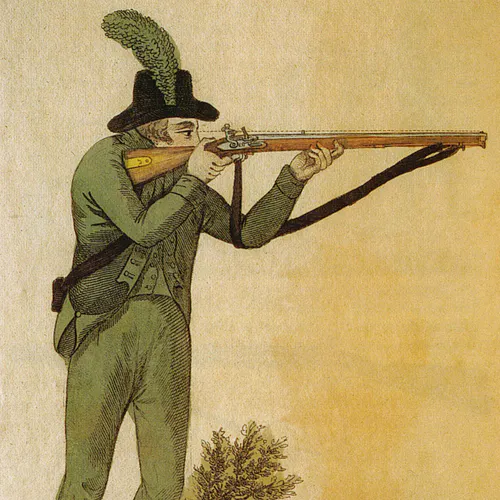
Ep 7Genealogies of Modernity Episode 7: A Genealogy of Gun Violence
The problem of gun violence is as old as guns themselves. According to historian Priya Satia, America’s present epidemic of gun violence has its roots in the industrial revolution. Satia tells the story of British gun-maker Samuel Galton, Jr., who was called to task by his Quaker community for manufacturing rifles. As a professed pacifist, Galton had to wrestle with the large-scale uses to which his weapons were put. So where do we look for answers about how to regulate guns? Some claim the answer has to lie in the past, in the nation’s founding documents. Others argue that novel technologies demand novel solutions. Solving the problem of gun violence may be a case where we need to make a strong modernity claim. Researcher, writer, and episode producer: Christopher Nygren, Associate Professor, History of Art and Architecture, University of Pittsburgh Featured Scholars: Catherine Fletcher, Professor of History, Manchester Metropolitan University Priya Satia, Professor of History, Stanford University Special thanks: James DeMasi, Chloé Hogg, Jonathan Lyonhart, Pernille Røge, Jennifer Waldron, Catherine Yanko. For transcript, teaching aids, and other resources, click here. Learn more about your ad choices. Visit megaphone.fm/adchoices Support our show by becoming a premium member! https://newbooksnetwork.supportingcast.fm/military-history
Ep 42Elena Schneider, "The Occupation of Havana: War, Trade and Slavery in the Atlantic World" (UNC Press, 2018)
Histories of the British occupation of Havana in 1762 have focused on imperial rivalries and the actions and decisions of European planters, colonial officials, and military officers. In her stunning revision, The Occupation of Havana: War, Trade and Slavery in the Atlantic World (University of North Carolina Press, 2018), Elena Schneider restores the central roles of enslaved Africans in all stages of the story. The relevance of the slave trade and the multiple and essential roles of African and African descended people in battle and in urban life emerge in this beautifully written account. In the aftermath, their valor and loyalty were omitted from contemporary accounts and the ensuing historiography. This book draws from a wide range of sources and multiple archives in a careful narrative that connects the Atlantic worlds of Spain, London, Havana, Kingston and the colonial United States, and zooms in on the enslaved individuals that made that world possible. Learn more about your ad choices. Visit megaphone.fm/adchoices Support our show by becoming a premium member! https://newbooksnetwork.supportingcast.fm/military-history
Ep 34Julia F. Irwin, "Catastrophic Diplomacy: US Foreign Disaster Assistance in the American Century" (UNC Press, 2023)
Catastrophic Diplomacy: US Foreign Disaster Assistance in the American Century (UNC Press, 2023) offers a sweeping history of US foreign disaster assistance, highlighting its centrality to twentieth-century US foreign relations. Spanning over seventy years, from the dawn of the twentieth century to the mid-1970s, it examines how the US government, US military, and their partners in the American voluntary sector responded to major catastrophes around the world. Focusing on US responses to sudden disasters caused by earthquakes, tropical storms, and floods—crises commonly known as "natural disasters"—historian Julia F. Irwin highlights the complex and messy politics of emergency humanitarian relief. Deftly weaving together diplomatic, environmental, military, and humanitarian histories, Irwin tracks the rise of US disaster aid as a tool of foreign policy, showing how and why the US foreign policy establishment first began contributing aid to survivors of international catastrophes. While the book focuses mainly on bilateral assistance efforts, it also assesses the broader international context in which the US government and its auxiliaries operated, situating their humanitarian responses against the aid efforts of other nations, empires, and international organizations. At its most fundamental level, Catastrophic Diplomacy demonstrates the importance of international disaster assistance—and humanitarian aid more broadly—to US foreign affairs. Julia F. Irwin, PhD, Yale University, 2009, is professor of history at Louisiana State University. Her research focuses on the place of humanitarian aid in twentieth-century U.S. foreign relations. Her first book, Making the World Safe: The American Red Cross and a Nation’s Humanitarian Awakening (2013), is a history of U.S. international relief efforts during the World War I era; the dissertation on which it is based won the Betty M. Unterberger Dissertation Prize from the Society for Historians of American Foreign Relations. Learn more about your ad choices. Visit megaphone.fm/adchoices Support our show by becoming a premium member! https://newbooksnetwork.supportingcast.fm/military-history
Ep 1399Jeffrey Whyte, "The Birth of Psychological War: Propaganda, Espionage, and Military Violence from WWII to the Vietnam War" (Oxford UP, 2023)
Jeffrey Whyte's book The Birth of Psychological War: Propaganda, Espionage, and Military Violence from WWII to the Vietnam War (Oxford UP, 2023) explores the history, politics, and geography of United States psychological warfare in the 20th century against the backdrop of the contemporary 'post-truth era'. From its origins in the Second World War, to the United States' counterinsurgency campaigns in Vietnam, Whyte traces how the theory and practice of psychological warfare transformed the relationship between the home front and theatres of war. Whyte interrogates the broader political mythologies that animate popular conceptions of psychological war, such as its claim to make war more humane and less violent. On the contrary, The Birth of Psychological War demonstrates the role of psychological warfare in expanding the scope and scale of military violence amidst ostensible efforts to 'win hearts and minds'. While casting a critical eye on psychological warfare, Whyte establishes its continued significance for the contemporary student of international relations. Dr. Whyte earned his Ph.D. with the Department of Geography, University of British Columbia and before that a MA with School of Communication, Simon Fraser University, also in beautiful British Columbia. He is currently Lecturer in International Relations at the Department of Politics, Philosophy, and Religion, Lancaster University. Michael G. Vann is a professor of world history at California State University, Sacramento. A specialist in imperialism and the Cold War in Southeast Asia, he is the author of The Great Hanoi Rat Hunt: Empires, Disease, and Modernity in French Colonial Vietnam (Oxford University Press, 2018). When he’s not reading or talking about new books with smart people, Mike can be found surfing in Santa Cruz, California. Learn more about your ad choices. Visit megaphone.fm/adchoices Support our show by becoming a premium member! https://newbooksnetwork.supportingcast.fm/military-history
Ep 302Jeremy Yellen, "The Greater East Asia Co-Prosperity Sphere: When Total Empire Met Total War" (Cornell UP, 2019)
Jeremy Yellen’s The Greater East Asia Co-Prosperity Sphere: When Total Empire Met Total War (Cornell University Press, 2019) is a challenging transnational exploration of the Greater East Asia Co-Prosperity Sphere, Japan’s ambitious, confused, and much maligned attempt to create a new bloc order in East and Southeast Asia during World War II. Yellen’s book is welcome both as the first book-length treatment of the Sphere in English and for also being innovative in both approach and analysis. The book is divided into two parts, each addressing one of the “two Pacific Wars,” as Yellen puts it: a “war of empires” and “an anticolonial war… for independence.” The first half of the book treats the Japanese “high policy” of the Sphere. Here, Yellen not only provides—through the Coprosperity Sphere—a provocative new reading of the Tripartite Pact and the imbrication of Japan’s regional and global geopolitical strategies, but also outlines an important timeline of how Japanese conceptualizations of the Sphere evolved with the changing economic, political, and military expediencies of the Pacific War. Though ideas about the Sphere as a regional order of hierarchical solidarity with Japan at its apex, a “grand strategy of opportunism” rooted in the “sphere-of-influence diplomacy” and “cooperative imperialism” of Japan’s bombastic and enigmatic foreign minister, Matsuoka Yōsuke, Yellen shows that plans for the Sphere only became specific and concrete when Japan’s war situation descended into increasing desperation from 1942 on. The second half of the book shifts gears to examine responses to the Sphere in the Philippines and Burma. Yellen shows that for local nationalist elites like Burma’s first prime minister Ba Maw, whether Japanese rhetoric about the creation of more-or-less liberal international order within the Sphere for the top-echelon nations like Burma and the Philippines was genuine or self-serving, “even sham independence brought opportunity.” By focusing on these pragmatic nationalists (“patriotic collaborators”) Yellen contributes to a growing body of literature on empire that refuses to be pigeonholed by binaries of virtuous resistance and traitorous collaboration. This podcast was recorded as a lecture/dialogue for a live audience at Nagoya University. Learn more about your ad choices. Visit megaphone.fm/adchoices Support our show by becoming a premium member! https://newbooksnetwork.supportingcast.fm/military-history
Ep 9On Native American Warfare: A Discussion with Author and Historian Wayne E. Lee
How did Native Americans make war, not with European settlers, but amongst themselves? Historian Wayne E. Lee, a professor at the University of North Carolina at Chapel Hill, explores this often-neglected question in his book, The Cutting-Off Way: Indigenous Warfare in Eastern North America, 1500-1800 (The University of North Carolina Press, 2023). The podcast begins with his explanation of the ‘cutting-off’ style of fight and retreat that characterized this method of warfare and proceeds to an understanding of the root causes of war among Native Americans including the imperative of “blood revenge.” Lee argues persuasively that wars among natives were endemic yet not of the “no-holds-barred” character of the European type. Also, unlike the Europeans, the Native Americans frowned on prisoner exchanges—prisoners, sometimes tortured, were seen as a measure of a campaign’s success—and the natives abjured rape of the enemy’s women as an allotted entitlement of war. Such important differences notwithstanding, The Cutting-Off Way also points to timeless principles in warfare, evident in today’s bloody conflicts, as when he writes: “The cultural mandate for revenge proved extremely difficult to overcome.” Veteran journalist Paul Starobin is a former Moscow bureau chief for Business Week and a former contributing editor of The Atlantic. He has written for The New York Times, The Washington Post, The Wall Street Journal and many other publications. His latest book, Putin’s Exiles: Their Fight for a Better Russia (Columbia Global Reports) will be published in January. Learn more about your ad choices. Visit megaphone.fm/adchoices Support our show by becoming a premium member! https://newbooksnetwork.supportingcast.fm/military-history
Ep 34Yael A. Sternhell, "War on Record: The Archive and the Afterlife of the Civil War" (Yale UP, 2023)
Yael A. Sternhell's War on Record: The Archive and the Aftermath of the Civil War (Yale University Press, 2023) is a history of the United States' greatest archival project and how it has shaped what we know about the Civil War. The Civil War generated a vast archive of official records--documents that would shape the postwar era and determine what future generations would know about the war. Yael Sternhell traces these records from their creation during wartime through their deployment in a host of postwar battles, including those between the federal government and Southerners seeking reparations and between veterans blaming each other for defeat. These documents were eventually published in the most important historical collection ever to have been assembled in the United States: The War of the Rebellion: The Official Records of the Union and the Confederate Armies. Known as the OR, it is the ultimate source for generations of scholars and writers and ordinary citizens researching the war. By delving into the archive, Sternhell reveals its power to shape myths, hide truths, perpetuate rancor, and foster reconciliation. Far more than a storehouse of papers, the Civil War archive is a major historical actor in its own right. Hallel Yadin is an archivist and special projects manager at the YIVO Institute for Jewish Research. Learn more about your ad choices. Visit megaphone.fm/adchoices Support our show by becoming a premium member! https://newbooksnetwork.supportingcast.fm/military-history
Ep 216John D. Hosler, "Seven Myths of Military History" (Hackett Publishing, 2022)
John D. Hosler's book Seven Myths of Military History (Hackett Publishing, 2022) "offers snapshots of seven pernicious myths in military history that have been perpetrated on unsuspecting students, readers, moviegoers, game players, and politicians. It promotes awareness of how myths are created by 'the spurious misuse and ignorance of history' and how misleading ideas about a military problem, as in asymmetric warfare, can lead to misguided solutions. Both scholarly and engaging, this book is an ideal addition to military history and historical methodology courses. In fact, it could be fruitfully used in any course that teaches critical thinking skills, including courses outside the discipline of history. Military history has a broad appeal to students, and there’s something here for everyone. From the so-called 'Western Way of War' to its sister-myth, technological determinism, to the ‘academic party game’ of once-faddish ‘Military Revolutions,’ the book shows that while myths about history may be fun, myth busting is the most fun of all." —Reina Pennington, Norwich University Learn more about your ad choices. Visit megaphone.fm/adchoices Support our show by becoming a premium member! https://newbooksnetwork.supportingcast.fm/military-history
Ep 54Huw Bennett, "Uncivil War: The British Army and the Troubles, 1966–1975" (Cambridge UP, 2023)
Huw Bennett is a Reader in International Relations at Cardiff Unviersity. He specializes in strategic studies, the history of war, and intelligence studies, and work on both historical and contemporary issues concerning the use of military power. His research focuses on the experiences of the British Army since 1945, in the contexts of British politics, the Cold War, the end of empire, and the War on Terror. In this interview he discusses his book Uncivil War: The British Army and the Troubles, 1966–1975 (Cambridge UP, 2023). When Operation Banner was launched in 1969 civil war threatened to break out in Northern Ireland and spread over the Irish Sea. Uncivil War reveals the full story of how the British army acted to save Great Britain from disaster during the most violent phase of the Troubles but, in so doing, condemned the people of Northern Ireland to protracted, grinding conflict. Huw Bennett shows how the army's ambivalent response to loyalist violence undermined the prospects for peace and heightened Catholic distrust in the state. British strategy consistently underestimated community defence as a reason for people joining or supporting the IRA whilst senior commanders allowed the army to turn in on itself, hardening soldiers to the suffering of ordinary people. By 1975 military strategists considered the conflict unresolvable: the army could not convince Catholics or Protestants that it was there to protect them and settled instead for an unending war. Aidan Beatty is a lecturer in the history department at Carnegie Mellon University Learn more about your ad choices. Visit megaphone.fm/adchoices Support our show by becoming a premium member! https://newbooksnetwork.supportingcast.fm/military-history
Ep 215Magda Stroińska, "My Life in Propaganda: A Memoir about Language and Totalitarian Regimes" (Durvile, 2023)
My Life in Propaganda: A Memoir about Language and Totalitarian Regimes (Durvile, 2023) is Magda Stroińska’s personal account of growing up with communist propaganda in Eastern Europe. She looks at the influence of her family history that contradicted what she was taught at school; the cognitive and emotional effects of compulsory school readings; socialist realist art and film; and Radio Free Europe and Voice of America and their role in shaping her generation’s collective view of the world. Through her chosen field of linguistics, she analyzes ways in which propagandistic language, such as ‘doubletalk,’ Orwellian ‘Newspeak,’ ‘weasel words,’ and, more colloquially, ‘bullshit,’ is used to distort reality. The book demonstrates that democracy can never be taken for granted. AJ Woodhams hosts the "War Books" podcast. You can subscribe on Apple here and on Spotify here. War Books is on YouTube, Facebook and Instagram. Learn more about your ad choices. Visit megaphone.fm/adchoices Support our show by becoming a premium member! https://newbooksnetwork.supportingcast.fm/military-history
Ep 510Wayne Soon, "Global Medicine in China: A Diasporic History" (Stanford UP, 2020)
Today I talked to Wayne Soon about his book Global Medicine in China: A Diasporic History (Stanford UP, 2020). In 1938, one year into the Second Sino-Japanese War, the Chinese military found itself in dire medical straits. Soldiers were suffering from deadly illnesses, and were unable to receive blood transfusions for their wounds. The urgent need for medical assistance prompted an unprecedented flowering of scientific knowledge in China and Taiwan throughout the twentieth century. Wayne Soon draws on archives from three continents to argue that Overseas Chinese were key to this development, utilizing their global connections and diasporic links to procure much-needed money, supplies, and medical expertise. The remarkable expansion of care and education that they spurred saved more than four million lives and trained more than fifteen thousand medical personnel. Moreover, the introduction of military medicine shifted biomedicine out of elite, urban civilian institutions and laboratories and transformed it into an adaptive field-based practice for all. Universal care, practical medical education, and mobile medicine are all lasting legacies of this effort. Wayne Soon is an Associate Professor in the Program of the History of Medicine in the Department of Surgery and the Program of History of Science, Medicine, and Technology at the University of Minnesota. Dr. Soon is a historian of medicine as well as modern China and Taiwan, with an interest in how international ideas and practices of medicine, institutional building, and diaspora have shaped Chinese East Asia’s interaction with its people and the world in the twentieth century. He has published scholarly articles in Bulletin of the History of Medicine, Twentieth Century China, American Journal of Chinese Studies, and East Asian Science, Technology and Society: An International Journal. Li-Ping Chen is a teaching fellow in the Department of East Asian Languages and Cultures at the University of Southern California. Her research interests include literary translingualism, diaspora, and nativism in Sinophone, inter-Asian, and transpacific contexts. Learn more about your ad choices. Visit megaphone.fm/adchoices Support our show by becoming a premium member! https://newbooksnetwork.supportingcast.fm/military-history
Ep 214Vladyslav Besedovskyy, "Uniforms and History of the Soviet Airborne in Afghanistan" (Safar, 2023)
The central focus of Vladyslav Besedovskyy's book Uniforms and History of the Soviet Airborne in Afghanistan (Safar, 2023) is a massive collection of high-quality photographs that illustrate the progression of the conflict. It tracks the development and application of Soviet russian military uniforms and equipment from 1979 to 1989. Accompanying texts narrate the soldiers’ lives in relation to the broader history of the 40th Army. The book covers the following topics: --Conscription and basic training --Invasion of Afghanistan --Mounted and dismounted operations --Notable operations Learn more about your ad choices. Visit megaphone.fm/adchoices Support our show by becoming a premium member! https://newbooksnetwork.supportingcast.fm/military-history
Ep 213Ronald C. White, "On Great Fields: The Life and Unlikely Heroism of Joshua Lawrence Chamberlain" (Random House, 2023)
Before 1862, Joshua Lawrence Chamberlain had rarely left his home state of Maine, where he was a trained minister and mild-mannered professor at Bowdoin College. His colleagues were shocked when he volunteered for the Union army, but he was undeterred and later became known as one of the North’s greatest heroes: On the second day at Gettysburg, after running out of ammunition at Little Round Top, he ordered his men to wield their bayonets in a desperate charge down a rocky slope that routed the Confederate attackers. Despite being wounded at Petersburg—and told by two surgeons he would die—Chamberlain survived the war, going on to be elected governor of Maine four times and serve as president of Bowdoin College. How did a stuttering young boy come to be fluent in nine languages and even teach speech and rhetoric? How did a trained minister find his way to the battlefield? Award-winning historian Ronald C. White delves into these contradictions in this cradle-to-grave biography of General Joshua Lawrence Chamberlain, from his upbringing in rural Maine to his tenacious, empathetic military leadership and his influential postwar public service, exploring a question that still plagues so many veterans: How do you make a civilian life of meaning after having experienced the extreme highs and lows of war? Chamberlain is familiar to millions from Michael Shaara’s now-classic novel of the Civil War, The Killer Angels, and Ken Burns’s timeless miniseries The Civil War, but in On Great Fields: The Life and Unlikely Heroism of Joshua Lawrence Chamberlain (Random House, 2023), White captures the complex and inspiring man behind the hero. Heavily illustrated and featuring nine detailed maps, this gripping, impeccably researched portrait illuminates one of the most admired but least known figures in our nation’s bloodiest conflict. AJ Woodhams hosts the "War Books" podcast. You can subscribe on Apple here and on Spotify here. War Books is on YouTube, Facebook and Instagram. Learn more about your ad choices. Visit megaphone.fm/adchoices Support our show by becoming a premium member! https://newbooksnetwork.supportingcast.fm/military-history
Ep 206Gary J. Bass, "Judgement at Tokyo: World War II on Trial and the Making of Modern Asia" (Knopf, 2023)
Judgement at Tokyo: World War II on Trial and the Making of Modern Asia (Knopf, 2023), a book ten years in the making, is the definitive account of the postwar trial of Japan’s leaders as war criminals, and the impact it had on the modern history of Asia. Written by Gary Bass, Professor of Politics and International Affairs at Princeton University, the book shines a much-needed spotlight on the International Military Tribunal for the Far East, the criminal process historically overshadowed by its namesake in Nuremberg for the senior leaders of the Nazi regime in the Third Reich. In the weeks after Japan finally surrendered to the Allies to end World War II, the victorious powers turned to the question of how to move on from years of carnage and destruction. To them, it was clear that Japan’s militaristic leaders needed to be tried and punished for their crimes. For the Allied powers, the trials were an opportunity both to render judgment on their vanquished foes and to create a legal framework to prosecute war crimes and prohibit the use of aggressive war. For the Japanese leaders on trial, it was their chance to argue that their war had been waged to liberate Asia from Western imperialism and that the court was no more than victors’ justice. Professor Bass tells a meticulously-researched compelling story of wartime action, dramatic courtroom battles, and the epic formative years that set the stage for the postwar era in the Asia–Pacific. It should be required reading for anyone interested in the meaning and morality of international justice, in all its messy complexity and contradiction. Alex Batesmith is a Lecturer in Legal Profession in the School of Law at the University of Leeds, and a former barrister and UN war crimes prosecutor, with teaching and research interests in international criminal law, cause lawyering and the legal profession, and law and emotion. LInkedIn. Twitter: @batesmith His recent publications include: “‘Poetic Justice Products’: International Justice, Victim Counter-Aesthetics, and the Spectre of the Show Trial” in Christine Schwöbel-Patel and Rob Knox (eds) Aesthetics and Counter-Aesthetics of International Justice (Counterpress, forthcoming 2023, ISBN 978-1-910761-17-5) "Lawyers who want to make the world a better place – Scheingold and Sarat’s Something to Believe In: Politics, Professionalism, and Cause Lawyering" in D. Newman (ed.) Leading Works on the Legal Profession (Routledge, July 2023), ISBN 978-1-032182-80-3) “International Prosecutors as Cause Lawyers" (2021) Journal of International Criminal Justice 19(4) 803-830 (ISSN 1478-1387) Learn more about your ad choices. Visit megaphone.fm/adchoices Support our show by becoming a premium member! https://newbooksnetwork.supportingcast.fm/military-history
Ep 85Troels Burchall Henningsen, "Western Intervention and Informal Politics: Simulated Statebuilding and Failed Reforms" (Routledge, 2021)
Western Intervention and Informal Politics: Simulated Statebuilding and Failed Reforms (Routledge, 2021) by Dr. Troels Burchall Henningsen examines the political and military dynamic between threatened local regimes and Western powers, and argues that the power of informal politics forces local regimes to simulate statebuilding. Reforms enabling local states to take care of their own terrorist and insurgency threats are a blueprint for most Western interventions to provide a way out of protracted internal conflicts. Yet, local regimes most often fail to implement reforms that would have strengthened their hand. This book examines why local regimes derail the reforms demanded by Western powers when they rely on their support to stay in power during existentially threatening violent crises. Based on the political settlement framework, the author analyses how web-like networks of militarised elites require local regimes to use informal politics to stay in power. Four case studies of Western intervention are presented: Iraq (2011-2018), Mali (2011-2020), Chad (2005-2010), and Algeria (1991-2000). These studies demonstrate that informal politics narrows strategic possibilities and forces regimes to rely on coup-proofing military strategies, to continue their alliances with militias and former insurgents, and to simulate statebuilding reforms to solve the dilemma of satisfying militarised elites and Western powers at the same time. This interview was conducted by Dr. Miranda Melcher whose forthcoming book focuses on post-conflict military integration, understanding treaty negotiation and implementation in civil war contexts, with qualitative analysis of the Angolan and Mozambican civil wars. Learn more about your ad choices. Visit megaphone.fm/adchoices Support our show by becoming a premium member! https://newbooksnetwork.supportingcast.fm/military-history
Ep 84Louis-Alexandre Berg, "Governing Security After War: The Politics of Institutional Change in the Security Sector" (Oxford UP, 2022)
Security assistance has become the largest component of international peacebuilding and stabilisation efforts, and a primary tool for responding to civil war and insurgency. Donors and peacekeepers not only train and equip military and police forces, they also seek to overhaul their structure, management, and oversight. Yet, we know little about why these efforts succeed or fail. Efforts to restructure security forces in Iraq, Libya, South Sudan, Timor-Leste, and the Democratic Republic of Congo ended amidst factional fighting. Similar efforts in Liberia, Sierra Leone, El Salvador, Mozambique, and Bosnia and Herzegovina helped to transform security forces and underpin peace. What accounts for the mixed outcomes of efforts to restructure security forces after civil war? What is the role of external involvement on these outcomes? In Governing Security After War: The Politics of Institutional Change in the Security Sector (Oxford University Press, 2023), Dr. Louis-Alexandre Berg examines the political dimensions of security governance through systematic, cross-country comparison. Dr. Berg argues that the extent to which state policymakers adopt changes to the management and oversight of security forces depends on internal political dynamics, specifically the degree to which leaders need to consolidate power. The different political strategies leaders pursue, in turn, affect opportunities for external actors to influence institutional changes through means such as conditions on aid, norm diffusion, or day-to-day participation in decision-making. Drawing on an original dataset of security governance and field research in Liberia, Bosnia and Herzegovina, and Timor-Leste, as well as mini-case studies of Iraq, Afghanistan, South Sudan, and Somalia, Dr. Berg draws out novel implications that help explain the recurrence of civil war and the impact of foreign aid on peacebuilding. Moreover, Berg provides practical recommendations for navigating the political challenges of institutional change in conflict-affected countries. Ultimately, Governing Security After War seeks to explain the success and failure of international assistance in war-torn countries and sheds light on the politics of peacebuilding. This interview was conducted by Dr. Miranda Melcher whose forthcoming book focuses on post-conflict military integration, understanding treaty negotiation and implementation in civil war contexts, with qualitative analysis of the Angolan and Mozambican civil wars. Learn more about your ad choices. Visit megaphone.fm/adchoices Support our show by becoming a premium member! https://newbooksnetwork.supportingcast.fm/military-history
Ep 1391Jonathan Sumption, "Triumph and Illusion: The Hundred Years War, Vol. 5" (Faber & Faber, 2023)
Triumph and Illusion (Faber & Faber, 2023) is the final volume of Jonathan Sumption's epic history of the Hundred Years War. It tells the story of the collapse of the English dream of conquest from the opening years of the reign of Henry VI, when the battles of Cravant and Verneuil consolidated their control of most of northern France, until the loss of all their continental dominions except Calais thirty years later. This sudden reversal of fortune was a seminal event in the history of the two principal nation-states of western Europe. It brought an end to four centuries of the English dynasty's presence in France, separating two countries whose fortunes had once been closely intertwined. It created a new sense of national identity in both countries. The legacy of these events would influence their divergent fortunes for centuries to come. Behind the clash of arms stood some of the most remarkable personalities of the age: the Duke of Bedford, the English Regent who ruled much of France from Paris and Rouen; Charles VII of France, underrated in both countries, who patiently rebuilt his kingdom after the disasters of his early years; the captains who populate the pages of Shakespeare - Fastolf, Montagu, Talbot, Dunois and, above all, the extraordinary figure of Joan of Arc who changed the course of the war in a few weeks at the age of seventeen. Jonathan, Lord Sumption is the author of the justly acclaimed, five volume history of the Hundred Years’ War. In his professional life, he served for six years as a Justice of the British Supreme Court. He is a graduate of Eton & Oxford. Charles Coutinho, PH. D., Associate Fellow of the Royal Historical Society, received his doctorate from New York University. Learn more about your ad choices. Visit megaphone.fm/adchoices Support our show by becoming a premium member! https://newbooksnetwork.supportingcast.fm/military-history
Ep 204Martin C. Dean, "Investigating Babyn Yar: Shadows from the Valley of Death" (Lexington Books, 2023)
Investigating Babyn Yar: Shadows from the Valley of Death (Lexington Books, 2023) pieces together the story of the destruction of Kyiv's Jews using history's shattered fragments. Martin Dean traces their journey out of the city, using discarded clothing and distinctive terrain as a trail of breadcrumbs to identify the killing site in the ravine. Shadowy figures in photographs and escape stories from the mass grave reveal the suffering of many that is documented by the survival of just a few. Using aerial photographs, ground photographs, and extensive eye-witness testimony, the author locates specific incidents in the topography to explain what happened on September 29-30, 1941. Interwoven into the main narrative, this book examines the massacre's broader context. Respective chapters describe efforts by Jews to flee the city, the escalation of Nazi mass shootings, and the plunder of Jewish property. During its occupation of Kyiv, the Gestapo established a network of prison camps and deployed a special unit to exhume and burn the corpses at Babyn Yar, covering up the crime before their hasty retreat. Postwar, the ravine was scarred by a terrible mudslide in 1961. Then Soviet redevelopment and memorial plans sought to erase both the topography and the Jewish identity of this symbolic site of Holocaust memory. Martin C. Dean is historical consultant based in Washington DC, who works for the Babyn Yar Holocaust Memorial Center, the University of Cologne, and other organizations as researcher and lecturer. Caleb Zakarin is the Assistant Editor of the New Books Network. Learn more about your ad choices. Visit megaphone.fm/adchoices Support our show by becoming a premium member! https://newbooksnetwork.supportingcast.fm/military-history
Ep 1390Alexandra Kitty, "A Different Track: Hospital Trains of the Second World War" (Heritage House, 2023)
Railroads played an integral role in the Second World War. Trains brought food, munitions, and essential supplies. They transported troops. They were a means of escape for those fleeing persecution. At the same, they were used to transport innocent people to their deaths. Yet there was one kind of train that improved the chances of survival every time they rolled through the battle-worn towns and cities of the European theatre of war. Hospital trains were not a new concept in the Second World War, but their use was instrumental in this most deadly conflict of the twentieth century. Regular passenger trains were converted into mobile emergency wards tending to the critically wounded. It was an elegant solution, as train cars could be refitted with tier beds, and supplies could be easily transported along with medical staff. A Different Track: Hospital Trains of the Second World War (Heritage House, 2023) introduces readers to the world of hospital trains of the Second World War. From the nurses who ran them to the factories that manufactured them, this book looks at how these trains quietly altered the fortunes of the world. From Canada's contributions to the role of women who both healed the sick and built the trains, this is a fascinating look at one of the hidden nuggets of history. Learn more about your ad choices. Visit megaphone.fm/adchoices Support our show by becoming a premium member! https://newbooksnetwork.supportingcast.fm/military-history
Ep 211Burkhard Bilger, "Fatherland: A Memoir of War, Conscience, and Family Secrets" (Random House, 2023)
A New Yorker staff writer investigates his grandfather, a Nazi Party Chief, in this “unflinching, gorgeously written, and deeply moving exploration of morality, family, and war” (Patrick Radden Keefe, author of Empire of Pain). As a boy growing up in Oklahoma, Burkhard Bilger often heard his parents tell stories about the Germany of their youth. Winters in the Black Forest, when the snow piled up to the eaves and haunches of smoked speck hung from the rafters. Springtime along the Rhine, when the storks came home to nest on rooftops. His parents were born in 1935 and had lived through the Second World War, but those stories, vivid as they were, had strange omissions. His mother was a historian, yet she rarely talked about her father’s relationship to the Nazis, or his role in the war. Then one day a packet of letters arrived from Germany, yellowed with age, and a secret history began to unfold. Karl Gönner was an elementary school teacher and father of four when the war began. In 1940, he was posted to a village in Alsace, in occupied France, and ordered to reeducate its children—to turn them into proper Germans. He was a loyal Nazi when he arrived, but as the war went on his allegiance wavered. According to some villagers, he risked his life shielding them from his own party’s brutalities. According to others, he ruled the village with an iron fist. After the war, Gönner was charged with giving an order that led police to beat a local farmer to death. Was he guilty or innocent? A war criminal or just an ordinary man, struggling to do right from within a monstrous regime? Fatherland: A Memoir of War, Conscience, and Family Secrets (Random House, 2023) is the story of Bilger’s nearly ten-year quest to uncover the truth. It is a book of gripping suspense and moral inquiry—a tale of chance encounters and serendipitous discoveries in archives and villages across Germany and France. Long admired for his profiles in The New Yorker, Bilger brings the same open-hearted curiosity to his grandfather’s story and the questions it raises. What do we owe the past? How can we make peace with it without perpetuating its wrongs? Intimate and far-reaching, Fatherland is an extraordinary odyssey through the great upheavals of the past century. AJ Woodhams hosts the "War Books" podcast. You can subscribe on Apple here and on Spotify here. War Books is on YouTube, Facebook and Instagram. Learn more about your ad choices. Visit megaphone.fm/adchoices Support our show by becoming a premium member! https://newbooksnetwork.supportingcast.fm/military-history
Ep 693Katharine M. Millar, "Support the Troops: Military Obligation, Gender, and the Making of Political Community" (Oxford UP, 2022)
In the past, it was assumed that men, as good citizens, would serve in the armed forces in wartime. In the present, however, liberal democratic states increasingly rely on small, all-volunteer militaries deployed in distant wars of choice. While few people now serve in the armed forces, our cultural myths and narratives of warfare continue to reproduce a strong connection between military service, citizenship, and normative masculinity. In Support the Troops: Military Obligation, Gender, and the Making of Political Community (Oxford University Press, 2022), Dr. Katharine M. Millar provides an empirical overview of "support the troops" discourses in the US and UK during the early years of the global war on terror (2001-2010). As Dr. Millar argues, seemingly stable understandings of the relationship between military service, citizenship, and gender norms are being unsettled by changes in warfare. The effect is a sense of uneasiness about the meaning of what it means to be a "good" citizen, "good" person, and, crucially, a "good" man in a context where neither war nor military service easily align with existing cultural myths about wartime obligations and collective sacrifice. Instead we participate in the performance of supporting the troops, even when we oppose war—an act that appears not only patriotic and moral, but also apolitical. Failing to support the troops, either through active opposition or a lack of overt supportive actions, is perceived as not only offensive and inappropriately political, but disloyal and dangerous. Dr. Millar asserts that military support acts as a new form of military service, which serves to limit anti-war dissent, plays a crucial role in naturalizing the violence of the transnational liberal order, and recasts war as an internal issue of solidarity and loyalty. Rigorous and politically challenging, Millar provides the first work to systematically examine "support the troops" as a distinct social phenomenon and offers a novel reading of this discourse through a gendered lens that places it in historical and transnational context. This interview was conducted by Dr. Miranda Melcher whose forthcoming book focuses on post-conflict military integration, understanding treaty negotiation and implementation in civil war contexts, with qualitative analysis of the Angolan and Mozambican civil wars. Learn more about your ad choices. Visit megaphone.fm/adchoices Support our show by becoming a premium member! https://newbooksnetwork.supportingcast.fm/military-history
Ep 245Ibrahim Fraihat and Isak Svensson, "Conflict Mediation in the Arab World" (Syracuse UP, 2023)
Today I talked to Isak Svensson (editor) and Laurie Nathan (contributor) about Conflict Mediation in the Arab World (Syracuse UP, 2023), a very important and timely work focusing on mediation in the Arab world. While we focused on the book, we also tried to look how various models discussed in the book may fit the current situation in Israel and Palestine. The Middle East and North Africa region has been plagued with civil wars, international interventions, and increasing militarization, making it one of the most war-affected areas in the world today. Despite numerous mediation processes and initiatives for conflict resolution, most have failed to transform conflicts from war to peace. Seeking to learn from these past efforts and apply new research, Fraihat and Svensson present the first comprehensive approach to mediation in the Arab world, taking on cases from Yemen to Sudan, from Qatar to Palestine, Syria, and beyond. Conflict Mediation in the Arab World focuses on mediation at three different levels of analysis: between countries, between governments and armed actors inside single countries, and between different communities. In applying this holistic method, the editors identify similarities and differences in the conditions for conflict resolution and management. Drawing upon the work of experts in the field with a deep understanding of the increasing complexities and changing dynamics of the region, this volume offers a valuable resource for academics, policy makers, and practitioners interested in conflict resolution and management in the Middle East and North Africa. Roberto Mazza is currently an independent scholar. He is the host of the Jerusalem Unplugged Podcast and to discuss and propose a book for interview can be reached at [email protected]. Twitter and IG: @robbyref Website: www.robertomazza.org Learn more about your ad choices. Visit megaphone.fm/adchoices Support our show by becoming a premium member! https://newbooksnetwork.supportingcast.fm/military-history
Ep 1388Sima Saigal, "The Second World War and North East India: Shadows of Yesteryears" (Routledge, 2022)
Sima Saigal's The Second World War and North East India: Shadows of Yesteryears (Routledge, 2022) discusses the untold story of North East India's role during the Second World War and its resultant socio-economic and political impact. It goes beyond standard campaign histories and the epicentre of the Kohima-Imphal battlefields to the Brahmaputra and Surma Valley of Assam--the administrative and political hub of the region, where decisions on the allied war efforts were deliberated and effected right from the outset of the War. What happened in the entire region during the intervening years from 1939? What did the war mean for the people of Assam? How were resources from the region mobilized for the global war effort and how did people adapt, co-opt and survive during these tumultuous years? What was the response of the nationalist and provincial political leaders to the challenges and demands of war? How did the crisis of the 1942 war impact the region? First of its kind, this book investigates hitherto unanswered questions to offer an understanding of contemporary Assam and the North East, including discussions on the complexity of issues such as terrain, migration, taxation, profiteering, inflation, famine and food grain trade. With its lucid style and rich archival material, this volume will be essential for scholars and researchers of history, the Second World War, South Asian history, politics and international relations, colonial studies, sociology and social anthropology, and North East India studies as well as to the interested general reader. Learn more about your ad choices. Visit megaphone.fm/adchoices Support our show by becoming a premium member! https://newbooksnetwork.supportingcast.fm/military-history
Ep 210Timothy G. Heck and Walker D. Mills, "Armies in Retreat: Chaos, Cohesion, and Consequences" (Army UP, 2023)
Timothy G. Heck and Walker D. Mills edited volume Armies in Retreat: Chaos, Cohesion, and Consequences (Army UP, 2023) is an extensive collection of essays by military history academics regarding the subject of retreat. Illustrated with maps and photographs throughout the text. An important study for any serious scholar of military history and strategy. This book is available open access here. Learn more about your ad choices. Visit megaphone.fm/adchoices Support our show by becoming a premium member! https://newbooksnetwork.supportingcast.fm/military-history
Ep 32Empires of the Steppes: A History of the Nomadic Tribes Who Shaped Civilisation
The “barbarian” nomads of the Eurasian steppes have played a decisive role in world history, but their achievements have gone largely unnoticed. These nomadic tribes have produced some of the world’s greatest conquerors: Attila the Hun, Genghis Khan and Tamerlane, among others. Their deeds still resonate today. Indeed, these nomads built long-lasting empires, facilitated the first global trade of the Silk Road and disseminated religions, technology, knowledge and goods of every description that enriched and changed the lives of so many across Europe, China and the Middle East. From a single region emerged a great many peoples—the Huns, the Mongols, the Magyars, the Turks, the Xiongnu, the Scythians, the Goths—all of whom went on to profoundly and irrevocably shape the modern world. Professor Kenneth W. Harl’s newest book Empires of the Steppes: A History of the Nomadic Tribes Who Shaped Civilization (Bloomsbury, 2023) vividly re-creates the lives and world of these often-forgotten peoples from their beginnings to the early modern age. Their brutal struggle to survive on the steppes bred a resilient, pragmatic people ever ready to learn from their more advanced neighbors. In warfare, they dominated the battlefield for over fifteen hundred years. Under charismatic rulers, they could topple empires and win their own. Learn more about your ad choices. Visit megaphone.fm/adchoices Support our show by becoming a premium member! https://newbooksnetwork.supportingcast.fm/military-history
Ep 209Andrew Pettegree, "The Book at War: Libraries and Readers in an Age of Conflict" (Basic Books, 2023)
Chairman Mao was a librarian. Stalin was a published poet. Evelyn Waugh served as a commando - before leaving to write Brideshead Revisited. Since the advent of modern warfare, books have all too often found themselves on the frontline. In The Book At War: Libraries and Readers in an Age of Conflict (Basic Books, 2023), acclaimed historian Dr. Andrew Pettegree traces the surprising ways in which written culture - from travel guides and scientific papers to Biggles and Anne Frank - has shaped, and been shaped, by the conflicts of the modern age. From the American Civil War to the invasion of Ukraine, books, authors and readers have gone to war - and in the process become both deadly weapons and our most persuasive arguments for peace. This interview was conducted by Dr. Miranda Melcher whose forthcoming book focuses on post-conflict military integration, understanding treaty negotiation and implementation in civil war contexts, with qualitative analysis of the Angolan and Mozambican civil wars. Learn more about your ad choices. Visit megaphone.fm/adchoices Support our show by becoming a premium member! https://newbooksnetwork.supportingcast.fm/military-history
Ep 1358Andrekos Varnava, "British Cyprus and the Long Great War, 1914-1925: Empire, Loyalties and Democratic Deficit" (Routledge, 2020)
Most of the Cypriot population, especially the lower classes, remained loyal to the British cause during the Great War and the island contributed significantly to the First World War, with men and materials. The British acknowledged this yet failed to institute political and economic reforms once the war ended. The obsession of Greek Cypriot elites with enosis (union with Greece), which only increased after the war, and the British dismissal of increasing the role of Cypriots in government, bringing the Christian and Muslim communities closer, and expanding franchise to all classes and sexes, led to serious problems down the line, not least the development of a democratic deficit. In British Cyprus and the Long Great War, 1914-1925: Empire, Loyalties and Democratic Deficit (Routledge, 2020), Andrekos Varnava studies the events and the impact of this crucial period. Learn more about your ad choices. Visit megaphone.fm/adchoices Support our show by becoming a premium member! https://newbooksnetwork.supportingcast.fm/military-history
Ep 208G. H. Bennett, "The War for England's Shores: S-Boats and the Fight Against British Coastal Convoys" (US Naval Institute Press, 2023)
The War for England's Shores: S-Boats and the Fight Against British Coastal Convoys (US Naval Institute Press, 2023) by Dr. G. H. Bennett examines the Kriegsmarine's S-Boat offensive along the English Channel and the North Sea from 1940 to 1945, together with British and, later, Allied responses to nullify that threat. Very fast, and armed with torpedoes and mines, S-Boats posed a serious threat to the convoys that were forced to run close along the British coast on a daily basis. Despite the significance of this campaign and the real threat to the whole British war economy, it has been, until now, strangely overlooked by historians. Indeed, the book highlights issues around the maritime identity of those states and navies that see themselves in oceanic terms, at the expense of engagement with, and operations in, coastal waters. Using an array of archival materials from Britain, Germany and the USA, The War for England’s Shores examines why the Germans failed to make the most of this opportunity to disrupt British trade. G. H. Bennett analyses how the British slowly countered the threat by embracing new technologies and developing a system of sea control that gradually forced the German S-Boat arm from the offensive against Britain's coastal convoys, and on to the defensive in the months leading up to the invasion of France. The author also looks at the S-Boat campaign along these convoy routes in the context of present-day interest in littoral warfare, so that the work has a vital and current appeal and offers significant and surprising insights. The book offers an unparalleled exploration of a key moment in the development of coastal warfare, and will appeal to historians and enthusiasts as well as defence analysts and naval personnel. This interview was conducted by Dr. Miranda Melcher whose forthcoming book focuses on post-conflict military integration, understanding treaty negotiation and implementation in civil war contexts, with qualitative analysis of the Angolan and Mozambican civil wars. Learn more about your ad choices. Visit megaphone.fm/adchoices Support our show by becoming a premium member! https://newbooksnetwork.supportingcast.fm/military-history
Ep 140Ran Zwigenberg, "Nuclear Minds: Cold War Psychological Science and the Bombings of Hiroshima and Nagasaki" (U Chicago Press, 2023)
Ran Zwigenberg’s Nuclear Minds: Cold War Psychological Science and the Bombings of Hiroshima and Nagasaki (U Chicago Press, 2023) explores early efforts by the American military, psychiatrists, psychologists, and social scientists to understand the effects of the atomic bombings on the minds of those who had survived. In positioning the book as “a prehistory of PTSD,” Zwigenberg draws attention to the historicity of the idea of psychological “trauma” before the concept was institutionalized in the Diagnostic and Statistical Manual of Mental Disorders (DSM) in 1980. Nuclear Minds shows that the ideological temperament of Cold War science and the gendered nature of scientific knowledge production versus psychological care were among the factors that led scientists and researchers to minimize, deny, or simply not register as meaningful the suffering of survivors, but also that without the concept of “trauma” as we use it now (or even the category of “survivor”) the experience of the affected did not always cleanly conform to our contemporary expectations. Nathan Hopson is an associate professor of Japanese language and history in the University of Bergen's Department of Foreign Languages. Learn more about your ad choices. Visit megaphone.fm/adchoices Support our show by becoming a premium member! https://newbooksnetwork.supportingcast.fm/military-history
Ep 207Peter Samsonov, "IS-2: Development, Design, and Production of Stalin's Warhammer" (Military History Group, 2022)
The IS-2 is the quintessential Soviet heavy tank from World War 2. Heavily armored and boasting a fearsome 122mm gun, this tank matched the German panzers on the Eastern front by more than just its fierce appearance. In Peter Samsonov's book IS-2: Development, Design, and Production of Stalin's Warhammer (Military History Group, 2022), this tank's history is told from the beginning of the Soviet heavy tank programme until the very end of World War 2, in the most detailed and complete account of its development, design and production available in English. Supported by extensive research of Russian language sources, this publication includes a comprehensive breakdown of prototypes, the Soviet analysis of weaknesses in German tanks including the Tiger and Panther, the development of the 122mm gun, the principles of the new tank's armor layout and a wealth of technical data. Learn more about your ad choices. Visit megaphone.fm/adchoices Support our show by becoming a premium member! https://newbooksnetwork.supportingcast.fm/military-history
Ep 32Brian D. Blankenship, "The Burden-Sharing Dilemma: Coercive Diplomacy in US Alliance Politics" (Cornell UP, 2023)
The Burden-Sharing Dilemma: Coercive Diplomacy in US Alliance Politics (Cornell UP, 2023) examines the conditions under which the United States is willing and able to pressure its allies to assume more responsibility for their own defense. The United States has a mixed track record of encouraging allied burden-sharing—while it has succeeded or failed in some cases, it has declined to do so at all in others. This variation, Brian D. Blankenship argues, is because the United States tailors its burden-sharing pressure in accordance with two competing priorities: conserving its own resources and preserving influence in its alliances. Although burden-sharing enables great power patrons like the United States to lower alliance costs, it also empowers allies to resist patron influence. Blankenship identifies three factors that determine the severity of this burden-sharing dilemma and how it is managed: the latent military power of allies, the shared external threat environment, and the level of a patron's resource constraints. Through case studies of US alliances formed during the Cold War, he shows that a patron can mitigate the dilemma by combining assurances of protection with threats of abandonment and by exercising discretion in its burden-sharing pressure. Blankenship's findings dismantle assumptions that burden-sharing is always desirable but difficult to obtain. Patrons, as the book reveals, can in fact be reluctant to seek burden-sharing, and attempts to pass defense costs to allies can often be successful. At a time when skepticism of alliance benefits remains high and global power shifts threaten longstanding pacts, The Burden-Sharing Dilemma recalls and reconceives the value of burden-sharing and alliances. Learn more about your ad choices. Visit megaphone.fm/adchoices Support our show by becoming a premium member! https://newbooksnetwork.supportingcast.fm/military-history
Ep 206Edward L. Ayers, "American Visions: The United States, 1800-1860" (Norton, 2023)
American Visions: The United States, 1800-1860 (Norton, 2023) is a revealing history of the formative period when voices of dissent and innovation defied power and created visions of America still resonant today. With so many of our histories falling into dour critique or blatant celebration, here is a welcome departure: a book that offers hope as well as honesty about the American past. The early decades of the nineteenth century saw the expansion of slavery, Native dispossession, and wars with Canada and Mexico. Mass immigration and powerful religious movements sent tremors through American society. But even as the powerful defended the status quo, others defied it: voices from the margins moved the center; eccentric visions altered the accepted wisdom, and acts of empathy questioned self-interest. Edward L. Ayers’s rich history examines the visions that moved Frederick Douglass, Margaret Fuller, the Native American activist William Apess, and others to challenge entrenched practices and beliefs. So, Lydia Maria Child condemned the racism of her fellow northerners at great personal cost. Melville and Thoreau, Joseph Smith and Samuel Morse all charted new paths for America in the realms of art, nature, belief, and technology. It was Henry David Thoreau who, speaking of John Brown, challenged a hostile crowd "Is it not possible that an individual may be right and a government wrong?" Through decades of award-winning scholarship on the Civil War, Edward L. Ayers has himself ventured beyond the interpretative status quo to recover the range of possibilities embedded in the past as it was lived. Here he turns that distinctive historical sensibility to a period when bold visionaries and critics built vigorous traditions of dissent and innovation into the foundation of the nation. Those traditions remain alive for us today. Learn more about your ad choices. Visit megaphone.fm/adchoices Support our show by becoming a premium member! https://newbooksnetwork.supportingcast.fm/military-history
Ep 23Maria Popova and Oxana Shevel, "Russia and Ukraine: Entangled Histories, Diverging States" (Polity, 2023)
Russia and Ukraine have alternative histories and alternative destinies. After the Soviet Union collapsed - depending on who you spoke to – they were either a single people artificially divided and destined for reunification, or one nation with a distinct history, culture, and language serially repressed by a dominant neighbour. In Russia and Ukraine: Entangled Histories, Diverging States (Polity, 2023), Maria Popova and Oxana Shevel argue that: "The root of the difficult Russia–Ukraine relationship is the misaligned understanding of Soviet dissolution – as the end of common statehood or as its reinvention". Maria Popova is a Jean Monnet Chair and Associate Professor of Political Science at McGill University in Montreal. Oxana Shevel is an Associate Professor of comparative politics at the Department of Political Science at Tufts University in Massachusetts. *The authors' own book recommendations are: [Popova] Europe Undivided: Democracy, Leverage, and Integration After Communism by Milada Anna Vachudova (OUP Oxford, 2005) and Courage and Fear by Ola Hnatiuk - translated by Ewa Siwak - (Academic Studies Press, 2019) and [Shevel] Nations and Nationalism by Ernest Gellner (Wiley-Blackwell, 2006) and In Isolation: Dispatches from Occupied Donbas by Stanislav Aseyev - translated by Lidia Wolanskyj - (Harvard Ukrainian Research Institute, 2022). Tim Gwynn Jones is an economic and political-risk analyst at Medley Advisors, who also writes the twenty4two newsletter on Substack and hosts the In The Room podcast series. Learn more about your ad choices. Visit megaphone.fm/adchoices Support our show by becoming a premium member! https://newbooksnetwork.supportingcast.fm/military-history
Ep 55Jenny Benham, "International Law in Europe, 700–1200" (Manchester UP, 2022)
Was there international law in the Middle Ages? Using treaties as its main source, International Law in Europe, 700-1200 (Manchester University Press, 2022) by Dr. Jenny Benham examines the extent to which such a system of rules was known and followed in the period 700 to 1200. It considers how consistently international legal rules were obeyed, whether there was a reliance on justification of action and whether the system had the capacity to resolve disputed questions of fact and law. The book further sheds light on issues such as compliance, enforcement, deterrence, authority and jurisdiction, challenging traditional ideas over their role and function in the history of international law. International law in Europe, 700-1200 will appeal to students and scholars of medieval Europe, international law and its history, as well as those with a more general interest in warfare, diplomacy and international relations. This interview was conducted by Dr. Miranda Melcher whose forthcoming book focuses on post-conflict military integration, understanding treaty negotiation and implementation in civil war contexts, with qualitative analysis of the Angolan and Mozambican civil wars. Learn more about your ad choices. Visit megaphone.fm/adchoices Support our show by becoming a premium member! https://newbooksnetwork.supportingcast.fm/military-history
Ep 145William S. Kiser, "Illusions of Empire: The Civil War and Reconstruction in the U.S.-Mexico Borderlands" (U Pennsylvania Press, 2021)
The 19th-century Mexican-American borderlands were a complicated place. By the 1860s, Confederates, Americans, Mexicans, French, and various Native societies were all scheming and vying for control of the region bifurcated by the Rio Grande. In Illusions of Empire: The Civil War and Reconstruction in the U.S.- Mexico Borderlands (U Pennsylvania Press, 2021), Texas A&M-San Antonio history professor William Kiser untangles the knotty history of this place at this time. For the United States, the Mexican borderlands were a problem - porous, difficult to control, and threatening to American sovereignty. For the Confederacy, the borderlands were a screen onto which they could project their dreams of a southern empire of slavery. For Mexicans, the borderlands represented their lack of control and political instability, while for Native people, they were homelands, to be defended at all costs. The borderlands were thus a contested space, where that same contestation shaped policy and outcomes of international crises, including the Civil War and the French Intervention. Kiser asks us to expand the boundaries of "Greater Reconstruction" to include not just the American West, but to cross international boundaries as well. Dr. Stephen R. Hausmann is an assistant professor of history at the University of St. Thomas in Minnesota and is the Assistant Director of the American Society for Environmental History. Learn more about your ad choices. Visit megaphone.fm/adchoices Support our show by becoming a premium member! https://newbooksnetwork.supportingcast.fm/military-history
Ep 255Andrew Monaghan and Richard Connolly. "The Sea in Russian Strategy" (Manchester UP, 2023)
The common perception of Russia's status as a great power is often portrayed as being based largely on land power. Being the largest country in the world and fielding massively large field armies, there is some considerable truth to this perception. By contrast, when concerning Russian capabilities as a naval power, the picture is different. Common references to the Battle of Tsushima during the Russo-Japanese War (1904-05), the Kursk submarine incident of 2000, and more recently the sinking of the Moskva warship in 2022 tend to portray Russia's naval abilities as very negligible at best. Nevertheless, this common perception is very misleading. Russia has in the 21st century been highly active in establishing itself as a major maritime power on the global stage, and these efforts have even accelerated since the start of the war in Ukraine in 2022. Andrew Monaghan and Richard Connolly have co-edited The Sea in Russian Strategy (Manchester University Press, 2023), bringing together top-tier scholars and experts to analyze Russia's growing maritime strength and how it should not be underestimated. Andrew Monaghan is Director of the Russia Research Network and a Senior Associate Fellow at the Royal United Services Institute (RUSI) in London. Learn more about your ad choices. Visit megaphone.fm/adchoices Support our show by becoming a premium member! https://newbooksnetwork.supportingcast.fm/military-history
Ep 138Ina Rupprecht, ed., "Persecution, Collaboration, Resistance: Music in the ‘Reichskommissariat Norwegen’ (1940–45)" (Waxmann Verlag, 2020)
When Germany invaded Norway on 9 April 1940, the long lasting bilateral relations changed fundamentally. Immediately, the administration of the ‘Reichskommissariat Norwegen’ responsible for culture and therein music together with the Norwegian puppet regime’s department for culture implemented the adaption to the new, official National Socialist guidelines. The diversity of music in Norway during the occupation is presented in this book by Norwegian and German authors, confronting research on collaboration, persecution, and resistance for the first time as an international endeavour. Persecution, Collaboration, Resistance: Music in the ‘Reichskommissariat Norwegen’ (1940–45) (Waxmann Verlag, 2020) illustrates not only examples of exile and persecution and ask for the consequences of Nazi politics on prominent and forgotten fates, but depict how Norwegian artists and their organisations positioned themselves towards collaboration or resistance during and after the war, as well as contrasting it with the impressions of German musicians, both military and civilian, playing in Norway during the occupation. Including Norway into the international discourse on ‘Music and Nazism’, the articles address readers both interested in the German occupation of Norway, and the implications the German administration and its Norwegian counterparts had on the music life. This book is available open access here. Learn more about your ad choices. Visit megaphone.fm/adchoices Support our show by becoming a premium member! https://newbooksnetwork.supportingcast.fm/military-history
Ep 241Marika Sosnowski, "Redefining Ceasefires: Wartime Order and Statebuilding in Syria" (Cambridge UP, 2023)
Since 2012, ceasefires have been used in Syria to halt violence and facilitate peace agreements. However, in Redefining Ceasefires: Wartime Order and Statebuilding in Syria (Cambridge University Press, 2023), Dr. Marika Sosnowski argues that a ceasefire is rarely ever just a 'cease fire'. Instead, she demonstrates that ceasefires are not only military tactics but are also tools of wartime order and statebuilding. Bringing together rare primary documents and first-hand interviews with over eighty Syrians and other experts, Dr. Sosnowski offers original insights into the most critical conflict of our time, the Syrian civil war. From rebel governance to citizen and property rights, humanitarian access to economic networks, ceasefires have a range of heretofore underexamined impacts. Using the most prominent ceasefires of the war as case studies, Dr. Sosnowski demonstrates the diverse consequences of ceasefires and provides a fuller, more nuanced portrait of their role in conflict resolution. This interview was conducted by Dr. Miranda Melcher whose forthcoming book focuses on post-conflict military integration, understanding treaty negotiation and implementation in civil war contexts, with qualitative analysis of the Angolan and Mozambican civil wars. Learn more about your ad choices. Visit megaphone.fm/adchoices Support our show by becoming a premium member! https://newbooksnetwork.supportingcast.fm/military-history