New Books in Geography
641 episodes — Page 6 of 13
Ep 95Vicky Johnson-Dahl, "Buffalo in 50 Maps" (Belt, 2023)
The third entry in Belt's urban cartography series, Buffalo in 50 Maps (2023) offers a truly unique view of the City of Good Neighbors, from the East Side to Millionaires' Row to Cazenovia Park. The best maps give you a feeling for what a place is really like, and Buffalo in 50 Maps offers a brand-new look at both the past and present of the Queen City of the Great Lakes. Through its colorful maps and insightful commentary, you'll discover the history of the city's changing boundaries, its numerous breweries, and its most popular bus routes. Learn how long it takes to get to a Bills game on Sunday, why the city smells like Cheerios, or where the city's immigrants have recently opened businesses. You'll also discover the city's food deserts, how the layout of its streets led to intense segregation, and how its vacant lots reveal where reinvestment and development have actually taken place. It's a beautiful and nuanced look that's perfect for Buffalo natives but also for those who just want to get to know the city a little bit better. Learn more about your ad choices. Visit megaphone.fm/adchoices Support our show by becoming a premium member! https://newbooksnetwork.supportingcast.fm/geography
Ep 94Ida Yoshinaga et al., "Uneven Futures: Strategies for Community Survival from Speculative Fiction" (MIT Press, 2022)
Essays on speculative/science fiction explore the futures that feed our most cherished fantasies and terrifying nightmares, while helping diverse communities devise new survival strategies for a tough millennium. The explosion in speculative/science fiction (SF) across different media from the late twentieth century to the present has compelled those in the field of SF studies to rethink the community’s identity, orientation, and stakes. In Ida Yoshinaga, Sean Guynes, and Gerry Canavan's edited volume Uneven Futures: Strategies for Community Survival from Speculative Fiction (MIT Press, 2022), more than forty writers, critics, game designers, scholars, and activists explore core SF texts, with an eye toward a future in which corporations dominate both the means of production and the means of distribution and governments rely on powerful surveillance and carceral technologies. The essays, international in scope, demonstrate the diversity of SF through a balance of popular mass-market novels, comics, films, games, TV shows, creepypastas, and more niche works. SF works explored range from Riot Baby by Tochi Onyebuchi, 2084: The End of the World by Boualem Sansal, Terra Nullius by Claire Coleman, Watchmen and X-Men comics, and the Marvel film Captain America: The Winter Soldier, to the MaddAddam trilogy by Margaret Atwood, The Dispossessed by Ursula K. Le Guin, The Wandering Earth by Liu Cixin, and the Wormwood trilogy by Tade Thompson. In an era in which ecological disaster and global pandemics regularly expose and intensify deep political-economic inequalities, what futures has SF anticipated? What survival strategies has it provided us? Can it help us to deal with, and grow beyond, the inequalities and injustices of our times? Unlike other books of speculative/science fiction criticism, Uneven Futures uses a think piece format to make its critical insights engaging to a wide audience. The essays inspire visions of better possible futures—drawing on feminist, queer, and global speculative engagements with Indigenous, Latinx, and Afro- and African futurisms—while imparting important lessons for political organizing in the present. Learn more about your ad choices. Visit megaphone.fm/adchoices Support our show by becoming a premium member! https://newbooksnetwork.supportingcast.fm/geography
Ep 248Michael T. Friedman, "Mallparks: Baseball Stadiums and the Culture of Consumption" (Cornell UP, 2023)
In Mallparks: Baseball Stadiums and the Culture of Consumption (Cornell UP, 2023), Michael T. Friedman observes that as cathedrals represented power relations in medieval towns and skyscrapers epitomized those within industrial cities, sports stadiums exemplify urban American consumption at the turn of the twenty-first century. Grounded in Henri Lefebvre and George Ritzer's spatial theories in their analyses of consumption spaces, Mallparks examines how the designers of this generation of baseball stadiums follow the principles of theme park and shopping mall design to create highly effective and efficient consumption sites. In his exploration of these contemporary cathedrals of sport and consumption, Friedman discusses the history of stadium design, the amenities and aesthetics of stadium spaces, and the intentions and conceptions of architects, team officials, and civic leaders. He grounds his analysis in case studies of Oriole Park at Camden Yards in Baltimore; Fenway Park in Boston; Dodger Stadium in Los Angeles; Nationals Park in Washington, DC; Target Field in Minneapolis; and Truist Park in Atlanta. Emilio J. Weber is a master’s student in the Physical Cultural Studies research group at the University of Maryland at College Park. He can be reached at [email protected] or on twitter. Learn more about your ad choices. Visit megaphone.fm/adchoices Support our show by becoming a premium member! https://newbooksnetwork.supportingcast.fm/geography
Ep 65Rob Marchant, "East Africa’s Human Environment Interactions: Historical Perspectives for a Sustainable Future" (Palgrave Macmillan, 2022)
East Africa’s Human Environment Interactions: Historical Perspectives for a Sustainable Future (Palgrave Macmillan, 2022) is an ambitious integration of ecological, archaeological, anthropological land use sciences, drawing on human geography, demography and economics of development across the East Africa region. It focuses on understanding and unpicking the interactions that have taken place between the natural and unnatural history of the East African region and trace this interaction from the evolutionary foundations of our species (c. 200,000 years ago), through the outwards and inwards human migrations, often associated with the adoption of subsistence strategies, new technologies and the arrival of new crops. The book will explore the impact of technological developments such as transitions to tool making, metallurgy, and the arrival of crops also involved an international dimension and waves of human migrations in and out of East Africa. Time will be presented with a widening focus that will frame the contemporary with a particular focus on the Anthropocene (last 500 years) to the present day. Many of the current challenges have their foundations in precolonial and colonial history and as such there will be a focus on how these have evolved and the impact on environmental and human landscapes. Moving into the Anthropocene era, there was increasing exposure to the International drivers of change, such as those associated with Ivory and slave trade. These international trade routes were tied into the ensuing decimation of elephant populations through to the exploitation of natural mineral resources have been sought after through to the present day. The book will provide a balanced perspective on the region, the people, and how the natural and unnatural histories have combined to create a dynamic region. These historical perspectives will be galvanized to outline the future changes and the challenges they will bring around such issues as sustainable development, space for wildlife and people, and the position of East Africa within a globalized world and how this is potentially going to evolve over the coming decades. Rob Marchant is Professor of Tropical Ecology in the Department of Environment and Geography at the University of York, UK. Ahmed Yaqoub AlMaazmi is a Ph.D. candidate at Princeton University, Near Eastern Studies Department. His research focuses on the intersection of law, the occult sciences, and the environment across the western Indian Ocean. He can be reached by email at [email protected] or on Twitter @Ahmed_Yaqoub. Listeners’ feedback, questions, and book suggestions are most welcome. Learn more about your ad choices. Visit megaphone.fm/adchoices Support our show by becoming a premium member! https://newbooksnetwork.supportingcast.fm/geography
Ep 387J. T. Roane, "Dark Agoras: Insurgent Black Social Life and the Politics of Place" (NYU Press, 2023)
In Dark Agoras: Insurgent Black Social Life and the Politics of Place (NYU Press, 2023), author J. T. Roane shows how working-class Black communities cultivated two interdependent modes of insurgent assembly--dark agoras--in twentieth century Philadelphia. He investigates the ways they transposed rural imaginaries about and practices of place as part of their spatial resistances and efforts to contour industrial neighborhoods. In acts that ranged from the mundane acts of refashioning intimate spaces to expressly confrontational and liberatory efforts to transform the city's social and ecological arrangement, these communities challenged the imposition of Progressive and post-Progressive visions for urban order seeking to enclose or displace them. Under the rubric of dark agoras Roane brings together two formulations of collectivity and belonging associated with working-class Black life. While on their surface diametrically opposed, the city's underground--its illicit markets, taverns, pool halls, unlicensed bars, as well as spaces housing illicit sex and informal sites like corners associated with the economically and socially disreputable--constituted a spatial and experiential continuum with the city's set apart--its house meetings, storefronts, temples, and masjid, as well as the extensive spiritually appropriated architectures of the interwar mass movements that included rural land experiments as well as urban housing, hotels, and recreational facilities. Together these sites incubated Black queer urbanism, or dissident visions for urban life challenging dominant urban reform efforts and their modes of producing race, gender, and ultimately the city itself. Roane shows how Black communities built a significant if underappreciated terrain of geographic struggle shaping Philadelphia between the Great Migration and Black Power. This fascinating book will help readers appreciate the importance of Black spatial imaginaries and worldmaking in shaping matters of urban place and politics. This interview was conducted during an event at Charis Books. Adam McNeil is a Ph.D. Candidate in History at Rutgers, the State University of New Jersey. Learn more about your ad choices. Visit megaphone.fm/adchoices Support our show by becoming a premium member! https://newbooksnetwork.supportingcast.fm/geography
Ep 63Burkhard Schnepel and Julia Verne, "Cargoes in Motion: Materiality and Connectivity across the Indian Ocean" (Ohio UP, 2022)
Cargoes in Motion: Materiality and Connectivity across the Indian Ocean (Ohio University Press, 2022) is an innovative collection of essays that foregrounds specific cargoes as a means to understand connectivity and mobility across the Indian Ocean world. Scholars have long appreciated the centrality of trade and commerce in understanding the connectivity and mobility that underpin human experience in the Indian Ocean region. But studies of merchant and commercial activities have paid little attention to the role that cargoes have played in connecting the disparate parts of this vast oceanic world. Drawing from the work of anthropologists, geographers, and historians, Cargoes in Motion tells the story of how material objects have informed and continue to shape processes of exchange across the Indian Ocean. By following selected cargoes through both space and time, this book makes an important and innovative contribution to Indian Ocean studies. The multidisciplinary approach deepens our understanding of the nature and dynamics of the Indian Ocean world by showing how transoceanic connectivity has been driven not only by economic, social, cultural, and political factors but also by the materiality of the objects themselves. Essays by: Edward A. Alpers, Fahad Ahmad Bishara, Eva-Maria Knoll, Karl-Heinz Kohl, Lisa Jenny Krieg, Pedro Machado, Rupert Neuhöfer, Mareike Pampus, Hannah Pilgrim, Burkhard Schnepel, Hanne Schönig, Tansen Sen, Steven Serels, Julia Verne, and Kunbing Xiao. Burkhard Schnepel is a professor of social anthropology at the Martin Luther University of Halle-Wittenberg. From 2013 to 2020, he was head of the Connectivity in Motion: Port Cities of the Indian Ocean fellows group at the Max Planck Institute for Social Anthropology in Halle. He is the author of The King’s Three Bodies: Essays on Kingship and Ritual and a coeditor of Travelling Pasts: The Politics of Cultural Heritage in the Indian Ocean World. Julia Verne is a professor of cultural geography at the Johannes Gutenberg University of Mainz, where she leads a research group on mobility, materiality, and maritimity, with a focus on the western Indian Ocean. Her publications include Living Translocality: Space, Culture, and Economy in Contemporary Swahili Trade and several articles discussing the Indian Ocean as a relational space. Ahmed Yaqoub AlMaazmi is a Ph.D. candidate at Princeton University, Near Eastern Studies Department. His research focuses on the intersection of law, the occult sciences, and the environment across the western Indian Ocean. He can be reached by email at [email protected] or on Twitter @Ahmed_Yaqoub. Listeners’ feedback, questions, and book suggestions are most welcome. Learn more about your ad choices. Visit megaphone.fm/adchoices Support our show by becoming a premium member! https://newbooksnetwork.supportingcast.fm/geography
Ep 1323Naoíse Mac Sweeney, "The West: A New History of an Old Idea" (Dutton, 2023)
Dr. Naoíse Mac Sweeney presents a radical new account of how the idea of the West has shaped our history, told through the stories of fourteen fascinating lives in her book The West: A New History of an Old Idea (Dutton, 2023). We tend to imagine Western Civilisation as a golden thread, leading through the centuries from classical antiquity to the countries of the modern West - a cultural genealogy that connects Plato to NATO. It is an idea often invoked in the speeches of politicians and the rhetoric of journalists, and which remains deeply embedded in popular culture. But what if it is wrong? In an epic sweep through the ages, prize-winning archaeologist and historian Naoíse Mac Sweeney charts the history of this idea - an idea of enormous political significance, but which is nonetheless factually incorrect and obscures the wondrous, rich diversity of our past. She reveals how this particular version of Western history was invented, how it has been used to justify imperialism and racism, and why it is no longer ideologically fit for purpose today. Told through the lives of fourteen fascinating historical figures - including a formidable Roman matriarch, an unconventional Islamic scholar, an enslaved African American poetess and a British prime minister with Homeric aspirations - The West is a groundbreaking retelling of Western history and a powerful corrective to one of the greatest myths of all: Western Civilisation. This interview was conducted by Dr. Miranda Melcher whose doctoral work focused on post-conflict military integration, understanding treaty negotiation and implementation in civil war contexts, with qualitative analysis of the Angolan and Mozambican civil wars. Learn more about your ad choices. Visit megaphone.fm/adchoices Support our show by becoming a premium member! https://newbooksnetwork.supportingcast.fm/geography
Ep 93Cat Button and Gerald Taylor Aiken, "Over Researched Places: Towards a Critical and Reflexive Approach" (Routledge, 2022)
Cat Button and Gerald Taylor Aiken's Over Researched Places: Towards a Critical and Reflexive Approach (Routledge, 2022) explores the implications that research-density has on the people and places researched, on the researchers, on the data collected and knowledge produced, and on the theories that are developed. It examines the effects that research-density has on the people and places researched, on the researchers, on the data collected and knowledge produced, and on the theories that are developed. By weaving together experiences from a variety of countries and across disciplinary boundaries and research methods, the volume outlines the roots of over-research, where it comes from and what can be done about it. The book will be useful for social science students and researchers working in ethnographic disciplines such as Human Geography, Anthropology, Urban Planning, and Sociology and seeking to navigate the tricky 'absent present' of already existing research on their fields of exploration. Learn more about your ad choices. Visit megaphone.fm/adchoices Support our show by becoming a premium member! https://newbooksnetwork.supportingcast.fm/geography
Ep 155Christina Gerhardt, "Sea Change: An Atlas of Islands in a Rising Ocean" (U California Press, 2023)
Atlases are being redrawn as islands are disappearing. What does an island see when the sea rises? Sea Change: An Atlas of Islands in a Rising Ocean (U California Press, 2023) weaves together essays, maps, art, and poetry to show us—and make us see—island nations in a warming world. Low-lying islands are least responsible for global warming, but they are suffering the brunt of it. This transportive atlas reorients our vantage point to place islands at the center of the story, highlighting Indigenous and Black voices and the work of communities taking action for local and global climate justice. At once serious and playful, well-researched and lavishly designed, Sea Change is a stunning exploration of the climate and our world's coastlines. Full of immersive storytelling, scientific expertise, and rallying cries from island populations that shout with hope—"We are not drowning! We are fighting!"—this atlas will galvanize readers in the fight against climate change and the choices we all face. Christina Gerhardt is Associate Professor at the University of Hawai'i at Mānoa, Senior Fellow at the University of California, Berkeley, and former Barron Professor of Environment and the Humanities at Princeton University. Her environmental journalism has been published by Grist.org, The Nation, The Progressive, and the Washington Monthly. Twitter. Brian Hamilton is chair of the Department of History and Social Science at Deerfield Academy. Twitter. Website. Learn more about your ad choices. Visit megaphone.fm/adchoices Support our show by becoming a premium member! https://newbooksnetwork.supportingcast.fm/geography
Ep 131James Zarsadiaz, "Resisting Change in Suburbia: Asian Immigrants and Frontier Nostalgia in L.A." (U California Press, 2022)
The myth of the frontier West found its home in America's late twentieth century suburbs, argues University of San Francisco associate professor James Zarsadiaz in Resisting Change in Suburbia: Asian Immigrants and Frontier Nostalgia in L.A. (U California Press, 2022). In the East San Gabriel Valley, that myth meant protecting the suburban concept of "country living" from specific types of development, including increased traffic density and Asian cultural influences. Yet, by the late 1990s, as Asian immigration to the valley increased, new Asian and Asian American homeowning residents also bought into that same frontier myth, who often partnered with their conservative white neighbors in resisting changes to their suburban developments. Zarsadiaz explains how Turnerian ideas about the West's meaning shape everything from architecture and landscaping to race and belonging in suburban America, not just in LA, but across the United States. Dr. Stephen R. Hausmann is an assistant professor of history at the University of St. Thomas in Minnesota. Learn more about your ad choices. Visit megaphone.fm/adchoices Support our show by becoming a premium member! https://newbooksnetwork.supportingcast.fm/geography
Ep 130Natalie Koch, "Arid Empire: The Entangled Fates of Arizona and Arabia" (Verso, 2023)
The iconic deserts of the American southwest could not have been colonized and settled without the help of desert experts from the Middle East. For example: In 1856, a caravan of thirty-three camels arrived in Indianola, Texas, led by a Syrian cameleer the Americans called "Hi Jolly." This "camel corps," the US government hoped, could help the army secure the new southwest swath of the country just wrested from Mexico. Though the dream of the camel corps - and sadly, the camels - died, the idea of drawing on expertise, knowledge, and practices from the desert countries of the Middle East did not. As Dr. Natalie Koch demonstrates in Arid Empire: The Entangled Fates of Arizona and Arabia (Verso, 2023), this evocative, narrative history, the exchange of colonial technologies between the Arabian Peninsula and United States over the past two centuries - from date palm farming and desert agriculture to the utopian sci-fi dreams of Biosphere 2 and Frank Herbert's Dune - bound the two regions together, solidifying the colonization of the US West and, eventually, the reach of American power into the Middle East. Koch teaches us to see deserts anew, not as mythic sites of romance or empty wastelands but as an "arid empire," a crucial political space where imperial dreams coalesce. This interview was conducted by Dr. Miranda Melcher whose doctoral work focused on post-conflict military integration, understanding treaty negotiation and implementation in civil war contexts, with qualitative analysis of the Angolan and Mozambican civil wars. Learn more about your ad choices. Visit megaphone.fm/adchoices Support our show by becoming a premium member! https://newbooksnetwork.supportingcast.fm/geography

S2 Ep 58The 10,000 Year Build-Up to Brexit: A Conversation with Ian Morris
How did Britain become a global superpower? Historian and classicist Ian Morris thinks geography has a lot to do with it. Prof. Morris discusses his latest book, Geography is Destiny: Britain and the World: A 10,000 Year History, which traces the long history of Britain's complex relationship with the European continent. He draws surprising parallels between characters ranging from the Roman Britons and Nigel Farage, to the Papacy and the European Union. Prof. Ian Morris is the Jean and Rebecca Willard Professor of Classics and Professor in History at Stanford University, as well as the author of the critically acclaimed Why the West Rules—for Now. Learn more about your ad choices. Visit megaphone.fm/adchoices Support our show by becoming a premium member! https://newbooksnetwork.supportingcast.fm/geography
Ep 154Rob Verchick, "The Octopus in the Parking Garage: A Call for Climate Resilience" (Columbia UP, 2023)
One morning in Miami Beach, an unexpected guest showed up in a luxury condominium complex’s parking garage: an octopus. The image quickly went viral. But the octopus―and the combination of infrastructure quirks and climate impacts that left it stranded―is more than a funny meme. It’s a potent symbol of the disruptions that a changing climate has already brought to our doorsteps and the ways we will have to adjust. His well-research and multi-faceted book, The Octopus in the Parking Garage: A Call for Climate Resilience (Columbia UP, 2023) is a tour de force that is engaging, informative and a book that is hard to put down. Topics range from the potential loss of the Joshua Tree to the dangers our coral reefs face. Learning from “Lucy,” our three million year old ancestor who can be found in the Hall of Human Origins at the Natural History Museum in Washington, DC, is a lesson Verchick tells us, can open new windows into “a saga of resilience and adaptation.” He also illustrates how intersectionality can help us listen, learn and understand how interconnected networks of oppression are woven into the fabric of global warming and climate change. Rob Verchick examines how we can manage the risks that we can no longer avoid, laying out our options as we face climate breakdown. Although reducing carbon dioxide emissions is essential, we need to adapt to address the damage we have already caused. Verchick explores what resilience looks like on the ground, from early humans on the savannas to today’s shop owners and city planners. He takes the reader on a journey into the field: paddling through Louisiana’s bayous, hiking in one of the last refuges of Joshua trees in the Mojave Desert, and diving off Key Largo with citizen scientists working to restore coral reefs. The book emphasizes disadvantaged communities, which bear the brunt of environmental risk, arguing that building climate resilience is a necessary step toward justice. Engaging and accessible for nonexpert concerned citizens, The Octopus in the Parking Garage empowers readers to face the climate crisis and shows what we can do to adapt and thrive. Robert Verchick just became a 2023-2024 Harvard Radcliffe Fellow and will be working on the impact our current environment has on oceans and coasts this year. He is one of the leading scholars in disaster and climate change law and designed climate-resilience policies in the Obama administration. Karyne Messina is a licensed psychologist and psychoanalyst at the Washington Baltimore Center for Psychoanalysis and am on the medical staff of Suburban Hospital in Bethesda, Maryland. She is the author of Resurgence of Populism: A Psychoanalytic Study of Projective Identification, Blame Shifting and the Corruption of Democracy (Routledge, 2022). Learn more about your ad choices. Visit megaphone.fm/adchoices Support our show by becoming a premium member! https://newbooksnetwork.supportingcast.fm/geography
Ep 49Cristina-Ioana Dragomir, "Power on the Move: Adivasi and Roma Accessing Social Justice" (Bloomsbury, 2022)
Throughout centuries of persecution and marginalization, the Roma and Adivasi have been viewed as both victims and fighters, as royals and paupers, beasts and gods, and lately have been challenging the political and social order by defying the status quo. In Power on the Move: Adivasi and Roma Accessing Social Justice (Bloomsbury Publishing, 2022), author Cristina-Ioana Dragomir traces the struggle for social justice in Roma and Adivasi communities based on intensive ethnographic work in Romania and India conducted over six years. Different from commonly held suppositions that assume most marginalized and mobile communities typically resist the state and engage in hostile acts to undermine its authority, Power on the Move shows how these groups are willing to become full members. By utilizing different means, such as protests, sit-ins and grassroots organizing, they aim to gain the attention of the state (national and international), hoping to reach inclusion and access social justice. Dr. Cristina-Ioana Dragomir is an immigrant and scholar of Social Justice and Human Rights, working on migration, gender, and environment. She is Clinical Assistant Professor in Global Liberal Studies at New York University. Previously she taught at Queen Mary University of London, Columbia University, Institute for the Study of Human Rights; she served as an Assistant Professor of Political Science at SUNY Oswego, and was a Center for Advanced Study of India 2016-2018 Visiting Scholar at University of Pennsylvania. Additionally, she was a Postdoctoral Fellow at Rockefeller College of Public Affairs and Policy. She also consults with the United Nations, GIZ, and IOM. She is also the author of Making the Immigrant Soldier: How Race, Ethnicity, Class, and Gender Intersect in the US Military (University of Illinois Press, 2023). Aleem Mahabir is a PhD candidate in Geography at the University of the West Indies, Mona, Jamaica. His research interests lie at the intersection of Urban Geography, Social Exclusion and Psychology. His dissertation research focuses on the link among negative psychosocial dispositions, exclusion, and under-development among marginalized communities in Port of Spain, Trinidad and Tobago. You can find him on Twitter. Learn more about your ad choices. Visit megaphone.fm/adchoices Support our show by becoming a premium member! https://newbooksnetwork.supportingcast.fm/geography
Ep 52Jack Parlett, "Fire Island" (Hanover Square Press, 2022)
A groundbreaking account of New York's Fire Island, chronicling its influence on art, literature, culture and queer liberation over the past century Fire Island, a thin strip of beach off the Long Island coast, has long been a vital space in the queer history of America. Both utopian and exclusionary, healing and destructive, the island is a locus of contradictions, all of which coalesce against a stunning ocean backdrop. Now, poet and scholar Jack Parlett tells the story of this iconic destination--its history, its meaning and its cultural significance--told through the lens of the artists and creators who sought refuge on its shores. Together, figures as divergent as Walt Whitman, Oscar Wilde, James Baldwin, Carson McCullers, Frank O'Hara, Patricia Highsmith and Jeremy O. Harris tell the story of a queer space in constant evolution. Transporting, impeccably researched and gorgeously written, Fire Island (Hanover Square Press, 2022) is the definitive book on an iconic American destination and an essential contribution to queer history. Kendall Dinniene is an English PhD candidate at Southern Methodist University in Dallas, Texas. Their research examines how contemporary American authors respond to anti-fatness in their work, revealing the contours of citizenship and paths toward liberation. Learn more about your ad choices. Visit megaphone.fm/adchoices Support our show by becoming a premium member! https://newbooksnetwork.supportingcast.fm/geography
Ep 129Anne Marie Todd, "Valley of Heart's Delight: Environment and Sense of Place in the Santa Clara Valley" (U California Press, 2022)
This agricultural history explores the transformation of the Santa Clara Valley over the past one hundred years from America's largest fruit-producing region into the technology capital of the world. In the latter half of the twentieth century, the region's focus shifted from fruits--such as apricots and prunes--to computers. Both personal and public rhetoric reveals how a sense of place emerges and changes in an evolving agricultural community like the Santa Clara Valley. In Valley of Heart's Delight: Environment and Sense of Place in the Santa Clara Valley (U California Press, 2022), Anne Marie Todd explores the concepts of place and placelessness, arguing that place is more than a physical location and that exploring a community's sense of place can help us to map how individuals experience their natural surroundings and their sense of responsibility towards the local environment. Todd extends the concept of sense of place to describe Silicon Valley as a non-place, where weakened or disrupted attachment to place threatens the environment and community. The story of the Santa Clara Valley is an American story of the development of agricultural lands and the transformation of rural regions. Dr. Stephen R. Hausmann is an assistant professor of history at the University of St. Thomas in Minnesota. Learn more about your ad choices. Visit megaphone.fm/adchoices Support our show by becoming a premium member! https://newbooksnetwork.supportingcast.fm/geography
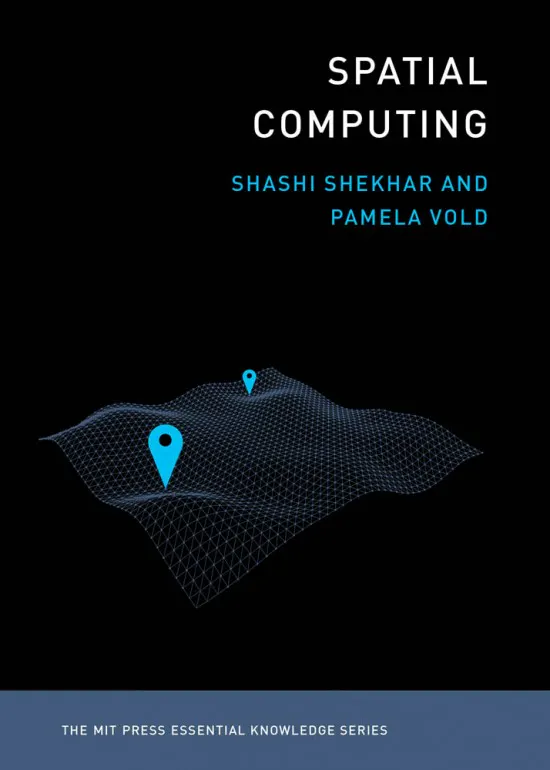
Ep 62Spatial Computing
Shashi Shekhar and Pamela Vold, authors of Spatial Computing, from The MIT Press Essential Knowledge series, discuss the reach, risks and importance of spatial computing in confronting COVID-19. An accessible guide to the ideas and technologies underlying such applications as GPS, Google Maps, Pokémon Go, ride-sharing, driverless cars, and drone surveillance. Billions of people around the globe use various applications of spatial computing daily--by using a ride-sharing app, GPS, the e911 system, social media check-ins, even Pokémon Go. Scientists and researchers use spatial computing to track diseases, map the bottom of the oceans, chart the behavior of endangered species, and create election maps in real time. Drones and driverless cars use a variety of spatial computing technologies. Spatial computing works by understanding the physical world, knowing and communicating our relation to places in that world, and navigating through those places. It has changed our lives and infrastructures profoundly, marking a significant shift in how we make our way in the world. This volume in the MIT Essential Knowledge series explains the technologies and ideas behind spatial computing. The book offers accessible descriptions of GPS and location-based services, including the use of Wi-Fi, Bluetooth, and RFID for position determination out of satellite range; remote sensing, which uses satellite and aerial platforms to monitor such varied phenomena as global food production, the effects of climate change, and subsurface natural resources on other planets; geographic information systems (GIS), which store, analyze, and visualize spatial data; spatial databases, which store multiple forms of spatial data; and spatial statistics and spatial data science, used to analyze location-related data. Learn more about your ad choices. Visit megaphone.fm/adchoices Support our show by becoming a premium member! https://newbooksnetwork.supportingcast.fm/geography
Ep 90Mitul Baruah, "Slow Disaster: Political Ecology of Hazards and Everyday Life in the Brahmaputra Valley, Assam" (Routledge, 2022)
Mitul Baruah's Slow Disaster: Political Ecology of Hazards and Everyday Life in the Brahmaputra Valley, Assam (Routledge, 2022) presents a fascinating, ethnographic account of the challenges faced by communities living in Majuli, India, one of the largest river islands in the world, which has experienced immense socio-environmental transformations over the years, processes that are emblematic of the Brahmaputra Valley as a whole. Written in an engaging style, full of the author's insider perspectives, this insightful volume explores the processes of flooding and riverbank erosion in Majuli, including re-configuration of the island’s geographies, loss of local livelihoods, and large-scale displacement of the population. The book begins with an examination of the physical geography of Majuli and its ecological complexities, leading to discussion on the role of the state in water governance and hazard management, as well as popular resistance by the rural communities on the island. The book focuses on livelihoods as a way of offering economic context to living in challenging environmental conditions and examines the interactions between the state and a whole host of non-state actors, and the everyday, arbitrary functioning of the bureaucracy in a hazardscape. This volume is an invaluable resource for scholars interested in political ecology of hazards and vulnerability, water and hydraulic infrastructure, rural livelihoods and agrarian questions, state theorizations, island studies, and resistance and social movements, as well as those with an interest in northeast India more generally across various disciplines. Learn more about your ad choices. Visit megaphone.fm/adchoices Support our show by becoming a premium member! https://newbooksnetwork.supportingcast.fm/geography
Ep 379Thomas Aiello, "Practical Radicalism and the Great Migration: The Cultural Geography of the Scott Newspaper Syndicate" (U Georgia Press, 2023)
In this episode, Thomas Aiello joins E. James West to discuss Practical Radicalism and the Great Migration: The Cultural Geography of the Scott Newspaper Syndicate (University of Georgia Press, 2023). Building on his earlier book The Grapevine of the Black South, which focused on the rise and fall of the Scott Newspaper Syndicate through its flagship publication the Atlanta Daily World, this book further reshapes the place of southern newspapers in the historiography of Black journalism. Practical Radicalism and the Great Migration traces the development and trajectory of the individual newspapers of the Syndicate, evaluating those with surviving issues, and presenting them as they existed in proximity to their Atlanta hub. In so doing, he emphasizes the thread of practical radicalism that ran through Syndicate editorial policy, providing a fuller picture of the Scott Newspaper Syndicate and the Black press in the 1930s, 1940s, and 1950s. James West is a historian of race, media and business in the modern United States and Black diaspora. Author of "Ebony Magazine and Lerone Bennett Jr.: Popular Black History in Postwar America" (Illinois, 2020), "A House for the Struggle: The Black Press and the Built Environment in Chicago" (Illinois, 2022), "Our Kind of Historian: The Work and Activism of Lerone Bennett Jr. (Massachusetts, 2022). Learn more about your ad choices. Visit megaphone.fm/adchoices Support our show by becoming a premium member! https://newbooksnetwork.supportingcast.fm/geography
Ep 91Joel E. Correia, "Disrupting the Patrón: Indigenous Land Rights and the Fight for Environmental Justice in Paraguay's Chaco" (U California Press, 2023)
The Paraguayan Chaco is a settler frontier where cattle ranching and agrarian extractivism drive some of the world's fastest deforestation and most extreme land tenure inequality. Disrupting the Patrón: Indigenous Land Rights and the Fight for Environmental Justice in Paraguay's Chaco (U California Press, 2023) shows that environmental racism cannot be reduced to effects of neoliberalism but stems from long-standing social-spatial relations of power rooted in settler colonialism. Historically dispossessed of land and exploited for their labor, Enxet and Sanapaná Indigenous peoples nevertheless refuse to abide settler land control. Based on long-term collaborative research and storytelling, Joel E. Correia shows that Enxet and Sanapaná dialectics of disruption enact environmental justice by transcending the constraints of settler law through the ability to maintain and imagine collective lifeways amidst radical social-ecological change. Learn more about your ad choices. Visit megaphone.fm/adchoices Support our show by becoming a premium member! https://newbooksnetwork.supportingcast.fm/geography
Ep 223A. J. Faas, "In the Shadow of Tungurahua: Disaster Politics in Highland Ecuador" (Rutgers UP, 2023)
In the Shadow of Tungurahua: Disaster Politics in Highland Ecuador (Rutgers University Press, 2023) relates the stories of the people of Penipe, Ecuador living in and between several villages around the volcano Tungurahua and two resettlement communities built for people displaced by government operations following volcanic eruptions in 1999 and 2006. The stories take shape in ways that influence prevailing ideas about how disasters are produced and reproduced, in this case by shifting assemblages of the state first formed during Spanish colonialism attempting to settle (make “legible”) and govern Indigenous and campesino populations and places. The disasters unfolding around Tungurahua at the turn of the 21st century also provide lessons in the humanitarian politics of disaster—questions of deservingness, reproducing inequality, and the reproduction of bare life. But this is also a story of how people responded to confront hardships and craft new futures, about forms of cooperation to cope with and adapt to disaster, and the potential for locally derived disaster recovery projects and politics. A.J. Faas (PhD, Anthropology, University of South Florida) is an Associate Professor and Graduate Coordinator at San Jose State University in California, where he studies disasters, environmental crises, and displacement and resettlement. He focuses on the anthropology of the state, postcolonialism, cooperation and reciprocity, economic anthropology, organizations and bureaucracy, and the politics of nature, culture, and memory. Aleem Mahabir is a PhD candidate in Geography at the University of the West Indies, Mona, Jamaica. His research interests lie at the intersection of Urban Geography, Social Exclusion and Psychology. His dissertation research focuses on the link among negative psychosocial dispositions, exclusion, and under-development among marginalized communities in Port of Spain, Trinidad and Tobago. You can find him on Twitter. Learn more about your ad choices. Visit megaphone.fm/adchoices Support our show by becoming a premium member! https://newbooksnetwork.supportingcast.fm/geography
Ep 89Kirstin Munro, "The Production of Everyday Life in Eco-Conscious Households" (Bristol UP, 2023)
Based on qualitative interviews with sustainability-oriented parents of young children, Kirstin Munro's book The Production of Everyday Life in Eco-Conscious Households (Bristol UP, 2023) describes what happens when people make interventions into mundane and easy-to-overlook aspects of everyday life to bring the way they get things done into alignment with their environmental values. Because the ability to make changes is constrained by their culture and capitalist society, there are negative consequences and trade-offs involved in these household-level sustainability practices. The households described in this book shed light on the full extent of the trade-offs involved in promoting sustainability at the household level as a solution to environmental problems. Learn more about your ad choices. Visit megaphone.fm/adchoices Support our show by becoming a premium member! https://newbooksnetwork.supportingcast.fm/geography
Ep 42Marie-Luise Theuerkauf, "Dindshenchas Érenn" (U College Cork, 2022)
The purpose of the present volume, Dindshenchas Érenn (U College Cork, 2022), is to provide an accessible overview and entry into the complex literary creation known as Dindshenchas Érenn ‘History of the Notable Places of Ireland’. The five chapters in the book consider different aspects of the Dindshenchas corpus, ranging from the manuscript sources; the format and structure of the various texts so labelled; an overview of the scholarship published to date; the dating of the corpus; the Dindshenchas as a branch of aetiological literature; and an analysis of the literary connections between the Dindshenchas and medieval Irish literature generally. Dindshenchas Érenn was published as a part of the series, Cork Studies in Celtic Literatures, in 2023. Dr. Marie-Luise Theuerkauf is a Leverhulme Trust postdoctoral fellow on the 'Mapping the Medieval Mind' project, with Prof. Máire Ní Mhaonaigh and Dr David McCay, in the Department of Anglo-Saxon, Norse, and Celtic at the University of Cambridge. Her academic interests include Celtic languages and literatures, with a specialisation in medieval Irish; dindshenchas (placename history), Irish metrics; Medieval Welsh literature; and Arthurian literature and folklore. She is also the editor of the forthcoming volume, Dublaídi Dindshenchais: Proceedings of a Conference on the Medieval Irish Place-name Tradition, which is being published by the Dublin Institute for Advanced Studies. Dr. Danica Ramsey-Brimberg is a multidisciplinary researcher, who is currently the Coordinator for Digital Engagement for the International Center of Medieval Art and an assistant editor for the journal, Church Archaeology. Learn more about your ad choices. Visit megaphone.fm/adchoices Support our show by becoming a premium member! https://newbooksnetwork.supportingcast.fm/geography
Ep 363Gediminas Lesutis, "The Politics of Precarity: Spaces of Extractivism, Violence, and Suffering" (Routledge, 2021)
Based on critical theory and ethnographic research, Gediminas Lesutis' book The Politics of Precarity: Spaces of Extractivism, Violence, and Suffering (Routledge, 2021) explores how intensifying geographies of extractive capitalism shape human lives and transformative politics in marginal areas of the global economy. Engaging the work of Judith Butler, Henri Lefebvre, and Jacques Rancière with ethnographic research on social and political effects of mining-induced dispossession in Mozambique, in the book Lesutis theorises how precarity unfolds as a spatially constituted condition of everyday life given over to the violence of capital. Going beyond labour relations, or governance of life in liberal democracies, that are typically explored in the literature on precarity, the book shows how dispossessed people are subjected to structural, symbolic, and direct modalities of violence; this simultaneously constitutes their suffering and ceaseless desire, however implausible, to be included into abstract space of extractivism. As a result, despite the multifarious violence that it engenders, extractive capital accumulation is sustained even in the margins, historically excluded from contingently lived imaginaries of a "good life" promised by capitalism. Presenting this theorisation of precarity as a framework on, and a critique of, the contemporary politics of (un)liveability, the book speaks to key debates about precarity, dispossession, resistance, extractivism, and development in several disciplines, especially political geography, IPE, global politics, and critical theory. It will also be of interest to scholars in development studies, critical political economy, and African politics. Shraddha Chatterjee is a doctoral candidate at York University, Toronto, and author of Queer Politics in India: Towards Sexual Subaltern Subjects (Routledge, 2018). Learn more about your ad choices. Visit megaphone.fm/adchoices Support our show by becoming a premium member! https://newbooksnetwork.supportingcast.fm/geography
Ep 371Alvin Hall, "Driving the Green Book: A Road Trip Through the Living History of Black Resistance" (HarperOne, 2023)
For countless Americans, the open road has long been a place where dangers lurk. In the era of Jim Crow, Black travelers encountered locked doors, hostile police, and potentially violent encounters almost everywhere, in both the South and the North. From 1936 to 1967, millions relied on The Negro Motorist Green Book, the definitive guide to businesses where they could safely rest, eat, or sleep. Most Americans only know of the guide from the 2018 Green Book movie or the 2020 Lovecraft Country TV show. Alvin Hall set out to revisit the world of the Green Book to instruct us all on the real history of the guide that saved many lives. With his friend Janée Woods Weber, he drove from New York to Detroit to New Orleans, visiting motels, restaurants, shops, and stores where Black Americans once found a friendly welcome. They explored historical and cultural landmarks, from the theatres and clubs where stars like Duke Ellington and Lena Horne performed to the Lorraine Motel where Dr. Martin Luther King, Jr. was assassinated. Along the way, they gathered memories from some of the last living witnesses for whom the Green Book meant survival--remarkable people who not only endured but rose above the hate, building vibrant Black communities against incredible odds. Driving the Green Book: A Road Trip Through the Living History of Black Resistance (HarperOne, 2023) is a vital work of national history as well as a hopeful chronicle of Black resilience and resistance. Nicole Trujillo-Pagán is a sociologist and Associate Professor at Wayne State University who studies race, the Latina/o/x population, and socio-spatial mobility. You can follow her on Twitter @BorderStruggles. Learn more about your ad choices. Visit megaphone.fm/adchoices Support our show by becoming a premium member! https://newbooksnetwork.supportingcast.fm/geography
Ep 9Felicity Hwee-Hwa Chan, "Tensions in Diversity: Spaces for Collective Life in Los Angeles" (U Toronto Press, 2022)
Urban landscapes are complex spaces of sociocultural diversity, characterized by narratives of both conviviality and conflict. As people with multiple ethnicities and nationalities find their common destinies in thriving globalizing cities, social cohesiveness becomes more precarious as different beliefs, practices, ambitions, values, and affiliations intersect in close proximity, producing social tensions. Felicity Hwee-Hwa Chan's Tensions in Diversity: Spaces for Collective Life in Los Angeles (U Toronto Press, 2022) presents a multi-method comparative study that draws on the experiences of 140 residents of native and immigrant origin, community organizers, and municipal officers in three culturally diverse neighborhoods of varying income levels in Los Angeles County. Using cognitive mapping analysis combined with data from interviews, surveys, and participant observation, this book explores how exactly coexistence is socio-spatially experienced and negotiated in daily life. Tensions in Diversity identifies the planning and design considerations that enable intercultural learning in the public places within diverse cities. In doing so, this book foregrounds urban space as an active force in shaping coexistence and convivial public environments. Anna Zhelnina holds a Ph.D. in Sociology and is a postdoctoral fellow at the University of Helsinki. To learn more, visit her website or follow Anna on Twitter. Learn more about your ad choices. Visit megaphone.fm/adchoices Support our show by becoming a premium member! https://newbooksnetwork.supportingcast.fm/geography
Ep 487Ian Rowen, "One China, Many Taiwans: The Geopolitics of Cross-Strait Tourism" (Cornell UP, 2023)
One China, Many Taiwans: The Geopolitics of Cross-Strait Tourism (Cornell UP, 2023) shows how tourism performs and transforms territory. In 2008, as the People’s Republic of China pointed over a thousand missiles across the Taiwan Strait, it sent millions of tourists in the same direction with the encouragement of Taiwan’s politicians and businesspeople. Contrary to the PRC’s efforts to use tourism to incorporate Taiwan into an imaginary “One China,” tourism aggravated tensions between the two polities, polarized Taiwanese society, and pushed Taiwanese popular sentiment farther toward support for national self-determination. Consequently, Taiwan was performed as a part of China for Chinese group tourists versus experienced as a place of everyday life. Taiwan’s national identity grew increasingly plural, such that not just one or two, but many Taiwans coexisted, even as it faced an existential military threat. Ian Rowen’s treatment of tourism as a political technology provides a new theoretical lens for social scientists to examine the impacts of tourism in the region and worldwide. Ian Rowen is Associate Professor at National Taiwan Normal University. He is the editor of Transitions in Taiwan. Follow him on Twitter @iirowen. Li-Ping Chen is Postdoctoral Scholar and Teaching Fellow in the East Asian Studies Center at the University of Southern California. Her research interests include literary translingualism, diaspora, and nativism in Sinophone, inter-Asian, and transpacific contexts. Learn more about your ad choices. Visit megaphone.fm/adchoices Support our show by becoming a premium member! https://newbooksnetwork.supportingcast.fm/geography
Ep 123Sango Mahanty, "Unsettled Frontiers: Market Formation in the Cambodia-Vietnam Borderlands" (Cornell UP, 2022)
Like other global frontiers, the Cambodia-Vietnam borderlands are a hotspot for migration, land claims, and markets for newly introduced commodities. These topics and more are the focus of Sango Mahanty’s recent book, Unsettled Frontiers: Market Formation in the Cambodia-Vietnam Borderlands (Cornell University Press, 2022). The book argues that frontier agricultural markets emerge from diverse commodity networks that constitute a dynamic and disruptive market ‘rhizome.’ In this podcast, Sango addresses several related themes, including: the relationship between frontiers and borderlands in this region; the role of rural migration and land-claiming in frontier markets; the nexus between market formation and state formation; and what it means to think ‘rhizomically’ about frontier markets. Sango also touches on how these insights translate to ongoing processes of social and environmental change, such as those imposed by climate change. Sango Mahanty is Professor in the Resources, Environment, and Development Program at the ANU Crawford School of Public Policy. Sango is a critical geographer who studies the politics of green economies, frontier markets and nature-society transformations in Cambodia and Vietnam. Professor Michele Ford is the Director of the Sydney Southeast Asia Centre, a university-wide multidisciplinary center at the University of Sydney, Australia. Learn more about your ad choices. Visit megaphone.fm/adchoices Support our show by becoming a premium member! https://newbooksnetwork.supportingcast.fm/geography
Ep 22Nomadic Pastoralism Among the Mongol Herders
Nomadic Pastoralism among the Mongol Herders: Multispecies and Spatial Ethnography in Mongolia and Transbaikalia (Amsterdam University Press, 2021) is based on anthropological research Charlotte Marchina carried out between 2008 and 2016 to investigate the spatial features of nomadic pastoralism among the Mongol herders of Mongolia and Southern Siberia. In addition to classical survey methods, Charlotte used GPS tracking to analyze the ways in which pastoralists envision and concretely occupy the landscape, which they share with their animals, non-herders, and invisible entities and deities. In this episode, we discuss differences between pastoralism in Mongolia and Siberia, changes in Mongol herding throughout the 20th and 21st centuries, and how animals and animal knowledge of the landscape shape pastoralist systems. Maggie Freeman is a PhD student in the School of Architecture at MIT. She researches uses of architecture by nomadic peoples and historical interactions of nomads and empires, with a focus on the modern Middle East. Learn more about your ad choices. Visit megaphone.fm/adchoices Support our show by becoming a premium member! https://newbooksnetwork.supportingcast.fm/geography
Ep 53The Future of the Silk Road: A Discussion with Tim Winters
The term "Silk Road" evokes images of trade and exotic luxurious goods and Orientalist images. Today, however, it also is associated with the projection of Chinese power abroad. And as that pairing suggests, the term "Silk Road" in fact has many meanings as Professor Tim Winter has been explaining in his book The Silk Road: Connecting Histories and Futures (Oxford University Press, 2022). Listen to him in conversation with Owen Bennett-Jones. Owen Bennett-Jones is a freelance journalist and writer. A former BBC correspondent and presenter he has been a resident foreign correspondent in Bucharest, Geneva, Islamabad, Hanoi and Beirut. He is recently wrote a history of the Bhutto dynasty which was published by Yale University Press. Learn more about your ad choices. Visit megaphone.fm/adchoices Support our show by becoming a premium member! https://newbooksnetwork.supportingcast.fm/geography
Ep 365Jovan Scott Lewis, "Violent Utopia: Dispossession and Black Restoration in Tulsa" (Duke UP, 2022)
In Violent Utopia: Dispossession and Black Restoration in Tulsa (Duke UP, 2022), Jovan Scott Lewis retells the history and afterlife of the 1921 Tulsa race massacre, from the post-Reconstruction migration of Black people to Oklahoma Indian Territory to contemporary efforts to rebuild Black prosperity. He focuses on how the massacre in Tulsa’s Greenwood neighborhood—colloquially known as Black Wall Street—curtailed the freedom built there. Rather than framing the massacre as a one-off event, Lewis places it in a larger historical and social context of widespread patterns of anti-Black racism, segregation, and dispossession in Tulsa and beyond. He shows how the processes that led to the massacre, subsequent urban renewal, and intergenerational poverty shored up by nonprofits constitute a form of continuous slow violence. Now, in their attempts to redevelop resources for self-determination, Black Tulsans must reconcile a double inheritance: the massacre’s violence and the historical freedom and prosperity that Greenwood represented. Their future is tied to their geography, which is the foundation from which they will repair and fulfill Greenwood’s promise. Omari Averette-Phillips is a graduate student in the department of history at UC Davis. He can be reached at [email protected] Learn more about your ad choices. Visit megaphone.fm/adchoices Support our show by becoming a premium member! https://newbooksnetwork.supportingcast.fm/geography
Ep 88Ronald L. Trosper, "Indigenous Economics: Sustaining Peoples and Their Lands" (U Arizona Press, 2022)
What does “development” mean for Indigenous peoples? Indigenous Economics: Sustaining Peoples and Their Lands (U Arizona Press, 2022) lays out an alternative path showing that conscious attention to relationships among humans and the natural world creates flourishing social-ecological economies. Economist Ronald L. Trosper draws on examples from North and South America, Aotearoa/New Zealand, and Australia to argue that Indigenous worldviews centering care and good relationships provide critical and sustainable economic models in a world under increasing pressure from biodiversity loss and climate change. He explains the structure of relational Indigenous economic theory, providing principles based on his own and others’ work with tribal nations and Indigenous communities. Trosper explains how sustainability is created at every level when relational Indigenous economic theory is applied—micro, meso, and macro. Good relationships support personal and community autonomy, replacing the individualism/collectivism dichotomy with relational leadership and entrepreneurship. Basing economies on relationships requires changing governance from the top-down approaches of nation-states and international corporations; instead, each community creates its own territorial relationships, creating plurinational relational states. This book offers an important alternative to classic economic theory. In Indigenous Economics, support for Indigenous communities’ development and Indigenous peoples’ well-being go hand-in-hand. Learn more about your ad choices. Visit megaphone.fm/adchoices Support our show by becoming a premium member! https://newbooksnetwork.supportingcast.fm/geography
Ep 87Matthew S. Henry, "Hydronarratives: Water, Environmental Justice, and a Just Transition" (U Nebraska Press, 2023)
The story of water in the United States is one of ecosystemic disruption and social injustice. From the Standing Rock Indian Reservation and Flint, Michigan, to the Appalachian coal and gas fields and the Gulf Coast, low-income communities, Indigenous communities, and communities of color face the disproportionate effects of floods, droughts, sea level rise, and water contamination. In Hydronarratives: Water, Environmental Justice, and a Just Transition (U Nebraska Press, 2023) Matthew S. Henry examines cultural representations that imagine a just transition, a concept rooted in the U.S. labor and environmental justice movements to describe an alternative economic paradigm predicated on sustainability, economic and social equity, and climate resilience. Focused on regions of water insecurity, from central Arizona to central Appalachia, Henry explores how writers, artists, and activists have creatively responded to intensifying water crises in the United States and argues that narrative and storytelling are critical to environmental and social justice advocacy. By drawing on a wide and comprehensive range of narrative texts, historical documentation, policy papers, and literary and cultural scholarship, Henry presents a timely project that examines the social movement, just transition, and the logic of the Green New Deal, in addition to contemporary visions of environmental justice. Learn more about your ad choices. Visit megaphone.fm/adchoices Support our show by becoming a premium member! https://newbooksnetwork.supportingcast.fm/geography
Ep 141Malcolm Harris, "Palo Alto: A History of California, Capitalism, and the World" (Little, Brown, 2023)
Palo Alto is nice. The weather is temperate, the people are educated, rich, healthy, enterprising. Remnants of a hippie counterculture have synthesized with high technology and big finance to produce the spiritually and materially ambitious heart of Silicon Valley, whose products are changing how we do everything from driving around to eating food. It is also a haunted toxic waste dump built on stolen Indian burial grounds, and an integral part of the capitalist world system. In Palo Alto: A History of California, Capitalism, and the World (Little, Brown, 2023), the first comprehensive, global history of Silicon Valley, Malcolm Harris examines how and why Northern California evolved in the particular, consequential way it did, tracing the ideologies, technologies, and policies that have been engineered there over the course of 150 years of Anglo settler colonialism, from IQ tests to the "tragedy of the commons," racial genetics, and "broken windows" theory. The Internet and computers, too. It's a story about how a small American suburb became a powerful engine for economic growth and war, and how it came to lead the world into a surprisingly disastrous 21st century. Palo Alto is an urgent and visionary history of the way we live now, one that ends with a clear-eyed, radical proposition for how we might begin to change course. Malcolm Harris is a freelance writer and the author of Kids These Days: The Making of Millennials and Shit is Fucked Up and Bullshit: History Since the End of History. He was born in Santa Cruz, CA and graduated from the University of Maryland. Twitter. Brian Hamilton is chair of the Department of History and Social Science at Deerfield Academy. Twitter. Website. Learn more about your ad choices. Visit megaphone.fm/adchoices Support our show by becoming a premium member! https://newbooksnetwork.supportingcast.fm/geography
Ep 86Piro Rexhepi, "White Enclosures: Racial Capitalism and Coloniality Along the Balkan Route" (Duke UP, 2022)
In White Enclosures: Racial Capitalism and Coloniality Along the Balkan Route (Duke UP, 2022), Piro Rexhepi explores the overlapping postsocialist and postcolonial border regimes in the Balkans that are designed to protect whiteness and exclude Muslim, Roma, and migrant communities. Rather than focusing on present crises to the exclusion of the histories that have gotten us to this point, Rexhepi takes a wide lens to understand how different mechanisms and regimes of exclusion are historically intertwined. This book makes a bold and important intervention against 'colorblindness' and white assimilation in the region, pushing us instead to disturb hierarchies of power by forging solidarities with those who are most excluded and marginalized by the Euro-American colonial project. Piro Rexhepi is a researcher based in London. He received his PhD in Politics from the University of Strathclyde. His new review essay, co-authored with Harun Buljina and Dženita Karić, is "Feel-good Orientalism and the Question of Dignity," is available to read on The Maydan. You can follow him on Twitter @pirorexhepi. Dino Kadich is a PhD candidate in Geography at the University of Cambridge. You can follow him on Twitter @dinokadich. Learn more about your ad choices. Visit megaphone.fm/adchoices Support our show by becoming a premium member! https://newbooksnetwork.supportingcast.fm/geography
Ep 175Nilakantan RS, "South vs. North: India's Great Divide" (Juggernaut, 2023)
Compare two children – one born in north India, the other in the south. The child from south India is far less likely to die in the first year of her life or lose her mother during childbirth.She will also receive better nutrition, go to school and stay in school longer; she is more likely to attend college and secure employment that pays her more. This child will also go on to have fewer children, who in turn will be healthier and more educated than her. In a nutshell, the average child born in south India will live a healthier, wealthier, more secure life than one born in north India. Why is south India doing so much better than the north? And what does that mean? In South vs. North: India's Great Divide (Juggernaut, 2023), data scientist Nilakantan RS shows us how and why the southern states are outperforming the rest of the country and its consequences in an increasingly centralized India. He reveals how south India deals with a particularly tough set of issues – its triumphs in areas of health, education and economic growth are met with a policy regime that penalizes it; its success in population control will be met with a possible loss of political representation. How will the region manage such an assault? Hard-hitting, troubling and full of fascinating data points, South vs North is an essential book about one of the biggest challenges that India faces today. Learn more about your ad choices. Visit megaphone.fm/adchoices Support our show by becoming a premium member! https://newbooksnetwork.supportingcast.fm/geography
Ep 481Ruth Rogaski, "Knowing Manchuria: Environments, the Senses, and Natural Knowledge on an Asian Borderland" (U Chicago Press, 2022)
Among all the world’s most storied and legend-filled regions, the place known to some over time as ‘Manchuria’ has had an especially wide range of ideas projected onto it. Everyone from Manchu emperors to Chinese exiles, European missionaries, Korean poets, indigenous shamans, Russian botanists, Japanese colonists and socialist planners have sought to know and understand this region, framing its vast forests, mountains, plains and earth according their own political, spiritual or scientific priorities over the past 400 years. Ruth Rogaski’s extraordinary new book Knowing Manchuria: Environments, the Senses, and Natural Knowledge on an Asian Borderland (U Chicago Press, 2022) shows how these acts of knowing have brought multiple Manchurias into existence as people, culture, nature and ecology have been entangled in diverse ways at different points in time. Today, perhaps befitting its status as a contested and layered borderland space, ‘Manchuria’ itself is a contested term, but this only makes Rogaski’s beautifully written multi-perspectival and multilingually-sourced history of this fascinating region all the more valuable. Ed Pulford is an Anthropologist and Lecturer in Chinese Studies at the University of Manchester. His research focuses on friendships and histories between the Chinese, Korean and Russian worlds, and indigeneity in northeast Asia. Learn more about your ad choices. Visit megaphone.fm/adchoices Support our show by becoming a premium member! https://newbooksnetwork.supportingcast.fm/geography
Ep 85Sheila R. Foster and Christian Iaione, "Co-Cities: Innovative Transitions toward Just and Self-Sustaining Communities" (MIT Press, 2022)
A new model of urban governance, mapping the route to a more equitable management of a city’s infrastructure and services. The majority of the world’s inhabitants live in cities, but even with the vast wealth and resources these cities generate, their most vulnerable populations live without adequate or affordable housing, safe water, healthy food, and other essentials. And yet, cities also often harbor the solutions to the inequalities they create, as this book makes clear. With examples drawn from cities worldwide, Co-Cities: Innovative Transitions toward Just and Self-Sustaining Communities (MIT Press, 2022) outlines practices, laws, and policies that are presently fostering innovation in the provision of urban services, spurring collaborative economies as a driver of local sustainable development, and promoting inclusive and equitable regeneration of blighted urban areas. Identifying core elements of these diverse efforts, Sheila R. Foster and Christian Iaione develop a framework for understanding how certain initiatives position local communities as key actors in the production, delivery, and management of urban assets or local resources. Within this framework, they explain the forms such initiatives increasingly take, like community land trusts, new kinds of co-housing, neighborhood cooperatives, community-shared broadband and energy networks, and new local offices focused on citizen science and civic imagination. The “Co-City” framework is uniquely rooted in the authors’ own decades-long research and first-hand experience working in cities around the world. Foster and Iaione offer their observations as “design principles”—adaptable to local context—to help guide further experimentation in building just and self-sustaining urban communities. Learn more about your ad choices. Visit megaphone.fm/adchoices Support our show by becoming a premium member! https://newbooksnetwork.supportingcast.fm/geography
Ep 56Philip Gooding, "On the Frontiers of the Indian Ocean World: A History of Lake Tanganyika, c.1830-1890" (Cambridge UP, 2022)
On the Frontiers of the Indian Ocean World: A History of Lake Tanganyika, c.1830-1890 (Cambridge UP, 2022) is the first interdisciplinary history of Lake Tanganyika and of eastern Africa's relationship with the wider Indian Ocean World during the nineteenth century. Philip Gooding deploys diverse source materials, including oral, climatological, anthropological, and archaeological sources, to ground interpretations of the better-known, European-authored archive in local epistemologies and understandings of the past. Gooding shows that Lake Tanganyika's shape, location, and distinctive lacustrine environment contributed to phenomena traditionally associated with the history of the wider Indian Ocean World being negotiated, contested, and re-imagined in particularly robust ways. He adds novel contributions to African and Indian Ocean histories of urbanism, the environment, spirituality, kinship, commerce, consumption, material culture, bondage, slavery, Islam, and capitalism. African peoples and environments are positioned as central to the histories of global economies, religions, and cultures. Philip Gooding is a postdoctoral fellow at the Indian Ocean World Centre and a course Lecturer in the History and Classical Studies department at McGill University. He wrote his doctoral dissertation at the Department of History, University of London (SOAS) in 2017. Gargi Binju is a researcher at the University of Tübingen. Learn more about your ad choices. Visit megaphone.fm/adchoices Support our show by becoming a premium member! https://newbooksnetwork.supportingcast.fm/geography
Ep 93Sue Ann Barratt and Aleah N. Ranjitsingh, "Dougla in the Twenty-First Century: Adding to the Mix" (UP of Mississippi, 2021)
Identity is often fraught for multiracial Douglas, people of both South Asian and African descent in the Caribbean. In this groundbreaking volume titled Dougla in the Twenty-First Century: Adding to the Mix (University Press of Mississippi, 2021), Sue Ann Barratt and Aleah N. Ranjitsingh explore the particular meanings of a Dougla identity and examine Dougla maneuverability both at home and in the diaspora. The authors scrutinize the perception of Douglaness over time, contemporary Dougla negotiations of social demands, their expansion of ethnicity as an intersectional identity, and the experiences of Douglas within the diaspora outside the Caribbean. Through an examination of how Douglas experience their claim to multiracialism and how ethnic identity may be enforced or interrupted, the authors firmly situate this analysis in ongoing debates about multiracial identity. Based on interviews with over one hundred Douglas, Barratt and Ranjitsingh explore the multiple subjectivities Douglas express, confirm, challenge, negotiate, and add to prevailing understandings. Contemplating this, Dougla in the Twenty-First Century adds to the global discourse of multiethnic identity and how it impacts living both in the Caribbean, where it is easily recognizable, and in the diaspora, where the Dougla remains a largely unacknowledged designation. This book deliberately expands the conversation beyond the limits of biraciality and the Black/white binary and contributes nuance to current interpretations of the lives of multiracial people by introducing Douglas as they carve out their lives in the Caribbean. Sue Ann Barratt is lecturer and head of the Institute for Gender and Development Studies (IGDS), University of the West Indies, St. Augustine Campus. She is a graduate of the University of the West Indies, holding a BA in Media and Communication Studies with Political Science, an MA in Communication Studies, and a PhD in Interdisciplinary Gender Studies. Her research areas are interpersonal interaction, human communication conflict, social media use and its implications, gender and ethnic identities, mental health and gender-based violence, and Carnival and cultural studies. Aleah N. Ranjitsingh is an assistant professor in the Caribbean Studies Program, Africana Studies Department of Brooklyn College of the City University of New York (CUNY). She holds a Ph.D. in Interdisciplinary Gender Studies from the Institute for Gender and Development Studies (IGDS), University of the West Indies, St. Augustine and; MA and BA degrees in Political Science from Brooklyn College (CUNY). Her research areas are gender and politics; Latin American and Caribbean politics; African diaspora studies with particular reference to North America, Latin America, and the Caribbean; and gender and ethnic identities. Aleem Mahabir is a PhD candidate in Geography at the University of the West Indies, Mona, Jamaica. His research interests lie at the intersection of Urban Geography, Social Exclusion and Psychology. His dissertation research focuses on the link among negative psychosocial dispositions, exclusion, and under-development among marginalized communities in Port of Spain, Trinidad and Tobago. You can find him on Twitter. Learn more about your ad choices. Visit megaphone.fm/adchoices Support our show by becoming a premium member! https://newbooksnetwork.supportingcast.fm/geography
Ep 76The 10,000 Year Build-Up to Brexit: A Conversation with Ian Morris
How did Britain become a global superpower? Historian and classicist Ian Morris thinks geography has a lot to do with it. Prof. Morris discusses his latest book, Geography is Destiny: Britain and the World: A 10,000 Year History (Farrar, Straus and Giroux, 2022) which traces the long history of Britain's complex relationship with the European continent. He draws surprising parallels between characters ranging from the Roman Britons and Nigel Farage, to the Papacy and the European Union. Prof. Ian Morris is the Jean and Rebecca Willard Professor of Classics and Professor in History at Stanford University, as well as the author of the critically acclaimed Why the West Rules—for Now (Picador, 2011). Learn more about your ad choices. Visit megaphone.fm/adchoices Support our show by becoming a premium member! https://newbooksnetwork.supportingcast.fm/geography

Ep 109Queer Space
In this episode of High Theory, Jack Jen Gieseking tells us about queer space. Queer geographies matter alongside queer temporalities. And it turns out that lesbian life in the 1950s cannot be generalized from the specific history of Buffalo, New York. In the episode they reference a number of scholarly books including J. Jack Halberstam, In a Queer Time and Place: Transgender Bodies, Subcultural Lives (NYU Press, 2005); Elizabeth Freeman, Time Binds: Queer Temporalities, Queer Histories (Duke UP, 2010); Elizabeth Lapovsky Kennedy and Madeline D. Davis, Boots of Leather, Slippers of Gold: The History of a Lesbian Community (Routledge, 1993); Mairead Sullivan, Lesbian Death: Desire and Danger between Feminist and Queer (Minnesota UP, 2022); Henri Lefebre, The Production of Space (La production de l'espace, Editions Anthropos, 1974, trans. Donald Nicholson-Smith, Blackwell, 1919). He also names a number of scholars, including the geographer Gill Valentine, the historian David Harvey, and cultural anthropologist Gayle Rubin, and the 1982 Barnard Conference on Sexuality. Jack Jen Gieseking is a Research Fellow at the Five College Women’s Studies Research Center. Their book A Queer New York: Geographies of Lesbians, Dykes, and Queers was published by NYU Press in 2020, and has a companion website called An Everyday Queer New York. They are working on a new book called Dyke Bars*: Queer Spaces for the End Times that uses the trans asterisk to invite consideration of queer spaces not historically claimed as dyke bars. Image: “Last Lesbian Bars in New York City” © 2023 Saronik Bosu Learn more about your ad choices. Visit megaphone.fm/adchoices Support our show by becoming a premium member! https://newbooksnetwork.supportingcast.fm/geography
Ep 84Stephanie C. Kane, "Just One Rain Away: The Ethnography of River-City Flood Control" (McGill-Queen's UP, 2022)
Not long ago it seemed flood control experts were close to mastering the unruly flows funnelling toward Hudson Bay and the Prairie city of Winnipeg. But as more intense and out-of-synch flood events occur, wary cities like Winnipeg continue to depend on systems and specifications that will soon be out of date. Rivers have impulses that defy many of the basic human assumptions underpinning otherwise sophisticated technologies. This is the river-city expression of climate change. In Just One Rain Away: The Ethnography of River-City Flood Control (McGill-Queen's UP, 2022), Stephanie Kane shows how geoscience, engineering, and law converge to affect flood control in Winnipeg. She questions technicalities produced and maintained in tandem with settler folkways at the expense of the plural legal cultures of Indigenous nations. The dynamics of this experimental ethnography feel familiar yet strange: here, many of the starring actors are not human. Ice and water - materializing as bodies, elements, and digital signals - act with diatoms, diversions, sensors, sandbags, and satellites, looping theories about glacial erratics and feminist science studies into scenes from neighbourhood parks, conferences, survey maps, plays, archival photos, a novel, an emergency press conference, LiDAR images, and a lab experiment in a bathtub. Through storytelling and environmental analytics, Just One Rain Away provides a starting point for cross-cultural discussions about how expert knowledge and practice should inform egalitarian decision-making about flood control and, more broadly, decolonize current ways of thinking, being, and becoming with rivers. Learn more about your ad choices. Visit megaphone.fm/adchoices Support our show by becoming a premium member! https://newbooksnetwork.supportingcast.fm/geography
Ep 209Namita Vijay Dharia, "The Industrial Ephemeral: Labor and Love in Indian Architecture and Construction" (U California Press, 2022)
What transformative effects does a multimillion-dollar industry have on those who work within it? The Industrial Ephemeral presents the untold stories of the people, politics, and production chains behind architecture, real estate, and construction in areas surrounding New Delhi, India. In The Industrial Ephemeral: Labor and Love in Indian Architecture and Construction (U California Press, 2022), the personal histories of those in India's large laboring classes are brought to life as Namita Vijay Dharia discusses the aggressive environmental and ecological transformation of the region in the twenty-first century. Urban planning and architecture are messy processes that intertwine migratory pathways, corruption politics, labor struggle, ecological transformations, and technological development. The aggressive actions of the construction activity produce an atmosphere of ephemerality in urban regions, creating an aesthetic condition that supports industrial political economy. Dharia's brilliant analysis of the aesthetics and experiences of work lends visibility to the struggle of workers in an era of growing urban inequality. Garima Jaju is a Smuts fellow at the University of Cambridge. Learn more about your ad choices. Visit megaphone.fm/adchoices Support our show by becoming a premium member! https://newbooksnetwork.supportingcast.fm/geography
Ep 57David Collier and Gerardo L. Munck, "Critical Junctures and Historical Legacies: Insights and Methods for Comparative Social Science" (Rowman & Littlefield, 2022)
Over the past 50 years, scholars across the social sciences have employed critical juncture analysis to understand how social orders are created, become entrenched, and change. In this book, leading scholars from several disciplines offer the first coordinated effort to define this field of research, assess its theoretical and methodological foundations, and use a critical assessment of current practices as a basis for guiding its future. Contributors include stars in this field who have written some of the classic works on critical junctures, as well as the rising stars of the next generation who will continue to shape historical comparative analysis for years to come. David Collier and Gerardo L. Munck's Critical Junctures and Historical Legacies. Insights and Methods for Comparative Social Science (Rowman & Littlefield, 2022) will be an indispensable resource for social science research methods scholars and students. Javier Mejia is an economist at Stanford University who specializes in the intersection of social networks and economic history. His research interests also include entrepreneurship and political economy, with a particular focus on Latin America and the Middle East. He holds a Ph.D. in Economics from Los Andes University. Mejia has previously been a Postdoctoral Associate and Lecturer at New York University-Abu Dhabi and a Visiting Scholar at the University of Bordeaux. He is also a frequent contributor to various news outlets, currently serving as an op-ed columnist for Forbes Magazine. Learn more about your ad choices. Visit megaphone.fm/adchoices Support our show by becoming a premium member! https://newbooksnetwork.supportingcast.fm/geography
Ep 16Adam Lajeunesse, "Lock, Stock, and Icebergs: A History of Canada's Arctic Maritime Sovereignty" (UBC Press, 2016)
In April 1988, after years of failed negotiations over the status of the Northwest Passage, Brian Mulroney gave Ronald Reagan a globe, pointed to the Arctic, and said "Ron that's ours. We own it lock, stock, and icebergs." A simple statement, it summed up Ottawa's official policy: Canada owns the icy waters that wind their way through the Arctic Archipelago. Behind the scenes, however, successive governments have spent over a century trying to figure out how to enforce this claim and on which legal basis to assert Canadian sovereignty over Arctic waters. In Lock, Stock, and Icebergs: A History of Canada's Arctic Maritime Sovereignty (UBC Press, 2016), Adam Lajeunesse, a Professor of Public Policy and Fellow of the Brian Mulroney Institute of Government at St. Francis Xavier University, guides readers through the evolution of Canada's Arctic sovereignty, showing how the Northwest Passage and the surrounding waters became Canadian. Listen to this engaging podcast to understand what inspired Lajeunesse to write the book, what are the main points of his argument, and how its insights are still relevant today. Lavinia Stan is a professor of political science at St. Francis Xavier University in Canada. Learn more about your ad choices. Visit megaphone.fm/adchoices Support our show by becoming a premium member! https://newbooksnetwork.supportingcast.fm/geography
Ep 233Malini Ambach et al., "Temples, Texts, and Networks: South Indian Perspectives" (HASP, 2022)
For many centuries, Hindu temples and shrines have been of great importance to South Indian religious, social and political life. Aside from being places of worship, they are also pilgrimage destinations, centres of learning, political hotspots, and foci of economic activities. In these temples, not only the human and the divine interact, but they are also meeting places of different members of the communities, be they local or coming from afar. Hindu temples do not exist in isolation, but stand in multiple relationships to other temples and sacred sites. They relate to each other in terms of architecture, ritual, or mythology, or on a conceptual level when particular sites are grouped together. Especially in urban centres, multiple temples representing different religious traditions may coexist within a shared sacred space. Temples, Texts, and Networks: South Indian Perspectives (HASP, 2022) pays close attention to the connections between individual Hindu temples and the affiliated communities, be it within a particular place or on a trans-local level. These connections are described as temple networks, a concept which instead of stable hierarchies and structures looks at nodal, multi-centred, and fluid systems, in which the connections in numerous fields of interaction are understood as dynamic processes. Raj Balkaran is a scholar of Sanskrit narrative texts. He teaches at the Oxford Centre for Hindu Studies and at his own virtual School of Indian Wisdom. For information see rajbalkaran.com. Learn more about your ad choices. Visit megaphone.fm/adchoices Support our show by becoming a premium member! https://newbooksnetwork.supportingcast.fm/geography
Ep 83James C. Rhoads et al., "Cultivating Q Methodology: Essays Honoring Steven R. Brown" (Bookbaby, 2022)
Cultivating Q Methodology is a collection of essays is in honor of Professor Steven R. Brown, the preeminent scholar of Q methodology. Q methodology, innovated by the British physicist/psychologist William Stephenson (1902-1989), Q methodology is a conceptual framework and set of procedures to systematically and scientifically study the subjective. Professor Brown has dedicated his academic life, more than 50 years and counting, to advancing the methodology and Stephenson's profound ideas. Each of the contributors in this volume are experts in the methodology as well, and the book is divided into 3 sections: 1. Chapters honoring Brown's legacy; 2. Chapters devoted to methodological aspects of Q; and 3. Applications of Q methodology to various topics. Professor Steven R. Brown has directly impacted the work of each of the contributors of this volume, and hundreds more who have sought to use Q methodology to study topics spanning the human sciences. Learn more about your ad choices. Visit megaphone.fm/adchoices Support our show by becoming a premium member! https://newbooksnetwork.supportingcast.fm/geography
Ep 350Steffen Mau, "Sorting Machines: The Reinvention of the Border in the 21st Century" (Polity Press, 2022)
It is commonly thought that, thanks to globalization, nation-state borders are becoming increasingly porous. In Sorting Machines: The Reinvention of the Border in the 21st Century (Polity, 2022) Steffen Mau shows that this view is misleading: borders are not getting more permeable in the era of globalization, but rather are being turned into powerful sorting machines. Today they fulfill their separation function better and more effectively than ever. While the cross-border movement of people has steadily increased in recent decades, a counter-development has taken place at the same time: in many places, new deterrent walls and militarized border crossings are being created. Borders have also become increasingly selective. Supported by digitalization, they have been upgraded to smart borders, and border control has expanded spatially on a massive scale, even becoming a global enterprise that is detached from territory. Steffen Mau shows how the new sorting machines create mobility and immobility at the same time: for some travellers, borders open like department-store doors, but for others they remain closed more firmly than ever. While a small circle of privileged people are allowed to travel almost everywhere today, the vast majority of the world’s population continues to be systematically excluded. Nowhere is the Janus face of globalization more evident than at the borders of the 21st century. Originally published in German in 2021, this new English edition was translated by Nicola Barfoot. Steffen Mau is Professor of Macrosociology at the Humboldt University of Berlin. His recent works include The Metric Society: On the Quantification of the Social (2019) and Inequality, Marketization and the Majority Class: Why Did the European Middle Classes Accept Neo-Liberalism? (2015). Catriona Gold is a PhD candidate in Geography at University College London. She is currently researching the US Passport Office's role in governing Cold War travel, and broadly interested in questions of security, surveillance and mobility. She can be reached by email, Mastodon or Twitter. Learn more about your ad choices. Visit megaphone.fm/adchoices Support our show by becoming a premium member! https://newbooksnetwork.supportingcast.fm/geography
Ep 177Carwil Bjork-James, "The Sovereign Street: Making Revolution in Urban Bolivia" (U Arizona Press, 2020)
In the early twenty-first century Bolivian social movements made streets, plazas, and highways into the decisively important spaces for acting politically, rivaling and at times exceeding voting booths and halls of government. The Sovereign Street documents this important period, showing how indigenous-led mass movements reconfigured the politics and racial order of Bolivia from 1999 to 2011. Drawing on interviews with protest participants, on-the-ground observation, and documentary research, activist and scholar Carwil Bjork-James provides an up-close history of the indigenous-led protests that changed Bolivia. At the heart of the study is a new approach to the interaction between protest actions and the parts of the urban landscape they claim. These “space-claiming protests” both communicate a message and exercise practical control over the city. Bjork-James interrogates both protest tactics—as experiences and as tools—and meaning-laden spaces, where meaning is part of the racial and political geography of the city. Taking the streets of Cochabamba, Sucre, and La Paz as its vantage point, The Sovereign Street: Making Revolution in Urban Bolivia (U Arizona Press, 2020) offers a rare look at political revolution as it happens. It documents a critical period in Latin American history, when protests made headlines worldwide, where a generation of pro-globalization policies were called into question, and where the indigenous majority stepped into government power for the first time in five centuries. Brad Wright is a historian of Latin America specializing in postrevolutionary Mexico. He teach world history at Kennesaw State University currently. PhD in Public History with specialization in oral history. Learn more about your ad choices. Visit megaphone.fm/adchoices Support our show by becoming a premium member! https://newbooksnetwork.supportingcast.fm/geography