
New Books in Economics
1,572 episodes — Page 7 of 32
Ep 322Thomas White, "China's Camel Country: Livestock and Nation-Building at a Pastoral Frontier" (U Washington Press, 2024)
China today positions itself as a model of state-led environmentalism. On the country’s arid rangelands, grassland conservation policies have targeted pastoralists and their animals, blamed for causing desertification. State environmentalism - in the form of grazing bans, enclosure, and resettlement - has transformed the lives of many ethnic minority herders in China’s western borderlands. However, this book shows how such policies have been contested and negotiated on the ground, in the context of the state’s intensifying nation-building project. Drawing on ethnographic fieldwork in Alasha, in the far west of China’s Inner Mongolia Autonomous Region, Thomas White describes how ethnic Mongols have foregrounded the local breed of Bactrian camel, mobilizing ideas of heritage and resource conservation to defend pastoralism. In exploring how the greening of the Chinese state affects the entangled lives of humans and animals at the margins of the nation-state, this study is both a political biography of the Bactrian camel and an innovative work of political ecology addressing critical questions of rural livelihoods, conservation, and state power. Thomas White is lecturer in China and Sustainable Development at the Lau China Institute, King’s College London. His research interests include China’s borderlands, political ecology, infrastructure, and Sino-Mongolian relations. China's Camel Country: Livestock and Nation-Building at a Pastoral Frontier (U Washington Press, 2024) is his first monograph. Yadong Li is a PhD student in anthropology at Tulane University. His research interests lie at the intersection of the anthropology of state, the anthropology of time, hope studies, and post-structuralist philosophy. More details about his scholarship and research interests can be found here. Learn more about your ad choices. Visit megaphone.fm/adchoices Support our show by becoming a premium member! https://newbooksnetwork.supportingcast.fm/economics
Ep 161Meg Rithmire, "Precarious Ties: Business and the State in Authoritarian Asia" (Oxford UP, 2023)
Developing Asia has been the site of some of the last century's fastest growing economies as well as some of the world's most durable authoritarian regimes. Many accounts of rapid growth alongside monopolies on political power have focused on crony relationships between the state and business. But these relationships have not always been smooth, as anti-corruption campaigns, financial and banking crises, and dramatic bouts of liberalization and crackdown demonstrate. Why do partnerships between political and business elites fall apart over time? And why do some partnerships produce stable growth and others produce crisis or stagnation? In Precarious Ties: Business and the State in Authoritarian Asia (Oxford UP, 2023) (Oxford, 2023), Meg Rithmire offers a novel account of the relationships between business and political elites in three authoritarian regimes in developing Asia: Indonesia under Suharto's New Order, Malaysia under the Barisan Nasional, and China under the Chinese Communist Party. All three regimes enjoyed periods of high growth and supposed alliances between autocrats and capitalists. Over time, however, the relationships between capitalists and political elites changed, and economic outcomes diverged. While state-business ties in Indonesia and China created dangerous dynamics like capital flight, fraud, and financial crisis, Malaysia's state-business ties contributed to economic stagnation. To understand these developments, Rithmire, a professor at Harvard Business School, presents two conceptual models of state-business relations that explain their genesis and why variation occurs over time. She shows that mutual alignment occurs when an authoritarian regime organizes its institutions, or even its informal practices, to induce capitalists to invest in growth and development. Mutual endangerment, on the other hand, obtains when economic and political elites are entangled in corrupt dealings and invested in perpetuating each other's dominance. The loss of power on one side would bring about the demise of the other. Rithmire contends that the main factors explaining why one pattern dominates over the other are trust between business and political elites, determined during regime formation, and the dynamics of financial liberalization. Empirically rich and sweeping in scope, Precarious Ties offers lessons for all nations in which the state and the private sector are deeply entwined. Host Peter Lorentzen is an Associate Professor in the Department of Economics at the University of San Francisco. His research examines the political economy of governance and development in China. Learn more about your ad choices. Visit megaphone.fm/adchoices Support our show by becoming a premium member! https://newbooksnetwork.supportingcast.fm/economics
Ep 241Alison Fragale, "Likeable Badass: The New Science of Successful Women" (Doubleday Books, 2024)
Behavioral scientist Alison Fragale offers powerful new insights and a practical playbook for women to advance in any workplace, full of tips, tricks, and strategies to help secure that elusive corner office. Over decades of research, speaking engagements, and mentorship, psychologist and professor Alison Fragale encountered recurring questions from high powered and early career women alike: How do women thread the needle of kindness and competence in the workplace? How can women earn credit for their accomplishments, negotiate better, and navigate complex office politics without losing the goodwill of their peers? Fragale investigated and determined that many women's workplace issues boil down to what psychologists call status: the perception of them by others. No amount of power-- no degree, title, or paycheck-- will raise a woman's workplace stature unless it also affects how others see her. Acknowledging this roadblock, Fragale pulls back the curtain on how we can change how others see us by developing our standing as a "likeable badass." By cultivating perceptions of warmth and assertiveness, women can achieve the kind of reputation that leads to a seat at the table and a fulfilling career path. Likeable Badass: The New Science of Successful Women (Doubleday Books, 2024) is equal parts behavioral science and life hacks, weaving together rigorous research with actionable advice and impactful stories from a diverse array of women. This is a warm, heartening book written for women, their allies, and anyone who struggles to rise, and wants evidence-based, practical strategies for success, served with a side of inspiration and humor. Learn more about your ad choices. Visit megaphone.fm/adchoices Support our show by becoming a premium member! https://newbooksnetwork.supportingcast.fm/economics
Ep 734David Lay Williams, "The Greatest of All Plagues: How Economic Inequality Shaped Political Thought from Plato to Marx" (Princeton UP, 2024)
Political Theorist David Lay Williams has a new book that traces the problem of economic inequality through the thought of many of the canonical thinkers in Western political theory. The Greatest of All Plagues: How Economic Inequality Shaped Political Thought from Plato to Marx (Princeton UP, 2024) explores the thought of Socrates and Plato, Jesus, Thomas Hobbes, Jean-Jacques Rousseau, Adam Smith, John Stuart Mill, and Karl Marx. We often turn to these thinkers and their various works to consider how best to establish political regimes and understand political power. But it is quite difficult to separate economics from politics, since these are both key parts of all societies. And this is the thrust of William’s work in The Greatest of All Plagues. We expect to find critiques of economics in Karl Marx or Adam Smith, given the focus of their political thought. But The Greatest of All Plagues demonstrates how vital the economic questions are for all of these western thinkers, and how concerned they each were with the concentration of wealth among the few within a society. This is a key component of the analysis in the book and in our conversation: “economic inequality” is a broad term and encompasses many complexities, but the thrust of the book is that each thinker is particularly concerned about the wealthy and the poor, and the destabilizing impact of a very few having great wealth. This is not to exclude poverty from the analysis, but much attention is often paid to the poor and ways to solve poverty. Scant attention is generally paid to the problem posed by excessive wealth, and the imbalance between those possessing great wealth and the rest of the society, and how this is problematic for political regimes and societies. The Greatest of All Plagues: How Economic Inequality Shaped Political Thought from Plato to Marx is an impressive exploration of not only the work of these political thinkers, but also of the many scholars who have studied these works and these thinkers. There is much depth to this study, and the reader learns a great deal about the works themselves, the theorist under consideration in each chapter, historical context, and the interrelationship between politics and inequality. Williams is clear that his focus is on economic inequality in political theory, and not other, equally important inequalities. During the course of our conversation, we only touch on the surface of this complex and deep work. It is a worthy subject for investigation and this well-written and accessible book provides the reader with a rich discourse on the reason why we should pay attention to wealth inequality and how it contributes to societal instability, the corruption of character and soul, and how it remains an ongoing threat to justice, democracy, freedom and faith. Lilly J. Goren is a professor of political science at Carroll University in Waukesha, WI. She is co-host of the New Books in Political Science channel at the New Books Network. She is co-editor of The Politics of the Marvel Cinematic Universe (University Press of Kansas, 2022), as well as co-editor of the award winning book, Women and the White House: Gender, Popular Culture, and Presidential Politics (University Press of Kentucky, 2012). She can be reached @gorenlj.bsky.social Learn more about your ad choices. Visit megaphone.fm/adchoices Support our show by becoming a premium member! https://newbooksnetwork.supportingcast.fm/economics
Ep 56Manuela Moschella, "Unexpected Revolutionaries: How Central Banks Made and Unmade Economic Orthodoxy" (Cornell UP, 2024)
In Unexpected Revolutionaries: How Central Banks Made and Unmade Economic Orthodoxy (Cornell University Press, 2024), Dr. Manuela Moschella investigates the institutional transformation of central banks from the 1970s to the present. Central banks are typically regarded as conservative, politically neutral institutions that uphold conventional macroeconomic wisdom. Yet in the wake of the 2008 global financial crisis and the 2020 COVID-19 crisis, central banks have upended observer expectations by implementing largely unknown and unconventional monetary policies. Far from abiding by well-established policy playbooks, central banks now engage in practices such as providing liquidity support for a wide range of financial institutions and quantitative easing. They have even stretched the remit of monetary policy into issues such as inequality and climate change. Dr. Moschella argues that the political nature of central banks lies at the heart of these transformations. While formally independent, central banks need political support to justify their policies and powers, and to obtain it, they carefully manage their reputation among their audience selected officials, market actors, and citizens. Challenged by reputational threats brought about by twenty-first-century recessionary and deflationary forces, central banks such as the Federal Reserve System and the European Central Bank strategically deviated from orthodox monetary policies to preempt or manage political backlash and to regain public trust. Central banks thus evolved into a new role only in coordination with fiscal authorities and on the back of public contestation. Eye-opening and insightful, Unexpected Revolutionaries is necessary reading for discussions on the future of the neoliberal macroeconomic regime, the democratic oversight of monetary policymaking, and the role that central banks canor cannotplay in our domestic economies. This interview was conducted by Dr. Miranda Melcher whose new book focuses on post-conflict military integration, understanding treaty negotiation and implementation in civil war contexts, with qualitative analysis of the Angolan and Mozambican civil wars. Learn more about your ad choices. Visit megaphone.fm/adchoices Support our show by becoming a premium member! https://newbooksnetwork.supportingcast.fm/economics
Ep 116The Human Advantage: A Conversation with Jay Richards
In this episode, we explore the insights of Jay Richards, author of The Human Advantage: The Future of American Work in an Age of Smart Machines (Forum, 2019). Richards wrote this book during a time when automation and technology were beginning to redefine the boundaries of human work and creativity. His core argument is that, despite the rise of machines, there are certain uniquely human qualities—such as creativity, moral judgment, and entrepreneurial spirit—that cannot be replicated by technology. These traits, he suggests, are what give us a distinct edge in the face of automation. As we look at today's world, where artificial intelligence and machine learning have advanced at an unprecedented pace, we must ask: Do Richards' ideas still hold true? In an era where AI can perform tasks once thought to be the exclusive domain of humans, from creative endeavors to complex decision-making, is there still a clear-cut human advantage? Richards' book offers a lens through which to examine these questions, urging us to consider how we can harness our inherent strengths to adapt and thrive in this new landscape. In our conversation, we dive deep into these questions, exploring the relevance of The Human Advantage in today's rapidly evolving technological environment. How can we, as individuals and as a society, ensure that we maintain and even enhance our human edge? What role do creativity, ethics, and entrepreneurship play in a world increasingly driven by algorithms and automation? This episode offers valuable insights for anyone grappling with the implications of modern technology on our work, lives, and future. Jay Richards is an American analytical philosopher who focuses on the intersection of politics, philosophy, and religion. He is the William E. Simon Senior Research Fellow in Heritage’s DeVos Center for Religion and Civil Society at The Heritage Foundation Madison’s Notes is the podcast of Princeton University’s James Madison Program in American Ideals and Institutions Learn more about your ad choices. Visit megaphone.fm/adchoices Support our show by becoming a premium member! https://newbooksnetwork.supportingcast.fm/economics
Ep 116Robert Vitalis, "Oilcraft: The Myths of Scarcity and Security That Haunt U.S. Energy Policy" (Stanford UP, 2020)
We've heard and rehearsed the conventional wisdom about oil: that the U.S. military presence in the Persian Gulf is what guarantees access to this strategic resource; that the "special" relationship with Saudi Arabia is necessary to stabilize an otherwise volatile market; and that these assumptions in turn provide Washington enormous leverage over Europe and Asia. That common sense is wrong. The author of America's Kingdom: Mythmaking on the Saudi Oil Frontier (Stanford University Press, 2007), Robert Vitalis returns to disenchant us once again—this time from "oilcraft," a line of magical thinking closer to witchcraft than statecraft. Contrary to the deeply-held beliefs of hawkish foreign policy experts and career academics alike, oil is a commodity like any other: bought, sold, and subject to market forces. The House of Saud does many things for U.S. investors, firms, and government agencies, but guaranteeing the flow of oil, making it cheap, or stabilizing the price isn't one of them. Nevertheless, persistent fears of oil scarcity and conflict continue to breed real consequences. Robert Vitalis, Oilcraft: The Myths of Scarcity and Security That Haunt U.S. Energy Policy (Stanford UP, 2020) presses us to reconsider, among many things, the U.S.-Saudi special relationship, which confuses and traps many into unnecessarily accepting what we imagine is a devil's bargain. Along the way, Vitalis resurrects a forgotten school of critics of empire—a reprisal of his task in White World Order, Black Power Politics: The Birth of American International Relations (Cornell University Press, 2017). Freeing ourselves from the spell of oilcraft won't be easy. But the benefits of doing so, and the drawbacks of not, make it essential. Learn more about your ad choices. Visit megaphone.fm/adchoices Support our show by becoming a premium member! https://newbooksnetwork.supportingcast.fm/economics
Ep 73Eyck Freymann, "One Belt One Road: Chinese Power Meets the World" (Harvard UP, 2020)
China’s One Belt One Road policy, or OBOR, represents the largest infrastructure program in history. Yet little is known about it with any certainty. How can something so large be so bewildering? In One Belt One Road: Chinese Power Meets the World (Harvard East Asian Monographs, 2020), Eyck Freymann, a DPhil Candidate in China Studies at the University of Oxford, explores the nature, function, and purposes of OBOR. Drawing on primary documents in five languages, interviews with senior officials, and on-the-ground case studies in Sri Lanka, Tanzania, and Greece, Freymann sifts through the purposeful ambiguity of the Chinese Communist Party and unravels a series of popular myths about OBOR. He finds that OBOR is not controlled by a monolithic state apparatus; that recipient nations do not consider OBOR a debt trap; and that appeal of OBOR is growing, not shrinking. Ultimately, Freymann argues that the infrastructure projects are a sideshow to something else: Xi Jinping’s project to restore China’s greatness in world affairs and to solidify his place at the helm of the new Chinese empire. John Sakellariadis is a 2020-2021 Fulbright US Student Research Grantee. He holds a Master’s degree in public policy from the School of International and Public Affairs at Columbia and a Bachelor’s degree in History & Literature from Harvard University. Learn more about your ad choices. Visit megaphone.fm/adchoices Support our show by becoming a premium member! https://newbooksnetwork.supportingcast.fm/economics
Ep 231Robert McCorquodale, "Business and Human Rights" (Oxford UP, 2024)
Business and Human Rights Law is a rapidly growing area of law, which has dramatically transformed many parts of international law. In this new volume in the Elements series, Robert McCorquodale explores how the responsibility for human rights abuses has transitioned from a purely state obligation to also being the responsibility of businesses. Business responsibility for human rights impacts have become subject both to legislation and to court decisions whenever their activities lead to human rights abuses anywhere in the world. Business and Human Rights (Oxford UP, 2024) shows the importance of the UN Guiding Principles on Business and Human Rights in these developments, and examines their influence on international, regional, and national law. It also analyses the changes on state obligations to protect human rights, on the corporate responsibility for human rights abuses, and on effective access to remedies for those adversely affected by business activities. Each of these shifts has consequences on core tenets of international law, such as sovereignty and jurisdiction, and has implications for crafting new international law in areas such as climate change and technology. Robert is a member of the United Nations Working Group on Business and Human Rights, and brings his decades of experience in scholarship and legal practice in business and human rights law, as well as his extensive engagement with businesses, governments, civil society, and international organisations, to bear on his understanding and analysis of this increasingly important field. Alex Batesmith is a Lecturer in Legal Profession in the School of Law at the University of Leeds, and a former barrister and UN war crimes prosecutor, with teaching and research interests in international criminal law, cause lawyering and the legal profession, and law and emotion. His University of Leeds profile page can be found here. Twitter: @batesmith. LinkedIn His recent publications include: “Cambodia and the progressivist ‘imaginary’: The limitations of international(ised) criminal tribunals as mechanisms for implementing human rights” in Louisa Ashley and Nicolette Butler (eds), The Incoherence of Human Rights in International Law: Absence, Emergence and Limitations (Routledge, 2024 ISBN13: 978-1-032638-03-4) “‘Poetic Justice Products’: International Justice, Victim Counter-Aesthetics, and the Spectre of the Show Trial” in Christine Schwöbel-Patel and Rob Knox (eds) Aesthetics and Counter-Aesthetics of International Justice (Counterpress, 2024 ISBN 978-1-910761-17-5) "Lawyers who want to make the world a better place – Scheingold and Sarat’s Something to Believe In: Politics, Professionalism, and Cause Lawyering" in D. Newman (ed.) Leading Works on the Legal Profession (Routledge, July 2023), ISBN 978-1-032182-80-3) “International Prosecutors as Cause Lawyers" (2021) Journal of International Criminal Justice 19(4) 803-830 (ISSN 1478-1387) Learn more about your ad choices. Visit megaphone.fm/adchoices Support our show by becoming a premium member! https://newbooksnetwork.supportingcast.fm/economics
Ep 160Angela Geck, "The Power to Persuade: Strategic Arguing at the World Trade Organization" (U Toronto Press, 2024)
The Power to Persuade: Strategic Arguing at the World Trade Organization (University of Toronto Press, 2024) by Dr. Angela Geck provides an innovative and eye-opening analysis of strategic arguing as a means of power in global politics. Based on an empirical case study of arguing processes in the World Trade Organization (WTO), the book shows how discursive contexts, institutional norms and procedures, and unequal human resources condition who has the power to persuade. While accounts of arguing in international relations are typically based on a notion of arguing as a power-free mode of interaction oriented towards understanding, Dr. Geck shows how such an approach precludes the question of persuasive power. Drawing on in-depth interviews with Geneva diplomats and a document-based analysis of the negotiations on two Doha Round issues, the book examines the practices governing strategic arguing in the WTO and uncovers two sources of persuasive power: firstly, prevalent discourses and connected regime norms empower some actors over others; secondly, their ability to debate is conditioned by exclusionary procedures and unequal human resources. Offering a grounded theory of strategic arguing in trade politics, The Power to Persuade presents a novel analysis of the relationship between arguing and power. This interview was conducted by Dr. Miranda Melcher whose new book focuses on post-conflict military integration, understanding treaty negotiation and implementation in civil war contexts, with qualitative analysis of the Angolan and Mozambican civil wars. Learn more about your ad choices. Visit megaphone.fm/adchoices Support our show by becoming a premium member! https://newbooksnetwork.supportingcast.fm/economics
Ep 108Gregory Makoff, "Default: The Landmark Court Battle over Argentina's $100 Billion Debt Restructuring" (Georgetown UP, 2024)
The dramatic inside story of the most important case in the history of sovereign debt law Unlike individuals or corporations that become insolvent, nations do not have access to bankruptcy protection from their creditors. When a country defaults on its debt, the international financial system is ill equipped to manage the crisis. Decisions by key individuals—from national leaders to those at the International Monetary Fund, from holdout creditors to judges—determine the fate of an entire national economy. A prime example is Argentina’s 2001 default on $100 billion in bonds, which stands out for its messy outcomes and outsized impact on sovereign debt markets, sovereign debt law, and IMF policy. Default: The Landmark Court Battle over Argentina's $100 Billion Debt Restructuring (Georgetown UP, 2024) is the riveting story of Argentina’s sovereign debt drama, which reveals the obscure inner workings of sovereign debt restructuring. This detailed case study describes the intense fight over the role of the IMF in Argentina’s 2005 debt restructuring and the ensuing bitter decade of litigation with holdout creditors, demonstrating that outcomes for sovereign debt are determined by a complex interplay between financial markets, governments, the IMF, the press, and the courts. This cautionary tale lays bare the institutional, political, and legal pressures that come into play when a country cannot repay its debts. It offers a deeper understanding of how global financial capitalism functions for those who work in or study debt markets, international finance, international relations, and international law. Gregory Makoff, PhD, is a senior fellow at the Harvard Kennedy School and a senior fellow at the Centre for International Governance Innovation and an expert on sovereign debt management. A former banker specializing in debt advice, liability management, and derivatives, he has also advised the US Department of the Treasury. Caleb Zakarin is editor at the New Books Network. Learn more about your ad choices. Visit megaphone.fm/adchoices Support our show by becoming a premium member! https://newbooksnetwork.supportingcast.fm/economics
Ep 59Nick Grono, "How to Lead Nonprofits: Turning Purpose into Impact to Change the World" (BenBella Books, 2024)
Non-profit organizations play an indispensable role in the world today, and are consistently rated higher than governments, the media or businesses in term of public trust. Yet many non-profit organizations suffer from dysfunction. New non-profit leaders find themselves unprepared for the challenges ahead, and even seasoned leaders often struggle to ensure their organizations achieve the impact they aim for. In How to Lead Non-Profits: Turning Purpose into Impact to Change the World (BenBella Books, 2024), Nick Grono, CEO of the Freedom Fund and former Deputy President of the International Crisis Group (ICG), provides a leadership framework that focuses on what truly drives success: maximizing impact by staying true to your organization's purpose, fostering an inclusive culture that inspires and empowers your team, and collaborating with the communities you serve, as well as with funders and peer organizations, to amplify your impact. There are countless books on organizational management and leadership. But most of them come from the business, for-profit, world, whose solutions do not translate well to the fundamentally different world of NGOs and charities. How to Lead Non-Profits fills that gap. Featuring insights and examples from nonprofit and charity leaders around the world, and informed by Grono's extensive experience, this book offers practical advice on how to use the power of purpose to shape every aspect of non-profit organizations—both internally and externally—as they work to make a difference in the world. This is an excellent guide not only for people in leadership positions, but also for anyone who works—or is considering working—in the non-profit sector; wants to start their own non-profit; serves on a non-profit Board or is simply curious about what good leadership in the non-profit sector looks like, regardless of who is in charge. Learn more about your ad choices. Visit megaphone.fm/adchoices Support our show by becoming a premium member! https://newbooksnetwork.supportingcast.fm/economics
Ep 318Matthew Archer, "Unsustainable: Measurement, Reporting, and the Limits of Corporate Sustainability" (NYU Press, 2024)
In recent years, companies have felt the pressure to be transparent about their environmental impact. Large documents containing summaries of yearly emissions rates, carbon output, and utilized resources are shared on companies’ social media pages, websites, and employee briefings in a bid for public confidence in corporate responsibility. And yet, Matthew Archer argues, these metrics are often just hollow symbols. Unsustainable: Measurement, Reporting, and the Limits of Corporate Sustainability (New York University Press, 2024) contends with the world of big banks and multinational corporations, where sustainability begins and ends with measuring and reporting. Drawing on five years of research among sustainability professionals in the US and Europe, Unsustainable shows how this depoliticizing tendency to frame sustainability as a technical issue enhances and obscures corporate power while doing little, if anything, to address the root causes of the climate crisis and issues of social inequality. Through this obsession with metrics and indicators, the adage that you can’t manage what you can’t measure transforms into a belief that once you’ve measured social and environmental impacts, the market will simply manage them for you. The book draws on diverse sources of evidence―ethnographic fieldwork among a wide array of sustainability professionals, interviews with private bankers, and apocalyptic science fiction―and features analyses of name-brand companies including Volkswagen, Unilever, and Nestlé. Making the case for the limits of measuring and reporting, Archer seeks to mobilize alternative approaches. Through an intersectional lens incorporating Black and Indigenous theories of knowledge, power and value, he offers a vision of sustainability that aims to be more effective and more socially and ecologically just. Robin Steiner is an economic anthropologist based in Miami, FL. His published work explores economic development, labor, and citizenship in Oman and the Arab Gulf. He teaches in the Department of Global and Sociocultural Studies at Florida International University. Robin can be reached at [email protected]. Learn more about your ad choices. Visit megaphone.fm/adchoices Support our show by becoming a premium member! https://newbooksnetwork.supportingcast.fm/economics
Ep 159Zvi Schreiber, "Money, Going Out of Style: The Story of Money and the Mystery of Its Decline" (2021)
What is money? Why are trillions of dollars, euros, pounds, and yen being printed, but not spent, and what does this reveal about the state of our society? Money, as we know it, was born in 1971 when currencies unlinked from gold. During its adolescence, money was hyperactive, causing rampant inflation. Three decades of mature growth followed. But as it reaches the age of fifty, money is changing again, and facing a figurative mid-life crisis. Zvi Schreiber's book Money, Going Out of Style: The Story of Money and the Mystery of Its Decline (2021) first offers the reader a clear understanding of economics and the role of money, by following a fictional island tribe as they develop money and an ever more sophisticated economy. The book never forgets that money is secondary to the real economy of goods, services, and tools. Armed with this deeper appreciation of money and economics, the book returns to the present day to examine money's midlife crisis: the effect of rising inequality, the puzzle of near-zero interest rates, and how this is causing money to go out of style. Learn more about your ad choices. Visit megaphone.fm/adchoices Support our show by becoming a premium member! https://newbooksnetwork.supportingcast.fm/economics
Ep 107Tehila Sasson, "The Solidarity Economy: Nonprofits and the Making of Neoliberalism after Empire" (Princeton UP, 2024)
After India gained independence in 1947, Britain reinvented its role in the global economy through nongovernmental aid organisations. Utilising existing imperial networks and colonial bureaucracy, the nonprofit sector sought an ethical capitalism, one that would equalise relationships between British consumers and Third World producers as the age of empire was ending. The Solidarity Economy: Nonprofits and the Making of Neoliberalism after Empire (Princeton University Press, 2024) by Dr. Tehila Sasson examines the role of nonstate actors in the major transformations of the world economy in the postwar era, showing how British NGOs charted a path to neoliberalism in their pursuit of ethical markets. Between the 1950s and 1990s, nonprofits sought to establish an alternative to Keynesianism through their welfare and development programs. Encouraging the fair trade of commodities and goods through microfinance, consumer boycotts, and corporate social responsibility, these programs emphasised decentralisation, privatisation, and entrepreneurship. Tehila Sasson tells the stories of the activists, economists, politicians, and businessmen who reimagined the marketplace as a workshop for global reform. She reveals how their ideas, though commonly associated with conservative neoliberal policies, were part of a nonprofit-driven endeavour by the liberal left to envision markets as autonomous and humanising spaces, facilitating ethical relationships beyond the impersonal realm of the state. Drawing on dozens of newly available repositories from nongovernmental, international, national, and business archives, The Solidarity Economy reconstructs the political economy of these markets—from handicrafts and sugar to tea and coffee—shedding critical light on the post imperial origins of neoliberalism. This interview was conducted by Dr. Miranda Melcher whose new book focuses on post-conflict military integration, understanding treaty negotiation and implementation in civil war contexts, with qualitative analysis of the Angolan and Mozambican civil wars. Learn more about your ad choices. Visit megaphone.fm/adchoices Support our show by becoming a premium member! https://newbooksnetwork.supportingcast.fm/economics
Ep 475Craig Gent, "Cyberboss: The Rise of Algorithmic Management and the New Struggle for Control at Work" (Verso, 2024)
Across the world, algorithms are changing the nature of work. Nowhere is this clearer than in the logistics and distribution sectors, where workers are instructed, tracked and monitored by increasingly dystopian management technologies. In Cyberboss: The Rise of Algorithmic Management and the New Struggle for Control at Work (Verso, 2024), Craig Gent takes us into workplaces where algorithms rule to excavate the politics behind the newest form of managerial power. Combining worker testimony and original research on companies such as Amazon, Uber, and Deliveroo, the cutting edge of algorithmic management technology, this book reveals the sometimes unexpected effects these new techniques have on work, workers and managers. Gent advances an alternative politics of resistance in the face of digital control. Louisa Hann attained a PhD in English and American studies from the University of Manchester in 2021, specialising in the political economy of HIV/AIDS theatres. Learn more about your ad choices. Visit megaphone.fm/adchoices Support our show by becoming a premium member! https://newbooksnetwork.supportingcast.fm/economics
Ep 78Benjamin C. Waterhouse on "One Day I'll Work for Myself: The Dream and Delusion That Conquered America"
Peoples & Things host, Lee Vinsel, talks to Benjamin Waterhouse, full-as-full-can- be Professor of History at University of North Carolina at Chapel Hill, about his book, One Day I’ll Work for Myself: The Dream and Delusion that Conquered America (Norton, 2024). The book examines how the ideal of self-employment became so prominent in the United States after the 1970s, and how the idea has had damaging consequences for many groups, who often are attracted to working for themselves not because it is so great but because they have so few other good options. Vinsel and Waterhouse also roast entrepreneurship, small businesses, and other golden calves. They end by discussing a new collaborative project, a forthcoming podcast on the political, cultural, and economic history of the United States in the 1990s. Learn more about your ad choices. Visit megaphone.fm/adchoices Support our show by becoming a premium member! https://newbooksnetwork.supportingcast.fm/economics
Ep 2Leslie Ramos, "Philanthropy in the Arts: A Game of Give and Take" (Lund Humphries, 2023)
In an era where the financial stability of many arts organizations is increasingly precarious, arts philanthropy stands at a critical juncture. The recent COVID-19 pandemic of 2020-21 laid bare the vulnerabilities in existing funding structures, highlighting just how fragile these lifelines can be. Coupled with a surge in social initiatives that demand attention and resources, the way the arts are funded is undergoing scrutiny and transformation. A new wave of philanthropists—individuals with fresh motivations and evolving priorities—has emerged. These next-gen donors continue the legacy of their predecessors, while actively reshaping it, bringing forth new perspectives and expectations. Their influence is profound but necessitates a balance of caution and optimism as the arts sector navigates this changing landscape. This is where Philanthropy in the Arts: A Game of Give and Take (Lund Humphries, 2023) steps in, offering a sprawling yet incisive exploration of philanthropy in the arts. The book examines the interests and behaviors of donors and recipients, suggesting ways in which their practices can be better intertwined. Through open and wide-ranging discussions, it explores the intricacies of giving and receiving in the arts, shedding light on the unique challenges and opportunities that define this relationship. For collectors, philanthropists, and patrons, this book is more than just analysis—it’s a handy guide that equips them with the knowledge to navigate the peculiarities of arts philanthropy. For art market and museum professionals, it provides insights into the evolving dynamics of donor relationships, helping them adapt to the rapidly changing environment. Amidst the increasing financial instability of numerous arts organizations, arts philanthropy finds itself at a critical juncture. Learn more about your ad choices. Visit megaphone.fm/adchoices Support our show by becoming a premium member! https://newbooksnetwork.supportingcast.fm/economics
Ep 91Arif Hasan, "The Search for Shelter: Writings on Land and Housing" (Oxford UP, 2022)
The Search for Shelter: Writings on Land and Housing (Oxford UP, 2022) sheds light on the global population living in slums, which has increased from 1 billion in 2014 to 1.6 billion in 2018. The book also looks at the impact of neoliberalism on urban planning, the manner of organization and the struggles of the communities affected by these processes, the cultural and political decision-making processes of the State, and their repercussions on the form and life of the city. In this book, Arif Hasan discusses the conflicts between ground realities, academic theory, governmental policies, and international interventions in the shelter sector. With the help of individual case studies, he goes into depths of the various issues faced, and in certain instances also gives recommendations to improve upon the situation. Learn more about your ad choices. Visit megaphone.fm/adchoices Support our show by becoming a premium member! https://newbooksnetwork.supportingcast.fm/economics
Ep 195Catherine Boone, "Inequality and Political Cleavage in Africa: Regionalism by Design" (Cambridge UP, 2024)
Inequality and Political Cleavage in Africa: Regionalism by Design (Cambridge University Press, 2024) by Dr. Catherine Boone integrates African countries into broader comparative theories of how spatial inequality shapes political competition over the construction of markets, states, and nations. Existing literature on African countries has found economic cleavages, institutions, and policy choices to be of low salience in national politics. This book inverts these arguments. Dr. Boone trains our analytic focus on the spatial inequalities and territorial institutions that structure national politics in Africa, showing that regional cleavages find expression in both electoral competition and policy struggles over redistribution, sectoral investment, market integration, and state design. Leveraging comparative politics theory, Dr. Boone argues that African countries' regional and core-periphery tensions are similar to those that have shaped national economic integration in other parts of the world. Bringing together electoral and economic geography, the book offers a new and powerful map of political competition on the African continent. This interview was conducted by Dr. Miranda Melcher whose new book focuses on post-conflict military integration, understanding treaty negotiation and implementation in civil war contexts, with qualitative analysis of the Angolan and Mozambican civil wars. Learn more about your ad choices. Visit megaphone.fm/adchoices Support our show by becoming a premium member! https://newbooksnetwork.supportingcast.fm/economics
Ep 15Neoliberalism and the University, Part 2
This is the Global Media & Communication podcast series. This podcast is a multimodal project powered by the Center for Advanced Research in Global Communication (CARGC) at the Annenberg School for Communication at the University of Pennsylvania. At CARGC, we produce and promote critical, interdisciplinary, and multimodal research on global media and communication. We aim to bridge academic scholarship and public life, bringing the best scholarship to bear on enduring global questions and pressing contemporary issues. Today, our hosts, Anjali DasSarma and Sim Gill, present the second episode in a two-part series on neoliberalism and the state of the university as a deeply powerful structure, along with two incredible scholars: Professor Natalie Fenton and Professor Alison Hearn. In this episode, we delve into the intricate mechanisms of capitalism, unpacking how metrics, the pressure to "publish or perish," and intellectual extraction shape the academic landscape. From the commodification of knowledge to the erosion of job security, we'll shine a light on some of the systemic forces at play in higher education. We also unpack the rhetoric surrounding Elon Musk and his impact on the age of artificial intelligence, to consider how AI tools like ChatGPT are shifting debates about teaching and student evaluation methods. Amidst these challenges, we'll also uncover the power of the ideological project of hope. Join us as we engage in a thought-provoking discussion on information, communication, and knowledge production. In this episode you will hear about: AI and job security How metrics, “publishing or perishing,” and intellectual extraction function under capitalism What the ideological project of hope offers us Community organizing, resistance, and learning Guest Biographies: Natalie Fenton: Natalie is a Professor of Media and Communications at Goldsmiths University. Alison Hearn: Alison is a professor in the Department of Information and Media Studies at the University of Western Ontario. Host Biographies: Anjali DasSarma: Anjali DasSarma is a doctoral student at the Annenberg School for Communication at the University of Pennsylvania. Sim Gill: Sim Gill is a doctoral student at the Annenberg School for Communication at the University of Pennsylvania and a research fellow at the Center for Advanced Research in Global Communication (CARGC) and the Center on Digital Culture and Society. Credits Interview by: Anjali DasSarma and Sim Gill Produced by: Eszter Zimanyi Edited by: Anjali DasSarma and Matt Parker Sound Mixing by: Matt Parker Music by: Zoe Zhao Blog post written by: Anjali DasSarma and Sim Gill Keywords: neoliberalism, higher education, artificial intelligence, community organizing This episode was recorded on November 15th, 2023 at the Annenberg School for Communication, University of Pennsylvania. Learn more about your ad choices. Visit megaphone.fm/adchoices Support our show by becoming a premium member! https://newbooksnetwork.supportingcast.fm/economics

Ep 158Paul Volcker: “The only number that works is zero”
More than any other global institution, the US Federal Reserve’s decisions and communications drive capital markets and alter financial conditions everywhere from Seattle to Seoul. While its interest rate are set by an expert committee, for almost a century, the Fed’s core philosophy and operational approach have been moulded by one person: the Chair of the Board of Governors. In this podcast series, Tim Gwynn Jones - a veteran central bank "watcher" - talks to authors of books about the Fed's most influential Chairs, starting with Marriner Eccles, Bill Martin, Arthur Burns, and Paul Volcker. In the fourth and final episode of this series, he talks to William Silber – author of Volcker: The Triumph of Persistence (Bloomsbury, 2012). A giant (literally) of 20th-century policymaking, Volcker chaired the Fed from 1979 to 1987, implementing monetarist shock therapy, driving up the fed funds rate from 11% to 20% to crush inflation expectations, and pulling inflation down from nearly 15% in early 1980 to below 3% three years later. “For Volcker, the most important denigrating fact of inflation was … that it undermines trust in government,” says Silber. “When we give the government the right to print money … we trust that the government will not debase the currency … When you think about inflation in that context, there is no number – two, four, six. Any number is bad. The only number that works is zero .. If you asked Volcker – and I asked him – what's the right number, he said zero”. From 1990 until his retirement in 2019, Bill Silber was professor of economics at the Stern School of Business, New York University. His award-winning book is built on more than 100 hours of interviews with Volcker. The author of seven other books, Silber’s latest – The Power of Nothing to Lose: The Hail Mary Effect in Politics, War, and Business – will be published in paperback in September 2024. Learn more about your ad choices. Visit megaphone.fm/adchoices Support our show by becoming a premium member! https://newbooksnetwork.supportingcast.fm/economics
Ep 375Claudia Strauss, "What Work Means: Beyond the Puritan Work Ethic" (ILR Press, 2024)
What Work Means: Beyond the Puritan Work Ethic (ILR Press, 2024) goes beyond the stereotypes and captures the diverse ways Americans view work as a part of a good life. Dispelling the notion of Americans as mere workaholics, Claudia Strauss presents a more nuanced perspective. While some live to work, others prefer a diligent 9-to-5 work ethic that is conscientious but preserves time for other interests. Her participants often enjoyed their jobs without making work the focus of their life. These findings challenge laborist views of waged work as central to a good life as well as post-work theories that treat work solely as exploitative and soul-crushing. Drawing upon the evocative stories of unemployed Americans from a wide range of occupations, from day laborers to corporate managers, both immigrant and native-born, Strauss explores how diverse Americans think about the place of work in a good life, gendered meanings of breadwinning, accepting financial support from family, friends, and the state, and what the ever-elusive American dream means to them. By considering how post-Fordist unemployment experiences diverge from joblessness earlier, What Work Means paves the way for a historically and culturally informed discussion of work meanings in a future of teleworking, greater automation, and increasing nonstandard employment. Claudia Strauss is Professor of Anthropology at Pitzer College. She is the author of A Cognitive Theory of Cultural Meaning with Naomi Quinn and co-editor of Human Motives and Cognitive Models. Learn more about your ad choices. Visit megaphone.fm/adchoices Support our show by becoming a premium member! https://newbooksnetwork.supportingcast.fm/economics
Ep 68Daniel Kahneman’s Forgotten Legacy: Investigating Exxon-Funded Psychological Research
After the unprecedented Exxon Valdez oil spill, a jury of ordinary Alaskans decided that Exxon had to be punished. However, Exxon fought back against their punishment. They did so, in-part, by supporting research that suggested jurors are irrational. This work came from an esteemed group of psychologists, behavioural economists, and legal theorists–including Daniel Kahneman, and Cass Sunstein. In this three-part series in partnership with Canada’s National Observer, Cited Podcast investigates the forgotten legacy of the Exxon Valdez oil spill and the research that followed. This first part, an Alaskan Nightmare, covers the spill and its immediate effects. Subsequent episodes will run weekly. Subscribe today to ensure you do not miss part #2, 12 Angry Alaskans, and part #3, Damaging Rationality. This is episode five of Cited Podcast’s returning season, the Rationality Wars. This season tells stories of political and scholarly battles to define rationality and irrationality. For a full list of credits, and for the rest of the episodes, visit the series page. Learn more about your ad choices. Visit megaphone.fm/adchoices Support our show by becoming a premium member! https://newbooksnetwork.supportingcast.fm/economics
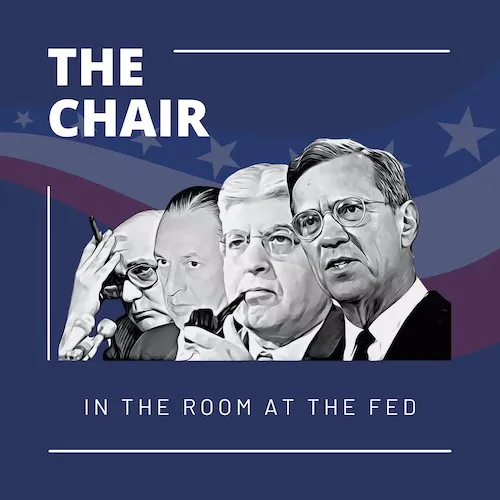
Ep 157Arthur Burns: “The smartest guy in the room”
More than any other global institution, the US Federal Reserve’s decisions and communications drive capital markets and alter financial conditions everywhere from Seattle to Seoul. While its interest rate are set by an expert committee, for almost a century, the Fed’s core philosophy and operational approach have been moulded by one person: the Chair of the Board of Governors. In this podcast series, Tim Gwynn Jones - a veteran central bank "watcher" - talks to authors of books about the Fed's most influential Chairs, starting with Marriner Eccles, Bill Martin, Arthur Burns, and Paul Volcker. In this third episode, he talks to Wyatt Wells – author of Economist in an Uncertain World – Arthur F. Burns and The Federal Reserve, 1970–1978 (Columbia University Press, 1994). Burns has had a bad press - so bad that Chris Hughes, one of Facebook's founders, was moved to rehabilitate him. Leading the Fed from 1970 to 1978 when inflation averaged 9%, Burns was an accomplished business-cycle economist but also a politically partisan Chair intensely loyal to Richard Nixon and Gerald Ford. Going far beyond his remit as a central banker, Burns oversaw government efforts to control prices and wages as an alternative to monetary policy. “If you couple an incomes policy with a tight fiscal and monetary policy, it can work. The problem is that it often becomes an excuse for not doing that,” says Wells. “Burns found himself trapped in this position where he felt he couldn't raise interest rates without wrecking the controls programme and possibly his own career – his own position at the Fed. It's clear in ‘73, he knows interest rates need to go up. They're trying to raise them but he's got these political concessions and he's doing this sort of dance, trying to square the circle … And of course: ‘I'm the smartest guy in the room. Therefore, I should play a key role in this effort to balance everything’. I think there are very few Federal Reserve chairmen who have elbowed their way into other areas in the way that Burns did. Maybe none”. An economic historian, Wyatt Wells has been Professor of History at Auburn University, Montgomery, since 1997. Learn more about your ad choices. Visit megaphone.fm/adchoices Support our show by becoming a premium member! https://newbooksnetwork.supportingcast.fm/economics
Ep 221Jacob Soll, "Free Market: The History of an Idea" (Basic Books, 2022)
After two government bailouts of the American economy in less than twenty years, free market thought is due for serious reappraisal. Free Market: The History of an Idea (Basic Books, 2022) shows how the idea became so powerful, why it succeeded, and why it has failed so spectacularly. In 1990, the G7 Countries enjoyed 70 percent of world GDP. In the face of the collapse of the Soviet Union, it was supposed to be a story of the success of free markets. However, in the past thirty years, that number has dropped by half, and Asia has emerged as a major motor of world economic growth. Today, state-run China is the second biggest economy on earth, and tiny Singapore, with its state-owned companies, has become a new model of wealth creation. In other words, Milton Friedman's free market dogma, that only private companies can create wealth and that states hamper it, has not proved very clearly to be untrue. This book shows how we got to the current crisis of free market thought, and suggests how we can find our way out. Contrary to popular free market narratives, early market theorists believed that states had an important role in building and maintaining free markets. But in the eighteenth century, some free-market thinkers began insisting only pure free markets, without state intervention, could work. A tradition of free-market ideological brittleness emerged, and it has led orthodox free market economics to some spectacular failures. It is a paradox that an economic theory rooted in the idea of competition, adaptation and evolution, has refused to follow its own precepts. This book shows that we need to go back to the origins of free market thought in order to understand its dynamism, as well as its inherent weaknesses, and to develop new economic concepts to face the staggering challenges of the twenty-first century. Jacob Soll is an American university professor and professor of philosophy, history and accounting at the University of Southern California. Soll's work examines the mechanics of politics, statecraft and economics by dissecting the various elements of how modern states and political systems succeed and fail. Morteza Hajizadeh is a Ph.D. graduate in English from the University of Auckland in New Zealand. His research interests are Cultural Studies; Critical Theory; Environmental History; Medieval (Intellectual) History; Gothic Studies; 18th and 19th Century British Literature. YouTube channel. Twitter. Learn more about your ad choices. Visit megaphone.fm/adchoices Support our show by becoming a premium member! https://newbooksnetwork.supportingcast.fm/economics

Ep 156Bill Martin: “Truman looked at him and said: ‘Traitor’”
More than any other global institution, the US Federal Reserve’s decisions and communications drive capital markets and alter financial conditions everywhere from Seattle to Seoul. While its interest rate are set by an expert committee, for almost a century, the Fed’s core philosophy and operational approach have been moulded by one person: the Chair of the Board of Governors. In this podcast series, Tim Gwynn Jones - a veteran central bank "watcher" - talks to authors of books about the Fed's most influential Chairs, starting with Marriner Eccles, Bill Martin, Arthur Burns, and Paul Volcker. In this second episode, he interviews Robert Bremner – author of Chairman of the Fed: William McChesney Martin Jr. and the Creation of the Modern American Financial System (Yale University Press, 2004). Bill Martin still holds the record for the longest chairmanship at the Fed – holding the office from 1951 to 1970. A Democrat, he was first nominated by President Harry Truman and reappointed (more or less willingly) by Eisenhower, Kennedy, Johnson, and Nixon. He dismantled government wartime controls over interest rates, battled to save the postwar currency-management regime, democratised the Fed, and fought successive presidents to keep its independence. These conflicts started early, says Bremner. “Martin told this story about walking down Wall Street and passing the president going the other way and Martin said: ‘Good morning, Mr. President, great to see you’. And Truman looked at him and said: ‘Traitor’. Basically Truman wanted to continue low interest rates certainly until he left office and for as long as possible”. After a career in finance at the World Bank and in the mutual-fund industry, Bob Bremner is now a director of the Westminster Ingleside Foundation. Learn more about your ad choices. Visit megaphone.fm/adchoices Support our show by becoming a premium member! https://newbooksnetwork.supportingcast.fm/economics

Ep 155Marriner Eccles: Reform “may not have happened in 1935 if Eccles hadn't been there”
More than any other global institution, the US Federal Reserve’s decisions and communications drive capital markets and alter financial conditions everywhere from Seattle to Seoul. While its interest rate are set by an expert committee, for almost a century, the Fed’s core philosophy and operational approach have been moulded by one person: the Chair of the Board of Governors. In this podcast series, Tim Gwynn Jones - a veteran central bank "watcher" - talks to authors of books about the Fed's most influential Chairs, starting with Marriner Eccles, Bill Martin, Arthur Burns, and Paul Volcker. In this first episode, he interviews Mark Nelson - author of Jumping the Abyss: Marriner S. Eccles and the New Deal, 1933-1940 (University of Utah Press, 2017). Eccles chaired the Fed from 1934 to 1948, turned it into a Washington power centre, and centralised policymaking with the Board of Governors. The US might have been better served if Eccles and his nemesis Henry Morgenthau, the Treasury Secretary from 1934-1945, had swapped roles, says Nelson. "That's true except for the fact that Eccles did do something very important at the Fed and that is the Banking Act of 1935, which really changed the Fed in an enormously important way and Morgenthau would not have done that ... I think it would have happened at some point. You could make the argument, though, that it may not have happened in 1935 if Eccles hadn't been there because Eccles took the job at the Fed on the understanding that these changes would be made”. An actor-turned-historian, Mark Nelson was educated at Pepperdine University and Claremont Graduate University and today teaches at Greenville Technical College, South Carolina. His next book will be Race and Recovery: James F. Byrnes and the New Deal. Learn more about your ad choices. Visit megaphone.fm/adchoices Support our show by becoming a premium member! https://newbooksnetwork.supportingcast.fm/economics
Ep 106Katherine Hempstead, "Uncovered: The Story of Insurance in America" (Oxford UP, 2023)
Historically, the insurance industry in America has been fragmented. As a result, there have been debates and conflicts over the proper roles of federal and state governments, business, and the responsibilities of individuals. Who should cover the risks of loss? And to what extent should risk be shared and by whom? In Uncovered: The Story of Insurance in America (Oxford UP, 2023), Katherine Hempstead answers these questions by exploring the history of the insurance business and its regulation in the United States from the 1870s through the twentieth century. Specifically, she focuses on the friction between the public demand for insurance and the private imperatives of insurers. Tracing the history of the industry from the early days of life, fire, and casualty insurance to the development of state regulation in the late nineteenth century, Hempstead examines the role that insurers initially played in the largely voluntary social safety net and how this changed over time. After the Great Depression, the federal government assumed a greater role in the provision of insurance, while insurers enthusiastically pursued the growing business of employee benefits. As the twentieth century progressed, insurers and government have become interdependent, with insurers participating in publicly funded markets. As Hempstead shows, periodic crises in life, fire, health, auto, and liability insurance highlighted gaps between the coverage that insurers were willing to provide and what the public demanded. Learn more about your ad choices. Visit megaphone.fm/adchoices Support our show by becoming a premium member! https://newbooksnetwork.supportingcast.fm/economics
Ep 472Bernard E. Harcourt. "Cooperation: A Political, Economic, and Social Theory" (Columbia UP, 2023)
Liberal democracy is in crisis around the world, unable to address pressing problems such as climate change. There is, however, another path—cooperation democracy. From consumer co-ops to credit unions, worker cooperatives to insurance mutuals, nonprofits to mutual aid, countless examples prove that people working together can extend the ideals of participatory democracy and sustainability into every aspect of their lives. These forms of cooperation do not depend on electoral politics. Instead, they harness the longstanding practices and values of cooperatives: self-determination, democratic participation, equity, solidarity, and respect for the environment. Bernard E. Harcourt develops a transformative theory and practice that builds on worldwide models of successful cooperation. He identifies the most promising forms of cooperative initiatives and then distills their lessons into an integrated framework: Coöperism. This is a political theory grounded on recognition of our interdependence. It is an economic theory that can ensure equitable distribution of wealth. Finally, it is a social theory that replaces the punishment paradigm with a cooperation paradigm. A creative work of normative critical theory, Cooperation: A Political, Economic, and Social Theory (Columbia UP, 2023) provides a positive vision for addressing our most urgent challenges today. Harcourt shows that by drawing on the core values of cooperation and the power of people working together, a new world of cooperation democracy is within our grasp. Bernard E. Harcourt is the Isidor and Seville Sulzbacher Professor of Law and professor of political science at Columbia University and a chaired professor at the École des Hautes Études en Sciences Sociales in Paris. An editor of Michel Foucault’s work in French and English, Harcourt is the author of several books, including Critique and Praxis (Columbia, 2020). He is a social-justice litigator and the recipient of the 2019 Norman Redlich Capital Defense Distinguished Service Award from the New York City Bar Association for his longtime representation of death row prisoners. Morteza Hajizadeh is a Ph.D. graduate in English from the University of Auckland in New Zealand. His research interests are Cultural Studies; Critical Theory; Environmental History; Medieval (Intellectual) History; Gothic Studies; 18th and 19th Century British Literature. YouTube channel. Twitter. Learn more about your ad choices. Visit megaphone.fm/adchoices Support our show by becoming a premium member! https://newbooksnetwork.supportingcast.fm/economics
Ep 154Jan Eeckhout, "The Profit Paradox: How Thriving Firms Threaten the Future of Work" (Princeton UP, 2021)
It is a truth universally acknowledged that as a society we want successful, profitable companies because, as Jan Eeckhout says in The Profit Paradox: How Thriving Firms Threaten the Future of Work (Princeton UP, 2021), “we tend to accept that when firms do well, the economy does well”, even when that's not true. The rising tide, in some cases, does not lift all boats. Even when a few strong players have outsized gains, the rest of the market can suffer. These trends have a ripple effect over time that effectively separate economic winners, who keep an increasingly large share of benefits, from economic losers who struggle to compete, let alone maintain the standard of living achieved by their parents. In this book, Jan Eeckhout documents how a small number of large firms have been able to gain tremendous market power through a variety of mechanisms such as price manipulation, outsourcing, and leveraging new technical innovations. None of these are inherently wrong, but when used by powerful companies to reduce or eliminate potential competition, they lead to inefficient markets that weaken society. It is a case of excessive success, as companies narrowly focus on defending and increasing their profits without significant consideration for the externalities or unintended consequences of these market failures. Eeckhout presents an optimistic outlook of how we can retain the extensive advantages of economic growth while reversing some of these more dangerous trends. His recommendations for the future include leveraging what we've learned from prior generations who faced similar challenges, and building on the incredible technical innovations that have characterized the last few decades, including recent breakthroughs in artificial intelligence. Recommended reading: The Wisdom of Crowds by James Surowiecki. Learn more about your ad choices. Visit megaphone.fm/adchoices Support our show by becoming a premium member! https://newbooksnetwork.supportingcast.fm/economics
Ep 471Lucia Hulsether, "Capitalist Humanitarianism" (Duke UP, 2023)
The struggle against neoliberal order has gained momentum over the last five decades – to the point that economic elites have not only adapted to the Left's critiques but incorporated them for capitalist expansion. Venture funds expose their ties to slavery and pledge to invest in racial equity. Banks pitch microloans as a path to indigenous self-determination. Fair-trade brands narrate consumption as an act of feminist solidarity with women artisans in the global South. In Capitalist Humanitarianism (Duke UP, 2023), Lucia Hulsether examines these projects and the contexts of their emergence. Blending historical and ethnographic styles, and traversing intimate and global scales, Hulsether tracks how neoliberal self-critique creates new institutional hegemonies that, in turn, reproduce racial and neocolonial dispossession. From the archives of Christian fair traders to luxury social entrepreneurship conferences, from US finance offices to Guatemalan towns flooded with their loan products, from service economy desperation to the internal contradictions of social movements, Hulsether argues that capitalist humanitarian projects are fueled as much by a profit motive as by a hope that racial capitalism can redeem the losses that accumulate in its wake. Lucia Hulsether is Assistant Professor of Religious Studies at Skidmore College. This episode’s host, Jacob Barrett, is currently a PhD student in the Department of Religious Studies at the University of North Carolina at Chapel Hill in the Religion and Culture track. For more information, visit his website thereluctantamericanist.com Learn more about your ad choices. Visit megaphone.fm/adchoices Support our show by becoming a premium member! https://newbooksnetwork.supportingcast.fm/economics
Ep 144Matt Stoller, "Goliath: The 100-Year War Between Monopoly Power and Democracy" (Simon & Schuster, 2020)
In Goliath: The 100-Year War Between Monopoly Power and Democracy (Simon & Schuster, 2019), Matt Stoller explains how authoritarianism and populism have returned to American politics for the first time in eighty years, as the outcome of the 2016 election shook our faith in democratic institutions. It has brought to the fore dangerous forces that many modern Americans never even knew existed. Today's bitter recriminations and panic represent more than just fear of the future, they reflect a basic confusion about what is happening and the historical backstory that brought us to this moment. The true effects of populism, a shrinking middle class, and concentrated financial wealth are only just beginning to manifest themselves under the current administrations. The lessons of Stoller's study will only grow more relevant as time passes. "An engaging call to arms," (Kirkus Reviews) Stoller illustrates here in rich detail how we arrived at this tenuous moment, and the steps we must take to create a new democracy. Matt Stoller is the Director of Research at the American Economic Liberties Project. Caleb Zakarin is the Assistant Editor of the New Books Network (Twitter: @caleb_zakarin). Learn more about your ad choices. Visit megaphone.fm/adchoices Support our show by becoming a premium member! https://newbooksnetwork.supportingcast.fm/economics
Ep 190Hamilton Nolan, "The Hammer: Power, Inequality, and the Struggle for the Soul of Labor" (Hachette Books, 2024)
Inequality is America's biggest problem. Unions are the single strongest tool that working people have to fix it. Organized labor has been in decline for decades. Yet it sits today at a moment of enormous opportunity. In the wake of the pandemic, a highly visible wave of strikes and new organizing campaigns have driven the popularity of unions to historic highs. The simmering battle inside of the labor movement over how to tap into its revolutionary potential--or allow it to be squandered--will determine the economic and social course of American life for years to come. In chapters that span the country, Nolan shows readers the actual places where labor and politics meld. He highlights how organized labor can and does wield power effectively: a union that dominates Las Vegas and is trying to scale nationally; a successful decades-long campaign to organize California's child care workers; the human face of a surprising strike of factory workers trying to preserve their pathway to the middle class. Throughout, Nolan follows Sara Nelson, the fiery and charismatic head of the flight attendants' union, as she struggles with how (and whether) to assert herself as a national leader, to try to fix what is broken. The Hammer: Power, Inequality, and the Struggle for the Soul of Labor (Hachette Books, 2024) draws the line from forgotten workplaces in rural West Virginia to Washington's halls of power, and shows how labor solidarity can utterly transform American politics--if it can first transform itself. A labor journalist for more than a decade, Nolan helped unionize his own industry. The Hammer is a urgent on-the-ground excavation of the past, present, and future of the American labor movement. Hamilton Nolan is a labor journalist who writes regularly for In These Times magazine and The Guardian. He has written about labor, politics, and class war for The New York Times, the Washington Post, Gawker, Splinter, and other publications. He was the longest-serving writer in Gawker’s history, and was a leader in unionizing Gawker Media in 2015. Hamilton is a proud member of the Writers Guild of America, East. Learn more about your ad choices. Visit megaphone.fm/adchoices Support our show by becoming a premium member! https://newbooksnetwork.supportingcast.fm/economics
Ep 52David J. Hand, "Dark Data: Why What You Don't Know Matters" (Princeton UP, 2020)
There is no shortage of books on the growing impact of data collection and analysis on our societies, our cultures, and our everyday lives. David Hand's new book Dark Data: Why What You Don't Know Matters (Princeton University Press, 2020) is unique in this genre for its focus on those data that aren't collected or don't get analyzed. More than an introduction to missingness and how to account for it, this book proposes that the whole of data analysis can benefit from a "dark data" perspective—that is, careful consideration of not only what is seen but what is unseen. David assembles wide-ranging examples, from the histories of science and finance to his own research and consultancy, to show how this perspective can shed new light on concepts as classical as random sampling and survey design and as cutting-edge as machine learning and the measurement of honesty. I expect the book to inspire the same enjoyment and reflection in general readers as it is sure to in statisticians and other data analysts. Suggested companion work: Caroline Criado Perez, Invisible Women: Data Bias in a World Designed for Men. Cory Brunson (he/him) is a Research Assistant Professor at the Laboratory for Systems Medicine at the University of Florida. Learn more about your ad choices. Visit megaphone.fm/adchoices Support our show by becoming a premium member! https://newbooksnetwork.supportingcast.fm/economics
Ep 153Daniel Susskind, "Growth: A History and a Reckoning" (Harvard UP, 2024)
Daniel Susskind examines the brief and powerful history of economic growth and puts it into perspective with human prosperity in Growth: A History and a Reckoning (Harvard UP, 2024). Susskind acknowledges the tremendous benefits of economic growth, which he credits with freeing billions of people from poverty and allowing us to live longer and healthier lives. He also recognizes the real and substantial costs of our relentless pursuit of growth at the expense of other considerations and moral challenges. Responding to the degrowth movement, Susskind counters the assumption that simply reducing growth will lead to better outcomes. In particular, Susskind points out that our key measure of growth, GDP, is one imperfect metric that is neither intended nor effective as a proxy for well-being. He recommends a more balanced "dashboard" approach that includes GDP along with other success measures. Reducing our myopic focus on GDP does not mean less growth. Susskind presents an alternate approach, arguing that we should continue to pursue growth through the creative application of new ideas that allow us to use our finite natural resources more effectively and efficiently. Ideas, he points out, are not a scarce asset but an infinite one; by shifting to focus on new ways of thinking and working Susskind shows how we can continue to pursue the benefits of growth while mitigating the high costs. Book referenced: GDP: A Brief but Affectionate History by Diane Coyle Recommended reading: Planting the Oudolf Gardens by Rory Dusoir Learn more about your ad choices. Visit megaphone.fm/adchoices Support our show by becoming a premium member! https://newbooksnetwork.supportingcast.fm/economics
Ep 36Balihar Sanghera and Elmira Satybaldieva, "Rentier Capitalism and Its Discontents: Power, Morality and Resistance in Central Asia" (Palgrave MacMillan, 2021)
Balihar Sanghera and Elmira Satybaldieva’s Rentier Capitalism and Its Discontents: Power, Morality and Resistance in Central Asia (Palgrave MacMillan, 2021) evaluates today’s economic political, social and ecological crises through the lens of rentier capitalism and countermovements in Central Asia. Over the last three decades, the rich and powerful have increased their wealth and political power to the detriment of social and environmental well-being. But their activities have not gone unchecked; grassroots activism has resisted the damaging effects of the neoliberal commodification of things. Providing a much-needed theorisation of the moral economy and politics of rent, this book offers in-depth case studies on finance, real estate and natural resources in Kazakhstan and Kyrgyzstan. The authors show the mechanisms of rent extraction, their moral justifications and legitimacy, and social struggles against them. This book not only offers insight into social and economic dynamics in Central Asia, but invites us all to interrogate what purpose, and whom, economies ultimately serve. Cholpon Ramizova is a London-based writer and researcher. She holds a Master's in Migration, Mobility and Development from SOAS, University of London. Her thematic interests are in migration, displacement, identity, gender, and nationalism - and more specifically on how and which ways these intersect within the Central Asia context. Learn more about your ad choices. Visit megaphone.fm/adchoices Support our show by becoming a premium member! https://newbooksnetwork.supportingcast.fm/economics
Ep 179Work-from-Home is Here to Stay: Call for Flexibility in Post-pandemic Work Policies
Listen to this interview of Darja Smite, Professor of Software Engineering at Blekinge Institute of Technology, Sweden, and also research scientist at SINTEF; and, Jarle Hildrum, Director, Deloitte Consulting, Norway; and also, Daniel Mendez, Professor of Software Engineering at Blekinge Institute of Technology, Sweden, and as well, Senior Scientist heading the research division Requirements Engineering at fortiss. We talk about their paper Work-from-home is here to stay: Call for flexibility in post-pandemic work policies (JSS 2023). Daniel Mendez : "Two key takeaways from our collective experience here are, No.1, figures don't need to be absolute — so, we should really focus on the essence of what we want to convey. And No.2, in terms of what we want to convey, I think that every figure ideally has one key message, one key takeaway." Learn more about your ad choices. Visit megaphone.fm/adchoices Support our show by becoming a premium member! https://newbooksnetwork.supportingcast.fm/economics
Ep 724Erin Lin, "When the Bombs Stopped: The Legacy of War in Rural Cambodia" (Princeton UP, 2024)
Over the course of the Vietnam War, the United States dropped 500,000 tons of bombs over Cambodia—more than the combined weight of every man, woman, and child in the country. Fifty years after the last sortie, residents of rural Cambodia are still coping with the unexploded ordnance that covers their land. In When the Bombs Stopped: The Legacy of War in Rural Cambodia (Princeton UP, 2024), Erin Lin investigates the consequences of the US bombing campaign across postconflict Cambodia. Drawing on interviews, original econometric analysis, and extensive fieldwork, Lin upends the usual scholarly perspective on the war and its aftermath, presenting the viewpoint of those who suffered the bombing rather than those who dropped the bombs. She shows that Cambodian farmers stay at a subsistence level because much of their land is too dangerous to cultivate—and yet, paradoxically, the same bombs that endanger and impoverish farming communities also protect them, deterring predatory elites from grabbing and commodifying their land. Lin argues that the half-century legacy of American bombs has sedimented the war into the layers of contemporary Cambodian society. Policies aimed at developing or modernizing Cambodia, whether economic liberalization or authoritarian consolidation, must be realized in an environment haunted by the violence of the past. As the stories Lin captures show, the bombing served as a critical juncture in these farming villages, marking the place in time where development stopped. Our guest today is Erin Lin, who is an Associate Professor of Political Science at The Ohio State University. Our host is Eleonora Mattiacci, an Assistant Professor of Political Science at Amherst College. She is the author of "Volatile States in International Politics" (Oxford University Press, 2023). Learn more about your ad choices. Visit megaphone.fm/adchoices Support our show by becoming a premium member! https://newbooksnetwork.supportingcast.fm/economics
Ep 34Nicolas Véron, "Europe's Banking Union at Ten: Unfinished Yet Transformative" (Bruegel, 2024)
In 2012, to stave off the collapse of their currency union, Europe’s leaders sought to end the so-called “doom loop” between the solvency of their governments and their banking systems. Two years later, a banking union was born. Created as a crisis response, like the postwar coal and steel community, this ten-year-old union is another step in Europe’s long integrationist road. Yet – as Nicolas Véron points out in Europe’s Banking Union At Ten: Unfinished Yet Transformative (Bruegel, 2024) - the effort to "break the vicious circle between banks and sovereigns remains fragile and incomplete". Together with Jean Pisani-Ferry, Nicolas Véron is a co-founder of the Bruegel public-policy think tank in Brussels and a scholar at the Peterson Institute for International Economics (PIIE) in Washington. A specialist in financial systems and regulatory reform, he is an alumnus of the École Polytechnique and the École nationale supérieure des mines in Paris and - until 2000 - was a French civil servant. He has written and co-written many papers on banking supervision, crisis management, and Eurozone policy governance. *The author's book recommendations were Central Banking Before 1800: A Rehabilitation by Ulrich Bindseil (OUP, 2020) and 7500 Euros: Pastiches politico-littéraires by David Spector (Wombat, 2022). Tim Gwynn Jones is an economic and political-risk analyst at Medley Advisors, who also writes the twenty4two newsletter on Substack. Learn more about your ad choices. Visit megaphone.fm/adchoices Support our show by becoming a premium member! https://newbooksnetwork.supportingcast.fm/economics
Ep 720Amy Schiller, "The Price of Humanity: How Philanthropy Went Wrong—And How to Fix It" (Melville House, 2023)
Amy Schiller, who spent a number of years working in both political and major gift fundraising, has a new book detailing some of the fundamental problems currently afflicting American philanthropy and how to correct some of these problems. Schiller, a political theorist currently at Dartmouth College’s Society of Fellows, brings two important perspectives to her research in The Price of Humanity: How Philanthropy Went Wrong—And How to Fix It (Melville House, 2023)—combining her experience in the philanthropic world with her training and expertise in political theory, especially democratic theory. The Price of Humanity also provides the reader with a vital history of philanthropy and giving, especially in the West, and how thinking about the role of supporting others as part of the common good has shifted over the course of more than two millennia. Schiller makes an important point about how St. Augustine, in his teachings on donations and giving, shifted the framing and understanding of giving from a community-based common good to a global approach to donating, tying the act of giving to individual salvation. This approach not only highlighted suffering and need and stratified those who give from those who are in need, but it also disconnected the philanthropic experience from the immediate community while objectifying those who are in poverty or generally in need. The Price of Humanity doesn’t dwell in the past but provides this important lens that continues to apply to our contemporary thinking about giving. This more disconnected approach is also overlaid, in our current environment, with the demand that non-profits and philanthropies product quantifiable goods: how many cases of malaria have been eradicated, how much food has been provided to those experiencing scarcity, how are the dollars donated spent and by whom and in what ways? Thus, in so many ways, philanthropic organizations have to report out their successes in the same ways that private corporations need to detail their fiscal health to their boards of directors and shareholders. All of these approaches tend to disconnect the act of giving from the world in which we live, according to Schiller, and this disconnection makes the reason for giving much more attenuated, distancing us from each other, our communities, and the real role of the common good. Instead of linking individuals together in our shared love for one another and humanity as a whole—which is actually what the word philanthropy means in the original Greek—we live in a philanthropic world that separates and isolates. The Price of Humanity spotlights different approaches to giving, with discussions of the Gates Foundation, Effective Altruism, Robber Barons and the Gilded Age, and other forms of the business of giving. Schiller also focuses on modern examples of philanthropy as the common good, which brings it into the realm of democratic theory, as a means to provide the flourishing of humanity, not merely fulfilling the desperate needs of individuals. This is a fascinating and valuable interrogation of the idea of giving to others, and how we need to reconsider our thinking about the act of giving itself and the role that this act plays in our community and in our democracy. Lilly J. Goren is a professor of political science at Carroll University in Waukesha, WI. She is co-host of the New Books in Political Science channel at the New Books Network. She is co-editor of The Politics of the Marvel Cinematic Universe (University Press of Kansas, 2022), as well as co-editor of the award winning book, Women and the White House: Gender, Popular Culture, and Presidential Politics (University Press of Kentucky, 2012). She can be reached @gorenlj.bsky.social Learn more about your ad choices. Visit megaphone.fm/adchoices Support our show by becoming a premium member! https://newbooksnetwork.supportingcast.fm/economics
Ep 223Andreas Fulda, "Germany and China: How Entanglement Undermines Freedom, Prosperity and Security" (Bloombury, 2024)
Germany and China: How Entanglement Undermines Freedom, Prosperity and Security (Bloomsbury, 2024) is a groundbreaking book, of which the findings have significant implications both for German-China relations and also in understanding the rising influence of autocratic China on liberal democracies globally. In today's interview, Associate Professor Andreas Fulda and I spoke about Germany's entanglement with China, and the extent of Germany's dependancies on China in terms of economics, technology, politics and academia. We spoke about the blind spots of policy makers and academics have, and the way that China policy is constructed and interpreted as a result. We also spoke about the implications for national security and German sovereignty, and the way that Germany entanglement with China is a warning sign for democratic states everywhere. Dr Fulda is a political scientist and China scholar with a keen interest in the philosophy of science. You can listen to an interview about his previous book, The Struggle for Democracy in Mainland China, Taiwan and Hong KongSharp Power and its Discontents (Routledge: 2019) here. Learn more about your ad choices. Visit megaphone.fm/adchoices Support our show by becoming a premium member! https://newbooksnetwork.supportingcast.fm/economics
Ep 222Rhodri Davies, "What Is Philanthropy For?" (Bristol UP, 2023)
In recent years, philanthropy, the use of private assets for the public good, has come under renewed scrutiny. Do elite philanthropists wield too much power? Is big-money philanthropy unaccountable and therefore anti-democratic? And what about so-called "tainted donations" and "dark money" funding pseudo-philanthropic political projects? The COVID-19 pandemic has amplified many of these criticisms, leading some to conclude that philanthropy needs to be fundamentally reshaped to play a positive role in our future. In What is Philanthropy For? (Bristol University Press, 2023), Rhodri Davies examines why it's important to ask what philanthropy is for, as it has shaped our world for centuries. Considering the alternatives, including charity, justice, taxation, the state, democracy, and the market, he explores the pressing questions that philanthropy must tackle to be equal to the challenges of the 21st century. Learn more about your ad choices. Visit megaphone.fm/adchoices Support our show by becoming a premium member! https://newbooksnetwork.supportingcast.fm/economics
Ep 464Jessica Calarco, "Holding It Together: How Women Became America's Safety Net" (Portfolio, 2024)
How do unequal societies function? In Holding It Together: How Women Became America's Safety Net (Portfolio, 2024), Jesscia Calarco, an Associate Professor of Sociology at the University of Wisconsin-Madison, examines how America’s DIY society depends on the labour of mothers and excludes the sorts of social supports present in other countries. This dependence has hugely negative social and individual consequences, as demonstrated by the rich qualitiative and quantitative data examined in the book. Alongside the analysis of the problems and consequences of women’s role in the US, the book also thinks through solutions, demonstrating how much political discourse is far from the collective action that is likely to be effective for social change. An outstanding contribution to social science and contemporary politics, the book is essential reading for anyone interested in contemporary social inequalities. Learn more about your ad choices. Visit megaphone.fm/adchoices Support our show by becoming a premium member! https://newbooksnetwork.supportingcast.fm/economics
Ep 99Allison J. Pugh, "The Last Human Job: The Work of Connecting in a Disconnected World" (Princeton UP, 2024)
With the rapid development of artificial intelligence and labor-saving technologies like self-checkouts and automated factories, the future of work has never been more uncertain, and even jobs requiring high levels of human interaction are no longer safe. The Last Human Job: The Work of Connecting in a Disconnected World (Princeton UP, 2024) explores the human connections that underlie our work, arguing that what people do for each other in these settings is valuable and worth preserving. Drawing on in-depth interviews and observations with people in a broad range of professions--from physicians, teachers, and coaches to chaplains, therapists, caregivers, and hairdressers--Allison Pugh develops the concept of "connective labor," a kind of work that relies on empathy, the spontaneity of human contact, and a mutual recognition of each other's humanity. The threats to connective labor are not only those posed by advances in AI or apps; Pugh demonstrates how profit-driven campaigns imposing industrial logic shrink the time for workers to connect, enforce new priorities of data and metrics, and introduce standardized practices that hinder our ability to truly see each other. She concludes with profiles of organizations where connective labor thrives, offering practical steps for building a social architecture that works. Vividly illustrating how connective labor enriches the lives of individuals and binds our communities together, The Last Human Job is a compelling argument for us to recognize, value, and protect humane work in an increasingly automated and disconnected world. Learn more about your ad choices. Visit megaphone.fm/adchoices Support our show by becoming a premium member! https://newbooksnetwork.supportingcast.fm/economics
Ep 16Branding Foreign Aid: Soft Power and Popular Attitudes in International Development
Why do international donors brand foreign aid? And what impact does it have on popular attitudes towards them? Join Matthew Winters and Petra Alderman as they talk about soft power, foreign aid branding, and popular attitudes towards USAID and Japan in India, Bangladesh, and Uganda. They discuss whether foreign aid branding works and address several tensions linked to this practice, including branding in the context of unequal North-South power relations and colonial legacies. Matthew Winters is Professor of Political Science at the University of Illinois and a recent holder of the Fulbright-University of Birmingham Distinguished Scholar Award at the International Development Department at the University of Birmingham. Petra Alderman is a Post-Doctoral Research Fellow in Leadership for Inclusive and Democratic Politics at the University of Birmingham and Research Fellow at CEDAR. The People, Power, Politics podcast brings you the latest insights into the factors that are shaping and re-shaping our political world. It is brought to you by the Centre for Elections, Democracy, Accountability and Representation (CEDAR) based at the University of Birmingham, United Kingdom. Join us to better understand the factors that promote and undermine democratic government around the world and follow us on X (Twitter) at @CEDAR_Bham! Learn more about your ad choices. Visit megaphone.fm/adchoices Support our show by becoming a premium member! https://newbooksnetwork.supportingcast.fm/economics
Ep 5Kathleen Day, "Broken Bargain: Bankers, Bailouts, and the Struggle to Tame Wall Street" (Yale UP, 2019)
Think that today's debates about the role of the Federal Reserve Bank, financial regulation, "too big to fail", etc. are new? Think again. Who should control banks, who should regulate banks, what should banks even do--these questions have been debated since the founding of the Republic. Replace CNBC's David Faber with Alexander Hamilton, and Joe Kernan with Thomas Jefferson (or James Madison) and the arguments about banking, moral hazard, and regulation would be largely the same, though the attire would be quite different. Kathleen Day's new book Broken Bargain: Bankers, Bailouts, and the Struggle to Tame Wall Street (Yale University Press, 2019) provides a detailed two-century history of the give and take between government authority and financial institutions (and the individuals caught between them). The challenges over time have changed--the absence of a single currency in the early 19th century, insufficient credit in the late 19th century, the roaring and patently stupid 1920s, and then the whole range of financial innovations in the postwar period--but the key issues recur over and over again. Day sides in the end with the need for consistent regulation from impartial and empowered bureaucrats, but alas, the last two centuries have shown that they are hard to come by. Not everyone will agree with her take on banks and regulation, but there can be no doubt about the underlying "capitalism is messy" theme running through our history and this book. Daniel Peris is Senior Vice President at Federated Investors in Pittsburgh. Trained as a historian of modern Russia, he is the author most recently of Getting Back to Business: Why Modern Portfolio Theory Fails Investors. You can follow him on Twitter @Back2BizBook or at http://www.strategicdividendinvestor.com Learn more about your ad choices. Visit megaphone.fm/adchoices Support our show by becoming a premium member! https://newbooksnetwork.supportingcast.fm/economics
Ep 272Gizem Zencirci, "The Muslim Social: Neoliberalism, Charity, and Poverty in Turkey" (Syracuse UP, 2024)
Since coming to power in 2002, Turkey’s governing party, the AKP, has made poverty relief a central part of their political program. In addition to neoliberal reforms, AKP’s program has involved an emphasis on Islamic charity that is unprecedented in the history of the Turkish Republic. To understand the causes and consequences of this phenomenon, Zencirci introduces the concept of the Muslim Social, defined as a welfare regime that reimagined and reconfigured Islamic charitable practices to address the complex needs of a modern market society. In The Muslim Social: Neoliberalism, Charity, and Poverty in Turkey (Syracuse UP, 2024), Zencirci explores the blending of religious values and neoliberal elements in dynamic, flexible, and unexpected ways. Although these governmental assemblages of Islamic neoliberalism produced new forms of generosity, distinctive notions of poverty, and novel ways of relating to others in society, Zencirci reveals how this welfare regime privileged managerial efficiency and emotional well-being at the expense of other objectives such as equality, development, or justice. The book provides a lens onto the everyday life of Islamic neoliberalism, while also mapping the kind of political concerns that animate poverty governance in our capitalist present. Gizem Zencirci is an associate professor of political science at Providence College. Her work has been published in journals such as the International Journal of Middle East Studies, Journal of the American Academy of Religion, and the Journal of Cultural Economy. Learn more about your ad choices. Visit megaphone.fm/adchoices Support our show by becoming a premium member! https://newbooksnetwork.supportingcast.fm/economics
Ep 10Using History to Better Finance and Build Social Wealth
Esoteric and frequently disinterested in the public good, financial institutions can be hard to navigate for those seeking to advance social welfare. My Episode 10 guest Paul Katz of the Jain Family Institute is trying to change that by building innovative tools to help visionary leaders in Brazil grow social wealth. During our lively exchange, Paul helped me understand how much history fits into his efforts and his organization's vision. We talked about Paul's discovery of his superpowers derived from a PhD in history, the importance of being a well-rounded researcher, and how it's often difficult to separate neatly quant from qual. We also discussed the significance of networking and wondered why historians routinely undervalue their expertise, thereby undercutting their chances of success in non-academic domains. Ultimately, our conversation is about the surprising ways to use history for the public good, contribute to organizational effectiveness, and explore new horizons for professional growth. Learn more about your ad choices. Visit megaphone.fm/adchoices Support our show by becoming a premium member! https://newbooksnetwork.supportingcast.fm/economics
Ep 460Anthony Heath and Yaojun Li, "Social Mobility" (Polity Press, 2024)
What is social mobility? In Social Mobility (Polity Press, 2023), Anthony Heath, an Emeritus Professor of Sociology at the University of Oxford and Yaojun Li, a Professor of Sociology at the University of Manchester, explore and explain this concept, setting out why the idea matters for both social scientists and the general reader. The book draws on a huge range of research, outlining the history of social mobility research, discussing central theories and approaches in sociology and economics, and detailing international comparisons and trends. The book highlights how social mobility is shaped by gender and ethnicity, along with the role of social class. Ultimately the book helps to explain who gets ahead in society and why; as a result the book will be essential reading across the social sciences, as well as for anyone interested in how society works. Learn more about your ad choices. Visit megaphone.fm/adchoices Support our show by becoming a premium member! https://newbooksnetwork.supportingcast.fm/economics