New Books in Economic and Business History
1,647 episodes — Page 8 of 33
Prithwiraj Choudhury, "The World Is Your Office: How Work from Anywhere Boosts Talent, Productivity, and Innovation" (Harvard Business Review Press, 2025)
As the debate around remote versus in-office work rages on, leaders in a wide range of industries continue to implement radically flexible work practices. Though there has been some pushback, many employers are still allowing most, if not all, of their employees to work from anywhere. The reason is that they understand that geographic flexibility offers a competitive advantage: the ability to attract and retain top talent globally. In The World Is Your Office: How Work from Anywhere Boosts Talent, Productivity, and Innovation (Harvard Business Review Press, 2025) Harvard Business School professor Prithwiraj Choudhury takes us inside that have been fully committed to work-from-anywhere (WFA) policies and shows how these organizations and their employees are benefiting. WFA is s a means of hiring and retaining the best talent. Choudhury show how to best manage WFA teams, share knowledge, and combat isolation, leverage AI and automation to extend WFA into manufacturing and other deskless roles, and design programs that attract talent to different regions Learn more about your ad choices. Visit megaphone.fm/adchoices
Emily Webber, "Mining Men: Britain's Last Kings of the Coalface" (Penguin, 2025)
The story of the last generation of British miners: fathers and sons, brothers and comrades, big hitters and broken men, strikers and scabs. Mining Men: Britain's Last Kings of the Coalface (Penguin, 2025) by Dr. Emily P. Webber explores how these men felt when the pits were closed and what happened next, including former miners who became factory workers, detectives, driving instructors, counsellors, the local mayor and one who even ended up working on Fleet Street. Featuring accounts from Ayrshire to the South Wales Valleys, from the ‘People’s Republic of South Yorkshire’, to the ‘Sunshine Corner Coalfields’ of Kent, each chapter offers a different perspective of the industry. Britain’s last deep coalmine closed in 2015, yet just fifty years ago the mining industry was a juggernaut, employing over 250,000 workers. Combining new personal interviews with extensive archival research, Dr. Webber illuminates the extraordinary history of the industry once considered the backbone of Britain. By situating the miners’ strike of 1984–85 in a longer history of the coalfields, we can understand why miners and their families fought so hard against pit closures, and what happened after the pit wheels stopped turning. Vivid, evocative and richly alive with minute detail, Mining Men uncovers what the mining industry once meant to its workers and their communities, and what Britain lost when it was gone. This interview was conducted by Dr. Miranda Melcher whose book focuses on post-conflict military integration, understanding treaty negotiation and implementation in civil war contexts, with qualitative analysis of the Angolan and Mozambican civil wars. You can find Miranda’s interviews on New Books with Miranda Melcher, wherever you get your podcasts. Learn more about your ad choices. Visit megaphone.fm/adchoices
John H. Cochrane, Klaus Masuch, and Luis Garicano, "Crisis Cycle: Challenges, Evolution, and Future of the Euro" (Princeton UP, 2025)
Crisis Cycle: Challenges, Evolution, and Future of the Euro (Princeton UP, 2025) John Cochrane Luis Garicano Klaus Masuch PRINCETON UNIVERSITY PRESS, 2025 Launched 26 years ago, the euro was never expected to have an easy life but it wasn't supposed to be this hard. A three-year solvency crisis, a string of bailouts, and a rescue by the European Central Bank (ECB) was followed by threats of deflation, negative interest rates, massive purchases of government debt, a global pandemic, a European land war, and an inflation surge. The euro area emerged from these tests but may not survive the next without reforms during this period of relative calm. In Crisis Cycle, economists John Cochrane, Luis Garicano, and Klaus Masuch call for critical reforms to rebuild the system's incentive structure and stop the ECB's unsought mission creep. "A beautiful ship was constructed," they write. "Out at sea, it ran into severe storms. Its captain and crew patched the holes as best they could. Now though it is time to return to the dry dock and fix the ship properly". John Cochrane is a professor of economics at Stanford University, best-known for his work on asset prices and the fiscal theory of the price level. Luis Garicano is an economics professor at the London School of Economics and former vice-chair of the Renew group in the European Parliament. Klaus Masuch recently retired from the ECB, where he was head of the monetary policy strategy department and a negotiator for the "Troika" of official creditors during the sovereign-debt crisis. To see the authors' own book recommendations, click here. Tim Gwynn Jones is an economic and political-risk analyst at Medley Advisors, who also writes 242.news on Substack. Learn more about your ad choices. Visit megaphone.fm/adchoices
Mark Somos, Matthew Cleary, Pablo Dufour, Edward Jones Corredera, and Emanuele Salerno, "The Unseen History of International Law" (Oxford UP, 2025)
The Unseen History of International Law (Oxford University Press, 2025) locates and describes almost one thousand surviving copies of the first nine editions of Hugo Grotius' De iure belli ac pacis (IBP) published between 1625 and 1650. Meticulously reconstructing the publishing history of these first nine editions and cataloguing copies across hundreds of collections, The Unseen History provides fundamental data for reconstructing the impact of IBP across time and space. The authors, Dr. Mark Somos, Dr. Matthew Cleary, Dr. Pablo Dufour, Dr. Edward Jones Corredera, and Dr. Emanuele Salerno, also examined annotations that thousands of owners and readers have left in IBP copies over four centuries, offering original insights into the development of international law.Grotius' De iure belli ac pacis has been commonly regarded as the foundation of modern international law since its first appearance in 1625. Most major international law scholars have engaged with IBP, often owning and richly annotating their own copies. At key moments - including the demise of the Holy Roman Empire, the fall of Napoleon, and the end of both world wars - IBP was reissued with new commentaries by multinational projects devoted to restarting the international order. Despite the enormous literature on IBP's reception and influence, we cannot fully understand its impact without uncovering the history of IBP as a physical object, with hundreds of thousands of unpublished annotations arguing or agreeing with the text, updating and adapting its contents.Approaching Grotius' seminal work as a physical vehicle of the author's, the publishers', owners', and readers' engagement, The Unseen History radically expands and revises our understanding not only of IBP, but also of the academic discipline and lived practice of modern international law over the last four centuries. In addition to delving into the first nine editions' printing history, descriptive bibliography, and both Grotius' and the publishers' marketing and donation strategies, the book explores Grotius' subsequent impact on pro-slavery and abolitionist litigation as a case study of how the census' original findings can be applied to specific areas of reception. This interview was conducted by Dr. Miranda Melcher whose new book focuses on post-conflict military integration, understanding treaty negotiation and implementation in civil war contexts, with qualitative analysis of the Angolan and Mozambican civil wars. Learn more about your ad choices. Visit megaphone.fm/adchoices
L. Sasha Gora, "Culinary Claims: Indigenous Restaurant Politics in Canada" (University of Toronto Press, 2025)
Culinary Claims: Indigenous Restaurant Politics in Canada (University of Toronto Press, 2025) by Dr. L. Sasha Gora explores the complex relationships between wild plants and introduced animals, Indigenous foodways, and Canadian regulations. Blending food studies with environmental history, the book examines how cuisines reflect social and political issues related to cultural representation, restaurants, and food sovereignty. Dr. Gora chronicles the rise of Indigenous restaurants and their influence on Canadian food culture, engaging with questions about how shifts in appetite reflect broader shifts in imaginations of local environments and identities. Drawing on a diverse range of sources – from recipes and menus to artworks and television shows – the book discusses both historical and contemporary representations of Indigenous foodways and how they are changing amid the relocalization of food systems. Culinary Claims tells a new story of settler colonialism and Indigenous resistance, emphasizing the critical role that restaurants play in Canada’s cultural landscape. It investigates how food shapes our understanding of place and the politics that underpin this relationship. Ultimately, the book asks, What insights can historians gain from restaurants – and their legacies – as reflections of Indigenous and settler negotiations over cultural claims to land? Culinary Claims presents a comprehensive history of Indigenous restaurants in Canada, highlighting their significant role in the evolution of Canadian food culture. This interview was conducted by Dr. Miranda Melcher whose book focuses on post-conflict military integration, understanding treaty negotiation and implementation in civil war contexts, with qualitative analysis of the Angolan and Mozambican civil wars. You can find Miranda’s interviews on New Books with Miranda Melcher, wherever you get your podcasts. Learn more about your ad choices. Visit megaphone.fm/adchoices
Mary A. Armstrong and Susan L. Averett, "Disparate Measures: The Intersectional Economics of Women in STEM Work" (MIT Press, 2024)
An exploration of workplace participation and earnings patterns for diverse women in US STEM professions that upends the myth that STEM work benefits women economically. Seen as part economic driver, part social remedy, STEM work is commonly understood to benefit both the US economy and people—particularly women—from underrepresented groups. But what do diverse women find when they work in US STEM occupations? What do STEM jobs really deliver—and for whom? In Disparate Measures: The Intersectional Economics of Women in STEM Work (MIT Press, 2024), Mary Armstrong and Susan Averett challenge the conventional wisdom that a diverse US STEM workforce will bring about economic abundance for the women who participate in it. Combining intersectionality theory and critical data theory with a feminist economic analysis, the authors explore how different groups of diverse women truly fare in US STEM professions.Disparate Measures is centered on eight unique, in-depth case studies, each of which provides an intersectional economic analysis (a term coined by the authors) of diverse women working in STEM occupations. Four case studies prioritize women of color and examine the STEM participation and earnings of Black women, American Indian and Alaska Native women, Asian and Pacific Islander women, and Hispanic women/Latinas; four additional case studies illuminate intersections that are frequently neglected by the STEM inclusivity literature: foreign-born women, women with disabilities, Queer women, and mothers. What the authors find in their groundbreaking, detailed analysis is that the promises of STEM are only partly true: when compared to women not working in STEM, most women are indeed economically elevated by STEM occupations—yet when compared to white men in the same STEM occupations, women's second-class status is usually reaffirmed. The authors conclude by offering seven “big-picture” recommendations for rethinking STEM equity, showing just how we can successfully confront the entrenched patterns of economic disadvantage faced by diverse women in STEM jobs. Learn more about your ad choices. Visit megaphone.fm/adchoices
Rita McGrath, "Seeing Around Corners: How to Spot Inflection Points in Business Before They Happen" (Harper Business, 2019)
Seeing Around Corners: How to Spot Inflection Points in Business Before They Happen by Rita Gunther McGrath Inflection points, as discussed first by Andy Grove in his book, Only the Paranoid Survive, are paradigmatic shifts that lead to entrepreneurial opportunities, such as those companies like Amazon and Netflix seized, or lead to failure, if not responded to adequately as in the instances of companies like Nokia, Blockbuster, Intel, Kodak, and Xerox. Leaders must “see around corners” to identify disruption and must respond appropriately. Business School Professor and consultant Rita McGrath contends that though the disruption often seems sudden, it is not entirely random and can be anticipated. Typically, it is the result of process that has been brewing for some time. Armed with the right strategies and tools, organizational leaders can identify that a disruption is arriving and can benefit from it if they take timely steps. This book is a guide to anticipating, understanding, and capitalizing the inflection points in the lives of business. Rich in example, itprovides a structured approach to understanding and responding to the disruptive inflections every business inevitably face. Case study presentations and illustrations are central. This book is a must for navigating in a world of constant disruptions. Alfred Marcus, Edson Spencer Professor of Strategy and Technology University of Minnesota Carlson School of Management. Learn more about your ad choices. Visit megaphone.fm/adchoices
Women as Economic Actors: New Sources, Theories, and Methods
In this episode of the JESB podcast, we focus on a landmark special issue: “Women as Economic Actors: New Sources, Theories, and Methods” (Vol. 10, No. 1, 2025). We begin the episode by exploring the editors’ introductory essay, which outlines key historiographical and methodological interventions, emphasizing the role of new archival practices, oral histories, and cross-disciplinary approaches. From there, we touch on the rest of contributing articles: Women as Economic Actors: New Sources, Theories, and Methods Beatriz Rodríguez-Satizábal, Laura Milanes-Reyes, Paula De la Cruz-Fernández DOI: 10.1344/jesb.48176 From Dagongmei to Entrepreneurs: Unpacking the Emergence of Businesswomen in Shenzhen (1978–2000) Yuan Jia Zheng DOI: 10.1344/jesb.42747 Unveiling Entrepreneurial Identities: Perspectives from Women Entrepreneurs in the Global South Pathiranage Padmali Manesha Peiris DOI: 10.1344/jesb.42336 Mind the Gap: How Media in Colombia Shapes the Gender Divide Ana Pirela-Rios, Ana Tribin DOI: 10.1344/jesb.42338 From Eccentric to Professional: The Representation of Women Entrepreneurs in Business Magazines (Argentina, 1986–2010) Magdalena Garmendia DOI: 10.1344/jesb.42337 Presented by the editors Beatriz Rodríguez-Satizábal (Universidad del Pacífico), Laura M. Milanes-Reyes, and Paula de la Cruz-Fernández. ➡️ Explore the full issue here: http://revistes.ub.edu/index.p... Learn more about your ad choices. Visit megaphone.fm/adchoices
Charles A. O'Reilly, III and Michael L. Tushman, "Lead and Disrupt: How to Solve the Innovator's Dilemma, Second Edition" (Stanford Business Books, 2021)
Lead and Disrupt: How to Solve the Innovator's Dilemma Second Edition 2nd Edition by Charles A. O’Reilly III and Michael L. Tushman The second edition of this classic analyzes why mature organizations find it so difficult to innovate. This question has become ever more important as organizations face continuous disruptive changes. O’Reilly and Tushman offer strategies for using ambidextrous organizational structures and arrangements for flexibility so that organizations can adapt to fast-changing environments and grow. The authors have worked with leaders of organizations around the world who have confronted disruptive change. Using examples from such firms such as Microsoft, General Motors, and Amazon, they illustrate how leaders can change their organization's cultures, and rely on ideation, incubation, and to create growth. The podcast also discusses Corporate Explorer: How Corporations Beat Startups at the Innovation Game by Andrew Binns, Charles A. O'Reilly, and Michael Tushman. Corporate Explorer explains how managers can become successful corporate innovators. It is a guidebook to the practices that enable managers to go from idea into action. Alfred Marcus, Edson Spencer Professor of Strategy and Technology University of Minnesota Carlson School of Management Learn more about your ad choices. Visit megaphone.fm/adchoices
Fernando Pérez-Montesinos, "Landscaping Indigenous Mexico: The Liberal State and Capitalism in the Purépecha Highlands" (U Texas Press, 2025)
Fernando Pérez-Montesinos's first book, Landscaping Indigenous Mexico: The Liberal State and Capitalism in the Purépecha Highlands (University of Texas Press, 2025), focuses on the Purépecha people of Michoacán, Mexico, and examines why and how long-standing patterns of communal landholding changed in response to liberal policies, railroad expansion, and the rise of the timber industry in Mexico. A history of the Purépecha people's survival amid environmental and political changes. Fernando Pérez-Montesinos holds that landscapes are more than geological formations; they are living records of human struggles. Landscaping Indigenous Mexico unearths the history of Juátarhu, an Indigenous landscape shaped and nurtured by the Purépecha—a formidable Mesoamerican people whose power once rivaled that of the Aztecs. Although cataclysmic changes came with European contact and colonization, Juátarhu’s enduring agroecology continued to sustain local life through centuries of challenges. Contesting essentialist narratives of Indigenous penury, Pérez Montesinos shows how Purépechas thrived after Mexican independence in 1821, using Juátarhu’s diverse agroecology to negotiate continued autonomy amid waves of national economic and political upheaval. After 1870, however, autonomy waned under the pressure of land privatization policies, state intervention, and industrial logging. On the eve of the Mexican Revolution in 1910, Purépechas stood at a critical juncture: Would the Indigenous landscape endure or succumb? Offering a fresh perspective on a seemingly well-worn subject, Pérez Montesinos argues that Michoacán, long considered a peripheral revolutionary region, saw one of the era’s most radical events: the destruction of the liberal order and the timber capitalism of Juátarhu. Fernando Pérez-Montesinos is a historian of modern Mexico with a focus on the nineteenth century and the Mexican revolution at the University of California, Los Angeles (UCLA). His research combines environmental, social, and indigenous history to study the connections between processes of land privatization, class and state formation, and ecological change. At UCLA, he teaches courses on modern Latin America and Mexico, as well as environmental and indigenous history. I am currently one of the senior editors of the Hispanic American Historical Review. A chilango at heart, he enjoys tacos al pastor, the Mexican summer rains, and playing fingerstyle guitar. Hugo Peralta-Ramírez is a doctoral student in Colonial Mexican History at the University of California, Los Angeles (UCLA) where he works on the intersection of land, labor, and law among the indigenous communities of Oaxaca. Learn more about your ad choices. Visit megaphone.fm/adchoices
Coll Thrush, "Wrecked: Unsettling Histories from the Graveyard of the Pacific" (University of Washington Press, 2025)
The Northwest Coast of North America is a treacherous place. Unforgiving coastlines, powerful currents, unpredictable weather, and features such as the notorious Columbia River bar have resulted in more than two thousand shipwrecks, earning the coastal areas of Oregon, Washington, and Vancouver Island the moniker “Graveyard of the Pacific.” Beginning with a Spanish galleon that came ashore in northern Oregon in 1693 and continuing into the recent past, Wrecked: Unsettling Histories from the Graveyard of the Pacific (University of Washington Press, 2025) by Dr. Coll Thrush includes stories of many vessels that met their fate along the rugged coast and the meanings made of these events by both Indigenous and settler survivors and observers.Commemorated in museums, historical markers, folklore, place-names, and the remains of the ships themselves, the shipwrecks have created a rich archive. Whether in the form of a fur-trading schooner that was destroyed in 1811, a passenger liner lost in 1906, or an almost-empty tanker broken on the shore in 1999, shipwrecks on the Northwest Coast opens up conversations about colonialism and Indigenous persistence. Dr. Thrush’s retelling of shipwreck tales highlights the ways in which the three central myths of settler colonialism—the disappearance of Indigenous people, the control of an endlessly abundant nature, and the idea that the past would stay past—proved to be untrue. As a critical cultural history of this iconic element of the region, Wrecked demonstrates how the history of shipwrecks reveals the fraught and unfinished business of colonization on the Northwest Coast. This interview was conducted by Dr. Miranda Melcher whose book focuses on post-conflict military integration, understanding treaty negotiation and implementation in civil war contexts, with qualitative analysis of the Angolan and Mozambican civil wars. You can find Miranda’s interviews on New Books with Miranda Melcher, wherever you get your podcasts. Learn more about your ad choices. Visit megaphone.fm/adchoices
Anthony C. Infanti, "The Human Toll: Taxation and Slavery in Colonial America" (NYU Press, 2025)
The Human Toll: Taxation and Slavery in Colonial America (NYU Press, 2025) by Anthony C. Infanti documents how the American colonies used tax law to dehumanize enslaved persons, taxing them alongside valuable commodities upon their forced arrival and then as wealth-generating assets in the hands of slaveholders. Dr. Infanti examines how taxation also proved to be an important component for subjugating and controlling enslaved persons, both through its shaping of the composition of new arrivals to the colonies and through its funding of financial compensation to slaveholders for the destruction of their “property” to ensure their cooperation in the administration of capital punishment. The variety of tax mechanisms chosen to fund slaveholder compensation payments conveyed messages about who was thought to benefit from—and, therefore, who should shoulder the burden of—slaveholder compensation while opening a revealing window into these colonial societies.While the story of colonial tax law is intrinsically linked to advancing slavery and racism, Infanti reveals how several colonies used the power of taxation as a means of curtailing the slave trade. Though often self-interested, these efforts show how taxation can be used not only in the service of evil but also to correct societal injustices. Providing a fascinating account of slavery’s economic entrenchment through the history of American tax law, The Human Toll urges us to consider the lessons that fiscal history holds for those working in the reparations movement today. This interview was conducted by Dr. Miranda Melcher whose book focuses on post-conflict military integration, understanding treaty negotiation and implementation in civil war contexts, with qualitative analysis of the Angolan and Mozambican civil wars. You can find Miranda’s interviews on New Books with Miranda Melcher, wherever you get your podcasts. Learn more about your ad choices. Visit megaphone.fm/adchoices
Joshua K. Wright, "The NBA's Global Empire: How the League Became an International Powerhouse" (McFarland, 2025)
Joshua K. Wright, The NBA's Global Empire: How the League Became an International Powerhouse (McFarland, 2025) During the 1992 Summer Olympics in Barcelona, the Dream Team, a collective of the National Basketball Association's top talent led by Michael Jordan, Magic Johnson, Larry Bird and Charles Barkley, shook up the world as they amazed spectators and opponents on their way to winning gold. Their success introduced the world to the NBA's charismatic superstars and their artistic brand of basketball. Over the next two decades, youth outside of America dreamed of becoming the next Michael Jordan, Kobe Bryant, and LeBron James. The NBA took advantage of its popularity in China by forming lucrative television and streaming deals and opening training academies. By the 2022-23 NBA season, there were 109 international players from 39 countries, a Canadian franchise, and a league in Africa. Today's best players are Africans, Canadians and Europeans like Nikola Jokic and Victor Wembanyama. This book presents the history of the NBA's ascension to a billion-dollar global empire, analyzing the globalization of American sports since the end of the Cold War and the dawn of the millennium. How essential is globalization for the NBA to thrive in the 21st century? Do the benefits outweigh the geopolitical controversies associated with being a global brand? Is globalization responsible for a decline in American-born NBA players and declining domestic popularity? These questions and others are answered in this first treatment of the NBA's global reach. Paul Knepper covered the New York Knicks for Bleacher Report. His first book was The Knicks of the Nineties: Ewing, Oakley, Starks and the Brawlers That Almost Won It All. His next book, Moses Malone: The Life of a Basketball Prophet, will be out in the fall of 2025. You can reach Paul at [email protected] and follow him on Twitter @paulieknep. Learn more about your ad choices. Visit megaphone.fm/adchoices
Amit Ron and Abraham A. Singer, "Everyone's Business: What Companies Owe Society" (U Chicago Press, 2024)
The ethics of the company in a highly politicized time. Businesses are increasingly social actors. They fund political campaigns, take stances on social issues, and wave the flags of identity groups. As a highly polarized public demands political alignment from the businesses where they spend their money, what's a company to do? Everyone's Business: What Companies Owe Society (University of Chicago Press, 2024) revises our understanding of business ethics in a world of unchecked corporate power. Political theorists Amit Ron and Abraham Singer show that the increasingly human-like role of companies in modern life is both the fundamental problem and inescapable fact of business ethics: corporate power makes business ethics necessary, and business ethics must strive to mitigate corporate power. Ron and Singer argue forcefully that the primary social responsibility of the modern business is to democracy, not politics. By wielding their newfound social influence on democratic institutions--elections, public debate, protest--businesses can be legitimated forces for good. Pragmatic and urgent, Everyone's Business offers an essential new framework for how we manufacture profit--and democracy--in our increasingly divided shared spaces. Amit Ron is associate professor of political science at Arizona State University. Abraham Singer is assistant professor of business at Loyola University Chicago. He is the author of The Form of the Firm: A Normative Political Theory of the Corporation. Learn more about your ad choices. Visit megaphone.fm/adchoices
Gennifer Weisenfeld, "The Fine Art of Persuasion: Corporate Advertising Design, Nation, and Empire in Modern Japan" (Duke UP, 2025)
Commercial art is more than just mass-produced publicity; it constructs social and political ideologies that impact the public’s everyday life. In The Fine Art of Persuasion: Corporate Advertising Design, Nation, and Empire in Modern Japan (Duke University Press, 2025), Gennifer Weisenfeld examines the evolution of Japanese advertising graphic design from the early 1900s through the 1964 Tokyo Olympics, a pivotal design event that rebranded Japan on the world stage. Through richly illustrated case studies, Weisenfeld tells the story of how modern corporations and consumer capitalism transformed Japan’s visual culture and artistic production across the pre- and postwar periods, revealing how commercial art helped constitute the ideological formations of nation- and empire-building. Weisenfeld also demonstrates, how under the militarist regime of imperial Japan, national politics were effectively commodified and marketed through the same mechanisms of mass culture that were used to promote consumer goods. Using a multilayered analysis of the rhetorical intentions of design projects and the context of their production, implementation, and consumption, Weisenfeld offers an interdisciplinary framework that illuminates the importance of Japanese advertising design within twentieth-century global visual culture. Gennifer Weisenfeld is Walter H. Annenberg Distinguished Professor of Art and Art History at Duke University. Dr. Jingyi Li is an assistant professor of Japanese Studies at Occidental College, Los Angeles. She is a cultural historian of nineteenth-century Japan. She researches about early modern Japan, literati, and commercial publishing. Learn more about your ad choices. Visit megaphone.fm/adchoices
John Horn, "Inside the Competitor's Mindset: How to Predict Their Next Move and Position Yourself for Success" (MIT Press, 2023)
Inside the Competitor's Mindset: How to Predict Their Next Move and Position Yourself for Success (MIT Press, 2023) offers a roadmap to help leaders predict, understand, and react to their competitors’ moves. It is a valuable tool to help companies stay ahead of their competitors when the competition is intensifying. To make the right choice when a competitor is working hard to prevent it is difficult. This book demystifies the process. For organizations developing systematic tools to effectively predict competitor behavior, this book provides a powerful, fact-based approach to building insight into A must-read for anyone seeking to better understand their competitors. This book shares proven methods for thinking like the competition and understand why they act the way they do. The keys are cognitive empathy and an approach that focuses on why competitors behave as they do. The book presents a systematic approach to competitive intelligence that starts with frameworks that get inside a competitor’s mindset, predict their reactions and assess their actions. The book stresses the importance of collecting forward-looking, predictive data; explains how to use war games, Black Hat exercises, mock negotiations, and premortems to build competitive insight; and makes the case for creating a dedicated competitive insight function within the organization. Reading this book will enable you to anticipate how competitors will react to moves you make. It ingeniously applies lessons from archaeologists, paleontologists, NICU nurses, and homicide detectives to better gather and analyze information when it is not possible to ask direct questions; Alfred Marcus, Edson Spencer Professor of Strategy and Technology University of Minnesota Carlson School of Management. Learn more about your ad choices. Visit megaphone.fm/adchoices
Xing Hang, "The Port: Hà Tiên and the Mo Clan in Early Modern Asia" (Cambridge UP, 2024)
The Port (present-day Hà Tiên), situated in the Mekong River Delta and Gulf of Siam littoral, was founded and governed by the Chinese creole Mo clan during the eighteenth century and prospered as a free-trade emporium in maritime East Asia. Mo Jiu and his son, Mo Tianci, maintained an independent polity through ambiguous and simultaneous allegiances to the Cochinchinese regime of southern Vietnam, Cambodia, Siam, and the Dutch East India Company. A shared value system was forged among their multiethnic and multi-confessional residents via elite Chinese culture, facilitating closer business ties to Qing China. The story of this remarkable settlement sheds light on a transitional period in East Asian history, when the dominance of the Chinese state, merchants, and immigrants gave way to firmer state boundaries in mainland Southeast Asia and Western dominance on the seas. Xing Hang is Associate Professor at the Hong Kong Polytechnic University. The Port: Hà Tiên and the Mo Clan in Early Modern Asia Ghassan Moazzin is Assistant Professor at the University of Hong Kong. Learn more about your ad choices. Visit megaphone.fm/adchoices
Julia McClure, "Empire of Poverty: The Moral-Political Economy of the Spanish Empire" (Oxford UP, 2025)
Empire of Poverty: The Moral-Political Economy of the Spanish Empire (Oxford University Press, 2024) by Dr. Julia McClure examines how changing concepts of poverty in the long-sixteenth century helped shape the deep structures of states and empires and the contours of imperial inequalities. While poverty is often understood to have become a political subject with the birth of political economy in the eighteenth century, this book points to the longer history of poverty as a political subject and a more complicated relationship between moral and political economies. It focuses upon the critical transformations taking place in the long-sixteenth century, with the emergence of the world´s first global empire and the development of colonial capitalism. The book explores how the 'moral-political economy of poverty' - defined as a new and changing conceptualisation of and approach to poverty, across laws, institutions, and acts of resistance - played a critical role in the development and governance of the Spanish Empire. In so doing it offers insights into the negotiated nature of sovereignty, the construction of inequalities, and strategies of resistance. Empire of Poverty explains how the combined processes of the transition to global capitalism and imperialism in the long-sixteenth century wrought a moral crisis which led to the transformation of poverty and reconceptualization of the poor and how the newly emerging beliefs, laws, and institutions of poverty helped structure the inequalities of the new global order. This interview was conducted by Dr. Miranda Melcher whose book focuses on post-conflict military integration, understanding treaty negotiation and implementation in civil war contexts, with qualitative analysis of the Angolan and Mozambican civil wars. You can find Miranda’s interviews on New Books with Miranda Melcher, wherever you get your podcasts. Learn more about your ad choices. Visit megaphone.fm/adchoices
Chris Aslan, "Unravelling the Silk Road: Travels and Textiles in Central Asia" (Icon Books, 2024)
The Silk Road may be the most famous trade network in history. But the flow of silk from China to the Middle East and Europe isn’t the only textile trade that’s made its mark on Central Asia, the subject of Chris Aslan’s latest book Unravelling the Silk Road: Travels and Textiles in Central Asia (Icon Books, 2024), recently published in paperback. Drawing on over a decade’s worth of experience in countries like Uzbekistan and Kyrgyzstan, Aslan notes that there’s really three “roads”: In addition to the famed Silk Road, there’s also the Wool Road, tied to nomads across Central Asia, and the Cotton Road, a modern-day source of economic growth–and environmental damage. You can find more reviews, excerpts, interviews, and essays at The Asian Review of Books, including its review of Unravelling the Silk Road. Follow on Twitter at @BookReviewsAsia. Nicholas Gordon is an editor for a global magazine, and a reviewer for the Asian Review of Books. He can be found on Twitter at@nickrigordon. Learn more about your ad choices. Visit megaphone.fm/adchoices
Ep 304Charles Hecker, "Zero Sum: The Arc of International Business in Russia" (Oxford UP, 2025)
Today I interviewed Charles Hecker about Zero Sum. The Arc of International Business in Russia (Oxford UP, 2025). Hecker, a journalist and business consultant, speaks with dozens of Western business executives, bankers, and financiers who reaped immense profits for themselves and their companies in the Russian market, which suddenly opened to foreigners after decades of state planning and economic autarky. These “riskophile” Westerners recall the early post-Soviet Russia as an unchartered territory where business “had a body count” and “violence was cheap, routine and almost casual”. In the 2000s Russia, now stabilized by Putin, offered unparalleled opportunities for those who had learnt to navigate its murky, gray environment. While some expressed concern over the unchallenged primacy of the supreme ruler presiding over arbitrary redistribution of property in favor of his cronies and the rapid consolidation of state ownership, the squeamish were far outnumbered by the opportunistic. Following Russia’s large-scale invasion of Ukraine in February 2022 and the subsequent imposition of sweeping Western sanctions forced most Westerners to flee, often selling their companies for a fraction of their value and, in some cases, even giving it for free to their Russian partners. Looking back some regret “looking the other way” at the rampant corruption and lawlessness, while others admit that enrichment in Russia was always destined to be short-lived. Learn more about your ad choices. Visit megaphone.fm/adchoices
Ep 251Lucia Soriano, "Embodying Normalcy: Women's Work in Neoliberal Times" (Lexington Books, 2024)
Embodying Normalcy: Women’s Work in Neoliberal Times (Lexington Books, 2024) calls attention to how women in the United States do a type of unpaid work to embody the latest trends for the purpose of achieving success in neoliberal culture. Using TLC reality shows, lifestyle and beauty influencers, Brazilian butt lift TikToks, and celebrities like Kim Kardashian as her archive, Lucia Soriano delivers four case studies that draw on gender studies, media studies, disability studies, and American studies to illustrate how the prerequisite for women to succeed in neoliberal culture calls for them to treat their bodies as projects that must be transformed every day. Author Lucia Soriano is assistant professor in women’s, gender, and sexuality studies and ethnic studies at Albion College. The episode is hosted by Ailin Zhou, PhD student in Film & Digital Media at University of California - Santa Cruz. Learn more about your ad choices. Visit megaphone.fm/adchoices
Alex Davies, "Driven: The Race to Create the Autonomous Car" (Simon & Schuster, 2022)
In Driven: The Race to Create the Autonomous Car (Simon & Schuster, 2022), Alex Davies tells the enlightening and significant story of the effort to create driverless cars and the intense competition among tech heavyweights such as Google, Uber, and Tesla to move this technology forward. Autonomous vehicles (AVs) have been one of the most hyped technologies of recent years, but early promises that they would quickly become common place have not borne fruit. Alex Davies set forth the twisted paths of this technology’s evolution from its genesis to the current moment. The idea began with the Defense Advanced Research Projects Agency (DARPA), which aimed to create a land-based equivalent to the drone, a vehicle that could operate in war zones without risking human lives. DARPA established “Grand Challenges” that enticed future-oriented thinkers including amateurs and students to help drive the technology from fantasy to reality. Carnegie-Mellon University and other universities played a major role. The technology got the attention of Silicon Valley companies like Google and Uber. Next arriving were the major US automakers, GM and Ford, who initiated their programs of their own to commercialize the technology, and Chinese companies also showed an intense interest. As road testing went forward, however, the challenges became far more apparent. The difficulties of traversing diverse terrains under varying weather conditions without a driver came out to be far more daunting than expected. Progress was made but in no way as fast as the developers of the technology hoped. The early enthusiasm of the key players dissipated as they came to realize that AI-assisted driverless transportation faced formidable barriers. This book provides fabulous insights into the key characters in this story and how they struggled with a technology that was not ready for rush-hour driving It is a fast-paced, exciting account of how autonomous technology emerged, the main players, the conflicts between companies, and state of the technology today. The book provides the reader with a genuine feel for how real happens. The writing is fantastic because of the emphasis on that details that come from the many conversations that Davies had with people at the center of the story. Hosted by Alfred Marcus, Edson Spencer Professor of Strategy and Technology University of Minnesota Carlson School of Management. Learn more about your ad choices. Visit megaphone.fm/adchoices
Ep 291Dionne Koller, "More Than Play: How Law, Policy, and Politics Shape American Youth Sport" (U California Press, 2025)
Tens of millions of children in the United States participate in youth sport, a pastime widely believed to be part of a good childhood. Yet most children who enter youth sport are driven to quit by the time they enter adolescence, and many more are sidelined by its high financial burdens. Until now, there has been little legal scholarly attention paid to youth sport or its reform. In More Than Play: How Law, Policy, and Politics Shape American Youth Sport (University of California Press, 2025) Dr. Dionne Koller sets the stage for a different approach by illuminating the law and policy assumptions supporting a model that puts children's bodies to work in an activity that generates significant surplus value. In doing so, she identifies the wide array of beneficiaries who have a stake in a system that is much more than just play—and the political choices that protect these parties' interests at children's expense. This interview was conducted by Dr. Miranda Melcher whose book focuses on post-conflict military integration, understanding treaty negotiation and implementation in civil war contexts, with qualitative analysis of the Angolan and Mozambican civil wars. You can find Miranda’s interviews on New Books with Miranda Melcher, wherever you get your podcasts. Learn more about your ad choices. Visit megaphone.fm/adchoices
Ep 178Nicholas Borst, "The Bird and the Cage: China’s Economic Contradictions" (Palgrave MacMillan, 2025)
The Chinese Communist Party’s complex and contradictory embrace of capitalism has played a pivotal role in shaping China’s economic reforms since the late 1970s. The Bird and the Cage: China's Economic Contradictions (Palgrave MacMillan, 2025) explores the persistent tensions between state control and market forces in China. It shows how these tensions provide a framework to understand Xi Jinping’s recent efforts to tighten control over the Chinese economy. It also evaluates the broader implications of these policies for China’s economic trajectory and its global trade relationships. Nicholas Borst is vice president and director of China research at Seafarer Capital Partners, and a member of the seventh cohort of the Public Intellectuals Program of the National Committee on US-China Relations. Prior to joining Seafarer, he was a senior analyst at the Federal Reserve Bank of San Francisco covering financial and economic developments in Greater China. Previously, Mr. Borst was the China program manager and a research associate at the Peterson Institute for International Economics. He also worked as an analyst at the World Bank, reviewing Chinese overseas investment projects. He was the founder and editor of the Peterson Institute’s China Economic Watch blog, the co-founder of the Federal Reserve’s Pacific Exchanges blog and podcast, and the founder of Seafarer’s Prevailing Winds blog. His research and commentary have been featured in the Financial Times, The Wall Street Journal, The Economist, Bloomberg, The Wire China, and South China Morning Post. He has testified before the U.S.-China Economic and Security Review Commission on two occasions. Mr. Borst holds a B.A. in political science and international studies from the University of Arizona. He holds a certificate in Chinese studies from The Johns Hopkins University – Nanjing University Center and a master’s degree in international relations and economics from the Johns Hopkins University School of Advanced International Studies. He is a CFA charterholder and a member of the CFA Institute. Learn more about your ad choices. Visit megaphone.fm/adchoices
Ep 131Tim Minshall, "How Things Are Made: A Journey Through the Hidden World of Manufacturing" (Ecco, 2025)
This book from Cambridge University Professor Tim Minshall provides an enlightening view of how the world of manufacturing world has an immense influence on our lives. We all reside in a world of multiple manufactured products, which include our clothing, food, furniture, electronics, automobiles, and so many other products upon which we rely, including commercial aviation, pharmeceuticals, baked good, and medical devices. Nonetheless, the processes by which these items are made and enter our lives are nearly unknown to us. How often do we think about from where these items come, how they are made, and how they come into our lives? Professor Minshall delivers answers in How Things Are Made: A Journey Through the Hidden World of Manufacturing (Ecco, 2025). The book traces the amazing paths that everyday products take to enter our lives, showing how products are designed, delivered, and assembled in small shops and giant factories throughout the work. The book depicts the role that global shipping hubs plays as well as the role that home delivery is playing in providing us with the products we want and upon which we depend. The book also delves into the important question of how we can improve the resiliency of the global manufacturing system. What makes the book special is that Professor Minshall pays substantial attention to the impacts of global manufacturing on nature and on how we can move to a more sustainable future. Brimming with vitality and sparkling examples, this book depicts the grand system of global of manufacturing that allows us to have all the products we need for virtually every aspect of our existence. By making sense of this astonishing and largely concealed world, Professor Minshall is enabling us to make better choices for ourselves, our communities, and the planet. Alfred Marcus is Edson Spencer Professor Chair of Strategy and Technology Leadership at the Carlson School of Management, University of Minnesota. Learn more about your ad choices. Visit megaphone.fm/adchoices
Ep 211Jody Benjamin, "The Texture of Change: Dress, Self-Fashioning, and History in Western Africa, 1700-1850" (Ohio UP, 2024)
The Texture of Change: Dress, Self-Fashioning, and History in Western Africa, 1700 – 1850 (Ohio UP, 2024) examines historical change across a broad region of western Africa—from Saint Louis, Senegal, to Freetown, Sierra Leone—through the development of textile commerce, consumption, and dress. Indigo-dyed and printed cotton, wool, linen, and silk cloths constituted major trade items that linked African producers and consumers to exchange networks that were both regional and global. While much of the historiography of commerce in Africa in the eighteenth century has focused on the Atlantic slave trade and its impact, this study follows the global cloth trade to account for the broad extent and multiple modes of western Africa’s engagement with Europe, Asia, and the Americas. Jody Benjamin analyzes a range of archival, visual, oral, and material sources drawn from three continents to illuminate entanglements between local textile industries and global commerce and between the politics of Islamic reform and encroaching European colonial power. The study highlights the roles of a diverse range of historical actors mentioned only glancingly in core-periphery or Atlantic-centered framings: women indigo dyers, maroon cotton farmers, petty traveling merchants, caravan guides, and African Diaspora settlers. It argues that their combined choices within a set of ecological, political, and economic constraints structured networks connecting the Atlantic and Indian Ocean perimeters. Jody Benjamin is a social and cultural historian of western Africa with expertise in the period between 1650 and 1850. His research is informed by a methodological concern to center the diverse experiences and perspectives of Africans in ways that transcend the limitations of the colonial archive. In broad terms, Prof. Benjamin’s scholarship interrogates the multiple connections between west African, African diaspora and global histories through the lens of material culture, technology, labor, gender and race to reshape how historians think about western Africa’s role in the history of global capitalism and its connections to contemporary questions of global inequality. Dr. Benjamin’s work has been supported by the National Endowment for the Humanities (NEH), the University of California Regents, University of California Humanities Research Initiative (UCHRI), the Hellman Fellows Fund, and the John Carter Brown Library at Brown University. From 2022-2023, he was the Principal Investigator for a Mellon Sawyer Seminar, “Unarchiving Blackness,” exploring archival practices in African and African Diaspora Studies. Prior to Howard University, Dr. Benjamin taught at the University of California, Riverside. You can learn more about his work here. Afua Baafi Quarshie is a Ph.D. candidate in history at the Johns Hopkins University. Her research focuses on mothering and childhood in post-independence Ghana. Learn more about your ad choices. Visit megaphone.fm/adchoices
Richard D. Oram, "A Land Won from Waste: Scotland AD 400-1400" (Birlinn, 2025)
Drawing together the evidence of archaeology, palaeoecology, climate history and the historical record, this first environmental history of Scotland explores the interaction of human populations with land, waters, forests and wildlife. A Land Won From Waste: Scotland AD 400–1400 (John Donald/Birlinn, 2025) by Professor Richard Oram takes the reader from the climatic highs of the Late Iron Age to the depths of the war-torn and plague-ravaged fourteenth century. Departing from traditional frameworks that divide Scotland’s history into periods based on kings’ reigns or major political events, discussion instead follows the major shifts in climate that divide these fourteen centuries into epochs, each with its own distinct characteristics. Starting amidst the fields and forests shaped across the eight millennia of Scotland’s prehistory, where we encounter the imprint of past generations of hunters and gatherers, farmers and fishermen, as well as the legacies of climate impacts and pathogens, the book explores the depths of the Late Antique Little Ice Age and the long climb back to the ‘Golden Age’ of the twelfth- and thirteenth-century Medieval Climate Anomaly, to end with the slide through crop-failure, famine, war and disease of what is reputed to be the ‘worst century in human history’. Also listen to Dr. Oram’s previous New Books Network interview on the “sequel” to this book, covering the period 1400-1850: Where Men No More May Reap or Sow: The Little Ice Age. This interview was conducted by Dr. Miranda Melcher whose book focuses on post-conflict military integration, understanding treaty negotiation and implementation in civil war contexts, with qualitative analysis of the Angolan and Mozambican civil wars. You can find Miranda’s interviews on New Books with Miranda Melcher, wherever you get your podcasts. Learn more about your ad choices. Visit megaphone.fm/adchoices
Ep 172Aviva Briefel, "Ghosts and Things: The Material Culture of Nineteenth-Century Spiritualism" (Cornell UP, 2025)
Ghosts and Things: The Material Culture of Nineteenth-Century Spiritualism (Cornell University Press, 2025) by Dr. Aviva Briefel argues that Victorians turned to the dead to understand the material culture of their present. With the rise of spiritualism in Britain in the early 1850s, séances invited participants to contact ghosts using material things, from ordinary household furniture to specialized technologies invented to register the presence of spirits. In its supernatural object lessons, Victorian spiritualism was not just a mystical movement centered on the dead but also a practical resource for learning how to negotiate the uncanniness of life under capitalism. Dr. Briefel explores how spiritualism compelled séance participants to speculate on the manufacture of spectral clothing; ponder the hidden histories and energies of parlor furniture; confront the humiliations of consumerism as summoned spirits pelted them with exotic fruits; and comprehend modes of mechanical reproduction, like photography and electrotyping, that had the power to shape identities. Dr. Briefel argues that spiritualist practices and the objects they employed offered both believers and skeptics unexpected frameworks for grappling with the often-invisible forces of labor, consumption, exploitation, and exchange that haunted their everyday lives. Ghosts and Things reveals how spiritualism's explorations of the borderland between life and death, matter and spirit, produced a strange and seductive combination of wonder and discomfort that allowed participants to experience the possibilities and precarities of industrial modernity in novel ways. This interview was conducted by Dr. Miranda Melcher whose book focuses on post-conflict military integration, understanding treaty negotiation and implementation in civil war contexts, with qualitative analysis of the Angolan and Mozambican civil wars. You can find Miranda’s interviews on New Books with Miranda Melcher, wherever you get your podcasts. Learn more about your ad choices. Visit megaphone.fm/adchoices
Ep 268Rot: An Imperial History of the Irish Famine
In 1845, European potato fields from Spain to Scandinavia were attacked by a novel pathogen. But it was only in Ireland, then part of the United Kingdom, that the blight’s devastation reached apocalyptic levels, leaving more than a million people dead and forcing millions more to emigrate. In Rot, historian Padraic X. Scanlan offers the definitive account of the Great Famine, showing how Ireland’s place in the United Kingdom and the British Empire made it uniquely vulnerable to starvation. Ireland’s overreliance on the potato was a desperate adaptation to an unstable and unequal marketplace created by British colonialism. The empire’s laissez-faire economic policies saw Ireland exporting livestock and grain even as its people starved. When famine struck, relief efforts were premised on the idea that only free markets and wage labor could save the Irish. Ireland’s wretchedness, before and during the Great Famine, was often blamed on Irish backwardness, but in fact, it resulted from the British Empire’s embrace of modern capitalism. Uncovering the disaster’s roots in Britain’s deep imperial faith in markets, commerce, and capitalism, Rot reshapes our understanding of the Great Famine and its tragic legacy. Our guest is: Dr. Padraic X. Scanlan, who is an associate professor at the Centre for Industrial Relations and Human Resources and the Centre for Diaspora & Transnational Studies at the University of Toronto. His writing has appeared in the Washington Post, the Guardian, the Times Literary Supplement, and the New Inquiry. The author of two previous books, he lives in Toronto. Our host is: Dr. Christina Gessler, who is a freelance editor. She the producer and show host of the Academic Life podcast. Playlist for listeners: The Social Construction of Race Climate Change We Refuse Where Does Research Really Begin? The First and Last King of Haiti Finishing Your Book When Life Is A Disaster Teaching About Race and Racism in the College Classroom Welcome to Academic Life, the podcast for your academic journey—and beyond! You can support the show by downloading and sharing episodes. Join us again to learn from more experts inside and outside the academy, and around the world. Missed any of the 250+ Academic Life episodes? Find them here. And thank you for listening! Learn more about your ad choices. Visit megaphone.fm/adchoices
Ep 112Selda Altan, "Chinese Workers of the World: Colonialism, Chinese Labor, and the Yunnan-Indochina Railway" (Stanford UP, 2024)
Chinese workers helped build the modern world. They labored on New World plantations, worked in South African mines, and toiled through the construction of the Panama Canal, among many other projects. While most investigations of Chinese workers focus on migrant labor, Chinese Workers of the World: Colonialism, Chinese Labor, and the Yunnan-Indochina Railway (Stanford UP, 2024) explores Chinese labor under colonial regimes within China through an examination of the Yunnan-Indochina Railway, constructed between 1898-1910. The Yunnan railway--a French investment in imperial China during the age of "railroad colonialism"--connected French-colonized Indochina to Chinese markets with a promise of cross-border trade in tin, silk, tea, and opium. However, this ambitious project resulted in fiasco. Thousands of Chinese workers died during the horrid construction process, and costs exceeded original estimates by 74%. Drawing on Chinese, French, and British archival accounts of day-to-day worker struggles and labor conflicts along the railway, Selda Altan argues that long before the Chinese Communist Party defined Chinese workers as the vanguard of a revolutionary movement in the 1920s, the modern figure of the Chinese worker was born in the crosscurrents of empire and nation in the late nineteenth century. Yunnan railway workers contested the conditions of their employment with the knowledge of a globalizing capitalist market, fundamentally reshaping Chinese ideas of free labor, national sovereignty, and regional leadership in East and Southeast Asia. Learn more about your ad choices. Visit megaphone.fm/adchoices
Ep 170Ben Jackson, "Material Masculinities: Men and Goods in Eighteenth-Century England" (Manchester UP, 2025)
Material Masculinities: Men and Goods in Eighteenth-Century England (Manchester University Press, 2025) by Dr. Ben Jackson examines the material and consumer practices of over 1000 men from the middling and upper ranks of eighteenth-century society, c.1650-1850. It draws upon evidence from over 35 archives and museum collections to detail how material objects were integral for men in forming identities and shaping experiences. For men of all social ranks, ages, and geographic locations, material knowledge was imperative for masculine social identities to operate in a commercial society. Before the centralised factory and widespread mass-produced goods, men personalised and repaired their goods; products were shaped by men's attitudes and concerns. Objects were tools in men's identity formation and the exercise of social and gendered power. There was a reciprocal relationship between men and goods in this period; men were active agents of material and commercial change driving product and aesthetic innovation. This interview was conducted by Dr. Miranda Melcher whose book focuses on post-conflict military integration, understanding treaty negotiation and implementation in civil war contexts, with qualitative analysis of the Angolan and Mozambican civil wars. You can find Miranda’s interviews on New Books with Miranda Melcher, wherever you get your podcasts. Learn more about your ad choices. Visit megaphone.fm/adchoices
Ep 45Júlia Király, "Hungary and Other Emerging EU Countries in the Financial Storm: From Minor Troubles to Global Hurricane" (Springer, 2020)
Donald Trump is putting liberal democracy through its greatest test in 80 years. None of it is original. His style of rule is straight from the democratic backsliders' playbook. To secure long-term power rather than short-term office, rulers must take over the institutions that check and balance majority rule and bend them to their will. Trump has tamed Congress and inserted his people into the Supreme Court, law enforcement, intelligence, and competition regulation but - to his great frustration - the Federal Reserve is holding out. It was the same story in Hungary after Viktor Orbán returned to the premiership in 2010. Bound by EU law and the mandates of the governor and his deputies, Orbán had to wait three years to break the national bank. One of those deputy governors, Júlia Király, experienced state capture from the inside and resigned with a public protest at the loss of institutional independence. Now an associate professor of finance and monetary economics at the International Business School in Budapest, she began her career under socialism at the statistics and planning offices. As deputy governor, she was part of the team that managed the Hungarian economy through the post-2007 financial crisis – an experience she chronicles in Hungary and Other Emerging EU Countries in the Financial Storm: From Minor Turbulences to a Global Hurricane (Springer, 2020). Tim Gwynn Jones is an economic and political-risk analyst at Medley Advisors, who also writes and podcasts at www.242.news on Substack. Learn more about your ad choices. Visit megaphone.fm/adchoices
Ep 150False Dawn: A Conversation with George Selgin on Recovering from the Great Depression
Join us on Madison's Notes as we sit down with George Selgin, senior fellow and director emeritus of the Cato Institute’s Center for Monetary and Financial Alternatives and professor emeritus of economics at the University of Georgia. In this insightful conversation, Selgin unpacks the myths and realities of FDR’s New Deal through the lens of his book, False Dawn: The New Deal and the Promise of Recovery, 1933–1947 (University of Chicago Press, 2025). While the New Deal is often celebrated as a bold and successful response to the Great Depression, Selgin argues that many of its policies actually prolonged economic suffering—with unemployment remaining staggeringly high years later. Drawing on extensive historical and economic analysis, he separates the New Deal’s successes from its failures, examines the distinct roles of fiscal and monetary policy, and reveals the overlooked factor that truly ended the Great Depression (hint: it wasn’t just WWII). This episode challenges conventional narratives and offers crucial lessons for navigating future economic crises. Tune in for a nuanced discussion on why we must assess policy decisions carefully—learning from the past to build a more resilient future. Madison’s Notes is the podcast of Princeton University’s James Madison Program in American Ideals and Institutions. Contributions to and/or sponsorship of any speaker does not constitute departmental or institutional endorsement of the specific program, speakers or views presented. Learn more about your ad choices. Visit megaphone.fm/adchoices
Ep 347Myka Tucker-Abramson, "Cartographies of Empire: The Road Novel and American Hegemony" (Stanford UP, 2025)
The road novel is often dismissed as a mundane, nostalgic genre: Jack, Sal, and other tedious white men on the road trying to recapture an authentic youth and American past that never existed. Yet, new road novels appear every year, tackling unexpected questions and spanning new geographies, from Mexico, Brazil, Bulgaria, Palestine, Ukraine, and former-Yugoslavia. Why did the road novel emerge and why does it persist? What does it do and why has it traveled so widely? In Cartographies of Empire: The Road Novel and American Hegemony (Stanford University Press, 2025) Dr. Myka Tucker-Abramson draws from an archive of more than 140 global road novels from over twenty countries, challenging dominant conceptions of the road novel as primarily concerned with American experiences and subjectivities. Grounding her analysis in materialist theories of genre, world-ecology and commodity frontier frameworks, and post-45 American literary studies, Dr. Tucker-Abramson persuasively argues that the road novel is a genre specific to, coterminous with, and revealing of US hegemony's global trajectory. Shifting our focus from Americanness to the fraught geopolitics of US Empire, from the car to the built environment through which it moves, and from passengers to those left behind, Dr. Tucker-Abramson remaps the road novel, elucidating the genre's unique ability both to reveal the violent and vertiginous processes of capitalist modernization and to obfuscate these harsh truths through seductive narratives of individual success and failure. This interview was conducted by Dr. Miranda Melcher whose book focuses on post-conflict military integration, understanding treaty negotiation and implementation in civil war contexts, with qualitative analysis of the Angolan and Mozambican civil wars. You can find Miranda’s interviews on New Books with Miranda Melcher, wherever you get your podcasts. Learn more about your ad choices. Visit megaphone.fm/adchoices
Ep 171Stuart Ward, "Untied Kingdom: A Global History of the End of Britain" (Cambridge UP, 2023)
How did Britain cease to be global? In Untied Kingdom: A Global History of the End of Britain (Cambridge University Press, 2023), Professor Stuart Ward tells the panoramic history of the end of Britain, tracing the ways in which Britishness has been imagined, experienced, disputed and ultimately discarded across the globe since the end of the Second World War. From Indian independence, West Indian immigration and African decolonization to the Suez. Crisis and the Falklands War, he uncovers the demise of Britishness as a global civic idea and its impact on communities across the globe. He also shows the consequences of this diminished 'global reach' in Britain itself, from the Troubles in Northern Ireland to resurgent Englishness and the startling success of separatist political agendas in Scotland and Wales. Untied Kingdom puts the contemporary travails of the Union for the first time in their full global perspective as part of the much larger story of the progressive rollback of Britain's imaginative frontiers. This interview was conducted by Dr. Miranda Melcher whose book focuses on post-conflict military integration, understanding treaty negotiation and implementation in civil war contexts, with qualitative analysis of the Angolan and Mozambican civil wars. You can find Miranda’s interviews on New Books with Miranda Melcher, wherever you get your podcasts. Learn more about your ad choices. Visit megaphone.fm/adchoices
Jennifer Holt, "Cloud Policy: A History of Regulating Pipelines, Platforms, and Data" (MIT Press, 2024)
How the United States' regulation of broadband pipelines, digital platforms, and data—together understood as “the cloud”—has eroded civil liberties, democratic principles, and the foundation of the public interest over the past century. Cloud Policy: A History of Regulating Pipelines, Platforms, and Data (MIT Press, 2024) is a policy history that chronicles how the past century of regulating media infrastructure in the United States has eroded global civil liberties as well as democratic principles and the foundation of the public interest. Jennifer Holt explores the long arc of regulating broadband pipelines, digital platforms, and the data centers that serve as the cloud's storage facilities—an evolution that is connected to the development of nineteenth- and twentieth-century media and networks, including railroads, highways, telephony, radio, and television. In the process, Cloud Policy unearths the lasting inscriptions of policy written for an analog era and markets that no longer exist on the contemporary governance of digital cloud infrastructure.Cloud Policy brings together numerous perspectives that have thus far remained largely siloed in their respective fields of law, policy, economics, and media studies. The resulting interdisciplinary argument reveals a properly scaled view of the massive challenge facing policymakers today. Holt also addresses the evolving role of the state in the regulation of global cloud infrastructure and the growing influence of corporate gatekeepers and private sector self-governance. Cloud policy's trajectory, as Holt explains, has enacted a transformation in the cultural valuation of infrastructure as civic good, turning it into a tool of commercial profit generation. Despite these current predicaments, the book's historical lens ultimately helps the reader to envision restorative interventions and new forms of activism to create a more equitable future for infrastructure policy. Learn more about your ad choices. Visit megaphone.fm/adchoices
Ep 299Brendan Haug, "Garden of Egypt: Irrigation, Society, and the State in the Premodern Fayyūm" (U Michigan Press, 2024)
Garden of Egypt: Irrigation, Society, and the State in the Premodern Fayyūm (University of Michigan Press, 2024) is the first environmental history of Egypt’s Fayyūm depression. The book examines human relationships with flowing water from the 3rd century BCE to the 13th century CE. Until the arrival of modern perennial irrigation in the nineteenth century, the Fayyūm was the only region of premodern Egypt to be irrigated by a network of artificial canals. By linking large numbers of rural communities together in a shared dependence on this public irrigation infrastructure, canalization introduced a radically new way of interacting with both the water of the Nile and fellow farmers in Egypt. Drawing on ancient Greek papyri, medieval Arabic literature, and modern comparative evidence, Garden of Egypt explores how the Nile’s water, local farmers, and state power continually reshaped this irrigated landscape over more than 13 centuries. Following human/water relationships through both space and time further helps to erode disciplinary boundaries and bring multiple periods of Egyptian history into contact with one another. In this episode, Ibrahim Fawzy chats with Brendan Haug about the relationship between people, water, and the environment in Egypt’s Fayyūm. Ibrahim Fawzy is a literary translator and writer based in Boston. His interests include translation studies, Arabic literature, ecocriticism, disability studies, and migration literature. Learn more about your ad choices. Visit megaphone.fm/adchoices
Ep 168Globalization's Backlash: Echoes of the Interwar Era in Today’s World
This week on International Horizons, RBI Director John Torpey interviews historian Tara Zahra, author of Against the World: Anti-Globalism and Mass Politics Between the World Wars (W.W. Norton, 2023). Zahra reflects on the historical parallels between the current backlash against globalization and the anti-globalist movements of the interwar period. She highlights how economic insecurity, the rise of mass politics, and anxieties over immigration and trade shaped political reactions in both eras, while noting key differences—such as the role of environmentalism today and the absence of a world war in recent memory. Zahra also discusses the collapse of the international economic system in the 1930s, the ideological diversity of anti-globalist movements, and the legacy of Bretton Woods. She proposes that revisiting elements of the post-WWII international order, including regional cooperation and economic stabilization, may offer insight into managing today’s fractured global landscape. Learn more about your ad choices. Visit megaphone.fm/adchoices
Ep 279Tupur Chatterjee, "Projecting Desire: Media Architectures and Moviegoing in Urban India" (NYU Press, 2025)
Since the late 1990s, the multiplex in India has emerged as a dominant site of media exhibition, almost always embedded within the shopping mall. This spatial pairing has transformed the experience of moviegoing, making it impossible to inhabit one space without also passing through the other. The rise of the mall-multiplex signals a broader shift in the spectatorial imagination: away from cinema halls built for the subaltern male viewer, toward environments curated for the aspiring, mobile, and consuming middle-class woman. Projecting Desire: Media Architectures and Moviegoing in Urban India (NYU Press, 2025) tells the story of this infrastructural and cultural transformation as it unfolded across media industries, architectural design, urban planning, and popular cinema. Tracing the multiplex’s evolution in post-liberalization India, Tupur Chatterjee reveals how this new built form not only reconfigured cinematic space, but also reshaped the aesthetics, publics, and gendered politics of the contemporary Indian city. Rather than narrating a linear history of technological replacement, the book situates the multiplex within a longer genealogy of postcolonial urban design—one marked by caste- and class-based anxieties around visibility, safety, and leisure. It argues that the architectural mediation of cinema is central to how desire, modernity, and risk are organised in India’s media cities. Drawing on industrial and organisational ethnography, in-depth interviews, participant observation, discourse and textual analysis, and archival research, Projecting Desire maps the multiplex as a space where film, infrastructure, and aspiration intersect. In doing so, it offers a critical framework for understanding how gendered publics are produced through the infrastructures of cinematic experience in the Global South. Dr Tupur Chatterjee is an Assistant Professor in Global Film and Media in the School of English, Drama, and Film at University College Dublin. Her research spans global media industries, feminist media studies, urban spatial politics, and the material life of media technologies. Her work has been published in journals like Television and New Media, International Journal of Cultural Studies, Feminist Media Studies, South Asian Popular Culture, and Porn Studies among others. Dr Priyam Sinha is a recipient of the Humboldt Research Award and is based at Humboldt University in Berlin. She earned her PhD from the National University of Singapore. Her research interests lie at the intersection of critical media industry studies, disability studies, gender studies, affect studies, production culture studies, and anthropology of the body. So far, her articles have been published in Media, Culture and Society; Communication, Culture and Critique; South Asian Diaspora, among others. More information on her research can be found on her website www.priyamsinha.com. She can also be reached at https://twitter.com/PriyamSinha Learn more about your ad choices. Visit megaphone.fm/adchoices
Ep 130David de Jong, "Nazi Billionaires: The Dark History of Germany's Wealthiest Dynasties" (Mariner Books, 2022)
In Nazi Billionnaires: The Dark History of Germany's Wealthiest Dynasties (Mariner Books, 2022), journalist David de Jong presents a groundbreaking investigation of how the Nazis helped German tycoons make billions off the horrors of the Third Reich and World War II—and how America allowed them to get away with it. In 1946, Günther Quandt—patriarch of Germany’s most iconic industrial empire, a dynasty that today controls BMW—was arrested for suspected Nazi collaboration. Quandt claimed that he had been forced to join the party by his arch-rival, propaganda minister Joseph Goebbels, and the courts acquitted him. But Quandt lied. And his heirs, and those of other Nazi billionaires, have only grown wealthier in the generations since, while their reckoning with this dark past remains incomplete at best. Many of them continue to control swaths of the world economy, owning iconic brands whose products blanket the globe. The brutal legacy of the dynasties that dominated Daimler-Benz, cofounded Allianz, and still control Porsche, Volkswagen, and BMW has remained hidden in plain sight—until now. In this landmark work of investigative journalism, David de Jong reveals the true story of how Germany’s wealthiest business dynasties amassed untold money and power by abetting the atrocities of the Third Reich. Using a wealth of untapped sources, de Jong shows how these tycoons seized Jewish businesses, procured slave laborers, and ramped up weapons production to equip Hitler’s army as Europe burned around them. Most shocking of all, de Jong exposes how America’s political expediency enabled these billionaires to get away with their crimes, covering up a bloodstain that defiles the German and global economy to this day. This interview was conducted by Dr. Miranda Melcher whose doctoral work focused on post-conflict military integration, understanding treaty negotiation and implementation in civil war contexts, with qualitative analysis of the Angolan and Mozambican civil wars. Learn more about your ad choices. Visit megaphone.fm/adchoices
Ep 65Maïa Pal, "Jurisdictional Accumulation: An Early Modern History of Law, Empires, and Capital" (Cambridge UP, 2020)
With rigorous attention to history and empire, Maïa Pal's Jurisdictional Accumulation: An Early Modern History of Law, Empires, and Capital (Cambridge UP, 2020) is a unique analysis of imperial expansion. Through an analysis of ambassadors and consuls in the Mediterranean—and attention to Castilian, French, Dutch, and British empires—Pal's multifaceted conceptualization of jurisdictional analysis gathers together law and capital in the early modern period. A compelling application of political Marxist frameworks, Jurisdictional Accumulation is a multidisciplinary approach to thinking through extraterritoriality and its implications. Through archival work, theorization, and legal analyses, Pal offers us a novel way to better understand the links between capital, law, and imperial authority. Dr. Maïa Pal is a Senior Lecturer in International Relations at Oxford Brookes University. Her research brings together international relations theory, international political economy, and histories of international law, and focuses on early modern overseas consuls, imperialism, and empire.Rine Vieth is an FRQSC Postdoctoral Fellow at Université Laval. Interested in how people experience state legal regimes, their research centres around questions of law, migration, gender, and religion. Learn more about your ad choices. Visit megaphone.fm/adchoices
Darryl Campbell, "Fatal Abstraction: Why the Managerial Class Loses Control of Software" (W. W. Norton, 2025)
A tech insider explains how capitalism and software development make for such a dangerous mix. Software was supposed to radically improve society. Outdated mechanical systems would be easily replaced; programs like PowerPoint would make information flow more freely; social media platforms like Facebook would bring people together; and generative AI would solve the world’s greatest ills. Yet in practice, few of the systems we looked to with such high hopes have lived up to their fundamental mandate. In fact, in too many cases they’ve made things worse, exposing us to immense risk at the societal and the individual levels. How did we get to this point? In Fatal Abstraction: Why the Managerial Class Loses Control of Software (W. W. Norton, 2025), Darryl Campbell shows that the problem is “managerial software”: programs created and overseen not by engineers but by professional managers with only the most superficial knowledge of technology itself. The managerial ethos dominates the modern tech industry, from its globe-spanning giants all the way down to its trendy startups. It demands that corporate leaders should be specialists in business rather than experts in their company’s field; that they manage their companies exclusively through the abstractions of finance; and that profit margins must take priority over developing a quality product that is safe for the consumer and beneficial for society. These corporations rush the development process and package cheap, unproven, potentially dangerous software inside sleek and shiny new devices. As Campbell demonstrates, the problem with software is distinct from that of other consumer products, because of how quickly it can scale to the dimensions of the world itself, and because its inner workings resist the efforts of many professional managers to understand it with their limited technical background. A former tech worker himself, Campbell shows how managerial software fails, and when it does what sorts of disastrous consequences ensue, from the Boeing 737 MAX crashes to a deadly self-driving car to PowerPoint propaganda, and beyond. Yet just because the tech industry is currently breaking its core promise does not mean the industry cannot change, or that the risks posed by managerial software should necessarily persist into the future. Campbell argues that the solution is tech workers with actual expertise establishing industry-wide principles of ethics and safety that corporations would be forced to follow. Fatal Abstraction is a stirring rebuke of the tech industry’s current managerial excesses, and also a hopeful glimpse of what a world shaped by good software can off. Alfred Marcus is Edson Spencer Professor at the Carlson School of Management, University of Minnesota. Learn more about your ad choices. Visit megaphone.fm/adchoices
Ep 236Odd Arne Westad and Chen Jian, "The Great Transformation: China's Road from Revolution to Reform" (Yale UP, 2024)
In 1968, Mao Zedong launched the Cultural Revolution, asserting his control of China 15 years later, Deng Xiaoping launched the reform and opening up period, putting China on the path to becoming an economic powerhouse. But what happens in between these two critical periods of Chinese history? How does China go from Mao's Cultural Revolution to Deng's embrace of reforms? Odd Arne Westad and Chen Jian together fill in this history in The Great Transformation: China's Road from Revolution to Reform (Yale University Press: 2024) Odd Arne Westad is the Elihu Professor of History and Global Affairs at Yale University. His books include The Global Cold War: Third World Interventions and the Making of Our Times (Cambridge University Press: 2012), winner of the Bancroft Prize, and Restless Empire: China and the World since 1750 (Basic Books: 2012). Chen Jian is Distinguished Global Network Professor of History at NYU and NYU Shanghai and Hu Shih Professor of History Emeritus at Cornell University. His books include China’s Road to the Korean War (Columbia University Press: 1994), Mao’s China and the Cold War (The University of North Carolina Press: 2001), and Zhou Enlai: A Life (Harvard University Press: 2024). You can find more reviews, excerpts, interviews, and essays at The Asian Review of Books, including its review of The Great Transformation. Follow on Twitter at @BookReviewsAsia. Nicholas Gordon is an editor for a global magazine, and a reviewer for the Asian Review of Books. He can be found on Twitter at @nickrigordon. Learn more about your ad choices. Visit megaphone.fm/adchoices
Ep 129Jack Copley, "Governing Financialization: The Tangled Politics of Financial Liberalization in Britain" (Oxford UP, 2022)
One of the most distinctive aspects of global capitalism in the last half century or so has been the increased role of the financial sector in the global economy, especially in the advanced industrial economies of the Global North. The profitability and market capitalization of firms in the financial sector have increased immensely, firms that originated in the real economy have diversified into financial activities, cross-border financial flows have limited the policy autonomy of national governments, and the value of financial assets has driven increasing global inequality. How did the financial sector come to occupy such an important position in the global economy? My guest today, the political economist Jack Copley, addresses this question by going back to the archives to investigate why the British government implemented key reforms associated with financial liberalization during the 1970s and 1980s. In Governing Financialization: The Tangled Politics of Financial Liberalization in Britain (Oxford UP, 2022), he shows that financialization did not result from some grand ideologically-driven policy agenda, nor did it result from the actions of far-sighted omnipotent state managers automatically adjusting the course of the British economy in the face of increased manufacturing competition. Rather, he argues that financial liberalization in the UK resulted from policymakers attempting to muddle through from one crisis to the next by balancing competing imperatives to enhance the country’s competitive position in the global economy while maintaining social and political order domestically. Short-term efforts to put out economic fires drove financial liberalization, rather than grand ideological designs or automatic adjustment to changing circumstances. Jack Copley is an assistant professor in international political economy at Durham University in the UK. Learn more about your ad choices. Visit megaphone.fm/adchoices
Ep 363Chloe Ahmann, "Futures After Progress: Hope and Doubt in Late Industrial Baltimore" (U Chicago Press, 2024)
Factory fires, chemical explosions, and aerial pollutants have inexorably shaped South Baltimore into one of the most polluted places in the country. In Futures After Progress: Hope and Doubt in Late Industrial Baltimore (U Chicago Press, 2024), anthropologist Chloe Ahmann explores the rise and fall of industrial lifeways on this edge of the city and the uncertainties that linger in their wake. Writing from the community of Curtis Bay, where two hundred years of technocratic hubris have carried lethal costs, Ahmann also follows local efforts to realize a good future after industry and the rifts competing visions opened between neighbors. Examining tensions between White and Black residents, environmental activists and industrial enthusiasts, local elders and younger generations, Ahmann shows how this community has become a battleground for competing political futures whose stakes reverberate beyond its six square miles in a present after progress has lost steam. And yet—as one young resident explains — “that’s not how the story ends.” Rigorous and moving, Futures after Progress probes the deep roots of our ecological predicament, offering insight into what lies ahead for a country beset by dreams deferred and a planet on the precipice of change. Futures after Progress is available in Open Access here.Mentioned in this episode: Ahmann, Chloe and Anand Pandian. 2024. “The Fight Against Incineration is a Chance to Right Historic Wrongs.” Baltimore Beat, June 26. Ahmann, Chloe. 2024. “Curtis Bay Residents Deserve a Coal-free Future.” Baltimore Sun, February 18. Boym, Svetlana. 2007. “Nostalgia and Its Discontents.” Hedgehog Review 9(2). Butler, Octavia. 1993. Parable of the Sower. New York: Grand Central Publishing. Butler, Octavia. 1998. Parable of the Talents. New York: Grand Central Publishing. Nixon, Rob. 2011. Slow Violence and the Environmentalism of the Poor. Harvard University Press. South Baltimore Community Land Trust. https://www.sbclt.org/ Weston, Kath. 2021. “Counterfactual Ethnography: Imagining What It Takes to Live Differently.” AIBR: Revista de Antropología Iberoamericana 16(3): 463–87. Chloe Ahmann is Assistant Professor of Anthropology at Cornell University. Her work explores what efforts to think and enact environmental futures look like from the sedimented space of late industrialism. Liliana Gil is Assistant Professor of Comparative Studies (STS) at The Ohio State University. [please link my name. Special thanks to Brittany Halley, Nikoo Karimi, Abigail Musch, Kate Roos, and Koray Sackan, who helped prepare this interview in the Comparative Studies Seminar in Technology and Culture. Learn more about your ad choices. Visit megaphone.fm/adchoices
Ep 204Laleh Khalili, "Extractive Capitalism: How Commodities and Cronyism Drive the Global Economy" (Profile Books, 2025)
Whether it's pumping oil, mining resources or shipping commodities across oceans, the global economy runs on extraction. Promises of frictionless trade and lucrative speculation are the hallmarks of our era, but the backbone of globalisation is still low-cost labour and rapacious corporate control. Extractive capitalism is what made - and is still making - our unequal world. In Extractive Capitalism: How Commodities and Cronyism Drive the Global Economy (Verso, 2025) Professor Laleh Khalili reflects on the hidden stories behind late capitalism, from seafarers abandoned on debt-ridden container ships to the nefarious reach of consultancy firms and the cronyism that drives record-breaking profits. Piercing, wry and constantly revealing, Extractive Capitalism brings vividly to light the dark truths behind the world's most voracious industries. This interview was conducted by Dr. Miranda Melcher whose new book focuses on post-conflict military integration, understanding treaty negotiation and implementation in civil war contexts, with qualitative analysis of the Angolan and Mozambican civil wars. You can find Miranda’s episodes on New Books with Miranda Melcher, wherever you get your podcasts. Learn more about your ad choices. Visit megaphone.fm/adchoices
Ep 177Jerome Powell: “We don't think you're a straight shooter"
More than any one institution, the US Federal Reserve drives global capital markets with its decisions and communications. While its interest rates are set by a committee, for almost a century, the Fed’s philosophy and operational approach have been moulded by one person: the Chair of the Board of Governors. In the first series of The Chair, Tim Gwynn Jones talked to authors of books about the Fed's foundational Chairs – Marriner Eccles, Bill Martin, Arthur Burns, and Paul Volcker. In this second series, he covers the people who chaired the Fed through the post-1990 period of financialisation, globalisation, and – perhaps today – deglobalisation. This eighth and final episode covers the life and times of the current chair, Jerome ("Jay") Powell - the technocratic lawyer-turned-banker who managed the global economy through two unprecedented disasters: the Covid pandemic and Donald Trump’s protectionist trade policies. As the episodes about Martin, Burns, and Volcker all attest, Powell isn't the first chairman to face political blowback. But he is the first to be publicly denounced as “Mr Too Late” and a “major loser” by a president intent on removing him from office before his term ends in mid-2026. To discuss Powell, Tim is joined by Nick Timiraos, author of Trillion Dollar Triage: How Jay Powell and the Fed Battled a President and a Pandemic and Prevented Economic Disaster (Little, Brown, 2022). “If people think you're not going to act in the country's best interest, that's bad for the Fed,” he says. “The next time the Fed decides it needs to do something that actually is ‘exigent and unusual’, people will say: ‘Well, wait a minute, the last time you did this, we thought you were a toady for the Democrats or a toady for the Republicans. We don't think you're a straight shooter. We're not going to let you raise interest rates by 25 basis points. We're not going to give you money to backstop your purchases of corporate credit’. Those are the kind of medium and long term risks from a fight with the White House. I think, for Powell, the worst outcome is that people don't think you have an independent central bank anymore. Your monetary policy won't be credible. Why not just roll that thing into the Treasury Department if that's what you're going to do?” Since 2017, Nick Timiraos has been the chief economics correspondent at The Wall Street Journal and has developed an unrivalled reputation as the "Fed whisperer". Learn more about your ad choices. Visit megaphone.fm/adchoices
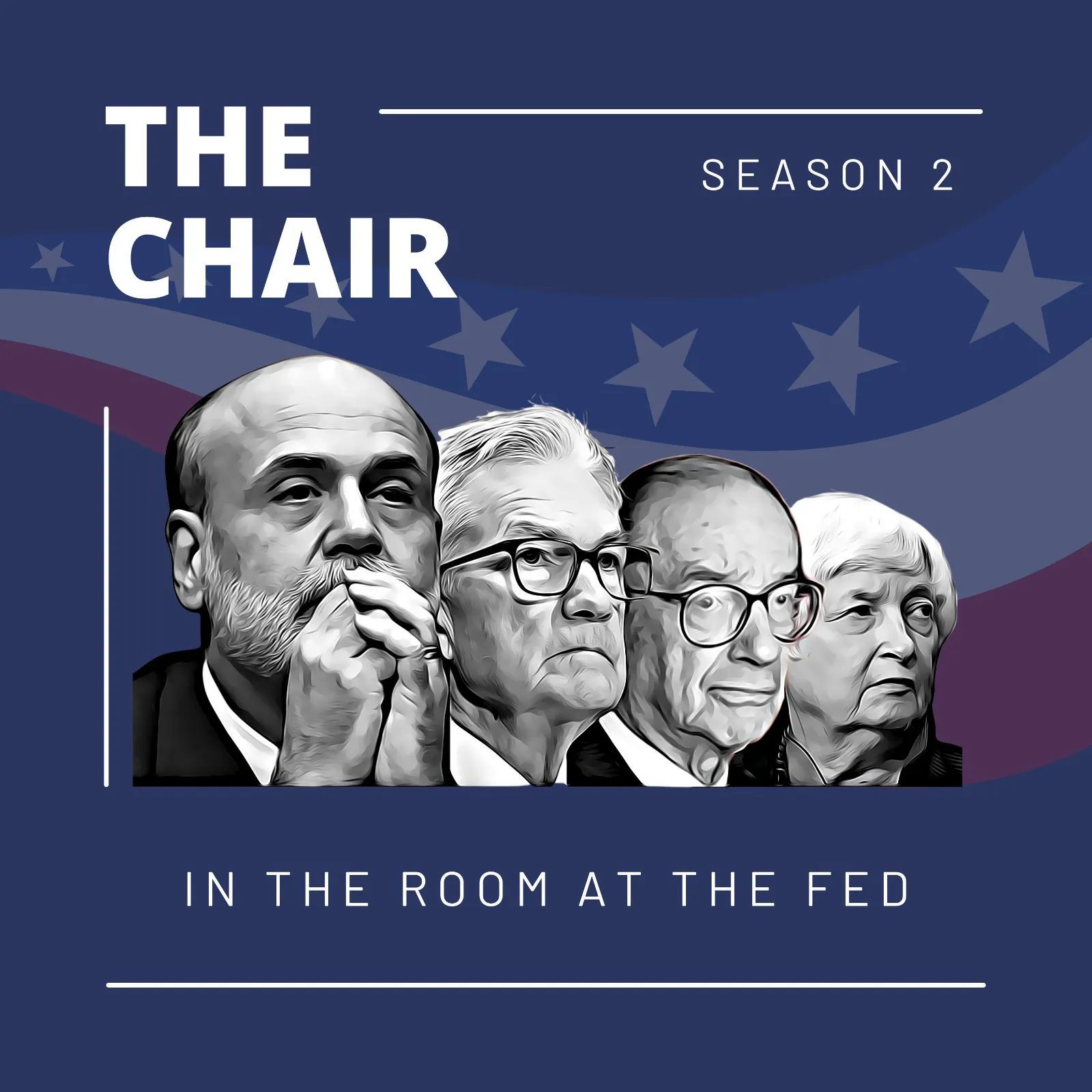
Ep 173Janet Yellen: “She had a view that the world was on fire”
More than any other single institution, the US Federal Reserve drives global capital markets with its decisions and communications. While its interest rates are set by a committee, for almost a century, the Fed’s philosophy and operational approach have been moulded by one person: the Chair of the Board of Governors. In the first series of The Chair, Tim Gwynn Jones talked to authors of books about the Fed's foundational Chairs – Marriner Eccles, Bill Martin, Arthur Burns, and Paul Volcker. In this second series, he covers the people who chaired the Fed through the post-1990 period of financialisation, globalisation, and – perhaps today – deglobalisation. The third episode of the second series covers Janet Yellen – not only the first woman to become Fed Chair but the first person of either sex to lead the Fed, the Treasury, and the Council of Economic Advisors. To discuss Ben Bernanke’s successor, Tim is joined by Jon Hilsenrath, author of Yellen: The Trailblazing Economist Who Navigated an Era of Upheaval (Harper Collins, 2022). “Bernanke was a consensus builder,” says Hilsenrath. “He wasn't the kind of guy who was going to push people on a personal level out of their comfort zones … Yellen was a bit of a bulldog there, but she was also a bulldog with the Fed staff. I mean, she had a view that the world was on fire and that they, you know, and that they had to be moving like people putting out a fire”. In 2023, Hilsenrath left the Wall Street Journal after a 26-year career during which he developed a market reputation as a pre-eminent Fed-watcher. He’s still watching the Fed but now for his own advisory firm. Learn more about your ad choices. Visit megaphone.fm/adchoices

Ep 172Ben Bernanke: “Like being a paleontologist”
More than any other single institution, the US Federal Reserve drives global capital markets with its decisions and communications. While its interest rates are set by a committee, for almost a century, the Fed’s philosophy and operational approach have been moulded by one person: the Chair of the Board of Governors. In the first series of The Chair, Tim Gwynn Jones talked to authors of books about the Fed's foundational Chairs – Marriner Eccles, Bill Martin, Arthur Burns, and Paul Volcker. In this second series, he covers the people who chaired the Fed through the post-1990 period of financialisation, globalisation, and – perhaps today – deglobalisation. Episode two of the second series covers the life and crisis-era times of Ben Bernanke, the man who filled Alan Greenspan’s big shoes and ran the Fed from 2006 to 2014. A shy but world-renowned monetary economist and historian of the Great Depression, Bernanke was left holding the proverbial bomb when the financial system came close to collapse in 2008. To discuss Bernanke, Tim is joined by David Wessel, author of In FED We Trust: Ben Bernanke's War on the Great Panic (Crown, 2010). “It wasn't obvious when he was appointed to the Fed in 2006 that having somebody who had spent their life studying the Great Depression would be well equipped to be Alan Greenspan's successor,” says Wessel. “I have sometimes said it was a like being a paleontologist. It's very nice that you know a lot about dinosaurs, but what use is that to us today until one day a Stegosaurus appears on the horizon. And it was remarkable good fortune for the country and the world that there was a guy who happened to have studied all the mistakes that the Fed made in the 1920s and the 1930s in a position to do something about it when a situation, not all that dissimilar, appears both to his surprise and to almost everybody else's”. Wessel is two-time Pulitzer Prize winning journalist who now runs the Hutchins Center on Fiscal and Monetary Policy at the Brookings Institution. For 30 years, he worked at the Wall Street Journal - reporting mostly from Washington and covering economics and the Fed. Learn more about your ad choices. Visit megaphone.fm/adchoices
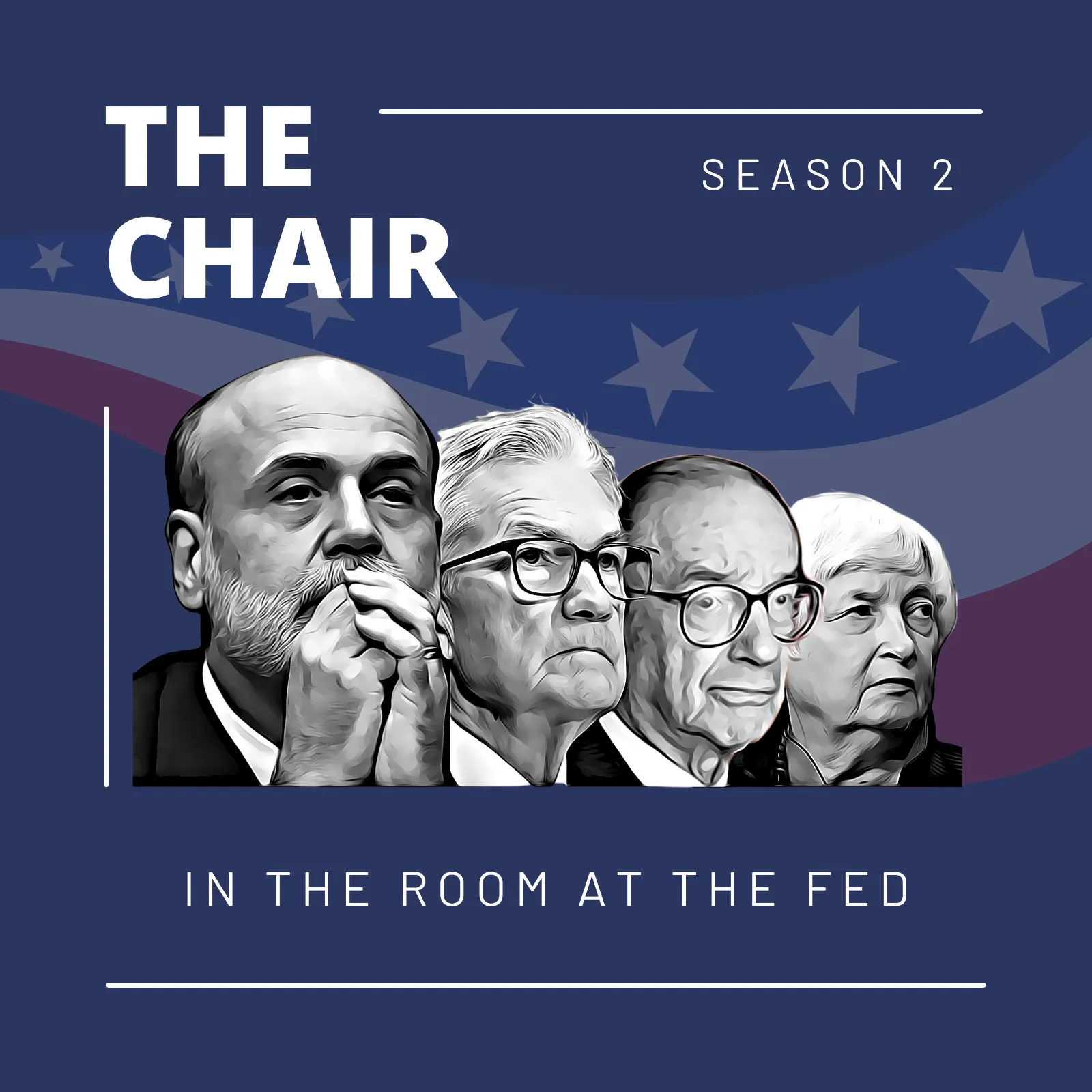
Ep 174Alan Greenspan: “The man who knew”
More than any other single institution, the US Federal Reserve drives global capital markets with its decisions and communications. While its interest rates are set by a committee, for almost a century, the Fed’s philosophy and operational approach have been moulded by one person: the Chair of the Board of Governors. In the first series of The Chair, Tim Gwynn Jones talked to authors of books about the Fed's foundational Chairs – Marriner Eccles, Bill Martin, Arthur Burns, and Paul Volcker. In this second series, he covers the people who chaired the Fed through the post-1990 period of financialisation, globalisation, and – perhaps today – deglobalisation. The first episode of the second series explores Alan Greenspan, the chairman who followed Paul Volcker and ran the Fed from 1987 until 2006. Once bestowed with “Maestro” status, Greenspan – who turns 100 in March 2026 – has seen his reputation deflate in the wake of the post-2008 financial crisis. To discuss the fallen Maestro, Tim is joined by Sebastian Mallaby, author of The Man Who Knew: The Life and Times of Alan Greenspan (Bloomsbury, 2016). “Greenspan was the man who knew,” says Mallaby. “He was the man who knew that bubbles were extremely destructive, and yet he was not the man who acted against those bubbles. So, whilst he was great on inflation and on stabilising the price of eggs, he was not good on asset-price inflation or stabilising the price of nest eggs”. A former journalist at The Economist and the Washington Post, Mallaby is the prize-winning author of The World's Banker – a portrait of the World Bank under James Wolfensohn – and More Money Than God: Hedge Funds and the Making of a New Elite. He is now the Paul A. Volcker senior fellow for international economics at the Council on Foreign Relations. Learn more about your ad choices. Visit megaphone.fm/adchoices