New Books in Economic and Business History
1,649 episodes — Page 28 of 33
Ep 137Finnish Maritime Interaction with China in the 18th Century
As COVID-19 disrupted maritime trade with China, the world was again reminded of the importance of shipping in global commerce. The roots of Nordic maritime trade relations with Asia go back centuries, and this history reveals interesting details about early Finnish interaction with China. For example, the Swedish East India Company’s 18th century trade voyages produced the first-ever Finnish academic dissertation on China, which was defended by Cadet Israel Reinius in Turku in 1749. In this episode, Dr. Erja Kettunen-Matilainen from the University of Turku introduces us to this fascinating but somewhat less known historical aspect of Finnish relations with China. Dr. Erja Kettunen-Matilainen is a Senior Research Fellow in Economic Geography and Adjunct Professor at the Department of Marketing and International Business at the University of Turku. She has written about Cadet Israel Reinius and Finland’s first China-related dissertation from 1749 as well as the participation of Finns in the Swedish East India Company’s trade voyages in the 18th century (in Finnish). Ari-Joonas Pitkänen is a Doctoral Researcher at the Centre for East Asian Studies, University of Turku. The Nordic Asia Podcast is a collaboration sharing expertise on Asia across the Nordic region, brought to you by the Nordic Institute of Asian Studies (NIAS) based at the University of Copenhagen, along with our academic partners: the Centre for East Asian Studies at the University of Turku, and Asianettverket at the University of Oslo. We aim to produce timely, topical and well-edited discussions of new research and developments about Asia. About NIAS: www.nias.ku.dk Transcripts of the Nordic Asia Podcasts: http://www.nias.ku.dk/nordic-asia-podcast Learn more about your ad choices. Visit megaphone.fm/adchoices
Ep 452Meng Zhang, "Timber and Forestry in Qing China: Sustaining the Market" (U Washington Press, 2021)
Focusing on timber in Qing China, Dr. Meng Zhang's new book, Timber and Forestry in Qing China: Sustaining the Market (U Washington Press, 2021) traces the trade routes that connected population centers of the Lower Yangzi Delta to timber supplies on China's southwestern frontier. She documents innovative property rights systems and economic incentives that convinced landowners to invest years in growing trees. Delving into rare archives to reconstruct business histories, she considers both the formal legal mechanisms and the informal interactions that helped balance economic profit with environmental management. Of driving concern were questions of sustainability: How to maintain a reliable source of timber across decades and centuries? And how to sustain a business network across a thousand miles? This carefully constructed study makes a major contribution to Chinese economic and environmental history and to world-historical discourses on resource management, early modern commercialization, and sustainable development. Huiying Chen is a Ph.D. candidate at University of Illinois at Chicago. She studies the history of travel in eighteenth-century China. She can be reached at hchen87 AT uic.edu Learn more about your ad choices. Visit megaphone.fm/adchoices
Ep 153Jessica Lipsky, "It Ain't Retro: Daptone Records and the 21st-Century Soul Revolution" (Jawbone, 2021)
Soul is the most powerful expression of American music--a distinct combination of roots, migration, race, culture, and politics packaged together for your dancing pleasure. But if you thought the sounds of Motown or Stax Records died along with 8-tracks and macramé, you'd be wrong. For two decades, Daptone Records has churned out hard funk and such beautiful soul that these records sparked a musical revolution. Run by a collective of soul-obsessed producers and musicians, the Brooklyn-based independent label launched the careers of artists such as Amy Winehouse, Sharon Jones & The Dap-Kings, Charles Bradley, and Bruno Mars. Daptone's records--and those of the larger soul revival scene--pay homage but never lip service to the original artists, proving that soul is still culturally relevant, and just as exciting as ever. It Ain't Retro: Daptone Records and the 21st-Century Soul Revolution (Jawbone, 2021) charts this revival's players, sounds, and tectonic shifts over the past twenty years, taking you from dingy clubs where soul crazed DJs packed the dancefloor, to just uptown where some of the genre's heaviest musicians jumpstarted the renaissance in a basement studio, and all the way to the White House. This definitive tale of Daptone Records' soulful revolution chronicles the label's history, players, and sounds while dissecting the scene's cultural underpinnings, which continue to reverberate in pop music. The book also contains rare and unseen images of Daptone artists past and present, including Sharon Jones, Charles Bradley, Lee Fields, Antibalas, The Sugarman 3, The Budos Band, and more. Jessica Lipsky is a journalist and DJ from Brooklyn by way of the San Francisco Bay. She first encountered sweet soul music as a child by obsessively tuning her radio dial and has since extensively covered soul, funk, reggae, and alternative Latin music. Her work on the intersection of culture, music, and politics has appeared in NPR, Billboard, Grammy.com, Columbia Journalism Review, Vice, and LA Weekly. Jessica Lipsky on Twitter. Bradley Morgan is a media arts professional in Chicago and author of U2's The Joshua Tree: Planting Roots in Mythic America. He manages partnerships on behalf of CHIRP Radio 107.1 FM, serves as a co-chair of the associate board at the Gene Siskel Film Center of the School of the Art Institute of Chicago, and volunteers in the music archive at the Old Town School of Folk Music. Bradley Morgan on Twitter. Learn more about your ad choices. Visit megaphone.fm/adchoices
Ep 101Mae Ngai, "The Chinese Question: The Gold Rushes, Chinese Migration, and Global Politics" (W. W. Norton, 2022)
Between 1848 and 1899, miners extracted more gold from the earth than in the previous 3,000 years of human history combined. Each gold rush in this period, from the Sierra Nevada to the highlands of Australia to the Transvaal, was a global event, drawing argonauts and others seeking new lives from all corners of the world, including from China. In her Bancroft-Prize winning book, The Chinese Question: The Gold Rushes and Global Politics (Norton, 2021), Columbia University Professor of Asian American Studies and History Mae Ngai seeks to dispel a long held myth that Chinese gold-seekers arrived as unfree labor to sites of gold rushes. Instead, Mae describes in great detail not just the global nature of gold rushes, but the complicated lives and politics of Chinese participation in imperial-era gold mining. Using a comparative study of three gold rushes in California, Australia, and South Africa, Ngai explains why "The Chinese Question" became a driving social and political question among White settlers in each of these zones of industrial gold mining, and how Chinese people navigated increasingly unfriendly and racist environments and legal structures. The Chinese Question is not just a thing of the past either, and Ngai makes a compelling case for its lasting impact on American and global politics into the twenty first century. Dr. Stephen R. Hausmann is an assistant professor of history at the University of St. Thomas in Minnesota. Learn more about your ad choices. Visit megaphone.fm/adchoices
Ep 20James Stafford, "The Case of Ireland: Commerce, Empire and the European Order, 1750-1848" (Cambridge UP, 2022)
James Stafford teaches at Columbia University, where he specializes in the political and intellectual history of Ireland, Britain and Western Europe since 1750, with a particular interest in questions of political economy and international order. In this interview he discusses his new book The Case of Ireland: Commerce, Empire and the European Order, 1750-1848 (Cambridge UP, 2022), which offers a fresh account of Ireland’s place in European debates about commerce and empire during a global era of war and revolution. The late eighteenth and early nineteenth centuries have long been seen as a foundational period for modern Irish political traditions such as nationalism, republicanism and unionism. The Case of Ireland offers a fresh account of Ireland's neglected role in European debates about commerce and empire in what was a global era of war and revolution. Drawing on a broad range of writings from merchants, agrarian improvers, philosophers, politicians and revolutionaries across Europe, this book shows how Ireland became a field of conflict and projection between rival visions of politics in commercial society, associated with the warring empires of Britain and France. It offers a new perspective on the crisis and transformation of the British Empire at the end of the eighteenth century, and restores Ireland to its rightful place at the centre of European intellectual history. Aidan Beatty is a historian at the Honors College of the University of Pittsburgh. Learn more about your ad choices. Visit megaphone.fm/adchoices
Ep 451Victor Seow, "Carbon Technocracy: Energy Regimes in Modern East Asia" (U Chicago Press, 2022)
Victor Seow’s Carbon Technocracy: Energy regimes in Modern East Asia (U Chicago Press, 2021) is an account of the modern “world that carbon made” through the case study of the Fushun colliery in Manchuria. “Carbon technocracy” is a system dedicated to the optimal exploitation of fossil fuel resources. It is, as Seow shows, a system of consistent waste, environmental degradation, and labor exploitation, built on a fantasy of inexhaustible energy reserves mobilized toward endless and accelerating development. Fushun exemplifies the violence, contradictions, and, as we discuss in this interview, failures of imagination of successive Japanese, Chinese Nationalist, and Chinese Communist regimes. Carbon Technocracy balances macro-level questions about the mutual constitution of nation and global energy regimes with a sensitivity to individual laborers caught up in these machinations. Nathan Hopson is an associate professor of Japanese language and history in the University of Bergen's Department of Foreign Languages. Learn more about your ad choices. Visit megaphone.fm/adchoices
Ep 35Deirdre N. McCloskey and Art Carden, "Leave Me Alone and I'll Make You Rich: How the Bourgeois Deal Enriched the World" (U Chicago Press, 2020)
The economist and historian Deirdre Nansen McCloskey has been best known recently for her Bourgeois Era trilogy, a vigorous defense, unrivaled in scope, of commercially tested betterment. Its massive volumes, The Bourgeois Virtues, Bourgeois Dignity, and Bourgeois Equality, solve Adam Smith's puzzle of the nature and causes of the wealth of nations, and of the moral sentiments of modernity. The world got rich, she argues, not chiefly by material causes but by an idea and a sentiment, a new admiration for the middle class and its egalitarian liberalism. For readers looking for a distillation of McCloskey's magisterial work, Leave Me Alone and I'll Make You Rich: How the Bourgeois Deal Enriched the World (U Chicago Press, 2020) is what you've been waiting for. In this lively volume, McCloskey and the economist and journalist Carden bring together the trilogy's key ideas and its most provocative arguments. The rise of the west, and now the rest, is the story of the rise of ordinary people to a dignity and liberty inspiring them to have a go. The outcome was an explosion of innovation after 1800, and a rise of real income by an astounding 3,000 percent. The Great Enrichment, well beyond the conventional Industrial Revolution, did not, McCloskey and Carden show, come from the usual suspects, capital accumulation or class struggle. It came from the idea of economic liberty in Holland and the Anglosphere, then Sweden and Japan, then Italy and Israel and China and India, an idea that bids fair in the next few generations to raise up the wretched of the earth. The original shift to liberalism arose from 1517 to 1789 from theological and political revolutions in northwest Europe, upending ancient hierarchies. McCloskey and Carden contend further that liberalism and "innovism" made us better humans as well as richer ones. Not matter but ideas. Not corruption but improvement. Leave Me Alone and I'll Make You Rich draws in entertaining fashion on history, economics, literature, philosophy, and popular culture, from growth theory to the Simpsons. It is the perfect introduction for a broad audience to McCloskey's influential explanation of how we got rich. At a time when confidence in the economic system is under challenge, the book mounts an optimistic and persuasive defense of liberal innovism, and of the modern world it has wrought. You can read Joel Moykr's review of Leave Me Alone and I'll Make You Rich here. Bernardo Batiz-Lazo is currently straddling between Newcastle and Mexico City. You can find him on twitter on issues related to business history of banking, fintech, payments and other musings. Not always in that order. @BatizLazo Learn more about your ad choices. Visit megaphone.fm/adchoices
Ep 131Lauren K. Stokes, "Fear of the Family: Guest Workers and Family Migration in the Federal Republic of Germany" (Oxford UP, 2022)
Beginning in 1955, West Germany recruited millions of people as guest workers from Yugoslavia, Italy, Greece, Spain, Portugal, and especially Turkey. This labor force was essential to creating the postwar German economic miracle. Employers fantasized that foreign "guest workers" would provide labor power in their prime productive years without having to pay for their education, pensions, or medical care. They especially hoped that the workers would leave behind their spouses and children and not encumber the German state or society with the cost of caring for them. As Lauren Stokes argues in Fear of the Family: Guest Workers and Family Migration in the Federal Republic of Germany (Oxford UP, 2022), the Federal Republic of Germany turned fear of this foreign family into the basis of policymaking, while at the same time implementing policies that inflicted fear in foreign families. Workers did not always prove willing to live their work lives in the FRG and their family lives elsewhere. They consistently challenged the state's assumption that "family" and "labor" could be cleanly divided, defied restrictive and discriminatory policies, staged political protests, and took their deportation orders to court. In 1973, the federal court legally recognized the constitutional right to family reunification, but almost immediately after the decision, the migration bureaucracy sought to limit that right in practice. Officials derided family migrants as a group of burdensome dependents seeking to defraud the welfare state and demonized them as a dangerous source of foreign values on German soil. Paul Lerner is Professor of History at the University of Southern California where he directs the Max Kade Institute for Austrian-German-Swiss Studies. He can be reached at [email protected] and @PFLerner. Learn more about your ad choices. Visit megaphone.fm/adchoices
Ep 34Christopher Blattman, "Why We Fight: The Roots of War and the Paths to Peace" (Viking, 2022)
In Why We Fight: The Roots of War and the Paths to Peace (Viking, 2022), Chris Blattman explains the five reasons why conflict (rarely) blooms into war, and how to interrupt that deadly process. It's easy to overlook the underlying strategic forces of war, to see it solely as a series of errors, accidents, and emotions gone awry. It's also easy to forget that war shouldn't happen-and most of the time it doesn't. Around the world, there are millions of hostile rivalries, yet only a tiny fraction erupt into violence. Too many accounts of conflict forget this. With a counterintuitive approach, Blattman reminds us that most rivals loathe one another in peace. That's because war is too costly to fight. Enemies almost always find it better to split the pie than spoil it or struggle over thin slices. So, in those rare instances when fighting ensues, we should ask: what kept rivals from compromising? Why We Fight draws on decades of economics, political science, psychology, and real-world interventions to lay out the root causes and remedies for war, showing that violence is not the norm; that there are only five reasons why conflict wins over compromise; and how peacemakers turn the tides through tinkering, not transformation. From warring states to street gangs, ethnic groups and religious sects to political factions, there are common dynamics to heed and lessons to learn. Along the way, we meet vainglorious European monarchs, African dictators, Indian mobs, Nazi pilots, British football hooligans, ancient Greeks, and fanatical Americans. Realistic and optimistic, this is a book that lends new meaning to the old adage, "Give peace a chance." Javier Mejia is an economist teaching at Stanford University, whose work focuses on the intersection between social networks and economic history. His interests extend to topics on entrepreneurship and political economy with a geographical specialty in Latin America and the Middle East. He received a Ph.D. in Economics from Los Andes University. He has been a Postdoctoral Associate and Lecturer at New York University--Abu Dhabi and a Visiting Scholar at the University of Bordeaux. He is a regular contributor to different news outlets. Currently, he is Forbes Magazine op-ed columnist. Learn more about your ad choices. Visit megaphone.fm/adchoices
Ep 24Carol A. Lipscomb, "The Lady Makes Boots: Enid Justin & the Nocona Boot Company" (Texas Tech UP, 2021)
In the summer of 1925, Enid Justin--daughter of H. J. Justin, founder of legendary Justin Boots--announced to her family that she was going to start her own boot company in her hometown of Nocona, Texas. The announcement shocked her family, who prophesied failure and begged her to reconsider, but thirty-one-year-old Enid’s mind was made up. What followed would be a multi-decade saga of tenacity, endurance, dedication, and entrepreneurial success. The Lady Makes Boots: Enid Justin & the Nocona Boot Company (Texas Tech UP, 2021) is the first biography of Enid Justin, lady bootmaker and the visionary who founded the Nocona Boot Company. Utilizing archival material, hundreds of newspaper articles from across the U. S. and beyond, and many personal interviews with Justin family members and boot company employees, The Lady Makes Boots tells the complete story of this multi-faceted woman and the growth of her small-town business to a multi-million-dollar corporation. Remembered fondly as the hard-working “Miss Enid”, Justin led the Nocona Boot Company through a seventy-four year history that included the Great Depression, World War II, and countless other challenges. Enid Justin was a true Texas pioneer: this is her story, stitched and bound. Jane Scimeca is Professor of History at Brookdale Community College Learn more about your ad choices. Visit megaphone.fm/adchoices
Ep 18The Future of Public Opinion: A Conversation with Susan Herbst
Politicians and corporations cannot only measure public opinion but also manipulate and create it. And they have been doing so since the 1930s when serious polling began. And as Professor Susan Herbst, author of Numbered Voices: How Opinion Polling Has Shaped American Politics, explains early public opinion research raised hopes for better democratic practice but also led to fears for the future. Owen Bennett-Jones is a freelance journalist and writer. A former BBC correspondent and presenter he has been a resident foreign correspondent in Bucharest, Geneva, Islamabad, Hanoi and Beirut. He is recently wrote a history of the Bhutto dynasty which was published by Yale University Press. Learn more about your ad choices. Visit megaphone.fm/adchoices
Ep 6Robert N. Wiedenmann and J. Ray Fisher, "The Silken Thread: Five Insects and Their Impacts on Human History" (Oxford UP, 2021)
Insects are seldom mentioned in discussions surrounding human history, yet they have dramatically impacted today's societies. The Silken Thread: Five Insects and Their Impacts on Human History (Oxford UP, 2021) places them front and center, offering a multidisciplinary view of their significance. Diseases vectored by insects have killed more people than all weapons of war. Fleas are common pests, but some can transmit illnesses such as the bubonic plague. In fact, three pandemics can be traced back to them. Epidemics of typhus have been caused by lice. Conversely, humans have also benefitted from insects for millennia. Silk comes from silkworms and honey comes from bees. Despite the undeniably powerful effects of insects on humans, their stories are typically left out of our history books. In The Silken Thread, entomologists Robert. N. Wiedenmann and J. Ray Fisher link the history of insects to the history of empires, cultural exchanges, and warfare. The book narrows its focus to just five insects: a moth, a flea, a louse, a mosquito, and a bee. The authors explore the impact of these insects throughout time and the common threads connecting them. Using biology to complement history, they showcase these small creatures in a whole new light. On every page, the authors thoughtfully analyze the links between history and entomology. The book begins with silkworms, which have been farmed for centuries. It then moves to fleas and their involvement in the spread of the plague before introducing the role lice played in the Black Death, wars, and immigration. The following section concerns yellow fever mosquitos, emphasizing the effects of yellow fever in the Americas and the connection to sugar and slavery. After discussing the importance of western honey bees, the authors tie these five insects together in an exciting closing chapter. Galina Limorenko is a doctoral candidate in Neuroscience with a focus on biochemistry and molecular biology of neurodegenerative diseases at EPFL in Switzerland. Learn more about your ad choices. Visit megaphone.fm/adchoices
Ep 105Michael Munger, "The Sharing Economy: Its Pitfalls and Promises" (Duke UP, 2021)
Transactions have always taken place. For hundreds of years that 'place' was a market or, more recently, a shopping mall. But in the past two decades these physical locations have increasingly been replaced by their virtual counterparts - online platforms. In this book Michael Munger explains how these platforms act as matchmakers or middlemen, a role traders have adopted since the very first exchanges thousands of years ago. The difference today is that the matchmakers often play no direct part in buying or selling anything - they just help buyers and sellers find each other. Their major contribution has been to reduce the costs of organizing and completing purchases, rentals or exchanges. The Sharing Economy: Its Pitfalls and Promises (Duke UP, 2021) contends that the key role of online platforms is to create reductions in transaction costs and it highlights the importance of three 'Ts' - triangulation, transfer and trust - in bringing down those costs. Professor Munger trained as an economist at Washington University in St. Louis under Nobel Prize-winning economic historian Douglass North. He has published prolifically across disciplines in the areas of political economy and public choice, and is now a professor of political science at Duke University, with secondary appointments in economics and public policy. Professor Munger is also an avowed libertarian, and has stood for office as a candidate of the Libertarian Party. In our interview, he explains how the emergence of the platform economy creates concentrations of economic power that are just as concerning to him as concentrations of political power. He also explains how thinking through the many changes and disruptions in our working lives that will result from the platform economy has led him to the view that Universal Basic Income and single-payer healthcare are necessary to creating the kind of free and prosperous society that he and other libertarians want. Host Peter Lorentzen is an Associate Professor in the Department of Economics at the University of San Francisco, where he leads a new Master's program in Applied Economics that trains students in the skills of data analytics needed to understand, succeed in, or make positive changes to the evolving digital platform economy. Learn more about your ad choices. Visit megaphone.fm/adchoices
Ep 234John Wills, "Gamer Nation: Video Games and American Culture" (Johns Hopkins UP, 2019)
In 1975, design engineer Dave Nutting completed work on a new arcade machine. A version of Taito's Western Gun, a recent Japanese arcade machine, Nutting's Gun Fight depicted a classic showdown between gunfighters. Rich in Western folklore, the game seemed perfect for the American market; players easily adapted to the new technology, becoming pistol-wielding pixel cowboys. One of the first successful early arcade titles, Gun Fight helped introduce an entire nation to video-gaming and sold more than 8,000 units. In Gamer Nation: Video Games and American Culture (Johns Hopkins UP, 2019), John Wills examines how video games co-opt national landscapes, livelihoods, and legends. Arguing that video games toy with Americans' mass cultural and historical understanding, Wills show how games reprogram the American experience as a simulated reality. Blockbuster games such as Civilization, Call of Duty, and Red Dead Redemption repackage the past, refashioning history into novel and immersive digital states of America. Controversial titles such as Custer's Revenge and 08.46 recode past tragedies. Meanwhile, online worlds such as Second Life cater to a desire to inhabit alternate versions of America, while Paperboy and The Sims transform the mundane tasks of everyday suburbia into fun and addictive challenges. Working with a range of popular and influential games, from Pong, Civilization, and The Oregon Trail to Grand Theft Auto, Silent Hill, and Fortnite, Wills critically explores these gamic depictions of America. Touching on organized crime, nuclear fallout, environmental degradation, and the War on Terror, Wills uncovers a world where players casually massacre Native Americans and Cold War soldiers alike, a world where neo-colonialism, naive patriotism, disassociated violence, and racial conflict abound, and a world where the boundaries of fantasy and reality are increasingly blurred. Ultimately, Gamer Nation reveals not only how video games are a key aspect of contemporary American culture, but also how games affect how people relate to America itself. Rudolf Inderst is a professor of Game Design at the IU International University of Applied Science. Learn more about your ad choices. Visit megaphone.fm/adchoices
Ep 172Holger Droessler, "Coconut Colonialism: Workers and the Globalization of Samoa" (Harvard UP, 2022)
In Coconut Colonialism: Workers and the Globalization of Samoa (Harvard UP, 2022), Holger Droessler provides a novel history of the impact of globalization on Sāmoa and vice versa. Using a series of case studies, he shows how Samoan workers responded to the rise of capitalism and colonialism in the Pacific in the decades just before and after 1900. Ordinary Samoans -- some on large plantations, others on their own small holdings -- picked and processed coconuts and cocoa, tapped rubber trees, and built roads and ports that brought cash crops to Europe and North America. Samoans also participated in ethnographic shows around the world, turning them into diplomatic missions and making friends with fellow colonized peoples. Droessler examines the 'workspaces' Samoans found constructed as the starting point for what he calls a new "Oceanian globality" through which Samoan used existing colonial structures to advance their own agency and find ways to press their own agendas and regain a degree of independence. Based on research in multiple languages and countries, Coconut Colonialism offers new insights into the global history of labor and empire at the dawn of the twentieth century. In this episode of the podcast, channel host Alex Golub speaks to Holger Droessler about the Pacific roots of the concept of "Oceanian globality", the value of German language sources for the largely-anglophone field of Pacific History, and the way colonialism and globalization but created a space which both limited and empowered Samoan agency. Alex Golub is associate professor of anthropology, University of Hawai‘i at Mānoa. Learn more about your ad choices. Visit megaphone.fm/adchoices
Ep 293Paul Lerner et al., "Jewish Consumer Cultures in Nineteenth and Twentieth-Century Europe and North America" (Palgrave Macmillan, 2022)
Jewish Consumer Cultures in Nineteenth and Twentieth-Century Europe and North America (Palgrave Macmillan, 2022) investigates the place and meaning of consumption in Jewish lives and the roles Jews played in different consumer cultures in modern Europe and North America. Drawing on innovative, original research into this new and challenging field, the volume brings Jewish studies and the history and theory of consumer culture into dialogue with each other. Its chapters explore Jewish businesspeople's development of niche commercial practices in several transnational contexts; the imagining, marketing, and realization of a Jewish national homeland in Palestine through consumer goods and strategies; associations between Jews, luxury, and gender in multiple contexts; and the political dimensions of consumer choice. Together the essays in this volume show how the study of consumption enriches our understanding of modern Jewish history and how a focus on consumer goods and practices illuminates the study of Jewish religious observance, ethnic identities, gender formations, and immigrant trajectories across the globe. Amber Nickell is Associate Professor of History at Fort Hays State University, Editor at H-Ukraine, and Host at NBN Jewish Studies, Ukrainian Studies, and Eastern Europe. Learn more about your ad choices. Visit megaphone.fm/adchoices
Ep 81Sarah Teasley, "Designing Modern Japan" (Reaktion Books, 2022)
Sarah Teasley's Designing Modern Japan (Reaktion, 2022) unpicks the history of Japanese design from the mid-nineteenth century to the end of the twentieth, focusing on continuities and disruptions within communities and practices of design. Designing Modern Japan explores design in the unfolding contexts of modernization, empire and war, defeat and reconstruction, postwar economic acceleration, and beyond. Throughout, Teasley is sensitive to issues of gender and class within the communities of design she studies. The book combines the history of design with social, economic, and geopolitical history, placing design and its material objects carefully in the larger currents of modern and contemporary Japan. Designing Modern Japan is a history of both the people who shaped Japanese design and the designs that were integral to life in modern Japan. Nathan Hopson is an associate professor of Japanese language and history in the University of Bergen's Department of Foreign Languages. Learn more about your ad choices. Visit megaphone.fm/adchoices
Ep 129David de Jong, "Nazi Billionaires: The Dark History of Germany's Wealthiest Dynasties" (Mariner Books, 2022)
In Nazi Billionnaires: The Dark History of Germany's Wealthiest Dynasties (HarperCollins, 2022), journalist David de Jong presents a groundbreaking investigation of how the Nazis helped German tycoons make billions off the horrors of the Third Reich and World War II—and how America allowed them to get away with it. In 1946, Günther Quandt—patriarch of Germany’s most iconic industrial empire, a dynasty that today controls BMW—was arrested for suspected Nazi collaboration. Quandt claimed that he had been forced to join the party by his arch-rival, propaganda minister Joseph Goebbels, and the courts acquitted him. But Quandt lied. And his heirs, and those of other Nazi billionaires, have only grown wealthier in the generations since, while their reckoning with this dark past remains incomplete at best. Many of them continue to control swaths of the world economy, owning iconic brands whose products blanket the globe. The brutal legacy of the dynasties that dominated Daimler-Benz, cofounded Allianz, and still control Porsche, Volkswagen, and BMW has remained hidden in plain sight—until now. In this landmark work of investigative journalism, David de Jong reveals the true story of how Germany’s wealthiest business dynasties amassed untold money and power by abetting the atrocities of the Third Reich. Using a wealth of untapped sources, de Jong shows how these tycoons seized Jewish businesses, procured slave laborers, and ramped up weapons production to equip Hitler’s army as Europe burned around them. Most shocking of all, de Jong exposes how America’s political expediency enabled these billionaires to get away with their crimes, covering up a bloodstain that defiles the German and global economy to this day. This interview was conducted by Dr. Miranda Melcher whose doctoral work focused on post-conflict military integration, understanding treaty negotiation and implementation in civil war contexts, with qualitative analysis of the Angolan and Mozambican civil wars. Learn more about your ad choices. Visit megaphone.fm/adchoices
Ep 57Deindustrialization
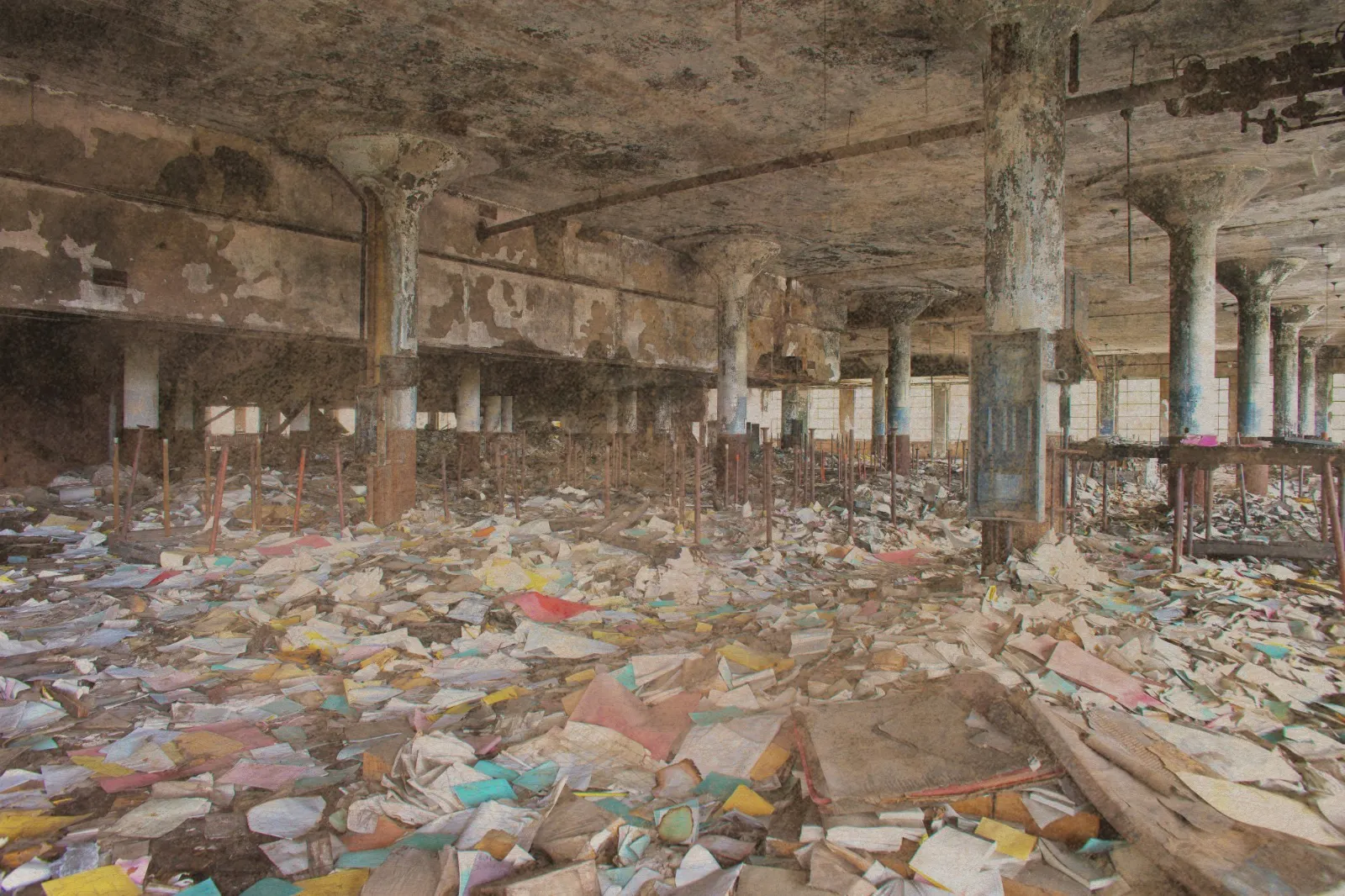
Gabriel Winant talks with Kim about the decline of the industrial working class and the rise of the health care industry. Gabriel is an assistant professor of History at the University of Chicago. His book, The Next Shift: The Fall of Industry and the Rise of Health Care in Rust Belt America, is recently out from Harvard University Press. You can read his recent article on the subject in The New York Times. The Next Shift focuses on the working class in the American context and Pittsburgh in particular. In the full version of our conversation, Gabriel recommended Aaron Benanav’s book Automation and the Future of Work (Verso 2020), for an argument about the larger global economic structures of deindustrialization. He also talks a bit about James Boggs, as someone who was well positioned to notice the effects of deindustrialization. We found this article about Boggs worth reading. The image for this episode is a photograph of the abandoned Detroit Public Schools Book Depository, taken by Thomas Hawk on 13 June 2010. The image is posted of Flickr under a creative commons attribution non-commercial license. Lauren Berlant describes gives this photograph as a bad image of neoliberalism, which allows our social theory to derive “its urgency and its reparative imaginary from spaces of catastrophe and risk where the exemplum represents structural failure” (“The Commons: Infrastructures for Troubling Times” Society and Space 34 no. 3 (2016) p.395). But I like it. Saronik modified the original image. Music used in promotional material: ‘Shadow of a Coal Mine’ by Linda Draper Learn more about your ad choices. Visit megaphone.fm/adchoices
Ep 33Mark Koyama and Jared Rubin, "How the World Became Rich: The Historical Origins of Economic Growth" (Polity, 2022)
Most humans are significantly richer than their ancestors. Humanity gained nearly all of its wealth in the last two centuries. How did this come to pass? In How the World Became Rich: The Historical Origins of Economic Growth (Polity, 2022), Mark Koyama and Jared Rubin dive into the many theories of why modern economic growth happened when and where it did. They discuss recently-advanced theories rooted in geography, politics, culture, demography, and colonialism. Pieces of each of these theories help explain key events on the path to modern riches. Why did the Industrial Revolution begin in 18th-century Britain? Why did some European countries, the USA, Canada, and Japan catch up in the 19th century? Why did it take until the late 20th and 21st centuries for other countries? Why have some still not caught up? Koyama and Rubin show that the past can provide a guide for how countries can escape poverty. There are certain prerequisites that all successful economies seem to have. But there is also no panacea. A society’s past and its institutions and culture play a key role in shaping how it may—or may not—develop. Javier Mejia is an economist teaching at Stanford University, whose work focuses on the intersection between social networks and economic history. His interests extend to topics on entrepreneurship and political economy with a geographical specialty in Latin America and the Middle East. He received a Ph.D. in Economics from Los Andes University. He has been a Postdoctoral Associate and Lecturer at New York University--Abu Dhabi and a Visiting Scholar at the University of Bordeaux. He is a regular contributor to different news outlets. Currently, he is Forbes Magazine op-ed columnist. Learn more about your ad choices. Visit megaphone.fm/adchoices

Ep 54Modernization
Varsha Venkatasubramanian discusses the many trajectories of modernization as a theoretical concept. She focuses mainly on the history of development in the US and in India, through the cold war years and continuing to the present day. Varsha (@varsha_venkat_ on Twitter) is a graduate student focusing on the history of dams in the US and the World as it relates to foreign policy, policy history, environmental movements, and legal history. She is particularly interested in US-India relations and infrastrcuture projects during the 1950s to the 1980s. Image: Sardar Sarovar Dam, Gujarat, India. Music used in promotional material: ‘Warm is Near’ by Post Human Era Learn more about your ad choices. Visit megaphone.fm/adchoices
Ep 75Erich Schwartzel, "Red Carpet: Hollywood, China, and the Global Battle for Cultural Supremacy" (Penguin, 2022)
From trade to technology to military might, competition between the United States and China dominates the foreign policy landscape. But this battle for global influence is also playing out in a strange and unexpected arena: the movies. The film industry, Wall Street Journal reporter Erich Schwartzel explains, is the latest battleground in the tense and complex rivalry between these two world powers. In recent decades, as China has grown into a giant of the international economy, it has become a crucial source of revenue for the American film industry. Hollywood studios are now bending over backward to make movies that will appeal to China’s citizens—and gain approval from severe Communist Party censors. At the same time, and with America’s unwitting help, China has built its own film industry into an essential arm of its plan to export its national agenda to the rest of the world. The competition between these two movie businesses is a Cold War for this century, a clash that determines whether democratic or authoritarian values will be broadcast most powerfully around the world. Red Carpet: Hollywood, China, and the Global Battle for Cultural Supremacy (Penguin, 2022) is packed with memorable characters who have—knowingly or otherwise—played key roles in this tangled industry web: not only A-list stars like Matt Damon, Angelina Jolie, and Richard Gere but also eccentric Chinese billionaires, zany expatriate filmmakers, and starlets who disappear from public life without explanation or trace. Schwartzel combines original reporting, political history, and show-biz intrigue in an exhilarating tour of global entertainment, from propaganda film sets in Beijing to the boardrooms of Hollywood studios to the living rooms in Kenya where families decide whether to watch an American or Chinese movie. Alarming, occasionally absurd, and wildly entertaining, Red Carpet will not only alter the way we watch movies but also offer essential new perspective on the power struggle of this century. Renee Garfinkel, Ph.D. is a psychologist, writer, Middle East television commentator and host of The New Books Network’s Van Leer Jerusalem Series on Ideas. Write her at [email protected] Learn more about your ad choices. Visit megaphone.fm/adchoices
Ep 104Andrew Shortland and Patrick Degryse, "When Art Isn’t Real: The World's Most Controversial Objects under Investigation" (Leuven UP, 2022)
In When Art Isn’t Real: The World's Most Controversial Objects under Investigation (Leuven University Press, 2022), Dr. Andrew Shortland and Dr. Patrick Degryse examine how an initially valueless object becomes worth hundreds of millions. And vice versa. The art world is a multi-billion-dollar industry which captures world headlines on a regular basis, for both good and bad reasons. This book deals with one of the most-discussed areas of controversy: high-profile objects that have experts arguing about their veracity. Some may have been looted, others may be fakes, some may be heavily restored or misattributed. Often, in these cases, analytical science is called on to settle a dispute. The authors of this book have decades of experience in this field, working on a range of objects dating from prehistory to the twentieth century. They present seven of the most famous cases from the Getty Kouros to the Turin Shroud – some of which are still contested, and examine how a few words from a connoisseur or scientist can make a virtually valueless object worth hundreds of millions. And vice versa. “We want to give readers some feel for the people involved. A feel for those period or material experts who give their opinion on an object’s validity from its looks, feel, even smell. A feel for the analysts, who employ their sicnetific equipment to the object and give their opinion from the numbers and pictures that are derived from them. A feel for the experts working with, in parallel with, and occasionally against each other.” This interview was conducted by Dr. Miranda Melcher whose doctoral work focused on post-conflict military integration, understanding treaty negotiation and implementation in civil war contexts, with qualitative analysis of the Angolan and Mozambican civil wars. Learn more about your ad choices. Visit megaphone.fm/adchoices
Ep 172Chris Gratien, "The Unsettled Plain: An Environmental History of the Late Ottoman Frontier" (Stanford UP, 2022)
In this episode, I talk to Chris Gratien, Assistant Professor of History at the University of Virginia, about his new book, The Unsettled Plain: An Environmental History of the Late Ottoman Frontier (Stanford University Press, 2022). The Unsettled Plain studies agrarian life in the Ottoman Empire to understand the making of the modern world. Over the course of the late nineteenth and early twentieth centuries, the environmental transformation of the Ottoman countryside became intertwined with migration and displacement. Muslim refugees, mountain nomads, families deported in the Armenian Genocide, and seasonal workers from all over the empire endured hardship, exile, and dispossession. Their settlement and survival defined new societies forged in the provincial spaces of the late Ottoman frontier. Through these movements, Chris Gratien reconstructs the remaking of Çukurova, a region at the historical juncture of Anatolia and Syria, and illuminates radical changes brought by the modern state, capitalism, war, and technology. Drawing on both Ottoman Turkish and Armenian sources, Gratien brings rural populations into the momentous events of the period: Ottoman reform, Mediterranean capitalism, the First World War, and Turkish nation-building. Through the ecological perspectives of everyday people in Çukurova, he charts how familiar facets of quotidian life like malaria, cotton cultivation, labor, and leisure attained modern manifestations. As the history of this pivotal region hidden on the geopolitical map reveals, the remarkable ecological transformation of late Ottoman society configured the trajectory of the contemporary societies of the Middle East. The music for this episode is Jazz Mice by Stefan Kartenberg. Deren Ertas is a PhD student in the joint program in History and Middle Eastern Studies at Harvard University. You can reach her on Twitter @drnrts. Learn more about your ad choices. Visit megaphone.fm/adchoices
Ep 80Jessamyn Abel, "Dream Super-Express: A Cultural History of the World's First Bullet Train" (Stanford UP, 2022)
Jessamyn Abel’s Dream Super-Express: A Cultural History of the World’s First Bullet Train (Stanford UP, 2022) is a history of Japan’s famous super-express (shinkansen) and “the bullet train imaginary.” In other words, it is both a history of infrastructure and mobility on the one hand, and a cultural and social history of the ways that the train was planned, interpreted, and built up as a symbol of a new Japan both at home and in the world on the other. The bullet train transformed the speed and volume of the flows of people and information across Japan, and became the embodiment of a dawning information society and a national brand. But it was also an agent of destruction for communities in its way; a source of anxiety for artists, activists, and others; and an object of nostalgia for those who connected it to Japan’s imperial past. While triumphalism eventually became hegemonic in public narratives about the shinkansen, Abel unearths the tensions, conflicts, and concerns often drowned out in the “monumentalization” of the bullet train as Japan’s Dream Super-Express. Nathan Hopson is an associate professor of Japanese language and history in the University of Bergen's Department of Foreign Languages. Learn more about your ad choices. Visit megaphone.fm/adchoices
Ep 302Irvin J. Hunt, "Dreaming the Present: Time, Aesthetics, and the Black Cooperative Movement" (UNC Press, 2022)
In their darkest hours over the course of the twentieth century, W. E. B. Du Bois, Ella Baker, George Schuyler, and Fannie Lou Hamer gathered hundreds across the United States and beyond to build vast, now forgotten, networks of mutual aid: farms, shops, schools, banks, daycares, homes, health clinics, and burial grounds. They called these spaces cooperatives, local challenges to global capital, where people pooled all they had to meet all their needs. In Dreaming the Present: Time, Aesthetics, and the Black Cooperative Movement (UNC Press, 2022), Irvin J. Hunt argues that their overarching need was to free their movement from the logic of progress. Steeped in the wonders of this movement's material afterlife, Hunt extrapolates three non-progressive forms of movement time: a continual beginning, a deliberate falling apart, and a kind of all-at-once simultaneity. These temporalities describe how these leaders, along with their circles, maneuvered the law, reappropriated property, expressed the pleasures of resistance, challenged the value of longevity, built autonomous communities, and fundamentally reimagined what a movement can be. Hunt offers both an original account of Black mutual aid and, in a world of diminishing of futures, a moving meditation on the possibilities of the present. Brittney Edmonds is an Assistant Professor of Afro-American Studies at UW-Madison. I specialize in 20th and 21st century African American Literature and Culture with a special interest in Black Humor Studies. Read more about my work at brittneymichelleedmonds.com. Learn more about your ad choices. Visit megaphone.fm/adchoices
Ep 30Ran Abramitzky and Leah Boustan, "Streets of Gold: America's Untold Story of Immigrant Success" (PublicAffairs, 2022)
In Streets of Gold: America's Untold Story of Immigrant Success (PublicAffairs, 2022), Ran Abramitzky and Leah Boustan reveal the true story of immigration and the American economy, debunking myths perpetuated by the media and inflamed by political rhetoric. Through this authoritative account of the historical record and important new findings, Abramitzky and Boustan will help shape our thinking and policies about the fraught topic of immigration with findings such as: ·Where you come from doesn't matter. The children of immigrants from El Salvador, Mexico, and Guatemala today are as likely to be as successful as the children of immigrants from Great Britain and Norway 150 years ago. ·Children of immigrants do better economically than children of those born in the U.S. – a pattern that has held for more than a century. ·The children of immigrants from nearly every country, especially children of poor immigrants, are more upwardly mobile than the children of US-born residents. ·Immigrants today, especially those from groups accused of lack of assimilation (such as Mexicans and those from Muslim countries) actually assimilate fastest. ·Immigration changes the economy in unexpected positive ways and staves off the economic decline that is the consequence of an aging population. ·Closing the door to immigrants harms the economic prospects of the U.S. born, the people politicians are trying to protect. More, not less, immigration will spur the American economy. ·Severe restrictions on immigration reduce innovation by blocking entry to future scientists, artists, and entrepreneurs. Using powerful story-telling and unprecedented research employing big data and algorithms, Abramitzky and Boustan are like dedicated family genealogists but millions of times over. They provide a new take on American history with surprising results, especially how comparable the "golden era" of immigration is to today, and why many current policy proposals are so misguided. Javier Mejia is an economist teaching at Stanford University, whose work focuses on the intersection between social networks and economic history. His interests extend to topics on entrepreneurship and political economy with a geographical specialty in Latin America and the Middle East. He received a Ph.D. in Economics from Los Andes University. He has been a Postdoctoral Associate and Lecturer at New York University--Abu Dhabi and a Visiting Scholar at the University of Bordeaux. He is a regular contributor to different news outlets. Currently, he is Forbes Magazine op-ed columnist. Learn more about your ad choices. Visit megaphone.fm/adchoices
Ep 103Jonathan Saha, "Colonizing Animals: Interspecies Empire in Myanmar" (Cambridge UP, 2021)
Colonial Myanmar was teeming with animals, both wild and domesticated. Yet few histories have devoted close attention to the importance of animals to British colonial rule in Myanmar. Jonathan Saha’s new book, Colonizing Animals: Interspecies Empire in Myanmar (Cambridge UP, 2021), does exactly this. According to Saha, imperialism was an “interspecies affair”. Colonial empires would have been impossible without the human mobilization and management of various animal species to first conquer, and then to maintain these empires. Saha brings together the emerging field of animal studies with the more established field of postcolonial studies to produce a new history of colonial Myanmar where the relationship between humans and animals is front and centre. In doing so. Saha highlights the importance of the lives of “non-human” animals in how we understand Southeast Asian history.” Patrick Jory teaches Southeast Asian History in the School of Historical and Philosophical Inquiry at the University of Queensland. He can be reached at: [email protected]. Learn more about your ad choices. Visit megaphone.fm/adchoices
Ep 31Tracey Deutsch, "Building a Housewife's Paradise: Gender, Politics, and American Grocery Stores in the Twentieth Century" (UNC Press, 2010)
The title of the book that we are introducing today is Building a Housewife's Paradise Gender, Politics, and American Grocery Stores in the Twentieth Century. This is not a new book, it was published in 2010, but one that deserves to be highlighted especially within the most recent debates on gender and business. Building a Housewife's Paradise studies the emergence of supermarkets in the urban United States by focusing on the case of Chicago. The book argues that this history, the birth, and growth of large and standardized grocery stores is undetachable from the social, cultural, and economic identities and gendered contexts of food and household provision and systems. Her analysis goes back to the beginning of the twentieth century through World War II. Supermarkets are a mundane feature in the landscape, but as Tracey Deutsch reveals, they represent a major transformation in the ways that Americans feed themselves. In her examination of the history of food distribution in the United States, Deutsch demonstrates the important roles that gender, business, class, and the state played in the evolution of American grocery stores. Deutsch's analysis reframes shopping as labor and embeds consumption in the structures of capitalism. The supermarket, that icon of postwar American life, emerged not from straightforward consumer demand for low prices, Deutsch argues, but through government regulations, women customers' demands, and retailers' concerns with financial success and control of the "shop floor." From small neighborhood stores to huge corporate chains of supermarkets, Deutsch traces the charged story of the origins of contemporary food distribution, treating topics as varied as everyday food purchases, the sales tax, postwar celebrations and critiques of mass consumption, and 1960s and 1970s urban insurrections. Demonstrating connections between women's work and the history of capitalism, Deutsch locates the origins of supermarkets in the politics of twentieth-century consumption. Tracey Deutsch is a history professor at the University of Minnesota. She teaches, researches, and writes about gender and women’s history, the history of capitalism, critical food studies, and modern US history. She has also published essays on the uses of women's history and women's labor in contemporary local food discourses. I recommend her chapter Home, Cooking: Women’s Place and Women’s History in Local Foods Discourse in Food Fights: How the Past Matters in Contemporary Food Debates, 2019. Her current research uses Julia Child's biography to study the emergence of food as a crucial object in middle-class life in the mid-twentieth-century United States. She is also pursuing research on the history of the abstraction of consumer demand in economic thought. Tracey Deutsch studies the intersections between gender and capitalism and she has recently published “Capitalism in the 20th and 21st Centuries,” co-authored with Nan Enstad in the Companion to American Women’s History, published by Wiley, 2021. Paula De La Cruz-Fernandez is a consultant, historian, and digital editor. Editor New Books Network en español. Edita CEO. Learn more about your ad choices. Visit megaphone.fm/adchoices
Ep 32Pierre Penet and Juan Flores Zendejas, "Sovereign Debt Diplomacies: Rethinking Sovereign Debt from Colonial Empires to Hegemony" (Oxford UP. 2021)
Pierre Penet and Juan Flores Zendejas' book Sovereign Debt Diplomacies: Rethinking Sovereign Debt from Colonial Empires to Hegemony (Oxford UP. 2021) aims to revisit the meaning of sovereign debt in relation to colonial history and postcolonial developments. It offers three main contributions. The first contribution is historical. The volume historicizes a research field that has so far focused primarily on the post-1980 years. A focus on colonial debt from the 19th century building of colonial empires to the decolonization era in the 1960s-70s fills an important gap in recent debt historiographies. Economic historians have engaged with colonialism only reluctantly or en passant, giving credence to the idea that colonialism is not a development that deserves to be treated on its own. This has led to suboptimal developments in recent scholarship. The second contribution adds a 'law and society' dimension to studies of debt. The analytical payoff of the exercise is to capture the current developments and functional limits of debt contracting and adjudication in relation to the long-term political and sociological dynamics of sovereignty. Finally, Sovereign Debt Diplomacies imports insights from, and contributes to the body of research currently developed in the Humanities under the label 'colonial and postcolonial studies'. The emphasis on 'history from below' and focus on 'subaltern agency' usefully complement the traditional elite-perspective on financial imperialism favored by the British school of empire history. Javier Mejia is an economist teaching at Stanford University, whose work focuses on the intersection between social networks and economic history. His interests extend to topics on entrepreneurship and political economy with a geographical specialty in Latin America and the Middle East. He received a Ph.D. in Economics from Los Andes University. He has been a Postdoctoral Associate and Lecturer at New York University--Abu Dhabi and a Visiting Scholar at the University of Bordeaux. He is a regular contributor to different news outlets. Currently, he is Forbes Magazine op-ed columnist. Learn more about your ad choices. Visit megaphone.fm/adchoices
Ep 115Adam M. Romero, "Economic Poisoning: Industrial Waste and the Chemicalization of American Agriculture" (U California Press, 2021)
The toxicity of pesticides to the environment and humans is often framed as an unfortunate effect of their benefits to agricultural production. In Economic Poisoning: Industrial Waste and the Chemicalization of American Agriculture (U California Press, 2021), Adam M. Romero upends this narrative and provides a fascinating new history of pesticides in American industrial agriculture prior to World War II. Through impeccable archival research, Romero reveals the ways in which late nineteenth- and early twentieth-century American agriculture, especially in California, functioned less as a market for novel pest-killing chemical products and more as a sink for the accumulating toxic wastes of mining, oil production, and chemical manufacturing. Connecting farming ecosystems to technology and the economy, Romero provides an intriguing reconceptualization of pesticides that forces readers to rethink assumptions about food, industry, and the relationship between human and nonhuman environments. Eyad Houssami makes theatre and has participated in the revitalization of an ancient organic farm in southern Lebanon. He is editor of the Arabic-English book Doomed by Hope: Essays on Arab Theatre (Pluto/Dar Al Adab) and was editor-at-large of Portal 9, a bilingual literary and academic journal about urbanism. His doctoral research project on ecology and agriculture in post-independence Lebanon sat the University of Leeds and this work are supported by the UK Arts & Humanities Research Council (grant number AH/R012733/1) through the White Rose College of the Arts & Humanities. Learn more about your ad choices. Visit megaphone.fm/adchoices
Ep 102Amanda Phillips, "Sea Change: Ottoman Textiles Between the Mediterranean and the Indian Ocean" (U California Press, 2021)
Textiles were the second-most-traded commodity in world history, preceded only by grain. In the Ottoman Empire, in particular, the sale and exchange of silks, cottons, and woolens generated an immense amount of revenue. They touched every level of society, from rural women tending silkworms to pashas flaunting layers of watered camlet to merchants travelling to Mecca and beyond. Sea Change: Ottoman Textiles Between the Mediterranean and the Indian Ocean (U California Press, 2021) offers the first comprehensive history of the Ottoman textile sector, arguing that the trade's enduring success resulted from its openness to expertise and objects from far-flung locations. Amanda Phillips skillfully marries art history with social and economic history, integrating formal analysis of various textiles into wider discussions of how trade, technology, and migration impacted the production and consumption of textiles in the Mediterranean from around 1400 to 1800. Surveying a vast network of textile topographies that stretched from India to Italy and from Egypt to Iran, Sea Change illuminates often neglected aspects of material culture, showcasing the objects' ability to tell new kinds of stories. Tanja Tolar is a Senior Teaching Fellow at the School of Oriental and African Studies in London. Learn more about your ad choices. Visit megaphone.fm/adchoices
Ep 1206Kate Luce Mulry, "An Empire Transformed: Remolding Bodies and Landscapes in the Restoration Atlantic" (NYU Press, 2021)
When Charles II ascended the English throne in 1660 after two decades of civil war, he was confronted with domestic disarray and a sprawling empire in chaos. His government sought to assert control and affirm the King’s sovereignty by touting his stewardship of both England’s land and the improvement of his subjects’ health. In An Empire Transformed: Remolding Bodies and Landscapes in the Restoration Atlantic (NYU Press, 2021), Dr. Kate Mulry examines ambitious projects of environmental engineering, including fen and marshland drainage, forest rehabilitation, urban reconstruction, and garden transplantation schemes, showing how agents of the English Restoration government aimed to transform both places and people in service of establishing order. Merchants, colonial officials, and members of the Royal Society encouraged royal intervention in places deemed unhealthy, unproductive, or poorly managed. Their multiple schemes reflected an enduring belief in the complex relationships between the health of individual bodies, personal and communal character, and the landscapes they inhabited. In this deeply researched work, Kate Mulry highlights a period of innovation during which officials reassessed the purpose of colonies, weighed their benefits and drawbacks, and engineered and instituted a range of activities in relation to subjects’ bodies and material environments. This book investigates how Restoration officials endeavoured to recover control and counteract any lingering questions about the king’s rightful authority after this long exile by reforming and cultivating environments on both sides of the Atlantic. An Empire Transformed is an interdisciplinary work addressing a series of interlocking issues concerning ideas about the environment, governance, and public health in the early modern English Atlantic empire. This interview was conducted by Dr. Miranda Melcher whose doctoral work focused on post-conflict military integration, understanding treaty negotiation and implementation in civil war contexts, with qualitative analysis of the Angolan and Mozambican civil wars. Learn more about your ad choices. Visit megaphone.fm/adchoices
Ep 14The Future of Neoliberalism: A Conversation with Gary Gerstle
The word neoliberalism is often used more as an insult than a description of a set of beliefs. And people can be rather hazy about the beliefs it refers to – although the mix generally includes free markets, privatisation and globalisation and high levels of inequality. In his book The Rise and Fall of the Neoliberal Order: America and the World in the Free Market Era (Oxford UP, 2022), Professor Gary Gerstle of Cambridge University charts how both rightists and leftists embraced neo liberal ideas which prevailed for some three decades until they were challenged by the populist ethno nationalism of Trump and his imitators. But can ethnonationalism prevail? Professor Gerstle argues its too soon to say whether ethnonationalism will become the new post neoliberal orthodoxy Learn more about your ad choices. Visit megaphone.fm/adchoices
Ep 1196Scott Reynolds Nelson, "Oceans of Grain: How American Wheat Remade the World" (Basic Books, 2022)
Grain traders wandering across the steppe; the Russian conquest of Ukraine (in the 18th century, that is); boulevard barons and wheat futures; railroads; the first fast food breakfast; and war socialism. It’s all crammed into this discussion of wheat, and what it wrought, with Scott Nelson. Scott Reynolds Nelson is the Georgia Athletics Association Professor of the Humanities at the University of Georgia. Author of numerous books, his latest is Oceans of Grain: How American Wheat Remade the World (Basic Books, 2022) and it is the subject of our conversation today. Al Zambone is a historian and the host of the excellent podcast Historically Thinking. You can subscribe to Historically Thinking on Apple Podcasts. Learn more about your ad choices. Visit megaphone.fm/adchoices
Ep 103Ran Abramitzky and Leah Boustan, "Streets of Gold: America's Untold Story of Immigrant Success" (Public Affairs, 2022)
Immigration is one of the most fraught, and possibly most misunderstood, topics in American social discourse—yet, in most cases, the things we believe about immigration are based largely on myth, not facts. Using the tools of modern data analysis and ten years of pioneering research, Streets of Gold: America's Untold Story of Immigrant Success (Public Affairs, 2022) provides new evidence about the past and present of the American Dream, debunking myths fostered by political opportunism and sentimentalized in family histories. They make a powerful case for four key facts: Children of immigrants from nearly every country, especially those of poor immigrants, do better economically than children of U.S.-born residents. Immigrants accused of lack of assimilation (such as Mexicans today and the Irish in the past) actually assimilate fastest. Immigration changes the economy in unexpected positive ways and staves off the economic decline that is the consequence of an aging population. Closing the door to immigrants harms the economic prospects of the U.S.-born—the people politicians are trying to protect. Using powerful story-telling and unprecedented research employing big data and algorithms, interviewee Leah Boustan and her co-author Ran Abramitzky are like dedicated family genealogists but millions of times over. They provide a new take on American history with surprising results, especially how comparable the “golden era” of immigration is to today, and why many current policy proposals are so misguided. Learn more about your ad choices. Visit megaphone.fm/adchoices
Ep 1203Gijs Mom, "Globalizing Automobilism: Exuberance and the Emergence of Layered Mobility, 1900–1980" (Berghahn Books, 2020)
Why has "car society" proven so durable, even in the face of mounting environmental and economic crises? In Globalizing Automobilism: Exuberance and the Emergence of Layered Mobility, 1900–1980 (Berghahn Books, 2020), Gijs Mom traces the global spread of the automobile in the postwar era and investigates why adopting more sustainable forms of mobility has proven so difficult. Drawing on archival research as well as wide-ranging forays into popular culture, Mom reveals here the roots of the exuberance, excess, and danger that define modern automotive culture. Learn more about your ad choices. Visit megaphone.fm/adchoices
Ep 321Simon Peter Rowberry, "Four Shades of Gray: The Amazon Kindle Platform" (MIT Press, 2022)
Four Shades of Gray: The Amazon Kindle Platform (MIT Press, 2022) is the first book-length analysis of Amazon's Kindle explores the platform's technological, bibliographical, and social impact on publishing. Dr. Simon Peter Rowberry recounts how Amazon built the infrastructure for a new generation of digital publications, then considers the consequences of having a single company control the direction of the publishing industry. Exploring the platform from the perspectives of technology, texts, and uses, he shows how the Kindle challenges traditional notions of platforms as discrete entities. Dr. Rowberry argues that Amazon's influence extends beyond “disruptive technology” to embed itself in all aspects of the publishing trade; yet despite industry pushback, he says, the Kindle has had a positive influence on publishing. Dr. Rowberry documents the first decade of the Kindle with case studies of Kindle Popular Highlights, an account of the digitization of books published after 1922, and a discussion of how Amazon's patent filings reflect a shift in priorities. Rowberry argues that while it was initially convenient for the book trade to outsource ebook development to Amazon, doing so has had adverse consequences for publishers in the mid- and long term, limiting opportunities for developing an inclusive and forward-thinking digital platform. While it has forced publishers to embrace digital forms, the Kindle has also empowered some previously marginalized readerships. Although it is still too early to judge the long-term impact of ebooks compared with that of the older technologies of clay tablets, the printing press, and offset printing, the shockwaves of the Kindle continue to shape publishing. This interview was conducted by Dr. Miranda Melcher whose doctoral work focused on post-conflict military integration, understanding treaty negotiation and implementation in civil war contexts, with qualitative analysis of the Angolan and Mozambican civil wars. Learn more about your ad choices. Visit megaphone.fm/adchoices
Ep 98Facing Failure and the Museum Dedicated to It
Welcome to The Academic Life! In this episode you’ll hear about: Why failure is part of the hidden curriculum Why you can’t be creative or innovative without failing [sometimes a lot] How to learn from it, instead of sweeping it under the rug A failure our guest and our host each faced A discussion of the Museum of Failure Our guest is: Dr. Samuel West, a licensed psychologist (cognitive behavioral therapy) with a PhD in Organizational Psychology. His research focuses on creating climates for innovation by encouraging experimentation and exploration. In 2017 he founded the Museum of Failure showcasing over a 100 innovation failures from around the world. The aim of the museum is to stimulate productive discussions about the important role of failure for innovation and to increase organizational acceptance of failure. Our host is: Dr. Christina Gessler, the co-creator and co-producer of the Academic Life. She previously worked in Museum Education at a small museum in New York; and as a PhD student worked for a professor who was a Smithsonian curator. Listeners to this episode might also be interested in: The Museum of Failure The Museum of Broken Relationships The remote control referred to in this podcast The marshmallow candy referred to in this podcast TedTalk on Failing “Mindfully” Podcast on fear and failure Podcast on the role of failure in student success Failosophy: A Handbook for When Things Go Wrong, by Elizabeth Day Dr. Manu Kapur’s work on Productive Failure You are smart and capable, but you aren’t an island and neither are we. We reach across our mentor network to bring you experts about everything from how to finish that project, to how to take care of your beautiful mind. Wish we’d bring on an expert about something? DM us on Twitter: The Academic Life @AcademicLifeNBN. Learn more about your ad choices. Visit megaphone.fm/adchoices
Ep 97The Problem with Museums: A Conversation with Georgina Adam and Nizan Shaked
In the past few years, museums of contemporary art have come under a fair deal of scrutiny. Pressures from groups such as Decoloinise This Space or the oxycontin scandal have forced changes to the governance of some of the world’s best-known institutions. At the same time, the work of journalists and museum scholars has revealed that the relationships between trustees, curators, collections, and the public are often far more complex than the narratives of public benefit and private value would have us believe. Nizan Shaked’s Museums and Wealth: The Politics of Contemporary Art Collections (Bloomsbury, 2022) is a critical analysis of contemporary art collections and the value form. In the United States, institutions administered by the nonprofit system have an ambiguous status as they are neither entirely private nor fully public. Among nonprofits, the museum is unique as it is the only institution where trustees tend to collect the same objects they hold in ‘public trust’ on behalf of the nation. Shaked argues that the public serves as an alibi for establishing the symbolic value of art, which sustains its monetary value and its markets. In The Rise and Rise of the Private Art Museum (Lund Humphries, 2022), Adam tracks the phenomenon of the collector’s museum in the 21st century. There are some 400 private art museums around the world, and an astonishing 70% of those devoted to contemporary art were founded in the past 20 years. Although private museums have been accused of being tax-evading vanity projects or ‘tombs for trophies’, the picture is complex and nuanced. Private museums can add greatly to the cultural life of a community, giving a platform to emerging artists, supplying educational programmes and revitalising declining or neglected regions. But their relationship with public institutions can also be problematic. Are museums purely public affairs? How do private collections serve the greater good? What happens when these missions become confused? Georgina Adam and Nizan Shaked speak to Pierre d’Alancaisez about the 500-year history and the recent rise of the private art museum and consider if even public museums are, in the end, private. Georgina Adam is a journalist specialising in the art market. She writes for the Financial Times and The Art Newspaper. She is the author of Big Bucks and The Dark Side of the Boom. Nizan Shaked is a professor of Contemporary Art History, Museum and Curatorial Studies at California State University Long Beach. She is the author of The Synthetic Proposition: Conceptualism and the Political Referent in Contemporary Art. Museum Susch The Fisher collection at SF MoMA Warren Kanders leaves the board of the Whitney Learn more about your ad choices. Visit megaphone.fm/adchoices
Ep 105Jeff D. Colgan, "Partial Hegemony: Oil Politics and International Order" (Oxford UP, 2021)
When and why does international order change? The largest peaceful transfer of wealth across borders in all of human history began with the oil crisis of 1973. OPEC countries turned the tables on the most powerful businesses on the planet, quadrupling the price of oil and shifting the global distribution of profits. It represented a huge shift in international order. Yet, the textbook explanation for how world politics works-that the most powerful country sets up and sustains the rules of international order after winning a major war-doesn't fit these events, or plenty of others. Instead of thinking of the international order as a single thing, Jeff Colgan explains how it operates in parts, and often changes in peacetime. Partial Hegemony: Oil Politics and International Order (Oxford University Press, 2021) offers lessons for leaders and analysts seeking to design new international governing arrangements to manage an array of pressing concerns ranging from US-China rivalry to climate change, and from nuclear proliferation to peacekeeping. A major contribution to international relations theory, this book promises to reshape our understanding of the forces driving change in world politics. Jeff D. Colgan is Richard Holbrooke Associate Professor of Political Science at Brown University and the Watson Institute of International and Public Affairs. He is also author of Petro-Aggression: When Oil Causes War. Caleb Zakarin is the Assistant Editor of the New Books Network (Twitter: @caleb_zakarin). Learn more about your ad choices. Visit megaphone.fm/adchoices
Ep 320Emily West, "Buy Now: How Amazon Branded Convenience and Normalized Monopoly" (MIT Press, 2022)
How Amazon combined branding and relationship marketing with massive distribution infrastructure to become the ultimate service brand in the digital economy. Amazon is ubiquitous in our daily lives—we stream movies and television on Amazon Prime Video, converse with Alexa, receive messages on our smartphone about the progress of our latest orders. In Buy Now: How Amazon Branded Convenience and Normalized Monopoly (MIT Press, 2022), Emily West examines Amazon's consumer-facing services to investigate how Amazon as a brand grew so quickly and inserted itself into so many aspects of our lives even as it faded into the background, becoming a sort of infrastructure that can be taken for granted. Amazon promotes the comfort and care of its customers (but not its workers) to become the ultimate service brand in the digital economy. Noopur Raval is a postdoctoral researcher working at the intersection of Information Studies, STS, Media Studies and Anthropology Learn more about your ad choices. Visit megaphone.fm/adchoices
Ep 161Mikkel Bunkenborg et al., "Collaborative Damage: An Experimental Ethnography of Chinese Globalization" (Cornell UP, 2022)
Collaborative Damage: An Experimental Ethnography of Chinese Globalization (Cornell UP, 2022) is an experimental ethnography of Chinese globalization that compares data from two frontlines of China's global intervention—sub-Saharan Africa and Inner/Central Asia. Based on their fieldwork on Chinese infrastructure and resource-extraction projects in Mozambique and Mongolia, Mikkel Bunkenborg, Morten Nielsen, and Morten Axel Pedersen provide new empirical insights into neocolonialism and Sinophobia in the Global South. The core argument in Collaborative Damage is that the different participants studied in the globalization processes—local workers and cadres; Chinese managers and entrepreneurs; and the authors themselves, three Danish anthropologists—are intimately linked in paradoxical partnerships of mutual incomprehension. The authors call this "collaborative damage," which crucially refers not only to the misunderstandings and conflicts they observed in the field, but also to their own failure to agree about how to interpret the data. Via in-depth case studies and tragicomical tales of friendship, antagonism, irresolvable differences, and carefully maintained indifferences across disparate Sino-local worlds in Africa and Asia, Collaborative Damage tells a wide-ranging story of Chinese globalization in the twenty-first century. Adam Bobeck is a PhD candidate in Cultural Anthropology at the University of Leipzig. His PhD is entitled “Object-Oriented Azadari: Shi’i Muslim Rituals and Ontology”. For more about his work, see www.adambobeck.com. Learn more about your ad choices. Visit megaphone.fm/adchoices
Ep 1196Megan Brown, "The Seventh Member State: Algeria, France, and the European Community" (Harvard UP, 2022)Megan Brown, "The Seventh Member State: Algeria, France, and the European Community" (Harvard UP, 2022)
In The Seventh Member State: Algeria, France, and the European Community (Harvard University Press, 2022), Dr. Megan Brown details the surprising story of how Algeria joined and then left the postwar European Economic Community and what its past inclusion means for extracontinental membership in today’s European Union. On their face, the mid-1950s negotiations over European integration were aimed at securing unity in order to prevent violent conflict and boost economies emerging from the disaster of World War II. But French diplomats had other motives, too. From Africa to Southeast Asia, France’s empire was unraveling. France insisted that Algeria—the crown jewel of the empire and home to a nationalist movement then pleading its case to the United Nations—be included in the Treaty of Rome, which established the European Economic Community. The French hoped that Algeria’s involvement in the EEC would quell colonial unrest and confirm international agreement that Algeria was indeed French. French authorities harnessed Algeria’s legal status as an official département within the empire to claim that European trade regulations and labor rights should traverse the Mediterranean. Belgium, Italy, Luxembourg, the Netherlands, and West Germany conceded in order to move forward with the treaty, and Algeria entered a rights regime that allowed free movement of labor and guaranteed security for the families of migrant workers. Even after independence in 1962, Algeria remained part of the community, although its ongoing inclusion was a matter of debate. Still, Algeria’s membership continued until 1976, when a formal treaty removed it from the European community. In this book, Dr. Brown combats understandings of Europe’s “natural” borders by emphasizing the extracontinental contours of the early union. The unification vision was never spatially limited, suggesting that contemporary arguments for geographic boundaries excluding Turkey and areas of Eastern Europe from the European Union must be seen as ahistorical. This interview was conducted by Dr. Miranda Melcher whose doctoral work focused on post-conflict military integration, understanding treaty negotiation and implementation in civil war contexts, with qualitative analysis of the Angolan and Mozambican civil wars. Learn more about your ad choices. Visit megaphone.fm/adchoices
Ep 81Felipe Fernandez-Armesto, "Straits: Beyond the Myth of Magellan" (U California Press, 2022)
2019 marked the five-hundred year anniversary of the launch of Ferdinand Magellan’s voyage around the world–a milestone marked by commemorative sailings, museum exhibitions, and a joint submission from Spain and Portugal to UNESCO. Two years later, the Philippines marked their own commemoration of Magellan’s voyage: the 500th anniversary of his death at the hands of local leader Lapu-Lapu. A master voyager in Spain and Portugal, a defeated imperialist in the Philippines–these are just two of the ways that Magellan’s image has evolved and changed over the past five centuries. But what was the man actually like? Felipe Fernandez-Armesto tries to get at who Magellan was in his latest book Straits: Beyond the Myth of Magellan (University of California Press: 2022). Relying on first-hand accounts of Magellan’s voyage, Felipe portrays Magellan as a self-promoter, devious over-promiser, lover of chivalric literature, ruthless authoritarian and, at the end, a believer in his own hype. In this interview, Felipe and I talk about Magellan: the man, his voyage (and what it was actually supposed to do), and the legacy of his expedition. Felipe holds the William P. Reynolds Chair of Mission in Arts and Letters at the University of Notre Dame, where he is a professor in the Departments of History and Classics and the Program in the History and Philosophy of Science. His most recent books are Out of Our Minds: What We Think and How We Came to Think It (University of California Press: 2019) and, as editor, The Oxford Illustrated History of the World (Oxford University Press: 2021) You can find more reviews, excerpts, interviews, and essays at The Asian Review of Books, including its review of Straits. Follow on Facebook or on Twitter at @BookReviewsAsia. Nicholas Gordon is an associate editor for a global magazine, and a reviewer for the Asian Review of Books. He can be found on Twitter at@nickrigordon. Learn more about your ad choices. Visit megaphone.fm/adchoices
Ep 77William Wayne Farris, "A Bowl for a Coin: A Commodity History of Japanese Tea" (U Hawaii Press, 2019)
A Bowl for a Coin: A Commodity History of Japanese Tea (U Hawaii Press, 2019) is the first book in any language to describe and analyze the history of all Japanese teas from the plant’s introduction to the archipelago around 750 to the present day. To understand the triumph of the tea plant in Japan, William Wayne Farris begins with its cultivation and goes on to describe the myriad ways in which the herb was processed into a palatable beverage, ultimately resulting in the wide variety of teas we enjoy today. Along the way, he traces in fascinating detail the shift in tea’s status from exotic gift item from China, tied to Heian (794–1185) court ritual and medicinal uses, to tax and commodity for exchange in the 1350s, to its complete nativization in Edo (1603–1868) art and literature and its eventual place on the table of every Japanese household. Farris maintains that the increasing sophistication of Japanese agriculture after 1350 is exemplified by tea farming, which became so advanced that Meiji (1868–1912) entrepreneurs were able to export significant amounts of Japanese tea to Euro-American markets. This in turn provided the much-needed foreign capital necessary to help secure Japan a place among the world’s industrialized nations. Tea also had a hand in initiating Japan’s “industrious revolution”: From 1400, tea was being drunk in larger quantities by commoners as well as elites, and the stimulating, habit-forming beverage made it possible for laborers to apply handicraft skills in a meticulous, efficient, and prolonged manner. In addition to aiding in the protoindustrialization of Japan by 1800, tea had by that time become a central commodity in the formation of a burgeoning consumer society. The demand-pull of tea consumption necessitated even greater production into the postwar period—and this despite challenges posed to the industry by consumers’ growing taste for coffee. A Bowl for a Coin makes a convincing case for how tea—an age-old drink that continues to adapt itself to changing tastes in Japan and the world—can serve as a broad lens through which to view the development of Japanese society over many centuries. Jingyi Li is a PhD Candidate in Japanese History at the University of Arizona. She researches about early modern Japan, literati, and commercial publishing. Learn more about your ad choices. Visit megaphone.fm/adchoices
Ep 99Jo Guldi, "The Long Land War: The Global Struggle for Occupancy Rights" (Yale UP, 2022)
Jo Guldi tells the story of a global struggle to bring food, water, and shelter to all. Land is shown to be a central motor of politics in the twentieth century: the basis of movements for giving reparations to formerly colonized people, protests to limit the rent paid by urban tenants, intellectual battles among development analysts, and the capture of land by squatters taking matters into their own hands. The book describes the results of state-engineered “land reform” policies beginning in Ireland in 1881 until U.S.-led interests and the World Bank effectively killed them off in 1974. The Long Land War: The Global Struggle for Occupancy Rights (Yale UP, 2022) provides a definitive narrative of land redistribution alongside an unflinching critique of its failures, set against the background of the rise and fall of nationalism, communism, internationalism, information technology, and free-market economics. In considering how we could make the earth livable for all, she works out the important relationship between property ownership and justice on a changing planet. Jo Guldi is associate professor of history at Southern Methodist University, where she teaches courses on the history of Britain, the British Empire, modern development policy, and property law. She is the author of Roads to Power: Britain Invents the Infrastructure State and (with David Armitage) The History Manifesto and lives in Richardson, Texas. Twitter. Website. Brian Hamilton is Chair of the Department of History and Social Science at Deerfield Academy. Twitter. Website. Learn more about your ad choices. Visit megaphone.fm/adchoices
Ep 100Paul Geary, "Experimental Dining: Performance, Experience and Ideology in Contemporary Creative Restaurants" (Intellect Books, 2022)
Dr. Paul Geary’s Experimental Dining: Performance, Experience and Ideology in Contemporary Creative Restaurants (Intellect, 2022) examines the work of four of the world’s leading creative restaurants: Noma, elBulli, The Fat Duck and Alinea. Using ideas from performance studies, cultural studies, philosophy and economics, Dr. Geary explores the creation of the dining experience as a form of multisensory performance. The book examines the construction of the world of the restaurants and their creative methods, the experience of dining and the broader ideological frames within which the work takes place. The book brings together ideas around food, philosophy, performance and cultural politics to offer an interdisciplinary understanding of the practice and experience of creative restaurants. The book interrogates the experience of the performances in and of these restaurants, with a particular focus on the entanglement of sensory, embodied, and reflective experience with the broader cultural and ideological discourses that both frame and produce those seemingly individual, personal and intimate encounters with the work. The author contends that the work of the experimental restaurant, while operating explicitly within an economy of experiences, is not absolutely determined by that political or economic context. Its practice has the potential to appeal to more than idle curiosity for novelty. It can be unsettling and revealing, provocative and evocative, personal and political, experimental and considered, thoughtful and sensual. Or in other words, that the food event can be art. This interview was conducted by Dr. Miranda Melcher whose doctoral work focused on post-conflict military integration, understanding treaty negotiation and implementation in civil war contexts, with qualitative analysis of the Angolan and Mozambican civil wars. Learn more about your ad choices. Visit megaphone.fm/adchoices
Ep 143Sarah Brouillette, "Underdevelopment and African Literature: Emerging Forms of Reading" (Cambridge UP, 2021)
In Underdevelopment and African Literature (Cambridge University Press, 2020), Sarah Brouillette tackles the print culture and literature in English in South and East Africa. Starting from the period of the 1970s to the contemporary times. She analyses literary texts as well as textbooks and books written for the learners of the English language. She puts forth how piracy, short-fictions app, apps and so on form an intricate part of this diverse field. Sarah Brouillette is a professor at Carleton University in Canada. Gargi Binju is a researcher at the University of Tübingen. Learn more about your ad choices. Visit megaphone.fm/adchoices
Ep 128Shobana Shankar, "An Uneasy Embrace: Africa, India and the Spectre of Race" (Oxford UP, 2021)
The entwined histories of Blacks and Indians defy easy explanation. From Ghanaian protests over Gandhi statues to American Vice President Kamala Harris’s story, this relationship—notwithstanding moments of common struggle—seethes with conflicts that reveal how race reverberates throughout the modern world. Shobana Shankar’s groundbreaking intellectual history tackles the controversial question of how Africans and Indians make and unmake their differences. In An Uneasy Embrace: Africa, India and the Spectre of Race (Oxford UP, 2021), she traces how economic tensions surrounding the Indian diaspora in East and Southern Africa collided with widening Indian networks in West Africa and the Black Atlantic, forcing a racial reckoning over the course of the twentieth century. While decolonization brought Africans and Indians together to challenge Euro-American white supremacy, discord over caste, religion, sex and skin color simmered beneath the rhetoric of Afro-Asian solidarity. This book examines the cultural movements, including Pan-Africanism and popular devotionalism, through which Africans and Indians made race consciousness, alongside economic cooperation, a moral priority. Yet rising wealth and nationalist amnesia now threaten this postcolonial ethos. Calls to dismantle statues, from Dakar to Delhi, are not mere symbolism. They express new solidarities which seek to salvage dissenting histories and to preserve the possibility of alternative futures. Shobana Shankar is currently an Associate Professor in the History Department at Stony Brook University. Sara Katz is a Postdoctoral Associate in the History Department at Duke University. Learn more about your ad choices. Visit megaphone.fm/adchoices