New Books in Economic and Business History
1,649 episodes — Page 13 of 33
Ep 71The Epic Story of America's Great Migration: A Talk by Isabel Wilkerson
In 2010, Isabel Wilkerson spoke to the Institute about the fifteen years she spent reporting and writing her book, The Warmth of Other Suns: The Epic Story of America's Great Migration (Knopf, 2010). The book won the 2010 National Book Critics Circle Award for Nonfiction, In 1994, Wilkerson was the New York Times Chicago Bureau Chief when she won the Pulitzer Prize for her profile of a fourth-grader from Chicago's South Side, and for two stories on the Midwestern floods of 1993. She was the first woman of African-American heritage to win the Pulitzer Prize in journalism. Her 2020 book Caste: The Origins of Our Discontents argues that racial stratification in the United States is best understood as a caste system, akin to those in India and in Nazi Germany She has taught at Princeton, Emory and Boston universities. Learn more about your ad choices. Visit megaphone.fm/adchoices
Ep 202David Chaffetz, "Raiders, Rulers, and Traders: The Horse and the Rise of Empires" (Norton, 2024)
After reading David Chaffetz’s newest book, you’d think that the horse–not oil–has been humanity’s most important strategic commodity. As David writes in his book Raiders, Rulers and Traders: The Horse and the Rise of Empires (Norton, 2024), societies in Central Asia grew powerful on the backs of strong herds of horses, giving them a military and an economic advantage against their horse-less neighbors. Persia, India and China all burned cash trying to sustain their own herds of horses–-with little success. And it all starts from humble beginnings: Horses domesticated for their milk, too small for anyone but children to ride. David Chaffetz, regular Asian Review of Books contributor, member of the Royal Society for Asian Affairs, and author of A Journey through Afghanistan and Three Asian Divas, has traveled extensively in Asia for more than forty years. You can find more reviews, excerpts, interviews, and essays at The Asian Review of Books, including its review of Raiders, Rulers and Traders. Follow on Twitter at @BookReviewsAsia. Nicholas Gordon is an editor for a global magazine, and a reviewer for the Asian Review of Books. He can be found on Twitter at @nickrigordon. Learn more about your ad choices. Visit megaphone.fm/adchoices
Ep 734David Lay Williams, "The Greatest of All Plagues: How Economic Inequality Shaped Political Thought from Plato to Marx" (Princeton UP, 2024)
Political Theorist David Lay Williams has a new book that traces the problem of economic inequality through the thought of many of the canonical thinkers in Western political theory. The Greatest of All Plagues: How Economic Inequality Shaped Political Thought from Plato to Marx (Princeton UP, 2024) explores the thought of Socrates and Plato, Jesus, Thomas Hobbes, Jean-Jacques Rousseau, Adam Smith, John Stuart Mill, and Karl Marx. We often turn to these thinkers and their various works to consider how best to establish political regimes and understand political power. But it is quite difficult to separate economics from politics, since these are both key parts of all societies. And this is the thrust of William’s work in The Greatest of All Plagues. We expect to find critiques of economics in Karl Marx or Adam Smith, given the focus of their political thought. But The Greatest of All Plagues demonstrates how vital the economic questions are for all of these western thinkers, and how concerned they each were with the concentration of wealth among the few within a society. This is a key component of the analysis in the book and in our conversation: “economic inequality” is a broad term and encompasses many complexities, but the thrust of the book is that each thinker is particularly concerned about the wealthy and the poor, and the destabilizing impact of a very few having great wealth. This is not to exclude poverty from the analysis, but much attention is often paid to the poor and ways to solve poverty. Scant attention is generally paid to the problem posed by excessive wealth, and the imbalance between those possessing great wealth and the rest of the society, and how this is problematic for political regimes and societies. The Greatest of All Plagues: How Economic Inequality Shaped Political Thought from Plato to Marx is an impressive exploration of not only the work of these political thinkers, but also of the many scholars who have studied these works and these thinkers. There is much depth to this study, and the reader learns a great deal about the works themselves, the theorist under consideration in each chapter, historical context, and the interrelationship between politics and inequality. Williams is clear that his focus is on economic inequality in political theory, and not other, equally important inequalities. During the course of our conversation, we only touch on the surface of this complex and deep work. It is a worthy subject for investigation and this well-written and accessible book provides the reader with a rich discourse on the reason why we should pay attention to wealth inequality and how it contributes to societal instability, the corruption of character and soul, and how it remains an ongoing threat to justice, democracy, freedom and faith. Lilly J. Goren is a professor of political science at Carroll University in Waukesha, WI. She is co-host of the New Books in Political Science channel at the New Books Network. She is co-editor of The Politics of the Marvel Cinematic Universe (University Press of Kansas, 2022), as well as co-editor of the award winning book, Women and the White House: Gender, Popular Culture, and Presidential Politics (University Press of Kentucky, 2012). She can be reached @gorenlj.bsky.social Learn more about your ad choices. Visit megaphone.fm/adchoices
Ep 223Aaron M. Hyman, "Rubens in Repeat: The Logic of the Copy in Colonial Latin America" (Getty, 2021)
Peter Paul Rubens (1577–1640) never crossed the Atlantic himself, but his impact in colonial Latin America was profound. Prints made after the Flemish artist’s designs were routinely sent from Europe to the Spanish Americas, where artists used them to make all manner of objects. Rubens in Repeat: The Logic of the Copy in Colonial Latin America (Getty Research Institute, 2021) by Dr. Aaron M. Hyman is the first comprehensive study of this transatlantic phenomenon, despite broad recognition that it was one of the most important forces to shape the artistic landscapes of the region. Copying, particularly in colonial contexts, has traditionally held negative implications that have discouraged its serious exploration. Yet analysing the interpretation of printed sources and recontextualizing the resulting works within period discourse and their original spaces of display allow a new critical reassessment of this broad category of art produced in colonial Latin America—art that has all too easily been dismissed as derivative and thus unworthy of sustained interest and investigation. This book takes a new approach to the paradigms of artistic authorship that emerged alongside these complex creative responses, focusing on the viceroyalties of New Spain and Peru in the seventeenth and eighteenth centuries. It argues that the use of European prints was an essential component of the very framework in which colonial artists forged ideas about what it meant to be a creator. This interview was conducted by Dr. Miranda Melcher whose new book focuses on post-conflict military integration, understanding treaty negotiation and implementation in civil war contexts, with qualitative analysis of the Angolan and Mozambican civil wars. Learn more about your ad choices. Visit megaphone.fm/adchoices
Ep 160Henry H. Work, "Wood, Whiskey and Wine: A History of Barrels"(Reaktion Books, 2024)
Barrels – we rarely acknowledge their importance, but without them we would be missing out on some of the world’s finest wines and spirits. For over two thousand years they’ve been used to store, transport and age an incredibly diverse array of provisions around the globe. In this comprehensive and wide-ranging book titled Wood, Whiskey and Wine: A History of Barrels (Reaktion, 2024), now available in paperback, Henry H. Work tells the intriguing story of the significant and ever-evolving role wooden barrels have played during the last two millennia. Offering a new way of thinking about one of the most enduring and successful products in history, Wood, Whiskey and Wine is a must-read for everyone from technology and history buffs to wine and whiskey aficionados. This interview was conducted by Dr. Miranda Melcher whose new book focuses on post-conflict military integration, understanding treaty negotiation and implementation in civil war contexts, with qualitative analysis of the Angolan and Mozambican civil wars. Learn more about your ad choices. Visit megaphone.fm/adchoices
Ep 56Manuela Moschella, "Unexpected Revolutionaries: How Central Banks Made and Unmade Economic Orthodoxy" (Cornell UP, 2024)
In Unexpected Revolutionaries: How Central Banks Made and Unmade Economic Orthodoxy (Cornell University Press, 2024), Dr. Manuela Moschella investigates the institutional transformation of central banks from the 1970s to the present. Central banks are typically regarded as conservative, politically neutral institutions that uphold conventional macroeconomic wisdom. Yet in the wake of the 2008 global financial crisis and the 2020 COVID-19 crisis, central banks have upended observer expectations by implementing largely unknown and unconventional monetary policies. Far from abiding by well-established policy playbooks, central banks now engage in practices such as providing liquidity support for a wide range of financial institutions and quantitative easing. They have even stretched the remit of monetary policy into issues such as inequality and climate change. Dr. Moschella argues that the political nature of central banks lies at the heart of these transformations. While formally independent, central banks need political support to justify their policies and powers, and to obtain it, they carefully manage their reputation among their audience selected officials, market actors, and citizens. Challenged by reputational threats brought about by twenty-first-century recessionary and deflationary forces, central banks such as the Federal Reserve System and the European Central Bank strategically deviated from orthodox monetary policies to preempt or manage political backlash and to regain public trust. Central banks thus evolved into a new role only in coordination with fiscal authorities and on the back of public contestation. Eye-opening and insightful, Unexpected Revolutionaries is necessary reading for discussions on the future of the neoliberal macroeconomic regime, the democratic oversight of monetary policymaking, and the role that central banks canor cannotplay in our domestic economies. This interview was conducted by Dr. Miranda Melcher whose new book focuses on post-conflict military integration, understanding treaty negotiation and implementation in civil war contexts, with qualitative analysis of the Angolan and Mozambican civil wars. Learn more about your ad choices. Visit megaphone.fm/adchoices
Ep 70Cynthia A. Ruder, “Building Stalinism: The Moscow Canal and the Creation of Soviet Space” (I. B. Tauris, 2018)
In Building Stalinism: The Moscow Canal and the Creation of Soviet Space (I. B. Tauris, 2018), Cynthia Ruder explores how the building of the Moscow canal reflected the values of Stalinism and how it was used to create distinctly Soviet space, both real and imagined. She discusses the canal as a physical construct: an massive and important infrastructure project that would allow Moscow to have a steady supply of drinking water and create enough water pressure to allow for the construction of high rises, as well as a shipping channel that connected Moscow to the Volga and the Russian heartland and the rest of the world via the Baltic, White and Caspian seas, as well as the imagined spaces created, such as Moscow becoming “a port of five seas.” Ruder examines the Stalinist political system’s ability to tame and control water, bending it in service of socialism, and how these achievements were memorialized in art, song and literature. But she also explores the darker side of canal construction, the use of Gulag labor, the human cost it exacted and how this too was reflective of a Stalinist world-view. Building Stalinism provides an excellent look into the pervasive nature of Stalinism and its complex modern legacy.. Learn more about your ad choices. Visit megaphone.fm/adchoices
Ep 370Susan Greenhalgh, "Soda Science: Making the World Safe for Coca-Cola" (U Chicago Press, 2024)
Soda Science: Making the World Safe for Coca-Cola (U Chicago Press, 2024) takes readers deep inside the secret world of corporate science, where powerful companies and allied academic scientists mould research to meet industry needs. The 1990s were tough times for the soda industry. In the United States, obesity rates were exploding. Public health critics pointed to sugary soda as a main culprit and advocated for soda taxes that might decrease the consumption of sweetened beverages—and threaten the revenues of the giant soda companies. Soda Science tells the story of how industry leader Coca-Cola mobilized allies in academia to create a soda-defense science that would protect profits by advocating exercise, not dietary restraint, as the priority solution to obesity, a view few experts accept. Anthropologist and science studies specialist Susan Greenhalgh discovers a hidden world of science-making—with distinctive organizations, social networks, knowledge-making practices, and ethical claims—dedicated to creating industry-friendly science and keeping it under wraps. By tracing the birth, maturation, death, and afterlife of the science they made, Greenhalgh shows how corporate science has managed to gain such a hold over our lives. Spanning twenty years, her investigation takes her from the US, where the science was made, to China, a key market for sugary soda. In the US, soda science was a critical force in the making of today’s society of step-counting, fitness-tracking, weight-obsessed citizens. In China, this distorted science has left its mark not just on national obesity policies but on the apparatus for managing chronic disease generally. By following the scientists and their ambitious schemes to make the world safe for Coke, Greenhalgh offers an account that is more global—and yet more human—than the story that dominates public understanding today. Coke’s research isn’t fake science, Greenhalgh argues; it was real science, conducted by real and eminent scientists, but distorted by its aim. Her gripping book raises crucial questions about conflicts of interest in scientific research, the funding behind familiar messages about health, and the cunning ways giant corporations come to shape our diets, lifestyles, and health to their own needs. Learn more about your ad choices. Visit megaphone.fm/adchoices
Ep 74Aleksander Pluskowski, "The Teutonic Knights: Rise and Fall of a Religious Corporation" (Reaktion, 2024)
Aleksander Pluskowski of the University of Reading joins Jana Byars to talk about his new book, The Teutonic Knights: Rise and Fall of a Religious Corporation, out 2024 with Reaktion Books. A gripping account of the rise and fall of the last great medieval military order. This book provides a concise and incisive introduction to the knights of the Teutonic Order, the last of the great military orders established in the twelfth century. The book traces the Order's evolution from a crusader field hospital into a major territorial ruler in northeastern Europe. Notably, the knights constructed distinctive fortified convents, including their headquarters in Western Christendom's largest castle. The narrative concludes with the Order's fifteenth-century decline due to the combined effects of a devastating war with Poland-Lithuania and the Protestant Reformation. The result is an accessible overview of this pivotal corporation in European history. Learn more about your ad choices. Visit megaphone.fm/adchoices
Ep 40Raiders, Rulers, and Traders: : The Horse and the Rise of Empires
No animal is so entangled in human history as the horse. The thread starts in prehistory, with a slight, shy animal, hunted for food. Domesticating the horse allowed early humans to settle the vast Eurasian steppe; later, their horses enabled new forms of warfare, encouraged long-distance trade routes, and ended up acquiring deep cultural and religious significance. Over time, horses came to power mighty empires in Iran, Afghanistan, China, India, and, later, Russia. Genghis Khan and the thirteenth-century Mongols offer the most famous example, but from ancient Assyria and Persia, to the seventeenth-century Mughals, to the high noon of colonialism in the early twentieth century, horse breeding was indispensable to conquest and statecraft. In Raiders, Rulers, and Traders: The Horse and the Rise of Empires (Norton, 2024), scholar of Asian history David Chaffetz tells the story of how the horse made rulers, raiders, and traders interchangeable, providing a novel explanation for the turbulent history of the “Silk Road,” which might be better called the Horse Road. Learn more about your ad choices. Visit megaphone.fm/adchoices
Ep 116Robert Vitalis, "Oilcraft: The Myths of Scarcity and Security That Haunt U.S. Energy Policy" (Stanford UP, 2020)
We've heard and rehearsed the conventional wisdom about oil: that the U.S. military presence in the Persian Gulf is what guarantees access to this strategic resource; that the "special" relationship with Saudi Arabia is necessary to stabilize an otherwise volatile market; and that these assumptions in turn provide Washington enormous leverage over Europe and Asia. That common sense is wrong. The author of America's Kingdom: Mythmaking on the Saudi Oil Frontier (Stanford University Press, 2007), Robert Vitalis returns to disenchant us once again—this time from "oilcraft," a line of magical thinking closer to witchcraft than statecraft. Contrary to the deeply-held beliefs of hawkish foreign policy experts and career academics alike, oil is a commodity like any other: bought, sold, and subject to market forces. The House of Saud does many things for U.S. investors, firms, and government agencies, but guaranteeing the flow of oil, making it cheap, or stabilizing the price isn't one of them. Nevertheless, persistent fears of oil scarcity and conflict continue to breed real consequences. Robert Vitalis, Oilcraft: The Myths of Scarcity and Security That Haunt U.S. Energy Policy (Stanford UP, 2020) presses us to reconsider, among many things, the U.S.-Saudi special relationship, which confuses and traps many into unnecessarily accepting what we imagine is a devil's bargain. Along the way, Vitalis resurrects a forgotten school of critics of empire—a reprisal of his task in White World Order, Black Power Politics: The Birth of American International Relations (Cornell University Press, 2017). Freeing ourselves from the spell of oilcraft won't be easy. But the benefits of doing so, and the drawbacks of not, make it essential. Learn more about your ad choices. Visit megaphone.fm/adchoices
Ep 79Cyrus Mody on the Importance of Square (as in NOT COOL) Scientists and Engineers
Peoples & Things host, Lee Vinsel, talks to Cyrus Mody, Professor in the History of Science, Technology, and Innovation and Director of the STS Program at Maastricht University, about his book, The Squares: US Physical and Engineering Scientists in the Long 1970s (MIT Press, 2022). Many narratives about contemporary technologies, especially digital computing and the Internet, focus on the influences of 1960s counter-cultures. In _The Squares_, Mody takes the opposite approach and asks how square, non-counter-cultural scientists and engineers reacted to their changing environments in the 1970s. Vinsel and Mody also talk about what this story may suggest about current efforts to refocus STEM education on “values.” The pair also discuss how, over the course of his career, Mody has continually used a set of historical actors he knows a great deal about to examine different historical themes and questions. Finally, they discuss Mody’s current projects and where he is headed. Learn more about your ad choices. Visit megaphone.fm/adchoices
Ep 67Damaging Rationality: Exxon-Funded Legal Research and the Exxon Valdez Oil Spill
This is part #3 of a the (ir)Rational Alaskans, a Cited Podcast mini-series that re-examines the legacy of the Exxon Valdez oil spill. In the last episode of the (ir)Rational Alaskans, Riki Ott, Linden O’Toole, and thousands of other Alaskan fishers won over $5 billion in punitive damages against Exxon for the Exxon Valdez oil spill. In our finale, while Ott and O’Toole wait for their cheques, Exxon fights back with a legal and academic appeal. In that appeal, they marshal some of the most-respected scholars of our generation. The (ir)Rational Alaskans is a partnership with Canada’s National Observer. You can also read about this story in Jacobin. For a full list of credits, and for the rest of the episodes, visit the series page. Programming Note: This marks the end of our returning season, the Rationality Wars. We will back with another season shortly, sometime this fall. If you want to catch that season, make sure to stay subscribed to our podcast feed (Apple, Spotify, RSS). You can also stay updated by following us on X (@citedpodcast), and you can contact us directly at info [at] citedmedia.ca if you have any questions or any feedback. Finally, if you are impatient and just itching for more content, check out some of our other episodes, like: the other episodes in this season, if you joined up late; the episodes from last season, especially America's Chernobyl; or some of the highlights from our other podcast, Darts and Letters. Learn more about your ad choices. Visit megaphone.fm/adchoices
Ep 110Gary Mucciaroni, "Answers to the Labour Question: Industrial Relations and the State in the Anglophone World, 1880–1945" (U Toronto Press, 2024)
Since the mid-nineteenth century, public officials, reformers, journalists, and other elites have referred to “the labour question.” The labour question was rooted in the system of wage labour that spread throughout much of Europe and its colonies and produced contending classes as industrialization unfolded. Answers to the Labour Question explores how the liberal state responded to workers’ demands that employers recognize trade unions as their legitimate representatives in their struggle for compensation and control over the workplace. In Answers to the Labour Question: Industrial Relations and the State in the Anglophone World, 1880–1945 (University of Toronto Press, 2024), Dr. Gary Mucciaroni examines five Anglophone nations – Australia, Canada, Great Britain, New Zealand, and the United States – whose differences are often overlooked in the literature on political economy, which lumps them together as liberal, “market-led” economies. Despite their many shared characteristics and common historical origins, these nations’ responses to the labour question diverged dramatically. Dr. Mucciaroni identifies the factors that explain why these nations developed such different industrial relations regimes and how the paths each nation took to the adoption of its regime reflected a different logic of institutional change. Drawing on newspaper accounts, parliamentary debates, and personal memoirs, among other sources, Answers to the Labour Question aims to understand the variety of state responses to industrial unrest and institutional change beyond the domain of industrial relations. This interview was conducted by Dr. Miranda Melcher whose new book focuses on post-conflict military integration, understanding treaty negotiation and implementation in civil war contexts, with qualitative analysis of the Angolan and Mozambican civil wars. Learn more about your ad choices. Visit megaphone.fm/adchoices
Ep 1466Robin Bernstein, "Freeman’s Challenge: The Murder That Shook America’s Original Prison for Profit" (U Chicago Press, 2024)
In the early nineteenth century, as slavery gradually ended in the North, a village in New York State invented a new form of unfreedom: the profit-driven prison. Uniting incarceration and capitalism, the village of Auburn built a prison that enclosed industrial factories. There, "slaves of the state" were leased to private companies. The prisoners earned no wages, yet they manufactured furniture, animal harnesses, carpets, and combs, which consumers bought throughout the North. Then one young man challenged the system. In Freeman’s Challenge: The Murder That Shook America’s Original Prison for Profit (U Chicago Press, 2024), Robin Bernstein tells the story of an Afro-Native teenager named William Freeman who was convicted of a horse theft he insisted he did not commit and sentenced to five years of hard labor in Auburn's prison. Incensed at being forced to work without pay, Freeman demanded wages. His challenge triggered violence: first against him, then by him. Freeman committed a murder that terrified and bewildered white America. And white America struck back--with aftereffects that reverberate into our lives today in the persistent myth of inherent Black criminality. William Freeman's unforgettable story reveals how the North invented prison for profit half a century before the Thirteenth Amendment outlawed slavery "except as a punishment for crime"--and how Frederick Douglass, Harriet Tubman, and other African Americans invented strategies of resilience and resistance in a city dominated by a citadel of unfreedom. Through one Black man, his family, and his city, Bernstein tells an explosive, moving story about the entangled origins of prison for profit and anti-Black racism. Learn more about your ad choices. Visit megaphone.fm/adchoices
Ep 474Edward Pearson, "The Enslaved and Their Enslavers: Power, Resistance, and Culture in South Carolina, 1670-1825" (U Pennsylvania Press, 2023)
In The Enslaved and Their Enslavers: Power, Resistance, and Culture in South Carolina, 1670-1825 (U Pennsylvania Press, 2023), Edward Pearson offers a sweeping history of slavery in South Carolina, from British settlement in 1670 to the dawn of the Civil War. For enslaved peoples, the shape of their daily lives depended primarily on the particular environment in which they lived and worked, and Pearson examines three distinctive settings in the province: the extensive rice and indigo plantations of the coastal plain; the streets, workshops, and wharves of Charleston; and the farms and estates of the upcountry. In doing so, he provides a fine-grained analysis of how enslaved laborers interacted with their enslavers in the workplace and other locations where they encountered one another as plantation agriculture came to dominate the colony. The Enslaved and Their Enslavers sets this portrait of early South Carolina against broader political events, economic developments, and social trends that also shaped the development of slavery in the region. For example, the outbreak of the American Revolution and the subsequent war against the British in the 1770s and early 1780s as well as the French and Haitian revolutions all had a profound impact on the institution’s development, both in terms of what enslaved people drew from these events and how their enslavers responded to them. Throughout South Carolina’s long history, enslaved people never accepted their enslavement passively and regularly demonstrated their fundamental opposition to the institution by engaging in acts of resistance, which ranged from vandalism to arson to escape, and, on rare occasions, organizing collectively against their oppression. Their attempts to subvert the institution in which they were held captive not only resulted in slaveowners tightening formal and informal mechanisms of control but also generated new forms of thinking about race and slavery among whites that eventually mutated into pro-slavery ideology and the myth of southern exceptionalism. Omari Averette-Phillips is a doctoral student in the Department of History at UC Davis. He can be reached at [email protected]. Learn more about your ad choices. Visit megaphone.fm/adchoices
Ep 377Le Lin, "The Fruits of Opportunism: Noncompliance and the Evolution of China's Supplemental Education Industry" (U Chicago Press, 2022)
An in-depth examination of the regulatory, entrepreneurial, and organizational factors contributing to the expansion and transformation of China’s supplemental education industry. Like many parents in the United States, parents in China, increasingly concerned with their children’s academic performance, are turning to for-profit tutoring businesses to help their children get ahead in school. China’s supplemental education industry is now the world’s largest and most vibrant for-profit education market, and we can see its influence on the US higher education system: more than 70% of Chinese students studying in American universities have taken test preparation classes for overseas standardized tests. The Fruits of Opportunism: Noncompliance and the Evolution of China's Supplemental Education Industry (U Chicago Press, 2022) offers a much-needed thorough investigation into this industry. This book examines how opportunistic organizations thrived in an ambiguous policy environment and how they catalyzed organizational and institutional changes in this industry. A former insider in China’s Education Industry, sociologist Le Lin shows how and why this industry evolved to become a for-profit one dominated by private, formal, nationally operating, and globally financed corporations, despite restrictions the Chinese state placed on the industry. Looking closely at the opportunistic organizations that were founded by marginal entrepreneurs and quickly came to dominate the market, Lin finds that as their non-compliant practices spread across the industry, these opportunistic organizations pushed privatization and marketization from below. The case of China’s Education Industry laid out in The Fruits of Opportunism illustrates that while opportunism leaves destruction in its wake, it can also drive the formation and evolution of a market. Professor Le Lin’s research centers on organizations, political economy, economic sociology and social stratification, especially where these areas intersect with education and healthcare in China, the U.S. and in a transnational context. His most recent book The Fruits of Opportunism: Noncompliance and the Evolution of China’s Supplemental Education Industry, was published by the University of Chicago Press won the Honorable Mention of the Asia/Transnational Book Award, American Sociological Association (ASA) in 2023. His articles and research have also appeared in journals such as Socio-Economic Review, Higher Education and Global Perspectives, and has won awards from the American Sociological Association and the Society for the Advancement of Socio-Economics. Gene-George Earle is currently a PhD candidate in Anthropology at East China Normal University in Shanghai. Learn more about your ad choices. Visit megaphone.fm/adchoices
Ep 109Oliver Volckart, "The Silver Empire: How Germany Created Its First Common Currency" (Oxford UP, 2024)
The problems that gave rise to the widespread desire to introduce a common currency were myriad. While trade was able to cope with-and even to benefit from-the parallel circulation of many different types of coin, it nevertheless harmed both the common people and the political authorities. The authorities in particular suffered from neighbours who used their comparatively good money as raw material to mint poor imitations. Debasing their own coinage provided an, at best, short-term solution. Over the medium and long term, it drove the members of the Empire into rounds of competitive debasements, until they realised that a common currency was the only answer that addressed the core of the problem. In The Silver Empire: How Germany Created Its First Common Currency (Oxford University Press, 2024) Dr. Oliver Volckart examines the conditions that shaped the monetary outlook of the member states of the Empire, paying particular attention to the uneven access to silver and gold. Following closely the negotiations that prepared the common currency, he is able to illuminate the interest groups that were formed, what their agendas and ulterior motives were, how alliances were forged, and how it was eventually possible to obtain majority agreement on what a common currency should look like: a silver-based currency that was introduced in 1559-66. In fact, in contrast to what historians once believed, the common currency they achieved turns out to have functioned not significantly worse than other currencies of the time: it had similar problems and similar advantages as the money issued by more centralised governments. This interview was conducted by Dr. Miranda Melcher whose new book focuses on post-conflict military integration, understanding treaty negotiation and implementation in civil war contexts, with qualitative analysis of the Angolan and Mozambican civil wars. Learn more about your ad choices. Visit megaphone.fm/adchoices
Ep 108Gregory Makoff, "Default: The Landmark Court Battle over Argentina's $100 Billion Debt Restructuring" (Georgetown UP, 2024)
The dramatic inside story of the most important case in the history of sovereign debt law Unlike individuals or corporations that become insolvent, nations do not have access to bankruptcy protection from their creditors. When a country defaults on its debt, the international financial system is ill equipped to manage the crisis. Decisions by key individuals—from national leaders to those at the International Monetary Fund, from holdout creditors to judges—determine the fate of an entire national economy. A prime example is Argentina’s 2001 default on $100 billion in bonds, which stands out for its messy outcomes and outsized impact on sovereign debt markets, sovereign debt law, and IMF policy. Default: The Landmark Court Battle over Argentina's $100 Billion Debt Restructuring (Georgetown UP, 2024) is the riveting story of Argentina’s sovereign debt drama, which reveals the obscure inner workings of sovereign debt restructuring. This detailed case study describes the intense fight over the role of the IMF in Argentina’s 2005 debt restructuring and the ensuing bitter decade of litigation with holdout creditors, demonstrating that outcomes for sovereign debt are determined by a complex interplay between financial markets, governments, the IMF, the press, and the courts. This cautionary tale lays bare the institutional, political, and legal pressures that come into play when a country cannot repay its debts. It offers a deeper understanding of how global financial capitalism functions for those who work in or study debt markets, international finance, international relations, and international law. Gregory Makoff, PhD, is a senior fellow at the Harvard Kennedy School and a senior fellow at the Centre for International Governance Innovation and an expert on sovereign debt management. A former banker specializing in debt advice, liability management, and derivatives, he has also advised the US Department of the Treasury. Caleb Zakarin is editor at the New Books Network. Learn more about your ad choices. Visit megaphone.fm/adchoices
Ep 160Angela Geck, "The Power to Persuade: Strategic Arguing at the World Trade Organization" (U Toronto Press, 2024)
The Power to Persuade: Strategic Arguing at the World Trade Organization (University of Toronto Press, 2024) by Dr. Angela Geck provides an innovative and eye-opening analysis of strategic arguing as a means of power in global politics. Based on an empirical case study of arguing processes in the World Trade Organization (WTO), the book shows how discursive contexts, institutional norms and procedures, and unequal human resources condition who has the power to persuade. While accounts of arguing in international relations are typically based on a notion of arguing as a power-free mode of interaction oriented towards understanding, Dr. Geck shows how such an approach precludes the question of persuasive power. Drawing on in-depth interviews with Geneva diplomats and a document-based analysis of the negotiations on two Doha Round issues, the book examines the practices governing strategic arguing in the WTO and uncovers two sources of persuasive power: firstly, prevalent discourses and connected regime norms empower some actors over others; secondly, their ability to debate is conditioned by exclusionary procedures and unequal human resources. Offering a grounded theory of strategic arguing in trade politics, The Power to Persuade presents a novel analysis of the relationship between arguing and power. This interview was conducted by Dr. Miranda Melcher whose new book focuses on post-conflict military integration, understanding treaty negotiation and implementation in civil war contexts, with qualitative analysis of the Angolan and Mozambican civil wars. Learn more about your ad choices. Visit megaphone.fm/adchoices
Ep 1469Susanne Barth, "From Schmelt Camp to 'Little Auschwitz': Blechhammer’s Role in the Holocaust" (Purdue UP, 2024)
From Schmelt Camp to "Little Auschwitz" Blechhammer's Role in the Holocaust (Purdue UP, 2024) is the first in-depth study of the second largest Auschwitz subcamp, Blechhammer (Blachownia Śląska), and its lesser known yet significant prehistory as a so-called Schmelt camp, a forced labor camp for Jews operating outside the concentration camp system. Drawing on previously untapped archival documents and a wide array of survivor testimonies, the book provides novel findings on Blechhammer's role in the Holocaust in Eastern Upper Silesia, a formerly Polish territory annexed to Nazi Germany in the fall of 1939, where 120,000 Jews lived. Established in the spring of 1942 to construct a synthetic fuel plant, the camp's abhorrent living conditions led to the death of thousands of young Jews conscripted from the ghettos or taken off deportation convoys from Western Europe. Blechhammer was not only used for selecting parts of the Jewish ghetto population for Auschwitz, but also for killing pregnant women and babies. As an Auschwitz satellite, Blechhammer became the scene of brutal executions and massacres of prisoners refusing to go on the Death March. This microhistory unearths the far-reaching complicity of often overlooked perpetrators, such as the industrialists, factory guards, policemen, and "ordinary" civilians in these atrocities, but more importantly, it focuses on the victims, reconstructing the prisoners' daily life and suffering, as well as their survival strategies. Learn more about your ad choices. Visit megaphone.fm/adchoices
Ep 1470Vanessa S. Oliveira, "Slave Trade and Abolition: Gender, Commerce, and Economic Transition in Luanda" (U Wisconsin Press, 2021)
Well into the early nineteenth century, Luanda, the administrative capital of Portuguese Angola, was one of the most influential ports for the transatlantic slave trade. Between 1801 and 1850, it served as the point of embarkation for more than 535,000 enslaved Africans. In the history of this diverse, wealthy city, the gendered dynamics of the merchant community have frequently been overlooked. Vanessa S. Oliveira traces how existing commercial networks adapted to changes in the Atlantic slave trade during the first half of the nineteenth century. Slave Trade and Abolition: Gender, Commerce, and Economic Transition in Luanda (U Wisconsin Press, 2021) reveals how women known as donas (a term adapted from the title granted to noble and royal women in the Iberian Peninsula) were often important cultural brokers. Acting as intermediaries between foreign and local people, they held high socioeconomic status and even competed with the male merchants who controlled the trade. Oliveira provides rich evidence to explore the many ways this Luso-African community influenced its society. In doing so, she reveals an unexpectedly nuanced economy with regard to the dynamics of gender and authority. Learn more about your ad choices. Visit megaphone.fm/adchoices
Ep 159Zvi Schreiber, "Money, Going Out of Style: The Story of Money and the Mystery of Its Decline" (2021)
What is money? Why are trillions of dollars, euros, pounds, and yen being printed, but not spent, and what does this reveal about the state of our society? Money, as we know it, was born in 1971 when currencies unlinked from gold. During its adolescence, money was hyperactive, causing rampant inflation. Three decades of mature growth followed. But as it reaches the age of fifty, money is changing again, and facing a figurative mid-life crisis. Zvi Schreiber's book Money, Going Out of Style: The Story of Money and the Mystery of Its Decline (2021) first offers the reader a clear understanding of economics and the role of money, by following a fictional island tribe as they develop money and an ever more sophisticated economy. The book never forgets that money is secondary to the real economy of goods, services, and tools. Armed with this deeper appreciation of money and economics, the book returns to the present day to examine money's midlife crisis: the effect of rising inequality, the puzzle of near-zero interest rates, and how this is causing money to go out of style. Learn more about your ad choices. Visit megaphone.fm/adchoices
Ep 107Tehila Sasson, "The Solidarity Economy: Nonprofits and the Making of Neoliberalism after Empire" (Princeton UP, 2024)
After India gained independence in 1947, Britain reinvented its role in the global economy through nongovernmental aid organisations. Utilising existing imperial networks and colonial bureaucracy, the nonprofit sector sought an ethical capitalism, one that would equalise relationships between British consumers and Third World producers as the age of empire was ending. The Solidarity Economy: Nonprofits and the Making of Neoliberalism after Empire (Princeton University Press, 2024) by Dr. Tehila Sasson examines the role of nonstate actors in the major transformations of the world economy in the postwar era, showing how British NGOs charted a path to neoliberalism in their pursuit of ethical markets. Between the 1950s and 1990s, nonprofits sought to establish an alternative to Keynesianism through their welfare and development programs. Encouraging the fair trade of commodities and goods through microfinance, consumer boycotts, and corporate social responsibility, these programs emphasised decentralisation, privatisation, and entrepreneurship. Tehila Sasson tells the stories of the activists, economists, politicians, and businessmen who reimagined the marketplace as a workshop for global reform. She reveals how their ideas, though commonly associated with conservative neoliberal policies, were part of a nonprofit-driven endeavour by the liberal left to envision markets as autonomous and humanising spaces, facilitating ethical relationships beyond the impersonal realm of the state. Drawing on dozens of newly available repositories from nongovernmental, international, national, and business archives, The Solidarity Economy reconstructs the political economy of these markets—from handicrafts and sugar to tea and coffee—shedding critical light on the post imperial origins of neoliberalism. This interview was conducted by Dr. Miranda Melcher whose new book focuses on post-conflict military integration, understanding treaty negotiation and implementation in civil war contexts, with qualitative analysis of the Angolan and Mozambican civil wars. Learn more about your ad choices. Visit megaphone.fm/adchoices
Ep 44Ana Raquel Minian, “Undocumented Lives: The Untold Story of Mexican Migration” (Harvard UP, 2018)
In the 1970s, the Mexican government acted to alleviate rural unemployment by supporting the migration of able-bodied men. Millions crossed into the United States to find work that would help them survive as well as sustain their families in Mexico. They took low-level positions that few Americans wanted and sent money back to communities that depended on their support. But as U.S. authorities pursued more aggressive anti-immigrant measures, migrants found themselves caught between the economic interests of competing governments. The fruits of their labor were needed in both places, and yet neither country made them feel welcome. Ana Raquel Minian explores this unique chapter in the history of Mexican migration. Undocumented Lives: The Untold Story of Mexican Migration (Harvard University Press, 2018) draws on private letters, songs, and oral testimony to recreate the experience of circular migration, which reshaped communities in the United States and Mexico. While migrants could earn for themselves and their families in the U.S., they needed to return to Mexico to reconnect with their homes periodically. Despite crossing the border many times, they managed to belong to communities on both sides of it. Ironically, the U.S. immigration crackdown of the mid-1980s disrupted these flows, forcing many migrants to remain north of the border permanently for fear of not being able to return to work. For them, the United States became known as the jaula de oro—the cage of gold. Lori A. Flores is an Associate Professor of History at Stony Brook University (SUNY) and the author of Grounds for Dreaming: Mexican Americans, Mexican Immigrants, and the California Farmworker Movement. Learn more about your ad choices. Visit megaphone.fm/adchoices
Ep 78Benjamin C. Waterhouse on "One Day I'll Work for Myself: The Dream and Delusion That Conquered America"
Peoples & Things host, Lee Vinsel, talks to Benjamin Waterhouse, full-as-full-can- be Professor of History at University of North Carolina at Chapel Hill, about his book, One Day I’ll Work for Myself: The Dream and Delusion that Conquered America (Norton, 2024). The book examines how the ideal of self-employment became so prominent in the United States after the 1970s, and how the idea has had damaging consequences for many groups, who often are attracted to working for themselves not because it is so great but because they have so few other good options. Vinsel and Waterhouse also roast entrepreneurship, small businesses, and other golden calves. They end by discussing a new collaborative project, a forthcoming podcast on the political, cultural, and economic history of the United States in the 1990s. Learn more about your ad choices. Visit megaphone.fm/adchoices
Ep 78Eric Hoyt, "Ink-Stained Hollywood: The Triumph of American Cinema’s Trade Press" (U California Press, 2022)
For the first half of the twentieth century, no American industry boasted a more motley and prolific trade press than the movie business—a cutthroat landscape that set the stage for battle by ink. In 1930, Martin Quigley, publisher of Exhibitors Herald, conspired with Hollywood studios to eliminate all competing trade papers, yet this attempt and each one thereafter collapsed. Exploring the communities of exhibitors and creative workers that constituted key subscribers, Ink-Stained Hollywood: The Triumph of American Cinema’s Trade Press (University of California Press, 2022) by Dr. Eric Hoyt tells the story of how a heterogeneous trade press triumphed by appealing to the foundational aspects of industry culture—taste, vanity, partisanship, and exclusivity. In captivating detail, Eric Hoyt chronicles the histories of well-known trade papers (Variety, Motion Picture Herald) alongside important yet forgotten publications (Film Spectator, Film Mercury, and Camera!), and challenges the canon of film periodicals, offering new interpretative frameworks for understanding print journalism’s relationship with the motion picture industry and its continued impact on creative industries today. This interview was conducted by Dr. Miranda Melcher whose new book focuses on post-conflict military integration, understanding treaty negotiation and implementation in civil war contexts, with qualitative analysis of the Angolan and Mozambican civil wars. Learn more about your ad choices. Visit megaphone.fm/adchoices
Ep 81David L. Hoffmann, "The Stalin Era" (Cambridge UP, 2018)
In his new book The Stalinist Era(Cambridge University Press, 2018), David L. Hoffmann focuses on the myriad ways in which Stalinist practices had their origins in World War I (1914-1918) and Russian Civil War era (1918-1920). These periods saw mass mobilizations of the population take place not just in Russia and the early Bolshevik state, but in many other nations, too. In order to place Stalinism in this more comparative context, Hoffmann draws on a variety of primary archival sources. The Stalinist Era also provides a broad synthesis of recent work on Stalinism, and so interested readers will be able to follow his bibliography to much of the key historical work on the Stalin era in the Soviet Union. Following its treatment of the Russian Civil War, The Stalinist Era takes readers through the NEP (New Economic Policy) period, the “building socialism” era of crash industrialization and the collectivization of agriculture, the Purges of the late 1930’s, the Second World War, and the final postwar Stalin years. Finally, Hoffmann suggests, there are important ways in which Stalinism did not die with Stalin himself. The Stalinist Era combines an effective synthesis of the entire Stalin period, while at the same time, putting forth a specific and engaging argument that Stalinism mirrors many broader trends in modern nations. Historical writing should encourage comparative thinking, and Hoffmann’s book does exactly that. Aaron Weinacht is Professor of History at the University of Montana Western in Dillon, MT. He teaches courses on Russian and Soviet History, World History, and Philosophy of History. His research interests include the sociological theorist Philip Rieff and the influence of Russian nihilism on American libertarianism. Learn more about your ad choices. Visit megaphone.fm/adchoices
Ep 195Catherine Boone, "Inequality and Political Cleavage in Africa: Regionalism by Design" (Cambridge UP, 2024)
Inequality and Political Cleavage in Africa: Regionalism by Design (Cambridge University Press, 2024) by Dr. Catherine Boone integrates African countries into broader comparative theories of how spatial inequality shapes political competition over the construction of markets, states, and nations. Existing literature on African countries has found economic cleavages, institutions, and policy choices to be of low salience in national politics. This book inverts these arguments. Dr. Boone trains our analytic focus on the spatial inequalities and territorial institutions that structure national politics in Africa, showing that regional cleavages find expression in both electoral competition and policy struggles over redistribution, sectoral investment, market integration, and state design. Leveraging comparative politics theory, Dr. Boone argues that African countries' regional and core-periphery tensions are similar to those that have shaped national economic integration in other parts of the world. Bringing together electoral and economic geography, the book offers a new and powerful map of political competition on the African continent. This interview was conducted by Dr. Miranda Melcher whose new book focuses on post-conflict military integration, understanding treaty negotiation and implementation in civil war contexts, with qualitative analysis of the Angolan and Mozambican civil wars. Learn more about your ad choices. Visit megaphone.fm/adchoices
Ep 375Claudia Strauss, "What Work Means: Beyond the Puritan Work Ethic" (ILR Press, 2024)
What Work Means: Beyond the Puritan Work Ethic (ILR Press, 2024) goes beyond the stereotypes and captures the diverse ways Americans view work as a part of a good life. Dispelling the notion of Americans as mere workaholics, Claudia Strauss presents a more nuanced perspective. While some live to work, others prefer a diligent 9-to-5 work ethic that is conscientious but preserves time for other interests. Her participants often enjoyed their jobs without making work the focus of their life. These findings challenge laborist views of waged work as central to a good life as well as post-work theories that treat work solely as exploitative and soul-crushing. Drawing upon the evocative stories of unemployed Americans from a wide range of occupations, from day laborers to corporate managers, both immigrant and native-born, Strauss explores how diverse Americans think about the place of work in a good life, gendered meanings of breadwinning, accepting financial support from family, friends, and the state, and what the ever-elusive American dream means to them. By considering how post-Fordist unemployment experiences diverge from joblessness earlier, What Work Means paves the way for a historically and culturally informed discussion of work meanings in a future of teleworking, greater automation, and increasing nonstandard employment. Claudia Strauss is Professor of Anthropology at Pitzer College. She is the author of A Cognitive Theory of Cultural Meaning with Naomi Quinn and co-editor of Human Motives and Cognitive Models. Learn more about your ad choices. Visit megaphone.fm/adchoices
Ep 158Paul Volcker: “The only number that works is zero”
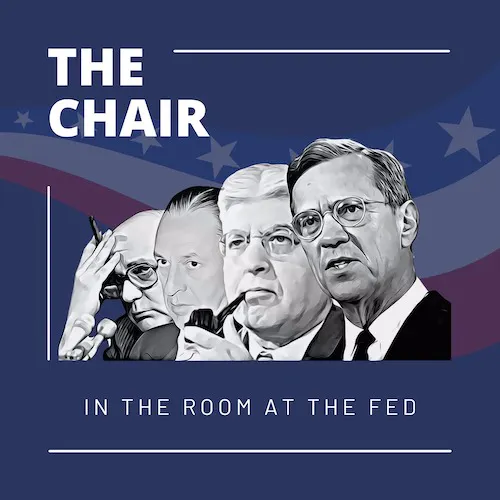
More than any other global institution, the US Federal Reserve’s decisions and communications drive capital markets and alter financial conditions everywhere from Seattle to Seoul. While its interest rate are set by an expert committee, for almost a century, the Fed’s core philosophy and operational approach have been moulded by one person: the Chair of the Board of Governors. In this podcast series, Tim Gwynn Jones - a veteran central bank "watcher" - talks to authors of books about the Fed's most influential Chairs, starting with Marriner Eccles, Bill Martin, Arthur Burns, and Paul Volcker. In the fourth and final episode of this series, he talks to William Silber – author of Volcker: The Triumph of Persistence (Bloomsbury, 2012). A giant (literally) of 20th-century policymaking, Volcker chaired the Fed from 1979 to 1987, implementing monetarist shock therapy, driving up the fed funds rate from 11% to 20% to crush inflation expectations, and pulling inflation down from nearly 15% in early 1980 to below 3% three years later. “For Volcker, the most important denigrating fact of inflation was … that it undermines trust in government,” says Silber. “When we give the government the right to print money … we trust that the government will not debase the currency … When you think about inflation in that context, there is no number – two, four, six. Any number is bad. The only number that works is zero .. If you asked Volcker – and I asked him – what's the right number, he said zero”. From 1990 until his retirement in 2019, Bill Silber was professor of economics at the Stern School of Business, New York University. His award-winning book is built on more than 100 hours of interviews with Volcker. The author of seven other books, Silber’s latest – The Power of Nothing to Lose: The Hail Mary Effect in Politics, War, and Business – will be published in paperback in September 2024. Learn more about your ad choices. Visit megaphone.fm/adchoices
Ep 198Lio Mangubat, "Silk, Silver, Spices, Slaves: Lost Tales from the Philippine Colonial Period, 1565-1946" (Faction Press, 2024)
Baseball’s introduction to the Philippines. The slot machine trade between Manila and Shanghai. A musical based extremely loosely on the life of the sultan of Sulu. These are just a few of the historical topics from Lio Mangubat’s Silk, Silver, Spices, Slaves: Lost Tales from the Philippine Colonial Period (Faction Press: 2024), a collection of 13 essays on stories from Filipino history as a Spanish and then American colony. All the stories come from Lio’s podcast, The Colonial Department, which features long-lost stories from the country's past under Spanish, British, American, and Japanese rule. In this interview, Lio and I talk about what inspired his essay collection, his conversation with Albert Samaha (an earlier podcast guest!) and what’s missing in how we talk about the Philippines Lio is also the editor in chief of publishing house Summit Books, and is based in Manila. Find him on Instagram at @liomangubat and @thecolonialdept. You can find more reviews, excerpts, interviews, and essays at The Asian Review of Books, including its review of Silk, Silver, Spices, Slaves. Follow on Twitter at @BookReviewsAsia. Nicholas Gordon is an editor for a global magazine, and a reviewer for the Asian Review of Books. He can be found on Twitter at @nickrigordon. Learn more about your ad choices. Visit megaphone.fm/adchoices
Ep 474Alice Mah, "Petrochemical Planet: Multiscalar Battles of Industrial Transformation" (Duke UP, 2023)
Is a green future possible? In Petrochemical Planet: Multiscalar Battles of Industrial Transformation (Duke UP, 2023), Alice Mah, a Professor in Urban and Environmental Studies at the University of Glasgow examines the practices of the petrochemical industry, along with the communities living with, and resisting, its impact. Offering ethnographic and theoretical reflections on this often overlooked and hidden part of the oil and plastics production chain, the book offers a new perspective on our present environmental crisis. Diagnosing the acuteness of problems as well as the challenges of solutions, the book is essential reading for anyone wanting to understand our planet and environment. The book is available open access here. Learn more about your ad choices. Visit megaphone.fm/adchoices
Ep 221Jacob Soll, "Free Market: The History of an Idea" (Basic Books, 2022)
After two government bailouts of the American economy in less than twenty years, free market thought is due for serious reappraisal. Free Market: The History of an Idea (Basic Books, 2022) shows how the idea became so powerful, why it succeeded, and why it has failed so spectacularly. In 1990, the G7 Countries enjoyed 70 percent of world GDP. In the face of the collapse of the Soviet Union, it was supposed to be a story of the success of free markets. However, in the past thirty years, that number has dropped by half, and Asia has emerged as a major motor of world economic growth. Today, state-run China is the second biggest economy on earth, and tiny Singapore, with its state-owned companies, has become a new model of wealth creation. In other words, Milton Friedman's free market dogma, that only private companies can create wealth and that states hamper it, has not proved very clearly to be untrue. This book shows how we got to the current crisis of free market thought, and suggests how we can find our way out. Contrary to popular free market narratives, early market theorists believed that states had an important role in building and maintaining free markets. But in the eighteenth century, some free-market thinkers began insisting only pure free markets, without state intervention, could work. A tradition of free-market ideological brittleness emerged, and it has led orthodox free market economics to some spectacular failures. It is a paradox that an economic theory rooted in the idea of competition, adaptation and evolution, has refused to follow its own precepts. This book shows that we need to go back to the origins of free market thought in order to understand its dynamism, as well as its inherent weaknesses, and to develop new economic concepts to face the staggering challenges of the twenty-first century. Jacob Soll is an American university professor and professor of philosophy, history and accounting at the University of Southern California. Soll's work examines the mechanics of politics, statecraft and economics by dissecting the various elements of how modern states and political systems succeed and fail. Morteza Hajizadeh is a Ph.D. graduate in English from the University of Auckland in New Zealand. His research interests are Cultural Studies; Critical Theory; Environmental History; Medieval (Intellectual) History; Gothic Studies; 18th and 19th Century British Literature. YouTube channel. Twitter. Learn more about your ad choices. Visit megaphone.fm/adchoices
Ep 157Arthur Burns: “The smartest guy in the room”
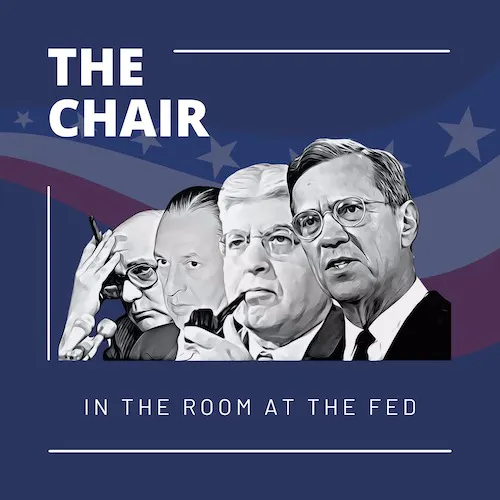
More than any other global institution, the US Federal Reserve’s decisions and communications drive capital markets and alter financial conditions everywhere from Seattle to Seoul. While its interest rate are set by an expert committee, for almost a century, the Fed’s core philosophy and operational approach have been moulded by one person: the Chair of the Board of Governors. In this podcast series, Tim Gwynn Jones - a veteran central bank "watcher" - talks to authors of books about the Fed's most influential Chairs, starting with Marriner Eccles, Bill Martin, Arthur Burns, and Paul Volcker. In this third episode, he talks to Wyatt Wells – author of Economist in an Uncertain World – Arthur F. Burns and The Federal Reserve, 1970–1978 (Columbia University Press, 1994). Burns has had a bad press - so bad that Chris Hughes, one of Facebook's founders, was moved to rehabilitate him. Leading the Fed from 1970 to 1978 when inflation averaged 9%, Burns was an accomplished business-cycle economist but also a politically partisan Chair intensely loyal to Richard Nixon and Gerald Ford. Going far beyond his remit as a central banker, Burns oversaw government efforts to control prices and wages as an alternative to monetary policy. “If you couple an incomes policy with a tight fiscal and monetary policy, it can work. The problem is that it often becomes an excuse for not doing that,” says Wells. “Burns found himself trapped in this position where he felt he couldn't raise interest rates without wrecking the controls programme and possibly his own career – his own position at the Fed. It's clear in ‘73, he knows interest rates need to go up. They're trying to raise them but he's got these political concessions and he's doing this sort of dance, trying to square the circle … And of course: ‘I'm the smartest guy in the room. Therefore, I should play a key role in this effort to balance everything’. I think there are very few Federal Reserve chairmen who have elbowed their way into other areas in the way that Burns did. Maybe none”. An economic historian, Wyatt Wells has been Professor of History at Auburn University, Montgomery, since 1997. Learn more about your ad choices. Visit megaphone.fm/adchoices
Ep 210Nora Stone, "How Documentaries Went Mainstream: A History, 1960-2022" (Oxford UP, 2023)
How Documentaries Went Mainstream: A History, 1960-2022 (Oxford University Press, 2023) provides a more comprehensive and meaningful periodization of the commercialization of documentary film. Although the commercial ascension of documentary films might seem meteoric, it is the culmination of decades-long efforts that have developed and fortified the audience for documentary features. Author Nora Stone refines rough explanations of these efforts through a robust synoptic history of the market for documentary films, using knowledge of film economics and the norms of industry discourse to tell a richer story. This periodization will allow scholars to compare the commercialization of documentary film with other genres. Drawing on archival documents, industry trade journals and popular press, and interviews with filmmakers and film distributors, Stone illuminates how documentary features have become more plentiful, popular, and profitable than ever before. Ailin Zhou is a PhD student in Film & Digital Media at University of California, Santa Cruz. Her research interests include transnational Chinese cinema, Asian diasporic visual culture, contemporary art, and feminist and queer theories. Learn more about your ad choices. Visit megaphone.fm/adchoices
Ep 194Andrew Denning, "Automotive Empire: How Cars and Roads Fueled European Colonialism in Africa" (Cornell UP, 2024)
In Automotive Empire: How Cars and Roads Fueled European Colonialism in Africa (Cornell University Press, 2024), Dr. Andrew Denning uncovers how roads and vehicles began to transform colonial societies across Africa but rarely in the manner Europeans expected. Like seafaring ships and railroads, automobiles and roads were more than a mode of transport—they organised colonial spaces and structured the political, economic, and social relations of empire, both within African colonies and between colonies and the European metropole. European officials in French, Italian, British, German, Belgian, and Portuguese territories in Africa shared a common challenge—the transport problem. While they imagined that roads would radiate commerce and political hegemony by collapsing space, the pressures of constructing and maintaining roads rendered colonial administration thin, ineffective, and capricious. Automotive empire emerged as the European solution to the transport problem, but revealed weakness as much as it extended power. As Automotive Empire reveals, motor vehicles and roads seemed the ideal solution to the colonial transport problem. They were cheaper and quicker to construct than railroads, overcame the environmental limitations of rivers, and did not depend on the recruitment and supervision of African porters. At this pivotal moment of African colonialism, when European powers transitioned from claiming territories to administering and exploiting them, automotive empire defined colonial states and societies, along with the brutal and capricious nature of European colonialism itself. This interview was conducted by Dr. Miranda Melcher whose new book focuses on post-conflict military integration, understanding treaty negotiation and implementation in civil war contexts, with qualitative analysis of the Angolan and Mozambican civil wars. Learn more about your ad choices. Visit megaphone.fm/adchoices
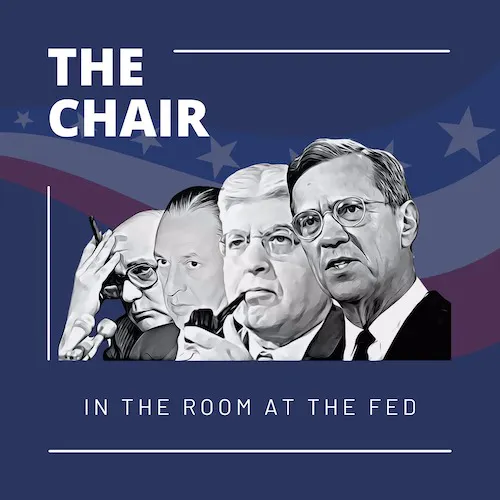
Ep 156Bill Martin: “Truman looked at him and said: ‘Traitor’”
More than any other global institution, the US Federal Reserve’s decisions and communications drive capital markets and alter financial conditions everywhere from Seattle to Seoul. While its interest rate are set by an expert committee, for almost a century, the Fed’s core philosophy and operational approach have been moulded by one person: the Chair of the Board of Governors. In this podcast series, Tim Gwynn Jones - a veteran central bank "watcher" - talks to authors of books about the Fed's most influential Chairs, starting with Marriner Eccles, Bill Martin, Arthur Burns, and Paul Volcker. In this second episode, he interviews Robert Bremner – author of Chairman of the Fed: William McChesney Martin Jr. and the Creation of the Modern American Financial System (Yale University Press, 2004). Bill Martin still holds the record for the longest chairmanship at the Fed – holding the office from 1951 to 1970. A Democrat, he was first nominated by President Harry Truman and reappointed (more or less willingly) by Eisenhower, Kennedy, Johnson, and Nixon. He dismantled government wartime controls over interest rates, battled to save the postwar currency-management regime, democratised the Fed, and fought successive presidents to keep its independence. These conflicts started early, says Bremner. “Martin told this story about walking down Wall Street and passing the president going the other way and Martin said: ‘Good morning, Mr. President, great to see you’. And Truman looked at him and said: ‘Traitor’. Basically Truman wanted to continue low interest rates certainly until he left office and for as long as possible”. After a career in finance at the World Bank and in the mutual-fund industry, Bob Bremner is now a director of the Westminster Ingleside Foundation. Learn more about your ad choices. Visit megaphone.fm/adchoices
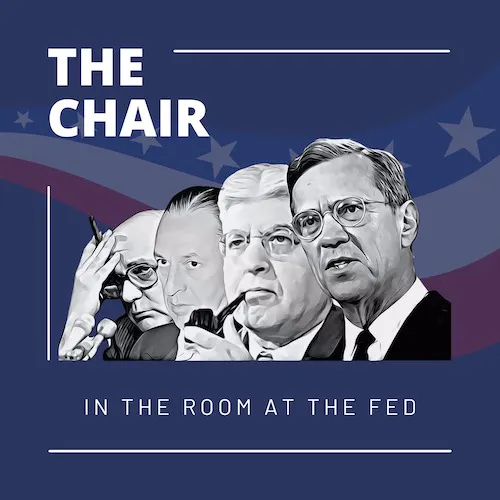
Ep 155Marriner Eccles: Reform “may not have happened in 1935 if Eccles hadn't been there”
More than any other global institution, the US Federal Reserve’s decisions and communications drive capital markets and alter financial conditions everywhere from Seattle to Seoul. While its interest rate are set by an expert committee, for almost a century, the Fed’s core philosophy and operational approach have been moulded by one person: the Chair of the Board of Governors. In this podcast series, Tim Gwynn Jones - a veteran central bank "watcher" - talks to authors of books about the Fed's most influential Chairs, starting with Marriner Eccles, Bill Martin, Arthur Burns, and Paul Volcker. In this first episode, he interviews Mark Nelson - author of Jumping the Abyss: Marriner S. Eccles and the New Deal, 1933-1940 (University of Utah Press, 2017). Eccles chaired the Fed from 1934 to 1948, turned it into a Washington power centre, and centralised policymaking with the Board of Governors. The US might have been better served if Eccles and his nemesis Henry Morgenthau, the Treasury Secretary from 1934-1945, had swapped roles, says Nelson. "That's true except for the fact that Eccles did do something very important at the Fed and that is the Banking Act of 1935, which really changed the Fed in an enormously important way and Morgenthau would not have done that ... I think it would have happened at some point. You could make the argument, though, that it may not have happened in 1935 if Eccles hadn't been there because Eccles took the job at the Fed on the understanding that these changes would be made”. An actor-turned-historian, Mark Nelson was educated at Pepperdine University and Claremont Graduate University and today teaches at Greenville Technical College, South Carolina. His next book will be Race and Recovery: James F. Byrnes and the New Deal. Learn more about your ad choices. Visit megaphone.fm/adchoices
Ep 106Katherine Hempstead, "Uncovered: The Story of Insurance in America" (Oxford UP, 2023)
Historically, the insurance industry in America has been fragmented. As a result, there have been debates and conflicts over the proper roles of federal and state governments, business, and the responsibilities of individuals. Who should cover the risks of loss? And to what extent should risk be shared and by whom? In Uncovered: The Story of Insurance in America (Oxford UP, 2023), Katherine Hempstead answers these questions by exploring the history of the insurance business and its regulation in the United States from the 1870s through the twentieth century. Specifically, she focuses on the friction between the public demand for insurance and the private imperatives of insurers. Tracing the history of the industry from the early days of life, fire, and casualty insurance to the development of state regulation in the late nineteenth century, Hempstead examines the role that insurers initially played in the largely voluntary social safety net and how this changed over time. After the Great Depression, the federal government assumed a greater role in the provision of insurance, while insurers enthusiastically pursued the growing business of employee benefits. As the twentieth century progressed, insurers and government have become interdependent, with insurers participating in publicly funded markets. As Hempstead shows, periodic crises in life, fire, health, auto, and liability insurance highlighted gaps between the coverage that insurers were willing to provide and what the public demanded. Learn more about your ad choices. Visit megaphone.fm/adchoices
Ep 539Janine P. Holc, "The Weavers of Trautenau: Jewish Female Forced Labor in the Holocaust" (Brandeis UP, 2023)
Beginning in late 1940, over three thousand Jewish girls and young women were forced from their family homes in Sosnowiec, Poland, and its surrounding towns to worksites in Germany. Believing that they were helping their families to survive, these young people were thrust into a world where they labored at textile work for twelve hours a day, lived in barracks with little food, and received only periodic news of events back home. By late 1943, their barracks had been transformed into concentration camps, where they were held until liberation in 1945. Using a fresh approach to testimony collections, Janine P. Holc reconstructs the forced labor experiences of young Jewish females, as told by the women who survived and shared their testimony. Incorporating new source material, the book carefully constructs survivors’ stories while also taking a theoretical approach, one alert to socially constructed, intersectional systems of exploitation and harm. The Weavers of Trautenau: Jewish Female Forced Labor in the Holocaust (Brandeis UP, 2023) elucidates the limits and possibilities of social relations inside camps and the challenges of moral and emotional repair in the face of indescribable loss during the Holocaust. Learn more about your ad choices. Visit megaphone.fm/adchoices
Ep 90Swati Chattopadhyay, "Small Spaces: Recasting the Architecture of Empire" (Bloomsbury, 2023)
Swati Chattopadhyay's book Small Spaces: Recasting the Architecture of Empire (Bloomsbury, 2023) recasts the history of the British empire by focusing on the small spaces that made the empire possible. It takes as its subject a series of small architectural spaces, objects, and landscapes and uses them to narrate the untold stories of the marginalized people-the servants, women, children, subalterns, and racialized minorities-who held up the infrastructure of empire. In so doing it opens up an important new approach to architectural history: an invitation to shift our attention from the large to the small scale. Taking the British empire in India as its primary focus, this book presents eighteen short, readable chapters to explore an array of overlooked places and spaces. From cook rooms and slave quarters to outhouses, go-downs, and medicine cupboards, each chapter reveals how and why these kinds of minor spaces are so important to understanding colonialism. With the focus of history so often on the large scale - global trade networks, vast regions, and architectures of power and domination - Small Spaces shows instead how we need to rethink this aura of magnitude so that our reading is not beholden such imperialist optics. With chapters which can be read separately as individual accounts of objects, spaces, and buildings, and introductions showing how this critical methodology can challenge the methods and theories of urban and architectural history, Small Spaces is a must-read for anyone wishing to decolonize disciplinary practices in the field of architectural, urban, and colonial history. Altogether, it provides a paradigm-breaking account of how to 'unlearn empire', whether in British India or elsewhere. Learn more about your ad choices. Visit megaphone.fm/adchoices
Ep 37Elena Borisova, "Paradoxes of Migration in Tajikistan: Locating the Good Life" (UCL Press, 2024)
Paradoxes of Migration in Tajikistan: Locating the Good Life (UCL Press, 2024) by Dr. Elena Borisova is the first ethnographic monograph on migration in Tajikistan, one of the most remittance-dependent countries in the world. Moving beyond economistic push-pull narratives about post-Soviet migration, it foregrounds the experiences of those who ‘stay put’ in the sending society and struggle to reproduce their moral communities. Dr. Borisova examines the role of mobility in historical and cultural ideas about the good life and how it becomes entwined with people’s efforts to become good, moral and modern subjects. Addressing the complex relationship between the economic, imaginative and moral aspects of (im)mobility, she shows that mass migration from Tajikistan is as much a project of navigating ethical personhood as it is a quest for economic resources. This book reveals how transnational regimes and structures of mobility, citizenship and histories map out in the intimate spheres of the body, the person and the family. It is a contribution to contemporary migration research, which is mostly centred on Europe and North America, and to the field of Central Asian studies. It will be of interest to researchers of migration, (im)mobility and citizenship, and to scholars of all disciplines working on Central Asia. This interview was conducted by Dr. Miranda Melcher whose new book focuses on post-conflict military integration, understanding treaty negotiation and implementation in civil war contexts, with qualitative analysis of the Angolan and Mozambican civil wars. Learn more about your ad choices. Visit megaphone.fm/adchoices
Ep 197Roger Crowley, "Spice: The 16th-Century Contest that Shaped the Modern World" (Yale UP, 2024)
The spice islands: Specks of land in the Indonesian archipelago that were the exclusive home of cloves, commodities once worth their weight in gold. The Portuguese got there first, persuading the Spanish to fund expeditions trying to go the other direction, sailing westward across the Atlantic. Roger Crowley, in his new book Spice: The 16th-Century Contest that Shaped the Modern World (Yale University Press: 2024) covers six decades of exploration, conflict and conquest, starting from the Portuguese capture of Malacca in 1511 to the Spanish founding of Manila and the start of the galleon trade in 1571. Roger Crowley is a narrative historian of the early modern period. He is the author of five celebrated books, including City of Fortune: How Venice Won and Lost a Naval Empire (Faber & Faber: 2011) and Conquerors: How Portugal Forged the First Global Empire (Random House: 2015). You can find more reviews, excerpts, interviews, and essays at The Asian Review of Books, including its review of Spice. Follow on Twitter at @BookReviewsAsia. Nicholas Gordon is an editor for a global magazine, and a reviewer for the Asian Review of Books. He can be found on Twitter at@nickrigordon. Learn more about your ad choices. Visit megaphone.fm/adchoices
Ep 472Bernard E. Harcourt. "Cooperation: A Political, Economic, and Social Theory" (Columbia UP, 2023)
Liberal democracy is in crisis around the world, unable to address pressing problems such as climate change. There is, however, another path—cooperation democracy. From consumer co-ops to credit unions, worker cooperatives to insurance mutuals, nonprofits to mutual aid, countless examples prove that people working together can extend the ideals of participatory democracy and sustainability into every aspect of their lives. These forms of cooperation do not depend on electoral politics. Instead, they harness the longstanding practices and values of cooperatives: self-determination, democratic participation, equity, solidarity, and respect for the environment. Bernard E. Harcourt develops a transformative theory and practice that builds on worldwide models of successful cooperation. He identifies the most promising forms of cooperative initiatives and then distills their lessons into an integrated framework: Coöperism. This is a political theory grounded on recognition of our interdependence. It is an economic theory that can ensure equitable distribution of wealth. Finally, it is a social theory that replaces the punishment paradigm with a cooperation paradigm. A creative work of normative critical theory, Cooperation: A Political, Economic, and Social Theory (Columbia UP, 2023) provides a positive vision for addressing our most urgent challenges today. Harcourt shows that by drawing on the core values of cooperation and the power of people working together, a new world of cooperation democracy is within our grasp. Bernard E. Harcourt is the Isidor and Seville Sulzbacher Professor of Law and professor of political science at Columbia University and a chaired professor at the École des Hautes Études en Sciences Sociales in Paris. An editor of Michel Foucault’s work in French and English, Harcourt is the author of several books, including Critique and Praxis (Columbia, 2020). He is a social-justice litigator and the recipient of the 2019 Norman Redlich Capital Defense Distinguished Service Award from the New York City Bar Association for his longtime representation of death row prisoners. Morteza Hajizadeh is a Ph.D. graduate in English from the University of Auckland in New Zealand. His research interests are Cultural Studies; Critical Theory; Environmental History; Medieval (Intellectual) History; Gothic Studies; 18th and 19th Century British Literature. YouTube channel. Twitter. Learn more about your ad choices. Visit megaphone.fm/adchoices
Ep 75Richard D. Oram, "Where Men No More May Reap Or Sow: The Little Ice Age: Scotland 1400-1850" (Birlinn, 2024)
Drawing together the evidence of archaeology, palaeoecology, climate history and the historical record, this first environmental history of Scotland explores the interaction of human populations with the land, waters, forests and wildlife. Where Men No More May Reap or Sow: The Little Ice Age: Scotland 1400–1850 (Birlinn, 2024) by Dr. Richard D. Oram spans 450 years that saw profound transformation in Scotland’s environment. It begins in the fifteenth century, when the ‘Golden Age’ of the early 1200s was but a fading folk memory in a land gripped by the gathering grimness of a ‘little ice age’. Colder, wetter, stormier weather became the new normal, interspersed with brief episodes of warmer but still moist conditions, all of which brought huge challenges to a society on the knife-edge of subsistence. Viewing the religious and political upheavals of the sixteenth and seventeenth centuries against the cycles of disease and dearth that were ever-present into the later 1700s, the book explores the slow adoption and application of the ideas of ‘Improvement’ and the radical disruption of Scotland’s environment that ensued. Reformation, revolution and rebellion were the background noise to efforts to subsist and succeed through a hostile age, in which Scotland’s environment was an adversary to be tamed, mastered and made ‘polite’. As the last, bitter decades of the ‘little ice age’ were ground out in foreign wars, forced clearances and potato famines, Scotland prepared itself to embrace the Industrial Age. This interview was conducted by Dr. Miranda Melcher whose new book focuses on post-conflict military integration, understanding treaty negotiation and implementation in civil war contexts, with qualitative analysis of the Angolan and Mozambican civil wars. Learn more about your ad choices. Visit megaphone.fm/adchoices
Ep 77Kate McDonald on Asian Mobility History as Labor History
Peoples & Things host, Lee Vinsel, talks to Kate McDonald, Associate Professor of History at University of California, Santa Barbara, about her fascinating research on the history of mobility in Asia and how it looks different when we approach it as a history of work and labor. The pair traverse McDonald’s career from her current project, The Rickshaw and the Railroad: Human-Powered Transport in the Age of the Machine, to her first book, Placing Empire: Travel and the Social Imagination in Imperial Japan (U California Press, 2017) to digital humanities projects she has helped lead. Along the way, they talk about the craft of historical research and what we can learn by revisiting classic texts with mobility and the work of transportation in mind. Learn more about your ad choices. Visit megaphone.fm/adchoices
Ep 12Kristie Flannery, "Piracy and the Making of the Spanish Pacific World" (U Pennsylvania Press, 2024)
Piracy and the Making of the Spanish Pacific World (University of Pennsylvania Press, 2024) offers a new interpretation of Spanish colonial rule in the Philippine islands. Drawing on the rich archives of Spain’s Asian empire, Dr. Kristie Patricia Flannery reveals that Spanish colonial officials and Catholic missionaries forged alliances with Indigenous Filipinos and Chinese migrant settlers in the Southeast Asian archipelago to wage war against waves of pirates, including massive Chinese pirate fleets, Muslim pirates from the Sulu Zone, and even the British fleet that attacked at the height of the Seven Years’ War. Anti-piracy alliances made Spanish colonial rule resilient to both external shocks and internal revolts that shook the colony to its core. This revisionist study complicates the assumption that empire was imposed on Filipinos with brute force alone. Rather, anti-piracy also shaped the politics of belonging in the colonial Philippines. Real and imagined pirate threats especially influenced the fate and fortunes of Chinese migrants in the islands. They triggered genocidal massacres of the Chinese at some junctures, and at others facilitated Chinese integration into the Catholic nation as loyal vassals. Piracy and the Making of the Spanish Pacific World demonstrates that piracy is key to explaining the surprising longevity of Spain’s Asian empire, which, unlike Spanish colonial rule in the Americas, survived the Age of Revolutions and endured almost to the end of the nineteenth century. Moreover, it offers important new insight into piracy’s impact on the trajectory of globalisation and European imperial expansion in maritime Asia. This interview was conducted by Dr. Miranda Melcher whose new book focuses on post-conflict military integration, understanding treaty negotiation and implementation in civil war contexts, with qualitative analysis of the Angolan and Mozambican civil wars. Learn more about your ad choices. Visit megaphone.fm/adchoices
Ep 207Kathleen Loock, "Hollywood Remaking: How Film Remakes, Sequels, and Franchises Shape Industry and Culture" (U California Press, 2024)
From the inception of cinema to today’s franchise era, remaking has always been a motor of ongoing film production. Hollywood Remaking: How Film Remakes, Sequels, and Franchises Shape Industry and Culture (U California Press, 2024) challenges the categorical dismissal in film criticism of remakes, sequels, and franchises by probing what these formats really do when they revisit familiar stories. Kathleen Loock argues that movies from Hollywood’s large-scale system of remaking use serial repetition and variation to constantly negotiate past and present, explore stability and change, and actively shape how the film industry, cinema, and audiences imagine themselves. Far from a simple profit-making exercise, remaking is an inherently dynamic practice situated between the film industry’s economic logic and the cultural imagination. Although remaking developed as a business practice in the United States, this book shows that it also shapes cinematic aesthetics and cultural debates, fosters film-historical knowledge, and promotes feelings of generational belonging among audiences. For more on the Hollywood Memories project, go here. Learn more about your ad choices. Visit megaphone.fm/adchoices
Ep 537Mark Baker, "Pivot of China: Spatial Politics and Inequality in Modern Zhengzhou" (Harvard UP, 2024)
China’s modern history has been marked by deep spatial inequalities between regions, between cities, and between rural and urban areas. Contemporary observers and historians alike have attributed these inequalities to distinct stages of China's political economy: the dualistic economy of semicolonialism, rural-urban divisions in the socialist period, and capital concentration in the reform era. In Pivot of China: Spatial Politics and Inequality in Modern Zhengzhou (Harvard UP, 2024), Mark Baker shows how different states across twentieth-century China shaped these inequalities in similar ways, concentrating resources in urban and core areas at the expense of rural and regional peripheries. Pivot of China examines this dynamic through the city of Zhengzhou, one of the most dramatic success stories of China’s urbanization: a railroad boomtown of the early twentieth century, a key industrial center and provincial capital of Henan Province in the 1950s, and by the 2020s a “National Central City” of almost ten million people. However, due to the spatial politics of resource concentration, Zhengzhou’s twentieth-century growth as a regional city did not kickstart a wider economic takeoff in its hinterland. Instead, unequal spatial politics generated layers of inequality that China is still grappling with in the twenty-first century. Huiying Chen is an Assistant Professor in History at Purdue University. She is interested in the circulation of people, goods, and ideas and how societies in history and today cope with the challenges wrought by increased travel in aspects of culture, politics, commerce, law, science, and technology. Learn more about your ad choices. Visit megaphone.fm/adchoices