New Books in Caribbean Studies
478 episodes — Page 3 of 10
Ep 236Jonathan Connolly, "Worthy of Freedom: Indenture and Free Labor in the Era of Emancipation" (U Chicago Press, 2024)
In Worthy of Freedom: Indenture and Free Labor in the Era of Emancipation (University of Chicago Press, 2024), Jonathan Connolly traces the normalization of indenture from its controversial beginnings to its widespread adoption across the British Empire during the nineteenth century. Initially viewed as a covert revival of slavery, indenture caused a scandal in Britain and India. But over time, economic conflict in the colonies altered public perceptions of indenture, now increasingly viewed as a legitimate form of free labor and a means of preserving the promise of abolition. Connolly explains how the large-scale, state-sponsored migration of Indian subjects to work on sugar plantations across Mauritius, British Guiana, and Trinidad transformed both the notion of post-slavery free labor and the political economy of emancipation. Excavating legal and public debates and tracing practical applications of the law, Connolly carefully reconstructs how the categories of free and unfree labor were made and remade to suit the interests of capital and empire, showing that emancipation was not simply a triumphal event but, rather, a deeply contested process. In so doing, he advances an original interpretation of how indenture changed the meaning of “freedom” in a post-abolition world. Jonathan Connolly is Assistant Professor of History at the University of Illinois Chicago. Connolly is a historian of the British empire with transnational interests in migration, the history of emancipation, and legal history. His research primarily concerns abolition and emancipation, imperial political and legal culture, and the category of free labor in the Caribbean and the Indian Ocean. Your host for this episode is Mahishan Gnanaseharan, a PhD student in the Department of History at Stanford University. Mahishan studies the social, political, and intellectual histories of South Asian migrants across the Indian Ocean during the 19th and 20th centuries. Learn more about your ad choices. Visit megaphone.fm/adchoices Support our show by becoming a premium member! https://newbooksnetwork.supportingcast.fm/caribbean-studies
Ep 468Firuzeh Shokooh Valle, "In Defense of Solidarity and Pleasure: Feminist Technopolitics from the Global South" (Stanford UP, 2023)
Including women in the global South as users, producers, consumers, designers, and developers of technology has become a mantra against inequality, prompting movements to train individuals in information and communication technologies and foster the participation and retention of women in science and technology fields. In In Defense of Solidarity and Pleasure: Feminist Technopolitics from the Global South (Stanford UP, 2023), Firuzeh Shokooh Valle argues that these efforts have given rise to an idealized, female economic figure that combines technological dexterity and keen entrepreneurial instinct with gendered stereotypes of care and selflessness. Narratives about the "equalizing" potential of digital technologies spotlight these women's capacity to overcome inequality using said technologies, ignoring the barriers and circumstances that create such inequality in the first place as well as the potentially violent role of technology in their lives. In Defense of Solidarity and Pleasure examines how women in the Global South experience and resist the coopting and depoliticizing nature of these scripts. Drawing on fieldwork in Costa Rica and a transnational feminist digital organization, Shokooh Valle explores the ways that feminist activists, using digital technologies as well as a collective politics that prioritize solidarity and pleasure, advance a new feminist technopolitics. Firuzeh Shokooh Valle is Assistant Professor of Sociology at Franklin and Marshall College. Previously, she was a journalist in Puerto Rico covering violence against women, the LGBTQI+ community, migration, racism, and social movements, and earned numerous national awards for her investigative work. Morteza Hajizadeh is a Ph.D. graduate in English from the University of Auckland in New Zealand. His research interests are Cultural Studies; Critical Theory; Environmental History; Medieval (Intellectual) History; Gothic Studies; 18th and 19th Century British Literature. YouTube channel. Twitter. Learn more about your ad choices. Visit megaphone.fm/adchoices Support our show by becoming a premium member! https://newbooksnetwork.supportingcast.fm/caribbean-studies
Ep 315Oneka LaBennett, "Global Guyana: Shaping Race, Gender, and Environment in the Caribbean and Beyond" (NYU Press, 2024)
Previously ranked among the hemisphere’s poorest countries, Guyana is becoming a global leader in per capita oil production, a shift which promises to profoundly transform the nation. This sea change presents a unique opportunity to dissect both the environmental impacts of modern-world resource extraction and the obscured yet damaging ways in which intersectional race and gender formations circumscribe Caribbean women’s lives. Drawing from archival research and oral history, and examining mass-mediated flashpoints across the African and Indian diasporas―including Rihanna’s sonic routes, ethnic conflict reportage, HBO’s Lovecraft Country, and Netflix’s Indian Matchmaking―Global Guyana: Shaping Race, Gender, and Environment in the Caribbean and Beyond (NYU Press, 2024) repositions this marginalized nation as a nexus of social and economic activity which drives popular culture and ideas about sexuality while reshaping the geopolitical and literal topography of the Caribbean region. Oneka LaBennett employs the powerful analytic of the pointer broom to disentangle the symbiotic relationship between Guyanese women’s gendered labor and global racial capitalism. She illuminates how both oil extraction and sand export are implicated in a well-established practice of pillaging the Caribbean’s natural resources while masking the ecological consequences that disproportionately affect women and children. Global Guyana uncovers how ecological erosion and gendered violence are entrenched in extractive industries emanating from this often-effaced but pivotal country. Sounding the alarm on the portentous repercussions that ambitious development spells out for the nation’s people and its geographical terrain, LaBennett issues a warning for all of us about the looming threat of global environmental calamity. Oneka LaBennett is Associate Professor of American Studies and Ethnicity and Gender and Sexuality Studies at the University of Southern California. She’s the author of She’s Mad Real: Popular Culture and West Indian Girls in Brooklyn and co-editor of Racial Formation in the Twenty-First Century. Reighan Gillam is Associate Professor in the Department of Latin American, Latino, and Caribbean Studies at Dartmouth College. Her research examines the ways in which Afro-Brazilian media producers foment anti-racist visual politics through their image creation. She is the author of Visualizing Black Lives: Ownership and Control in Afro-Brazilian Media (University of Illinois Press). Learn more about your ad choices. Visit megaphone.fm/adchoices Support our show by becoming a premium member! https://newbooksnetwork.supportingcast.fm/caribbean-studies
Ep 113Faith Smith, "Strolling in the Ruins: The Caribbean's Non-Sovereign Modern in the Early Twentieth Century" (Duke UP, 2023)
In Strolling in the Ruins: The Caribbean's Non-Sovereign Modern in the Early Twentieth Century (Duke UP, 2023), Faith Smith engages with a period in the history of the Anglophone Caribbean often overlooked as nondescript, quiet, and embarrassingly pro-imperial within the larger narrative of Jamaican and Trinidadian nationalism. Between the 1865 Morant Bay Rebellion and World War I, British imperialism was taken for granted among both elites and ordinary people, while nationalist discourses would not begin to shape political imagination in the West Indies for decades. Smith argues that this moment, far from being uneventful, disrupts the inevitability of nationhood in the mid-twentieth century and anticipates the Caribbean’s present-day relationship to global power. Smith assembles and analyzes a diverse set of texts, from Carnival songs, poems, and novels to newspapers, photographs, and gardens, to examine theoretical and literary-historiographic questions concerning time and temporality, empire and diaspora, immigration and indigeneity, gender and the politics of desire, Africa’s place within Caribbeanist discourse, and the idea of the Caribbean itself. Closely examining these cultural expressions of apparent quiescence, Smith locates the quiet violence of colonial rule and the insistence of colonial subjects on making meaningful lives. Learn more about your ad choices. Visit megaphone.fm/adchoices Support our show by becoming a premium member! https://newbooksnetwork.supportingcast.fm/caribbean-studies
Ep 112Keja L. Valens, "Culinary Colonialism, Caribbean Cookbooks, and Recipes for National Independence" (Rutgers UP, 2024)
Women across the Caribbean have been writing, reading, and exchanging cookbooks since at least the turn of the nineteenth century. These cookbooks are about much more than cooking. Through cookbooks, Caribbean women, and a few men, have shaped, embedded, and contested colonial and domestic orders, delineated the contours of independent national cultures, and transformed tastes for independence into flavours of domestic autonomy. Culinary Colonialism, Caribbean Cookbooks, and Recipes for National Independence (Rutgers University Press, 2024) by Dr. Keja Valens integrates new documents into the Caribbean archive and presents them in a rare pan-Caribbean perspective. The first book-length consideration of Caribbean cookbooks, Culinary Colonialism joins a growing body of work in Caribbean studies and food studies that considers the intersections of food writing, race, class, gender, and nationality. A selection of recipes, culled from the archive that Culinary Colonialism assembles, allows readers to savour the confluence of culinary traditions and local specifications that connect and distinguish national cuisines in the Caribbean. This interview was conducted by Dr. Miranda Melcher whose new book focuses on post-conflict military integration, understanding treaty negotiation and implementation in civil war contexts, with qualitative analysis of the Angolan and Mozambican civil wars. Learn more about your ad choices. Visit megaphone.fm/adchoices Support our show by becoming a premium member! https://newbooksnetwork.supportingcast.fm/caribbean-studies
Ep 157John Soluri, "Banana Cultures: Agriculture, Consumption, and Environmental Change in Honduras and the United States" (U Texas Press, 2021)
Bananas, the most frequently consumed fresh fruit in the United States, have been linked to Miss Chiquita and Carmen Miranda, "banana republics," and Banana Republic clothing stores—everything from exotic kitsch, to Third World dictatorships, to middle-class fashion. But how did the rise in banana consumption in the United States affect the banana-growing regions of Central America? In this second edition of Banana Cultures: Agriculture, Consumption, and Environmental Change in Honduras and the United States (University of Texas Press, 2021) Dr. John Soluri presents a lively, interdisciplinary study that integrates agroecology, anthropology, political economy, and history to trace the symbiotic growth of the export banana industry in Honduras and the consumer mass market in the United States. Beginning in the 1870s, when bananas first appeared in the U.S. marketplace, Dr. Soluri examines the tensions between the small-scale growers, who dominated the trade in the early years, and the shippers. He then shows how rising demand led to changes in production that resulted in the formation of major agribusinesses, spawned international migrations, and transformed great swaths of the Honduran environment into monocultures susceptible to plant disease epidemics that in turn changed Central American livelihoods. Soluri also looks at labor practices and workers' lives, changing gender roles on the banana plantations, the effects of pesticides on the Honduran environment and people, and the mass marketing of bananas to consumers in the United States. His multifaceted account of a century of banana production and consumption adds an important chapter to the history of Honduras, as well as to the larger history of globalisation and its effects on rural peoples, local economies, and biodiversity. This interview was conducted by Dr. Miranda Melcher whose new book focuses on post-conflict military integration, understanding treaty negotiation and implementation in civil war contexts, with qualitative analysis of the Angolan and Mozambican civil wars. Learn more about your ad choices. Visit megaphone.fm/adchoices Support our show by becoming a premium member! https://newbooksnetwork.supportingcast.fm/caribbean-studies
Ep 91Chloe Wigston Smith, "Novels, Needleworks, and Empire: Material Entanglements in the Eighteenth-Century Atlantic World" (Yale UP, 2024)
In the eighteenth century, women’s contributions to empire took fewer official forms than those collected in state archives. Their traces were recorded in material ways, through the ink they applied to paper or the artefacts they created with muslin, silk threads, feathers, and shells. Handiwork, such as sewing, knitting, embroidery, and other crafts, formed a familiar presence in the lives and learning of girls and women across social classes, and it was deeply connected to colonialism. In Novels, Needleworks, and Empire: Material Entanglements in the Eighteenth-Century Atlantic World (Yale University Press, 2024) Dr. Chloe Wigston Smith follows the material and visual images of the Atlantic world that found their way into the hands of women and girls in Britain and early America—in the objects they made, the books they held, the stories they read—and in doing so adjusted and altered the form and content of print and material culture. A range of artefacts made by women, including makers of colour, brought the global into conversation with domestic crafts and consequently placed images of empire and colonialism within arm’s reach. Together, fiction and handicrafts offer new evidence of women’s material contributions to the home’s place within the global eighteenth century, revealing the rich and complex connections between the global and the domestic. This interview was conducted by Dr. Miranda Melcher whose new book focuses on post-conflict military integration, understanding treaty negotiation and implementation in civil war contexts, with qualitative analysis of the Angolan and Mozambican civil wars. Learn more about your ad choices. Visit megaphone.fm/adchoices Support our show by becoming a premium member! https://newbooksnetwork.supportingcast.fm/caribbean-studies
Ep 68Laura Gómez, "Inventing Latinos: A New Story of American Racism" (The New Press, 2020)
Latinos have long influenced everything from electoral politics to popular culture, yet many people instinctively regard them as recent immigrants rather than a longstanding racial group. In Inventing Latinos: A New Story of American Racism (The New Press, 2020), Laura Gómez, a leading expert on race, law, and society, illuminates the fascinating race-making, unmaking, and re-making of Latino identity that has spanned centuries, leaving a permanent imprint on how race operates in the United States today. Pulling back the lens as the country approaches an unprecedented demographic shift (Latinos will comprise a third of the American population in a matter of decades), Gómez also reveals the nefarious roles the United States has played in Latin America—from military interventions and economic exploitation to political interference—that, taken together, have destabilized national economies to send migrants northward over the course of more than a century. It’s no coincidence that the vast majority of Latinos migrate from the places most impacted by this nation’s dirty deeds, leading Gómez to a bold call for reparations. In this audacious effort to reframe the often-confused and misrepresented discourse over the Latinx generation, Gómez provides essential context for today’s most pressing political and public debates—representation, voice, interpretation, and power—giving all of us a brilliant framework to engage cultural controversies, elections, current events, and more. David-James Gonzales (DJ) is Assistant Professor of History at Brigham Young University. He is a historian of migration, urbanization, and social movements in the U.S., and specializes in Latina/o/x politics and social movements. Follow him on Twitter @djgonzoPhD. Learn more about your ad choices. Visit megaphone.fm/adchoices Support our show by becoming a premium member! https://newbooksnetwork.supportingcast.fm/caribbean-studies
Ep 109Timothy P. Storhoff, "Harmony and Normalization: US-Cuban Musical Diplomacy" (UP of Mississippi, 2020)
Harmony and Normalization: US-Cuban Musical Diplomacy (University Press of Mississippi, 2020) explores the channels of musical exchange between Cuba and the United States during the eight-year presidency of Barack Obama, who eased the musical embargo of the island and restored relations with Cuba. Musical exchanges during this period act as a lens through which to view not only US-Cuban musical relations but also the larger political, economic, and cultural implications of musical dialogue between these two nations. In this first book on the subject since Obama’s presidency, musicologist Timothy P. Storhoff describes how, after specific policy changes, musicians were some of the first to take advantage of new opportunities for travel, push the boundaries of new regulations, and expose both the possibilities and limitations of licensing musical exchange. This ethnography demonstrates how performances reflect aspirations for stronger transnational ties and a common desire to restore the once-thriving US-Cuban musical relationship. Dr. Timothy Storhoff is an orchestra administrator, fundraiser, and ethnomusicologist in Winston-Salem, North Carolina. Emily Ruth Allen (@emmyru91) is a PhD candidate in Musicology at Florida State University. She is currently working on a dissertation about parade musics in Mobile, Alabama’s Carnival celebrations. Learn more about your ad choices. Visit megaphone.fm/adchoices Support our show by becoming a premium member! https://newbooksnetwork.supportingcast.fm/caribbean-studies
Ep 129Vince Brown, Caribbean Vectors (EF, JP)
The largest slave uprising in the 18th century British Caribbean was also a node of the global conflict called the Seven Year’s War, though it isn’t usually thought of that way. In the first few days of the quarantine and our current geopolitical and epidemiological shitshow, John and Elizabeth spoke with Vincent Brown, who recently published Tacky’s Revolt: The Story of an Atlantic Slave War (Harvard UP, 2019), centered on a group of enslaved West Africans, known under the term “Coromantees” who were the chief protagonists in this war. Tracing the vectors of this war within the Caribbean, the North Atlantic, and West Africa, Vince shows us how these particular enslaved Africans, who are caught in the gears of one of human history’s most dehumanizing institutions, constrained by repressive institutions, social-inscribed categories of differences and brutal force, operate tactically within and across space in complex and cosmopolitan ways. Vince locates his interest in warfare (as an object of study) in emergence of new world order and disorder through the Gulf Wars. His attention to routes and mobilities he credits to an epidemiological turn of mind–perhaps inherited from his father Willie Brown, a medical microbiologist now retired from UCSD. The idea of the vector shaped his first book as well. Vince’s “cartographic narrative” “A Slave Revolt in Jamaica: 1760-1761” and the film he produced with director Llewellyn Smith, Herskovits at the Heart of Blackness (which traces African studies and anthropology’s understanding of cultural movements from between Africa and the Americas) also explore these burning questions. Along the way, Vince discusses C.L.R. James’ notion of conflict, war and global connectedness in The Black Jacobins and the ways that categories of social difference both are constituted by global capital (reminding us of our conversation on caste, class and whiteness with Ajantha Subramanian) and those bumper stickers from the early 1980s in which the Taliban were the good guys. Mentioned in this episode: Rambo III (1988) The Interesting Narrative of the Life of Olaudah Equiano, or Gustavus Vassa, the African, written by himself (1789) Aphra Behn, Oroonoko (1688) Catherine Hall, Civilising Subjects: Metropole and Colony in the English Imagination, 1830-1867 (2002) C. L. R. James, The Black Jacobins: Toussaint L’Ouverture and the San Domingo Revolution (1938) John Thornton, Africa and Africans in the making of the Atlantic World-1400-1800 (1992) Derrick ‘Black X’ Robinson on his advocacy to make Tacky a national hero in Jamaica Black X walks barefoot across Jamaica to make Tacky a national hero Recallable Books: Marlon James, The Book of Night Women (2009) John Tutino, Making a New World (2011) Angel Palerm, The First Economic World-System (1980) Listen and Read Here: 34 The Caribbean and Vectors of Warfare: Vincent Brown Learn more about your ad choices. Visit megaphone.fm/adchoices Support our show by becoming a premium member! https://newbooksnetwork.supportingcast.fm/caribbean-studies
Ep 33Vanessa Walker, "Principles in Power: Latin America and the Politics of U.S. Human Rights Diplomacy" (Cornell UP, 2020)
Vanessa Walker's Principles in Power: Latin America and the Politics of U. S. Human Rights Diplomacy (Cornell University Press, 2020) explores the relationship between policy makers and nongovernment advocates in Latin America and the United States government in order to explain the rise of anti-interventionist human rights policies uniquely critical of U.S. power during the Cold War. Walker shows that the new human rights policies of the 1970s were based on a complex dynamic of domestic and foreign considerations that was rife with tensions between the seats of power in the United States and Latin America, and the growing activist movement that sought to reform them. By addressing the development of U.S. diplomacy and politics alongside that of activist networks, especially in Chile and Argentina, Walker shows that Latin America was central to the policy assumptions that shaped the Carter administration's foreign policy agenda. The coup that ousted the socialist president of Chile, Salvador Allende, sparked new human rights advocacy as a direct result of U.S. policies that supported authoritarian regimes in the name of Cold War security interests. From 1973 onward, the attention of Washington and capitals around the globe turned to Latin America as the testing ground for the viability of a new paradigm for U.S. power. This approach, oriented around human rights, required collaboration among activists and state officials in places as diverse as Buenos Aires, Santiago, and Washington, DC. Principles in Power tells the complicated story of the potentials and limits of partnership between government and nongovernment actors. Analyzing how different groups deployed human rights language to reform domestic and international power, Walker explores the multiple and often conflicting purposes of U.S. human rights policy. Jo Butterfield is the Advisor for the Human Rights Certificate offered by the University of Iowa Center for Human Rights and is an Adjunct Asst. Professor with the UI Department of History. Learn more about your ad choices. Visit megaphone.fm/adchoices Support our show by becoming a premium member! https://newbooksnetwork.supportingcast.fm/caribbean-studies
Ep 219Benjamin Bryce and David M. K. Sheinin, "Race and Transnationalism in the Americas" (U Pittsburgh Press, 2021)
Edited by Benjamin Bryce and David Sheinin, Race and Transnationalism in the Americas (University of Pittsburgh Press, 2021), highlights the importance of transnational forces in shaping the concept of race and understanding of national belonging across the Americas, from the late nineteenth century to the present times. The book also examines how race and its categories have functioned as mechanisms of exclusion and inclusion across cultural, political, and social dimensions. The authors across the different chapters examine phenomena such as immigration policies, indigenous decolonization efforts, and governmental colonization endeavors to discuss the intersections between race and both transnational and national elements. New ways to think about what it means to be a citizen, to belong, and to be of a particular race are offered, which prove useful and refreshing in our day and age, marked by considerable migration across borders in the Americas and the politization of racial identities. Benjamin Bryce is a Professor of History at the University of British Columbia. David Sheinin is a Professor of History at Trent University. Ariadna Obregon is a PhD student at the School of Media and Communication at the University of Leeds. On Twitter/X: @AriadnaObregn1 Learn more about your ad choices. Visit megaphone.fm/adchoices Support our show by becoming a premium member! https://newbooksnetwork.supportingcast.fm/caribbean-studies
Ep 111Adriana Chira, "Patchwork Freedoms: Law, Slavery, and Race beyond Cuba's Plantations" (Cambridge UP, 2022)
In nineteenth-century Santiago de Cuba, the island of Cuba's radical cradle, Afro-descendant peasants forged freedom and devised their own formative path to emancipation. Drawing on understudied archives, this pathbreaking work, Patchwork Freedoms: Law, Slavery, and Race beyond Cuba's Plantations (Cambridge UP, 2022) unearths a new history of Black rural geography and popular legalism, and offers a new framework for thinking about nineteenth-century Black freedom. Santiago de Cuba's Afro-descendant peasantries did not rely on liberal-abolitionist ideologies as a primary reference point in their struggle for rights. Instead, they negotiated their freedom and land piecemeal, through colonial legal frameworks that allowed for local custom and manumission. While gradually wearing down the institution of slavery through litigation and self-purchase, they reimagined colonial racial systems before Cuba's intellectuals had their say. Long before residents of Cuba protested for national independence and island-wide emancipation in 1868, it was Santiago's Afro-descendant peasants who, gradually and invisibly, laid the groundwork for emancipation. Kishauna Soljour is an Assistant Professor of Public Humanities at San Diego State University. Her most recent writing appears in the edited collection: From Rights to Lives: The Evolution of the Black Freedom Struggle. Learn more about your ad choices. Visit megaphone.fm/adchoices Support our show by becoming a premium member! https://newbooksnetwork.supportingcast.fm/caribbean-studies
Ep 110Maria Cristina Garcia, "State of Disaster: The Failure of U. S. Migration Policy in an Age of Climate Change" (UNC Press, 2022)
Natural disasters and the dire effects of climate change cause massive population displacements and lead to some of the most intractable political and humanitarian challenges seen today. Yet, as Maria Cristina Garcia observes in State of Disaster: The Failure of U. S. Migration Policy in an Age of Climate Change (UNC Press, 2022), there is actually no such thing as a "climate refugee" under current U.S. law. Most initiatives intended to assist those who must migrate are flawed and ineffective from inception because they are derived from outmoded policies. In a world of climate change, U.S. refugee policy simply does not work. Garcia focuses on Central America and the Caribbean, where natural disasters have repeatedly worsened poverty, inequality, and domestic and international political tensions. She explains that the creation of better U.S. policy for those escaping disasters is severely limited by the 1980 Refugee Act, which continues to be applied almost exclusively for reasons of persecution directly related to politics, race, religion, and identity. Garcia contends that the United States must transform its outdated migration policies to address today's realities. Climate change and natural disasters are here to stay, and much of the human devastation left in their wake is essentially a policy choice. Learn more about your ad choices. Visit megaphone.fm/adchoices Support our show by becoming a premium member! https://newbooksnetwork.supportingcast.fm/caribbean-studies
Ep 299Eziaku Atuama Nwokocha, "Vodou en Vogue: Fashioning Black Divinities in Haiti and the United States" (UNC Press, 2023)
In Haitian Vodou, spirits impact Black practitioners' everyday lives, tightly connecting the sacred and the secular. As Eziaku Atuama Nwokocha reveals in Vodou En Vogue: Fashioning Black Divinities in Haiti and the United States (UNC Press, 2023), that connection is manifest in the dynamic relationship between public religious ceremonies, material aesthetics, bodily adornment, and spirit possession. Nwokocha spent more than a decade observing Vodou ceremonies from Montreal and New York to Miami and Port-au-Prince. She engaged particularly with a Haitian practitioner and former fashion designer, Manbo Maude, who presided over Vodou temples in Mattapan, Massachusetts, and Jacmel, Haiti. With vivid description and nuanced analysis, Nwokocha shows how Manbo Maude's use of dress and her production of ritual garments are key to serving Black gods and illuminate a larger transnational economy of fashion and spiritual exchange. Eziaku Atuama Nwokocha is assistant professor of religion at the University of Miami. Reighan Gillam is an Associate Professor in the Department of Latin American, Latino, and Caribbean Studies at Dartmouth College. Her research examines the ways in which Afro-Brazilian media producers foment anti-racist visual politics through their image creation. She is the author of Visualizing Black Lives: Ownership and Control in Afro-Brazilian Media (University of Illinois Press). Learn more about your ad choices. Visit megaphone.fm/adchoices Support our show by becoming a premium member! https://newbooksnetwork.supportingcast.fm/caribbean-studies
Ep 218Mateo Jarquín, "The Sandinista Revolution: A Global Latin American History" (UNC Press, 2024)
The Sandinista Revolution and its victory against the Somoza dictatorship in Nicaragua gripped the United States and the world in the 1980s. But as soon as the Sandinistas were voted out of power in 1990 and the Iran Contra affair ceased to make headlines, it became, in Washington at least, a thing of the past. In The Sandinista Revolution: A Global Latin American History (UNC Press, 2024), Mateo Jarquin recenters the revolution as a major episode in the history of Latin America, the international left, and the Cold War. Drawing on research in Nicaragua, Cuba, Mexico, Panama, and Costa Rica, he recreates the perspective of Sandinista leaders in Managua and argues that their revolutionary project must be understood in international context. Because struggles over the Revolution unfolded transnationally, the Nicaraguan drama had lasting consequences for Latin American politics at a critical juncture. It also reverberated in Western Europe, among socialists worldwide, and beyond, illuminating global dynamics like the spread of democracy and the demise of a bipolar world dominated by two superpowers. Jarquin offers a sweeping analysis of the last left-wing revolution of the twentieth century, an overview of inter-American affairs in the 1980s, and an incisive look at the making of the post-Cold War order. Mateo Jarquín is assistant professor of history at Chapman University. Katie Coldiron is the Outreach Program Manager for the Digital Library of the Caribbean (dLOC) and PhD student in History at Florida International University. Learn more about your ad choices. Visit megaphone.fm/adchoices Support our show by becoming a premium member! https://newbooksnetwork.supportingcast.fm/caribbean-studies
Ep 109Andil Gosine, "Nature's Wild: Love, Sex, and Law in the Caribbean" (Duke UP, 2021)
In Nature's Wild: Love, Sex, and Law in the Caribbean (Duke UP, 2021), Andil Gosine engages with questions of humanism, queer theory, and animality to examine and revise understandings of queer desire in the Caribbean. Surveying colonial law, visual art practices, and contemporary activism, Gosine shows how the very concept of homosexuality in the Caribbean (and in the Americas more broadly) has been overdetermined by a colonially influenced human/animal divide. Gosine refutes this presupposed binary and embraces animality through a series of case studies: a homoerotic game called puhngah, the institution of gender-based dress codes in Guyana, and efforts toward the decriminalization of sodomy in Trinidad and Tobago—including the work of famed activist Colin Robinson, paintings of human animality by Guadeloupean artist Kelly Sinnapah Mary, and Gosine's own artistic practice. In so doing, he troubles the ways in which individual and collective anxieties about “wild natures” have shaped the existence of Caribbean people while calling for a reassessment of what political liberation might look like. Learn more about your ad choices. Visit megaphone.fm/adchoices Support our show by becoming a premium member! https://newbooksnetwork.supportingcast.fm/caribbean-studies
Ep 95Jorell Meléndez-Badillo, "Puerto Rico: A National History" (Princeton UP, 2024)
Puerto Rico is a Spanish-speaking territory of the United States with a history shaped by conquest and resistance. For centuries, Puerto Ricans have crafted and negotiated complex ideas about nationhood. Jorell Meléndez-Badillo provides a new history of Puerto Rico that gives voice to the archipelago's people while offering a lens through which to understand the political, economic, and social challenges confronting them today. In this masterful work of scholarship, Meléndez-Badillo sheds light on the vibrant cultures of the archipelago in the centuries before the arrival of Columbus and captures the full sweep of Puerto Rico's turbulent history in the centuries that followed, from the first indigenous insurrection against colonial rule in 1511--led by the powerful chieftain Agüeybaná II--to the establishment of the Commonwealth in 1952. He deftly portrays the contemporary period and the intertwined though unequal histories of the archipelago and the continental United States. Puerto Rico: A National History (Princeton UP, 2024) is an engaging, sometimes personal, and consistently surprising history of colonialism, revolt, and the creation of a national identity, offering new perspectives not only on Puerto Rico and the Caribbean but on the United States and the Atlantic world more broadly. Available in Spanish from our partners at Grupo Planeta. Learn more about your ad choices. Visit megaphone.fm/adchoices Support our show by becoming a premium member! https://newbooksnetwork.supportingcast.fm/caribbean-studies
Ep 1434Jeremy Black, "The Atlantic Slave Trade in World History" (Routledge, 2015)
In The Atlantic Slave Trade in World History (Routledge, 2015), Jeremy Black presents a compact yet comprehensive survey of slavery and its impact on the world, primarily centered on the Atlantic trade. Opening with a clear discussion of the problems of defining slavery, the book goes on to investigate the Atlantic slave trade from its origins to abolition, including comparisons to other systems of slavery outside the Atlantic region and the persistence of modern-day slavery. Crucially, the book does not ask readers to abandon their emotional ties to the subject, but puts events in context so that it becomes clear how such an institution not only arose, but flourished. Black shows that slavery and the slave trade were not merely add-ons to the development of Western civilization, but intimately linked to it. In a vital and accessible narrative, The Atlantic Slave Trade in World History enables students to understand this terrible element of human history and how it shaped the modern world. Learn more about your ad choices. Visit megaphone.fm/adchoices Support our show by becoming a premium member! https://newbooksnetwork.supportingcast.fm/caribbean-studies
Ep 712Christopher Michael Blakley, "Empire of Brutality: Enslaved People and Animals in the British Atlantic World" (Louisiana State UP, 2023)
Historians of early America, slavery, early African American history, the history of science, and environmental history have interrogated the complex ways in which enslaved people were thought about and treated as human but also dehumanized to be understood as private property or chattel. The comparison of enslaved people to animals, particularly dogs, cattle, or horses, was a common device deployed by enslavers. The letters, memoirs, and philosophical treatises of the enslaved and formerly enslaved reveal the complex ways in which enslaved people analyzed and fought these comparisons. Dr. Chris Blakely focuses on human-animal relationships to unpack “how, where, and when did such decisions regarding the chattel nature of human captives take place?” In Empire of Brutality: Enslaved People and Animals in the British Atlantic World (LSU Press, 2023), they argue that slaving and slavery relied on and generated complex human-animal networks and relations. Exploring these groupings leads to a deeper understanding of how enslavers worked out the process of turning people into chattel and laid the foundations of slavery by mingling enslaved people with nonhuman animals. Efforts to remake people into property akin to animals involved exchange and trade, scientific fieldwork that exploited curiosity, and forms of labor. Using the correspondence of the Royal African Company, specimen catalogs and scientific papers of the Royal Society, plantation inventories and manuals, and diaries kept by slaveholders, Dr. Blakley describes human-animal networks spanning from Britain's slave castles and outposts throughout western Africa to plantations in the Caribbean and the American Southeast. They combine approaches from environmental history, history of science, and philosophy to examine slavery from the ground up and from the perspectives of the enslaved. Dr. Chris Blakley is a visiting assistant professor in the Core Program at Occidental College and a historian interested in more-than-human relationships with a focus on racialization and empire-building. Empire of Brutality: Enslaved People and Animals in the British Atlantic World is their first book and they are just beginning a second project on science, race, and the senses in the nineteenth century. Daniela Lavergne served as the editorial assistant for this podcast. Learn more about your ad choices. Visit megaphone.fm/adchoices Support our show by becoming a premium member! https://newbooksnetwork.supportingcast.fm/caribbean-studies
Ep 235Adele Oliver, "Deeping It: Colonialism, Culture & Criminalisation of UK Drill" (404 Ink, 2023)
Deeping It: Colonialism, Culture & Criminalisation of UK Drill (404 Ink, 2023) by Adèle Oliver shines a critical light on UK drill and its fraught relationship with the British legal system. Intervening on current discourse steeped in anti-Blackness and moral panic, this Inkling ‘deeps’ how the criminalisation of UK drill cannot be disentangled from histories, technologies, and realities of colonialism, consumerism and more. This interview was conducted by Dr. Miranda Melcher whose forthcoming book focuses on post-conflict military integration, understanding treaty negotiation and implementation in civil war contexts, with qualitative analysis of the Angolan and Mozambican civil wars. Learn more about your ad choices. Visit megaphone.fm/adchoices Support our show by becoming a premium member! https://newbooksnetwork.supportingcast.fm/caribbean-studies
Ep 212Mauricio Fernando Castro, "Only a Few Blocks to Cuba: Cold War Refugee Policy, the Cuban Diaspora, and the Transformations of Miami" (U Pennsylvania Press, 2024)
In Only a Few Blocks to Cuba: Cold War Refugee Policy, the Cuban Diaspora, and the Transformations of Miami (U Pennsylvania Press, 2024), Mauricio Castro shows how the U.S. government came to view Cuban migration to Miami as a strategic asset during the Cold War, in the process investing heavily in the city's development and shaping its future as a global metropolis. When Cuban refugees fleeing Communist revolution began to arrive in Miami in 1959, the city was faced with a humanitarian crisis it was ill-equipped to handle and sought to have the federal government solve what local politicians clearly viewed as a Cold War geopolitical problem. In response, the Eisenhower and Kennedy administrations, and their successors, provided an unprecedented level of federal largesse and freedom of transit to these refugees. The changes to the city this investment wrought were as impactful and permanent as they were unintended. What was meant to be a short-term geopolitical stratagem instead became a new reality in South Florida. A growing and increasingly powerful Cuban community contested their place in Miami and navigated challenges like bilingualism, internal political disputes, socioeconomic polarization, and ongoing struggles and negotiations with Washington and Havana in the decades that followed. This contested process, argues Mauricio Castro, not only transformed South Florida, but American foreign policy and the calculus of national politics. Castro uses extensive archival research in local and national sources to demonstrate that the Cuban diaspora and Cold War refugee policy made South Florida a key space to understanding the shifting landscape of the late twentieth century. In this way, Miami serves as an example of both the lived effects of defense spending in urban spaces and of how local communities can shape national politics and international relations. American politics, foreign relations, immigration policy, and urban development all intersected on the streets of Miami. Mauricio Castro is Assistant Professor of History at Centre College. Katie Coldiron is the Outreach Program Manager for the Digital Library of the Caribbean (dLOC) and PhD student in History at Florida International University. Learn more about your ad choices. Visit megaphone.fm/adchoices Support our show by becoming a premium member! https://newbooksnetwork.supportingcast.fm/caribbean-studies
Ep 126126 E. G. Condé / Steve Gonzalez on Hurricanes, Fiction, and Speculative Ethnography (EF)
In this episode, Elizabeth talks with Steven Gonzalez, anthropologist and author of speculative fiction under the pen name E.G. Condé. They discuss the entanglement of politics, Taíno animism, and weather events in the form of a hurricane named Teddy. Steve describes the suffusion of sound he has experienced in Puerto Rico and the soundlessness at the heart of hurricanes, and tells us about his academic work on data centers, and a collaborative speculative film that imagines a world without clouds. Steve and Elizabeth reflect on current shifts within anthropology that are opening the discipline to other modes of expression, including speculative fiction, poetry, and creative nonfiction, in the tradition of Ursula K. Le Guin (the subject of a recent episode and of John's recent book Ursula Le Guin's Earthsea: My Reading) and of Arkady Martine, Byzantine historian and author of A Memory called Empire, and A Desolation Called Peace. As her Recallable Book, Elizabeth offers an anthropological space opera, The Expanse. Mentioned in the episode: "World without Clouds" by Jia Hui Lee, Luísa Reis Castro, Julianne Yip, Steven Gonzalez, and Gabrielle Robbins. Dreaming of Dry Land: Environmental Transformation in Colonial Mexico City by Vera S. Candiani. Haraway, Donna. "Situated knowledges: The science question in feminism and the privilege of partial perspective 1." In Women, science, and technology, pp. 455-472. Routledge, 2013. Marcus, George E. "On the unbearable slowness of being an anthropologist now: Notes on a contemporary anxiety in the making of ethnography." Cross Cultural Poetics 12, no. 12 (2003): 7-20. Read the episode here. Learn more about your ad choices. Visit megaphone.fm/adchoices Support our show by becoming a premium member! https://newbooksnetwork.supportingcast.fm/caribbean-studies
Ep 108Erin L. Durban, "The Sexual Politics of Empire: Postcolonial Homophobia in Haiti" (U Illinois Press, 2023)
Evangelical Christians and members of the global LGBTQI human rights movement have vied for influence in Haiti since the 2010 earthquake. Each side accuses the other of serving foreign interests. Yet each proposes future foreign interventions on behalf of their respective causes despite the country’s traumatic past with European colonialism and American imperialism. In The Sexual Politics of the Empire: Postcolonial Homophobia in Haiti (University of Illinois Press, 2023), author Erin L. Durban shows two discourses dominate discussions of intervention. One maintains imperialist notions of a backward Haiti so riddled with cultural deficiencies that foreign supervision is necessary to overcome Haitians’ resistance to progress. The other sees Haiti as a modern but failed state that exists only through its capacity for violence, including homophobia. In the context of these competing claims, the book explores the creative ways that same-sex desiring and gender creative Haitians contend with anti-LGBTQI violence and ongoing foreign intervention. As the episode neared its conclusion, Erin took a moment to shine a spotlight on the vital efforts of various organizations operating within Haiti, emphasizing the significance of their work and expressing a keen interest in bringing their endeavors to the forefront. The aim was not only to acknowledge these organizations but also to explore avenues through which individuals could offer their support, be it through donations, volunteering, or simply by raising awareness about their commendable efforts. These entities represent just a fraction of the many groups making a difference in Haiti, and include: 1. The Haitian Studies Association: An organization dedicated to scholarly research and academic excellence concerning Haiti and its diaspora. 2. The Lambi Fund of Haiti: A group focused on supporting economic justice, democracy, and sustainable development in Haiti through grassroots initiatives. 3. Partners In Health (PIH) in Haiti: A healthcare organization committed to bringing high-quality health care to some of Haiti's most remote areas. 4. Association of Haitian Women in Boston: An organization aimed at empowering Haitian women by providing them with resources to achieve social and economic stability. Erin L. Durban is an associate professor in the Department of Anthropology at the University of Minnesota–Twin Cities, affiliated with American Studies; Gender, Women, Sexuality Studies; and the Center for Race, Indigeneity, Disability, Gender, and Sexuality Studies. Their scholarship works at the intersections of interdisciplinary feminist and queer studies, transnational American studies, critical disability studies, and critical ecologies. Aleem Mahabir is a PhD candidate in Geography at the University of the West Indies, Mona, Jamaica. His research interests lie at the intersection of Urban Geography, Social Exclusion, and Psychology. His dissertation research focuses on the link among negative psychosocial dispositions, exclusion, and under-development among marginalized communities in Port of Spain, Trinidad and Tobago. You can find him on Twitter. Learn more about your ad choices. Visit megaphone.fm/adchoices Support our show by becoming a premium member! https://newbooksnetwork.supportingcast.fm/caribbean-studies
Ep 67Jamie Goodall, "Daring Exploits of Pirate Black Sam Bellamy: From Cape Cod to the Caribbean" (History Press, 2023)
In 1717, the Council of Trade and Plantations received "agreeable news" from New England. "Bellamy with his ship and Company" had perished on the shoals of Cape Cod. Who was this Bellamy and why did his demise please the government? Born Samuel Bellamy circa 1689, he was a pirate who operated off the coast of New England and throughout the Caribbean. Later known as "Black Sam," or the "Prince of Pirates," Bellamy became one of the wealthiest pirates in the Atlantic world before his untimely death. For the next two centuries, Bellamy faded into obscurity until, in 1984, he became newsworthy again with the discovery of his wrecked pirate ship. In Daring Exploits of Pirate Black Sam Bellamy: From Cape Cod to the Caribbean (The History Press, 2023), historian Dr. Jamie L.H. Goodall unveils the tragic life of Bellamy and the complex relationship between piracy and the colonial New England coast. This interview was conducted by Dr. Miranda Melcher whose forthcoming book focuses on post-conflict military integration, understanding treaty negotiation and implementation in civil war contexts, with qualitative analysis of the Angolan and Mozambican civil wars. Learn more about your ad choices. Visit megaphone.fm/adchoices Support our show by becoming a premium member! https://newbooksnetwork.supportingcast.fm/caribbean-studies
Ep 65Lillian Guerra, "Patriots and Traitors in Revolutionary Cuba, 1961-1981" (U Pittsburgh Press, 2023)
Authorities in postrevolutionary Cuba worked to establish a binary society in which citizens were either patriots or traitors. This all-or-nothing approach reflected in the familiar slogan “patria o muerte” (fatherland or death) has recently been challenged in protests that have adopted the theme song “patria y vida” (fatherland and life), a collaboration by exiles that, predictably, has been banned in Cuba itself. In Patriots & Traitors in Revolutionary Cuba, 1961-1981 (University of Pittsburgh Press, 2023) Lillian Guerra excavates the rise of a Soviet-advised Communist culture controlled by state institutions and the creation of a multidimensional system of state security whose functions embedded themselves into daily activities and individual consciousness and reinforced these binaries. But despite public performance of patriotism, the life experience of many Cubans was somewhere in between. Guerra explores these in-between spaces and looks at Cuban citizens’ complicity with authoritarianism, leaders’ exploitation of an earnest anti-imperialist nationalism, and the duality of an existence that contains elements of both support and betrayal of a nation and of an ideology. Learn more about your ad choices. Visit megaphone.fm/adchoices Support our show by becoming a premium member! https://newbooksnetwork.supportingcast.fm/caribbean-studies
Ep 67Ariel Mae Lambe, "No Barrier Can Contain It: Cuban Antifascism and the Spanish Civil War" (UNC Press, 2019)
Ariel Mae Lambe’s new book No Barrier Can Contain It: Cuban Antifascism and the Spanish Civil War (University of North Carolina Press, 2019) is a history of transnational Cuban activists who mobilized in the mid-1930s to fight fascism both in Cuba and beyond. A wide variety of civic and political groups, including Communists, anarchists, Freemasons, and Afro-Cubans, mobilized to support the Spanish Republican cause, which they connected to their efforts at home to fight persisting colonial structures and strongman politics. Lambe emphasizes the human side of antifascist activism through biographical studies of both well-known and overlooked Cuban figures. Her book shows that the 1930s, often dismissed as an apolitical period in Cuban history, were in fact characterized by vibrant efforts to raise funds, send combat troops, and provide other kinds of aid to Spanish Republicans. Lambe argues that important changes on the island in 1940 – the holding of free elections and the promulgation of a progressive constitution – suggest that Cuban antifascist efforts, though unable to turn the tide of the Spanish Civil War, did have an impact on Cuban domestic politics. In the interview, Lambe reflects on how her work is relevant to the Antifa movement of today. Rachel Grace Newman is Lecturer in the History of the Global South at Smith College. She has a Ph.D. in History from Columbia University, and she writes about elite migration, education, transnationalism, and youth in twentieth-century Mexico. She is also the author of a book on a binational program for Mexican migrant children. She is on Twitter (@rachelgnew). Learn more about your ad choices. Visit megaphone.fm/adchoices Support our show by becoming a premium member! https://newbooksnetwork.supportingcast.fm/caribbean-studies
Ep 435Imani D. Owens, "Turn the World Upside Down: Empire and Unruly Forms of Black Folk Culture in the U.S. and Caribbean" (Columbia UP, 2023)
In the first half of the twentieth century, Black hemispheric culture grappled with the legacies of colonialism, U.S. empire, and Jim Crow. As writers and performers sought to convey the terror and the beauty of Black life under oppressive conditions, they increasingly turned to the labor, movement, speech, sound, and ritual of everyday “folk.” Many critics have perceived these representations of folk culture as efforts to reclaim an authentic past. Imani D. Owens recasts Black creators’ relationship to folk culture, emphasizing their formal and stylistic innovations and experiments in self-invention that reach beyond the local to the world. Turn the World Upside Down: Empire and Unruly Forms of Black Folk Culture in the U.S. and Caribbean (Columbia UP, 2023) explores how Black writers and performers reimagined folk forms through the lens of the unruly―that which cannot be easily governed, disciplined, or managed. Drawing on a transnational and multilingual archive―from Harlem to Havana, from the Panama Canal Zone to Port-au-Prince―Owens considers the short stories of Eric Walrond and Jean Toomer; the ethnographies of Zora Neale Hurston and Jean Price-Mars; the recited poetry of Langston Hughes, Nicolás Guillén, and Eusebia Cosme; and the essays, dance work, and radio plays of Sylvia Wynter. Owens shows how these figures depict folk culture―and Blackness itself―as a site of disruption, ambiguity, and flux. Their works reveal how Black people contribute to the stirrings of modernity while being excluded from its promises. Ultimately, these works do not seek to render folk culture more knowable or worthy of assimilation, but instead provide new forms of radical world-making. Omari Averette-Phillips is a doctoral student in the Department of History at UC Davis. He can be reached at [email protected]. Learn more about your ad choices. Visit megaphone.fm/adchoices Support our show by becoming a premium member! https://newbooksnetwork.supportingcast.fm/caribbean-studies
Ep 228Mirelsie Velazquez, "Puerto Rican Chicago: Schooling the City, 1940-1977" (U Illinois Press, 2022)
The postwar migration of Puerto Rican men and women to Chicago brought thousands of their children into city schools. These children's classroom experience continued the colonial project begun in their homeland, where American ideologies had dominated Puerto Rican education since the island became a US territory. Mirelsie Velázquez tells how Chicago's Puerto Ricans pursued their educational needs in a society that constantly reminded them of their status as second-class citizens. Communities organized a media culture that addressed their concerns while creating and affirming Puerto Rican identities. Education also offered women the only venue to exercise power, and they parlayed their positions to take lead roles in activist and political circles. In time, a politicized Puerto Rican community gave voice to a previously silenced group--and highlighted that colonialism does not end when immigrants live among their colonizers. A perceptive look at big-city community building, Puerto Rican Chicago: Schooling the City, 1940-1977 (U Illinois Press, 2022) reveals the links between justice in education and a people's claim to space in their new home. Mirelsie Velázquez, PhD, is an associate professor of Latina/o Studies. As an interdisciplinary scholar, her work centers history of education, women's history, Puerto Rican studies, gender and sexuality, and teacher education. Max Jacobs is a PhD student in education at Rutgers University. He currently sits on the Graduate Student Council for the History of Education Society. Learn more about your ad choices. Visit megaphone.fm/adchoices Support our show by becoming a premium member! https://newbooksnetwork.supportingcast.fm/caribbean-studies
Ep 207Pablo Alonso González, "Cuban Cultural Heritage: A Rebel Past for a Revolutionary Nation" (UP of Florida, 2018)
Cuban Cultural Heritage: A Rebel Past for a Revolutionary Nation (UP of Florida, 2018) explores the role that cultural heritage and museums played in the construction of a national identity in postcolonial Cuba. Starting with independence from Spain in 1898 and moving through Cuban-American rapprochement in 2014, Pablo Alonso González illustrates how political and ideological shifts have influenced ideas about heritage and how, in turn, heritage has been used by different social actors to reiterate their status, spread new ideologies, and consolidate political regimes. Unveiling the connections between heritage, power, and ideology, Alonso González delves into the intricacies of Cuban history, covering key issues such as Cuba's cultural and political relationships with Spain, the United States, the Soviet Union, and so-called Third World countries; the complexities of Cuba's status as a postcolonial state; and the potential future paths of the Revolution in the years to come. This volume offers a detailed look at the function and place of cultural heritage under socialist states. Pablo Alonso González is a Senior Researcher at the Spanish National Research Council (IPNA-CSIC). He is the author of several books, including Cultural Parks and National Heritage Areas: Assembling Cultural Heritage, Development and Spatial Planning. Katie Coldiron is the Outreach Program Manager for the Digital Library of the Caribbean (dLOC) and PhD student in History at Florida International University. Learn more about your ad choices. Visit megaphone.fm/adchoices Support our show by becoming a premium member! https://newbooksnetwork.supportingcast.fm/caribbean-studies
Ep 46Marisol LeBrón, "Policing Life and Death: Race, Violence, and Resistance in Puerto Rico" (U California Press, 2019)
Marisol LeBrón’s new book, Policing Life and Death: Race, Violence, and Resistance in Puerto Rico (University of California Press, 2019), examines the rise of and resistance to punitive governance (tough on crime policing policies) in Puerto Rico from the 1990s to the present. As in the United States, LeBrón shows how increased investment in policing did not respond to a spike in crime. It actually emerged as a strategy to shore up the local political and economic establishment mired in the crisis of the archipelago’s postwar colonial development policy “Operation Bootstrap,” spiking unemployment, lack of U.S. investment, and a growing informal economy which included the drug trade. Puerto Rican elites hoped to reinvent themselves as models for tough on crime policing and gatekeepers for the United States to Latin America. Beginning with the mano dura contra el crimen (iron fist against crime) policy of commonwealth Governor Pedro Rosselló in 1993, police increasingly targeted lower income, predominantly Black public housing complexes (caseríos) as sources of criminality and lawlessness. Using Justice Department reports, social media research, newspapers, and oral interviews to create a “police archive,” LeBrón demonstrates that while police killings, brutality, surveillance, and harassment were hallmarks of mano dura, the policy also reinvented popular understandings of the “who” and “where” of crime that endure to the present. In doing so, she shows how presumptions about race, class, gender, and sexuality linked to certain places (public housing, sex work neighborhoods, schools, and universities) created notions of victims and criminals who “deserved” life or death. The book’s second half explores critiques of and resistance to punitive governance by looking at underground rap, university student activism, social media debates, and non-punitive anti-violence activism. These case studies show the growing resistance to policing as policy instead of social investment, but also the tenacity of the discourses of criminality activists must wrestle with today. LeBrón is also the author of the forthcoming Aftershocks of Disaster: Puerto Rico Before and After the Storm (Haymarket Books) and the co-creator of the Puerto Rico Syllabus. Jesse Zarley will be an assistant professor of history at Saint Joseph’s College on Long Island, where in Fall 2019 he will be teaching Latin American, Caribbean, and World History. His research interests include borderlands, ethnohistory, race, and transnationalism during Latin America’s Age of Revolution, particularly in Chile and Argentina. He is the author of a recent article on Mapuche leaders and Chile’s independence wars. You can follow him on Twitter. Learn more about your ad choices. Visit megaphone.fm/adchoices Support our show by becoming a premium member! https://newbooksnetwork.supportingcast.fm/caribbean-studies
Ep 122The Culture Trap, with Sociologist Derron Wallace (EF, JP)
In this episode, Elizabeth and John talk with Derron Wallace, sociologist of education and Brandeis colleague, about his new book The Culture Trap, which explores "ethnic expectations" for Caribbean schoolchildren in New York and London. His work starts with the basic puzzle that while black Caribbean schoolchildren in New York are often considered as "high-achieving," in London, they have been, conversely thought to be "chronically underachieving." Yet in each case the main cause -- of high achievement in New York and low achievement in London -- is said to be cultural. We discuss the concept of "ethnic expectations" and the ways it can have negative effects even when the expectations themselves are positive, and the dense intertwining of race, class, nation, colonial status, and gender, and the travels of the concept of culture in the 20th and 21st centuries. Mentioned in the episode: The Commission on Race and Ethnic Disparities Report [the Sewell Report] (2021) The Moynihan Report (1965) Georg Lukacs, "Reification and the Consciousness of the Proletariat" (1923) Diane Reay, "What Would a Socially Just Educational System Look Like?" (2012) Bernard Coard, How the Caribbean Child is made Educationally Subnormal in the British School System Steve McQueen, Small Axe, "Education," (2020) Bernardine Evaristo, Girl, Woman, Other (2019) B. Brian Forster, I Don't Like the Blues: Race, Place, and the Backbeat of Black Life (2020) Michel-Rolph Trouillot, "Adieu Culture: A New Duty Arises" (2003) David Simon's TV show The Wire (and also Lean on Me, and To Sir, with Love and with major props from Derron, Top Boy) Stuart Hall, The Fateful Triangle (1994) Listen and Read Learn more about your ad choices. Visit megaphone.fm/adchoices Support our show by becoming a premium member! https://newbooksnetwork.supportingcast.fm/caribbean-studies
Ep 432Nicholas Radburn, "Traders in Men: Merchants and the Transformation of the Transatlantic Slave Trade" (Yale UP, 2023)
During the eighteenth century, Britain’s slave trade exploded in size. Formerly a small and geographically constricted business, the trade had, by the eve of the American Revolution, grown into an Atlantic-wide system through which fifty thousand men, women, and children were enslaved every year. In Traders in Men: Merchants and the Transformation of the Transatlantic Slave Trade (Yale UP, 2023), Nicholas Radburn explains how thousands of slaving merchants in Africa, Britain, and the British Americas collectively created this cancerous system by devising highly efficient, but also violent, new business methods. African brokers developed commercial techniques that facilitated the enslavement and sale of millions of people. Britons invented shipping methods that quelled enslaved people’s constant resistance on the Middle Passage. And American slave traders formulated brutal techniques through which shiploads of people could be quickly sold to a variety of colonial buyers. Truly Atlantic-wide in its vision, this study shows how the slave trade became one of the most important phenomena in world history and dragged millions of people into the trade’s terrible vortex. Katrina Anderson is a doctoral candidate at the University of Delaware. Learn more about your ad choices. Visit megaphone.fm/adchoices Support our show by becoming a premium member! https://newbooksnetwork.supportingcast.fm/caribbean-studies
Ep 108Chelsea Schields, "Offshore Attachments: Oil and Intimacy in the Caribbean" (U California Press, 2023)
Chelsea Schields's book Offshore Attachments: Oil and Intimacy in the Caribbean (U California Press, 2023) reveals how the contested management of sex and race transformed the Caribbean into a crucial site in the global oil economy. By the mid-twentieth century, the Dutch islands of Curaçao and Aruba housed the world's largest oil refineries. To bolster this massive industrial experiment, oil corporations and political authorities offshored intimacy, circumventing laws regulating sex, reproduction, and the family in a bid to maximize profits and turn Caribbean subjects into citizens. Historian Chelsea Schields demonstrates how Caribbean people both embraced and challenged efforts to alter intimate behavior in service to the energy economy. Moving from Caribbean oil towns to European metropolises and examining such issues as sex work, contraception, kinship, and the constitution of desire, Schields narrates a surprising story of how racialized concern with sex shaped hydrocarbon industries as the age of oil met the end of empire. Chelsea Schields is Associate Professor of History at the University of California, Irvine. Katie Coldiron is the Outreach Program Manager for the Digital Library of the Caribbean (dLOC) and PhD student in History at Florida International University. Learn more about your ad choices. Visit megaphone.fm/adchoices Support our show by becoming a premium member! https://newbooksnetwork.supportingcast.fm/caribbean-studies
Ep 107Gustav Cederlof, "The Low-Carbon Contradiction: Energy Transition, Geopolitics, and the Infrastructural State in Cuba" (U California Press, 2023)
In the pursuit of socialism, Cuba became Latin America’s most oil-dependent economy. When the Soviet Union collapsed, the country lost 86 percent of its crude oil supplies, resulting in a severe energy crisis. In the face of this shock, Cuba started to develop a low-carbon economy based on economic and social reform rather than high-tech innovation. The Low-Carbon Contradiction: Energy Transition, Geopolitics, and the Infrastructural State in Cuba (University of California Press, 2023) by Dr. Gustav Cederlöf examines this period of rapid low-carbon energy transition, which many have described as a “Cuban miracle” or even a real-life case of successful “degrowth.” Working with original research from inside households, workplaces, universities, and government offices, Dr. Cederlöf retells the history of the Cuban Revolution as one of profound environmental and infrastructural change. In doing so, he opens up new questions about energy transitions, their politics, and the conditions of a socially just low-carbon future. The Cuban experience shows how a society can transform itself while rapidly cutting carbon emissions in the search for sustainability. This interview was conducted by Dr. Miranda Melcher whose forthcoming book focuses on post-conflict military integration, understanding treaty negotiation and implementation in civil war contexts, with qualitative analysis of the Angolan and Mozambican civil wars. Learn more about your ad choices. Visit megaphone.fm/adchoices Support our show by becoming a premium member! https://newbooksnetwork.supportingcast.fm/caribbean-studies
Ep 205Sandro R. Barros et al., "The Dissidence of Reinaldo Arenas: Queering Literature, Politics, and the Activist Curriculum" (U Florida Press, 2022)
Focusing on the didactic nature of the work of Reinaldo Arenas, The Dissidence of Reinaldo Arenas: Queering Literature, Politics, and the Activist Curriculum (U Florida Press, 2022) demonstrates the Cuban writer’s influence as public pedagogue, mentor, and social activist whose teaching on resistance to normative ideologies resonates in societies past, present, and future. Through a multidisciplinary approach bridging educational, historiographic, and literary perspectives, The Dissidence of Reinaldo Arenas illuminates how Arenas’s work remains a cutting-edge source of inspiration for today’s audiences, particularly LGBTQI readers. It shows how Arenas’s aesthetics contain powerful insights for exploring dissensus whether in the context of Cuba, broader Pan-American and Latinx-U.S. queer movements of social justice, or transnational citizenship politics. Carefully dissecting Arenas’s themes against the backdrop of his political activity, this book presents the writer’s poetry, novels, and plays as a curriculum of dissidence that provides models for socially engaged intellectual activism. Sandro R. Barros, assistant professor in the Curriculum, Instruction, and Teacher Education program at Michigan State University, is the author of Competing Truths in Contemporary Latin American Literature: Narrating Otherness, Marginality, and the Politics of Representation. Rafael Ocasio is Charles A. Dana Professor of Spanish at Agnes Scott College. He is the author of A Gay Cuban Activist in Exile: Reinaldo Arenas and Cuba’s Political and Sexual Outlaw: Reinaldo Arenas. Angela L. Willis is professor of Hispanic studies and Latin American studies at Davidson College. Katie Coldiron is the Outreach Program Manager for the Digital Library of the Caribbean (dLOC) and PhD student in History at Florida International University. Learn more about your ad choices. Visit megaphone.fm/adchoices Support our show by becoming a premium member! https://newbooksnetwork.supportingcast.fm/caribbean-studies
Ep 61Marcy Norton, "The Tame and the Wild: People and Animals after 1492" (Harvard UP, 2024)
In The Tame and the Wild: People and Animals after 1492 (Harvard University Press, 2024), Dr. Marcy Norton offers a dramatic new interpretation of the encounter between Europe and the Americas that reveals the crucial role of animals in the shaping of the modern world. When the men and women of the island of Guanahani first made contact with Christopher Columbus and his crew on October 12, 1492, the cultural differences between the two groups were vaster than the oceans that had separated them. There is perhaps no better demonstration than the divide in their respective ways of relating to animals. In this book, Dr. Norton tells a new history of the colonisation of the Americas, one that places wildlife and livestock at the centre of the story. She reveals that the encounters between European and Native American beliefs about animal life transformed societies on both sides of the Atlantic. Europeans’ strategies and motives for conquest were inseparable from the horses that carried them in military campaigns and the dogs they deployed to terrorise Native peoples. Even more crucial were the sheep, cattle, pigs, and chickens whose flesh became food and whose skins became valuable commodities. Yet as central as the domestication of animals was to European plans in the Americas, Native peoples’ own practices around animals proved just as crucial in shaping the world after 1492. Cultures throughout the Caribbean, Amazonia, and Mexico were deeply invested in familiarisation: the practice of capturing wild animals—not only parrots and monkeys but even tapir, deer, and manatee—and turning some of them into “companion species.” These taming practices not only influenced the way Indigenous people responded to human and nonhuman intruders but also transformed European culture itself, paving the way for both zoological science and the modern pet. This interview was conducted by Dr. Miranda Melcher whose forthcoming book focuses on post-conflict military integration, understanding treaty negotiation and implementation in civil war contexts, with qualitative analysis of the Angolan and Mozambican civil wars. Learn more about your ad choices. Visit megaphone.fm/adchoices Support our show by becoming a premium member! https://newbooksnetwork.supportingcast.fm/caribbean-studies
Ep 94Katherine M. Marino, "Feminism for the Americas: The Making of an International Human Rights Movement" (UNC Press, 2019)
Katherine M. Marino is an assistant professor of history at the University of California, Los Angeles. Feminism for the Americas: The Making of an International Human Rights Movement (University of North Carolina Press, 2019) follows the many Latin American and Caribbean women in the first half of the century who not only championed feminism for the continent but also contributed to defining the meaning of international human rights. They drove a transnational movement for women’s suffrage that included equal work and maternity rights and the self-determination of their nations rejecting U.S. imperialism. Marino draws attention to the enduring contributions of women such as the Brazilian Bertha Lutz, Cuban Clara Gonzales and Chilean Marta Vergara who have yet to receive a significant place in human rights history. The work of Latin American and Caribbean feminist was impeded by internal race and class conflict, insufficient funding, lack of government support and by imperial assumptions of U.S. feminists. Their tenacious efforts through multiple organizations, gatherings, and personal networks led to the inclusion of women’s rights in the global human rights framework and assured that economic and social rights would not be sidelined. The book also illuminates the ideological differences that have plagued the global feminist movement and adds a significant piece to the history of human rights. Lilian Calles Barger, www.lilianbarger.com, is a cultural, intellectual and gender historian. Her most recent book is entitled The World Come of Age: An Intellectual History of Liberation Theology (Oxford University Press, 2018). Her current research project is on the intellectual history of feminism seen through the emblematic life and work of Simone de Beauvoir. Learn more about your ad choices. Visit megaphone.fm/adchoices Support our show by becoming a premium member! https://newbooksnetwork.supportingcast.fm/caribbean-studies
Ep 42Elena Schneider, "The Occupation of Havana: War, Trade and Slavery in the Atlantic World" (UNC Press, 2018)
Histories of the British occupation of Havana in 1762 have focused on imperial rivalries and the actions and decisions of European planters, colonial officials, and military officers. In her stunning revision, The Occupation of Havana: War, Trade and Slavery in the Atlantic World (University of North Carolina Press, 2018), Elena Schneider restores the central roles of enslaved Africans in all stages of the story. The relevance of the slave trade and the multiple and essential roles of African and African descended people in battle and in urban life emerge in this beautifully written account. In the aftermath, their valor and loyalty were omitted from contemporary accounts and the ensuing historiography. This book draws from a wide range of sources and multiple archives in a careful narrative that connects the Atlantic worlds of Spain, London, Havana, Kingston and the colonial United States, and zooms in on the enslaved individuals that made that world possible. Learn more about your ad choices. Visit megaphone.fm/adchoices Support our show by becoming a premium member! https://newbooksnetwork.supportingcast.fm/caribbean-studies
Ep 44Marixa Lasso, "Erased: The Untold Story of the Panama Canal" (Harvard UP, 2019)
Many of our presumptions about the Panama Canal Zone are wrong; it was not carved out of uninhabited jungle, the creation of Lake Gatún did not flood towns and force them to move, people living in the zone prior to the construction of the canal were not out of step with modernity. In her new book, Erased: The Untold Story of the Panama Canal (Harvard University Press, 2019), Marixa Lasso argues compellingly that the construction of the Panama Canal prompted the destruction of a bustling network of towns, along with the livelihoods and democratic traditions of their inhabitants. Alejandra Bronfman is Professor and Director of Undergraduate Studies Latin American, Caribbean & U.S. Latino Studies at SUNY, Albany. Learn more about your ad choices. Visit megaphone.fm/adchoices Support our show by becoming a premium member! https://newbooksnetwork.supportingcast.fm/caribbean-studies
Ep 275Trent Masiki, "The Afro-Latino Memoir: Race, Ethnicity, and Literary Interculturalism" (UNC Press, 2023)
Despite their literary and cultural significance, Afro-Latino memoirs have been marginalized in both Latino and African American studies. Trent Masiki remedies this problem by bringing critical attention to the understudied African American influences in Afro-Latino memoirs published after the advent of the Black Arts movement. In The Afro-Latino Memoir: Race, Ethnicity and Literary Interculturalism (University of North Carolina Press, 2023) Masiki argues that these memoirs expand on the meaning of racial identity for both Latinos and African Americans. Using interpretive strategies and historical methods from literary and cultural studies, Masiki shows how Afro-Latino memoir writers often turn to the African American experience as a model for articulating their Afro-Latinidad. African American literary production, expressive culture, political ideology, and religiosity shaped Afro-Latino subjectivity more profoundly than typically imagined between the post-war and post-soul eras. Masiki recovers this neglected history by exploring how and why Black nationalism shaped Afro-Latinidad in the United States. Trent Masiki is assistant professor of Africana Studies at Worchester Polytechnic Institute. Reighan Gillam is an Associate Professor in the Department of Latin American, Latino, and Caribbean Studies at Dartmouth College. Her research examines the ways in which Afro-Brazilian media producers foment anti-racist visual politics through their image creation. She is the author of Visualizing Black Lives: Ownership and Control in Afro-Brazilian Media (University of Illinois Press). Learn more about your ad choices. Visit megaphone.fm/adchoices Support our show by becoming a premium member! https://newbooksnetwork.supportingcast.fm/caribbean-studies
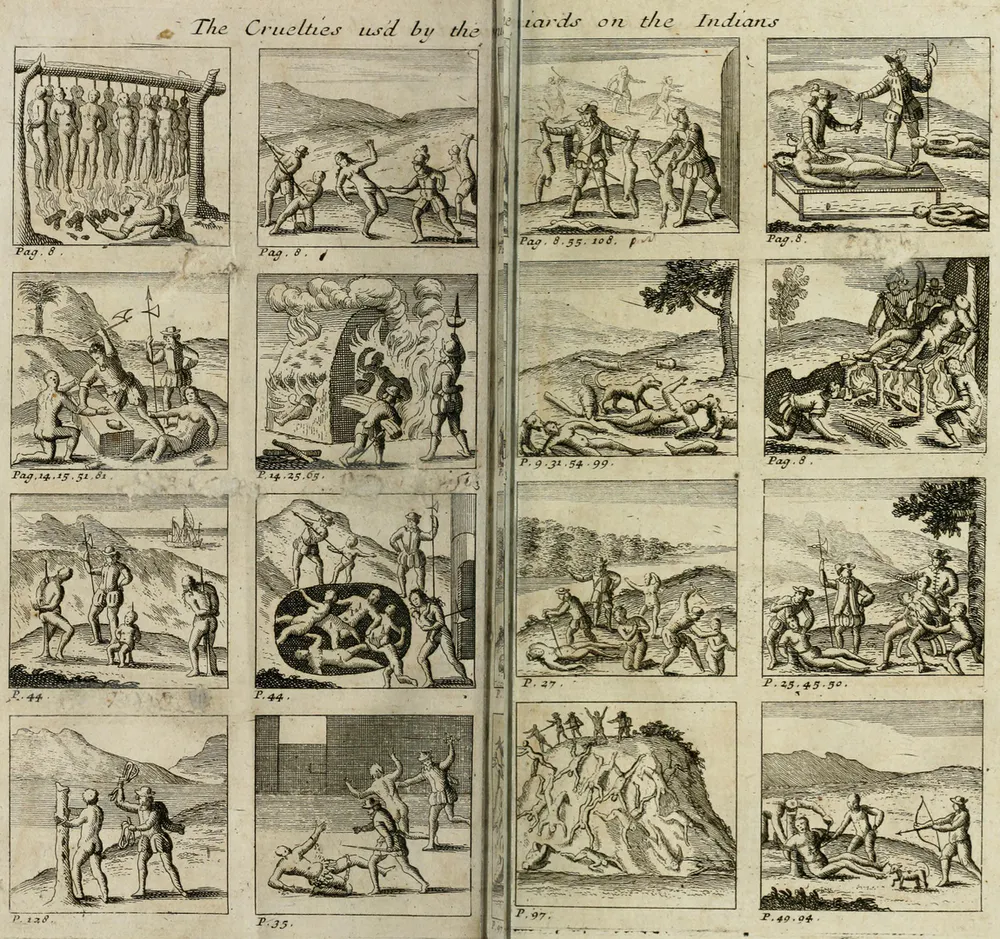
Genealogies of Modernity Episode 6: A Medieval Anti-Racist
What if racism shared an origin with opposition to racism? What if the condemnation of injustice gave rise both to an early form of anti-racism and to the racial hierarchies that haunt the modern era? Rolena Adornol, David Orique, María Cristina Ríos Espinosa tell the story of how Bartolomé de las Casas, a Dominican missionary to New Spain, came to racial consciousness in the presence of slavery. His intellectual rebellion spurred slavery’s apologists to more strident and sinister modes of defense – but also laid a lasting Christian groundwork for the fight against racial injustice. Researcher, writer, and episode producer: Terence Sweeney, Assistant Teaching Professor, Honors College, Villanova University Featured Scholars: Rolena Adorno, Sterling Professor Emerita of Spanish, Yale University María Cristina Ríos Espinosa, Professor of Arts, Humanities, and Culture, University of Sor Juana’s Cloister, Mexico City David Orique, Professor of History, Providence College Special thanks: Chiyuma Eliott, Michael Sawyer For transcript, teaching aids, and other resources, click here. Learn more about your ad choices. Visit megaphone.fm/adchoices Support our show by becoming a premium member! https://newbooksnetwork.supportingcast.fm/caribbean-studies
Ep 106Emily R. Aguiló-Pérez, "An American Icon in Puerto Rico: Barbie, Girlhood, and Colonialism at Play" (Berghahn Books, 2022)
Since her debut in 1959, Barbie has transcended boundaries and transformed into a global symbol of femininity, capturing the imaginations of girls all around the world. An American Icon in Puerto Rico: Barbie, Girlhood, and Colonialism at Play (Berghahn, 2022) offers a captivating study of that iconic influence by focusing on a group of multigenerational Puerto Rican women and girls. Through personal narratives and insights, author Dr. Emily R. Aguiló-Pérez unveils the emotional attachment that these women and girls have formed with the doll during their formative years. This connection serves as a powerful lens to explore the intricate relationships girls have with their Barbie dolls and the complex role Barbie plays in shaping their identities. Dr. Aguiló-Pérez boldly confronts the challenges and contradictions that arise, offering a compelling analysis of how playing with Barbie dolls can impact a girl's perception of femininity, body image, race, and even national identity. Through these nuanced explorations, she unearths the potential pitfalls of these influences, encouraging readers to reflect on their own relationships with the iconic doll. This interview was conducted by Dr. Miranda Melcher whose forthcoming book focuses on post-conflict military integration, understanding treaty negotiation and implementation in civil war contexts, with qualitative analysis of the Angolan and Mozambican civil wars. Learn more about your ad choices. Visit megaphone.fm/adchoices Support our show by becoming a premium member! https://newbooksnetwork.supportingcast.fm/caribbean-studies
Ep 1386Rebecca Simon, "The Pirates’ Code: Laws and Life Aboard Ship" (Reaktion Books, 2023)
In The Pirate's Code: Laws and Life Aboard Ship (Reaktion, 2023), Dr. Rebecca Simon presents a rollicking account of pirates’ codes, the strict rules essential for survival at sea. Pirates have long captured the imagination with images of cutlass-wielding swashbucklers, eye patches and buried treasure. But what was life really like on a pirate ship? Piracy was a risky, sometimes deadly occupation, and strict orders were essential for everyone’s survival. These ‘Laws’ were sets of rules that determined everything from how much each pirate earned from their plunder to compensation for injuries, punishments and even the entertainment allowed on ships. These rules became known as the ‘Pirates’ Code’, which all pirates had to publicly swear by. Using primary sources such as eyewitness accounts, trial proceedings and maritime logs, this book explains how these codes were the key to pirates’ success in battle, both on sea and on land. This interview was conducted by Dr. Miranda Melcher whose forthcoming book focuses on post-conflict military integration, understanding treaty negotiation and implementation in civil war contexts, with qualitative analysis of the Angolan and Mozambican civil wars. Learn more about your ad choices. Visit megaphone.fm/adchoices Support our show by becoming a premium member! https://newbooksnetwork.supportingcast.fm/caribbean-studies
Ep 222Saran Stewart et al., "Each One Teach One: Parental Involvement and Family Engagement in Jamaica's Education System" (U West Indies Press, 2022)
Each One Teach One: Parental Involvement and Family Engagement in Jamaica’s Education System (University of the West Indies Press, 2022) is a collection of research studies and essays across multiple educational fields: leadership, psychology, special education, early childhood, literacy studies, mathematics and teacher education. The contributors to this collection provide empirical evidence on the state of parental involvement and family engagement in Jamaica. A team approach has been used in completing the various chapters in which graduate researchers collaborated with lecturers in their areas of specialization. The different voices and data from the participants along with relevant literature shape the dialogue on the importance of home and school collaboration in students’ overall outcomes. Each One Teach One provides critical onto-epistemological frameworks grounded within the Jamaican context to examine the scope, prevalence, and effects of parental involvement and family engagement in schooling. The findings, implications and recommendations can guide policymakers in the formulation of strategies compatible with the needs of the schools, students and families and provide indispensable data on how to effectively work together to optimize students’ success. Saran Stewart is Associate Professor of Higher Education and Student Affairs and Director of Global Education, Neag School of Education, University of Connecticut, Storrs, Connecticut. Sharline Cole is Lecturer in Educational Psychology and Research, the School of Education, the University of the West Indies, Mona, Jamaica. Yewande Lewis-Fokum is Lecturer in Literacy and Language Education, the School of Education, the University of the West Indies, Mona, Jamaica. Madden Gilhooly is a humanities public-school teacher and casual academic based on Gadigal land in so-called-Sydney, Australia. Learn more about your ad choices. Visit megaphone.fm/adchoices Support our show by becoming a premium member! https://newbooksnetwork.supportingcast.fm/caribbean-studies
Ep 173Musab Younis, "On the Scale of the World: The Formation of Black Anticolonial Thought" (U California Press, 2022)
On the Scale of the World: The Formation of Black Anticolonial Thought (U California Press, 2022) examines the reverberations of anticolonial ideas that spread across the Atlantic between the two world wars. From the 1920s to the 1940s, Black intellectuals in Europe, Africa, and the Caribbean established theories of colonialism and racism as structures that must be understood, and resisted, on a global scale. In this richly textured book, Musab Younis gathers the work of writers and poets, journalists and editors, historians and political theorists whose insights speak urgently to contemporary movements for liberation. Bringing together literary and political texts from Nigeria, Ghana, Sierra Leone, France, the United States, and elsewhere, Younis excavates a vibrant and understudied tradition of international political thought. From the British and French colonial occupations of West Africa to the struggles of African Americans, the hypocrisy of French promises of 'assimilation, ' and the many-sided attacks on the sovereignties of Haiti, Liberia, and Ethiopia, On the Scale of the World shows how racialized imperialism provoked critical responses across the interwar Black Atlantic. By transcending the boundaries of any single imperial system, these counternarratives of global order enabled new ways of thinking about race, nation, and empire. Elisa Prosperetti is an Assistant Professor in International History at the National Institute of Education in Singapore. Her research focuses on the connected histories of education and development in postcolonial West Africa. Contact her at here. Learn more about your ad choices. Visit megaphone.fm/adchoices Support our show by becoming a premium member! https://newbooksnetwork.supportingcast.fm/caribbean-studies
Ep 111Cecilia Márquez, "Making the Latino South: A History of Racial Formation" (UNC Press, 2023)
The presence of Latinx people in the American South has long confounded the region's persistent racial binaries. In Making the Latino South: A History of Racial Formation (UNC Press, 2023), Cecilia Márquez uses social and cultural history methods to assess the racial logics that have shaped the Latinx experience in the region since the middle of the twentieth century. Structuring her argument around several major themes that frequently signpost the history of the South and of race relations in the United States--the rise of an increasingly mobile middle class, the civil rights movement and fight over school integration, the growth global connection of the region's economy, and political conflict over immigration--Márquez reveals how Latinx people in the South have confronted both whiteness and antiblackness, and how cultural boundaries to exclude Black people from full participation in the life of the region and nation have been essential to the construction of Latinx as a category. Anna E. Lindner (Ph.D., Communication) is an Assistant Professor of Teaching at Wayne State University. On Twitter. Learn more about your ad choices. Visit megaphone.fm/adchoices Support our show by becoming a premium member! https://newbooksnetwork.supportingcast.fm/caribbean-studies
Ep 261Marisel C. Moreno, "Crossing Waters: Undocumented Migration in Hispanophone Caribbean and Latinx Literature and Art" (U Texas Press, 2022)
Debates over the undocumented migration of Latin Americans invariably focus on the southern US border, but most migrants never cross that arbitrary line. Instead, many travel, via water, among the Caribbean islands. The first study to examine literary and artistic representations of undocumented migration within the Hispanophone Caribbean, Crossing Waters: Undocumented Migration in Hispanophone Caribbean and Latinx Literature and Art (U Texas Press, 2022) relates a journey that remains silenced and largely unknown. Analyzing works by novelists, short-story writers, poets, and visual artists replete with references to drowning and echoes of the Middle Passage, Marisel Moreno shines a spotlight on the plight that these migrants face. In some cases, Puerto Rico takes on a new role as a stepping-stone to the continental United States and the society migrants will join there. Meanwhile the land border between Haiti and the Dominican Republic, the only terrestrial border in the Hispanophone Caribbean, emerges as a complex space within this cartography of borders. And while the Border Patrol occupies US headlines, the Coast Guard occupies the nightmares of refugees. An untold story filled with beauty, possibility, and sorrow, Crossing Waters encourages us to rethink the geography and experience of undocumented migration and the role that the Caribbean archipelago plays as a border zone. Marisel C. Moreno is the Rev. John O'Brien Associate Professor in the Department of Romance Languages and Literatures at the University of Notre Dame. She is the author of Family Matters: Puerto Rican Women Authors on the Island and the Mainland. Reighan Gillam is an Associate Professor in the Department of Latin American, Latino, and Caribbean Studies at Dartmouth College. Her research examines the ways in which Afro-Brazilian media producers foment anti-racist visual politics through their image creation. She is the author of Visualizing Black Lives: Ownership and Control in Afro-Brazilian Media (University of Illinois Press). Learn more about your ad choices. Visit megaphone.fm/adchoices Support our show by becoming a premium member! https://newbooksnetwork.supportingcast.fm/caribbean-studies
Ep 121Lucy Swanson, "The Zombie in Contemporary French Caribbean Fiction" (Liverpool UP, 2023)
Believed to have emerged in the French Caribbean based on African spirit beliefs, the zombie represents not merely the walking dead, but also a walking embodiment of the region's history and culture. In Haiti today, the zombie serves as an enduring memory of enslavement: it is defined as a reanimated body robbed of part of its soul, forced to work in sugarcane fields. In Martinique and Guadeloupe, the zombie takes the form of a shape-shifting evil spirit, and represents the dangers posed to the maroon or 'freedom runner.' Lucy Swanson's book The Zombie in Contemporary French Caribbean Fiction (Liverpool UP, 2023) is the first book-length study of the literary zombie in recent fiction from the region. It examines how this symbol of the enslaved (and of the evil spirits that threaten them) is used to represent and critique new socio-political situations in the Caribbean. It also offers a comprehensive and focused examination of the ways contemporary authors from Haiti and the French Antilles contribute to the global zombie imaginary, identifying four 'avatars' of the zombie-the slave, the trauma victim, the horde, and the popular zombie-that appear frequently in fiction and anthropology, exploring how works by celebrated and popular authors reimagine these archetypes. Annie deSaussure, holds a Ph.D. in French from Yale University. Her work focuses on minority regional languages, literatures, and cultures in contemporary France, radio, sound studies, and podcasting. Her most recent article on feminist discourses of motherhood in French podcasting was published in the “Podcasting Disruptive Voices” issue of CFC Intersections in July 2023. Learn more about your ad choices. Visit megaphone.fm/adchoices Support our show by becoming a premium member! https://newbooksnetwork.supportingcast.fm/caribbean-studies
Ep 120Charles Forsdick and Claire Launchbury, "Transnational French Studies" (Liverpool UP, 2023)
On the 16th October 2023, I met with Claire Launchbury and Charles Forsdick to discuss the recent publication of Transnational French Studies (Liverpool UP, 2023), a collection of essays that draws attention to the diverse objects of study and methodologies that can be brought to bear on French cultural production. This is the latest in the “Transnational Modern Languages” series published by Liverpool University press. The series furnishes frameworks and concrete examples of how to study languages and cultures through their interactions, rather than as isolated national traditions. It is especially of note that Transnational French Studies has been conceived as a handbook for students of French (at both undergraduate and postgraduate levels). The key objective of the volume is to define the core set of skills and methodologies that constitute the study of French culture as a transnational, transcultural and translingual phenomenon. Written by leading scholars within the field, chapters demonstrate the type of inquiry that can be pursued into the transnational realities - both material and non-material - that are integral to what is referred to as French culture. The book is divided into four sections: Languages, Spaces, Temporalities and Subjectivities. These follow a detailed introduction written by the editors that comprehensively explains and situates “transnationalism” and its reception within contemporary French Studies. The collection moves smoothly from literature to sociolinguistics to videogames and comics. In addition to its diverse subject matter, the edition makes a major contribution to French Studies by drawing attention to the complex ways that monolingualism can become conflated with monoculturalism in our discipline. Forsdick and Launchbury in their introduction stress that the “nation is a keyword that all students of France must interrogate in its historic and semantic complexity”. The collection’s historical breadth expands social scientific definitions of “transnationalism” and historicizes both “Frenchness” and the French language’s (and cultures’) evolutions. Individual essays explore histories of migration, flows of ideas and goods to demonstrate that “transnationalism” is not a contemporary phenomenon but a cultural disposition that extends back centuries. Learn more about your ad choices. Visit megaphone.fm/adchoices Support our show by becoming a premium member! https://newbooksnetwork.supportingcast.fm/caribbean-studies