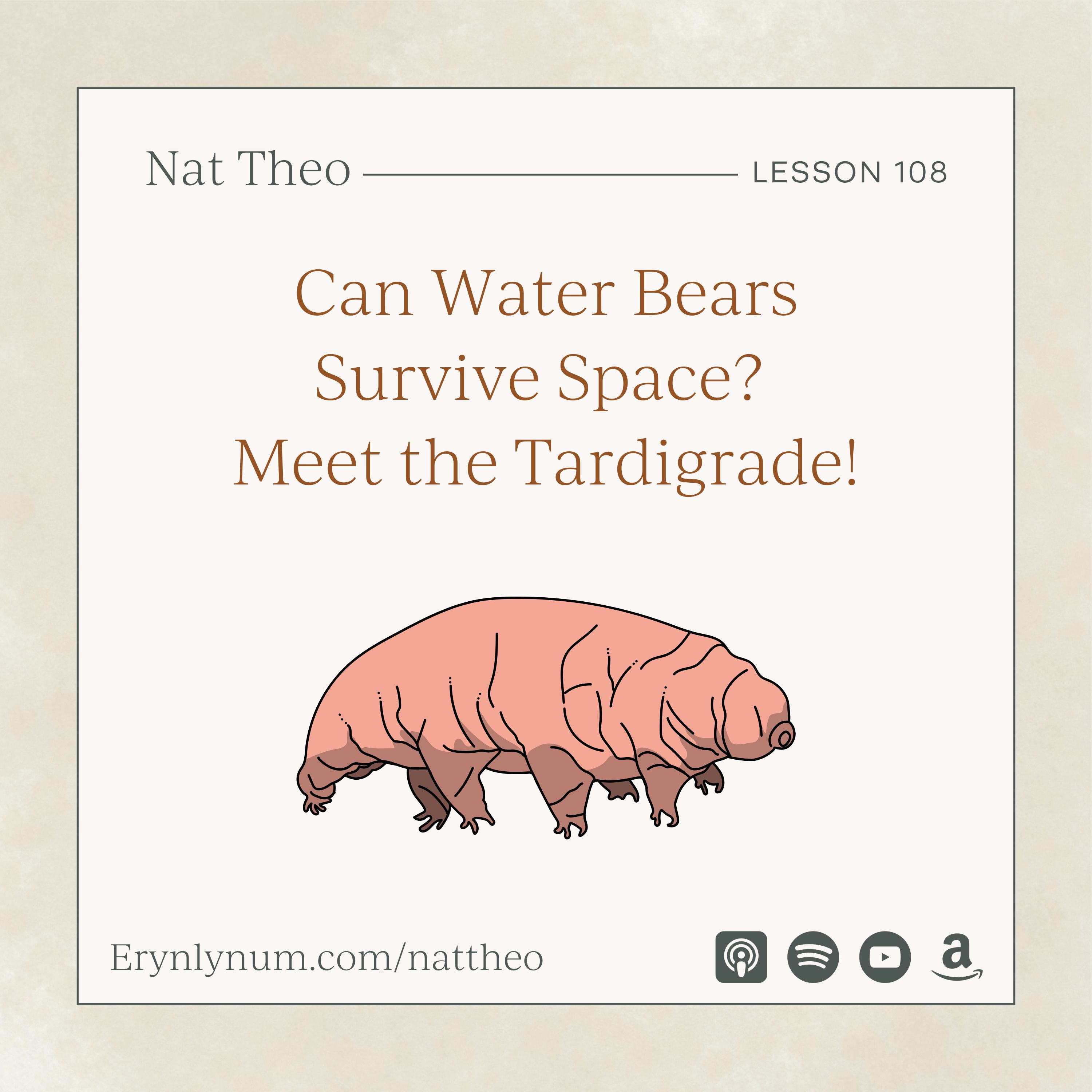
Can Water Bears Survive Space? Meet the Tardigrade! Lesson 108
Nat Theo Nature Lessons Rooted in the Bible · Eryn Lynum
Audio is streamed directly from the publisher (episodes.captivate.fm) as published in their RSS feed. Play Podcasts does not host this file. Rights-holders can request removal through the copyright & takedown page.
Show Notes
What is a water bear? And how does it survive space travel? Discover a microscopic animal that might be the toughest creature on earth: the tardigrade!
Here’s our trail map:
- If a Water Bear Isn’t a Bear, What Is It?
- How Does a Tardigrade Grow Up?
- How Is a Tardigrade the Toughest Animal on Earth?
- How Does God Help Us Endure Hard Things?
Eryn's Books:
- The Nature of Rest: What the Bible and Creation Teach Us About Sabbath Living: https://www.amazon.com/Nature-Rest-Creation-Sabbath-Living/dp/0825448891
- Rooted in Wonder: Nurturing Your Family's Faith Through God's Creation: https://www.amazon.com/Rooted-Wonder-Nurturing-Familys-Creation/dp/0825447615
- 936 Pennies: Discovering the Joy of Intentional Parenting: https://www.amazon.com/936-Pennies-Discovering-Intentional-Parenting/dp/0764219782
Episode Links:
- America’s Story: American History Homeschool Curriculum from a Biblical worldview: https://www.masterbooks.com/americas-story-series
- Explore all of Master Books Christ-centered books, curriculum, and resources: https://www.masterbooks.com/
- Explore Apologia’s award-winning curriculum at https://www.apologia.com/
- Nat Theo Club Bonus Video: https://erynlynum.com/club-videos
- Get full lesson guides in the Nat Theo Club: https://erynlynum.com/club
- Free Water Bear Coloring Sheet: https://erynlynum.com/what-is-a-tardigrade/
- Ask your nature question: https://erynlynum.com/ask
- An excellent video about tardigrades from Answers in Genesis (Used in researching this lesson): https://youtu.be/FcMPpXSAeV4?si=P8PeUmKY1a9ah8Sd
Scriptures Referenced in This Episode:
“How many are your works, Lord!
In wisdom you made them all;
the earth is full of your creatures.” Psalm 104:24 (NIV)
“So don’t worry, because I am with you.
Don’t be afraid, because I am your God.
I will make you strong and will help you;
I will support you with my right hand that saves you.” Isaiah 41:10 (NCV)
“...the joy of the Lord is your strength.” Nehemiah 8:10 (NIV)
“But let all who take refuge in you rejoice;
let them sing joyful praises forever.
Spread your protection over them,
that all who love your name may be filled with joy.” Psalm 5:11 (NLT)
“I have told you all this so that you may have peace in me. Here on earth you will have many trials and sorrows. But take heart, because I have overcome the world.” John 16:44 (NLT)
Terms Learned in This Episode:
- Tardigrade: Meaning “slow stepping.” A microscopic animal (without any bones) and with eight legs (often called a water bear).
- Tardigrada: A phylum (large category) of animals including only tardigrades, with more than 1,200 unique species.
- Microscopic: Something so small that you cannot see it with only your eyes. You need a microscope to see it.
- Invertebrate: A group of animals that don’t have a backbone.
- Cuticle: A tough and flexible outer layer that covers a tardigrade's body, which the tardigrade molts and regrows as it gets larger.
- Piercing Stylet: A hard, sharp mouthpart the tardigrade uses to pierce food and eat the fluids inside.
- Hypertrophy: An increase in the size of a tissue or organ (growth) caused by cells getting larger, not by making more cells.
- Cryptobiosis: A process that dramatically slows down metabolism to survive harsh conditions.
- Tun Stage: During cryptobiosis when a tardigrade rolls up into a protective ball and dries out to survive harsh conditions.
- Cyst Stage: When a tardigrade creates extra cuticle layers around its tun state for extra protection.
- Dsup: A damage suppressor protein that shields a tardigrade’s DNA from damage.
- TDR1: A DNA repair machine found in tardigrades. When DNA gets damaged, TDR1 repairs the broken spots so the cell can work normally again.
This podcast episode contains paid advertisements.